




Abstract
Using a gendered household analysis, we explore the extent to which operating a business upon a flexible basis at specific times in the life course impacts upon an entrepreneur’s exit from their business. Drawing upon UK data and a discrete-time event history model to conduct a life course analysis, we find women caring for young children are more likely to exit given limited returns related to incompatible demands between the time required to generate sufficient returns and caring demands. Limited returns however, were not significant to continuation rates if a male partner contributed a compensatory household income.
Analyses of the rationale, process and impact of entrepreneur exit and where relevant, business closure or failure are acknowledged as distinct domains of contemporary entrepreneurship research (De Tienne & Wennberg, 2015; Shepherd et al., 2015). There has however, been a tendency to conflate exit with failure as Shane (2008, p. 98) states, ‘Most new businesses fail. Pretty much all studies agree on that. The only question is how long it takes for a majority of them to go out of business (and why)’. Such presumptions do not recognise that many entrepreneur exits are successful harvest sales or voluntary closures of going concerns (Coad, 2014). As such, there are complex and multi-faceted influences informing the exit decision and process which are contextualised and bounded by the personal circumstances of the founders, their ambitions for the firm and prevailing market conditions. Given the initial problems regarding identifying different modes and motivations for exit, it is notoriously difficult to measure their number and impact (Marlow & Swail, 2015). Attempts to do so have used sources such as panel data from the US Small Business Administration (Cortes, 2010), VAT data from the UK (Carter & Evans-Jones, 2012) and in the contemporary period, material from social media sources (Mandl et al., 2016). It is however, difficult to gain accurate information regarding the causes and rates of exit as the rationale underpinning this decision can incorporate multiple factors (Coad, 2014). We argue therefore, that despite dependence upon large scale survey evidence to analyse generic exit trends, there is clearly need for more nuanced analyses of various dimensions of this event and the multiplicity of influences that prompt them. Further, we note that with few exceptions (Hsu et al., 2016; Justo et al., 2015; Marlow & Swail, 2015; Taylor, 1999; Yang et al., 2019) this increasingly complex debate is largely gender blind.
To contribute to this debate, we employ a comparative analysis of exit rates by men and women in the UK. Comparative analyses have been critiqued for using sex as a variable resulting in simplistic descriptive categories revealing headline rates of male and female venture creation and performance profiles, largely to the detriment of women (Henry et al., 2016). Acknowledging critiques of the crudity of this approach if used as a blunt instrument to describe base line differences (Jayawarna et al., 2015; Robb & Watson, 2012), we develop a comparative gendered analysis. This does not merely describe exit rates but delves into the gendered antecedents of such differences drawing upon theories of household dynamics (Pahl, 1989) and the life course (Elder, 1999). As such, we analyse how gendered ascriptions enacted within the entrepreneurial household position men primarily as breadwinners, and women as carers, noting how such responsibilities shift over the life course. Our comparative approach is therefore, our starting point to illustrate how these constructs meld to shape exit. 1
Elder (1999) argues that households are flexible economic units and social spaces in which coordinated arrangements are made to collectively maximise family household production and economic well-being. Although Elder emphasises the economic function of the household, we argue that household social structures relating to expectations regarding task divisions, emotional support and social engagement are critical to enable economic well-being. Thus, economic and social aspects interlock in a mutually supportive matrix reflecting the priorities of the household and how it is organised. So for example, an entrepreneurial household includes at least one person in self-employment alongside others linked by kinship ties that may be employed, retired et cetera with no formal role within the venture but have some form of substantive or tacit input (Carter et al., 2017). This approach recognises that entrepreneurs rarely operate their ventures in isolation but are likely to draw upon the support of household members for a range of purposes – financial support, unpaid labour, emotional support et cetera yet, we know little about the dynamics or influence of such exchanges and how this changes over time (Kim et al., 2013; Marlow & Swail, 2015). As Alsos et al. (2014, p. 100) note, we need to acknowledge the potential of the entrepreneurial household context as a research site: ‘Adopting a household perspective to entrepreneurial activities introduces a novel set of issues … into the research process. These include household size and income structure, the number of entrepreneurs within the household, the presence and relative age of children…as either liabilities or resources.’ Reflecting foundational work by Pahl (1989) we acknowledge gendered ascriptions as critical to shaping household dynamics regarding economic and caring responsibilities. So for example, women are more likely to combine (or forfeit) economic participation alongside caring labour (Cantillon & McLean, 2016). Men however, still dominate as primary income generators, so called ‘breadwinners’ with a contemporary median income advantage of around 10 percent in the UK (Gender Pay Gap Services, 2019) and 20 percent in the US (Payscale.com, 2019). The balance of such activities, we argue will impact upon the exit decision but, we also hypothesise that this balance changes over time reflecting shifting life course demands (Elder, 1998; Lin & Burgard, 2018).
We draw upon Mortimer and Shanahan (2007, p. xi) to define the life course as ‘the age graded, socially embedded sequence of roles that connect the phases of life’. Examples of key life course influences include: establishing a separate household, marriage/partnering, parenting and divorce; each has specific implications for household relations over time. We transpose this debate to the context of entrepreneurship by arguing that household dynamics and life course issues shape the trajectory and outcomes of entrepreneurial careers, including the exit decision (Hsu et al., 2016; Yang & Triana, 2019). Although the exit decision may be ostensibly actioned by the entrepreneur with reference to a substantive tipping point such as financial distress, this decision is embedded within and influenced by prevailing household socio-economic relations (Marlow et al., 2014; Shepherd et al., 2015). Specific events, such as childbirth, alter household membership, responsibilities and roles prompting labour reallocation to maintain a productive regime and economic well-being (Hutchison, 2011). Such events have important ramifications for the exit decision as they prompt a re-evaluation of family and work roles for entrepreneurs and other household members. With this in mind, we consider shifts in time commitments (work hours in relation to housework hours, childcare), relative earnings (breadwinner role) and family transitions (household structure as a result of childbirth, children age and marriage/divorce) as time-varying predictor variables in event-history models.
While longitudinal data has been utilised to study the impact of household dynamics upon various aspects of entrepreneurship (Jayawarna et al., 2014; Wiklund et al., 2013), dynamic modelling techniques enabling the study of detailed changes influencing the exit decision are rare. We contend that to develop a more complex analysis, it is necessary to draw upon such techniques to analyse how gendered relational ties position both men and women within entrepreneurial households, and how such relations are shaped by life course events over time. This analysis informs our research question: How do the differential effects of life course and household dynamics influence the exit decision of male and female entrepreneurs? For women, entrepreneurship offers the potential to act as a flexible working option substituting for part-time employment (Jayawarna et al., 2019). Just as the latter has implications for income, status and career progression however, so using entrepreneurship flexibly comes at the price of diminished returns, legitimacy and scalability (McGowan et al., 2012). Moreover, axiomatically self-employed parents do not benefit from employment related benefits regarding access to paternity/maternity/parental leave/benefits, subsidised childcare et cetera (Stumbitz et al., 2018). Flexibility therefore, becomes a time/income/benefits trade off. Given that income returns to self-employment in the UK are notably lower than equivalent employment, this further impinges upon the opportunity to purchase time by employing others for caring and domestic labour (Yuen et al., 2018). 2 For men, however, this trade-off is less evident as they may be more likely to persist in traditional breadwinner roles whereby their business activities are prioritised over caring roles with greater emphasis on earning where there are young children in the household (Yang & Aldrich, 2014).
To critically analyse our research question, we draw upon a UK longitudinal prospective panel dataset employing a dynamic modelling technique enabling the study of detailed changes occurring within households upon a year-by-year basis. Our results demonstrate that although household structures are pertinent in explaining exit rationales per se, women are particularly affected by life course responsibilities associated with caring labour. Conversely, men are more affected by income and business performance issues. Drawing upon our theoretical framework and empirical evidence, we illustrate how complex socio-economic relationships weave around individuals, the business and household priorities contributing to the exit decision.
To explore these arguments, the article is structured as follows: first, we frame the debate noting connections between gender, entry and exit, we then illustrate our rationale for adopting a household and life course perspective in entrepreneurship as an alternative lens to analyse entrepreneurial exit. This discussion is embedded within emerging analyses of gendered life course and household dynamics (Carter et al., 2017; Jayawarna et al., 2014) and the business-family interface (Hsu et al., 2016; Yang et al., 2019). Our second section draws these arguments together explaining the rationale for arriving at our research hypotheses. Third, we describe our data, empirical analysis and findings. The fourth section, the discussion, outlines the implications of our findings; we then note limitations of the study and finally, conclude by capturing our contribution.
Gender, Business Entry and Exit
Regarding debates pertaining to gender and entrepreneurship, women dominate as the subject of the gendered entrepreneurial discourse (Marlow & Martinez Dy, 2018). As such, within this discourse, masculine characteristics meld with preferred entrepreneurial characteristics positioning women in deficit (Ahl, 2006). Men as a homogenised category are presumed to command essential entrepreneurial attitudes and competencies with this being evident through higher levels of venture creation with greater scalability and viability over time (McAdam, 2013). Consequently, women’s lack of entrepreneurial propensity and poorer performance profiles has been deemed a gendered problem of agency and attitude whereby gender, as a valorisation device, positions them in deficit in this discourse (Ahl & Marlow, 2019). Such assumptions have been roundly critiqued in that they do not acknowledge how gendered ascriptions disadvantage women (Ahl, 2006; Jennings & Brush, 2013). In summary, women are less likely to select into self-employment in advanced economies (Elam et al., 2019) and if they do, their ventures are more likely to be concentrated in feminised service sectors and operate from home and upon a flexible, part-time basis with implications for performance and persistence (Rose, 2019). Moreover, any suggestion of an essential feminised entrepreneurial deficit is discounted given evidence from a US sample found that under weighted conditions of equivalence, controlling for sector, size, operating conditions et cetera, women owned businesses may actually performed slightly better than those of their male peers (Robb & Watson, 2012).
As the extant literature testifies, considerable attention has been afforded to the gendered antecedents surrounding women’s engagement with entrepreneurship (Jennings & Brush, 2013) and the ecosystems which support and hinder their entrepreneurial efforts (Elam et al., 2019; Deloitte, 2016). Within this article, we suggest however, that this literature has afforded little attention to gendered influences upon exit. For example, Elam et al. (2019) note, drawing from GEM data, women aged between 25-44 are most likely to become entrepreneurs. Given this is the prime period for child birth and care, claims relating to the flexibility of home-based entrepreneurship may be particularly attractive to women with child care responsibilities as a motive for start-up. However, we know little about the implications of such gendered rationales upon the exit decision. For women entrepreneurs afforded high levels of domestic/ caring responsibilities, their capacity to invest time to sustain and develop the firm will be constrained (Thébaud, 2016) and ultimately, may have an influence upon the decision to persist with or exit the business. In effect, we argue that a combination of household responsibilities and the life course stage will combine to influence both selection into entrepreneurship and exit from it. Acknowledging that men too are gendered subjects, we also recognise that household dynamics and life course changes will influence how they operate their businesses. For example, within households, men are more likely to be designated as main breadwinners with the onus of such responsibilities increasing with fatherhood (Green, 2016). Consequently, we suggest that within gendered households, more resources in the shape of time, effort and support from other family members will be invested into their businesses influencing exit. As such, we move beyond focusing upon gender as a blunt variable which merely compares the exit rates of male and female owned firms. Rather, we conceptually analyse how the social context generated by gendered expectations shifts over the life course for men and women within entrepreneurial households and how this in turn, shapes exit.
Entrepreneurial Exit and Life Course
The rationale for, and the process of, business/entrepreneur exit relates to a diverse multiplicity of issues (Taylor, 1999; Wennberg et al., 2010), arising from both internal and external influences (Yang & Triana, 2019). Shepherd et al. (2015) for example acknowledge that entrepreneurs encounter structural challenges and possess differential levels of resources influencing the decision whether to exit or persist with their entrepreneurial endeavour. Moving away from the normative firm level analysis of business failure (Balcaen et al., 2012), contemporary literature analyses the role of the entrepreneur and their family on the exit decision (Bird & Wennberg, 2016; Justo et al., 2015). Drawing upon a family embeddedness perspective, and data from formally unemployed immigrant entrepreneurs Bird and Wennberg (2016) explored how geographical proximity to other family members enabled resource flows to avoid exit. Justo et al. (2015) argue that the family forms the key social unit for entrepreneurs and how family embeddedness influence performance thresholds. This study suggests that married women entrepreneurs with children are more likely to voluntarily exit from their ventures; this decision is largely influenced by personal choice in that the venture did not fulfil the motivations underpinning start-up (Justo & De Tienne, 2008). Such arguments challenge the general understanding that exit is the result of poor performance (Coad, 2014) rather, they note the importance of choices undertaken by the entrepreneur arising from their experience in managing and strategising action at the work-family interface. Hsu et al. (2016) regard exit, similar to entry, as an intentional career choice for entrepreneurs; yet, as business and family are closely interconnected, conflicting business and family roles shape the exit decision. It is argued that entrepreneurs either prioritise their family, with associated implications for the business, or vice versa. As women may prioritise personal relationships above economic participation and overall, are deemed to be less risk tolerant than men (Morris et al., 2018), they are more likely to exit voluntarily, due to personal reasons related to family care (Justo et al., 2015).
Although this article complements such analyses of exit adopting a gender and family perspective, we add a life course perspective to explore how household resources are utilised within entrepreneurial endeavours but also, the implications for exit. This perspective highlights that such experiences are interconnected and embedded within a broader series of normative transitions (Elder, 1998; Hutchison, 2011) influenced by life events (Elder et al., 2003). As the timing and the ordering of these life events and transitions are structured by various factors, including the availability of resources within a dynamic context, and in relation to other social relationships (Elder & Johnson, 2002) the “developmental impact of a succession of life transitions or events is contingent on when they occur in a person’s life” (Elder, 1998). Unlike other theories of entrepreneur exit focused upon resource explanations (access to finance, human capital etc.,), life course theory remains open to the totality of personal history. Consequently, we link exit decisions to the changes that occur in time and space (Hutchison, 2011). Navigating along the life course, individuals build particular sets of coping strategies to support changing resource and demand needs (Elder et al., 2003; Moen et al., 1995). These shifting life course coping strategies, specifically regarding caring and breadwinning responsibilities, are core to analysis of the exit decision.
A Gendered Analysis of the Entrepreneurial Household and Life Course Dynamics
Exploring entrepreneurial behaviour from a household perspective reveals diverse motivations and processes hidden by the normative tendency to isolate the entrepreneur from their household context (Alsos et al., 2014; Carter et al., 2017) or reify the business as a proxy for the entrepreneur. We recognise that household priorities change over time as the life course evolves shaping household dynamics which it is acknowledged, pivot around gendered ascriptions (Rossi, 2018). There is a rich and varied literature on life course transitions associated with the work-family nexus (Lin & Burgard, 2018; Martinengo et al., 2010); there is some consensus however, that a critical event is that of parenting (Green, 2016). The birth of a child disrupts the socio-economic context of household relations given the ‘dramatic’ effect this has upon the roles and responsibilities of parents (Erickson et al., 2010, p. 956). In particular, it is noted that there is a specifically gendered effect as most mothers still undertake primary caring responsibilities whilst most fathers are designated as bread winners (Johnstone et al., 2011; Munkejord, 2017). This division of labour ensures that parents have to negotiate the conflict between the work-family interface to generate income whilst fulfilling parental roles (Lin & Burgard, 2018). What is rarely acknowledged in this debate however, is the need for more nuanced analyses of differing life course stages in the demands upon parents relating to child age. As Martinengo et al. (2010, p. 1382) note, without such analyses; ‘differences get smoothed over’ between intensive child rearing years, school age children and empty nest syndrome with such differences treated as ‘noise’ rather than discrete variables. Analyses of the differing conflicts associated with life stages suggest that the presence of very young children constrains women’s economic participation given caring responsibilities but this lessens over time as they mature (Nomaguchi, 2012).
Such detrimental effects upon women’s economic participation, and the household income, fuels diverse approaches to accommodating this conflict through, for example, part-time work or home-based entrepreneurship organised around household demands (Johnstone et al., 2011; McGowan et al., 2012). The debate regarding women’s dominance of part-time employment as a strategy to accommodate paid work and caring requirements is well-documented (DuRivage, 2016; Johnstone et al., 2011). Increasingly however, home-based entrepreneurship is being promoted as a flexible strategy for women to generate income alongside the autonomy of when and where to conduct her business. This trend has given rise to notions such as ‘mumpreneurship’ given assumptions that flexible home-based enterprise equates with specific forms of maternal entrepreneurial femininity (Lewis, 2014).
Yet, evidence suggests that undertaking entrepreneurship upon this basis, whilst certainly enhancing flexibility, will dampen financial returns and potentially, compromise business viability (De Vita et al., 2014). This argument however, is attenuated by life course stages as caring demands and flexibility requirements shift over time influencing the potential for returns and venture growth (Davis & Shaver, 2012; Jayawarna et al., 2019). Consequently, we suggest that to date, analyses of life course events and their impact upon household entrepreneurial activities have been somewhat ‘smoothed over’ yet, together they have a critical influence. By widening our perspective, temporally and contextually, a life course framework encourages us to explore how lives (and businesses) evolve over time and are linked between the social processes and institutions that govern domains of action, such as family and work (Elder et al., 2003; Elder, 1998; Hutchison, 2011). This approach supports calls to study the ‘lifecycle’ of entrepreneurship (Davis & Shaver, 2012; Jayawarna et al., 2014) as it relates to context (De Clercq et al., 2011).
To contribute to a more nuanced debate, we focus specifically upon the exit decision. Consequently, we model exit in the context of the life course of the entrepreneur and the household acknowledging that extant research tends to assume a stable setting or use cross-sectional data (Davis & Shaver, 2012). This ignores the effects of household dynamics on subsequent action and so, draws upon static data to model dynamic processes. As such, we expect that how individuals accommodate the time demands and the economic risks associated with childcare will partly depend on access to external institutional provision to mitigate work-life demands regarding paid parental and income resources available to the household (Thébaud, 2015), and this will change over time. Carter et al. (2017) argue that ‘understanding how entrepreneurial households manage resources, develop strategies, generate and allocate income and wealth is critical if we are to fully comprehend the impact of self-employment and business ownership upon society’ (p. 84). In response, we transpose such arguments onto the exit process arguing that gendered household roles and life course dynamics offer novel insights into how gendered divisions of labour and related demands upon income generation and parenting (Meliou & Edwards, 2018; Yang & Triana, 2019) spill over onto the demands of business ownership.
To illustrate our arguments, we argue that reconciling the demands between household and entrepreneurial activity can be categorised into two strategy components: household work strategy and household economic strategy. The former captures exits prompted by practices through which households organise, perform and purchase the labour required to meet household consumption demands. The latter relates to practices through which households draw in and organise finance to meet immediate and longer-term consumption needs and aspirations. In our analysis, household work strategies are measured in terms of the reproductive demands made upon the household so, whether the entrepreneur is partnered and the presence of children (household structure) and the entrepreneur’s labour role regarding domestic caring responsibilities (household demands). Household economic strategy is measured in terms of the extent to which the household is financially dependent upon the income generated by the entrepreneur in relation to additional streams of income from other household members and their specific breadwinner role (sole, primary or shared). We now develop hypotheses to test these arguments.
Hypotheses Development
Household Work Strategy: Presence of Children, Child Age and Care Responsibilities
For the purposes of this analysis, we focus upon how household responsibilities are allocated between adults in terms of caring and economic contributions particularly in relation to child care. The extant research clearly identifies the ‘transformatory’ impact of parenthood (Erickson et al., 2010), designating a gendered division of responsibilities (Lin & Burgard, 2018). Undertaking the majority share of such responsibilities ensures that women are more likely to seek part-time and flexible forms of working to combine economic activity and caring labour with negative implications for career progression, status and income levels (Lindsey, 2015). As noted, for women, self-employment has been mooted as a flexible solution to combine caring labour with income generation (Ahl & Marlow, 2019) as the venture can be based at home and moulded to fit household routines (Richomme-Huet & Vial, 2014). Yet, critical analyses of this argument suggest flexibility options have penalties (Jayawarna et al., 2019). Generating profits to the level of wage replacement income and responding to unpredictable client demands promptly to build trusted profiles intrude into alleged flexibility regarding how and when the venture operates (Dy et al., 2017). Thus, if women attempt to manage a business and household concomitantly, this will generate conflicting demands upon the time and effort required for each activity. Whilst they may wish to operate the venture to complement household demands, these may become secondary to those of the business undermining the alleged flexibility of entrepreneurship (Jayawarna et al., 2019; Werbel & Danes, 2010). Therefore, it is important to investigate how fluctuating family responsibilities at pivotal life course points such as parenting and caring affect the exit decision.
For men however, a structural division of labour whereby a female partner undertakes caring labour frees him to prioritise his venture; as such, there is less competition for his time and effort. Yang and Triana (2019) capture the implications of this division of labour upon entrepreneurial activity as a ‘liability of womanness’ (p. 24) such that male-led ventures have a survival advantage. We acknowledge that many businesses operate from the home regardless of ownership profile (Mason et al., 2011). However, given gendered social norms and their higher earning capacity potential (England, 2017), we suggest men will prioritise the venture above domestic demands, reflecting gendered breadwinner roles. Thus, we expect that when entrepreneurs occupy positions within household work strategies where reproductive labour demands are low, they will have a greater capacity to apply their labour to entrepreneurship and so, generate higher returns and autonomy. This will increase the possibilities of persisting with the business. If the time demands of caring responsibilities conflict with those of business operations, this will have a greater impact upon the exit decision.
Although household structure and resources have been acknowledged as influential regarding stocks of start-up capital in terms of income subsidisation, network analysis, encouragement and support et cetera (Rodriguez et al., 2009) this debate has rarely been applied to the exit decision (Marlow & Swail, 2015). We posit that the manner in which the household unit is structured, in terms of the gendered allocation of caring and economic labour and the presence of children has a greater influence upon a woman’s decision to exit from entrepreneurship. This effect, we argue, will also be evident for single parent divorced women with dependent children (Härkönen, 2014). Thus, whilst there a stereotypical gendered division of income/caring responsibilities persist for women in heterosexual partnered relationships, moving to a single parent status is unlikely to alleviate this problem rather, it is exacerbated given the association between divorce and decline in the household income (Tamborini et al., 2015).
Exit is however, influenced by the age of children within the household (Conroy, 2019). Clearly, younger children are more demanding in terms of time and care but this declines as they mature. Thus, as the time balance demands related to caring and economic labour shift, this will critically influence the attention attributed to entrepreneurial activities, particularly for women. Accordingly, we expect that, after controlling for business performance, child age influences business exit in such a way that mothers of preschool children (0-4 years) are more likely to exit their businesses due to child care responsibilities but this diminishes when the children grow older (e.g., when the youngest child reaches school age). We capture these issues within our first overarching hypothesis – H1, which is tested through sub-hypotheses H1a – H1c.
H1: Acknowledging that child age influences business exit, this is more likely for women business owners with pre-school children (compared to primary school and above), particularly women who undertake a care giving role (time spent and self-report); furthermore, the likelihood of exit for women decreases if she outsources childcare.
H1a: The propensity for women to exit is influenced by child age in such a way that women with pre-school children are more likely to exit compared to those with children in primary school and above; this likelihood is not evident for men.
H1b: Undertaking caring responsibilities for children of any age (compared to sharing responsibilities with partner) within an entrepreneurial household increases the propensity for women entrepreneurs (compared to male entrepreneurs) to exit.
H1c: The likelihood of women exiting from their business falls if she outsources care responsibilities.
Household Economic Strategies: Breadwinner Role and Economic Contribution Through Partner Income
Although empirical evidence confirms the contribution of spouses to entrepreneurship (Özcan, 2011; Werbel & Danes, 2010) there are limited analyses regarding how couple households manage collective welfare at the household level affecting the risk of exit. As entrepreneurial households follow the normative pattern of gender division (Carter et al., 2017), where children are present, we expect their household economic strategies to be adjusted to accommodate income generation and caring. This model of household labour division suggests that in the event of constraints, households can efficiently maximise a joint utility function by specialising in either market work, or domestic work, according to the relative productivity of the spouse (Lin & Burgard, 2018). Thus, parenting, particularly at the early stages shifts income dynamics within the household; as has been noted within the work-life adaption thesis (Erickson et al., 2010) women are more likely to curtail the hours they invest in paid work whilst men are more likely to expand their work efforts. For women therefore, early stage parenting has greater incompatibility with employment whilst for men, enhanced breadwinning responsibilities have the potential for positive spill over as: ‘having a job made one feel better about or enhanced the experience of being a father’ (Lin & Burgard, 2018, p. 26).
We transpose this life course analysis to the realm of exit; within extant analyses, dominant explanations pivot upon financial returns. It is taken as a given that sub-optimal ventures have to exit the market due to a lack of financial viability (Coad, 2014; Ucbasaran et al., 2012). When adopting a household gendered critique, we contest the simplicity of this axiom when examining the necessity (or not) of the entrepreneurial income contribution to the overall household, which may delay or expedite the exit decision. So, for a woman with child care responsibilities who seek to use entrepreneurship to combine earning and caring her business will most likely be home-based and operated flexibly to accommodate household routines. Consequently, if the venture satisfies such motivations, and a woman is not the primary household earner, she may persist despite very limited or indeed, sub-optimal returns (Marlow & Swail, 2015). Thus, we contest that in households where men act as the primary earner with an income sufficient to support household needs, generating surplus income may not be a priority for women entrepreneurs and so, will influence their exit decision.
Carter (2011) advances the argument that the reverse relationship is also pertinent. Given the relatively higher rates of male self-employment, combined with evidence that income from entrepreneurship appears to be lower than equivalent waged work (Yuen et al., 2018), a female salary may subsidise a partner’s venture and so, act to cumulatively generate a satisfactory household income. Regardless, the important implication for exit is that a household wage earner (whether a male or female employee) has the capacity to subsidise the venture, or at the least, provide a fall-back dependable income in the face of an uncertain income from entrepreneurial activity (Thébaud, 2015). In essence, if financial returns are not a priority issue and other satisfiers from entrepreneurship are highly valued (e.g., the autonomy of running a business (Thébaud, 2015)) the entrepreneur is more likely to persist, even in the context of poor returns. Given the persistent income disparities between men and women, we suggest cross subsidies will be more evident from male wage earners to their self-employed female partners (England, 2017). In addition, if access to better remunerated, flexible employment for women is constrained by caring responsibilities, the feasibility of break-even or sub-optimal entrepreneurship should increase, if subsidised via a [male] secondary secure income. Accordingly, we argue how gender acts as a repository whereby resources are exchanged between members and directed towards entrepreneurial activities. Therefore, we present our second overarching hypothesis, H2, and two testable sub-hypotheses (H2a and H2b) related to the household economic strategy where we contend that if a women entrepreneur is a secondary breadwinner who prioritises care, she is less likely to exit her business and is more likely to undertake sub-optimal entrepreneurship, with this effect becoming stronger as the male income rises.
H2: Business exits are less likely for secondary breadwinners (compared to sole breadwinners and primary breadwinners) and positively correlated with spouse/partner’s income particularly in households where women have lower incomes than their partners.
H2a: When a woman entrepreneur is the secondary breadwinner, the probability of her exiting the business is lower compared to a male entrepreneur secondary breadwinner.
H2b: The higher her partner’s income, the lower the probability that a women entrepreneur will exit from her business (compared to a male entrepreneur exiting from his business).
In sum, there are multiple variables which influence the exit decision with the extant research largely concentrating on substantive events for example, finance and market conditions (Coad, 2014). Acknowledging that we cannot control for all such variables we focus upon the social context of the household and life course applying a theoretically derived gendered perspective upon this decision to add to this developing debate. From our theoretical analysis, we argue the exit is influenced by prevailing gendered norms, but we expect the relative importance of these different dimensions to vary such that men are influenced more by work-related factors and economic resources, and women more by factors related to family and child care demands. Before empirically testing these arguments, we outline the institutional context for this study regarding the work-household interface in the UK.
The UK Context
There is some debate exploring how entrepreneurship is influenced by different forms of institutional support for working parents regarding paid leave and subsidised child care (Naldi et al., 2019; Thébaud, 2015). In the case of the UK, parents in employment can access paid maternity, paternity and parental leave. Axiomatically, entrepreneur parents forfeit access to, or have reduced support from these benefits (Jayawarna et al., 2019). Given that women are the major beneficiaries of such support, they experience the greatest detriment if pursuing entrepreneurship. This may be deemed particularly ironic given the ongoing policy rhetoric over many years that categorically call women to entrepreneurship on the basis of flexibility and choice (Ahl & Marlow, 2019). This rhetoric may be considered as a positive fillip to start up decisions as households attempt to balance caring and breadwinning responsibilities with obvious implications for entry decisions (Stumbitz et al., 2018). To date, there is little consideration to how the context for institutional support for parents of young children might influence exit.
Methodology and Method
We note the critiques of comparative quantitative approaches using gender as a variable to explore gender differences in entrepreneurship (Jayawarna et al., 2015). As Max and Ballereau (2013, p. 100) argue, ‘statistically observing that most entrepreneurs are, for the most part, men does not mean that one can reliably infer that women are less able to be entrepreneurs’. Using large data sets to explore patterns and differences in business ownership has to be seen as a ‘first step’ in revealing the reasons that generate such patterns enabling more complex analyses that delve into the differences. So for example, the data upon which we draw reveals differences in the exit patterns of male and female owned businesses which we use to illustrate our gendered critique analysing these patterns. As Jayawarna et al., 2015, p. 321) argue: ‘although gender is a social construction, such constructions have measurable outcomes which need to be enumerated and analysed to identify broader gender effects and trends.’
To explore our theoretical arguments, we draw upon data from the Understanding Society harmonised BHPS database generating longitudinal household panel data from both Understanding Society and its predecessor, the British Household Panel Study (BHPS). BHPS is a nationally representative annual survey of over 10,000 individuals aged sixteen years and above recruited in 1991 following a stratified random cluster sample of more than 5,500 British households. Data collection for the Understanding Society survey commenced in 2009, as BHPS terminated in 2008. In addition to including the same/similar design features and questions from the BHPS, the remaining eligible BHPS sample members continued as part of Understanding Society, offering opportunities for researchers to merge data from the two surveys to create a long panel of data (Fumagalli et al., 2017). To facilitate meaningful and accurate integration, the ‘Understanding Society harmonised BHPS’ database was introduced in 2017 combining the two surveys with data period spanning 1991 to 2016.
Together, BHPS and Understanding Society provide self-reported data for longitudinal samples of individuals covering a range of topics. These include employment, marriage and cohabitation, education and demographics at the individual level and family background, family resources, household composition, children and their ages, and caring responsibilities at the household level. 3 This data provides several advantages for life course analysis for work transition research. For example, the longitudinal nature enables time variant covariates to be used as predictors. This is required to capture the individual and household dynamics essential in life course analysis to study various temporal and dynamic aspects of transitions. 4 The harmonised dataset also provides panel data from a longer time span enabling a contemporary analysis of influential factors upon entrepreneur exit. The large dataset consisting of a range of variables offer opportunities for cross references useful for checking the validity of responses. Furthermore, the short duration between waves (one year) enables estimating the likelihood of more regular transitions between employment statuses (employment/self-employment/inactive).
Our focus is upon the entrepreneur, but as our explanatory exit determinants are measured at the household, both the individual and household files for all individuals are merged to track life histories. The historical data, together with available prospective data enabled detailed information to separate the timing and sequencing of life course events in relation to its shifting economic resources (in terms of relative earnings and spousal contribution) and changing work roles (in terms of children, childcare and division of housework). This makes it possible to test the time-dependent relationship between household conditions and exit after controlling for a number of established exit determinants at both individual and business levels. For more recent data, we limit our observational window to 10 years from 2007 to 2016. To conduct the event history analysis with time dependent covariates, we reconfigured the data set into long-format person-year observations. This resulted in a data set with 18,326 time-ordered spells for 673 individuals who reported at least two years of business ownership in the 2007–2016 time span.
We used self-reported measures of self-employed business ownership rather than merely self-employment to define exit. As Dawson and Henley (2012) warn, selecting self-employed individuals to represent business owners is misleading in entrepreneurship research as some, such as subcontractors and freelance workers, have different patterns of employment to business owners. We therefore, combined the responses to two questions in the survey to measure our dependent variable: entrepreneur exit. We first assessed the responses to the question regarding the economic status of the individual, this filtered out the self-employed population from waged and unemployed populations. Second, an additional question in relation to the nature of the entrepreneurial activity was consulted to select those individuals who own a business. Additionally, using the household reference number we looked for couple households where both partners claiming to be running a business in any particular year by matching employment profile data for business profits, size and industry. These cases, plus any others where an informed decision cannot be made based on the available data, were excluded to avoid double counting of household resources for individuals from the same household. Respondents who recorded ownership status only in wave 1 (2007 for the BHPS sample and 2009 for the Understanding Society sample) were excluded to enable lag variables to be used in our modelling. We restricted our sample to those who made an exit for reasons other than retirement. This has resulted in a sample of 629 entrepreneurs with at least two spells of continuous business ownership over the 10 year observation window. Participants with interrupted or missing employment history were excluded.
We treat the year respondents first reported self-employed business ownership as the year in which individuals became entrepreneurs. However, a problem arose for individuals who had already been in business when the records began but made an exit while in business. Accordingly, we utilise a less conservative definition for exit - the first ‘observed’ exit: (a) an entrepreneur whose entrance and exit was observed for the first time during the study period or (b), an entrepreneur already in business at the start of the data with no indication of previous exit but, who made an exit during the study period. We then track these individuals through the subsequent consecutive waves until the exit event occurrence, censoring (did not make the exit until end of observation period) or lost through attrition. To address censoring problems, we used dummy variables to identify censored spells and estimated the exit parameters excluding left-censored spells to test the sensitivity of our results.
Measures
Dependent Variable
The length of duration of ownership is recorded in years: individuals were followed from the year of recording the ownership status until the year of leaving that business (or until the last wave, where we applied right censoring). A respondent was considered to have made an exit from the business, the main outcome of interest, if (a) the self-reported measure of employment status in a particular wave (t) changes from its previous wave (t-1) status of self-employed business ownership to wage employment or unemployment; (b) they did not report business ownership a minimum of three years post exit; and (c) reported zero ‘income from business’ in those three years. Those fulfilled all three conditions were coded as 1 and 0 otherwise.
Explanatory Variables
In our hypotheses development, we discussed a number of explanatory variables that affected the gendered dynamics of household labour division and so, shape the exit decision. Of specific interest is the time varying nature of household work and economic strategy variables, the values of which changed several times over the risk period in either direction. As we hypothesise that exit is not limited to a specific stage, such as the time surrounding childbirth as one event, but as dynamic and affecting decision during the course of the life course, time varying measurements is essential in our life course modelling. We followed the process and the coding strategy outlined in Allison (1982) and Longhi and Nandi (2014) to prepare time varying variables in our dataset. All explanatory variables including controls are lagged one year to decrease possible endogeneity in our survival models. 5 As family composition changes occur as a result of life course events, we included a number of indicators to capture these effects. First, we measured the changing household configurations over time by tracking the marriage and cohabitation history of individuals and age of children simultaneously to create a number of dummy variables. Second, we used these dummies to create our first variable of interest, effect of children, our intention was to capture the demands of children in relation to their age on parent’s time and resource commitment to business. In addition to the reference category of ‘no children in the household’, we included three categories to distinguish between the household configurations of children based on the age of the youngest child in the household: youngest child under four (pre-school), youngest child between four and ten (primary school) and the youngest child over 10 years old (secondary school). The youngest child under four (pre-school) also captured the motherhood transition. Third, we included marital status as a time-varying covariate equal to one in each year that a person enters marriage or remains married and zero each year a person exits marriage/divorce or remains single. 6 Finally, this information combined with data from the childbearing history generated a second four category variable: single household with no children, 7 married with or without children (reference), divorced with children and divorced without children.
To account for household work strategies in relation to varying household configurations and to capture different work arrangements between partners, two additional time varying variables were included. For childcare care responsibilities, we used three broad but theoretically meaningful dummy variables (reference being no responsibility/no children) which correspond to the main argument of the gendered dynamics of household labour division: taking full responsibility, sharing responsibility with a partner and paying for childcare. We tested different definitions of these dummies to ensure that our findings were not artefacts of the type of measure created. 8 Number of hours the respondent spent doing domestic work as a proportion to the time in business is the second time varying (log transformed) measure of household work roles. Regarding household economic strategies, ‘breadwinner role’ is a set of four category time varying dummy variables. The four categories were derived using a comparison of the income/drawings measures for both the respondent and the spouse. A business owner is classed as a sole breadwinner if he/she brings the only income to the household. In dual earner households, if the business owner income is more than 10% higher than the spouse’s income, they were grouped as primary breadwinner and otherwise secondary breadwinner. A fourth dummy was introduced to flag when the respondent and spouse’s average monthly income is equal, lies within 10% of the higher income or when the income information is missing. 9 Spousal contributions to household income were measured as a log transformed time-varying covariate measuring the spousal income from employment after adjusting for inflation using the Consumer Price Index; a value of ‘0’ was assigned if the entrepreneur is in a single household or spouse is economically inactive.
To control for alternative explanations that individual-specific capabilities and firm specific characteristics produce differential survival chances and to minimise the effect of selection bias 10 on findings, we have included a number of control variables used in prior research to explore exit. We are primarily interested if the associations between household level determinants and entrepreneur exit are robust to these established relationships. The individual level control variables are sex, 11 age, human capital of the respondent (qualifications), previous employment status (employment vs. unemployment), previous self-employment experience, net income from business and a subjective measure of ‘current financial situation’, a five-point ordinal measure (where five is living comfortably). The International Labour Organisation (ILO) occupation group is a standard six category dummy variables, recoded into four categories in the modelling with Professional/Managerial as the reference. The values for these time invariant variables were taken the year prior to making the exit.
Control variables used at the business level included the scale of the business measured by means of home based versus others and solo versus staffed to capture the accompanying business size-specific challenges and obligations concerning exit. A six category industrial affiliation from the UK Standard Industrial Classification was used and represented in the model as six dummy variables with extractive/manufacturing as the reference category for the industry control. The local labour market conditions 12 for the year the entrepreneur exits from the business were also included to rule out possible exits due to high unemployment rates measured at the regional level. We also included year dummy variables 13 to capture temporal macroeconomic factors that might influence the exit decision. Although we acknowledge that considering every potentially relevant influence is challenging, a sufficiently wide range of controls were found to be insignificant in the models giving us confidence that the risk of bias from omitted variables is minimal. Furthermore, the inclusion of a random effect formulation to absorb the unobserved heterogeneity assures that bias in the estimates of explanatory variables were negligible.
Analytical Strategy
We combine individual-level data with data from their households to investigate how the dynamic relationship between life course events and fluctuating family responsibilities affect work schedules leading to exit. To achieve this objective, we employ a discrete-time event history model following logit specifications (Allison, 1982; Beck et al., 1998) to model time to the occurrence of exit, conditional on a series of household determinants, including related controls, to predict the likelihood of an owner exiting from the business. Event history models not only effectively manage the lag time but also handle non-normal, skewed distributions of binary outcome variables, the case with the data used in this study. Most importantly, event history models allow for time-varying independent variables in addition to time-constant ones and consider cases that do not experience the event during the study period through censoring. We used piecewise constant modification to the standard exponential model with episode-splitting (Blossfeld et al., 1989) to account for the time dependence in the process. Allowing variables to change over time is an advantage of our data, enabling us to disentangle the causal order of family events, housework processes and outcomes (exit versus remain in business).
Model elements can be classified into three broad categories: events that occur at a specific point in time (T1) in the person’s life course, processes triggered by these events (T2 – Tn), and the exit that occur at Tn, where n is time the exit happened or until the data is censored. These processes, triggered by specific events that occurred at various stages in life and moderated by contextual variables, are the underlying change mechanisms of household influences upon business exit under scrutiny in this analysis. We explored several ways of modelling exit; models presented in Tables 3 and 4 were found to be the best-fit and most parsimonious (see details of the robustness tests conducted below). In the analysis, household determinants as time varying measures were intersected with sex to study the gender moderating effects proposed in our hypotheses.
Results
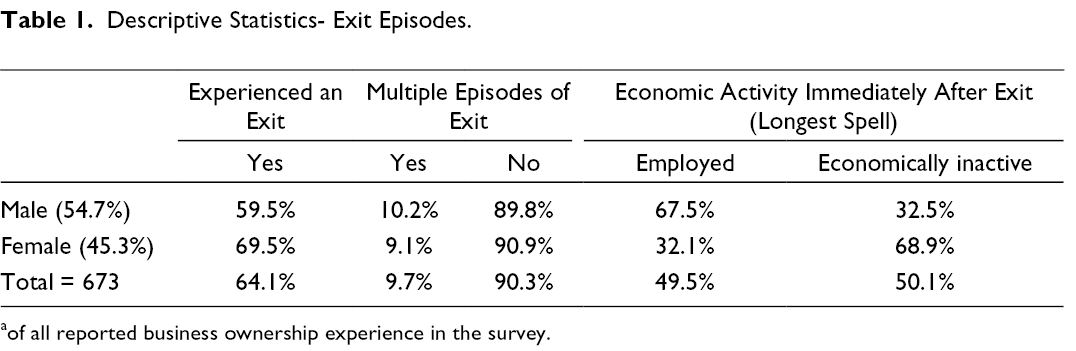
We commence our presentation of the results with descriptive statistics (a) in relation to exit episodes and subsequent employment patterns (Table 1) and (b) for each variable disaggregated by gender (Table 2). In Table 1, we stratified individuals as male or female over the course of the study period assessing the proportion experiencing at least one exit episode. For those who made an exit, subsequent employment chances are evaluated based on the yearly employment activity status differentiating between employment and economic inactivity. We also recorded those who did, and did not, report multiple episodes of exit.
Descriptive Statistics- Exit Episodes.
aof all reported business ownership experience in the survey.
Descriptive Statistics – Control Variables.
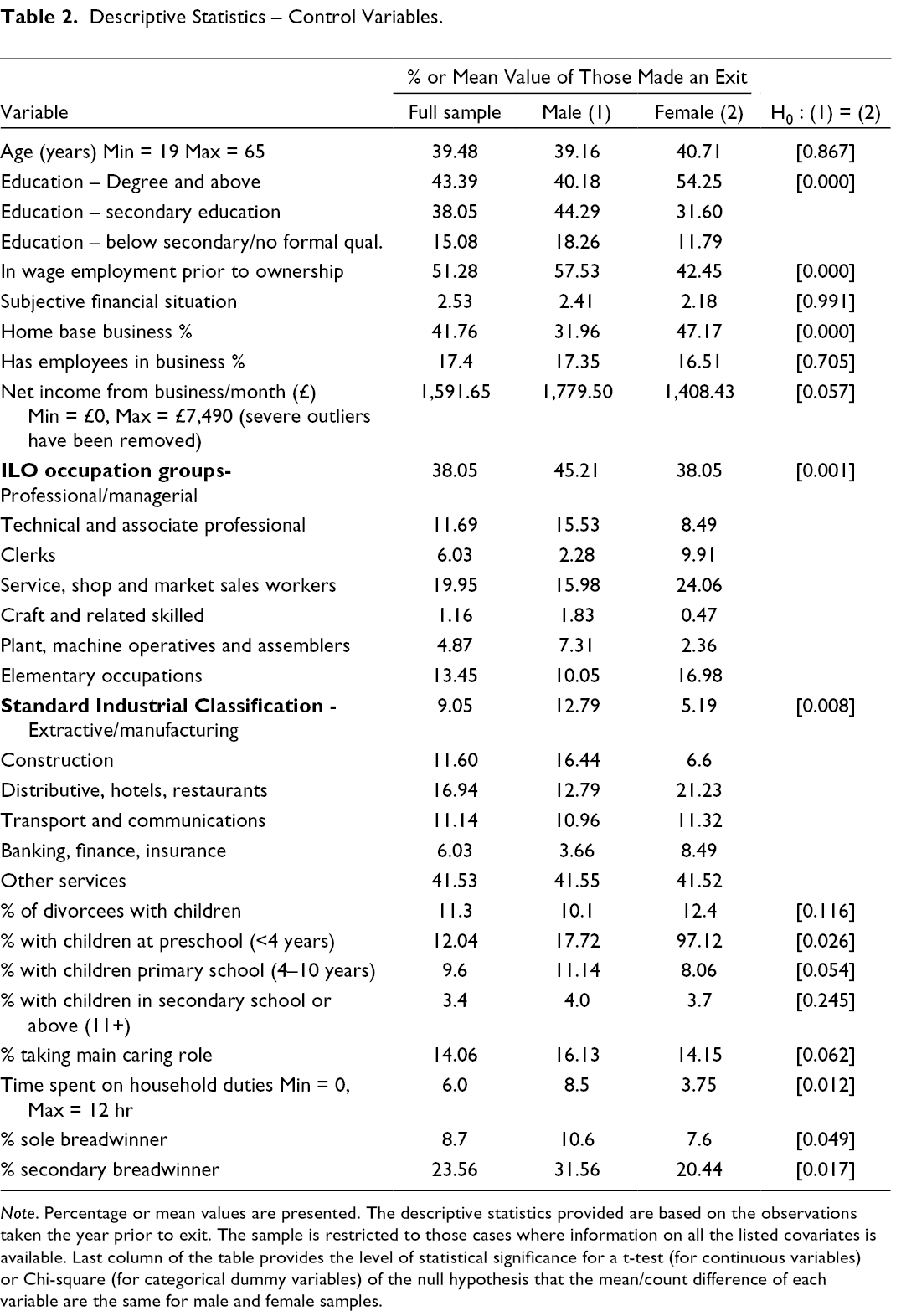
Note. Percentage or mean values are presented. The descriptive statistics provided are based on the observations taken the year prior to exit. The sample is restricted to those cases where information on all the listed covariates is available. Last column of the table provides the level of statistical significance for a t-test (for continuous variables) or Chi-square (for categorical dummy variables) of the null hypothesis that the mean/count difference of each variable are the same for male and female samples.
Data suggest that overall, a majority of entrepreneurs in our sample faced at least one exit episode during the 10 year observation window; fewer than 10% of the sample reported multiple episodes of exit. We also observed positive labour market transitions for male business owners who exit (67.5% reported gaining wage employment). This was not the case for women where only 32% reported working in wage employment post exit. With regards to data disaggregated by gender in Table 2, it is clear that significant gender differences exist for a number of control variables used in our logit modelling. More specifically, a significant proportion of women business owners were educated to degree level, operated from home and are under-represented in technical and associate professional occupations. Within the exit population, important gender differences by industry were also observed. As expected, women have relatively lower net business income at the time of exit compared to male owners (£1,408 compared to £1,774 to male entrepreneurs). Significant gender differences were also observed for percentage of parents with children in pre-school and primary school, the average time one spent on household duties and the percentage taking secondary breadwinner role.
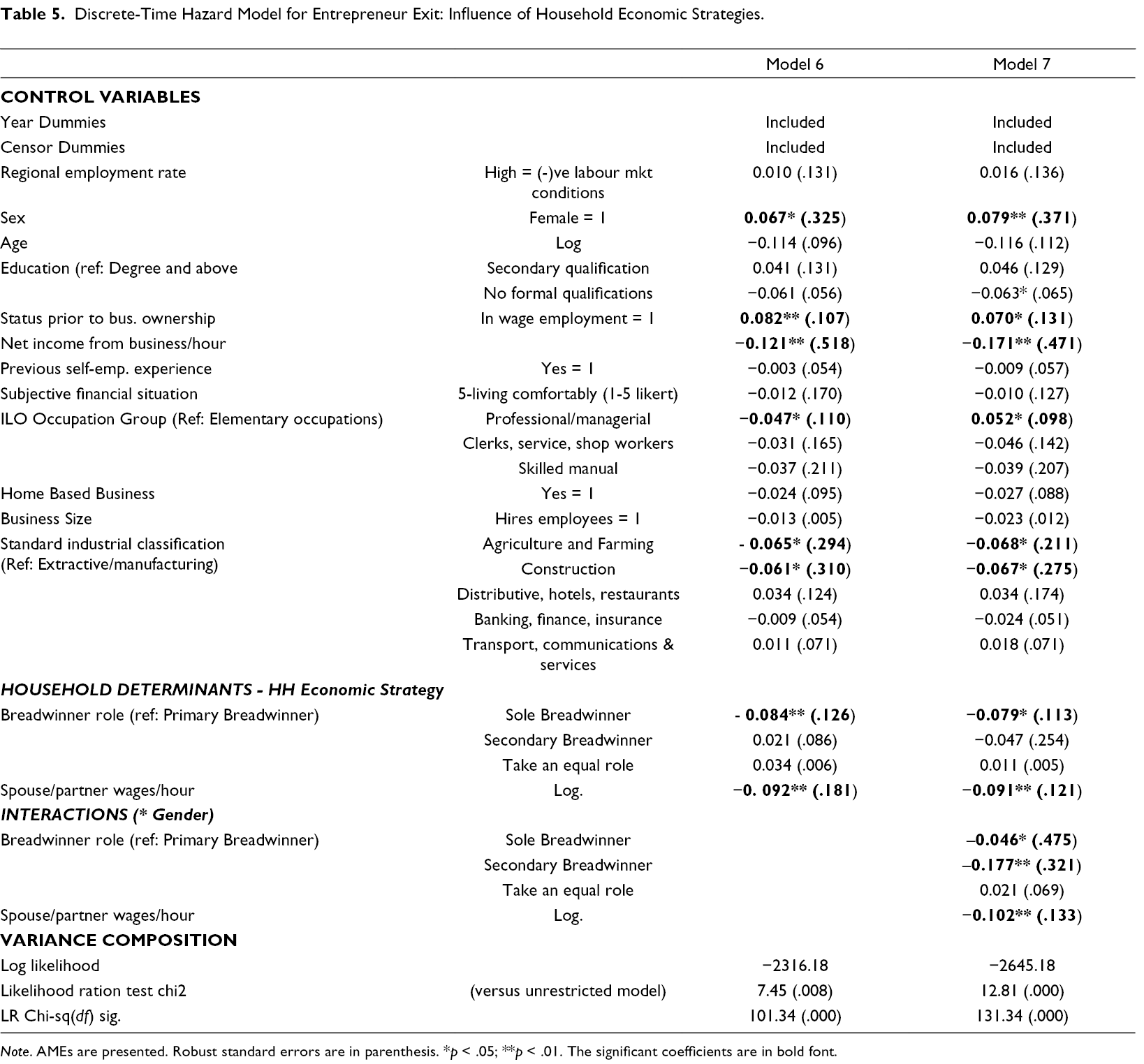
To study the effects of household-related factors on entrepreneur exit in an individual’s dynamic life course and to test our hypotheses, we conducted discrete-time event history analysis, using a series of log models (models 1–7) – seTables 3 and 4. All event history models are estimated using Stata v.14 and Average Marginal Effects 14 (AME) are presented. To avoid slicing the data too thin and possible multicollinearity issues, the covariates and interaction terms are introduced individually. In terms of the effects of controls, those who draw a relatively high hourly business income and those who made the business transition from wage employment have a lower exit probability. Occupation appears to have an important association with the exit condition. This is particularly so with those in professional/managerial occupations compared to those from the elementary unskilled occupation reference category. Differences in exit rates by industry were also apparent. Those in agriculture and farming (AME = −0.084; p < .01) and construction (AME = −0.081; p < .01) display a significantly lower exit probability whereas those in hotel and catering and service industries show high probability even though this is not statistically significant.
Discrete-Time Hazard Model for Entrepreneur Exit: Influence of Household Structure and Work Strategies.
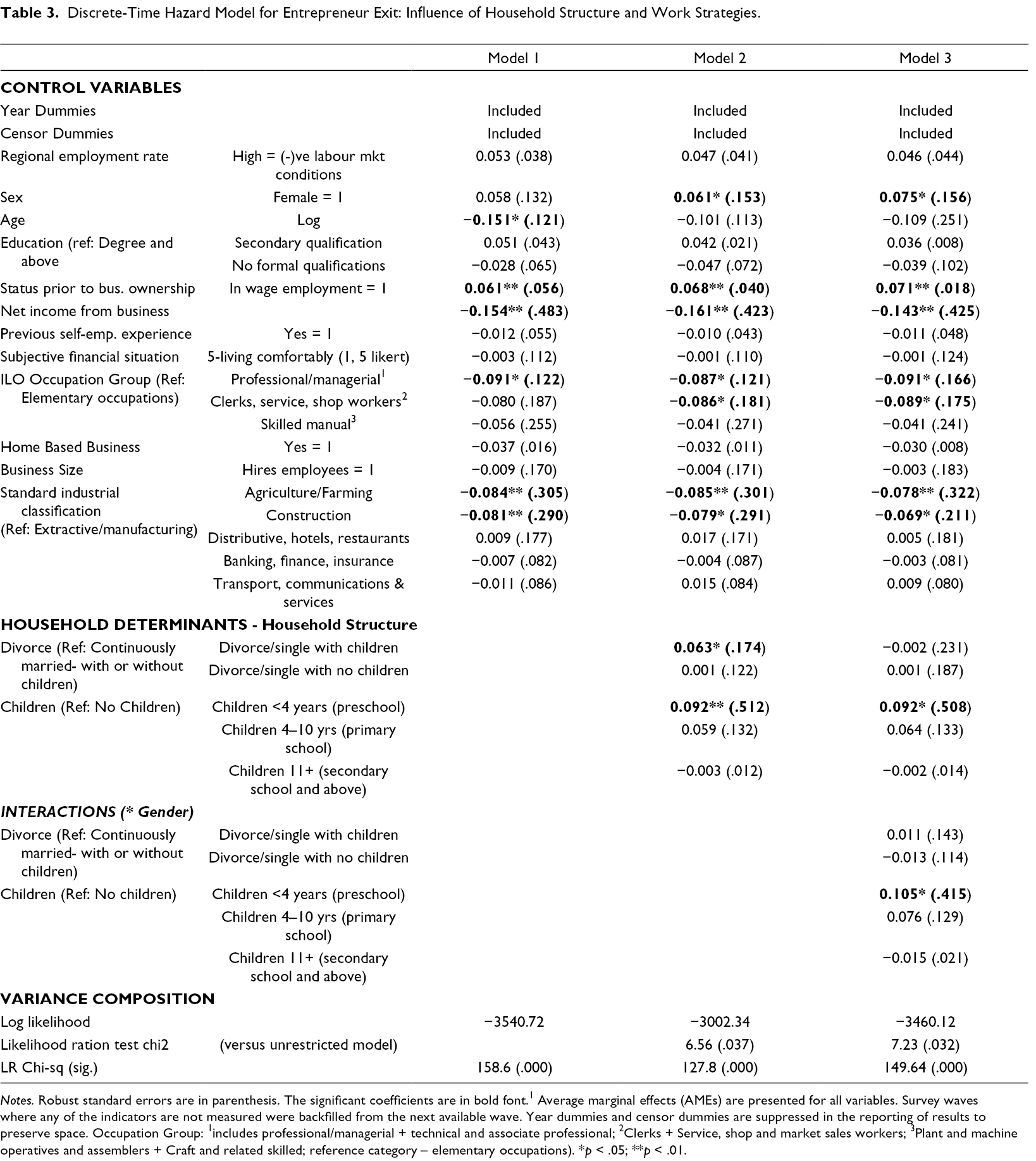
Notes. Robust standard errors are in parenthesis. The significant coefficients are in bold font.1 Average marginal effects (AMEs) are presented for all variables. Survey waves where any of the indicators are not measured were backfilled from the next available wave. Year dummies and censor dummies are suppressed in the reporting of results to preserve space. Occupation Group: 1includes professional/managerial + technical and associate professional; 2Clerks + Service, shop and market sales workers; 3Plant and machine operatives and assemblers + Craft and related skilled; reference category – elementary occupations). *p < .05; **p < .01.
Discrete-Time Hazard Model for Entrepreneur Exit: Influence of Household Work Strategies – Caring Roles.
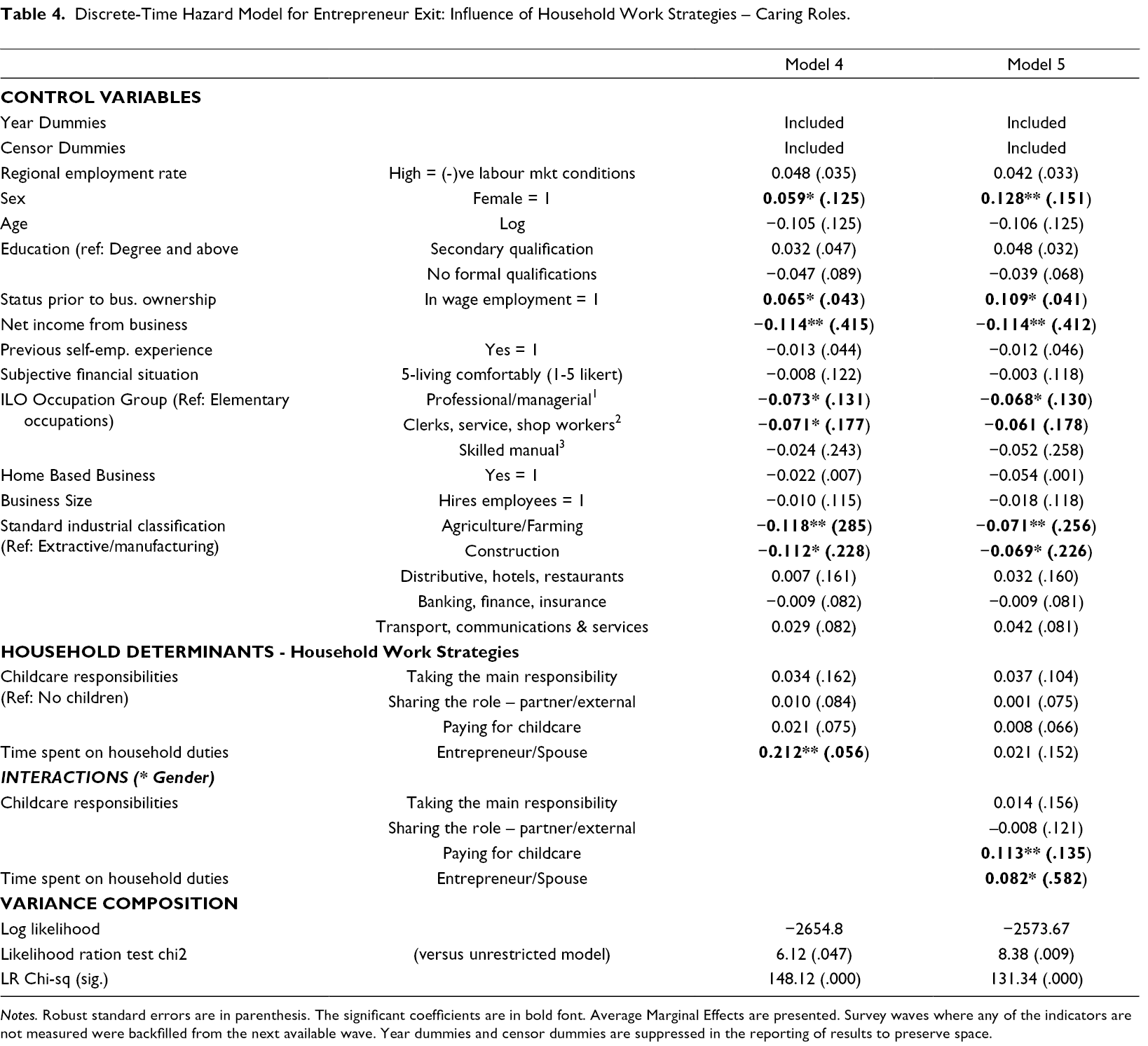
Notes. Robust standard errors are in parenthesis. The significant coefficients are in bold font. Average Marginal Effects are presented. Survey waves where any of the indicators are not measured were backfilled from the next available wave. Year dummies and censor dummies are suppressed in the reporting of results to preserve space.
We subsequently tested a series of hazard models by adding variables related to household work strategy (models 2 and 4, Tables 3 and 4) and household economic strategy (model 6, Table 5) respectively to the base model. The gender interactions were studied in models 3, 5 and 7. Overall, after accounting for both individual and business specific effects (as controls), we find a statistically significant premium that can be attributed to exit largely resulting from household work and economic strategies. The strength of the coefficients, model fit statistics, Log Likelihood and Log Likelihood Ratio tests 15 were used to compare models. Adding household determinants to the control only model increased the model fit; this is significant in all our models. Improvements to the goodness-of-fit statistics, despite losing degrees of freedom, indicate the model robustness and reliable bootstrap standard errors confirming the stability of the parameter estimates explaining the benefits of including household level covariates in our models.
Household Structure and Work Strategies – Direct Effects
Turning first to the impact of childcare on changing the household structure, including divorcees with parental responsibilities, we studied the marital and childrearing history of business owners. All other things being equal, divorce increases the likelihood of exit; this is particularly the case when the divorcee is a parent. Being a divorced woman with children increases the exit transition rate by 6.3 percentage points, this increase in exit rate drops to 1.0 percentage points for those without children. It is also evident that although children in the household matter as an explanatory factor, the likelihood of an entrepreneur exiting from their venture is not equal in all households with children. The presence of a preschool child increases the risk of exit by 9.2 percentage points; for those with primary school children it is 5.9. When children reach secondary school age the exit rate decreases significantly to 0.3 percentage points. The tendency of a declining hazard when children enter secondary education is particularly clear for divorced parents; while the exit hazard for a divorced parent with preschool children is 61% higher than married parents, 16 the exit hazard increases by only 14% if a divorced parent has children of secondary school age and above. Data in model 4 also shows broad support for the notion that those with childcare responsibilities have a higher exit probability. Although not statistically significant, the probability of exiting is nearly four percentage points higher if the owner takes the main responsibility for childcare. Each additional hour spent on housework, rather than on the business, increases the exit rate by almost 50% (AME = 0.21; p < 0.01).
Household Structure and Work Strategies – Gender Moderation Hypotheses (H1a – H1c)
We ran a further set of hazard models (models 3 and 5) to determine if demanding household configurations and work roles have the same exit-triggering effect for both men and women in order to test the conditions for H1a. In these models we studied the interactions between household determinants and gender. First, we considered the exit triggering effect of household structural components (model 3); the point of interest being whether household configurations and children in the household have a greater impact upon a woman’s entrepreneurial exit. We also included divorce related variables to provide a full account of the gender effects on children. To operationalise our hypothesised children age-exit relationship, we introduced three age groups classed here as preschool children (age 0–4 years), primary school children (5–10) and secondary school children (>10 years). We found that while having children increases the probability of exit, business owners in households with young children of preschool age have an elevated probability of exit. This exit risk drops as the youngest child in the household reaches secondary school age; but being a woman has the most significant progressive effect from child age on the exit hazard. While the presence of a preschool child increases the risk of exit by 10.5 percentage points for women business owners, this figure drops to 7.6 percentage points if the youngest child in the women business owner’s household is in primary school. When her children reach secondary school age the exit rate decreases to 0.15 percentage points. Being divorced with children also increased the probability of exit; the conditional effects indicated the risk of exit is generally stronger for women, although this effect is not statistically significant. Overall, our results provide strong support for H1a suggesting that while the propensity to exit is influenced by child age there is a stronger risk of exit for women business owners with at least one child of preschool age compared to those whose children are of primary or secondary school age.
With respect to the effect of caring responsibilities, data in model 5 indicates unsurprisingly, that being in a household with children increases the exit risk per se. In terms of childcare commitment, the results are mixed. We found that although women are more likely to exit if they undertake the main childcaring role than when they share the childcare role with a partner (perceived measures of childcare), the effects are not statistically significant (AME = 0.014 and −0.008). We however found stronger evidence to suggest that exit triggering effects were stronger for women who committed more time to caring labour compared to the male partner; she was 8.2 percentage points more likely to exit (AME = 0.082; p < .05), providing partial support for H1b. With regard to H1c, counter to expectations, we found a strong gender interaction between those households where childcare has been outsourced and where women, not men, face a higher risk of business exit (AME = 0.113; p < .01). Comparison between the slopes in the moderation graphs also suggest that whilst the probability of exit amongst women business owners who outsource childcare increased, the effect was opposite for men. There is therefore, some support for caring responsibilities and exit relationship for women in that women who undertake a greater share of domestic caring labour are more likely to exit from entrepreneurship than male spouses; out-sourcing such responsibilities does not encourage women to remain in business.
Overall, we found support for H1 that while child age influences business exit, business exit is more likely for women business owners with young children (preschool) compared to older children (primary school and above) – H1a. Additionally we found that the likelihood of women (not men) business owners exiting their business increases when they take a larger share of the child caring role – H1b. For H1c we found that outsourcing child care does not encourage women to persist with their ventures, but has a positive influence upon business persistence for men.
Household Economic Strategy – Direct Effect
The strong negative significant coefficients for spouse/partner income (AME = –0.092; p < .01) and the owner’s sole breadwinner role (in relation to primary breadwinner) in the household (AME = −0.084; p < .01) suggest that the income contribution from the partner/spouse in dual earner households and greater economic responsibility where the entrepreneur is the sole earner lessens the likelihood of exit (Table 5). With an increase in every one unit of spousal contribution to the household, the probability of exiting the business falls by 9.2 percentage points. Being the sole breadwinner reduces the probability of exit, compared to being the primary breadwinner, by just over 8 percentage points. Compared to a primary breadwinner, the exit probability of a secondary breadwinner, or those making almost equal earnings in a dual earner household, increases by around 2.1 percentage points, even though this difference is statistically not significant.
Discrete-Time Hazard Model for Entrepreneur Exit: Influence of Household Economic Strategies.
Note. AMEs are presented. Robust standard errors are in parenthesis. *p < .05; **p < .01. The significant coefficients are in bold font.
Household Economic Strategy – Gender Moderation (Hypotheses H2a and H2b)
The predicted probabilities in the hazard model 7 (Table 5) illustrate strong negative significant gender interactions with both household economic strategy variables (entrepreneur being the sole or the secondary breadwinner compared to the primary breadwinner and spouse/partner income). Women are less likely to exit from a business if they are situated in a dual earner household where they contribute a secondary income, this supports H2a. A women business owner in a dual earner household who makes a lower financial contribution is nearly 50% less likely to exit compared to a male counterpart who acts as a secondary breadwinner. Turning to male business owners, there is evidence for a higher risk of exit when he is the sole economic provider. Comparison of the regression slopes suggests that for men, the exit probability associated with being a secondary breadwinner is not as clear. We also found the exit probability from increased spousal contribution to the household income was significantly lower for women (AME = −0.102; p < 000) providing strong support for H2b. This confirmed that the positive impact of a male salary subsidy to the persistence of a women’s business is greater than vice versa. Therefore, the likelihood that a woman entrepreneur exits significantly decreases as her partner’s salary subsidy increases. Overall, we found strong support for H2 that exit is associated with spousal contributions to the household; our argument that taking the role of primary or secondary breadwinner is critical. Where men assume the primary breadwinner, women are more likely to persist with their firm with this effect becoming stronger as the male income rises. This effect is not evident where women are primary breadwinners.
Robustness Tests
The use of longitudinal panel data and lag variables helped to overcome endogeneity concerns and random effect modelling tested for unobserved heterogeneity. Although unobserved heterogeneity among individuals did not affect exit rates, our modelling approach cannot completely control for selection effects. As such, the same exit selection tendencies that encourage household division of labour through running a particular type of business for example, potentially also correlate with explanatory variables such as children and childcare arrangements. Accordingly, we controlled for additional individual and business level characteristics tied to selectivity with respect to family statuses and transitions that might bias the relationship between the household life course and exit. For example, we included occupation type and industry dummies to control for possible endogeneity from self-selection of women into jobs that generate less work-family conflict. Availability of home working, reduced working hours, previous work experience, for example, are also enabling conditions for business continuity and thus, have been used as controls in our models.
We also conducted several sensitivity analyses. First, because there is variation in how household work and economic strategies are measured (e.g., child age lower than four to be treated as preschool versus child age at other cut-offs); we explored if our results were robust to different measurement conditions. Regardless of the cut-offs used, our results were consistent across specifications. Second, the results did not change when we dropped the cases representing ‘equal share’ in breadwinner role from our final dataset. Third, we re-estimated the models using data for the period up to 2014, the only substantive change was that the effect of preschool children on exit was no longer significant, although it remained positive. Fourth, as cohort factors in social change have already been captured in the regional economic conditions control variable in the model, information on birth cohort is not included. However, as the regional economic conditions variable may not capture structural influences in full, we re-estimated the models using period dummies with a reference category of exit period prior 2010. Estimated marginal effects did not change even though the exit rates in the 3-year period 2010–2013 were significantly higher compared to those before 2010. Finally, there was no evidence of problematic multicollinearity; the mean variance inflation factor (VIF) was 2.12 and the maximum VIF is 3.71.
Discussion
Analyses of the impact of gender upon entrepreneurship suggest that personal circumstances and gendered disadvantages are likely to shape the business exit decision for women (Justo et al., 2015; Taylor, 1999; Yang & Triana, 2019). We advance these analyses by focusing upon how gendered household relations, regarding responsibilities allocated to men as breadwinners and women as carers, influence exit and are mitigated by life course factors. Within this analysis we focus upon the rationale for the entrepreneur exiting the business using two hypotheses to discriminate between household make-up (structure), work (work strategy) and economic resource flows within households (economic strategy) at specific life course stages.
Household Structure and Work Strategy
Within our first hypothesis, we explored how the household structure influenced exit with a focus upon how the presence of children and their age affected this dimension whilst work strategy looked separately at the division of caring responsibilities. Regarding gendered differential levels of exit we find that women entrepreneurs in couple households were nearly twice as likely to exit as their male counterparts. Such evidence suggests that caring demands for very young children (preschool) militate against commitment to entrepreneurial activity. This is equally applicable to men and women entrepreneurs who undertake primary caring roles but, as gendered expectations ensure the latter undertake the majority of caring responsibilities, this represents a gendered effect. This effect diminishes as children mature as clearly, women are able to adjust the time ratio between caring and business operation.
We further refined our arguments by focusing upon child age given that caring demands change as children mature. For most women with infants or very young children, a combination of normative social expectations and personal preferences direct them towards prioritising caring responsibilities. Entrepreneurial activities and caring for very young children are conflicting and time hungry activities. Consequently, if there is a secure primary income to the household, the time challenges and marginal returns from fragmented entrepreneurship combine to suggest it is an unattractive proposition for mothers with such children. If the youngest child in the household is older than four however, for women the exit transition is less likely. At this age, time demands shift as children are likely to be less dependent and so, the ‘commitment balance’ changes in favour of the venture. Thus, exploring the age of the children within the household, and just who assumes caring responsibilities, are germane when analysing the dynamics of the entrepreneurial household (Justo et al., 2015; Thébaud, 2016). However, we took our analysis further, recognising that many contemporary households use paid child care provision, we examined the relationship between outsourcing childcare and exit. Notably, we found that within households who contract out childcare, women are more likely to exit whereas for a man, this probability decreases.
In the case of women, we speculate that in order to justify the additional expense of care for very young children, the household income needs to be sufficient to cover such costs. So for example, in the case of the UK, Coleman et al. (2020) found that full time (50 hr per week) nursery care for a child under two is £252.07 (£13,100 per year) and £232.71 (£12,100 per year) for childminder care. Part-time weekly care (25 hr per week) is relatively more expensive at £131.61 (£6,800 per year) and £118.34 (£6,200 per year) for childminder care. 17 Evidence however, suggests that in the UK, returns to self-employment are considerably less than comparable forms of employment with the gap accentuated for women, particularly those in part-time self-employment (Jayawarna et al., 2019). Yuen et al. (2018) using ONS data found that in the UK, full-time female employees have a mean weekly income of £428, compared with £243 for self-employment. In level terms, the employment premium is 76%; even allowing for under-reporting of self-employed income, this is a substantial disparity that widens further for part-time comparators. Therefore, investing in fixed cost external childcare is difficult to justify if one income from self-employment is constrained and uncertain unless of course, the overall household income is sufficient to compensate. Thus, where households utilised formal child care, this did not encourage women to persist with their ventures. We suggest that for women, operating a time hungry venture with lower returns than employment represents a high risk if households have to factor in formal child care costs to this calculation.
The second scenario, regarding the tendency for men to persist with entrepreneurship where formal paid child care is evident raises a number of intriguing speculations Tentatively, it could be that in such households with only a male entrepreneur, one would assume that the female partner has returned to secure employment; this would support the argument by Yang & Triana. (2019) that women with young children are more likely to use entrepreneurship as a stop gap prior to returning to employment. Thus, the combination of income enables the use of paid child care which particularly benefits male entrepreneurs; this may in fact represent a subsidy effect from female employment to male self-employment but this requires further analysis and evidence.
Finally, for divorced women, there is a notable gulf (22%, 0.6%) in exit rates between those with and without children. Evidence suggests that divorced women with children, as a category, are likely to experience falls in household income (as the main breadwinner departs) whilst assuming a greater share of childcare than women in partnered households (Tamborini et al., 2015). Under such conditions, the need to increase income becomes more pressing but the time available by sole carers for business operation is likely to be constrained in turn, limiting income. Therefore, using entrepreneurship to generate income while assuming the responsibilities of single parenthood, does not appear to be conducive. Overall, there can be little dispute that entrepreneurship offers choice and flexibility to women with very young children; however, our evidence suggests such flexibility incurs income penalties which for some, tempers the exit decision. This effect is tempered if there is a male subsidy to a mother’s firm but this subsidy does not work in reverse whilst using formal child care for women to invest more time in the business does not appear to be conducive to persistence.
Household Economic Strategy
Our second hypothesis examined economic strategies and in particular, whether the necessity (or not) of the entrepreneurial income contribution to the overall household may delay or expedite the decision to close the firm. Thus, where the woman entrepreneur is a secondary breadwinner, such that her spouse contributes a higher income to the household, she is less likely to close her business. Alternatively, in the reverse scenario, the likelihood of a male entrepreneur closing his business if he is the secondary breadwinner is much less conclusive. In addition, if a woman entrepreneur is the sole breadwinner, she is more likely to remain in business in comparison to a male entrepreneur sole breadwinner.
On the basis of income generated, we find evidence supporting that by Yuen et al. (2018) that returns to women owned firms are lower than those of their male counterpart (women business owner’s monthly net income of £1,408 compared to male owner income of £1780). However, where a woman’s business does not offer a primary contribution to the household, it has an increased chance of persisting compared to the scenario where a male-owned business makes a secondary contribution. Whilst we acknowledge that from a household perspective this economic strategy might represent rational decision-making given how the venture meets life course demands at specific times. From a gendered critique, we note that such household dynamics simply reproduce traditional divisions of labour and in so doing, have a dampening effect on the performance profiles of many women owned businesses. This notion of under-performance levelled at women entrepreneurs has been linked to a lack of entrepreneurial ambition or competency (Yousafzai et al., 2018) with policy directives focused on agentic solutions to this issue (Ahl & Marlow, 2019). So women are encouraged to be less risk averse, improve self-confidence and emulate successful role model exemplars (Deloitte, 2016; Rose, 2019). These assumptions that problematise women’s attitudes and actions are simplistic when assuming they operate in isolation from prevailing social contexts.
Within this article, we demonstrate how household and life course dynamics contextualise entrepreneurial activity and specifically, how gender critically impacts upon the operating circumstances, performance potential and decision to persist with or exit from a venture. To add further detail to such claims, we also explored sectoral issues in finding some differences. It is notable that businesses in sectors associated with men, such as agriculture and construction, were significantly more likely to persist whereas those in service industries, where women have a higher presence, had higher rates of exit even though this is not significant. Thus, we suggest sector does have an influence; it is well documented that women are more likely to enter lower order, crowded feminised service sectors affecting performance (Yousafzai et al., 2018) which would in turn, make such firms more vulnerable to exit further compounding the gendered effect. In effect, the decisions underpinning entry and exit are inter-related rather than discrete events.
Limitations and Future Research
Our study has a number of limitations which offer scope for further research. We employed a single country sample which limits generalisability; thus, as Naldi et al. (2019) revealed in their analysis of Sweden, under some circumstances, generous parental leave can make space for women to pursue entrepreneurship if spouses share caring duties over a sustained period of time. Thus, a more nuanced analysis of how differing institutional contexts policies affect exit are required. Exit can have both positive and negative market outcomes (De Tienne & Wennberg, 2015; He et al., 2018); due to data limitations, we were unable to make the distinction between distress and voluntary exit. To extend our model, and fully capture the complexity of the exit decision, further research is needed to shed light on the nuances of persistence, exit and re-entry over time. As we note, the rationale for creating a venture will have an influence upon the rationale to exit; evidence which can track or analyse both the entry and exit decisions would illustrate how the two are intertwined.
Some of our measures are imprecise, reflecting the difficulties of attaining accurate measures for such constructs as household responsibilities from a secondary data source. We were also unable to directly measure alternative labour market opportunities that mediate our theory; we were also unable to test if a woman’s decision to exit is affected by access to alternative forms of employment. We have focused upon entrepreneur exit to ascertain how differentiated gendered ascriptions influence this decision so are not measuring the status of owner [sole-proprietor/ business owner]. Future research could explore the extent to which the status and structure of the firm intersects with the household positioning of the owner and their life course stage. Axiomatically, we could not control for all possible motives for exit beyond those explored in our theoretical framing so inevitably, despite our best efforts to address this issue using statistical methods, our findings are not without problems of endogeneity. Such limitations lay the foundations for future interpretative work to delve more deeply into entry and exit as related issues and how these are shaped by households dynamics and life course stages with a particular focus upon gendered responsibilities. Indeed, a further limitation arises from our heteronormative focus upon heterosexual households headed by male and female partners. Given the growth of same sex partnerships, with implications for gendered responsibilities and resources (Marlow et al., 2018), evaluating how these might influence entrepreneurial behaviour, including exit decisions is intriguing. In addition, how single parent households, 90% of which are largely headed by divorced women in the UK (ONS, 2017), use entrepreneurship to combine domestic flexibility and economic participation requires further exploration. Whilst popularly presented as a flexible route to economic participation for such women, particularly those with younger children dependent upon welfare benefits, (Cain, 2016; Marlow, 2006) our findings suggest they could be exchanging the security of welfare benefits for the uncertainty of short tenured entrepreneurship. This requires further critical evaluation.
Finally, future studies should discriminate upon the basis of business tenure; that is to explore differences in exit decisions between women who owned an established business prior to child birth then exited due to caring demands and those who created a venture shortly after child birth. If the latter group are particularly swayed by flexibility arguments this may shape the type and performance profile of their firms and so the exit decision whereas the former, established entrepreneurs, may carry forward different expectations and ambitions for their ventures impeded by caring demands (Joona, 2018). An interpretative ontology would be particularly useful to explore such issues and also, illustrate the sense-making process underpinning the exit decision.
Conclusion
Within this article, we have developed a gendered critique of the influence of household and life course dynamics upon the entrepreneur’s decision to exit a venture captured within our research question: How do the differential effects of life course and household dynamics influence the exit decision of male and female entrepreneurs? This question responds to calls to incorporate a household perspective into entrepreneurship research (Alsos et al., 2014; Carter et al., 2017; Meliou & Edwards, 2018) whilst introducing the notion of life course stages, specifically child birth and parenting. Theoretically, we advance contemporary analyses of exit by conceptually drawing together the notions of household dynamics and the life course within a gendered framing to reveal how particular facets of the exit decision are socially embedded within assumptions of feminised caring and masculinised breadwinning. Having generated this theoretical framing, we tested it through two hypotheses drawing upon UK household panel data spanning 1991–2016. Drawing upon this longitudinal detailed data set offers a novel empirical contribution as it enables us to offer robust evidence to support our theoretical framing. The data analysis confirms that child care responsibilities, particularly for preschool children, have a higher impact upon women’s exit decision. Axiomatically, we associated this with lower returns to entrepreneurial effort compromised by caring demands yet, somewhat counter intuitively this does not automatically encourage higher rates of exit; this is moderated by financial contribution. In effect, the more modest the contribution to household income, the less likely a woman is to exit her business. Rather, if there is a compensating male primary ‘bread winner’ income, such that the income from the woman’s business is not supporting the household, she is more likely to persist. Thus, the balance between income and exit has to be analysed in terms of how income is distributed within the household, the rationale for creating the venture and whether it is being used as a bridging activity for women as an adjustment strategy 18 prior to selecting back into employment at a more appropriate point in the life course.
This point relates to contemporary debates regarding the efficacy of entrepreneurship as a flexible form of part-time work where effort can be tailored to convenience (Agarwal & Lenka, 2015; Ahl & Marlow, 2019). Undoubtedly, for many women the opportunity to choose what they do, when and how they do it has multiple advantages. If income generation is not a priority in the presences of a compensating partner income, flexible entrepreneurship offers many advantages in determining not only work-life balance but also task autonomy. Moreover, entrepreneurship can enable women to make choices regarding adjustments between the balance of caring and income generation whilst the paternal subsidies facilitate the shifting nature of such adjustments.
We do caution however, that the benefits claimed regarding increased autonomy for women who select into flexible entrepreneurship need to be balanced with consideration of a constraints regarding access to a range of employee welfare benefits and poorer incomes (Stumbitz et al., 2018). Moreover, entrepreneurship may offer a good fit with the gendered division of house hold labour whereby the prevailing social context encourages male breadwinners and female carers but the tacit implications of this fit have to be considered. Despite notions of autonomy which form the basis of entrepreneurship, if enacted within households with parenting responsibilities for young children, entrepreneurship folds around stereotypical gendered assumptions regarding caring and breadwinning which in turn, influences the exit decision.
Consequently, the choices men and women make regarding how they structure their entrepreneurial activities cannot be divorced from the gendered social context in which they occur. As such, merely using gender roles to describe a dichotomous articulation of entrepreneurship which positions women in deficit is simplistic and superficial. Using a critical gendered analysis, as we have done here, and advancing this analysis by drawing upon a house hold and life course stage conceptual framing illustrates how gender works in a social context to channel choices and priorities regarding entrepreneur exit. Rather, as we demonstrate, gender acts as a valorisation device which ascribes roles that in turn, channel possibilities and so, act as a situation/choice filter. This has implications for entrepreneurial propensity and activity; thus, reflecting feminised ascriptions, women are more likely to be channelled towards crowded lower order service sectors, operate their ventures from home and upon a flexible basis. In combination, such choices may support work life balance but have implications for persistence, depending upon additional income flows into the household. Masculinised gendered ascriptions however, channel men towards more lucrative opportunities to support their breadwinning role. As such, our theoretical framing and empirical analysis suggest that women and men are socially positioned in differing gendered spaces that lead to differing outcomes regarding entrepreneur exit. On one hand, this may appear to represent autonomous choice. But on the other, as we hope to have illustrated by analytically melding gender, household and life course theory, these choices are firmly embedded within a directive social context.
This debate prompts a number of policy recommendations. Our study advocates that the context of household and life course dynamics need to be recognised in future policy initiatives. Current policy initiatives cast the domestic sphere and household dynamics as wholly separate and thus, irrelevant to business operation (Rouse & Woolnough, 2018). This is problematic as for example, the debate around gender, women and flexible working, child care issues and maternity support focuses very much upon employment related challenges. So for example, while employees within the UK and many European countries have a statutory right to a national minimum wage, sick pay, holiday pay, enhanced maternity benefits and supported flexible working options, by definition the self-employed do not (Klyver et al., 2013). This is particularly detrimental for women who have a much higher dependency upon employer or state benefits for income support, child care costs and maternity support (Stumbitz et al., 2018).
Policy consideration should be afforded to how such benefits can be extended to self-employed women as few invest in adequate insurance to cover loss of earnings (Hughes, 2017). The lack of such benefits is detrimental to all entrepreneurs but more so to women given much higher take up of benefits related to maternity and child care while lower and volatile returns from entrepreneurship leaves them vulnerable to income fluctuations and of course, exit. In particular, future analyses need to explore the efficacy of policy initiatives that assume entrepreneurship offers single parents and other marginalised groups who lack access to entrepreneurial capitals a flexible and sustainable form of economic participation. Rather, entrepreneurship is more likely to be detrimental to such households, particularly those headed by women single parents as a limited but secure welfare income is replaced by a limited and volatile entrepreneurship income (Marlow, 2006). There is a higher degrees of churn among women-owned firms (Yousafzai et al., 2018) linked to issues of alleged ‘under-performance’ prompting policy initiatives to encourage women to address this issue through increasing self-confidence, becoming less risk averse and pursuing growth (Ahl & Marlow, 2019). We suggest however, that if countries were to combine churn data with household dynamics, alternative insights could be advanced to explain the rationale for women’s choices with respect to their (dis-) engagement with business ownership during their life course.
Finally, acknowledging the dynamics of household relations using a life course approach could, we suggest, offer a new pathway to challenge and so, contribute to theory development regarding the motivations for entrepreneurial behaviour through a range of critical stages from start-up to differing forms of exit. In addition, generating empirical evidence which captures the relational aspects of entrepreneurial households at particular stages in the life course will offer a new facet to illustrate how decisions relating to business management are embedded in complex social relationships. We suggest that recognising the complexities associated with life course issues and how they shape the dynamics of entrepreneurial households offers considerable scope to critically evaluate the motivations for, and outcomes of, entrepreneurship. 19
Footnotes
Declaration of Conflicting Interests
The author(s) declared no potential conflicts of interest with respect to the research, authorship, and/or publication of this article.
Funding
The author(s) received no financial support for the research, authorship, and/or publication of this article.
