



Abstract
Entrepreneurial fear of failure is a ubiquitous yet aversive experience with critical implications for entrepreneurial action and well-being. To understand how entrepreneurs can effectively cope with fear-inducing obstacles, we hypothesize and experimentally test the extent to which self-compassion, cultivated through Loving-Kindness Meditation (LKM), counteracts entrepreneurs’ fear of failure when facing a threatening venture obstacle. Compared to an active control group, entrepreneurs exposed to a brief guided LKM showed higher self-compassion, which, in turn, was associated with lower fear reactivity. We offer novel contributions to entrepreneurship theory and practice by highlighting the role of meditation and self-compassion in building entrepreneurial resilience.
Entrepreneurial fear of failure is a cognitive and emotional reaction to a threatening obstacle in the process of starting and running a new venture (Cacciotti & Hayton, 2015; Cacciotti et al., 2016; Kollmann et al., 2017). Acting as a feedback signal indicating that a venture-related goal is under threat, fear of failure shapes entrepreneurial action (e.g., Cacciotti et al., 2016; Kollmann et al., 2017; Lebel, 2017; Morgan & Sisak, 2016) while it can also cause negative self-views, self-handicapping, and the erosion of entrepreneurial well-being (e.g., Cacciotti & Hayton, 2015; Foo, 2011). It is therefore important to understand what allows entrepreneurs to effectively cope with venture obstacles while minimizing the stressful and unpleasant aspects of experiencing entrepreneurial fear of failure.
In contrast to coping with actual venture failure, which has been studied extensively in the entrepreneurship literature (e.g., Jenkins et al., 2014; Singh et al., 2007; Ucbasaran et al., 2013), research on coping with the day-to-day obstacles that induce fear of failure is remarkably scarce. This is surprising because fear of failure occurs much more frequently than actual failure and arises independently from it. Moreover, most of what we know about fear of failure in entrepreneurship comes from studying individuals as they initially decide whether to engage in entrepreneurship or not, hence highlighting the inhibiting effects of fear (e.g., Arenius & Minniti, 2005; Grichnik et al., 2010; Welpe et al., 2012). Only rarely have scholars examined fear of failure after setting up a new venture (Cacciotti et al., 2016; Morris et al., 2012). This too is surprising because coping with fear of failure is likely to be very different before or after committing to a new venture. Therefore, even as theory about entrepreneurial coping has recently begun to emerge (Cacciotti et al., 2016; Foo, 2011; Patzelt & Shepherd, 2011; Uy et al., 2013), and despite the latest reconceptualization of entrepreneurial fear of failure (Cacciotti et al., 2016) as well as the emergence of new studies about its antecedents and outcomes (e.g., Kollmann et al., 2017), knowledge about effective coping mechanisms remains scant.
In addressing this gap, we build on the broad and multidisciplinary evidence that meditation is vital for resilience, coping, and subjective well-being in the face of adversity (e.g., Dahl et al., 2015; Fredrickson et al., 2008; Galante et al., 2014; Good et al., 2016). Moreover, we draw on a set of theoretical propositions developed by Shepherd and Cardon (2009), which assert that self-compassion is critical to effectively regulating negative emotional reactions to failure. We specifically study the effects of Loving-Kindness Meditation (LKM; e.g., Fredrickson et al., 2008; Galante et al., 2014; Hutcherson et al., 2008), a form of meditation that engenders compassion to others and, more crucially in this study, self-compassion: being kind and understanding toward oneself, perceiving experiences as part of a broader human experience, and not over-identifying with painful thoughts (e.g., Leary et al., 2007; Neff, 2003; Sbarra et al., 2012). We then bind these perspectives together by conceptualizing the development of self-compassion in entrepreneurship as a form of resilience—the build-up of resources to deal with failure that may or may not occur in the future (Allen & Leary, 2010; Chadwick & Raver, 2018).
To empirically examine how the cultivation of self-compassion (Neff, 2003), evoked by a brief LKM session, can present a practically attainable way for entrepreneurs to better cope with fear-inducing venture obstacles, we conducted a randomized-controlled experiment with a sample of active entrepreneurs. We focus on the effects of meditation practice because of its well-established positive impact on human functioning more generally (Goldberg et al., 2018; Good et al., 2016) and a consistently powerful effect of LKM on self-compassion in particular (Galante et al., 2014; Kreplin et al., 2018).
Overall, our work contributes to theory on entrepreneurial coping with fear of failure, provides new insights about resilience in the face of venture obstacles, and offers practical implications to entrepreneurs who so often experience fear of failure. First and foremost, our study contributes to a general theory of entrepreneurial coping (e.g., Patzelt & Shepherd, 2011; Uy et al., 2013) by answering the theoretical question of what allows entrepreneurs to effectively cope with venture obstacles while minimizing the stressful and unpleasant aspects of experiencing entrepreneurial fear of failure. Cacciotti et al. (2016) provide empirical evidence that fear of failure is a ubiquitous and inevitable part of the entrepreneurial journey, and that it can promote as well as inhibit effective entrepreneurial performance. It is, therefore, necessary to understand why some entrepreneurs can function well in the face of fear-inducing obstacles, whereas others do not. Research on negative emotions concentrates on the advantages provided by positive emotions (e.g., Baron, 2008; Cardon et al., 2009) or the buffering effect afforded by a positive self-image like self-efficacy or confidence (Hayward et al., 2010). In contrast, our focus on how self-compassion modulates fear reactivity, without compromising on the accuracy of threat recognition, offers a novel perspective that sidesteps the pitfalls associated with overly positive self-beliefs, such as hubris or narcissism (Hayward et al., 2006).
This positions our study as a response to calls for research that examines the reciprocal relationship between entrepreneurial challenges and emotions (Cardon et al., 2012; Kollmann et al., 2017). This study also aligns well with recent research overviews on entrepreneurial well-being (Stephan, 2018; Wiklund et al., 2019) and stress (Rauch et al., 2018). These provide conclusive arguments and evidence that entrepreneurial success is not only a function of effectively managing the venture and navigating the business environment, but also of effectively managing your inner world: the subjective, internal responses that accompany the uncertainties and challenges that come with being an entrepreneur.
By offering the first empirical evidence for the effects of LKM and self-compassion in entrepreneurship, our study represents a way forward for scholars interested in understanding and addressing the experience of fear in the entrepreneurial context of uncertainty and the possibility of material and psychological loss (Cacciotti & Hayton, 2015; Cacciotti et al., 2016; Kollmann et al., 2017). This also has important practical implications (Wiklund et al., 2019), as the brief meditation-based intervention that our participants completed offers a nonintrusive and efficient way to induce self-compassion, making it an appropriate tool for entrepreneurs to use under demanding time constraints.
Theoretical Framework
The core argument advanced by this paper concerns the impact of LKM on entrepreneurial fear of failure through self-compassion. The conceptual model detailed in Figure 1 summarizes this study’s theoretical framework and graphically displays its hypotheses. The following sections unpack this model, and each relationship is developed in turn.
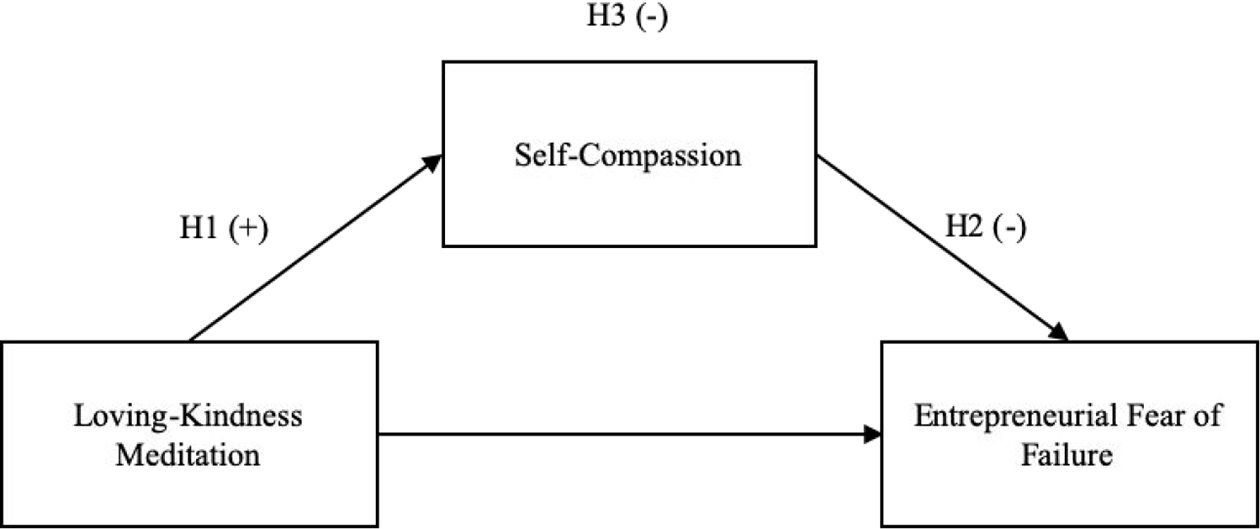
Conceptual model.
LKM and Self-Compassion
Self-compassion is an integrative construct consisting of three components: (1) mindful acceptance—balanced awareness of negative thoughts and feelings; (2) common humanity—the acknowledgment that your subjective experiences are part of the larger human condition; and (3) self-kindness—treating oneself with understanding and forgiveness in the face of adversity (Neff, 2003; Neff & Dahm, 2015). These three components of self-compassion impact how individuals feel and behave (Leary et al., 2007; Sbarra et al., 2012). Hence, self-compassion allows to experience negative emotions without becoming overwhelmed or over-identifying with them. Instead of seeing one’s experience as isolating or shaming, self-compassion provides a broader perspective within which both the highs and the lows of life are considered as parts of the human experience. Rather than being harshly judgmental and self-critical, individuals can then be kind to themselves, and feel less fearful or anxious about their situation (Neff, 2003; Neff & Knox, 2017). Crucially, self-compassion is teachable and, due to their common Buddhist heritage, 1 LKM is one of the most effective ways to develop and enhance it (e.g., Boellinghaus et al., 2014; Neff & Germer, 2013; Neff & Knox, 2017).
LKM is a form of meditation practice among many others. Indeed, meditation is a broad umbrella term that can refer to different contemplative practices (e.g., mindfulness meditation, LKM, visualization meditation; see Dahl et al. (2015) for a detailed review and classification). Another form of meditation, mindfulness, has seen increasing popularity in research, including in management and entrepreneurship (e.g., Good et al., 2016; Kudesia, 2019; Murnieks et al., 2019; van Gelderen et al., 2019), and in the popular press (e.g., Gelles, 2018) where it is sometimes used interchangeably with the larger concept of meditation. To avoid confusion, our specific focus in this study is on LKM. Not on mindfulness.
A typical LKM exercise guides a person through different stages of contemplation. One is invited to direct warm feelings of loving-kindness and compassion toward (1) the self, (2) a good friend, (3) a neutral person, (4) a person associated with negative feelings, (5) all persons focused on in the exercise, dividing attention equally, and finally toward (6) the entire universe (Hofmann et al., 2011). Through this exercise, the participant investigates what occurs when generating loving-kindness, rather than just imagining it mechanically. LKM is therefore distinguished from other forms of meditation because it not only focuses on increased awareness and acceptance of the present moment but also shifts affective states to a loving and kind concern for all beings, including oneself (Fredrickson et al., 2008; Galante et al., 2014; Hofmann et al., 2011; Hutcherson et al., 2008).
Prior research reports that the three components of self-compassion (mindful acceptance, common humanity, and self-kindness) are indeed promoted by practicing LKM. Regarding mindful acceptance, studies report that LKM decreases negative thoughts and rumination (Feldman et al., 2010; Hofmann et al., 2011) while increasing a sense of decentering—the shift from a subjective to a more objective witness-like perspective (Logie & Frewen, 2015). Similarly, through 9 months of training, LKM (via socio-affective and socio-cognitive routes) has been shown to reduce both self-reported stress reactivity and the physiological stress response (cortisol secretion; Engert et al., 2017). Regarding common humanity, Hutcherson et al., 2008 used a 7-min LKM intervention to increase social connectedness as well as positive evaluations of the self and others. This is consistent with other studies showing how LKM increases compassion for others and prosocial responding (Kreplin et al., 2018; Leiberg et al., 2011; Weng et al., 2013) as well as feeling connected to nature and caring for the natural world (Aspy & Proeve, 2017). Finally, regarding self-kindness, Fredrickson et al. (2008) observed that LKM training increased daily experiences of positive emotions, and Weibel et al. (2017) report that of the facets of self-compassion, self-kindness was most consistently affected by their LKM intervention, generating medium-to-large effects at posttreatment and follow-up, relative to a waitlist control group.
Research has also confirmed that LKM is linked to self-compassion more holistically. The systematic review and meta-analysis by Galante et al. (2014) reports that a favorable effect of LKM on self-compassion is a robust outcome across studies. Researchers have also started to establish the biophysical basis of this relationship. Using functional Magnetic Resonance Imaging (fMRI), research by Lutz et al. (2008), Klimecki et al. (2013), and Weng et al. (2013) provides insight into the neurological correlates of LKM. Findings suggest that LKM stimulates the empathy-related network in the brain, including brain regions involved in social cognition and emotion regulation. Importantly, comparison of novice and expert meditators suggests that years of daily meditation practice can be linked to physical change in brain circuitries (e.g., accommodating greater activation of the insula, which was implicated in previous studies of compassion), a phenomenon called neuroplasticity (Davidson & McEwen, 2012).
The wide variety of effects generated by LKM position it as a unique way to induce all three subdimensions of self-compassion (mindful acceptance, common humanity, and self-kindness,) simultaneously. It is, therefore, not surprising that in developing and validating their 8-week workshop that is designed to train people to be more self-compassionate, Neff and Germer (2013) emphasize formal meditation practice by introducing participants to LKM and several LKM variants. In sum, LKM is a practically attainable way to develop self-compassion, both in the short term, using a brief intervention, and in the long term with more regular practice. On the basis of this extensive body of evidence, we expect that:
LKM, Self-Compassion, and Entrepreneurial Fear of Failure
The uncertainties, challenges, and stressors that come with the entrepreneurial process often generate significant and recurrent fear of failure (Cacciotti et al., 2016; Kollmann et al., 2017; Thompson et al., 2019). There are three main reasons why this is important, and the seminal work by Cacciotti et al. (2016) provides empirical evidence for all three. Firstly, the experience of fear of failure is aversive and lowers entrepreneurial well-being. Cacciotti et al. (2016) report extensively on the stress, anxiety, panic, depression, and frustration that their respondents commonly associated with the experience of fear of failure. Even if the experience of fear is transitory, this does not negate from the need to cope with it, as frequent temporary affect fluctuations have been shown to be negatively related to well-being and venture progress (Uy et al., 2017). Secondly, fear of failure can impair entrepreneurial performance. It causes entrepreneurs to decrease or cease opportunity pursuit behavior, prefer inaction over action, and procrastinate fear-arousing activities (Cacciotti et al., 2016; Kollmann et al., 2017). Thirdly, fear of failure can also be motivational and lead to better performance, as succeeding is the ultimate way to beat failure and its associated fears (Cacciotti et al., 2016; Carver, 2006; Elliot et al., 2006). Thus, the question of what allows entrepreneurs to cope with threatening obstacles, events, and challenges, and to develop resilience in the face of these conditions, is of extreme theoretical importance.
To examine this question, it is helpful to think of entrepreneurial fear of failure as involving cognitive, affective, and behavioral responses to cues that signal potential entrepreneurial failure. Indeed, drawing on appraisal theory (Lazarus & Folkman, 1984) or affective event theory (Beal & Weiss, 2005; Weiss & Cropanzano, 1996), studies have conceived of fear of failure as being the outcome of an appraisal process (Cacciotti & Hayton, 2015; Jenkins et al., 2014; Morris et al., 2012). In this process, entrepreneurs evaluate whether an obstacle represents a threat, not just to venture survival, but to a range of goals, values, and standards. Thus, in the appraisal process, the cognitive and affective dimensions operate together as fear arises with the evaluation of an obstacle as threatening. In turn, within the coping response, the affective and behavioral dimensions are intertwined such that even as the affective experience of fear of failure is decidedly unpleasant, it can be activating as well as deactivating (Cacciotti et al., 2016; Feldman Barrett & Russell, 1998; Foo et al., 2015; Lebel, 2017). Indeed, psychological perspectives such as control theory (Carver, 2006) and the hierarchical model of approach-avoidance motivation (Elliot & Church, 1997; Elliot et al., 2006) outline that when threats to goals or standards arise, individuals engage in protective efforts to achieve their goals and maintain their standards. Whether this takes the form of shutting down or stepping up entrepreneurial efforts largely depends on whether entrepreneurial fear of failure is emotionally overwhelming, paralyzing, and disconnecting (Lebel, 2017; Shepherd & Cardon, 2009). A crucial self-regulatory step is therefore to down-regulate the intensity of the negative feeling (Gross, 1998, 2015).
In this study, we are therefore interested in whether self-compassion can help entrepreneurs cope with threatening venture obstacles by mitigating the negative experience of fear of failure. Although no direct evidence for this relationship is currently available, several empirical and theoretical grounds point to its existence. Our core argument is that fear-inducing cues are likely to be reinterpreted depending on one’s level of self-compassion. Specifically, we theorize that self-compassion intervenes in the appraisal process by mitigating the intensity of negative affect without distorting the cognitive evaluation of the threat. This is important by itself as it promises to shield entrepreneurial well-being, but also because it provides the conditions under which fear may motivate rather than restrict entrepreneurial action. 2
A significant body of empirical research in psychology shows that self-compassion fends off negative affect associated with stressful or demoralizing events (Allen & Leary, 2010; Leary et al., 2007; Sbarra et al., 2012; Tugade & Fredrickson, 2004). Considering this body of evidence within a more focused theoretical framework about project failure, Shepherd and Cardon (2009) developed a conceptual model in which self-compassion reduces negative emotional reactions to failure. Using this model, they propose that by caring for oneself (self-kindness), keeping emotions in balance (mindful acceptance), and placing project failure in perspective (common humanity), individuals may mitigate their negative emotional reaction to failure and will be better able to see such failure as an opportunity to learn. Below, we outline arguments and findings showing why this logic applies to coping with entrepreneurial fear of failure.
Regarding self-kindness, because fear of failure is related to an individual’s self-image (Cacciotti et al., 2016; Mitchell & Shepherd, 2010), the positive self-image promoted by being kind to oneself can play a crucial role in coping with fear inducing events. Holding a positive self-image has an “undoing” effect on negative emotions by promoting a more comprehensive range of perspectives on behavioral coping responses (Sbarra et al., 2012). Thus, self-compassion offers opportunities for positive cognitive restructuring that assists coping when thinking about difficult experiences (Allen & Leary, 2010). Neff and McGehee (2010), for example, found self-compassion to be an effective intervention target when suffering from negative self-views, and Neff et al. (2005) reported preliminary evidence that, among students, self-compassion is negatively associated with fear of failure and positively associated with perceived academic competence. Turning to mindful acceptance, self-compassionate entrepreneurs are expected to keep their emotions in balance and approach their fears with curiosity and openness. Self-compassion can enable such feats because it allows an individual to avoid ruminations and overidentification with fearful thoughts and feelings (Neff & Vonk, 2009; Shepherd & Cardon, 2009). Finally, regarding common humanity, due to its ability to promote a broader perspective and avoid self-criticism and overidentification, self-compassion was found to be negatively associated with social comparison, public-self-consciousness, self-rumination, anger, and the need for cognitive closure (Neff & Vonk, 2009), all of which are relevant to an individual’s experience of fear of failure.
In sum, the development of self-compassion can be seen as resilience-building (Baron et al., 2016; Chadwick & Raver, 2018; Rutter, 1987, 2012), which can then minimize the severity of negative future events by mitigating the felt intensity of negative affect such as fear. We expect that, if and when entrepreneurs with high levels of self-compassion encounter a fear-inducing obstacle, they would criticize themselves less harshly, remain more emotionally balanced, and acknowledge that failure is a part of the entrepreneurial process. Thus:
Taken together, Hypotheses 1 and 2 mean that by practicing LKM, entrepreneurs may be able to develop their self-compassion and, in turn, decrease their fear reactivity when facing a venture obstacle that would otherwise prompt entrepreneurial fear of failure. We propose mediation (indirect effect via self-compassion) and do not hypothesize a direct effect of LKM on entrepreneurial fear of failure because, theoretically, there is no strong basis to expect that LKM will impact entrepreneurs’ fear of failure, independently of self-compassion. In other words, we expect that LKM only impacts fear of failure to the extent that it impacts an intervening variable such as self-compassion. We therefore hypothesize that:
Methods
To test our model (Figure 1), we conducted a between-subject experiment with a sample of entrepreneurs by randomly assigning them to one of two experimental conditions. One of the two groups of participants listened to a guided LKM audio while the other group listened to a TED talk about meditative practices, without actually engaging in meditation. Thereafter, we measured self-compassion, presented participants with a realistic scenario that was designed to induce entrepreneurial fear of failure, and asked them to rate their level of entrepreneurial fear of failure. This approach allowed us to examine the indirect effect of LKM, through self-compassion, on entrepreneurial fear of failure.
Sample
Participants were recruited through social media groups for entrepreneurs (on Facebook and LinkedIn), via e-mail addresses obtained from the Dutch Chamber of Commerce’s website, at co-working spaces in Amsterdam, and at a large entrepreneurship professional conference in Utrecht. Participants were first asked to identify themselves as entrepreneurs and report their age. Consistent with other studies (e.g., Hmieleski & Baron, 2008), entrepreneurs were defined as those who currently own a business and were actively involved in starting it up and operating it. Subsequently, entrepreneurs over the age of 18 (adults who can provide informed consent for participation) were provided with a link to the online survey and used their devices (laptop, desktop, or mobile) to access the questionnaire and all of the study materials. To thank participants for their time, on the last page of the survey just before they were debriefed, participants were offered the opportunity to join a raffle for a book (The Headspace Guide to Meditation and Mindfulness by Andy Puddicombe).
A-priori power analysis using G*Power 3.1.9.2. (Faul et al., 2007) estimated that a sample size of n = 78 at 80% power and α = .05 was required to detect a medium effect size (d = .65) 3 for between-groups comparison. This sampling target was increased by 15% to allow for incomplete responses and other exclusions based on preset criteria (see below). One-hundred eighty-nine individuals started the experiment. 4 Participants were excluded from the final sample on the basis of the following preset exclusion criteria: (1) if they exited the survey early (before randomization); (2) if they did not listen to the entire audio fragment (9 min); (3) if they did not complete all questions; (4) if they failed both attention checks; 5 and (5) if they stayed longer than 15 min on the audio fragment page. A detailed overview of these exclusion criteria and the number of participants excluded at each step is provided in the Appendix (see Table A1). 6 The final sample consisted of 87 entrepreneurs (34 in the LKM group and 53 in the control group). 7
The participating entrepreneurs were on average 35.21 years old (SD = 12.56), 52% were male and 95% had Dutch nationality. In terms of formal education, 80% of entrepreneurs in the sample hold an academic degree (53% with a bachelor’s degree and 26% with a master’s degree). On average, they had 6.39 years (SD = 6.85) of entrepreneurial experience. The average firm age was 6.02 years (SD = 9.31), which is consistent with most research on new ventures (e.g., Hmieleski & Baron, 2008); 38% of the sample’s firms were private limited companies, 8 36% had the legal status of sole proprietorship, and 18% limited liability partnership. Based on Eurostat classifications (2016), 40% of the firms operated in knowledge intensive service industries. On average, these firms had 2.05 (SD = 1.42) cofounders. Moreover, 44% of the sample had never meditated before participating in our study and the four participants who reported daily meditation practice were randomized into the control group, rendering this study’s tests even more conservative.
Material and Procedure
Participants were informed that the study’s purpose was to explore the role of meditation in how entrepreneurs deal with their day-to-day operations. They were instructed to find a quiet location, reserve about 30 min for their participation in the study, and to use headphones when asked to on-screen. The first battery of questions consisted of several firm-level controls (e.g., firm size, industry) as well as measures for mindfulness, optimism, entrepreneurial self-efficacy, and prior meditation experience. Participants were then randomly assigned into one of two experimental groups and instructed to put their headphones on and press play on the following screen. The experimental condition consisted of a guided LKM audio (retrieved from Williams & Penman, 2011 and available in its original version at: https://soundcloud.com/hodderbooks/mindfulness-meditation-7-befriending). The guided instruction included the standard elements of LKM—focusing on breathing patterns, guiding feelings of compassion and love to the self and extending this to others. In the active control condition, participants listened to an informative TED talk about meditation (retrieved from: https://www.ted.com/talks/andy_puddicombe_all_it_takes_is_10_mindful_minutes). Both audio fragments were edited slightly to get exactly the same length (9 min) without losing any vital information. The full transcripts and timings for both conditions are available from the authors upon request.
After listening to one of the audio fragments, all participants responded to manipulation check items to verify that the experimental condition worked as intended and the mediator variable self-compassion was measured. The participants were then asked to think for 1 min about their own company and imagine, as vividly as possible, their products, services, and other entrepreneurial activities. On the following page, participants were presented with a realistic scenario describing a situation in which customer demand for their product or service suddenly dropped. Kollmann et al. (2017) found that a decrease in customer demand was a particularly powerful catalyst for fear of failure among entrepreneurs. The scenario was described as follows:
“Today, you learn that the demand for your products and services has suddenly dropped sharply. People are not as interested in your product and services as they were before, and they do not want to buy what you are selling. Unfortunately, you cannot find an immediate explanation for this drop in customer demand. You realize that because this happens to your own startup, you are solely responsible for deciding what to do next.”
After reading the scenario, participants were presented with items (randomized among other items assessing entrepreneurial fear of failure) that evaluated whether the venture obstacle in the scenario was accurately understood. Demographics and other factual controls were subsequently measured, and on the last screen, participants were asked to report whether the audio worked properly and how realistic and believable the scenario was for them. In the debrief, participants were also informed about the actual purpose of the study.
Measures
Entrepreneurial Fear of Failure
In line with the theoretical development presented above, we measured entrepreneurial fear of failure using the Entrepreneurial Fear of Failure Scale (Cacciotti et al., 2015). This scale, which was specifically designed to capture entrepreneurial fear of failure rather than fear of failure more generally (cf. Kollmann et al., 2017), consists of 18 items rated on a seven-point scale (strongly disagree to strongly agree). Minor adaptions were made to the original wording to use these items in response to the study’s hypothetical scenario. Specifically, participants were asked to consider the situation as described in the scenario and then indicate their level of agreement with the scale items. Sample items are: “I would be afraid of not being able to manage the business effectively” and “I would be afraid that no one will be interested in the product/service.” The scores for all items were averaged to create a composite score for each participant with higher scores indicating greater entrepreneurial fear of failure (α = .92).
Self-Compassion
Self-compassion was measured with the Self-Compassion Scale–Short Form (SCS-SF; Raes et al., 2011). The SCS-SF was carefully developed using multiple samples and includes a single, higher-order factor of self-compassion, the scores on which are highly correlated with scores on the full SCS. The scale consists of 12 items rated on a five-point scale. Sample items are: “When something painful happens, I try to take a balanced view of the situation” and “When I’m going through a very hard time, I give myself the caring and tenderness I need.” The scores for all of the items were averaged to create a composite score for each participant with higher scores indicating greater self-compassion (α = .82).
Control Variables
To confirm proper randomization into the experimental conditions, we controlled for a host of relevant variables. At the individual level, we controlled for the following demographic information: gender, age, education, and nationality. At the firm level, we controlled for industry, firm size, the legal status of the firm, firm age, and the number of cofounders. Additionally, because differences in personality traits and prior experience in either entrepreneurship or meditation could influence how individuals respond to the study’s experimental manipulations, we controlled for optimism, mindfulness, entrepreneurial self-efficacy, entrepreneurial experience, and prior experience with meditation practice.
Our theory predicts that self-compassion builds resilience to fears induced by threatening obstacles. To show that this study’s meditation intervention impacts self-compassion and fear of failure, over and above traits associated with resilience, we control for optimism, mindfulness, and entrepreneurial self-efficacy. The widely-used Life Orientation Test – Revised (LOT-R; Scheier et al., 1994; six items; α = .76) was used to measure optimism. To measure mindfulness, which relates to both LKM (Fredrickson et al., 2008) and self-compassion (Neff & Dahm, 2015), we used the short form of the Mindful Attention and Awareness Scale (MAAS; Dane & Brummel, 2014; seven items; α = .76). To control for self-efficacy, a measure for entrepreneurial self-efficacy (ESE) was used (Zhao et al., 2005). A rather low Cronbach’s α of .56 was found for this four-item scale. We, therefore, also checked the inter-item correlations, as Briggs and Cheek (1986) call attention to the sensitivity of Cronbach’s α values in short scales and recommend that inter-item correlations should be between .20 and .40. We found a good inter-item correlation average of .25. To measure entrepreneurial experience, participants were asked to report their overall entrepreneurial experience (reported in years, between less than 1 year to more than 20 years). Log transformation procedures were also performed and a 1 was added to all values to allow the log transformation of cases with less than 1 year of prior start-up experience.
Finally, participants were asked to indicate how often they meditated to control for their level of practice and experience with meditation. Participants could indicate the frequency of their practice with the options: “never,” “once a month,” “two-three times a month,” “once a week,” “two-three times a week,” “four-six times a week,” and “daily.”
Manipulation Checks
As a manipulation check, we asked the participants to report the extent to which they agreed with the following items about their experience while listening to the audio (Hafenbrack et al., 2014): “I was focused on my breathing,” “I was focused on the physical sensations of my breathing,” and “I felt really in touch with my body.” Responses were averaged (α = .91).
To assess participants’ understanding of the venture obstacle in the scenario that they read, we used two items based on Kollmann et al. (2017): “My situation is problematic with regard to the customer demand for my products/services” and “The customer demand situation for my products/services is difficult.” Both items were scored on a seven-point scale and were subsequently combined to provide a single measure (r = .62; Spearman–Brown Coefficient = .76). Beyond confirming the efficacy of our hypothetical scenario, this measure is particularly important for our design because it enables us to tease apart the participants’ (cognitive) recognition and understanding that they are dealing with a threatening obstacle from the (affective) fear reactivity that such a threat might induce.
Additionally, participants were asked to report whether the scenario that was presented to them was realistic and believable, and whether they could identify with the situation described in the scenario. Finally, none of the participants reported any technical issues related to listening to the audio files.
Analysis
To test our hypotheses regarding direct and indirect effects, we used a bias-corrected bootstrapping-based mediation technique using the PROCESS macro for SPSS (Hayes, 2013).
Results
Table 1 shows bivariate correlations among key variables and for each of the groups. Table 2 shows the means, standard deviations, and randomization checks of the variables used in this study.
Correlations Between Measures for the LKM Group (Above the Diagonal) and the Control Group (Below the Diagonal), Including Internal Consistency Estimates (on the Diagonal).
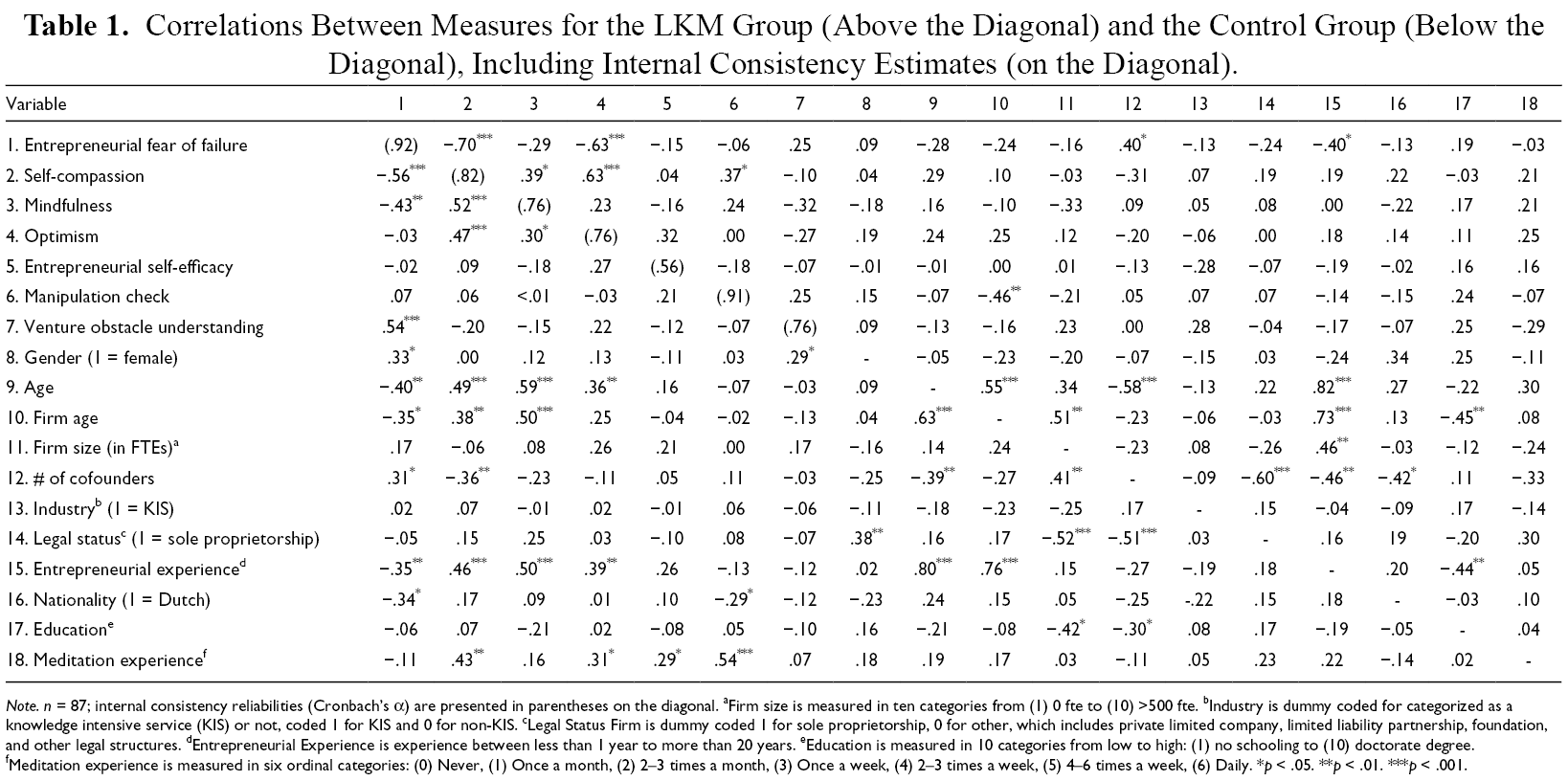
Note. n = 87; internal consistency reliabilities (Cronbach’s α) are presented in parentheses on the diagonal. aFirm size is measured in ten categories from (1) 0 fte to (10) >500 fte. bIndustry is dummy coded for categorized as a knowledge intensive service (KIS) or not, coded 1 for KIS and 0 for non-KIS. cLegal Status Firm is dummy coded 1 for sole proprietorship, 0 for other, which includes private limited company, limited liability partnership, foundation, and other legal structures. dEntrepreneurial Experience is experience between less than 1 year to more than 20 years. eEducation is measured in 10 categories from low to high: (1) no schooling to (10) doctorate degree. fMeditation experience is measured in six ordinal categories: (0) Never, (1) Once a month, (2) 2–3 times a month, (3) Once a week, (4) 2–3 times a week, (5) 4–6 times a week, (6) Daily. *p < .05. **p < .01. ***p < .001.
Means, Standard Deviations, and Randomization Checks.
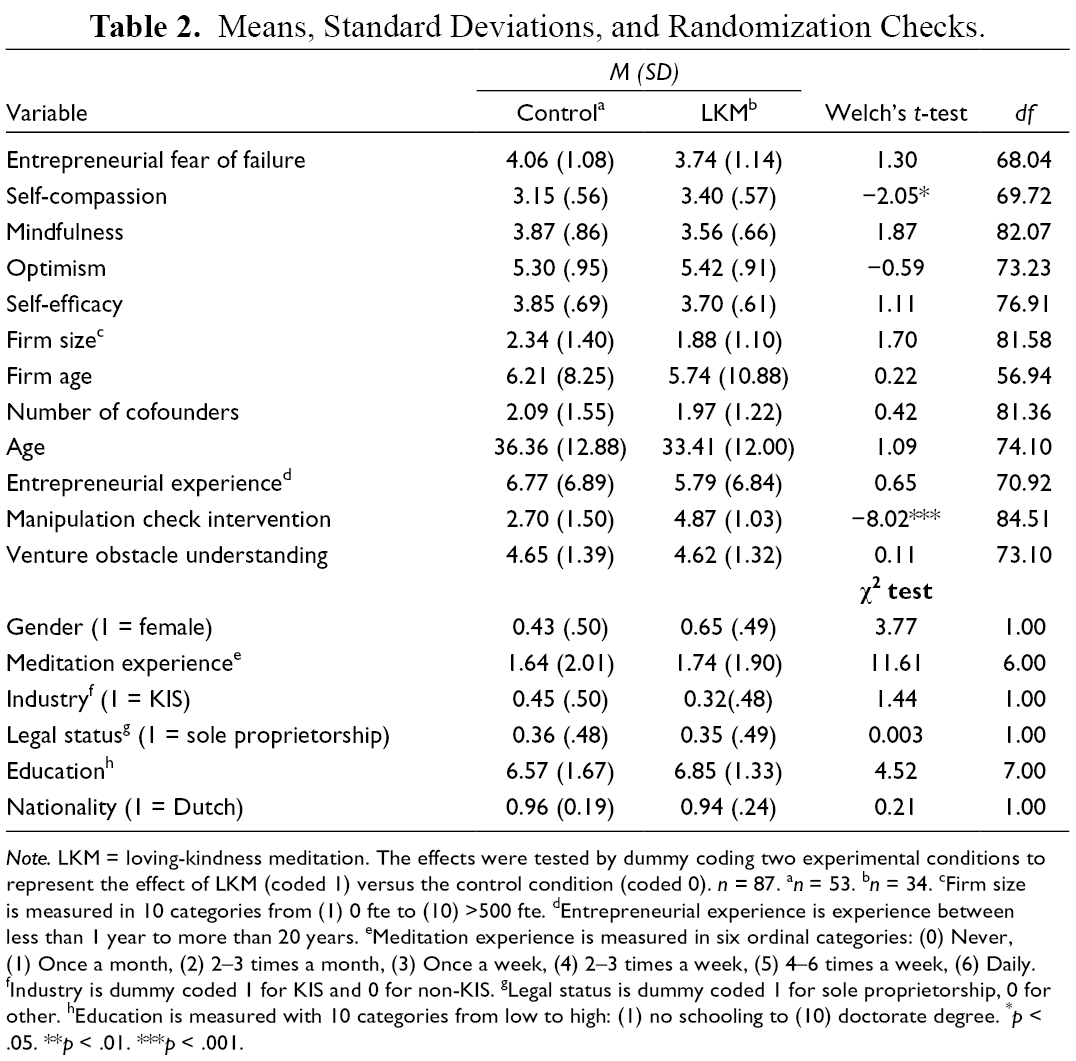
Note. LKM = loving-kindness meditation. The effects were tested by dummy coding two experimental conditions to represent the effect of LKM (coded 1) versus the control condition (coded 0). n = 87. a n = 53. b n = 34. cFirm size is measured in 10 categories from (1) 0 fte to (10) >500 fte. dEntrepreneurial experience is experience between less than 1 year to more than 20 years. eMeditation experience is measured in six ordinal categories: (0) Never, (1) Once a month, (2) 2–3 times a month, (3) Once a week, (4) 2–3 times a week, (5) 4–6 times a week, (6) Daily. fIndustry is dummy coded 1 for KIS and 0 for non-KIS. gLegal status is dummy coded 1 for sole proprietorship, 0 for other. hEducation is measured with 10 categories from low to high: (1) no schooling to (10) doctorate degree. * p < .05. **p < .01. ***p < .001.
Preliminary Tests
Randomization Checks
Independent t-tests and chi-square tests for independence indicate that there was no significant difference between the control group and the experimental group for any of the measured control variables in this study (Table 2). This indicates that randomization into the experimental conditions was successful.
Manipulation Checks
The control condition (M = 2.70, SD = 1.50) and LKM condition (M = 4.87, SD = 1.03) differed significantly (t(84.51) = −8.02, p < .001, d = −1.69) on the manipulation check. This confirms that unlike the control group, entrepreneurs in the LKM group actually meditated while listening to the audio fragment. This indicates that the LKM manipulation was successful.
As designed, no significant difference was found between the control group (M = 4.65, SD = 1.39) and LKM group (M = 4.62, SD = 1.32) in evaluating and understanding the fear-inducing scenario (t(73.10) = .11, p = .911, d = .025). This indicates that both groups understood the drop-in-demand scenario in the same way and, therefore, differences in entrepreneurial fear of failure cannot be explained by different interpretations of the scenario inducing it. The mean scores for this variable show that in both groups, entrepreneurs recognized that they were dealing with a threatening venture obstacle. Further, this variable (reflecting a participant’s understanding of the obstacle) was not significantly correlated with self-compassion; however, it was positively and significantly correlated with entrepreneurial fear of failure in the control group (r = .54, p < .001) but not in the LKM group (r = .25, p = .15). This provides empirical support for our theoretical assumption that threat recognition can be independent of the experience of fear and that LKM and self-compassion may modulate fear reactivity without necessarily affecting threat recognition.
Additionally, the scenario was seen as believable and realistic across the conditions (M control = 4.98, SD = 1.31; M LKM = 5.21, SD = 1.39; t(67.43) = −.75, p = .454, d = −.17), and participants also reported that they could imagine themselves in the situation described in the scenario (M control = 4.89, SD = 1.40; M LKM = 4.97, SD = 1.34; t(72.73) = −.28, p = .780, d = −.06).
Hypotheses Testing
Hypothesis 1 was first tested by examining whether the LKM intervention, when compared to the control condition, positively affects entrepreneurs’ self-compassion. Consistent with our theoretical expectation, the entrepreneurs who had been randomized to listen to the guided LKM reported significantly higher self-compassion (M = 3.40, SD = .57) than entrepreneurs in the control group (M = 3.15, SD = .56), t(69.72) = −2.05, p < .05, d = .45 (Figure 2). This effect size implies that 67% of participants in the LKM group reported higher self-compassion than the mean for the control group and the chance that a person picked at random from the LKM group will have a higher level of self-compassion than a person picked at random from the control group was 62% (see http://rpsychologist.com/d3/cohend/ for calculations). Therefore, our first hypothesis was supported.
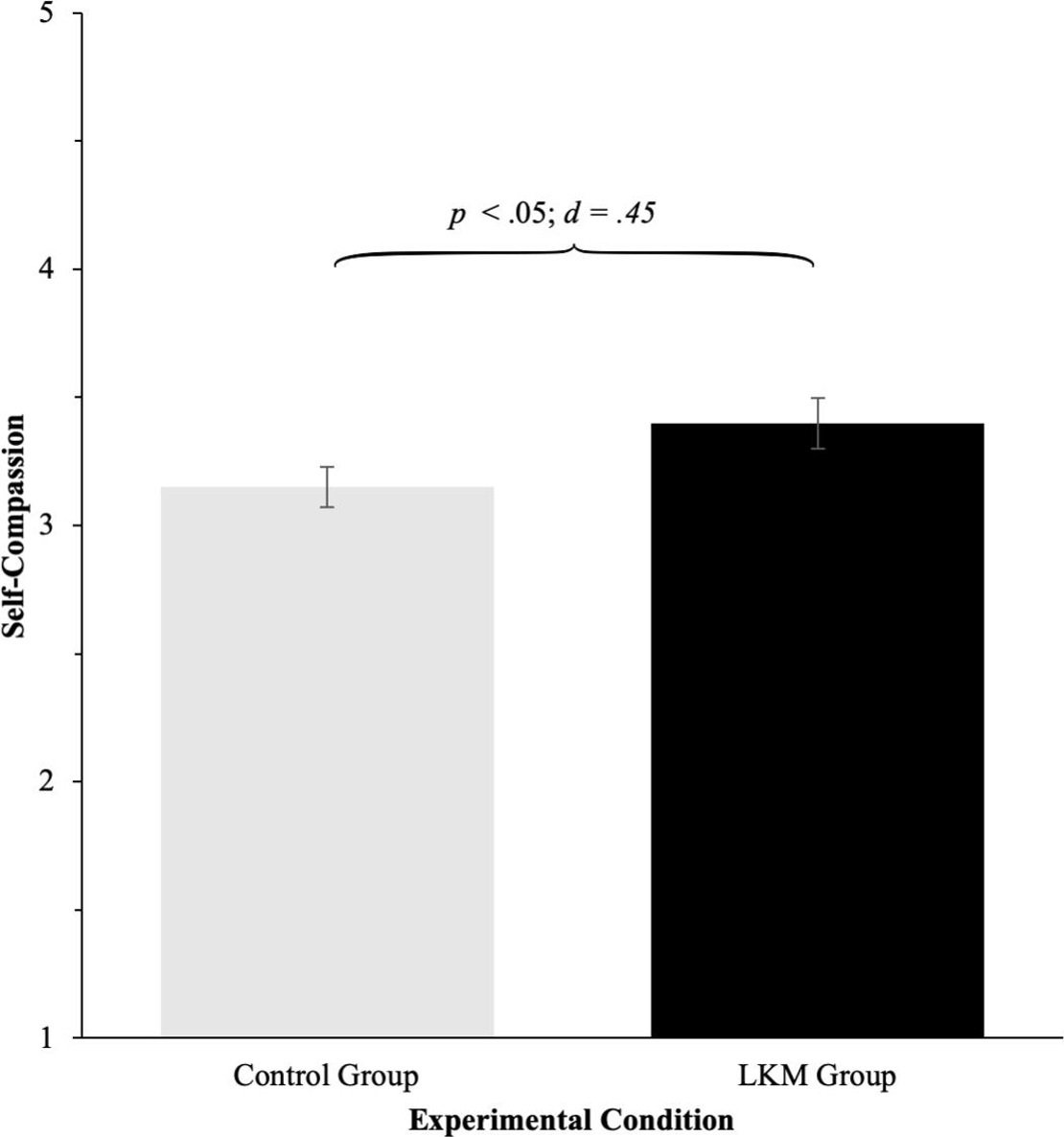
Graph depicting the effect LKM on self-compassion; error bars represent standard errors of the mean. Note. LKM = loving-kindness meditation.
A bootstrapping procedure was then used for estimating direct and indirect effects with a mediator (Hayes, 2013), using 5,000 bootstrap samples. We examined the mediating role of self-compassion in the relationship between LKM and entrepreneurial fear of failure (Table 3 and Figure 3). Providing additional support for Hypothesis 1, the unique direct effect of LKM on self-compassion was positive and significant (b = .25, SE = .12, 95% CI [.01, .50]).
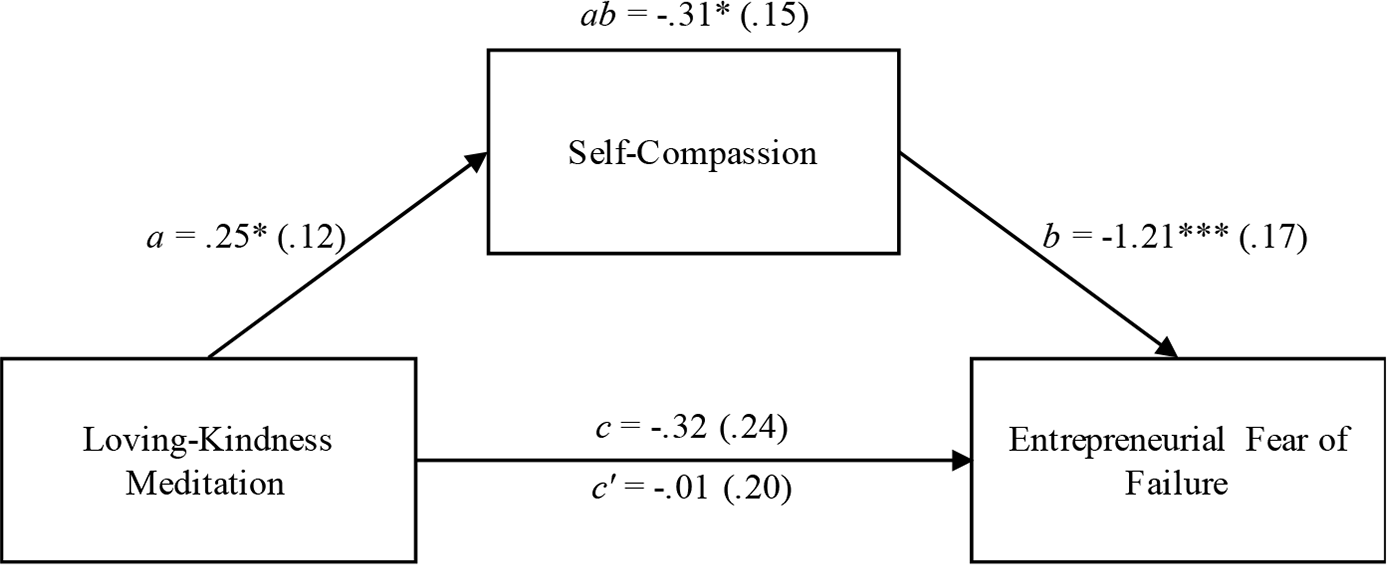
Total, direct, and indirect effects of LKM through self-compassion on entrepreneurial fear of failure; ab is the unique indirect effect of LKM on entrepreneurial fear of failure; unstandardized regression coefficients on the paths, standard errors between parenthesis. Note. LKM = loving-kindness meditation. *p < .05, **p < .01, ***p < .001.
Mediation Results.
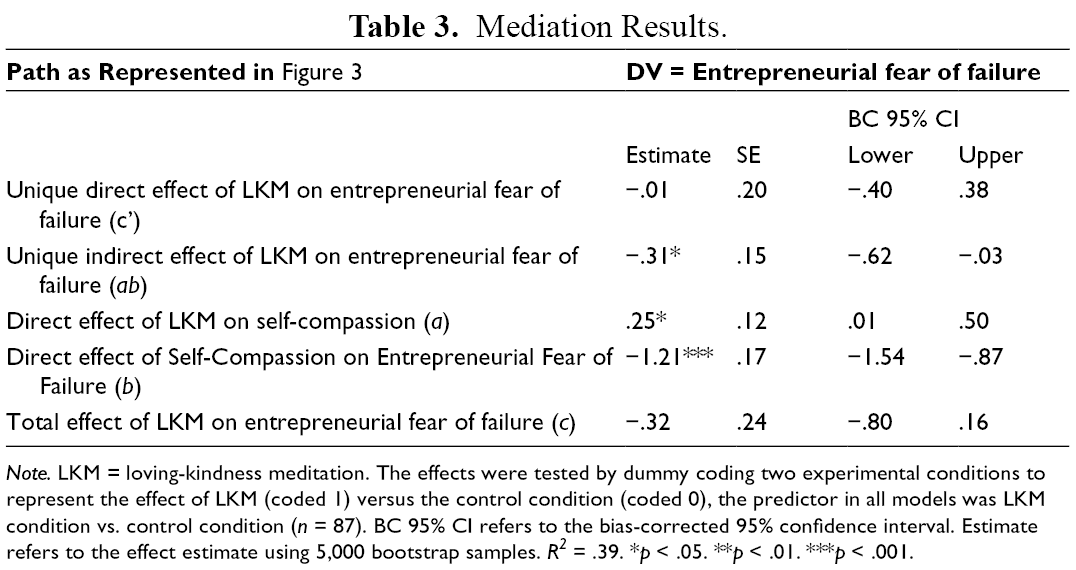
Note. LKM = loving-kindness meditation. The effects were tested by dummy coding two experimental conditions to represent the effect of LKM (coded 1) versus the control condition (coded 0), the predictor in all models was LKM condition vs. control condition (n = 87). BC 95% CI refers to the bias-corrected 95% confidence interval. Estimate refers to the effect estimate using 5,000 bootstrap samples. R 2 = .39. *p < .05. **p < .01. ***p < .001.
In support of Hypothesis 2, we found that the unique direct effect of self-compassion on entrepreneurial fear of failure was negative and significant (b = −1.21, SE = .17, 95% CI [−1.54, −.87]). In support of Hypothesis 3, we found a significant negative indirect effect of LKM on entrepreneurial fear of failure through self-compassion (b = −.31, SE = .15, 95% CI [−.62, −.03]). The total effect of LKM on entrepreneurial fear of failure (b = −.32, SE = .24, 95% CI [−.80, .16]), while pointing in the same direction, was not significant at the 5% level. Based on the recommendations of Wen and Fan (2015), the high ratio between the indirect and total effect of LKM on entrepreneurial fear of failure (PM = .97) indicates that the effect of LKM on entrepreneurial fear of failure can almost completely be attributed to the mediation of self-compassion.
Post Hoc Robustness Tests
We have taken several steps to further examine the robustness of our model. First, because mediation models can be vulnerable to bias when common causes of mediator and outcome are not accounted for (Loeys et al., 2014; Yzerbyt et al., 2018), we added several covariates to our model: age, gender, entrepreneurial experience, optimism, mindfulness, and entrepreneurial self-efficacy, controlling for their effects statistically in addition to experimentally. We found only minor changes in the results compared to our original model (Appendix Table A2). Nevertheless, in this analysis, the total effect of LKM on entrepreneurial fear of failure became significant at the 5% level (b = −.62, SE = .23, 95% CI [−1.07, −.17]). Additionally, a significant effect of gender on entrepreneurial fear of failure emerged (b = .50, SE = .19, 95% CI [.12, .90]), indicating that entrepreneurial fear of failure was higher for females than for males. This finding was further explored by specifying a new moderated mediation model (PROCESS model 14; Hayes, 2013), adding gender to our original model as a moderator on the path between self-compassion and entrepreneurial fear of failure (Appendix Table A3). We found a significant interaction effect of gender and self-compassion on entrepreneurial fear of failure (b = −.74, SE = .31, 95% CI [−1.35, −.12]). While significant for both genders, the effect of self-compassion on entrepreneurial fear of failure was almost twice as strong for females (b = −1.53, SE = .21, 95% CI [-1.94,, 1.12]) than for males (b = −.79, SE = .24, 95% CI [−1.26, −.32]). However, the index of moderated mediation was not significant at the 5% level (index = −.19; SE = .013; 95% CI [−.50, .01]) indicating no significant gender differences in the conditional indirect effects of LKM, via self-compassion, on entrepreneurial fear of failure (b females = −.39, SE = .18, 95% CI [−.75, −.03]; b males = −.20, SE = .12, 95% CI [−.47, −.01]). Overall, while not hypothesized, that the negative association between self-compassion and fear of failure is stronger for females than for males makes for an interesting exploratory finding with potential implications for future research.
Second, we estimated our model on each of the six subscales of entrepreneurial fear of failure to examine whether the effects we observed were driven by a specifically strong association with one of these sources. Again, while we did not initially hypothesize such differences, investigating them post hoc can provide direction for future studies. The subscales of entrepreneurial fear of failure, based on Cacciotti et al. (2016), are fear deriving from (1) opportunity costs, (2) financial security, (3) personal ability, (4) the ability to fund the venture, (5) the potential of the idea, and (6) threat to social esteem. A consistent trend was found across these alternative dependent variables providing support for the mediating role of self-compassion (Appendix Table A4). Nevertheless, differences were found in the strength of the effects. The indirect effect of LKM through self-compassion on fear of failure as based on threat to social esteem (b = −.41, SE = .21, 95% CI [−.88, −.03]) was almost twice as strong as the effect on fear based on financial security (b = −.24, SE = .14, 95% CI [−.61, −.03]).
Finally, despite prior LKM studies documenting intra-individual changes in self-compassion (Boellinghaus et al., 2014; Fredrickson et al., 2008; Galante et al., 2014), we were concerned that without a baseline measure of self-compassion, our conclusions about the effect of a brief LKM may be undermined. To provide a more robust test of Hypothesis 1, which is the basis for our mediation analysis, we collected additional data via the Prolific.co online panel (Palan & Schitter, 2018). Using strict prescreening criteria (see Appendix Table A5), we sampled 98 U.S.-based entrepreneurs (see Appendix Table A6 for sample characteristics). We measured self-compassion with the SCS-SF (Pepping et al., 2015; Raes et al., 2011) three times on a seven-point scale: (1) before participants were randomized into the experimental conditions (identical conditions to our main data collection; pre; α = .80); (2) after the audio segment (post; α = .85), and (3) at the very end of the questionnaire (end; α = .85). After confirming randomization 9 and manipulation check results (Appendix Table A6), we conducted a two (condition: control, LKM) by three (time: pre, post, end) repeated-measures ANOVA with Greenhouse–Geisser correction. Findings indicated a significant condition by time interaction [F(1.76, 169.39) = 17.63, p = <.001, η2 p = .16]. Follow-up paired sample t-tests using the Bonferroni correction revealed that LKM induced an increase in self-compassion from pre to post (M LKM(pre) = 4.47, SD = .92; M LKM(post) = 5.12, SD = .83; t(192) = −8.02, p = <.001, d = .94) and pre to end (M LKM(end) = 4.88, SD = .87; t(192) = −5.04, p = <.001, d = .59). Participants in the control group showed no significant differences across the three measures (M Control(pre) = 4.61, SD = .81; M Control(post) = 4.59, SD = .85; M Control(end) = 4.50, SD = .95). In addition, the between groups difference in self-compassion was significant at post (M Control(post) = 4.59, SD = .85; M LKM(post) = 5.12, SD = .83; t(95) = −3.09, p = .003, d = .63) and at the end of the study (M Control(end) = 4.50, SD = .95; M LKM(end) = 4.88, SD = .87; t(93.1) = −2.03, p = .045, d = .41), but not at pre (M Control(pre) = 4.61, SD = .81; M LKM(pre) = 4.47, SD = .92; t(95.9) = .79, p = .43, d = .16. See Appendix Figure A1). We can therefore conclude that our brief LKM intervention elicited a statistically significant increase in self-compassion, and that this increase remained significant at least within the duration of our study (approximately 20 min).
Overall, these additional tests provide further support for our proposed model and offer interesting directions for future research.
Discussion
Because fear-inducing obstacles are everywhere in entrepreneurship (Kollmann et al., 2017) and fear of failure constitutes an integral part of the entrepreneurial journey (Cacciotti et al., 2016), it is crucial to understand the factors that promote resilience and enhance entrepreneurs’ ability to cope with fear of failure. Our study joins a recent upsurge in research on the topic (e.g., Cacciotti & Hayton, 2015; Cacciotti et al., 2016; Kollmann et al., 2017; Morgan & Sisak, 2016), and adds to the field’s collective understanding of how people effectively cope with fear-inducing obstacles throughout the entrepreneurial process.
Our main objective was to examine an alternative coping mechanism for entrepreneurial fear of failure, one that can potentially sidestep the disadvantages of overly positive self-belief, help ensure that fear of failure motivates rather than impairs entrepreneurial action, and that also represents a practical resource that entrepreneurs can actually use. Specifically, we investigated the extent to which LKM, through the self-compassion that it engenders, can counteract entrepreneurs’ fear of failure when they encounter an obstacle that threatens their venture.
Our findings suggest that, when compared to an active control group, just a few minutes of listening to a guided LKM audio were sufficient to generate self-compassion among entrepreneurs. In turn, there was a strong negative association between self-compassion and entrepreneurial fear of failure when these individuals were presented with a threatening obstacle to their venture. Crucially, this study has shown that the comparatively weaker fear reactivity among participants in the LKM group did not come at the expense of recognizing the threat itself or misunderstanding its severity. With these findings, we make several theoretical contributions and offer practical implications for entrepreneurs and educators.
Theoretical Implications
The broader question that this study aims to answer is how entrepreneurs can thrive while working under difficult task conditions. The typical entrepreneur routinely faces challenges, obstacles, and threats to venture goals, which can cause stress and induce fear of failure (Cacciotti et al., 2016; Kollmann et al., 2017; Rauch et al., 2018). At the same time, fear of failure may serve as a useful feedback signal that a threat to venture goals—or associated personal goals and standards—is at stake. Nevertheless, entrepreneurial fear of failure remains an aversive and stressful experience, calling to question whether venture threats can still be accurately perceived (without resorting to denial or overconfidence) if the experience of fear is less negatively salient. Our model and results suggest that LKM, by means of the self-compassion it generates, can help entrepreneurs in retaining the information for which fear of failure is a feedback signal while reducing the stressful and aversive experience that fear of failure represents. From a broader perspective, this signifies the idea that entrepreneurship entails both having to deal with any aspect of the venture and its environment, as well as a subjective pathway involving effective self-regulation (Rauch et al., 2018; Stephan, 2018). The latter means building resilience concerning fear-inducing venture obstacles (Baron et al., 2016; Chadwick & Raver, 2018; Kollmann et al., 2017).
As hypothesized and empirically shown in this paper, the development of self-compassion through meditation builds resilience to entrepreneurial fear of failure in the face of threatening venture obstacles. Part of the self-compassion construct is that it takes a benign view on the self and others, without denying the relevance of a looming threat (Allen & Leary, 2010; Leary et al., 2007; Neff et al., 2005; Neff & McGehee, 2010). Other studies that more broadly deal with negative emotions in entrepreneurship have focused on the advantages provided by positive emotions (e.g., Baron, 2008; Cardon et al., 2009) or the buffering effect afforded by a positive self-image like self-esteem or confidence (Baumeister et al., 2003; Hayward et al., 2010). By focusing on self-compassion, we offer a novel perspective that sidesteps the pitfalls associated with positive self-beliefs, such as hubris or narcissism (Hayward et al., 2006). As such, our findings contribute to the ongoing efforts to explain the interaction of external triggers and internal emotional states in predicting entrepreneurial experiences, not only before starting up but also during the venturing process (e.g., Cacciotti et al., 2016).
More specifically, we advance the emerging theory of entrepreneurial coping. Patzelt and Shepherd (2011) teach us that problem-focused and emotions-focused coping can help individuals balance the negative emotions associated with self-employment (e.g., stress, loneliness, fear of failure) while their business is ongoing. Uy et al. (2013), who posit that entrepreneurship can be rewarding yet stressful, provide the insight that entrepreneurs manage to deal effectively with stress by active coping and—if experienced—by temporary avoidance coping. Cacciotti et al. (2016) have added a further element by showing that coping responses fall into three classes: motivation, inhibition, and repression. The idea that fear of failure can result in motivation, rather than inhibition or repression, is important. This paper adds the insight that self-compassion can help facilitate motivation rather than inhibition, by reducing the intensity of the negative feeling, without resorting to repression.
Within the entrepreneurship literature, Shepherd and Cardon (2009) conceptually introduced self-compassion; however, it was never studied empirically. We, therefore, offer the first empirical evidence for the relevancy of self-compassion for entrepreneurship theory and in particular to studies about resilience and coping with fear (e.g., Chadwick & Raver, 2018; Patzelt & Shepherd, 2011). By conceptualizing self-compassion in entrepreneurship as a means to build resilience (Rutter, 1987, 2012) and showing that it is associated with reduced fear reactivity, we speak to scholars working on ways to better understand and address the experience of fear in the entrepreneurial context (Cacciotti et al., 2016; Kollmann et al., 2017). Put differently, a shift toward coping is warranted in light of our “limited understanding of how people experience fear of failure and respond to it throughout the entrepreneurial process” (Cacciotti et al., 2016). In that sense, our findings are potentially meaningful even more broadly as self-compassion may also serve to disarm other negative emotions (e.g., Leary et al., 2007). We therefore hope to encourage a stream of exciting research on the relationship between self-compassion and entrepreneurship-relevant psychological constructs such as stress, anxiety, and grief (Cardon et al., 2012; Frese & Gielnik, 2014; Rauch et al., 2018; Shepherd, 2003). For example, self-compassion may help individuals whose projects or ventures have failed to move faster to a restoration orientation (Shepherd, 2003; Shepherd & Cardon, 2009).
While our focus on the role of self-compassion is largely consistent with prior findings in psychology (Leary et al., 2007; Neff et al., 2005), it also offers additional contributions to the general self-compassion literature. So far, the efficacy of self-compassion in dealing with fear of failure has only been explored anecdotally in a limited educational context among undergraduates (Leary et al., 2007; Neff et al., 2005). Here, however, we examine this relationship with a sample of entrepreneurs, thus providing necessary support for the broad applicability of self-compassion in coping with fear. Moreover, our study provides a unique empirical contribution to the self-compassion literature by directly addressing one of the core tenants of self-compassion theory—that it can fend off aversive emotions without compromising on the accuracy of cognitive threat recognition (Leary et al., 2007; Neff et al., 2005). This finding, particularly because it is situated within the entrepreneurship context (Cardon et al., 2012; Shepherd & Wiklund, 2019), opens the door for future studies in psychology to examine the conditions under which self-compassion alters the tradeoff between affective reaction and perceptual accuracy of threats.
Finally, by designing a meditation-based intervention, we provide important information on how and to what degree entrepreneurs can become more self-compassionate. Self-compassion is believed to be a teachable skill (Neff & Germer, 2013), and the literature on LKM as its antecedent, is growing rapidly (e.g., Fredrickson et al., 2008; Galante et al., 2014). Thus, as the first study to introduce LKM to entrepreneurship, we hope that our promising findings stimulate a deeper and broader investigation of meditation in the entrepreneurial context. If this perspective is adopted, the potential impact on theory development as well as future empirical studies is immense (see Good et al., 2016 for related ideas about the role of mindfulness meditation in management theory). For instance, next to inducing self-compassion, LKM has been studied as a driver of compassion for others (Galante et al., 2014) and may thus be of interest for entrepreneurship scholars who view compassion as the core motivation for social entrepreneurship and ethical decision-making (Miller et al., 2012; Shepherd, 2015). Similarly, LKM interventions are effective in enhancing prosocial attitudes and social connectedness—feelings of social connection and positivity toward others, even those who are yet to enter one’s circle of trust (Fredrickson et al., 2008; Hutcherson et al., 2008). This may be relevant for the emerging literature about entrepreneurial networking (Engel et al., 2017) as well as to studies about entrepreneurial team dynamics (e.g., Breugst & Shepherd, 2017).
Practical Implications
From a practical perspective, our findings suggest that entrepreneurs, who often experience fear of failure, could be helped by a simple LKM intervention to increase self-compassion. Indeed, the entrepreneurs participating in our study demonstrated how easily they could practice LKM by themselves, with only minimal time investment. This can be done as a preventive step—allowing entrepreneurs to prepare in advance for their encounter with fearful events. This can also be used more concurrently across a variety of situations when self-compassion is known to be particularly effective as, for example, when entrepreneurs become stressed or demoralized (e.g., Allen & Leary, 2010; Rauch et al., 2018; Sbarra et al., 2012) and when rumination prevents them from sleeping well (e.g., Kollmann et al., 2019; Murnieks et al., 2019; Neff & Vonk, 2009). Because of their busy lives and long working hours compared to employees (Hartog et al., 2010), LKM provides a practical and accessible intervention for entrepreneurs, allowing our study to establish a much-needed link between theory and practice (Wiklund et al., 2019). Along the same lines, this study also offers valuable implications to entrepreneurial education. Educators, who attempt to familiarize students with the challenges that entrepreneurship may entail, can incorporate mediation practice into their classrooms. This may become particularly relevant when students learn about ways to cope with entrepreneurial challenges and their associated fear of failure (e.g., Cacciotti et al., 2016; Shepherd, 2004).
Limitations and Suggestions for Future Research
This study’s findings should be considered in light of its limitations. First, the majority of our respondents participated online, at their own time and place, making it impossible to know the extent to which they were focusing on the meditation. However, although we could not control for this in a manner comparable to laboratory studies, we still found a strong effect for the intervention. Considering the chance that some of the participants might have been distracted during the study, the true impact of this intervention might be even stronger. Nevertheless, for a more precise estimation for the effects of LKM on self-compassion and fear of failure, future research could replicate our study in a laboratory-like setting and utilize different samples.
Second, we acknowledge that the participants in our study made decisions about hypothetical situations that do not consider all the information embedded within “real-life” entrepreneurial experiences. Specifically, the fear-inducing obstacles that the participants were presented with are not likely to accurately induce the full emotional burden of entrepreneurial fear of failure. In addition, in our attempt to adapt the scale items to fit with this hypothetical situation, we have essentially asked participants to report how they “would” feel rather than report directly about their experience. Thus, despite our careful attention to adopting a scenario that faithfully represented reality and was validated in prior research (Kollmann et al., 2017), we recommend that future research tests our hypotheses in a more natural field setting and with measures that can tap into the lived experience of entrepreneurial fear of failure.
Third, we acknowledge the possibility that, next to self-compassion, other alternative mechanisms exist that transmit the effect of LKM on entrepreneurial fear of failure. For instance, LKM has been shown to increase compassion for others (Kreplin et al., 2018; Leiberg et al., 2011; Weng et al., 2013), thereby potentially broadening a narrow focus on the self (Fredrickson et al., 2008) and assisting in coping. At the same time, whereas the evidence of LKM affecting compassion to others is strong, the relationship between compassion (in comparison to self-compassion) and entrepreneurial fear of failure is less clear and requires further theory development before it can be tested. For instance, future studies could explore whether LKM’s focus on compassion to oneself and others might impact fear of failure by shifting one’s temporal focus (Foo et al., 2009; Shipp et al., 2009) away from the future and into the present moment.
Self-compassion may also be subject to a “to-much-of-a-good-thing effect” (Pierce & Aguinis, 2013). Like other positive emotions, at very high levels self-compassion can be expected to interfere with cognition, perception, motivation, and self-regulation to the extent that it may jeopardize sound reasoning and logic (e.g., Baron et al., 2012). To the best of our knowledge, however, no evidence for such an effect involving self-compassion exists to date. Moreover, studies comparing the impact of self-compassion and self-esteem on well-being find that self-compassion provides greater resilience and stability with fewer downsides (Leary et al., 2007; Neff, 2011). This does not negate the possibility that self-compassion might have a debilitating impact at extremely high levels but suggests that the threshold for these effects is relatively higher than for other positive emotions.
Going further, some effects surfaced in our post hoc analysis that might be particularly interesting for future research. For example, an indication for gender differences in entrepreneurial fear of failure was found, suggesting that women displayed higher levels of entrepreneurial fear of failure compared to men. This type of difference, while discussed in prior studies (e.g., Shinnar et al., 2012), is fascinating when considering the possibility that it may also interact with self-compassion. Indeed, previous research also found self-compassion to be slightly lower for woman compared to men (Yarnell et al., 2015). Thus, future research could benefit from investigating the role of gender in the relationship between self-compassion and entrepreneurial fear of failure. Additionally, our post hoc analysis suggests that fears related to the social status and self-image of the entrepreneur, like fears related to social esteem or personal abilities, are more susceptible to the “undoing” effects of self-compassion. Thus, even though our results show that self-compassion is an effective tool to cope with fearful entrepreneurial situations, further research is required to unpack why and when LKM and self-compassion would be most effective as an entrepreneurial coping strategy.
Finally, as the Buddhist tradition teaches, the effects of meditation are likely to intensify with practice (Hofmann et al., 2011). Further research is, therefore, needed to understand the long-term effects of meditation for entrepreneurs. Fortunately, there is a growing body of literature on the long-term impact of meditation that future studies in entrepreneurship can draw on. For example, continued practice is found to transform the short-term affective changes that can be measured shortly after meditation into habitual patterns of responding, and, in some cases, lead to profound neurological and biological changes (e.g., Brefczynski-Lewis et al., 2007; Cahn & Polich, 2006; Le Nguyen et al., 2019). Testing the efficacy of an 8-week-long LKM-based self-compassion intervention program, Neff and Germer (2013) found a significant increase in self-compassion among participants, which were maintained at 6-month and 1-year follow-ups. It is therefore possible that entrepreneurs that adopt a more stable meditation practice and nourish it over an extended period may also develop a more stable sense of self-compassion, allowing them to “conquer their fears” across a wider range of entrepreneurial situations.
Conclusion
A better understanding of coping with fear of failure in entrepreneurship is crucial, because fear of failure often restricts or harms the well-being of entrepreneurs as well as their capacity for entrepreneurial action. This study experimentally tested a theoretical model suggesting that self-compassion—cultivated through a brief guided LKM—may help entrepreneurs to cope with the experience of fear of failure when facing a threatening venture obstacle. Our findings are promising as they point to the potential of LKM and self-compassion to serve as a practically attainable way for entrepreneurs to develop resilience and more effectively cope with entrepreneurial fear of failure.
Supplemental Material
Supplementary Material 1 - Supplemental material for Self-Compassion When Coping With Venture Obstacles: Loving-Kindness Meditation and Entrepreneurial Fear of Failure
Supplemental material, Supplementary Material 1, for Self-Compassion When Coping With Venture Obstacles: Loving-Kindness Meditation and Entrepreneurial Fear of Failure by Yuval Engel, Stephany Noordijk, Afra Spoelder and Marco van Gelderen in Entrepreneurship Theory and Practice
Footnotes
Acknowledgments
We thank the editor Marilyn Uy and three anonymous reviewers for their thoughtful guidance and insightful comments. We are grateful to Melissa Cardon and to participants of BCERC 2018, the 2018 AOM Annual Meeting, and research seminars at the University of Groningen and Eindhoven University of Technology for useful comments on earlier versions of this paper.
Declaration of Conflicting Interests
The author(s) declared no potential conflicts of interest with respect to the research, authorship, and/or publication of this article.
Funding
The author(s) disclosed receipt of the following financial support for the research, authorship, and/or publication of this article: This study was supported by the Netherlands Organization for Scientific Research (NWO) under project number 016.Veni195.133.

Supplemental Material
Supplemental material for this article is available online.
Notes
Author Biographies
References
Supplementary Material
Please find the following supplemental material available below.
For Open Access articles published under a Creative Commons License, all supplemental material carries the same license as the article it is associated with.
For non-Open Access articles published, all supplemental material carries a non-exclusive license, and permission requests for re-use of supplemental material or any part of supplemental material shall be sent directly to the copyright owner as specified in the copyright notice associated with the article.
