




Abstract
We study initial entrepreneurial networking, and describe it as a process of initiating, reacting, and evaluating networking. Our study of student entrepreneurs’ weekly diaries particularly points at the interaction of networking actions and cognitive evaluations. We introduce the concept of network momentum, which refers to the entrepreneur’s perception that the network starts to exist without the immediate effort of the entrepreneur, and we analyze the processes that lead to the establishment of network momentum. Our study contributes to the emergent literature on entrepreneurial networking and the role of cognitive evaluative processes in particular.
Keywords
Because entrepreneurial networks are crucial for new ventures, it is important to understand the processes through which network relations are formed (Hite & Hesterly, 2001; Hoang & Antoncic, 2003). Yet compared with the many studies devoted to the effect of entrepreneurs’ networks (Stam, Arzlanian, & Elfring, 2014), relatively scant attention has been paid to the processes of networking itself (cf. Porter & Woo, 2015). As a result, we know little about why and how entrepreneurs differ in their networking processes. Why are some entrepreneurs more active than others? How do they react to rejections and nonresponses? Answering such questions is both practically relevant and theoretically important; understanding the processes of networking can help explain the origins of crucial differences in entrepreneurs’ networks (Hoang & Antoncic, 2003; Stuart & Sorenson, 2007; Tasselli, Kilduff, & Menges, 2015).
To respond to such questions, recent studies have taken a behavioral turn, focusing on the networking actions of individuals (Engel, Kaandorp, & Elfring, 2017). This attention to actual networking behavior has shed light on the creation of entrepreneurial networks, highlighting differences between broadening and deepening strategies (Vissa, 2012) and revealing how entrepreneurs might strategically create strong ties to harvest important resources (Hallen & Eisenhardt, 2012). However, these studies also cite the need for greater understanding of the cognitive processes that drive networking behaviors (Casciaro et al., 2015; Engel et al., 2017; Porter & Woo, 2015); in particular, we know little about how entrepreneurs perceive, interpret, and respond to signals from (prospective) network contacts.
This study aims to deepen understanding of entrepreneurial networking processes by focusing on cognitive evaluations in relation to networking actions. We build on Porter and Woo’s (2015) conceptual work, which proposes that network partners make cognitive evaluations of each other. We extend this work by adding empirical investigations of the cognitive-evaluative processes in entrepreneurial networking. By inductively developing new concepts, we confirm the influences of evaluating others and identify the importance of evaluating the self, as well as evaluating the networking process.
Accordingly, this study addresses two key research questions: How do nascent entrepreneurs engage in initial networking? How do they perceive and respond to responses from (prospective) network contacts? We address these questions by tracing the networking activities of nascent student entrepreneurs during their 20-week involvement in a university-run venturing program. This research setting allowed us to closely follow networking attempts of 58 student entrepreneurs in 28 start-ups, including access to their reflections on networking activities, which they provided in weekly diaries. The diaries captured their networking actions and provided insights into the student entrepreneurs’ personal evaluations of their own actions and the responses of the people they contacted.
Our study thus contributes to a greater understanding of entrepreneurial networking processes. First, we show that cognitive evaluations of the self, others, and the networking process can help explain variations in entrepreneurial networking behavior. These evaluations are part of a process that comprises three elements: entrepreneurs’ initiating actions, their reactions to responses on contact attempts, and their evaluations of actions and reactions. Crucial differences in the pattern of networking actions are contingent on differences between constructive and unconstructive evaluations. Second, by providing details of these cognitive evaluations, we highlight the importance of perceived networking progress—conceptualized in our study as network momentum—in entrepreneurs’ evaluations of networking and their subsequent networking actions.
Theoretical Background
To understand entrepreneurs’ networking processes, researchers explore various actions and strategies that entrepreneurs employ (Engel et al., 2017). This behavioral approach yields important insights, particularly related to different networking actions and the network structure that emerges (e.g., Bensaou, Galunic, & Jonczyk-Sédès, 2014). For example, entrepreneurs might adopt a broadening networking style to connect with new others, without using many referrals (Vissa, 2012). Conversely, they could work to deepen existing relationships by forming strong ties with key resource providers and heavily relying on referrals (Hallen & Eisenhardt, 2012). Likewise, entrepreneurs can symbolically portray their meaning to acquire resources (Zott & Huy, 2007) or strategically aim for a high-performing portfolio of acquaintances (Ozcan & Eisenhardt, 2009). As Jack (2005) and Elfring and Hulsink (2007) show, entrepreneurs use strong and weak ties in different ways. Strong ties enable them to acquire knowledge and resources and help them build reputations, whereas weak ties provide access to unique sources of information. To create such ties effectively, entrepreneurs may need sufficiently developed political skills (Fang, Chi, Chen, & Baron, 2015).
These results jointly show the importance of entrepreneurial actions and networking skills for the creation and development of networks (Engel et al., 2017). However, their focus is consistently on networking behavior; how entrepreneurs make choices regarding their networking actions and selection of ties remains an open question. In a sense, the behavioral turn seems to run parallel to psychological and cognitive turns in network research (e.g., Casciaro et al., 2015; Landis, 2016; Smith, Menon, & Thompson, 2012), such that they have become separate paradigms. Bridging the paradigms could be fruitful, as exemplified by multiple calls for more insights into the cognitive processes related to entrepreneurial networking (e.g., Engel et al., 2017; Hallen & Eisenhardt, 2012). Specifically, why do entrepreneurs create or fail to create specific networks (Casciaro et al., 2015; Porter & Woo, 2015)? The uncertainty involved in early phases of venture development implies that the success of a networking approach can be evaluated only post hoc; however, choices take place in the moment, which underscores need for longitudinal studies in which both the reasons for choices and the effects of these choices are captured concurrently. To advance theories of entrepreneurial networking, we must attend to the cognitive-evaluative processes that drive actions at the moment of networking (Engel et al., 2017; Porter & Woo, 2015).
Work on network cognition has emphasized more or less static cognitive attributes of individuals that influence networking, such as the self-monitoring trait (Sasovova, Mehra, Borgatti, & Schippers, 2010), and differences in perceiving the social environment (Ibarra, Kilduff, & Tsai, 2005; Krackhardt, 1987). Other studies focus on individual differences in networking styles (Bensaou, Galunic, & Jonczyk-Sédès, 2014; Ebbers, 2014) and how subjective beliefs and feelings influence actual networking (Casciaro, Gino, & Kouchaki, 2014; Kuwabara, Hildebrand, & Zou, 2018). This stream of research has identified stable individual preferences that influence the networking processes, though it has fallen short in explaining the dynamics of individuals’ or teams’ actions over time (Van de Ven & Engleman, 2004).
Therefore, the contribution Porter and Woo (2015) make with a dynamic psychological perspective on networking is a promising avenue to answer questions about why and how entrepreneurs network during the venturing process. They theorize that for each network contact, people develop relational schemas containing information about this partner. These relational schemas provide information to evaluate the partner and the relationship and to make decisions “about whether, with whom, and how to conduct networking interactions” (Porter & Woo, 2015, p. 1482). Regarding the initiation stage of networking—the focus of our study—Porter and Woo (2015) propose that cognitive evaluation centers on the partner’s instrumentality. In other words, the evaluation focuses on potential resources that can be exchanged. Similarly, Engel et al. (2017) propose that entrepreneurial networking is driven by evaluating the means available through existing or new contacts. In the context of emergent ventures and considering the lack of experience of the entrepreneurs we study, they often are not able to evaluate a partner’s instrumentality, because they might not know exactly what type of contacts they need or what means to pursue, even though their networking success depends on how they handle these new and unfamiliar situations. We conjecture that the evaluations of networking contacts, as well as the process itself, largely determine how networking contacts are formed over time.
Methods
Research Approach
Qualitative research approaches, particularly process studies, are well suited to capture change in social networks (e.g., Berends, van Burg, & van Raaij, 2011; Berthod, Grothe-Hammer, & Sydow, 2016) while also accounting for context (Ahuja, Soda, & Zaheer, 2012; Williams & Shepherd, 2015). Therefore, we use a qualitative study with weekly diaries as a primary data source. We study student entrepreneurs in a venturing program in which they were required to write weekly diaries for both educational and research purposes. The goal was to monitor their activities without prescribing any particular actions or reflections. Individual diary entries varied in length from roughly half a page to two pages. Altogether, the student entrepreneurs wrote 859 weekly diaries.
Using the diaries enabled us to concurrently and reflectively capture dynamics in entrepreneurial networking during early venturing. Previous researchers have called for the use of fine-grained, reflective data to clarify the dynamics of entrepreneurial networking (e.g., Engel et al., 2017), as well as to gain insight into other entrepreneurship and management topics (e.g., Qureshi, Kistruck, & Bhatt, 2016; Stewart, 1965). Diaries reveal anticipation and evaluation of actions and serve to reduce unobserved memory decay and hindsight bias (Bird, Schjoedt, & Baum, 2012). In addition, compared with interviews, diaries are not directly influenced by the observer and are time efficient for both the informant and the investigator. Diaries facilitate frequent data collection from the same informants, and they reveal what the student entrepreneurs did during the week, including whom they met, and what they planned to do next week, offering detailed insights into networking processes (e.g., Lichtenstein, Dooley, & Lumpkin, 2006). The diaries thus facilitated a longitudinal study of the cognitive-evaluative aspects of entrepreneurial networking. To offset the shortcomings of diaries (see Bolger, Davis, & Rafaeli, 2003), we also rely on direct observations and additional data sources. Application and admissions information provided information about each student entrepreneur. Business plans, web pages and newspaper clips, and pre- and postprogram surveys gave us background information on the projects. These data sources thus established a comprehensive picture of each case. In our reporting, we primarily refer to the diaries, but we triangulate their information with these other data sources when applicable.
Research Setting
This study focuses on entrepreneurial networking processes by individuals whom we classify as nascent student entrepreneurs. For this study, networking refers to “the practice of building and maintaining professional relationships” (Porter & Woo, 2015, p. 1478). Our focus required a setting in which we could gain fine-grained insights into the dynamics of nascent entrepreneurs’ networking. Therefore, we studied all 28 start-up ventures in the 2009–2010 and 2010–2011 editions of an annual Venturing Program for entrepreneurs in Sweden (Lackéus & Williams Middleton, 2015). The program provides a specific pedagogical approach to entrepreneurship education based on experiential learning, which resembles actual entrepreneurial endeavors in terms of the authenticity of the experience (Miles et al., 2017). Accordingly, a survey of students indicated that 85% stated they were actually starting businesses, rather than doing so as part of an academic exercise (Karlsson & Moberg, 2013). In addition, at least half the emergent ventures continued after the program finished, and 9 of 28 respondents (32%) formally founded a business based on their projects. For example, one alumnus stated: “I was a student in 2009–2010 and now I am working on the project that I founded actually on the program early 2010” (Charity Widget, Jeremy, interview, 20150218).
In this context, the entrepreneurs are students who attempt to create real-life ventures in interaction with real-life stakeholders (Lackéus & Williams Middleton, 2015). These students were enrolled in a 1-year master’s program, comprised of four courses in entrepreneurship, followed by the 20 week Venturing Program, such that “The course focuses on the development of a real-life business project.… The overall objective is to provide students with actionable knowledge of how to successfully commercialize a new venture idea into a viable business” (Course description, 20091102). During the program, student entrepreneurs were expected to write a business plan, work on starting the venture, present their ideas to investors, and exhibit their ideas during a trade show at the end of the program. Some of these 28 nascent ventures were run by teams, but others were individual endeavors, so we had a total of 58 informants. Students were informed about our use of the diaries for educational and research purposes, and they had the opportunity to provide feedback before publication. We used pseudonyms to protect the anonymity of both the projects and the people.
Table 1 indicates whether each emergent venture could rely on existing contacts 1 that were relevant to the venture’s development. Sixteen ventures had at least one relevant contact prior to starting the Venturing Program. Eight teams chose to work on ideas provided by the university technology transfer office. We treated these contacts as preexisting relevant contacts, because students could draw on these contacts (at least initially). In addition, eight student entrepreneurs mentioned relevant contacts, such as family members active in the same industry, or were creating ventures using their relations with established companies with which they previously had collaborated. In 12 cases, we could not identify any such preexisting relevant contacts, and we concluded they had to start from scratch in terms of contacts. Table 1 also shows that the students were mostly international (43 of 58), so they likely had few existing local contacts on which they could draw when starting a venture.
Case Characteristics.

The student entrepreneurs in our study were relatively similar in age. Moreover, they all participated in the same courses during the first semester. They had obtained at least an undergraduate university degree, and all had the same educational objectives for the project. These factors allow us to reduce some sources of unobserved heterogeneity and thus focus on meaningful differences in networking actions and evaluations within this group. In general, these student entrepreneurs have high levels of human capital, are far away from home, and have taken the same entrepreneurship courses prior to the project.
Data Analysis
We employ grounded theory procedures (e.g.,Gioia, Corley, & Hamilton, 2013; Glaser & Strauss, 2009) to develop new concepts related to entrepreneurs’ understanding of networking actions and cognitive evaluations. The analysis primarily focuses on how student entrepreneurs extended their set of contacts beyond the support initially offered by the Venturing Program.
In the first step of the data analysis, we sought an initial understanding of each case from the diaries and constructed Table 1 to delineate the case characteristics, using information from the business plans, admission data, and observational data gathered by one of the authors. Where possible, we calculated relevant measures as numerical indicators of networking processes, which helped us check the overall patterns.
In the second step, we started to analyze networking processes. Here, we coded for both actors and actions, using the diaries and business plans. To ensure consensus in the coding, the research team started by coding three cases together. Next, the authors continuously discussed the codes, the coding procedure, and different interpretations. Initially, we used an open coding structure with only general codes, such as Vissa (2012) “broadening” and “deepening”; we then gradually developed the structure into codes that covered different sorts of networking actions, such as initiations, reactions, and interactions. We then refined and (re)clustered these codes throughout the coding process. By iterating between data and concepts, we developed the final data structure presented in Figure 1. Table 2 provides exemplary quotes and definitions of the concepts.
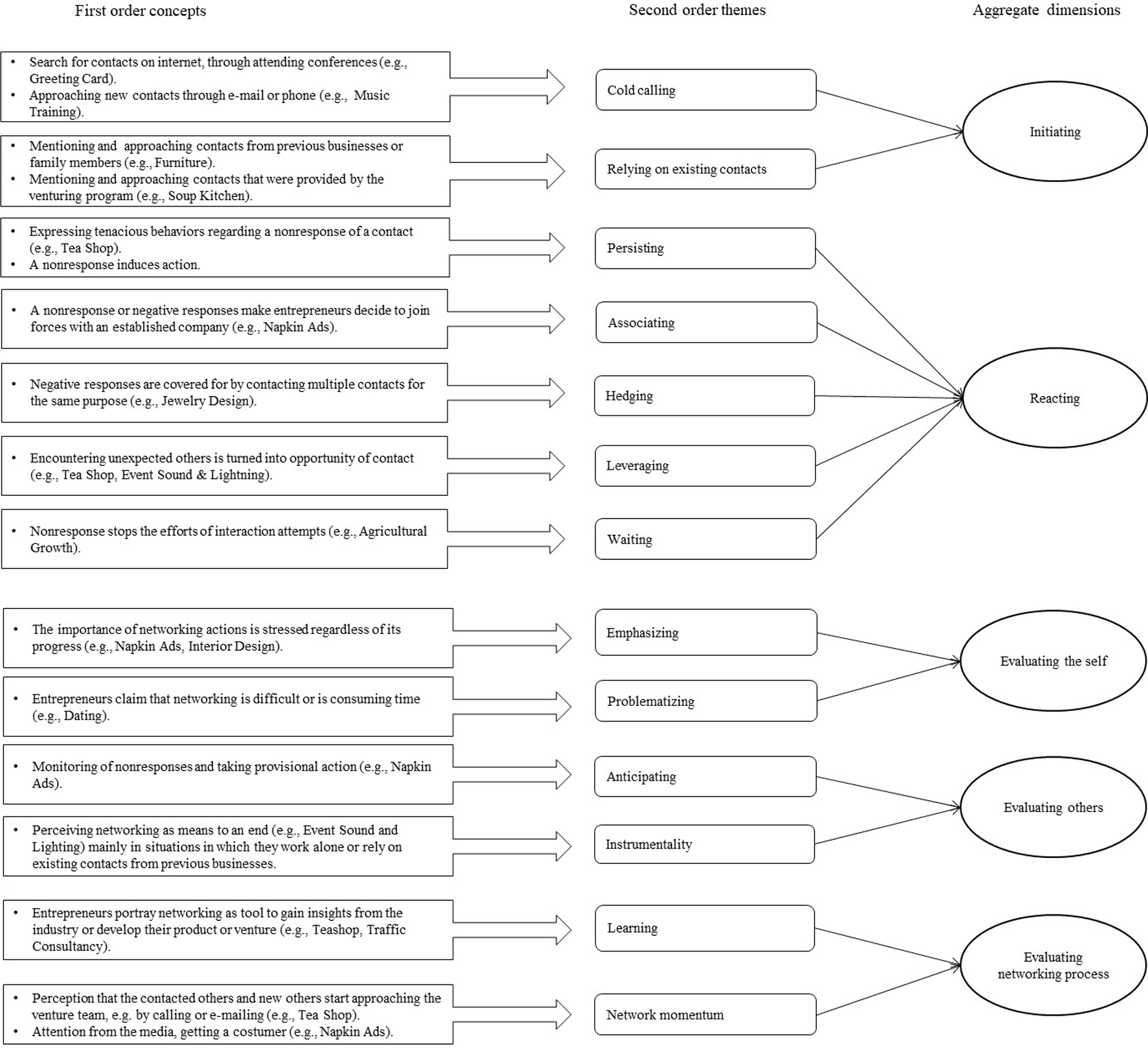
Data structure.
Coding and Exemplary Quotes.
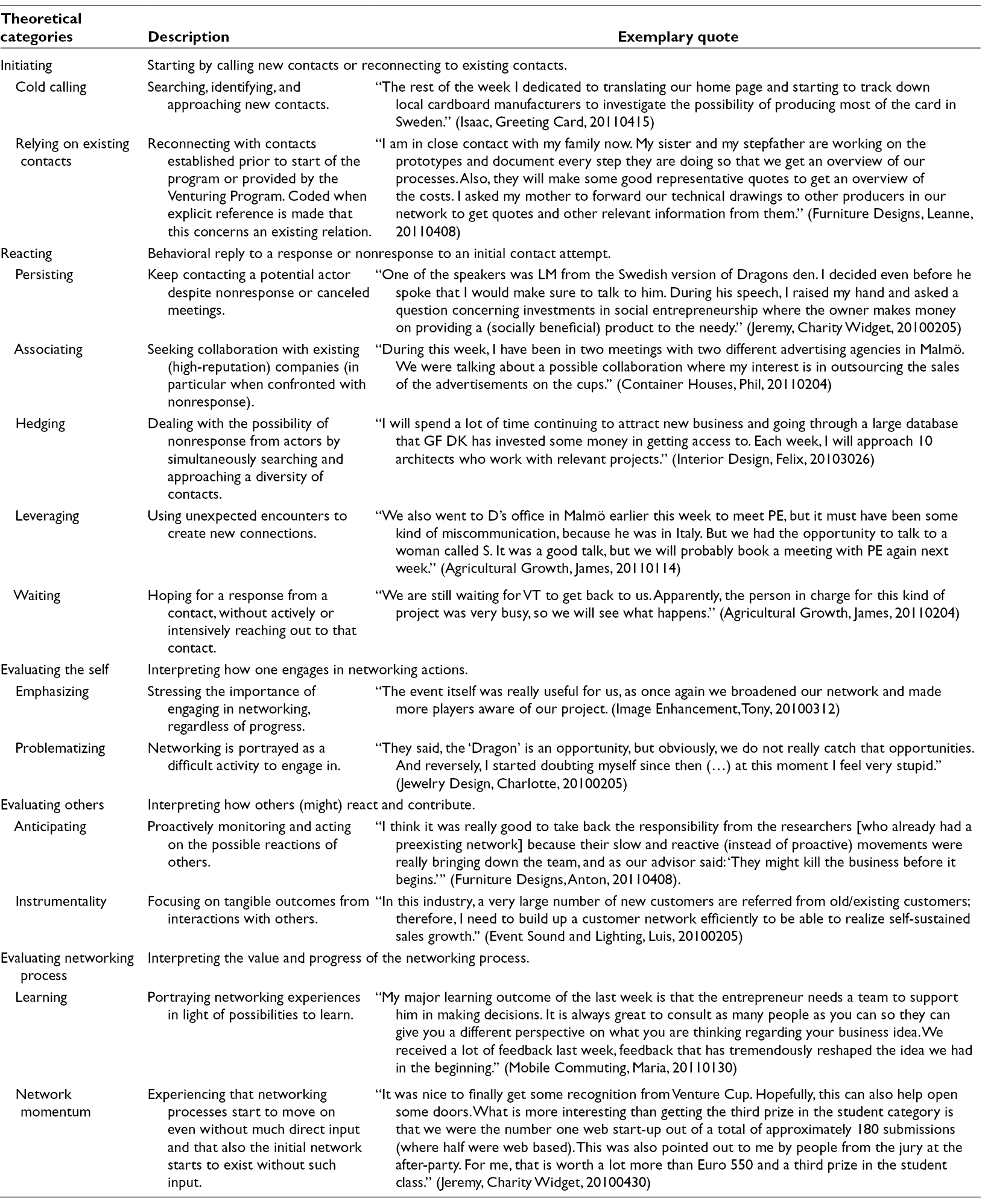
The primary information about networking actions consists of mentions of initial or follow-up interactions with particular people or companies, consistent with Vissa (2012) operationalization of networking actions. We believe such networking actions are central to understanding the process of entrepreneurial networking, but we do not claim that such networking actions indicate that contacts already have turned into weak or strong ties. We coded the actors mentioned in the diaries by personal name or by company if no personal names were indicated. We categorized contacts as new, program provided, or preexisting. If an actor had not been mentioned before and we found no indications of preexisting relationships in the diary, we considered it a new contact attempt. By coding contacts at the venture level, we avoided double-coding members of the same venture. We coded several types of actors (e.g., financiers, customers, competitors). In addition, starting with open coding, we inductively developed networking action codes. We time-stamped each networking action by the date the diary was submitted and coded only for those that had actually taken place that week. We distinguished between first contact attempts and follow-up actions. This step in the analysis clarified the initiated networking actions and reactions to responses by the contacted actors.
The third step focused on developing graphical representations for each case (cf. Langley, 1999; Langley, 2007). We constructed five 4-week program periods as standardized months that excluded weeks in which the Venturing Program did not run (e.g., during the Christmas holiday). We developed tables and graphs to gain a sense of networking processes, depicting the overall number of actors, new actors added during this period, networking activity, and networking outcomes for each 4-week period. In addition, as general indicators of network development, we calculated the number of contacts approached and the duration of the relationship with the contact during the five periods (20 weeks). For example, if someone were mentioned in Period 1 and again in period 3, the duration of contact would be two periods. Table 3 lists these indicators of network development.
Networking Descriptive Statistics.
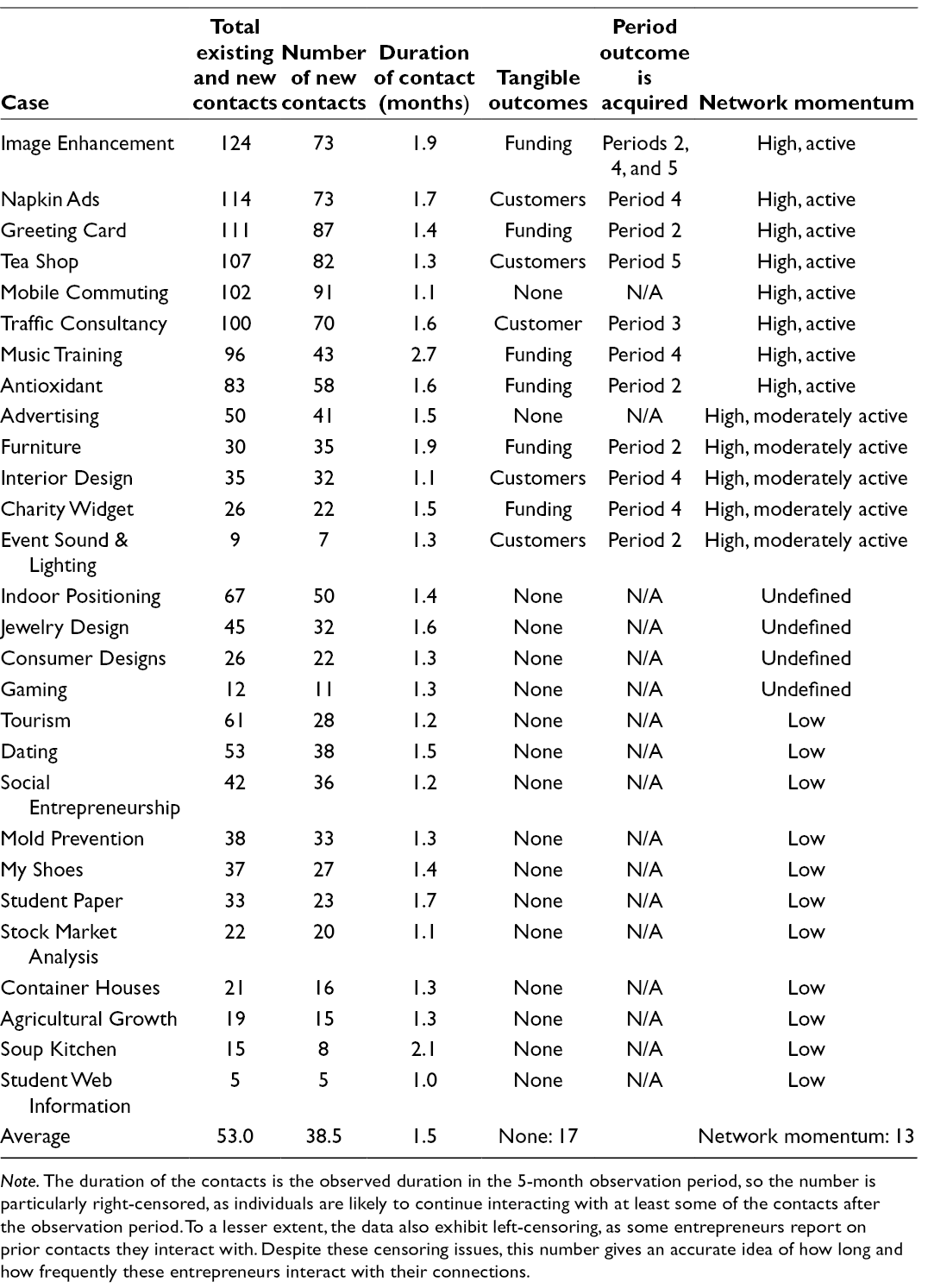
Note. The duration of the contacts is the observed duration in the 5-month observation period, so the number is particularly right-censored, as individuals are likely to continue interacting with at least some of the contacts after the observation period. To a lesser extent, the data also exhibit left-censoring, as some entrepreneurs report on prior contacts they interact with. Despite these censoring issues, this number gives an accurate idea of how long and how frequently these entrepreneurs interact with their connections.
In the fourth step, after having established a comprehensive understanding of networking actions and responses at the venture level, we turned to additional coding of the diaries to deepen our understanding of the process of entrepreneurial networking. In particular, we noted the importance of evaluative processes with regard to the networking actions of initiating and reacting. After coding for networking actions, as explicated previously, we recognized that the observed differences among cases were significantly influenced by how student entrepreneurs evaluated themselves, the responses to their contact attempts, and perceived networking progress. Therefore, we coded for evaluations of networking actions, as well as perceptions of the outcomes of actions (e.g., contacts and contracts with customers, suppliers, and financiers), in both diary and interview data. Doing so resulted in a set of evaluations, as well as evidence of “network momentum” as an indicator of perceived networking progress.
We organized the results of these four steps into two sets of findings. The first set describes categories of actions and evaluations of the student entrepreneurs in the process of creating their network. The second set shows how these categories jointly shed light on the process of creating network momentum.
Findings I: Initiating, Reacting, and Evaluating Networking
Although the student entrepreneurs are relatively similar, the cases show vast differences in their networking activity and network momentum. We define “network momentum” as the primary outcome of this networking process: the experience of student entrepreneurs that the networking process is gaining traction and that their initial network is starting to take shape, even without direct input from them (cf. the concept of momentum in physics). The differences among cases raise a question though: Why do some student entrepreneurs reach network momentum and others do not? This question can be partially answered by differences in the processes of entrepreneurial networking. Therefore, we present a model of entrepreneurial networking that puts evaluation at the center (Figure 1) and that consists of three elements: (a) initiating the network through initial contact attempts, (b) reacting to (non)responses to these contact attempts, and (c) evaluating networking with respect to the self, others, and the networking process.
Initiating
Given the unfamiliarity of the context for many of the student entrepreneurs, they had an eminent need to initiate contacts with new others—and, where possible, to rely on existing contacts. The number of contacts initiated ranged from contacting no actors to contacting 37 actors in the 4-week period (adjusted for the number of team members). A large cluster of people was moderately to very active in initiating (17 cases); a smaller portion was generally less active in initiating new contacts (11 cases). Active initiations were often a team endeavor, and some of them could rely on existing contacts from previous businesses or other ties. Figure 2 displays the networking characteristics of two exemplary cases in terms of activity, one in which the student entrepreneur established network momentum and one in which (s)he did not.
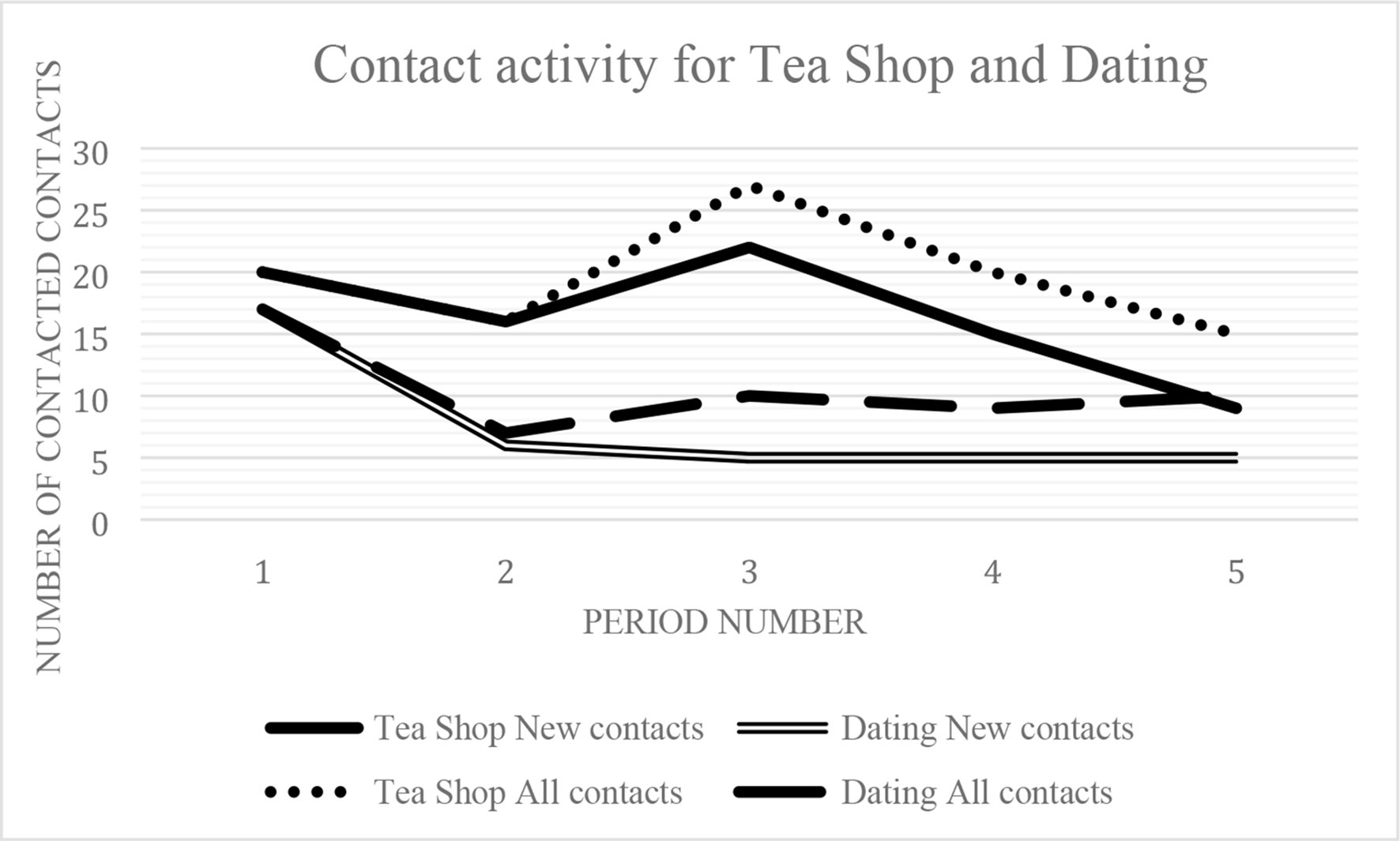
Contact development.
Most student entrepreneurs started with cold calling to initiate new contacts. Their approach varied from contacting targeted actors to attending relevant events to trying to obtain referrals from their personal network, and even to accidently running into potentially useful contacts. Student entrepreneurs who did not have relevant connections had to rely solely on initiating. For example:
The management team is currently working within the program to widen our network and gain access into the consumer electronic markets. (Image Enhancement, Business Plan, 2010)
Others used a less systematic approach, finding that attending industry events such as conferences and seminars could help them meet potential new contacts. Some also obtained referrals from people they met accidently:
I accidently ran into X from Venture Cup, who works at Y, and talked for a while about the Image Enhancement project. He suggested further people we should talk to. (Image Enhancement, Tony, 20100129 2 )
Others could actually rely on existing contacts to initiate their network, though such contacts typically constituted only a fraction of the total number of contacts. Many were contacts provided by the Venturing Program. Some student entrepreneurs had previous business experience or parents who worked in the industry and could thus re-initiate “semi-warm” contacts:
After using my personal network, I managed to get a professional designer who is helping our team with the logo for Social Entrepreneurship and the future visuals for our website. (Social Entrepreneurship, George, 20100405)
Overall, student entrepreneurs who were not very active in initiating new contacts (i.e., low levels of contact activity) had difficulty creating initial network contacts.
Reacting
After initiating contacts, the student entrepreneurs had to perform subsequent actions to maintain and develop their initiated relationships. Here, we noticed important differences in how the student entrepreneurs reacted to responses to their contact attempts. We identified four active and one more passive response. Overall, we conclude that creating a network in a new environment is not easy, as exemplified by the frequent lack of response (nonresponse) or negative responses to their network-initiating actions.
How the student entrepreneurs react to nonresponses is especially crucial for their initial networking. Whereas some persevered in their efforts to reach of a particular contact, others gave up after one or two attempts. Our analysis shows that student entrepreneurs who persevere establish more network connections and maintain them for longer periods of time (Figure 2 and Table 3). For example, the Music Training team was able to maintain its connections for long periods of time, the highest average among all cases (2.7 months out of the 5-month period), and their perseverance resulted in a fairly large set of contacts (96 in total). For them, persisting was the only way to build sufficient relationships, as the diaries and interviews illustrate. One team pursued a potential contact for 4 consecutive months:
I was supposed to meet C from [company] S, but unfortunately, due to time constraints, he was unable to fit us in.… I will, alongside the team, have a telephone interview with him in the New Year. (Music Training, Matt, 20091211)
Sean will be calling C from [company] S Fri the 29th with a list of questions that we have put together for him. (Music Training, Matt, 20100129)
Sean contacted C but has still to hear from him. (Music Training, Matt, 20100205)
We finally met C at [the trade show] K and he will try to help us with our questions for the business plan over the next few days. (Music Training, Matt, 2010312)
By persevering, the team was able to contact this person, despite his initial nonresponse, and he proved to be a great help in launching the venture. A student entrepreneur from another venture reflected on a similar experience in an interview:
The problem for a lot of people is that you stop, the first speed bump you stop. You have to be able to take criticism and continue. Just go with your ideas basically. And you fail, and if you fail, just learn by your failure and then you go on the next one. (Charity Widget, Jeremy, interview, 20150218)
Another reaction to negative responses is to associate with existing companies to put the emergent venture in the spotlight. The founders of Napkin Ads started to associate their venture with established companies after a number of unsuccessful attempts:
We had problems contacting other companies.… We felt that a faster and more effective approach would be to get help from an established company to get us to the market quicker. That is how we found Company A, with well-established backing from Company C. (Napkin Ads, Tom, 20100417)
Other student entrepreneurs mitigated the risk of nonresponse upfront by diversifying the actors they contacted. As they struggled with the difficulty of securing contacts, they also engaged in hedging to obtain at least some relevant contacts for their venture. The founders of Jewelry Design explicitly targeted a variety of contacts:
Attracting investors is NOT easy—even for a general interview. We have tried to send out e-mails and call people from A but they are too busy at this year-end.… Anyways, we have prepared a plan B and C for the worst-case scenarios. (Jewelry Design, Jenny, 20091211)
This week we have tried to search for more suppliers in Sweden. So far, we still haven’t found any yet. The problem is that it’s hard to find suppliers who actually craft their jewelries on their own. Perhaps we should not be so locked in that area. Instead, we could turn to the suppliers who sell different pieces because there are a bunch of Swedish internet-based companies that are doing exactly that. (Jewelry Design, Maria, 2010426)
In addition, when cold calling for new contacts did not work, some student entrepreneurs reacted by leveraging already existing network relations, if available. This approach often was fruitful, as in the Image Enhancement case:
Erik also gave us contacts for a couple of auxiliary companies to the cell phone industry, Company B and Company T. (Image Enhancement, Mac, 20100122)
We met with MA, the CEO of Company B, on Wednesday. He was a real cool, young, and wild looking guy who was kind enough to have lunch with us and give us his opinion on our technology and possible applications/partners, etc. (Image Enhancement, Mac, 20100212)
In contrast with these more proactive efforts, some student entrepreneurs did little to nothing and waited for responses from the people they approached:
We are waiting for a reply from K at Company T, but because he’s on holiday, we have to wait probably two more weeks. (Container Houses, Phil, 20110311)
We haven’t heard anything from K at Company T yet; hopefully, we will soon. (Container Houses, Phil, 20110318)
Instead of reaching out, these student entrepreneurs typically engaged in internal activities, such as product development, market research, and planning. In particular, they engaged more in internal activities if they did not have teammates who motivated them to persist. They apparently had a difficult time recovering from negative responses; in contrast, team endeavors showed more productive evaluations, as we discuss in the next section.
Evaluating the Self
To understand the initiating actions of the student entrepreneurs and their reactions, we consider how their actions depend on cognitive evaluations of their self, others, and the networking process. These dimensions of evaluating networking influence the (subsequent) networking actions and reactions of the student entrepreneurs.
Those who evaluated themselves positively and constructively emphasized the importance of their networking activities and grew eager to continue initiating more contacts, as the Napkin Ads and Jewelry Design cases show:
Even competitors can be some of your best allies! Ours turned into a strategic partner. Also, network, network, network! (Napkin Ads, Tom, 20100501)
It is hard to access capital at the very beginning of this business. We need a strong social network to market the competition first. (Jewelry Design, Business Plan, 2010)
In contrast, those who evaluated themselves in a fairly negative way indicated that their efforts to initiate network connections were time consuming and difficult. Especially with regard to setting up a new venture and the related activities, they problematized their networking actions. They became disappointed when they perceived that their networking actions received negative responses. As a result, generally, these student entrepreneurs were less eager to engage actively in follow-up networking. For example, the founder of Shoes reported:
I had a meeting with J.... He informed me that he did not need to work for a project.… This was a very unfortunate happening for our project, since I believe that J could have been a great asset to execute our business idea. Therefore, it created some discouragement for me. (Shoes, Audrey, 20110226)
Some of these student entrepreneurs simply felt uncomfortable contacting others or were unable to reach out effectively. To compensate, they indicated a desire to acquire skills:
I still have to improve my entrepreneurial skills if I want to translate my potential into tangible things. I should be more action oriented and not be shy in applying things or not be afraid of failing. I am improving, but slowly. (Consumer Designs, Sara, 20100508)
Because they perceived networking as time consuming, they also sensed that it competed with the development of other aspects of the venture, such that they invested less time in network development.
Evaluating Others
Anticipating is a type of evaluation of others that prepares for negative or absent responses. For example, Interior Design’s founder kept an eye on who was contacted and anticipated follow-up actions to initiate and maintain the relationship:
Have not heard anything from the moviemaker after I sent him the material, so I think it is in place to make a call there to make sure he has not forgotten about it (Interior Design, Felix, 20100422)
In contrast with those who tried to anticipate that others might not respond favorably, some informants evaluated networking through a focus on instrumentality, or what others could provide. Their primary aim was to gather resources from others:
I need to contact John from Company V. He told me that he is from a family of teachers and would help me with contacting them (Gaming, Hans, 20100416)
However, the student entrepreneurs who primarily evaluated instrumentality became easily discouraged by the lack of immediate results.
Evaluating Networking Process
Next, student entrepreneurs who were highly active in initiating contacts and reacting to others regarded the networking processes—including actions with disappointing responses—as learning experiences. Even negative responses were helpful, because they regarded them as means to learn along the way:
My major learning outcome of the last week is to not be afraid of going out there and making mistakes in an early stage. The more you showcase your idea, the more feedback you’ll get to make it better. It doesn’t matter that the concept is not ready or not solid; going out there and showing it to others will make it rock solid for later presentations. (Mobile Commuting, Maria, 20110204)
Thus, some emphasized the importance of their continued and intensified networking, based on how they evaluated their own networking and (lack of) responses to their contact attempts.
Entrepreneurs’ cognitive evaluations of the process of networking emerged as very important in motivating them to carry on with their networking actions. This evaluation, which we label network momentum, refers to the perceived establishment of a social network and is critical to whether they persevere. Network momentum stems from an evaluation that indicates the networking process is gaining traction, such that a network has begun “out there” and can persist without immediate effort. Thus, network momentum represents a perceived, intermediate outcome of the process of entrepreneurial networking. Although primarily a positive evaluation of network emergence, it also can be informed by tangible outcomes such as gaining a first customer or financier. As one student entrepreneur stated in an interview:
It is another victory, we just won venture cup before this.… So yes, a lot of good momentum going. (Image Enhancement, Mac, interview, 20101122)
Network momentum also involves the creation of external awareness, reflected in an internal evaluation. Student entrepreneurs related it to a “feeling of being on the right track” and “making progress towards the goals of the venture.” Some found that after weeks of trying to get their network initiated, the amount of “energy” they needed to put into the network decreased as the network-in-the-making started to “exist.” They found that they were attracting attention from others, which they referred to as the moment the “network starts to call back”:
The researchers have also been contacted by SE. This success is related to the networking we did around Lund, and it extended our network. (Image Enhancement, Tony, 20100305)
Thus, by initiating and reacting, student entrepreneurs engage in networking actions, and through evaluating themselves, others, and the networking process, they make sense of these actions and reactions. Only by including initial actions, reactions, and evaluations can we begin to understand how some student entrepreneurs actually get their network going, sometimes relying on a mix of preexisting contacts and new connections, while others cannot get their initial network started.
Findings II: Creating Network Momentum
Our study shows how nascent student entrepreneurs build up networks in a rather unfamiliar context with limited access to existing contacts and how their evaluation of self, others, and the networking process drives perseverance. Although the student entrepreneurs were in very similar situations, we observed wide variation in their networking actions, primarily fueled by differences in their cognitive evaluations of their actions and the responses to these actions.
Figure 3 summarizes how initiating actions, subsequent reactions to (non)responses, and evaluating networking influence whether student entrepreneurs build up network momentum. The white boxes indicate aspects that are positively related to the establishment of network momentum; the gray boxes represent detrimental aspects.
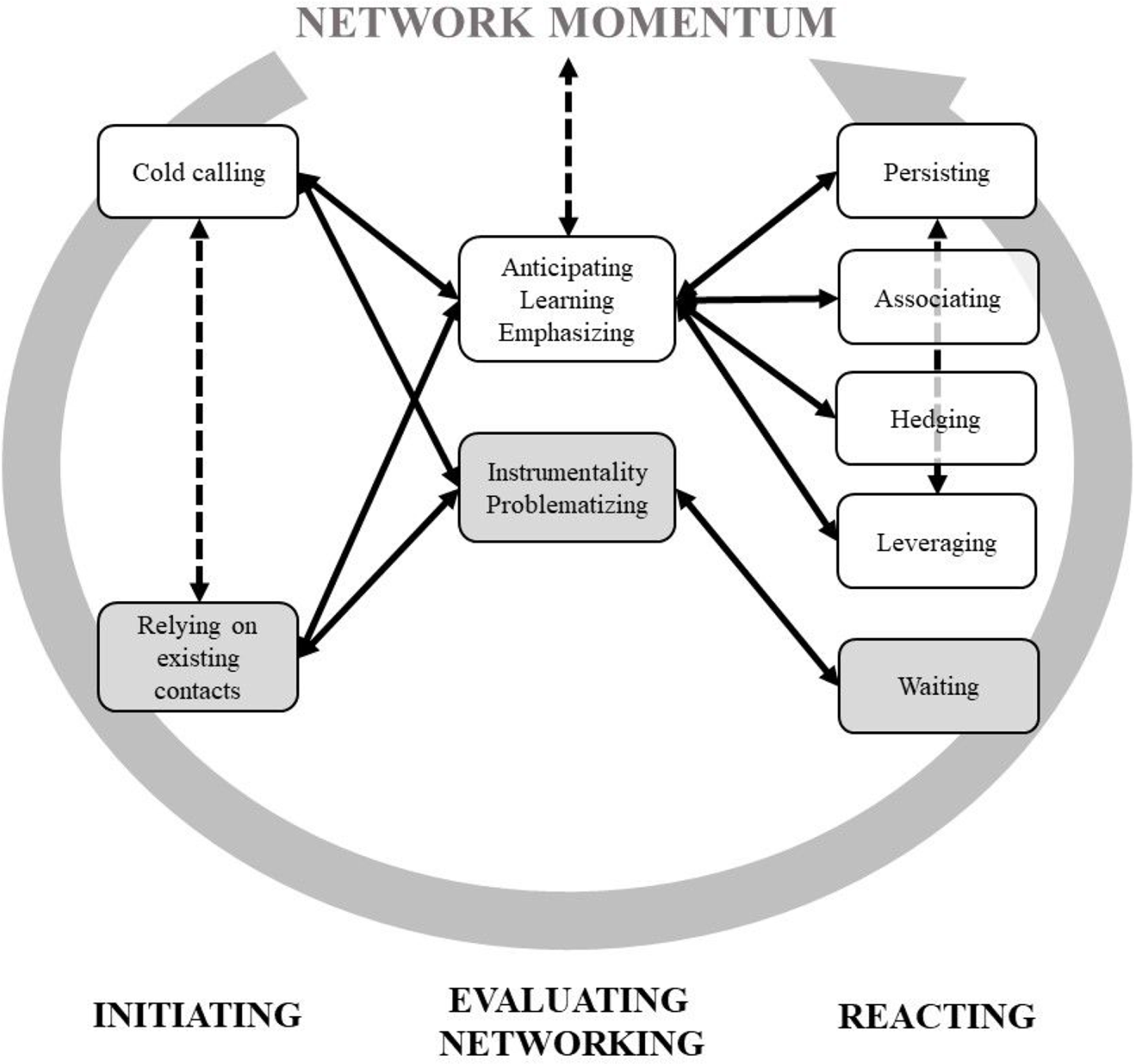
Process model of initial entrepreneurial networking.
Our systematic, comparative case analysis shows that the main difference between cases that do and those that do not perceive network momentum lies in how student entrepreneurs evaluate their actions and react to (negative) contact responses, thus stressing the value of the cognitive-evaluative dimension of entrepreneurial networking. For instance, the founders of Image Enhancement clearly related their perceived success to follow-up networking actions:
Sweet success! We took 1st place yesterday for our Dragons at the University venture capitalist pitch competition after a crazy week of planning and preparing our presentation.… Our current strategy with the Image Enhancement project is to network like crazy and talk to as many people and companies in our field as possible. (Image Enhancement, Mac, 20100122)
Student entrepreneurs viewed networking actions and responses as contributing to gaining network momentum if they sensed that others were starting to know about the venture. That is, some indicated that the responses did not have to be positive to provide some benefits.
Achieving Network Momentum
We systematically compared all cases using the concepts displayed in Figures 2 and 3, and Table 3 further identifies which cases reported network momentum. To establish an in-depth description of how these concepts work together, we first turn to Tea Shop as an exemplary case that achieved network momentum. Tea Shop’s two founders had the idea to sell Chinese tea to tea shops in Sweden. Although they come from abroad, the founders Janice and Siri were very active in approaching new contacts, and they approached a wide variety of people. During the first period in December, they started enthusiastically contacting others using cold calling, with the aim of learning about the context in which they would be operating:
We have interviewed Company HC to learn more about the tea industry (Tea Shop, Janice, 20091204).
In total, they reported making 84 new contacts during the entire 20-week period, including many potential customers, indicating that they emphasized networking actions. Their level of activity remained quite constant over the 5-month observation period. Two additional features characterize this case. First, they were able and willing to react to unexpected encounters by leveraging them and by remaining flexible in what they are looking for:
On the way, we found a big new tea shop, Company A, by chance. Talking with the staff, we knew that they have lots of tea that [they] imported from China. They also have a tea-tasting community. It will have a different event every month. It would be great if we can cooperate with them. However, the manager was not there. We left our contact information. We will visit it again when the manager comes back. (Tea Shop, Janice, 20100312)
Second, their evaluation of networking shows that they anticipated nonresponse, in that they plan to “visit again when the manager comes back.” In addition, Janice and Siri reacted to negative responses by persistently trying to contact others and seeking alternative ways to approach those contacts. In subsequent diary entries, Janice and Siri deliberated on their strategies for being persistent, which exhibit their learning evaluation as they tried to understand the reasons for nonresponse:
I planned to visit the customers to get some feedback on our tea and the price, because they didn’t reply [to] the e-mail after we gave them samples. But we worried that we will annoy them. So, we are choosing to wait a little bit. (Tea Shop, Siri, 20100410)
However, the manager didn’t come that day, so we can’t discuss much further. So, I e-mailed her and will arrange a discussion about the corporation in the following weeks. (Tea Shop, Janice, 2010417)
But the other potential customers, after the discussion and leaving the contact information with them, never call again. Some of them didn’t even reply to the e-mail. I need to find out the reason to go further. (Tea Shop, Janice, 20100430)
In the final month of the Venturing Program, Siri and Janice saw results: They were contacted by actors they had previously approached, and they started to perceive network momentum:
Once you build up a good relationship with your customer, they will keep contacting you, like Company CS. (Tea Shop, Siri, 20100430)
Other student entrepreneurs who achieved network momentum (Table 3) exhibited similar dynamics of initiating actions, reactions, and evaluations. These cases also demonstrated that subsequent networking actions were motivated by perceived network momentum. As a result, student entrepreneurs who did not have any prior relevant connections persevered in building a new network, such as the Music Training entrepreneurs, who tried to associate with a high-quality, well-reputed actor to assist with their marketing strategy over a 5-month period.
Although not all the student entrepreneurs were equally active in networking, they were similar in the sense that they actively and constructively evaluated themselves, others, and the networking process. Through their evaluations, they identified the key role of both leveraging existing contacts and diversifying their network through hedging. They did so more quickly than others who did not ultimately experience network momentum. Perseverance and creativity in networking actions, for Tea Shop and for similar cases, were driven by positive, stimulating evaluations of others, which involved anticipating nonresponses. In addition, their evaluation of the networking process, focused on learning, helped them persist in their networking actions or hedge against nonresponses. Regarding their self-evaluations, these student entrepreneurs tended to critique themselves rather than blame others, which led them to emphasize that they should reach out more actively. This constructive self-evaluation helped them discover why certain networking actions had not been performed or failed. In general, these student entrepreneurs’ evaluations of their actions and progress convinced them to reinforce existing actions or change to more productive alternatives, which ultimately led to network momentum.
Not Achieving Network Momentum
Entrepreneurs who were unable to achieve network momentum were often instrumentally motivated by the Venturing Program to do some networking. However, difficulties in reaching out undermined this motivation. In response, they merely focused on internal venture processes that the Venturing Program required (e.g., develop business plans). Their (lack of) networking actions was accompanied by unconstructive self-evaluations that mainly depicted networking as difficult rather than as a challenge or pleasure. To illustrate how our model (Figure 3) describes why student entrepreneurs do not perceive network momentum, we turn to Dating, a venture started by Fes and Anton with the aim of building an online dating app with multiple services.
The founders originated from Asia and Sweden, so one of the team members had familiarity with the Swedish market. In the first period, the founders of Dating contacted several new actors through cold calling, but their activity dropped in the subsequent four periods. Over the course of the Venturing Program, they contacted only 38 new actors. These new actors were either in close psychological proximity to the founders or were necessary for their product development. For example, Fes described approaching contacts provided by the Venturing Program, such as a professor who presented during the program. Generally, their descriptions of these contacts referred to their functions rather than names. They problematized networking from the very start, which prompted a low level of new contact initiation and unproductive reactions to responses:
We need to find a person(s) with the IT competency that we lack. However, it is hard to initiate operations with someone we do not know personally. (Dating, Fes, 20101203)
Initiating new contacts is perceived as problematic, as reflected in the repeated reports of a lack of networking actions:
I have not met anybody personally, but I have chatted with some daters using other dating applications. (Dating, Fes, 20110121)
I haven’t met anyone this week. (Dating, Fes, 20110218)
I have not met anybody personally. (Dating, Fes, 20110401)
Instead, Fes states that they have focused on writing a business plan and receiving feedback from program-provided contacts. This pattern persists over the 5 months of the Venturing Program, as the following quotes illustrate:
I will continue to improve the business plan in areas we have not had a strong focus on, such as business model and market strategy. (Dating, Fes, 20101217)
I am looking forward to getting the feedback about our business plan from my mentor, but I have not received any comments yet. (Dating, Fes, 20110225)
I contacted my mentor via email about updating the business plan, and I asked for comments regarding the new business model. (Dating, Fes, 20110415)
When they did actually contact others but perceived a negative or delayed response, they reacted by waiting instead of thinking how they could have anticipated the delayed response:
Things have not been developing as fast as we wanted them to the last week. We were hoping to receive a new version of the informatics students report today, but unfortunately this didn’t happen. (Dating, Anton, 20110304)
Similarly, Anton problematizes efforts to obtain resources as time consuming:
Bootstrapping apparently is quite time consuming and not always the most efficient way of reaching your goals. (Dating, Anton, 20110415)
By negatively evaluating their own ability to network, as well as others’ responses, and instead shifting to internal activities, Anton and Fes came to believe they could not create a network that would gain traction.
In similar cases (Table 3), the motivation to initiate contacts dropped after negative responses or due to a shift in focus to internal activities. These student entrepreneurs typically problematized their context and network development, indicating negative self-evaluations. Some felt too constrained by their lack of existing ties; they simply did not know how or where to start to achieve their networking goals. Moreover, student entrepreneurs who had relevant existing contacts focused on the instrumentality of these ties and had the—apparently inaccurate—impression that they could rely on those existing relationships to obtain the necessary resources. Consequently, they did not feel a sense of urgency to engage actively in initiating new contacts. Because these existing contacts were insufficient or not actively leveraged, the student entrepreneurs did not achieve network momentum, resulting in a further breakdown of networking activity.
Discussion
With this study, we aim to deepen understanding of entrepreneurial networking processes by exploring important differences between entrepreneurs in terms of their networking actions. Our diary data enabled us to connect networking actions to cognitive evaluations in the process of entrepreneurial networking. We develop a process model of entrepreneurial networking, which includes initiating, reacting, and evaluating, to depict the key processes in initial networking. This framework emphasizes networking actions, similar to other network studies that take a behavioral turn (Elfring & Hulsink, 2007; Hallen & Eisenhardt, 2012; Jack, 2005; Vissa, 2012), but our results add some further insights into the cognitive-evaluative processes related to these networking actions.
Our findings contribute to literature on entrepreneurial networking in two ways. First, we describe the key elements of initial entrepreneurial networking as processes of initiating, reacting, and evaluating contacts. Our description of these key elements bridges behavioral and cognitive perspectives on networking. Regarding the behavioral perspective, we highlight the importance of how entrepreneurs react to responses—and nonresponses—from actors they contact. Especially in a setting in which entrepreneurs must engage extensively in broadening their networks through cold calling, persisting and hedging are key reactions that are beneficial for establishing a meaningful set of network contacts in a short period. Moreover, leveraging unplanned encounters helps entrepreneurs flexibly create new contacts. A reaction marked by associating with established players to gain reputation and referrals is an effective networking tactic that has gained considerable recognition in prior networking literature (Shane & Cable, 2002; Stuart, Hoang, & Hybels, 1999; Vissa, 2012).
Moreover, we highlight that cognitive evaluations of networking actions, reactions, and network momentum, as an influential evaluation of networking progress, drive the actual actions and reactions of student entrepreneurs. Thus, we posit that entrepreneurial networking actions should be understood in relation to evaluations of the self (i.e., networking ability), the cognitive evaluation of responses from others, and the evaluation of networking progress (i.e., momentum). Understanding this evaluative capacity of network agency (e.g., Emirbayer & Mische, 1998) is key for advancing entrepreneurial networking theory. The three types of evaluations, relative to initiating networking actions and reacting to responses, provide necessary insights into why and how certain networking actions emerge (Bensaou et al., 2014; Fang et al., 2015; Porter & Woo, 2015). Our results thus emphasize the role of evaluations in networking processes, a theme introduced previously to interfirm network literature, such that they comprise both formal and informal aspects, executed by company managers (e.g., Berends et al., 2011; Doz, 1996; Sydow & Windeler, 1998). We advance this insight by noting that at the individual and venture levels, these cognitive evaluations are of crucial importance to understand the differences in how individuals and ventures create their initial networks.
Evaluation appears central to an inductive learning process in which entrepreneurs learn while or after they act—one of the key characteristics of entrepreneurial creation processes (Alvarez & Barney, 2007). This finding suggests the need for a stronger emphasis on a cognitive perspective on networking behavior (Casciaro et al., 2015; Tasselli et al., 2015), particularly insofar as it addresses the question of how people cope with the process of networking (Bensaou et al., 2014; Fang et al., 2015). Few prior studies explicitly link the cognitive side to the action side of networking (e.g., De Carolis & Saparito, 2006; Sasovova et al., 2010). Our observations stress the importance of cognitive processes instead of cognitive traits, in line with a dynamic cognitive perspective (e.g., Engel et al., 2017; Porter & Woo, 2015). Our findings also link literature on entrepreneurial networking behavior to that on entrepreneurial cognition (see Grégoire, Cornelissen, Dimov, & Van Burg, 2015). In particular, we extend Porter & Woo’s (2015, p. 1487) proposal of a key role of cognitive evaluations about a potential partner’s instrumentality: “What does he or she have to offer, and what do I have to offer in return?” Our student entrepreneurs certainly evaluate the instrumentality of others (i.e., “Are they helpful?”), but our findings also point to cognitive evaluations of the self in networking (i.e., “Am I good enough?”) and of the networking process as a whole (i.e., “Are we making progress?”).
This insight leads to our second, related contribution: We provide details of cognitive evaluation processes. In particular, we reveal the importance of evaluations of perceived networking progress—termed “network momentum”—in an entrepreneur’s evaluation of networking and subsequent networking actions. The concept of network momentum is central to networking progress, from the entrepreneur’s viewpoint. Network momentum refers to the perception that the network has begun to gain traction, because others start to approach the entrepreneurs; in turn, experiencing network momentum motivates entrepreneurs to carry on with their networking. The concept also provides a basis for researchers to theorize about how entrepreneurial networking unfolds over time, in various settings and under various conditions, which ultimately may help them build more accurate theories of initial entrepreneurial networking (e.g., Bensaou et al., 2014; Gulati & Srivastava, 2014; Porter & Woo, 2015; Vissa, 2012). Network momentum offers a perceptual counterpart to more tangible network features, such as structure, size, and density, and it sheds light on how networking actions and evaluations result in network outcomes in the first phase of the venture. Furthermore, network momentum offers the fundamental insight that the temporary perception of whether the network starts to “exist” has an important impact on whether the entrepreneur continues with (or halts) networking activity. As such, network momentum forms a central, temporary sensemaking device in networking processes that entrepreneurs use to motivate themselves, and it helps them engage others in their networking process (cf. Cornelissen & Clarke, 2010) as they become convinced of their perceived—yet still uncertain—networking success.
Whether entrepreneurs undertake constructive and unconstructive evaluations appears to be a crucial difference between those who start to perceive network momentum and those who do not. The diary-based data we use are uniquely able to provide information on such evaluations, including reflections on unsuccessful contact attempts. The student entrepreneurs in our study who were not able to gain network momentum typically reflected on their actions and the actors’ responses by problematizing the creation of their networks; they tended to doubt their ability to establish a network in due time. From their perspective, it was difficult and time consuming. In turn, they typically became passive and decided to wait for responses on their actions, rather than reaching out to other, similar contacts (hedging) or trying to reach influential contacts (associating). In contrast, others had much more constructive self-reflections, viewing networking as a learning experience and emphasizing the need for more of it. These student entrepreneurs started to anticipate negative responses. This finding confirms that networking is not always heroic (Engel et al., 2017); paying attention to responses to networking actions is key. Relatedly, we show that predictions about obtaining networking outcomes may be overly positive (cf. Eveleens, van Rijnsoever, & Niesten, 2017).
This difference between constructive and unconstructive evaluations also suggests a fruitful avenue for further studies. It would be worthwhile to determine whether the same entrepreneurs employ multiple types of evaluations and how these evaluations relate. Are the evaluations linked to more or less stable cognitive dispositions, such as biases and personality traits (e.g., De Carolis & Saparito, 2006) or perhaps cognitive traits (e.g., Landis, 2016; Sasovova et al., 2010)? More insight also is needed into the relation between network momentum and employed cognitive evaluations. For example, are entrepreneurs who can effectively envision and enact future realities (Ariño, Ragozzino, & Reuer, 2008) less susceptible to unconstructive evaluations than those who cannot? Do they report more network momentum after a period of networking?
Boundary Conditions
This study has several limitations that provide boundary conditions for the model we developed. First, the data originate from a specific venturing program. Although the Venturing Program provides an exceptional setting and controls for potential differences between cases (e.g., timing, geography), it nevertheless has its own peculiarities that may have influenced the results. In particular, we acknowledge the artificial and protected research context of our study. The 20-week time span was artificial, and networking in the last weeks decreased among entrepreneurs who apparently decided they did not want to continue with their venture. Such student entrepreneurs might not have carried on with their idea if they operated outside this setting. At the same time, this setting provided an equal starting point for studying the process of entrepreneurial networking in the first phase of the venture. Moreover, some students used contacts with researchers from the university (Table 1). Some students were expatriates, and they could have been searching for emotional as well as informational support (Farh, Bartol, Shapiro, & Shin, 2010), which may have influenced their networking. Yet we did not find any indication that intensive contact with the university was related to obtaining network momentum. In addition, though the context offers an excellent setting to study goal-oriented networking behavior with clearly observable outcomes, it does not reflect other potential motivators for social interaction, such as prosocial behavior or giving (Grant, 2013; Porter & Woo, 2015).
Second, we qualitatively accounted for the entrepreneurs’ different origins (e.g., observed that Swedish nationality is not related to experiencing network momentum, because most student entrepreneurs who reported network momentum were international; see Tables 1 and 3), but controlling for culturally influenced dispositions toward networking was not one of our research priorities. Prior literature hints at potential cultural differences regarding networking, and this factor may warrant further scrutiny.
Third, diary data have great potential to shed light on cognitive-evaluative processes and actions of entrepreneurs and can enrich multiple entrepreneurship domains, in which researchers can use diaries to obtain primary, fine-grained, and longitudinal data. Diaries also may offer a promising method to explore everyday entrepreneurship from the entrepreneur’s perspective (Welter, Baker, Audretsch, & Gartner, 2017), the difference between intentions and actions (Kautonen, van Gelderen, & Fink, 2015), and grief processes following entrepreneurial exits (Ucbasaran, Shepherd, Lockett, & Lyon, 2013). Yet diaries also suffer some limitations (see Bolger et al., 2003), such that people can become habituated in writing their diaries and might feel forced to be more reflective than they usually would be. Perhaps the most relevant limitation in this sense is that the networking data are only ego-level data and do not reveal others’ perspectives.
Conclusion
This study used detailed diary data to study entrepreneurial networking processes in the very early stages of venture development. These data served to reveal both networking actions and cognitive evaluations in entrepreneurial networking processes, thereby fostering understanding of why some entrepreneurs are able to gain momentum in their processes while others experience more difficulty in doing so. We observed different ways in which contacts are approached and followed up on, and we find that to understand the entrepreneurs’ actions over time, we need to pay attention to how entrepreneurs evaluate themselves, others, and the networking process. When engaging in networking, nascent student entrepreneurs who experience network momentum and perceive progress have made a critical step into the entrepreneurial world.
Footnotes
Acknowledgments
We are grateful to Tom Elfring, Benson Honig, and Wouter Stam for their constructive and detailed feedback on an earlier version of this article.
Declaration of Conflicting Interests
The author(s) declared no potential conflicts of interest with respect to the research, authorship, and/or publication of this article.
Funding
The author(s) received no financial support for the research, authorship, and/or publication of this article.
Notes

Author Biographies