




Abstract
This study examines the role of national culture on the entrepreneurial orientation (EO) rhetoric contained within franchisee recruitment promotional materials, where EO rhetoric is defined as the strategic use of words in organizational narratives to convey the risk taking, innovativeness, proactiveness, autonomy, and competitive aggressiveness of the firm. The sample comprised 378 franchise organizations, in five different countries (Australia, France, India, South Africa, and the UK). The results indicate that franchise systems operating in high uncertainty avoidance and feminine cultures use less entrepreneurially oriented rhetoric, suggesting that EO rhetoric in franchise organizations varies according to different national cultural contexts.
Research suggests that there are cross-cultural variations in entrepreneurial entry rates (Autio, Pathak, & Wennberg, 2013) and it seems that this in part stems from differences in national cultural values. It has been contended that entrepreneurship is a response to certain environmental conditions that can help or hinder entrepreneurial success (Lee & Peterson, 2000). Berger (1991, p. 122) comments that “culture […] serves as the conductor, and the entrepreneur as the catalyst” to entrepreneurship. Mueller and Thomas (2001, p. 58) argue that values and norms are “powerful forces in controlling and directing human behavior,” and thus differences in cultural values may mean that the extent to which entrepreneurial behaviors, such as risk taking and independent thinking, are considered desirable will differ between cultures (Hayton, Gerard, & Zahra, 2002). Therefore, it is suggested that some cultures will be more closely aligned with an entrepreneurial orientation (EO) than others (Mueller & Thomas, 2001). However, as highlighted by Covin and Miller (2014), empirical research on the relationship between EO and national culture is very limited. This provides a significant research opportunity (Covin & Miller, 2014), which the present study seeks to develop further.
This paper examines the role of national culture on the EO rhetoric contained within franchisee recruitment promotional materials. Drawing on Zachary et al. (2011a), we define EO rhetoric as the strategic use of words in organizational narratives to convey the risk taking, innovativeness, proactiveness, autonomy, and competitive aggressiveness of the firm. We argue that cultural differences in EO will lead to differences in the extent to which EO rhetoric is used to attract franchisees. Thus, for example, in cultures where autonomy is more highly valued, franchisors may be more likely to stress the independence offered by franchising in their communications. Similarly, in cultures where risk taking is not valued (or indeed where cultures are risk-averse), franchisors may emphasize the reduced risk offered by being part of an established system.
EO has been conceptualized in a number of different ways in the literature (see Covin & Lumpkin, 2011 for a discussion), but these have principally been aligned to one of two key conceptualizations. The first, most largely associated with the early work of Miller (1983) and Covin and Slevin (1989), views EO as a unidimensional construct. The second conceptualization follows the approach of Lumpkin and Dess (1996), where EO is viewed as a multidimensional construct. Prior studies exploring the relationship between national culture and EO have tended to adopt the former of these conceptualizations. For example, Morris, Davis, and Allen (1994) in their study comparing the importance of Hofstede’s national cultural dimension of individualism-collectivism on EO, adopted the unidimensional measure of EO in different cultures. Although Kreiser et al. (2010) view EO as multidimensional, they only consider how two EO dimensions, namely risk taking and proactiveness, vary by national cultural dimensions. Thus, a gap remains in our understanding of how other EO dimensions may be related to national culture. This paper seeks to address this gap by examining the impact of national culture on the EO rhetoric of franchise organizations, using the five-dimensional conceptualization of EO.
In order to understand the role of national culture on EO rhetoric, we analyzed, using computer-aided content analysis, franchisee recruitment advertisements from 378 franchise systems in five different country contexts (Australia, France, India, South Africa, and the UK). The use of a content analysis of organizational narratives by which to assess EO is a method that is increasingly being adopted by EO researchers (see e.g., Engelen, Neumann & Schmidt, 2016; Moss et al., 2011; Short et al., 2009; Short et al., 2010; Zachary et al., 2011a).
Through our examination of franchise EO rhetoric across different national cultures, we offer several contributions. Firstly, we add to methodological innovation in the assessment of EO by responding to recent calls for developing new EO measures. Arguing for scholars to develop alternative operationalizations of EO, Miller (2011, p. 879) noted that “there has been a tendency to adhere to the same measures of EO year after year, based on instruments that were developed decades ago. It may be time to try different measures … .” George and Marino (2011) also argued that there is a need to develop subcategories of EO within the EO conceptual family by using new measurement items. In response, we use concept traveling (see George & Marino, 2011) to distinguish the concept of EO rhetoric from the classic EO construct. We assert in this paper that EO rhetoric results from an organization’s EO. However, given that promotional rhetoric may be subject to image management, we argue that EO rhetoric may not be the same as EO. For example, in communicating to shareholders, organizations might emphasize innovation, but downplay risk-taking. In seeking to attract franchisees, franchisors might stress areas of franchisee autonomy, while downplaying the restrictions franchisees may face as a result of franchisor control. Thus, while EO rhetoric results from organizational EO, both concepts are not the same. Following George and Marino’s (2011) call for greater precision in the use of EO terms, we therefore use the term “franchise EO rhetoric” to provide definitional clarity. Secondly, we adopt a multidimensional conceptualization (and measurement) of franchise EO rhetoric, where EO rhetoric encapsulates language that reflects risk taking, innovativeness, proactiveness, competitive aggressiveness, and autonomy. In doing so, we provide the first known study to examine how each of the EO rhetoric dimensions is influenced by national culture. Thirdly, this paper further contributes to the EO literature by examining EO rhetoric within a particular context, that of franchising, responding to Miller’s (2011, p. 881) suggestion that context specificity may generate “more fine-grained and more empirically valid knowledge.” Little is known about EO rhetoric within the franchising context.
We believe franchising is an interesting context in which to explore EO rhetoric for a number of reasons. Firstly, franchising a business has been described as a comparatively risk-free route to rapid growth (Tracey & Jarvis, 2007). This is because when firms franchise, franchisees become the engines of expansion for the chain, opening new markets, identifying new sources of demands, and assuming the risk associated with that activity (Kaufmann & Dant, 1999; Martin, 1988). It is therefore important to understand how franchisors communicate the shift in risk taking to franchisees across different cultures. Secondly, there is an apparent contradiction between the autonomy which may be granted to franchisees versus the standardization which franchise systems are often seen to represent (see Dada, Watson, & Kirby, 2012 for a discussion of the issues). Thus, the rhetoric used in promoting the system to franchisees becomes of particular interest. Thirdly, franchising as a standardized organizational form adopted by many large international chains, particularly in the retail and service sectors, may be less subject to cultural influences. Franchising is designed around having uniform operations in different geographical environments, raising questions as to the extent to which local communications will be influenced by culture. However, according to previous research, culture has been found to influence decisions to be self-employed rather than to work for others (Alon, Lerner, & Shoham, 2016; Mueller & Thomas, 2001), suggesting that franchisors may benefit from using their EO rhetoric differently in different cultures to appeal to potential franchisees.
The paper will begin by explaining and justifying our conceptualization, before developing research hypotheses about the potential role of culture on franchise EO rhetoric. The methods are outlined, and the results from the hypotheses testing presented. The paper then provides discussions and conclusion in relation to the implications of the findings, and the potential avenues for future research.
Conceptual Framework and Hypotheses Development
Conceptual Framework
Entrepreneurial Orientation
Entrepreneurial orientation (EO) is considered to be a key ingredient for firm success (Wang, 2008). It describes how a firm operates (Lumpkin & Dess, 1996), capturing “specific entrepreneurial aspects of decision-making styles, methods, and practices” (Wiklund & Shepherd, 2005, p. 74). While some scholars have considered EO at an individual level, the “scholarly community has largely coalesced around the understanding that EO is a firm-level phenomenon” (Covin & Lumpkin, 2011, p. 857). Thus, EO refers to the processes and practices that are characteristic of entrepreneurial companies (Lumpkin & Dess, 1996). As highlighted earlier, there is some debate as to how EO should be conceptualized (Hansen et al., 2011), with some scholars considering EO as a unidimensional (i.e., composite) concept, while others consider it to be a multidimensional concept (Covin & Wales, 2012). Under the unidimensional conceptualization of EO, “… the latent construct is understood to exist only to the extent that risk taking, innovativeness, and proactiveness are concurrently manifested by the firm” (Covin & Lumpkin, 2011, p. 862). On the other hand, in terms of the “multidimensional view of EO, the latent construct exists as a set of independent dimensions, namely risk taking, innovativeness, proactiveness, competitive aggressiveness, and autonomy” (Covin & Lumpkin, 2011, p. 863).
Autonomy is based on the notion of entrepreneurial independence in developing and bringing into effect an idea (Miller, 2011). Competitive aggressiveness reflects “the intensity of a firm's efforts to outperform industry rivals, characterized by a combative posture and a forceful response to competitor's actions” (Lumpkin & Dess, 2001, p. 431). Lumpkin and Dess (2001, p. 431) define innovativeness as “a willingness to support creativity and experimentation in introducing new products/services, and novelty, technological leadership and R&D in developing new processes.” Proactiveness is associated with a forward-looking perspective with aggressive posturing relative to the firm’s competitors (Knight, 1997). Risk taking involves a firm’s propensity to take actions when the outcomes are uncertain (Walter, Auer, & Ritter, 2006) such as moving into unfamiliar new markets (Lumpkin & Dess, 2001). These five attributes form the framework of EO, and its resulting rhetoric, in the context of this research.
While undoubtedly the differing conceptualizations of EO has led to some confusion within the literature, as Covin and Lumpkin (2011, p. 863) argue, “EO researchers will be well served by acknowledging the distinctiveness of these two conceptualizations and by explicitly recognizing and defending the particular conceptualization being employed in their research.” In this respect, the decision to employ the five-dimensional conceptualization in the present study emanated for a number of reasons. Firstly, within the context of franchising, the dimensions of autonomy in particular, but also competitive aggressiveness, have resonance. Franchisees are awarded some degree of autonomy by which to operate their individual units, and this provides a mechanism by which entrepreneurial behaviors can be encouraged. Some research (e.g., Kaufmann & Stanworth, 1995) suggests that one of the main reasons why individuals join a franchise system, as franchisees, is their desire for independence. However, the extent to which autonomy is granted to individual franchisees tends to vary across systems, suggesting that while greater autonomy may increase EO, it is not a necessary condition. Furthermore, within the context of franchising, competitive aggressiveness can provide an important signal to franchisees in relation to the franchisor’s intentions to continually assess and exploit its competitors in order to be most successful within its sector. Additionally, the dimensions of risk taking, innovativeness, and proactiveness can be used by franchisors to enable franchisees to align the franchise concept to different markets. Thus, we suggest that the dimensions of autonomy, competitive aggressiveness, as well as the core EO dimensions of risk taking, innovativeness and proactiveness, are all central to understanding the entrepreneurial process within franchise systems. The dimensions may occur in different combinations, depending on the type of entrepreneurial opportunity a firm pursues (Lumpkin & Dess, 1996).
In both unidimensional and multidimensional conceptualizations of EO, survey measures of management perceptions have been the most widely used approach (Lyon, Lumpkin, & Dess, 2000), despite calls for new approaches to be considered (Miller, 2011). This paper, therefore, employs a relatively new operationalization of EO, developed by Short et al. (2010) which measures EO through computer-aided text analysis (CATA) of organizational narratives. McKenny, Short, and Payne (2012, p. 153) suggest that analysis of organizational narratives (in this case promotional messages) may be preferable to surveys when measuring organizational constructs (such as EO), as they provide a “valuable source from which to measure phenomena directly at the organizational level.”
Previous studies which have employed CATA (Engelen et al., 2016; Moss et al., 2011; Short et al., 2009; Short et al., 2010; Zachary et al., 2011a) have sought to measure EO directly. However, as George and Marino (2011) argue, it is important to ensure that the operationalization and conceptualization of EO are consistent. Thus, while we believe that EO rhetoric will reflect the EO of the firm (since the former results from the latter), both represent different concepts. Therefore, to ensure definitional and measurement precision, we use the term EO rhetoric, and employ the five-dimensional EO conceptualization. Drawing on insights from Zachary et al. (2011a), we define EO rhetoric as the strategic use of words in organizational narratives to convey the firm’s extent of risk taking, innovativeness, proactiveness, autonomy, and competitive aggressiveness. To further clarify the context (extension) of the concept, we specifically refer to this construct as “franchise EO rhetoric,” which represents a secondary category of EO rhetoric (see George & Marino, 2011 for discussions about secondary categories of EO).
In adopting the multidimensional conceptualization, we do not attempt to measure overall EO, but rather explore the relationship between national culture and each of the subdimensions of franchise EO rhetoric. This follows the recommendation of Covin and Wales (2012) that CATA-based measures of EO should be reserved for separately measuring the dimensions of EO, and should not be summed to create an overall EO index.
Development of Research Hypotheses
Cultural Influences on Entrepreneurship
Culture refers to a “learned, socially transmitted set of behavior standards” (Morris, Davis, & Allen, 1994, p. 70). It is the “collective programming of the mind which distinguishes the members of one human group from another” and includes systems and values (Hofstede, 1980, p. 25). These cultural values and norms have a strong influence on human behavior (Mueller & Thomas, 2001). It has been argued by a number of scholars that cultural values will influence the extent to which society considers entrepreneurial behaviors as desirable (Hayton et al., 2002). For example, Hayton et al. (2002, p. 33) suggest cultures that value and reward behaviors such as risk taking and independent thinking promote “a propensity to develop and introduce radical innovation.” Cultures which do not value such behaviors are unlikely to show entrepreneurial behavior. Thus, it is argued that some cultures will be more closely aligned with an EO than others (Engelen, 2010; Mueller & Thomas, 2001). Saeed, Yousafzai, and Engelen (2014) suggest that the influence of national culture on EO can be explained from an institutional perspective. The informal institutions (national culture) and formal institutions determine the “rules of the game” in strategy implementation (Saeed et al., 2014). Despite the suggestion that national culture influences entrepreneurial behaviors, few researchers have studied the role and influence of national culture on EO (Covin & Miller, 2014; Fayolle, Basso, & Bouchard, 2010). Thus, little is understood as to how national culture influences the different dimensions of EO.
There are a number of different conceptualizations of country culture, but Hofstede’s (1980) dimensions are the most widely accepted among entrepreneurship and management scholars (Kreiser et al., 2010). Hofstede’s indices were constructed and validated within the context of large formal organizations (Hayton et al., 2002), and therefore are suited to studies of corporate entrepreneurship, such as in the context of franchise systems. This paper focuses on two of Hofstede’s cultural dimensions which are considered to influence entrepreneurship (Hayton et al., 2002; Nguyen et al., 2009), namely uncertainty avoidance and masculinity–femininity. These dimensions and their implications for EO will be considered in turn.
Uncertainty Avoidance
Hofstede’s (1980) concept of uncertainty avoidance can be defined as “the extent to which people feel threatened by uncertainty and ambiguity and try to avoid these situations” (de Mooij & Hofstede, 2010, p. 89). It concerns the way society tolerates ambiguity and uncertainty. There are empirical and theoretical evidence to suggest a link between uncertainty avoidance and entrepreneurial behaviors.
Shane (1993) found that national rates of innovation are lower in high uncertainty avoidance cultures, and Mueller and Thomas (2001) found that the entrepreneurial trait of innovativeness was less prevalent in cultures of high uncertainty avoidance. Innovation increases uncertainty because innovations require the commitment of resources before the outcomes are known (Autio et al., 2013), creating resistance toward innovation and change in uncertainty avoidance cultures (Rauch et al., 2013). Therefore, it could be argued that franchise systems in high uncertainty avoidance cultures will exhibit lower levels of innovativeness, and this will be apparent in the communications used to promote their systems to prospective franchisees.
Hofstede (1980) found that in high uncertainty avoidance societies, there is a greater fear of failure, a lower willingness to take risks and less tolerance for ambiguity. Kreiser et al. (2010) found risk-taking levels within SMEs to be negatively influenced by uncertainty avoidance. Thus, it could be argued that systems in high uncertainty avoidance cultures may downplay the risks associated with the franchise, and indeed may go as far as to promote the reduction in risk associated with joining their systems.
Saeed et al. (2014) argue that, within high uncertainty avoidance cultures, strict rules and regulations on individual behavior are imposed, which inhibits EO. It has been suggested (Stephan & Pathak, 2016) that uncertainty avoidance cultures are more accepting of authoritarian leadership, as they are, to an extent, willing to trade their voice for more predictability. Thus, franchisees in uncertainty avoidance cultures may be less concerned with autonomy. Furthermore, in cultures exhibiting high uncertainty avoidance, franchisees may be less willing to deviate from proven processes (given the risks of so doing), and therefore will value autonomy less than those in uncertainty tolerant cultures. Therefore, franchise systems operating in cultures which are characterized by high levels of uncertainty avoidance, will adopt more rigid support structures and standardized processes, and not encourage autonomy among their franchisees. These boundaries are likely to be communicated to prospective franchisees in the recruitment promotional materials used in high uncertainty avoidance cultures.
Kreiser et al. (2010) suggest that organizations in uncertainty tolerating cultures are more willing to interact with their environment, and will be more proactive. As Mueller and Thomas (2001) note, entrepreneurs in uncertainty-accepting cultures will perceive more opportunities as existing in the external environment compared with uncertainty-avoiding cultures. This favorable perception of the external environment will mean organizations will be more willing to act as first-movers (Kreiser et al., 2010). Therefore, it can be argued that franchise systems in high uncertainty avoidance cultures will exhibit lower levels of proactiveness, and will communicate this in the organizational narratives used to recruit franchisees in these cultures.
Uncertainty avoidance has also been linked with lower levels of competitive aggressiveness. Mueller and Thomas (2001, p. 61) argue that for uncertainty-avoiding cultures there is a belief that “conflict and competition unleashes destructive aggression” and should therefore be avoided. Thus, we propose that franchise systems in high uncertainty avoidance cultures will exhibit lower levels of competitive aggressiveness, which will be apparent in the recruitment narratives used to promote the systems to potential franchisees.
The preceding rationale suggests that franchise systems in countries of uncertainty avoidance cultures are likely to have lower EO in terms of each of its five dimensions compared with uncertainty tolerant societies. It is expected that this will be reflected in their EO rhetoric. Furthermore, given franchisees in such cultures are less likely to value EO, this provides a further incentive for franchisors to use rhetoric which does not refer to EO. It is therefore hypothesized that:
Masculinity
The dominant values in a masculine society are achievement and success, while in a feminine society the dominant values are caring for others and quality of life (de Mooij & Hofstede, 2010). Nakata and Sivakumar (1996) define masculinity as the degree to which a society is characterized by assertiveness. Thus, in masculine societies there is a greater willingness to engage in competitive behaviors, a high need for achievement (Kreiser et al., 2010), and a greater emphasis on independence (Gudykunst, 1997).
Bachmann, Engelen, and Schwens (2016, p. 302) argue that managers in masculine cultures tend not to accept tight control systems, but rather they “prefer to see themselves as heroes who do not submit themselves to control systems.” In contrast, feminine cultures view control systems as a source of valuable support, rather than a restriction to individual freedom (Bachmann et al., 2016). Thus, franchise systems in more masculine cultures may emphasize aspects of autonomy in their communications, in order to appeal to potential franchisees, while systems in more feminine cultures will promote the operating systems and support.
Furthermore, the emphasis on assertiveness and competitiveness found in masculine societies suggests a high responsiveness to the environment and to competitive threats (Lumpkin & Dess, 2001). Thus, franchise systems in more masculine societies are likely to exhibit greater competitive aggressiveness, and reflect this in their rhetoric to help create interest in their brand from prospective franchisees.
The focus on competitive behavior, and individual achievement within masculine cultures, is also likely to create an environment in which innovation is valued and encouraged. Indeed, innovation has been linked with two values associated with masculine cultures, purposefulness (Nakata & Sivakumar, 1996) and achievement orientation (Rinne, Steel, & Fairweather, 2012). Hence, franchise systems in more masculine cultures may emphasize innovativeness, which will be promoted in their organizational narratives to attract prospective franchisees.
Additionally, Kreiser et al. (2010) argue that masculine societies will engage in highly proactive strategies given the emphasis on “finishing first.” This desire to “finish first” creates a greater willingness to interact with the external environment, a feature that is at the core of proactive firm behaviors (Lumpkin & Dess, 2001). In contrast, organizations in feminine cultures are more likely to adopt a reactive attitude, and will be less likely to willingly interact with their external environment (Kreiser et al., 2010). Consequently, franchise systems in more masculine societies are likely to exhibit greater proactiveness, and reflect this in their rhetoric in order to appeal to prospective franchisees.
Masculine cultures have been found to score highly on McClelland’s need for achievement (Hofstede, 1980), a personality characteristic associated with entrepreneurs and risk-taking behavior (Kreiser et al., 2010). Indeed, Hoegl, Parboteeah and Muethel (2012) argue that more assertiveness valuing societies (such as the case in masculine cultures) believe that individuals should be willing to take risks to succeed, and Bachmann et al. (2016) highlight that masculine cultures value boldness. This may, therefore, suggest that franchise brands in masculine cultures will be more likely to use rhetoric which refers to risk-taking activities, adventure and daring, than those in more feminine societies, where risk taking is not valued.
Thus, the foregoing indicates that, unlike franchise systems in feminine societies, franchise systems in masculine societies will refer more to their innovativeness, proactiveness, risk taking, competitive aggressiveness, and autonomy in their marketing communications to prospective franchisees. These will reflect not just the franchise systems’ EO, but also the extent to which such entrepreneurial behaviors will appeal to the values of potential franchisees. Hence it is hypothesized that:
Methods
Selection of Countries and Associated Cultural Dimensions for the Countries
Country Scores for Uncertainty Avoidance and Masculinity a .

Note.Adapted from Hofstede (2010).
aRankings shown in brackets (from a sample of 53 countries).
Sample of Franchise Systems
To assess the EO rhetoric of franchise systems, this study examined the promotional narratives (in this case, online franchise directories) of franchise systems from Australia, France, India, South Africa, and the UK. These promotional messages are an opportunity for franchisors to transmit their organizational identity to potential franchisees, and thus, in keeping with Zachary et al. (2011a), the messages will reflect the entrepreneurial identity (high or low) of the system. Furthermore, it is assumed that organizations will transmit values in their advertising messages which are congruent with the local culture (de Mooij & Hofstede, 2010), and that national culture is an influence on organizational behaviors (Engelen, 2010).
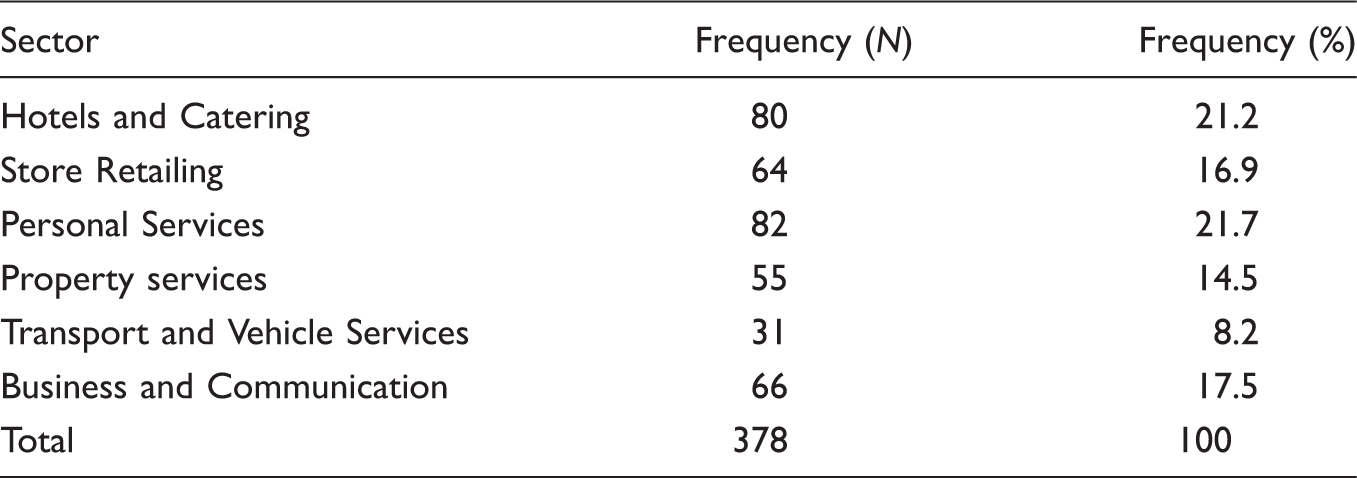
In order to avoid translation issues, initially four countries (Australia, India, South Africa, and the UK) were selected, as the directories were all published in English, but in order to have a country which contrasted significantly in terms of uncertainty avoidance and masculinity, French franchise systems were included in the final sample. Franchise systems from each of the sampled countries were randomly selected from leading online franchise directories in Australia (www.franchisebusiness.com.au), France (www.franchise-magazine.com), India (www.franchisebusiness.in), South Africa (www.whichfranchise.co.za), and the UK (www.franchisedirect.co.uk). A total of 378 franchise systems were selected across the five countries (91, Australia; 91, France; 58, India; 42, South Africa; 96, the UK). The variations in the final sample size were caused by data on system age and size not always being available, and thus these systems were excluded from the analysis. Furthermore, for both India and South Africa, only a limited number of systems advertise in online directories, perhaps due to limited ubiquity of the internet infrastructure, and thus for these two countries the sample essentially reflects the total population of systems advertising through the selected directories.
Sector Distribution of Sample Franchise Systems.
Content Analysis
EO rhetoric was measured through a content analysis of the promotional entries in online franchise directories. As Zachary et al. (2011b) comment, content analysis is a commonly used technique to capture marketing phenomena of interest. It is a qualitative research method that uses a set of procedures to classify or otherwise categorize communications (Weber, 1990). It has been previously used in international marketing research (Wheeler, 1988), consumer research (Kassarjian, 1977), and to measure market orientation (Zachary et al., 2011a; 2011b) and EO (Engelen et al., 2016; Moss et al., 2011; Short et al., 2009; Short et al., 2010; Zachary et al., 2011a). Content analysis of narrative texts, such as online communications, rather than interviews is considered a less obtrusive technique for capturing managerial cognitions, and avoids recall bias (Short et al., 2009).
Much of the extant literature on EO has used surveys of executives/senior managers in order to assess organizational EO. However, there are potential limitations of such an approach. As Lyon et al. (2000) note, surveys of executives/managers are based on a self-reporting technique, and thus rely on data that are potentially subjective. They may also be subject to functional bias, whereby, for example, a finance officer may perceive risk differently from (say) a marketing director, leading to inconsistencies in such a perceptual measure. Furthermore, a firm’s EO may be an artifact of the EO of the individual completing the survey. The use of content analysis of organizational narratives enables the construct to be objectively measured directly at the organizational level, and thus the level of the measure matches that of the construct, enhancing construct validity (McKenny et al., 2012).
Text for the analysis was collected from the franchise directory entry for each of the franchise systems, omitting pro forma key facts, where they formed part of the directory template—so for example, for the Franchise Business directory of Australia and India, the “more info” section provided the text, as this represented the franchisors chosen promotional entry. Each of the directories adopted a similar format, with a free text area which formed the bases of the analysis. The franchise directory entries were used, rather than accessing the franchisors’ web sites directly, as it ensured that all of the text was aimed at prospective franchisees. Varying approaches in terms of style and structure of franchise system web pages means that it is not always easy to distinguish between communications aimed at consumers or potential franchisees. Franchisors may be less concerned with conveying their EO to consumers, and therefore it is believed that communications aimed at (potential) franchisees are the most appropriate source by which to explore EO rhetoric. However, to ensure the veracity of the directory entries, and as a test of their reliability, data from the franchise web pages for a subsample (64) of the systems were gathered, and analyzed using the same process of content analysis. This number is in keeping with McKenny et al. (2016) who suggest a minimum of a 10% subsample for reliability analysis. Significant correlations were found for each of the EO dimensions between the web pages and the directory entries, suggesting that the directories provide a reliable representation of marketing communications to potential franchisees.
The content analysis was conducted using a computer-assisted content analysis software, DICTION. Short and Palmer (2008) highlight the potential value of using DICTION to analyze language usage in organizations, and significantly it has been employed by a number of previous studies to measure EO (Engelen et al., 2016; Moss et al., 2011; Short et al., 2009; Short et al., 2010; Zachary et al., 2011a). Kabanoff, Waldersee, and Cohen (1995) contend that computer-aided content analysis leads to perfect reliability since the coding rules are always applied in the same way, and through the use of standard dictionaries the comparability and validity of the analyses are enhanced.
Measures
Measuring Entrepreneurial Orientation Rhetoric
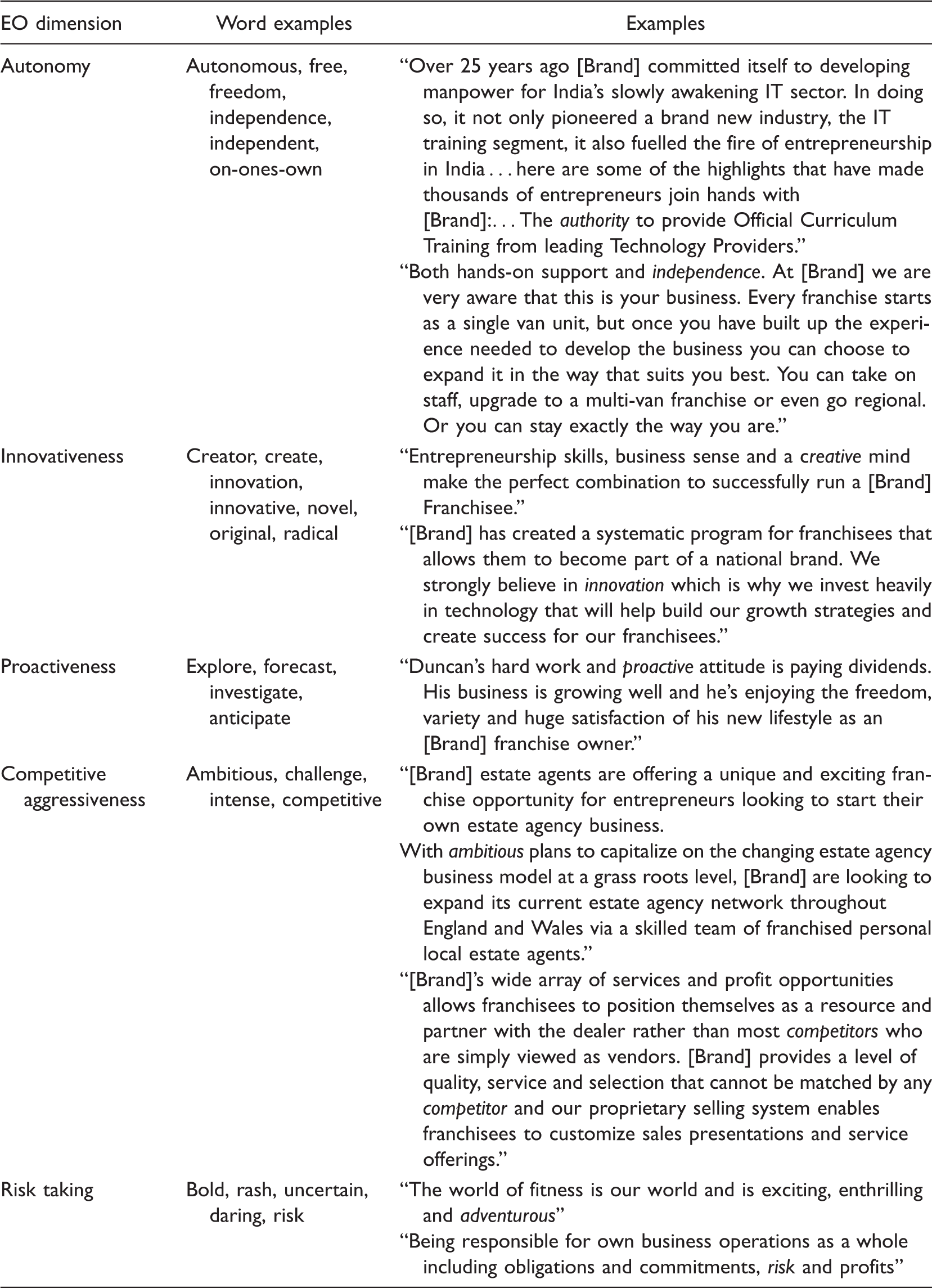
In order to measure entrepreneurial orientation rhetoric, the five-dimension conceptualization of EO provided the basis of the content analysis. Each of the five component dimensions of EO (autonomy, competitive aggressiveness, innovativeness, proactiveness, and risk taking) were measured using the word list developed and validated 1 by Short et al. (2010). The EO dictionary (word list) developed by Short et al. (2010) provides words for each of the EO dimensions and enabled rhetoric indicative of each of the EO dimensions to be identified and quantified. The dictionary contains 36 words pertaining to autonomy, 85 to innovativeness, 27 to proactiveness, 58 to competitive aggressiveness, and 36 to risk taking. 2
Examples of EO Rhetoric Dictionary Words.
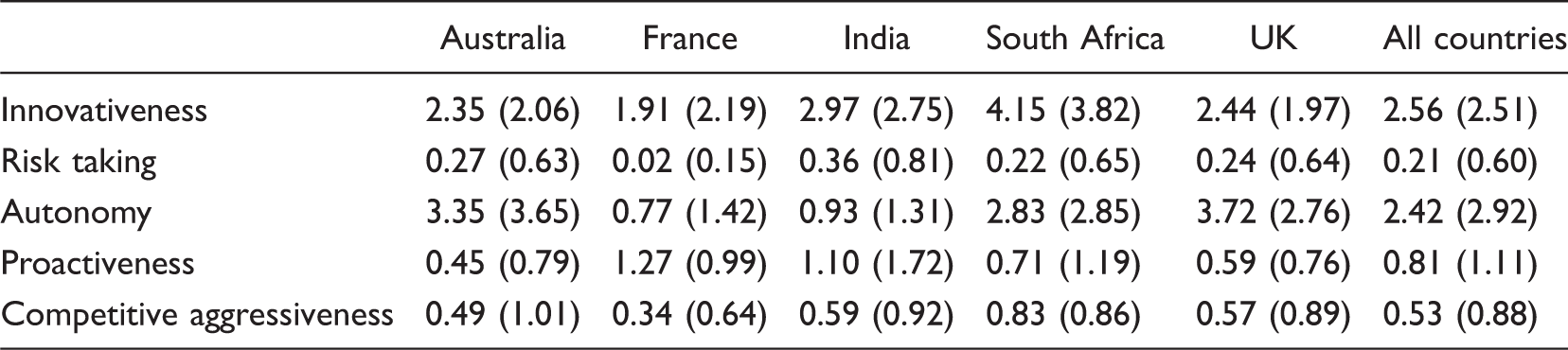
Sample Descriptive Statistics: Mean and Standard Deviation (in brackets).
Measuring Culture
Summary of Cultural Features of Australia, France, India, South Africa, and the UKa.

Note. aCountries were classified as “high” if their score on the Hofstede dimension was >55; “mid,” if the score was 45–55; “low” if their score was <45.
Analysis and Results
General Linear Modeling was employed as the method of analysis, using SPSS software. To control for possible age, size, and industry affects, these were included as covariates (with age being measured as the number of years the business had been franchised, size measured by the number of franchised outlets, and sectors as retail or nonretail). Franchise systems in retail and nonretail sectors do present some significant differences in terms of main characteristics and strategies adopted (Perrigot, 2006). Hence, we control for the industry sectors. Firms of different size and age may also exhibit different organizational and environmental characteristics (Wiklund & Shepherd, 2005). Therefore, by controlling for age and size, this enables us to account for the lifecycle of the franchise organizations, which may influence their EO (see Miller & Breton-Miller, 2011).
Results of ANCOVA Tests: UA.
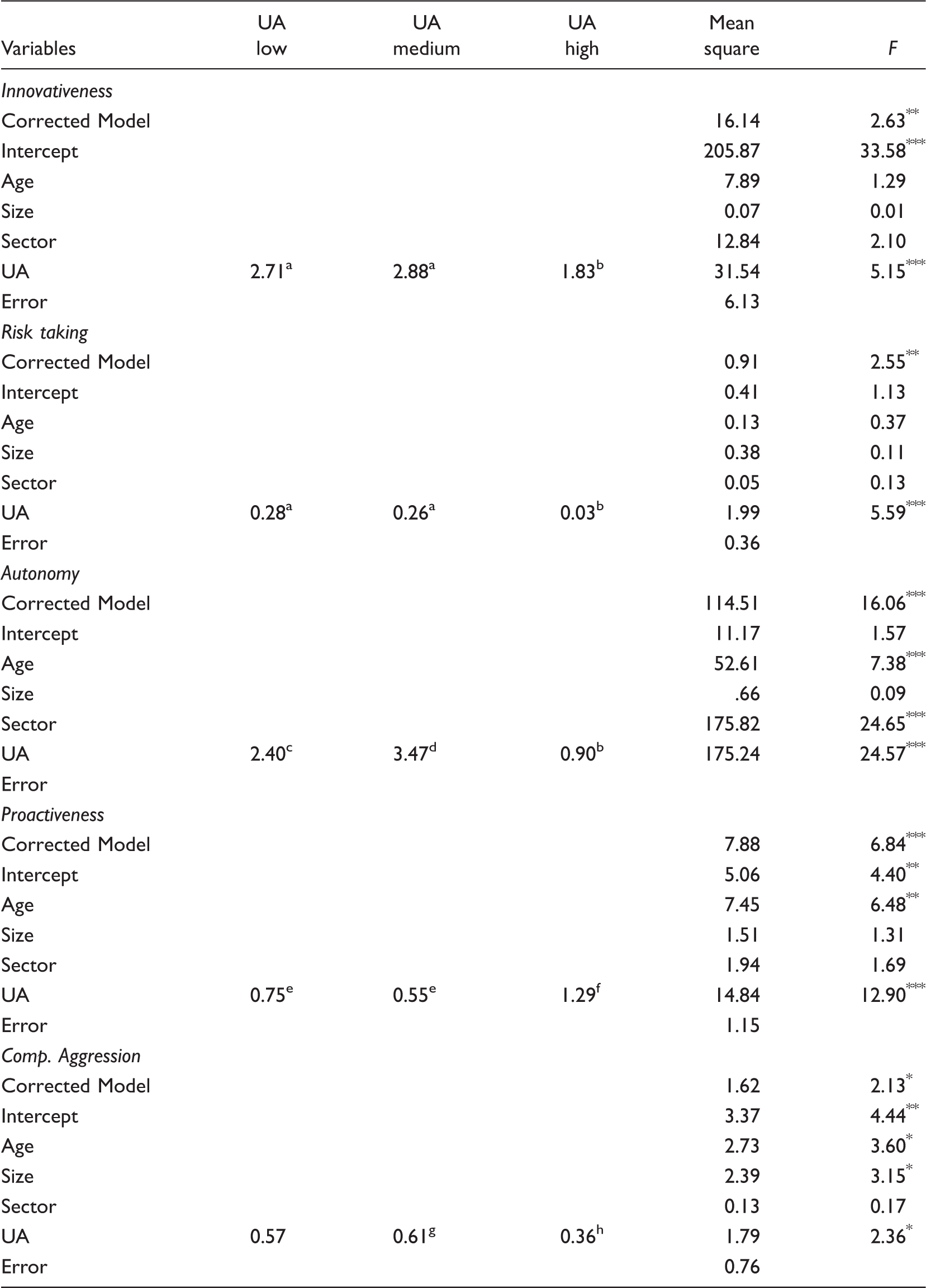
Note. ANCOVA = analysis of covariance; UA = uncertainty avoidance.
aHigher than UA high (p = .01). bLower than UA low and UA medium (p = .01). cHigher than UA high, and lower than UA medium (p = .01). dHigher than UA high and UA low (p = .01). eLower than UA high (p = .01). fHigher than UA low and UA medium (p = .01). gHigher than UA high (p = .05). hLower than UA medium (p = .05).
*p = .10. **p = .05. ***p = .01.
Results of ANCOVA Tests: Masculinity.
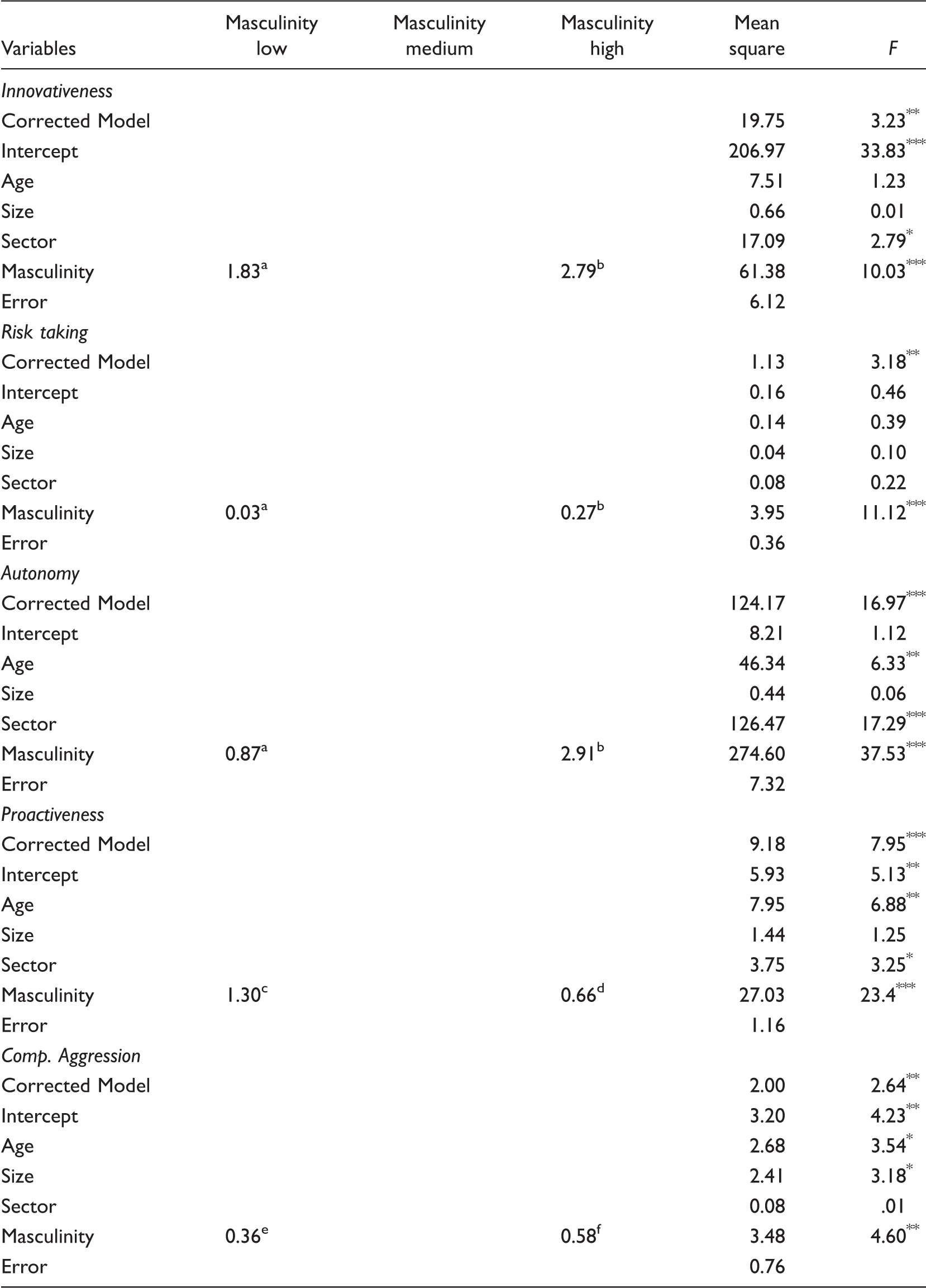
Note. ANCOVA = analysis of covariance.
aSignificantly lower than masculinity high (p = .01). bSignificantly higher than masculinity low (p = .01). cSignificantly higher than masculinity high (p = .01). dSignificantly lower than masculinity low (p = .01). eSignificantly lower than masculinity high (p = .05). fSignificantly higher than masculinity low (p = .05).
*p = .10. **p = .05. ***p = .01.
Discussion
Summary of Hypotheses Findings.
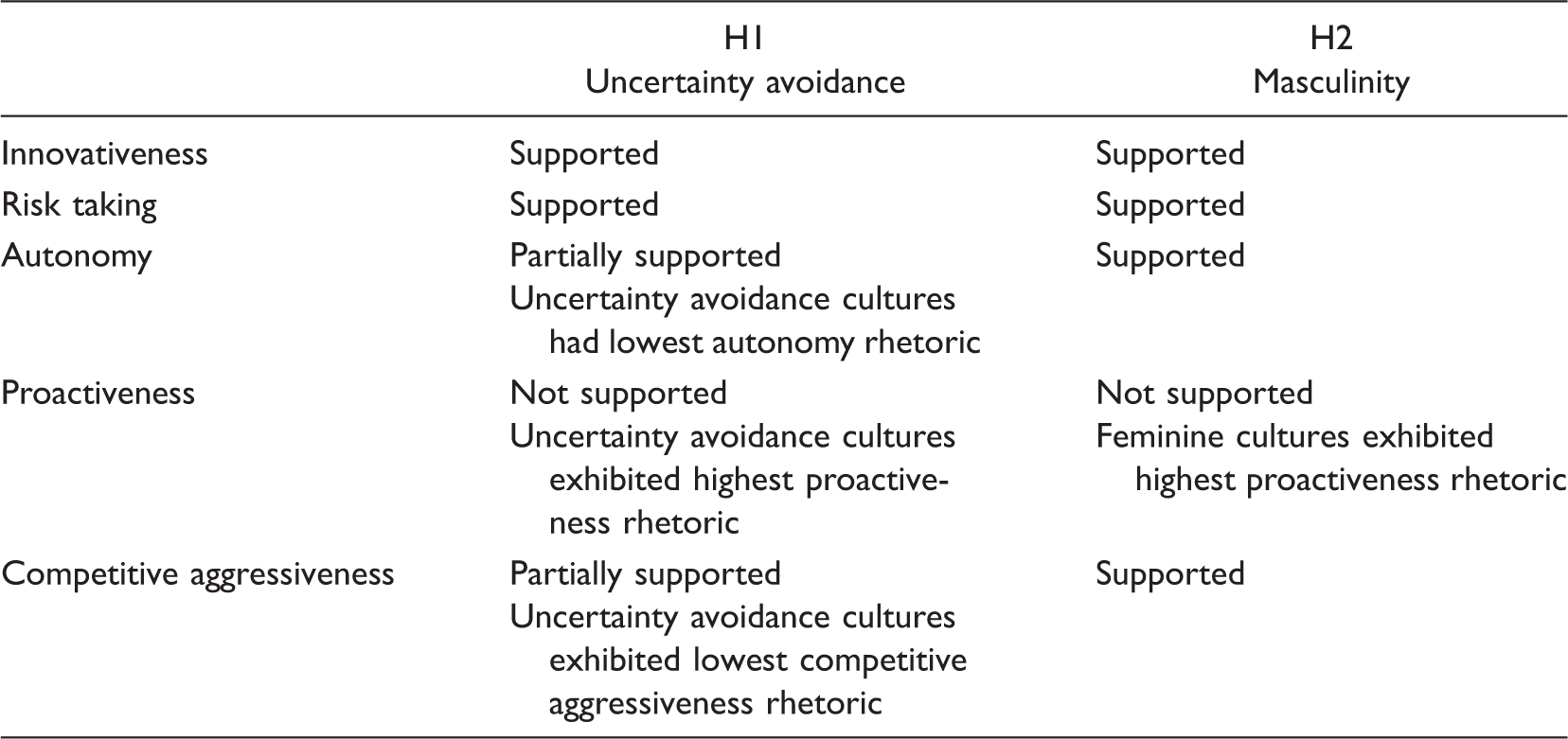
Note. H1 = Hypothesis 1; H2 = Hypothesis 2.
Masculinity was found to be positively linked with the EO rhetoric dimensions of innovativeness, risk taking, autonomy, and competitive aggressiveness as predicted, providing support for H2. However, a negative relationship was found for proactiveness, such that franchise chains from a feminine culture referred more to proactiveness than those from more masculine cultures. Bachmann et al. (2016) argue that the focus on individual achievement in masculine cultures may lead to information withholding, and limit the desire for systematic information collection about the environment. They further argue that given the value placed on bold and decisive actions in masculine cultures, such societies will be less likely to engage in a methodical analysis of information (to create forecasts and risk analysis) gained from environmental scanning. This may impede the ability of firms to develop proactive strategies in response to developments in the market environment. Thus, the lower levels of proactivity found in the EO rhetoric of franchise systems operating in masculine societies may reflect lower levels of engagement with systematic market analysis.
The results suggest that the EO rhetoric used by franchisors varies according to national culture. Such variations in rhetoric can be explained from two perspectives. Firstly, potential franchisees, as individuals within a cultural setting, are likely to hold values in keeping with their national culture. Thus, franchisors will seek to ensure that their rhetoric is in keeping with these values, in order to attract franchisees to their system. Secondly, an organization is made up of individuals, and thus “national culture enters an organization through the individuals who join the organization” (Engelen, 2010, p. 356). Thus, we argue that the EO of franchise systems will be influenced by its cultural setting. In this sense, we contend that EO rhetoric is likely to be a reflection of actual EO. However, to lessen the potential for measurement bias (i.e., the systematic deviation from the true score of the underlying phenomena), we use the term EO rhetoric, as the content analysis provides a more direct measurement of EO rhetoric, compared with EO. However, future research could seek to test this contention by exploring whether the EO transmitted through promotional messages is consistent with that of the franchise system. This could be achieved through the traditional means of assessing EO, such as through survey data of executives or business owners (Dada & Watson, 2013a; Lumpkin & Dess, 2001; Wang, 2008), and comparing this with promotional messages (Dada & Watson, 2013b). We attempted this by conducting franchisor surveys across all the five countries studied in this research. However, we received insufficient responses, which prevented us from undertaking further explorations in this direction.
There are also other potential measurement issues pertaining to the use of CATA. As McKenny et al. (2016) note, specific factor errors (i.e., errors arising from the content of the word lists) may arise when using CATA. McKenny et al. (2016) suggest that a potential source of specific factor errors are differences in context. Thus, the EO dictionary developed and validated by Short et al. (2010) may not be equally applicable across all sectoral or cultural contexts. However, by supplementing the EO dictionaries with words specific to the franchise context, we minimized the potential for specific factor bias. As the research team contained natives from three of the countries studied (i.e., the UK, France, and Australia), this allowed the EO dictionary to be scrutinized from these different cultural perspectives. However, as South African and Indian perspectives were not represented in the research team, it is possible that the EO dictionary may not fully contain words or phrases particular to these two cultural contexts. While there is some evidence that traditional measures of EO are invariant across different cultures, CATA-based measures have yet to be assessed. This could be an avenue for future research. Another potential limitation of CATA and source of specific factor error is CATA’s inability to capture context or rhetorical nuance. To reduce the likelihood of such errors, texts were also read manually to ensure the semantic context was consistent.
Cross-cultural research exploring the EO rhetoric-performance relationship both within the context of franchising, but also within other organizational settings would add value. There are only a limited number of studies which have considered the influence of EO on franchise performance, with evidence to suggest that EO is positively linked with franchise system performance (Dada & Watson, 2013a; Zachary et al., 2011a). However, these studies were undertaken in the UK and United States, respectively, which are culturally similar. From the findings here, it is not clear whether in different cultural contexts this relationship would hold. It would also be useful to understand, more specifically, how the franchise systems’ strategic adoption of EO rhetoric influences their performance. It would seem plausible that franchise systems that are more effective in aligning their use of EO rhetoric to the cultural context will be better able to persuade potential franchisees of the value of the opportunity offered by their system, and to attract franchisees whose entrepreneurial values align with their own, both of which should have positive performance implications.
Furthermore, while this study has focused on the role of culture on EO rhetoric, there may be a number of other country-specific factors which may be influential, such as the economic, political, and regulatory contexts (Saeed et al., 2014). These represent useful avenues for future research. Although this study has focused on EO rhetoric, it seems unlikely that the influence of national culture on franchise systems is limited to this domain. Thus, there could be implications for other aspects of franchise organizational culture, franchisor–franchisee relationships, franchisee recruitment, and organizational structures, to highlight just some potential avenues for future research. Dant (2008) comments that franchise research has focused almost exclusively on the North American context. The findings here suggest that it is important in order to further our understanding of franchising to consider different cultural contexts, to better understand the implications of culture on franchise systems. Thus, in keeping with Dant (2008), we highlight the need for further research of franchise systems beyond the United States. Given the increasing internationalization of franchise systems, the need for such research becomes even more urgent.
The sample used in this study predominantly comprised local franchise chains, but it did contain a small number (approximately 30) of international franchise systems. These were retained within the sample on the basis that for the most commonly used form of international franchising, master franchising, the master franchisee essentially takes the role of the franchisor within the international location, and is subject to less controls and granted greater autonomy than domestic (multi-unit) franchisees (Paik & Choi, 2007). Thus, the autonomy and control granted to the master franchisee will mean that the EO of the system within their territory is likely to be influenced by the local culture. However, this would be an interesting area to explore, to determine if, and to what extent, international chains adapt their EO rhetoric within different cultures. The small number of international chains within the sample did not enable this analysis to be run, although it should be noted that the analysis was rerun excluding the international chains, and the results did not differ significantly. Future research could explore if the EO of international chains differs across cultures and the factors which might influence such adaptations.
Conclusion
Research exploring the influence of culture on EO has been sparse. This study provides a pioneering research which shows that national culture influences the EO rhetoric used within franchisee recruitment promotional materials. Drawing on insights from Zachary et al. (2011a), we delineate the concept of EO rhetoric as the strategic use of words to convey the extent to which organizational narratives refer to risk taking, innovativeness, proactiveness, autonomy, and competitive aggressiveness of the firm. This research expounds upon the EO rhetoric conceptualization as an effective approach for assessing the dimensions of firm-level entrepreneurial behaviors captured in corporate communications in different cultural contexts. The findings emphasize that rhetoric-based research provides an alternative means of developing the classic EO construct.
The study has implications for how international franchise brands promote themselves in international markets. Highly entrepreneurial rhetoric may not be successful in recruiting franchisees in less entrepreneurial cultures. That said, we suggest that franchisors should not seek to disguise their “true” EO in their promotions, but consider how different dimensions of EO might be perceived, and how their business may need to be adapted in different cultural contexts. For example, franchisors entering markets with high uncertainty avoidance should seek to reassure potential franchisees about the risks entailed in joining the franchise system. The findings also have implications for how franchisors manage their international franchisees. Franchisors with high (or low) levels of EO in their domestic operations may find that for operations based in countries with a less (or more) entrepreneurial culture, franchisees would benefit from greater (or less) support and management control. As a result, franchisors may have to create a variety of support frameworks that can be attuned to different contexts (e.g., support frameworks targeted at individual franchisees and those targeted at country-level cultures). For example, in more feminine cultures, franchisees may value the support systems and structures, whereas in masculine cultures franchisees are more likely to value autonomy. In such circumstances, franchisors will need to consider those elements of the business for which franchisees can be granted autonomy (e.g., human resource management and price setting), and those which must be carefully controlled to ensure system uniformity. By providing directions for research this paper acts as a catalyst to future studies to further advance our understanding of franchising within different cultural contexts.
Footnotes
Acknowledgments
The authors are very grateful for the helpful comments from two anonymous referees and the Editor, Prof. Sophie Manigart. Rozenn Perrigot thanks the French National Research Agency (reference: FRANBLE ANR-12-BSH1-0011-01) as well as the Center in Franchising, Retail & Service Chains for their valuable support.
Declaration of Conflicting Interests
The author(s) declared no potential conflicts of interest with respect to the research, authorship, and/or publication of this article.
Funding
The author(s) received no financial support for the research, authorship, and/or publication of this article.