




Abstract

We bring to the attention of the JVDI readership a new rule by the U.S. Federal Government indicating that autopsies are now mandatory for every horse that dies at most racetrack facilities in the United States. Although several states have been performing autopsies of racehorses for many years, 1 this new rule extends this obligation to all racetracks with interstate commerce within the United States.
The Horseracing Integrity and Safety Authority (HISA) was established when the Horseracing Integrity and Safety Act was signed into federal law in 2020 (https://www.congress.gov/bill/116th-congress/house-bill/1754/text). The HISA is overseen by the Federal Trade Commission (FTC) and is responsible for drafting and enforcing uniform safety and integrity rules in Thoroughbred racing in the United States. The FTC recently approved a rule mandating autopsy for all horses that die spontaneously or are euthanized at a covered racetrack facility. The autopsy rule became effective July 1, 2022, and will most likely have an impact on many AAVLD-accredited laboratories in the United States, given that it mandates that “necropsies should be performed at facilities and by personnel with capabilities and expertise to perform necropsies of racehorses. . .and field necropsies are strongly discouraged.” The goals of the autopsies are to identify the cause of death and pre-existing lesions that predisposed to catastrophic injuries.
Salient features of the relevant Racetrack Safety Program rules (https://www.govinfo.gov/content/pkg/FR-2022-01-05/html/2021-28513.htm) are quoted below:
“2121. Racetrack Safety and Welfare Committee.”
“(c) Responsibilities. The Racetrack Safety and Welfare Committee shall be responsible for:
(1) Review of all equine catastrophic injuries and the circumstances surrounding those injuries, including, at a minimum:”
“(ii) examination of past performances, workouts, pre-race inspection findings,
“2170. Necropsies.
(a) All Horses that die or are euthanized on racetrack grounds shall have an autopsy (necropsy) examination performed.
(b) Necropsies should be performed at facilities and by personnel with capabilities and expertise to perform necropsy examination of racehorses. Relationships and contact information shall be included in the necropsy standard operating procedure. The Veterinarian performing the necropsy shall not be an Attending Veterinarian of the affected Horse.
(c) Field necropsy is strongly discouraged. When a field necropsy is the only practical option available, necropsy examinations shall be performed under direct or indirect supervision of a board-certified pathologist including phone call guidance or video conferencing. Necropsies shall be performed in a secure area on all Horses that die or are euthanized on Racetrack premises, isolated from the general public. Whenever possible, the veterinarian performing the necropsy shall not be an Attending Veterinarian of the affected horse.
(d) Transportation options for necropsy cases and invoicing for the transportation and necropsy shall be identified prior to need and included in a standard operating procedure. Secure storage, pending transport, and transportation of the body should be managed in such a way that tissue degradation and the development of post-mortem artifacts are minimized. Care shall also be taken to implement sound infection control practices with respect to equine infectious or zoonotic disease.
(e) Gross necropsy examination findings must be submitted by the Regulatory Veterinarian to the Authority within seventy-two (72) hours of receiving the necropsy report, and updates submitted to the Authority within seventy-two (72) hours as the results of ancillary tests and the final report are received. This workflow shall be included in the necropsy standard operating procedures.”
The autopsy findings will be used in a review of factors surrounding the incident by the Racetrack Safety and Welfare Committees, will be highly educational to the racing community, and will assist in prevention of similar injuries or illness in other racehorses. Paramount to the goal is understanding common lesions that predispose to catastrophic injuries in racehorses, how to efficiently perform the autopsy to observe lesions, and understanding the relevance of the findings to racing industry participants. 1 A “necropsy standard operating procedure” will facilitate compilation of results, and remains to be agreed upon across the country.
Most fatal musculoskeletal injuries are associated with bone- and site-specific pre-existing stress fractures or subchondral bone stress remodeling1,2 (Fig. 1). Knowledge of features associated with stress fractures (e.g., periosteal callus) and subchondral bone remodeling (e.g., focal discoloration and osteopenia) can facilitate observing key findings. Dissemination of autopsy findings in reports is instrumental in educating racing industry participants who can relate findings to previous clinical signs for the detection of stress fractures and subchondral lesions in live racehorses. Detection of horses with mild injuries allows for rehabilitation and recovery. Information that will potentially help prevent sudden death and other medical causes of death is also a useful outcome of the racehorse postmortem programs.
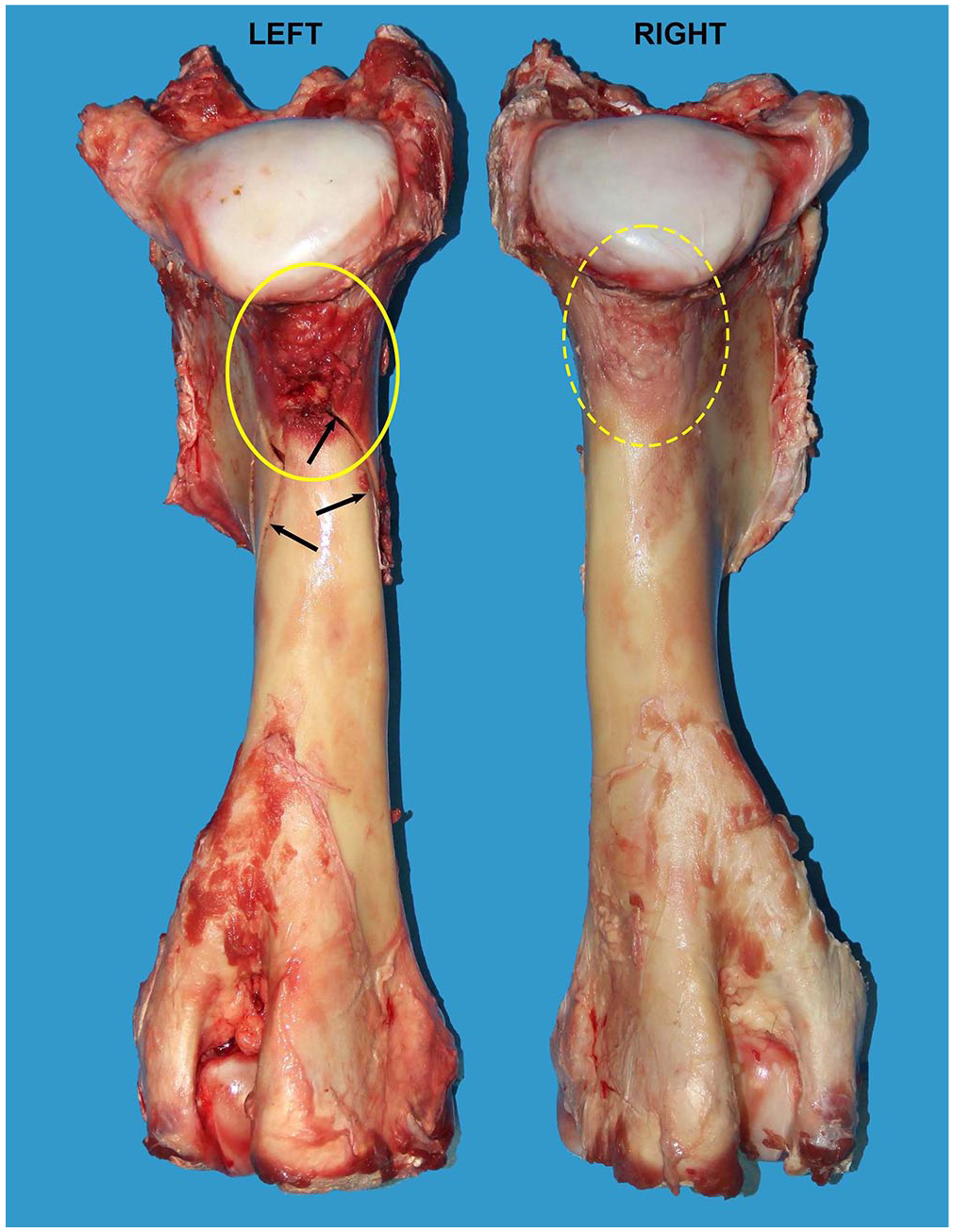
Humeri (caudal view) from a racehorse that completely fractured the left humerus through a region of preexisting stress fracture callus—highly vascular woven bone (red, raised, irregular surfaced tissue; yellow ellipse) on the periosteal surface located just below the articular surface of the humeral head. The callus is associated with, and bridges, the complete fracture (arrows). Note the smaller, pink callus (dashed yellow ellipse) in the corresponding location on the right humerus. These findings indicate that the horse had a preexisting stress fracture that predisposed the left humerus to fracture. Detection of the earlier, milder stage of stress fracture development, and appropriate rehabilitation could have prevented catastrophic fracture. The bilateral nature of the disorder may have made the detection of clinical signs associated with lameness difficult.
Reference citations for site-specific bone fractures and diagrams to record fracture configuration and findings can be downloaded using the following links:
Racehorse catastrophic injury references: https://vorl.vetmed.ucdavis.edu/sites/g/files/dgvnsk4731/files/inline-files/Racehorse%20Catastrophic%20Injury%20References.docx Bone fracture diagrams: https://vorl.vetmed.ucdavis.edu/sites/g/files/dgvnsk4731/files/inline-files/Equine_bone_fracture_diagrams.zip