




Abstract
We assessed the bacterial agents found in 8–12-wk-old post-weaning pigs with arthritis. The bodies of 178 post-weaning pigs from 90 farms (average of 2 pigs/farm) with recurrent problems of lameness and swollen joints in a high-density breeding area were submitted for autopsy and sampled for further bacterial investigation. The most common articular gross lesions and histopathologic findings were serofibrinous (95 of 178; 53%) or serous (65 of 178; 37%) arthritis; suppurative lesions were less frequent (18 of 178; 10%). In 133 of 178 (74.7%) cases, a bacterial agent was detected in joints. Mycoplasma hyorhinis was the most common bacterium detected (82 of 133; 61.6%). Haemophilus parasuis and Streptococcus spp. were observed in 27 of 133 (20.3%) and 24 of 133 (18.0%) cases, respectively. Other bacteria in the 113 cases, considered less important, in order of their low frequency, were Mycoplasma spp. (13; 9.8%), Trueperella pyogenes (11; 8.2%), Mycoplasma hyosynoviae (4; 3.0%), Staphylococcus spp. (3; 2.2%), Escherichia coli (2; 1.5%), and Actinobacillus spp. (2; 1.5%). Our results highlight the primary role of M. hyorhinis compared to other microorganisms involved in young pigs with arthritis.
Polyarthritis is a widespread and important disease in pig farms, responsible for a significant increase in post-weaning loss of animals, with a drastic reduction in welfare, loss of portions of carcasses, as well as condemnation of entire carcasses in finishers at the abattoir. 5 Arthritis is defined as inflammation of the intra-articular tissue of one or more joints; it is characterized by an increased volume of intra-articular fluid with specific features, which vary depending on the duration and the components of the exudate. Infectious arthritis in swine is commonly associated with bacteria. Mycoplasma hyorhinis and M. hyosynoviae are known causative agents of arthritis in swine. Other bacteria include Erysipelothrix rhusiopathiae, Haemophilus parasuis, Actinobacillus suis, Staphylococcus spp., Streptococcus spp., Salmonella enterica, Escherichia coli, and Trueperella pyogenes.
Despite studies highlighting the importance of these microorganisms in slaughter hogs,3,4,9 investigations involving post-weaning animals are lacking. In Italy, ~12 million pigs are produced per year, of which 70% are finished as traditional heavy Italian pigs, generally slaughtered at ≥9-mo-old and averaging 160–180 kg live weight. Their meat is used mainly in the production of uncooked, unsmoked, and dry-cured meat preparations, of which the ham is the most common. Typical heavy-pig farms are intensive indoor farms, even when organized in different sites with different production systems (including farrow-to-finish, farrow-to-wean, and multiple-site herds). Occurrence of lameness is of great concern because of negative implications for the health and welfare of animals raised to reach a heavy weight before slaughter.
We examined 178 dead pigs, from 90 different farms in the Po Valley region of northern Italy, the highest-density swine breeding area in Italy. The examined farms had a history of recurrent problems of lameness in post-weaned animals 8–24-wk-old. We examined at autopsy only animals 8–12-wk-old that were submitted to the Diagnostic Laboratory of Animal Diseases of the Istituto Zooprofilattico Sperimentale della Lombardia ed Emilia Romagna in Brescia, Italy. Older affected pigs were not sampled. We enrolled only animals with signs of articular lesions, such as swollen and fluctuant joints. We examined hocks, carpi, and phalanges, which are usually more visibly affected. Shoulders, stifles, and atlantooccipital joints were also inspected carefully. Internal viscera were also inspected. Articular synoviae were sampled for histologic examination. Samples were fixed in 10% neutral-buffered formalin, processed routinely, and 5-μm sections stained with H&E. Affected joints were classified according to the gross pathology and histology results.
Swabs from the articular synovium, pleura, pericardium, or peritoneum, as well as tissue from the lung, spleen, kidney, and brain were collected from each pig. We performed direct culture for non-target agents, such as common bacteria, rather than the more sensitive PCR methods, which can detect nucleic acids from nonviable organisms from past or chronic infections that are not related. For fastidious microorganisms, such as H. parasuis, M. hyorhinis, and M. hyosynoviae, given the low sensitivity of culture, we used PCR. Bacteria were isolated from tissues and swabs in pure cultures on solid agar plates (Gassner agar and 5% blood agar, with Staphylococcus aureus as feeder organisms in a microaerophilic condition) at 37°C for 24–48 h. Identification took place by standard phenotypic characterization, including the analytical profile index system. 2 For H. parasuis, we used an endpoint PCR based on the amplification of a species-specific 821-bp sequence of 16S rRNA. 6 An endpoint PCR assay based on the amplification of a genera-specific 721-bp sequence of 16S rRNA was used for the detection of Mycoplasma spp.; in positive cases, a real-time PCR assay for the p37 protein was used for the detection of M. hyorhinis and M. hyosynoviae.1,8,10 However, when the PCR for Mycoplasma spp. was positive, but the PCR for M. hyorhinis and M. hyosynoviae was negative, we recorded the case as positive only for Mycoplasma spp.
According to the autopsy and histologic observations, the most frequent lesion was serofibrinous arthritis (95 of 178; 53%), followed by serous arthritis (65 of 178; 37%); purulent arthritis was less frequent (18 of 178; 10%; Table 1). In 133 of 178 (74.7%) cases, a bacterial agent was detected in the joints (Table 1). M. hyorhinis was the most common pathogen (82 of 133; 61.6%) and was associated with serous or serofibrinous synovitis. We found M. hyosynoviae to be less common than M. hyorhinis (4 of 133; 3% vs. 61.7%), contrary to reports of arthritis in finishing pigs.3,4 H. parasuis and Streptococcus spp. were found in 27 of 133 (20.3%) and 24 of 133 (18.0 %) cases, respectively, particularly in cases of fibrinous arthritis or when diffuse infection of the serosae or parenchymatous organs was present. Other bacteria found in the133 positive cases, but considered less important, in order of their frequency, were Mycoplasma spp. (13; 9.8%), T. pyogenes (11; 8.2%), M. hyosynoviae (4; 3.0%), Staphylococcus spp. (3; 2.2%), E. coli (2; 1.5%), and Actinobacillus spp. (2; 1.5%). Bacteria such as S. enterica and E. rhusiopathiae were not detected in our study, probably because of the age of the animals or the widespread use of a specific vaccine for E. rhusiopathiae in the examined farms.
Bacteria isolated from various histopathologic types of arthritis in 8–12-wk-old pigs.
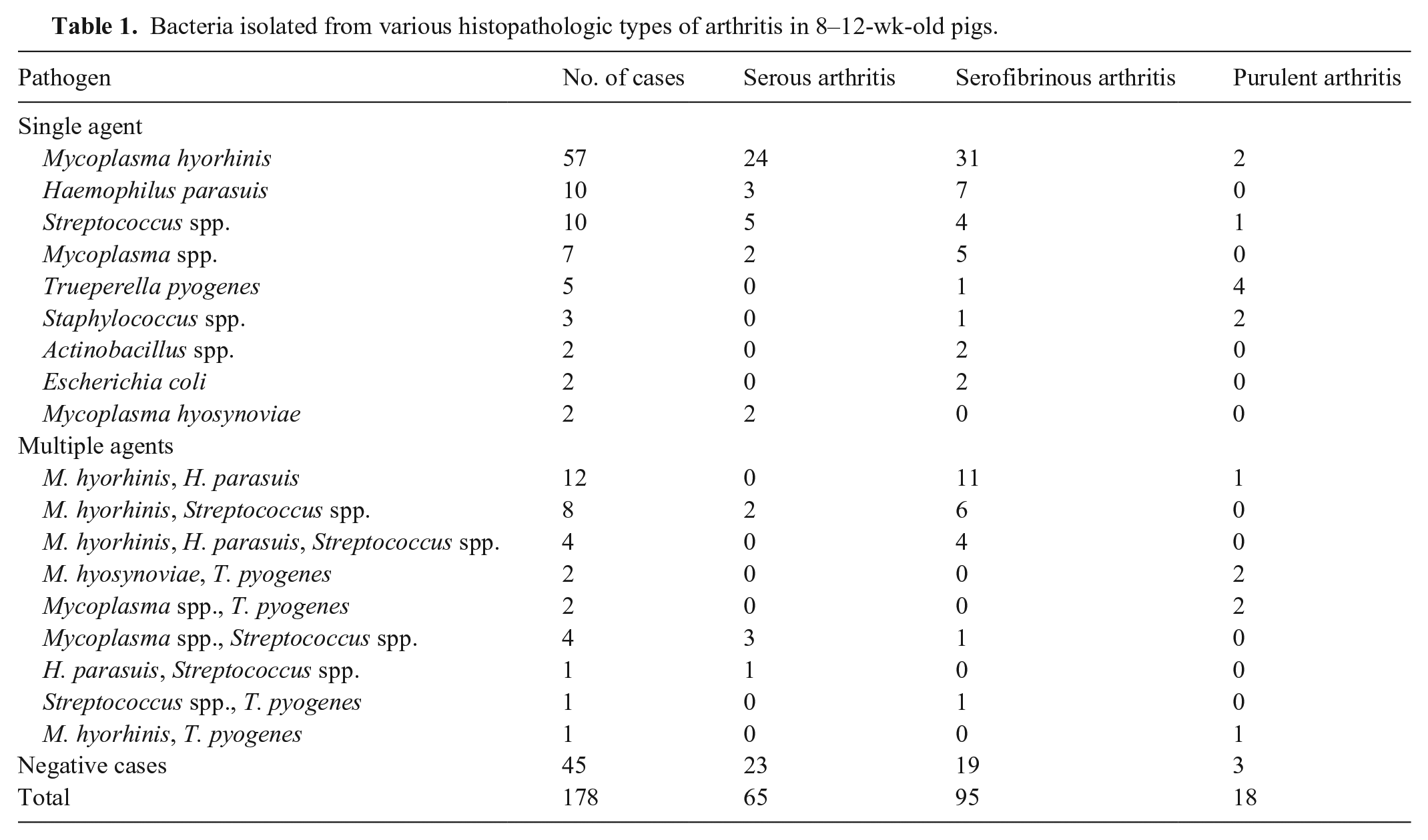
Although we cannot speculate about the statistical strength of our multi-agent finding, we found bacterial coinfection in 35 of 133 (26.3%) cases, especially coinfections between M. hyorhinis and H. parasuis or M. hyorhinis and Streptococcus spp. (Table 1). H. parasuis and M. hyorhinis, as well as Streptococcus spp., E. coli, and Actinobacillus spp., were also detected in the parenchymatous organs (spleen, lung, kidney, brain) or serosae (pericardium, peritoneum, pleura; Table 2), indicating systemic involvement of the infections. In these cases, the most common autopsy evidence was polyserositis associated with pneumonia and splenomegaly (58 of 178; 32.5%). 7
Number of cases with visceral and serosal involvement in swine with bacterial arthritis.
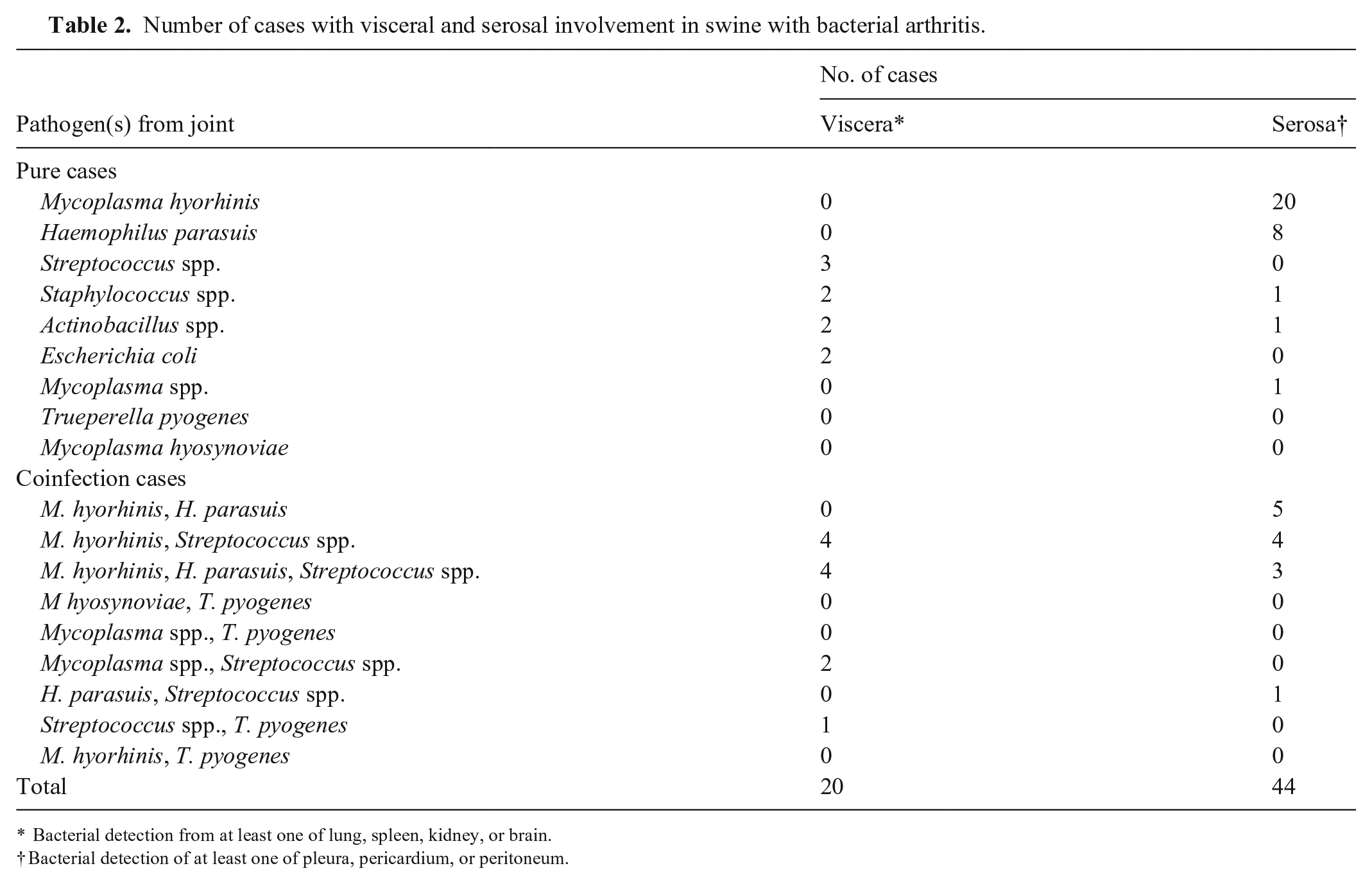
Bacterial detection from at least one of lung, spleen, kidney, or brain.
Bacterial detection of at least one of pleura, pericardium, or peritoneum.
Articular lesions in which bacteria were not detected may have resulted from elimination or reduction of bacteria by the immune system of the pigs, leading to concentrations undetectable by culture or PCR; or lesions resulting from noninfective causes, such as mechanical injuries, immunological diseases, or dystrophy. 5 These events were not investigated in our study.
Footnotes
Declaration of conflicting interests
The authors declare no potential conflicts of interest with respect to the research, authorship, and/or publication of this article.
Funding
The authors received no financial support for the research, authorship, and/or publication of this article.
