



Abstract
We investigated the effects of season and geographic location on detection of nucleic acids of potential enteric pathogens (PEPs) or their toxins (PEP-Ts) in feces of horses ≥6-mo-old in the United States. Results of 3,343 equine diarrhea PCR panels submitted to Idexx Laboratories for horses >6-mo-old were reviewed. Submission months were grouped into 4 seasons, and states were grouped into 4 geographic regions. Logistic regression was performed to assess effects of season and region on detection rates of PEPs and PEP-Ts. Agresti–Coull CIs were determined. Detection rate of Salmonella enterica was higher in the South in summer compared to all other regions, and was also higher in the South in fall compared to the Midwest and Northeast. The Neorickettsia risticii detection rate was lower during summer in the West and higher in fall in the Midwest. Detection of Cryptosporidium spp. was lower during spring, summer, and winter in the West. Differences were not identified for detection rates of Clostridioides difficile, Clostridium perfringens, Lawsonia intracellularis, Rhodococcus equi, equine rotavirus, and equine coronavirus. Overall, our data support seasonal and regional differences in detection rates of S. enterica, N. risticii, and Cryptosporidium spp. in horses ≥6-mo-old in the United States.
Equine gastrointestinal (GI) disease attributable to enteric pathogens and their toxins in adult horses poses treatment and management challenges. Although establishing an etiologic diagnosis is essential for making well-informed treatment and biosecurity decisions, identifying potential enteric pathogens (PEPs) and their toxins (PEP-Ts) is challenging.5,19 Well-recognized infectious causes of GI disease in adult horses include Salmonella enterica serovars, Neorickettsia risticii, toxin-producing strains of Clostridioides difficile and Clostridium perfringens, and equine coronavirus. 19 Various detection tests, including bacterial culture and real-time PCR (rtPCR) and ELISA testing of feces, are often pursued to identify a causative agent. Unfortunately, multiple tests are expensive, and results may not be available for several days. Further, negative results for all tests remain a common problem.11,19 In an attempt to improve diagnostic yield and turnaround time, as well as to lower cost, molecular-based tests to detect nucleic acids of PEPs or PEP-Ts, including the equine diarrhea rtPCR panel offered by Idexx Laboratories, have been developed to screen a single fecal sample for nucleic acids of various PEPs or PEP-Ts. Because treatment for GI disease is implemented before test results become available, information regarding likelihood of specific PEPs or PEP-Ts, based on season and geographic region, could assist clinicians in making empirical treatment decisions. 12 Further, information regarding effects of season and region on rates of detecting PEPs or PEP-Ts in adult horse feces could provide a foundation for future investigation of effects of global climate change on prevalence of PEPs or PEP-Ts. Thus, our objective was to determine effects of season and geographic location on detection rates of nucleic acids of PEPs or PEP-Ts in feces collected from horses ≥6-mo-old in the United States. We hypothesized that rates of detection of PEPs and PEP-Ts would vary by season and geographic region.
Results of 3,343 Idexx Laboratories equine diarrhea rtPCR panels performed on fecal samples submitted from across the United States between January 2011 and December 2014 were reviewed for horses ≥6-mo-old. Samples collected from younger horses and subsequent submissions from the same horse (rare) were excluded. Months of submission were grouped into 4 seasons: winter (December–February); spring (March–May); summer (June–August); and fall (September–November), and states were separated into 4 geographic regions; South, West, Midwest, and Northeast (Table 1).
Categorization of U.S. states into geographic regions.
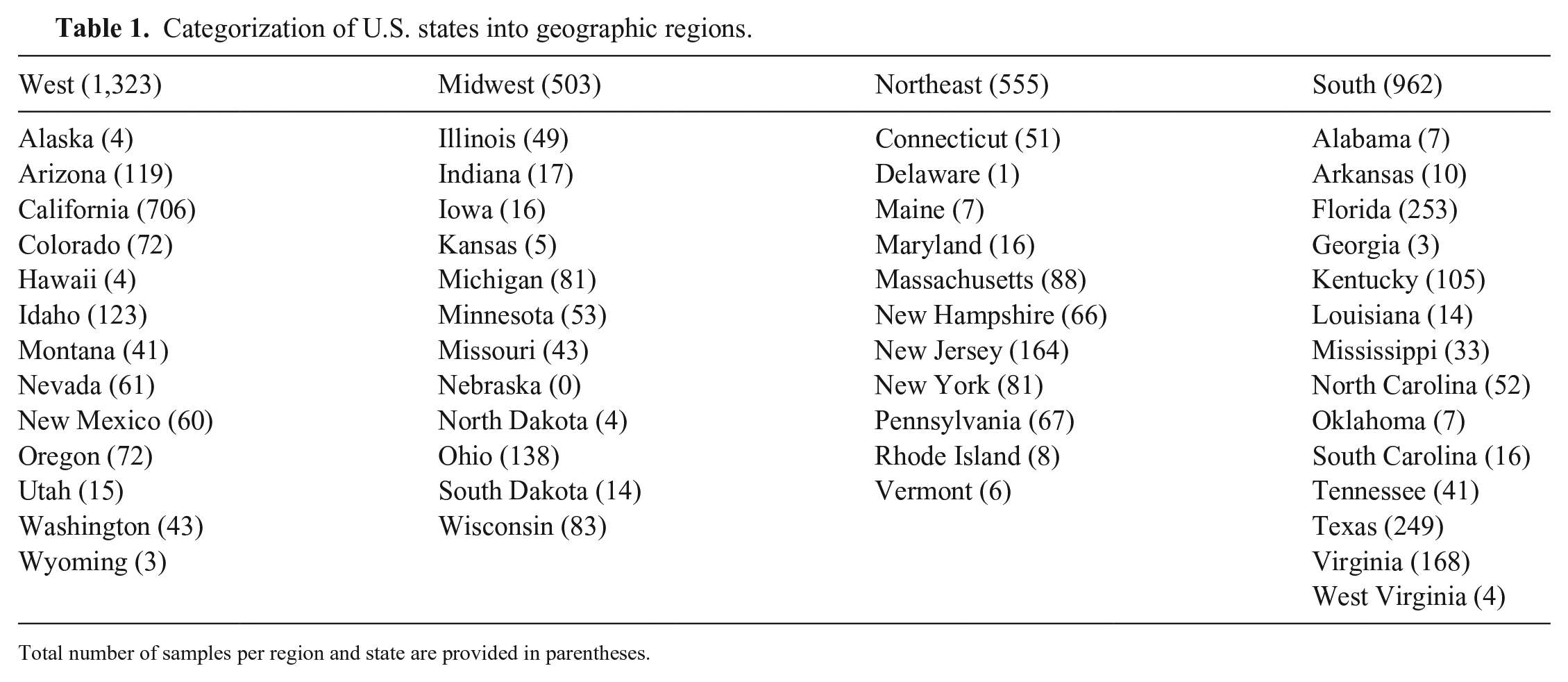
Total number of samples per region and state are provided in parentheses.
Fecal samples were collected and shipped at 4°C, and nucleic acids were extracted using published protocols. 20 Hydrolysis probe (TaqMan)-based reverse-transcription PCR (RT-PCR) assays targeting 10 PEP or PEP-T genes (Equine diarrhea RealPCR panel; Idexx Laboratories) were performed on the 3,343 equine fecal samples. Nucleic acid extraction and PCR testing for Salmonella enterica was also performed on samples following an enrichment step using selective culture media. Real-time PCR was performed (LightCycler 480; Roche) with proprietary forward and reverse primers and hydrolysis probes (Roche). Target genes included S. enterica: invasion A gene (invA, GenBank EU348366); N. risticii: ribosomal RNA (16S rRNA, AF194082.1); C. difficile toxin A gene (X60984); C. difficile toxin B gene (X60984); C. perfringens alpha toxin gene (L43545); Cryptosporidium spp. single-stranded rRNA (ssrRNA, AF093489); Rhodococcus equi: virulence-associated protein A gene (vapA, AF116907); Lawsonia intracellularis: aspartate ammonia-lyase gene (aspA, AM180252); equine rotavirus: VP4 (EU717544) and VP7 (L49043) genes; and equine coronavirus: M gene (EF446615), as described previously. 20 Real-time PCR was performed with 7 quality controls, including PCR-positive and -negative controls, negative extraction controls, DNA pre-analytical quality control targeting the host ssrRNA (18S rRNA) gene complex, RNA pre-analytical quality control targeting the host ssrRNA gene complex, an internal positive control spiked into the lysis solution, and an environmental contamination monitoring control. Results of PCR runs were accepted only if quality control results were correct. Crossing points (Cp) were calculated using the second derivative maximum method analysis with a high-sensitivity algorithm. Crossing points of ≤39.9 were considered positive, and ≥40 were considered negative for all rtPCR test results.
Detection rates are expressed as percentages of positive results for each PEP or PEP-T during each season in each region. Logistic regression models for each PEP or PEP-T were fit to relate detection rates to season, region, and the interaction between season and region. The effect of year, after adjusting for season and region, was assessed by fitting a full logistic regression model with an interaction of season, region, and year, and comparing it to a reduced model with only the interaction of season and region using a likelihood ratio test. The effect of year without adjustment for season and region was assessed by fitting a full logistic regression model with the effect of year and comparing it to the null model with only an intercept using a likelihood ratio test. Post-hoc Tukey comparisons were made to compare all regions within each season. Agresti–Coull CIs were determined and plotted for each PEP or PEP-T and for each level of interaction between season and region. All statistical analyses were performed using R. 16
Fecal samples were submitted from 49 of 50 states (samples from horses ≥6-mo-old were not available from Nebraska). Detection rates of one or more PEP or PEP-T in feces were 29–32% across seasons and 27–35% across regions (Table 2). There was no effect of year in overall detection rates (p = 0.49). No effect of season or region was found for detection rates of C. difficile toxin A and toxin B genes, C. perfringens alpha toxin gene, or L. intracellularis, R. equi, equine coronavirus, or equine rotavirus genes (p > 0.05; Fig. 1, Suppl. Fig. 1). In contrast, there was a difference in detection of S. enterica during summer and fall between regions, with highest detection rates in the South. Specifically, detection rates for S. enterica were higher in the South compared to the Midwest and Northeast in the fall. Additionally, there was a higher S. enterica detection rate in the South in the summer compared to all other regions. Detection rates of N. risticii were lower during summer in the West and higher in the Midwest during fall, compared to all other geographic regions. Detection rates of Cryptosporidium spp. were lower during spring, summer, and winter in the West, compared to other regions (Fig. 1; Suppl. Fig. 1).
Detection rates of one or more potential enteric pathogens or toxins by Idexx Laboratories multiplex rtPCR by season or region.
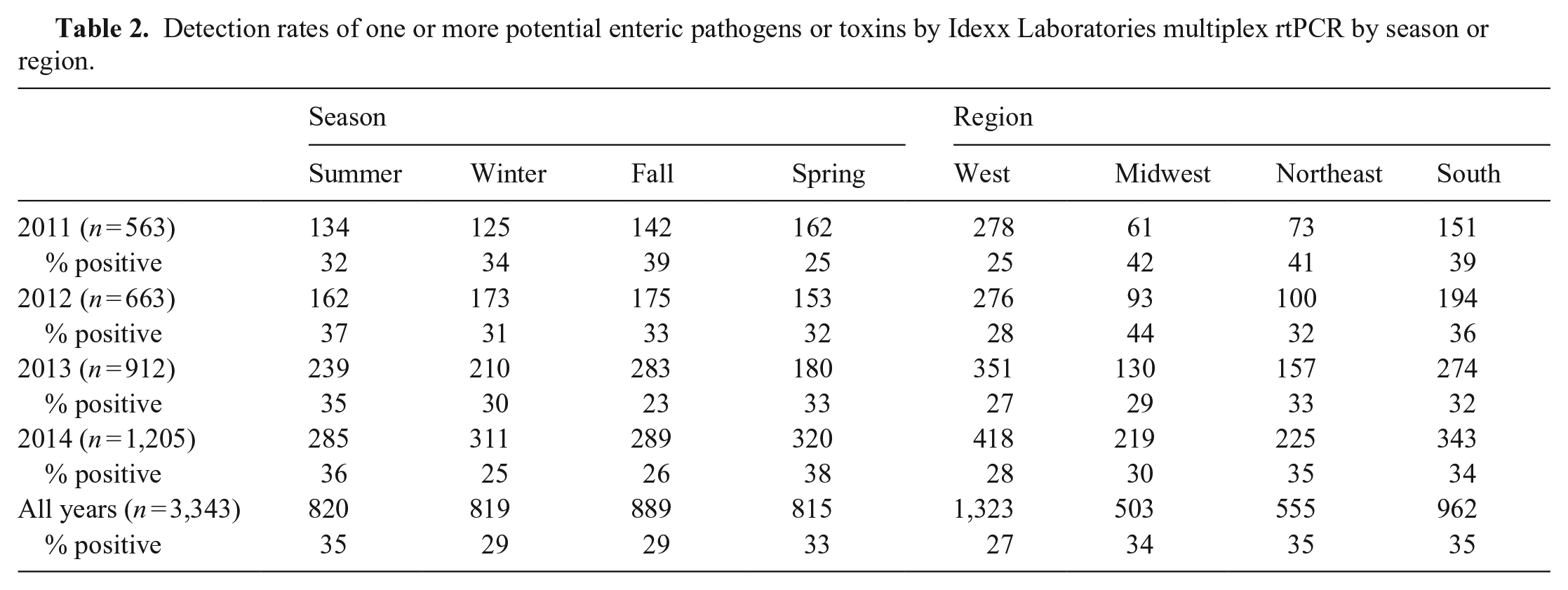
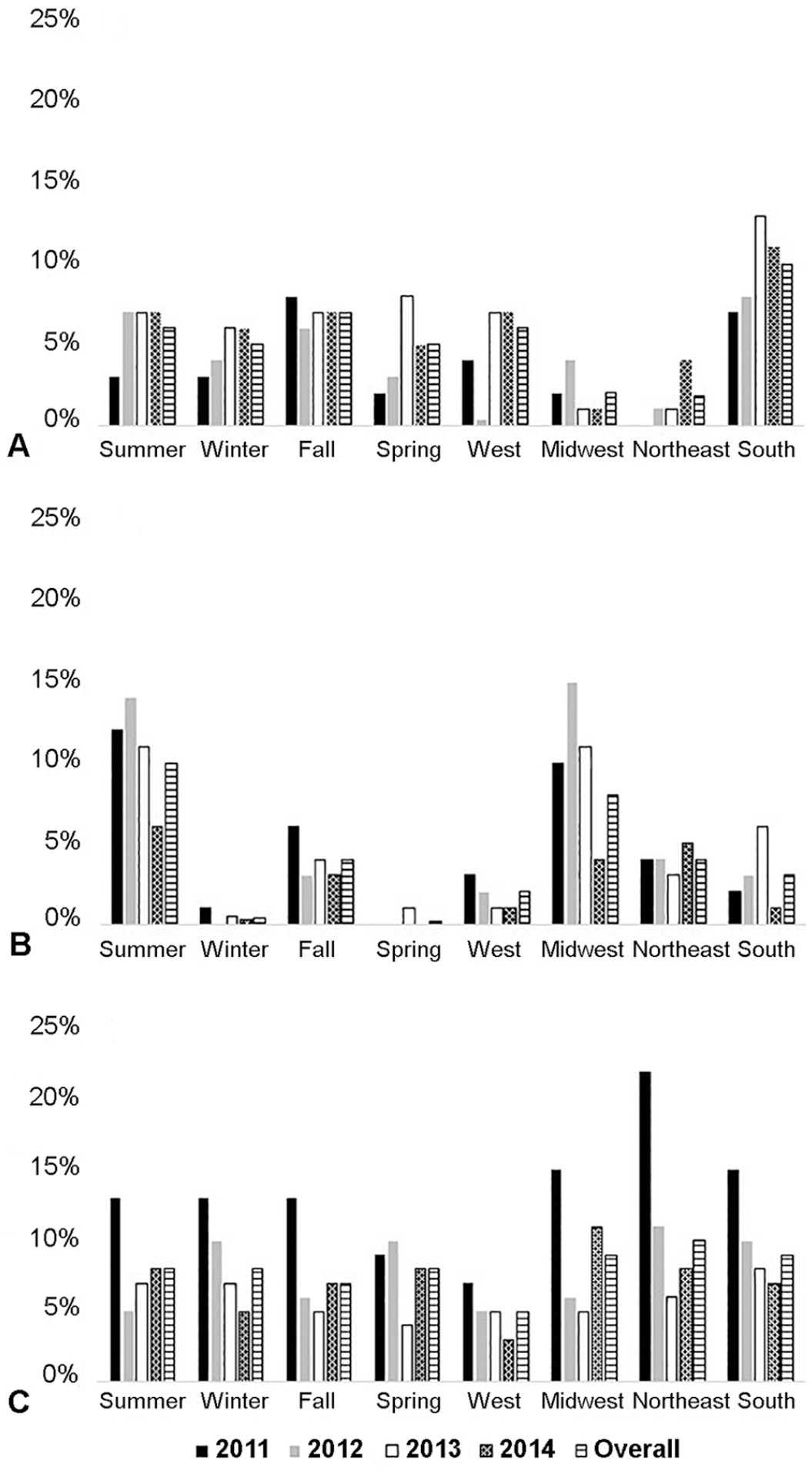
Detection rates of
Intestinal colonization with S. enterica serovars can result in a variety of clinical presentations in individual horses, ranging from silent carriage to life-threatening typhlitis and colitis,21,22 and can also cause outbreaks in hospital and farm settings.6,18,24 As part of the 1998 National Animal Health Monitoring System (NAHMS) survey of management practices and health problems on equine operations in the United States, S. enterica was cultured from 0.8% of 8,417 fecal samples. 23 Although 1.1% of 4,643 samples collected during the summer had positive results, compared to only 0.2% of 3,774 samples collected during the winter, this difference was not a significant finding. Similarly, 1.4% of samples collected from equids in Southern states were positive for S. enterica, compared to 0.2% of samples collected from equids in Northern states, but again this difference was not a significant finding. When shedding data for S. enterica was assessed on an operation (farm) level, compared to individual horse data, operations sampled in the summer (2.5%) and in Southern states (3.1%) had higher rates of shedding than operations sampled in the winter (0.7%) and in Northern states (0.8%). Higher ambient temperature and humidity can allow longer environmental survival of S. enterica serovars and have been implicated as contributing factors in outbreaks.6,18,22 In contrast, freezing temperatures and low humidity decrease S. enterica viability in the environment,2,7 and these factors might partly explain the seasonal and regional effects on S. enterica detection rates in our study. To our knowledge, effects of season and geographic region on detection of S. enterica in feces collected from horses with suspected GI disease have not been reported previously on a national (U.S.) level. As in the NAHMS study, S. enterica detection rates were higher in non-winter months in the South, with higher absolute detection rates likely attributable to testing of feces collected from horses with suspected enteric disease. Further, because higher rates of S. enterica infection are associated with warmer weather, concerns have been raised that global warming may lead to an increase in S. enterica outbreaks in people. 1 Our data may serve as a baseline that could allow future comparison of S. enterica detection rates to assess whether global warming may lead to an increased risk of equine salmonellosis.
N. risticii, a gram-negative intracellular bacterium, is the causative agent of Potomac horse fever (PHF), also known as Shasta River crud in northern California.13,14 N. risticii utilizes trematode parasites as a vector, with freshwater operculate snails as an initial intermediate host and flying aquatic insects (e.g., caddisflies, mayflies, and possibly others) as secondary intermediate hosts; infection of horses occur by accidental ingestion of dead insects infested with trematode metacercaria during warmer months. 14 Proximity to freshwater lakes and streams is a recognized risk factor for PHF 4 thus, it was not surprising to find seasonal and regional differences in detection rates for N. risticii. Although a previous study found no evidence of geographic variation in seropositivity to N. risticii within a single state (New York), 3 to our knowledge, variations in detecting N. risticii over season and by region have not been reported previously on a country-wide basis. Further, although less well-described, regional outbreaks of PHF appear to vary from year to year in endemic regions. 4 Although we did not find significant seasonal or regional differences for N. risticii detection rates over the 4 y of our study, annual variation could support that environmental factors play a role in PHF risk, as would be expected with a disease reliant on insect vectors and environments favorable for proliferation of these vectors. Additional work is needed to further document risk of N. risticii infection based on proximity to freshwater lakes and streams, as well as with variation in environmental factors over successive years.
Cryptosporidium spp. had lower detection rates during spring, summer, and winter in the West compared to other geographic locations. Cryptosporidium spp. infection is associated with development of profuse diarrhea in several species, including humans and cattle. However, the clinical significance of detecting Cryptosporidium spp. in feces collected from horses ≥6-mo-old remains unclear. Clinical disease attributable to infection with Cryptosporidium spp. has been limited to foals.8,10 Further investigation of the clinical significance of identifying Cryptosporidium spp. in feces from horses ≥6-mo-old is warranted. No differences in detection rates between seasons and/or geographic locations were noted for C. perfringens and C. difficile toxins, R. equi, L. intracellularis, equine rotavirus, and equine coronavirus. This lack of differences may be because of several reasons, such as the pathogen not requiring a vector with seasonal and geographic tendencies, ubiquitous presence in a variety of environments, and/or failure to fully evaluate the disease prevalence as a result of not identifying clinically relevant strains and/or toxins (i.e., C. perfringens).
Several limitations of our study warrant mention. First, clinical reasons for submission of fecal samples for PCR testing were not available nor were other potentially relevant data (i.e., farm size, horse movement, medication use, etc.). Although it would seem intuitive that all horses for which a comprehensive enteric disease panel was submitted were showing signs of GI disease, this might not be true. The lack of travel history could also impact season and geographic risk factors given that the state of submission might not always represent where the patient acquired a PEP or PEP-T. Next, submission of a single fecal sample to detect S. enterica could have resulted in false negatives, as it is generally recommended that 3–5 fecal samples are collected on sequential days for testing given the intermittent shedding of the organism. 15 Similarly, a 2018 study reported that horses infected with equine coronavirus may also have intermittent shedding; thus, results from a single fecal sample could also produce false-negative results. 17 Next, testing for PEPs and PEP-Ts by PCR panels detects microorganism nucleic acids, not live microorganisms. Although detection of DNA by PCR is often accepted to be supportive evidence of infection, this may not always be the case; hence, the word detection rather than infection has been used throughout this manuscript. Likewise, PCR assays for PEP-Ts detect toxin genes and may not reflect actual toxin production. Next, geographic locations were defined based on 4 common terms (North, South, East, and West). However, these groupings include states with diverse climate and terrain. Ideally, submissions would have been grouped based on state of submission, but lower total numbers of submissions per state precluded meaningful statistical analyses. Finally, the clinical relevance of detecting C. perfringens alpha toxin as a cause of enteric disease in horses has been questioned, compared to detection of other C. perfringens toxins. 9 Thus, it is possible that some horses with enteric disease attributable to production of other C. perfringens toxins were missed with the Idexx diarrhea PCR assays at the time of our study.
Supplemental Material
sj-pdf-1-vdi-10.1177_10406387211056054 – Supplemental material for Effect of season and geographic location in the United States on detection of potential enteric pathogens or toxin genes in horses ≥6-mo-old
Supplemental material, sj-pdf-1-vdi-10.1177_10406387211056054 for Effect of season and geographic location in the United States on detection of potential enteric pathogens or toxin genes in horses ≥6-mo-old by Jaclyn A. Willette, Jamie J. Kopper, Clark J. Kogan, M. Alexis Seguin and Harold C. Schott in Journal of Veterinary Diagnostic Investigation
Footnotes
Acknowledgements
We thank Sue Wismer, LVT for her help in obtaining and organizing laboratory results.
Declaration of conflicting interests
M. Alexis Seguin is employed by Idexx Reference Laboratories, which provided the data for this manuscript. The remaining authors declared no potential conflicts of interest with respect to the research, authorship, and/or publication of this article.
Funding
The authors received no financial support for the research, authorship, and/or publication of this article.

Supplemental material
Supplemental material for this article is available online.
References
Supplementary Material
Please find the following supplemental material available below.
For Open Access articles published under a Creative Commons License, all supplemental material carries the same license as the article it is associated with.
For non-Open Access articles published, all supplemental material carries a non-exclusive license, and permission requests for re-use of supplemental material or any part of supplemental material shall be sent directly to the copyright owner as specified in the copyright notice associated with the article.
