




Abstract

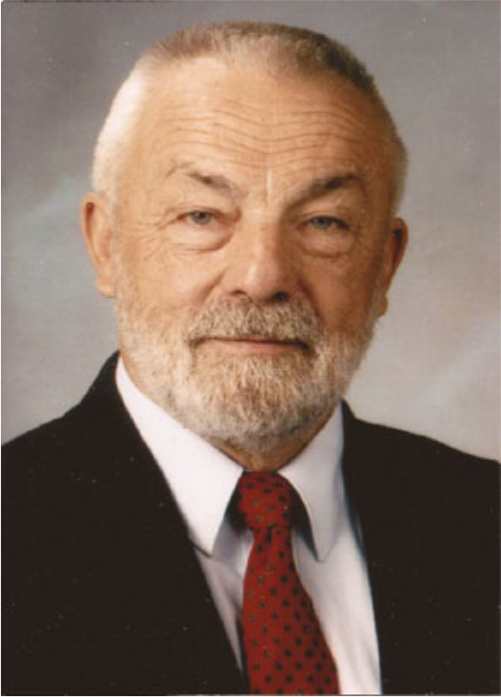
A giant’s heart was stilled recently and its silence will reverberate forever within our profession. It was far larger than most, filled with a love of pathology, a love of learning, of students and of teaching, and a love of challenging both young and old minds alike. It was a heart whose generosity filled our textbooks with his observations without the need for recognition, that filled our lectures with his images without the need for attribution, and whose “Necropsy Book”—one of the best-selling volumes ever written for veterinary pathologists—raised money not for his pocket, but for the education of veterinarians around the world.
John M. King’s peers called him a “legend” or a “pillar of pathology,” but he was so much more. John was beyond larger than life; he was mythic. His childhood in an orphanage where his only shoes were a pair of rubber boots, his service as a U.S. Army paratrooper in Nazi Germany, and his lifelong love affair and 70-year marriage to his darling Marie—even without veterinary pathology, it was a magical story.
Everyone who knew John has stories of him to tell, and some are probably even true. Some of us were blessed to know John a bit more than just his public persona, and our stories can only paint a pale picture of the influence he had on our lives and careers. But knowing John, he would rather have me impart a story or two, rather than perform a dry-as-dust recitation of accolades from his amazing career.
I said that, without the pathology, his story would still be amazing—but oh, the pathology! John was the unrivalled master of observation and perhaps the finest pure pathologist our field has ever known. His library was the necropsy floor, and his books were the endless stream of autopsied animals divulging their secrets to his knife or the knives of his students under his watchful eye. For 50 years, he saw with those crisp blue eyes alone what most pathologists, backed by the steady progress of technology, could not or would not. Unlike most of us, who have assimilated the mass of our professional knowledge from books and the work of others, John learned all of his on the necropsy floor. Although few of these discoveries were published at the time, they populate textbooks today, largely through the hundreds, maybe even thousands of his students around the world, who learned from him and later proved them to be true during their own careers.
John’s curiosity was his defining feature, but perhaps even more important was his unflagging questioning of literally everything. He was not someone to accept an explanation simply because it was in print or was cited by a prominent pathologist. Seeing John’s hand go up in the middle of one of your lectures meant that the podium was about to become your hot seat, much to John’s and the audience’s delight. More important, he imbued this truth-seeking into his thousands of students, encouraging them to challenge even what he was teaching them. I believe that it is this simple trait that has resulted in so many of his graduate students becoming renowned teachers on their own, as well as professors of veterinary pathology, outstanding researchers, and leaders of our profession.
In his later years, he wouldn’t interrupt your lecture but he would let you know at the end. On a lecture trip I made with him to Korea a number of years ago, I thought I was doing pretty well until a week later when I received a 24-page handwritten letter from John of all of the things I had “gotten wrong.” I felt terrible about it, until another teacher more senior than I admitted that he had gotten 1 of 26 pages. (It isn’t as bad as it sounds—John’s handwriting was “unique” at best and try as he might, he could only fit about 10–12 lines onto a sheet of lined paper.) I still have that letter and it is one of my fondest possessions.
The necropsy room was not only his library, but it was also his theater. He was a master showman, always playing to packed houses. Even at 5
Many pathologists who only knew John from afar were put off by the size of John’s personality. For those of us who were able to know him, we knew John’s bluster to be far more a part of his myth than grounded in any truth. One of my favorite stories about John concerned his mentor Dr. Peter Olafson, who had “owned” the Cornell necropsy floor before John. When John took over that responsibility, each Friday afternoon he would help the frail and nearly blind Dr. Olafson to a seat at the edge of the necropsy table in front of a hundred or more students and faculty. John, an amazing pathologist by now in his own right, would simply describe the lesions for Dr. Olafson, who would either comment on the case, or wave his hand for John to describe another lesion. John never offered a dissenting opinion, and his kindness and obvious love and respect for Dr. Olafson was not lost on a packed house.
Later in his career, John was the driving force in instituting the Olafson Medal, an award given to pathologists around the world who have made distinguished contributions to the field in the combined disciplines of diagnostics, teaching, and research. After many years, and only after stepping down from the committee, he was unanimously given the award for which he had steadfastly refused to allow himself to be considered.
To see John with the students was to see the real man. Students loved John and he loved them back. No question was beneath him, and his time was always theirs. John had some rough edges to be true, but they were necessary as a defense for the softest, kindest heart imaginable. Passing years were not always kind to John’s unfiltered nature; however, the tremendous diversity of those in our profession who love him shows that good people will always triumph over progressively narrowing sensibilities. Sadly, on this day, I would rather hear one of John’s “Williams, just what good ARE you?” than a compliment from anyone else I know.
God, John loved to teach—anywhere and anyone. My glass tabletop still proudly bears scratch marks from when he would hold court with nonpathologist dinner guests and my kids, showing them bezoars, blister beetles, and other bits of magic from his “Black Box”—a battered old suitcase with a chain leash for a handle into which he had piled a career’s worth of portable oddities and treasures that didn’t require fixation.
One of John’s favorite pastimes was giving young (and old) book-smart pathologists the “pathology catechism”—over a 100 questions about veterinary pathology that aren’t in any textbook. I took it several times, always failing miserably (and later pretending to after I had memorized a copy he left lying around) to his great delight. Although a correct answer would bring a twinkle to his eye and a paternal smile, he loved wrong answers best, because he knew a spirited discussion was in the offing. John loved the argument, because in his later years, when he was no longer in the necropsy room, that was where he would learn something new (not that it would change his long-held views on pathology, but he delighted in learning new things almost as much as he did in teaching). At the 2012 American College of Veterinary Pathologists (ACVP) meeting, where he was invited to talk as a “Pillar of Pathology,” rather than recounting the high points of his unrivaled career as expected, John decided to give the assembled guests a part of the “catechism” instead. The ACVP learned that day what we all had known for so long—you never know what John was going to say, but it was always entertaining.
John didn’t know everything, and he was the first person to tell you this fact. There were few questions he probably had never considered, and he knew the ones that had him stumped. When you asked him one of these, he would just smile and simply raise his index finger to the sky and say, “Ask him.” And his later years, he would tell me “Ask him yourself, because I’m too close to doing it for real.”
Now that my friend John is gone, I know that God is going to be busy for a while.