




Abstract
Vaccinia virus (VACV) has been associated with zoonotic exanthemic outbreaks affecting bovids and human beings, with significant public health and economic impacts. Rapid and reliable diagnostic methods are needed to detect and epidemiologically monitor antibodies to VACV. The current study describes the development of an immunoperoxidase monolayer assay (IPMA) for detection of total VACV antibodies in bovine serum. The assay was validated by comparison with a plaque reduction neutralization test (PRNT). Kappa index of agreement, diagnostic sensitivity, specificity, and accuracy of the IPMA were −1.008, 100%, 96%, and 98%, respectively, when compared with PRNT on 148 field bovine sera. Repeatability tests on 32 field-positive serum samples revealed that intraclass coefficient correlation was 0.86. In experimentally infected cattle, VACV antibodies were detectable by IPMA 4 days postinfection, which was more than 2 weeks earlier than with the PRNT, indicating that IPMA could be a more sensitive test than the latter. In 4 naturally VACV-diseased cows monitored for 13 months, IPMA could detect VACV antibodies up to 13 months, a longer time than PRNT. The IPMA is simpler to produce and perform when compared with PRNT and is time saving and suitable for large-scale surveys of VACV infection in bovine.
In recent years, orthopoxviruses have been reported worldwide as being associated with zoonotic outbreaks, causing serious economic losses and public health concerns. Cases of Cowpox virus infections affecting human beings and animals have been frequently reported in Europe, as well as outbreaks of Monkeypox virus in Africa and the United States; Buffalopox virus in India, Egypt, and Bangladesh; and Vaccinia virus (VACV) in Brazil.2,3,8
In dairy cattle, VACV can cause a disease known as bovine vaccinia (BV), which is characterized by lesions on teats and udder of cows, which usually evolve from papules to vesicles, pustules, and crusts. 6 The circulation of VACV within and among farms during BV outbreaks is usually promoted by infected milkers and by the trade of infected cattle between properties. 6 However, the epidemiological status of the bovine population regarding VACV infection is poorly known, and a serological survey could bring key information to understanding virus circulation in the field.
Traditional methods for VACV antibody research, such as the reference method of plaque reduction neutralization test (PRNT), are complex and laborious, and they may require many days to be completed. 5 Although efforts to make this technique faster and reliable have been made, 1 a rapid method suitable for detecting VACV in large-scale surveys is still needed. Immunoperoxidase monolayer assay (IPMA) has proven to be an easy to perform assay and a valuable tool for the diagnosis of several infectious diseases, especially those conducted under field conditions. 9 The purpose of the current study was to test the validity of IPMA as a serologic test for the detection of VACV infection in dairy cattle.
Sera from 148 dairy cows were used to estimate the accuracy of IPMA to detect VACV antibodies comparing positive and negative results with those obtained by PRNT. Bovine VACV-positive sera (n = 73) were collected from diseased animals during a BV outbreak in Mariana County, Brazil, in 2006. In addition, 4 diseased cows from the same property were ear-tagged, and serum samples were collected 7 times: 2 weeks after the beginning of the outbreak, 15 days later, and then at approximately 2-month intervals throughout the year. Bovine VACV-negative sera (n = 75) were collected at the same time in neighboring nonaffected properties. In addition, 2 crossbred cows were inoculated in the teats, after previous skin scarification, with 50 µl of 106 plaque-forming units (PFU)/ml of VACV strain Guarani P2. a Pre- and postinoculation serum samples were collected weekly. The presence or absence of anti-VACV antibodies in all field and experimental sera were confirmed by the reference method PRNT. The present study was approved by the ethical committee of Universidade Federal de Minas Gerais (protocol no. 167/09).
The sera were submitted to a PRNT using the VACV Western Reserve (WR) strain b as the reference virus. Serum preheated at 56°C for 30 min and a virus suspension containing approximately 150 PFU were incubated at 37°C for 1 hr and then dispensed into a monolayer of Vero (African green monkey kidney epithelial) cells on 6-well plates. After 72 hr, the plates were stained with crystal violet, and the plaques were counted. The PRNT titer was defined as a reciprocal of the serum dilution resulting in 50% plaque reduction when compared with control. Titers less than 20 were considered negative, whereas titers of 20 were considered low, 40–80 were considered moderate, and 160 were considered high. The titers results were expressed in log2 with dilutions corresponding to 20 = 4.32, 40 = 5.32, 80 = 6.32, and 180 = 7.32.
The VACV-specific total antibody in serum was detected by IPMA. Fifty microliters of a suspension containing 50,000 freshly trypsinized Vero cells/cm2 in minimal essential medium (MEM) with 8% fetal bovine sera and 50 µl of VACV, at a multiplicity of infection of 0.01 in MEM, were dispensed into 96-well plates and incubated for 24 hr at 37°C in 5% CO2. Plates were fixed with methanol:acetone for 10 min at room temperature and then air-dried. Plates were used freshly or stored at −20°C for up to 3 months until use. Serial 3-fold dilutions of samples in phosphate-buffered saline (PBS)–Tween-20 0.05% (PBS-T) with 1% of casein were prepared (1:20–1:4,860) and pipetted into 96-well plates containing fixed VACV WR strain–infected Vero cells. Plates were incubated for 1 hr at 37°C and then washed with PBS-T. Next, 50 µl of protein G conjugated with peroxidase c diluted 1:750 in PBS-T was added to the wells and incubated for 1 hr at 37°C. Finally, plates were washed, and a substrate solution of 3-amino-9-diethyl-carbazole in 0.1 M acetate buffer with 0.05% hydrogen peroxide was added to reveal the reaction. In each plate, a positive and a negative serum sample was used as control. Six wells of each plate were incubated without VACV and served as cell control. Plates were examined under an inverted light microscope. The IPMA titer was defined as a reciprocal of the serum dilution that exhibited at least 5 plaques with reddish color–stained cells. The results were expressed as the average log2 titer in the IPMA test with dilutions corresponding to 20 = 4.32, 60 = 5.90, 180 = 7.49, 540 = 9.07, 1,620 = 10.66, and 4,860 = 12.24.
Evaluation of assay reproducibility and linearity within and between repetitions was performed as proposed elsewhere. 7 Thirty-two of 73 VACV-positive sera titrated by PRNT (12 PRNT low positive, 18 moderate positive, and 2 high positive) and 6 VACV-negative sera were selected for the reproducibility and linearity experiments. These sera were titrated by IPMA. For intra-assay reproducibility, 4 replicates of each serum sample were assigned in the same plate. For interassay reproducibility, 5 replicates of each sample were run in different plates and read by 5 blinded independent technicians. To evaluate the effects of IPMA plate storage in the reading of the test, 14 positive serum samples were titrated at the same time in fresh plates and in plates stored for 1, 2, and 3 months. Serum titers and color reaction intensity were recorded and compared.
Accuracy parameters used in the current study included sensitivity and specificity with 95% confidence interval. Kappa index was performed to determine the agreement of positive and negative results between PRNT and IPMA. Pearson correlation was used to correlate the titers of VACV antibodies between tests. Wilcoxon signed-rank test (one-sided test) was used for pairwise comparison of IPMA with the PRNT. The IPMA repeatability was quantified by the intraclass correlation coefficient (ICC) by a two-way mixed effect model (absolute concordance) with respective 95% confidence intervals for all measures and analysis of variance for the 5 measurements.
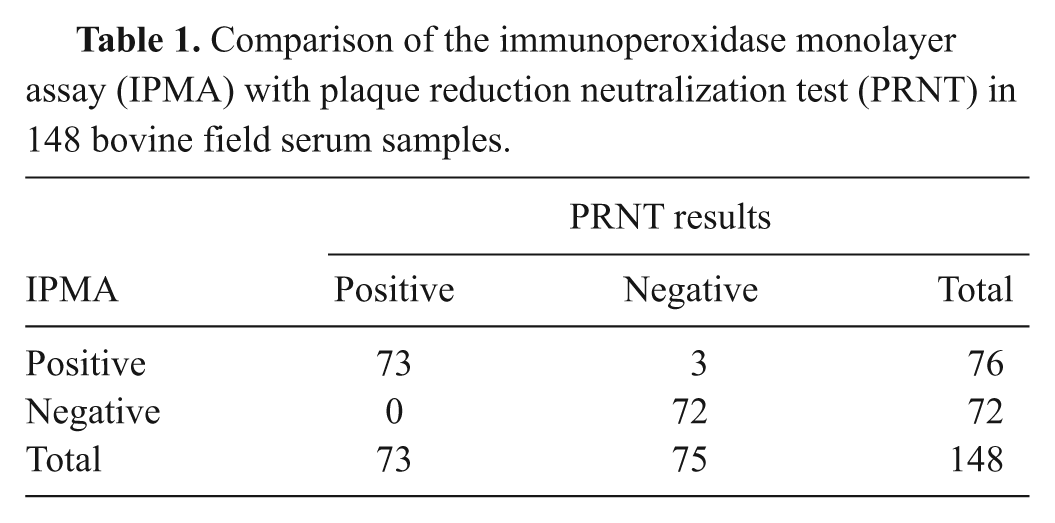
The positive and negative results of field serum samples tested by PRNT and IPMA are shown in Table 1. The IPMA has shown excellent accuracy (98%), sensitivity (100%), specificity (96%), and kappa index of agreement (κ = −1.008). Validity and agreement coefficients are summarized in Table 2.
Comparison of the immunoperoxidase monolayer assay (IPMA) with plaque reduction neutralization test (PRNT) in 148 bovine field serum samples.
Validity and repeatability parameters (95% confidence interval) for anti–Vaccinia virus antibodies measured by immunoperoxidase monolayer assay.
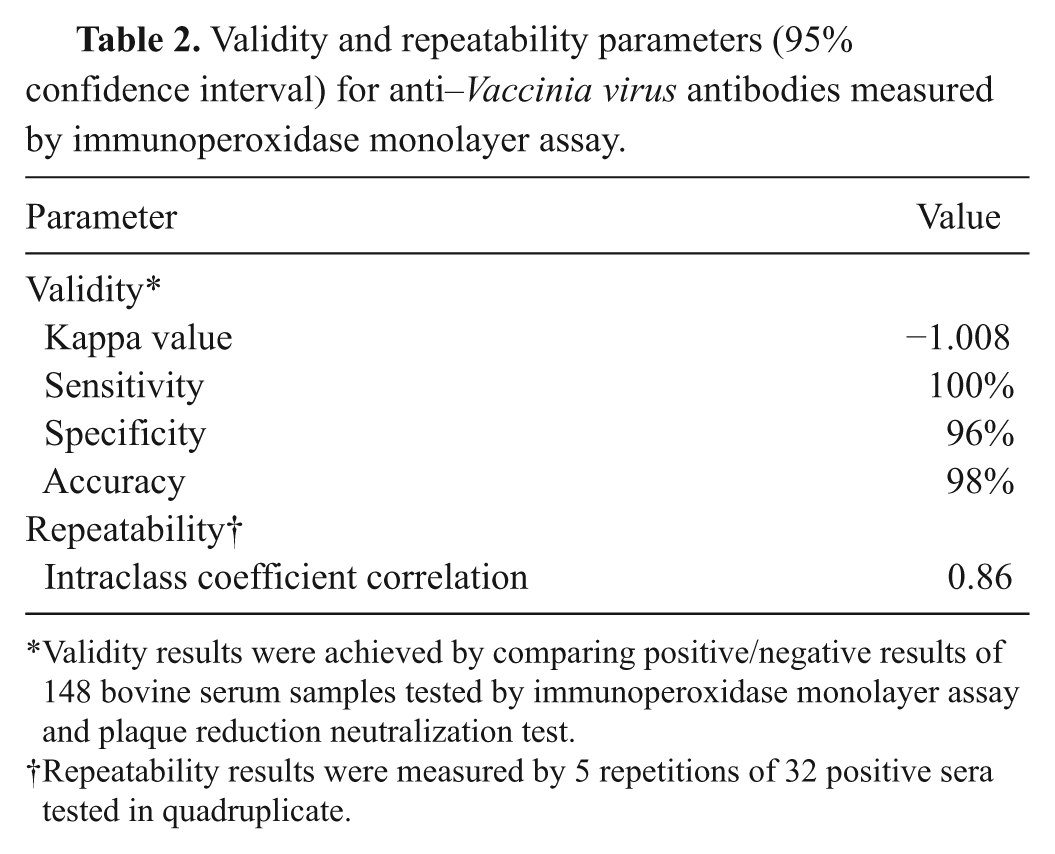
Validity results were achieved by comparing positive/negative results of 148 bovine serum samples tested by immunoperoxidase monolayer assay and plaque reduction neutralization test.
Repeatability results were measured by 5 repetitions of 32 positive sera tested in quadruplicate.
Mean of IPMA antibodies titers was higher than PRNT titers (mean titer = 11.69 ± 0.83 log2 and 5.37 ± 0.96 log2, respectively; P < 0.001). To ascertain whether PRNT and IPMA titers were related, a correlation between the 2 variables was performed, and a moderate level of correlation was found (r = 0.31, P < 0.05).
The repeatability and linearity of the test were determined by comparing IPMA titers within replicates. Intraclass correlation coefficient was 0.86 (P < 0.001; Table 2), evidencing excellent repeatability of this method. There was no difference between repetitions tested by exact Fisher test (F = 0.72; P = 0.57), indicating that the median of all repetitions was similar. In addition, IPMA also showed good repeatability for the 6 PRNT-negative sera. There was no difference between the titration and color intensity of sera tested in fresh or stored plates.
In naturally infected cows, IPMA detected VACV antibodies in a higher number of samples and in higher titers than PRNT during the entire monitored period. In experimentally infected cows, the IPMA first demonstrated a VACV antibody response approximately 4–7 days postinfection (dpi); the PRNT started to rise later, approximately 21 dpi, with lower titers. Serology profile had a similar pattern for both assays when testing bovine sera samples collected from 15 days until 6 months after a VACV outbreak (Fig. 1). At the first sera-sampling day, 1 of 4 animals was IPMA and PRNT negative. Fifteen days later, IPMA and PRNT VACV antibodies were detected in all 4 animals. At the sampling dates of 2 and 6 months, VACV antibodies were detected in 3 of 4 and 2 of 4 samples by IPMA and PRNT, respectively. From 8 to 13 months, serological profile between the tests diverged and IPMA titers rose while PRNT titers declined (Fig. 1). The IPMA VACV antibodies were detected in all animals at 8, 10, and 13 months and in 1 of 4, 1 of 4, and 0 of 4 animals by PRNT at 8, 10, and 13 months, respectively.
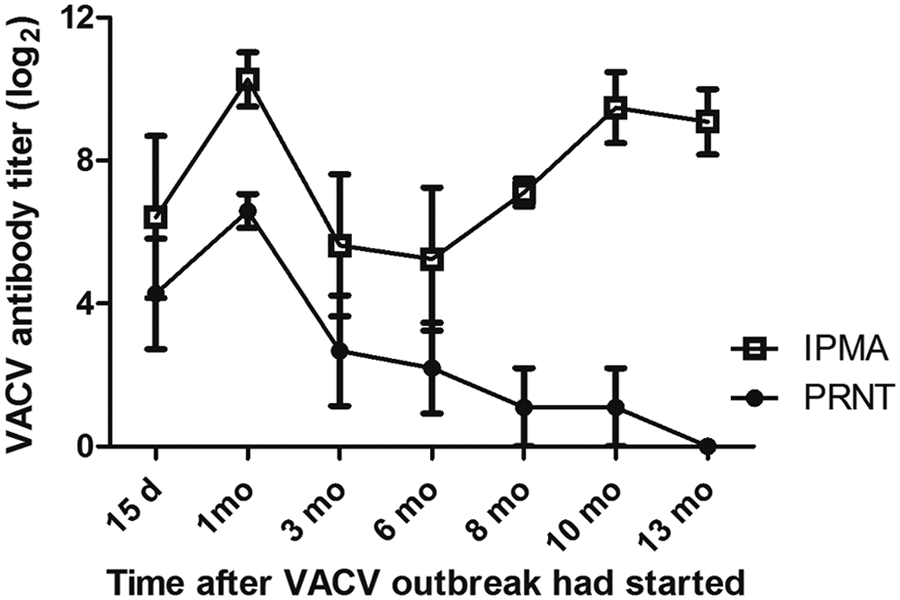
Mean of antibody responses against Vaccinia virus (VACV) in 4 VACV-diseased cows as determined by plaque reduction neutralization test (PRNT) and immunoperoxidase monolayer assay (IPMA) from samples collected from 15 days up to 13 months after a VACV outbreak. Vertical bars indicate standard error.
The current study has shown the development and validation of an IPMA technique to detect VACV antibodies in cattle. The IPMA and PNRT (used as reference technique) both had a high level of agreement of results. However, IPMA has advantages over the PRNT, as it does not require pretreatment of test serum, less incubation time is required (24 hr vs. 4 days), has a lower cost, and has a faster execution and reading time. Furthermore, with a brief standardization, the IPMA test could be used to detect VACV antibodies in serum of different species because protein G can bind to a wide variety of immunoglobulin (Ig)G Fc fraction from different species, including human beings, or it can be modified to detect different isotypes of immunoglobulins, such as IgM, by changing the secondary antibody used in the test.
The IPMA could detect VACV total antibodies in experimentally infected cows as early as 4 dpi, which was 17 days before the detection of VACV neutralizing antibodies by PRNT. In addition, IPMA could detect VACV antibodies up to 13 months in naturally infected animals, a longer time than PRNT (Fig. 1). These data could be partially explained by differences in the 2 types of antibodies. Assays such as IPMA can be used for the detection of the vast majority of virus-specific antibodies and are therefore used to monitor the immune status of hosts, whereas PRNT can be used to detect the biological function of antibodies. 4 The detection of neutralizing antibodies is delayed and often of low titer when compared with the detection of total antibodies because it may take weeks or months to form neutralizing antibodies, depending on the virus that elicits the immune response. 4 These data support the findings in which the IPMA has been shown to be more sensitive than PRNT in the early detection of anti-VACV antibodies and could partially explain the small number of field sera that were negative by PRNT but were classified as positive by IPMA.
A moderate correlation between IPMA and PRNT titers was found in field samples, suggesting that, regardless of the possible delay in the production of anti-VACV neutralizing antibodies in relation to total antibodies, there is a relation between titers of both types of antibodies. Therefore, IPMA could be used to monitor the immune status of cattle against VACV. Indeed, the increase of IPMA titers in naturally infected cattle 8 months after a VACV outbreak suggests that VACV can recirculate with a low infection pressure in the field, eliciting a VACV total antibody response; however, that stimulation does not seem to be enough to cause clinical disease or elicit neutralizing antibodies. Additional studies are required to elucidate the role of total and neutralizing antibodies in bovine VACV infections.
Human and cattle infections caused by poxvirus are increasing in Brazil.6,8 Even though cattle play an important role in the zoonotic transmission of VACV, there are few data about virus circulation and seroprevalence in these animals. The IPMA has proven to be a simple and valuable tool for indirect diagnosis of VACV infection. Plates coated with virus-infected cells could be prepared in advance and stored, making this test faster to perform, especially in cases of outbreaks where a large number of sera should be quickly tested. Moreover, IPMA could be used to perform screening tests of anti-VACV antibodies in cattle, thus providing new and important epidemiological information about humoral response in diseased and nondiseased animals and virus distribution in farms and counties.
In summary, the present study shows that the IPMA developed for detection of anti-VACV antibodies is sensitive, specific, rapid, easy to perform, and suitable for screening large numbers of bovine sera. The IPMA technique described may be a valuable test for VACV seroepidemiological surveys in cattle.
Footnotes
Acknowledgements
Priscilla F. Gerber and Ana Carolina D. Matos contributed equally to this work.
a.
Dr. E. G. Kroon, Instituto de Ciências Biológicas, Universidade Federal de Minas Gerais, Belo Horizonte, Brazil.
b.
ATCCVR-119, Rockville, MD.
c.
Invitrogen, Eugene, OR.
The author(s) declared no potential conflicts of interest with respect to the research, authorship, and/or publication of this article.
The author(s) disclosed receipt of the following financial support for the research, authorship, and/or publication of this article: This work was funded by CNPq and MAPA (grant 578442/2008-6). Zélia I. P. Lobato has a research fellowship from CNPq.