




Abstract
An increasing number of veterinary laboratories worldwide have obtained or are seeking certification based on international standards, such as the International Organization for Standardization/International Electrotechnical Commission 17025. Compliance with any certification standard or quality management system requires quality documentation, an activity that may present several unique challenges in the case of veterinary laboratories. Research specifically addressing quality documentation is conspicuously absent in the veterinary literature. This article provides an overview of the quality system documentation needed to comply with a quality management system with an emphasis on preparing written standard operating procedures specific for veterinary laboratories. In addition, the quality documentation challenges that are unique to veterinary clinical pathology laboratories are critically evaluated against the existing quality standards and discussed with respect to possible solutions and/or recommended courses of action. Documentation challenges include the establishment of quality requirements for veterinary tests, the use or modification of human analytic methods for animal samples, the limited availability of quality control materials satisfactory for veterinary clinical pathology laboratories, the limited availability of veterinary proficiency programs, and the complications in establishing species-specific reference intervals.
Keywords
Introduction
Quality management systems for laboratories are designed to promote and maintain the generation of valid test results in a way that meets or exceeds client expectations. A quality management system may help to demonstrate that the laboratory is technically competent and able to produce results appropriate for its needs. In the absence of compulsory quality standards, the implementation of quality management systems in veterinary laboratories has historically been driven by the need for mutual recognition of infectious disease tests for international trade. The release of standards of acceptable laboratory practice derived from the International Organization for Standardization (ISO)/International Electrotechnical Commission (IEC) 17025 by the World Organization for Animal Health (OIE), the animal health reference institutions of the World Trade Organization, has facilitated the implementation of quality management among laboratories responsible for certifying the infectious disease status of traded animals. 8,18 In North America, the American Association of Veterinary Laboratory Diagnosticians (AAVLD) has run an accreditation program for publicly funded veterinary diagnostic laboratories since 1969. The AAVLD has recently incorporated the OIE quality standards into its essential requirements for accreditation. 1,18 In addition, several veterinary laboratories worldwide that are not involved in official infectious disease testing but have recently obtained or are seeking certification based on international standards, such as the ISO/IEC 17025 or the more recent ISO/IEC 15189. 7 The recent establishment of the European College of Veterinary Clinical Pathology (ECVCP) has provided a further incentive to implement a quality management system for veterinary laboratories in Europe. In order to be considered a training laboratory for candidates for the ECVCP examination, European veterinary laboratories must be ECVCP accredited. 4
The verification of compliance with any certification standard requires complete documentation of the processes included in the quality system. In human medical laboratories, the most common deficiencies identified during on-site inspections performed by regulatory bodies are quality documentation problems. 6,12 Unsurprisingly, the inadequacy of written documentation has been reported as a major problem for several veterinary laboratories seeking approval for training by the ECVCP Laboratory Standards Committee and is likely to represent a major obstacle for other veterinary laboratories seeking certification based on international standards. 4
In addition to problems shared with human medical laboratories, several quality documentation issues are unique to veterinary clinical pathology laboratories. The absence of defined quality requirements, the frequent use or modification of human analytical methods, the limited availability of quality control (QC) materials satisfactory for animal species, the scarcity of proficiency testing programs specific for veterinary laboratories, and the lack of valid species-specific reference intervals are typical challenges that have to be faced during the preparation of quality documentation for veterinary clinical pathology laboratories.
The main purpose of this article is to provide an overview of the documentation needed to implement a quality management system in veterinary laboratories, with an emphasis on standard operating procedures (SOPs). In addition, the quality documentation challenges that are unique to veterinary clinical pathology laboratories are critically evaluated against the existing quality standards (ISO, OIE, AAVLD) and discussed with respect to possible solutions and/or recommended courses of action.
Quality documentation in the veterinary laboratory
Quality documentation can be defined as the set of documents and records generated by a laboratory to demonstrate the planning, implementation, adherence to, and continuous improvement associated with a quality management system. Documentation comprises all levels of the organization, from the quality statement and SOPs to the forms and reports medical laboratories generate daily. Additionally, many other types of internal and external documents, such as meeting minutes, reference intervals, instructions, laboratory plans, and textbooks, are considered part of the quality documentation. 8
The amount of documentation produced should be adequate to demonstrate compliance with the quality system without overburdening laboratory personnel with unnecessary documentation. A good document-control system is necessary to provide unique identifiers for all documents, to assist in the periodic review of documents currently in use, and to ensure that obsolete documents are promptly removed from the environment. Specific software packages for document control are commercially available and are commonly used for the management of all the quality system documentation (IdeaGen Software: 2006, Quality workbench. Matlock, Derbyshire, UK; Clinical Pathology Accreditation [UK]: 2004. Available at: http://www.cpa-uk.co.uk/files/aatdoc.pdf. Accessed November 16, 2007). 2
The veterinary laboratory has a need for quality documentation to demonstrate quality practices as requested by ISO or other external quality certification authorities and/or to demonstrate to internal and external clients and management the activities associated with the quality system, regardless of whether or not external certification is desired. Quality documentation is derived from quality plans addressing both the laboratory environment/community and philosophy/vision. The latter addresses the scope of testing, type of clientele, quality standards, and ongoing quality improvement, while the laboratory environment/community refers to the actual physical setting of the laboratory and its facilities, equipment, and personnel. Eventually, the quality plans are translated into the working practices and procedures that make up the practical instructions that regulate the activities within the laboratory. Finally, the forms and records generated while executing laboratory activities provide evidence of quality practices as determined by the quality management system.
The relationship between documentation and other quality aspects in the veterinary laboratory is shown in Fig. 1. Each of the items specified within the concept map requires documentation to provide evidence of the laboratory's commitment to quality, the competence of personnel, assurance of the quality of results, delivery to veterinary clients, and provision of the best possible patient care as a result of the laboratory-veterinarian partnership.
The categories and relationships identified in Fig. 1 may be further expanded to specify the standards and working practices in each section. The expansion for the section on environment/community includes addressing such issues as the adequacy and ergonomics of facilities, the type of equipment and its validation, maintenance, calibration, and performance requirements. Training, initial and ongoing competency demonstration, and appraisal forms and plans should be included in the section for personnel. The philosophy and vision section should include information regarding the scope of testing, quality requirements for testing, the turnaround time for various tests, internal QC and proficiency testing, audits, and other aspects of continuous quality improvement. Working practices/procedures can be expanded to include the specific aspects of a variety of documents, including the laboratory catalogue, price list, information sheets or handouts, invoices, report forms, work lists, and performance logs.
Standard operating procedures
An SOP is a set of written instructions that describes a routine or repetitive activity an organization follows. SOPs describe the operational elements of an organization and are derived from its quality policy. 8,15 The preparation and use of SOPs represent critical parts of any quality management system and are not an exclusive requirement of the ISO standards.
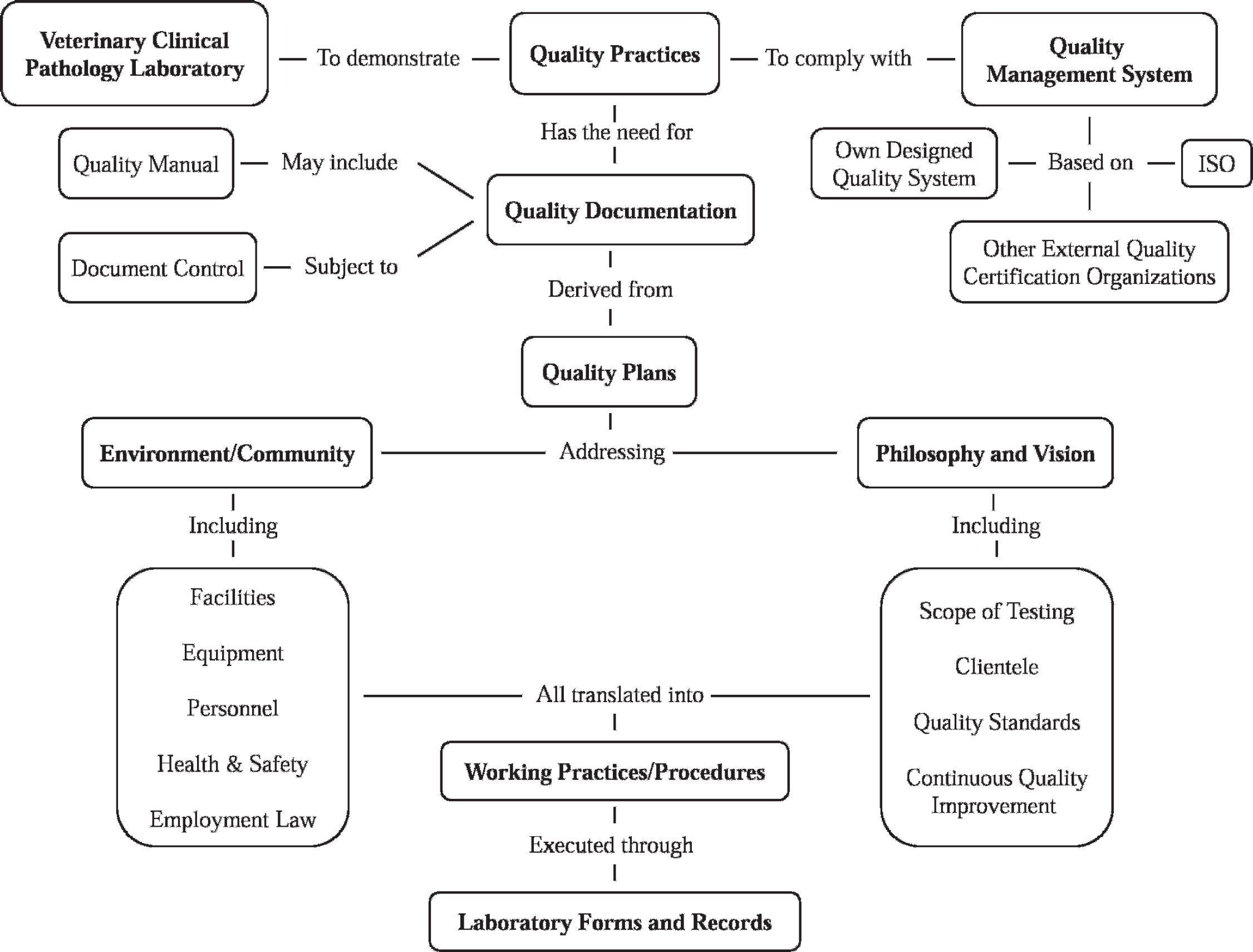
Concept map showing the relationship between documentation and other quality aspects in the veterinary clinical pathology laboratory.
The main purpose of SOPs is to facilitate consistent conformance to technical and quality specifications within an organization. For this reason, SOPs are intended to be specific to the organization whose activities are described. Adopting SOPs allows organizations to implement standardized processes to maximize the efficiency and effectiveness of the work effort and minimize the effects of temporary/permanent personnel changes. In addition, SOPs can be used as educational material for personnel training programs and can serve as a checklist for inspectors during the auditing process. 8,15 It is the laboratory's responsibility to decide which of its activities need to be documented. Table 1 provides examples of quality policies and SOPs adopted by the cytology department of the authors' laboratory.
The writing style of the SOP should be concise, and information should be provided in a step-by-step format. The amount of information included should be sufficient to allow someone with limited experience, but basic understanding, to perform the procedure unsupervised. The minimum level of expertise required to carry out the procedure should also be specified. 2,7,8,15,18
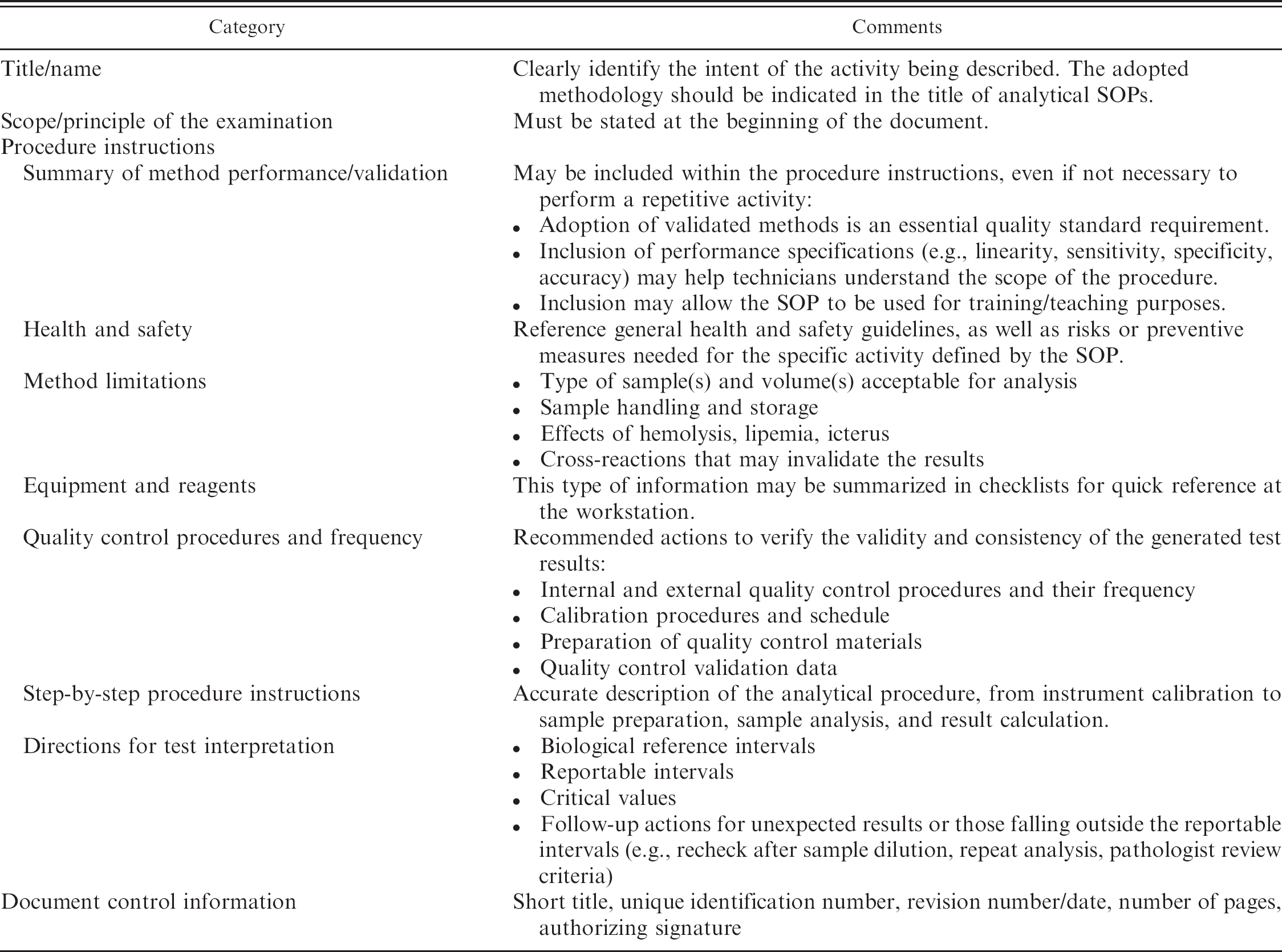
The SOP format may vary significantly between organizations and types of SOPs being written. A laboratory should have SOPs that describe preanalytical, analytical, and postanalytical activities. A generalized format should include title, purpose or principle, procedure instructions, quality documentation management information, and additional information in the procedure instruction for analytical methods. Activities performed with automated instruments may contain the instructions from the instrument's manual and manufacturer's literature; activities performed manually need to be described in detail following the step-by-step procedures performed in the laboratory. A general template for an analytical SOP is shown in Table 2. 2,3,7
Standard operating procedures (SOPs) and policies adopted in the Cytology department of the authors' laboratory.*
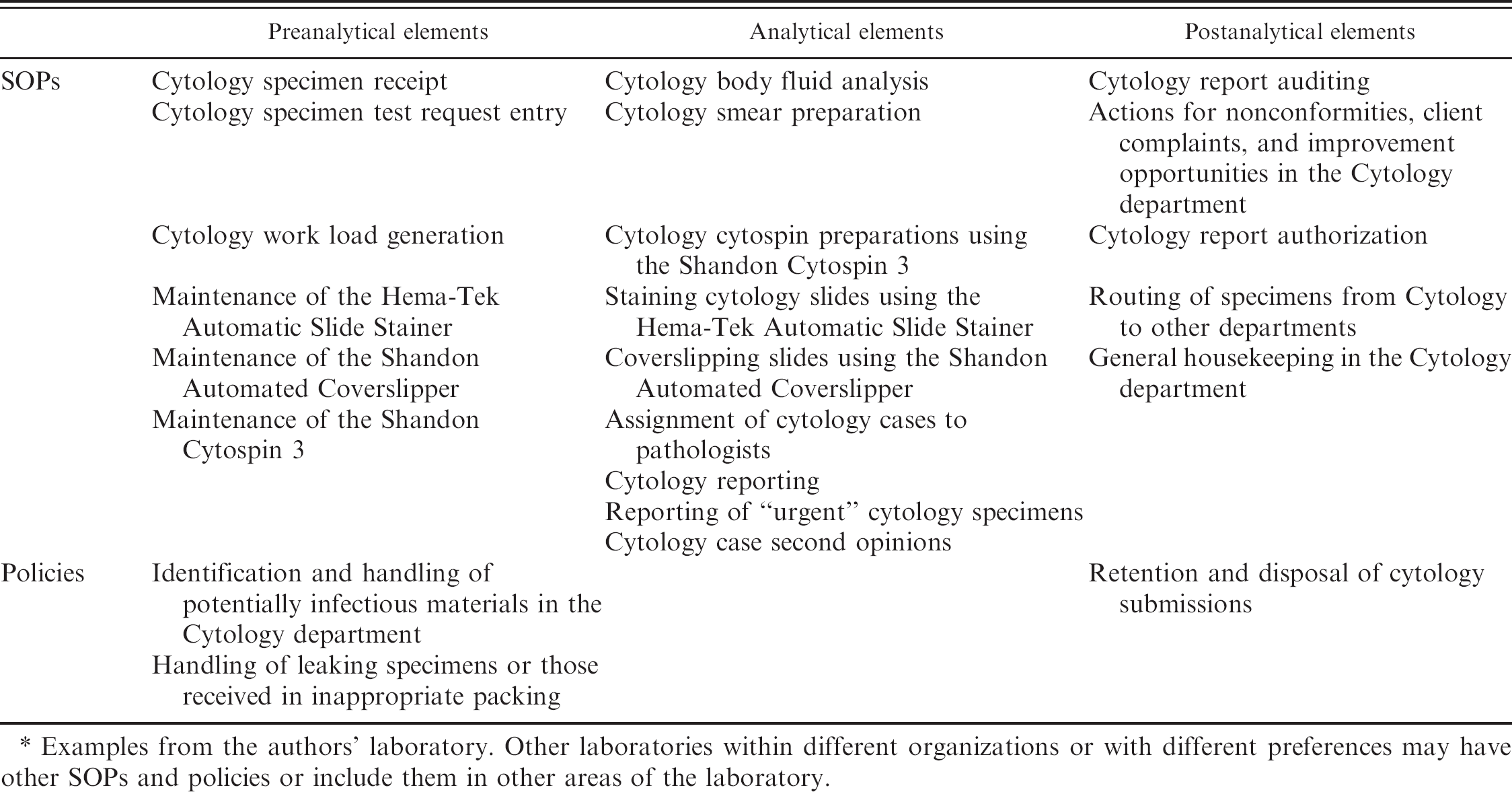
Examples from the authors' laboratory. Other laboratories within different organizations or with different preferences may have other SOPs and policies or include them in other areas of the laboratory.
Documentation challenges in veterinary clinical pathology laboratories
The previously described documentation concepts and guidelines are extrapolated from international standards developed by the ISO and the Clinical and Laboratory Standards Institute (CLSI), which are applicable to any type of diagnostic laboratory. Although the same principles can be intuitively adjusted to prepare quality documentation for many different types of laboratories, a series of specific challenges arise for veterinary clinical pathology laboratories. As previously mentioned, these include the absence of compulsory quality requirements for veterinary tests, the frequent use or modification of human analytical methods for animal samples, the limited availability of QC materials at levels of analytes significant for animal species, the limited availability of proficiency testing programs for veterinary testing, and the complications in establishing species-specific reference intervals.
In the following section, the previously identified quality challenges specific to veterinary clinical pathology laboratories are critically evaluated with reference to the quality standards usually adopted (ISO/IEC 17025, ISO/IEC 15189, OIE, AVVLD) and discussed with respect to possible solutions and/or recommended courses of action.
Absence of compulsory quality requirements
Quality requirements are critical to quality planning. In the clinical pathology laboratory this type of information promotes selection of analytical methods based on the required specifications (e.g., allowable imprecision, inaccuracy, total error) and to implement statistical QC procedures designed to detect errors that exceed the predetermined quality requirements. 16 Quality requirements can be established in several ways, depending on the intended use of information. For instance, quality requirements for clinical pathology laboratories can be provided in the form of medically important changes (e.g., clinical decision limit, medically significant change), analytical quality requirements (e.g., allowable total error), or analytical performance criteria (e.g., maximum allowable imprecision/bias), all of which can be translated in operating specifications for the method (e.g., allowable imprecision, allowable bias, and validated QC procedures; Wesgard, JO: 2000, Defining quality requirements. Available at: http://www.westgard.com/lesson53.htm. Accessed November 17, 2007). The existence of many different types of quality requirements has created some confusion in human clinical pathology, and a hierarchic approach to quality requirements has been recently proposed to clarify the subject. 10 Veterinary clinical pathology laboratories have no compulsory quality requirements, and quality requirements based on clinically relevant information are rarely available. 5 Recently, quality requirements for several canine analytes based on analytical performance criteria (e.g., maximum allowable total error, imprecision, bias) calculated from data on biological variation have been proposed. 9
General template for analytical standard operating procedures (SOPs). 2,3,7,8,15
The international quality standards do not indicate specific quality requirements to be met by veterinary clinical pathology laboratories. This is understandable because the quality requirements may differ with laboratory type, clients, use of the laboratory data, and species of interest. However, both the ISO/IEC 17025 and 15189 standards indicate that the laboratory shall use examination procedures that meet the needs of the client/user of the service, while the OIE standard and the AAVLD essential requirements recommend including international/scientific acceptance and client expectations among the many criteria to be adopted for selecting a test method and the required quality for the test.
Until widely accepted quality requirements are developed, a critical point for a veterinary clinical pathology laboratory willing to implement a quality management system is to establish its own quality requirements. As indicated by the ISO, OIE, and AAVLD standards, the quality requirements for examination procedures should be based on the needs and expectations of clients/laboratory users. The utilization of quality requirements obtained from human proficiency testing has been suggested as a possible starting point. 5,9 An obvious limitation of this approach is represented by the differences in needs and expectations between veterinary and human clinical pathology laboratory users. Additionally, the selection of analytical methods for veterinary clinical pathology laboratories is often limited by cost, and the performance of the adopted method may not be sufficient to meet stringent human quality requirements. Nevertheless, this approach may provide realistic estimates of quality requirements attainable with the analytical method, assuming that these data are critically evaluated against the needs and expectations of laboratory users, particularly in respect to medically important changes such as clinical decision limits and medically significant changes specific for the target animal species.
Use of human analytical methods or modified methods for animal species
Many clinical pathology veterinary tests are performed adopting human analytical methods or their modifications, and require validation before they can be routinely used for animal species. Validation may be defined as the demonstration that the method performs adequately for a specifically defined purpose throughout the range of analyte concentrations and test materials to which it is applied. 14 The implementation of a quality management system in veterinary laboratories requires the adoption of validated analytical methods and may represent a further guarantee of the quality of results to clients/users of the service.
The ISO/IEC 17025 provides explicit guidance about the scope and techniques to be adopted for method validation, but it recognizes that “validation is always a balance between costs, risks, and technical possibilities.” 8 Specific guidance for validating diagnostic assays for animal infectious disease can be found in the Manual of Diagnostic Tests and Vaccines for Terrestrial Animals (World Animal Health Organization [OIE]: n.d., Principles of validation of diagnostic assays for infectious diseases. In: Manual of diagnostic tests and vaccines for terrestrial animals. Available at: http://www.oie.int/eng/normes/mmanual/A_00010.htm. Accessed November 16, 2007). The application of the same principles outlined in the OIE manual is recommended by the AAVLD standard for evaluating other test methods in veterinary laboratories. General principles of method validation are also available from other publications. 9,16
The AAVLD essential requirements for accreditation define a method as “validated for use” if adequate performance is demonstrated with ongoing documentation of internal or inter-laboratory use of known reference standards for the species and/or diagnostic specimens of interest. Alternatively, a validated method can be defined as one or more of the following: 1) endorsed or published by reputable technical organizations such as the OIE; 2) published in a peer-reviewed journal with sufficient documentation to establish diagnostic performance and interpretation of results; or 3) documentation of internal or interlaboratory comparison to an accepted methodology or protocol. 1,18
With the exception of infectious disease testing, there is limited availability of large collaborative validation studies addressing animal analytical methods. Consequently, in some cases it is necessary for veterinary clinical pathology laboratories to perform single-laboratory method validation. Unfortunately, this type of study is often expensive and may be limited by technical problems (e.g., number of available subjects, lack of a gold standard). In such circumstances it is important that the laboratory identifies (in agreement with its clients) which characteristics need to be evaluated. In the absence of mandated requirements, the extent of the evaluation undertaken by the laboratory must meet client expectations, bearing in mind that often the data regarding method performance obtained from single-laboratory validation studies are not robust enough to fulfill OIE validation standards. 8,14
Availability of quality control materials for animal samples
All of the quality standards usually applied to laboratories recommend the implementation of internal QC procedures to verify the validity and consistency of the generated test results. The use of suitable certified reference standards and materials is recommended by the ISO to ensure the quality of examination procedures. The OIE and AAVLD standards also include the availability of QC materials among the criteria to be adopted for method selection. However, when human analytical methods (or their modifications) are applied to animal species, the implementation of statistical QC procedures may be limited by the availability of QC materials satisfactory for veterinary clinical pathology laboratories (e.g., biologically significant analyte concentrations for specific animal species) or matrices representative of animal origin. In such cases, alternative QC procedures (e.g., nonstatistical) may be implemented and the rationale of these actions justified in the procedure instructions of the SOP.
Examples of nonstatistical QC that may be implemented in veterinary laboratories include providing criteria for repeat testing, technical supervisor review, and pathologist's review. In addition, there may be reflex testing (i.e., if a particular result is obtained, then additional testing is initiated). For many tests, correlation with other tests and clinical signs may help provide confidence in the interpretation of the test results. If the test result does not appear to fit with those obtained for other tests or does not correlate well with the clinical signs of the patient, then additional evaluation and investigation is warranted to determine if there may be an error or if additional testing may be required. Other nonstatistical QC that can be initiated in any laboratory, but that may be of special importance in veterinary laboratories, include review of patient data and percentages of positive tests for particular tests and species for specified time periods (e.g., percent positive feline leukemia virus results for a specified period, such as shift, week, or month). The nonstatistical QC implemented by various veterinary clinical pathology laboratories may vary depending on the type of laboratory, volume of testing, technical and pathological expertise, and other factors.
Availability of proficiency testing programs for veterinary clinical pathology laboratories
Participation in proficiency testing programs is required by the ISO and OIE. Relatively few proficiency testing programs are specific for veterinary testing (Veterinary Laboratories Agency: n.d., Proficiency testing or external quality assessment schemes. Available at: http://www.defra.gov.uk/corporate/vla/eqa/PTschemes.html. Accessed November 16, 2007). 17 Human-based proficiency testing programs may not test levels of analytes significant for veterinary clinical pathology laboratories and may not represent differences in matrix, analytes, or other factors important for animal species testing. However, human-based quality assurance (QA) programs offer an opportunity for external QA when veterinary-based programs are not available.
Inclusion of species-specific reference intervals
Though veterinary laboratories analyze specimens obtained from a variety of animal species, the reference intervals are often poorly defined, particularly in the case of rare or exotic species. Beyond cost, several factors may complicate the establishment of specific laboratory reference intervals for animal species. Regulations may prohibit the collection of blood samples from healthy animals for this purpose. In other cases, an adequate number of suitable subjects may not be readily available, or technical issues such as analyte stability, may limit the transport of fresh material to the laboratory.
Including reference intervals for quantitative test results in the test report is recommended by all quality standards. When species-specific reference intervals are not available and the laboratory-specific reference intervals cannot be established, the verification of published reference intervals is stimulated by adopting a quality management system. The selection of at least 120 animals is typically recommended to establish reference intervals. 13 However, the availability of such a large number of independent samples is often unrealistic when dealing with animal species. Sixty animals may be acceptable if the resultant reference distribution is Gaussian, but even finding 60 animals may be prohibitive for a veterinary laboratory. 11 In such circumstances, previously published reference intervals may be verified by analyzing specimens from 20 animals representative of the reference sample population. If 2 or fewer samples fall outside the claimed reference limits, the reference interval is considered to be verified. 16 If no previously published reference intervals are available, and fewer than 60 animals are used to establish a new reference interval, the maximum and minimum observed test values, and possibly a histogram showing the distribution of the values, should be reported. Finally, reference intervals are sometimes calculated from the comparative method, using the regression equation established from statistical analyses. 16
Conclusion
Documentation is an important part of any veterinary laboratory quality system. Careful thought about the aspects of the laboratory that need documentation to achieve external certification or to demonstrate a quality system without external certification is required. The type of documentation and document control required by external certification programs is usually well defined, but the specifics of the documentation may vary among veterinary clinical pathology laboratories because the type of testing, scope of testing, and client needs may differ.
Several unique challenges must be addressed when implementing quality systems. This article has outlined possible solutions and/or courses of action that may help to overcome some of these unique challenges, but it is not meant to be exhaustive or prescriptive. It is the authors' intent to stimulate a discussion about these topics among the veterinary clinical pathology community, starting for instance, with the need for a consensus on establishing quality requirements for veterinary tests.