



Abstract
Over a 12-day period, 13 animals in a herd of 110 beef cattle developed ataxia with profound muscle fasciculations progressing to recumbency. Twelve animals (5 adults and 7 calves from 8–10 months of age) died, and 1 cow was euthanized. Hemorrhagic diarrhea occurred in some, but not all, animals. The onset of clinical signs was at least 12 hours after the cattle had gained access to contents of old buildings used for storage, and the majority of deaths occurred within 24 to 48 hours after the onset of clinical signs. Approximately 9 kg of unidentified pellets were found strewn in the barn area where the cattle had been. Autolysis considered more severe than expected for the postmortem interval, suggestive of high body temperature before death, and congestion of body tissues were the only significant findings detected in the cow that was euthanized and submitted for necropsy examination. The clinical history and lack of postmortem lesions were most consistent with toxicity. A toxic level of arsenic (6.18 ppm) was detected in the kidney, and metaldehyde was detected in the liver. The pellets were analyzed and found to contain both arsenic and metaldehyde, consistent with a discontinued molluscicidal product.
Pesticide poisoning is a common problem in domestic animals. In 1 study, approximately 0.05% of all cases at a veterinary laboratory in the United Kingdom in a 4-year period involved pesticide toxicosis. 10 The most common cause of toxicosis in cattle and sheep was organophosphate pesticide toxicity. 10 Metaldehyde toxicosis because of ingestion of molluscicides (snail and slug bait) is most common in dogs, 3 and metaldehyde toxicosis is uncommon in livestock. 10 Metaldehyde toxicity has been reported in sheep and cattle 5,8,10,12,15 and in goats. 5 Metaldehyde toxicosis has also been described in horses 7 and in ducklings. 1 Arsenic toxicosis occurs in cattle but has become much less common than in years past. 2,6,9 This report describes an outbreak of pesticide toxicity in a herd of beef cattle in southern Oregon in which both arsenic and metaldehyde were detected in tissues from an affected cow and in unidentified pellets considered to be the source of the toxicosis. To the authors' knowledge, this is the first report on combined toxicity of arsenic and metaldehyde in cattle.
The herd consisted of 55 crossbred Angus cows from 4 to 8 years of age and 55 calves from 8 to 10 months of age. The cattle grazed on creek bottom and upland pasture composed of fescue, rye grass, and native grasses. The cattle were supplemented with a salt and mineral mix offered free choice. The cattle were in a good herd health program, with routine vaccinations and parasite control. The pasture contained an old home site, a barn, and an outbuilding, with gates to prevent access by the cattle. The rancher had grazed cattle on this pasture for 10 years with no herd health problems. The property had been sold recently but the owner of the cattle maintained grazing rights.
From October 17, 2005, to October 21, 2005, the rancher was out of town. When he returned to check the cattle on October 22, 2005, he found that the barn and the outbuilding were in the process of being cleaned out, with the contents left scattered in the barnyard area. The gates leading to the barn and the outbuilding had been left open, and tracks and manure indicated that cattle had been in the area. All animals were clinically normal at that time, and the rancher closed the gates, thus preventing further access to the area.
Later in the day, while moving the cattle to the bottomland pasture, 1 cow was noticed to be lagging behind the herd, stumbling, and “not acting right.” On October 23, this cow was recumbent, with profound muscle fasciculations, and she died later in the day. Two calves were seen exhibiting similar signs and were found dead on the morning of October 24. Severe muscle fasciculations that persisted after recumbency were observed in all affected animals. Bloody feces were detected in some, but not all, affected animals. Visual deficits were not observed, and dead animals did not exhibit unusually rapid onset of rigor mortis. On October 24, field necropsies were performed on 2 calves and a cow. The only gross lesions found were bloody content in the intestinal tract and bloody feces around the anus. By October 25, another cow and 2 calves were exhibiting clinical signs. Toxicity was suspected, and the rancher started feeding hay in the hopes of increasing forage intake and diluting the consumed toxin. The barn and the outbuilding areas were examined, and a pile of approximately 20 pounds of small pellets with size, shape, color, and consistency of pellets used in pellet-burning wood stoves was found (Fig. 1). The pellets did not have any distinctive odor. No container or bag to identify the pellets was found, and no pellet-burning stove was present on the property. The pellets were strewn in a pattern consistent with having been explored by the cattle. It was not possible to determine how much might have been ingested. No other open containers or suspicious products were found on the property. The most recently affected animal, an approximately 6-year-old cow, was euthanized by a gunshot to the head and was transported to the Oregon Veterinary Diagnostic Laboratory on October 25, along with a sample of the pellets, for necropsy examination and toxicologic analysis. Fixed samples of small intestine and mesenteric lymph node obtained from a field necropsy of an affected calf were also submitted for histopathologic examination.
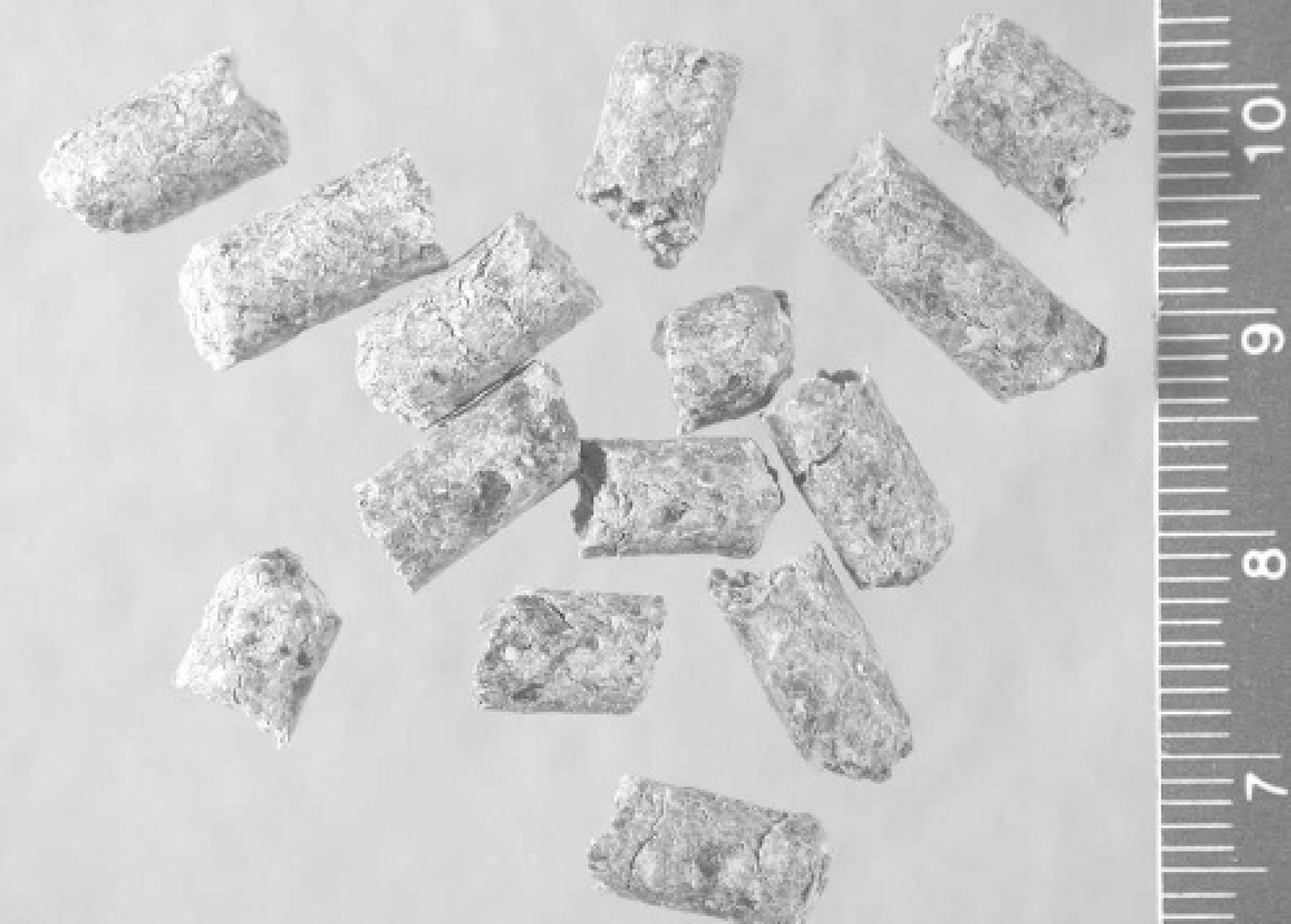
Pellets stored within an old barn, causing toxicity in a group of beef cattle.
The cow weighed 645 kg and was in excellent body condition. Autolysis was considered excessive given the postmortem interval (approximately 5 hours) and cool weather conditions during transport. Tissue congestion was the only significant gross postmortem finding. In particular, intestinal content and feces were normal, with no evidence of hemorrhage, erosions, or diarrhea. The fore-stomach and abomasal contents were carefully examined, and, with the exception of a small stainless steel fishing swivel in the reticulum, no foreign materials or unusual contents were found. A sample of rumen content was submitted to the Department of Botany and Plant Pathology, Oregon State University, for examination and identification of plant material. Samples of liver, kidney, and pellets were submitted to the Diagnostic Center for Population and Animal Health, Michigan State University, for toxicologic analysis. Multiple samples, including liver, lung, kidney, heart, spleen, sciatic nerve, brain, skeletal muscle, forestomachs, and abomasum, were fixed for histopathologic examination.
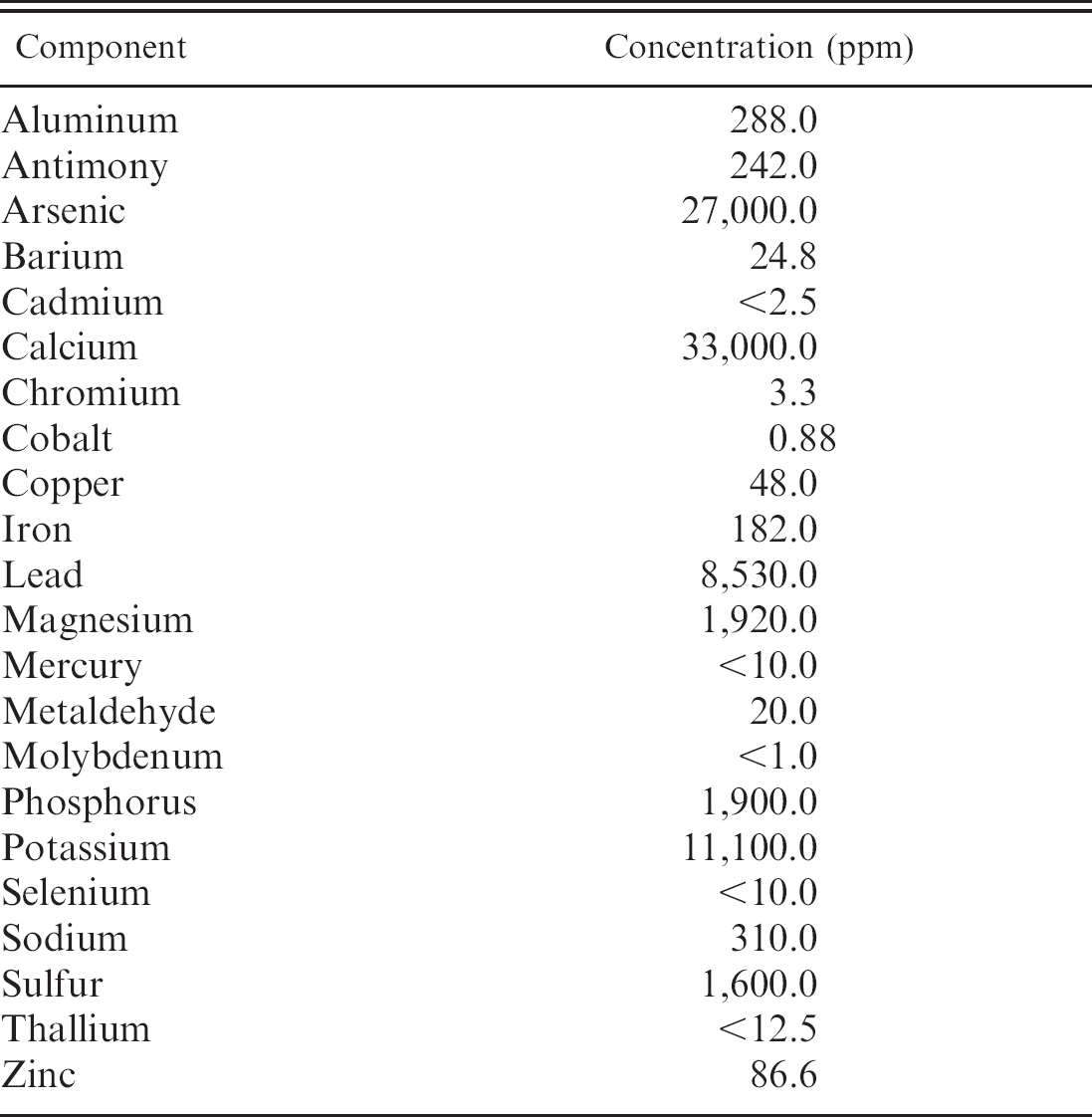
Microscopic examination of tissues from the cow revealed a small number of scattered acutely necrotic ischemic neurons in the midbrain. No significant microscopic lesions were detected in other tissues from the cow or in the fixed samples from the calf. No toxic plants were identified in the rumen content. Results of analyses of the pellets are provided in Table 1. Gas chromatography/mass spectrometry (GC/MS) analysis of the pellet sample revealed 20 ppm (0.002%) metaldehyde. Trace elemental analysis by inductively coupled plasma atomic emission spectrometry (ICP/AES) of the pellets revealed 27,000 ppm (2.7%) arsenic and 8,530 ppm (0.8%) lead, as well as high amounts of calcium and potassium (Table 1). Evaluation of liver by GC/MS detected a large amount of metaldehyde. Trace elemental analysis of kidney by ICP/AES detected 6.18 ppm arsenic on a wet-weight basis. This was considered to be within toxic range (normal, <0.5 ppm; toxic, >5 ppm). A nontoxic concentration of lead was also detected in the kidney (0.6 ppm wet weight; normal, <2.0 ppm). Concentrations of other potentially toxic elements, i.e., barium, mercury, and thallium, were also within normal limits.
Results of analysis of pellets found in an abandoned barn.
Animals within the herd continued to sicken and die over a 12-day period, with a total mortality of 6 cows and 7 calves. In the majority of cases, death occurred within 24–48 hours of onset of clinical signs. The last 3 calves that died exhibited clinical signs of a slow, stumbling gait, with mild muscle fasciculations, for approximately 72 hours before recumbency and death. Before becoming recumbent, one of these animals became aggressive and charged the rancher without provocation. No further clinical signs of disease occurred after this 12-day period. Based on the clinical signs and laboratory findings, illness and death were attributed to toxicity caused by ingestion of pesticide pellets that contained metaldehyde and arsenic.
Metaldehyde is the active ingredient in products designed for control of mollusks (snails and slugs), insects, mites, and tadpole shrimp. These pesticide products have been formulated to contain metaldehyde alone or metaldehyde in combination with carbaryl (a cholinesterase-inhibiting carbamate) or calcium arsenate. 3,4 Molluscicidal products are often bran based, 3,4,10 and molasses may be added to make the product more attractive to snails and slugs. 4 Added molasses could explain the high potassium content of these pellets (Table 1). This type of formulation also makes these products attractive to nontarget animals. 3,4,10 The analysis of the pellets in this case is most consistent with a molluscicidal product with added calcium arsenate. Products that contained metaldehyde and calcium arsenate, a pentavalent form of inorganic arsenic, are no longer commercially available, but they may continue to be present in old storage areas.
Metaldehyde toxicity results in central nervous system stimulation, leading to profound muscle fasciculations, causing a marked increase in body temperature. Clinical signs often progress to seizures and death. 3,4 The mechanism of action is largely unknown, although alterations in central nervous system neurotransmitter levels are described. 3,4 The acute lethal dose of metaldehyde is estimated to be 0.2 g/kg in adult cattle and somewhat less in calves. 13 The onset of clinical signs of metaldehyde toxicosis in cattle and sheep is reported to be from 15 minutes 13 to approximately 24 hours after ingestion. 8,12,15 A dose of 0.78 g/kg of metaldehyde administered by gastric intubation to an adult goat caused clinical signs in 20 minutes and death in 2 hours. 5 Metaldehyde is poorly soluble in water and may require activation by gastric acidity. 3,4 The onset of clinical signs of metaldehyde toxicosis is longer in ruminants than in monogastric animals, most likely reflecting delayed activation and absorption because of the retention of metaldehyde in the rumen. 3 This may be particularly true in large ruminants, especially if only low doses are ingested. The time of onset of clinical signs of toxicity in this outbreak, beginning at least 12 hours after suspect exposure and continuing for several days, is longer than previous reports of metaldehyde toxicosis in cattle and sheep. 8,12,13,15 At the time of analysis, the concentration of metaldehyde in the pellets in this case was relatively low (0.002%). Although body temperature was not measured in affected cattle in this outbreak, the unexpected degree of autolysis of the body of the cow is suggestive of increased body temperature at the time of death. Postmortem findings reported in cattle and sheep that have died from metaldehyde ingestion include subcutaneous edema, 12,13 gastrointestinal mucosal congestion and enteritis, 13 hemorrhagic bowel content, 12 epicardial or endocardial hemorrhage, 12,13,15 pulmonary congestion and edema, 13,15 and no significant lesions. 13 Ingestion of snail and slug bait pellets can be suspected based on the finding of yellow 12,13 or blue-green 15 dyed material within the forestomach or the abomasum. In this outbreak, the pellets were not dyed and, therefore, could not be detected in forestomach or abomasal contents.
With the exception of the profound muscle fasciculations, the clinical signs in these cattle (ataxia, diarrhea, hemorrhagic diarrhea, recumbency, and death) are also consistent with acute arsenic toxicity. 6,11,14 In this outbreak, a toxic concentration of arsenic (6.18 ppm) was detected in kidney tissue. Death from inorganic arsenic toxicosis in cattle has been reported to occur beginning approximately 20 hours after exposure. 11 Gastrointestinal mucosal congestion, edema, and erosions are typical 6,9,11 but do not occur in every case. 6 Pentavalent arsenic is metabolized to trivalent arsenic, the more toxic form of arsenic, within the rumen. 6 Trivalent arsenic disrupts cellular metabolism and oxidative phosphorylation. 2,6,9
The hemorrhagic diarrhea observed in some of the animals in this case was most likely a result of arsenic present in this product. The profound muscle fasciculations observed are consistent with metaldehyde toxicosis. Clinical signs of ataxia and recumbency can be caused by either arsenic or metaldehyde. The concentration of arsenic within the kidney of this cow (6.18 ppm) was less than that in a previous report of inorganic arsenic toxicosis in cattle, in which up to 23 ppm arsenic was detected in kidney and many affected cattle were dead at 20 hours after exposure. 11 The lower concentration of arsenic in the kidney of this present case was expected, because these animals lived longer and, therefore, were likely to have excreted a significant amount of arsenic by the time death occurred. Because ingestion of a large amount of arsenic and metaldehyde is expected to cause peracute death, the presentation in these cases suggests that only a moderate amount of the product was ingested. Given the findings in this outbreak, it is suspected that the clinical signs and death were related more to the arsenic component than to the metaldehyde ingestion. However, the possibility of a combined toxic effect of arsenic and metaldehyde must also be considered.
Current pesticide baits are brightly colored to distinguish them from feed products, 10 but the pellets that caused toxicity in this case were not dyed. The contents of this barn and this outbuilding were old (estimated to be at least 20 years old), and the previous owner of the property had died years before. This outbreak illustrates that some banned pesticides may last for years in storage areas and that ingestion of such material can result in livestock poisoning. This report describes an unusual case of beef cattle poisoning with a product containing 2 highly toxic compounds, arsenic, and metaldehyde.
Acknowledgements. The authors thank Jermey Becker (Oregon State University) for technical and photographic assistance, Margaret Johnson and Kirk Stuart (Michigan State University) for toxicological analysis, and Rick Anderson for valuable input.