



Abstract
Objective
This systematic review investigates the impact of climate change on the mental health of Pacific Island Nations (PINs), with a focus on identifying culturally tailored interventions and appropriate research methodologies to address these impacts.
Method
A systematic review of peer-reviewed literature up to May 18, 2024, was conducted using the Preferred Reporting Items for Systematic Review and Meta-Analysis (PRISMA) protocol and the Population, Interest Area, and Context (PICo) framework. Empirical studies on the impact of climate change on mental health in PINs were evaluated by using the Quality Assessment Tool for Studies with Diverse Designs (QATSDD).
Results
Six studies from the Solomon Islands, Cook Islands, and Tuvalu were identified, indicating significant mental health impacts from sea level rise (SLR) and extreme weather events with compounding and mitigating effects across diverse groups. The Skills for Life Adjustment and Resilience (SOLAR) program was highlighted as a promising culturally adapted intervention.
Conclusion
Climate change significantly impacts mental health, particularly in PIN communities facing SLR and Extreme Weather Events (EWE). Culturally sensitive interventions, local knowledge, and further research are vital to mitigate these effects and support well-being.
Since 1970, global sea levels have been rising at an accelerating rate.1,2 Research has shown that the primary driver of Sea Level Rise (SLR) is anthropogenic carbon dioxide (CO2) emissions.3,4 Moreover, the geological records from the past three ice age cycles (Paleogene, Neogene, and Quaternary geological periods) indicated a strong positive correlation between atmospheric CO2 levels and SLR. 1 Over the past century, the rate of SLR has increased significantly, from 1.4 mm per year (between 1901 and 1990) to 3.6 mm per year between (2006-2015), 3 with future projections suggesting a rise of 0.3 to 2 m by 2100.5,6 Pacific Island Nations (PINs) are especially vulnerable to these changes 7 with regional leaders raising concerns about SLR as early as 2014. 8 In addition to SLR, PINs also face other severe climate change related Extreme Weather Events(EWE) including cyclone, flooding, storm wave, erosion and submersion of land, coral bleaching, and droughts.9–11 These events can force people to involuntarily migrate or relocate, 3 cause financial hardship, loss of cultural heritage including indigenous knowledge, and lead to a loss of community and belonging. 12 Such challenges negatively affect individuals’ mental health. 13 It is well documented that extreme weather events related to climate change are strongly linked to mental health impact.14–16 This systematic review seeks to address the question of how climate change induced SLR and EWE impact the mental health and well-being of PINs populations. It will also explore culturally appropriate interventions to mitigate mental health risks and assess the research methodologies applied in PINs contexts to ensure culturally sensitive insights.
Methods
Inclusion and exclusion criteria
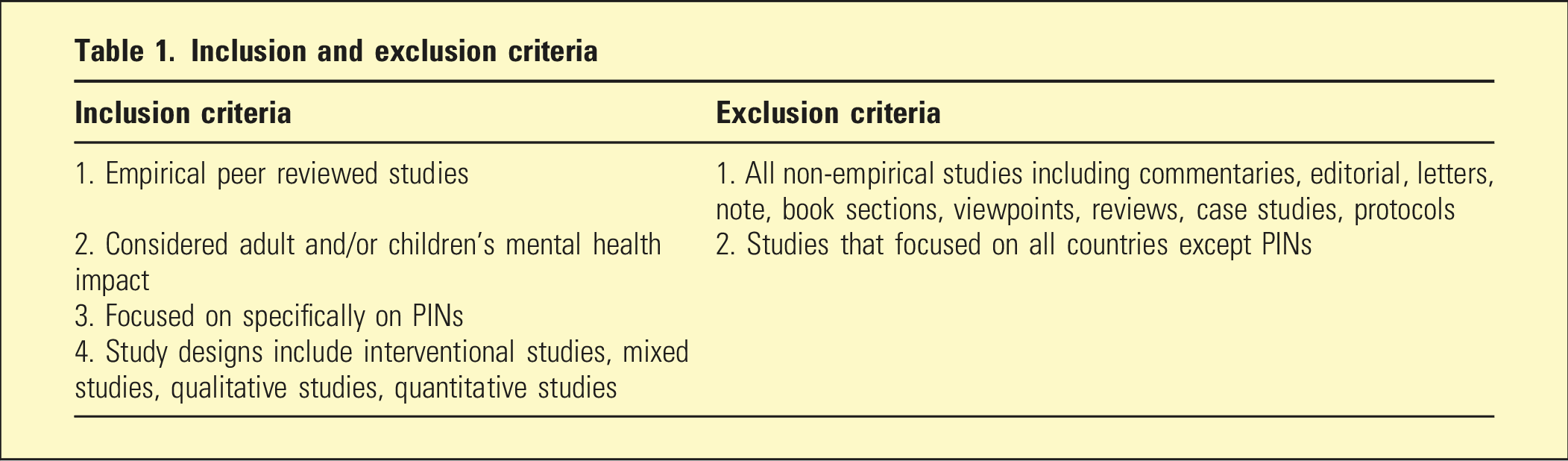
The authors independently screened the titles and abstracts, and any conflicts were resolved by discussion. Full-text studies were screened independently by authors, with a random double check of 20% conducted for accuracy. Only empirical studies that specifically explored the impact of climate change on the mental health in PINs were chosen for critical evaluation.
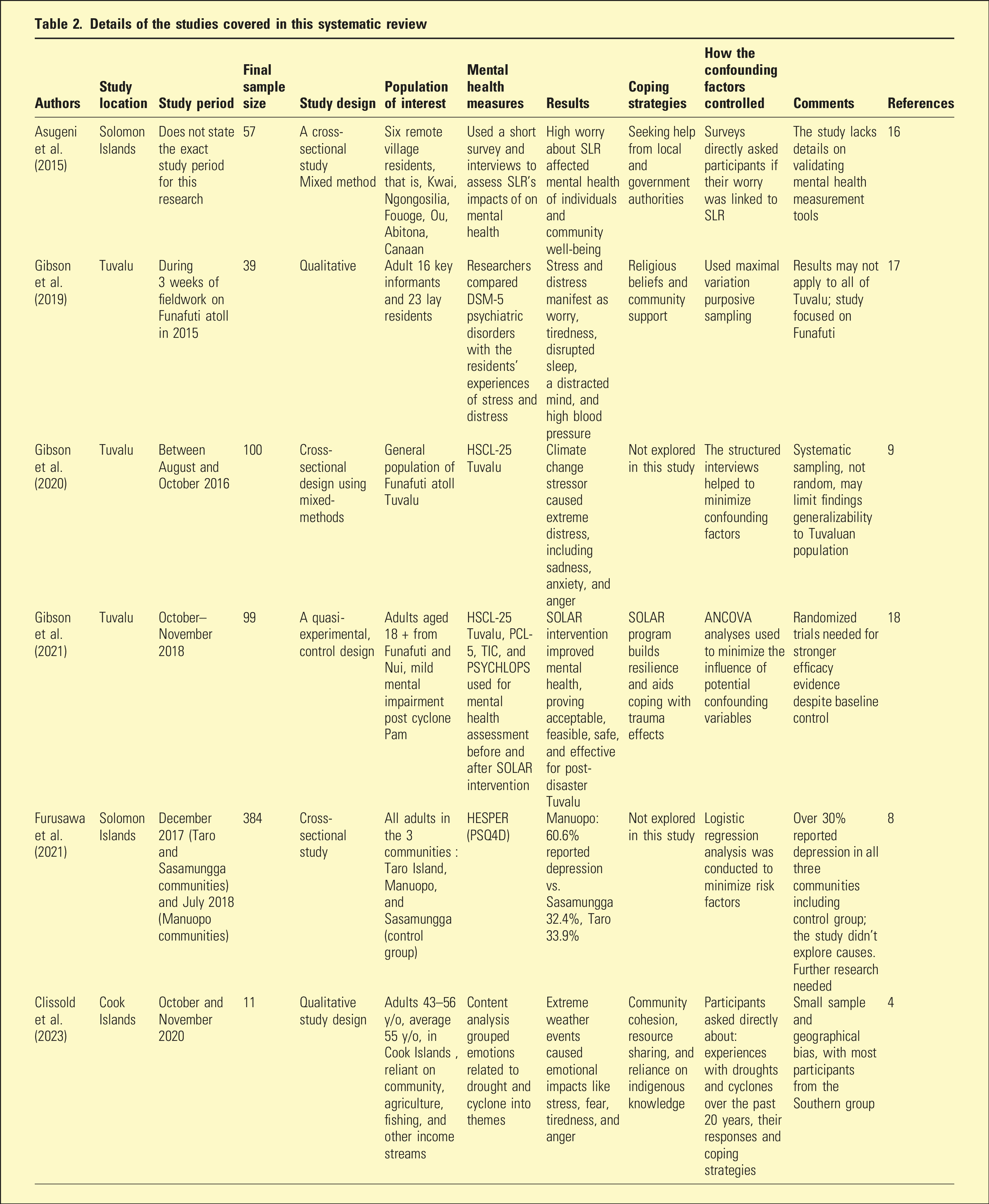
Details of the studies covered in this systematic review
Results
The key search terms generated a total of 46 records as visually presented in a PRISMA
17
flow chart (Figure 1). Prisma flow chart. * Number of records identified from each database from CINAHL (n = 0), Emcare on Ovid (n = 7), Medline Ovid (n = 4), PsycINFO (n = 1), Scopus (n = 21), web of science (n = 11), Google Scholar (n = 2). ** EndNote 20.4.1 software was utilized to streamline the selection process by identifying and excluding non-empirical studies, such as books, editorials, commentaries etc. As a result, 11 records were excluded using the automation tools provided by EndNote. Additionally, n = 19 duplicate records were identified and removed. *** 9 records were excluded by a human after full text screening not meeting predefined inclusion criteria.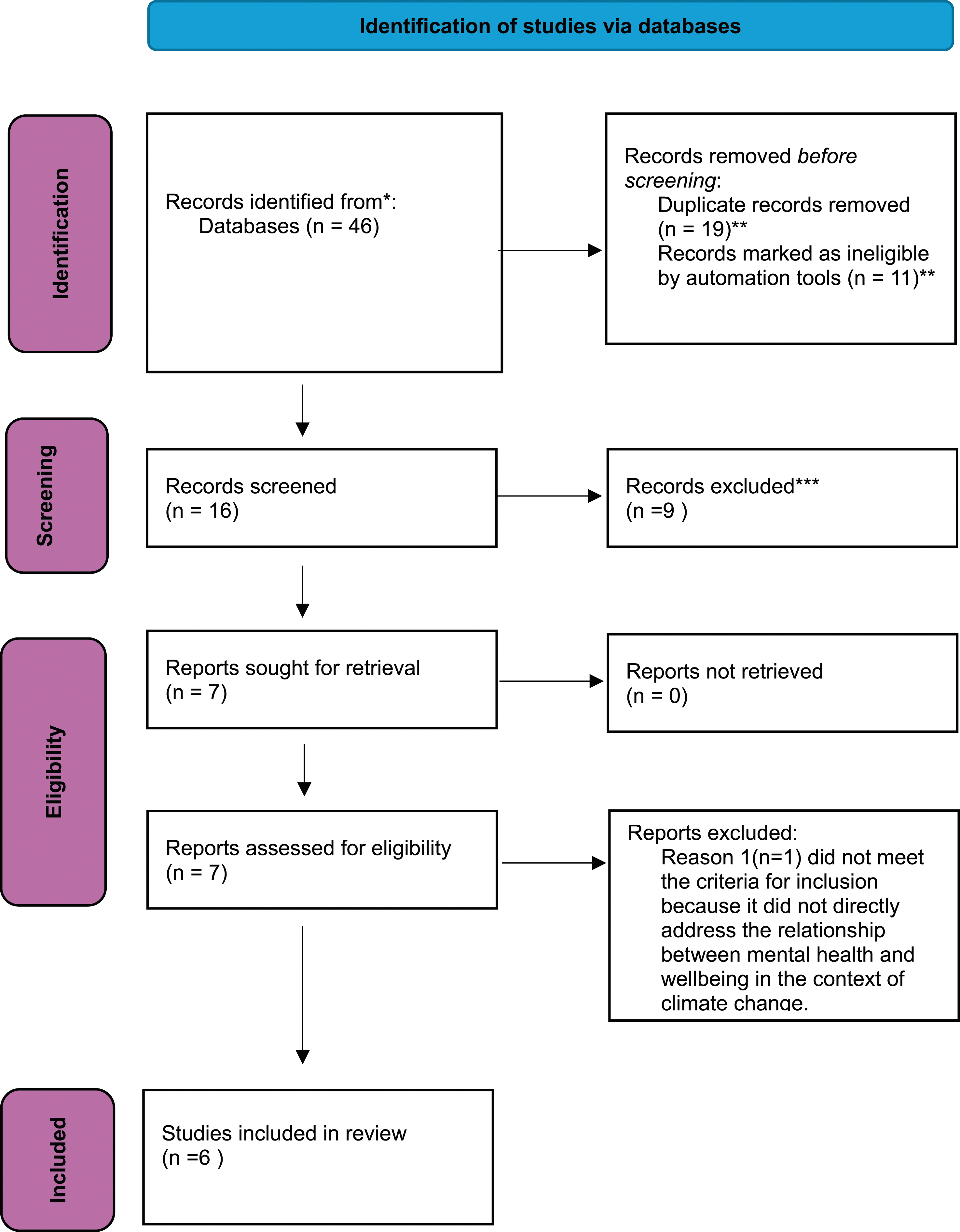
After removing 19 duplicates, title and abstracts were screened of 27 studies that yielded 16 articles to apply the inclusion and exclusion criteria to. Finally, 6 studies were found eligible for quality assessment.
Four studies provided numerical data for data extraction; the other two studies were qualitative in nature. Results of the QATSDD analysis indicate that the quality of the papers is good, with two papers scoring from 62 to 71%, 3 papers scoring from 83 to 88%, 1 paper scoring 93% (Supplemental File 2). Of the 6 papers selected for extraction, two were from Solomon Islands,20,21 three from Tuvalu,22–24 and one from the Cook Islands. 25 Each study used different methodologies and measurements to assess the mental health outcomes associated with climate change.
The studies reviewed explore the mental health impacts of climate change in PINs. Asugeni et al. (2015) and Furusawa et al. (2021) reported high levels of stress, worry, and depression linked to rising sea levels in the Solomon Islands. Gibson et al (2019, 2020, and 2021) highlighted climate-related distress in Tuvalu, focusing on social-environmental challenges, psychological distress, and the effectiveness of the SOLAR intervention program. Clissold et al. (2023) in the Cook Islands emphasized emotional impacts of extreme weather, with community and indigenous knowledge aiding resilience. These studies underscore the importance of culturally relevant mental health strategies in climate-vulnerable regions. A detailed summary of the characteristics of each paper is summarized in Table 2 as a data extraction table.
Discussion
From the six reviewed studies, we identified four key themes including 1 Mental health impacts of climate change by geographical location 2 ; Resilience and culturally appropriate intervention 3 ; Multiple stressors versus single stressor for risk of depression; and 4 possible vicarious traumatization experience. These themes explore the mental health implications of climate change induced SLR and extreme weather events. These events include floods, cyclones, and drought.
Mental health impacts of climate change by geographical location
The studies reviewed reveal the profound mental health impacts of climate change, particularly in small island communities across the Solomon Islands,20,21 Cook Islands, 25 and Tuvalu.22–24 In the Solomon Islands, Asugeni et al. conducted a cross-sectional study in Malaita, exploring the mental health issues associated with SLR in two low-lying islands and coastal mainland location. 21 The study found that 98% of participants reported that concerns about SLR influenced their everyday thinking and behavior, impacting not only themselves but also their families and communities. 21 In Tuvalu, qualitative research uncovered distress among women and older adults, manifesting in local idioms such as “manavase” (worry) and “mafaufau mafa” (thinking too much), which correspond with symptoms of anxiety and depression. 22 Similarly, another study in Tuvalu linked local observable climate changes, such as declining crop yields and coastal erosion, with significant psychological distress, particularly among women and those already experiencing financial hardship. 23 In the Cook Islands, individuals reliant on agriculture and fishing reported heightened vulnerability to mental health issues due to extreme weather events like droughts and cyclones, emphasizing the connection between resource depletion and psychological distress. 25
Resilience and culturally appropriate intervention
Resilience strategies and culturally appropriate interventions play a crucial role in mitigating the mental health impacts of climate change. Across these studies, community cohesion, 25 resource sharing, 25 religion/faith, 22 and reliance on indigenous knowledge 25 were identified as critical coping mechanisms. In Tuvalu, the SOLAR program was piloted as a culturally adapted, scalable psychosocial intervention designed to reduce distress following disasters. 24 The program demonstrated significant improvements in mental health outcomes, including reductions in psychological distress, Post Traumatic Stress Disorder (PTSD) symptoms, and self-identified difficulties, with these gains maintained at a 6-month follow-up. 24 These findings underscore the importance of developing and implementing culturally tailored interventions accepted by the community and delivered by local, non-specialist facilitators.
Multiple stressors versus single stressors for risk of depression
A cross-sectional study conducted in the Solomon Islands by Furusawa et al., 20 compared depression rates across three communities such as Taro Island, Manuopo community in Reef Islands, and Sasamungga being a control group. Depression was assessed using the Primary Care Screening Questionnaire for Depression (PSQ4D), while physical, mental, and social needs were measured with the Humanitarian Emergency Settings Perceived Needs Scale (HESPER). Manuopo residents exhibited a significantly higher proportion of depression (60.6%) than those in Sasamungga (32.4%) and Taro (33.9%).
The Manuopo community faces unique challenges typical of small island environments, including limited income and livelihoods, frequent food shortages, and lack of support from others such as restricted access to essential resources and information. These compounding stressors likely exacerbate mental health vulnerabilities, suggesting that the convergence of multiple stress factors may heighten depression risk more than any single factor. Interestingly, while Taro residents experience similar concerns related to SLR and have been advised to consider relocation by the government, they reported lower depression rates than Manuopo residents, possibly due to easier access to inland resources and food supplies.
Possible vicarious traumatization experience
Research indicates that indirect exposure to traumatic events, such as through news coverage or conversations, can trigger psychological responses similar to those experienced by individuals directly impacted.26,27 For instance, a study conducted in New South Wales (NSW), Australia, following the 2001–2002 bushfires, estimated a 75% of risk of developing vicarious trauma among indirectly exposed individuals in the general population. 28 Similarly, research by Furusawa et al. 20 in the Solomon Islands found unexpectedly high rates of elevated blood pressure among the communities of Sasamungga (26.5%), Taro (12.1%), and Manuopo (13.5%). Notably, Sasamungga, a community (with low risk of SLR) showed particularly high blood pressure results, though the study did not explain the specific factors contributing to this outcome. However, it may be possible that Sasamungga residents are experiencing vicarious trauma related to climate change, manifesting as physical symptoms like increased blood pressure rather than overt emotional distress. This aligns with findings from a study in Tuvalu by Gibson et al., 22 which noted that individuals who appeared visibly distressed often exhibited physical symptoms, such as high blood pressure, increased heart rate, and trouble sleeping. Emotional stress was typically only mentioned when accompanied by these physical symptoms, suggesting that in cultural contexts of the PINs, physical symptoms may serve as indicators of psychological distress. 22 Moreover, research shows that individuals exposed to psychological stress may experience temporary blood pressure spikes that normalize once the stress is alleviated. 29 However, those with stress associated with PTSD face a higher risk of long-term rise of blood pressure. 29
These findings highlight the potential for similar expressions of vicarious trauma, related to climate change and SLR, within the Sasamungga community. Comprehensive studies are necessary to further investigate the relationship between indirect trauma exposure and psychological or physiological responses in climate-vulnerable populations such as PINs.
Methodologies and limitations
The methodologies used in the reviewed studies primarily involved cross-sectional designs and a combination of qualitative and quantitative methods.20–23,25 While these approaches provided valuable insights into the mental health impacts of climate change, several limitations were noted. The small sample sizes and geographical biases in the studies limit the generalizability of the findings. Additionally, there was a lack of information on pre-existing mental health conditions, and the cross-sectional nature of the studies prevented the examination of long-term impacts. Importantly, none of the studies employed objective, biological measures of stress, such as biomarkers which could offer a more comprehensive understanding of the biological underpinning of climate related stress.
Research gaps
The reviewed literature highlights significant research gaps in climate change and mental health. Future studies could benefit from more robust methodological approaches, including longitudinal designs that track mental health outcomes over time. Incorporating objective measures of stress, such as such as hair cortisol, could provide insights into longer term activation of the biological stress response 30 or heart rate and heart rate variability which are sensitive measures of the stress-related alterations of the autonomic nervous system. 31 For example, the study that was conducted in Solomon Islands by Furusawa et al did measure the physiological health status as well as the mental health assessments. However, the high blood pressure outcome in the Sasamungga community was not explained. Therefore, further research could offer a more comprehensive understanding of the biological underpinning of climate related stress. Addressing these gaps would not only enhance our understanding of the mental health impacts of climate change but also inform the development of more effective interventions to mitigate these impacts in vulnerable communities.
Conclusion
The reviewed studies present compelling evidence of the substantial mental health impacts of climate change on small island communities in the Pacific region. Although, this is a brief systematic review, limited by the availability of empirical studies on PIN, it offers significant and insightful contributions to the understanding of this issue. Rising sea levels and extreme weather events exacerbate psychological distress, particularly among vulnerable populations such as women, younger individuals, and those experiencing financial hardship. Traditional knowledge and community cohesion emerge as vital coping mechanisms, highlighting the resilience of these communities.
Culturally adapted interventions, like the SOLAR program, demonstrate the potential for effective mental health support in post-disaster contexts. However, future research must address the limitations of current studies, including small sample sizes, geographical biases, pre-disaster interventions, and methodological weaknesses. By enhancing the robustness of research designs and incorporating a broader socio-political perspective, we can better understand and mitigate the mental health impacts of climate change on these vulnerable communities.
Therefore, the intersection of environmental changes and mental health in Pacific Island communities requires continued attention and action. By leveraging local knowledge and resources and developing culturally sensitive interventions, we can support the mental well-being of these communities as they navigate the challenges posed by climate change.
Supplemental Material
Supplemental Material - The mental health impact of climate change on Pacific Islanders: A systematic review focused on sea level rise and extreme weather events
Supplemental Material for The mental health impact of climate change on Pacific Islanders: A systematic review focused on sea level rise and extreme weather events by Netsanet Ayele Mengesha and Zoltan Sarnyai in Australasian Psychiatry.
Footnotes
Acknowledgment
The authors would like to thank Professor Ernest Hunter for his guidance and advice on this manuscript.
Author contributions
NM completed the full literature search, conducted full-text studies screening the titles and abstracts with a random double check of 20%, data extraction, critical appraisal analysis, and full writing the systematic review. ZS: Conducted full-text studies screening the titles and abstracts with a random double check of 20%, resolved conflicts, full reading and editing the systematic review, double checking of the critical appraisal analysis.
Disclosure
The author(s) declared no potential conflicts of interest with respect to the research, authorship, and/or publication of this article.
Funding
The author(s) received no financial support for the research, authorship, and/or publication of this article.

Supplemental Material
Supplemental material for this article is available online.
Appendix
References
Supplementary Material
Please find the following supplemental material available below.
For Open Access articles published under a Creative Commons License, all supplemental material carries the same license as the article it is associated with.
For non-Open Access articles published, all supplemental material carries a non-exclusive license, and permission requests for re-use of supplemental material or any part of supplemental material shall be sent directly to the copyright owner as specified in the copyright notice associated with the article.
