



Abstract
Objective
Many with a bipolar disorder embark on a quest, most commonly during elevated mood states, and sometimes driven by a prescient delusion. This essay draws a parallel with a prominent literary plot – the Quest.
Method
Reference to the literary plot is made and an exemplar provided, being based on the personal stories of several patients.
Results
Parallels between the literary model and the current vignette are emphasized.
Conclusion
Manic prescience can sometimes be more than a delusion. The Quest is both a literary plot and at times may underlie manic behaviours and even illustrate its symbolic value.
Christopher Booker 1 has argued that there are seven basic plots underlying literary stories, one being ‘The Quest’. Most people with a psychiatric condition are on a quest for remission. Some with a bipolar disorder also engage in a journey within that broad quest, often sparked by a sense of prescience during a hypo/manic state. I offer an amalgam of the personal stories of several bipolar patients in seeking to illustrate the phenomenon and perhaps provide another ‘staging’ model. Such an approach is consistent with mental health recovery narratives and with Llewellyn-Beardsley et al 2 providing both a systematic review and a conceptual framework for such narratives.
Booker contends that the Quest is the most instantly recognizable plot, providing examples including Homer’s Odyssey, Virgil’s Aeneid, Dante’s Divine Comedy and Bunyan’s Pilgrim’s Progress.
‘James’ had been diagnosed with a bipolar disorder and it had already cost him his family. His wife Sonia had left him six months earlier after he had a manic episode and legally prohibited him from any contact with their son Paul until he was sixteen. The need for reparation with Paul was his incentive to seek treatment while his career with a major newspaper company slowly advanced.
Booker notes (p. 70) that ‘the Quest usually begins on a note of the most urgent compulsion’. The ‘call’ comes to the hero after he judges that his life has become oppressive and intolerable, with matters only able to be rectified by a long and difficult journey.
A week after Paul turned 16, James received a note from him stating that, while now permitted to be in contact with his father, he had no such wish. The same week James was informed that his work role was being examined and that he likely faced redundancy. His capacity to meet payments to Sonia and his home mortgage was under threat. Shattered, James abruptly ceased his medication and became manic. His mood oscillations varied from moments of great tenderness – when, in tears, he gave money to those living on the streets - to be followed by periods of rage.
Booker’s stages for the ‘Quest’ plot and as experienced by James
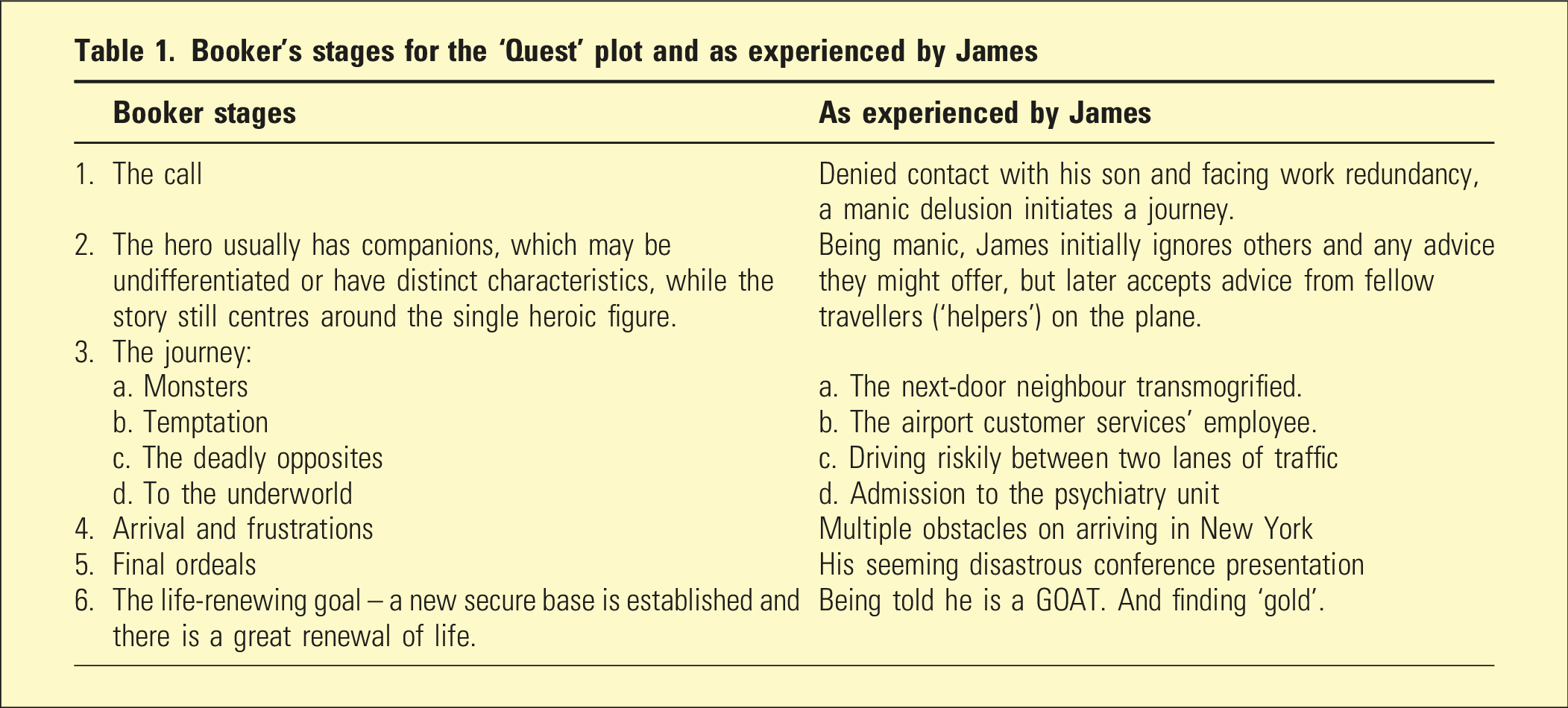
Though the Quest reflects valour, Booker notes (p. 71) that the gallant hero ‘may face every kind of discouragement and opposition before they depart’. James woke the following morning to find that his house had been burgled.
Pressured and in tears he threw a few things in a bag (just remembering to include his passport) and left the house hurriedly. The beginning of the Journey.
Booker states that the ‘essential pattern of the journey in a Quest is always the same’ (p. 73). The first challenge is the terrain – wild, alien and unfriendly, with the hero facing a series of life-threatening ordeals. Booker listed four specific obstacles – (i) monsters, (ii) the need to travel a perilous path between two opposing dangers (e.g. Lancelot tested by having to pass between two lions), (iii) temptations (generally involving a captivating woman) and (iv) a visit to the underworld.
Already far removed from reality, as he walked to the garage, James noted a man waving his arms and calling out. Now his běte noir and not recognizable as his neighbour. A wolf man monster, he thought, and posing great danger. He therefore pelted across the lawn, dodging the dog kennel and hurdling an old tricycle. Then, while driving the family car frenetically he sliced his way through a miniscule opening between two lines of traffic on the expressway (his Scylla and Charybdis), before arriving at the airport and leaving the car in the ‘no standing’ zone before racing to the check in counter.
He became immediately bewitched by the customer service representative, one of the most beautiful women he had ever seen, and with her smile so captivating. He became absorbed by her long inky black hair, and her perfume, clearly a pheromone. However, he moved from bewitched to bewildered when she informed him that all the direct US flights had been cancelled for the day – but she could get him on another carrier (one that James knew to have had a plane crash the previous week). She was clearly Circe. James started banging his fist on the counter – now aware that he had been beguiled. Circe called her manager, the Federal police shortly arrived and James was taken to the nearest psychiatry unit.
He was aghast at being admitted to the ward. Shades of Hades! Then followed a regimen of medications and an appearance before a magistrate. Somewhat less manic, James was able to marshal his verbal skills and convince the magistrate to make him a voluntary patient and, an hour later, he slipped out the main door and hailed a taxi. On re-arrival at Mascot, he went to another carrier’s check in counter, reeled off his credit card details from memory and boarded a New York flight Table 1.
Next, according to Booker, the hero invariably meets helpers (e.g. seers and priestesses) who act as journey guides and advisers.
Once on board, James’ mood rose in synch with the plane’s altitude. Relaxed, he made many immediate friends, chatting to each as they emerged from the adjacent toilet. If they asked where he was going, James became coy. He would simply sing the title to the Billy Joel song – ‘New York State of Mind’ – and tap his nose. They all beamed and so many suggested sites to visit and several gave their phone number.
Booker next mentions a period of ‘final ordeals’. The hero comes within reach of the great goal (Jason arrives in Colchis, the rabbits reach Watership Down) only to find that the journey was just a part of the story. Now in sight of the goal, the hero has to face a great ordeal or a series of them (Jason finds that he cannot claim the Golden Fleece until he has overcome three exacting challenges).
Thus, James’s frustration on arrival at New York when six successive taxi drivers point-blank refused to take him to the site of his fortune after he explained he could only pay them later. Undeterred, James took the subway, jumping over the entrance gate. There was an electric scooter outside the subway exit. He veered around potholes and rats the size of possums in Brooklyn. Forced to walk the final ‘mile’ (New World lingo) due to tyres deflated by glass shards, James plodded past several street gangs with impunity. They judged that any suited male walking those mean streets could not simply be a naive tourist but a policeman in mufti and to be ignored, apart from sneers.
Booker then details how once such tests are passed (and proving that the hero is truly worthy of the prize), the hero arrives at a life-renewing goal ‘with an assurance of renewed life stretching into the future’ (p. 83).
James is keenly aware that when he gains the gold he will be able to refinance his debts, that his superior will have come to his mind, and perhaps he might be reunited with Sonia or at least being allowed contact with son Paul. Panting, he finally arrives at the Brooklyn Heights address to find a hotel. He judges that the bullion must be stored in the hotel’s safe and heads for the reception counter. He is temporarily bemused to note a placard in the foyer detailing that the annual conference of his firm’s international office is taking place on the third floor – being quite unaware that he had seen conference details on an email some weeks previously.
At Reception he recognizes that he needed to be ‘cagey’ with the female concierge. He would ask about the gold enigmatically. ‘Are you the bird in the gilded cage?’ he asked. ‘She wrote him a note and passed it over, smiling broadly. “You a wise cracker? Well, Toucan play at that game.”’ She gestured towards the security officer.
James raced away, to enter the conference room. An attendant smiled, and mistaking him for the next speaker in the chat room, asked James to follow him to the podium. Aware of the approaching security officer James followed quickly, and joined the three formal speakers by taking up the remaining chair, before smiling broadly at the Chairman and offering ‘James Quilty. Sydney office’. The chairman appeared briefly nonplussed but having always prided himself on his capacity for spontaneous initiative, immediately invited James to give the Australian interpretation as to how the crisis in publishing might be addressed.
James stood up and, in full manic state, allowed words to tumble one upon another, offering a lateral arabesque strategy. At three minutes he started to see audience members frowning and then muttering. He became aware that he was talking madness and his mood plunged, leading to him finish with a quiet thanks for the opportunity to speak.
The Chairman thanked all the speakers as a group but his eyes ignored James. He then invited the audience for drinks and savouries. James sunk back in his chair, aware that the report back to the Sydney office would certainly end his career. He waited until the audience had spilled out before he attempted to exit the conference room, the hotel and the country.
As he reached the open door a frowning man turned around and then smiled at James. ‘It’s taken me a while to process what you were saying but I now realise that your plan is extraordinary. Quite brilliant in fact’. Others, who had been muttering and frowning during James’ talk, started to come up to him, offering him drinks and echoing the praise. The words ‘brilliant, ingenious, dazzling and startling’ were offered and repeated.
A tall man with grey hair and a military-like moustache approached. James recognized him as the owner of the publishing company. The man beamed. ‘What a strategy! The Sydney office is clearly so lucky to have you. As have we been so privileged. We must have your family join us at the Hamptons this weekend’. Two days later, while sitting around his host’s swimming pool, James received multiple emails. Some reported media pick up of his brilliant success at the conference, while one from his superior offered more than simply congratulations but a promotion and a pay rise. And there was one from son Paul. The email was brief: ‘Dad. You’re a GOAT’.
James emailed back: “Goat?”
Seconds later, another email from Paul. ‘Yeah, dad. Greatest Of All Time and me and me girlfriend would like to spend time with you when you get back to Syd’. James smiled with relief. And muttered: ‘Gold’. And he would have to get back home quickly to recommence his medication before his mood dropped. He had to stay well.
As summarized by Booker (p. 83), Quest stories end on a ‘great renewal of life, centred on a very secure base, guaranteed into the future. And we can see at last…. That this was what the Quest had really been about all along’. The relevance of the Quest to psychiatry is that it may sometimes underlie the patient’s perception of their goal and illustrate its symbolic value.
