



Abstract
Objective
Following the release of the Australian National Safety and Quality Digital Mental Health (NSQDMH) Standards in November 2020, our objective was to ensure effective implementation of the Standards. This included the development of an accreditation scheme to allow digital mental health services to be formally assessed against the Standards and provide service users with an assurance of safe and high-quality services.
Method
The accreditation scheme was adapted from the one used for the National Safety and Quality Health Service (NSQHS) Standards. As the digital mental health sector was largely unfamiliar with standards and accreditation, the scheme was pilot-tested with a range of service providers and further consultation took place to refine it.
Results
The accreditation scheme was launched in November 2022 with support resources published to aid implementation.
Conclusions
The NSQDMH Standards accreditation scheme provides an assurance of safety and quality for digital mental health service users.
The development of Australian National Safety and Quality Digital Mental Health (NSQDMH) Standards has been previously reported.1-3 Evolving from the National Safety and Quality Health Service (NSQHS) Standards, 4 the NSQDMH Standards were developed from 2018 and released in November 2020. 5 Australia was the first nation to develop standards specifically targeting digital mental health services and is recognised globally as leading in both digital mental health service provision and safety standards development. 6
The principle aim of the NSQDMH Standards is to improve the safety and quality of services and protect users from harm. The Standards also align with Australian Privacy Principles, Consumer Law, Therapeutic Good Administration (TGA) regulation and the Australian Digital Health Agency’s assessment framework for mHealth apps. 7 The release of the National Digital Mental Health Framework in 2021 highlights the timeliness of the NSQDMH Standards in meeting the framework objectives including enhancing trust and confidence in digital mental health services. 8
Accreditation to the NSQDMH Standards is voluntary, although it is likely that a combination of funding requirements and consumer awareness will drive expectations that providers should be accredited to recognised standards, such as the NSQDMH Standards. Accreditation can assure service users that the service is safe and of high quality, meeting expected standards in areas including protecting privacy and information security.
Method
Accreditation pilot study of digital mental health services
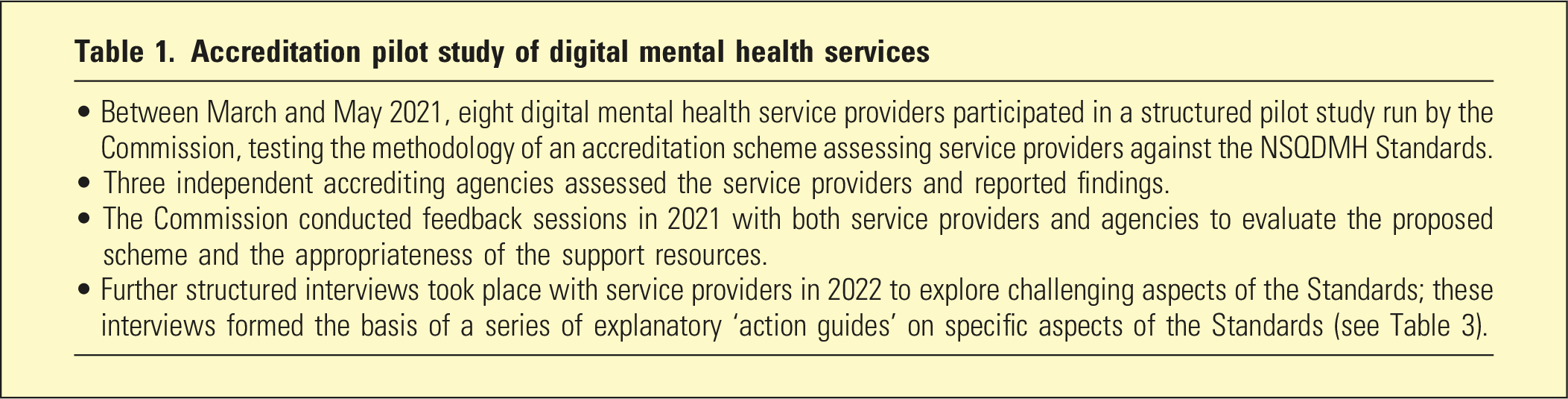
The Commission has well-established accreditation schemes for hospitals and primary care services; however, standards accreditation was largely unfamiliar to the digital mental health sector. The accreditation scheme tested in the pilot study followed the framework of existing schemes recognising that additional resources and elements might be required for the sector.
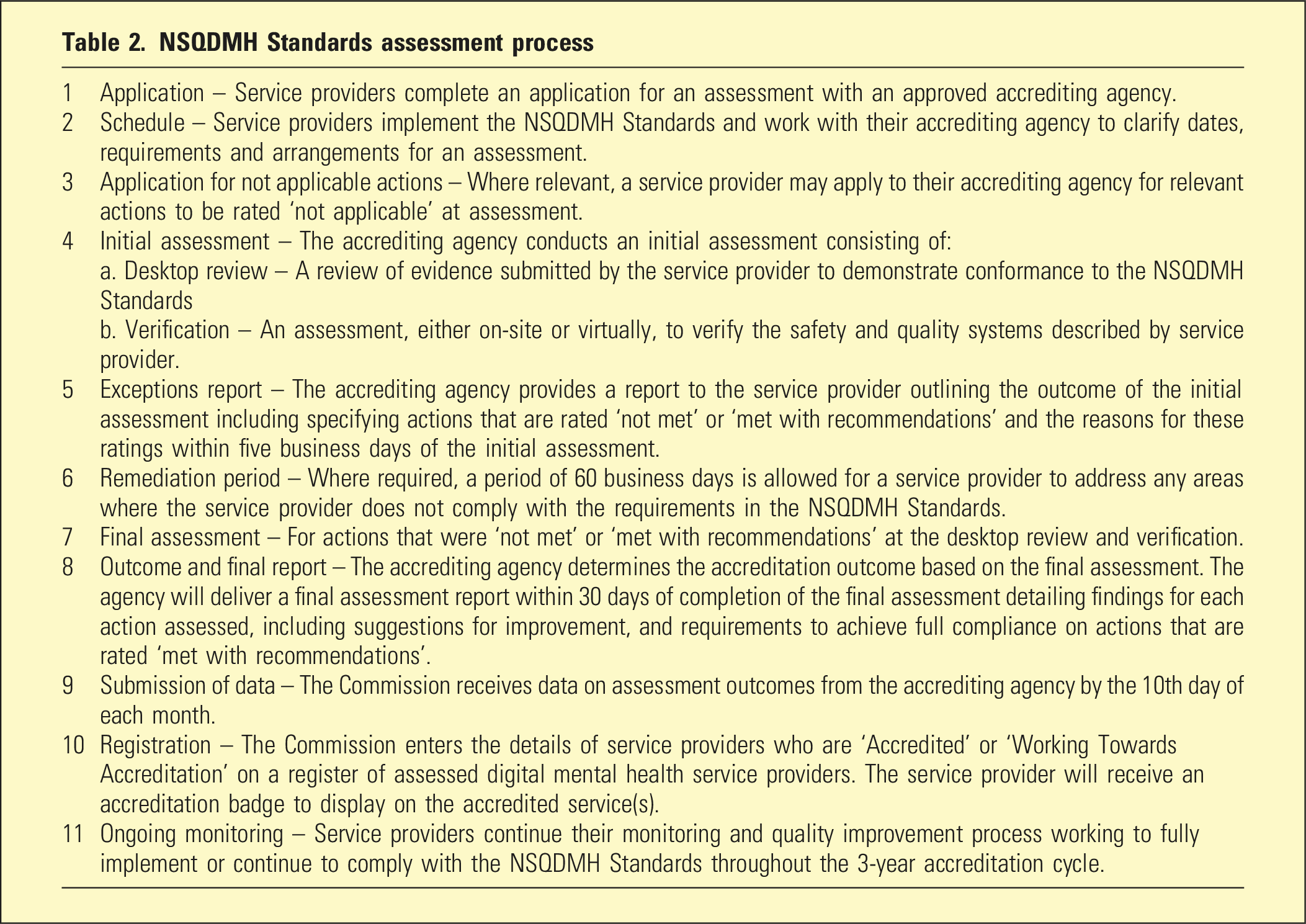
NSQDMH Standards assessment process
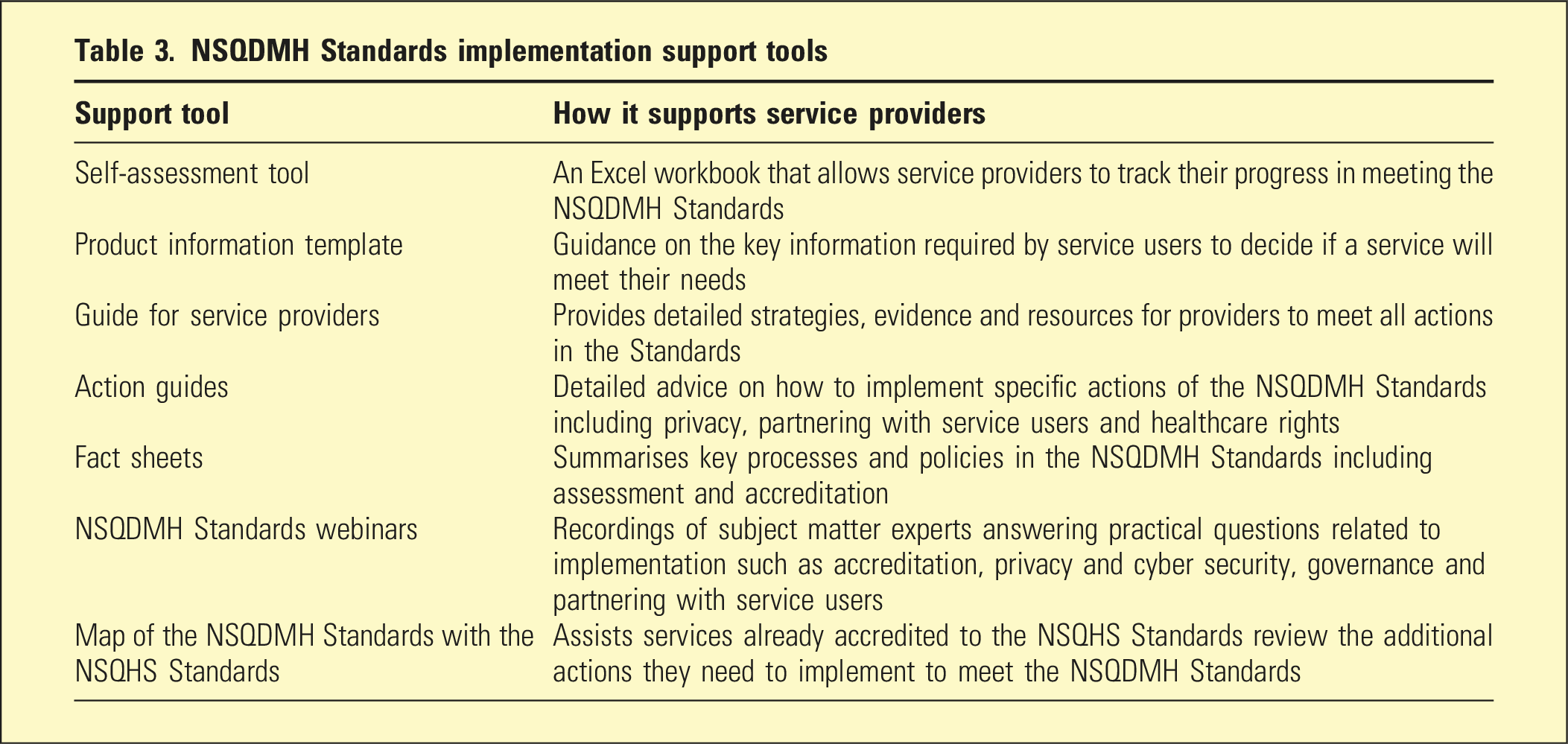
NSQDMH Standards implementation support tools
Accreditation to the NSQDMH Standards is conducted under the Australian Health Service Safety and Quality Accreditation (AHSSQA) Scheme 10 and performed by approved independent accrediting agencies.
A key feature of the NSQDMH Standards accreditation scheme is the ability to undertake all assessment components online, facilitating the process.
The first service provider achieved accreditation in April 2023 with further providers currently engaged in assessment.
Results
The NSQDMH Standards are aligned to other sets of Commission-developed standards. To avoid duplicating effort for organisations with active NSQHS Standards accreditation, but who also offer a digital mental health service, mapping was completed to identify where additional implementation tasks are required. 9 These services are only required to meet 24 of the 59 NSQDMH Standards actions; those which primarily relate to technical criteria such as privacy, data management and cyber security.
NSQDMH Standards accreditation outcome classifications

Accredited services are also authorised to use a digital accreditation badge to assist all service users easily identify an accredited service. All services deemed accredited or working towards accreditation are listed on the Commission’s online register 11 .
A communications strategy following launch of the NSQDMH Standards accreditation scheme facilitated consistent updates to service providers ensuring awareness of Commission resources. A series of educational webinars ran from November 2022 to August 2023 to complement the communications strategy and remain available online. 9
Discussion
For almost two decades Australia has played a leading role in the research, design and delivery of digital mental health tools and platforms. Digital mental health services have seen significant growth over the past few years, with a 62% increase in the proportion of users accessing supported services in Australia between 2019 and 2021 coinciding with the COVID-19 pandemic. 12 Studies also indicate many people using digital mental health services are not accessing any other kind of support, suggesting the significant reach of these services to otherwise under-served population groups and the corresponding importance of ensuring safety and quality. 13 In addition, use of artificial intelligence is becoming more common among digital mental health services through the integration of chat bots and other tools into therapy. 14 As this technology becomes more sophisticated and widespread, appropriate regulatory approaches and oversight may be needed to mitigate patient safety risks.
The release of the NSQDMH Standards and its accreditation scheme signifies a turning point for governments and regulators in acknowledging the unique benefits and risks of delivering mental health services online. Several international jurisdictions have also developed standards, assessment frameworks and certification schemes for digital health technologies.20,21 This movement towards a standards-based regulatory approach is significant as health care becomes increasingly more digitised, online risks including cyber security threats more prevalent and healthcare consumers demand more flexible service delivery.
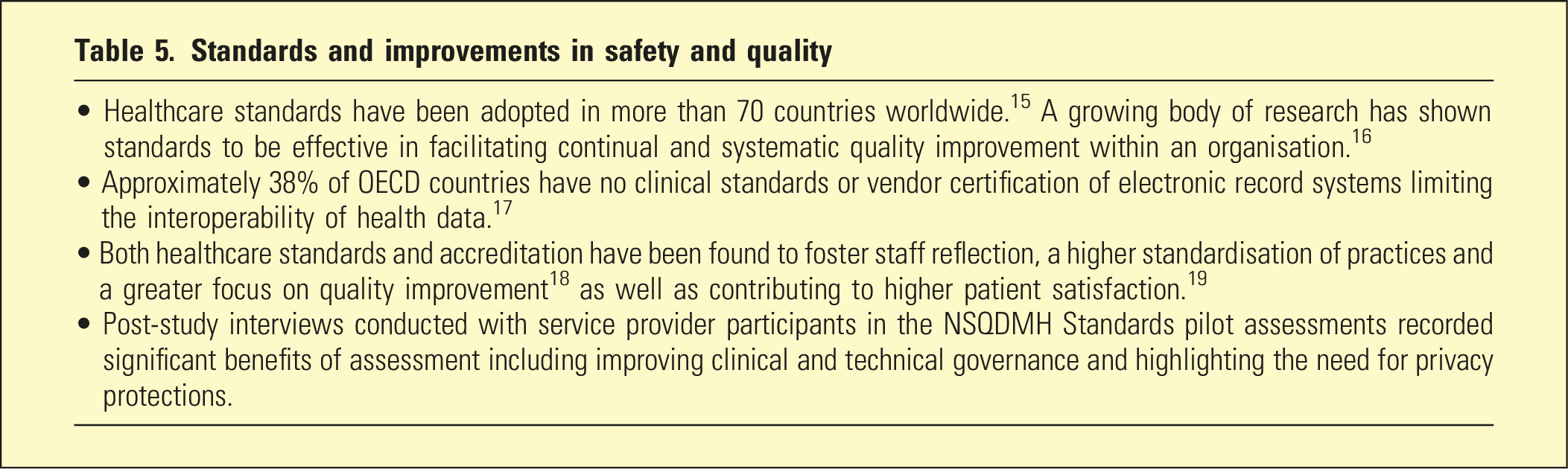
Standards and improvements in safety and quality
It will be crucial for a broad range of stakeholders to continue working together to further strengthen the digital mental health sector in Australia. This will need to include the Australian Government, state and territory governments, regulators such as the TGA and Office of the Australian Information Commissioner, the Australian Digital Health Agency, service users and industry to make digital mental health services safe and deliver improved service user outcomes.
Conclusions
The NSQDMH Standards support a framework for safe and high-quality delivery of digital mental health care. Standards-based regulation is one mechanism to drive quality improvement and reduce potential harms to service users and their support people as more mental health services seek to harness digitally enabled tools.
The Commission has a suite of targeted resources to assist services in implementing the NSQDMH Standards which develop good clinical and technical governance practices, improve their safety and quality systems and support better integration of user-centric models of care.
Accreditation to the NSQDMH Standards provides an assurance to clinicians and service users alike that a service provider’s digital offerings meet stringent safety and quality requirements and the service is committed to improving upon service delivery. Evaluation of the NSQDMH Standards may be an important aspect of ensuring the accreditation scheme remains fit for purpose in an evolving technological landscape.
Footnotes
Acknowledgements
The authors wish to thank all participants who contributed to the consultation and pilot processes during the development of the NSQDMH Standards accreditation scheme. The authors also thank Dr Paul Miles and Ms Margaret Banks for their comments on the penultimate draft.
Disclosure
The author(s) declared no potential conflicts of interest with respect to the research, authorship, and/or publication of this article.
Funding
The author(s) disclosed receipt of the following financial support for the research, authorship, and/or publication of this article: The development and implementation of the NSQDMH Standards was funded by the Australian Government Department of Health and Aged Care.
