




Abstract
Objective
Many trainees find the Psychotherapy Written Case (PWC) requirement of the Royal Australian and New Zealand College of Psychiatrists training program challenging. The skills developed and assessed through this experience are critical to the competencies expected of a psychiatrist. However, the process of psychodynamic psychotherapy is often dramatically different from the expectations associated with early clinical placements in acute psychiatric settings. To support trainees in achieving success in the PWC, a guide to the written report was developed based on a review of existing resources and various stakeholder perspectives.
Conclusions
The submission should reflect a training case rather than an idealised or fictionalised story attempting to demonstrate the therapist’s competence. The PWC submission must meet the requirements of a general psychiatric report and provide a considered reflection on the experience of the novice therapist.
Passing the Psychotherapy Written Case (PWC) is a mandatory requirement of the Royal Australian and New Zealand College of Psychiatrists (RANZCP) training program. Successful completion of the case involves a trainee seeing a patient for at least 40 weekly sessions of psychodynamic psychotherapy under the guidance of an accredited supervisor and then submitting a case report summarising the psychological assessment, progress of therapy, and reflections on the case experience. The PWC submission allows trainees to develop skills in professional report writing and sophisticated formulation. 1 However, historically the psychotherapy case requirements have been described as a ‘daunting task’ 2 by trainees, and in the 2016 RANZCP Admission to Fellowship survey, only half of the respondents agreed that their training in psychotherapies had been satisfactory. 3
The pass rate for the PWC has hovered around 70% for many years. Our experience is that many trainees initially struggle to understand the requirements of the case report submission. Over the period 2021–2022, almost 90% of unsuccessful cases did not meet the standard across multiple marking domains, and more than 50% of unsuccessful cases had deficits across four or more of the eight marking domains. 4 The PWC submission may be challenging for trainees as the process of psychodynamic therapy and preparation of detailed reports differ dramatically from the experiences and expectations of early clinical placements in acute psychiatric settings. Much of their training focuses on crisis and risk management and the biological aspects of psychiatry,5,6 particularly early in the training pathway. As a result, trainees may feel comfortable to describe their case presentation, but have more difficulty in thinking about, understanding, and working through psychodynamic models of care as it relates to their specific case. However, psychodynamic thinking remains a critical orientation in psychiatry, underpinning guiding assumptions such as early life experiences influencing later struggles, unconscious processes’ role in day-to-day life, and doctor-patient interaction. 7 Skills in psychodynamic thinking remain helpful in assessing and treating a wide range of psychiatric presentations, making this an important skill to develop in trainees.
The PWC submission also assesses professional written communication. It is the only assessment of report writing skills in the current iteration of the RANZCP training program. Although report writing is a core competency expectation of psychiatrists, many trainees have limited opportunities to develop comprehensive formulations with patients 8 and prepare similar reports. 1 Several Branch Training Committees (BTCs) make a de-identified case history library of past successful submissions available to trainees. These will reflect the broad range of passing standard and there may be challenges associated with using another trainee’s case as a template to capture the unique narrative of each long case experience.
The PWC is a unique assessment that requires considerable time and effort. While undertaking the minimum 40 hourly sessions, trainees receive supervision (preferably weekly), engage in formal case-based discussions, maintain detailed process notes, and read texts and papers to inform their understanding of relevant theoretical frameworks. 9 However, competing training and life commitments mean that some trainees struggle to adequately complete these tasks during therapy progress. In addition, writing the report following therapy completion requires synthesising large amounts of observed and inferred information to develop a coherent self-reflective narrative of the patient and therapy grounded in a specified therapy model. Given these demands, it is unsurprising that some trainees find the PWC report submission daunting.
Our experience is that accredited RANZCP psychotherapy written case supervisors are often more confident in supervising the therapy than supporting the case write-up. The expectations of the report, extensively detailed in the Policy and Procedure, 10 encompass features of a general psychiatric assessment report going beyond the expectations of a psychoanalytic case report. Furthermore, the size of the submission report (8000–10,000 words) means it is unfeasible for other training supports, such as Directors of Training, to provide feedback on reports before submission. The Queensland experience suggests it takes between three and 10 h to provide individualised feedback to a trainee to guide their successful re-admission of a failed PWC.
To address the challenges experienced by trainees in preparing the PWC submission report, Post-Graduate Training in Psychiatry (Queensland, PGT-QLD) developed a report template. This paper describes the template’s development and shares the resource for the benefit of trainees and their supervisors.
Methods
Resources informing the initial development of the psychotherapy written case submission guidance
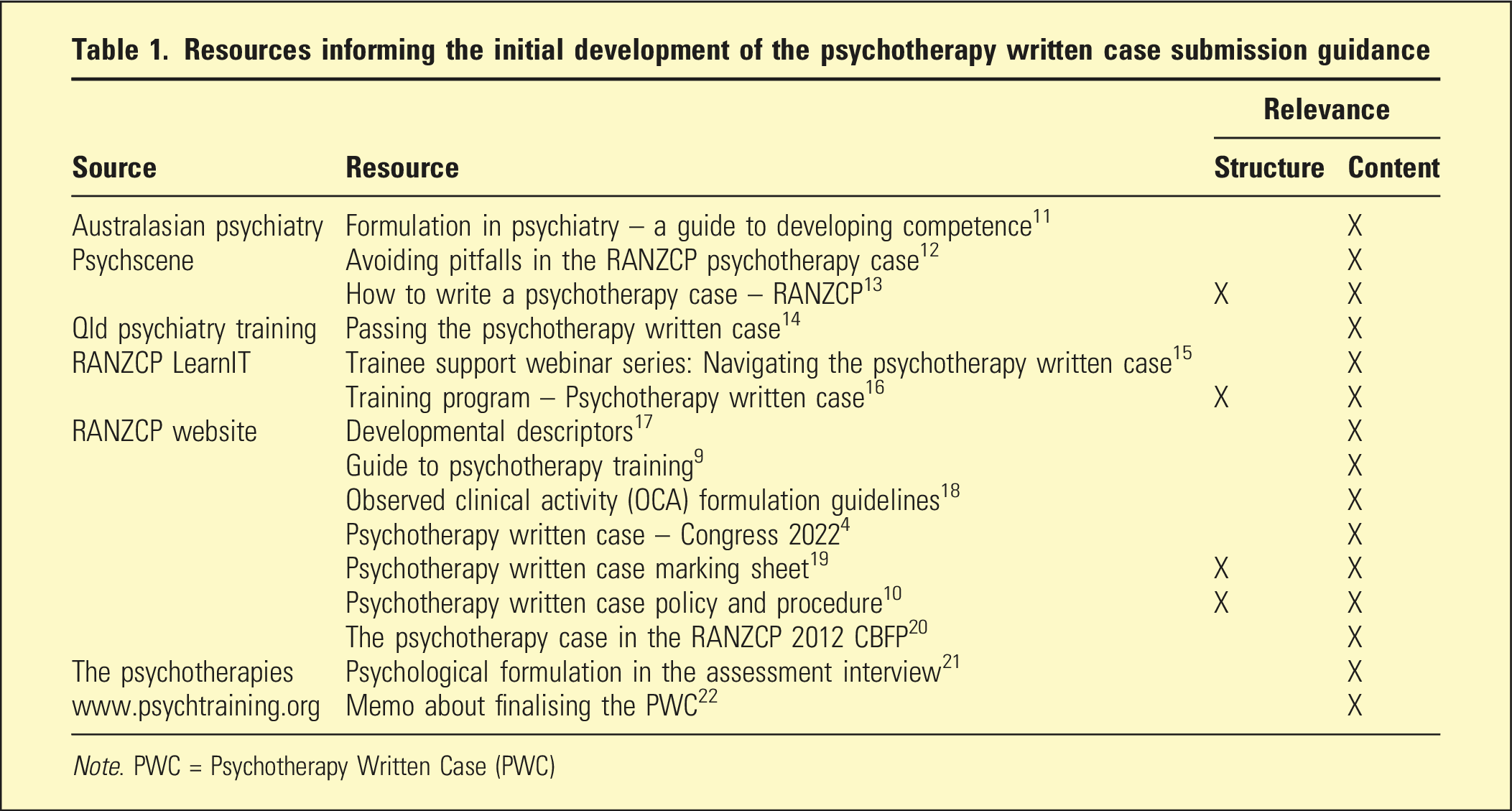
Note. PWC = Psychotherapy Written Case (PWC)
PWC submission guidance: Sections, key points, and key resources
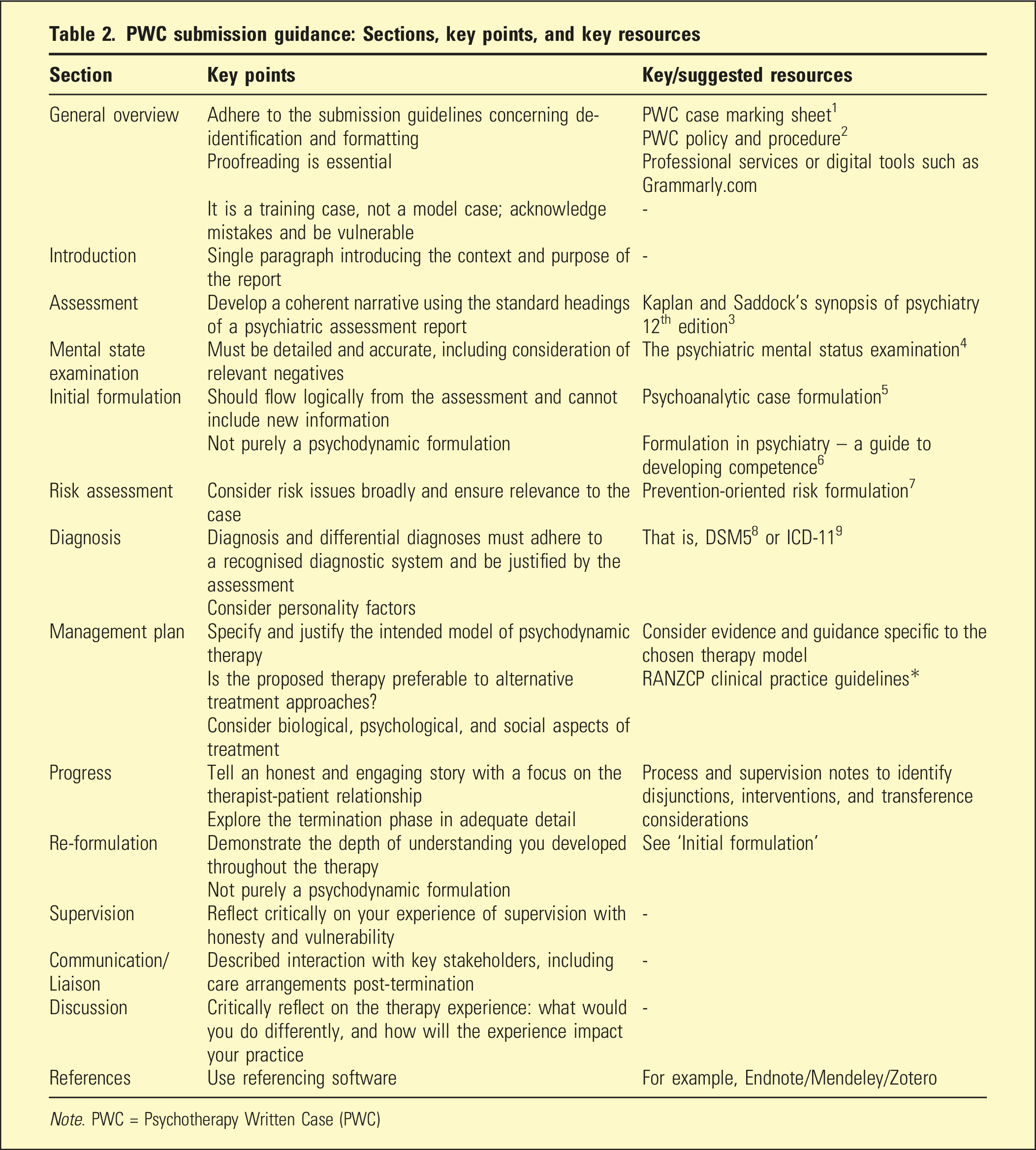
Note. PWC = Psychotherapy Written Case (PWC)
Results
The final psychotherapy written case submission guide matched the PWC’s recommended structure and formatting requirements (Supplementary File 1, see Table 2 for an overview). In addition, content guidance and additional resources (where relevant) were detailed.23–28 Queensland trainees have already provided positive feedback on the usefulness of the guidance in supporting the drafting of PWC submissions.
Discussion and conclusion
It is anticipated that the PWC report guidance will make writing up the PWC case submission less daunting for trainees. Initial feedback from stakeholders, including trainees and supervisors, has been positive. Hopefully, this resource will improve the success rate of PWC submissions in Queensland. Early feedback suggests this is the case.
Supplemental Material
Supplemental Material - A guide to support trainee’s success in the psychotherapy written case submission
Supplemental Material for A guide to support trainee’s success in the psychotherapy written case submission by Korinne Northwood, Nicola Warren, Jimsie Cutbush, and Stephen Parker in Australasian Psychiatry.
Footnotes
Acknowledgements
We gratefully acknowledge Ms Jacki Higginbottom for her assistance with data extraction for this work.
Declaration of conflicting interests
The author(s) declared the following potential conflicts of interest with respect to the research, authorship, and/or publication of this article: KN and JC have declared no potential conflicts of interest with respect to the research, authorship, and/or publication of this article. NW has received honoraria from Otsuka, Lundbeck, and Janssen. SP has received honoraria from Johnson & Johnson and Queensland Psychotherapy Training.
Funding
The authors received no financial support for the research, authorship, and/or publication of this article.

Supplemental Material
Supplemental material for this article is available online.
References
Supplementary Material
Please find the following supplemental material available below.
For Open Access articles published under a Creative Commons License, all supplemental material carries the same license as the article it is associated with.
For non-Open Access articles published, all supplemental material carries a non-exclusive license, and permission requests for re-use of supplemental material or any part of supplemental material shall be sent directly to the copyright owner as specified in the copyright notice associated with the article.
