




Abstract
Australian undergraduate musicians often aspire for orchestral-performance careers despite the limited available positions. Whilst research has frequently examined these aspirations, currently none has focused exclusively on Australian classical brass musicians. This study provides an exploratory analysis of eight Australian undergraduate brass musicians’ aspirations. As part of a larger project, participants reflected on their current and prior career aspirations during semi-structured interviews. A substantial increase in orchestral performance aspirations during undergraduate study was found. Analysis using the Systems Theory Framework of Career Development (STF) revealed the importance of multiple constructs (Education Institutions, World of Work Knowledge, Interests, and Values) and highlighted the extensive influence of performance-focused career outlooks. STF provided an effective framework that enabled discussion of the diverse influences on brass musicians’ aspirations. By highlighting participants’ performance focus, these results reiterate the need for holistic curriculum reform that is consistent with industry realities.
Introduction and Literature Review
It is rare for Australian musicians to work full-time within one organisation or employer (Armstrong, 2013; Bartleet et al., 2020; Bennett, 2008; Bridgstock, 2005; Daniel, 2016; Throsby & Petetskaya, 2017, 2024; Tolmie, 2017). In their economic report on Australian artists, Throsby and Petetskaya (2024) found that only 20% of musicians “worked for a salary or wage” (p. 91). Whilst classical musicians may be more likely to hold full-time performance positions (Bennett & Hennekam, 2018), in Australia, this work is only available in one of the country's 17 professional orchestras and Defence Force ensembles. Holding one of these positions requires passing a multi-round audition process, and job availability is largely dependent on the instrument played. For example, each Australian orchestra employs between 12 and 30 violinists but only four to five French horn players and one tuba player.
Given this employment scarcity, it is unsurprising that most Australian musicians are self-employed and maintain portfolio careers consisting of multiple roles (Armstrong, 2013; Bartleet et al., 2020; Bennett, 2008; Bridgstock, 2005; Daniel, 2016; Throsby & Petetskaya, 2017, 2024; Tolmie, 2017). These musicians earn most of their income through teaching (Bennett, 2008; Hennekam & Bennett, 2016b; Umney & Kretsos, 2015), rarely spend all of their time performing (Bennett, 2007; Throsby & Petetskaya, 2017), and also complete non-music-related work (Bennett & Bridgstock, 2015; Connell, 2020; Everts et al., 2022; Hennekam & Bennett, 2016b). As with full-time positions, the type of freelance performance work available to musicians is influenced by the specific instrument they play. A trumpet player, for instance, could perform in symphony orchestras, concert bands, jazz bands, and brass quintets, whereas a euphonium player can only perform in a concert band.
Despite this career reality, many undergraduate music students aspire for full-time sole-performance positions (Bartleet et al., 2012; Bennett & Bridgstock, 2015; Bennett & Hennekam, 2018; Burt et al., 2006; Gee, 2009; Tolmie, 2017). As a result, much research has analysed the influences on pre-tertiary and undergraduate students’ aspirations. Research into high-school students’ music aspirations, primarily focused on students aspiring to become music teachers, highlights the influence of student's passion for music, music teaching experiences, participation in musical ensembles, and role models such as music teachers, peers, and family members (Henry, 2013; Rickels et al., 2013, 2019). Family members may also be important to high school students’ music performance aspirations. A small study (four participants) by Goopy (2022) found that parents’ beliefs in the viability of music performance as a career heavily influenced their children's performance-related career aspirations. Studies (Bennett & Bridgstock, 2015; Bennett & Freer, 2012; Freer & Bennett, 2012; Munnelly, 2017) have also found that first-year music students often enter tertiary study with performance-focused aspirations, making it likely that these aspirations are present during high school. Performance-focused school music curricula (Abril & Gault, 2008; Haning, 2021; Williams, 2011), music examination systems such as the Australian Music Examination Board (Bennett & Hennekam, 2018; Freer & Bennett, 2012), and tertiary entrance auditions (Bennett & Hennekam, 2018; Freer & Bennett, 2012) may also increase students’ performer identities and reinforce performance-focused aspirations (Freer & Bennett, 2012; Froehlich & Smith, 2017).
At an undergraduate level, students’ sole-performance aspirations are also influenced by their passion for music (Bartleet et al., 2020; Bennett & Hennekam, 2018; Hennekam & Bennett, 2016a; Umney & Kretsos, 2015), instrumental teachers (Austin et al., 2010; Burland, 2005; Burwell et al., 2019; Gee, 2009), and naïve understanding of music industry employment (Hennekam & Bennett, 2016b). These aspirations can also be reinforced by undergraduate music programs that prioritise solo and orchestral careers (Bennett & Stanberg, 2006; Bull & Scharff, 2021) and focus on developing technical skills (Bartleet et al., 2012; Burwell et al., 2019; Creech et al., 2020; Hennekam & Bennett, 2016b; López-Íñiguez & Bennett, 2021). The utilisation of the master-apprentice model of teaching also heightens the influence of the teacher, who is often a performer, which reinforces student's performance aspirations (Burwell et al., 2019). As demonstrated by undergraduate brass students interviewed by Gee (2009), who consistently identified their instrumental teachers as career role models but only in their capacity as performers. This focus on technical skill, taught using traditional methods, may also prevent students from developing necessary non-technical skills (Bridgstock & Cunningham, 2016; Connell, 2020; Hennekam & Bennett, 2016b; Slaughter & Springer, 2015).
Students’ sole performance aspirations are also incongruous with the realities of musicians’ work, which rarely involves full-time performance (Throsby & Petetskaya, 2024) and may negatively impact their transition into the workforce (Burwell et al., 2019; López-Íñiguez & Bennett, 2020). Despite this, it is possible that high-level performance aspirations may be important in motivating students to achieve a high level of technical skill (Gee, 2009), which is important to successfully maintaining a music career (Bartleet et al., 2012; Bennett & Hennekam, 2018; Gee & Yeow, 2021).
Given the influence of performance-focused music curricula on students’ aspirations, many scholars have recommended holistic curriculum reform to school (Abril & Gault, 2008; Goopy, 2022; Haning, 2021) and tertiary music education (Bartleet et al., 2012; Beckman, 2005; Bennett, 2007; Bridgstock, 2012). It is recommended that tertiary music education focus on broader skills (Bennett, 2007; Bridgstock, 2012; Bridgstock & Cunningham, 2016; López-Íñiguez & Bennett, 2020), increase industry connection (Beckman, 2007; Tolmie, 2017), integrate entrepreneurship and business training within the curriculum (Bartleet et al., 2012; Beckman, 2005; Bennett, 2007), and move away from the master-apprentice model (Carey, 2010; López-Íñiguez & Bennett, 2020).
Whilst limited research has explored how one's instrument influences their aspirations, gendered instrument preferences (Harrison & O’Neill, 2000; Sheldon & Price, 2005; Wych, 2012), and personality differences between instrumentalists (Builione & Lipton, 1983; Buttsworth & Smith, 1995; Cribb & Gregory, 1999) have been found, suggesting it may be an influential factor. Additionally, it can be hypothesised that the work available to a musician, governed by their instrument choice, may also shape their aspirations. For example, musicians limited to orchestral performance, such as French horn players, may hold narrower (orchestral-focused) aspirations than those, such as trumpeters, who can perform in a wider range of settings (e.g., jazz, classical, and rock).
To allow for a more in-depth analysis of musicians’ aspirations and careers, scholars have employed a range of career theories, such as Expectancy Value Theory (Jones & Parkes, 2010; Parkes & Jones, 2011, 2012), Calling (Dobrow Riza & Heller, 2015; Man-Kei Lee, 2021), Possible Selves (Creech et al., 2014; Freer, 2009; Goopy, 2022), and Life-Span Life-Space Career Development Theory (Gee, 2009). Whilst additional research has also analysed the careers of specific instrument groups such as strings (Gillespie & Hamann, 1999; Mills, 2007), vocalists (Connell, 2020), pianists (Zhukov & Rowley, 2022), and brass players (Burt et al., 2006; Gee, 2009; Gee & Yeow, 2021), little has utilised a career theory to do so. To date, only two studies conducted by Gee (2009) and Gee and Yeow (2021) apply a career theory to brass musicians’ careers. However, the breadth and variety of the influences by the above scholars, suggests that the use of one career theory alone may provide an insufficient exploratory analysis tool.
Therefore, the Systems Theory Framework of Career Development (STF) is useful as it is “… the basis for an overarching, or metatheoretical, framework within which all concepts of career development described in the plethora of career theories can be usefully positioned and utilised in theory and practice” (Patton & McMahon, 2021, p. 71). The framework highlights two key components of career development: content and process influences (Patton & McMahon, 2021). Content influences are grouped into three interconnected systems: individual, social, and environmental-societal. Influences within the systems include values, interests, and world of work knowledge (individual system); peers, family, and education institutions (social system); and geographical location, gender, and political decisions (environmental-societal system). Process influences include chance, change over time, and recursiveness.
Given the variety of influences on musicians’ aspirations found in previous research, STF may provide an effective exploratory analysis tool to analyse their (musicians) aspirations. As a result, this study used STF to explore the development of eight Australian brass musicians’ career aspirations as they progressed from high school through tertiary music study.
Study Design
This study utilised a qualitative design to analyse the career aspirations of Australian brass musicians. The use of qualitative research methods aligned with the constructivist and narrative nature of STF. As part of a larger research project, semi-structured interviews were conducted with 28 Australian brass musicians. This article reports on eight interviews conducted with undergraduate brass students. Undergraduate students were separated from the larger sample (consisting of musicians at all career stages) so that their current connection with tertiary music education could provide better insight into its influence on their aspirations.
Semi-structured interviews allowed for intuitive and natural conversations (Austin & Sutton, 2014), flexible questioning (Bernard & Ryan, 2010), and assisted participants in discussing their career stories. Interviews were conducted either face-to-face or over Microsoft Teams, to enable individuals from multiple cities to participate. Interviews were recorded on multiple devices (phone, laptop, iPad). Questions began with childhood music experiences (Tell me about how you came to play your instrument, when did you decide to become a musician? How did you come to that decision?) and progressed to current (When someone asks you, “What do you do?” How do you respond? Describe your current career aspirations) and future expectations (What would have to happen for your aspirations to change in the future? How confident are you that your career will be similar to your expectations?) to enrich the narrative approach.
Participants were recruited using snowball sampling. Whilst this method can result in an unbalanced and biased sample (Marcus et al., 2017; Wheeler et al., 2014), it is common in qualitative research (Marcus et al., 2017) and allows participants outside the researcher's network to be recruited (Leighton et al., 2021). Once completed, interview recordings were professionally transcribed.
Prior to data collection, ethical clearance was granted from the affiliated university (GU Reference No. 2023/015). Participants were required to verbally consent and sign an informed consent package before interviews commenced. It is commonly understood that Australian brass musicians exist within a comparatively small and networked professional community. Therefore, participants’ identifying features such as name, location, exact age, and instrument played have been removed from interview transcripts and publications to ensure they remain de-identifiable. Participants were male (3), female (4), and non-binary (1). All were aged between 18 and 24; seven attended the same metropolitan conservatoire and were in the first (1), second (2), third year (3), and fourth year (2) of their undergraduate study.
Researcher Positionality
I am a recent Bachelor of Music graduate and brass player, meaning that my experiences as a musician and with higher music education influenced my interpretations of the data and categorise this study as Insider Research. My position as an insider and personal experience with the topic assisted in developing rapport with participants and enabled a deeper or more authentic understanding of the research problem (Bonner & Tolhurst, 2002; Dwyer & Buckle, 2009). The importance of my input as researcher also aligned with the Reflexive Thematic Analysis that was used to code the data (Braun & Clarke, 2022).
Data Analysis:
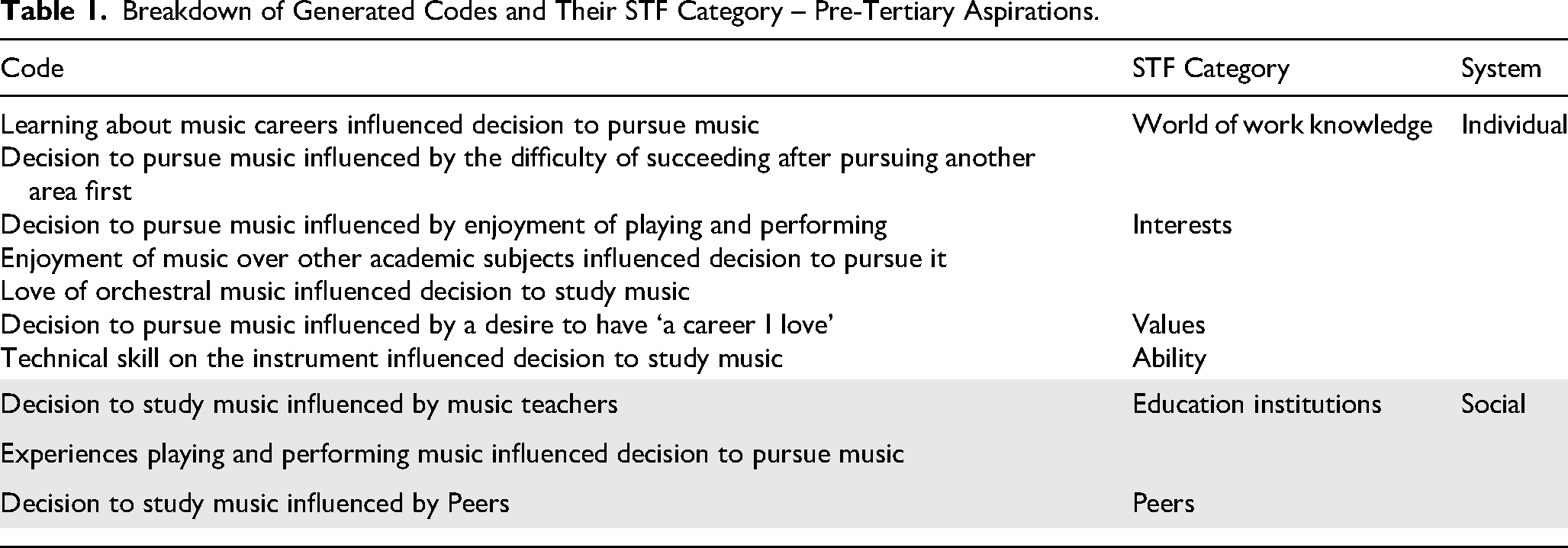
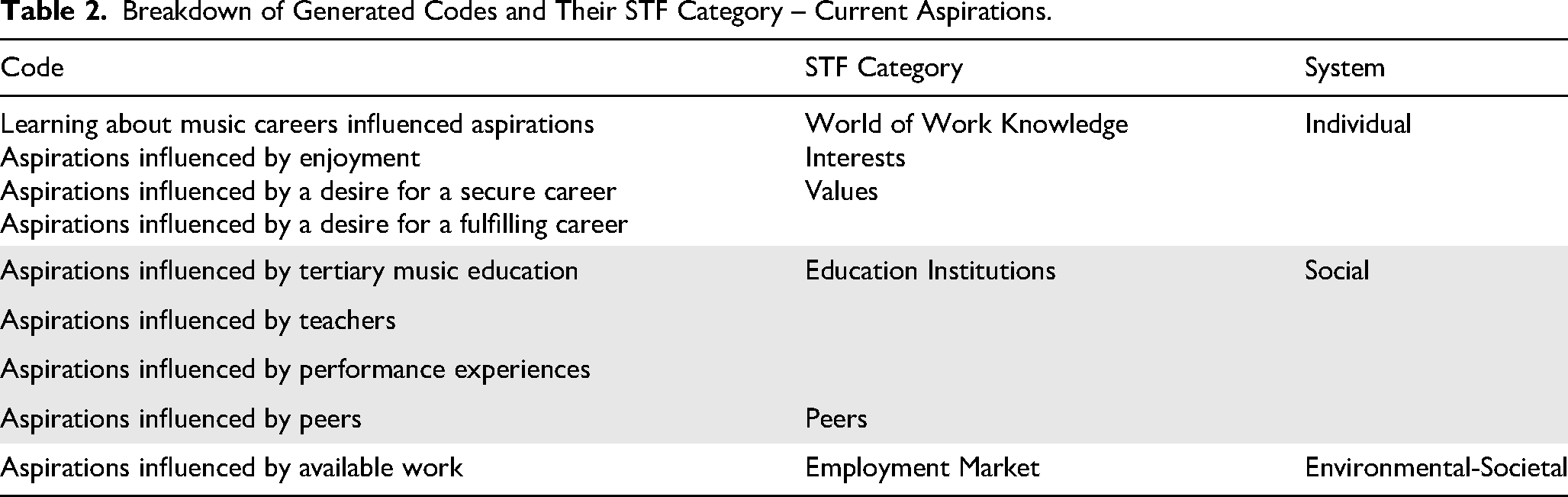
Once transcribed, interview transcripts were analysed using the six-phase process of Reflexive Thematic Analysis outlined by Braun and Clarke (2022). This process involves “… familiarising yourself with the dataset, … coding, … generating initial themes, … developing and reviewing themes, … refining, defining, and naming themes, … [and] writing up” (Braun & Clarke, 2022, pp. 35–36). This method was chosen because it ingrains reflexivity, acknowledges the researcher's influence and importance, allows freedom in the approach and can be effectively and rigorously completed by a single researcher (Braun & Clarke, 2022). Generated codes were sorted into the relevant influences within STF. These codes are outlined in Tables 1 and 2 below.
Breakdown of Generated Codes and Their STF Category – Pre-Tertiary Aspirations.
Breakdown of Generated Codes and Their STF Category – Current Aspirations.
Results
Current and Prior Aspirations
Prior to attending tertiary study, participants aspired to full-time music education (2), full-time music education and part-time performance (1), full-time orchestral performance (2), to perform in orchestras and music theatre pit bands (1), and to work anywhere in the creative industries (1). Participants’ current aspirations narrow towards full-time orchestral performance (7). In conjunction with an orchestral role, participants aspired to teach (4) and to perform in music theatre (1). One participant was unsure of their aspirations.
STF Influences on Aspirations
The importance of each STF influence was determined by the number of participants who discussed it. Participants’ pre-tertiary aspirations were influenced by Education Institutions (7), Interests (5), World of Work Knowledge (5), Peers (3), and Values (2). Similarly, the influences Education Institutions (7), Values (6), Interests (5), World of Work Knowledge (5), and Peers (5) were important to participants’ current aspirations.
Individual System
Interests
Pre-Tertiary
Participants were influenced to pursue a career in music by their Interests. Either because music was the most interesting of their school subjects (“I had lots of different interests, but nothing really jumped out at me as a career, but I always preferred music over everything” – Maria) or because performing within school ensembles was enjoyable (“… I think I just sort of realised as I went through high school, just because it [music] was a really enjoyable thing to do”- Charles).
Tertiary
Enjoyment remained influential to participants’ current aspirations. Here, this enjoyment was often specific to performing orchestral music. Jane, for example, stated: “It's really cool and it's working with a team in such different ways, and not just the [instrument] section team, but the whole ensemble and the conductor and how all of the little parts come together.”
Participants with education aspirations were similarly influenced by their enjoyment of teaching (“I do also like private teaching, I really enjoy that, and I feel like I would get a lot out of it” – Lucy).
World of Work Knowledge
Pre-Tertiary
A belief that a successful music career was dependent on studying music straight after high school influenced participants’ decision to study music. For example, John stated: “… it felt like I was progressing and practising … in high school … if I decided to go and do something else at uni, I wouldn't have given all of my focus into that [playing], and it either would've just stayed the same or slipped away, which was never going to be of the standard to win a job. So, I felt as though if I took what I had and decided to put everything into it and progress and keep going, then [my chance to win a job] would get better.”
Peers were also an important source of career knowledge, with participants learning about the possibility of studying music at university from older students. Isabella, for example, stated, “… I hadn’t really seen many musicians around my area … but a couple of people I knew got into [university] and [I thought], ‘Maybe I can do this.’”
Tertiary
Participants’ current aspirations were also influenced by their World of Work Knowledge, which was often shaped by their music degree. Lucy described developing orchestral performance aspirations after learning about the career during her undergraduate study. Stating: “… I wasn't really super involved in the music world from a young age. I just liked it, but I had nothing to do with it. I never went to see orchestras and stuff like that. So now I get to see all of these people perform and I have this understanding of what other jobs there are.”
Contrastingly, Charles’ increased World of Work Knowledge and understanding about the reality of a music career, decreased his performance aspirations. He stated: “… now that I'm actually [studying], I sort of know how things are working, I'm not sure. I'm still thinking about what I really want to do and what I should be focusing on more.”
Values
Pre-Tertiary
Prior to tertiary study, participants’ career values were influential to their aspirations. Maria and Isabella decided to study music because they wanted to have a career they loved. Maria stated: “I didn't want an office job. I didn't want to go into a very academically inclined field. I just really wanted to do something that I loved and that I could make a living off. So that's the reason I chose music.”
Tertiary
Career values were more important to participants’ current aspirations. Orchestral performance aspirations were influenced by a desire for a secure and stable career. Jane stated, “Obviously, as a musician, that's [security] already just harder than 90% of anything else. So, if I could have that, that would be wonderful.” A desire for a career that was fulfilling was also important to performance aspirations. Maria, for example, suggested that performing with orchestras was “… always keeping me on the edge, and it's always really fulfilling as a person.”
Social System
Within the Social System, participants’ aspirations were influenced by Education Institutions (including music teachers), Peers, and Community Groups.
Education Institutions
Pre-Tertiary
At both stages, Education Institutions were the most influential element of the Social System. Prior to tertiary study, instrumental teachers provided participants with important insights into music careers, which increased their music-related aspirations. John described his teacher's influence on his orchestral aspirations, stating: “… I think the way [my teacher] inspired me was all about starting with the sound. His examples of sound concepts came from orchestral recordings. … and that was my entire inspiration soundscape.” “… I think it was the … ensemble rehearsal. And just hearing [everyone] play … I think that was what sold me on it. [I thought] ‘This is the coolest thing in the world, I want to go do this.’”
This contact with university students also enabled participants to learn about music careers, linking this construct with World of Work Knowledge.
Tertiary
Higher music education was an important influence on participants’ current aspirations. More specifically, the prominence of orchestral music within degree programming often resulted in participants’ orchestral focused aspirations. Maria recalled: “… the more playing I did and the more I learnt about orchestras and the industry and how everything worked, it kind of shifted and performing kind of became the forefront and then the teaching became the side-gig.”
Finally, tertiary instrumental music teachers were important career role models who often inspired participants to strive for high-profile aspirations. Darcy described that, “… my one-on-one … teacher says that I could really do something with myself and gave me some confidence.” Instrumental teachers also provided participants with knowledge about music careers, which influenced their orchestral aspirations. Jane stated: “… in first year, [my teacher] had told me that I could be a [de-identified instrument] player, and I'd just not considered it ever. And I was like, ‘oh yeah, actually I enjoy this a lot too.’ And maybe that's something I could do and see myself doing as a career.”
The increased career knowledge that Jane's instrumental teacher provided her with, highlight the connection between Education Institutions and World of Work Knowledge.
Peers
Pre-Tertiary
Prior to tertiary study, Peers provided participants with knowledge of music career possibilities which influenced their aspirations to study music. Isabella stated: “… a couple of my friends made it into [university] that year. And it kind of widened my scope of music, I started diving into what [studying music] was about and what professional musicians were doing, and what the opportunities were for jobs.”
Tertiary
Peers were also influential to participants’ current performance aspirations. Specifically, the inspiration that successful older peers provided. Isabella described looking up to peers’ success as a future career model, stating: “… some of the fourth years, they’re casual musicians in [the local orchestra]. Going to see them perform makes it a reality that that could be me in a few years.”
Slightly differently, the infectious pull of having an aspiration was important to Darcy who stated: “… seeing people around me want to strive for something … gave me some confidence [to aspire for an orchestral position],” and peer encouragement was influential for Jane, “… it's just different people going, ‘oh yeah, I think you’d make a good [deidentified instrument] player.’”
Discussion
In response to the limited research analysing the career aspirations of specific instrument groups, this study sought to provide an exploratory analysis of Australian undergraduate brass musicians’ career aspirations. The data presented in this article demonstrates STF's utility in analysing brass musicians’ aspirations, provides an overview of participants’ orchestral aspirations, and highlights the varied influences on them.
A key finding was participants’ focus on full-time orchestral careers. Despite most musicians teaching (Bennett, 2008; Hennekam & Bennett, 2016b; Umney & Kretsos, 2015), study participants positioned education aspirations secondary to performance. Additionally, non-music and music-related work was not mentioned in the interviews, even though many musicians must work in these areas to sustain themselves (Bennett & Bridgstock, 2015; Connell, 2020; Everts et al., 2022; Hennekam & Bennett, 2016b). This result is reiterated by existing general and brass musician-focused research where undergraduate students rarely aspire to work outside of education and performance areas (Bartleet et al., 2012; Bennett & Freer, 2012; Bennett & Hennekam, 2018) and brass students often aspire to orchestral careers, believing teaching is an activity only done to alleviate financial pressure (Gee, 2009). Whilst orchestral aspirations may be “… a normal part of becoming a musician, and … integral to the motivation driving many … through their training” (Gee, 2009, p. 215), participants’ sole orchestral focus could demonstrate a limited understanding of career reality (Bennett, 2007) and inhibit their ability to transition into the workforce (Burwell et al., 2019; López-Íñiguez & Bennett, 2020). In addition, such aspirations are inconsistent with the realities of the Australian music industry, where most musicians are self-employed (Throsby & Petetskaya, 2024) and limited orchestral brass positions exist.
Participants’ change in aspirations during their undergraduate degree provides another significant finding. Prior to tertiary study, participants rarely recollected orchestral aspirations, instead aspiring to become music teachers. This is contrasted with participants’ orchestral-focused current aspirations. It is possible that the orchestral performance focus of tertiary music education influenced participants’ changing aspirations. Existing research has frequently documented this impact (Burwell et al., 2019; Creech et al., 2020; López-Íñiguez & Bennett, 2021). Whilst orchestral aspirations may be an important motivator for undergraduate students to achieve a high level of technical skill (Gee, 2009), which is necessary to develop a music career (Bartleet et al., 2012; Bennett & Hennekam, 2018; Gee & Yeow, 2021), current study participants’ prioritisation of orchestral performance and limited knowledge of non-orchestral careers may detrimentally impact their readiness for an industry where full-time employment is rare, and multiple work roles are a necessity (Throsby & Petetskaya, 2024). Creating implications on their ability to develop a fulfilling and lifelong career and on the role that Conservatoire play in promoting and upholding these ideals.
The STF analysis provides more insight into these changes. Firstly, Education Institutions, specifically music teachers, were influential on participants’ aspirations. Research examining school students’ education aspirations suggests that school conductors, instrumental music teachers, and classroom music teachers are influential (Henry, 2013; Rickels et al., 2013, 2019). Whilst teachers remain an important influence at an undergraduate level (Austin et al., 2010; Burland, 2005; Burwell et al., 2019; Gee, 2009), they are often primarily performers, which increases students’ sole-performance aspirations (Burwell et al., 2019; Gee, 2009). It is possible, then, that current study participants’ changing aspirations reflect their changing role models. This suggests the need for the master-apprentice method of instruction to be integrated with a method that exposes students to a broader range of mentors.
The experiences that Education Institutions provided participants were also influential to their aspirations. These experiences included completing the music academic subject (during high school) and participating in ensembles (at both school and university). During school, these ensembles also included youth orchestras and university outreach programs. It is important to note that these experiences are all performance related. Scholars such as Freer and Bennett (2012) suggest students’ performer identities, influenced by performance focused music education programs, result in performance aspirations that are difficult to alter. Whilst current study participants held professional music education aspirations during high school, the importance of performance experiences could suggest that increased orchestral aspirations during tertiary study was linked with performance-focused musical identities.
Connected with Education Institutions was the World of Work Knowledge construct. Participants’ knowledge about music careers was important to their prior and current aspirations. Prior to tertiary study, participants’ World of Work Knowledge was focused on tertiary study pathways rather than music industry careers. This result suggests that high school students enter tertiary music education with a limited understanding of the reality of music careers, highlighting the need for better career awareness to be included within high-school music curricula (Goopy, 2022). Interestingly, participants’ current aspirations did not demonstrate a more accurate understanding of music careers, with their knowledge focused entirely on orchestral careers. This was despite all participants having completed a compulsory first-year vocational preparation course. Students’ reluctance to engage with non-performance courses has been well documented (Beckman, 2007) and, when combined with their complete focus on highly competitive careers, has ramifications for the effectiveness of such courses in preparing them for their careers (Beckman, 2007; López-Íñiguez & Bennett, 2021).
Analysis of the Interest construct further demonstrates participants’ narrowing focus towards orchestral performance. Prior to tertiary study, participants were interested in music generally and enjoyed performing in ensembles. Interests that were reflective of their pre-tertiary music education experiences. Once attending tertiary study, this interest became specific to orchestral music and performing in orchestras – likewise reflective of their tertiary music education experiences.
The Values construct showed the most significant change between participants’ previous and current aspirations. A desire for a fulfilling and secure career often influenced participants’ current aspirations. Whilst participants initially pursued music to have a career they loved, fulfilment and security did not influence pre-tertiary aspirations. The importance of fulfilment and security to participants’ aspirations could provide insight into their orchestral focus. Given the limited career knowledge demonstrated in the World of Work Knowledge construct, participants may view an orchestral position as the only way to have a fulfilling and financially stable career in the music industry. Indeed, this presumption further highlights participants’ career naivety, given that research suggests that orchestral musicians are unsatisfied with their careers (Allmendinger et al., 1996). This result supports the call to increase industry connections (López-Íñiguez & Bennett, 2021; Tolmie, 2017) and include broader career experiences within tertiary music curricula, although it is unclear whether such courses would be effective with students, such as the current participants, who seem unwilling to engage with non-performance courses.
The above analysis shows that STF provided a suitable framework to analyse brass musicians’ careers, providing a key study implication. Its open-endedness highlighted the nuanced nature of the influences on participants’ aspirations. As a narrative career theory, it also provided an individualised discussion of each participant's aspirations. As a metatheoretical framework, STF facilitated a broad discussion of the factors that shaped participants’ aspirations and enabled the incorporation of much previous research.
In addition, the recursiveness of constructs clearly demonstrated participants’ orchestral performance focus. For example, participants often aspired to become an orchestral performer after learning about orchestral careers (World of Work Knowledge) through their peers (Peers), teachers (Education Institutions), or undergraduate courses (Education Institutions). Experiences playing in an orchestra (Education Institutions) reinforced these aspirations and helped participants discover the enjoyment (Interest) and fulfilment (Values) that performing orchestral music brought them. This recursiveness also highlighted the far-reaching impact of orchestral-focused ideals. The constructs Education Institutions, Interests, and World of Work Knowledge, especially, demonstrated participants’ narrowing focus as they progressed through tertiary music education. This result reiterates the need for tertiary music education to collectively undergo holistic curriculum reform that provides students with a wider variety of role models and experiences (Beckman, 2007; Slaughter & Springer, 2015).
Research Limitations and Opportunities for Further Research
Some limitations to the current study must be acknowledged. Firstly, as an exploratory study, the sample size was limited to eight participants. While methodological choices were made (qualitative design and reflexive thematic data analysis) to reduce the impact of a small sample, its results are not generalisable. In addition, longitudinal research was outside the scope of this study, meaning participants’ pre-tertiary aspirations are based on their recollections, so may not be entirely accurate. Despite these limitations, this study offers a novel approach to researching musicians’ aspirations and provides valuable insight into the specific influences on brass musicians’ aspirations.
Future studies might replicate the research using a larger sample size. Studies with a larger sample size would be able to further explore the applicability of STF in analysing brass musicians’ careers and may also produce results that are applicable to a wider group of people. Longitudinal research spanning brass musicians’ transitions from training (both secondary and tertiary) into the workforce may also provide a more in-depth understanding of the development of their aspirations. Such research may confirm the orchestral-performance focus found in the current study and provide further insight into its positive and negative implications on career development. Analysis of brass students’ musical identity and the factors that influence it may also supply a deeper understanding of the undergraduate brass musicians’ performance focus.
Conclusion
This study aimed to provide an exploratory analysis of Australian undergraduate brass musicians’ career aspirations. The findings highlighted the suitability of STF to analyse musicians’ career aspirations and revealed the continued impact of higher music educations’ performance focus on students’ career aspirations. Reiterating the need for broader tertiary curricula that reflects industry realities to better prepare brass students for their careers.
Footnotes
Acknowledgements
Many thanks to the study participants and to Dr Diana Tolmie for her suggestions and editing of manuscript drafts.

Ethical Considerations
The Human Research Ethics Review Committee at Griffith University approved interviews (GU Reference No. 2023/015) on the 23rd of January 2023.
Consent to Participate
Participants were required to verbally consent and sign an informed consent package prior to interviews.
Consent for Publication
Not applicable.
Funding
The author received no financial support for the research, authorship, and/or publication of this article.
Declaration of Conflicting Interests
The author declared no potential conflicts of interest with respect to the research, authorship, and/or publication of this article.
Data Availability
To protect study participants’ privacy, data discussed in this article is not publicly available.