



Abstract
Career involves proactive behaviours to advance employee's professional standing. Drawing on the Conservation of Resources and Career Construction theories, this study focuses on how employees manage their careers proactively by changing or shaping their jobs (through job crafting and person-environment fit) to experience subjective career success. Data were collected in South Africa from 492 working adults through electronic surveys, and the relationships were explored through structural equation modelling. This study adds insights into the underlying mechanism (i.e., person-environment fit) that elucidates how approach crafting (career management behaviour) relates to subjective career success. Illustrating how employees can utilise approach crafting (by increasing structural and social resources or by increasing challenging demands) as a resource-generating behaviour to improve their person-environment fit. Thus, as a result of job crafting, person-environment fit can be utilised as a personal resource to increase subjective career success.
Keywords
Introduction
In the past, organisations were responsible for managing the careers of their employees, with a strong focus on achieving organisational outcomes (e.g., productivity) and providing objective career success (e.g., pay and promotion) for individuals (Arthur et al., 2005). Organisations would provide employees with a range of traditional top-down approaches to help them manage their careers while at the same time ensuring the success and sustainability of the organisation. However, recently, scholars have advocated for the enhancement of resources and building of workers’ strengths as a new positive preventative approach toward the health of employees and the sustainable organisation (Di Fabio & Kenny, 2016). A positive organisational health psychology approach emphasises the promotion of healthy business environments through the well-being of workers and not solely relying on profits (Di Fabio, 2017b). While the main cornerstones of career development have been individual differences, individual development and life design models, sustainable development as a fourth paradigm for the twenty-first-century careers has received increased research interest (Hartung & Di Fabio, 2024). In this sense, incorporating the psychology of sustainability and sustainable development means considering career contributions through a psychological lens to identify problems and develop perspectives on intervention involving sustainability and the sustainable development of global, social, and human systems. According to Di Fabio (2017a), in the psychology of sustainability and sustainable development, meaningfulness is considered the intrinsic motivational energy that fosters genuine sustainability for employees, performance, development and choices. As such, psychological processes are critical in decisions and behaviours connected to sustainability and sustainable development. Therefore, psychological processes “deserve to be studied in depth, considering processes within the individual(s), within the environment(s), between/among individuals, between/among environments, between/among individuals and environments, and between/among living beings and the natural world/universe, from the past, in the present, and into the future” (Rosen & Di Fabio, 2023, p. 20).
With the rapidly changing nature of contemporary jobs (Hu et al., 2021), globalisation, and technological advancements (Guan et al., 2019; Haenggli & Hirschi, 2020), the importance of self-directed and individually customised career paths has increased and became more relevant for successful career development (Wiernik & Wille, 2018). Consequently, career development and attaining success in the contemporary workplace have shifted towards individuals, where employees must take responsibility for their career progression and advancement. Henceforth, career self-management entail employees that are required to develop new skills and capabilities continuously to meet the changing demands in the workplace.
Spurk et al.'s (2019) review has different views on the most compelling theoretical approaches for attaining career success. It is against the backdrop of the Conservation of Resources (COR) theory (Hobfoll, 1989) that Spurk et al. (2019) argued that individuals need to develop resource management behaviours and attitudes to optimise their attainment of career success. Hence, theoretical approaches that focus on personal fulfilment and career self-management increasingly highlight the importance of subjective career success (SCS) and the role that resource accumulation and dynamics can play in this regard (Kundi et al., 2021).
In line with the contemporary career landscape, characterised by less upward mobility and being more self-directed, this study focuses on two career-related concepts that illustrate how employees themselves manage their careers pro-actively by changing or shaping their jobs (through job crafting and person-environment fit) as a means to experience SCS. Over the past decade, literature has illustrated that employees are increasingly engaging in job crafting behaviours where they initiate changes in their skills, capabilities, knowledge, preferences, or work aspects to optimise their jobs without direct support from others (Demerouti, 2014; Rudolph et al., 2017; Tims et al., 2022). In this regard, job crafting has become an essential bottom-up approach where employees are inspired to self-initiate changes to meet their needs and abilities, contributing to better work performance and work environments (Tims et al., 2012; Wrzesniewski & Dutton, 2001).
According to Akkermans and Tims (2017), when employees craft their jobs, they increase their probability of achieving better performance and career success. In this sense, several recent studies encourage self-directed behaviour to enhance employee career success (Diaa et al., 2024; Hirschi et al., 2022). Therefore, there is a growing trend of integrating contemporary career and job design literature, specifically incorporating job crafting as a mediator (or explanatory variable) between contemporary careers and career success (Akkermans & Tims, 2017; Kundi et al., 2021; Presti et al., 2023).
Individuals engage in job crafting behaviours for various reasons, with one of the main notions being that the changes that job crafters make are primarily aimed at improving their person-job fit and work motivation (Demerouti, 2014). Viewing job crafting from the Job Demands-Resources (JD-R) perspective has been dominant in the literature and explains the proactive changes that employees make to balance their job demands and resources with their capacities and needs (Oprea et al., 2022; Tims et al., 2013). The goal is to better fit their attributes with their work environment. As such, studies have shown that different types of job crafting, within the context of demands and resources, can enhance employee fit perceptions (Ok & Lim, 2022; Tims et al., 2016). In this sense, job crafting is a way for individuals to deal with the demands and resources in their work environment and explore opportunities to change their jobs to better fit their abilities and strengths. According to Cenciotti et al. (2017), job crafting is critical to translating psychological resources into subjective or objective career success. Although job crafting has been linked to job satisfaction (Chen et al., 2023), little is known about how job crafting impacts job satisfaction but also SCS.
In the literature, both person-environment fit (P-E fit) and career success have been identified as outcomes of job crafting (Liao, 2023; Presti et al., 2023). Similar to the work of Li et al. (2023), which utilised job satisfaction as an outcome, this study adds to crafting research by identifying P-E fit as a crucial explanatory variable (mediator) to understand the associations between job crafting (i.e., approach crafting) and SCS. As such the overall aim of the present study was to illustrate P-E fit as mediator in the relationship between job crafting and SCS. Based in previous literature specific hypotheses were developed and are expanded on in the section to follow.
Theory and Hypotheses
Job Crafting from the JD-R Perspective
Job crafting has gained increased research interest, primarily due to its view as an essential mechanism linking characteristics in the work environment to work outcomes (Rudolph et al., 2017). In essence, the conceptualisation of job crafting has mainly stemmed from two perspectives in the literature. That is the job redesign perspective of Wrzesniewski and Dutton (2001) or the view in line with the JD-R model of Bakker and Demerouti (2007). However, studies expanding the initial works of Tims et al. (2012) and Demerouti (2014) have dominated job crafting literature in the last decade. In line with the JD-R model, these scholars conceptualised and explained that individuals assess their job characteristics and change the job demands and resources they experience. Utilising the JD-R theory as a framework, Tims et al. (2012) operationalised job crafting as the proactive changes individuals make to balance their demands and resources with their abilities and needs. Consequently, differentiating between four specific forms of crafting job demands and resources:
Increasing social job resources (for example, increasing the level of support), Increasing structural job resources (by increasing the level of autonomy), Increasing challenging job demands (increasing the level of challenging aspects of the work) Decreasing hindering job demands (i.e., reducing hindering aspects such as cognitive or emotional demands in the work).
In general, both perspectives (the JD-R view and the job design perspective) indicate that individuals can either expand (by adding more tasks) or shrink (reducing workload) their jobs and roles (Zhang & Parker, 2019).
However, despite the increase in studies incorporating these perspectives, Zhang and Parker (2019) criticised the disparity in the job crafting literature and argued the need for a more conceptual synthesis and construct clarification. As a way to synthesise these perspectives, Zhang and Parker (2019) developed an integrated hierarchical structure which differentiates between job crafting in terms of orientation (i.e., approach and avoidance crafting), form (behavioural or cognitive) and content (targeted to change job resources or job demands). In such an integrated structure, approach crafting entails effortful and directed actions to seek positive aspects of work, which can be both behavioural or cognitive and resource-focused or demand-focused. In line with the current emphasis on career self-management and proactive behaviours that employees take to enhance their professional standing in contemporary careers (Diaa et al., 2024), approach crafting seems highly relevant. According to Presti et al. (2023), approach crafting is directed towards actions aimed at enhancing positive aspects of one's work and aligns particularly to three of the dimensions of Tims et al. (2012), namely increasing structural resources, increasing social resources and increasing challenging demands.
Subjective Career Success
Initially, career scholars focused on career success by considering objective aspects related to the job (such as pay, salary, and promotion) and how that would be related to success (Arthur et al., 2005). Later, scholars claimed that career success could be better viewed as the aggregated measure of objective and subjective attributes related to the job individuals have (Spurk et al., 2019). SCS refers to a person’ perceptions of his or her career (Haenggli & Hirschi, 2020). In this sense, many scholars have expressed SCS as career or job satisfaction (Gaile et al., 2022). However, given the changing career contexts, how employees perceive success has drastically shifted, with much more emphasis being placed on the subjective components within the work environment. In this regard, Shockley et al. (2016) emphasised that measuring the subjective components of career success has become critical, as this will assist organisations in designing jobs that will support career commitment, tenure of employees and productivity. As such, an increased interest in SCS studies is evident in the literature.
Job Crafting and Subjective Career Success
Recently, studies emphasised specifically how protean individuals (self-directed individuals) seek opportunities to allow for a greater variety of tasks and job autonomy or increase the degree and number of challenging demands as ways to develop themselves (Presti et al., 2023; Sartori et al., 2023). According to Sartori et al. (2023), when employees proactively search for more resources and challenges in their work (which align with the notion of approach crafting), they enhance their understanding of factors that influence their employability. As such, career scholars agree that when individuals seek feedback or ways to develop themselves or embrace new challenges at work (e.g., engage in approach crafting), they accumulate a greater pool of job resources which enables them to develop and learn professional skills and increase their self-perceived employability (Sartori et al., 2023). In the review of Rudolph et al. (2017), prominent outcomes related to job crafting include job attitudes, occupational well-being or work performance. However, recent studies have also illustrated career-related outcomes related to job crafting, such as job satisfaction (Chen et al., 2023), career commitment and career satisfaction (Kim & Beehr, 2018; Kundi et al., 2021). In addition, job crafting has also been shown to be an effective strategy for employees to achieve their career goals and success (Cenciotti et al., 2017).
Building on the insights from the aforementioned studies, we have formulated the following hypothesis:
The Role of P-E Fit in the Approach-Crafting Subjective Career Success Relationship
In the literature, employees’ critical factors to promote or attain career success have been categorised as career resources (Hirschi et al., 2018). In this sense, scholars frequently refer to and investigate how human capital (e.g., skills, knowledge or abilities that are crucial for performance), environmental (external factors such as growth opportunities and social support), motivational (career-related psychological factors) or career management behaviours are considered resources that help individuals to attain the desired outcomes or success in their careers. Most relevant to this study are career management behaviours, which are known to be aimed at achieving career goals and P-E fit (Kundi et al., 2024). According to Kim and Beehr (2018), employees’ proactive behaviours alter the boundaries of their jobs and ultimately facilitate the attainment of their career goals or lead to higher career success. In this regard, scholars have become more interested in the proactive behaviours employees show to achieve their career goals, instead of only concentrating on motivational factors (Haenggli & Hirschi, 2020; Hirschi et al., 2022).
In the context of this study, such proactive behaviours can be considered approach crafting, as employees engage in actions aimed to deal with demands and resources in their work environment to obtain a better fit with their abilities and strengths ultimately (Cenciotti et al., 2017; Tims et al., 2016). According to Rudolph et al. (2017), P-E fit has been the focus of proactive work behaviour research for some time. Subsequently, recent studies have examined job crafting with various forms of P-E fit (Li et al., 2023; Liao, 2023; Ok & Lim, 2022; Shah & Khail, 2023). In essence, employees use job crafting as an adaptive strategy to reshape the content of their jobs (demands and resources), not only to create a better person-job fit or P-E fit (Liao, 2023; Ok & Lim, 2022; Shah & Khail, 2023), but also to achieve objective and SCS (Presti et al., 2023) or improved self-employability (Akkermans & Tims, 2017). According to Gaile et al. (2022), people possess and employ resources to exploit the opportunities that are available in their external environment. In this sense, Akkermans and Tims (2017) argue that job crafting can be a means to mobilise personal resources that positively impact one's career-related outcomes. This resonates with the COR perspective, which suggests that individuals utilise and use their existing resources to acquire additional resources by adopting crafting strategies (Kundi et al., 2024). This resonates also with the career construction theory of Savickas et al. (2009), which explains that individuals’ activities aim to design their careers by developing resources and being active and decisive in their job roles. In this regard, Xi et al. (2022) illustrated the role of P-E fit as an explanatory mechanism and how demands-abilities fit, needs-supplies fit, and person-organisation fit strongly correlate with objective and SCS indicators. Incidentally, former studies have examined job crafting with P-E fit (Li et al., 2023; Ok & Lim, 2022); P-E fit with career success (Ballout, 2007; Guan et al., 2021; Koekemoer et al., 2023; Salisu et al., 2020; Xi et al., 2022), and job crafting with career success (Kim & Beehr, 2018; Presti et al., 2023). Furthermore, De Cooman and Vleugels (2022) argue that aligning an individual's signature strengths and job requirements (for example, through engaging in job crafting) can strengthen the P-E fit and success relationship. Yet, research on the job-crafting-SCS linkage has been limited, and little is known about how specific job crafting strategies could impact career success. However, van Zyl et al. (2023) postulate that when individuals perceive a fit between themselves and their work environment, they are more likely to show sustained effort and perseverance in achieving their long-term goals, which may affect work-related performance. Guan and Frenkel (2019, p. 1758) state that “obtaining additional resources from existing resources increases the likelihood of stronger work motivation and enhanced capability to successfully execute more challenging work.” In line with this, we argue that job crafting (the proactive management behaviour career resource) enables employees to experience P-E fit (i.e., obtain an additional career resource), which ultimately can increase feelings of SCS.
Method
Participants and Procedure
A cross-sectional survey design was used to gather data from South African employees employed full-time for at least two years in their respective organisations (N = 492). The sample mainly consisted of Caucasian females (59.8%) between 30 and 59 years of age (77.1%). Regarding work experience, 68.7% of the sample had more than 11 years of work experience. More than half of the sample had completed a degree at a tertiary institution (55.6%) and 63.1% of the sample were employed on either middle, senior, or executive managerial level. The majority of the sample (75%) indicated their home language as Afrikaans and English (as their speaking language). Although fewer employees did indicate African languages as their home language, English proficiency was not a problem, as the sample can be considered highly educated (with 80% indicating tertiary education degrees), with English being the primary language spoken in South African Organizations. Using convenience and snowball sampling methods, a Qualtrics survey link was shared via social media platforms (LinkedIn and WhatsApp) and emailed to the researchers’ personal contacts. An introductory letter emphasising the importance of participants’ rights informed them that participation is voluntary and anonymous and that they could withdraw anytime. Informed consent was obtained from all participants, ensuring their autonomy and respect. Data collection only commenced after ethical approval was obtained from the relevant tertiary institution (MMD/2022/2), demonstrating the study's adherence to ethical standards. All communication to the participants and the surveys were in English.
Measures
Below is a description of all the scales used and their reliabilities. All scales were administered in English. The scales used in this study have widely been used in previous South African studies and were deemed appropriate for use in the South African context. Both the P-E fit (Cable & DeRue, 2002) and SCS (Shockley et al., 2016) scales use five-point Likert scales, where 1 = strongly disagree and 5 = strongly agree. All variables of the job crafting scale (JCS) (Tims et al., 2012) were scored on a five-point rating scale ranging from 1 (Never) to 5 (Often).
Person-Environment fit (P-E Fit)
P-E fit was measured by the nine-item Perceived Fit Scale (PFS) of Cable and DeRue (2002) which comprises three factors: person–organisation fit, needs–supplies fit and demands–abilities fit. Three items measure each factor. The following are example items: “…my personal values match my organisation's values and culture” (person–organisation fit); “…the job that I currently hold gives me just about everything that I want from a job” (needs–supplies fit); and “…the match is very good between the demands of my job and my personal skills” (demands–abilities fit). Çarkıt (2024) reported acceptable Cronbach's alpha values ranging between 0.92 and 0.94 for the scale and subscales. The instrument also proved valid and reliable among South African employees in the study of Carstens et al. (2021) with alpha's ranging from 0.77–0.91.
Job Crafting (Approach Crafting)
Approach job crafting in this study was measured using 15 items of the JCS developed by Tims et al. (2012). Approach job crafting was measured by the following three subscales, each measured by five items: increasing structural job resources (e.g.,” I try to learn new things at work”), increasing social job resources (e.g., “I look to my supervisor for satisfaction”) and increasing challenging job demands (e.g., “When there is not much to do at work, I see it as a change to start new projects”). Viseu et al. (2024) reported Cronbach's alpha values ranging between 0.73 and 0.80 for the various subscales with the study of Peral and Geldenhuys (2016) also reporting alphas between 0.83–0.84 among a sample of South African teachers.
Subjective Career Success (SCS)
The 24-item SCS Inventory (SCSI) developed by Shockley et al. (2016) was used for measuring SCS. Participants were required to remember the following stem phrase while responding to the items: ‘Considering my career as a whole…’. This scale comprises eight dimensions, each dimension measured by three items. Example items for each of the scales are as follows: “…my supervisors have told me I do a good job” (recognition); “…I am proud of the quality of the work I have produced” (quality work); “…I believe my work has made a difference” (meaningful work); “…others have taken my advice into account when making important decisions” (influence); “…I have chosen my own career path” (authenticity); “…I have been able to have a satisfying life outside of work” (personal life); “…I have expanded my skill sets to perform better” (growth and development), and “…I am enthusiastic about my career” (satisfaction). Acceptable Cronbach's alpha values have been reported between 0.76 and 0.86 in other SA studies (Olckers & Koekemoer, 2022).
Statistical Analysis
We analysed the data using SPSS version 28 and Mplus version 8.7. We first wanted to determine whether common method bias (CMB) might threaten our data since we used a cross-sectional design and self-report measures. Therefore, we employed Harman's one-factor test to establish whether a single factor explains less than 50% of the variance. Additionally, we tested if the fit of a single latent factor model, where all observed variables were allowed to load directly on it following a confirmatory factor analyses (CFA) approach, displayed poor model fit. To estimate our model, we followed Anderson and Gerbing's (1988) two-step approach in structural equation modelling (SEM) using Maximum Likelihood Robust (MLR) estimation. MLR is recommended for small and medium-sized sample sizes and non-normally distributed data (Wang & Wang, 2020). We first used CFA to verify the factor structure of our three measurement scales and to inspect whether the factor loadings of all the observed variables were higher than 0.40 (McNeish et al., 2018). Second, we evaluated the fit of our structural model, examining the relationships between the latent variables in our hypothesised model. We used the following goodness-of-fit indices and suggested cut-off criteria to assess model fit: the comparative fit index (CFI; ≥ 0.90), Tucker-Lewis index (TLI; ≥ 0.90), root mean square error of approximation (RMSEA; ≤ 0.08), and standardised root mean square residual (SRMR; ≤ 0.08) (Kline, 2016). We estimate the reliability of the scales using Cronbach's alpha (> 0.70; Flora (2020). Descriptive statistics included the means and standard deviations. Correlational analyses (p ≤ 0.05) were conducted and evaluated according to the guidelines set by Ferguson (2009): 0.10 (small size), 0.30 (medium size) and 0.50 (large size). Lastly, we applied bias-corrected bootstrapping (BCB) with 1000 sample iterations to determine the point estimate and 95% confidence interval of the total and indirect effect.
Results
To determine the results of Harman's one-factor test, we specified all observed variables to load onto a single factor by using an unrotated exploratory factor analysis via a principal component analysis (Tehseen et al., 2017). A one-factor explained only 27.43% of the variance, falling below the critical value of 50% (Fuller et al., 2016). Results of the one-factor CFA showed poor model fit: (c2 = 5709.99; p < 0.01; df = 1080; CFI = 0.55; TLI = 0.53; RMSEA = 0.09 [0.09–0.10; SRMR = 0.09) and a low unstandardised variance value of 11%. It thus may be concluded that the data obtained in this study did not present significant CMB.
We have used Soper's online SEM calculator (Soper, 2021) to determine the required sample size for our SEM model. The desired statistical power level was set at 0.80, the p-value at 0.05 and the anticipated effect size as medium (0.30). The results indicated that a minimum sample size of 119 was needed to detect effect. Our sample (N = 492) was thus large enough to detect the specified effect.
We employed a competing measurement modelling strategy to determine the factor structures of the PFS, JCS, and SCSI. We did not remove any items. These model results are summarised in Table 1.
Fit Statistics per Measurement Model.
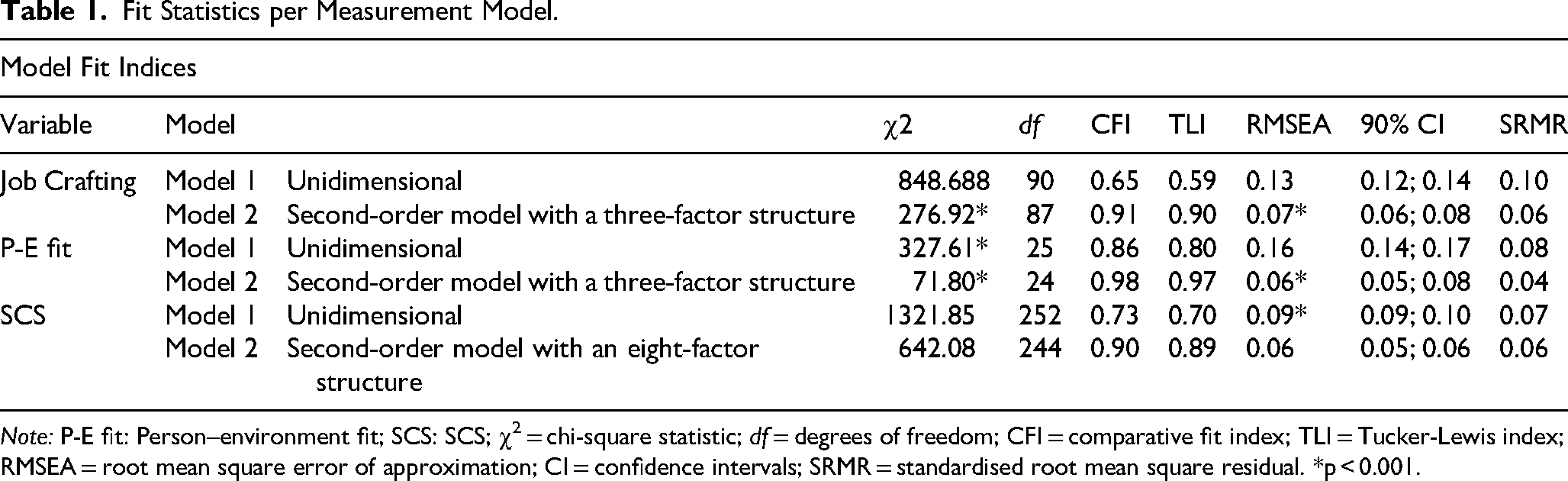
Note: P-E fit: Person–environment fit; SCS: SCS; χ2 = chi-square statistic; df = degrees of freedom; CFI = comparative fit index; TLI = Tucker-Lewis index; RMSEA = root mean square error of approximation; CI = confidence intervals; SRMR = standardised root mean square residual. *p < 0.001.
Descriptive statistics (means and standard deviations) and intercorrelations among the latent variables in the study are displayed in Table 2. Statistically significant (p < 0.01) positive associations among the latent variables were found. Approach job crafting was positively related to P-E fit (r = 0.34; medium size) and SCS (r = 0.43; medium size). A strong relationship was observed between P-E fit and SCS (r = 0.71; large size). Overall, these correlations imply that by increasing their approach crafting behaviours, individuals improve their P-E fit and their probability of achieving career success. The Cronbach's alpha values exceeding 0.70 suggested acceptable reliabilities for all scales (Flora, 2020).
Descriptive Statistics, Reliabilities and Correlations.
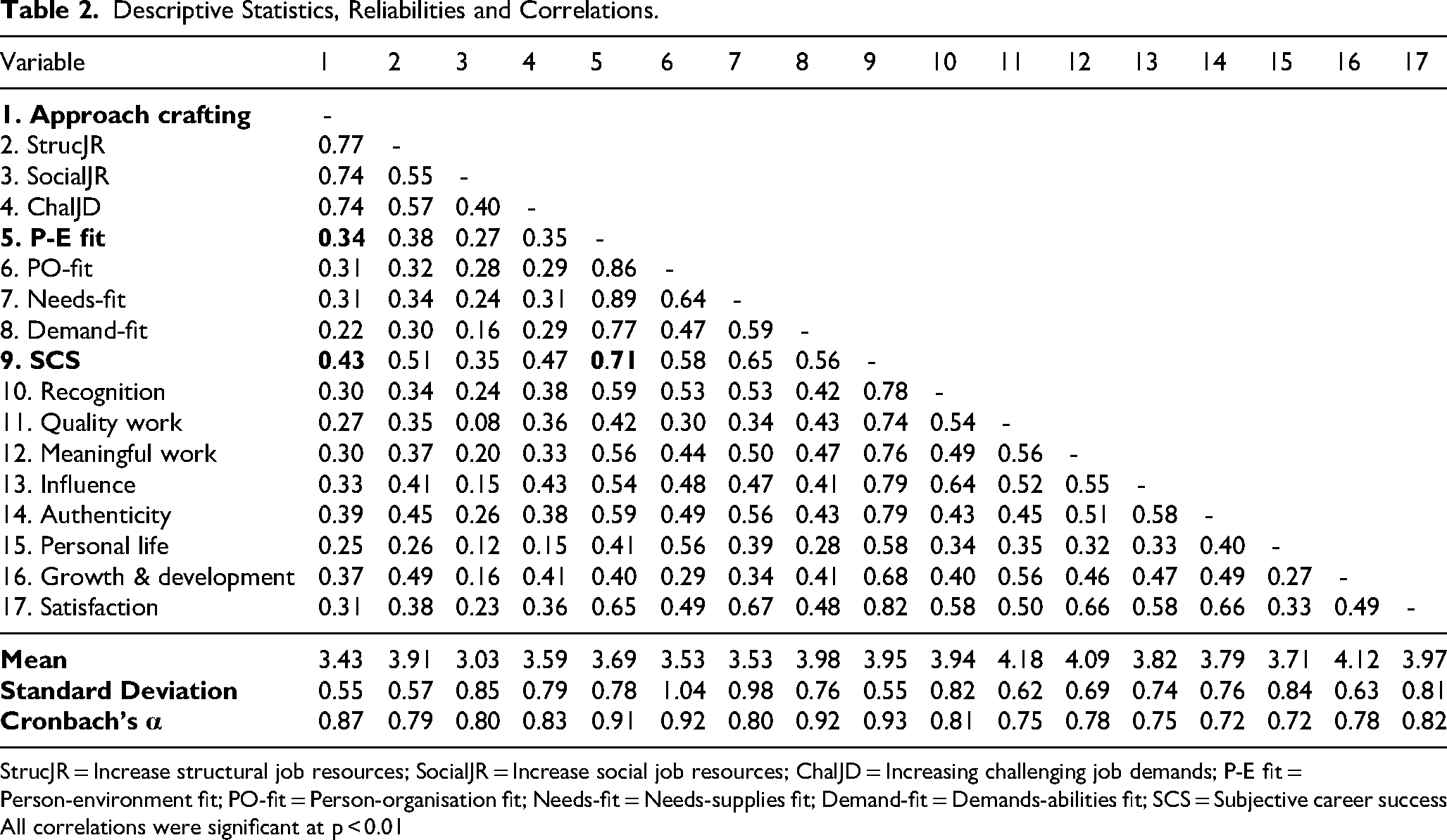
StrucJR = Increase structural job resources; SocialJR = Increase social job resources; ChalJD = Increasing challenging job demands; P-E fit = Person-environment fit; PO-fit = Person-organisation fit; Needs-fit = Needs-supplies fit; Demand-fit = Demands-abilities fit; SCS = Subjective career success
All correlations were significant at p < 0.01
Our structural model, displayed in Figure 1, showed acceptable model fit: (χ2 = 2104.99; p < 0.001; df = 1060; CFI = 0.90; TLI = 0.89; RMSEA = 0.05 [0.04–0.05; SRMR = 0.06). All factor loadings in this model were significant (p < 0.001) and above 0.04, as was suggested by McNeish et al. (2018), ensuring measurement quality.
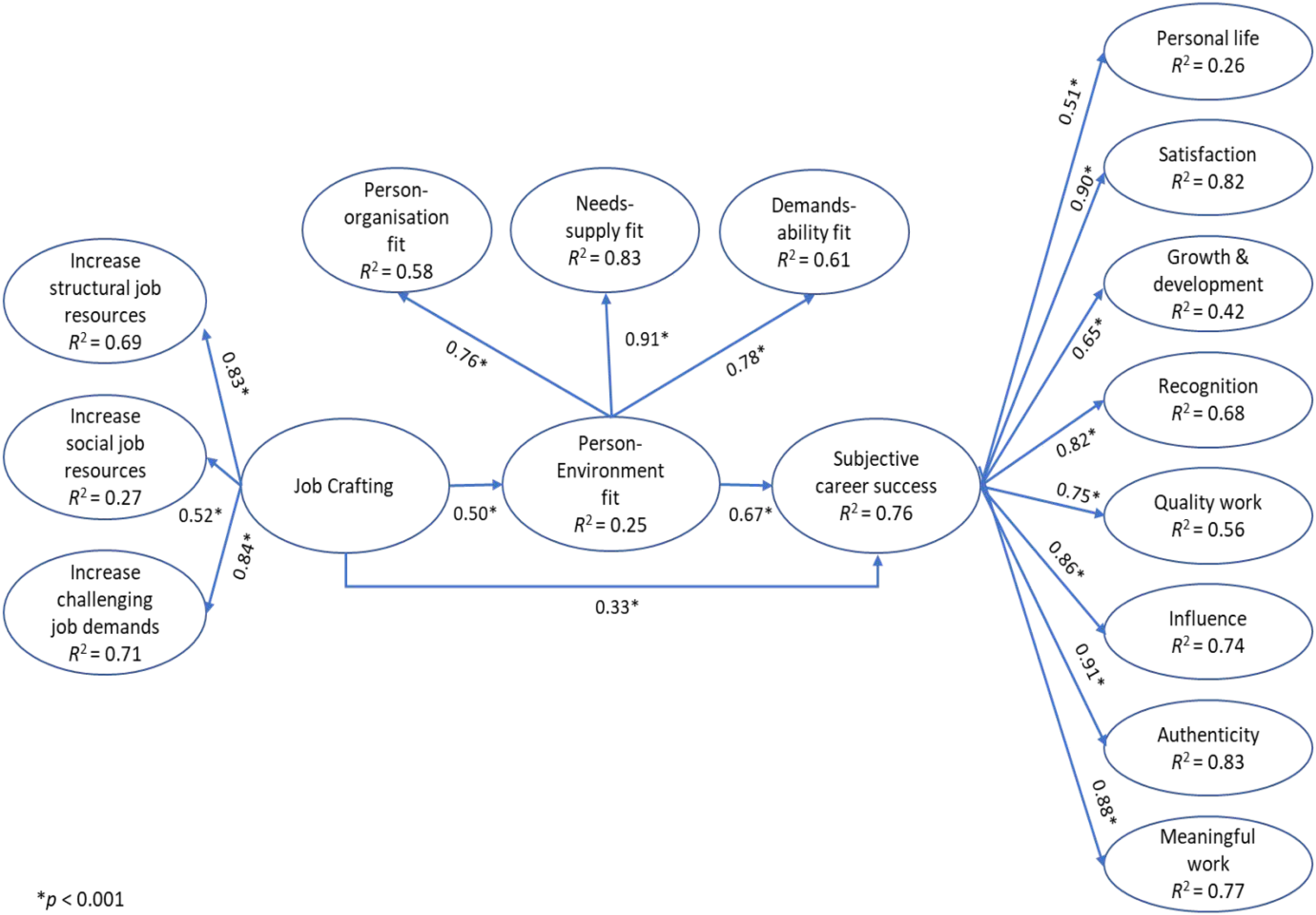
Structural Model.
In this model, as suggested by the modification indices, the error terms on the following items were allowed to covary: For SCS, item 6 (“…the work I have done has contributed to society”) with item 13 (“…I believe my work has made a difference”) of the meaningful work subdimension; for approach job crafting, item 1 (“I try to develop my capabilities”) with item 2 (“I try to develop myself professionally”) of the increase structural job resources subdimension and for P-E fit, item 8 (“…my abilities and training are a good fit with the requirements of my job”) and item 9 (“…my personal abilities and education provide a good match with the demands that my job places on me”) of the demands-ability fit dimension. These modifications were only considered due to the similarity in the item working (Wang & Wang, 2020).
The results of our structural model showed a significant positive association between approach job crafting and SCS (β=0.32; p < 0.001), explaining 77% of the variance in SCS. Hypothesis 1 was therefore supported. Similarly, significant positive relationships were found between approach job crafting and P-E fit (β=0.50; p < 0.001) and between P-E fit and SCS (β=0.67; p < 0.001). Approach job crafting explained 59% of the variance in P-E fit.
BCB results with 1000 iterations indicated a significant indirect effect between approach job crafting and SCS (β = 0.34, p < 0.01) via P-E fit. The bias-corrected 95% CIs (0.27; 0.44) also did not include zero. Partial mediation was established because approach crafting improves SCS both directly and indirectly through P-E fit. Therefore, hypothesis 2 was supported.
Discussion
In viewing job crafting from the perspective of the JD-R model (Demerouti, 2014; Tims et al., 2012), this study examined the mediating role of P-E fit on the job crafting-SCS relationship. Against the backdrop of the COR and career construction theories (Hobfoll, 1989; Savickas & Mark, 2002), our findings confirmed strong positive relationships between approach crafting, P-E fit, and SCS. Such findings illustrate how employees can utilise approach crafting (self-directed actions aimed at increasing structural and social resources or by increasing challenging demands) as an effective resource-generating behaviour to improve their P-E fit and SCS in an ever-changing work environment. In this regard, employees cope with the demands of the contemporary work environment by modifying their work through utilising job crafting as an adaptive strategy better to fit their preferences, abilities, and needs. In this manner, by aligning the demands and resources with their needs and abilities, employees are generating additional personal resources (i.e., improved P-E fit), which can be an essential mechanism for job satisfaction or career success (Li et al., 2023; Xi et al., 2022). Similarly, van Zyl et al. (2023) also illustrated how P-E fit as a personal resource can increase task performance.
In the contemporary workplace, where rigid job functions are no longer effective, employees must be empowered to be more flexible in their work roles to achieve better person-job fit (Kim et al., 2024). According to Hu et al. (2021), when individuals engage in job crafting behaviour, they can more comprehensively mobilise resources in their environment and are better capable of overcoming obstacles as they put in much energy to obtain more material and emotional resources. As such, Ballout (2007) argued that employees who experience P-E fit are more likely to engage in development-seeking behaviours and create situations that support higher job performance and achievement levels. Our findings support such notions by illustrating how employees’ efforts to craft their jobs both directly and indirectly contribute to SCS via P-E fit. Our findings underscore why and how P-E fit promotes SCS due to job crafting behaviours. The current study expands on the research of Koekemoer et al. (2023) by illustrating that it is through effective job crafting that individuals feel that their skills fit the demands of their job and their needs for rewards are being met (meaning they experience person-job fit in terms of need-supply fit and demand-ability fit). They experience increased feelings of career success. Our findings have both theoretical and practical implications.
Theoretical Implications
Although the job crafting-career success relationship has enjoyed increased research attention (Kim & Beehr, 2018; Presti et al., 2023), many studies have emphasised job crafting as the mediator (or explanatory variable) between contemporary careers and career success (Akkermans & Tims, 2017; Kundi et al., 2021). For example, Kundi et al. (2024) illustrated job crafting as the underlying mechanism linking career-related resources to SCS. Their study explains how motivational career resources initiate the motivational process, encouraging individuals to craft their jobs and achieve higher career success. However, studies explaining how and why job crafting per se impacts career success have been studied to a much lesser extent (Li et al., 2023). In this regard, our findings expand contemporary career success models or views by illustrating how P-E fit, as a result of job crafting, can be utilised as a personal resource to partially increase feelings of SCS.
In line with the COR theory, our research expands on the works of Kundi et al. (2024) by illustrating that job crafting in itself can not only be seen as the outcome of career-related resources but can also be considered for its ability to generate additional resources in the form of P-E fit. In this sense, when employees take control of their environment by engaging in job crafting, such proactive behaviour and actions will help them improve various forms of P-E fit to achieve the desired success in their careers. Hence, our research explains of how employees crafting their jobs could increase their SCS directly, but also indirectly through their improved P-E fit. This is similar to the findings of Li et al. (2023), who illustrated P-E fit as the mediator in the job crafting-job satisfaction relationship. The contribution of our research is that it tests theoretically grounded propositions of the relationships of approach job crafting with motivational career resources (P-E fit) and subsequent SCS. Consequently, we found that as a result of job crafting, employees experience increased P-E fit, which may act as a personal resource, contributing to increased feelings of career success.
Practical Implications
Our findings show how employees can effectively use job crafting to improve their P-E fit and experience increased SCS. Such findings suggest that organisations should allow employees to craft their jobs more freely to fit their preferences, abilities and needs. This might entail job crafting interventions to stimulate conversations between employees and managers on their ideal jobs and how they can take initiatives to improve fit experiences in their work. In this regard, the value of self-direction through action should be embodied in organisational cultures. Given the various ways of crafting one's job (Rudolph et al., 2017), managers can assist employees by providing targeted support for how individuals can respond to job demands.
Limitations
Despite its contributions, we acknowledge that our research results are subject to limitations. At the outset, it should be noted that data stemmed from self-reported measures and are therefore sensitive to social desirability and confirmation bias. Using cross-sectional data also opens the potential issue of common method variance. However, we did attempt to test for this during our preliminary analysis using Harman's one-factor test and tested the fit of a single latent factor model. In addition, using cross-sectional data does not allow for assessing actual causal effects but only the direction and magnitude of the potential causal effect. Therefore, the exploratory mediation results can be used for explanatory purposes and to inform future longitudinal studies investigating actual causal effects.
Conclusion
Our study investigated the relationships between job crafting, P-E fit and SCS among a sample of full-time employees (N = 492). Our research contributes to the job crafting and career management literature by illustrating how engaging in approach-job crafting behaviours can increase employees’ SCS by utilising P-E fit as an explanatory mechanism in the crafting-career success relationship. More specifically, we found both approach crafting and P-E fit to be predictors of SCS, with P-E fit partially mediating the relationship between approach job crafting and SCS. Based on COR and Career Construction theories, our findings suggest that employees can manage their careers proactively by mobilising their personal resources, such as their job crafting behaviours and P-E fit, to enhance their feelings of career success. Our findings imply that organisations should allow their employees to craft their jobs to improve their fit experiences in their work in order for them to increase their SCS.
Footnotes

Funding
The authors received no financial support for the research, authorship, and/or publication of this article.
Declaration of Conflicting Interests
The authors declared no potential conflicts of interest with respect to the research, authorship, and/or publication of this article.