




Abstract
Since 2013, the UNESCO Chair of Lifelong Guidance and Counseling, together with its UNITWIN Network created in 2017, have been driving research, training, and interventions from a Life Design perspective to help people to navigate this uncertain world. This article is a UNESCO Chair position paper which aims to propose a new vision for career counseling in the current context of the Anthropo-Capitalocene. This vision is based on forms of active life, a concept developed in the career guidance literature by Eduard Spranger. This paper identifies new counseling interventions involving a range of activities that make every individual's daily life a certain form of life. The discussion considers avenues for helping individuals to engage in sustainable forms of active life. The conclusion discusses the need to break away from siloed approaches to career counseling and to develop a conception of the individual in connection with the Earth system.
Keywords
The growing need for labor associated with the industrialization of society in the nineteenth century contributed to giving career counseling a primary purpose: the employability of individuals and their adaptation to the labor market (Guichard, 2009a, 2011). Subsequently, the organization of work, the globalization of the economy and an increasingly unpredictable labor market led a group of specialists in the field of lifelong career construction to re-examine this objective, which had been dominant for several decades (Savickas et al., 2009). This group aimed to redefine the central concepts on which career development interventions were based in order to adapt them to a work and life context characterized by more transitions and ruptures than in the past. The reflection led to the development of life design in career counseling. This constructivist paradigm, which was conceived in the first decade of the twenty-first century, envisions a new purpose for career counseling: helping individuals to build their lives in a holistic way. This involves designing interventions aimed at self-transformation, combined with a reflection on the interrelations between different life domains (Collins & Guichard, 2011; Duarte, 2009, 2014; Guichard, 2009b). These interventions reveal configurations taking the form of life-course trajectories within which career paths are embedded.
The UNESCO Chair of Lifelong Guidance and Counseling, founded in 2013 at the University of Wroclaw, Poland, advances this innovative life design perspective. The Chair's main objective was to involve researchers from various countries in the development of a reflection on how career counseling could play a role in helping individuals to deal with the major crises of the early twenty-first century and build a desirable future (Guichard et al., 2016). The inaugural conference of the Chair, which took place in Wrocław on November 26 and 27, 2013, brought together researchers and professionals from 20 countries across 5 continents around a central question: How can interventions for life and career construction support the development of a sustainable and equitable global economy through decent work activities? Following this initial event, a UNITWIN UNESCO network was created in 2017, bringing together 21 academic partners. These activities are in line with the strategic objectives of UNESCO, the International Labor Organization (ILO, 2017), and the UN Sustainable Development Goals (Brundtland Report, 1987). The aim is to develop career interventions that help individuals to design their active lives, integrating sustainable human development and decent work (Cohen-Scali et al., 2018; Guichard et al., 2017). Today, more than 10 years after the foundation of the Chair, it seems necessary to broaden the epistemological position of the Chair in relation to the profound transformation of societies and the globe that has marked the first quarter of this century and has come to be referred to as the Anthropocene 1 (Crutzen & Stoermer, 2000; Friedlingstein et al., 2020) and more recently the Capitalocene 2 (Bonneuil, 2017; Moore, 2017). 3
This is the subject of our three-part paper. In the first part, the characteristics of the global context and current career development interventions are discussed. The second part presents the principles that can serve as theoretical foundations for creating new interventions. Finally, the third part explains the relevance of these new approaches to the designing of active lives 4 from the concept of forms of life.
Career development interventions in the context of the anthropocene
The world is facing a set of major crises that are changing the relationships between individuals, groups, and systems of activity and life in many parts of the world. The socio-economic approach adopted since the start of the industrial era has led to a massive deterioration in living conditions on earth. This approach has been termed the “Predatory Anthropocene” by McDonald (2016): “Predatory Anthropocene is the outcome of what many call neoliberalism, supra-personal systemic forces that offer capitalist social subjectivations like entrepreneur and artist and wrangler us as cogs in massive machines of production, exchange, and consumption” (p. 10). Current career development interventions should be reviewed for their capacity to help individuals to cope with these major crises and the reorganization of the representations and modes of life. Guichard (2022b) observes that, as we find ourselves at a turning point in human history today, we must reconsider and remodel both our practices and theories of support for the design of active life.
Living in the age of the predatory anthropocene
Already established by Meadows et al. in 1972 (Meadows et al., 1972), the effects of human activities on the planet have been further detailed in various reports by the IPCC 5 (Friedlingstein et al., 2020). This situation causes living beings to live with 40 gigatons of carbon added to the Earth's atmosphere every year. It entails the daily destruction of 8,000 hectares of forest (Carrington et al., 2018) and the loss of more than half of all animals over the past 40 years (Ceballos et al., 2017). While the concentration of carbon in the atmosphere affects all humans, exposure to pollution, hunger, and water scarcity—the consequences of climate change—affects the world's populations differently (Report of IPCC Working Group III, April 2022). Indicators of the quality of life and environment (Better Life Index 6 , Global Climate Risk 7 Index) help to understand these consequences for many countries. Human practices bring about a massive loss of biodiversity, a huge production of unrecyclable waste, air and land pollution in all parts of the world, and climate change, which makes life impossible in many tropical and equatorial countries.
Climate change and the deterioration of the natural environment are two of the consequences of today's dominant systems of industrial production and economic exchange. These systems deplete resources and lead to degraded living conditions (ILO, 2019). Social and environmental inequalities are deepening all over the world, with some people accumulating all the wealth derived from the exploitation of humans and nature, and others leading a life of toil with no hope of improvement (Chancel et al., 2022). This situation aggravates challenges in adapting to more frequent and severe climate disasters and boosts the incidence of serious pollution related illnesses. Having reached the “final stage of modernity” (Macé, 2022, p. 8), we are confronted with an increased risk of inability to secure decent work, and vulnerability due to precariousness and poor working conditions is spreading across all populations (Blustein, 2019; Blustein & Flores, 2023; Nota et al., 2023). A large number of companies are now “in crisis” (Segrestin & Hatchuel, 2012). Subject to shareholder pressure, they are no longer committed to a social mission as in the past, their primary objective being to maximize financial returns. This mode of operation, based on the pursuit of continuous performance enhancement, comes at the expense of work quality, social justice, and innovation capabilities, resulting in workplace distress, mental health issues, a sense of ethical conflict, and a loss of meaning in work (Blustein et al., 2022; Coutrot & Perez, 2022; Kalleberg & Vallas, 2017).
Current characteristics of career development interventions
Despite these challenges, most interventions supporting the design of active lives are underpinned by a logic focused on employability and managing the flow of individuals to be integrated into the labor market. Many career development interventions are inspired by Human Resource Management practices. Rather than considering individual needs and aspirations, they utilize predefined frameworks, such as assessment tests and reference frameworks with their fixed criteria and assessment methods for learning (Vergnies, 2023). In France, for example, high school students and bachelor's degree graduates must now make their career choices using a platform based on predefined options according to a managerial logic of matching, which limit their exploration possibilities and exacerbate inequalities (Mizzi, 2022). Similar procedures are applied in Poland, Portugal, and many other countries.
Furthermore, the increasing reliance on the notion of skills in the field of career guidance raises various issues (Duru-Bellat, 2015). For example, skills are often assessed on a declarative basis, and this often hinges on the wording of questions, which tends to be tainted by biases. It is difficult to pinpoint the factors that drive skill development, especially because they manifest within a context of situated social appraisal. They make for a fragmented representation of individuals in action, who are judged generally incompetent if they do not have a certain number and type of competencies. For example, today's young people are encouraged to develop soft skills, which are regarded as essential for entering the labor market, whatever the job.
Moreover, current interventions encourage individuals to integrate the new constraints of the workplace through notions such as nomadic careers, protean careers, and sustainable careers, promoting autonomy and self-entrepreneurship, which can sometimes enhance people's isolation by moving them further away from communities of life and work.
Finally, we are witnessing the development of dematerialization in career counseling, involving the growing use of information platforms. For example, individuals experiencing psychological distress need to interact more and more frequently with virtual assistants based on AI algorithms, entailing an ever-greater adaptation of individuals to the operations of machines (Park et al., 2023; Vaidyam et al., 2019). The specific critique of current career development interventions is that they embrace a techno-optimist view of the future of society and fail to analyze the underlying relationships between beings or to consider adequately social justice issues in career development.
A techno-optimist view of the future of society
Career development interventions are increasingly conceived as part of flow management, where individuals need to be matched with training programs, a system falling within the digital field, involving minimal dialog with trained humans. This trend aligns with societal belief in the superior power of technology to solve all societal and individual problems. Specifically it is: The belief that science and technology will be able to solve the major social and environmental problems of our times, without rethinking the structure or goals of our growth-based economies on the nature of Western-style, affluent lifestyles … In other words, techno-optimism is the belief that the problems caused by economic growth can be solved by more growth, provided we learn how to produce and consume more efficiently through the application of science and technology. (Alexander & Rutherford, 2019, p. 232)
Questioning the representations underlying the relationships between beings
The anthropologist Descola (2021) has shown that the relationship with self and others is structured according to representations of beings and things based on their differences and similarities. He has also shown that the naturalist regime characteristic of Western societies is premised on a systematic division between nature/non-humans and humans. This concept must be questioned in the current crisis context to ensure the continuity of life on Earth. Descola and Pignocchi (Descola & Pignocchi, 2022) propose to rebuild these relationships by focusing on an inclusive view of living environments and: Attempting to imagine forms of delegation of non-humans’ capacity to act that are institutionally viable (…). In fact, it is easy to imagine representing not individual or collective beings as such (…) but rather living environments, that is to say, relationships of a certain type between beings located in more or less large spaces, whatever their nature may be (…). The sense of appropriation—from the environment to humans, not the other way round—represents a prodigious mental revolution for naturalist citizens, which could prepare even greater upheavals in practices and habits of thought. It is firstly in the mind that we change the world, as institutions are ideas that manifest in and through practices (pp. 89–91).
Social justice issues insufficiently accommodated in career counseling interventions
Seven hundred million people worldwide lack access to decent work or opportunities to engage in work that meets their fundamental needs of survival, social connection, and self-determination (Blustein et al., 2019; ILO, 2019). However, as noted by McWhiter and McWha-Hermann (2021), there is no comprehensive framework for the integration of research and the identification of barriers preventing progress towards greater social justice in access to work and employment. Interventions to promote social justice that challenge neoliberalism and that support the design of active lives have recently been proposed (Hooley et al., 2018, 2019). To accommodate the principle of social justice in interventions for the design of active lives, we must abandon the conception of human activities as commodities. As Supiot (2019) states, “Social justice aims to ensure … that workers are employed in occupations where they have the opportunity to fully utilize their skills and knowledge and to contribute most effectively to the common good” (p. 31).
Making social justice part of career development interventions would provide practitioners with a framework to understand the role of oppression and inequality in the development of behaviors and to shift from individual work to community work (Guichard, 2018b; Ribeiro, 2023).
These various limitations prevent current life and career development interventions from fulfilling a role commensurate with the gravity of the constraints societies experience in the era of the Anthropocene. Below, we propose some principles developed by the UNESCO Chair to help individuals to face the current crises that we believe should guide the implementation of interventions promoting people's new relationships with the world.
Key principles for learning to become with the world
Interventions supporting the design of active lives should heed seven principles that contribute to social justice, decent work, and sustainable development, enabling individuals to cope with the Anthropo-Capitalocene, and helping them to relate to themselves, others, and the world (Carosin et al., 2022). This involves making such interventions an essential component of education for all, an education capable of teaching how to become with the world and thus of bringing about a new mode of humanity (Common Worlds Research Collective, 2020; Plumwood, 2009). As Descola emphasizes in discussing ways of thinking about the world, the challenge is to redraw: … modes of identification, these ontological filters that structure mondiation
8
… which can be seen as cognitive and sensorimotor schemes, which are incorporated during socialization in a particular physical and social environment and function as framing devices for our practices and our institutions, without mobilizing propositional knowledge. (Descola, 2021, p.11)
The limited earth-system principle
The Doughnut model “recognizes that well-being depends on enabling every person to lead a life of dignity and opportunity, while safeguarding the integrity of Earth's life-supporting systems” (Raworth, 2017, p. 48). This model postulates the existence of an environmental ceiling and floor that constitute limits beyond which humanity is at risk of disappearing. The goal is therefore to keep human actions within a safe and just space for humanity. This space is metaphorically pictured as the Doughnut, with this image providing a simple representation of a world with limited resources and being a convenient prop in thinking about human activities and their consequences, and in making comparisons across time and space (Fanning et al., 2022). Several cities (e.g., Amsterdam) and universities (e.g., the University of Lausanne) around the world have already decided to adopt this model structuring their operations in the coming years.
The principle of care
Care is defined as a general activity that includes everything that we do to maintain, continue, and repair the world so that we can live in it as well as possible (Tronto, 1993). By “world,” Tronto means interlinked bodies, people, and environments—a whole set of elements that are connected in a complex life-sustaining network. Espousing a care ethics is about engaging in unique relationships that take place in a vulnerable world. Integral to care ethics is a very strong sense of responsibility towards and for others and their needs. Various models of care ethics are proposed as the foundation of a new human order based on non-violence as a means of fighting for social change (Butler, 2020). Interventions supporting vulnerable individuals in designing their active lives should give them the greatest freedom possible so that they can act and express their full potential.
The principle of responsibility
Our current technological and industrial world requires the implementation of an ethical code guiding all human actions in order to make sure that future generations will enjoy a quality life. Individuals and collectives must align their endeavors and projects with an imperative of responsibility (Jonas, 1984). This imperative is enacted in reflection on and the observance of principles such as: “Act so that the effects of your action are compatible with the permanence of genuine human life” (p. 11). Given this, responsibility should be made a goal and the rule of life and career counselling interventions so that people heed the imperative of responsibility and make choices that protect future generations (Drabik-Podgórna, 2018).
The principle of truth
For Foucault (2011), “the true life” originates from the development of a vigilant relationship with oneself. It is a practice of truth aimed at showing that “the world will be able … to transfigure itself and become other … only at the price of a change, a complete alteration, the complete change and alteration in the relation” (p. 315) one has with one's self. On the one hand, the work of truth is achieved through the development of self-knowledge to accurately assess one's capacity to face the looming challenges. On the other, it involves perpetual self-vigilance of one's own representations and thoughts. It is about developing a new relationship with self, others, and the world in the “practice of truth” underpinned by self-scrutiny and solidarity with humankind for the sake of bringing forth a “whole other world” (p. 315). Career counseling interventions should offer experiences that develop critical thinking and resistance to thinking patterns (Guichard, 2018b).
The principle of hope
The German philosopher Bloch (1986) opened his magnum opus, The Principle of Hope, by underlining the importance of learning hope: “It is a question of learning hope. … The work of this emotion requires people who throw themselves actively into what is becoming, to which they themselves belong.” This principle appears to be embodied in The Convivialist Manifesto and to promote the development of life and career interventions to support active-life designing. Convivialism is the name given to everything that in doctrines and wisdom, existing or past, secular or religious, contributes to the search for principles that allow human beings to compete without massacring each other in order to cooperate better: to advance us as human beings in full awareness of the finiteness of natural resources and in a shared concern for the care of the world. …. The only legitimate policies, but also the only acceptable ethics, are those based on the following five principles: common naturality, common humanity, common sociality, legitimate individuation, creative opposition. These five principles are subordinate to the absolute imperative of hubris control (Convivialist International, 2020, p. 7).
Our aim is to develop interventions that contribute to shaping a convivial society (Illich, 1973) in a plural world that ensures prosperity and well-being for all individuals and rejects any idea or action that fuels perpetual economic growth and unlimited consumption. Life and career design interventions should foster the experience of sustainable lifestyles with a low environmental footprint through social and anthropological experimentation.
The principle of activity
In her book The Human Condition, Arendt (1958) characterizes the eponymous notion fundamentally as “active life.” 9 In Arendt's model, Active life includes three main categories of activities: “labor” (die Arbeit), “work” (die Herstellung), and “action” (das Handeln). “Labor” encompasses the necessary activities for sustaining the life and reproduction of the “human animal.” These are activities that are constantly repeated and leave no trace of produced works (e.g., picking fruit, changing a child's diapers, etc.). “Work” refers to the activities of the homo faber in which relatively durable products are designed and manufactured, helping human beings to move away from their animal condition (e.g., devising a machine tool or a printing press). Generally speaking, people develop feelings of “self-achievement” through their work: they produce “works” in which they can recognize themselves. Finally, action designates the activity of the human being as zoon politikon,— a social animal—that relies on the mediation of reasonable endeavors to “make a world together,” notably by dealing with the “collateral” issues induced by labor and work (e.g., political deliberation, the organization of a local exchange system, etc.).
The interest of Arendt's analyses for interventions supporting the design of active life is twofold. They emphasize that active life is not reducible to jobs on the labor market. The same activities can be performed either as a job or as what Richardson (2012) calls “personal care work” (which, in Arendt's classification, should be better labelled as “personal care labor”). At the same time, Arendt's analyses make it possible to establish significant differences between the various occupational functions on the current labor market, depending on the proportion of labor, work, and action they comprise. Certain jobs epitomize quasi-pure forms of labor or work, or again action. For example, in the case of labor: cleaning the headquarters of companies at night, delivering meals to homes, coding images for artificial intelligence, etc.
The capability principle
A convivial society is a society where “man controls the tool” (Illich, 1973). In such a society, collective capabilities are mobilized to empower individuals. This implies that individuals teach each other to be more autonomous (Arnsperger, 2023). The capability-based approach (Sen, 2009) has reconsidered the concept of social justice as a set of opportunities given to every individual to strengthen their power in order to be able to choose the life to which they aspire. Capability is defined as the freedom an individual has to do things and lead a life they have reason to value. The development of human capabilities must concern all members of society. For Sen (2009), developing capabilities for sustainable development also helps to make freedom sustainable: “Sustainable freedom … would involve maintaining and, if possible, expanding the real freedoms and capabilities that people currently enjoy without compromising the capability of future generations to have similar or greater freedom” (p. 307).
Using the capability-based approach in counseling interventions helps individuals to increase their possibilities for action and, consequently to have dignified work (Bolton, 2011) and live a freer life, without compromising the well-being of future generations and non-humans. All these principles provide a foundation from which counseling interventions can act to support individuals and groups in considering their lives in the context of the Anthropocene.
A perspective focused on the form of life concept
In the context of the Predatory Anthropocene, or the Capitalocene (Moore, 2017), new concepts must be used to rethink the designing of active lives. The form of life concept is a set of various practices and usages that give communal life its distinctiveness, expressed in language, modes of action, beliefs, values, and ways of thinking. The form of life concept also sparks a comprehensive anthropological and psychosocial process that helps to understand the logic of configurations of contemporary lives in the current crises. This concept invites us to attend to several dimensions of human existence. It shows the world in its plurality and offers new perspectives for and on career counseling as support for people in transforming their lives to align them with the needs of a limited Earth-system.
What is a form of life?
As early as 1914, Spranger proposed a definition of forms of life focusing on the anthropo-socio-psychological character: …the term individuality, which seems to come from Plato's Phaedo via Leibniz and Marsilio Ficino, does not cover the phenomenon that is meant here due to its scientific symbolism. We do not mean either a mere view of the soul, which would be placed as a formative principle in the common world of objects, but we mean the human being in his manifold interwovenness with the content of life itself, as the inseparable product of both: the natural-spiritual world and the mysteriously shaping and shaped individuality. What we call a form of life is this whole, in its organic context (Spranger, 1914). … bearing witness by one's life in the form of a style of existence … [which] must manifest directly by … its constant practice, and its immediate existence, the concrete possibility and the evident value of another life, which is the true life. (p. 184; italics original)
More recently, Ferrarese and Laugier (2018) have defined a form of life as a combination of “social practices and institutions, a relationship to the world and perception modes, attitudes and behavioral dispositions. It sets the framework for possible ideas of the good life” (p. 5). It can therefore be said that a form of life, as its very name implies, informs the life of the individual (behaviors, attitudes, actions, representations, etc.), but does not characterize the individual as such. Or rather, what characterizes the individual depends closely on the configuration in which they coexist with other humans.
One of the important points of this definition is that a form of life is a shared human way of being in the world and “functioning” with others. As such, the term “form of life” encourages us to relinquish a psychological view of an individual as characterized by a set of essential defining traits.
Active forms of life consist of several “traits arranged” in a unique way (Ferrarese & Laugier, 2018). On the one hand, a form of life does not refer to a set of characteristics, but to a configuration “instituted by the arrangement of traits among themselves” (ibid., p. 11). On the other hand, it is always actualized in a sequence of social practices. Given this, it is an ensemble of common ways of acting. Enacting a form of life …involves putting oneself at stake; it is not what is imposed on me but what I can only achieve at a certain cost. Forms of life include dispositions, orientations, gestures, modes of interaction, and action scripts, which are realized within a material and institutional framework that conditions our actions and possibilities of life. (Ferrarese & Laugier, 2018, p. 13)
Ferrarese and Laugier (2018) believe that the political horizon of the twenty-first century is bound to transform our forms of life radically, which involves the common self-invention and the joint organization of life, locally and globally. The dominant forms of life in contemporary Western societies, which are centered on the market rules and maximum profits for capitalist organizations, have ravaged the natural resources to the point of putting life on earth at risk. To ensure quality life for all, including future generations, a radical transformation of forms of life is necessary. These must now incorporate care, responsibility, and vulnerability of living beings.
The purpose of career counseling interventions: building active forms of life
How can I build my active life individually and collectively to contribute to a fair and sustainable society, in a world of 10 billion people affected by major disasters and depleted natural resources?. In the era of the Anthropo-Capitalocene, helping people to find answers to this question for themselves should become the primary purpose of interventions supporting them in designing their active lives. On the one hand, everybody must envision the course of their personal and social life, at the same time consuming the minimum of resources and being mindful of other humans’ and non-humans’ need to live dignified lives in a healthy world. On the other hand, effective ways of dealing with major climatic events must be considered. These projections can be initiated through resonance processes (Rosa, 2019).
Below, we outline some models that can be used to support individuals as they reflect in-depth on their active lives.
The active life model
Arendt's analyses of active life help to translate abstract reflection on “forms of life” into a more concrete scrutiny of “active forms of life,” based on all the three dimensions of her model (labor, work, and action). Each of them can be associated with a set of questions for evaluating one's form of life.
The first dimension addresses how the individual solves the problem of their
The second dimension pertains to how one engages in
The third dimension corresponds to one's contribution
These three dimensions of active life can serve as criteria for analyzing individuals’ situations in their active forms of life. They can also be used in life and career counseling interventions to help individuals to depict their adopted form of life. It is essential to explore every situation linked to the forms of life, which stem from an individual's familiarity with a set of people or objects, combined with specific abilities mobilized to carry out expected or desired actions.
The activity system model
The operationalization or framing of these questions can be inspired by the activity system model (Curie et al., 1990). This model categorizes daily activities into four life domains: familial, occupational, personal, and social. Community activities belong to the social domain. All these domains should incorporate activities involved in the care, information, education, and action for the protection of the natural environment and biodiversity. Active forms of life also produce situations that cut across these domains. For example, an unemployed person may engage in biodiversity awareness activities with schoolchildren, which may sometimes be remunerated; or a person may work part-time to devote more time to growing fruit and vegetables in their garden for their private use, and then sell part of this produce.
Table 1 provides some examples of activities pertaining to active forms of life in line with sustainable human development. This presentation is partial since any active form of life includes not only activities but also attitudes, representations, capabilities, feelings, ways of being, and ways of doing things.
Selected examples of activities included in active forms of life in line with sustainable human development.
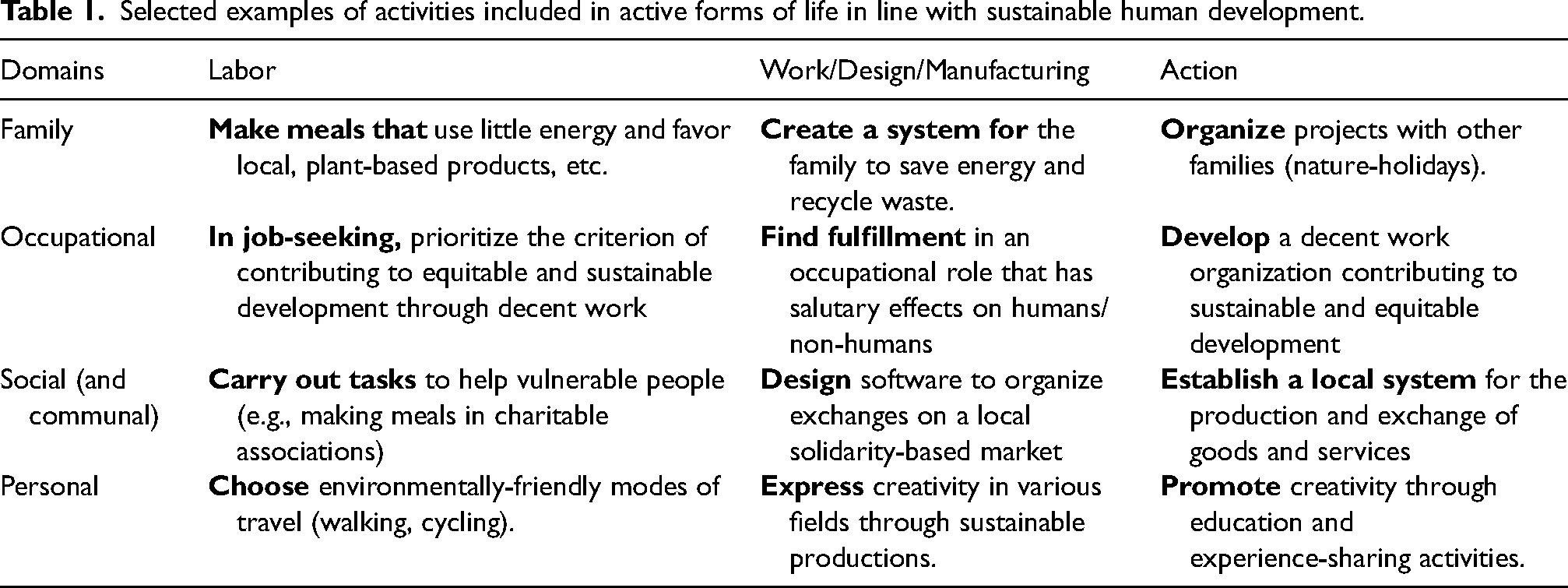
For counselors, helping to build active forms of life means encouraging individuals to reflect on and analyze everyday situations (Goffman, 1974) and helping them to change their lifestyle habits. According to Ricoeur (2009), the domain of habit corresponds to “an acquired and relatively stable way of feeling, perceiving, acting and thinking: it affects all the aims of consciousness without being itself an aim” (p. 353). The aim is to question our daily life in all its dimensions.
Resonance to drive projection towards active forms of life
Rosa (2019) has proposed the concept of resonance, where something is set in vibration, and the concept of acceleration, which he links to alienation we experience in late modernity. Our experience of the world is always an amalgam of body and senses. It could or should arise through a direct bodily relationship, but for Rosa (2019), relationships to the worlds of late modern subjects are no longer, for the most part, immediately bodily, but rather mediated by language, books, screens and music. Relationships with the world are therefore just as much the result of cultural visions of the world and social practices as of individual physical and psychological dispositions. These mediators of world experience can generate “cold, silent and poor” alienating world relations. Furthermore, for Rosa (2019), in the state of alienation, our own voice and/or the voice of the other person tends to become inaudible or no longer tell us anything—the subject and the world stand frozen in a silent face-to-face.
The search for resonance can therefore be seen as a path of transformation and an individual and collective solution to the current alienation induced by the Anthropo-Capitalocene. More specifically, resonance is a person-environment relationship that can be experienced on three axes. Horizontal resonance (the social axis) emerges from intersubjectivity in the family, friendship, and political spheres. Diagonal resonance (or material resonance) is based on the relationship with inanimate objects and exists in the spheres of work, school, sport, and consumption. Vertical resonance is transcendental and encompasses the spheres of nature, art, religion, and history. The three axes are intertwined and coalesce to form an experiential space which is a locus of various relationships with the world, Among those, resonance is the type of relation that, according to Rosa (2019), results in a “good life.” Thus, resonance can be seen as a way of actualizing active forms of life.
In practical career counseling settings, the foundations of everyday life can be examined with a view to modifying them in conjunction with active forms of life through certain methods informed by the life-design perspective.
Supporting the transformation into sustainable active forms of life: some methodological avenues
Reflecting on the transformation of forms of life involves two steps: firstly, analyzing one's current form of life, and secondly, imagining an active form of life in which one would like to engage. A form of life requires inquiry into the frameworks of daily action. Individuals must indeed identify the personal and social factors that govern their actions and practices (Ogien, 2018). This involves a deep and critical interrogation of one's mode of existence in the current context of the Anthropo-Capitalocene: … the imaginary of growth seems almost “constitutional” to us today; that is why consuming and working to produce are now seen as real civic duties and why a different philosophy (if deemed necessary) will require a profoundly different metaphysics and anthropology … inaugurating a truly existential critique of our involuntary but persistent complicity with growthism. (Arnsperger, 2023, p.156)
Facilitating narration/dialogue
Dialogue is an essential attitude for counselors that contributes to the construction of identity: “A person is three instances I-YOU-HE … a human being becomes someone, a person and therefore an I, only through the additional trial of what can be called HE” (Jacques, 1982, p. 72). Thus, personal identity is accomplished through the merging of these three positions in the act of communication, with self-experience being discursive before being existential. Dialogue helps to co-construct stories by inspiring the narration of experience, in which these three positions are integrated (McLeod, 2004). Any experience can be narrated in various ways and mobilize a diversity of voices (Hermans & Hermans-Konopka, 2010), following models that can be universal (McAdams, 1996). The counselor is both a witness and a co-editor of a new story. Their role is to help people to become the authors of their lives (McLeod, 2004; Savickas, 2009). In doing so, the counselor accompanies the verbalization of new experiences to make it possible for the individual to articulate them in a new form. As Buber (1937) elucidates, a man is faced by a form which desires to be made through him into a work (…) The man is concerned with an act of his being. If he carries it through, if he speaks the primary word (I-Thou) out of his being to the form which appears, then the effective power streams out, and the work arises (p. 9–10).
Inquiry/co-inquiry
Implementing an active form of life presupposes a change in the way we evaluate our previous way of living and thinking. Individuals must ask themselves what gives value to their activities and their lives.
For Dewey (2011), values bring together desires and interests and are central to the course of action: The continuity of human, individual and collective activities means that we cannot validly establish the importance of present valuations without placing them in the perspective of past valuations with which they are in continuity. Without this view, the future perspective—the consequences of the new current valuations—remains undefined. (p.158)
Supporting and co-constructing collective actions and projects
Another method is to design, with the counselor, projects for involvement in new collective actions. As Ogien (2018) points out, in collective action, the individual discovers other forms of life. Counselors arrange “the identification and planning activity that helps individuals involved in joint action to take steps toward the completion of the action and the opportunities that each action opens up to ensure its continuity” (p. 140). Collective action makes it possible to organize “agentive configurations,” defined as sets of individuals’ abilities, to exhibit creativity in artistic, poetic, or political expression, as a platform from which the individuals can organize and transform the environment around them (Pitrou, 2018).
This activity helps to combat isolation, promotes social relationships, and also nurtures skill development. Philosophical conversations are an opportunity for individuals’ moral education, as they cultivate empathy, reflexivity, and logical reasoning. Exchanges can take place in a context of participatory workshops with inputs of knowledge and discussion (e.g., on the climate crisis as in the Climate Fresk 10 ). These events develop debating and listening skills, and help people to become moral thinkers, attentive and competent interlocutors (Noddings, 2002).
Experimenting and opening up resonance
Interventions supporting the design of active life may also be devised to draw people's attention to certain axes of resonance. They can encourage individuals to explore and consider these axes in shaping their future and preparing the contribution they want to make to humanity and the world. As Lijster and Celikates (2019) explain, experiencing resonance provides a new perception of self and the world: “When you really experience resonance, the time horizon rather widens … it extends; it is the co-presence of the past and the future. Once you are in resonance with something it is like the past speaks to you and through you into the future” (p. 74). More than building “artificial” resonance situations, life-design counseling situations aim to make resonance available and active as an adaptive resource to develop. In Rosa's description (2019), this resonance relationship depends on two complementary movements: (1) openness to the world, that is, a willingness and an invitation to hear the world and be affected by its call (emotional, cognitive and physical); and (2) the power to act, experience self-efficacy and recognize one's activity in the world. These two movements are at play in the active construction of forms of life. Consequently, life design interventions themselves represent, as it were, a unique social resonance relationship in which a support-seeker is touched and transformed (Kargulowa, 2023).
Speaking up for people: advocacy
Advocacy in counseling was emphasized as a necessity for the profession by the American Counseling Association in 1999 (Lewis & Bradley, 2000). While advocacy is generally understood as standing up for the profession (Schiersmann et al., 2012), in our paper the focus is on client advocacy. In Toporek's (1999) definition advocacy is “action taken by a counseling professional to facilitate the removal of external and institutional barriers to clients’ well-being” (p. 2). This does not mean that people cannot defend themselves, but rather that counselors may have access to social, economic, or political levers that are out of reach for individuals. In Toporek's (1999) view, to be effective, the counselor must become involved in the person's environment in order to help them to identify and overcome all sources of difficulty. This also means that counselors engage in social action and participate in the socio-political context as activists to facilitate the elimination of sources of oppression and inequality.
Conclusion
From this perspective, the purpose of career counseling—and more generally of any intervention that supports people when they design their active lives—is to assist them in their interrogation, on one hand, of the value criteria of activities and social practices in their lived world, and on the other hand, of their own existential purposes in the light of the objective criteria of the needs and limits of the Earth system. New forms of active life must consist of activities, social practices, ideas, and meanings geared to the preservation of this system. This perspective appears in line with the sustainable development as a fourth paradigm for careers interventions in the XXI century based on “respect for nature as a whole (animals, plants, and the planet) incorporating future generations and future life on the Earth” (Hartung & Di Fabio, 2024, p. 207).
The climate crisis, which is also a societal crisis, has exposed, and more than anything before, too, the extent of socio-economic inequalities. This must mobilize all practitioners in the field of support for the construction of active lives. The multifaceted crisis calls for a rethinking of the skill set of counselors, who must commit more strongly to social justice and the fight against inequalities. The concept of forms of life offers a broad perspective on the ways of being, thinking, and acting of individuals and reflects a certain type of relationship to self, others, and the world (Guichard, 2022a). This concept breaks with the siloed approaches that separate psychological and social processes, and are still all too often adopted in career development interventions. The form-of-life approach provokes reflection on the principles of action defined here. The four methodological avenues we delineate are likely to advance the emergence of active forms of life, that is, sustainable forms of life that accommodate the needs of survival, achievement, and collective action. They should result in the production of a repertoire of new practices for strengthening the role of career practitioners as social and political actors.
Footnotes
Declaration of conflicting interests
The authors declared no potential conflicts of interest with respect to the research, authorship, and/or publication of this article.
Funding
They received no financial support for the publication of this article.
The article is in line with the TRUST code, a global code of conduct for equitable research partnerships.
