



Abstract
This study used a short-term longitudinal design to test the social-cognitive model of career self-management's (CSM) theorized pathway in which exploratory actions mediate the association between career exploration self-efficacy and decisional outcomes. The study clarifies the role of exploratory actions in the decision-making process by distinguishing between self-exploration and environmental exploration. College students (N = 136; 77% female; mean age = 18.71 years [SD = 1.19]; 47% with undeclared majors) completed an online survey assessing self-efficacy for self-appraisal and self-efficacy for obtaining occupational information. A month later, they reported the frequency of their engagement in self-exploratory and environment-exploratory actions over the past month and completed measures of two decisional outcomes reflecting readiness to make career decisions (vocational identity and need for additional occupational information). The CSM's mediational pathway was supported with respect to self-exploration but not environmental exploration. I discuss implications for the CSM model and for career-development interventions.
Keywords
Helping students gain clarity about their career goals and make decisions about their future work is an important function of counselors, advisors, and other career-development professionals (Career Industry Council of Australia, 2019; Department of Education and Training, 2019; O’Reilly et al., 2020). Theories of career choice and development (e.g., Dawis & Lofquist, 1984; Holland, 1997; Super et al., 1996) suggest students are in the best position to make career-related decisions when they have insight into their own characteristics, have a good familiarity with the world of the work, and can integrate the two to arrive at a good match. Accordingly, career exploration—activities a person undertakes to acquire information that helps them choose, prepare for, enter, and progress in a career (Jordaan, 1963)—is viewed as an integral part of effective career decision-making. The current study's purpose is to clarify the role of career exploration in preparing college students to be ready to make career decisions, with the hope that this clarification can guide the development of more effective career interventions.
Career self-management mediational pathway involving career exploration
The social-cognitive model of career self-management (CSM; Lent & Brown, 2013) explicates processes that underlie people's career decision-making. Career exploratory actions are at the heart of the model because having adequate information about oneself and the world of work is of critical importance when evaluating options and narrowing one's choices. Because people are more likely to initiate and persist in behaviors when they have a sense of competence and confidence for engaging in them (Bandura, 1997), in the CSM model self-efficacy is a predictor of career-exploratory actions. In fact, the association between career decision-making self-efficacy and career exploratory actions is well-established with both cross-sectional and longitudinal data (Chiesa et al., 2016; Jiang et al., 2019; Lent et al., 2019; Pérez-López et al., 2019; Rogers & Creed, 2011).
Exploration is typically not viewed as an inherently valuable outcome in and of itself. Rather, it is important from a process standpoint because it can reduce problems that result from inadequate or inconsistent information (Xu et al., 2014). The CSM model positions exploratory actions as a direct determinant of decisional outcomes (i.e., career decision-making status or readiness to make decisions). The benefits of exploration are supported by some studies that have found it to relate to vocational identity (Praskova et al., 2015), career-related distress (Praskova et al., 2015), job-search efforts (Stumpf et al., 1984), career decidedness (Lent et al., 2019; Pérez-López et al., 2019), and career-choice congruence (Grotevant et al., 1986). However, other studies (e.g., Cheung & Arnold, 2014; Lent et al., 2019; Rogers et al., 2018) have failed to support the link between career exploratory actions and various decisional outcomes, so our understanding of career exploration's role in promoting students’ readiness to make career decisions remains a bit murky.
While acknowledging that self-efficacy likely exerts some direct influence on the decisional outcomes, the CSM model frames exploratory actions as a lynchpin in the career decision-making process, as they mediate the link between self-efficacy and decisional outcomes. To date, two studies have assessed self-efficacy, exploratory actions, and decisional outcomes in a manner consistent with that hypothesized mediational pathway. Whereas support for the pathway was obtained in Pérez-López et al.'s (2019) test of the model with business students’ entrepreneurial decision-making, the model was only partially supported in Lent et al.'s (2019) longitudinal study with a general student sample.
One potential explanation for the inconsistent findings in tests of the CSM model's pathway involving exploratory actions is that all the existing studies have treated career exploration as a single construct and have not distinguished between types of career exploratory actions. Holding a magnifying lens to the CSM pathway and seeing how it fits fficients presented in two different types of career exploration could help clarify the nature of the relations among its constructs.
Types of career exploration
Career exploration is commonly conceptualized as comprising two dimensions (Jiang et al., 2019; Jordaan, 1963; Stumpf et al., 1983). Self-exploration (SE) involves reflecting on one's own abilities, personality, values, and interests to form a clear vocational identity (Flum & Blustein, 2000). Activities typical of SE include reflecting on one's past experiences and decisions, exploring aspects of the self via formal assessments or discussions with a counselor, asking others for feedback about one's strengths and weaknesses, or keeping a log of one's vocational fantasies (Atkinson & Murrell, 1988). In contrast, environmental exploration (EE) involves activities that promote an understanding of the world of work. Such activities include discussing careers with others, using information resources to learn about job requirements and rewards, or engaging in job shadowing (Atkinson & Murrell, 1988).
SE and EE are moderately positively correlated (Cheung & Arnold, 2014; Zikic & Klehe, 2006), and in research they have often been assessed by aggregating SE and EE scores into a composite or using measures that do not distinguish between the two forms of exploration. There is, however, reason to question the practice of treating these forms of exploration as a single construct (Jiang et al., 2019). Studies treating SE and EE scores as separate constructs have revealed the two forms of exploration sometimes have different associations with other variables. For example, SE, but not EE, has been shown to relate to general self-efficacy (Zikic & Klehe, 2006). Other research showed EE has a stronger association than SE with college students’ perceptions of the amount of career information they possess (Cheung & Arnold, 2014) and with college seniors’ job-search intensity and initial pay (Werbel, 2000). Finally, Xu et al. (2014) found that whereas both SE and EE were associated with some career-indecision indices, only SE was associated with indecision stemming from perceived inconsistent career information.
The differential associations of SE and EE with other variables led Jiang et al. (2019) to argue for treating SE and EE in research and practice as separate, though related, constructs. The CSM model does not make different predictions for SE versus EE, but as with other social-cognitive research (Lent et al., 1994), the CSM model's constructs are conceived as domain-specific (Lent & Brown, 2013). In this way, it is possible to consider that the CSM-posited efficacy-exploration-outcome pathway operates in a parallel way for SE and EE, but it need not be assumed that the two forms of exploration necessarily occur simultaneously. For example, SE could occur early in students’ academic careers as they are making initial decisions about fields of study, but advanced students might engage in more intentional EE as they seek jobs and internships (Blustein & Phillips, 1988). The two forms of exploration could lead to different domain-specific outcomes as well.
To date, no known studies have distinguished between SE and EE when testing the CSM model's mediational pathway. Thus, we do not know if the two forms of exploration operate similarly in determining outcomes that are important in college students’ career development. If the two forms of exploration have different associations with their antecedents or outcomes, that might help explain why previous studies of career exploration's role in career decision-making (e.g., Cheung & Arnold, 2014; Lent et al., 2019; Rogers et al., 2018) have sometimes yielded inconsistent findings. Additionally, if the two forms of exploration are found to operate differently within the CSM framework, it would provide information that is useful when designing career interventions. The development of effective career interventions is predicated on an accurate understanding of the processes that underlie career decision-making, so examining the CSM pathway in a more nuanced fashion by distinguishing between SE and EE could potentially yield useful information for practice. Because no prior research has disentangled SE from EE in examinations of the CSM model's mediational pathway involving career exploration, the current study addresses an important literature gap by considering SE and EE as potentially distinct processes.
The current study's hypotheses
I examined the CSM model's hypothesized efficacy-exploration-outcome mediational pathway for SE and EE separately. College students completed measures of self-efficacy at Time 1 (T1). One month later, they reported the frequency with which they had engaged in exploratory actions over that past month (Time 2 [T2]– retrospective report). They also completed outcome measures reflecting the two decisional outcome variables of vocational identity and need for additional career information (Time 2 [T2] – current). In keeping with the CSM model's domain specificity, the measures for constructs in each pathway were reflective of either SE or EE. Thus, unlike previous tests of the CSM pathway, the current study's analyses disentangle SE from EE.
With respect to SE, I expected that self-efficacy for engaging in self-appraisal would be positively associated with the frequency of subsequent SE actions. This positive association would be expected because those with greater efficacy for engaging in self-appraisal should be more likely to initiate self-reflective actions and persist with them even if they face difficulties during the process (Bandura, 1997; Lent & Brown, 2013). In turn, I expected the SE actions to be associated with students’ vocational identity—the degree to which they hold a clear and stable understanding of their own interests, abilities, values, and other career-relevant characteristics (Holland et al., 1980). Engaging frequently and thoroughly in self-reflective actions should help students draw conclusions about their tendencies and characteristics, thereby allowing them to form an overall vocational identity (Holland, 1997). As per the CSM, I expected that the frequency of SE actions would partially mediate the relation between self-appraisal self-efficacy and vocational identity but that efficacy would also have a direct effect on identity as well. This is because students’ confidence in their ability to engage in accurate self-appraisal will likely lead them to feel that they have a solid basis for the conclusions they have drawn about their career-related interests, abilities, and values (Holland, 1997). Thus, the study's first hypothesis was as follows:
Hypothesis 1: SE actions will partially mediate the association between self-appraisal self-efficacy and vocational identity.
With respect to EE, I expected that self-efficacy for obtaining occupational information would relate to students’ later EE actions which, in turn, would be associated with their perceived need for additional occupational information. Those who feel confident in their ability to gather occupational information should theoretically be more likely to initiate the search for such information and persist in seeking the information even if it is challenging (Bandura, 1997; Lent & Brown, 2013), so I expected that the association between self-efficacy and EE actions would be positive. Engaging in EE actions is likely to yield information that students need when making career decisions, so such actions should eventually decrease the perceived need for additional occupational information (Holland, 1997). Accordingly, I expected that the association between EE actions and the need for occupational information would be negative. Again, consistent with the CSM model, I expected the exploratory actions’ mediation to be partial. Students with high self-efficacy for obtaining career information likely perceive less need for additional information because they feel confident in their ability to gather information if the need arises (Bandura, 1997). Those with lower self-efficacy may doubt their ability to locate information when the need arises, so they perceive a need to have as much information in hand as is possible. Thus, the study's second hypothesis was as follows:
Hypothesis 2: SE actions will partially mediate the association between self-appraisal self-efficacy and vocational identity.
Method
Participants and procedure
After obtaining approval from its Institutional Review Board, I recruited participants from a large, public, university in the midwestern United States. Students were identified via the psychology department participant pool, which is open to students of all majors who are taking psychology courses. Career exploration is ideally studied among people who have reason to engage in exploratory actions (Cheung & Arnold, 2014). Given this study's short Time 1 (T1)-Time 2 (T2) interval, it was important to sample students who might have reason to engage in career exploratory actions in the immediate future. External pressure, such as the need to declare a major, can prompt students’ active engagement in career-related exploration (Blustein, 1992; Lent et al., 2019), so I attempted to oversample students who were not yet fully committed to a major by indicating in the study's sign-up instructions that eligible participants needed either to be first-year students or undecided about their majors. They also needed to be at least 18 years old to provide informed consent for research participation. There were no additional inclusionary or exclusionary criteria for the study. Students were assured that participation in the study was voluntary and that their responses would be kept confidential.
Three hundred ninety-eight students received extra course credit by completing the T1 online survey. At the end of the survey, students provided their university e-mail addresses if they were willing to be contacted for a follow-up survey for additional credit. An invitation to complete the T2 survey was sent 4 weeks after the students had completed the T1 survey. The T1 and T2 data were linked using students’ university login identifications, which they were required to enter when accessing the surveys. The study's 4-week T1-T2 interval helps to minimize the risk of common method bias but is not so long as to be likely to introduce history effects that would complicate the interpretation of the findings.
The 136 students with complete data ranged in age from 18 to 23 years (M = 18.71, SD = 1.19). The majority (105; 77%) were women; 31 (23%) identified as men. The sample included participants who identified as White/European American (n = 103; 76%), Black/African American (n = 17; 13%), Hispanic/Latinx American (n = 8; 6%), Asian/Asian American (n = 4; 3%), or “other” race/ethnicity (n = 4; 3%). There were 110 (81%) first-, 17 (13%) second-, and 9 (7%) third-year students. Sixty-four (47%) had an undeclared major.
Measures
Career exploration self-efficacy
The Career Decision-Making Self-Efficacy Scale - Short Form's (CDMSES-SF; Betz et al., 1996) 25 items, which are equally distributed across five subscales, assess beliefs about one's ability to complete tasks involved in making career decisions: engaging in accurate self-appraisal, gathering occupational information, engaging in goal selection, planning for the future, and engaging in problem-solving. For this study, I used the self-appraisal and occupational information subscales to reflect students’ self-efficacy for engaging in SE and EE, respectively. The self-appraisal subscale includes items such as, “Determine what your ideal job would be,” and “Accurately assess your abilities,” whereas the occupational information subscale includes such items as, “Find out the employment trends for an occupation over the next ten years,” and “Find information about graduate or professional schools.” Respondents rate each item using a 5-point Likert-type response scale (1 = no confidence at all; 5 = complete confidence). Averaging responses from each subscale's five items yields subscale scores. In previous research, the internal consistency estimates for the self-appraisal and occupational information subscales were .73 and .78 (Betz et al., 1996); in the current study, the Cronbach's alpha coefficients were .74 and .66. The CDMSES-SF scores’ validity is supported by findings that they relate in expected ways to vocational indecision, locus of control, and occupational self-efficacy (Betz et al., 1996).
Career exploratory actions
The Career Exploration Survey (CES; Stumpf et al., 1983) was developed to “index career-search behaviors, reactions to exploration, and beliefs about exploration” (Stumpf et al., 1983, p. 192). For this study, students completed the CES's five-item SE subscale and six-item EE subscale. Each item uses a 5-point Likert-type scale (1 = very little; 5 = very much) to assess the degree to which an individual has engaged in that form of career exploration, and subscale scores are created by averaging the responses to the items. In the original CES respondents rate their behavior from the past 3 months, but for this study, the instructions asked students to rate how often they had engaged in those forms of exploration over the past month (the period of time since the T1 survey). The SE subscale includes items such as, “Understood a new relevance of past behavior for my future career,” and “Focused my thoughts on me as a person,” and the EE subscale includes such items as, “Obtained information on the labor market and general job opportunities in my career area,” and “Sought information on specific areas of career interest.” Previous research revealed alpha coefficients ranging from .88 to .83 for the SE and EE subscales (Stumpf et al., 1983); in this study, the SE and EE alpha coefficients were .77 and .83, respectively. The SE and EE subscale scores predict outcomes such as job interview behaviors (Stumpf & Hartman, 1984) and vocational self-concept crystallization (Hamer & Bruch, 1997).
Decisional outcomes
I assessed the two decisional outcomes using Holland et al.'s (1980) My Vocational Situation (MVS) instrument. The Vocational Identity (VI) subscale assesses the degree to which students possess “a clear and stable picture of one's goals, interests, personality, and talents” (Holland et al., 1980, p. 1), and the Occupational Information (OI) items assess a need for career information. The VI score is calculated by summing responses to 18 true-false items (e.g., “If I had to make an occupational choice right now, I am afraid I would make a bad choice” [reverse scored]), with higher numbers reflecting greater vocational identity clarity. The OI score is calculated by summing responses to four yes-no items (e.g., “I need information on how to get the necessary training in my chosen career.”), with higher scores reflecting a greater need for information. Holland et al. (1980) reported Kuder-Richardson 20 (KR-20) reliability coefficients of .89 and .79 for college students on the MVS VI and OI subscales, respectively. In this study, the KR-20 reliability estimate for the VI scale was .91 and for the OI scale was .87. The MVS scores’ validity is supported by the finding that they distinguish adults seeking career counseling from general populations of students and adults in general (Lucas et al., 1988).
Data analysis
I conducted the study's analyses using IBM's Statistical Package for the Social Sciences (SPSS; version 25) and the Hayes (2022) PROCESS (version 4.2) macro. I first used chi-square analyses and independent samples t-tests to compare participants with and without T2 data on the demographic variables and on the T1 survey's measures. This allowed for an examination of the degree to which attrition may have resulted in a final sample that differed from the group of participants who began the study. I then computed the means and standard deviations for each measure and examined the intercorrelations among the measures’ scores to ensure that the relations among variables were in theoretically expected directions. Finally, I tested the CSM model's hypothesized mediational relationship for SE and EE separately using ordinary least squares regression-based path analysis (PROCESS Model 4). As shown in Figure 1, self-efficacy was the predictor, exploratory actions was the mediator, and vocational identity or need for occupational information was the decisional outcome variable. This data-analytic approach provides estimates of the relationships between self-efficacy and career exploratory actions (a path), career exploratory actions and decisional outcomes (b path), and self-efficacy and decisional outcomes (c’ path). The indirect effect is a × b, the direct effect is c’, and the total effect (c) is the sum of a × b and c’. Bias-corrected 95% lower limit (LL) and upper limit (UL) confidence intervals were estimated from 5,000 bootstrap samples to test the significance of indirect effects. If the confidence interval for the indirect effect did not include 0, this was an indication that the indirect effect was significant at p = .05 (Hayes, 2022). To reduce bias in the estimates of other parameters, I included age and gender as covariates in the regression analyses.
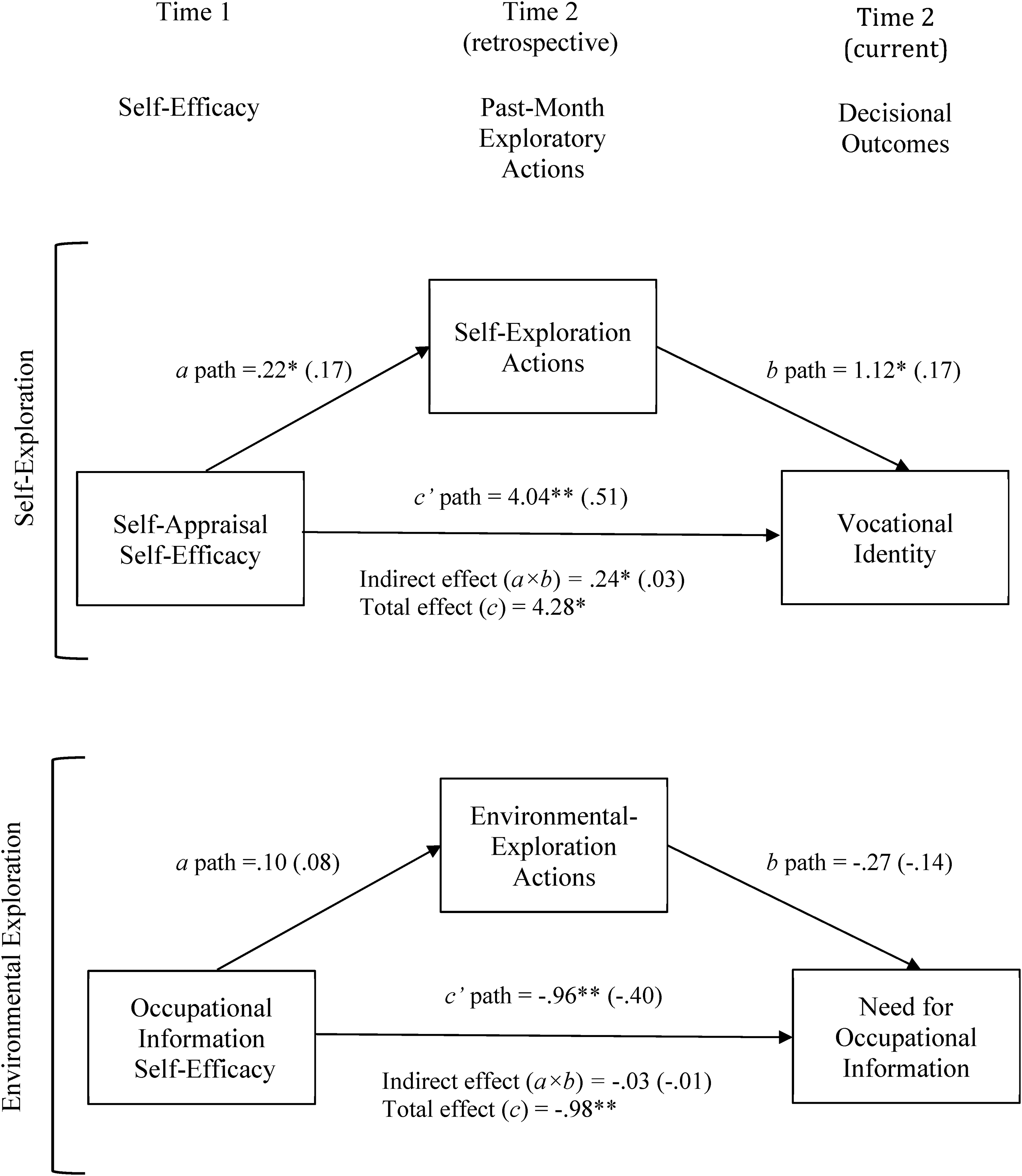
Unstandardized coefficients from the tests of the career self-management model's mediational pathway for self-exploratory and environmental exploratory actions (standardized coefficients in parentheses).
Results
Chi-square analyses revealed that participants with and without T2 data did not differ significantly in terms of gender and race (ps > .05). Likewise, an independent samples t-test showed that those with and without T2 data were not significantly different in terms of occupational information self-efficacy (p > .05). Those with T2 data (M = 18.71, SD = 1.19) were, however, significantly older than those who did not complete the T2 survey (M = 18.33, SD = 0.74), t(190) = 3.33, p = .001. Those participants with complete data (M = 3.69, SD = 0.69) also had significantly lower scores than those who only completed the T1 survey (M = 3.87, SD = 0.59) on the measure of self-appraisal self-efficacy, t(240) = 2.67, p = .008.
Table 1 shows the means, standard deviations, internal consistency estimates, and correlations among the study's measures’ scores. There were strong correlations between the parallel variables involved in SE and EE. At T1, students who felt confident in their ability to engage in self-appraisal also tended to feel confident in their ability to obtain occupational information (r = .80; p < .001). Students who at T2 reported engaging in frequent SE actions over the past month also tended to have engaged in frequent EE actions (r = .70, p < .001). With respect to the decisional outcomes assessed at T2, students with greater vocational identity clarity reported less need for additional occupational information (r = -.65; p < .001).
Means, standard deviations, reliability estimates, and intercorrelations among the measures.
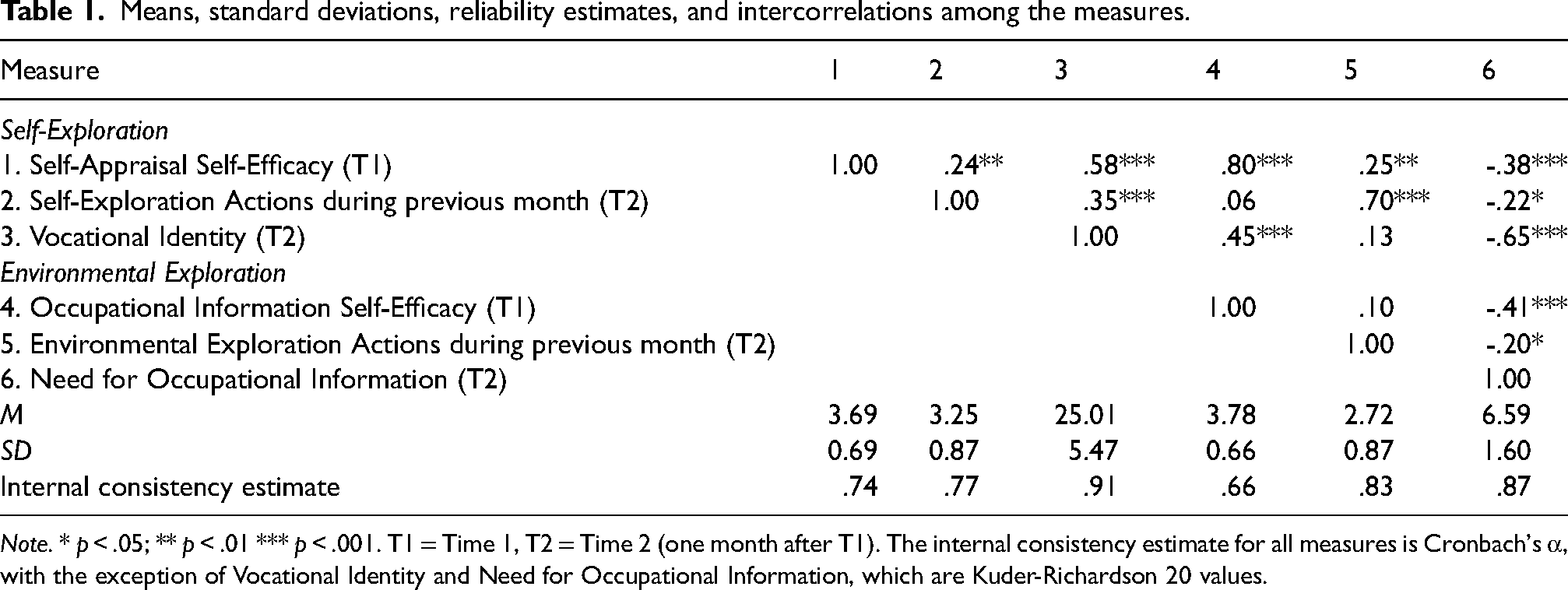
Note. * p < .05; ** p < .01 *** p < .001. T1 = Time 1, T2 = Time 2 (one month after T1). The internal consistency estimate for all measures is Cronbach's α, with the exception of Vocational Identity and Need for Occupational Information, which are Kuder-Richardson 20 values.
The coefficients presented in Figure 1 show that the CSM-based mediation hypothesis was supported with respect to self-exploration (note that gender and age were also included in the model but are not shown for the sake of simplicity). Self-efficacy for engaging in self-appraisal was positively associated with later SE actions, and the SE actions were associated with greater vocational identity clarity. The bootstrap analyses revealed that the indirect effect was significant, 95% CI [.001, .65]. While controlling for SE actions, self-appraisal self-efficacy remained a significant predictor of vocational identity, consistent with the CSM model's theorized partial mediation. Thus, the data supported the study's Hypothesis 1.
The CSM model was not, however, supported with respect to EE. Contrary to expectation, neither the association between occupational information self-efficacy and later EE actions nor the relation between EE actions and the perceived need for additional occupation was significant. The indirect effect was also not significant, 95% CI [-.11, .02]. While controlling for EE actions, occupational information self-efficacy remained a significant predictor of the need for occupational information. Thus, for EE, self-efficacy's link with students’ perceived need for additional occupation appeared to be primarily direct. This pattern of findings was largely not consistent with the CSM-based mediation hypothesis, and thus Hypothesis 2 was not supported.
Discussion
The purpose of this study was to examine the CSM-based hypothesis that career exploratory actions mediate the association between self-efficacy and decisional outcomes. Because existing research (Lent et al., 2019; Pérez-López et al., 2019) testing the CSM model did not distinguish between SE and EE, a novel contribution of the current study is that it yields information about the degree to which the model's associations hold for both types of exploration. Despite the parallel variables involved in SE and EE having strong associations with each other, the findings suggest the SE and EE processes are not necessarily identical. Whereas the CSM model's mediational pathway was supported with respect to SE, that was not the case for EE. This finding mirrors other research that has found SE and EE actions to function differently in relation to other constructs (Cheung & Arnold, 2014; Xu et al., 2014; Zikic & Klehe, 2006) and gives weight to the idea that it is valuable in research and practice contexts to treat the two forms of exploration as distinct rather than conflating them (Jiang et al., 2019).
In support of the CSM model and consistent with this study's Hypothesis 1, among the current sample students’ confidence in their ability to engage in self-appraisal was associated with the frequency of their SE actions over the next month. Those with greater confidence for engaging in self-reflection subsequently reported engaging in more exploration in the next month. Supporting the idea that exploration plays a role in constructing a sense of self (Flum & Blustein, 2000; Holland, 1997), students’ SE actions were, in turn, associated with the degree to which they perceived themselves as having a clearly defined vocational identity. Consistent with the CSM model, self-appraisal self-efficacy was linked to the clarity of students’ vocational identity both directly and indirectly via SE actions. Thus, the CSM model's mediational pathway appears to be a good representation of SE actions’ role in helping students develop a clear and stable sense of self.
In this sample, associations among the EE variables did not conform as well to the CSM's theoretical predictions. Hypothesis 2 was not supported, because the frequency of engaging in EE actions was not predicted by students’ earlier confidence in their ability to obtain occupational information. This finding is inconsistent with the CSM model and with prior research that has linked a variety of forms of self-efficacy to career exploratory actions (Chiesa et al., 2016; Lent et al., 2019; Pérez-López et al., 2019; Rogers & Creed, 2011). Moreover, the frequency of students’ EE actions over the previous month was not significantly related to their subsequent perceived need for additional occupational information. This finding is also inconsistent with the CSM model, although it is in line with some other previous research (e.g., Cheung & Arnold, 2014; Lent et al., 2019; Rogers et al., 2018) that failed to find support for a link between career exploratory actions and various decisional outcomes. This finding could suggest that students’ EE actions are not as productive as one would hope, or perhaps students perceive a need for information that is not attainable via exploration. For example, some students might futilely engage in environmental exploration seeking concrete answers to questions for which there are only subjective or inconclusive data. Finally, whereas this study did find evidence of a direct negative link between self-efficacy for obtaining occupational information and students’ later perceived need for additional information that was consistent with the CSM model, the CSM model's posited indirect relationship involving EE actions was not significant. Altogether, the lack of support for the CSM-based mediation hypothesis in the context of EE suggests that researchers and practitioners will need to revisit the understanding of the processes by which students come to feel they have obtained an adequate amount of occupational information.
Future research will be needed to reveal more about how the SE and EE processes differ in order to determine why the CSM model's pathway is not supported with respect to EE. Career exploration can be planned and purposeful (Jiang et al., 2019), but it can also occur via chance events as conceptualized by planned happenstance theory (Krumboltz, 2009). Perhaps SE and EE differ in their degree of intentionality, with EE requiring more purposeful effort. Outcome expectations and exploratory goals were not included in the current study but along with self-efficacy are other theorized predictors of exploratory actions in the CSM model. If EE does require more purposeful effort, then outcome expectations may play a more critical role in determining the frequency of EE actions because, regardless of their confidence in their ability to do so, students would only engage in the actions to the degree they believe the actions will produce beneficial outcomes. Alternatively, it is possible that students obtain some vocational information without engaging in purposeful environmental-exploratory actions. For example, they may be exposed to information about careers in major-related classes without necessarily seeking that information intentionally. If so, then this might result in their feeling as if they have adequate information without having engaged in exploratory actions. Either way, it would be useful in future research to examine purpose and intentionality as potential moderators of some CSM pathways.
SE and EE are probably recursive processes (Flum & Blustein, 2000), but they do not necessarily occur simultaneously and to the same degree. Accordingly, SE and EE could operate through similar pathways but do so on a different schedule. When students are early in the exploration process, as was the case with the current sample, EE may be less likely to occur because the sheer volume of information about the broad world of work is impractical to digest. Engaging in SE as a first step would help students narrow the scope of EE by determining a sector of the world of work that may be especially promising to explore in depth. Thus, even if they feel confident in their ability to obtain information about occupations, they may not attempt to do so until they have already engaged in sufficient SE. Perhaps the CSM model's efficacy-exploration-outcome pathway better accounts for the EE process that occurs later in students’ development after they have committed to a major and are faced with the need to make decisions about applying for internships and jobs. In other words, developmental stage might moderate the associations among some of the CSM pathways. Future research with students who are in different stages of career decision-making progress could determine if this is the case.
Practice implications
With the assumption that sound academic and career decisions are based on accurate information about the self and the world of work, counselors and educators often strive to promote students’ active and frequent engagement in career exploration activities. The current study's results suggest that any interventions striving to promote exploration may need to vary depending on whether the goal is to promote SE or EE.
If the goal is to promote SE, then interventions that boost self-efficacy for self-appraisal are worth considering because they have been shown to have large effects (Ozlem, 2019). Consistent with Bandura's (1997) theorized sources of self-efficacy, those interventions might involve helping students reflect on past insights about themselves that they gleaned through reflection (i.e., past performance accomplishments), citing evidence (e.g., Brown et al., 2003) that assessment tools such as interest inventories produce benefits (i.e., verbal persuasion), helping students connect with others who have gained insights through self-exploratory actions (i.e., vicarious learning), and helping remove emotional barriers, such as anxiety, that may interfere with self-appraisal efforts (i.e., physiological arousal). Engaging in community practice also appears to serve as a valuable source of career self-efficacy (Goodwin, 2019). Although the study's non-experimental data cannot confirm the relation is causal, the fairly strong association between SE actions and vocational identity is consistent with the idea that students may feel a greater sense of clarity regarding their personal characteristics and goals following a period of frequent SE actions stimulated by the efficacy-boosting interventions.
When the goal is to promote EE, it is less clear that self-efficacy-enhancing interventions will help. This study found self-efficacy for obtaining occupational information to be unrelated to EE actions but negatively associated with the perceived need for additional occupational information. Because students might be tempted to cut the exploration process short when there are environmental pressures (Lent et al., 2019), it seems prudent to ensure they have engaged in thorough EE actions prior to deciding they have no further need for occupational information (Soares et al., 2022). If future research confirms other CSM-model variables, such as outcome expectations and exploratory goals, as mediators in the link between self-efficacy and the need for occupational information, counselors and educators might need to use those, rather than self-efficacy-enhancing interventions, as mechanisms for promoting thorough EE actions. For example, counselors might help students recognize the drawbacks of settling on a major prior to learning about it thoroughly and the benefits (e.g., increased congruence; Grotevant et al., 1986) that stem from more exhaustive exploration efforts. Recent research (Şen Baz & Ulaş Kılıç, 2023) confirmed that outcome expectations partially mediate the association between self-efficacy and career decidedness, so this route does appear to hold promise. If students are relying on environmental information obtained passively, rather than through intentional exploratory actions, counselors could help them evaluate whether that information is sufficient and point to any gaps in the scope of information they have. A speculative possibility is that fostering curiosity rather than promoting self-efficacy could be a key to ensuring that students engage in thorough environmental exploration.
Limitations and future research directions
Several limitations of the current study could be addressed in future research. First, this study employed two data collection points. Although the mediator was assessed in terms of retrospective reports and the outcome was assessed in terms of current perceptions of decision-making status and needs, ideally three data points are necessary for testing mediation rigorously (Frazier et al., 2004).
Second, this study employed a one-month lag between the assessment of the predictor variables and the mediator and outcome variables. The short interval is informative, because students often seek assistance when there is external pressure to make a decision quickly. Thus, it is useful to know which efficacy-enhancing interventions yield benefits via increasing exploration in the short run. On the other hand, exploration is complex and may require more than a month to yield benefits. Lent et al. (2019) explored the longitudinal associations among the CSM model's variables using three- and four-month spans but suggested studying the associations with both shorter and longer intervals would be useful. Given the short spans of the current study and the Lent et al. (2019) study, future studies with follow-up intervals of a year or more would be beneficial. Research conducted over a lengthier interval would also permit an examination of the CSM model's theorized recursive relationships whereby decisional outcomes become sources of learning that affect future self-efficacy.
Third, it would be useful for future research to examine the study's hypotheses with larger and more diverse samples. The analyses could only be conducted among participants who had complete data, and attrition resulted in a final sample that was skewed in the direction of being older and lower in self-appraisal self-efficacy. It is unknown how these differences may have affected the CSM model relations. The proportion of men and non-White students was fairly small and does not permit a rigorous examination of whether demographic differences exist in the associations among the variables. By design the study also comprised students who were likely not yet firmly committed to a major. The homogeneity in terms of developmental stage helps reveal whether SE and EE processes operate similarly at a given point in development, but future research is needed to explore whether developmental stage moderates the relations in the efficacy-exploration-outcome pathway. Finally, although the study's sample comprised students with a wide variety of majors in addition to the undecided students, all the participants were enrolled in at least one psychology class. It is possible that students who choose to take psychology classes to fulfill general education requirements could differ from the general student population in terms of career-exploration tendencies. It will be important to replicate the study with students who have a wide variety of course-taking preferences.
Conclusion
The study's limitations notwithstanding, there are two key take-away conclusions. First, the CSM model's efficacy-exploration-outcome pathway seems to be a valid representation of the process that underlies vocational identity but may not account as well for how students reach a point where they feel they have adequate occupational information. Second, this CSM model pathway appears to have more veracity as applied to SE compared to EE, at least when students are still deciding on broad fields of study. Continuing to investigate SE and EE as separate processes would be useful, as it may shed additional light on how the two forms of exploration can be facilitated and how they contribute uniquely to decisional outcomes.
Footnotes
Declaration of conflicting interests
The author declared no potential conflicts of interest with respect to the research, authorship, and/or publication of this article.
Funding
The author received no financial support for the research, authorship, and/or publication of this article.
