



Abstract
This article provides a review of existing research on youth transitions within regional, remote and rural communities. Results were organised according to the Systems Theory Framework of Career Development, highlighting the importance of geographical location as an environmental influence within the career decision-making process. By deploying a scoping review methodology it was determined that educational institutions, the employment market, socioeconomic status and families are the most significant influences on the career decision-making processes for young people in regional, remote and rural communities. Future research in this area would involve an examination of these four areas.
Introduction
Young people, aged 15–21 in regional, remote and rural communities as defined by the Australian Statistical Geographical Standard (Australian Bureau of Statistics, 2022) in highly developed economies are more likely to experience unemployment and underemployment than their urban peers (Halsey, 2018). In addition to limited opportunities for employment (Dayaram et al., 2020), young people in regional, remote and rural areas often lack access to post-school training opportunities within their home communities. This is despite regional, remote and rural areas being a source of cultural capital and natural resources (Buikstra et al., 2010). Subsequently, young people in these geographic areas need to migrate to other towns and cities to gain qualifications that will assist in gaining employment. However, once a young person departs from a regional, remote or rural community to an urban setting, they are unlikely to return to their community of origin (Alston, 2004). The subsequent outcome of this departure is that communities often lose motivated and capable people from their workforce, resulting in a ‘brain drain’ that stifles economic growth and community development (Eliasson et al., 2015; Nelson, 2019).
A potential method for mitigating the number of people departing regional, remote and rural areas is the provision of career development services. Career development support provided to young people during educational transition periods seems to have a positive impact on employment prospects (Galliott et al., 2015; Ontiveros, 2020). Therefore, a need exists to examine what the influence of career development is on the career decision-making processes of young people in regional, remote and rural areas, specifically those who are considering migration for educational and employment opportunities. The purpose of this review is to evaluate the influences on the career decision-making processes of young people who are faced with the prospect of leaving their home communities. To facilitate this, the author utilises a Systems Theory perspective to examine the existing literature on post-school opportunities and outcomes in regional, remote and rural areas. The goal of this approach is to be able to develop a framework through which future research into this area could be undertaken.
Literature review
Career development
The study of career development in regional, remote and rural communities is of significant importance. It forms part of a post-modern approach to career development, with a significant shift in focus from ways in which the individual can find the ‘right career’, to where they can enter an environment where their self-concept can be actualised through work (Patton & McMahon, 2021). This shift of focus has become centred on the individual system within STF, as post-modern theories of career development such as vocational personality and career construction (Savickas, 2013) provide a pathway for the individual to navigate the other systems in a positive fashion. This is particularly important in regional, remote and rural contexts as the social and environmental systems play a significant role in enabling a young person to access further education and employment opportunities.
Systems Theory Framework of Career Development
Systems Theory exists across multiple disciplines, however Systems Theory Framework of Career Development is a distinct approach that is separate from existing systems theories within other disciplines. A Systems Theory approach enables an investigation of domains and sub-domains within a field, identifying the recursiveness of influences on an individual or domain. The Systems Theory of Career Development as promulgated by Patton and McMahon (2015) is centred on the notion that career decisions do not occur in isolation and instead are made in consideration of a wide range of factors. Due to the broad basis of these systems, Systems Theory Framework can incorporate a wide range of existing career theories by leveraging existing theories and contexts. Subsequently, Systems Theory is commonly referred to as Systems Theory Framework (STF) when incorporating a wide range of theories. The influences include the individual, social and environmental systems across time and chance.
The elements of STF are important to consider when examining the career decision-making processes of young people in regional, remote and rural areas as they demonstrate the complexity of the decisions faced by young people in the area. As Patton and McMahon (2015) noted, when geographic influences are considered the complexities of the individual system become magnified, due to the lack of access to resources that otherwise might be taken for granted.
The social system of STF refers to the social influences that interplay with the individual system and subsequently help shape the career decision-making process. The social system incorporates educational institutions, peers, family, media, community groups and the workplace (Patton & McMahon, 2021). The social system is important to consider as it can influence the self-concept of the individual within each influence of the individual system (Vondracek et al., 1983). However, the social system and individual system have a recursive relationship. Without the influence of the individual system, elements of the social system cannot be fully developed. For example, without key individuals, educational institutions will not have an impact on the skills and world of work knowledge within the individual system. Therefore, the link between the individual system and the social system needs to be seen as recursive in nature as opposed to linear.
The other system of influence of STF that requires examination is the environmental system. The environmental system accounts for influences on an individual beyond their immediate control. For example, an individual working in a rural community in the Northern Territory would have little control on political decisions made that impact their employment opportunities. With regard to this study, the most important environmental factor is geographical location. Geographical location is arguably the most underrated and examined element of STF (Patton & McMahon, 2021). The influence that geographical location has on the career decision-making process is impacted by other environmental influences such as the employment market, socioeconomic status, political decisions, historical trends and globalisation (Patton & McMahon, 2021). These influences, when considered in light of geographic location often result in young people in regional, remote and rural areas being deprived of the same educational and employment opportunities as their urban-based counterparts (Halsey, 2018).
Utilising STF enables a comprehensive approach when examining the career decision-making processes of young people in regional, remote and rural areas. By adopting this approach, diverse elements of a young person's life can be taken into consideration in addition to their geographical location. By assuming that geographic location has an influence on young people in regional, remote and rural areas, it is possible to examine other influences in detail. In turn, this examination supports an understanding of how young people in these communities are making career decisions, and from there, extrapolate how these decisions are impacting the communities they are based in. The authors used STF to guide the scoping review in terms of framing the research questions and then later the findings in terms of the three systems of influence. Specifically, the authors focussed on identifying influences related to the individual system, the social system and the environmental system, broadly defined.
To facilitate the review, the following questions formed the basis of the literature searches:
What are the influences that enable access to further education and employment for young people in regional, remote and rural communities? What are the influences that create barriers to further education and employment for young people in regional, remote and rural communities?
Methods
To guide this examination, the methodological framework for a scoping literature review as developed by Arksey and O’Malley (2005) was adopted, to give structure and a methodical approach that will enable replication. A scoping literature review is designed to provide a map of the existing literature in an area, as opposed to providing a clear answer to a well-defined question (Arksey & O’Malley, 2005). Hence, it allows for the literature to be perused with a view to garnering ‘the scope’ of research to date and assist in identifying gaps and providing validity for a proposed research project (see Figure 1).

Search terms.
The author assessed the titles and abstracts of the remaining articles for relevance to the topic of career development and employment in regional, remote and rural areas. The process is detailed in Table 1.
Inclusion and exclusion criteria.
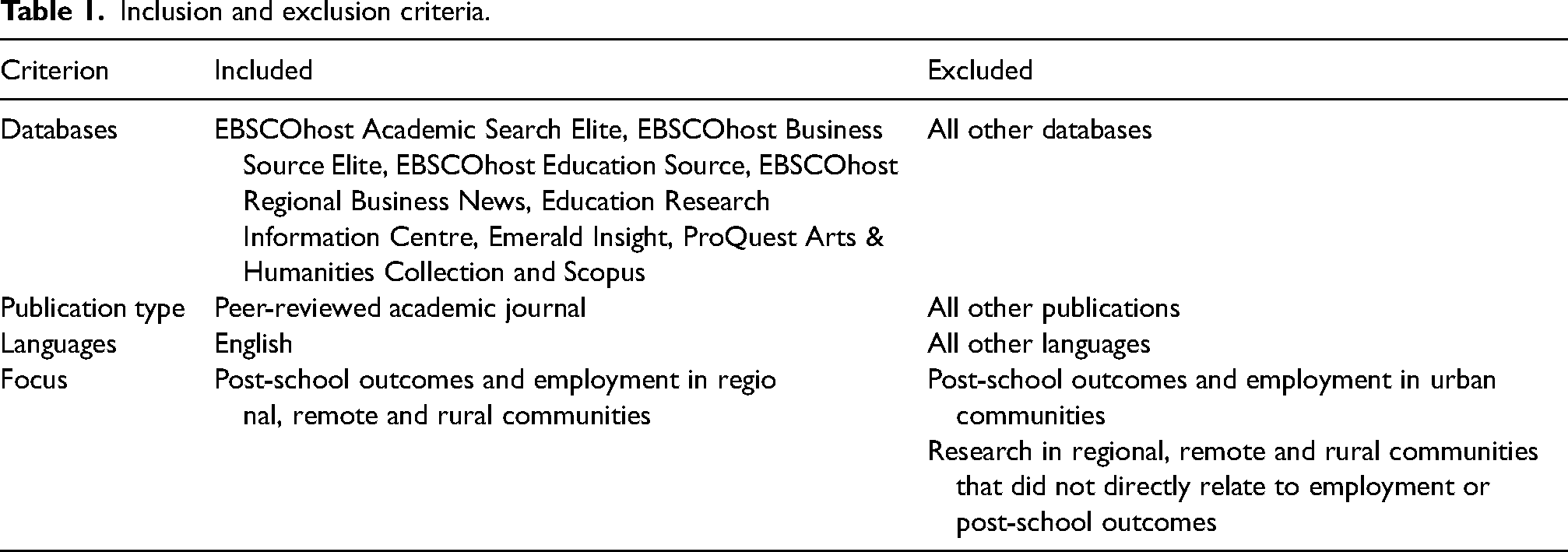
Given the broad scope of the topic, spanning across the Career Development, Economic and Employment fields, the author made several adjustments to the research terms to ensure that all relevant literature was brought into the study (Westphaln et al., 2021). These included terms such as ‘career development’, ‘access to higher education’ and ‘employment’ as ways of describing post-school outcomes. Further adjustments were made to the target group, with ‘post-school outcomes’ being divided into ‘communities’, ‘students’ and ‘youth’ to ensure the appropriate target group was addressed in the search. The result is a broad review of the literature in the discipline which can be analysed in broad ways across the career development and community development fields. This process is akin to Gore et al.'s (2017) scoping review of the participation of Indigenous Australians in higher education. As the focus of Gore's study is similar to the desired outcomes of this study, the author aligned the methods of research and analysis as closely as possible to ensure effective comparison between outcomes could be achieved. To ensure that all articles were directly relevant to the research question, the author only included articles that made explicit reference to regional, remote or rural communities. Following this, a reference list search of all included publications (n = 911) resulted in the identification of 126 new articles that met the inclusion criteria. The abstracts and titles of these articles were examined, resulting in 763 articles being excluded.
The author then conducted a manual search in all journals that yielded five or more articles in the initial search. The journals were the Australian and International Journal of Rural Education and the Journal of Vocational Behavior, which yielded no results. All articles that met the inclusion criteria were examined in their entirety, leading to the exclusion of 26 articles which focussed on experiences in countries with developing economies, as the outcomes of these studies would not be applicable due to the focus of the study being on countries with developed economies. This meant that 122 articles were included in the final review, as detailed in Figure 2.
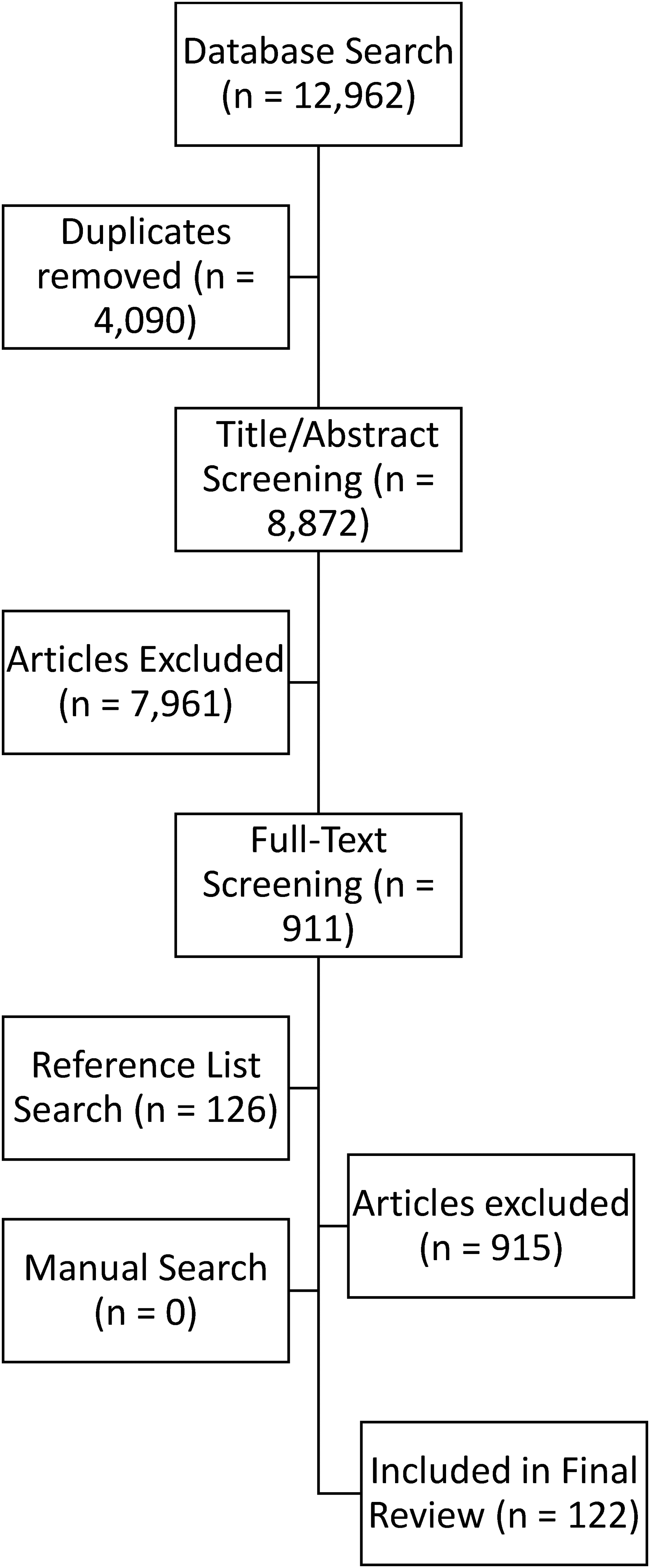
Process of scoping review.
Results
The results are organised into two sections. The descriptive overview provides a brief description of key trends within the articles, and the substantive overview identifies the four largest themes drawn from STF that the author interpreted from the articles examined. The emergent themes identified in the articles are detailed in Table 2.
Overview of substantive themes.

Descriptive overview
Rather than an article-by-article analysis, which is beyond the parameters of this review, the following is an illustrative review of the identified articles, followed by an over-arching review of their findings:
Year of publication. The review examined journal articles with the earliest published in 1977 (DeBord et al., 1977) and the most recent published in 2021. The majority of articles have been published since 2010 (n = 83), with 2012 and 2019 having the greatest number of publications (n = 12). Publication source. Publications were sourced exclusively from academic journals due to their peer-reviewed and rigorous nature. The Australian and International Journal of Rural Education (n = 7) and the Journal of Vocational Behaviour (n = 5). The journals Australian Educational Researcher, Australian Journal of Rural Health and Rural Sociology provided four articles each. The remaining journals offered no more than two articles each. Methodological approach. The predominant research method was quantitative analysis undertaken via surveys (n = 55), with qualitative analysis (n = 25) and case studies (n = 14) being significant research methods. Some articles focussed purely on providing an analysis of relevant government statistics (n = 11). Research locations. The majority of articles were generated from Australia (n = 41), United States (n = 34), China
1
(n = 12), United Kingdom (n = 8) and Canada (n = 5). Predominant individual system influences. Seventy-seven articles made explicit reference to an element of the individual system. The majority of these articles centred on ability (n = 13), self-concept (n = 12), interests (n = 11), skills and world of work knowledge (n = 10), ethnicity (n = 7), beliefs (n = 6), gender (n = 6), attributes, (n = 6), disability (n = 1) and values (n = 1). Health, sexual orientation, personality, age and physical attributes were not explicitly mentioned in the remaining articles. Predominant social system influences. Social system factors were explicitly mentioned in 78 articles. The majority were in educational institutions (n = 40), family (n = 22), peers (n = 7), community groups (n = 5), and workplace (n = 4). Media was not reported in any articles surveyed. Predominant environmental system factors. Environmental system factors were mentioned in 58 articles. The majority of these articles centred on the employment market (n = 26), socioeconomic status (n = 17), political decisions (n = 10), and historical trends (n = 4). Globalisation, along with time and chance, was not explicitly mentioned in any articles surveyed.
Substantive overview
Educational institutions (social sphere)
The predominant theme in the research analysed was the role that educational institutions play in providing opportunities for young people. There is a consensus that young people in regional, remote and rural communities face significant barriers in pursuing their careers. Educational institutions play a clear role in creating opportunities in career areas that are otherwise inaccessible without migration. Forty-one publications related to the role that educational institutions had in the decision-making process of young people. Out of these, higher education providers were the predominant institutions recorded (n = 19), followed by secondary schools (n = 15) and vocational education providers (n = 7).
This finding is important, as there is a correlation between concentration of university graduates and high economic growth (Pink-Harper, 2015). As regional, remote and rural communities are often concentrations of lower socioeconomic status, having a higher concentration of university graduates could be a method of improving economic activity (Pink-Harper, 2015). It is worth noting the correlation as opposed to causation. Lucas (2001) noted that applicants from low socioeconomic backgrounds, including regional, remote and rural applicants are up to 50% less likely to attend university than applicants from wealthy families (2001, p. 1676). Therefore, the argument can be made that specific university programs that enable applicants from regional, remote and rural communities to enter a study program are of vital importance.
From 2013 to 2020, six articles were published that examined the influence that university-specific programs can have in increasing entrance rates from regional, remote and rural communities (Cattle et al., 2013; Elliott & Link to external site, 2018; Goldman, 2019; Johns et al., 2016; Ohlson et al., 2020; Walton & Carrillo-Higueras, 2019). The suggestion that universities engage in a ‘rural hub’ model for core subject areas is theoretically feasible (Cattle et al., 2013, p. 107). In practice, it only works when explicit links are made to urban-based campuses through either face-to-face attendance or via distance education (Elliott & Link to external site, 2018; Johns et al., 2016; Mountford, 2011). A potential way forward is embedding university staff within secondary schools to enhance links between the school and the university (Ohlson et al., 2020). However, outreach programs run by tertiary institutions designed to encourage students to migrate to urban settings for university study were largely ineffective (Walton & Carrillo-Higueras, 2019). When considered in light of the findings from Lucas (2001), the potential reason for the failures of outreach programs could be the failure to address the socioeconomic disadvantage experienced by students in remote, rural and regional areas. The socioeconomic disadvantage inherent within regional, remote and rural communities would arguably need to be addressed on a large-scale basis in order for this to be fully actualised (Gale, 2011; Halsey, 2018).
Although universities have a role to play in providing post-school education and training for students in regional, remote and rural communities, it would be remiss not to make mention of secondary schools. Secondary schools provide the basis for human capital in these communities (Corbett & Tinkham, 2014), and thus they have an important role to play in preparing students for opportunities after graduation. Although part of the individual system, self-concept plays a role in the way in which a school influences the outcomes of its graduates (Mills, 2008). Therefore, it takes a concerted effort from the school and the broader community to challenge the status quo and encourage its students to engage in educational opportunities beyond the community. Several schools have undertaken a specific curriculum program designed to prepare students for university study and employment, with no observable difference in outcomes (Chappel, 2001; Emery et al., 2009; Herbst, 2020; Shogren et al., 2017; Woodroffe et al., 2017).
The elements of the secondary school experience that have the largest impact on university attendance are directly related to a dedicated career advisor/counsellor. The career advisor is uniquely placed to aid students in navigating the barriers to higher education. Subsequently, students who have access to dedicated career support in school report higher acceptance rates into university than their peers who lack access to these services (Ontiveros, 2020; Seward & Gaesser, 2018; Tian & Chen, 2018). However, it is not just in university acceptance that the career advisor has a significant role to play. Rather, schools with career advisors also have students who report less uncertainty with regard to employment opportunities (Galliott et al., 2015). Therefore, when considering the impact of the secondary school with regards to post-school outcomes it appears that having a dedicated career advisor is a significant influence.
Employment market (environmental sphere)
The second theme that was prominent in the research was the employment market (n = 26). All articles within the study focussed on community employment markets, with a specific focus on depressed labour markets (n = 7). Depressed labour markets in regional, remote and rural areas appear to inspire higher aspirations for post-school outcomes, as the desire to leave the depressed region increases (Morrison & Loeber, 2005). As local employment opportunities decrease, young people seek different methods to gain employment, and as a result interest in higher education increases (Dalley-Trim & Alloway, 2010; Morrison & Loeber, 2005) along with interest in migrating for employment (Culliney, 2014; Li & Que, 2016). Subsequently, the decision-making process leads young people towards migrating for higher education and employment when the local employment market is in a depressed state. However, in regional, remote and rural areas where the employment market is activated, young people are still finding it challenging to gain meaningful employment post-high school (Dayaram et al., 2020). In these communities, young people are likely to remain in the community in the hope of obtaining meaningful employment within their area, especially if they have obtained part-time employment during their high school years (McKechnie et al., 2005).
There is a slightly different trend identified for young people in remote areas, as reliable access to information and communication technology is limited, and subsequently digital literacy skills are lower, leading to reduced employment opportunities (Lindsay et al., 2005; McQuaid et al., 2004). As a result, employment markets in regional, remote and rural areas become centred on social capital with small to medium enterprises becoming the focus of employment activity (Matthews et al., 2009). These businesses are highly likely to provide on-the-job training for young people, despite what pre-existing qualifications the employee may have. As a result, the value of vocational education and training in these communities becomes diminished, as completing the qualification is not considered to be valuable by the employer, rather social capital becomes the primary method for gaining employment (Abbott-Chapman & Kilpatrick, 2001). Because of this trend, many young people in these areas will seek to enter the employment market by creating their own businesses (Wang & Yang, 2013). This places businesses in these communities in a vital situation for supporting the wellbeing of the community by maintaining the employment market either by employing local young people or by enabling young people to support themselves (Murray & Skarlind, 2005; Steiner & Atterton, 2014).
Employment markets also have a significant impact on the return rate of young people who had previously migrated out from the community for higher education and employment. People who have departed their communities are likely to return to the communities if viable employment opportunities exist (Eliasson et al., 2015; Nelson, 2019). The returning migrants are likely to carry larger social capital due to their experiences outside of the community (Nelson, 2019). Because they are able to leverage this capital, they are less likely to undertake entrepreneurial activities (Eliasson et al., 2015). However, when considering Pink-Harper's (2015) analysis of the impact that highly educated people have on economic activity, the potential exists that returning migrants are used by existing businesses to increase activity and productivity, thus leading to higher rates of employment.
Family (social sphere)
The family unit is an important aspect of a young person's life, as the establishment of a household narrative can have a significant impact on the mindset a young person takes into their decision-making process. This is reflected in the number of studies that examined family as an influence on young people's decision making (n = 22). Families who are zero or one-generation migrants into a community are more willing to encourage young people to undertake higher education in geographically different locations (Xiao, 2019). However, where families become entrenched in a community through several generations, there is less willingness to encourage migration for higher education and employment purposes (Xiao, 2019). Subsequently, parental influence becomes an important element. If parents are well-entrenched within a community, then there is a higher degree of belonging for the family in the geographic location, thus young people are often discouraged from migrating for higher education (Abbott-Chapman et al., 2014).
Even if a young person chooses to remain within a community, the influence of the parents is still important for ensuring a positive transition from school to either employment or further training locally (Phillips et al., 2002). If a parent maintains employment or a dedication to education throughout the young person's school life, the young person is more likely to follow that example (Conroy, 1997). However, parents can also provide encouragement for the child to have higher aspirations and encourage migration to ‘further’ the family or the child beyond what the parents were able to achieve (Conroy, 1997; Friesen & Purc-Stephenson, 2016; Xie & Postiglione, 2016).
Socioeconomic status (environmental sphere)
The fourth most predominant theme in the research was socioeconomic status (n = 17). This theme, although in the environmental sphere, was specifically deployed to the socioeconomic status of young people in regional, remote and rural areas. Two distinct strands are apparent from the literature. The first strand relates to the impact that low socioeconomic status has on the aspirations of young people with regard to university entrance (DeBord et al., 1977; Fahy et al., 2009; Rojewski, 1994; Thiele et al., 2017; Wilks & Wilson, 2012; Xiao, 2019). DeBord et al.'s examination of career aspirations for rural youth was conducted through a racial and gender lens (1977). The results are akin to Xiao's (2019) findings with regard to entrenchment, where young people hold higher aspirations if their parents are zero or first-generation migrants to an area. However, the more entrenched the family is, the less likely they are to consider relocating. Unlike Xiao, DeBord noted a financial element – that where families were further entrenched, young people were more likely to point to lack of financial capacity as the reason for not pursuing higher education outside of their community. Within an Australian context, Wilks and Wilson (2012) noted financial factors are a significant element for young people choosing not to aspire for university. This is highlighted in an example provided within Wilks and Wilson's research where a participant noted that their brother could not support himself after moving away for university due to the high cost of city living (2012, p. 86). Fahy et al. (2009) noted that financial factors were encouraging more young people living in regional, remote and rural areas to remain in their local communities, and technological advancements were helping reduce the financial cost of studying at university. Fahy et al. (2009) posit that if students choose to study via distance education locally, with adequate guidance, students can choose courses that not only match their interests but also match the needs of the community, thus improving retention for both the community and the course.
Socioeconomic status also has a direct impact on student experiences when studying at university. Students from regional, remote and rural areas report lower mental health, centred around feelings of inadequacy than their urban counterparts do (Liao & Wong, 2019), despite outperforming their urban peers academically (Liao et al., 2013). These feelings of inadequacy can be related back to the concept of social and cultural capital. Students from regional, remote and rural areas can compensate for their apparent lack of social and cultural capital through improved academic effort and achievement early in their university careers (Xiaoliang, 2019), which may explain the phenomenon noted by Liao et al. with regard to academic achievement (Liao et al., 2013). Students from regional, remote and rural communities reported an increase in social and cultural capital during the search and application process (Nelson, 2016). When combined with financial considerations, highlighting the number of students from low socioeconomic backgrounds who work to support themselves during their study (Ramos et al., 2021), the potential exists that students from regional, remote and rural areas are able to rapidly build social capital due to their experience and resilience that is developed because of their low socioeconomic upbringing.
Discussion
The questions that informed the scoping review were:
What are the influences that enable access to further education and employment for young people in regional, remote and rural communities? What are the influences that create barriers to further education and employment for young people in regional, remote and rural communities?
These questions have been partially addressed in the literature found in the scoping review. The influences that enable access to further education and employment for young people in regional, remote and rural communities seem to be predominantly centred within the social sphere, with educational institutions and family having the most significant influence. Educational institutions and families have an inspirational and encouraging influence on young people accessing further education and employment (Mills, 2008). This is due to the influence that they have on the self-concept and world of work knowledge within the individual sphere. It appears that with appropriate influence from a career development practitioner, young people in regional, remote and rural communities can overcome potential barriers to access. However, further research is needed to confirm a causation between career development practitioners in educational institutions and individual self-concept.
The barriers that inhibit access to further education and employment can be found in the environmental sphere. Specifically, socioeconomic status and employment market both establish barriers for young people in regional, remote and rural communities from accessing further education and employment. Young people from lower socioeconomic status backgrounds are less likely to feel confident in their ability to finance their studies, as well as experience reduced social and cultural capital in a higher education setting. Employment markets also have a significant influence on the career decisions of young people in regional, remote and rural communities. A suppressed employment market will encourage young people to migrate in search of further opportunities; however, an active employment market will encourage young people to stay in their home communities. An area for further research is examining how young people from low socioeconomic backgrounds respond when faced with a suppressed employment market. The potential exists that they will lack the financial resources to migrate and subsequently experience negative social outcomes as a result of not being able to find employment.
Conclusion
To date, research examining the impact of career decisions by young people in regional, remote and rural areas has been centred on the impact that educational institutions, the employment market, family and socioeconomic status have on post-school outcomes. The impacts of these studies demonstrate that the career decision-making process of young people in these communities is complex, especially given the connection between career identity and geographical locations (McIlveen et al., 2022). Barriers to accessing higher education and employment are related to geographic isolation, financial concerns, lack of social and cultural capital as well as individual factors such as self-concept and appropriate world of work knowledge.
These factors can be addressed through educational institutions such as universities and secondary schools providing adequate career guidance that takes into consideration the students’ individual situation (Ontiveros, 2020; Seward & Gaesser, 2018; Tian & Chen, 2018). However, this potential method has not been addressed in a significant form, rather, the discovery of this link has been made as part of broader studies. No dedicated study was discovered in this scoping review that explicitly examined the link between career guidance, student decision making and subsequent employment outcomes in regional, remote and rural areas. Examining this link in a mixed methods study centred on several geographically diverse areas could provide results that highlight the importance of career guidance to broader communities.
Supplemental Material
sj-docx-1-acd-10.1177_10384162241258275 - Supplemental material for The relationship between living in regional, remote and rural areas and post-school outcomes: A scoping review
Supplemental material, sj-docx-1-acd-10.1177_10384162241258275 for The relationship between living in regional, remote and rural areas and post-school outcomes: A scoping review by Ben Archer, Kerry Russo, Jonathan Woodend and Josephine Pryce in Australian Journal of Career Development
Footnotes
Author contribution
Ben Archer contributed to conceptualisation, formal analysis, investigations, and writing – original draft and review. Kerry Russo contributed to conceptualisation, writing – editing, and supervision. Jonathon Woodend contributed to conceptualisation, writing – editing, and supervision. Josephine Pryce contributed to conceptualisation, writing – editing, and supervision.
Declaration of conflicting interests
The authors declared no potential conflicts of interest with respect to the research, authorship, and/or publication of this article.
Funding
The authors disclosed receipt of the following financial support for the research, authorship, and/or publication of this article: This work was supported by the Australian Government Research Training Program Scholarship of which the RTP Fee Offset is a component.
Australian Government (grant number Research Training Program).

Supplemental material
Supplemental material for this article is available online.
Notes
References
Supplementary Material
Please find the following supplemental material available below.
For Open Access articles published under a Creative Commons License, all supplemental material carries the same license as the article it is associated with.
For non-Open Access articles published, all supplemental material carries a non-exclusive license, and permission requests for re-use of supplemental material or any part of supplemental material shall be sent directly to the copyright owner as specified in the copyright notice associated with the article.
