




Abstract
Drawing on the Psychology of Working Theory, the aim of this study is to assess the relationship between decent work, work needs’ satisfaction and entrepreneurial intentions in Burkina Faso, Switzerland, and Togo. We also test the applicability of the model of entrepreneurial intentions in these countries. Using a sample of 1,829 individuals we conducted structural equation modeling and multigroup analyses. Our results show that the model of entrepreneurial intentions is applicable in West Africa and Switzerland, and that it seems that perceived control and attitudes towards entrepreneurship are particularly important for entrepreneurial intentions. In all three countries, decent work contributes to the satisfaction of survival, social connectedness, and self-determination needs. Decent work and the satisfaction of needs do not seem to influence entrepreneurial intentions suggesting that other factors are important for the development of entrepreneurial intentions. The implications for policy, education and career guidance and counseling are presented.
Keywords
Access to decent work was included as a specific goal in the United Nation's 2030 Agenda for Sustainable Development. According to the International Labour Organization (ILO, 1999), decent work is characterized by four attributes; the creation of jobs, guarantees of rights of workers, the creation of a social dialogue, and the creation of equal opportunities. In vocational psychology, decent work is positioned as a key element of the Psychology of Working Theory (PWT; Duffy et al., 2016). Despite the political emphasis on promoting decent work, many individuals, especially those in developing economies, do not have access to decent work, resulting in unemployment and underemployment, possibly leading individuals to seek alternative forms of income through other avenues such as entrepreneurship. The choice to become an entrepreneur depends on contextual factors, but also on certain characteristics or orientations of the individual that favor the emergence of entrepreneurial activity. These entrepreneurial intentions are seen as precursors to entrepreneurial behavior (Liñán & Chen, 2009). Our cross-cultural study evaluates the relationship between decent work, entrepreneurial intentions and the satisfaction of professional needs in two West African countries (Burkina Faso and Togo) and one European country (Switzerland).
Psychology of Working Theory and decent work
The PWT (Duffy et al., 2016) adopts a psychological approach and proposes that work is characterized as decent when it meets the following five requirements: (1) provides safe physical and interpersonal working conditions (e.g., freedom from physical, mental, or emotional abuse); (2) ensures work schedules that allow for work–life balance; (3) promotes values that are consistent with those of the workers and their community; (4) ensures adequate pay; and (5) provides access to health benefits. For these authors, decent work leads to needs satisfaction, work fulfillment, and individual wellbeing.
Concerning needs satisfaction, decent work meets three basic human needs: survival needs, social connection needs, and self-determination needs. Firstly, the reliable income, security, and safety that decent work provides are essential for adequate access to the resources needed (food, shelter, and social capital) for survival. Secondly, work can provide opportunities for direct interpersonal relationships with others and connect workers to the larger society (Blustein, 2011). Thirdly, decent work, when operating at its optimal level, should promote conditions that foster self-determination (Duffy et al., 2016).
Research on decent work has typically adopted a macro-economic approach to assess the extent to which decent work is available in different countries, yet psychological research on decent work is growing and been conducted in countries outside of the United States (Blustein et al., 2016; Duffy et al., 2020). Recently attention has been given to studying decent work in low-income countries and has found that the PWT is applicable in such countries (Atitsogbe et al., 2021a) and that social recognition is an important aspect in people's representation of a decent work (Rossier & Ouedraogo, 2021). Not much research has tested the link between decent work and the satisfaction of work needs as proposed by the PWT. However, a qualitative study suggested that having work that is considered decent does contribute to the satisfaction of needs (vital, psychological, social, busyness, and statutory needs) (Kazimna et al., 2020).
Entrepreneurial intentions
Building on the theory of planned behavior (Ajzen, 1991) and the recognition that becoming an entrepreneur may be viewed as a process (Gartner et al., 1994), Liñán and Chen (2009) proposed a model of entrepreneurial intentions. The choice to start an entrepreneurial activity is preceded by one's entrepreneurial intention, referring to the motivation factors that may drive the entrepreneurial behavior including the attitude toward startups, perceived behavioral control, and subjective norm (Liñán & Chen, 2009). The attitude toward startups, refers to the degree to which the individual has a positive or negative personal assessment of being an entrepreneur. It includes affective and evaluative considerations. Perceived behavioral control is the perception of the ease or difficulty of becoming an entrepreneur and is close to the concept of self-efficacy (see Atitsogbe et al., 2019) and the perceived feasibility of Shapero and Sokol (1982). The third element, subjective norm, measures the perceived social pressure, from family, friends, and colleagues, to exercise or not to an entrepreneurial behavior.
The model has been validated in different contexts including, for example, Spanish university students (Rueda et al., 2015), a Saoudi sample (Hoda et al., 2020) and several developed and developing countries (Iakovleva et al., 2011) suggesting that this model is applicable in quite a diverse set of cultures (Engle et al., 2010). Yet, the contribution of the antecedents of entrepreneurial intention (attitude, subjective norms, and perceived behavioral control) differs across countries (Engle et al., 2010; Iakovleva et al., 2011).
Decent work, needs satisfaction, and entrepreneurial intentions
Decent work, or more precisely the lack of decent work, may be linked to entrepreneurial intentions. In situations where access to decent work is more difficult, such as in West Africa, individuals may seek alternative forms of employment and therefore express stronger entrepreneurial intentions. Evidence for this may be seen in differences in entrepreneurial intentions between developed and developing countries. Several studies have shown that entrepreneurial intentions are higher in developing rather than developed countries (Davey et al., 2011; Dos Santos Silva et al., 2021; Iakovleva et al., 2011). This may be further reinforced by policy makers of countries with high level of informal labor promoting entrepreneurship to stimulate the creation of employment (ILO, 1999). Studies have also shown that job seekers (i.e., those without decent work because they lack employment) score higher on entrepreneurial intentions than students (Atitsogbe et al., 2019) suggesting that professional status may also influence entrepreneurial intentions.
The impact of decent work on entrepreneurial intentions could also be indirect, through the satisfaction (or lack thereof) of work needs. The PWT (Duffy et al., 2016) proposes that decent work leads to the satisfaction of three needs: survival, social connection, and self-determination. If an individuals’ employment situation permits the satisfaction of needs, as suggested by the PWT; then it is less likely that they will be motivated to seek other options, such as starting an entrepreneurial activity. In scenarios where individuals do not have decent work, then the satisfaction of these needs is compromised, meaning that individuals may consider alternatives, such as entrepreneurship.
Differences in needs satisfaction may lead to differences in perceptions of entrepreneurial intentions. Research has shown that the perceptions of entrepreneurial intentions, and the motivation to pursue entrepreneurship (or not) are different in developing and developed countries (Dos Santos Silva et al., 2021). For example, those in developed countries were more likely to say that starting a new business is a desirable career choice, that those who start a new business have a high level of respect or status, and that pursuing entrepreneurship allowed them to main their income. Whereas in developing countries, individuals were more likely to say that they were starting a business because they had no better choice and that their main reason for pursuing entrepreneurship was to increase personal income.
Comparing Burkina Faso, Switzerland, and Togo
Burkina Faso
Burkina Faso is a developing country located in the heart of West Africa and has a population of 20,505,155 with one-third of the population made up of youth. It has gross domestic product (GDP) per capita estimated at USD 893 (World Bank, 2021) which indicates that most of the population experiences financial precarity. In 2015 (INSD, 2016), the unemployment rate was estimated at 5.6% overall. For youth the unemployment rate is 2.9%, and on a national level 23.7% of the population are thought to be underemployed (ILO, 2020).
Burkina Faso generally has poor working conditions. Up to 85.8% of the employed population are in vulnerable jobs and are mostly independent or working for family (INSD, 2019). In terms of social benefits there is a virtual absence of social protection (INSD, 2016) and in 2015, only 7.5% of the population was covered by at least one social protection scheme (ILO, 2020). In such a context, the aspirations of most young people lie in finding employment in the public sector, which cannot offer employment to everyone. Thus, as an alternative, some young people turn to entrepreneurship. To this end, 81% of respondents in 2016 to a Global Entrepreneurship Monitor (GEM, 2017) study found entrepreneurship to be a good career choice with close to two-thirds of working adults running their own business.
Switzerland
Switzerland, located in central Europe, is a rich and economically strong country, with the second highest per capita GDP in the world, a population of 8.7 million, and a low unemployment rate of 5.1% (FSO, 2022). Individuals in Switzerland generally perceive good opportunities for entrepreneurship, rate the government support available as adequate, and see entrepreneurship as an interesting professional pathway (Baldegger et al., 2021). Nonetheless, only 13.5% of the economically active population are entrepreneurs (FSO, 2022). Switzerland has a regulated approach to entrepreneurship, with entrepreneurs being required to pay social contributions and have health insurance.
Regarding decent work features, the country is characterized by a mandatory health insurance scheme and globally shows good working conditions compared to other OECD countries. However, as Masdonati et al. (2019) concluded, populations such as less-skilled individuals, women, young people, foreign workers, and people from the French-speaking and Italian-speaking areas of the country are more likely to face job insecurity.
Togo
Togo is a West African country with an estimated population of 8.5 million (World Bank, 2023a). The country is characterized by its extremely young population, with 43% under the age of 15 (World Bank, 2023b) bringing many challenges in terms of access to education and subsequent employment. It is estimated that 30.6% of the national population, and 45.9% in rural areas, live in extreme poverty (World Bank, 2023a).
Three major sectors offer employment in Togo (ILO, 2012). The agricultural sector accounts for most of the active population (60%) and holds the potential to generate wealth and employment. The informal sector occupies 30% of the active population and constitutes a potential source of better-quality jobs if it is restructured to increase productivity and ensure its transition to the formal sector. Lastly, a minority of people are employed in the formal sector (9.7%).
Aim of our study
The aim of our study is to assess the contributions of attitude toward entrepreneurship, subjective norms, and perceived behavioral control to entrepreneurial intentions, and the relationships between decent work, work need satisfaction, and entrepreneurial intentions in a multicultural context. According to the PWT, we expect that decent work will produce direct positive paths to work need satisfaction components (i.e., survival needs, social connection needs, and self-determination needs) in Burkina Faso, Switzerland, and Togo (hypothesis 1). Based on the model of entrepreneurial intentions, we expect that attitudes toward entrepreneurship (hypothesis 2a), subjective norms (hypothesis 2b), and perceived behavioral control (hypothesis 2c) will positively predict entrepreneurial intentions in Burkina Faso, Switzerland, and Togo. Furthermore, we expect that decent work will be negatively related to entrepreneurial intentions in all three countries (hypothesis 3). Our last hypothesis concerns the relationship between work needs’ satisfaction and entrepreneurial intentions which we expect to be negative such that the components of work need satisfaction will produce negative direct paths to entrepreneurial intentions in the three countries (hypothesis 4).
Method
Participants
Data were collected from 1,829 participants in Burkina Faso, Togo, and Switzerland. The Burkinabe sample (N = 607) consisted of 305 women (50.2%) and 302 men (49.87%), aged 17 to 68 (Mage = 32.11). In terms of employment status, 474 participants (78.1%) identified as working in a private company, 112 (18.5%) in a public company, and 19 (3.12%) in a parastatal company, and 2 (0.4%) nonresponse. Furthermore, 304 participants (50.1%) identified as informal sector workers.
The Swiss sample (N = 590) consisted of 304 women (51.5%) and 258 men (43.7%), aged 18 to 66 (Mage = 38.07). Twenty-eight participants (4.8%) didn’t provide information on sex. Among this sample, 297 participants (50.3%) identified as working in a private company, 255 (43.2%) in a public company with 38 nonresponses (%). All identified as formal sector workers.
The Togolese sample (N = 632) consisted of 283 women (44.8%) and 348 men (55.1%), aged 13 to 63 (Mage = 33.87). One participant (0.1%) didn’t provide information on sex. Among this sample, 551 participants (87.2%) identified as working in a private company, 46 (7.3%) in a public company, and 33 (5.2%) in a parastatal company, and 2 (0.3%) nonresponse. Furthermore, 281 participants (49.2%) identified as informal sector workers.
Measures
This study is part of a large-scale study conducted in Burkina Faso, Switzerland, and Togo. Except the core entrepreneurial intention measures used for the first time in this study across the three countries, the decent work scales and the work needs satisfaction scale are known for having similar psychometric properties in West Africa and French-speaking European countries (name deleted to maintain the integrity of the review process).
The core entrepreneurial intention measures
Attitude toward entrepreneurship, perceived behavioral control, subjective norms, and entrepreneurial intentions were assessed with the French-validated version (Atitsogbe et al., 2019) of the 20-item core entrepreneurial intention measures (Liñan & Chen, 2009). Attitude toward startups was assessed with five items (e.g., “Being an entrepreneur implies more advantages than disadvantages to me”). Perceived behavioral control was assessed with six items (e.g., “To start a firm and keep it working would be easy for me”). Entrepreneurial intentions were measured with six items (e.g., “I am determined to create a firm in the future). All items of the above three scales were rated on a seven-point Likert-type scale ranging from 1 (strongly disagree) to 7 (strongly agree). Finally, subjective norms were assessed through one item each (for family, friends, and colleagues) (i.e., “If you decided to create a firm, would people in your close environment approve of that decision?”) on a seven-point scale ranging from 1 (total disapproval) to 7 (total approval). Internal consistencies across the three countries for the core entrepreneurial intentions measures ranged from .69 to .96.
Decent work
The Decent Work Scale (Duffy et al., 2017) includes 15 items divided into five subscales corresponding to the five components of decent work. Masdonati et al.’s (2019) French-translated version was used. The response format for all these scales is a seven-point Likert-type scale ranging from 1 (strongly disagree) to 7 (strongly agree). The five factors of decent work are: (1) safe working conditions (e.g., “At work I feel safe from physical abuse”); (2) access to healthcare (e.g., “My health insurance allows me to have access to good healthcare services”); (3) adequate compensation (e.g., “my work is paid adequately”); (4) free time and rest (e.g., “I do not have enough time to rest”); and (5) complementary values (e.g., “The values of my organization are consistent with the values of my community”). A decent work total score represents the composite of the five subscale scores. Internal consistencies across the three countries for the Decent Work Scale and its dimensions ranged from .60 to .96.
Work needs satisfaction
The French-validated version of the Work Need Satisfaction Scale (Atitsogbe et al., 2023; Autin et al., 2019) that includes 20 items was used to assess three types of needs, survival needs (four items; e.g., “My work allows me to have the means to feed myself and my family”), social connection needs (four items; e.g., My work allows me to contribute more to the common good”), and self-determination needs (12 items; e.g., “My work allows me to feel that I am good at my job). The response format is a seven-point Likert-type scale ranging from 1 (strongly disagree) to 7 (strongly agree). The Cronbach's alpha values for these scales ranged from .76 to .96.
Procedure
In Burkina Faso and Togo, data were collected by four doctoral students using a paper questionnaire in French with the support of hired data collectors using a convenience sampling method. All participants provided their informed consent. The investigators translated the questionnaire into local languages for participants who could not complete it independently (i.e., people with low or no education), and reported their responses. In Switzerland, both paper and online surveys were used. Data were collected with the help of psychology undergraduate students as part of a research methodology course which is an integral part of their training. Each student collected data from about 10 participants. All respondents participated voluntarily in the study after having read the objectives and giving their consent. Participation was without compensation in all countries.
Analyses
First, descriptive analyses including means, standard deviations, Skewness (S), and Kurtosis (K) were computed. The two later coefficients are used to assess normality in data. While values of 0 suggest strict normality, those below 2 in absolute value suggest closeness to normality or acceptable deviation from normality. Cronbach's alpha was used to assess scales’ internal consistency and correlations were presented. Data were analyzed using SPSS 23.
Second, measurement and structural models were assessed using AMOS 23. A measurement model including the latent variables under investigation was specified across the overall sample and adjusted to reach an acceptable fit. Then, the adjusted model was used to construct a structural model depicting hypothesized paths. Various model fit indices were analyzed including χ2 per degree of freedom (χ2/df), comparative fit index (CFI), Tucker–Lewis index (TLI), and root mean square error of approximation (RMSEA). According to Bollen and Long (1993), values of χ2/df ≤ 3, CFI and TLI ≥ .90, and RMSEA ≤ .05 indicate that a specified model has an adequate fit. However, according to Hu and Bentler (1999), RMSEA ≤ .05 or.10 and χ2/df < 5 are acceptable. Finally, the overall well-fitting structural model is used for a multigroup analysis (the three-country data simultaneously).
Results
Descriptive statistics
Descriptive statistics for all variables across countries are presented in Table 1. As can be seen, S and K absolute values for all variables ranged from .01 to 1.92 except for the K value of attitude toward entrepreneurship in Burkina Faso (K = 3.43), which was above the threshold value of 2. Therefore, expect for attitude toward entrepreneurship in Burkina Faso, the distribution of all the other variables across countries could be considered as normally distributed or within the acceptable range. Overall, most Cronbach's alphas ranged from acceptable (.71) to very strong (.96) for all scales in all three countries except for the subjective norms scale (.69) and the decent work subscale of free time and rest (.60) in Burkina Faso that were low.
Descriptive statistics of the study variables in the three samples.
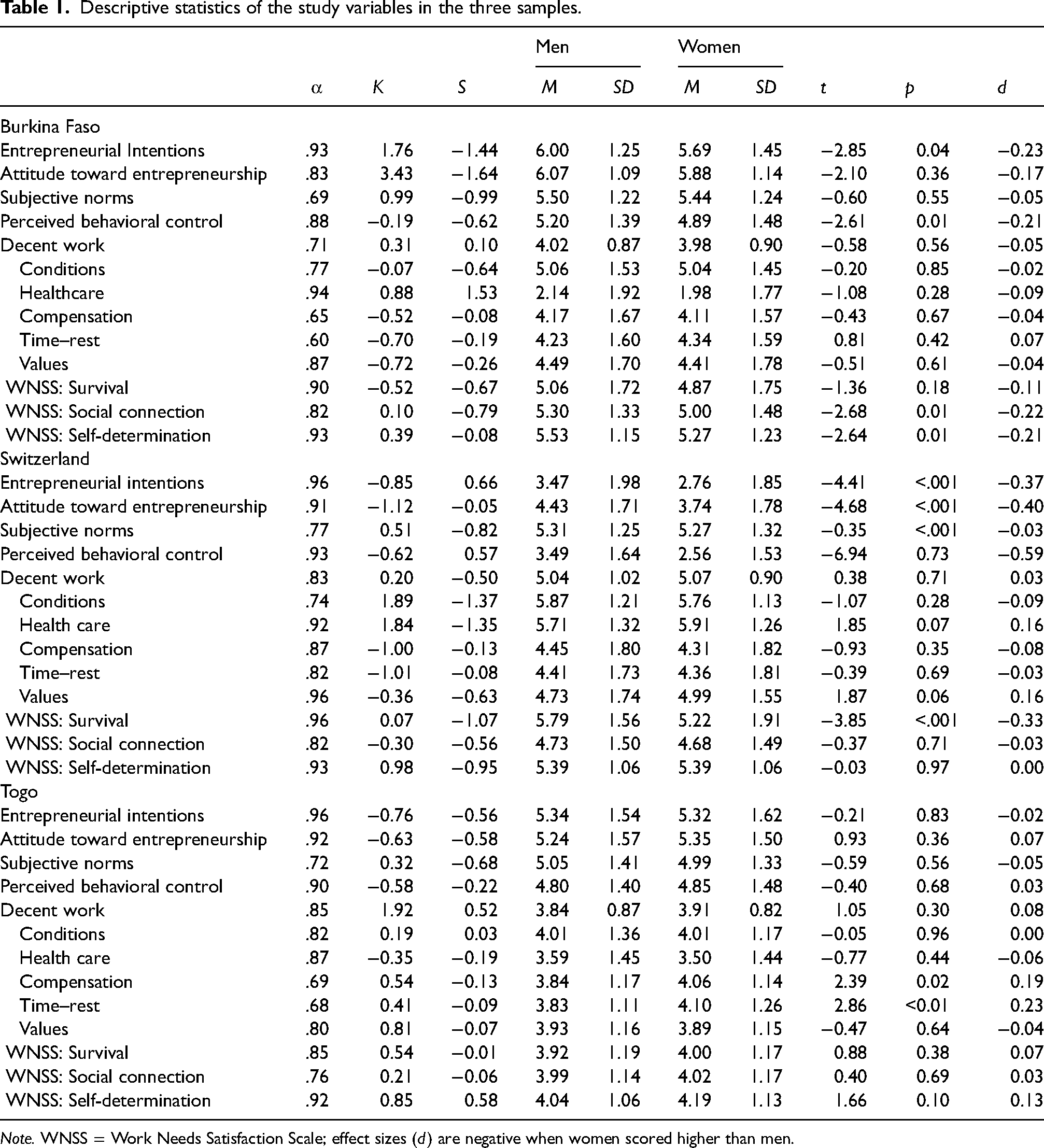
Note. WNSS = Work Needs Satisfaction Scale; effect sizes (d) are negative when women scored higher than men.
Correlations are presented in Tables 2 and 3. While overall decent work correlated positively with the four core entrepreneurship measures (i.e., intentions, attitude, norms, and behavioral control) in Burkina Faso (r ranging from .11 to .24) and Togo (r ranging from .10 to .15), only norms presented a positive correlation in Switzerland (r = .16), and furthermore, intentions (r = −.17) and attitudes (r = −.14) presented negative correlations and behavioral control, a nonsignificant correlation. Moreover, while the three work need satisfaction components correlated positively but weakly with entrepreneurial intentions in Burkina Faso (r ranging from .20 to .34) and Togo (r ranging from .11 to .24), none of these correlations were significant across the Swiss sample. Finally, overall decent work positively correlated with work need satisfaction components in Burkina Faso (r ranging from .47 to .51), Switzerland (r ranging from .17 to .46), and Togo (r ranging from .24 to .36). These correlations were moderate in Burkina Faso, weak in Togo, and ranged from very weak to moderate in Switzerland.
Correlations between study variables in the Swiss and Burkina Faso samples.
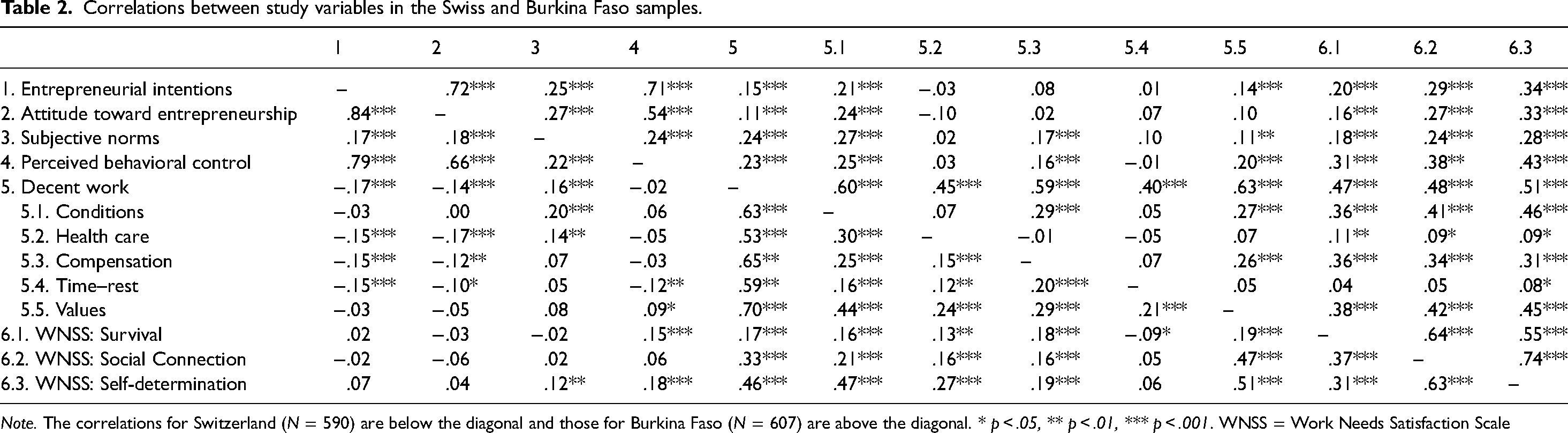
Note. The correlations for Switzerland (N = 590) are below the diagonal and those for Burkina Faso (N = 607) are above the diagonal. * p < .05, ** p < .01, *** p < .001. WNSS = Work Needs Satisfaction Scale
Correlations between study variables in the Togolese sample and the global sample.
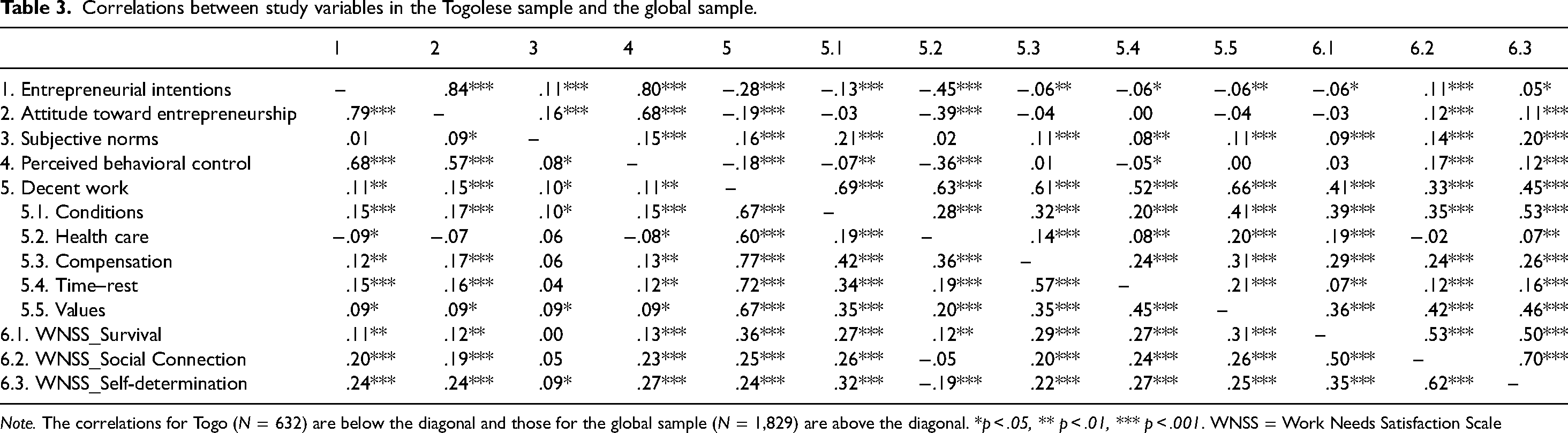
Note. The correlations for Togo (N = 632) are below the diagonal and those for the global sample (N = 1,829) are above the diagonal. *p < .05, ** p < .01, *** p < .001. WNSS = Work Needs Satisfaction Scale
Measurement model
We specified a measurement model including latent variables of entrepreneurial intentions (six-item indicators), attitude toward entrepreneurship (five-item indicators), subjective norms (three-item indicators), perceived behavioral control (six-item indicators), decent work (five-subscale score indicators), work need satisfaction (three-subscale score indicators). This measurement model exhibited relatively good fit indices across the overall sample: χ2(335) = 3902.95, p < .001, CFI = .914, TLI = .903, RMSEA = .076. As item-level models usually result in higher modification indices and relatively poor fit (Thompson & Melancon, 1996), we considered an alternative measurement model based on parceling the perceived behavioral control factor and entrepreneurial intention factor. Three parcels were created for each of these factors based on Weston and Gore (2006) recommendations, resulting in a significant improvement in fit: χ2(377) = 3503.77, p < .001, CFI = .927, TLI = .916, and RMSEA = .067. This model was adjusted by setting one covariance link between error terms associated with high modification indices within the attitude toward entrepreneurship, survival need, and self-determination factors, respectively, which increased the fit: χ2(374) = 3317.65, p < .001, CFI = .931, TLI = .920, and RMSEA = .066.
Structural model
The structural model (see Figure 1) has relatively good fit indices across the overall sample: χ2(388) = 3601.32, χ2(388)/df = 9.28, CFI = .925, TLI = .916, and RMSEA = .067. This allowed us to run a multigroup analysis to assess the hypothesized relations across the three countries. The multigroup model exhibited a nearly acceptable fit indices: χ2(1164) = 4556.47, χ2(1164)/df = 3.91, CFI = .910, TLI = .899, and RMSEA = .040.
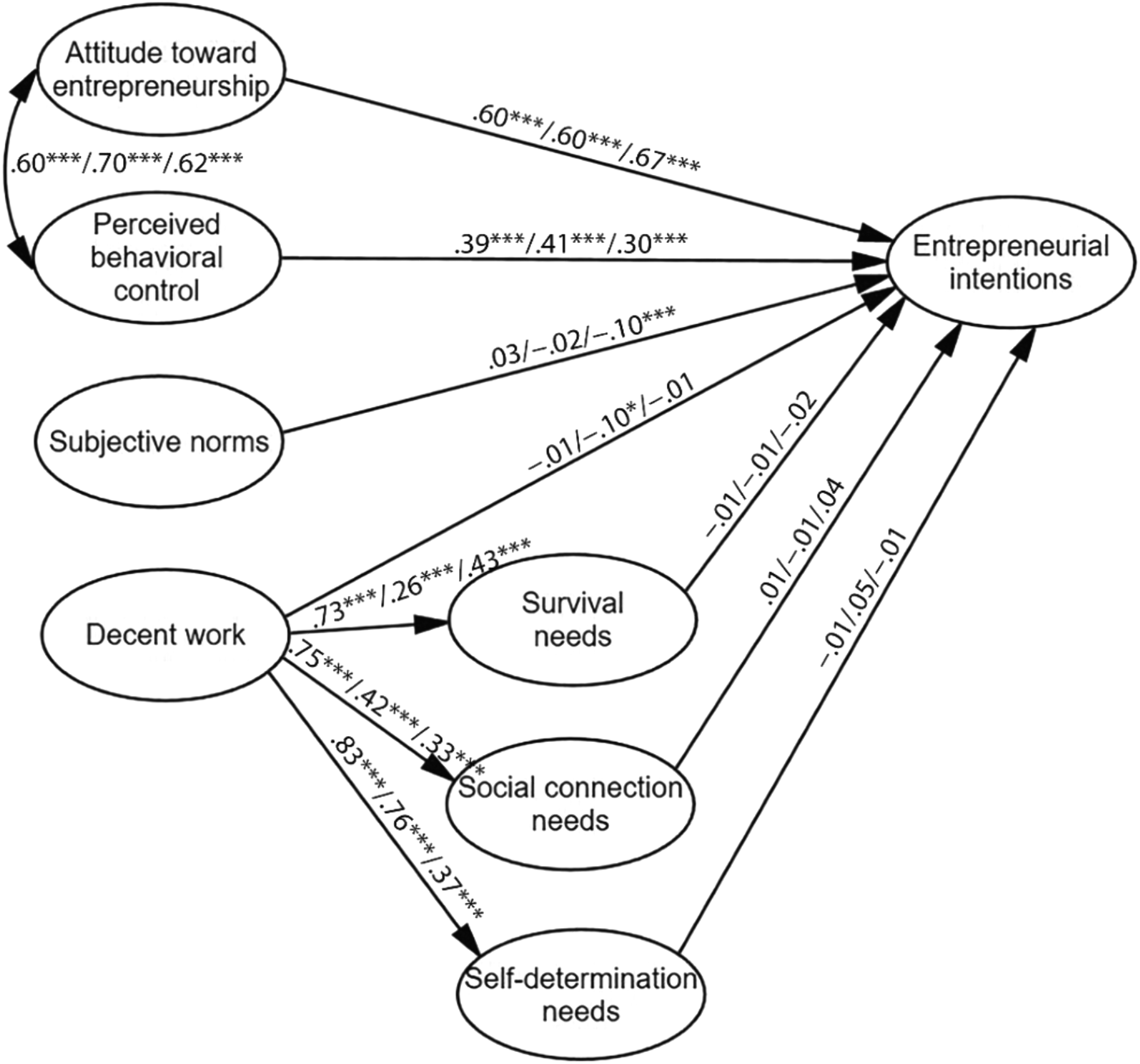
Standardized coefficients of the structural hypothesized model.
We hypothesized that decent work will positively relate to each of the work needs’ satisfaction components (H1). Consistent with these expectations, decent work produced strong positive paths to survival needs, social connection needs, and self-determination needs, respectively, in Burkina Faso (β = .73, β = .75, and β = .83, all p < .001), Switzerland (β = .26, β = .42, and β = .76, all p < .001), and Togo (β = .43, β = .33, and β = .37, all p < .001). These findings suggest that independently of the context, higher levels in access to decent work are associated with higher levels of work needs satisfaction.
Attitudes toward entrepreneurship (H2a; β = .60, β = .60, and β = .67, all p < .001) and perceived behavioral control (H2c; β = .39, β = .41, and β = .30, all p < .001) positively predicted entrepreneurial intentions across the Burkinabe, Swiss, and Togolese sample, respectively. While subjective norms showed a weak relatedness to entrepreneurial intention in Togo (H2b; β = −.10, p < .001), such relationship was nonsignificant across the Burkinabe (β = .03, p = .25) and Swiss (β = −.02, p = .44) samples, supporting partially hypothesis 2.
Regarding the relation between decent work and entrepreneurial intentions (H3), results showed that the hypothesized negative path was confirmed across the Swiss sample only, but the standardized path coefficient was very weak (β = −.10, p = .03). This suggests that unlike the African countries of Burkina Faso and Togo, higher levels in access to decent work tend to result in lower levels of entrepreneurial intentions in Switzerland. Our hypothesis 3 is therefore partially supported.
We expected that each of the work needs satisfaction components will be negatively related to entrepreneurial intentions (H4). Contrary to our expectation survival needs, social connection needs, and self-determination needs produced nonsignificant direct paths to entrepreneurial intention across the three country samples. These findings suggest that generally, entrepreneurial intention might not be driven by work needs satisfaction components.
Discussion
Relationship between attitudes, perceived control, and subjective norms to entrepreneurial intentions
One of the objectives of this study was to show the influence of attitudes toward entrepreneurship, subjective norms, and behavioral control on entrepreneurial intention. Our results showed that while attitudes toward entrepreneurship and behavioral control contributed positively to entrepreneurial intentions in all three countries, this was not the case for subjective norms. Other studies have shown similar effects for attitudes toward entrepreneurship and behavioral control. Autio et al. (2001) showed the impact of personal attitude on intention. Then, Naktiyok et al. (2010) found a strong and positive relationship between perceived entrepreneurial self-efficacy (similar to perceived behavioral control, see Atitsogbe et al., 2019) and entrepreneurial intention.
Unlike other researchers (Filion et al., 2002; Guenoun et al., 2018, Van Auken et al., 2006), we did not find a positive effect of subjective norms on entrepreneurial intentions. One explanation for the absence of a positive relationship between subjective norms and entrepreneurial intentions in our study could be explained by the sample. The studies mentioned above were all conducted in student samples, and one could argue that social norms and the presence of role models are more important for student rather than adult populations. Yet, the results of our correlation analyses show no relationship between age and the predictors of entrepreneurial intentions suggesting that it is more than just the younger age of student samples that contributes to explain the relationship between the subjective norms and entrepreneurial intentions.
It may also be that the support that people receive from others in their network is limited to verbal support and encouragement and does not include instrumental support (e.g., financial). It may be that this instrumental support is more pertinent for the development of entrepreneurial intentions, and that when this is missing, we may observe a negative relationship between subjective norms and entrepreneurial intentions (as is the case in the Togolese sample).
Relationship between decent work and work needs’ satisfaction
In all three countries, our results show that decent work has a positive relationship with work needs’ satisfaction. These results are in line with those of Kazimna et al. (2020) who found in a qualitative study done with students and workers that an important element of having a job is to satisfy needs. Atitsogbe et al. (2021a) also found a positive relationship between decent work and life and job satisfaction. Taken together it seems that the proposition made in the PWT (Duffy et al., 2016) that decent work is important for work needs’ satisfaction holds true in different socioeconomic and cultural contexts, and for students and adults.
Relationship between decent work and entrepreneurial intentions
We observed multicultural differences influence the relationship between decent work and entrepreneurial intentions. Indeed, contrary to expectations, the results showed a small negative relationship between decent work and entrepreneurial intentions in Switzerland, and no relationship between decent work and entrepreneurial intentions in Burkina Faso and Togo. We suggest several reasons for these results. Our data showed that for Switzerland, individuals reported higher levels of decent work, and lower levels of entrepreneurial intentions than in Burkina Faso and Togo. Thus, given the high levels of decent work in Switzerland, individuals may not be motivated to pursue entrepreneurial activities as there is less need to do so. This is mirrored in Swiss population data, showing that relatively few people engaged in entrepreneurial activities (FSO, 2022).
In African countries such as Burkina Faso and Togo, high levels of precarious employment, job insecurity, and instability may lead to the development of entrepreneurial intentions. Our data did show higher levels of entrepreneurial intentions in Burkina Faso and Togo than in Switzerland, a trend that has been observed in other research showing higher levels of entrepreneurial intentions in developing, rather than developed countries (Davey et al., 2011; Dos Santos Silva et al., 2021; Iakovleva et al., 2011). Despite higher levels of entrepreneurial intentions, most individuals prefer and desire salaried work which has social benefits and is therefore seen as more advantageous than entrepreneurship. This may be further entrenched by the lack of administrative, social, and financial structures that support entrepreneurship in Burkina Faso and Togo. Thus, it appears that in developing countries, such as Burkina Faso and Togo, the link between decent work and entrepreneurial intentions is largely absent, suggesting that entrepreneurial intentions are driven by factors other than the absence of decent work. For example, other studies have shown that, promotion or prevention focused goal orientations (Jaskiewicz et al., 2016) and career guidance and counseling (Marshall & Gigliotti, 2020) are important for the development of entrepreneurial intentions.
Relationship between needs satisfaction and entrepreneurial intentions
Our last hypothesis that the components of need satisfaction are negatively related to entrepreneurial intentions is not supported. This finding may be explained by professional status. Atitsogbe et al. (2021b) showed that entrepreneurial intentions were higher in job seekers than in students. As such, we may expect to observe that the lack of work need's satisfaction drives entrepreneurial intentions in those who are seeking a job, or who are unsatisfactorily employed. However, for those with a satisfactory employment, their needs are satisfied, and therefore there is less interest in pursuing entrepreneurial activity.
The lack of a relationship between needs’ satisfaction and entrepreneurial intentions could also be explained by age differences. The satisfaction of needs may differ from one age category to another. For example, Hassan and Al-Jubari (2015) confirmed, in an undergraduate Malaysian sample, a positive hypothesized relationship between need satisfaction (autonomy, competence, and relationships) and entrepreneurial intention. Indeed, the study by Tornikoski et al. (2012) on the impact of age on entrepreneurial intentions in Finland showed that the impact of age decreases year by year until the individual is in his or her 40s and beyond the age of 45 the effect of age on intention is no longer significant. Atitsogbe et al. (2021b) showed that younger individuals showed higher entrepreneurial intentions. Yet, the impact of age was canceled out as students moved into unemployment such that jobseekers then showed higher levels of entrepreneurial intentions than students. Thus, the relationship between work needs satisfaction likely depends on a combination of age and professional status.
Limitations
One limitation of our study is that we did not consider factors that influence the socioeconomic and cultural context in the three countries. As this study is cross-sectional, we cannot make any conclusions concerning causality. Furthermore, the regression indices obtained in our study are small suggesting that other factors need to be taken account. Another limitation is that investigators translated the items of the questionnaires for participants with low or no education from Burkina Faso and Togo. This procedure may have affected the reliability and trustworthiness of scales. However, Burkina Faso and Togo have 39% and 66.5% literacy rates among adults, respectively (UNESCO UIS, 2023a, 2023b). Therefore, this procedure allowed us to include a wider group of workers, including those less educated, representing a very large portion of the adult population of Burkina Faso and Togo. This data collection procedure has been used before in Burkina Faso (Rossier & Ouedraogo, 2021).
Future directions
Further research could adopt a longitudinal approach and consider other variables that may better explain the relationships between the variables under investigation, such as contextual variables. The relevance of the PWT could be investigated in other developing countries, including other West African countries to confirm the results we obtained.
Practical implications
Our study has practical implications for career guidance and counseling, education, and policy development. The promotion of decent work, as an important element of decent lives, requires a consideration of both subjective and objective factors as context (like economic constraints and marginalization factors) impact perceptions of working conditions as captured in the decent work scale (Rossier & Ouedraogo, 2021). Vocational psychology research can provide insights into the importance of decent work for individual quality of life beyond only economic factors. Career guidance practitioners may want to consider developing entrepreneurial intentions in young people to present entrepreneurship as an alternative to paid employment. Career development practitioners could provide practical information concerning possible pathways to entrepreneurship. They could also work on perceived control and attitudes toward entrepreneurship as these are important factors in the development of entrepreneurial intentions. Career practitioners could also promote social justice through the promotion of right at works either through helping clients identify and negotiate characteristics of decent work, or through working directly with organizations (Blustein et al., 2019; Masdonati et al. 2019).
The results of our study show that decent work is an important criterion for the fulfillment of survival, social connection, and self-determination needs in countries with different social, political, and economic climates calling for a continuation in political and labor market policies to promote decent work. Policy makers in Togo and Burkina Faso hoping to encourage entrepreneurship as an avenue toward decent work may focus on perceived control and attitudes toward entrepreneurship as these are important motivating factors. In countries where access to decent work is difficult, it may be particularly important to put in place political, social, and education systems that support entrepreneurship and those that help to transform the informal economy into a formal economy. In Burkina Faso and Togo, there have been policies on entrepreneurship—but they have tended to focus on unemployed populations who do not have the resources to start an entrepreneurial activity. Therefore, there is also a need to focus on promoting entrepreneurship among people who are already working. Similarly, the provision of social security to only those working for the state in some African countries reduces the attractiveness of other employment options suggesting that more possibilities to adhere to social security systems could be beneficial.
Footnotes
Declaration of conflicting interests
The authors declared no potential conflicts of interest with respect to the research, authorship, and/or publication of this article.
Funding
The authors disclosed receipt of the following financial support for the research, authorship, and/or publication of this article: This research was supported by the Swiss National Science Foundation (SNF) and the Swiss Agency for Development and Cooperation (SDC) within the Research for Development (r4d) program (grant no IZO8ZO_177295).
