




Abstract
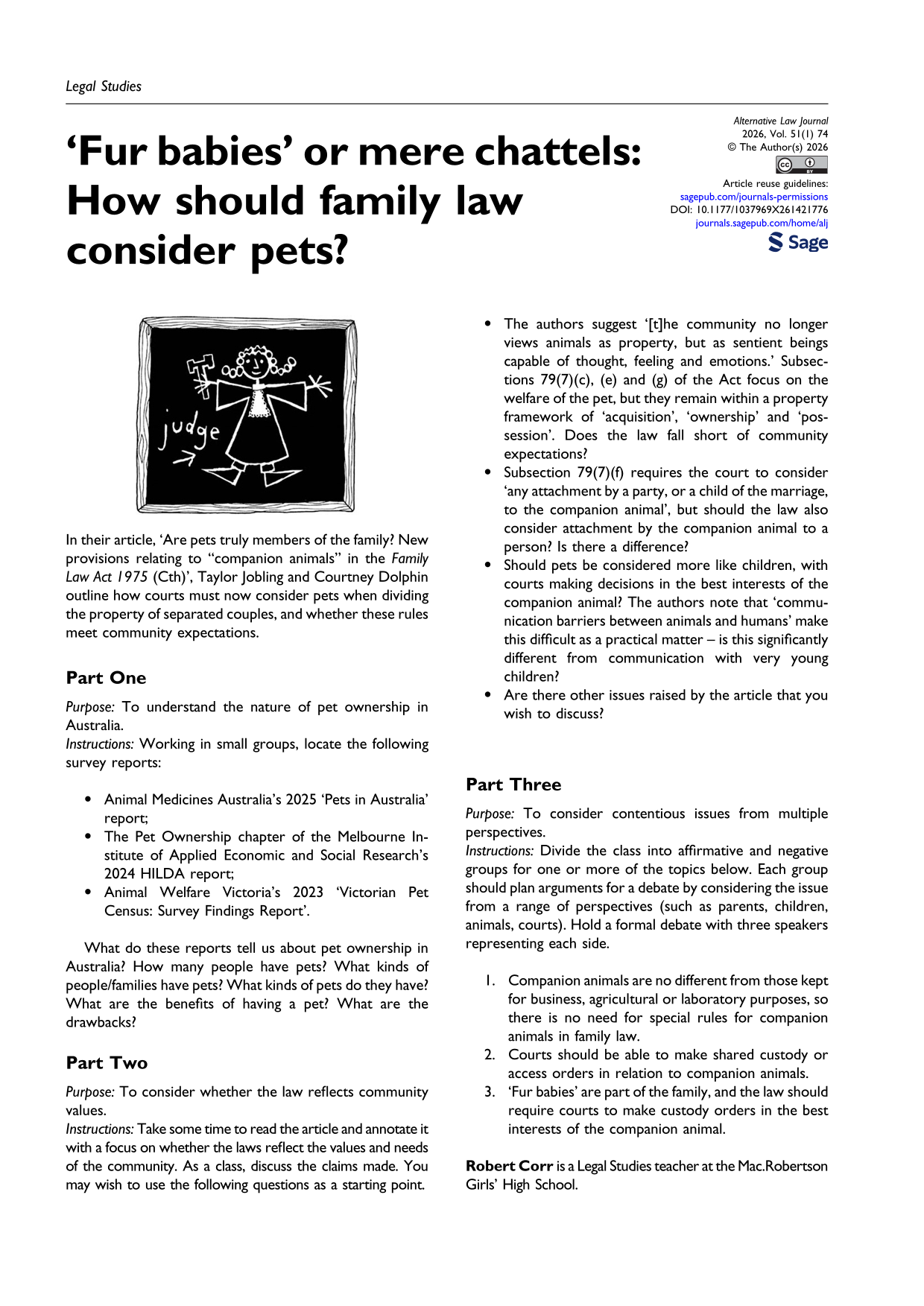

In their article, ‘Are pets truly members of the family? New provisions relating to “companion animals” in the Family Law Act 1975 (Cth)’, Taylor Jobling and Courtney Dolphin outline how courts must now consider pets when dividing the property of separated couples, and whether these rules meet community expectations.
Part One
Purpose: To understand the nature of pet ownership in Australia.
Instructions: Working in small groups, locate the following survey reports: • Animal Medicines Australia’s 2025 ‘Pets in Australia’ report; • The Pet Ownership chapter of the Melbourne Institute of Applied Economic and Social Research’s 2024 HILDA report; • Animal Welfare Victoria’s 2023 ‘Victorian Pet Census: Survey Findings Report’.
What do these reports tell us about pet ownership in Australia? How many people have pets? What kinds of people/families have pets? What kinds of pets do they have? What are the benefits of having a pet? What are the drawbacks?
Part Two
Purpose: To consider whether the law reflects community values.
Instructions: Take some time to read the article and annotate it with a focus on whether the laws reflect the values and needs of the community. As a class, discuss the claims made. You may wish to use the following questions as a starting point. • The authors suggest ‘[t]he community no longer views animals as property, but as sentient beings capable of thought, feeling and emotions.’ Subsections 79(7)(c), (e) and (g) of the Act focus on the welfare of the pet, but they remain within a property framework of ‘acquisition’, ‘ownership’ and ‘possession’. Does the law fall short of community expectations? • Subsection 79(7)(f) requires the court to consider ‘any attachment by a party, or a child of the marriage, to the companion animal’, but should the law also consider attachment by the companion animal to a person? Is there a difference? • Should pets be considered more like children, with courts making decisions in the best interests of the companion animal? The authors note that ‘communication barriers between animals and humans’ make this difficult as a practical matter – is this significantly different from communication with very young children? • Are there other issues raised by the article that you wish to discuss?
Part Three
Purpose: To consider contentious issues from multiple perspectives.
Instructions: Divide the class into affirmative and negative groups for one or more of the topics below. Each group should plan arguments for a debate by considering the issue from a range of perspectives (such as parents, children, animals, courts). Hold a formal debate with three speakers representing each side. 1. Companion animals are no different from those kept for business, agricultural or laboratory purposes, so there is no need for special rules for companion animals in family law. 2. Courts should be able to make shared custody or access orders in relation to companion animals. 3. ‘Fur babies’ are part of the family, and the law should require courts to make custody orders in the best interests of the companion animal.