




Abstract
This article critically examines the Making Queensland Safer Act 2024 (Qld), situating it within a broader trajectory of punitive youth justice reforms in Queensland. It argues that the Act reflects a deliberate political strategy of punitive populism, enacted at the expense of children and young people’s rights and in clear contravention of both domestic and international human rights standards. The author explores the symbiotic relationship between media narratives, political opportunism and public opinion in manufacturing a youth crime ‘crisis’ and calls for an urgent shift toward evidence-informed youth justice policy.
The treatment of children and young people within Australia’s criminal justice system remains one of the nation’s most pressing human rights concerns. 1 In Queensland, recent amendments to youth justice legislation signify a troubling intensification of punitive populism – a political strategy that promotes harsh criminal laws for electoral advantage, 2 often at the expense of evidence-based policy, long-term effectiveness, and fundamental human rights protections.
Queensland is not alone in pursuing increasingly punitive youth justice policies. Across Australia, other state and territory governments are advancing similarly regressive reforms, reflecting a broader national trend toward punitive populism. 3 Earlier this year, the Victorian government passed what it described as the ‘toughest’ bail laws in the country, becoming the latest jurisdiction to follow the lead of Queensland and the Northern Territory (NT) – both of which have long relied on reactive, punitive approaches to youth crime. 4 More recently, the newly elected NT government amended the Youth Justice Act 2005 (NT) 5 to remove detention as a measure of last resort, reintroduce previously banned spit hoods, expand the ‘reasonable force’ powers of Youth Justice Officers, and increase the number of serious offences ineligible for diversionary programs. 6
This commentary situates the Making Queensland Safer Act 2024 (Qld) 7 within a broader trajectory of regressive legislative responses to youth crime in the state. Enacted shortly after the 2024 Queensland state election, the Act exemplifies a bipartisan ‘race to the bottom’, with both major parties vying to appear ‘tougher on crime’. 8 Central to the Act is the legislative embodiment of the Liberal National Party (LNP) slogan, ‘Adult Crime, Adult Time’, 9 which now underpins provisions requiring children and young people charged with serious offences – such as murder, grievous bodily harm or robbery – to be subjected to adult criminal penalties, including mandatory life imprisonment. 10
Additionally, the legislation dismantles long-standing protections enshrined in the Youth Justice Act 1992 (Qld), 11 including the principle that detention should be a measure of last resort and the presumption in favour of non-custodial orders. 12 These reforms fly in the face of overwhelming criminological and legal evidence indicating that punitive approaches to youth offending are not only ineffective in reducing recidivism but are actively harmful to the children and young people subjected to them.
Legislative overreach
The reforms were promoted as the response to a purported statewide youth crime ‘crisis’. In official media statements, the LNP attributed the situation to the former Labor government’s decade of ‘weak laws’, claiming it had produced a ‘generation of untouchable youth criminals’, transformed suburbs into ‘youth crime warzones’ and left communities at the mercy of ‘hardcore repeated offenders’, supposedly creating ‘thousands more victims’ across Queensland. 13
Framed by the government as necessary to protect public safety and target so-called ‘serious repeat offenders’, 14 the reforms mark the third instance in under two years that the Queensland government has invoked s 43 of the Human Rights Act 2019 (Qld) 15 to override protected rights for the purpose of passing incompatible youth justice legislation. This provision – intended for use only in exceptional circumstances such as war or public emergency – was again employed under dubious claims of an unfolding ‘crisis’, enabling the government to bypass ordinary human rights scrutiny.
The international community’s response was swift and unequivocal. Professor Ann Skelton, then Chair of the United Nations (UN) Committee on the Rights of the Child, described the legislation as a ‘flagrant disregard of children’s rights’ and a clear breach of Australia’s international obligations. 16 More troubling still is the Queensland government’s own admission, contained in its statement of compatibility, that the Act is ‘more punitive than necessary’ and in ‘direct conflict with international law standards’. 17 This is not legislative overreach born of haste or oversight; it is a calculated political decision to sacrifice children and young people’s rights in the pursuit of political appeal.
The Making Queensland Safer Act does not exist in isolation. It is the latest iteration of a familiar cycle in Queensland’s youth justice policy, wherein populist and reactionary reforms are repeatedly introduced around election cycles – ranging from bootcamps in 2012, 18 to the transfer of children to adult correctional facilities in 2014, 19 and youth curfews in Cairns and Townsville in 2020. 20 Conversely, more progressive approaches are quickly deserted when politically inconvenient. 21 These include the 2018 Atkinson Report, 22 which recommended a shift away from purely punitive measures towards restorative and rehabilitative practices. As well as the widespread public, media and advocacy group scrutiny – including the Law Council of Australia, Amnesty International, Human Rights Watch, and Save the Children – it was revealed, following the Australian Broadcasting Corporation’s 2019 ‘Inside the Watch House’ exposé, 23 that children were being held in police watch houses which, in turn, prompted government commitment to reduce the practice. 24
Incompatibility with human rights standards
The recent amendments represent a significant breach of both international and domestic human rights obligations. Key provisions of the UN Convention on the Rights of the Child
25
are contravened, including: • Article 3(1): the best interests of the child shall be a primary consideration;
26
• Article 37(b): detention shall be a last resort and for the shortest appropriate period;
27
and • Article 40(1): children who have infringed penal law shall be treated in a manner that takes into account their age and promotes reintegration.
28
These violations are compounded by the Act’s incompatibility with the UN Standard Minimum Rules for the Administration of Juvenile Justice (The Beijing Rules), 29 particularly in failing to ensure that:
Domestically, the legislation imposes ‘clear and deep’ limitations on protected rights under Queensland’s Human Rights Act, 33 including:
The government’s own Statement of Compatibility concedes that the reforms will have a disproportionate impact on First Nations children and young peoples, 38 who remain grossly overrepresented in Queensland’s youth justice system (YJS). Queensland incarcerates more First Nations children than any other jurisdiction in Australia. 39 Across 2022–23, over 70 per cent of all young people in detention in Queensland were First Nations. 40 This stark figure does not suggest that First Nations children ‘do more crime’, as is too often implied in political and media narratives, but rather reflects the enduring effects of structural and systemic inequality. 41 Understanding the mass incarceration of First Nations children requires acknowledging the role of intergenerational trauma, social and economic disadvantage, and racial discrimination, all of which contribute to their disproportionate criminalisation. 42
Yet, in the same paragraph of the Statement of Compatibility, the government asserted that the reforms do not directly or indirectly discriminate based on race. 43 This claim is both misleading and inaccurate. A law that produces unequal impacts, effects or outcomes for a particular group – especially one already subject to systemic racism – is inherently discriminatory. 44 Far from being neutral, the Making Queensland Safer Act will deepen existing inequities and further entrench the injustices already experienced by First Nations children and young people in Queensland’s YJS.
A regressive and reprehensible shift
Australia is failing its children. These reforms disproportionately target some of the most marginalised and vulnerable members of our society. 45 The deliberate erosion of legal protections for children and young people – under the guise of public reassurance – is neither benign nor accidental; it constitutes a systemic moral and legal failure. In doing so, the Queensland government sends a troubling message: that it is willing to abandon the most fundamental human rights protections for the children and young people in its care when politically expedient to do so.
In a democratic society governed by the rule of law and committed to the dignity of all persons, the Making Queensland Safer Act represents a profound regression. Queensland youth justice policy must be urgently reformed to adopt evidence-informed approaches that uphold the rights, address the needs, and safeguard the futures of children and young people.
Politically manufactured intractability
Youth crime is frequently presented as a discrete law-and-order issue. In reality, it is a profoundly complex policy challenge situated at the intersection of legal, political, social and cultural domains. It is also one of the few areas that consistently provoke intense community emotion, widespread outrage and political posturing. 46
A fundamental question must be asked: what is the goal? Crime is an enduring feature of all societies. Given the complexity of human behaviour and structural conditions, total eradication is neither realistic nor achievable. A more appropriate aim is to reduce its incidence and mitigate its harm – particularly for children and young people.
Youth crime as a ‘wicked policy’ challenge
Youth crime exhibits the attributes of a ‘wicked’ problem: it is complex, intractable, unpredictable and resistant to straightforward solutions. 47 However, issues arise when the wicked problem framework is applied in binary terms by labelling a problem as either ‘wicked’ or ‘not wicked’. This reductive approach encourages totalising narratives that frame wicked problems as requiring a single, dramatic intervention to ‘fix’ them, once and for all. 48 Such narratives tend to obscure the need for long-term, evidence-based strategies aimed at managing complexity and achieving incremental progress. 49
To that end, a more constructive approach is to recognise that wickedness can manifest in varying degrees and forms.
50
Drawing on Alford and Head’s typology (see Figure 1),
51
youth crime is better understood as a ‘politically turbulent problem’ – one shaped less by the nature of the problem itself and more by the contested positions of the actors involved. The value of this framing lies not in offering a definitive solution, but in identifying which aspects of youth crime merit further investigation. Types of complex problems.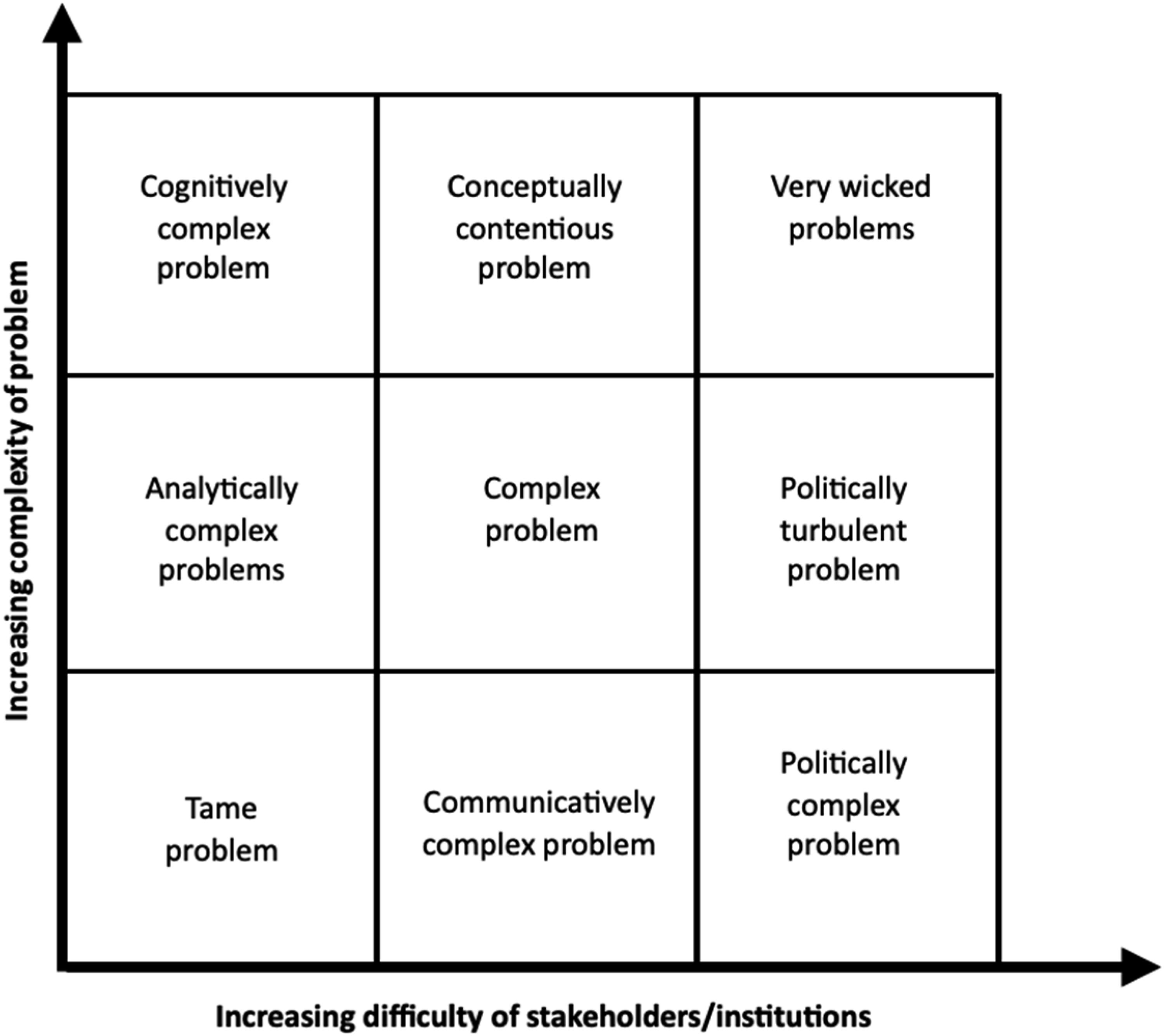
The vertical axis reflects the extent to which a problem is intractable. On the surface, the problem of youth crime appears relatively clear: high rates of offending, recidivism, and public safety concerns are all observable phenomena. Yet, policy responses aimed at ‘solving’ the issue are fragmented, contested and inconsistent. Governments have long oscillated between punitive, justice-based models and periodic inclinations toward more therapeutic, welfare-oriented approaches, with no enduring consensus or sustained commitment to reform.
The horizontal axis reflects diversity of actors shaping the problem’s tractability. A wide range of stakeholders – including politicians, law enforcement, victims, advocates, academics, and children and young people themselves – hold divergent, often competing, views on the causes of youth crime and appropriate responses. This divergence is amplified by political discourse, which frequently constructs youth crime as a false dichotomy between protecting community safety and supporting criminalised children, 52 implying that one set of interests must be prioritised at the expense of the other. These competing priorities, reinforced by power asymmetries, intensify the contestability of the youth justice space.
Manufactured crisis and avoidance of solutions
Within this context, Queensland’s recent legislative actions must be critically examined. Successive governments have not only failed to confront the complexities of youth offending, but they have also actively contributed to constructing and perpetuating the very ‘crisis’ they now invoke. The spectre of youth crime is cyclically ‘rediscovered’ as an emergency, particularly during election periods.
Perhaps, then, youth crime itself is not as complex a problem as it is purported to be. The real impediment is not a lack of viable solutions, but a sustained political unwillingness to implement them. 53 Despite decades of research endorsing early intervention, diversion and community-based alternatives, governments have consistently invested millions into punitive measures. 54 Tough-on-crime policies endure – not because they deliver results, but because they deliver votes. No such strategy has produced a lasting reduction in youth crime. Rather, Queensland continues to record the highest rates of youth incarceration and recidivism in the country, inflicting profound and lasting harm on children caught in the system – clear evidence of a YJS entrenched in failure. 55
Media hype, political gain: A symbiotic relationship
Punitive populism in Queensland’s youth justice landscape is sustained by a mutually reinforcing relationship between sensationalist media narratives, political opportunism and perceived public appetite for tougher responses to youth crime. 56 This dynamic has fostered a policy environment not merely indifferent to evidence-based reform, but actively resistant to it.
The role of media-driven moral panics
As Renee Zahnow observed, young people have long been central to recurring moral panics in Australian media. 57 Professor Stanley Cohen theorised that moral panic involves the portrayal of a group – here, children – as a threat to societal interests and values. 58 Their behaviours are stylised, exaggerated, and stereotyped through mass media narratives, transforming them into ‘folk devils’, symbolic targets of public condemnation. 59 In the youth justice context, this framing constructs ‘wayward’ children as deviant and irredeemable outsiders, further entrenching their alienation and disenfranchisement from the community. 60 These narratives are compounded by racialised stereotyping, with moral panics historically directed disproportionately at First Nations, Vietnamese-Australian, Lebanese-Australian, and Sudanese-Australian young people. 61
Despite youth offending representing a small proportion of total crime in Queensland, it receives disproportionate media coverage. 62 Cultivation theory offers a useful lens: repeated exposure to sensationalist crime reporting cultivates a distorted perception of its prevalence and severity. 63 Lacking political voice or media influence, children and young people are acutely vulnerable to this distortion. Notably absent from public discourse are the voices of those with lived experienced or any meaningful engagement with the complex drivers of youth offending. 64
While Queensland law rightly prohibits the publication of identifying information about children and young people to protect their safety and privacy, 65 anonymised reporting of lived experiences remains essential. The work of Guardian journalist Ben Smee, for example, demonstrates how such storytelling can challenge sensationalist media narratives, humanise criminalised children, and expose the structural disadvantage and systemic failures that both precede and sustain their involvement in the YJS. 66 Yet this form of journalism remains rare, as sensationalism continues to dominate media coverage.
A recent media analysis confirmed that coverage of youth crime routinely prioritises exceptional, violent or high-profile incidents. 67 While news outlets are expected to provide impartial reporting, sensationalism designed to increase readership often takes precedence over factual accuracy. 68 The editorial logic remains: ‘If it bleeds, it leads’. 69 Even when rehabilitative alternatives are mentioned, they are often framed as secondary to, or less credible than, punitive measures. 70 This has significant consequences. Once criminality is linked to youth identity in the public imagination, support for rehabilitative responses rapidly declines, while punitive measures gain legitimacy.
The politicisation of youth justice
This distorted narrative directly influences political decision-making. In Queensland, news media – particularly crime reporting – has been shown to exert considerable influence over governmental authorities. 71 The media often frames youth crime as primarily a political problem rather than a social issue, 72 directing political attention and creating pressure to respond to media demands. As a result, policy decisions are increasingly driven by media cycles rather than expert advice or long-term planning, resulting in reactive interventions that fail to address the complexities of youth offending. 73
Youth justice experts have long lamented the politicisation of youth justice. As Andrew Hughes, a lecturer at the Australian National University with a special interest in political marketing notes, youth crime is ‘an easy one for politicians to go after’: it attracts headlines but rarely invites scrutiny. 74 This is the very appeal of punitive populism – it enables elected officials to appear responsive and decisive, even when their policies are ineffective or actively harmful.
This entanglement between media, politics and public opinion must be disrupted. Youth justice policy demands rational, evidence-informed deliberation – free from the distorting influence of sensationalist journalism and electoral imperatives. The continued exploitation of youth crime for political and media gain at the expense of children and young people’s rights, dignity and futures is not only intellectually negligent but morally indefensible.
Public opinion and the power of narrative
The persistence of punitive responses to youth crime cannot be attributed solely to media and political influence. These responses are sustained by deep-seated mental models – the assumptions, beliefs and values that shape how society interprets and reacts to complex social issues. The ‘iceberg’ model of systems thinking provides a useful framework for conceptualising this dynamic, illustrating how visible events, such as tough-on-crime policies, are driven by deeper, often hidden forces: patterns of behaviour, system structures, and, most importantly, mental models. 75
These mental models operate as the submerged drivers of systemic behaviour. 76 Without confronting them, meaningful reform remains out of reach. Real transformation requires more than policy change; it demands the exposure and disruption of the foundational narratives that sustain the current system, creating space to move beyond short-term, reactive measures towards lasting, systemic change.
Constructing – and reconstructing – public understandings
Public perceptions of crime play a central role in shaping legislative responses. Reforms are often justified as necessary to ‘meet community expectations’, a rationale relied upon during the passage of the Making Queensland Safer Bill. 77 The government’s decision to override human rights protections was defended on the basis of strong public support and growing concern for community safety.
Yet public opinion is neither organic nor spontaneously formed – it is actively constructed. 78 Most Australians have limited direct interaction with the criminal justice system. Consequently, their views are primarily mediated by secondary sources – namely, political messaging and media narratives.
While public support for punitive reforms may appear strong, it is often built on misinformed understandings of youth crime’s prevalence, causes and consequences. A recent discourse analysis of Queensland media and public commentary identified a striking alignment between sensationalist reporting, public sentiment and the dominant punitive policy narrative. 79 This alignment renders public opinion highly susceptible to manipulation, yet it also holds transformative power.
Debunking common misconceptions
Reframing public understanding is essential to fostering support for rights-based, long-term reform. This requires a fundamental shift in the mental models that underpin how youth offending is understood and discussed. The following section addresses and corrects four persistent misconceptions shaping Queensland’s youth justice discourse.
Mainstream reporting often perpetuates a reductive moral binary where ‘bad’ children make bad choices and must be punished to protect ‘good’ citizens. 80 This narrative detaches offending from its broader social context and ignores the overwhelming evidence that most children and young people in the YJS are among the most disadvantaged in society. 81
Youth offending is strongly correlated with social disadvantage – poverty, family breakdown, poor mental and physical health, cognitive impairment, low educational attainment, and histories of trauma and child protection involvement. 82 Most affected children and young people face multiple, intersecting vulnerabilities. 83 Systemic failure is evident in racialised policing, with First Nations children disproportionately arrested, charged, and detained – not for committing more crime, but because of over-policing and racial profiling. 84 These structural and systemic factors are not offered as excuses but as critical context. Offending rarely stems from moral failing; more often, it results from a confluence of circumstances and systemic failures largely beyond a child’s control.
The Making Queensland Safer Act was introduced on the pretext of enhancing community protection, with then Attorney-General Frecklington declaring it ‘the first step in restoring safety to our community’. 85 Punitive policies remain politically attractive because they provide visible demonstrations of ‘strong leadership’, a quality which is prized in Queensland’s political culture. 86
Yet criminological research consistently finds that punitive measures, especially incarceration, are ineffective and in many cases, counterproductive. Incarceration increases the risk of recidivism and drives disproportionately high imprisonment rates. For children and young people in particular, detention is well recognised as criminogenic – it fosters, rather than deters, further criminality. 87
Punitive measures undermine, rather than enhance, community safety. As Queensland Human Rights Commissioner Scott McDougall noted, ‘debate about youth crime often makes it seem like we have to choose between keeping communities safe and protecting children’s rights’ but this is ‘a false dichotomy’ that ‘demonises and dehumanises children’. 88 Serious offending must be addressed, but the focus should be on approaches that are genuinely effective in reducing such behaviour, prioritising evidence-based interventions that target its root causes.
The so-called youth crime ‘crisis’ in Queensland is better understood as a crisis of perception. 89 Political actors, particularly the LNP, have exaggerated the crisis narrative, positioning themselves as the hardline solution. 90 While public concern is real and often grounded in genuine fear, the data tells a different story.
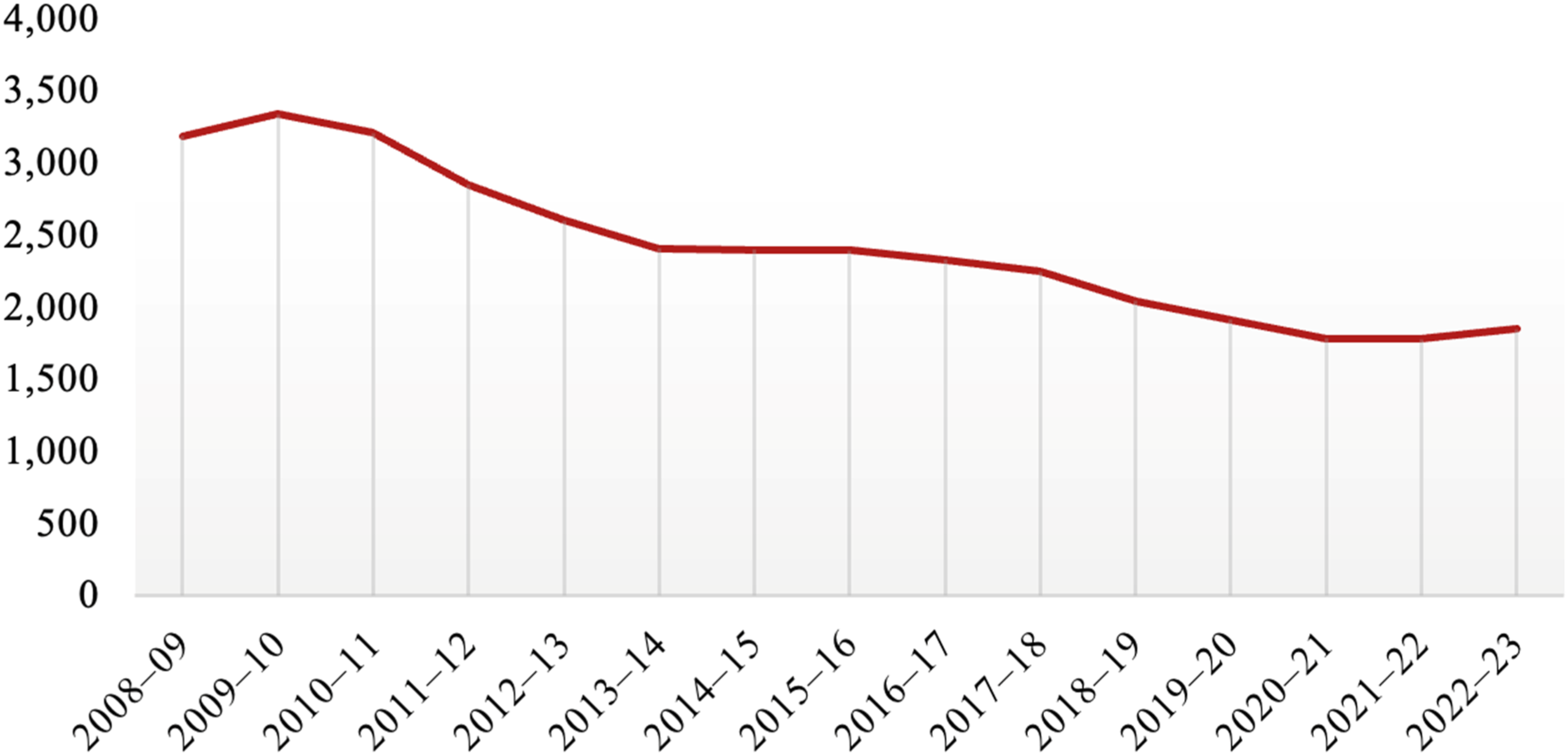
In reality, youth crime has declined significantly over the past decade (see Graph 1).
91
In the 2021–22 financial year, it reached its lowest recorded level in Queensland’s history,
92
with Queensland Police Service data showing a further 6.7 per cent decrease between the 2022–23 and 2023–24 financial years.
93
The majority of offences are non-violent and property-related;
94
violent crime accounts for only 7 per cent of proven youth offences.
95
Almost half of all offences before the Childrens Court of Queensland are committed by just 10 per cent of child defendants.
96
Number of youth offenders in Queensland per 100,000 population.
97
Believing youth offending can be solved solely through the justice system is not only misguided, but dangerously narrow. It reflects a reactive approach – intervening only after a crime occurs and relying on punishment as the primary response.
98
This limitation has been acknowledged by the judiciary. In a recent decision, a Queensland Childrens Court judge candidly remarked to a young defendant: Your needs are complex, and there is really not a lot I can do sitting here in a criminal court to make sure that you get the treatment and the support that you need to stop committing offences.
99
The path forward: A collaborative approach
Queensland’s so-called youth crime ‘crisis’ is, more accurately, a crisis of the systems responsible for supporting and protecting children and young people. The problem does not lie inherently with the children, but with the systemic failures that surround them. Too often, children are framed solely as offenders to be punished, while the institutions responsible for their care, development and rehabilitation escape proper scrutiny. In many ways, the children and young people in the YJS reflect the cumulative failure of social policy across multiple domains – including housing, healthcare, education, and child protection. 100 If accountability is to be meaningful, it must extend to the institutions, services, and systems entrusted with their protection. 101
Community safety is a shared goal, but it requires moving beyond punitive, reactive responses. As highlighted by recent findings from the Queensland Audit Office, a whole-of-system approach is essential to meaningfully reduce serious youth offending, given the multi-faceted nature of its underlying causes. 102 This means confronting difficult questions: What forces are pushing children and young people into the justice system? And how can early, coordinated intervention prevent this trajectory?
The solution lies not in reactive legislative reforms but in a fundamental shift towards a care-based, multi-agency model that prioritises therapeutic, trauma-informed and culturally appropriate responses. These approaches provide the foundations for enabling children and young people to develop the skills, confidence and opportunities they need to thrive, ideally before they offend, and certainly before they become entrenched in the YJS. 103
Crucially, this shift must be supported by sustained, needs-based funding for Aboriginal Community-Controlled Organisations (ACCOs), which are uniquely positioned to deliver culturally safe, community-led services. 104 For First Nations children and young peoples, meaningful outcomes will only be achieved if the ACCO sector is properly resourced and empowered to lead these responses. 105 Failing to centre ACCO-led solutions risks entrenching systemic inequities rather than achieving lasting change.
The well-worn phrase ‘it takes a village to raise a child’ remains profoundly relevant. A protective ecosystem – comprising families, communities, schools, healthcare and long-term care – is vital to nurturing children and young people and shielding them from harm. 106 Responsibility for building and maintaining this ecosystem must be shared. Policymakers, community leaders, media and institutions must not only respond to the evidence but commit to amplifying and embedding it.
If Queensland is serious about addressing youth crime, it must be prepared to be tough on its causes not just its consequences. Unless society confronts the root causes, we are merely managing symptoms, not addressing the problem. 107 The way forward lies in cross-sector collaboration and an unwavering commitment to approaches that centre the rights, needs and futures of children and young people. Anything less will only deepen the harm – for children and for the community as a whole.
Footnotes
Declaration of conflicting interests
The author declared no potential conflicts of interest with respect to the research, authorship, and/or publication of this article.
Funding
The author received no financial support for the research, authorship, and/or publication of this article.
