



Abstract
This article is an overview of the contemporary phenomenon of pseudolaw and argues that, at its heart, it involves a mistaking of the form of legal argumentation for its substance. Essentially, through the use of legalistic language, archaic sources and strange rituals, an illusion of legal meaning is created which tricks users into believing their actions are legally meaningful. This article argues that it shares common features with generative AI, in that it produces an illusion of meaning which users mistake for actual meaning. It then explores this juxtaposition and its implications for responses to pseudolaw.
Anyone who has spent extended time in Australian courts in the last five years will be familiar with the very strange phenomenon that is pseudolaw. A confident, assertive, self-represented litigant will rise to make their appearance only to argue the judge has no authority as the court is displaying the wrong coat of arms; or they will assert they are a ‘natural person’ not subject to the law; or they argue that the judge has somehow committed treason. A vivid illustration is provided in the case of Georganas v Georganas,
1
when a pseudolaw ‘guru’ interceded from the public gallery:
These types of arguments are, of course, without any legal merit. They do not work, 3 and are rightly regarded as ‘obvious nonsense’, 4 ‘pseudo-legal gibberish’, 5 or ‘gobbledygook’. 6 Yet these forms of argument continue to proliferate, with a significant growth seen in the years since the COVID-19 pandemic. 7 This is no longer a fringe concern: such matters are now occurring on a daily basis in Australian courts, 8 and in some jurisdictions is already being seen to profoundly reshape litigation. 9
Courts are busy places, and pseudolaw can be particularly disruptive,
10
not least because of the disproportionate impact of each pseudolaw case compared to other cases.
11
The case law involving pseudolaw matters commonly includes statements of judicial concern about the systemic impact of such cases.
12
For example, in Rossiter v Adelaide City Council,
13
Livesey J observed that pseudolegal arguments have ‘without reservation been rejected as involving both legal nonsense and an unnecessary waste of scarce public and judicial resources.’
14
The burden of dealing with pseudolaw matters is having a profound impact on the courts. As one judicial officer put it: It uses up so much court resources because every time they want to file something they end up making the lives of the Registry staff miserable. [The clerk’s] email inbox … [is] full of emails from them. They have changed the whole face of the civil justice system.
15
In this article, I provide an overview of the contemporary phenomenon of pseudolaw and argue that – at its heart – it involves a mistaking of the form of legal argumentation for its substance. Essentially, through the use of legalistic language, archaic sources and strange rituals, an illusion of legal of meaning is created which tricks users into believing their actions are legally meaningful. That these users lack legal literacy, are largely alienated from the law, and desperately want to believe in the promise of pseudolaw means that this illusion is difficult to displace. I argue, however, that it is critical the scale and nature of this threat to the good administration of justice is recognised and countered – not least because it is quickly merging with another emerging phenomenon, the use of generative AI (‘GenAI’), which shares many of these same characteristics.
This article briefly draws out the similarities between GenAI and pseudolaw, with the goal of helping the reader better understand both phenomena. Unfortunately, the collision between GenAI and pseudolaw is already beginning to disrupt our courts, 16 and it is increasingly necessary that we are all familiar with the contours of both the overlap between them and their impact upon the administration of justice.
Ultimately, I argue that – as amusing as some of the examples may be – pseudolaw itself is no laughing matter. It is, as I have written elsewhere, ‘disrupting our courts … threatening our judicial officers and administrators [and] harming all who come into contact with it.’ 17 The same is true on the increasing use of GenAI in litigation 18 – it can appear humorous, but is increasingly problematic. As these two phenomena collide, it is critical we stop laughing and start learning.
What is pseudolaw?
The term ‘pseudolaw’ is used to refer to the social phenomenon whereby adherents use the forms of conventional legal argument, but not the substance, in their interactions with law, legal and government institutions. As Mark Pitcavage, one of the preeminent global scholars on the topic, describes it, pseudolaw can be understood as the creation and employment of theories and arguments that mimic the outward form and appearance of legitimate legal arguments to the extent that they might be able to convince an untrained layperson, but which in no meaningful way (except rarely and by accident) address or have standing in actual law.
19
Broadly conceived, pseudolaw can be seen to co-opt the form of legal language but substitute its own norms and contra-narratives to create an alternative legal universe, which adherents believe represents the ‘true’ meaning of the law. 20 While there have always been litigants willing to advance fanciful legal arguments, pseudolaw possesses a more collective and loosely organisational quality, with common forms of argumentation and behaviours.
Perhaps the most significant and influential sect of pseudolaw is the ‘Sovereign Citizen’ movement, which emerged in the United States in the 1990s. 21 Indeed the ‘sovereign citizen’ movement is often conflated with the broader social phenomenon of pseudolaw. This is a mistake, though, as the latter term helps us recognise that there are a wide range of movements, groups and practices that share a common methodological approach to engaging with the law. 22 These include the American State Nationals (US); 23 Moorish Sovereign Movement (US); 24 the Freemen-on-the-Land movement (Canada & UK); 25 Detaxers (US and Canada); 26 the Magna Carta Lawful Rebellion (Canada); 27 and the Reichsbürger 28 and ‘Sovereignism’ movements (Germany). 29
What these movements all have in common is a tendency for adherents to deploy ‘a collection of legal sounding but false rules that purport to be law’ 30 in the mistaken belief that they are actually engaged in genuine legal argumentation. 31 There have been a number of notable attempts to provide a systematic overview of the various pseudolaw arguments, including the influential decision of Rooke ACJ of the Alberta Court of Queen’s Bench in the case of Meads v Meads, 32 and subsequent work of Donald Netolitzky to describe the six core concepts of the ‘pseudolaw memeplex’. 33 Recently, I co-authored a study that undertook the doctrinal analysis of the forms of pseudolegal argumentation in Australia and Aotearoa New Zealand. 34 There, my co-authors and I identified three broad categories of arguments: 35 (1) The Strawman Argument: the law does not apply because it applies only to ‘artificial’ persons who possess a separate legal personality – the strawman duality; 36 (2) Absence of Individual Consent: government authority is illegitimate in the absence of individual consent, and they did not consent to the law operating upon them – everything is a contract; and (3) State Law is Defective: the law was invalidly enacted and is of no legal effect – state authority is defective or limited. In later research, we identified a number of additional tropes and forms of argument, including private prosecutions, 37 and the use of a range of pseudolegal traffic law arguments. 38
More recent research suggests, however, that rather than simply focus on the style and content of arguments used, pseudolaw is best understood through the behaviours and attitudes of its followers.
39
These behaviours include a conspiratorial worldview, a constant questioning of authority, the proliferation of irrelevant and voluminous filings, and the use of scripted, often illogical arguments.
40
Moreover, a degree of theatricality, indeed of ritualistic behaviour, has been recognised as one of the defining features of pseudolaw,
41
and this theatrical nature of pseudolaw is becoming better understood in the literature.
42
For example, in his influential paper ‘A Kind of Magic’, Judge Cash observes: Ritual and ceremony have long been at the heart of pseudolaw ideology. Documents are marked with signals and signs. Written submissions bear the appearance of incantations. Statutes are parsed to discover hidden meaning and codes. It is unsurprising then that pseudolaw has been likened to magic.
43
One example of this type of behaviour is the filing of documents that appear – on their face – to reflect the forms of genuine legal documents. Netolitzky illustrates such behaviour in the form of an ‘affidavit’ filed by an adherent in one case (see Figure 1). Illustrative pseudolaw document: Yankson Moorish Law ‘Affidavit’.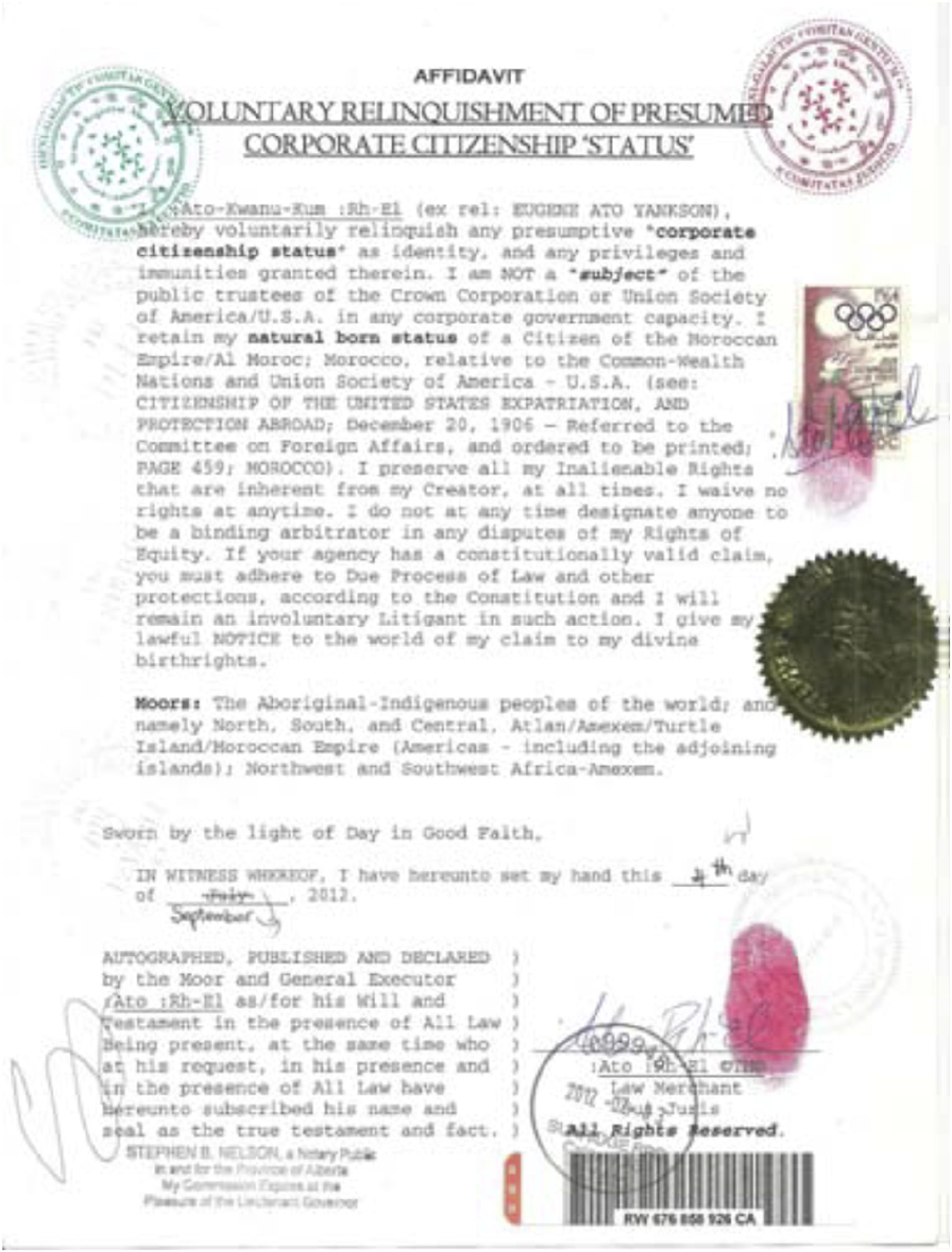
Such a document appears, at first glance, to be a standard legal document. To the non-legally trained, it would appear formal and legally significant. It is only on closer inspection that some of the bizarre pseudolaw ritualistic behaviours are revealed, including the affixed postage stamp and red fingerprint. 44
And this highlights the key issue that needs to be understood about pseudolaw. Pseudolaw arguments do not work. They are not law and are not effective in avoiding legal obligations. Yet the arguments, forms and rituals of pseudolaw often look like law to the legal outsider.
Pseudolaw and illusions of meaning
It is at this point that we, as legal insiders, need to pause and reflect – because pseudolaw, while nonsensical to our eyes, does hold up a (distorting) mirror to our legal system. As uncomfortable as it may be to acknowledge, the reality is that our law does use archaic language and often Byzantine ritual, and these systems are conceptually inaccessible to the general member of the public. In such a context, it is far too easy for an alienated and excluded layperson to mistake the (pseudolegal) behaviour that mimics the form of law for law itself. As Griffin and Roemling observe, ‘as long as a given pseudolegal text “sounds” sufficiently legal, a layperson may well interpret it as such.’ 45
Critically, when disaffected and alienated individuals with poor functional legal literacy 46 are confronted with the coercive power of law, the allure of pseudolaw can be compelling. 47 The esoteric and inaccessible law is suddenly reclaimed, and the new rituals and arguments seem to offer an inversion of traditional legal powerlessness. Pseudolaw seems to share all the outward characteristics of law, a seemingly common form of both argumentative style and ritualistic behaviours: it must, therefore, be law!
This is the central issue: pseudolaw creates an illusion, for the laity, of being legally meaningful. Were the actual law readily accessible this may not be a problem. However, when we exclude the population from meaningful engagement with the law, we rob them of the ability to distinguish between law and not-law. At this point, not only is the public unable to distinguish between law and its illusion, but they lack the tools to pierce that illusion.
Yet citizens inevitably need to engage with the law – our best data remains that, every year, 25 per cent of Australians experience a serious legal issue. 48 Unavoidably, then, the collision between need and capacity creates a fertile space for misinformation and conspiracy to grow. There is now an increasing recognition that a sense of ‘alienation’ and ‘legal powerlessness’ 49 underlies the emergence of pseudolaw. 50 Pseudolaw flourishes where a lack of ‘legal literacy’ 51 (that is, the ability to meaningfully utilise and understand law and legal processes) collides with the need of an individual to engage with legal institutions.
Pseudolaw operates to create an illusion of law, and it thrives where alienated individuals desperately want to believe in that illusion.
Pseudolaw, generative AI and illusions of meaning
Were this the extent of pseudolaw, its potential disruption would be bad enough, particularly with its historical links to extremism and violence. 52 Yet there is evidence that this pseudolaw is beginning to interact with another emerging social phenomenon – the widespread use of GenAI and particularly Large Language Models (‘LLMs’) – in a manner that is particularly alarming. In one recent case, a judge was dealing with oral submissions that were advancing pseudolaw-like arguments, only to discover that the litigant-in-person was using an LLM to generate responses to questions from the bench in real time. Instances of written submissions containing clear hallucinations are becoming unfortunately common. 53 What is concerning is that both pseudolaw and LLMs share core common characteristics: in both cases, the public is engaging with inherently complex and inaccessible forms of technology that produce outputs which look like what they think the output should look like.
As I have explained elsewhere, LLMs utilise a mindbogglingly large number of permutations to make predictions about the most likely next word in a sequence, by treating each word as a number: ‘words-as-vectors’. 54 This technology enables extraordinarily compelling outputs that look meaningful. Yet these systems make no attempt to understand or externally validate the meaning of terms used; all that matters is the statistical ‘closeness’ of any set of words-as-vectors. 55 However, most users do not understand the functioning of this technology. When combined with the inherently opaque ‘black-box’ deep neural networks technology used to ‘transform’ these statistical calculations to add context, 56 LLMs function in a manner that is beyond the comprehension of most people. 57 Yet these technologies succeed in producing outputs that appear eerily close to actual language – that have all the appearance of semantic and syntactic meaning. Moreover, they appear to promise the intoxicating proposition of democratising all human knowledge and expertise. This is, however, only an illusion – there is no external verification of meaning, and no underlying intentionality in the use of words.
LLMs are like pseudolaw: they promise meaningful engagement with knowledge, but only produce something that looks meaningful. Essentially, both phenomena succeed in replicating the form of their mimicked output, but not its substance. Moreover, both phenomena flourish where their users desperately wish to believe in the efficacy of their magical output. And, of course, both seem to offer a shortcut to the acquisition and use of apparently Byzantine knowledge.
Implications of pseudolaw’s triumph of form over substance
The convergence of these two fundamental characteristics helps us to understand the success and limitations of both phenomena. In particular, if we are to properly develop responses to pseudolaw, and its threat to the administration of justice, it is necessary to have a deep understanding of its nature – and the analogy with LLMs helps reveal a number of aspects of that nature. While I have developed these ideas in more detail elsewhere, 58 in the following section I explore four key implications of this juxtaposition for better understanding pseudolaw.
Conceptual pareidolia
First, the juxtaposition highlights that both phenomena see users being tricked by the illusion, mistaking the form for the thing itself. I suggest that this reflects the human tendency to perceive meaningful patterns in unrelated stimuli – akin to a form of pareidolia. Pareidolia involves perceiving patterns and meaningful interpretation in things that are nebulous and otherwise meaningless: 59 for example animals in clouds, a face in the gnarled trunk of a tree. It is recognised that users of pseudolaw generally have a genuine belief that what they are doing represents actual law. I argue that this is because they are experiencing a kind of pareidolia – the ritualistic words appear so like how they expect law to look that they think they are looking at law.
The mistaken correlation of confidence for competence
Secondly, users of pseudolaw are notably more confident in their presentation of their arguments than other litigants-in-person, As with LLMs, I suggest that this is a consequence of users mistaking confidence for substantive knowledge drawing upon the heuristic to treat confidence as a proxy for knowledge (the ‘confidence heuristic’). 60 When a pseudolaw adherent reads pseudolegal materials and arguments developed by gurus, the very confidence by which those materials mimic legal forms makes that adherent more likely to believe that what is presented is true and is ‘true law’. Pseudolaw may be nonsense, but it is confident nonsense.
Form-driven success
Thirdly, both phenomena can be highly successful in a certain way, provided the relevant domain focuses on form rather than substance. For pseudolaw, this form-as-success helps to explain both communicative expertise developed by some users, 61 as well as the role of gurus who sell access to the specialised knowledge and language forms they purport to possess. In both instances, there is success – but it is a success of form and not substance.
The use of magic thinking
Finally, both phenomena appear to offer something deeply desirable – genuine access to specialised knowledge in a way that empowers the user. 62 Through special ritualised forms, the users seem to achieve a fantastical and magical result – so good, in fact, that the user desperately wants to believe that the output is substantive successful. Pitcavage has noted that ‘[m]agical thinking is at the heart of most sovereign citizen pseudolaw.’ 63 For pseudolaw, the recognition of the appeal of this ‘magical thinking’ by users is vital if judges and educators are to help users abandon the practice.
If we are to understand, and confront, the rise of pseudolaw it is important to think about it as more than just a collection of arguments that are ‘obvious nonsense’. 64 While it is easy for lawyers to focus on the ‘doctrinal’ form of pseudolaw arguments, and the often-obvious logical incoherence of the arguments, the focus misses the appeal and longevity of the claims.
My hope is that the juxtaposition with LLMs helps us to get behind the argumentation to focus on the qualities of the phenomenon – that contrast highlights the efficacy of the illusion, the significance of the confident mode of presentation, the spaces where it does succeed and the inherent appeal to users. We are already seeing evidence of the overlap between pseudolaw and the use of GenAI by litigants, and it is reasonable to suspect that the line between these two phenomena are likely to blur further in coming years. Each phenomenon deserves study in its own right. Yet it is also worth reflecting on the commonalities highlighted through their juxtaposition.
Why understanding that pseudolaw matters
First and foremost, however, this article aims to provide an introductory overview of the phenomenon of pseudolaw to an audience that likely has had little more than a passing acquaintance to the key ideas. In this context, I introduce the juxtaposition with LLMs for the principal purpose of helping the reader understand pseudolaw, and because it helps to highlight a number of possible responses to pseudolaw that can be effective in minimising its impact.
First, this approach helps us focus on the significance of the illusion to the user of pseudolegal arguments, as users often have a genuine belief in the meaningfulness of the pseudolaw argument. This requires both systemic and individual responses. Systemically, we must recognise the role of our institutions in creating the fertile fields for such misinformation to flourish as a result of our tolerance of legal illiteracy and the alienation of citizens from law. At the individual level, this recognition reveals the need to avoid both mockery and engagement – pragmatic disinterest in the argument (but not the person) is now the preferable approach. 65 Secondly, it is important to recognise that there are a range of different types of users – the naïve, the true believer, the mercenary and the guru. 66 Responses should vary depending upon the type of user being confronted. Thirdly, as the form and performance of pseudolaw matters, the most successful responses are aimed at disrupting the performance. Users can display a high degree of communicative expertise, but judges and practitioners can develop responses that subvert the attempted performance. 67 Finally, it is critical to recognise that scholarship and experience of dealing with pseudolaw has expanded rapidly in the last few years. No one now need to feel like they must start from scratch, as there are extensive resources outlining the nature, form and effects of pseudolaw.
Ultimately, though, understanding pseudolaw is critical because it forces us to reflect upon our legal institutions and the relationship between the public and the law.
Law matters. But so does meaningful public engagement with, and understanding of, law. Pseudolaw is the logical extension of 50 years of diminishing access to justice and a chronic underinvestment in civics and legal literacy education. Failures in those domains have given rise to pseudolaw, which is already profoundly disrupting our courts. Yet the problem has the potential – if turbocharged through its interaction with GenAI – to become an existential threat. The widespread utilisation of technologies to create outputs that look legally meaningful, yet are substantively nonsensical, would risk fundamentally disrupting almost all aspects of our legal processes. It is critical, therefore, that all law students, academics, practitioners and judges begin to fully engage with the nature of this phenomenon.
Footnotes
Declaration of conflicting interests
The author declared no potential conflicts of interest with respect to the research, authorship, and/or publication of this article.
Funding
The author received no financial support for the research, authorship, and/or publication of this article.
