




Abstract
Australia faces declining productivity growth, which risks affecting national prosperity. This article considers whether adopting a four-day work week in Australian labour law could boost labour productivity. It argues that the four-day work week should be seriously pursued by policy-makers, employers, employees and unions.
Productivity growth has traditionally supported prosperity growth in Australia; productivity growth represents fewer hours worked for the same output.
1
However, Australia faces what the Australian Productivity Commission has described as a ‘productivity predicament’.
2
Productivity growth is slowing,
3
and in 2023–24 declined to 0 per cent.
4
Declining productivity growth means incomes will be lower, and working time will be longer.
5
As the Productivity Commission summarises, with slow productivity growth, [n]ot only does it take longer to achieve a given level of prosperity, but the cost – in terms of consumption forgone – of swapping out of work and into leisure is also much higher. The often touted ‘4-day week’ is that much harder to achieve.
6
But what if the touted ‘four-day week’ could itself boost productivity? The ‘four-day week’ involves workers maintaining the same level of pay, while working only four days (or 30 to 32 hours) per week as a full-time load, and still maintaining the same level of productivity (that is, still doing the same job). 7 The non-profit 4 Day Week Global describes this as a 100-80-100 model – 100 per cent of the pay, 80 per cent of the time, but 100 per cent of the productivity. 8 Essentially, this model reconceives what ‘full-time equivalent’ work looks like, and the number of working hours it entails. 9
This article assesses current progress towards a four-day work week in Australia, and its potential to boost labour productivity. It argues that the four-day work week should be seriously pursued by policy-makers, employers, employees and unions. The article commences by examining the issue of declining productivity growth in Australia, then moves to the existing regulation of working time in Australian labour law. The next section considers whether a four-day work week in Australia might actually boost labour productivity, drawing on existing trials of the four-day working week in Australia and internationally. The article then interrogates why reducing working time might boost productivity, then examines existing calls for the four-day working week in Australia and finally considers four-day working week trials in enterprise bargaining. The article concludes by considering the implications of the four-day working week for work intensity and for workers who are not employees, and identifies areas for future research, practical trials and scholarship.
The Australian productivity predicament
For the Australian Bureau of Statistics (ABS), labour productivity is calculated as gross domestic product (GDP) per hours worked. 10 Labour productivity is an indicator of economic efficiency, and productivity growth can drive economic growth, wages and living standards. 11
Labour productivity growth, 20-year average annual growth rate (%), Australia, 2003–04 to 2022–23.
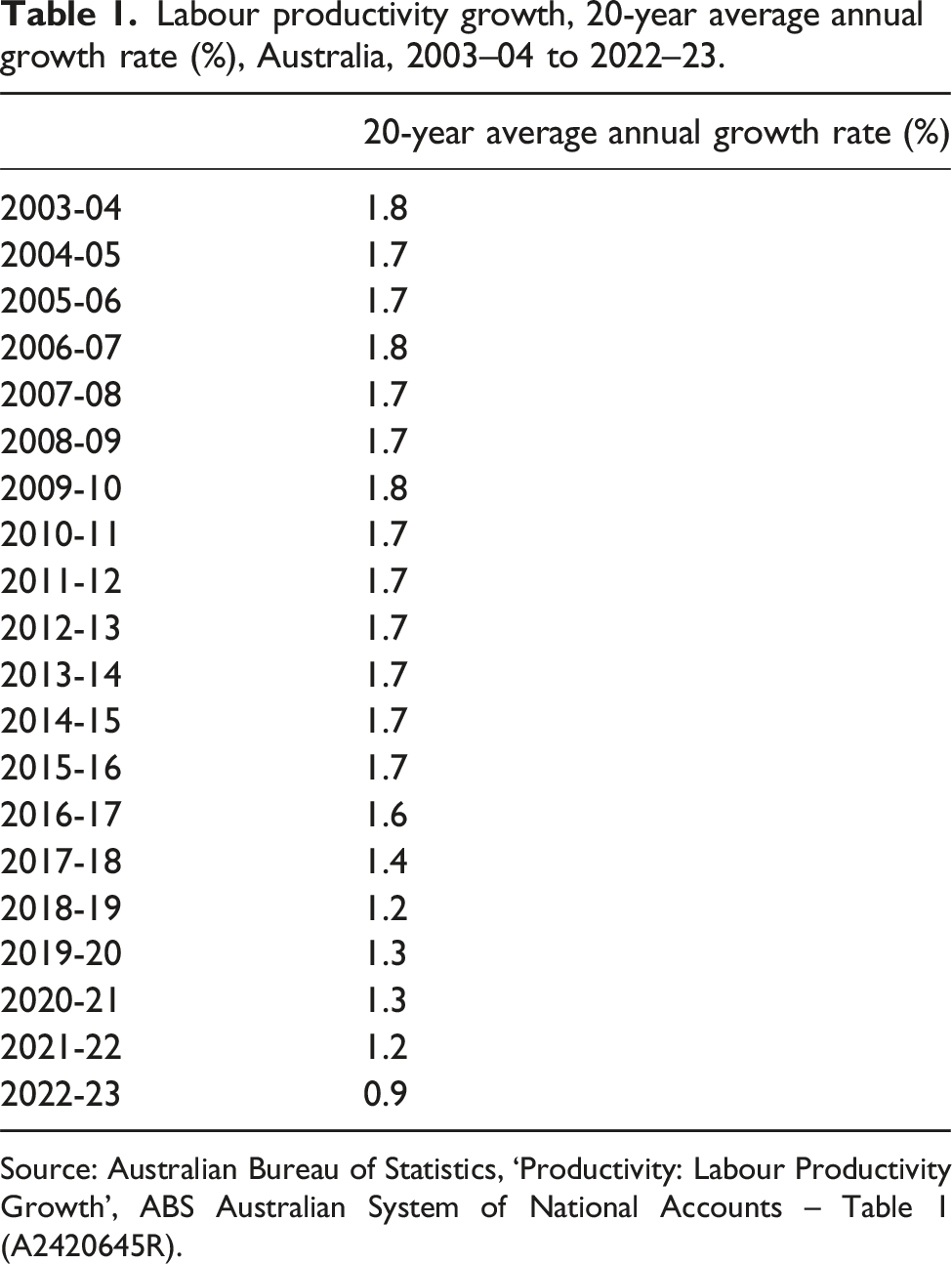
Source: Australian Bureau of Statistics, ‘Productivity: Labour Productivity Growth’, ABS Australian System of National Accounts – Table 1 (A2420645R).
Productivity growth is not a unified picture across the economy; 12 some sectors are experiencing more productivity growth than others, particularly due to the uptake of technology. 13 The services sector has particularly low productivity growth; 14 at the same time, the services sector continues to grow as a proportion of the Australian economy, 15 employing nine out of 10 workers, and accounting for around 80 per cent of Australia’s economic output. 16 These dual trends are likely to be pulling down productivity growth for the Australian economy as a whole.
The Draft Report of the Secure Jobs, Better Pay Review, 17 prepared by Emeritus Professor Mark Bray and Professor Alison Preston, has therefore called for a ‘sophisticated conversation’ about productivity in Australia. 18 Employer submissions to the Review asserted that flexible working arrangements would ‘likely result in a significant loss in efficiency or productivity’. 19 However, submissions to the Review generally contained little evidence in relation to factors that would support or inhibit productivity. 20 The Review distinguished productivity at national, industry/sectoral and enterprise/organisational levels, 21 while also noting that measuring productivity at enterprise or organisational levels is fraught, including due to a lack of public data. 22 At the national level, while labour productivity can simply be measured by comparing hours worked to GDP (as reported by the ABS, above), another approach is to adjust hours worked by workers’ level of skill. 23 Thus, different measures of productivity may lead to different results or insights. Regardless, it is difficult to measure productivity in non-market sectors, as for services provided by government, despite such services growing over time. 24 Productivity data is therefore likely to have significant gaps and omissions in considering the economy as a whole. The Report did flag, though, that one reason for declining productivity may be worker burnout, 25 raising the question of how we could use working time to better promote labour productivity growth.
Working time in Australian labour law
The Fair Work Act 2009 (Cth) provides for maximum weekly hours in s 60. Maximum weekly hours are set at 38 hours for full time work, plus reasonable additional hours. 26 Employees may refuse to work unreasonable additional hours. 27 Existing full-time working hours reflect the 19th century call for ‘Eight hours to work, Eight hours to play, Eight hours to sleep’, which has been progressively introduced in Australian labour law since stonemasons downed tools at the University of Melbourne in 1856 in support of the eight-hour work day. 28 The 40-hour work week was adopted in an award test case in 1947. 29 Full-time working hours reflect a gendered model of work that ignores the unpaid labour of social reproduction, such as domestic obligations, caring or community responsibilities. 30
In 2024, following the passage of the Fair Work Legislation Amendment (Closing Loopholes No 2) Act 2024 (Cth), the Fair Work Act 2009 (Cth) was amended to add a right to disconnect. 31 The right to disconnect provides that employees may refuse to respond to contact from an employer or a third party outside of working hours, unless that refusal would be unreasonable. 32 This could prove to be an important complement to provisions relating to maximum working hours, ensuring the sanctity of non-working hours. 33 Further provisions relating to working time might be included in awards or enterprise agreements. Practically, a four-day work week might be implemented in Australia via amendments to the Fair Work Act 2009 (Cth) to reduce maximum weekly hours for full-time work or via specific provisions in awards or enterprise agreements.
Adjustments to working time can promote equality at work. For example, the right to request flexible work arrangements might be used to adjust or compress working hours, supporting workforce participation for those with caring responsibilities or disabilities and for older workers. 34 Part-time work has traditionally been common among women in Australia, particularly for those with caring responsibilities, and is one contributor to both the gender pay gap and the gender pension gap. 35 The difference between part-time work and the four-day work week, though, is that the time commitment to work is reduced in the four-day work week (from five days to four), but typically without a reduction in pay. The four-day work week is also distinct from compressed working hours, where a worker completes a full work week (of 38 hours), but across four (long) days; instead, in a four-day work week, weekly working hours are reduced overall, while maintaining productivity. The four-day work week is an adjustment to working time that might be particularly successful at advancing workplace equality, as well as, perhaps, productivity.
Findings from four-day work week trials: The impact on productivity
In 2022, a series of trials were conducted around the world, with employers in Ireland, the United States, Australia and New Zealand trialling a four-day work week. This was followed by city and national trials. A separate 2022 survey of 41 participating companies in the United Kingdom (UK) found that 46 per cent reported that productivity remained at the same level during the four-day work week trial; 34 per cent reported that productivity improved; and 15 per cent said that it significantly improved. 36 An earlier trial by Microsoft Japan reported a 40 per cent increase in productivity. 37
In 2024, 45 German companies trialled a four-day work week. The majority (73 per cent) of participating companies were small or medium enterprises, and a number of participating companies were providing services. 38 There was no significant difference between the financial performance of the companies (across revenue and profit) in the year prior to the trial and during the trial. 39 This implies productivity gains during the trial, 40 as the same output was produced in less working time. On a scale of 0 (negative) to 10 (positive), senior managers on average reported the impact of the trial on productivity as being 6.7, and on performance as being 6.8. 41 Employees’ self-reported productivity also increased. 42 The majority of companies (73 per cent) elected to continue the four-day work week after the end of the trial period. 43
A 2023 study of 10 Australian employers which had adopted a four-day work week also found that employers reported improved productivity with the new working arrangements, as well as better staff retention and recruitment. 44 In that study, 70 per cent of employer respondents said productivity was higher since the introduction of the four-day work week, and 30 per cent said it was about the same as before. 45 In 2023, health insurer Medibank launched a four-day work week trial for some employees for six months, 46 which was expanded in 2024 to 500 employees; 47 and Unilever commenced a 12-month trial in Australia in 2022, following a successful pilot in New Zealand. 48
Shorter working time and productivity
These trials seem to indicate that shorter working hours can actually boost productivity. What is going on? As Chung argues, short, focused hours of work can be more effective at getting things done than working longer hours. 49 Inadequate rest, insufficient down time away from work, and long working hours themselves can lead to negative health outcomes and reduce employee engagement with work. 50 All these things can reduce productivity.
As well, however, four-day work weeks refocus our attention on what it means to be productive. During the trials, employees reported being more strategic and selective with their time management. In the German trial, for example, employees reported they made adjustments to respond to the reduction in working time, including by reducing distractions (65 per cent), optimising processes (63 per cent), and modifying meeting structures (52 per cent).
51
Employers and organisations also made changes to respond to the shift in working time, including by changing the culture around meetings (68.8 per cent), reducing distractions (56.3 per cent), and introducing new digital tools or systems (40.6 per cent).
52
The Microsoft Japan trial of the four-day work week
53
involved encouraging shorter (30 minute) meetings, and using chat channels rather than email.
54
In the Australian study, to implement the four-day work week, all respondents had reduced the length and frequency of meetings.
55
Other strategies Australian companies adopted included identifying and reducing non-essential tasks, the better management of email (via Inbox Zero training), and time management strategies such as ‘time blocking’ to complete important tasks.
56
In the Australian study, most employers saw the four-day work week as a privilege or ‘gift’, which could be taken away if productivity declined.
57
The shift in working hours was not generally formalised in employees’ contracts.
58
As Hopkins, Bardoel and Djurkovic noted in their Preview Report, ‘Gifting somebody an extra day off each week provides strong motivation for getting the work done, maintaining quality and performance, and cutting out wasteful tasks and behaviours.’
59
And as one witness in the Australian Capital Territory (ACT) inquiry into the future of the working week (discussed below) described, I suppose it is about having the mental energy. When you are there on those four days, you are really there. When you are at work for five days, sometimes you spend Monday morning settling in, and you spend Friday afternoon sliding off, sometimes. I noticed it in my behaviour; when I switched to four days, I rocked up and I was right into it. I continue right until the end of the Thursday. For me it is Monday to Thursday. I certainly have not seen a decrease in productivity. I have the same number of projects, if not more, as my colleagues who are in the same job. … I maintained my workload.
60
Essentially, adopting a four-day work week means people get more done in less time, 61 and adapt their work behaviours to become more efficient and productive (including, perhaps, because they are aware they are taking part in a trial). Workers involved in the trials also reported feeling less stress, burnout, and fatigue, and reported better work-life balance, getting more exercise and more sleep. 62 Infinite Potential’s report, The State of Workplace Burnout 2024, surveying 2008 participants across 43 countries, found that while 42 per cent of those surveyed and working 40+ hours per week were experiencing burnout, only 9 per cent of those working a reduced-hour model (four-day work week) were experiencing burnout. 63 The four-day work week can therefore improve the psycho-social environment of the workplace, increasing staff retention and morale. Indeed, burnout is negatively correlated with productivity. 64
While a four-day work week, and these strategies for increasing productivity, are particularly well-adapted to professional roles, they may be more complicated to adapt to sectors like health care or emergency services, where continuous coverage may be required. There is a need, then, for trials across a range of jobs and sectors, to better establish the possibilities and limits of a four-day work week.
Calls for trials in the Australian public sector
The potential benefits of a four-day work week are being increasingly recognised in government inquiries and reports. In the ACT, the Standing Committee on Economy and Gender and Economy Equality of the Legislative Assembly conducted an inquiry into the future of the working week from 2021 to 2023. The ACT Committee found that the evidence presented contradicted any belief that a four-day work week would lead to a decline in productivity, or an increase in employment costs.
65
As the ACT Committee concluded: While the Committee acknowledges that some specific industries (mainly front-line services) would experience a loss of worker and business productivity if a four-day work week were implemented, the majority of evidence shows that productivity can be maintained or increased across the economy at large. Across organisations and perhaps across industries, there is scope for productivity gains in one sector to balance out losses in another, for an overall gain or at least maintenance of the quality and quantity of goods and services produced under a longer week.
66
The ACT Committee found strong support in the community for a four-day work week, and cited benefits such as improved staff retention, improved work-life balance and wellbeing, lower rates of stress and burnout, more time for caring responsibilities, 67 and better enabling workers with caring responsibilities and disabilities to participate in the workplace. 68 The ACT Committee noted that the ACT public sector was a good place to trial a four-day work week, given the range of roles and sectors it operated in, 69 and recommended that findings from a trial should be shared broadly, to inform the evidence base for the four-day work week. 70 In its response to the ACT Committee’s report, the ACT government agreed in principle to look into convening a working group in 2024 to develop a roadmap to trial a four-day working week in the ACT public sector, and to give private sector organisations the opportunity to participate voluntarily in the trial. 71
A four-day work week was also recommended by the Senate Select Committee on Work and Care in 2023.
72
For the Select Committee, a key benefit of a four-day work week is that it ‘normalises care as a part of working life’.
73
It could also make work more accessible, especially for women and those with caring responsibilities, offering an ‘even playing field’
74
of work: It raises the prospect that working carers can progress their careers and take up employment appropriate to their level of qualification, while also encouraging a redistribution of unpaid labour more equally across genders.
75
A more even playing field could help reduce the gender pay gap 76 and the gender pension gap, although the Select Committee noted that these potential impacts had not been well captured in existing analysis of the four-day work week. 77 The Select Committee recommended that the Australian government should request the Fair Work Commission (FWC) to undertake a review of standard working hours, with a view to reducing the standard working week. 78 The Select Committee also recommended that the Australian government undertake a four-day work week trial, based on the 100:80:100 model, and partner with a university to monitor the trial, including its impact on gender equality. 79 In its response to the Select Committee’s report, the government noted these recommendations, but deferred any consideration until after the FWC’s Modern Awards Review, which was to consider working hours. 80 The government noted that claims relating to the four-day work week had not been agreed as part of enterprise bargaining for the federal public sector. 81 The FWC’s Modern Awards Review 2023–24 Report was delivered in 2024, and canvassed a number of issues relating to working time, including provisions relating to part-time work. 82 However, the Modern Awards Review did not consider or canvass a four-day work week or changes to the maximum working hours for full-time work. 83 It is perhaps timely, then, for the government to reconsider its response to the Select Committee report. In 2025, the Greens announced a four-day work week election policy, including national trials of a four-day work week, to be co-ordinated via the formation of a National Institute for the Four Day Work Week (with funding of $10 million per year), and support of a test case for reduced hours at the FWC. 84 The President of the Australian Council of Trade Unions, Michele O’Neil, has also expressed support for a four-day work week. 85
The four-day work week in enterprise bargaining
While progress in the Australian public sector towards a four-day work week has been slow, some progress is being seen in collective bargaining. For example, the Oxfam Australia (OAU) enterprise agreement has embedded a commitment to trial a four-day work week, providing that: [d]uring the life of this Agreement, OAU agrees to pilot a 30 hour working week arrangement with all of its fixed-term, maximum-term and permanent employees (30 Hour Work Week Trial) for an initial 6 month period.
86
During the Oxfam trial, a full-time load will be varied from 35 hours per week to 30 hours per week, with part-time work adjusted accordingly. The trial will be regularly reviewed and assessed, to ensure it supports both OAU and its employees’ preferred way of working; supports employees’ work life balance, and mental and physical wellbeing; remains cost neutral to OAU; and maintains comparable productivity levels observed during the current 35 hour week.
87
The agreement provides that, at the end of the trial, it could be extended, formalised as part of regular working arrangements, or could return to a 35 hour week. 88 Proposals for a four-day work week, or a trial, were rejected as part of Australian Public Service bargaining in 2023. 89
Conclusions: Implications of the four-day work week
So far, the evidence in favour of a four-day work week appears strong. Trials across countries and employment types have consistently illustrated potential benefits of reducing working time. Indeed, it appears that a four-day work week may boost productivity, encouraging workers and organisations to refocus their attention on what it means to be productive, and to become more strategic and selective with their time management. Existing trials illustrate a range of strategies that might boost labour productivity: reducing meetings and their duration, reducing email, and adopting better time management strategies. The promise of reduced working time, without a reduction in pay, offers employees significant incentives to identify and implement productivity gains, beyond what might be achieved in regular working arrangements. Essentially, the benefits of increased productivity are shared, by enabling workers to have access to more time off work.
In theory, though, adopting a four-day work week could lead to an increase in work intensity or work intensification. 90 In the German trial, work pace was reported as increasing (from 7.16 out of 10, with 1 very low and 10 very high, to 7.53 out of 10). 91 An increase in work pace is likely to be related to increased productivity. 92 This reveals, however, the need for collaborative (re)design of what a four-day work week looks like for each organisation and role, to manage work intensity and to keep intensity at sustainable levels. At Oxfam, for example, the plan for moving to a four-day work week was ‘co-designed’. 93 With strategic redesign of work, to focus on what adds value, a four-day work week does not need to lead to damaging work intensification. Rather, co-design can ensure that any increase in work pace is manageable and sustainable. Indeed, any intensification that does result from adopting a four-day work week is likely to be offset by workers having an additional day to rest and recharge at the end of the working week. In the German trial, then, 83 per cent of employees wished to continue with a four-day work week, 94 and the trial overall led to improved employee wellbeing and health, and reduced stress, 95 even with an increase in work pace.
A four-day work week could be applied to both full-time and part-time employees, as in the Oxfam model. Most trials to date have focused on employees; there has been less consideration of how a four-day work week might impact casual employees, or those who are self-employed or independent contractors. These are questions that could be considered in future trials and research. The Australian study also noted differences between client-facing organisations (where days off were often staggered, so clients always had support), and non-client-facing organisations, where most people took their ‘day off’ on the same day (generally Friday). 96 Thus, each organisation might implement a four-day work week in a slightly different form or way: again, negotiation and co-design of these arrangements will prove critical to the success of the four-day work week.
More broadly, the four-day work week should prompt us to reconsider what ‘full-time’ work entails. This might ultimately require amendments to the Fair Work Act 2009 (Cth) to reduce the maximum weekly hours for full-time work. In the interim, collective bargaining and negotiated solutions in enterprise agreements offer an important means of ensuring collaborative, co-designed solutions to reduce working time. While four-day work week trials are being repeatedly conducted across the globe, the challenge is to shift work cultures to ensure such changes are sustainable and continued into the medium and long-term. This shift in working time may just hold the key to boosting labour productivity in Australia and resolving Australia’s productivity predicament.
Footnotes
Declaration of conflicting interests
The author(s) declared no potential conflicts of interest with respect to the research, authorship, and/or publication of this article.
Funding
The author(s) received no financial support for the research, authorship, and/or publication of this article.
