



Abstract
Kathleen Folbigg’s recent acquittals for multiple homicides have rekindled the debate over the adequacy of post-conviction review in Australia. This article explores the constraints of the finality principle and the appellate system in Australia in addressing potential wrongful convictions, including the impact of managerialist policies. The authors discuss the limitations of an independent criminal case review commission model. They argue that the debate should be centred on the inadequacy of legal aid as a significant risk factor for wrongful convictions, the need for less restrictive appeal criteria, and developing consistent and transparent processes for the retention and retrieval of evidence.
Kathleen Folbigg’s recent acquittals for manslaughter and murder 1 re-ignited discussions about an independent criminal cases review commission in Australia. Folbigg was convicted in 2003 of killing her four infant children but a 2022 inquiry found there was medical evidence indicating her children died of natural causes. 2 Folbigg had exhausted all avenues of appeal and had been unsuccessful in an earlier judicial inquiry. 3
The history of miscarriages of justice through the courts has shown that challenging potential wrongful convictions is intended to be difficult. The restrictive application of the finality principle limits opportunities for defendants to contest their convictions and, while one of the functions of criminal appeals is to safeguard against miscarriages of justice, 4 threshold appeal requirements potentially exclude many cases of factual innocence. The Australian appellate system is reluctant to deal with the problem and prevalence of factual innocence cases, preferencing legal errors on ‘first’ appeals 5 and insisting on fresh evidence on second and further appeals. 6
Most research on risk factors for miscarriages of justice has been international, focused primarily on the United States (US), and little is known about Australian risk factors. The US experience has led to expansive non-judicial review mechanisms, including numerous innocence projects and almost 100 conviction integrity units. 7 Conviction integrity units are specialist departments established within prosecution bodies to conduct independent and impartial reviews of challenged convictions. 8 The Australian response to known wrongful convictions, however, has largely been confined to creating additional, narrower opportunities to appeal, which have severely restricted review opportunities for factually innocent defendants.
This article examines limitations of the appellate system in addressing wrongful convictions in Australia and considers the possibility of a post-conviction review body such as the Criminal Cases Review Commission (‘CCRC’), which was established to investigate potential miscarriages of justice in England, Northern Ireland, and Wales. We argue that meaningful discussions about post-conviction review reform must consider balancing managerialist policies with more flexible thresholds for appeal that acknowledge practical constraints on defendants’ capacity to run a thorough trial defence, or access evidence for appeal. These constraints include the lack of effective or full disclosure to the defence prior to trial and the impact of legal aid funding restrictions on preparation time.
Managerialism
The influence of managerialist policies on the practices of Australian courts over the last four decades is a significant impediment to more flexible appellate reforms. 9 Managerialism carries concerns about the ‘McDonaldisation’ of justice, when benefits of increased efficiency and calculability, improved administration and reduced delays in the court system come at the cost of due process. 10 Managerialism is particularly evident in the appellate gatekeeping role; while most Australia jurisdictions allow appeals as of right on questions of law alone, 11 leave is required for all other grounds of appeal. Requirements for leave to appeal empower courts to limit the number of cases that progress to appeal, addressing concerns about unmeritorious claims inundating the courts. 12 In 2021–22, there were 684,138 criminal cases finalised at the state and territory court levels, including children’s courts and, of those, 8733 or 0.012 per cent were appeals. 13 The appellate gatekeeping function is particularly evident in the cautionary legislative approach to second and further appeal rights, namely that the ‘spectre of endless untenable efforts to reopen old convictions should be avoided.’ 14
While Australian post-conviction review options include judicial inquiries, Royal Commissions, and prerogative of mercy petitions, these administrative options are ad hoc, can be difficult to access and, in the case of the mercy prerogative, lack transparency. This article is concerned with the limitations of judicial appeals in addressing systemic impediments to establishing wrongful convictions, beginning with the limitations imposed by the finality principle.
The finality principle provides a practical means of providing certainty by bringing disputes to a conclusion. 15 Its rationale in criminal proceedings is both managerial 16 and compassionate: 17 endless legal proceedings would impede the administration of justice, and victims and witnesses should not be re-traumatised by convicted people relitigating the issues they disputed at trial. 18 Finality is also a powerful concept, directly linked to public confidence in the criminal justice system. As people tend to accept convictions as indisputable, the trial and punishment of offenders promotes confidence in the system’s community protection role. 19 Australian appeal courts are also reluctant to disturb jury verdicts. 20 This restrictive adherence to the rule can make it very difficult for defendants to challenge their convictions.
Criminal appeals and the proviso
Criminal appeal rights in the UK and Australia are relatively recent. Australian appeal provisions were modelled on the Criminal Appeal Act 1907 (UK) 21 and empower appellate courts to overturn convictions on grounds that: the jury’s verdict was unreasonable or cannot be supported on the evidence; there was a wrong decision on a question of law; or on any ground, where there was a miscarriage of justice. 22 Referred to as ‘common form’, the Australian provisions retained a proviso from the UK model authorising a court of appeal to dismiss appeals if it considered no substantial miscarriage of justice had occurred. 23 The High Court has declined to define either ‘substantial miscarriage of justice’ or ‘no substantial miscarriage of justice as these would depend on the individual circumstances that are claimed to attract the proviso’. 24
‘Fresh’ evidence appeals
At common law, miscarriages of justice occur where: there is evidence on appeal establishing an appellant’s innocence such as exculpatory DNA evidence; the court can conclude on the material before it that there is reasonable doubt about guilt; or the appellant’s trial was not fair. 25 Appeal courts can consider new evidence but are more likely to intervene if the new evidence has the additional quality of being fresh, namely evidence that was not reasonably available to the defendant during the trial. 26 The High Court has held that there will not be a miscarriage of justice just because the defendant did not call evidence that they should reasonably be expected to have been aware of at trial, even if that evidence would likely have resulted in a different trial verdict. 27
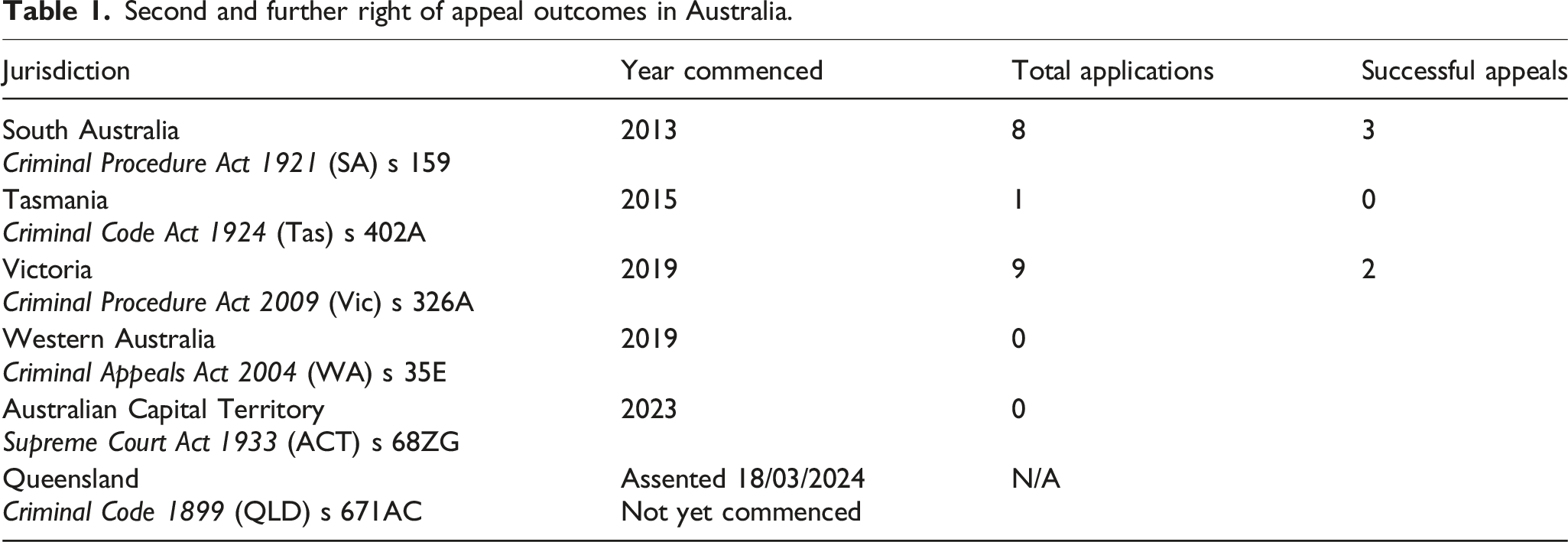
Fresh evidence is critical to second and further appeal rights introduced in South Australia (SA), Tasmania, Victoria, Western Australia (WA), Queensland and the Australian Capital Territory. 28 All require ‘fresh’ and ‘compelling’ evidence. For example, in Victoria, the Court of Appeal may grant leave to appeal under section 326A of the Criminal Procedure Act 2009 (Vic), if it is satisfied that there is fresh and compelling evidence that should, in the interests of justice, be considered on an appeal. Evidence is compelling if it is reliable and substantial and either highly probative of the issues in the dispute or would have eliminated or substantially weakened the prosecution case at trial. Once past that threshold, the court must allow the appeal, if satisfied there has been a substantial miscarriage of justice (s 326D).
The bar is exceptionally high. Threshold requirements of fresh and compelling evidence in considering leave to appeal present a very difficult hurdle for many potential applicants. The reliance on fresh evidence assumes that defendants have access to all their case materials and can digest and sufficiently understand those materials to appropriately instruct counsel. There is also an underlying assumption that defence lawyers have the time and resources to be across the whole case.
New further appeals provisions in the Criminal Appeals Act 2004 (WA) provide more flexibility than in the other jurisdictions. ‘Fresh’ evidence defined in s 35D includes the failure to tender evidence, due to the incompetence or negligence of a defence lawyer, while s 35H(4) provides that the Court of Appeal must allow an appeal based on ‘new’ and compelling evidence, if satisfied on the balance of probabilities that, in light of all the evidence, innocence has been established. 29 As we discuss next, however, this expanded definition of fresh evidence may not result in an influx of new appeals.
Second and further right of appeal outcomes in Australia.
Fresh evidence and forensic decision-making
The emphasis on fresh evidence ignores practical limitations on defendants’ capacity to run a comprehensive trial defence. First, fresh evidence impliedly assumes that defendants were aware of evidence that might reasonably have been available to them at trial, were able to make decisions about the treatment of evidence in their defence and understood the significance of those decisions. But many defendants have difficulties in understanding the case against them or providing effective instruction to counsel. Language impairment is a significant issue in Australia where a 2015 survey estimated that 1.2 million people experienced communication difficulties. 30 People with language and communication impairments can struggle to provide a coherent narrative or respond to alternative narratives 31 and there is a well-established relationship between language impairment and involvement with the criminal justice system in Australia. 32 Further, even when defendants on remand can obtain access to digital versions of their case materials to prepare their defence, many may lack essential digital literacy skills. Most correctional facilities also place capacity limits on convicted prisoners’ property, further impeding their opportunities to access material in preparation for any appeal.
Another limitation occurs when defendants lack effective control over their defence. Defendants are bound by forensic decisions made by their counsel in the conduct of their defence and must assume the consequences of that conduct, even if they do not agree with counsel’s decision-making. 33 There will generally be no miscarriage of justice in holding a defendant to tactical decisions that counsel makes on their behalf. 34 Defence counsel’s ‘flagrant incompetence’ may be sufficient but appeals based on this ground must show that the ‘failing or error of counsel was a material irregularity and that there is a significant possibility that counsel’s conduct affected the outcome of the trial.’ 35 Appeal courts consider whether the conduct resulted in a material irregularity in the context of counsel’s wide discretion and will be very unlikely to find there was a miscarriage of justice if there was a reasonable explanation for the act or omission. 36 This ‘reasonable explanation’ potentially includes lack of preparation time, which can have devastating consequences when that results in defence lawyers’ failure to obtain or use relevant, admissible and available evidence or their failure to identify potential non-disclosure issues.
Inadequate legal aid
The most common reason cited for a claimed wrongful conviction in cases reviewed by the UK CCRC was inadequate preparation or trial work by defence lawyers. 37 The 2021 UK Westminster Commission on Miscarriages of Justice heard that legal aid cuts meant that defence lawyers were limited to undermining the prosecution case rather than investigating and gathering independent evidence. 38 The Australian experience, where more than half of criminal cases are legally aided, 39 is likely to be similar. Legal aid funding usually limits defence lawyers to constructing the defence case from material disclosed by the prosecution, with little scope for independent investigation, 40 such as the testing and analysis of forensic evidence. 41
In most criminal cases funded by legal aid, preparation fees are substantially restricted. For example, Victoria Legal Aid only allows fee claims for reviewing or listening to specific segments of video or audio recordings, which means that counsel either listens unpaid to the whole of the recorded material or only consumes content within the limits of the permissible period. 42 These problems are magnified in complex trials involving hundreds of hours of covert recordings obtained from telephone intercepts and listening devices, and even more so in the case of recorded conversations in languages other than English, which are often of a very poor and indistinct quality. A 2008 review found that fee constraints were likely to create incentives for barristers funded by Victorian Legal Aid to accept multiple briefs or proceed in cases with insufficient preparation. 43 More recently, an independent review of the National Legal Assistance Partnership (NLAP) found that current funding of the legal assistance sector was ‘inadequate … to deal with mounting cost pressures and increased demand and complexity.’ 44
Inadequate preparation time drastically impacts counsel’s ability to detect and remedy any non-compliance with prosecution’s disclosure obligations such as seeking to exclude evidence or seeking a stay or adjournment of the proceedings. 45 Several Australian jurisdictions impose obligations on the police to make disclosures to the prosecution. 46 But, even in these jurisdictions, police may continue to disclose to the prosecution material they think is relevant to the defence, based on the case they have presented, not material that would be relevant to the defence. 47 Police may also fail to disclose voluminous material in sufficient detail, limiting opportunities for the prosecution to detect any deficiencies.
Defendants may not be aware that certain evidence was available to them because defence counsel lacked the time and resources to discover disclosure errors. In addition to increasing legal aid funding, we suggest that disclosure inadequacies could be addressed through mandating detailed itemisation of disclosed materials, and random, independent auditing of disclosure certificates in jurisdictions where these exist.
Non-disclosure or late disclosure and lack of full disclosure is an ongoing problem in Australia (see, for example, Victoria’s Royal Commission into the Management of Police Informants in 2020). 48 While miscarriages of justice can be procedural and substantive, non-disclosure does not necessarily demonstrate the substantial miscarriage of justice required for criminal appeals. The appeal court will need to be satisfied that the non-disclosure would have made a difference to the outcome of the trial or undermined the fairness of the trial. 49 In many cases, establishing the non-disclosure breaches may be dependent on the availability of the evidence in question. Uncovering non-disclosure post-conviction is very difficult, particularly when crucial evidence has been withheld or is missing due to inadequate storage practices by police.
Retention of evidence
The 2021 Westminster Commission inquiry found that destruction of exculpatory material was a factor in numerous miscarriages of justice in the UK, with the ‘post-conviction retention landscape’ described in one submission as ‘chaotic’. 50 In Australia, statutory and administrative limits on the retention of property are likely to be similar contributors to unresolved miscarriages of justice. For instance, the Victoria Police Retention and Disposal Authority, which expires on 22 December 2024, provides that briefs of evidence can be destroyed seven years after resolution of a criminal case, including expiry of the appeal period. 51 Records of evidence gathered during the police investigation which were not incorporated into the brief of evidence, including audiovisual records, cell and interview recordings, can be destroyed after administrative use has been concluded. 52 It is not clear whether this authority takes into account the availability of second and further appeal rights, which can be engaged many years after the initial appeal.
There is also a distinct lack of clarity about the retention and storage of evidence by police, particularly where evidence is being stored. For example, it is difficult to determine how many storage facilities are currently maintained by Victoria Police. In 2018, the Victorian Auditor-General’s Office (VAGO) reported that Victoria Police were storing approximately 470,000 property items and exhibits at more than 200 locations, including police stations. 53 The 2023–2024 Victoria Police Corporate Plan, however, only disclosed three storage facilities. It is not clear whether the number of storage locations has been reduced or whether police stations continue to be used for evidence storage. 54
Another issue is whether the evidence is being stored appropriately. The VAGO report found variable practices for auditing property stores with most stations and storage locations not meeting the required number of full annual audits. 55 Inadequate organisational oversight also increased the risk of inaccurate records, and reduced the likelihood of detecting inappropriate handling of materials. 56 In another example in New South Wales, exhibits connected to 22 unsolved homicide cases were discovered by chance in a storeroom of the Sydney Police Centre in 2013. 57 Police record-keeping was later described as ‘bordering on shambolic’ during a subsequent 2023 inquiry into LGBTQ+ hate crimes in the state. 58 The inquiry found a substantial loss of physical exhibits due to property being lost, contaminated or compromised, misfiled, destroyed, or returned to the owners. 59
Limitations of a criminal cases review model
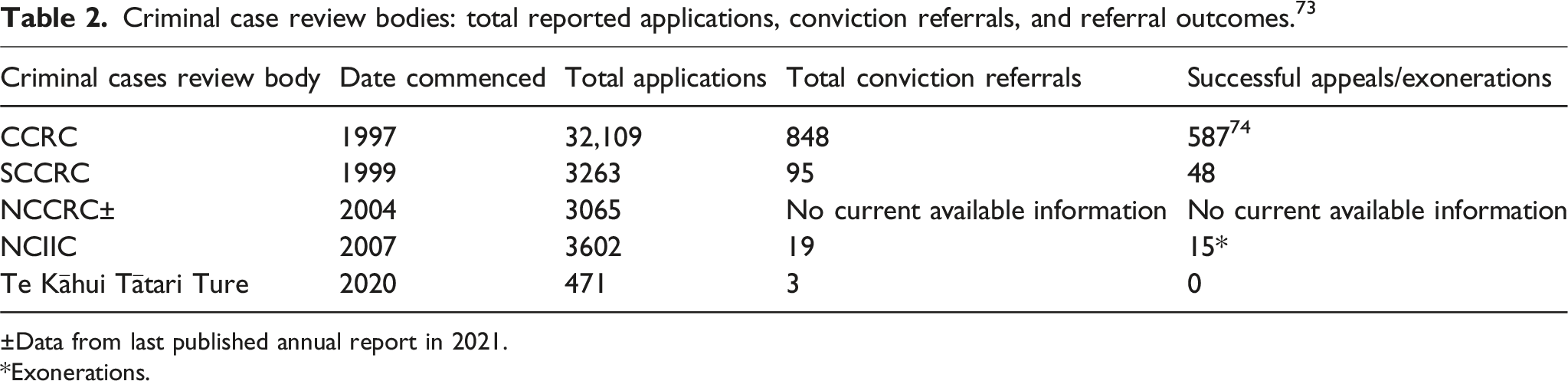
The practical impediments to post-conviction review outlined above are not likely to be addressed by a criminal cases review model such as in the United Kingdom (UK). Established in 1997, the CCRC is an independent statutory body empowered to investigate potential miscarriages of justice in England, Wales, and Northern Ireland. 60 The CCRC has influenced the creation of similar bodies in Scotland, New Zealand, Norway, and North Carolina in the US, while Canada is in the process of establishing a Miscarriages of Justice Review Commission. 61
These bodies have a shared purpose in reviewing convictions but there are some differences between them. For instance, the structure of the North Carolina Innocence Inquiry Commission (‘NCIIC’), which commenced in 2007, 62 borrowed ‘heavily (and self-consciously so) from the CCRC model’, but its narrower focus on factual innocence distinguishes it from the CCRC, which has a broader mandate to investigate unsafe convictions. 63 The New Zealand Criminal Cases Review Commission/Te Kāhui Tātari Ture (‘Te Kāhui Tātari Ture’) and the Scottish Criminal Cases Review Commission (‘SCCRC’) are more closely modelled on the CCRC. 64 The SCCRC is an independent body established to review and investigate Scottish criminal cases involving miscarriages of justice. Another difference is that while the commissions in the UK, Scotland and New Zealand have power to refer cases for fresh appeal, and the North Carolina Innocence Inquiry Commission has power to refer a case for judicial review by a panel of superior court judges, 65 the Norwegian Criminal Cases Review Commission (‘NCCRC’) 66 is empowered to refer re-opened cases for retrial. 67
Criminal case review bodies: total reported applications, conviction referrals, and referral outcomes. 73
±Data from last published annual report in 2021.
*Exonerations.
The low number of referrals reinforces concerns that the CCRC’s deference to the Court of Appeal has resulted in an overly cautious approach in making its determinations This approach reflects similar issues of managerialism in Australia including a conservative response to second appeals. 71 While approximately 69 percent of the cases referred by the CCRC have resulted in successful appeals, as Table 2 indicates, it is referring less than 3 per cent of the applications it receives. The SCCRC has adopted a broader approach than the CCRC, 72 but this has still only resulted in under 3 per cent of referrals from received applications. Further, with 50 per cent of referrals resulting in overturned convictions, the SCCRC had less success than the CCRC.
Critics of the CCRC point to investigators conducting ‘desk assessments’ of the merits of applications for assistance rather than being proactive in examining cases in more detail, 75 and under-resourcing due to extremely high caseloads and funding cuts. 76 Another criticism is that although the CCRC’s mandate includes investigating wrongful convictions resulting from systemic errors or misconduct and cases of factual innocence, successful appeals have been more about procedural errors than factual innocence. 77
While change is clearly needed in post-conviction review processes in Australia, a criminal case review body may not be an effective approach if the threshold for referral is tied to considering the possibility of success on appeal, as in the UK, particularly when that decision-making is further limited by narrow appeal criteria. An Australian criminal cases review body would be unlikely to have independent powers to overturn convictions. The complex jurisdictional considerations in establishing a national review body may, in any event, be too difficult to overcome.
Conclusion
There is a pressing need for substantial reform to ensure a fairer and more accessible post-conviction review process and address systemic flaws contributing to wrongful convictions in Australia. The crisis of legal aid funding must be recognised as a critical risk factor for miscarriages of justice when the lack of adequate funding for preparation impedes the capacity of defence lawyers to conduct a thorough defence. Funding limits for preparation effectively confine the defence to the case disclosed by the prosecution, stifling independent investigations that might identify admissible and available evidence to support the defence case and the time needed to identify and address non-disclosure.
If Australia is serious about addressing the problem of wrongful convictions, then, legislatures should consider expanding the definition of fresh evidence or removing those requirements entirely, before debating the possibilities of a criminal cases review commission. Fresh evidence requirements may create insurmountable hurdles for factually innocent appellants, particularly those who are legally aided. Legislatures should also consider incorporating more flexible criteria for ‘new’ evidence appeals in second right appeals regimes, like those in WA and Queensland, which are still to be tested.
In other reforms, we suggest that ongoing inadequacies in police disclosure across Australia could be addressed through random, independent auditing of disclosure certificates and by mandating complete, itemised details of disclosed material to mitigate partial disclosure. There should also be mandatory, centralised digital storage of case files to assist in post-conviction review. Above all, however, the disastrous implications of inadequate legal aid funding must be conclusively addressed.
Footnotes
Declaration of conflicting interests
The author(s) declared the following potential conflicts of interest with respect to the research, authorship, and/or publication of this article: Both authors work with an innocence project which investigates wrongful conviction claims.
Funding
The author(s) received no financial support for the research, authorship, and/or publication of this article.
