



Abstract
This article analyses Australian law and literature to identify the key cultural and legal considerations that can arise in medical treatment decision-making with Aboriginal and Torres Strait Islander peoples at the end-of-life. The authors explore how First Nation peoples’ cultural values, connection to Country, family, and community, history, and health care experiences, intersect with end-of-life medical treatment laws, providing valuable insights for lawyers, policymakers and health practitioners.
Keywords
In Australia, health and wellbeing, and approaches to death, dying and decision-making for many Aboriginal and Torres Strait Islander peoples (also respectfully referred to as First Nations People or Indigenous people 1 ) are intrinsically linked to diverse cultural values, customs and beliefs – including connection to Country, 2 family and community. 3 These beliefs and connections, often particularly significant to people at the end-of-life, can influence decision-making about medical treatment, and shape interactions with health professionals and systems. 4
Historical, social and economic factors, and health care inequities can also profoundly affect death, dying and decision-making for Indigenous people. Australia’s colonisation and dispossession, and lengthy history of unjust laws, policies and practices against its First Nations People, has left a legacy of trauma, discrimination, and loss of culture, identity and connectedness. 5 An ongoing impact of colonisation is the significant health inequalities 6 that Indigenous people experience, including higher rates of mortality, life-limiting illness, burden of disease and disability than non-Indigenous Australians. 7 At the end-of-life, systemic barriers including lack of palliative care services in some remote areas, late referrals to palliative care, lack of Culturally Safe and Responsive services, and institutional racism continue to impede Indigenous peoples’ access to appropriate health care. 8
Knowing and understanding this context, and how these factors intersect with health care and the law, is critical for medical treatment decision-making with Indigenous people and the delivery of Culturally Safe and Culturally Responsive care. 9 It is also relevant to lawyers working in health care, guardianship and disability, and for policymakers developing health care policies and systems that support Indigenous people. Despite this, there has been little exploration of how Indigenous culture and health care experiences may influence medical treatment decision-making in the context of end-of-life law.
End-of-life law focuses on legal issues governing end-of-life decision-making, including advance care planning, decisions about withholding or withdrawing life-sustaining treatment, substitute decision-making, and regulation of palliative care. 10 These laws aim to support provision of health care consistent with a person’s choices and values, to protect health professionals who act within the law, and to establish dispute resolution mechanisms. 11 All Australian states and territories have laws governing end-of-life decision-making. 12 Although similar, these laws differ across jurisdictions, and can be complex and difficult to understand. 13
Few Australian legal cases consider end-of-life decision-making in the Indigenous cultural context. Further, guardianship and medical treatment legislation, state and territory health department policies, and health professional guidelines provide only limited guidance for legal and health professionals in relation to legal issues in this setting.
The authors have examined Australian law and literature to analyse how First Nations’ culture, family and community relationships, history, and health care experiences intersect with and influence end-of-life decision-making. We then identified key legal concerns that may arise when caring for Indigenous people at the end-of-life. This informed the development of unique end-of-life law training for Australian health professionals. 14
Our findings provide valuable insights for lawyers, policymakers and health practitioners, demonstrating how these professionals can engage in Culturally Safe and Culturally Responsive end-of-life decision-making with Indigenous people.
Method
Our analysis was undertaken as part of an Australian government-funded national training program, End of Life Law for Clinicians (ELLC). 15 The training program, established in 2017, delivers online modules and workshops for medical practitioners, nurses, allied and other health professionals, and health professional students about Australian end-of-life decision-making laws. The training is also relevant and available to lawyers, policymakers and others.
A new online module exploring end-of-life law when caring for Aboriginal and Torres Strait Islander peoples was developed by the ELLC training program. To support module development, we reviewed Australian case law, state and territory legislation, and literature (including searches of Google Scholar and PubMed) to identify and examine legal, cultural and health care considerations relevant to end-of-life and Indigenous people. Websites of health professional and palliative care organisations, health departments from all jurisdictions, and guardianship bodies were searched for relevant resources including end-of-life policies and guidelines. Reference lists of relevant literature were reviewed, and potentially relevant documents known to the authors were also considered.
The key considerations, themes and legal issues identified were categorised into various legal domains, drawing on a comprehensive mapping exercise previously undertaken by the ELLC training program. 16 That mapping identified the following 11 (at times overlapping) domains: consent to treatment; decision-making capacity; withholding and withdrawing life-sustaining treatment; advance care planning; substitute decision-making; providing pain and symptom relief at the end-of-life; futile or non-beneficial treatment; emergency treatment; managing conflict/complaints and dispute resolution; children and end-of life decision-making; and voluntary assisted dying (VAD).
Findings
The following sections will discuss our key findings from the analysis of Australian legislation, case law and literature on end-of-life law and Aboriginal and Torres Strait Islander peoples.
Legislation
Human rights legislation in the Australian Capital Territory (ACT), Queensland and Victoria reinforces that First Nations People have distinct cultural and human rights. 17 In these jurisdictions, public authorities, including hospitals and health services, must act consistently with these rights. 18 Queensland law specifically recognises the right to health services. 19
State and territory guardianship and medical treatment legislation provides a framework for medical treatment decision-making for a person with impaired decision-making capacity. 20 These laws apply to all people, regardless of cultural background, but provide only broad guidance for decision-making with Indigenous people.
The laws seek to preserve and maintain an Aboriginal and Torres Strait Islander person’s cultural values, beliefs, customs, protocols and supportive relationships (for example, with family and community) when the person lacks capacity. Most state and territory legislation recognises that an individual’s cultural and linguistic environment and values should be promoted, maintained and taken into account in decision-making for a person with impaired capacity. 21 In Queensland and the ACT, the importance of maintaining the person’s Aboriginal or Torres Strait Islander cultural and linguistic environment and values, including Aboriginal tradition or Island custom, is specifically recognised and must be considered. 22
In relation to communication, some legislation enables a person to receive assistance from an interpreter to make an Advance Care Directive. 23 Several jurisdictions also recognise that a finding of impaired decision-making capacity in someone should not be based on that person’s inability to speak English, or engaging in or making decisions because of particular cultural or religious practices or beliefs. 24
Health policies, guidelines and regulatory instruments
Health policies and guidelines vary between jurisdictions, and most do not provide specific guidance on end-of-life decision-making and Indigenous people. 25
In Queensland and New South Wales (NSW), some guidance is provided on obtaining consent to medical treatment, communication, and cultural considerations in delivering health care. 26 In Western Australia (WA), Queensland and NSW, there are also resources for health professionals caring for Indigenous people wanting to access VAD, but similar resources do not exist in the other states where VAD is operating. 27
Despite this, most health professional codes of conduct require health professionals to provide Culturally Safe and Culturally Responsive care, and to respect a person’s diverse cultural practices and beliefs relating to death and dying. 28 National safety and quality standards for health services and aged care also require delivery of Culturally Safe and Culturally Responsive care. 29
Case law
We found very few Australian cases that focus on end-of-life decision-making for Indigenous peoples. Most do not consider the impact of the person’s cultural values and beliefs or family relationships in decision-making. For example, the cases Application of a Local Health District; Re a Patient Fay [2016] NSWSC 624 and Re PVM [2000] QGAAT 1 concerned determinations of decision-making capacity, refusal of treatment and withholding of treatment. However, there was no discussion of the patients’ Aboriginal cultural values, beliefs and practices in decision-making.
Some state and territory guardianship tribunals have considered the role of family and community; maintaining cultural, spiritual, and family connections; and returning to and connections with Country in applications for the appointment (or review of appointment) of a guardian or administrator for an Aboriginal and/or Torres Strait Islander person with impaired capacity. 30 These cases focus on whether there is a need for a guardian for broader health care, financial and personal decisions (such as accommodation) rather than specific decisions about end-of-life treatment. However, they provide some guidance as to how tribunals may consider a person’s culture and family relationships in determining guardianship applications.
There was brief consideration of an Aboriginal person’s culture in relation to continuation of artificial nutrition and hydration in Re Herrington [2007] VSC 151. There, the hospital decided to cease artificial feeding and antibiotics and provide palliative care to an Aboriginal woman in a persistent vegetative state. The patient’s partner and family applied for an order that continuing medical treatment was in her best interests. They believed she was responsive, and that food and drink should continue to be provided, in accordance with Aboriginal cultural values. The family also argued that ‘Aboriginal culture involves caring for people who are unwell’. 31
Williams J considered ‘everything said about the cultural values of Aboriginal society’ but accepted the unanimous medical evidence that continuing treatment would be futile, and may hasten death or cause unnecessary pain and suffering. 32 The decision attracted some criticism for not giving sufficient weight or consideration to Aboriginal cultural values and human rights raised by the patient’s family, or Aboriginal cultural rights (a requirement of the Charter of Human Rights and Responsibilities Act 2006 (Vic)). 33
There was also discussion of cultural practices in decision-making in Livermore v The New Children's Hospital Westmead [2002] NSWADT 111. This case involved a claim of discrimination against the applicants during the time their infant child was in the respondent’s care. Life-sustaining treatment was withdrawn from the child after an unsuccessful operation. The applicants alleged discrimination on the grounds of race and provision of goods or services in contravention of the Anti-Discrimination Act 1977 (NSW).
A central argument was that clinicians treated the applicant father differently and less favourably than the applicant mother because his appearance was Aboriginal. The applicants gave evidence that staff addressed the mother in preference to the father even though Aboriginal culture required the man of the family to deal with major questions relating to the family. This would then be related back to the family so that each member can have some input in the decision-making process.
34
By showing preference in addressing the mother, the father ‘was humiliated and shamed within his cultural framework’. 35 The Tribunal ultimately concluded there was no discrimination by the respondent.
Re Herrington and Livermore provide useful guidance for lawyers and health practitioners about cultural considerations that may arise in the context of decision-making with Indigenous patients, families and communities at the end-of-life.
Due to the recency of the operationalisation of VAD laws in Australia, there are very few reported decisions relating to VAD. To date, no reported cases have involved consideration of Indigenous cultural values, beliefs or decision-making practices. Wake v Northern Territory of Australia (1996) 109 NTR 1 involved a constitutional challenge to the validity of the now-repealed Rights of the Terminally Ill Act 1995 (NT), which permitted voluntary euthanasia in the Northern Territory (NT) between 1996 and 1997. The plaintiffs included an Aboriginal Uniting Church Minister, the Reverend Djiniyini Gondarra. One of the key arguments was that the Act violated an inalienable right to life and was therefore invalid. This case was decided on constitutional law grounds, and the judgment did not discuss end-of-life decision-making, or Aboriginal and/or Torres Strait Islander cultural values or beliefs.
Literature review
The literature revealed that end-of-life legal concerns for Indigenous people arise primarily within two domains: consent to treatment and approaches to decision-making. Six other domains – advance care planning, withholding or withdrawing life-sustaining treatment, futile and non-beneficial treatment, managing conflict, administering pain and symptom relief, and VAD – were also identified (these will be referred to as treatment decisions). Across all domains, two core themes emerged about approaches to end-of-life decision-making: first, the importance of clear, honest and Culturally Safe and Respectful communication with patients, families, and community; and second, for some Indigenous people, the role of collective decision-making with family and community.
There is significant diversity among First Nations People, and different preferences, beliefs and values about end-of-life decisions and medical treatment. Accordingly, the findings presented below may not apply to everyone. It is important to discuss with every patient (and, with consent, their family or community) their preferences, and identify individual needs.
Consent to medical treatment and communication
Consent to treatment is valid when it is given freely and voluntarily, a person has decision-making capacity, and it applies to the circumstances.
36
Decision-making capacity is presumed unless a person is unable to comprehend, retain, use and weigh the relevant information.
37
The literature reported additional factors relevant to obtaining consent from Indigenous people (see Figure 1, on the following page). Diagram of considerations for medical treatment discussions with Indigenous people.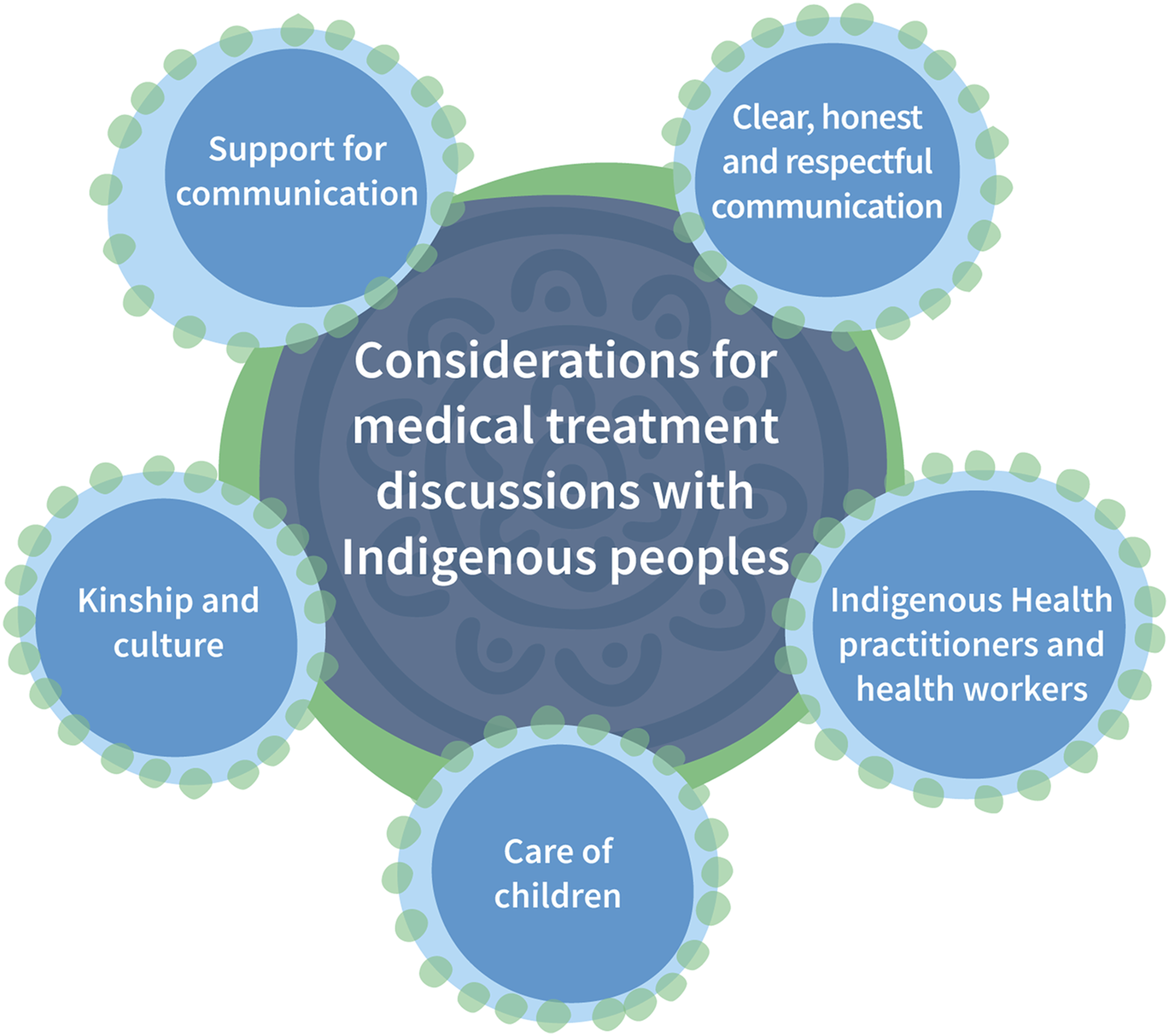
Clear, honest and respectful communication between health care providers, patients and families, and strong relationships based on trust and rapport underpins end-of-life decision-making with Aboriginal or Torres Strait Islander peoples. Good communication and rapport with patients and families allows the person’s values and cultural beliefs associated with dying to be explored and understood, and their preferences followed (for example, returning to and dying on Country or involving family and community in decision-making). 38 It also enables accurate determinations of decision-making capacity, and effective consent and decision-making processes.
Aboriginal and Torres Strait Islander health practitioners and health workers play a significant role in supporting communication, obtaining consent, and decision-making. These health professionals coordinate and provide specialised, holistic, Culturally Safe and Culturally Responsive health services to Indigenous people at the end-of-life. 39 Aboriginal and Torres Strait Islander health workers provide essential emotional, social and cultural support to patients with a life-limiting illness and their families. 40 They are an important conduit between the individual, family and clinical team in hospital and health services, and the community, understanding language (verbal and non-verbal) of the people they care for, as well as Indigenous cultural beliefs and knowledge. 41
Other relevant factors include support for communication, including interpreters, setting aside more time for yarning (conversations), and the importance of kinship and culture in decision-making. 42
In many Aboriginal communities, child rearing practices are communal, often involving extended family. 43 Treatment decisions for children may be a shared responsibility of the child’s parents, extended family and community members, and the child’s biological parents. 44 In Torres Strait Islander cultures, consent to medical treatment may be the responsibility of the child’s cultural parents in accordance with Ailan Kastom traditional adoption and child rearing practice. 45
At the end-of-life, advance care planning processes may be undertaken to determine a person’s values and preferences about treatment if they lose decision-making capacity in the future. 46 Many First Nations People may prefer to communicate about the end-of-life through advance care yarning. 47 This approach, embodying traditional yarning practices, involves people connecting, storytelling, and sharing information. 48 In the end-of-life context, yarning supports discussions about treatment and care preferences and needs, and cultural and spiritual values and beliefs. If the person desires, it can include formally documenting these in an Advance Care Directive or other planning documents (but this is less common among Indigenous than non-Indigenous people). 49 For many Indigenous people the terms ‘death’ and ‘dying’ may not be appropriate, therefore care should be taken to use the person’s preferred terminology in advance care planning and other end-of-life conversations. 50
Collective decision-making
In First Nations Peoples’ kinship systems and Lore, the individual, family, and community are innately linked. 51 Connection to family, community and Country is also fundamental to Indigenous peoples’ health and wellbeing. 52 While medical treatment laws in Australia generally focus on individual autonomy, some Indigenous people may prefer collective decision-making, a cultural approach involving collaborative and consultative decision-making with family, Elders and/or community. 53
The critical role of family and community in supporting decision-making was a core theme that arose throughout our analysis. A health care decision may consider the needs of family and community and therefore a patient may seek input from others before deciding.
54
Patients may identify the ‘right person’ within their family or community for involvement in the decision-making process if this is a cultural protocol.
55
Decisions may become shared decisions, made within family contexts and within a wide network of supportive relationships and responsibilities. They are not decisions of one Person: the partner, the parent or the child.
56
However, decision-making preferences vary among individuals, with some Indigenous people preferring to make decisions independently.
Decisions may be influenced by traditions, cultural protocols, kinship, and family dynamics. For example, decision-making may be led by a certain person, such as the eldest person in the family, 57 or Elders or others within kinship groups may be consulted. 58 The decision-maker recognised by guardianship and medical treatment laws may not be the same as the cultural decision-maker, based on cultural Lore and protocols. 59 Some decisions may only be made by male or female family members if considered Men’s or Women’s business. 60
Some jurisdictions’ guardianship and medical treatment legislation (and health policies) support a person’s choice to involve family or community in decision-making, as well as to decide independently. For example, in the ACT, South Australia and Tasmania, a person’s wish to involve family and relatives in decision-making, and to make decisions collaboratively with family and community, is recognised. 61 Queensland’s legislation acknowledges and respects the role of families and significant persons in the adult’s life to support the adult to make decisions. 62 In all jurisdictions, a person’s decision to involve or not involve family or community in decision-making should be respected. 63
State and territory guardianship and medical treatment legislation provides a framework for treatment decisions to be made by a ‘default’ decision-maker if a person does not have capacity and there is no Advance Care Directive or appointed decision-maker. 64 In all states and territories except the NT and Victoria, a person’s close relative or friend can be a default decision-maker. 65 This could be an Indigenous person’s extended family, friends and community representatives. 66 In Queensland and SA, relatives under Aboriginal tradition, Torres Strait Islander custom, or Aboriginal or Torres Strait Islander kinship rules are recognised as default decision-makers. 67 In SA, this includes an adult legally married to a person in accordance with Aboriginal tradition. 68 There may be more than one possible default decision-maker, which may be the case if the person has many family members under kinship protocols. 69
Queensland has further provisions relating specifically to Indigenous people. For example, whether a potential guardian is compatible with the person, ie whether they have appropriate cultural or social knowledge or experience, is a consideration the tribunal must take into account when appointing a guardian for the adult. 70 Another example is that, in order to be a statutory health attorney (default decision-maker), a person must be ‘culturally appropriate’ to exercise decision-making power. 71
In the NT, a person related to the adult in accordance with Aboriginal customary law or tradition may be an ‘interested person’ and consulted by a decision-maker when determining what is in the adult’s best interests. 72
In clinical practice, when there are multiple family members involved in decision-making and the person does not have capacity, decisions are generally reached through shared decision-making at family meetings. This involves the person’s clinical team bringing together close and extended family, Elders and possibly other community members to discuss and decide about the person’s care and treatment. 73 Including Aboriginal and Torres Strait Islander health care professionals in meetings (with the family’s consent) can facilitate decision-making and obtaining consent. 74
Treatment decisions
Issues relating to withholding or withdrawing life-sustaining treatment, futile or non-beneficial treatment, administering pain and symptom relief, and VAD also arose in the literature.
For many Indigenous people, decisions about withholding (not starting) or withdrawing (stopping) life-sustaining treatment may be influenced by the person’s cultural, spiritual and religious beliefs, and connection to Country, family and community. 75 For example, a person may refuse life-prolonging treatment and/or transfer to hospital or care facilities in order to pass away on Country or remain close to community. 76 A related challenge is provision of treatment that is unnecessary or unlikely to benefit the person. Although the law does not require health professionals to provide treatment that is futile or non-beneficial, research indicates that such treatment is often provided at the end-of-life. 77 For Indigenous people, non-beneficial treatment can result in unnecessary hospital admissions, false hope of recovery, or deterioration preventing the person from returning home to pass away. 78 Such outcomes can cause considerable emotional and spiritual distress to the person and family. 79
Considerations relating to administering pain and symptom relief were also identified. These include beliefs among some Indigenous people that suffering is a necessary part of sickness and death, uncertainty about pain medication and fear of addiction. 80 Concerns that strong pain relief may prevent a person from communicating, spending time with family, or passing on traditional knowledge were also raised. 81 These factors may lead to the refusal of pain and symptom relief at the end-of-life.
In some communities, fear of payback (practices of punishment or retaliation under cultural Lore) may arise, 82 where a dying person’s community feel the person was poisoned or their death was hastened by care providers. 83 Blame may be directed at family members or health professionals administering the medication. 84 This may make health professionals reluctant to provide pain relief. 85 Clear communication about pain relief can reduce this fear and dispel myths.
VAD was identified as an area relevant to First Nations People. At the time of writing, VAD is operating in all states. 86 Reports of some states’ VAD regulatory Boards indicate that people who identify as Aboriginal and/or Torres Strait Islander have applied to access VAD. 87
As with the general Australian population, there are diverse attitudes and beliefs regarding VAD among First Nations People. For all people, personal values and beliefs, including cultural, spiritual and religious beliefs, guide decision-making at the end-of-life, 88 including decisions about accessing VAD. 89 While a person may involve family and others in discussions about VAD, each state’s laws require the decision to access VAD to be made autonomously and voluntarily by the person, and only if they have decision-making capacity. 90 An Indigenous person’s family or community cannot choose VAD for a person. 91 Where required, interpreters can provide communication support to assist a person to access VAD. 92
Online training module
The online training module Aboriginal and/or Torres Strait Islander Peoples and end of life law was launched in September 2022 as part of the ELLC training program. 93 It is self-directed, interactive and includes case studies.
In addition to legal analysis, consultation was undertaken with Aboriginal and Torres Strait Islander palliative care and health professional stakeholders to inform the module. The consultation included participation in a National Yarning Circle comprising representatives from key Indigenous health professional bodies. These stakeholders provided invaluable knowledge, stories and perspectives about end-of-life and palliative care to support identification of relevant cultural, health and legal considerations. Non-Indigenous health professionals with experience caring for Indigenous people were also consulted.
All stakeholders shared perspectives on the challenges that First Nations People may experience in end-of-life decision-making, and stories of decision-making involving Indigenous patients, families and community. Three Indigenous professionals with expertise in nursing, health and palliative care (including co-author Eliza Munro) were integral in identifying these challenges and concerns, providing knowledge, facilitating connections with Indigenous stakeholders, guiding module development, and undertaking review.
An Aboriginal artist worked with a graphic designer to design a unique logo and artwork for the module (Figures 1, 2 and 3). The artwork demonstrates the importance of cultural law and Lore in the Indigenous setting. It depicts the flow of information through community back and forth to understand practices and protocols, and how they relate to mainstream non-Indigenous law. Main artwork. ELLC Indigenous logo. (Designed by Isaac Simon and Daniel Richards, Kit Kreative).
The module is novel in several respects. It examines significant historical, socio-economic, cultural, and health care considerations relating to Aboriginal and Torres Strait Islander peoples. This enables the cultural, historical and social context in which the law operates to be understood and acknowledged. Further, consultation with key Indigenous stakeholders enabled Aboriginal and Torres Strait Islander knowledge and perspectives to directly inform the development of accurate, relevant, Culturally Safe and Culturally Responsive module content, and realistic case studies based on actual experiences and clinical cases. Finally, the module comprehensively addresses Australian end-of-life decision-making laws relevant to the experiences of First Nations People.
Conclusion
End-of-life decision-making for many Aboriginal and Torres Strait Islander peoples can be shaped by diverse cultural values, beliefs and customs. Connection to Country, kinship, Lore, spirituality and religion may have a profound impact on treatment preferences. However, some Indigenous people continue to face significant barriers to accessing health care, arising from a range of historical, socio-economic and systemic factors, which can also impact end-of-life decision-making.
We undertook a novel analysis to determine the key legal considerations at end-of-life when caring for Aboriginal and Torres Strait Islander peoples. These processes highlighted consent to treatment, collective and substitute decision-making, and end-of-life treatment decisions including withholding and withdrawing life-sustaining treatment, provision of pain and symptom relief, as well as VAD, as key areas relevant to Indigenous people.
Two central themes – the importance of clear, honest and Culturally Safe and Respectful communication, together with the role of collective decision-making at the end-of-life – emerged throughout the analysis. Effective communication and trusting relationships between health professionals and Indigenous people is critical to obtaining consent, capacity determination, treatment decision-making, resolving conflict and delivering end-of-life care that reflects the person’s preferences and values. Some Indigenous people may prefer to make end-of-life decisions collectively, where decision-making occurs collaboratively with family and community.
This analysis has important implications for legal and health professionals, and for policymakers. For each of these groups, understanding the cultural, historical, social and health factors influencing end-of-life decision-making with First Nations People can support delivery of health and legal services and systems that are culturally aware, safe and responsive. 94 This can also reduce existing barriers to accessing palliative and end-of-life care for many Indigenous people. We also suggest there may be value in education for Indigenous communities on the core themes and domains discussed in this article, to support enhanced knowledge and awareness of the law and legal rights at the end-of-life.
Footnotes
Acknowledgment
The authors acknowledge and pay their deepest respect to the past, present and future Traditional Custodians and Elders of the many lands on which we work and live, and the continuation of cultural, spiritual, and educational practices of Aboriginal and/or Torres Strait Islander peoples. The authors also respectfully acknowledge the cultural sensitivities surrounding Sorry Business, Sad News and Finishing Up.
The authors gratefully acknowledge the contribution of the many Indigenous health professionals and stakeholders across Australia, including the Palliative Care Australia Yarning Circle, who provided invaluable knowledge and perspectives to inform the training module. We also acknowledge the ELLC National Advisory Committee 2020–23 for their ongoing support and contribution and the Australian Department of Health and Aged Care for its continued funding and support of ELLC.
Declaration of conflicting interests
The author(s) declared no potential conflicts of interest with respect to the research, authorship, and/or publication of this article.
Funding
The author(s) disclosed receipt of the following financial support for the research, authorship, and/or publication of this article: This research was undertaken as part of developing training for the End of Life Law for Clinicians (ELLC) project which is funded by the Australian government’s Department of Health and Aged Care. The funder had no involvement in the preparation of the manuscript nor the decision to submit for publication.
