



Abstract
This article argues that the recent changes to Australia’s rolling temporary protection regime do not mark a shift away from Australia’s flawed and unjust asylum system for two key reasons. First, the government did not repeal the temporary protection regime nor the fast track process. Secondly, the changes mobilise and perpetuate the inherent hostility of Australia’s asylum seeker policies targeting ‘irregular arrivals’. This article offers a critical analysis of the design and operation of Australia’s asylum system, as well as an examination of the 2023 changes and the political and journalistic discourse surrounding their announcement.
Keywords
On 13 February 2023, the Australian government announced a permanent visa pathway for approximately 19,000 ‘legacy caseload’ refugees currently holding a Temporary Protection visa (‘TPV’) or Safe Haven Enterprise visa (‘SHEV’). 1 These are primarily refugees who arrived in Australia by boat between 13 August 2012 and 1 January 2014 and who were subsequently subjected to a rolling temporary protection visa scheme formally introduced by the Migration and Maritime Powers Legislation Amendment (Resolving the Asylum Legacy Caseload) Act 2014 (Cth) 2 in December 2014. As at September 2023, 7690 of these refugees had been granted a Resolution of Status (subclass 851) visa (‘RoSV’), which provides permanent visa status and an opportunity for naturalisation. 3
The changes introduced by the Migration Amendment (Transitioning TPV/SHEV Holders to Resolution of Status Visas) Regulations 2023 (‘Amendment Regulations’) were touted by the government as a shift towards a more humane and just asylum system. 4 This article argues that these changes have not effected a substantive move in this direction for two important reasons.
In introducing these changes, the government has: 1. made a deliberate decision not to repeal the temporary protection regime and other key measures introduced by the Resolving the Asylum Legacy Caseload Act – most significantly, the ‘fast track’ refugee status determination process (‘fast track’ RSD); and 2. perpetuated the inherent hostility of the asylum seeker policy through the mobilisation of ‘Othering’ discourse, which led to the introduction of the rolling temporary visa scheme and that underpins the current asylum system.
In this article, I offer a critical analysis of the design and operation of Australia’s asylum policies that impact visa and related outcomes for the ‘legacy caseload’ cohort. This analysis provides the foundation for an examination of both the changes that were introduced in February 2023 and the political and journalistic discourse surrounding their announcement. This analysis is grounded in two key arguments: first, I argue that it is futile and ultimately misleading to consider the state and nature of Australia’s asylum system through the lens of these recent changes without an interrogation of the system as a whole; second, and notwithstanding assertions that this system is ‘broken’, 5 I argue the system is in fact functioning precisely as it was intended – to punish and deter people seeking asylum by boat while preserving Australia’s image as a ‘generous open-hearted’ nation. 6 Until these foundational issues are resolved, I contend that the Australian government is simply tinkering at the edges of a system that requires a complete overhaul.
Before considering the two reasons outlined above, I will map the historical and political context within which ‘legacy caseload’ refugees first became subject to indefinite temporary protection and the known impacts of this policy.
The introduction of perpetual temporariness for the legacy caseload cohort
On 28 June 2012, following months of political deadlock regarding the management of boat arrivals, the then Labor government announced the appointment of an Expert Panel to provide recommendations as to ‘the best way forward for … dealing with asylum seeker issues’. 7 The Report of the Expert Panel made 22 recommendations, several of which Labor hastily adopted into practice from August 2012, 8 including the application of a ‘no advantage’ principle, 9 and the re-introduction of offshore processing. 10 While the Report did not expressly recommend the reintroduction of TPVs, the Labor government agreed to ‘pursue in good faith’ the ‘deterrence value’ of TPVs. 11
In the lead up to the September 2013 federal election, the Liberal Party together with the National Party developed a policy ‘to clear Labor’s 30,000 border failure backlog’ – asylum seekers who had arrived in Australia by boat during Labor’s tenure, had not been transferred offshore, and were awaiting processing. 12 Once elected, the Coalition government engaged in a number of ‘legally dubious’ tactics that stymied Permanent Protection Visa (‘PPV’) grants to this cohort pending enactment of the Resolving the Asylum Legacy Caseload Act in December 2014. 13 This included delaying ASIO security checks for some 1700 refugees who had already been found to be owed protection obligations and capping the number of PPVs which could be granted for the 2013–14 year to a number that had already been reached. 14
Summary of visa entitlements and rights.
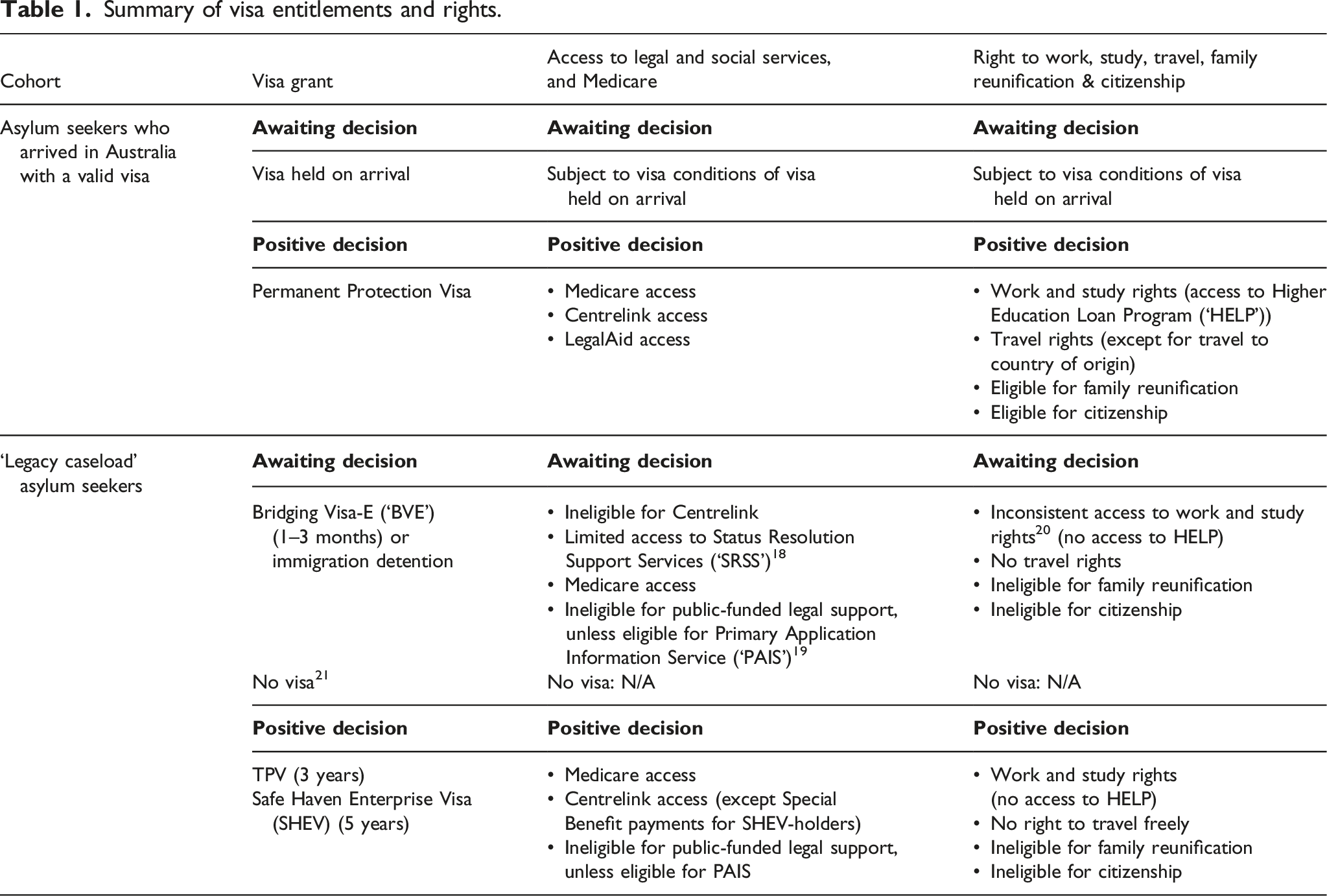
What can be seen in Table 1 is a significant curtailing of access to material support and legal rights for the legacy caseload cohort, creating conditions that have been described by the United Nations’ Assistant High Commissioner for Refugees (‘UNHCR’) as a ‘social time bomb’ and more recently by Vanessa Barker as ‘a crescendo of violence that might be better called a war’. 19 20 21 22 This includes well-documented financial and material hardship and homelessness, 23 labour insecurity and exploitation, 24 and the aggravation of pre-existing traumas and mental health issues (as well as the creation of new ones). 25 We also know that for women with temporary visa status, including those on TPVs and SHEVs, this hardship often manifests in a higher risk of experiencing family violence, weaponisation of their visa status by perpetrators, and additional obstacles to accessing assistance. 26
The use of ongoing temporary protection has also been argued to be inconsistent with Australia’s international obligations on the basis that it breaches rights to non-discrimination, 27 fundamental rights related to family, 28 as well as the prohibition of penalisation for mode of entry and the requirement to facilitate the assimilation and naturalisation of refugees. 29
Labor’s pathway to permanent protection: Worse than window dressing
In order to establish that the recent changes introduced by the Amendment Regulations are part of an inherently violent and punitive asylum system for those who arrive in Australia ‘uninvited’, I will consider the following key actions of the Australian government: first, the decision not to repeal the temporary protection regime and the ‘fast track’ RSD at law; and second, the mobilisation and perpetuation of hostility towards asylum seekers who have arrived by boat.
Preserving the hostile measures of the Resolving the Legacy Caseload Act
Ahead of the 2022 federal election, the Albanese government committed to abolishing TPVs and SHEVs, conceding that these visas subject refugees to ongoing uncertainty, prevent meaningful settlement, and create hardship. 30 However, the Amendment Regulations do not remove TPVs and SHEVs from the Migration Act. 31 Rather, they provide a pathway to permanency to a limited cohort of people – existing TPV and SHEV holders, certain former holders (such as those whose visas have lapsed and who have not reapplied), and persons who applied for their first TPV or SHEV prior to the commencement of the Amendment Regulations and who are subsequently found to be refugees. 32
Excluded from these changes are: 1. all future unauthorised arrivals; 2. all existing ‘excluded fast track applicants’, 2425 asylum seekers who have had their application for a TPV or SHEV refused under the ‘fast track’ RSD without ongoing matters, and almost 2000 asylum seekers who have already departed Australia;
33
3. over 3000 people currently waiting for the Minister to exercise ‘god-like’ powers to intervene in their case;
34
and 4. all ‘unauthorised maritime arrivals’ who entered Australia after 18 September 2013, including some 1100 refugees that were transferred to Australia from a regional processing centre under the ‘Medevac legislation’.
35
As at 31 March 2023, 14,340 refugees have already applied for a RoSV and a further 7790 may be eligible to apply, 36 while 10,000 asylum seekers who arrived in Australia by boat are specifically excluded. 37 The Explanatory Statement to the Amendment Regulations acknowledges that subjecting asylum seekers to ‘indefinite temporary status … exacerbates mental health issues and creates poor integration outcomes’. 38 Despite this acknowledgment, these recent changes fail to abolish the use of indefinite temporary status. I assert that these changes therefore do not effect true transformation of Australia’s asylum system and will in fact ensure that we are sustaining the hardship caused by ‘radical temporariness’ for thousands of existing and future refugees. 39
The Albanese government also committed to abolishing the ‘fast track’ RSD,
40
a process that has been described as a ‘slow motion crisis’ by refugee advocates.
41
This is due not only to protracted processing times – with the average TPV processing time exceeding 2685 days, that is, over seven years, in 2022–23
42
– but also to the defective design and operation of the system, which fatally limits a right of appeal for some asylum seekers and wholly excludes it for others. The ‘fast track’ RSD was designed such that those who receive a negative primary decision for a TPV or SHEV have their claim automatically referred to the Immigration Assessment Authority (IAA), an independent office within the Administrative Appeals Tribunal which was established by the Resolving the Asylum Legacy Caseload Act.
43
The IAA was designed to conduct a ‘limited’ form of merits review, which departs from the ‘vision splendid’
44
standard of merits review under Australian administrative law in three fundamental ways. The IAA: (i) is not empowered to set aside the primary decision and substitute its own, it may only affirm the decision or remit it for reconsideration;
45
(ii) must conduct the review without accepting or requesting new information,
46
save for ‘exceptional circumstances’;
47
and (iii) must conduct its review ‘on the papers’, except for exceptional circumstances.
48
These departures raise concerns of an increased risk of inaccurate decision making (and consequential breaches of Australia’s non-refoulement obligations), decreased scrutiny of Department decisions, 49 and likely breaches of fundamental procedural fairness requirements. 50 Perhaps most concerningly, asylum seekers that are classified as ‘excluded fast track applicants’ within the ‘fast track’ RSD (the majority of whom have been excluded on the basis they submitted a ‘bogus document’) 51 are ineligible for any form of merits review. 52 This is despite the express guidance of the UNHCR that asylum claims cannot be declared abusive on the basis they are supported by ‘insufficient or false information or documentation’ 53 and extensive academic criticism of the provision as a breach of international human rights law. 54
On committing to the changes to the system, the Albanese government conceded that the ‘fast track’ RSD ‘does not provide a fair, thorough and robust assessment process for persons seeking asylum’. 55 Despite this concession, and repeated calls for the ‘fast track’ RSD to be repealed, 56 the recent changes sanction the continued operation of this process as designed by the previous government. This means that over 7000 existing asylum seekers will be processed by the ‘fast track’ RSD, 57 as well as all future ‘irregular arrivals’. It is my argument that the preservation of this process should be recognised as a deliberate decision of the current government to maintain a harmful, internationally criticised system, alongside a conscious attempt to obfuscate this preservation through claims that the recent changes ‘show humanity’. 58
Perpetuating the hostility of Australia’s asylum policy
Finally, I argue that the recent changes deliberately mobilise and perpetuate the hostility with which asylum seekers who arrive by boat are treated in Australia, through the sustained use of legal provisions as hostile weapons against, and continued ‘Othering’ of, ‘irregular’ arrivals.
Successive governments dating back to the early 1990s have pursued a string of controversial asylum policies – including criminalised measures of boat identification and interdiction, enhanced screening, mandatory detention and offshore processing – to create a regulatory regime underpinned by principles of deterrence (to prevent ‘floods’ of ‘illegal boat people’ from penetrating Australian borders) 59 and punishment (for those who do). 60 These measures are arguably inconsistent with Australia’s international obligations and these principles seemingly contradict Australia’s self-proclaimed generosity with respect to refugees.
The changes introduced by the Albanese government, on their face, appear (and are claimed) to be a shift away from these hostile principles that harm people seeking asylum by boat. Indeed, the Labor Party’s 2023 Draft National Platform stated that ‘Labor will deal with the complex issue of those seeking Australia’s protection by giving expression to the values of compassion, justice, human rights, fairness and generosity.’ 61 However, through the following analysis of the political and journalistic discourse in relation to the introduction of these changes, I argue that the Albanese government has not only relied on previous governments’ hostile treatment of ‘irregular arrivals’, but has perpetuated it.
This begs two key questions: First, how have successive Australia governments been able to treat certain cohorts of asylum seekers with such hostility while declaring us a generous nation? Secondly, how is this hostility mobilised and perpetuated by the recent changes?
How and why has Australia ‘Othered’ asylum seekers who arrive by boat?
Following the works of those such as Elder 62 and Burke, 63 I contend that the answer to the first question can, in part, be traced back to colonisation. That is to say there is a direct connection between the persistence of Australia’s anxiety of being overwhelmed by outsiders and the chronic failure to reconcile Australia’s birth from invasion itself. 64 Asylum seekers who fail to fit within the culturally homogenised (white, Christian) national image, and who threaten Australia’s sovereignty as a host by arriving uninvited, continually expose ‘the sore that is colonisation – the original unauthorised crossing’. 65 These persons are identified as cultural ‘Others’ and consequently become ‘hostile subjects’. 66 Over the last two decades, politicians and the press have ‘Othered’ asylum seekers who arrive by boat by creating binaries between ‘us’ (Australians) and ‘them’ (asylum seekers), and between ‘genuine refugees’ and ‘illegal boat people’. These binaries, although well-documented and well-developed in discursive analysis literature, 67 are an important lens through which to examine contemporary developments to asylum policy that are deeply rooted in the same foundations.
The binary created between ‘Australians’ and ‘boat people’ is perhaps best exemplified by the 2001 ‘Children Overboard Affair’. 68 Notwithstanding its known fiction, 69 the incident was exploited to differentiate asylum seekers – people who would willingly throw their own children into dangerous waters in a manipulative bid to reach Australian shores – from true Australians. Then Foreign Minister, Alexander Downer stated, ‘Any civilized person wouldn’t dream of treating their own children that way’ – the implication being that ‘we’ are civilised and ‘they’ are not. 70 Similarly, the ‘queue jumping’ metaphor differentiates asylum seekers as morally antithetical to the Australian notion of a ‘fair go’ on the flawed position that boat arrivals (often framed as ‘economic migrants’) 71 purloin the resettlement opportunity of refugees languishing in offshore camps. 72
The binary between ‘genuine refugees’ and ‘illegal boat people’ has taken many forms in Australia over the last century. For example, the subtle conflation of asylum seekers with people smugglers and illicit border activities occurred when then Prime Minister John Howard co-located ‘boat people, drug runners, and other illegals’ in his 2001 election campaign speech. 73 Of course, criminalisation has also occurred more expressly, through labels such as ‘illegal maritime arrival’ and through links to terrorism, paedophiles and murderers. 74
This ‘Othering’ serves three key functions, all which are instrumental in creating, propelling and sustaining hostile asylum policies affecting those who arrive in Australia by boat. First, the dichotomy created between the ‘illegal’ asylum seeker and the ‘genuine’ refugee has created an inferior subcategory of refugee – the boat person – with an inferior entitlement to protection and rights. 75 Secondly, Othering creates a ‘political master narrative’ 76 and a framework for the widespread reproduction of prejudice debate, 77 which has fostered a public that is not only passively ‘untroubled’ by Australia’s cruel treatment of asylum seekers, but which actively elects a government that sanctions this treatment. 78 Finally, Othering legitimises repressive regulatory responses under the guise of ‘state sovereignty’ and ‘border protection’. 79 That is, because the policies are presented as a legitimate enforcement of Australia’s borders in defence against ‘the threatening “Other”’, 80 public concern about their severity (and legality) is effectively quelled.
How do the recent changes mobilise and perpetuate the hostility of Australia’s asylum system?
Turning now to the second question, I assert that the Labor government’s amendments mobilise and perpetuate the hostility that underpins the current system and the exploitation of asylum seekers as a political wedge issue. This is evidenced by the Explanatory Memorandum, which states that not allowing future unauthorised arrivals to apply for a RoSV is justified on the basis they remain a threat to Australia’s border security, and the Government is committed to discouraging hazardous boat journeys and deterring people smugglers who are willing to put the lives of vulnerable people at risk for financial gain.
81
This language – that co-locates asylum seekers with people smugglers and economic opportunism, frames their mobility as a ‘security threat’, and supposes concern for safety at sea – has been used by other Labor party members when discussing the changes. For example, Minister for Home Affairs, Clare O’Neil is quoted in her joint media release with Immigration Minister Andrew Giles as follows: Let me be crystal clear – if you try to enter Australia without a valid visa you will be turned back or returned to your port of origin. There is zero-chance of settling in Australia under Operation Sovereign Borders [OSB].
82
Similarly, government frontbencher Bill Shorten told media agencies that the government was still committed to ensuring that future boat arrivals would not be provided with permanent protection, stating, ‘Anyone being sold a lie by the unscrupulous people smugglers, they’re not staying here … it’s a terrible way of coming to Australia. It’s horribly unsafe, so the answer is no’. 83 This language replicates that used by the previous Coalition government, which told detained asylum seekers, ‘People smugglers have told you lies … tell your friends and families … to not get on the boat because you will not get what you came for’. 84
The deliberate mobilisation of the hostility that underpins the current system is apparent when we consider the language used in response to the recent changes from the Opposition and right-wing news agencies. As an example, the Shadow Minister for Home Affairs, Karen Andrews warned that Labor ousting a ‘key pillar’ of OSB (being that those who arrive ‘illegally’ will never settle in Australia)
85
would ‘weaken our borders’,
86
and made the following comments: It is crucial to our national security and our sovereignty that we maintain the integrity of Australia's borders. That is very concerning in terms of the message that it sends … to people smugglers who watch and listen to everything coming out of Australia and look for opportunities for them to go and to sell illegal tickets to come to Australia.
87
Media agencies, including News Corp media, have also employed alarmist language to invoke Australia’s deep-seated anxiety of being overrun by an ‘armada of boats’. 88 For example, in February 2023 following the announcement of the changes, The Australian newspaper published articles with headlines, ‘SOS to navy: get ready for boats surge’, and, ‘Visa deal, “brace” for boats’. 89 This language has also been employed by Opposition Leader, Peter Dutton, who has accused the Albanese government of turning OSB into ‘Operation Sloppy Borders’ and warned ‘there are thousands and thousands and thousands of people who would want to come here overnight’. 90
I contend that the clearest indicator the Australian government has deliberately reaffirmed the hostility that has underpinned asylum policy for decades is the maintenance of existing (and the enactment of new) legislative provisions which do not remove or otherwise amend the substantive policy. This includes the decision not to reform the Migration Act identified above, as well as the continued introduction of legislation that is hostile towards asylum seekers. 91 The government’s deliberate exclusion of the current asylum system from the scope of its recent Migration System review, is perhaps most telling of all. 92
Addressing ‘irregular’ mobility moving forward
The changes introduced by the Amendment Regulations, while welcome for the select cohort of refugees that are now eligible for the RoSV, do not make any substantial alterations to Australia’s hostile asylum system. The changes are, as the title of this article suggests, window dressing. While claiming it can ‘keep our borders safe while showing humanity too’, 93 the Labor government is simply tinkering at the edges and being praised for doing so. This, I suggest, is a key indicator that the system is in need of judicious interrogation and genuine overhaul – that is, there are many who consider the recent changes to demonstrate a shift away from Australia’s hostile asylum system precisely because this system is, as it was designed to be, impenetrable and mystifying not only to the general public, but to those subject to it. This paradox, pursuant to which the Australian government claims to be an ‘exemplar’ 94 of protection obligations while simultaneously ‘tampering’ 95 with international refugee law, must be exposed and remedied for such an interrogation and overhaul to occur.
In the current global context, in which more people than ever are being forcibly displaced by persecution, conflict and other crises, 96 and while other countries look to Australia’s punitive refugee policies as a model to halt ‘irregular’ migration, 97 the Australian government faces an increasingly complex challenge. How can it resile from hostile, exclusionary asylum policies, developed with bipartisan support over decades and based on deep-seated colonial fears? Perhaps the more appropriate question is, will the Albanese government genuinely and permanently resile from these policies?
Indeed, it would not be the first time a Labor government has committed to more humane asylum seeker policies during an election campaign, only to revert to punitive policies to secure re-election in the future. In 2008, the Rudd government repealed the Howard government’s TPV regime (along with boat ‘turn-backs’ and offshore processing) following the Senate Legal and Constitutional Affairs References Committee’s finding that there was ‘little real evidence of its deterrent value’. 98 Just four years later in 2012, the Gillard Labor government adopted the ‘no advantage principle’ and in 2013, as the federal election loomed and managing asylum seeker boats became a key campaign issue for both major political parties, the Rudd government announced that asylum seekers arriving in Australia by boat would ‘have no chance of being settled in Australia as refugees’. 99 Instead, asylum seekers would be taken to Manus Island for refugee status assessment and, if found to be refugees, resettled in Papua New Guinea. 100
The Albanese government’s decision not to repeal the ‘fast track’ RSD and temporary protection regime, and its perpetuation of the hostile ‘Othering’ narratives that have underpinned punitive and deterrent policies targeted at ‘irregular arrivals’ over the past four decades, suggest that these recent changes do not signal the dawn of a genuine and permanent asylum policy transformation in Australia.
Footnotes
Acknowledgment
The author would like to thank Professor Marie Segrave and Professor JaneMaree Maher for their support and feedback in the development of this article.
Declaration of conflicting interests
The author(s) declared no potential conflicts of interest with respect to the research, authorship, and/or publication of this article.
Funding
The author(s) received no financial support for the research, authorship, and/or publication of this article.
