



Abstract
The 2023 coronial inquest findings into the death of Aboriginal woman, Ms Veronica Nelson, in a Victorian prison represents a high-water mark for the relevance and application of the Victorian Charter of Human Rights and Responsibilities Act 2006 to inquests into deaths in custody. The reliance on the Victorian Charter in the inquest was particularly significant because of the detailed findings and recommendations, directed at a wide variety of criminal justice system agencies, intended to prevent future deaths in custody. The outcome of the inquest clearly demonstrates that Human Rights Acts can enhance the preventive function of coroners in Australia.
Keywords
On 30 January 2023, Coroner Simon McGregor delivered his findings from the coronial inquest into the death of Ms Veronica Nelson. Ms Nelson died in ‘harrowing’ and ‘preventable’ circumstances in the Dame Phyllis Frost (‘DPF’) women’s prison in Victoria on 2 January 2020. 1 Ms Nelson had been remanded in custody following her arrest on 30 December 2019 and denial of bail under so-called ‘double uplift’ provisions the following day ‘for relatively minor, non-violent offences’. 2 The 365-page findings followed a two-and-a-half-week inquest held in April-May 2021.
Ms Nelson was a 37-year-old proud Gunditjmara, Dja Dja Wurrung, Wiradjuri and Yorta Yorta woman who was ‘loved and respected by those who knew her’.
3
Uncle Percy Lovett, Veronica’s partner, released a statement that included: Veronica was the love of my life. We were together for more than 20 years and we did everything together. She was a kind and loving girl, who would always help people, no matter who they were. She taught me everything I know about Aboriginal culture.
4
The circumstances of Ms Nelson’s death were distressing for complex reasons that included denial of the medical treatment that she required for opioid withdrawal. 5 The Coroner found that Ms Nelson was very unwell when she arrived at the DPF prison and should have been transferred to hospital. 6 She was instead locked in a cell and ‘left to lie in her own vomit.’ 7 Over a period of about 36 hours, Ms Nelson ‘used an intercom 49 times to request assistance or complain of symptoms’. 8 The Coroner found that there was a failure to escalate her care by correctional and medical staff, and this was influenced by ‘drug-use stigma’. 9
The inquest process and findings are significant for numerous reasons. The inquest provided important answers to Ms Nelson’s family about the circumstances in which she died. 10 It included a comprehensive investigation into every stage of the criminal justice process from Ms Nelson’s arrest to the review of her death by government agencies. The Coroner found that Ms Nelson’s death was preventable – particularly because of the failure to implement the recommendations of the 1991 Royal Commission into Aboriginal Deaths in Custody (‘1991 Royal Commission’) 11 and also made findings about, and directed recommendations to, a wide variety of criminal justice agencies.
This article will focus on two further aspects of significance of the Nelson inquest. First is the role of the Charter of Human Rights and Responsibilities Act 2006 (Vic) (‘Victorian Charter’) in the inquest. This is the first time that a coroners court in Australia has given detailed consideration to human rights obligations under a Human Rights Act. Second is the broader implications of the Victorian Charter in the coroners court’s preventive role. It is the first finding by a coroners court in Australia that legislation is incompatible with human rights under a Human Rights Act, and a rare instance of coronial inquest findings about breaches of public authorities/entities under such an Act. Where relevant, reference will also be made in this article to the other Human Rights Acts enacted in Australia, namely, in the Australian Capital Territory (‘ACT’) and Queensland (‘state/territory Human Rights Acts’ collectively).
This article commences with an overview of the role of coronial inquests into Indigenous deaths in custody in Victoria. Next, it examines the relevance of the main operative provisions of state/territory Human Rights Acts applicable to both coroners courts and the public agencies to whom recommendations were directed by the Coroner in the Nelson inquest. Finally, the article details the relevance of the Victorian Charter to the Coroner’s findings and recommendations, and for enhancing the preventive role of coronial inquests.
Inquests into Indigenous deaths in custody
The Coroner’s role is a well-established mechanism for investigating deaths – dating back to the late ninth century. 12 The Coroner is required to make a determination about the cause of death, but the role is much broader than this and extends to making findings and recommendations to prevent similar deaths from occurring in the future. 13 This is a legislative mandate in most jurisdictions. For example, s 1 of the Coroners Act 2008 (Vic) stipulates the purpose of the Act is ‘to contribute to the reduction of the number of preventable deaths … through the findings of the investigation of deaths … and the making of recommendations, by coroners’. 14
Coroners have a particularly important role in investigating deaths in custodial environments, such as prisons. In Victoria, deaths of people in care/custody 15 are ‘reportable’ under s 4(2)(c) and must be ‘investigated’ in accordance with section 15(b). Further, an inquest ‘must’ be held under s 52(2)(b), unless the death is considered to be ‘due to natural causes’ (s 52(3A)). The inquest may lead to a Coroner making findings and/or recommendations under ss 67(3) or 72.
Since the 1991 Royal Commission there have been 541 Indigenous deaths in custody. 16 A research project undertaken at the University of Queensland reveals two national trends that the Nelson inquest does not follow (see contrast below). The first trend is the general lack of reporting of Indigenous identity of people who die in custody (absent in 70 per cent of inquest findings). 17 Lack of acknowledgment means that the role of systemic racism in the death will necessarily remain unconsidered. The second trend is that the most common documented causes of death do not involve findings of any wrongdoing by criminal justice agencies and the individuals employed in them (ie, systemic failings). For inquests into deaths overall, ‘medical condition’ is the most commonly documented cause of death – 44 per cent. However, specifically for inquests into deaths of people reported to be Indigenous, ‘medical condition’ was reported at the higher rate of 60 per cent. 18 This trend is characterised by Razack as ‘medicalisation’ of Indigenous deaths in custody, which Razack argues shifts the focus away from the ongoing impacts of colonialism in the criminal justice system, resulting in ‘indifference’ displayed towards Indigenous people while they are held in custody. 19
In stark contrast, Coroner McGregor placed the Indigenous identity of Ms Nelson at the centre of the investigation (her identity is referred to in the first paragraph of the inquest findings) and the findings thoroughly document the relevance of Ms Nelson’s Indigenous identity to her treatment. It also squarely confronts the ‘indifference’ – and far worse treatment – displayed towards Ms Nelson at every stage of the criminal justice system. As noted, the Coroner ultimately found that her death was preventable and that a number of Victorian Charter rights and obligations were violated.
State/territory Human Rights Acts and coronial inquests into deaths
As is well known, there is currently no national bill of rights in Australia. 20 However, at state and territory level, the state/territory Human Rights Acts are statutory bills of rights. 21 They protect human rights predominantly based on civil and political rights. This includes (most relevantly) the right to life and right to humane treatment when deprived of liberty, 22 and in the context of Aboriginal deaths, the right to equality and cultural rights. 23 The right to life at international human rights law imposes positive obligations on States Parties to the International Covenant on Civil and Political Rights 24 to protect life, including ‘preventable life-terminating harm or injury’, and to conduct an effective investigation into deaths in certain instances. 25 Coroners courts are the primary institution responsible for investigating deaths – including deaths in custody or care – therefore they contribute to giving effect to this right. 26
There are two main ways that state/territory Human Rights Acts impact on the role of coroners courts. First, where possible consistently with purpose, they are required to interpret legislation compatibly with human rights (interpretive obligation). 27 Second, human rights obligations are imposed on ‘public authorities’ (Victoria and ACT) or ‘public entities’ (Queensland), such that they are required to act compatibly with human rights (substantive obligation) and give proper consideration to relevant human rights (procedural obligation). However, coroners courts are excluded from such obligations unless they are acting administratively. For example, the Victorian Charter states that a public authority ‘does not include … a court or tribunal except when it is acting in an administrative capacity …’. 28 A ‘court’ is defined as including the Coroners Court. 29 That means that coroners are not required to comply with the public authority obligations when acting in a judicial capacity.
Further, for the Victorian Charter and Human Rights Act 2019 (Qld) (‘Qld HRA’), there are the curious provisions of s 6(2)(b) and s 5(2)(a) respectively. 30 These have been interpreted as operative provisions, whereby courts are bound to comply with human rights where they apply or enforce human rights ‘that relate to court or tribunal proceedings’. 31 This had significant implications for the Nelson inquiry, as outlined below.
There has been limited commentary on the interaction between the state/territory Human Rights Acts and the coroners courts. 32 The jurisprudence is only now starting to crystallise. The Nelson inquest is a major step forward for the jurisprudence of the Coroners Court in respect of the Victorian Charter. 33
The Nelson inquest builds on the findings of the Inquest into the Death of Tanya Louise Day, 34 which involved another tragic Aboriginal death of a Yorta Yorta woman in police custody for a minor offence. In ‘an Australian first’, 35 Coroner English ruled that she was empowered as part of the scope of the inquest to consider whether systemic racism ‘played a causal part’ in the death of Ms Day. 36 Coroner English also found that Ms Day ‘was not treated with humanity and respect for the inherent dignity of a human person’ when deprived of liberty by Victoria Police under the Victorian Charter. 37 Coroner English did not consider it necessary to determine the application of the public authority obligations or s 6(2)(b) of the Victorian Charter to the Coroners Court. 38 The findings of the Nelson inquest significantly advanced this position.
The Nelson inquest’s broad application of the Victorian Charter
Coroner McGregor’s findings include a detailed Appendix entitled ‘The Role of the Charter in Coronial Proceedings’ that can guide future inquests. In that Appendix, Coroner McGregor considered that the Victorian Charter was applicable in three different contexts. First, the Coroners Court is acting in an administrative capacity and is, therefore, a public authority when conducting an investigation ‘on the papers’; but not when conducting an inquest. 39 Second, even though the Coroners Court is acting in a judicial capacity and not as a public authority during an inquest, the Coroners Court is nevertheless bound by s 6(2)(b) of the Victorian Charter. This is because the Coroners Court applies or enforces the right to life – being a right ‘that relate[s] to’ its proceedings. As a result of s 6(2)(b), an effective investigation into Ms Nelson’s death meant ‘investigation into potential breaches of human rights that might have caused or contributed to the death, and comments and recommendations that flow therefrom’. 40 Third, that position was fortified by the interpretive obligation such that the Coroner Court’s power to make findings, comments, and recommendations 41 included identifying potential human rights breaches by Victoria Police, the Magistrates’ Court of Victoria, Corrections Victoria (‘CV’) and other public authorities. 42
It appears that the above distinction between acting in administrative and judicial capacities is unlikely to make much material difference in the context of inquests into deaths – at least in Victoria and Queensland. If the Nelson inquest findings are followed, the coroners courts in these states would be practically bound to act compatibly with the right to life (and certain other rights). 43 Those coroners courts would also be empowered to make human rights-related findings, comments, and recommendations. That is because of a combination of s 6(2)(b) of the Victorian Charter, 44 and the interpretive obligation. Section 6(2)(b) is a tangential provision becoming of increasing importance. 45 In the Nelson inquest Coroner McGregor elevated the role of s 6(2)(b) to overcome the restrictions placed on the definition of ‘public authority’ under the Victorian Charter. As to the interpretive obligation, the scope of the powers of the Coroners Court were interpreted broadly and beneficially so as to give effect to human rights.
Applying this to the circumstances, Coroner McGregor found that 2018 legislative amendments to the Bail Act 1977 (Vic) (‘Bail Act’) were incompatible with the right to liberty and had a discriminatory impact on Aboriginal and Torres Strait Islander women. 46 Those amendments expanded a presumption against bail for certain offences (a reverse onus regime), in some circumstances imposing a high threshold ‘exceptional circumstances test’ to obtain bail. This created a ‘double uplift’ applicable to Ms Nelson, who had been charged with shoplifting ‘while at large awaiting trial’ and breaching bail by failing to attend court. 47
Victorian Charter public authority breaches
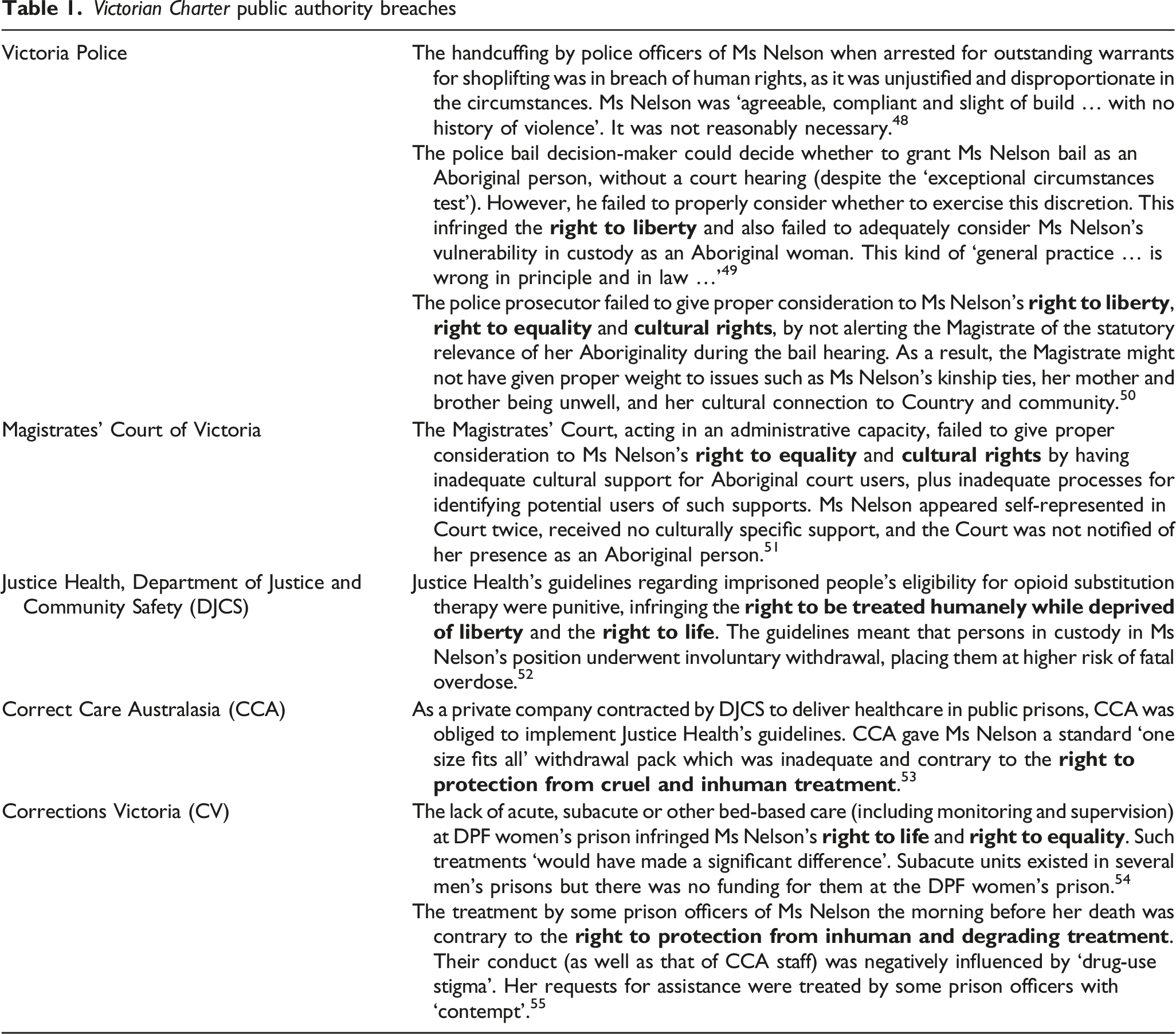
These findings are highly significant. It is the first time, to our knowledge, that a coronial inquest has found that legislation – in this case the Bail Act – is in breach of human rights under a state/territory Human Rights Act. It is also the first comprehensive determination of the extent to which the operative provisions of a state/territory Human Rights Act apply to a coroners court. Further, it is one of the few instances of coronial findings of human rights breach by a public authority or public entity under a state/territory Human Rights Act. 56 In a wide-ranging set of findings, both the substantive and procedural obligations were found to have been breached at various stages of the criminal justice process. Several of these related directly to Ms Nelson’s treatment as an Aboriginal woman.
Nevertheless, there are two aspects of the Victorian Charter findings which could have been better addressed. First, Correct Care Australasia (CCA) was correctly identified by Coroner McGregor as a functional public authority bound by the public authority obligations. 57 It was exercising ‘functions of a public nature … on behalf of the State or a public authority’. 58 Coroner McGregor made numerous adverse findings against CCA and CCA staff, including the medical reception doctor and night nurse on duty, regarding their care and treatment of Ms Nelson. 59 Despite the above, Coroner McGregor did not reach any findings of public authority breach against CCA, except in relation to treatment for her opioid withdrawal. This can be contrasted to the breach of human rights finding made against some CV prison officers for their inhuman and degrading treatment of Ms Nelson. In any event, Coroner McGregor referred or notified CCA and its staff to the Director of Public Prosecutions and the national health practitioner regulator, respectively. 60
Second, Coroner McGregor did not significantly engage in the relevant tests when determining whether public authorities were in breach of the substantive and procedural obligations. This was curious. As acknowledged in his discussion of the substantive obligation, ‘[w]here a public authority limits a right but the limitation is justified, the human right is not breached and there is no contravention of the obligation on a public authority to act compatibly with human rights …’. 61 Whether a limitation is justified involves ‘a proportionality test’. 62 In relation to the procedural obligation, there are several elements which a decision-maker must satisfy before reaching a decision. 63 However, Coroner McGregor’s reasoning mostly did not apply these tests, prior to finding breaches of public authority obligations. Such application would have made the coronial findings more rigorous.
Coroner McGregor went on to make 39 recommendations in total, which is more than coroners typically make in inquests into Indigenous deaths in custody. It is clear several were directly informed by the findings of Victorian Charter breaches. This demonstrates that a human rights-based approach is consistent with the preventive role of the coroner,
64
and in this instance enabled Ms Nelson’s Indigenous identity to take centre place. For example, Coroner McGregor recommended: • an urgent review of the Bail Act provisions having a disproportionately adverse effect on Aboriginal and Torres Strait Islander people (which would include the reverse onus regime), and repeal of the provisions relating to the ‘double uplift’;
65
• Victoria Police urgently correct any misunderstanding of an ‘informal policy’ to oppose all bail applications involving the ‘exceptional circumstances test’, and which discouraged police bail decision-makers from properly considering whether to exercise their discretion to grant bail to an Aboriginal person;
66
• Victoria Police review and (if necessary) update their training for all police members on their public authority obligations and police prosecutors on their duty to inform the court on all relevant matters within their knowledge and develop and implement an ongoing cultural awareness strategy;
67
• the Magistrates’ Court employ sufficient Aboriginal and Torres Strait Islander staff in roles which provide assistance and advocacy for Aboriginal and Torres Strait Islander court users and develop and implement robust processes for timely notification of the presence of such users at court.
68
Coroner McGregor further recommended that CV, Justice Health and CCA, as public authorities, request within 12 months that the Victorian Equal Opportunity and Human Rights Commission conduct a review of any improvements to programmes, practices, and facilities in response to the coronial recommendations. 69
The response and conclusion
The outcome of the Nelson inquest attracted significant media attention. It appears that the findings of Victorian Charter breaches likely contributed to this heightened publicity. Several prominent media reports and editorials referred to these human rights breaches. 70 Some of the responses to Coroner McGregor’s recommendations have been fairly swift. On 1 February 2023, the Victorian Premier was reported as saying that reform of the Bail Act ‘will be done as soon as possible. Work is well and truly under way.’ 71
Formal responses to the Nelson inquest recommendations were published on the Coroners Court website on 1 May 2023 in 10 separate documents by eight different agencies. The Victorian government’s response indicated that bail law reforms would be introduced in parliament in 2023. Victoria Police accepted the majority of the recommendations and gave timeframes between three months and the end of 2023 for implementation. The Magistrates’ Court response noted that the Court ‘is committed to employing Aboriginal and Torres Strait Islander staff to provide assistance and support to Aboriginal and Torres Strait Islander court users, including people who are before the Court in custody’. 72
While the final result remains to be seen at the time of writing, the generally positive response to the recommendations is both welcome and simultaneously somewhat surprising. It is surprising because the coronial jurisdiction is frequently criticised as ineffective because governments often do not implement the recommendations made in inquests into deaths in custody – especially in relation to Indigenous deaths in custody. 73
Perhaps the response to the Nelson inquest differs because of that inquest’s focus on human rights. In a 2014 article by Freckelton SC and McGregor (prior to his appointment as Coroner), the co-authors foreshadowed the important potential of human rights in the coronial process. They remarked on the United Kingdom experience, where the protection of the right to life by the Human Rights Act 1998 (UK) led to both a duty to investigate deaths in custody and an amplification of the preventive focus of coronial law.
74
Freckelton SC and McGregor argued that a ‘rights focus adds a valuable lens through which Australian [coronial] systems can be viewed’.
75
Moreover, the incorporation into findings and recommendations that there have been violations of human rights … which have led to avoidable deaths is likely to lend greater weight to coronial recommendations directed toward reducing the risks of further such violations.
76
True to those words, the Nelson inquest has set both a high-water mark for inquests into Indigenous deaths in custody and demonstrated the meaningful impact that a state/territory Human Rights Act can have on the preventive role of coroners. This means that individuals such as Ms Nelson, the tragic circumstances in which they died, and the lessons learned, are given the attention they deserve.
Postscript
On 15 August 2023, the Bail Amendment Bill 2023 (Vic) was introduced in Victorian Parliament. It is intended to implement the Government’s response to the Nelson inquest recommendations to reform the Bail Act. The Bill proposes to repeal the ‘double uplift’ provisions. It does not propose to repeal the reverse onus regime. Ms Nelson’s family and legal advocates have criticised the proposals for not going far enough. 77
Footnotes
Declaration of conflicting interests
The Bills which amended the Bail Act to create the ‘double uplift’ were enacted in 2018. Bruce Chen was a member of the Human Rights Unit, Department of Justice and Regulation, Victoria during 2018. As part of its role, the Human Rights Unit routinely gave legal policy advice on the human rights impacts of government Bills.
Funding
The author(s) received no financial support for the research, authorship, and/or publication of this article.
