




Abstract
This portrait of activist education, drawn from a larger ethnographic study into critical literacies and teacher activism in Oaxaca, Mexico in the wake of a teacher-driven social movement, showcases the celebrating of a popular, contentious national hero, Benito Juárez. In Mexico’s poorest region, where teacher mobilization on the streets and learning strategies in schools intersect, resistance to authoritarianism and instructional compliance with officialdom often overlap. Although critical multicultural approaches advocate for teaching to reduce the achievement gap or to critique extant power structures and practices, this article locates the repositioning of a mainstream historical personage as a pedagogical package, an allegory for justice and equality. Deploying the hero as a pedagogical package, the activist teachers established democratic education, altering formal timetables and curricular maps and humanizing the formal learning spaces in school in the aftermath of intensified conflict. Celebrating a popular hero on his birthday in school is a convocation for community members, parents, teachers and students to gather. The contentious relationships between teachers and the village community softened, particularly among men, and classroom learning and street-level mobilization formed part of a continuum of teacher practice.
Keywords
In 2006, Mexico commemorated the bicentenary of the birth of national hero, Benito Juárez (1806–1872), a president known for instilling liberal, modern reforms. 1 Not everyone was celebrating in 2006. On the streets of Oaxaca City, a 6-hour bus ride to the southeast of Mexico City, a social movement erupted against the Governor of Oaxaca after a 14 June police raid against protesting teachers. 2 In this multisectional social movement (Esteva, 2007b), a ‘movement of movements’ against the misrule of the governor (p. 89), featured the adages and visage of Juárez in rally chants and on graffiti and posters around Oaxaca City (Beas Torres, 2007; Colectivo Producciones Vanguardia Proletária, 2006; Estrada Saavedra, 2012; Lache Bolaños, 2012). This article, drawn from a participant-observation ethnography on social movement and classroom practices, begins with how a popular hero flows into visual and textual experiences for classroom teachers and students. This article on the pedagogical use of Benito Juárez examines the critique of heroes and holidays in multicultural education (Nieto, 2010). It draws upon the term activist “package” from anthropologist Anna Tsing (2005: 227), which is an allegory that politically unites people. Based on Tsing’s activist package, this article introduces the term “pedagogical package,” where a national hero becomes a semiotic device that unites teachers, parents and students after a time of intensified conflict. The creation of affective bonds among the adults and students fomented democratic education (Biesta, 2007), where solidarity relationships in rural schools prepare young people for handling conflict in the socioeconomic world outside.
Introduction
‘¡Si Juárez viviera, a Gabino le escupiera!’
3
Teacher rally chant, February 2011 ‘Nada con la fuerza, todo con la razón – Benito Juárez’
4
Anti-teacher rally placard, February 2011
Oaxaca, the southeastern Mexican state where this research took place, is often misrepresented as folkloric, traditional and backward. Mesoamerican worldviews, languages and political economic systems flourish in this mountainous and largely rural part of ‘deep Mexico’ (Bonfil Batalla, 1996, uses this term for communities where Indigenous worldviews and practices predominate). Much of Oaxaca state, which contains more than a quarter of all municipalities nation-wide, is community controlled rather than privately owned, and most towns take decisions collectively rather than through political party governance (Hernández Díaz, 2007), avoiding the ‘hyper individualism’ of mainstream society (Durand Ponte, 2007: 34). Key insignia of Mexicanity – the cypress species that is the national tree, the wool weavings with staircase patterns from archaeological sites and the brightly embroidered blouses worn by Frida Kahlo – have roots in Oaxaca. Such living and cultural motifs prompt artisans and environmentalists to protect the cultural property whenever it comes under threat of imitation or excavation. 5 Far from a unified political entity, though, many Oaxacan communities remain mutually isolated. The Mixteco language spoken in a village in the Mixteca region in the western part of Oaxaca, for instance, may be unintelligible to people a few kilometres down the valley, and intervillage conflicts may lead a person from one village to avoid self-identifying as a member of the Mixteca culture that also encompasses the adjacent village (Nagengast and Kearney, 1990: 72). Across those villages, in Oaxaca and elsewhere in deep Mexico, early 20th century teachers spread science, public health and the Spanish language for forging national unity (Vaughan, 1997). Oaxacan teachers, then, have long laboured between problems of instruction and problems of society.
Rural teachers often consider their work as political advocacy for the poor (Foweraker, 1993: 19). The teacher may be considered the town’s most worldly resident (Howell, 1997) and upholder of moral authority. As recently as the 1970s, a teacher in my research reported that villagers brought newborns to a teacher to seek his blessing. Oaxacan teachers study critical social theory and develop culturally relevant teaching materials (CEDES 22, 2010) to supplement the official textbooks that are out of touch with rural school children’s background knowledge. Such children, a group of pre-service teachers reported to me, may never have seen paved roads or come across motorized vehicles, making resource and expectations gaps (Nieto and Bode, 2007) that teachers seek to bridge. Also, since the late 1970s, Oaxacan teachers have led a national movement to eliminate state patronage from the educator’s union and to protect teaching as public service (Foweraker, 1993). With critical pedagogy and activist pedigree, how would critically aware teachers find value in a mainstream national icon like a former President?
A Juárez in any village
To approach this question, it is important to review how educational and economic development policies in Mexico have leveraged Juárez. As an activist and pedagogical package in Oaxaca and Mexico, Juárez is problematic. In her research on environmental activism, Anna Tsing (2005) describes packaging as symbolic “modules that speak to the possibilities of making a cause heard. These packages feature images, songs, morals, organizational plans or stories. They introduce us to heroes and villains; they show how an unrepresented group can become a political force” (p. 227).
As a package, Juárez has been used as an exemplar of Indigenous 6 educational achievement: hailing from a village, he learned Spanish and became a lawyer, judge and later President of Mexico. He would thwart French imperial intrusions against Mexico’s sovereignty and turn into a ‘Zapotec Indian made good’ (Poole, 2009: 204), an embodiment that proved ideologically useful for forging a one-nation, one-people sense of Mexico (Gutiérrez, 1999: 57). Insight on the Juárez question came to me one afternoon in my fieldwork, when perusing books in downtown Oaxaca City during a book festival. I found the text Señor Juárez and turned to a chapter by public intellectual, Gustavo Esteva (2007a), 7 whose title read as a lament: ‘Líbranos del peso Juarista (Free us of the burden of Juárez)’. In that chapter, Esteva critiqued Juárez as the benchmark of assimilation, discernible in remarks like ‘in any one of these villages there could be a Juárez’ to justify a project (p. 20). This suggested that the latent talent in each village could one day be as important as it was when Juárez left behind his life as a hillside shepherd, studied law in the city and became a national unifier. With controversy surrounding his legacy, it might be a surprise as to how Juárez has become workable to the Oaxacan teachers and other social movement actors.
More than a century of nation building provides evidence for Esteva’s reading of Juárez as mechanism of assimilation. Muralists, like Siqueiros, Rivera and Clemente Orozco depicted past leaders, farm workers, urban labourers and teachers on public buildings during the national rebuilding decades after the bloody 1910 Revolution. Moisés Sáenz, a key bureaucrat of that period,
8
and John Dewey’s former student, worked for the Federal Department of Education in a downtown Mexico City building with noteworthy nationalist murals. At a conference in the early 1920s, Sáenz justified extending schooling to the rural hinterlands via the promise that there may be a Juárez in any village: We cannot forget for a moment that our great national re-unifier, Benito Juárez, was a pure-blooded Indio.
9
Thus, we have decided to bring Indios to the bosom of our Mexican family. Through the rural school we ensure their incorporation to this type of civilization that at present constructs our nationality. (Loyo, 1985: 26)
This cultural incorporation, this in-any-village-a-Juárez impetus, has made the national hero visible and critiqued by intellectuals. But as I will show, the same popular hero remains available for repurposing for critical pedagogical aims.
Though a hero may be open for resignification by activists, critical multicultural advocates find little to celebrate in official figures like Juárez. Jaime Martínez Luna (2007) uses the term comunalocracia (p. 96) to describe how Oaxacan villages have turned towards public works, festivity planning and decision-making through community-based decision-making, where relationship building is most important. 10 Thus, Oaxacans question the official calls to join modern, western Mexico (p. 96) and interrogate the neoliberal multicultural (Hale, 2005) trend for governmental and non-governmental organisms to identify and accentuate permitted, superficial traits of cultural difference. Critical multicultural educators side with this line of critique, criticizing the teaching of taco Tuesdays (Green, 2000), dance, dress and dining (Sensoy et al., 2010) and heroes and holidays (Nieto, 2010). Critical multiculturalists favour work to reduce the gap in economic resources and learning expectations that place unjustified responsibility on the shoulders of the working class and students of colour (Nieto and Bode, 2008: 11). Esteva, (2007a) rejecting the in-any-village-a-Juárez prompting for rural development, and Martínez Luna, (2007) specifying the value of communal governance, find their schoolroom equivalents in critical multicultural strategies for transformational learning. Nevertheless, present in the two epigraphs in the introduction, Benito Juárez emerges as a stalwart symbol of insight and political engagement. The deployment of a popular hero as allegory of noble and truthful accomplishment counts as what Anna Tsing (2005) calls an activist package (p. 227) or, as we shall see later, a pedagogical package.
Activist package
To approach how activists on the streets deploy Benito Juárez, as the introductory epigraphs and Figures 1 reveal, the political and social impressions of cultural and textual practices merit consideration here. Above I have explained the activist package theoretically; below I show it in action in a village school with a teacher named Marcos, a bilingual educator in a village outside Oaxaca City, who marched with the teachers in the 2006 Movimiento and met with parents and community leaders in cultural performances and dialog tables on democracy in Oaxaca City. He returned to his village rejuvenated, inviting a storyteller he met during the protests and contracting an Argentine author touring Mexico to read to his village students. Afterwards, Marcos reported to me, audience members in northern Mexico questioned the Argentine on how a writer from Argentina found interest in a Oaxacan village reading project. Upon reporting this reception, Marcos explained to him that across Mexico, people think that ‘Oaxaca aun vive en la prehistoria (Oaxaca still lives in prehistory)’ compared to the northern, industrialized part of the country. This racialized and metropolitan chauvinism at the expense of Oaxaca carries political implications, discernible when an educational official discussed Mexico’s low-skilled workforce and called Oaxaca a drag on Mexican progress. He considered Mexico’s achievement gap a problem emblematized by a Oaxacan woman, a chapulinera (grasshopper lady), who trades in grasshoppers because her teachers failed to develop her potential, and now she knows of no other way to make a living than gathering insects (Díaz De Cossío, 2011: 41). Díaz De Cossío packages Oaxacans in Nexus, a high-brow arts and culture magazine, as primordial and docile.
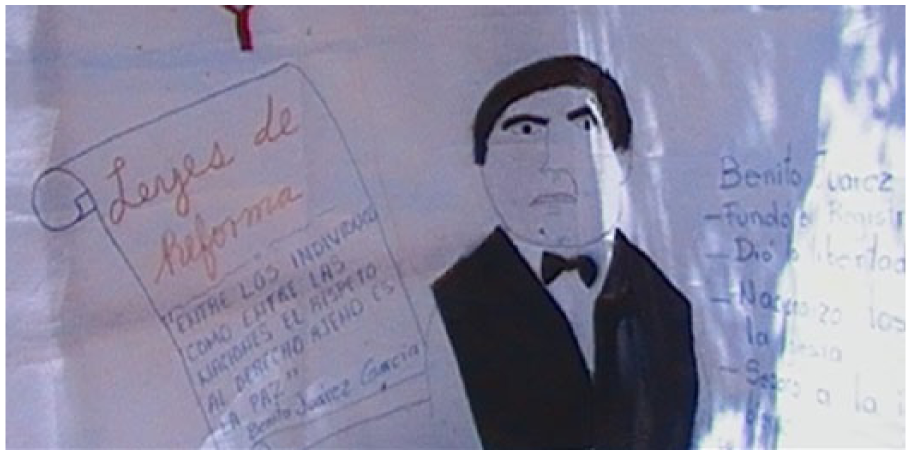
Student poster from Juárez day. ‘Reform Laws. “Among individuals like among nations, respect for the rights of others is peace” – Benito Juárez García’ poster, Juárez celebration. The bowtie and suit jacket allude to the cover image of the text students and Marcos used for research (Vásquez, 2005) that showed Juárez in a tuxedo waving a flag. Like the students, social movement writers and artists use the Oaxacan president’s visage in their `aesthetics of the aggrieved’ (Estrada Saavedra, 2012: 135). (photo by author).
Dominant-group stereotypes of Oaxacans as primitive and naive, however, face critique from public schoolteachers. Engaging in struggles over cultural representation can serve as a flashpoint for political projects, following Stuart Hall’s (1981) observation that neither dominant nor the subordinate groups can ever claim a decisive victory in the battlefield of cultural meanings (p. 233). This incompleteness is the starting point for examining activist and pedagogical packaging of a national hero. What is officially recognized, for instance, appears in social movements as organic and emergent. Facing riot police, protesters in 2006 sang the Mexican National Anthem (Santiago Cruz, 2010) and composed and performed their own anthem (Albertani, 2009: 180). Activist artists stencilled national heroes and religious saints on signs and walls (Lache Bolaños, 2012) to take back the streets (para. 26), and then they rally-chanted on the collapse of state government while climbing the statue of Benito Juárez (Stephen, 2013: 68). 11 When faced with conflict, cultural representations, lend advantage to authorities; however, social movement actors also package the national hero for their cause. The semiotic practice of the activist package (Tsing, 2005) helps political actors to link the local with the global to find resonance with allies and bystanders. In an activist package, publicly recognizable faces and texts sound out hopes and anxieties and envision a better future (p. 228), though it carries no coherent ideology. For instance, the Mexican revolutionary Emiliano Zapata is celebrated by a Mexican President and by a contemporaneous Zapatista guerrilla movement, the The Zapatista Army of National Liberation (EZLN), struggling for autonomy from state hegemony (Stephen, 2002). In the 2006 Movimiento in Oaxaca City, the stencilled image of Zapata appeared in street art (Nevaer and Sendyk, 2009: 123), pulling the historical record of the famous rebel into the immediacy of the marches and sit-ins. Popular and mainstream cultural images become the raw material for activist packages, and Benito Juárez in our story here comes to life in this way. 12
Turning popular culture into political currency enjoys a long history. From the 2006 Movimiento to my 2010–2011 fieldwork, frictions over cultural meaning-making became evident at an annual dance festival in Oaxaca City, the Guelaguetza. The Guelaguetza folkloric event, named for the Oaxacan system of the same name for mutual support (Stephen, 2005), began in 1932, the period of rural-school expansion and sanctioned artwork for forging a modern nation. ‘Pure folklorism’ a Mixtec-language poet called the Guelaguetza festival when I asked him for his interpretation. A state-published festival guidebook of the time (Vargas, 1935: 3) explains such official usage of folklorism: As a moving tribute to the [1910] Mexican Revolution in its 25th anniversary, the people of the State of Oaxaca present, once again, the Guelaguetza festival that wondrously symbolises the greatest example of the cooperation and solidarity that is cultivated in Oaxaca… With this objective, racial values, better defined and consistent as they are, leave behind their farmlands and mountains and turn, enthusiastically and sincerely, to the city to commemorate on this occasion the liberating (revindicador) [Mexican Revolution] movement that has moved the Nation in favour of a better life for all Mexicans.
The guidebook suggests a primal set of Indigenous values predominating in Oaxaca, that the Guelaguetza festival renders visible this world of deep Mexico, the heart and soul of the Mexican Revolutionary spirit. Here, traits of Indigenousness have been packaged for the official scripts of national unity similar to how Esteva (2007a) observed the packaging of Juárez for economic development in rural Oaxaca.
An official guidebook for the state-sponsored Guelaguetza festival may essentialize Oaxacan racial and cultural identity traits for post-Revolutionary nation building, 13 but the festival enjoys wide public support, including among teachers. The festival, and the auditorium where it takes place, is ‘iconic’, a teacher named Wendy revealed. With a master’s degree in educational foundations from the elite National Autonomous University and a position as a regidora, a cultural and social-event coordinator in her village, Wendy spoke to me about the Guelaguetza festival. We gathered at a roadblock below the dance venue to obstruct vehicles from servicing the 2010 Guelaguetza teachers from Wendy’s union delegation blamed the governor for the violence against them 4 years earlier; they wished to shame the governor as presider over the dance festival to sit beneath an incomplete roof. To protect the values of solidarity celebrated in the festival, some teachers have also staged a free-of-charge version of the Guelaguetza to rival the state-sanctioned one (Davies, 2009). Even if such dance represents Oaxaca as primitive, Oaxacans have come to love the Guelaguetza enough to stand against a repressive and corrupt political machine that has made illicit construction deals (Sotelo Marbán, 2008: 44) and rigged the festival with positions for family members, as Wendy reported.
In the Guelaguetza cultural battlefield, Juárez enters the stage. The Governor’s construction project on the hillsides below the Guelaguetza auditorium had at one point damaged a Benito Juárez statue (Martínez Vásquez, 2007). Also, a sculpture-sized phrase, ‘El respeto al derecho ajeno es la paz (The respect of the rights of others is peace)’, a famous Juárez adage, broke apart when the final words ‘la paz, peace’ fell over. In response, jokes circulated about the Governor’s inability to maintain la paz (Colectivo Producciones Vanguardia Proletária, 2006, min 11:31). Juárez had addressed peace during his lifetime, as we shall see in the convocation Marcos gives below, and now the state-sponsored corruption and violence in the city which he called home toppled a monument of his famous adage. Here, the use of the words of Juárez locate his figure into present use as an activist package.
Activist package to pedagogical package
The Juárez activist package on the streets brings us to our principal concern here, the ‘packaging’ (Tsing, 2005: 227) of national hero Benito Juárez in a rural elementary school. To start, I should emphasize that the public pedagogical work on the streets through the teachers’ union and illustrated by the 2006 Movimiento intersects with classroom pedagogies. Testimonial (Martínez Vásquez, 2007), journalistic (Osorno and Meyer, 2007), ethnographic (Stephen, 2013), cinematic (Colectivo Producciones Vanguardia Proletária, 2006) and street art (Nevaer and Sendyk, 2009) texts discuss the significant role played by teacher meaning-making practices. The correlation of activism and classroom instruction, though less developed than work on teacher social movements, includes transnational (Arriaga Lemus, 2016), Indigenous (Meyer and Maldonado, 2004), English-language (Clemente, 2007) and popular (CEDES 22, 2010) education. It may, however, seem unlikely that urban protests in Oaxaca City should resonate with village schools in a different climatic zone and with dirt roads and scant public transportation. Teachers, in my research, furthermore have opted to keep their urban protest work isolated from their rural classroom teaching. On one hand, the trade union will sanction a teacher for holding classes during official protests, and on the other, village parents accuse teachers of laziness or recklessness for cancelling classes to attend protests. Missing classes brings difficulty for teachers. One teacher calls the combining of activism and teaching the ‘dual effort’, where a village teacher serves the union in their political functions and the village learning community with formal instruction. Still, as we see below, and as I have reported elsewhere (Sadlier and Morales Sánchez, 2012), social movement practices touch and are touched by teaching and learning in village schools, especially, as a teacher named Andrea reported (Sadlier, 2014), children learn ‘democratic education’ in schools (p. 106). 14 Correspondingly, the activist packaging of Juárez in open-air protests has its correlate in the pedagogical packaging of Juárez, showcased below on a school holiday when the historical figure appeared in school murals, student artwork, performances and teacher speeches.
Democratic education
Students learn how to live democratically from their schools. The 2006 Movimiento revealed a more complex, democratic picture than a struggle between unionized teachers and state authorities. Marcos reported meeting a middle-school teacher named Andrea at dialog tables around Oaxaca City established during the conflict (Martínez Vásquez, 2007) to develop democratic solutions (p. 133). Andrea and Marcos expressed dismay when, at these dialog tables, parents of school-aged children berated the teachers for shirking their classroom duties, and both teachers made a personal commitment to listen to parents and to teach school children in a more democratic way. For Andrea, democracy for school children would include the full inclusion of all students in her middle school. She would no longer tolerate the school practice of tracking students with disabilities to evening courses. For her, democratic education was in the details; when walking with a parent and a middle-schooler with disabilities on a Mexico City street, Andrea heard the mother laugh at a same-sex couple holding hands on the sidewalk. In front of the student, Andrea reminded the mother that their visit to the capital city to support the presence of all in public schooling could not happen unless everyone was included. Andrea, in personal communication, stressed that young people learn the practice of ‘democratic education’ by inclusion and exclusion in schools and in the actions of the adults they trust. At the same time, Marcos came to similar views on what children need from their schools and teachers. If Andrea’s post Movimiento shift centred on democratic education, Marcos’s commitment upon returning to classes in November 2006 focused on ‘quality education’. He returned to his village elementary school to face parents locking the elementary school gate, prohibiting the teachers from resuming normal classes.
In the farming village outside Oaxaca City, Marcos and his elementary school teacher colleagues discussed the locked gate and demands of enraged parents. When they met with the parents, the teachers underscored how the political action on the city streets forms part of their work as committed teachers. The parents did not accept that as a valid reason for missing 5 months of class, but the mood brightened when Marcos and his colleagues promised ‘quality education’, an offer parents accepted. Over time, quality education became a strategy of inclusion where students would have freedom to open any door throughout the school, play music and paint murals. Classes continued after the end-of-day bell and on weekends to make up the lost time from the months of missed classes (Sadlier and Morales Sánchez, 2012). Marcos also envisioned quality education as the creation of student reading space. Marcos planned to build a platform in the crook of a tree beside the library where children could read beyond direct adult surveillance. As part of this quality education modification of space, time and socialization, the teachers from grades 1 to 6 instituted interdisciplinary, project-based learning to replace the single-subject model. In my fieldwork in 2011, national hero Benito Juárez became the subject of student inquiry through math, science, civics and fine arts.
Pausing at the mural
On 21 March, I rode to the village elementary school with Marcos, as was our custom each morning during the winter and spring of 2011. On the national holiday in memory of President Juárez, this day seemed unusual. Our commute chat concentrated on the Oaxacan teachers’ union roadblocks planned for the next 2 days and, more sombrely, the recent forced disappearance of a noted Oaxacan teacher who advocated critical teaching practices. Marcos knew of the teacher’s key role in promoting critical teaching materials and approaches in The Centro de Estudios y Desarrollo Educativo de la Sección 22 (CEDES 22) (2010), the pedagogical division of the teachers’ union in Oaxaca, Local 22. Rally chanting, posters and graffiti noticeable around Oaxaca City of that time had demanded the teacher’s safe return, saying ‘because he was taken alive we want him returned alive’. As there had been little news and no ransom demands, I asked Marcos for clarification on the teacher’s disappearance. Marcos responded with alarm, to which I asked why this teacher, a known advocate for grassroots popular education, was grabbed instead of someone more directly involved in Local 22 governance. He avoided a direct answer, saying that the operatives who engage in disappearing people know what they are doing even if it makes no sense to us.
Arriving in town, we passed along a well-maintained access road, a causeway running through the cultivated, moist fields. In an arid region, this farming town has water, and the farmers had reported the aquifer particularly high this year, though the price of garlic had dropped. Arriving in school, Marcos parked his car, and we passed through the metal gate the parents had 4 years prior chained shut after the teachers missed 5 months of school in the 2006 Movimiento events in Oaxaca City. Ahead of us, the school’s interior courtyard stood out, and there, parents had arranged a central makeshift theatre of foldable chairs below a vinyl tarpaulin covering. We walked to the left of the periódico mural, a notice board made of a plywood sheet fastened to the iron bars on a classroom window that was pasted with student work, pictures and printed texts on Benito Juárez and the anniversary of Mexico’s nationalizing its oil industry. Two weeks before, after the Monday morning homage to the flag ceremony that begins each school week, Marcos had remained under the sun with his sixth-grade students, standing before the same Juárez-themed periódico mural. In many similar schools, the periódico mural functions as a literacy space more than an official notice board, as students post and read what others have posted. At this spot 2 weeks before the holiday, when Marcos began class facing the mural, he had been coordinating his sixth-grade group’s performance on Juárez’s life for the celebration day, and, like the work exhibited on the periódico mural, Marcos’s group would base presentations on research (Figure 1). During those weeks, in the classroom 20 paces away, a ‘Performance on Benito Juárez García’ poster read in Spanish: ‘Performance, an English word which we’ll understand as representation with various artistic activities (theatre, music, dance, poetry, song…). How can we make our performance the way we need to? Creativity. Know the history of Juárez. Sources to check: books, the internet, Encarta [digital encyclopaedia]’. Finally, the page featured a flowchart: ‘research it ⇒ result ⇒ learning’. As recent reforms reduced Juárez-focused content, Marcos explained, the teachers felt obliged to teach about the man’s life, but in an alternative, interdisciplinary and playful way.
Standing at the periódico mural, 2 weeks before the holiday, the students had yet to research, write out or choreograph their Juárez performance, and Marcos was not happy. Facing the mural, he asked the class to open the photo albums on Juárez they had assembled for homework. One student showed me his construction paper collection covered with laminated cards available at any stationary store. I asked him where he had gotten the words that he had written below the cards; he remarked that he had copied them off the backs and affixed them onto the sheets. Marcos, in front of the mural, seemed in full classroom mode, displaying irritation upon seeing the students’ cut-and-paste job, pronouncing the laminated cards a last resort, not a main source for research. The group had already perused the Enciclomedia research database in the computer laboratory where they had read original material on the life of Juárez, the text Notes for my Children (Juárez, 1987) and the epistles the President exchanged with Maximiliano, the Austrian-born Emperor of Mexico. The students watched the classic film, El Jóven Juárez (Gómez Muriel et al., 1954), and listened to an instructional ballad on Juárez’s origins and deeds. But in his informal diagnostic of student research, Marcos noticed a lack of progress, and he remarked: ‘What is the good of taking notes if you don’t use them?’ His exasperation with one task segued into another, reading the periódico mural out loud for his sixth graders to compare with their Juárez notes. Line-by-line, Marcos and the students proceeded with the comparison before heading to their classroom.
Performances and basketball
Two weeks later, on 21 March, Marcos and I strode past the periódico mural and stood on the sun-drenched school esplanade. Marcos then picked up a cordless microphone to emcee the Juárez celebration. I stood to the side, observing Marcos speak via the loudspeaker before his students who, ready or not, would soon perform before the teachers, parents’ committee and municipal officials, all of whom had shown up on this school holiday. Marcos opened with comments on the importance of self-government and the infringements on sovereignty, like the ongoing United States military strikes in Libya. It was Juárez in his time who stood up to such violations. What is more, Juárez originated from a nearby town and went on to success on the national stage. Though he was a flawed man of his time, Marcos continued, Juárez opposed the pro-clergy conservatives who, according to a student’s speech later, had invited Emperor Maximiliano to Mexico to stop the United States stealing Mexican territory, such as the state of Texas. Juárez confronted these 19th-century religious conservatives and royalists, Marcos related, and then deposed the Emperor which in turn fortified Mexican democracy.
After Marcos’s kick-off speech before the school community, students under the tarpaulin performed on the life of Juárez before the sporting began. Dressed in period costumes, shepherding live sheep and posting drawings of landscapes and biographic timelines, the performances progressed from first to sixth grade. Afterwards, the all-female honour guard, rounded out with several of Marcos’s students, paid homage to the flag to signal the move from the commemoration to the basketball league finals. When the matches began, Marcos grabbed the same microphone he had used in his speech, sat under the tarpaulin and called the play-by-play for two simultaneous matches in adjacent courts. He mentioned students by their nicknames and with warm wittiness announced the details: ‘In extraordinary fashion, Pepe has made a shot but missed the mark’. When the students in the lower grades broke a scoreless tie, the whole court erupted with children’s screams. Marcos turned his attention to them, saying ‘and it seems the first point has been scored; yes, the first basket in one and a half games!’ The energy level had become more student-centred, where the adults remained present as witnesses. Parents and teachers had repeatedly described their satisfaction with the improvement in the children’s self-confidence in speaking and carrying out projects in public. Here, I noticed the Juárez day events uniting a community, the teachers scaffolding the day’s presentations and competitions and the children finally emerging with agency in the formal space of the public school.
Beer beneath canvas
After awarding school-supply prizes to victorious teams, the male teachers took to the court in a grudge match against the pupils’ fathers. Given the resentment the parents had felt towards the teachers who cancelled 5 months of school in 2006, sports competition appeared particularly confrontational – for this match, one of the fathers complained that I was ringer for the teachers, and so Marcos handed me a whistle, downgrading my participation from player on the teachers’ team to referee. In this holiday game, subjectivities began to shift away from the ones ascribed during ordinary schooling. In the second period of the game, for example, the school director changed from his collared shirt into a tank top, reducing the residual veneer of authority and freeing up the joints for better jump shots. The teachers ended up winning, but the fathers had narrowed the margin by the very end.
When the basketball game ended, the players sat in a circle below the tarpaulin. One of the fathers placed a case of Corona beer at our feet. At that time, almost all others had left the school grounds, save the 15 or so male teachers, the fathers and me. A son and daughter sat on the lap of one of the fathers; I noticed his fingernails covered with blue paint, worn off on all but the corners and edges of the nails. Drinking and sitting in the shade after sports enabled a brand of conversational flexibility unlike any I had experienced at many recess meals and curb-side chats with teachers and parents. The beer under the tarpaulin lubricated a cautious solidarity, an unobtrusive, eyes-to-the ground togetherness, as the men maintained a strained relationship, given teacher nonattendance for protests and parental discontent over abandoned classes. When we all got to talking, I spoke with the father on my right who mentioned legal patents for Atlanta-based Coca Cola. The school director, to the right of him, added that Chinese firms were beginning to patent a nopal cactus plant, a patriotic symbol and a culinary delicacy in Mexico. Then the banter segued to the recent 2011 tsunami in the northeast coast of Japan. The men discussed disasters and school preparedness until the director described the school’s earthquake protocol in which the pupils exit the individual buildings to the ball courts where we were seated. The director mentioned the dissimilarities in the Japanese response compared to the Haiti quake a year before. After this, dialog turned to the United States’ bombing campaign in Libya. Someone also brought up the disappeared teacher that Marcos and I had discussed during our ride to town and how this unresolved act of repression would provoke an intensification of teachers’ union political action.
The conversations, undertaken by huffing-and-puffing, out-of-shape men, had departed from the roles I had perceived over the last 6 weeks. In my case, the fathers forgot I was a visitor, given how as referee I faced the exasperation of one father who faulted me for calling in favour of the teachers, and I responded to him with an irreverent, ‘play better, then’. Marcos, the school assistant director, hardly spoke. The director was loquacious, but having withdrawn from a leadership position, physically changing from collared shirt to tank-top, he never took charge; although, he positioned himself as the principal when the topic of student safety arose. It happened that some of the most verbal in the conversation had less authority in the school and community, such as a recently hired young teacher who mockingly dragged the case of beer away from the reach of anyone who uttered something absurd, gesturing, ‘you are cut off from the booze!’ The open exchanges, Marcos reported later, enabled the teachers to continue to level relations with the parents, ever tense since the parents locked them all out for their missing classes in 2006. Now the doors were open on Benito Juárez Day, and teachers remained seated with parents well into the late afternoon. In our drive home to Oaxaca City, Marcos, who often depends on community support for his reading project activities, suggested things might go a little smoother with parents now after the day’s events, and this would help him seek funding for the tree house beside the library for student pleasure reading.
Pedagogical packaging
As an activist package, Benito Juárez lends celebrity to the culture work of protests. This occurred in a 2006 Movimiento march to Mexico City to pressure the lawmakers to investigate the state of misrule under the sitting governor, a legal declaration that leads to a politician’s removal (Martínez Vásquez, 2007). Marchers carried posters of President Juárez wearing a Che Guevara-like cap. As seen in the epigraphs, small business owners angry about the teacher-led disruptions that dissuaded tourism, strolled through Oaxaca City carrying Juárez quotes on reasonable and peaceful resolution to the state’s conflicts. Juárez packaged in open-air activism correlated with turning him into a pedagogical package. Teachers organized a curricular unit and a whole-town gathering on a non-work day among schoolchildren, community leaders and parents that had disapproved of protest-focused teacher nonappearances. Calling the community together in the name of Juárez, Marcos delivered a convocation on social justice in the shadow of Mexico’s great unifier, at a school not 20 km from Juárez’s residence. The Juárez day formed a respite from routine, as the performances, basketball games and socializing encouraged affective togetherness, the practice of living and sharing with others (Villenas, 2005). According to Marcos and Andrea, this togetherness, important in rural Oaxacan village governance as in the emergent solidarity networks in the 2006 Movimiento, is teachable. Students and teachers focused diligently on honouring their former president; the athletes competed in earnest; the conversational topics revolved around the seriousness of current events and disaster contingencies. A typical school holiday in the community or a working day in school would not allow for shared spaces of concern without the cover provided beneath the celebrated hero, Juárez.
Celebrating Juárez and the socially inclusive quality education he galvanized confronted multicultural educators (Green, 2000; Nieto, 2010; Sensoy et al., 2010), public intellectuals (Esteva, 2007a) and activist anthropologists (Hale, 2005) critiquing the selective use of popular culture. Because ‘[c]ultural integration’, key to the functioning of a state, ‘uses, adapts and combines a plethora of symbolic material to be crystallised into a national mythology’ (Gutiérrez, 1998: 286), children learning through a celebration of Juárez can be read as politically problematic. Still, the Benito Juárez pedagogical package crosses into social movement and attempts to legitimize grassroots protest while pinpointing Oaxaca State authorities as inept and repressive. Thus, the pedagogical packaging of Benito Juárez’s words, appearance and legacy provide an occasion, a convocation, for social gathering. Noteworthy here is masculine communication. In times of struggle, it becomes less important that a pedagogical package represents authentic history and identity than for the package to establish sociocultural links that soften rivalry and promote camaraderie, as Andrea explained. The social bonds established by a pedagogical package matter more than the ideological content itself.
Here, the shelter provided by Juárez brings together quarrelling teachers and parents, where we see men cultivating empathy. As Latina feminist pedagogies draw on women’s humour, beliefs and other everyday speech to humanize learning (Trinidad, 2010), men’s sense of shared togetherness comes up here via teasing banter, sports and current events sharing. Key to this is a named holiday with sports competition and beer drinking – and what we might call counter-care work. The ‘counter’ side of affect is twofold: in the basketball game, adversarial relations over pride and physical prowess temporarily collide, and drinking beer in school during the working day is counter to the daily routine. It is less common within everyday institutional routines for masculine socialization to emerge with mutual concern. Still, like the vinyl tarpaulin lapping above them, the pedagogical package of Benito Juárez provided an official cover story for the horizonal informality, a convocation to meet, perform prepared poems, discuss events and equalize social roles through competition. The chance to turn formal elementary school learning spaces into more social and emergent ones provided teachers negotiable terrain for establishing the ‘quality education’ that they had promised the parents. In answering Juárez’s convocation to assemble on a holiday, interdisciplinary learning, play, socialization and relationship repair materialized in a recognized and responsible manner beneath the shelter of the hero and the shade of the makeshift tarpaulins.
Footnotes
Acknowledgements
I thank Jennifer Lee O’Donnell and the two anonymous reviewers for helpful editorial suggestions.
Funding
The author(s) received no financial support for the research, authorship, and/or publication of this article.