




Abstract
In the mid-1660s, London was impacted by the plague, and the period saw important changes in the government's responsibilities around issues of public health. This research studies the Bills of Mortality, the accounting for death and the use of these accounts, as reported in Samuel Pepys's journal 1 or diary, to explore how these public accounts informed individuals, increased debate, awareness, policies and regulations around health. The research uses a microhistory, narrative approach to study the diarist's use of the Bills and life during the plague year. The contribution of this research is in the use of this detailed diary to explore the accounting of death and illness in the time of the plague, giving insight into policy around public health and the restriction of public rights to protect the public. The research also explores how individuals use these accounts to determine their actions, investigating how non-conventional forms of accounting can drive judgments and decision-making.
Keywords
Introduction
The choice of timeframe can have a profound impact on a narrative and its themes. The seventeenth century stands out as a period of transition and change that marked the end of the Middle Ages and the Renaissance, creating a bridge that led to the Age of Enlightenment and the Industrial Revolution (Lotz-Heumann, 2019). This period of transition was not just in economic terms, but also in terms of living standards. 2 Diseases, including the plague, tend to occur in societies with poor living standards and inflict the greatest mortality on the underprivileged (e.g., Cipolla, 2004). The ‘Great Plague’, as it was known, was a devastating epidemic of bubonic and pneumonic plague, which struck in 1665, killing thousands of people. It is important to note the change in the responsibilities of Governments around issues of public health during this period due to the plague. Public authorities were compelled to be responsible for the provision of care for the sick, and burying the dead, but also for determining the causes of the disease and ensuring that the disease did not spread. This was unusual as the function of protecting the public had always been the responsibility of Royalty, exercised through the church, before this transformation of power, of governmentality (Foucault, 2007: 144). Governments extended their power and took on the task of limiting the public's liberties, which was initially controversial but has subsequently become a part of what is now expected as part of public health provision. Accounting assisted in the governance developed during this extension of the Governments’ role in formulating those first public health systems, and the ideologies and rationales that underpinned this provision.
This article elucidates those forms of accounting evidenced by a contemporaneous diary, which observes how those accounts were produced and used. The diary is that of Samuel Pepys, Clerk of Acts to The Navy Board, an educated man, a member of the Royal Society in London, 3 who is known for the detailed and extensive ‘journal’ (Pepys, 1660; Diary, 4 20th April 1660), that he kept for ten years from 1660. Although his famous diary was only written for a decade, this was a decade of many events, and he observed and described those events with great clarity, enabling readers of the translation from the shorthand he used to experience those events as if at first hand. His diary is studied in many contexts, but although it offers insight into his experience of the plague and the accounting for death through the Bills of Mortality (the Bills) (e.g., Birch, 1759), few scholars have studied his contribution in the context of the development of public health and policy of the time and the use of the Bills as accounts which he notes and observes in the diary. The word plague is mentioned 150 times in Pepys’ diary, and the Pest House 5 four times, related to this period of the plague in London.
Several articles in the accounting history literature consider the use of accounts and accounting information (Stevenson-Clarke and Bowden, 2018, 2023). This literature includes cases where accounting information was used but could have been used better and more extensively for management decision-making purposes but was only used to rationalise and evidence issues, thus limiting its usefulness (Fogarty and Dirsmith, 2005). Other articles explore the seemingly neutral appearance of accounting, which allows it to be utilised to play different roles, acquire different meanings, and enable those in power to behave in negative ways (Bigoni, 2021; Detzen and Hoffmann, 2020; Silva et al., 2019; Tyson and Oldroyd, 2019). There is a growing literature that considers instinctive, rudimentary uses of accounting information to enhance management and prospects, with an intuitive use of fundamental accounting principles in a basic form (Cummings and St Leon, 2009; Leoni, 2021; Masiero, 2020; McBride, 2022). This article aims to develop ideas of the use of accounting and accounting information to consider the utilisation of accounting in determining collective and individual decision-making around life and death scenarios.
Moerman and van der Laan (2022: 23) highlight the previous literature examining accounting for death and call for further research in this area: ‘In particular, the opportunities from foregrounding accounting for and accounts of death as an empirical phenomenon, rather than being buried in the detail of case studies or side-lined by an interesting event or site of research’. This article answers this call by highlighting the role of accounting for death in guiding behaviour and decision-making during a time of plague. Previous accounting literature either considers accountability for death or views death as something that needs calculative approaches to achieve value. Literature has generally explored accounting for deaths as a means of accountability. Sargiacomo et al. (2012) investigated the accounting of deaths of the enemies of the Venetian State in the sixteenth century. The accounting for deaths made those responsible for the killings accountable for their actions. Similarly, Yu (2021) considers accountability in accounting for death at the time of COVID-19. The article differentiates between two understandings of accountability: accountability to explain the reason or cause, and accountability to provide a total. Le Theule et al. (2024) consider making accountability an approach that acknowledges the other, humility and interdependence of death. They question how accounting and accountability can impact the way life ends to inform accounting through conceptions of life, health and normality (Le Theule et al., 2023).
There is also a stream of literature that considers the calculative practices of valuations of lives, for example, relating to the slave trade (e.g., Fleischman et al., 2004; Fleischman and Tyson, 2004; Jeacle, 2023) or relating to the treatment of Jews in the Holocaust (e.g., Funnell, 1998; Funnell et al., 2022; Lippman and Wilson, 2007) and the absence of including these values (e.g., Chwastiak, 2008; Cunha et al., 2022; Funnell and Chwastiak, 2015).
This research develops previous literature on accounting and death, in considering decisions made not only by the Government about the plague, but also by individuals in the way in which they lived their lives during a time of plague. The diary exhibits elements of surveillance, self-governance and record-keeping in Pepys's life and writings (McBride, 2022) that resonate with the theme of governmentality (Foucault, 1991).
The research utilises a wider notion of accounting, as accounting history scholars have noted a need to expand archival sources beyond financial accounts (Carnegie and Napier, 1996), to study other archival evidence that can be perceived as forms of accounting and accountability, and to investigate different forms of historical accounting (Carnegie and Napier, 2017). Napier (2006: 457) clarifies that the limits of what is accounting ‘are left deliberatively vague’ within accounting history studies, as whatever is seen as accounting will be framed as such within the specific period of the study and relating to ‘social change, social relations and … social contexts’ (Walker, 2016: 45). Previous studies in accounting history have considered the use of social media, or the alternative accounts of the time, for example, a campaigning pamphlet, raising awareness of pollution in the 1660s (Atkins and McBride, 2022); maps and the notion of cartography representing different socio-political alternatives to reality (Napier, 2011); consideration of inscriptions to investigate institutional logics in Buddhist monasteries (Chandrasena and Quinn, 2024); travel writings and etchings to frame pollution as picturesque (McBride et al., 2024); and the wide range of media that accounts for death (Moerman and van der Laan, 2022).
The approach is one of a historical case study (Detzen and Hoffmann, 2021; McBride, 2023), a microhistory (Carnegie and McBride, 2023), considering the diary of Samuel Pepys, a resident of London at the time of the plague and a man about town. Pepys kept a very detailed diary, which chronicled not only his own activities but also gave insight into the times in which he lived. Samuel Pepys was a high-ranking naval administrator who lived and worked in the City of London. Just before the time of the plague, he was relatively wealthy and rising in the ranks of the Royal Navy; he had the freedom to move about the city at will and was often to be found at the Stock Exchange (the ‘Change’) or frequenting coffee-houses. He worked hard but also socialised well and was acquainted with those who surrounded the King. He and his wife had a Naval accommodation, a home of ten rooms in London. This article explores his diary as an account of the time of plague. Specifically, the article examines his account of life in London at the time and his use of accounts, the Bills of Mortality, in order to live his life and to survive when many were dying of the plague. Officially, the ‘Great Plague’ caused the deaths of 68,595 people in London during that year, although a more realistic figure is believed to be nearer 100,000, almost one-fifth of the city's population (Cummins et al., 2016; Morrill, 2023).
A narrative approach is used to study this contemporary diary. Using a diary this detailed has various advantages similar to an unstructured oral history method (e.g., Charlton et al., 2006; Perks, 1990; Thompson, 2016); it helps to add to the story of the past, to contribute various perspectives and viewpoints that fill in the gaps (Cordery et al., 2023). Certainly, Pepys’ fulsome diary does that, with its detailed observations and explanations. The research identifies references to the plague and the Bills of Mortality within the diary to present this microhistory as a narrative chronology of the use of the accounts and behaviours of the time. The narrative is referenced back to the Bills, the accounts, which serve to triangulate that Pepys is using these accounts, their numbers and making observations around these, his and others’ behaviours within the diary (see Table 1 for a summary of the figures).
Bills of Mortality table of plague deaths.
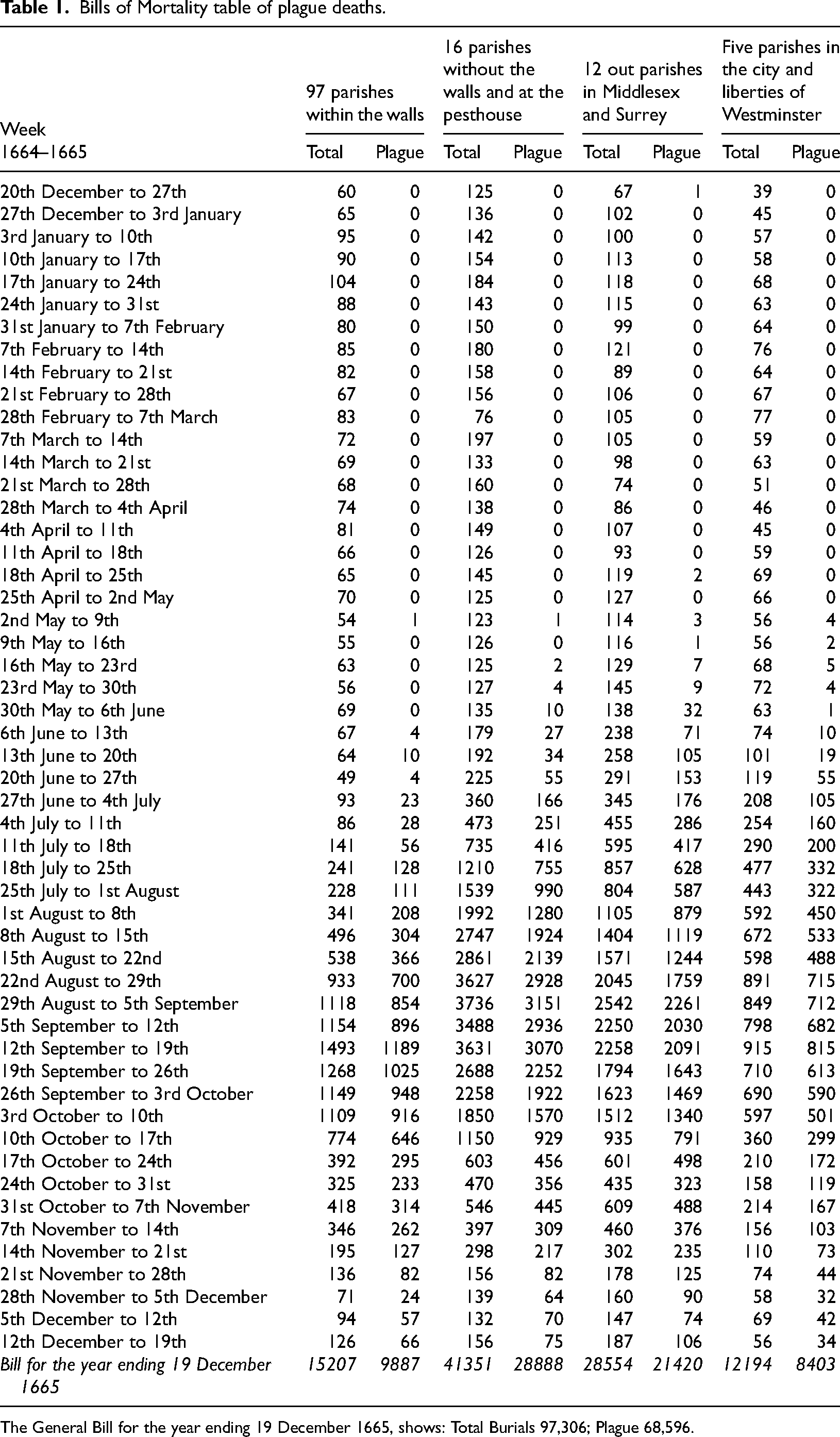
The General Bill for the year ending 19 December 1665, shows: Total Burials 97,306; Plague 68,596.
The article is presented as follows: this introduction sets the scene, placing the research within the literature, and provides the method and methodology. The second section provides the context and background, exploring the reactions to plague in various European countries and tracking the introductions of policies and regulations for public health in times of plague, including quarantining, distancing and restriction of travel, all of which have persisted to the current day. This section outlines the accountings of plague in London and provides a background of the Bills of Mortality. The third section narrates in chronological order the diary entries of Pepys and his comments and reflections at the time. This narration shows his own behaviours, others’ behaviours, public policy and the use of the Bills related to these policies, behaviours and decision-making. A fourth section provides an overall analysis, followed by the conclusion.
Context and background
Governments across Europe attempted to provide guidance to respond to the plague. This was not easy, given that the causes were not known at this time. There was no clear medical opinion that the disease was contagious; many doctors thought that the individual ‘humours’ of an infected person had caused the illness rather than it being passed from person to person (Harrison, 2013).
As governments attempted to learn from the observations and accounts of the ways in which the disease spread, they decided that restrictions on the movement of people, the isolation of those with the disease and the banning of public gatherings seemed necessary, even when there was some uncertainty about their efficacy (Tognotti, 2013). During the first bouts of the plague, for example, in Marseilles, the movements of merchants travelling to and from the city were constrained (Conti, 2008). When the plague struck Italy in 1348, Venice and then Florence instituted health commissions with members from their key citizens to govern the health crisis. Alongside enforcing the rules, the commissioners in Florence removed infected members of the public from the streets of the city to prevent them from contributing to airborne infection (plague was first believed to come from Miasma or bad air) (Cipolla, 1992). In Venice, Florence, and other cities in Italy, travellers were barred from entering the cities, their products were isolated (Ziegler and Platt, 1998), and in order to reduce infection, in some places in Italy, there were restrictions on the number of people attending the funerals of those who had died of the plague. These ideas led to the idea of quarantine, in one of the Venetian colonies (now Dubrovnik) in 1377 (Grmek and Buchet, 1997), all incoming travellers were isolated with their goods for 30 days. This was soon targeted at ships and merchants from places known to be infected, with variations in the period of isolation, 30 days became 40 days (‘trenta’ became ‘quaranta’ in Italian) (Gensini et al., 2004). Venice held those quarantined on an island just outside the city. These quarantine stations were subsequently used to accommodate those suffering from the plague to locate them outside of the city. Plague hospitals or ‘pesthouses’ were set up as small communities, a number of little houses around a square and a chapel; this model was copied elsewhere. This model was developed in Milan in the mid to late 1400s, where the Dukes of the city set up health boards, as in other cities that had suffered earlier from the effects of the plague. They built a plague hospital, along with temporary cabins outside the city walls, and Milan was one of the first cities to seek contacts of those affected by the plague and make them stay within their homes to avoid the spread of the disease (Luconi et al., 2023).
Accounting for the plague
Public policy was developed to include accounting to monitor illnesses and deaths, and the formal registration of deaths (Wrigley and Schofield, 1989). Key to these policies around plague was segregation and surveillance; the sources of the disease were identified and segregated to ensure the progress of the disease was stopped. Cities and countries throughout Europe gradually adopted plague regulations, restricting the movement of people with the disease and those they had been in contact with, isolating them at home, within hospitals, or other special accommodations. Many of the cities trading with those in Italy came to have plague regulations similar to those in Italy (Henderson, 2020).
In England, a royal announcement in 1518 determined the commencement of ‘contagious infections’ restrictions, with plague orders being printed in books from 1578; these were issued at various stages when the disease was recognised as recurring (Roger, 2020). They were based on the policies in Italy and backed up by sanctions outlined in an Act of Parliament in 1604 (King James I, 1604). Punishments where quarantine was instituted included being beaten by watchmen if found outside. The punishment for being outdoors with symptoms of the plague was even more severe and included being guilty of a felony for which the potential punishment was to be hanged (Wagner, 2017).
A report on plague written for King Charles II (1666) recommended practices to maintain ‘the public health of all’ and suggested plague houses, isolation of those afflicted and health boards that had the power to carry out these recommendations. These plague policies reassured the literate and wealthy; indeed, they were designed and instituted by those with influence to protect themselves. In this way, social differences were emphasised, and in parallel other new laws regulating the movement of the poor and beggars were applied. The regulations for public health and social welfare were enforced by watchmen, who later became the police (Carroll, 2002).
The regulations linked policy and regulation, order and control. This was assisted by accounting; deaths were now being registered in Italy and in England, and in the latter, cities accounted for deaths in the form of published Bills of Mortality. These Bills noted the number of deaths in the different areas of London and provided information for Londoners like Samuel Pepys.
Bills of Mortality
The Bills of Mortality were weekly reports of mortality numbers for London; they recorded burials from 1592 to 1595 and then continuously from 1603. In the time of Pepys’ diary and the plague in London of 1665 to 1666, Bills of Mortality were issued that listed the causes of death, accounting for these in the various areas of London. The Worshipful Company of Parish Clerks in London, UK, published the weekly Bill of Mortality as a sheet of paper with the mortality figures for each of the 130 parishes of London on one side, and on the other side, the different causes of death (Boyce, 2020). These accounts were sold as a subscription or on the street and posted up in public places to warn of the spread of the plague, and the Bills were distributed (Greenberg, 2004).
With a heading of ‘… A summary for the year, or A Collection of All the Bills of Mortality for this present year beginning 27th December 1664, and ending 19th December following …’ the annual Bill was adorned with a border of pictures related to death, skeletons, bones and grave digging tools, with a large skull at the top of the page and ‘Memento Mori’ (remember you must die). The annual Bill for 1665 for the period 27th December 1664 to 19th December 1665, shows 97,306 deaths, of which 68,596 were deaths from the plague (see Table 1). The plague did not reduce until the following year, by which time an estimated 100,000 people had died, around a fifth of all of the inhabitants of London. At the time, many believed this did not show the true figure. Graunt (1665) was dubious about the number of plague deaths recorded in the Bills of Mortality, due to the unreliability of those reporting the causes of death in the Bills of Mortality.
Deaths from plague were being accounted for, and these numbers were used to identify trends. Graunt (1665) referred to the Bills of Mortality for a statistical analysis of the plague, noting the trends of the incidence of the disease with the seasons of the year. His analysis of the Bills has been highlighted as the start of statistics (Fienberg, 1992). Graunt (1665) concluded that even with the peak of the mortalities from the plague, the population of London had recovered, due to many fleeing from the city. He also noted that those leaving tended to be the rich inhabitants, those who could leave the city and afford to live elsewhere. Following his calculations regarding the separation of people from the source of the disease, his fellow Royal Society member, William Petty, made further calculations, suggesting that any plague epidemic after 1665 would be less severe and recommending that he could introduce more effective quarantine measures (Rosen, 1953).
This accounting for plague provided the details for these statistical observations. Previously, readers of the Bills had used them to discover what was happening in their own locality. In contrast, Graunt used the Bills in aggregate to find patterns in the data, to determine the spread of plague across parishes, and changes in weekly death tolls (Graunt, 1662; 1676; Robertson, 1996) to track the plague (Boyce, 2020), an approach aligned with the belief in useful knowledge, promoted by Gresham College 6 and the Royal Society (Slack, 2004). With the improved knowledge that accompanied these public accounts and information came increased debate and an increased awareness of the need for policies and regulations regarding public health.
This article considers Pepys’ use of these accounts as recounted in his diary, highlighting both the personal and accounting aspects of the use of these accounts, in contrast to the summary nature of the information which underpinned this development of statistics and national accounting.
The story of the plague from the accounts, the Bills of Mortality and the perspective of Pepys’ diary
Prologue: Plague in Europe
In his diary, Pepys references that there was an outbreak of the plague in the Netherlands (19th October 1663), with a quarantine of ships from Europe (26th November 1663) and further reports of plague among the ships of the Dutch Navy throughout 1664. There are then no references to plague until 1665.
Referencing the Bills, plague in the city (May–June 1665)
Pepys’ first use of the Bills of Mortality (hereafter the Bills) was the observation that ‘the plague growing upon us in this towne’ (24th May 1665). The first case recorded in the period in the Bills was at the beginning of May 1665 (2nd May to 9th, Table 1). With an increase to four deaths at the beginning of June within the city walls (6th June to 13th, Table 1). Previously, a death outside of the city had been recorded in December 1664 (20th December to 27th, Table 1), with numbers increasing with each reported week (2nd May to 9th onwards, Table 1).
Pepys notes ‘to my great trouble, hear the plague is come into the City (though it hath these three of four weeks since its beginning been wholly out of the City; but where should it begin but in my good friend and neighbour's Dr Burnett, in Fenchurch Street: which in both points troubles me mightily’ (10th June 1665).
In June, Pepys starts to take precautions to avoid areas of London where there is plague, advising his wife to take a particular route on going to dinner with friends ‘because of the plague’ (8th June 1665). Pepys is clearly reading the Bills, as he reports a few days later ‘The towne grows very sickly, and people to be afeard of it; there dying this last week of the plague 112, from 43 the week before’ (15th June 1665), his figures aligning with the reported numbers of deaths in the Bills for these two weeks (9th June to 13th and 30th May to 6th June, Table 1).
Pepys has a close brush with a possible plague victim (17th June 1665), his coachman engaged to drive him from a part of town where there was plague. Pepys is clearly not taking as many precautions as he might do. In the meantime, he marvels at others’ naivety, on reporting four or five more deaths at Westminster, he quips, ‘yet people do think that the number will be fewer in towne than it was the last weeke!’ (20th June 1665).
Pepys reports a house being shut up due to the plague, as a ‘sad sight’ (26th June 1665), and seeing several other ‘plague houses’ cause him to be ‘fearful of going to any house’ (28th June 1665). Pepys references the Bills (29th June 1665) noting where the deaths are occurring. June ends, ‘In a sickly time of the plague growing on’, Pepys is considering moving his wife to Woolwich (30th June 1665).
Consulting the Bills to make decisions, plague increasing (July 1665)
July and the plague increases. Pepys notes more houses ‘shut up of the plague’ (1st July 1665). He has taken the decision to send his wife out of the City, to Woolwich, noting ‘some trouble there is in having the care of a family at home in this plague time’ but ‘very lonely’ (5th July 1665). The mood in general at this time is sombre, Pepys notes, ‘I perceive, an unpleasing thing to be at Court, everybody being fearful one of another, and all so sad, enquiring after the plague’ (10th July 1665).
However, he continues to go to Westminster, where he hears ‘the plague increases’ (11th July 1665), and with ‘the plague growing upon us’, he goes to Deptford, although ‘because of the plague, which renders it unsafe to stay long at Deptford’ (12th July 1665). He still consults the Bills and reports ‘Above 700 died of the plague this week’, 725 according to the Bills (4th July to 11th, Table 1).
He is concerned at the burying of the plague dead in plague pits in the marshy land west of Westminster, ‘such as are able to pay dear for it, can be buried there’ (18th July 1665). He continues to visit areas where ‘I hear the sickness is, and indeed is scattered almost everywhere, there dying 1089 of the plague this week’ (20th July 1665) despite consulting the Bills (11th July to 18th, Table 1) and exclaiming ‘But, Lord! to see how the plague spreads’ (20th July 1665) and ‘the plague growing very raging, and my apprehensions of it great’ (21st July 1665).
On 25th July, ‘but sad the story of the plague in the City, it growing mightily. This day my Lord Brunker did give me Mr Grant's 7 book upon the Bills, new printed and enlarged’ (25th July 1665) (Graunt, 1665).
Pepys is still worried about ‘the sad news of the death of so many in the parish of the plague, forty last night, the bell always going’ (26th July 1665) and ‘At home met the weekly Bill, where above 1000 encreased in the Bill, and of them, in all about 1,700 of the plague, which hath made the officers this day resolve of sitting at Deptford, which puts me to some consideration what to do’ (27th July 1665). The figures were slightly higher than this 1700, 1843 according to the Bill (18th July to 25th, Table 1), he notes ‘Thus we end this month, … the plague, which grows mightily upon us, the last week being about 1700 or 1800 of the plague’ (31st July 1665).
Plague increasing, general use of the Bills (August 1665)
In August, plague deaths are still increasing, Pepys notes an unusual remedy, ‘Up it being a publique fast, as being the first Wednesday of the month, for the plague’ (2nd August 1665). Pepys rides outside of the City, ‘all the way people, citizens, walking to and again to enquire how the plague is in the City this week by the Bill; which by chance, at Greenwich, I had heard was 2,020 of the plague, and 3,000 and odd of all diseases; but methought it was a sad question to be so often asked me’ (3rd August 1665).
Pepys is starting to worry for his health ‘in great trouble to see the Bill this week rise so high, to above 4,000 in all, and of them above 3,000 of the plague’ (10th August 1665), continuing ‘home, to draw over anew my will, which I had bound myself by oath to dispatch by to-morrow night; the town growing so unhealthy, that a man cannot depend upon living two days to an end’ (10th August 1665). The Bills show 2817 deaths from plague (1st August to 8th, Table 1).
On both the 3rd and 10th August, he retells in his diary curious plague stories, repeating local gossip and rumours. He is becoming increasingly worried: Up, and all day long finishing and writing over my will twice, for my father and my wife … at my papers, and putting up my books into chests, and settling my house and all things in the best and speediest order I can, lest it should please God to take me away, or force me to leave my house. (11th August 1665)
The effects of the plague are also starting to manifest in business, ‘But Lord! how sad a sight it is to see the streets empty of people, and very few upon the ‘Change. Jealous of every door that one sees shut up, lest it should be the plague; and about us two shops in three, if not more, generally shut up’ (16th August 1665).
Travel is becoming more dangerous, ‘I late in the darke to Gravesend, where great is the plague, and I troubled to stay there so long for the tide’ (18th August 1665). Whilst Pepys is still travelling, others are not so enthusiastic to do so, ‘and I could not get my waterman to go elsewhere for fear of the plague’ (20th August 1665). Pepys goes to Greenwich to see his new offices, ‘the lodgings appointed for us there for our office, which do by no means please me, they being in the heart of all the labourers and workmen there, which makes it as unsafe as to be, I think, at London’ (21st August 1665).
Pepys begins to question the figures, when he meets with ‘our clerke, who, upon my asking how the plague goes, he told me it encreases much, and much in our parish; for, says he, there died nine this week, though I have returned but six: which is a very ill practice, and makes me think it is so in other places; and therefore the plague much greater than people take it to be’ (30th August 1665).
Pepys is still keeping a close check on the figures and removes himself to Woolwich, because ‘the plague having a great encrease this week, beyond all expectation of almost 2,000, making the general Bill 7,000, odd 100; and the plague above 6,000’ (31st August 1665). 6102 according to the Bills (22nd August to 29th, Table 1).
Again, Pepys questions the figures. ‘In the City died this week 7,496, and of them 6,102 of the plague. But it is feared that the true number of the dead, this week is near 10,000; partly from the poor that cannot be taken notice of, through the greatness of the number, and partly from the Quakers and others that will not have any bell ring for them’ (31st August 1665). He is getting somewhat fed up with being away from home. ‘As to myself I am very well, only in fear of the plague, and as much of an ague by being forced to go early and late to Woolwich, and my family to lie there continually’ (31st August 1665).
First plague decreases in the Bills, large increases and observations on travel (September 1665)
September and travel has become difficult, especially from London. ‘I by water to Greenwich, where much ado to be suffered to come into the towne because of the sicknesse, for fear I should come from London’ (3rd September 1665). He notes ‘but Lord! to consider the madness of the people of the town, who will (because they are forbid) come in crowds along with the dead corps[es] to see them buried; but we agreed on some orders for the prevention thereof’ (3rd September 1665). He is perturbed at people's lack of caution, ‘two or three burials upon the Bankeside, one at the very heels of another: doubtless all of the plague; and yet at least forty or fifty people going along with every one of them’ (6th September 1665). The plague rages on ‘sent for the Weekely Bill, and find 8,252 dead in all, and of them 6,878 of the plague; which is a most dreadful number, and shows reason to fear that the plague hath got that hold that it will yet continue among us’ (7th September 1665), the Bills show 6978 dead from the plague (29th August to 5th September, Table 1).
Pepys reflects on the negative impact on business and the Navy: The fleete come home with shame to require a great deale of money, which is not to be had, to discharge many men that must get the plague then or continue at greater charge on shipboard, nothing done by them to encourage the Parliament to give money, nor the Kingdom able to spare any money, if they would, at this time of the plague, so that, as things look at present, the whole state must come to ruine. (9th September 1665)
There is a lucky escape for Pepys ‘God's great mercy I did not go by water with them yesterday, for he fell sick on Saturday night, and it is to be feared of the plague’ (10th September 1665). Pepys again marvels at the lack of caution: I did wonder to see the ‘Change so full, I believe 200 people …. I did endeavour all I could to talk with as few as I could, there being now no observation of shutting up of houses infected, that to be sure we do converse and meet with people that have the plague upon them. (14th September 1665)
He reflects on various instances during the day when he has seen deaths from the plague quite close to him and recounts many instances and stories he has been told, concluding ‘do put me into great apprehensions of melancholy, and with good reason’ (4th September 1665). Again, ‘the discourse of the likelihood of the increase of the plague this weeke makes us a little sad’ (16th September 1665), which turns out to be the case, from 6543 (5th September to 12th, Table 1) to 7165 (12th September to 19th, Table 1). Pepys finds this out, ‘and, which is worst of all, the Duke showed us the number of the plague this week, brought in the last night from the Lord Mayor; that it is encreased about 600 more than the last, which is quite contrary to all our hopes and expectations, from the coldness of the late season. For the whole general number is 8,297, and of them the plague 7,165; which is more in the whole by above 50, than the biggest Bill yet; which is very grievous to us all’ (20th September 1665).
Further decreases in the plague figures in the Bills, other stories from Pepys (October 1665)
At the beginning of October, Pepys reports the death of one of the watermen who carried the letters, with the other one sick from the plague; he notes, ‘The plague, though decreasing elsewhere, yet being greater about the Tower and thereabouts’ (3rd October 1665). Pepys is told, ‘the plague is decreased this week 740, for which God be praised! but that it encreases at our end of the town still’ (4th October 1665). The Bills record 5533 (19th September to 26th, Table 1) and 4929 (26th September to 3rd October, Table 1), a drop of 604, with reductions in all areas. He notes again, ‘The Bill blessed be God! is less this week by 740 of what it was the last week’ (5th October 1665). He laments how commonplace the plague has become ‘close by the bearers with a dead corpse of the plague; but, Lord! to see what custom is, that I am come almost to think nothing of it’ (7th October 1665).
Then ‘Good newes this week that there are about 600 less dead of the plague than the last’ (12th October 1665). Indeed, the Bills show 4327 (3rd October to 10th, Table 1), compared with 4929 (26th September to 3rd October, Table 1), a drop of 602. However, he observes, I walked to the Tower; but, Lord! how empty the streets are and melancholy, so many poor sick people in the streets full of sores; and so many sad stories overheard as I walk, everybody talking of this dead, and that man sick, and so many in this place, and so many in that. And they tell me that, in Westminster, there is never a physician and but one apothecary left, all being dead; but that there are great hopes of a great decrease this week: God send it! (16th October 1665)
Having recounted a story of suspicions of plague at the house of a colleague, he notes ‘Thus we end the month merrily; and the more for that, after some fears that the plague would have increased again this week, I hear for certain that there is above 400 [less], the whole number being 1,388, and of them of the plague, 1,031’ (31st October 1665), which is as reported in the Bills, 1031 (24th October to 31st, Table 1) and 1421 (17th October to 24th, Table 1) a reduction of 390.
More decreases, more stories and moving home (November 1665)
Early November Pepys says ‘I hear that one of the little boys at my lodging is not well; and they suspect, by their sending for plaister and fume, that it may be the plague’. He sends his colleagues to his lodgings, who on speaking with the mother are assured it is not, and while he says ‘however, I was resolved myself to abstain coming thither for a while’ (4th November 1665). He notes ‘the worst is I hear that the plague increases much at Lambeth, St Martin's and Westminster, and fear it will all over the city’ (5th November 1665) and ‘being glad I was out of the towne; for the plague, it seems, rages there more than ever’ (8th November 1665).
On 10th November, a neighbour dies from the plague, but ‘They hope here the plague will be less this weeke’ (12th November). According to the Bills, 1050 (7th November to 14th, Table 1) from 1414 (31st October to 7th November, Table 1). ‘The plague blessed be God! is decreased 400; making the whole this week but 1300 and odd; for which the Lord be praised!’ (15th November 1665). But the day before, on the road to Greenwich, he had passed through ‘a sad place through the plague, people sitting sicke and with plaisters about them in the street begging’ (14th November 1665). There is also news of another acquaintance being dead of the plague and another on 20th November.
Then, ‘I was very glad, but most of all, to hear that the plague is come very low; that is, the whole under 1,000, and the plague 600 and odd: and great hopes of a further decrease, because of this day's being a very exceeding hard frost, and continues freezing’ (22nd November 1665). The Bills show 652 (14th November to 21st, Table 1) and ‘It continuing to be a great frost, which gives us hope for a perfect cure of the plague’ (23rd November 1665).
Pepys dines, noting that ‘sending for one of my barrels of oysters, which were good, though come from Colchester, where the plague hath been so much. Here, a very brave dinner’ (24th November 1665).
By the end of the month ‘we do resolve to remove home soon as we know how the plague goes this weeke, which we hope will be a good decrease’ (28th November 1665) and ‘Great joy we have this week in the weekly Bill, it being come to 544 in all, and but 333 of the plague; so that we are encouraged to get to London soon as we can. And my father writes as great news of joy to them, that he saw Yorke's waggon go again this week to London, and was full of passengers’ (30th November 1665), the Bills show 333 (21st November to 28th, Table 1).
Man about town again, despite increases in the Bills (December 1665)
However, the plague is still evident ‘hear the ill news, to my great and all our great trouble, that the plague is encreased again this week, notwithstanding there hath been a day or two great frosts; but we hope it is only the effects of the late close warm weather, and if the frosts continue the next week, may fall again; but the town do thicken so much with people, that it is much if the plague do not grow again upon us’ (13th December 1665).
Pepys is getting out and about and visiting friends and acquaintances despite talk that ‘that this towne is still very bad of the plague’ (17th December 1665). He hopes that ‘The weather hath been frosty these eight or nine days, and so we hope for an abatement of the plague the next weeke, or else God have mercy upon us! for the plague will certainly continue the next year if it do not’ (22nd December 1665). He notes that it is ‘before the plague is quite over’. But also ‘with great content that the plague is decreased to 152, the whole being but 330’ (27th December 1665).
Pepys ends the year with ‘we have gone through great melancholy because of the great plague, and I put to great charges by it, by keeping my family long at Woolwich, and myself and another part of my family, my clerks, at my charge at Greenwich, and a mayde at London; but I hope the King will give us some satisfaction for that. But now the plague is abated almost to nothing, and I intending to get to London as fast as I can. My family, that is my wife and maids, having been there these two or three weeks’. And ‘to our great joy, the town fills apace, and shops begin to be open again. Pray God continue the plague's decrease!’ (31st December 1665).
Epilogue, Bills still consulted to verify that the worst is over
Although the year 1665 saw the worst of the plague (total deaths in the Bills in 1665 numbered 97,306, compared with a total of 12,738 in 1666 8 ), Pepys continues to comment on the figures and the Bills ‘with great joy I received the good news of the decrease of the plague this week to 70, and but 253 in all; which is the least Bill hath been known these twenty years in the City. Through the want of people in London is it, that must make it so low below the ordinary number for Bills’ (3rd January 1665/66 9 ).
There are returns to normality as Pepys moves back ‘to the office, where we met first since the plague, which God preserve us in!’ (9th January 1665/66). He reports slight increases in the Bills recording of the plague ‘hear to our grief how the plague is encreased this week from seventy to eighty-nine’ (10th January 1665/66) with ‘pretty merry, though not perfectly so, because of the fear that there is of a great encrease again of the plague this week’ (13th January 1665/66) and ‘mightily troubled at the newes of the plague's being encreased … The total being now 375, and the plague 158’ (16th January 1665/66). Life is starting to get back to normal, for example, ‘the first meeting of Gresham College since the plague’ (22nd January 1665/66).
With ‘Good newes beyond all expectation of the decrease of the plague, being now but 79, and the whole but 272’ (23rd January 1665/66), ‘great hopes there is of a decrease this week’ (29th January 1665/66) and more return to normality ‘This is the first time I have been in this church since I left London for the plague, and it frighted me indeed to go through the church more than I thought it could have done, to see so [many] graves lie so high upon the churchyards where people have been buried of the plague. I was much troubled at it, and do not think to go through it again a good while’ (30th January 1665/66). Pepys also goes to Whitehall, ‘to my great joy people begin to bustle up and down there, the King holding his resolution to be in towne to-morrow, and hath good encouragement, blessed be God! to do so, the plague being decreased this week to 56, and the total to 227’ (31st January 1665/66).
In February Pepys starts to refer to ‘before/since the plague’ and in the past tense (1st, 4th, 5th, 7th, 10th, 12th, 20th February; 9th February 1665/66) despite ‘Ill newes this night that the plague is encreased this week, and in many places else about the towne, and at Chatham and elsewhere’ (13th February 1665/66). He is now going back to crowded places ‘With Moore to the Coffee-House, the first time I have been there, where very full, and company it seems hath been there all the plague time’ (16th February 1665/66), with reflection on the relatively low numbers ‘We are much troubled that the sicknesse in general (the town being so full of people) should be but three, and yet of the particular disease of the plague there should be ten encrease’ (22nd February 1665/66).
March starts with ‘blessed be God! a good Bill this week we have; being but 237 in all, and 42 of the plague, and of them but six in the City: though my Lord Brunker says, that these six are most of them in new parishes where they were not the last week’ (1st March 1665/66). He continues to worry, notes he is afraid to walk in London's narrow lanes (14th March 1665/6) and to check the Bills, noting all changes in the number of deaths, particularly even small increases in plague deaths (13th March 1665/66; 22 March 1665/66; 5th April 1666; 8th April 1666; 10th April 1666; 23rd April 1666), but then ‘The plague, blessed be God! is decreased sixteen this week’ (25th April 1666).
Pepys notes his worries in May, ‘The plague encreases in many places, and is 53 this week with us’ (12th May 1666). Monthly fast days are still being held for the plague (6th June 1666, 4th July 1666).
He also comments on his fears around the increasing numbers of people in London and his fears of a resultant increase in plague, with anecdotal evidence, but he no longer references the Bills (6th August 1666; 9th August 1666; 9th August 1666; 17th August 1666; 13th September 1666).
In November, ‘then to church, it being thanksgiving-day for the cessation of the plague; but, Lord! how the towne do say that it is hastened before the plague is quite over, there dying some people still, but only to get ground for plays to be publickly acted, which the Bishops would not suffer till the plague was over; and one would thinke so, by the suddenness of the notice given of the day, which was last Sunday, and the little ceremony’ (20th November 1666). Pepys references ‘before the (great) plague’ (30th November 1666; 7th December 1666) and by 1st May 1667, ‘the late great plague’.
Analysis
During the Great Plague of 1665, accounting in the form of the Bills of Mortality recorded deaths; these summary accounts were released to the public via posting on billboards in an attempt to ensure that people followed the procedures in place. Foucault's (2007) concept of governmentality refers to the ways in which power is exercised and how individuals and populations are governed. Combining the terms ‘government’ and ‘mentality’, it reflects both the practical techniques of governing and the underlying mentalities or rationalities that make governance possible. Foucault introduced the concept to analyse the relationship between power, knowledge and the conduct of individuals and populations (Foucault, 1979).
Governmentality includes various forms of governance, including through social norms. It refers to the rational frameworks or ideologies that underpin governance, with power operating at multiple levels in society. For example, the shift during this period of plague from sovereign power (rule through laws and force) to disciplinary power (rule through normalisation and surveillance) reflects changes in governmentality.
Unlike earlier forms of power focused on ruling over a territory, governmentality emphasises managing populations. It involves understanding demographics, health, economy and other factors to optimise the welfare of the population while maintaining control (Foucault, 2004).
Foucault (2004) highlights the tools and techniques of power (e.g., statistics, censuses and surveillance) used to guide and control behaviour. These techniques are often subtle, aiming to shape the conduct of individuals and groups. The Bills of Mortality were statistics received, read and discussed by Pepys and his peers; they used these to understand the extent, the impact and the regions affected by the plague. Pepys constantly references these accounts, the Bills, from when they first show this bout of plague in May 1665.
The Bills were produced weekly, and Pepys starts recording the figures in his diary (from 15th June 1665), observing the changes in figures as he views them, mainly noting increases and decreases in numbers, and areas affected. He records the figures alongside personal anecdotes of people he knows or has heard of being afflicted with the plague.
He uses the increases in the accounts to determine when he will move his wife out of the city, and the decreases for when he will visit friends or return to work. When the numbers reduce in 1666, he is still recording the increases and decreases, but then the thoughts in his diary are more around fear of a return to the large numbers seen previously.
Pepys notes that Lord Brunker (Viscount William Brouncker), his friend and colleague, has given him the newly released third edition of Graunt's book (Graunt, 1665) on the Bills of Mortality. Lord Brouncker (Brunker) was a mathematician, and he was at that time President of the Royal Society. Pepys notes that this latest edition is ‘new printed and enlarged’ (25th July 1665). In his work, Graunt classified death rates by causes, including overpopulation. One of his conclusions was that the urban death rate exceeded the rural. Graunt himself notes in the Observations, that the Bills are used to determine, ‘in the Plague-time, how the Sickness increased or decreased, that the Rich might judge of the necessity of their removal, and Trades-men might conjecture what doings they were likely to have in their respective dealings’ (Graunt, 1665: 33). The Bills, the accounts of mortality were used to make decisions around where to travel, where to reside during the epidemic, and where to work. Those who were able to move from London to the countryside, tended to be the wealthier citizens and the city was empty. Pepys spent his time consulting the Bills to determine these things. At the beginning of July 1665, Pepys had dispatched his wife and her maid to Woolwich, initially he ‘feels lonely’ (5th July 1665), but he continues to go to Westminster despite the increases in the reported plague figures there (11th July 1665), by August he is visiting Woolwich and staying there overnight on occasion, albeit early in the morning and late at night, and occasionally having to lie about his previous whereabouts, ‘But Lord, to see how all these great people here are afeared of London, being doubtful of anything that comes from thence or that hath lately been there, that I was forced to say that I lived wholly at Woolwich’ (17th July 1665).
There was a clear, coordinated Government response; plague rules and orders had been issued (King Charles II, 1666), which were enforced by watchmen and reflected the medical understandings of the time. There was quarantining of incoming transport, isolation when infected was required, and the government provided plague houses for those who could not do this within their own homes. When people noted the number of deaths, they were thankful for the medics who remained in London. Or at least, mostly they were thankful to the medics; however, some denied that people were dying of the plague. Pepys reports a conversation with his doctor, whose manservant had died of the plague, I met this noon with Dr Burnett, who told me, and I find in the newsbook this week that he posted upon the ‘Change, that whoever did spread the report that, instead of the plague, his servant was by him killed, it was forgery, and shewed me the acknowledgment of the master of the pest-house, that his servant died of a bubo on his right groine, and two spots on his right thigh, which is the plague. (22nd July 1665)
Initially, there were restrictions on travel, and in 1663 Pepys reports the quarantining of ships from Hamburg and other infected places, ‘… a thing never done by us before’ (26th November 1663). Later, although formal ‘lockdowns’ were not implemented, there were directions for isolating those infected and their households. Pepys notes the isolating of households where inhabitants were suffering from the plague, with the mark of a red cross on the door, This day, much against my Will, I did in Drury-lane see two or three houses marked with a red cross upon the doors, and ‘Lord have mercy upon us’ writ there – which was a sad sight to me, being the first of that kind that to my remembrance I ever saw. (7th June 1665).
A significant aspect of governmentality is the way individuals internalise governance, regulating their own behaviour in line with societal norms and expectations. Individuals are guided to behave in particular ways. Foucault traced the emergence of governmentality from early modern times, from before the rise of the modern state. With early welfare-state approaches, the state started to take on a more direct responsibility for individual well-being. In the 1600s, the Government had a less developed role; there was less expectation for the Government to protect the people, so less questioning around their role. The Bills of Mortality recorded the deaths in total and from the plague; these summary figures were used by both the authorities and the people. The figures were not always accurate or completely trusted by those reading them. Whilst Pepys mentions the possibility of the Bills figures being an underestimate, he notes clear reasons why that might be the case and is not criticising the Government around this; he does not comment on the government's reaction to the Plague or its policies. At the end of August 1665, Pepys meets with, our clerke, who, upon my asking how the plague goes, he told me it encreases much, and much in our parish; for, says he, there died nine this week, though I have returned but six: which is a very ill practice, and makes me think it is so in other places; and therefore the plague much greater than people take it to be. (30th August 1665) In the City died this week 7496; and all of them, 6102 of the plague. But it is feared that the true number of the dead this week is near 10,000 – partly from the poor that cannot be taken notice of through the greatness of the number, and partly from the Quakers and others that will not have any bell ring for them. (31st August 1665)
Despite believing the figures to be an underestimate, Pepys, like many people he observes, continues to go to work and to socialise. On 10th August 1665, ‘By and by to the office, where we sat all the morning; in great trouble to see the Bill this week rise so high, to above 4,000 in all, and of them above 3,000 of the plague’, that same evening he attends a dinner party, with seven other friends and colleagues, but returns home ‘to draw over anew my will, which I had bound myself by oath to dispatch by to-morrow night; the town growing so unhealthy, that a man cannot depend upon living two days to an end’.
During the plague, Parliament did not sit; however, the country continued to function, and social order was maintained, though at times Pepys fears otherwise. ‘Things here must break in pieces, every man his own business of profit or pleasure; and that certainly the Kingdom could not stand in this condition long – which I fear’ (1st October 1665).
Entertainment such as theatres had been shut down. Pepys clearly understands that isolation would be advisable; however, this was not required. The Government response to the plague was a curfew, which Pepys frequently ignores, as do his peers, travelling after dark and meeting ‘sat late’ and then ‘to dinner’ (10th August 1665). Over time and with observation of the increasing incidences of death from plague in the Bills, he does, however, try to reduce contact with others. ‘How few people I see, and those walking like people that have taken leave of the world, thus I think to take Adieu today of London streets (28th August 1665).
While socialising was not advisable, Pepys frequently changed his mind about his views on this – ‘to dinner, sending for one of my barrels of oysters, which were good, though come from Colchester, where the plague hath been so much. Here a very brave dinner’ (24th November 1665).
Pepys hears that the servant of someone at work has died, so he sends him home. ‘By and by Captain Cocke came to the office and I did send to him that he would either forbear the office or forbear going to his own office’ (31st October 1665). However, he continues to meet with him outside of work (including dinner at his, on the 6th, 7th, 12th and 13th November 1665).
Plague hospitals were run by the City of London. It was realised that 1665 was to be a record year for plague victims, and during the summer, attempts were made to increase the number of beds provided, but most people were isolated at home. Although the causes of the plague were not clear, Pepys and his peers were cognisant of the possibility of catching the disease: …my meeting a dead corpse of the plague, carried to be buried close to me at noonday through the City in Fanchurch-street and to see a person sick of the sores carried close by me by Grace-church in a hackney-coach. (14th September 1665)
London's poor were more likely to live in close proximity to each other, eat less well, suffer from malnutrition and other health issues; they were unlikely to be able to leave London to protect themselves in the countryside or to work in isolation (Cummins et al., 2016; Graunt, 1665). Pepys observes that the deaths of employees and friends’ servants put him ‘into great apprehensions of melancholy, and with good reason’ (14th September 1665). On this day, he lists the various deaths that he feels linked to. The deaths noted in the diary are mainly of those in low socio-economic groups, medics who would have been more exposed to the disease, or those more elderly and frailer. Indeed, towards the end of the period, Pepys notes that none of his immediate family has been affected except one elderly aunt. There is a stark contrast between the summary nature of the figures and the actual situation Pepys found himself in. Although his personal decisions were framed around the numbers in the accounts, in reality, he was better protected to survive than less wealthy members of society.
With these many deaths in proximity to him and separated from his wife, Pepys is depressed; his diary has a different timbre as he becomes more aware of being surrounded by death.
There was no cure for the plague; the ways of treating it were limited, and stress was put on reducing transmission and trying to prevent infection. There was generally limited access to doctors at the time, and many of those had left the city. Many supposed cures were discussed in London in 1665; there were many rumours of how the plague could be avoided and dealt with. ‘The plague growing upon us in this towne; and of remedies against it: some saying one thing, some another’ (24th May 1665).
With the numbers increasing, fast days were implemented on the first Wednesday of each month, Pepys mentions being up early for these. These measures would have further weakened those who were poor and malnourished.
Government policies included quarantining, the banning of public gatherings, watchmen identifying those afflicted and the locking up of homes where the plague was experienced. Pepys notes these measures, and as the numbers in the Bills fall, the lifting of the measures. Again, these measures disproportionately impacted the poor. Measures that Pepys can observe in the diary, and whilst worrying about them, he is not unduly personally affected; he is still able to travel at will and maintain his lifestyle.
Pepys records his delight when ordinary life resumes. He notes with surprising resilience that he had ‘never lived so merrily’ (31st December 1665), he recounts how ‘to our great joy, the town fills apace, and shops begin to be open again’ (31st December 1665). A year and a half after the plague arrived in London, church bells are ringing: Thence to church, it being thanksgiving-day for the cessation of the plague; but, Lord! They say that it is hastened before the plague is quite over, there dying some people still. (20th November 1666)
Pepys's reactions change from fear of becoming ill with the disease, he reflects on monetary and business interests (16th August 1665; 9th September 1665; 1st October 1665). Initially, Pepys is upset to see houses, shops and places of entertainment, such as theatres, shut down; he worries about his own health and the possibility of catching the plague. These fears soon turn to economic concerns, worry about business, and his ability to carry out business and to profit from business. He notes the ‘great charges’ he has suffered, resulting from the plague, and hopes to be reimbursed, ‘but I hope the King will give us some satisfaction for that’ (31st December 1665). Again, this situation would have been far worse for those Pepys references as the poor; those in poverty, with limited financial capacity.
Conclusion
The contribution of this research is in the analysis of a diary, especially one as descriptive and self-reflective as that written by Pepys, which explored the accounting for death in the time of plague. This approach gives insight into how the Bills of Mortality, the accounts of death, were disseminated, digested and framed the decision-making of individuals. It shows the increased knowledge around this reporting and how the Government used these statistics to promulgate information around public health and substantiate the restriction of rights to protect the public. The research uses the insight gleaned from this narrative, but equally, this is one person's account; whilst other sources corroborate the facts, this does not elucidate how others used the information.
Pepys's diary reflects meticulous attention to detail, scrutiny and a negotiation between a public and private self. These characteristics align with the impact of Governmentality as Foucault describes, which centres on the management of the population through subtle and dispersed forms of power that operate not only through state directives but also through the shaping of individual conduct, including decision-making, activities and health (Foucault, 1991). The shaping of his narrative demonstrates Foucault's ideas about how individuals internalise governing norms and enact them in both personal and professional domains, for Pepys, as a private citizen and naval administrator.
The diary reveals the uses of the Bills of Mortality, weekly accounts, summary statistics that were calculated and disseminated, posted on billboards, widely available to those able to read them, offering a form of disclosure designed to inform and encourage rational action. This aligns with Foucault's argument that power works not just through domination but through knowledge and visibility. This accounting reflected a need to understand the impact and areas affected, and often these were further analysed and presented by experts for those seeking further information, such as Graunt's book (1665), given to Pepys. While such efforts advanced knowledge, there was also a questioning of the reliability of the accounts, of the methods of calculating and the acknowledgement that the Bills presented information that was most likely underestimated. However, these accounts were used to guide individual and collective decisions, including the decision to flee or stay in the city and pressures for policies to restrict travel.
The Government responded to the aggregated death accounts through rules and orders, imposition of quarantine and isolation, particularly of those affected, trying to prevent further infection, illustrating a shift from sovereign to disciplinary power, attempting to normalise behaviour and to mitigate risk. The policies enacted tended to have a disproportionate effect on the poor, those who had little living space and could not remove themselves from London to live in less crowded and less affected areas. Malnutrition, overcrowding, and limited access to healthcare exacerbated their vulnerability. This section of the population was more likely to get ill and more likely to die. They were also less likely to be able to access the accounts, the Bills and unable to act upon them. As more privileged individuals had the option to relocate and safeguard themselves, many doctors also left the city, creating a shortage of medical care and placing greater strain on an already suffering population.
Entertainments were closed and socialising was not advisable. With more suffering in poorer parts of the city, where there was overcrowding and where people could not leave, there were also families split apart. There were many curious cures and rumours about how one could be cured and how infection came about. People exhibited great resilience despite struggles with mental health, and then huge delight when ordinary life resumed. There were also economic concerns and impact on businesses and hopes for some form of restitution. All of these are reflected in Pepys’ diary alongside an ongoing recording, observing and reference to the numbers and the Bills of Mortality accounts, which serve as a parallel narrative to his reflections and decisions on a day-to-day basis during this time of plague.
The Bills of Mortality, developed in seventeenth-century London, were foundational in the development of actuarial science and the insurance industry. When Graunt (1662) analysed these bills, he created one of the earliest mortality tables (Hacking, 2006), using statistical methods to show the regularity of life expectancy and death probabilities (Knights and Vurdubakis, 1993). This innovation laid the groundwork for life insurance and actuarial mathematics by enabling the valuation of life annuities and the calculation of premiums based on mortality risk.
The time of the plague in London demonstrates various uses of accounting, along with the provision of accounts in guiding individual and collective decision-making around life and death choices. Pepys’ diaries provide insights into both the public and private use of these accounts. Pepys critiques the veracity of the accounts, notes the government's responses to the information reported, and uses the accounts as the basis to justify his own ethical and moral decisions.
Footnotes
Acknowledgements
The author gratefully acknowledges the assistance of Francesca McBride, who contributed to data collection during summer 2023.
Declaration of conflicting interests
The author declared no potential conflicts of interest with respect to the research, authorship, and/or publication of this article.
Funding
The author received no financial support for the research, authorship, and/or publication of this article.
