




Abstract
The key aim of this article is to reflect on the potential impacts of various types of historical counter accounts, used by civil society to promote resistance and conservation. For this purpose, the High Ross Dam controversy (in the 1970s) represents an important and unique historical case of social–political biodiversity conservation action, by civil society. A detailed case study is presented that includes an analysis of civil society opposition through counter accounts. Technical and non-technical counter accounts of resistance by civil society are investigated, using Escobar's theoretical framework. Examples of historical counter accounts serve as outstanding precedents of civil society activism for biodiversity against business and political agendas.
Introduction
Economic considerations, including business actions over ecological concerns, exacerbate environmental vulnerabilities, resulting in biodiversity destruction (Ehrlich, 2002; Nazarea, 2006). Biodiversity is required for the provision of several critical ecosystems’ processes and services (Hector and Bagchi, 2007; Worm et al., 2006). Business, in some instances, such as in the historical case study addressed in this article, pushes its agenda, by promoting the business case, potentially resulting in biodiversity destruction. In opposition, there is civil society resistance against potential business biodiversity destruction (Escobar, 1996). The case presented in this article is a relevant representation of civil society resistance (Escobar, 1996) depicted through its counter accounts.
This article contributes to the biodiversity accounting literature by providing a historical view of a wide range of biodiversity conservation-focused civil society counter accounts. While there have been multiple considerations over the use of counter accounts against misleading corporate reporting (see Apostol, 2015; Spence, 2009; Thomson et al., 2015), the article has a civil society activism focus regarding counter accounts. It employs a unique theoretical lens (that of Escobar, 1998) to attain an understanding of civil society resistance (depicted through its counter accounts). We refer to counter accounts as instruments of social-materiality construction of biodiversity conservation rather than as critical alternative accounts to corporate reporting. This approach aligns with Gray et al. (2014), Thomson et al. (2015) and Vinnari and Laine (2017). Vinnari and Laine (2017) define counter accounts as alternative representations of organisations, industries, or governance regimes, produced by civic society, to fix a state of affairs that is considered harmful (Thomson et al., 2015). These counter accounts serve to bring about emancipatory changes in society (Spence, 2009).
The article adds to the developing literature (Parker and Guthrie, 2012) on biodiversity accounting (see Cuckston, 2013; Feger and Mermet, 2017; Freeman and Groom, 2013; Liempd and Busch, 2013; Rimmel and Jonäll, 2013; Samkin et al., 2014; Siddiqui, 2013) who analysed the impacts of information systems’ adoption for collective action for biodiversity conservation and the counter accounts literature (Cooper et al., 2005; Denedo et al. 2017; Everett, 2004; Gallhofer et al., 2006; Gray and Milne, 2018; Spence, 2009) by undertaking a historical analysis of counter accounts as part of the civil society's discourse for the conservation of biodiversity. As such, this article is one of the few articles (see Atkins and Thomson, 2014; Hrasky and Jones, 2016) that have referred to counter accounts for biodiversity conservation, in a historical context. A ‘rigorous scrutiny of documents’ had to be undertaken to discover the truths of the past (Gaffikin, 2011: 241). Nevertheless, such scrutiny is not deemed to be sufficient and social implications should be brought to light (Gaffikin, 2011). This article has implemented this combined approach, by highlighting social and political implications of the actions of various actors, including civil society actors. The case analysed represents a milestone in the development of civil society's actions to promote biodiversity conservation (Escobar, 1998, 1996, 2011).
This study also contributes to counter accounts literature by classifying counter accounts into two types, the first being technical counter accounts. These types of accounts are adopted by non-business, non-industry or non-government entities
The article addresses how civil society problematised the need for biodiversity conservation (Jones and Solomon, 2013) and communicated this through the following technical counter accounts: cost/benefit analysis and the inventory method (Jones, 2003) using data collected from biodiversity field surveys. Also, civil society's non-technical counter accounts (discourse) served an important purpose of resistance against business. In a nutshell, we provide a historical depiction of civil society's biodiversity conservation, by using technical and non-technical counter accounts, which we have analysed through the lens of Escobar's (1998) social–political construction. Justification for selecting the case study lies in the High Ross Dam's civil society providing cross-border (U.S. and Canada) counter accounts, which served to set the precedence for lasting material changes for biodiversity conservation action.
The rest of the article is structured as follows: counter accounts and contribution to biodiversity accounting literature is discussed below. This is followed by Escobar's (1998) theoretical framework of social–political civil society construction of biodiversity conservation through counter accounts (technical and non-technical). The next section is a description of the research methodology employed. We then look at the case background and provide an analysis of the technical and non-technical civil society counter accounts around biodiversity conservation. The article ends with a discussion and conclusion section.
Biodiversity conservation counter accounts
Biodiversity conservation and civil society
Human (including business) actions are causing a biodiversity crisis including high extinction rates (Pimm et al., 1995). This process is negatively impacting the environmental services that biodiversity has been providing to humans (Reid et al., 2005), including raw materials, ecosystem services, soil fertility, nutrient cycling, flooding control, aesthetic and recreational benefits, human security, health, social relations, freedom of choices and action (Kumar and Ram, 2005). From the perspective of this article, we focus on civil society's conservation efforts. There have been attempts by civil society to understand the drivers of threats to biodiversity and the reasons some human actions are unsustainable (Holling, 2001). Biodiversity conservation bodies’ activism has resulted in these organisations using counter accounts to share critical information with the public.
Counter accounts
The reliability of communications from governments and businesses has been questioned on numerous occasions (O’Dwyer and Owen, 2005), with assertions of communications being manipulative (Archel et al., 2011; Unerman and Bennett, 2004). In response, civil society counter accounts have been identified as important forms of rebuttal, presented as alternative forms of sustainability accounts (including biodiversity accounts), by non-economic driven actors (Dey and Gibbon, 2014). Counter accounts enable silenced, contested and captured biodiversity aspects to become prominent in public debates and critical discourses (Appadurai, 1990), leading to public action (Vinnari and Laine, 2017) and transformative decisions (Laine and Vinnari, 2017), against biodiversity destruction for profit-making purposes (Forester and Machlist, 1996). Counter accounts overcome the one-sided political and economic picture (Apostol, 2015). In their technical and non-technical forms, they become vehicles of ‘speaking truth to power’ (Tregidga, 2017: 521).
Dey and Gibbon (2014) have pointed out that such accounts promote progressive social agendas and reformist efforts and become active attempts to de-legitimise the actions of dominant institutions. Dey and Gibbon (2014) have classified these counter accounts as external social accounting, an important element of grassroots social activism (Lubbers, 2002). Counter accounts (of civil society) provide information to a wide range of stakeholders including governments, civil society, media and the public (Dey and Gibbon, 2014).
Counter (technical) accounts serve to measure, create, make visible and communicate evidence in contested areas (Georgakopoulos and Thomson, 2008). They problematise business push for biodiversity destruction; they act as a catalyst for change (Dey and Gibbon, 2014). This understanding of counter accounts as external social accounting is very similar to Escobar and Paulson's (2005) description of biodiversity discourse, being the dispersion of new truths through vast social domains. Counter accounts act as symbolic political tactics that create alternative representations of the consequences of problematic (political economy) conduct (Cooper et al., 2005; Denedo et al., 2017; Everett, 2004; Gallhofer et al., 2006; Spence, 2009).
Civil society counter accounts are technical (quantitative and scientific, such as field surveys, reports or cost/benefit analyses) and non-technical (such as artistic forms of expression, dialogue, narratives and discourse) and are primarily used to disprove or resist business/government stances or actions. Counter accounts are critical elements of resistance from civil society (Ball, 2007; Samkin et al., 2014); they convey important information about impacts on ecosystems (Maunders and Burritt, 1991). They offer evidence through which the meaning of an event or action is rearticulated from a civil society perspective (Laine and Vinnari, 2017). Counter accounts result in ‘alternative representations, new visibilities and knowledge of existing situations in order to problematise … and represent the views of oppressed ecological systems’ (Dey et al., 2011: 64). Biodiversity accounts, as part of civil society activism, are typically the scientific form of environmental accounting, involving scientific measurements (see, e.g., Jones’ (2003) inventory model). Generating biodiversity accounts based on scientific measurements requires the use of appropriate indicators and data collection methods, which capture detailed descriptions (Puumalainen et al., 2003). Biodiversity inventory and impact accounts (Jones, 2014a) are crucial aspects of civil society activism (Escobar, 1996) in this instance. As Feger et al. (2017) and Feger (2019) have stressed, the true usefulness of ecosystem services’ assessments and tools emerges from their use by civil society as part of a strategy for communication, advocacy and action.
It is important to note that from civil society's activism perspective, biodiversity accounts are transformed into something more than just technical scientific measurement and reporting. Technical counter accounts are used in discourse (non-technical counter accounts), which speakers and writers use to inform, persuade and motivate the audience in particular situations (Watson, 1995). Biodiversity counter accounts in different forms (written and oral) can: no longer be regarded as a neutral device that merely documents and reports ‘the facts’ [for example through field surveys of sites] … they can be seen as a set of practices that affects the type of world we live in, the type of social reality we inhabit, the way in which we understand choices. (Miller, 1994: 1)
Biodiversity accounts, as civil society activism counter accounts, assist negotiations between stakeholder groups on crucial issues (Siddiqui, 2013), such as biodiversity conservation. Once biodiversity counter accounts become mobilised, crucial issues start to emerge, for example, the actual costs of biodiversity destruction, due to economic actions (Cuckston, 2013). Civil society counter accounts enable silenced, contested and captured biodiversity aspects and critical discourses (Appadurai, 1990), resulting in public action (Vinnari and Laine, 2017). Counter accounts promote ‘speaking truth to power’ (Tregidga, 2017: 521); they promote progressive social agendas and reformist efforts (Dey and Gibbon, 2014). Civil society counter accounts, with their technical and non-technical, communicative nature, provide adequate understandings (Laine and Vinnari, 2017). In summary, counter accounts act as enablers of resistance, as critical discourses that speak truth to power (Appadurai, 1990; Tregidga, 2017), resulting in public action, reformist efforts and progressive social agendas (Dey and Gibbon, 2014; Vinnari and Laine, 2017).
A key contribution to counter accounts literature is the presentation and analysis of a wide range of technical and non-technical counter accounts by civil society, relating to a prominent historical case. There is a wide understanding of the meaning and impact of counter accounts presented in prior literature (Appadurai, 1990; Cooper et al., 2005; Denedo et al., 2017; Dey and Gibbon, 2014; Everett, 2004; Gallhofer et al., 2006; Georgakopoulos and Thomson, 2008; Spence, 2009). This article not only presents the impacts of various types of counter accounts in a historical context; it also accords a combined understanding of counter accounts and the dispersion of new truths, through vast social domains (Escobar and Paulson, 2005).
Seminal biodiversity accounting literature
Seminal work has been undertaken by Jones (1996) around the concept of natural inventory. Jones stressed non-economic valuation of natural capital and provided a framework, which could be used by various types of organisations including public and semi-public bodies. Jones (1996) promoted the assets-based inventory approach, which encompasses the provision of a balance sheet with various levels of biodiversity, including habitat type, inventory of listed and protected flora and fauna on all habitats, inventory of critical habitats by species and population and general inventory by species and population.
In 2003, Jones provided an application of the natural inventory approach in the context of Elan Valley, a critical water catchment and storage area in Wales (UK). Jones (2003) stressed that data availability, especially for non-critical species can be problematic, nevertheless, benefits of implementing the model outweigh the costs. It was a decade later, in 2013, that further work on the natural inventory model was published by Siddiqui (2013), who applied the model in the context of Bangladesh and highlighted the social–political issues of corruption. He stressed the importance of environmental stewardship and accountability. Liempd and Busch (2013) focused on Denmark and promoted the ethical case for corporate biodiversity reporting, while stressing that Danish companies score low for biodiversity reporting. Freeman and Groom (2013) raised the issue of using long-term discount rates which may cause under-valuation of sensitive biodiversity conservation projects. Rimmel and Jonäll (2013) analysed biodiversity disclosures of Swedish companies and, based on interviews with corporate representatives, found that the key reason for low biodiversity reporting is the lack of demand from pressure groups. These articles on biodiversity accounting and reporting emerged as a result of an urgent call to address biodiversity and extinction, and to promote greater corporate accountability (Jones and Solomon, 2013).
Jones (2014c) re-emphasised the importance of biodiversity accounting from the perspective of measurement and reporting and from the perspective of discharge of organisational accountability. In the same year, Khan (2014) looked at the critical issue of destruction of biodiversity in Indonesia, due to palm oil plantations and Samkin et al. (2014) presented a biodiversity reporting and evaluation framework. In Accounting for Biodiversity edited by Jones (2014a), the work of Atkins and Thomson (2014) provided a historical context to biodiversity accounting. Their focus was on one individual, William Morris, who was an influential member of various institutions in nineteenth-century Britain. He utilised accountability mechanisms and the concept of naturalism to promote greater accountability by government institutions and business. He promoted the intrinsic value of nature, and a subjective, romantic understanding of nature. He utilised various forms of counter accounts discourse including poetry, fiction, letters, lectures and political writings to problematise human-nature interactions (Atkins and Thomson, 2014). His efforts can be classified as civil society's activism by an individual, through the utilisation of multiple counter accounts.
Hrasky and Jones (2016) considered the role of accounting in an environmental infrastructure project, which caused the flooding of Lake Pedder in Tasmania (Australia), in the 1960s. Accounting, in this instance, was used to misrepresent the Gordon River hydroelectric scheme as a rational and sustainable allocation of resources. Hrasky and Jones (2016) demonstrated critical limitations of financial accounting: not being able to capture environmental externalities, and its use as an impression management tool. There were key issues relating to the project, including flawed and biased political processes, lack of impact study assessments, lack of disclosures, selective use of cost/benefits analyses and the lack of consideration of non-financial actors.
This article is the first contribution to the biodiversity accounting literature to provide a historical perspective on civil society's collective social and political construction of the case for biodiversity conservation, against the political economic imperatives of biodiversity destruction. Civil society is expected to take a stand against biodiversity destruction, caused by infrastructure projects, which unfortunately occurred in the case of Lake Pedder (Hrasky and Jones, 2016).
Theoretical framework of social–political construction of biodiversity conservation
Escobar's (1998) social–political construction model conceptualises the conservation of biological diversity by focusing on civil society and civil society's social movements. This study uses Escobar's (1998) social–political construction model because it fits with the article focus on a historical case of social–political construction of biodiversity conservation, by civil society, through various forms of activist counter accounts.
In relation to civil society (social) movements, Alvarez and Escobar (2018) stress that civil society actors could act in the multiple arenas where power is exercised. Efforts of social movements reconstitute identities through contested discourses and strategies (Alvarez and Escobar, 2018). The model considers mutual influences of multiple actors in the political environment (Weingast and Wittman, 2008). It addresses the role of government and the influence of power relationships. Social–political construction focuses on the role of language as a form of communication in the construction of social reality; discourse represents facts that social movements and community activists articulate (Escobar, 1996).
On the one hand, economic motives of businesses and governments (political economy) represent production at will. On the other hand, civil society's movements (activism) undertake the task of building alternative rationalities and strategies, against the destructive forces of capitalism (Escobar, 1998), through counter accounts. Escobar (1998) proposes the consideration of discourses as strategy, through which nature becomes known. A key consideration in Escobar's (1998) conceptualisation of social–political constructions is the appearance of new social actors: progressive NGOs and local social movements. Escobar (1998) provides a two-sided view of the social–political construction of biodiversity conservation efforts: the technical side and the discourse side. The technical side focuses on the scientific aspect of biodiversity measurements (e.g., the use of biodiversity accounting models). It includes the monitoring and assessment of biodiversity and economic valuations (Escobar, 1998). The other side of the social–political construction of biodiversity conservation is discourse (Escobar, 1998; Martin et al., 2013). Discourse is undertaken by multiple actors ranging from NGOs to scientists, local communities and social movements. The case under consideration involves both technical and discourse elements (Escobar, 1998).
Escobar (1996) identified the development of discourse as a series of statements and visibilities linked together. Discourse highlights concern with power (Watts, 1993). To analyse social–political constructs for biodiversity conservation, biodiversity is expected to be considered as a historically produced discourse (Escobar and Paulson, 2005). The emergence of biodiversity (conservation) discourse is a response to the problematisation of flora and fauna survival. ‘The ferment of activity that characterises the biodiversity field today is novel but not without historical precedents…. Lessons from this kind of experience [can be used] to illuminate today's biodiversity debates’ (Escobar and Paulson, 2005: 259).
In its non-technical and technical forms, biodiversity (conservation) counter accounts of civil society are a prime instance of co-production. It is co-production of technical science (which encompasses biodiversity measurements, biodiversity inventory disclosures and impact assessments defined as technical) and non-technical discourse of multiple actors (such as poetic discourse) (Escobar and Paulson, 2005). This co-production can facilitate a holistic transfer of knowledge in relation to environmental impacts. Discourse involves social–political accounts, expressions and statements of resistance against the economic destruction of biodiversity (Escobar, 1998). Social–political construction encompasses the mobilisation of biodiversity technical accounts as well as conversations and expressions of resistance by civil society (discourse), in cohesion, to promote the case for biodiversity conservation. They become strategic, political talk.
Political talk involves the inclusion of voices and counter accounts by civil society in political debates such as public hearings. This is necessary to promote the case for biodiversity conservation and to reduce environmental vulnerabilities caused by economic actions (Escobar, 1998; Escobar, 2009; McGregor, 2004). Counter accounts, as statements and expressions of resistance, are an important part of political talk because they demonstrate an issue or problem that impacts the broader community (Scheufele, 2000). Public hearings involve the presentation of counter accounts (Cooper and Elliott, 2000; Featherstone, 2013) around negotiations for conserving the land. Counter accounts, as demonstrations of persistence and struggle, play an important role in the strategy of civil society for social–political construction (Escobar, 1996; Escobar, 2011). For successful outcomes in political talks, negotiators presenting a case on behalf of endangered species, provide informed arguments, backed by scientific evidence and ecological measurements (Rowland, 1992): that is, technical accounts. Technical accounts can be backed with non-technical forms of discourse (Lemke, 2005), resulting in a combined approach for knowledge transfer. ‘Truths’ circulated by powerful actors, such as economic entities and governments, are resisted, subverted or recreated to serve other ends, by social movements and their counter accounts (Escobar, 1996, 2006).
In a nutshell, Escobar (1998, 2006) identifies three propositions to be applied in a context: (1) biodiversity as discourse. It is a discourse from a complex network of actors. Discourse has the potential to articulate a re-identified relation between society and nature (Escobar, 2006). Each actor's identity is affected by the discourse as it affects the network. The second proposition is that (2) through politics, social movements advance the civil society activism agenda (Escobar, 1996, 1998, 2007). The third proposition indicates that (3) discourses, as biodiversity debates, take on new dimensions, which overcome managerial and economic (business) potential destruction (Escobar, 1998; Escobar and Paulson, 2005).
Research methodology
Case study approach
Documents and photographs act as a means of triangulation that is ‘the combination of methodologies in the study of the same phenomenon’ (Denzin, 1970: 291). The approach adopted for this case study is the consideration of counter technical and non-technical accounts through the lens of Escobar's (1998) social–political construction (Simons, 2009). Also, we provide descriptive (Yin, 2009) information relating to the key roles and actions of civil society.
Archival documents have been utilised to present aspects of reality (as created through the efforts of social actors) relevant to the case study (Linders, 2008). Appropriate selection of documents was driven by an understanding of whom the participating actors were, and how they went about constructing or contesting the aspect of the reality of interest (Linders, 2008). Archival information relating to the dam's history and social–political processes was collected from Washington State's website and related links (i.e., Washington State Library archives; University of British Columbia records; North Cascades Conservation Council's journals and archives). Three datasets were analysed: first, field surveys representing biodiversity inventories, reports and collection of views on the use of the biodiversity accounting materials at public hearings; second, visual representations (images and pictures) of the events; and third, non-technical accounts (letters and other forms of discourse) used to present the case for the region's biodiversity conservation. Data sources are presented in Table 1; key actors have also been identified in the table.
Documentary analysis.
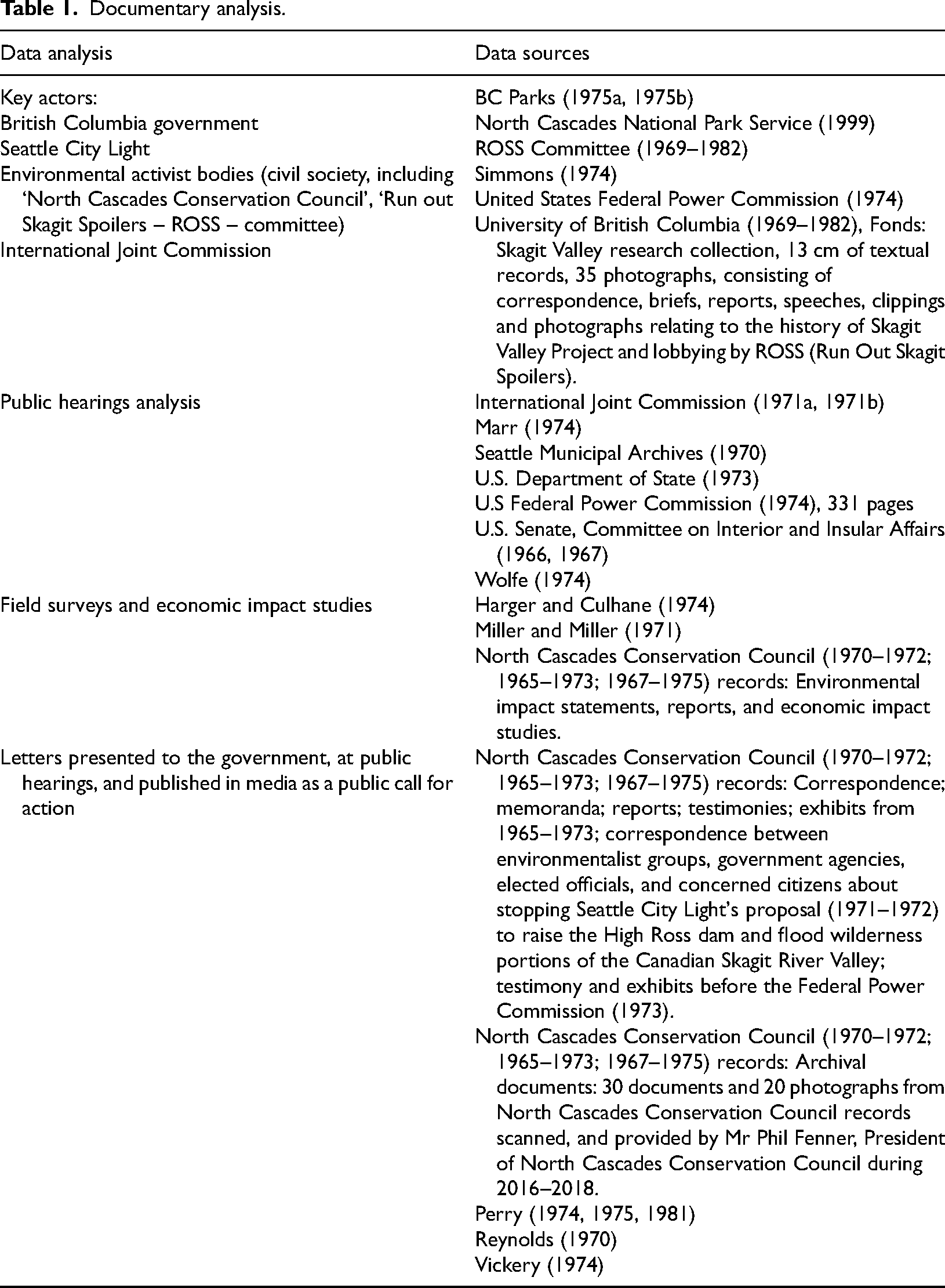
Documentary analysis
The major data source were the North Cascades Conservation Council's archival records. North Cascades Conservation Council was established in 1957 in British Columbia. All documents (approximately 800 pages) were manually analysed to identify key social–political counter accounts. Copies of the underlying research materials are available from the corresponding author. Following the footsteps of Apostol (2015), discourse analysis, that is analysis of texts in close interconnection with the relevant social context and practices, has been undertaken. Thus, the data analysis section interconnects documents to social developments (Apostol, 2015). Analysis was performed through close readings of the documents and textual interpretation was undertaken considering the social–political developments (Apostol, 2015). Multiple iterations were undertaken, based on data and theoretical aspects, interpretations, multiple readings and revised data interpretations (Apostol, 2015).
It took almost two years, from 2016 to 2018, to collect enough documentation (articles, reports, pictures, personal views, documents relating to public hearings, field surveys and other technical accounts) for a complete analysis and presentation of the case study, following Apostol's (2015) discourse analysis technique. Phil Fenner, and other North Cascades Conservation Council's board members, as well as the Washington State Library personnel, provided scanned copies of relevant documents via email. A few skype meetings were undertaken to clarify, verbally, the specific types of documents required. This process was implemented throughout 2016–2018. There were multiple interactions with the North Cascades Conservation Council and the Washington State Library archives as data analysis and case write-up progressed, to attain relevant data.
Case background
The High Ross Dam stretches across the Skagit River and is situated in Washington State, U.S. It has formed the Ross Lake, which extends into British Columbia, in Canada. The High Ross Dam led to a transnational controversy, which involved the approval and proposed commencement of the fourth stage of the High Ross Dam construction, in 1970. This expansion, related to the fourth stage of the construction, would have increased the height of the Ross Lake reservoir to 1,725 feet. This would have created additional flooding in British Columbia. The case, as analysed in this article, represents transnational civil society counter accounts and actions for biodiversity conservation, against the fourth stage expansion. The key actors were:
Seattle City Light: Washington's publicly owned electric power utility. The City of Seattle: local government authority. British Columbia's local government. The International Joint Commission: a quasi-judicial independent body, authorised under the ‘Boundary Waters Treaty’ of 1909 to mediate boundary disputes, and all related issues, between the U.S. and Canada (Simmons, 1974). The U.S. Federal Power Commission, responsible for licensing processes. The civil society, referred to as environmental preservationists, including (a) ‘Run Out Skagit Spoilers (ROSS) committee’ formed in British Columbia by a mix of U.S. and Canadian participation; (b) ‘North Cascades Conservation Council’ (N3C), formed in Washington State, in 1969; (c) ‘Society for Pollution and Environmental Control’ (SPEC), formed in British Columbia, in 1969; d) ‘British Columbia (BC) Sierra Club’, in British Columbia, which played a central role in the formation of the ‘Don’t Make a Wave Committee’, in 1970. This Committee evolved into ‘Green Peace’, in 1971.
The impact of the dam's expansion as flooding of the region is shown in Figure 1.
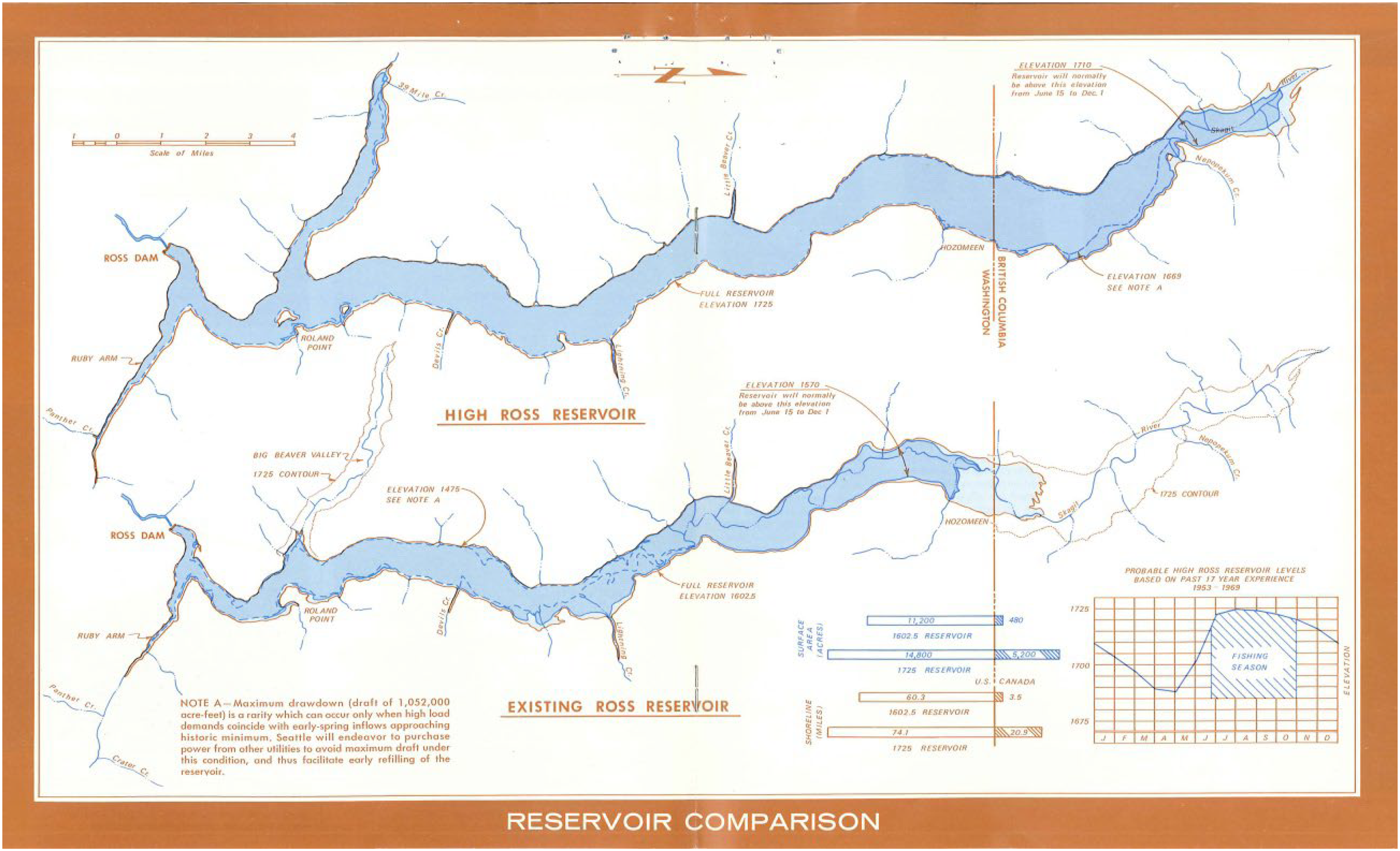
High Ross Dam's fourth stage: expansion flooding impact.
Figure 1 pairs two maps, showing a comparison of lake size if the fourth stage, called ‘high dam’ had been built, at High Ross Dam. It is an official Seattle City Light's document when the proposal was still active in 1970. The upper map in Figure 1 shows what the dimensions of the reservoir would have been if the high dam had been expanded. The lower map in Figure 1 shows the existing dimensions of the reservoir. The dam is at the far left in both maps.
High Ross Dam's history prior to the fourth stage planning
Louter (1998) outlines the historical background of the High Ross Dam construction, and its impact on biodiversity. The Skagit River hydraulic project comprised of three dams: the Gorge Dam, the Diablo Dam and the Ross Dam (prior name of High Ross Dam) in the Whatcom County, west of North Cascades National Park on the Skagit River, in Northern Washington State. The Ross Lake extends into British Columbia (Seattle City Light, 2014) as can be seen in Figure 1. Before the construction of the Ross Dam, the Skagit Gorge upstream was free-flowing and biodiversity-rich (Louter, 1998). Within the canyon, an ancient forest of Douglas firs, western hemlocks and western red cedars lays intact, with an estimated timber market value of $340 million.
The Skagit River hydraulic project began in 1910, with the construction, downstream, of the Gorge and Diablo Dams. In 1937, the High Ross Dam's construction commenced. There were four phases: before 1940, the first two phases were completed. The dam was 305 feet above the river. In 1943, the third construction phase of the High Ross Dam began, increasing the dam's height to 475 feet. The transcript of the 1941 Seattle Hearing on High Ross Dam suggests a complete lack of understanding of the land that was going to be impacted by the dam's construction (Perry, 1975). The Canadian and British Columbian governments were not aware of the land impacts of the dam and its flooding.
On the other hand, Seattle City Light's business case for approving the dam construction was quite strong. The company presented the argument that the construction of the dam was urgently needed, to meet the power demands created by World War II: this was the account of societal interest presented by Seattle City Light. The U.S. War Department also made an urgent request for building the reservoir to prevent flooding in the lower Skagit Valley, in Washington State. However, as Perry (1975) has stressed, both goals could have been met without requiring flooding in British Columbia (Canada). The Decco-Walton Logging Company was awarded a contract in 1945, by Seattle City Light, to undertake logging in the area for the third stage construction of the dam. This clearing of the trees had a profound flooding impact after the third stage of construction.
Stage three of the dam was completed in 1949 when the dam height reached 540 feet. This height increase caused the reservoir, when at full capacity, to extend over the Washington-British Columbia border. This happened in 1954; a small penalty was paid by Seattle City Light as a result.
There was an absence of measurements and detailed assessments of the region prior to the 1941 decision to allow the further construction of the dam. This lack of transparency in the early days resulted in years of lengthy political and social action by civil society.
The timeline of key events is presented in Table 2.
Key events timeline.
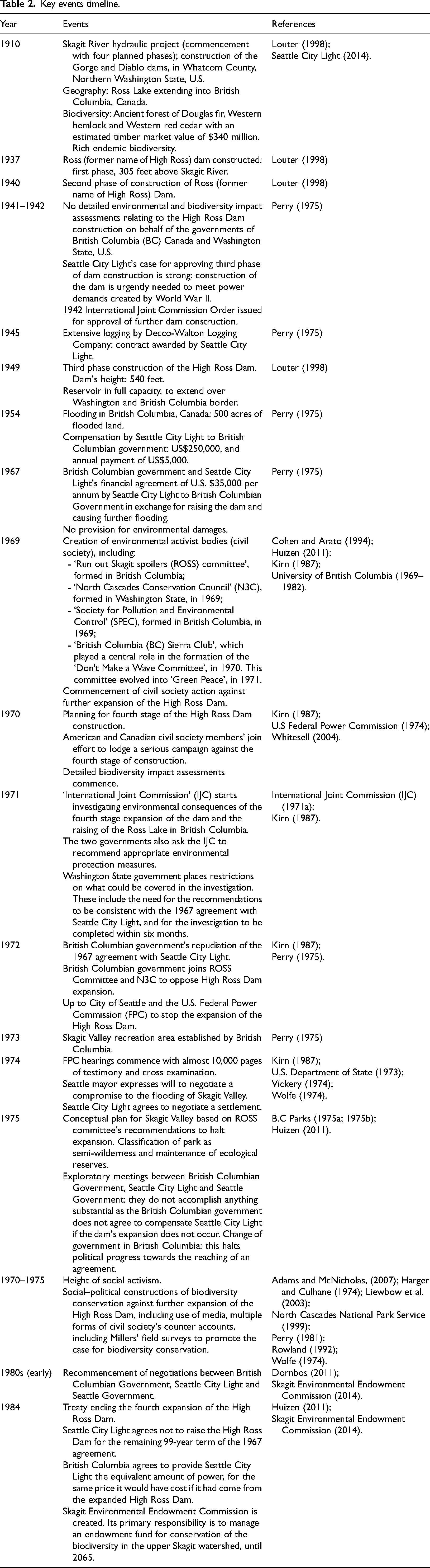
Fourth stage expansion: The High Ross Dam controversy
The controversy began in relation to the fourth stage of the construction of the dam: the proposed expansion was relevant to the land that was going to be flooded further. It became known as the High Ross Dam controversy
Civil society's political–social discourse on biodiversity conservation in the High Ross area
Public and civil society's frustration with the lack of political acknowledgement of the negative biodiversity impacts of the dam's expansion grew, and civil society groups also started to resist the dam's expansion. The groups commenced the production of alternative rationalities and strategies for the purpose of resistance (Escobar, 1998). Four civil society committees were formed in British Columbia: the ‘British Columbia (BC) Sierra Club’, in 1969; the ‘Society for Pollution and Environmental Control’ (SPEC), in 1970, and the ‘Don’t Make a Wave Committee’, which evolved into ‘Green Peace’, in 1970 (Huizen, 2011). The ‘Run Out Skagit Spoilers’ (ROSS) committee was formed in 1969, comprising of U.S. and Canadian citizens (University of British Columbia, 1969–1982). The establishment of these committees is an important phenomenon of social–political construction in the form of the emergence of new social actors and progressive NGOs (Escobar, 1996). Each group represented an autonomous argument for biodiversity conservation (Cohen and Arato, 1994). Civil society's activism represented a sphere of social movements and public communications (Cohen and Arato, 1994).
The organised action for the protection of the region's biodiversity emerged from 1970 onwards. ‘As … [civil society became] more concerned about the impact … on the environment and biodiversity … [there was] an increased demand for information that [was] … critically scrutinised’ (Samkin et al., 2014: 529). A new range of interactions and engagement dynamics (Dey and Russell, 2014; Georgakopoulos and Thomson, 2008) began taking the form of multiple technical and non-technical counter accounts for biodiversity conservation; these included monitoring and assessing biodiversity and economic valuations (Escobar, 1998).
Whitesell (2004) has pointed out that the U.S. and Canadian joint efforts, with the help of other environmental groups from both sides, led to lodging a campaign that continued for many years. The campaign gained momentum and the number of participants including activists, journalists and politicians grew into thousands.
The dam expansion would have significantly altered Ross Lake's physical characteristics; it would have flooded an additional seven miles of the Canadian Skagit Valley and five miles of the Big Beaver Valley in the U.S. (United States Federal Power Commission, 1974). The High Ross reservoir would have replaced a portion of naturally occurring riverine and terrestrial ecosystems consisting of swamplands, bush and forestlands (Kirn, 1987). The flooding would have resulted in the destruction of old-growth Western red cedar in the Big Beaver valley and a large reduction in wildlife populations (United States Federal Power Commission, 1974).
Civil society counter accounts
The primary goal of civil society's action against the dam expansion was to protect the public lands in the North Cascades region, due to their ecological, recreational and scientific values (United States Federal Power Commission, 1974). The main premise of the social–political construction of the resistance (Escobar, 1998) to the dam's expansion was that the plans for the High Ross Dam were drawn up a few decades before, without considering the newly recognised environmental value of the region (Kirn, 1987). Civil society's strategic actions of opposition (Escobar, 1996, 2011) to the expansion of the dam continued for more than a decade, with continued involvement in official proceedings and negotiations.
Hundreds of members of the public presented their arguments at public hearings of the Seattle City Council Utilities Committee, the Washington State Ecological Commission, the International Joint Commission and the U.S. Federal Power Commission between 1970 and 1975 (Perry, 1975). These hearings resulted in almost 10,000 pages of testimony and cross-examination (Kirn, 1987; Wolfe, 1974). Counter accounts were used to promote the case for biodiversity conservation and to reduce environmental vulnerabilities caused by economic actions (Escobar, 1998, 2009; McGregor, 2004). Seattle City Light's economic analyses were questioned through biodiversity conservation technical and non-technical counter accounts and arguments for alternative power generation options were raised (Kirn, 1987). In 1972, the Democratic Party in British Columbia repudiated the 1967 agreement with Seattle City. British Columbian government joined the ROSS Committee and the N3C in opposition to the dam's expansion.
Biodiversity conservation technical accounts
Biodiversity technical counter accounts are required to establish the need for biodiversity conservation (Jones, 2014b). Counter accounts encompass assessment tools (Trakhtenbrot et al., 2005) to provide comparable values for estimates of site-specific biodiversity (Duelli, 1997). They form a critical part of biodiversity conservation activism.
Biodiversity technical counter accounts: Cost/benefit analysis of natural land use
This method incorporates a societal cost/benefit analysis of the recreational resource, pre- and post-business project (Milne, 1991). This is a preservation-value method. Cost/benefit analysis was applied by civil society members in their construction of the social and political case for biodiversity conservation, against the expansion of the High Ross Dam. Crucial issues started to emerge, for example, the real costs of biodiversity destruction to society because of economic actions (Cuckston, 2013).
Specifically, Harger and Culhane (1974) presented an ecological cost assessment of the High Ross Dam at the International Joint Commission Hearings in 1971 and 1974 on behalf of the Environmental Systems Community Association and the ROSS Committee (Wolfe, 1974). Their analysis was also presented at the hearings of the Seattle City Council in 1970, and before the Washington State Ecological Commission, in 1971, in Mount Vernon Washington (Harger and Culhane, 1974). Their analysis provided critical evidence to convince the International Joint Commission against the expansion of the dam (Wolfe, 1974). Political talks, such as these political hearings, facilitate public resistance (Escobar, 1996, 2006).
The authors used cost/benefit analysis to demonstrate the quantified negative assessment of the dam's expansion on Skagit Valley. This analysis is presented in Figure 2 below: their cost/benefit analysis is a statement of economic valuation, which compares the economic value of the valley with infrastructure improvements (without the High Ross Dam expansion) and the economic value of the valley use with the High Ross Dam expansion (see Figure 2).
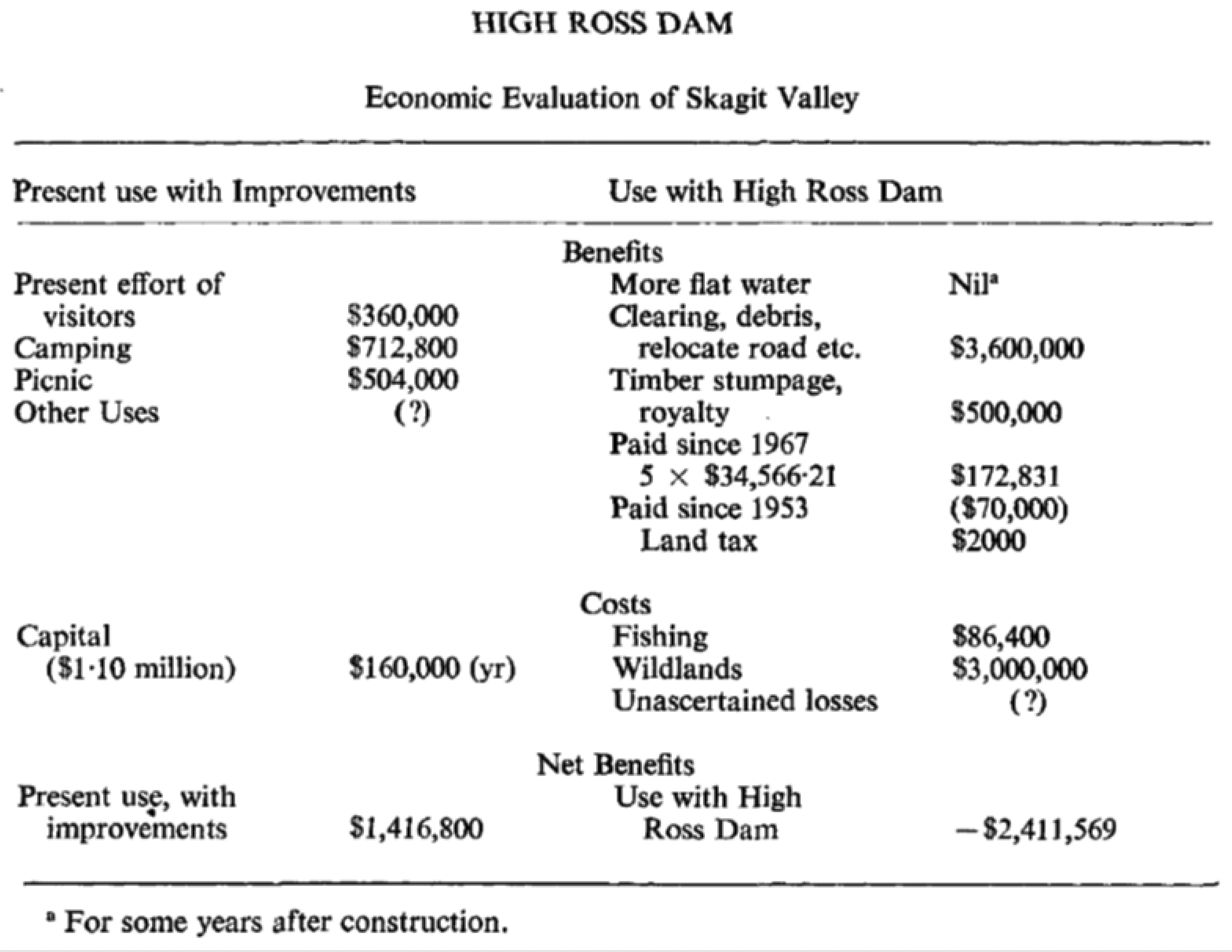
Harger and Culhane's High Ross Dam expansion cost/benefit analysis for Skagit Valley, British Columbia.
The cost/benefit analysis in Figure 2 represents the per annum quantification of value if the dam was not expanded (present use with improvements) and the loss of the valley value with the use of the High Ross Dam, following its fourth stage expansion, from the first year of the dam's expansion. The present use of the valley with improvements, $1,416,800 was calculated as the value of the public use of the region in activities including tourism, camping and picnics ($360,000 + 712,800 + 504,000) less the amount spent on capital improvements per annum of $160,000. The costs and benefits relating to the expansion of the High Ross Dam were calculated as costs = loss of fishing and wild lands ($3,086,400) less benefits (land tax of $2,000, payments by Seattle City Light of $172,831 and timber stumpage royalty of $500,000 = $674,831), resulting in a loss of $2,411,569.
Harger and Culhane (1974) pointed out that, in addition to the above balance sheet, numerous intangibles including the loss of quality recreational activities also had to be considered. They focused on societal considerations, including the impacts on the two human communities sharing the Skagit River system, as well as the biodiversity losses in both Skagit and Big Beaver valleys. Harger and Culhane (1974) identified the main limitation of an economic valuation perspective as the non-recognition of pollution as an internal cost for any organisation or project.
Harger and Culhane (1974) called for a re-examination of economic choices in terms of ecology, not vice versa. They asked for consideration of the impact of the dam expansion on the local (bio) diversity which they defined as: ‘the community, the species … stability of ecosystems, for a variety of forms of life, against simplification of species and ecosystems’ (Harger and Culhane, 1974: 274).
They stressed that the expansion of the High Ross Dam would contribute to the inability of the region ecosystems to cope with change. In addition, they emphasised the importance of conserving endemic biodiversity via the integrity of the structure and the system of Skagit Valley as ‘it has the attribute of being somewhat unique’ (Harger and Culhane, 1974: 274).
Harger and Culhane (1974) used qualitative (description of the importance of endemic biodiversity) and quantitative techniques (cost/benefit analysis) to present the case for biodiversity conservation. Cost/benefit analyses such as these may face criticisms in literature: see, for instance, Wegner and Pascual (2011), who have critically evaluated the cost/benefit method applied to ecosystem valuations and deemed them as being simplistic. Schröter et al. (2014) highlighted this type of counter account as being anthropocentric, and commodifying of nature. Nevertheless, this method serves as an important tool to quantify benefits derived from nature's ecosystems.
Biodiversity technical counter accounts: Ecological survey evidence
Jones’ (1996, 2003) natural inventory approach implements a non-economic quantification of biodiversity inventory. It comprises a pyramid of hierarchical criticality and a natural capital status inventory of listed and protected flora and fauna.
Similar to Jones’ (2003) biodiversity inventory modelling, civil society undertook biodiversity surveys and presented detailed representations of the region's biodiversity inventory. Biodiversity inventory surveys, undertaken by civil society, describe the natural capital status of the biodiversity inventory and emphasise biotic relationships. These field surveys represent another technical side, which focused on the scientific aspect of biodiversity measurements (Escobar, 1998). In this instance, they monitored and assessed biodiversity (Escobar, 1998).
Biodiversity surveys in Washington State were undertaken by Joe and Margaret Miller. Joe Miller became the treasurer of the North Cascades Conservation Council (N3C), in 1962. Margaret Miller was also on the board. In 1969, N3C commenced activism against the dam's expansion. Filed surveys were undertaken by the Millers in 1969 and 1970 (Miller and Miller, 1971). Their ecological survey was commissioned by Roger J. Contor, the first superintendent of the North Cascades National Park. He informed them that there was a crucial requirement for a complete ecosystem survey of the Big Beaver Valley, as a direct result of the threat from Seattle City Light to expand the High Ross Dam. The Millers commenced immediately and dedicated 15 days to the survey, in 1969. The detailed second stage of the survey was undertaken in 1970, for two months. According to Margaret Miller, in the interview by Liewbow et al. (2003), due to limited staff availability, a detailed analysis of the region, although critically required, could not be undertaken by the North Cascades National Park's employees. The help of the Millers was necessary to undertake the biodiversity surveys.
In the field surveys, the Millers documented the ecosystems and cider groves of the lake's tributary system. They analysed the Big Beaver, Little Beaver, Baker, Chillicack and Silver Creek valleys, and undertook the Cascade Pass revegetation project. They discovered 240 native plants, 21 of which were newly discovered species. The Millers examined the region under the 1,725-m elevation, the proposed new water level in Washington State, because of the High Ross Dam expansion. Complete drainage from Beaver Pass to Ross Lake was examined. The report was a comprehensive description of plant communities in Big Beaver Valley. It was also a detailed listing of mammals, avifauna and lower vertebrates. The Millers also documented interrelations between flora and fauna.
The Millers developed a strong case for promoting the importance of Big Beaver Valley's local biodiversity. They emphasised the negative impacts of the dam expansion on local biodiversity including the destruction of western red cedars, sphagnum bogs and the floating mats of Big Beaver Valley, for economic gains (Escobar, 1998). The Millers, in relation to these species, stated that ‘these plants are seldom grown outside of bogs and with the rapid disappearance of this ecosystem, they are certainly deserving of a high order of protection’ (Miller and Miller, 1971: 18). They also stressed the uniqueness of the micro-climate that the waterfalls and cascades had maintained in the region. They asserted that research provides humans with the required knowledge to ‘restore to health the land [they had] abused’ (Miller and Miller, 1971: 60). They proposed that the National Park lands should be considered more as outdoor museums and not so much as areas of intensive recreation. They described the region as offering limitless opportunities for the public to appreciate the immense value of the valley and its biodiversity.
As a technical biodiversity conservation counter account (Escobar, 1998), Millers’ report based on the first stage of the survey was delivered to the Seattle City Council, which was holding hearings on the raising of the High Ross Dam (Joe Miller, in Liewbow et al., 2003), in 1969. The survey received considerable public attention (see Figure 3).

Demonstration of the development of public attention around civil society activism counter accounts.
The survey results were published in Wild Cascades, Seattle P-I and Seattle Times and in the Journal of the North Cascades Conservation Council. Local newspapers were used to promote the risk of biodiversity destruction in the region, through the evidence presented by the Millers. The survey results were presented in summary form to Seattle City Council members and were also made available to the North Cascades National Park Service and the public. The Millers were labelled as expert witnesses, on whom the conservation movement relied. The surveys were presented as critical evidence in multiple documents of North Cascades National Park, and their contributions were recognised in the Park's annual reports in 1977 and 1978 (North Cascades National Park Service, 1999). The Millers accounts of the potential biodiversity destruction added to the public criticism of the dam expansion. Survey results were shown to numerous bodies including the International Joint Commission, Rotary, the Chambers of Commerce and Federal Power Commission (FERC) hearings in 1971 (Wolfe, 1974).
Discourse to promote biodiversity conservation
In addition to providing technical accounts as part of the civil society discourse on biodiversity conservation, non-technical counter accounts were also used (Alvarez and Escobar, 1992; Escobar, 1998, 2004; Lemke, 2005). These non-technical counter accounts took many forms. ROSS undertook many campaigns and convinced Malvina Reynolds, an American folk/blues singer, song writer and political activist to express negative emotions against the expansion of the dam in the ‘Skagit Valley Forever’ poem in 1970:
This poem opposes the political and economic priorities at stake. The words ‘grabber’ and ‘vandal’ imply the exploitation of nature and biodiversity for short-term monetary gains, which the activists opposed. Economic considerations by politicians over ecological concerns, with the potential to exacerbate environmental vulnerabilities (Escobar, 1996; Weingast and Wittman, 2008), are stressed in the poetic discourse.
There had also been a call for greater public engagement, through the media, to drive public pressure for biodiversity conservation (Adams and McNicholas, 2007) against the region's biodiversity destruction (to keep the forest paradise). The impact of this poetic counter account was obvious when the poem became a song and was released on a Vancouver radio station. As a result of the broadcast, thousands of people turned up at the ROSS Committee's demonstration against the High Ross Dam, in October 1970 (Perry, 1981). Social–political construction focused on the role of (poetic) language as a form of activism communication (Escobar, 1996).
Civil society's activism and counter accounts (technical and non-technical) resulted in increasing public attention. Thousands of letters from the public were received by politicians on both sides. Figure 4 shows an old newspaper clipping, which indicates the amount of public attention the controversy received.
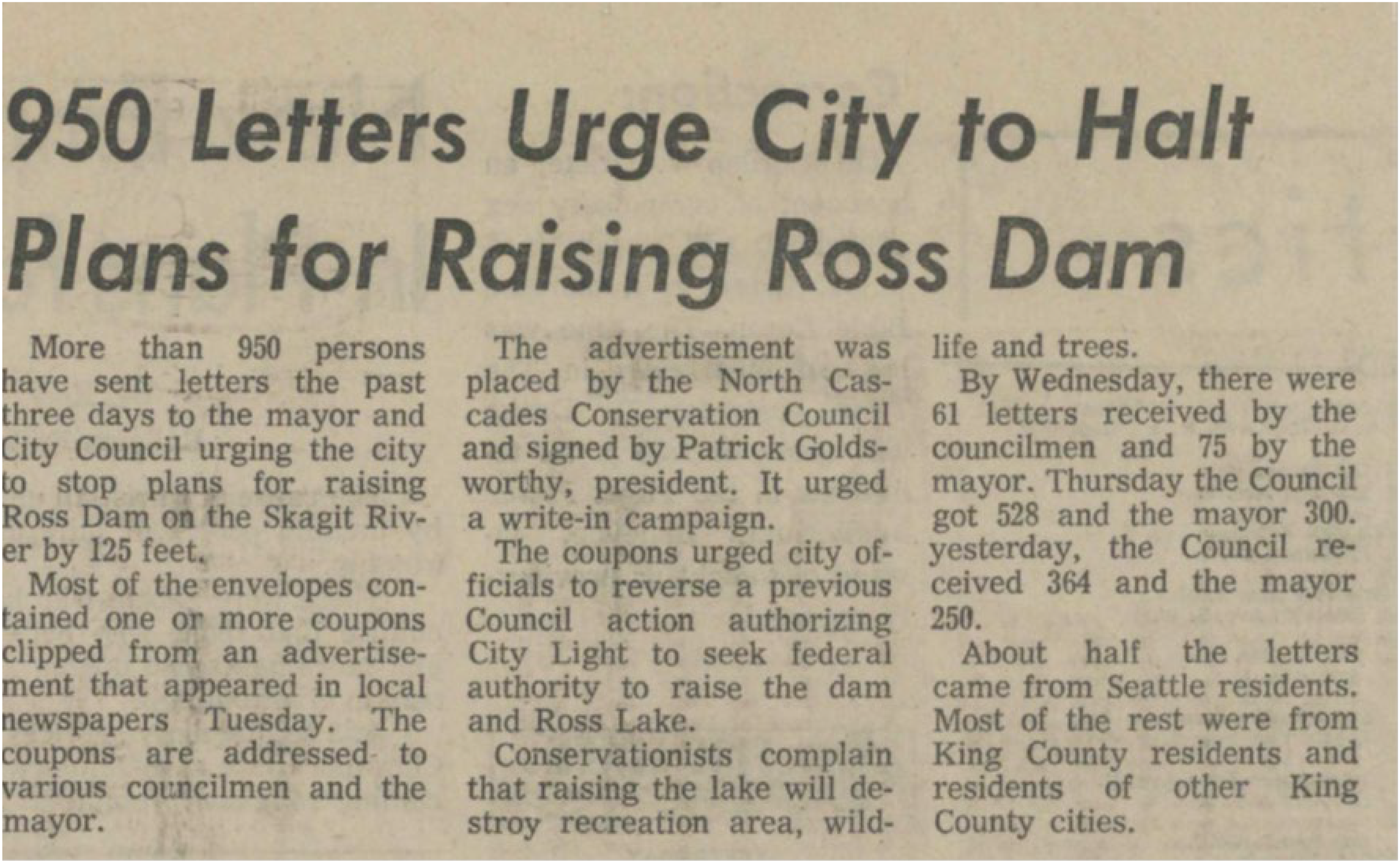
Demonstration of public environmental activism.
Impacts of social–political accounts, expressions and statements of activism against the economic destruction of biodiversity (Escobar, 1998) finally started to emerge from 1973. During 1973 and 1974, Seattle's mayor, in the U.S., who publicly opposed the High Ross Dam expansion, indicated to the British Columbian Government, through official diplomatic channels, that his government was willing to negotiate (U.S. Department of State, 1973). Seattle City Light also agreed to negotiate a settlement, in 1974 (Vickery, 1974).
Official conceptual plans for the Skagit Valley, issued in 1975, embedded the ROSS Committee's requirement to halt the expansion, the classification of the North Cascades National Park as ‘semi-wilderness’ and the maintenance of ecological reserves. The recreational park arrangement still meant that mining and forestry would be allowed. Environmental groups’ leaders had to use the threat of negative publicity to prevent the government from issuing further logging permits.
Civil society activism's counter accounts resulted in significant social and political change. They raised public consciousness of environmental (and biodiversity) issues and had a major impact (Ball, 2007) on biodiversity conservation. The Skagit Valley has received more publicity, more studies, and more inquiries … than any previous Parks Branch Lands. Coupled with the fact that it offers some of the most diverse environments in the province and borders a vast recreation complex in the United States, the Valley inherently affords the opportunity to be all things to all people. (BC Parks, 1975b: 2)
Discussion and conclusions
This study has focused on the use of civil society (activism) counter accounts (Ball, 2007; Dey et al., 2011; Samkin et al., 2014) and has analysed them through the lens of Escobar's social–political construction model (Alvarez and Escobar, 1992; Escobar, 1998, 2004), to demonstrate that civil society's social movements acted as effective instruments of resistance. Civil society's social movements incorporated discourse (Appadurai, 1990; Escobar, 1996; Watts, 1993) and served to represent ‘[facts] that social movements and community activists … articulate for their own views of … ecology’.
Initially, the fourth expansion of the High Ross Dam was not expected to encounter public resistance. In turn, that would have been a problematic representation of the dominant political economy conduct (Cooper et al., 2005; Denedo et al. 2017; Escobar, 1998; Escobar and Paulson, 2005; Everett, 2004; Gallhofer et al., 2006; Spence, 2009). A key risk factor was the lack of public awareness of potential negative biodiversity destruction impacts (Dey and Gibbon, 2014; Hrasky and Jones, 2016). Seattle City Light, a business company, originally presented information that deflected society's attention from biodiversity impacts (Archel et al., 2011; O’Dwyer and Owen, 2005; Unerman and Bennett, 2004) to deflect society's attention.
Civil society activism demonstrated that technical or non-technical accounts, on their own, may not be adequate (Escobar, 1998; Martin et al., 2013) for successful outcomes (Rowland, 1992). In this instance of civil society activism, a combination of counter accounts (technical, including biodiversity field surveys and non-technical discourse, including discussions at public hearings and in media articles) became necessary, to resist loss of biodiversity, due to the fourth expansion of the High Ross Dam (Dey and Gibbon, 2014; Escobar, 1998, Escobar and Paulson, 2005). Escobar's (1998) framework (see also Martin et al., 2013) implies that multiple discourses were undertaken by multiple actors, ranging from NGOs to scientists and local communities as part of social movements (Escobar and Paulson, 2005). Counter accounts acted as a political strategy (Cooper et al. 2005; Denedo et al. 2017; Everett, 2004; Gallhofer et al. 2006; Spence, 2009) of civil society activism for biodiversity conservation (Escobar, 1998). Multiple discourses were utilised to raise a wide awareness and to give weight to the social–political construction of biodiversity conservation (Escobar, 1996, 1998, 2011). Persistence by civil society was required (Escobar, 1996; Escobar, 2011).
Counter accounts enabled silenced, contested, and captured biodiversity aspects and critical discourses (Appadurai, 1990), resulting in public action (Vinnari and Laine, 2017). Counter accounts promoted ‘speaking truth to power’ (Tregidga, 2017: 521) and progressing social agendas (Dey and Gibbon, 2014). Civil society activism's counter accounts provided adequate understandings, leading to decisions for biodiversity conservation (Laine and Vinnari, 2017). Real costs of biodiversity destruction became clearer (Cuckston, 2013); they resulted in rational public discussion (Cooper and Elliott, 2000; Featherstone, 2013) and acted as an impactful strategy for change (Escobar, 1996, 2011).
Not only was there resistance (Escobar, 1998) to changes to the land and its biodiversity by business; the High Ross Dam expansion controversy also caused the emergence of new actors in the form of progressive NGOs (Dey and Gibbon, 2014) and their social movements (Escobar, 1996). This was a counter measure by civil society against dominant political and economic interests (Escobar, 1998; Escobar and Paulson, 2005; Weingast and Wittman, 2008). Civil society activism counter accounts problematised political behaviours (Cooper et al., 2005; Denedo et al., 2017; Everett, 2004; Gallhofer et al., 2006; Spence, 2009) and acted as a catalyst for change (Dey and Gibbon, 2014). The case analysed in this article represents a milestone in the development of civil society's actions in promoting biodiversity conservation (Escobar and Paulson, 2005) against politically dominant actors including business (Apostol, 2015; Cooper et al., 2005; Denedo et al., 2017; Everett, 2004; Gallhofer et al., 2006; Spence, 2009). It represents civil society activism against business agenda to cause biodiversity destruction (Cuckston, 2013; Escobar, 1998; Forester and Machlist, 1996).
There was the adoption and implementation of discourses by multiple civil society actors (Escobar, 1998; Escobar and Paulson, 2005) to implement effective resistance (Escobar, 1998). The presentation of technical and non-technical accounts by civil society actors resulted in the fulfilment of all three propositions by Escobar (1998, 2006). These being first, the emergence of biodiversity conservation discourse: as presented in the case study description, discourses in various forms, such as poetic discourse, presentations and discussions at public hearings, arguments and assertions occurred over several years, from multiple actors. The second proposition referred to social movements proposing an alternative ecology framework (Escobar, 1996, 1998, 2007). In the case under analysis, this was promoted, through constant attention towards the destructive impacts of the dam's expansion, by various civil society actors (Escobar, 2006). The third proposition demonstrated in this case is that civil society biodiversity activism discourse overcame managerial economising motives (Escobar, 1998; Escobar and Paulson, 2005).
This article provides a contribution to biodiversity accounting literature, with a focus on the roles and impacts of civil society activism's counter accounts, in political conversations (Escobar, 1998, 2009; McGregor, 2004), for biodiversity protection. It has built on the seminal work of Atkins and Thomson (2014), who focused on one individual, William Morris, who played an important role in British history for biodiversity conservation by using multiple discourses. Research presented in this article has extended the contribution to the field of biodiversity accounting by addressing a historical perspective, originally embraced by Hrasky and Jones (2016), in representing biodiversity accounting in its historical context. Hrasky and Jones (2016) referred to the flooding of Lake Pedder, in Tasmania (Australia), while our work has provided a historical perspective on the role of accounting in a major environmental infrastructure project, the High Ross Dam (U.S. and Canada), complementing the work undertaken by Hrasky and Jones (2016). Following our literature review, very few studies have undertaken analyses of biodiversity accounting's potential for the social–political construction of biodiversity conservation.
This article has demonstrated biodiversity conservation efforts via multiple discourses (Escobar and Paulson, 2005) and as civil society activism strategies (Escobar and Paulson, 2005). Civil society activisms counter accounts as part of discourse, were proven to: no longer be regarded as a neutral device that merely documents and reports ‘the facts’ [for example through field surveys of sites] … they can be seen as a set of practices that affect the type of world we live in, the type of social reality we inhabit, the way in which we understand choices … the way we administer the lives of others [for example that of biodiversity] and ourselves. (Miller, 1994: 1)
The use of multiple forms of counter accounts in cohesion suggested the use of counter accounts as a strategic tool (Escobar, 1996, 2011) and it required civil society pressure. These pressures have been more impactful if exerted in unity to create change and public pressure (by appealing to public emotion, e.g., through photographs and songs as shown in this case) (Appadurai, 1990). Pressure was exerted also through the use of scientific evidence (e.g., field surveys and cost/benefit analyses) (Maunders and Burritt, 1991), which were presented through argumentative discourses in political talks, at public hearings (Cooper and Elliott, 2000; Escobar, 1996, 1998; Escobar and Paulson, 2005; Featherstone, 2013; Martin et al., 2013; Watson, 1995) and through press articles. In combination, multiple counter accounts resulted in the presentation of counter evidence (Georgakopoulos and Thomson, 2008) to the High Ross Dam extension and acted as a catalyst for change (Dey and Gibbon, 2014). Counter accounts resulted in the spread of new truths (Escobar and Paulson, 2005) by civil society.
By applying Escobar's (1998) social–political construction model (see also Escobar, 1996, 2006, 2007, 2009, 2011; Escobar and Paulson, 2005) and its concepts, which are unique to civil society's social movements, this article has added to counter accounts literature. Escobar's model has been applied in the context of a political environment (Escobar, 1996, 1998, 2007), with critical analysis of political relationships and impacts (Weingast and Wittman, 2008) and a focus on various forms of communication used in the construction of social reality (Escobar, 1996; Miller, 1994). This resulted in alternative ecology developments (Escobar, 1996), based on both technical (biodiversity monitoring and economic valuations) (Escobar, 1998) and discoursive means (Escobar, 1998; Martin et al., 2013), acted by multiple actors. The new emerging outcomes of this mobilisation were in opposition to the business agenda of the dam extension. Biodiversity civil society activism's accounts served ‘as a mechanism to reform society's relationship with nature by challenging the legitimacy of government institutions (and business) … through publicising the damaging impact of their actions and their intentions, on nature’ (Atkins and Thomson, 2014: 267).
Future research possibilities include analyses of the critical role of biodiversity accounting for biodiversity conservation in numerous country-specific and case-specific contexts. Such research will strengthen the case for the use of biodiversity counter technical and non-technical (discourse) accounts as biodiversity conservation tools. More case studies will show that public biodiversity counter accounts have immense potential to enhance economic entities and government accountabilities when operationalised by public interest representatives such as the civil society.
Footnotes
Declaration of conflicting interests
The author declared no potential conflicts of interest with respect to the research, authorship, and/or publication of this article.
Funding
The authors received no financial support for the research, authorship, and/or publication of this article.

