




Abstract
This research investigates the historical role of the president's letter, and in particular how impression management was used by the Brazilian company Petrobras, during the military dictatorship (1964–1985), to build up and legitimise the company and the regime. Following an interpretative approach, and through a framework that includes both impression management tactics and presentational methods, the study analyses both narrative and visual images of the letters. The adoption of assertive impression management tactics helped to propagate Petrobras in the ascendancy and with it the Brazilian nation. Reinforcement, rhetorical manipulation and visual emphasis were adopted to convey a message of ascendancy and optimism, even in periods of crisis and shocks to legitimacy. Simultaneously, the omission tactic allowed it to keep invisible damaging events. As a recurrent, voluntary accounting narrative, the president's letters provided valuable storytelling and impression management opportunities which were used to promote Petrobras and as a legitimate façade for the government.
Keywords
Introduction
The chief executive officer's (CEO) or president's annual report letter to shareholders (henceforth simply ‘president's letter’ 1 ) has been described as a discretionary narrative (Aerts and Yan, 2017; Davison, 2008; Merkl-Davies et al., 2011), that has relevance (Abrahamson and Park, 1994), broader cultural and political significance (Amernic and Craig, 2006; Mäkelä and Laine, 2011), and often considered the most widely read section of the annual report (Breton, 2009). As a voluntary corporate disclosure, it is subject to and used for impression management (IM) purposes (e.g., Hooghiemstra, 2010; Mäkelä and Laine, 2011; Martins et al., 2019).
This study offers an historical analysis of the role of IM through the president's letter in a non-Anglo-Saxon company – Petróleo Brasileiro S.A. – Petrobras (hereafter Petrobras) – and immersed in the context of the Brazilian military dictatorship. Petrobras was established in 1953 in Brazil and for nearly 40 years held the state monopoly of oil and natural gas exploration and production and oil refining. Since its founding and through different political regimes, Petrobras has always been linked to the government as an instrument to further government policies (see Petrobras, 2013; Voss et al., 2023; Whitehead and Belghitar, 2022). It also holds a place in the national psyche as the pillar of Brazilian development and economic independence (see Fico, 1997; Maia, 2005). From 1964 to 1985 Brazil was under a military dictatorship regime, marked by authoritarianism, repression and lack of freedom of speech (Comissão Nacional da Verdade 2 – CNV, 2014a). Under this regime, state-owned companies, such as Petrobras, were used to disseminate ideological and political discourses (see Fico, 1997), paving the way for the IM of the Brazilian society itself, which longed to cease the nation's international indebtedness and dependence on foreign investors and funders and to promote economic growth (Markoff and Baretta, 1990; Smith, 1978). The military not only occupied the presidency and the board of directors of Petrobras but also headed its communication area (see CNV, 2014b; Petrobras, 2013). Accordingly, Petrobras was strategic to the national development and the security aimed at by the military (CNV, 2014b; Praun and Costa, 2016).
Considering the multiple dimensions of accounting, particularly its conception as a social and moral practice (Carnegie et al., 2021, 2023), this study explores how IM through the Petrobras president's letter was used to build up and legitimise both the company and the regime. Through a comprehensive analysis of the president's letter, this article evidences the influential, enabling and pervasive role of accounting (Carnegie et al., 2021; Hopwood and Miller, 1994) and contributes to accounting history research on corporate communication (see Merkl-Davies and Brennan, 2017), highlighting how the discretional nature of the president's letter disseminated the story of Petrobras’ ascension (and of the political regime in force), creating visibilities and invisibilities and influencing the readers’ perceptions. The study also addresses the scant research on IM with a holistic (narrative and visual) and longitudinal approach (Brennan et al., 2009; Cooper and Slack, 2015), enabling the comprehensive analysis of the letters and the opportunity to study its consistency and change from 1964 to 1985. The research also contributes to the literature on IM, evidencing how the political, social and economic context (particularly the military dictatorship context) affects storytelling, corporate reporting and communication practices (see Hooghiemstra, 2010, Martins et al., 2019; Merkl-Davies and Brennan, 2007). Recognising the call to study accounting under different political contexts (Antonelli et al., 2020; Cinquini et al., 2016) and the relevance of accounting to conducting social history (Antonelli et al., 2022; McWatters and Lemarchand, 2010; Pinto and West, 2017), this study also adds to the accounting literature by considering the under-researched context of the Brazilian military dictatorship.
The rest of the article is structured as follows. Impression management and the annual report letter to shareholders section provides the theoretical underpinning of the article and highlights IM and the president's letter. The research method is then explained. The Brazilian context and the company section describes the Brazilian context and Petrobras. The president’s letter: Nurturing the dream during the military dictatorship section proceeds with the analysis of how Petrobras president's letters shaped the social consciousness during the military dictatorship. Finally, the main conclusions are presented.
Impression management and the annual report letter to shareholders
Within the scope of sociological theories (e.g., legitimacy theory, stakeholder theory and institutional theory), discretionary narrative disclosures in corporate narratives, such as the president's letter, are a means to address both stakeholder's concerns and to demonstrate organisational legitimacy (Merkl-Davies and Brennan, 2011). In situations where an organisation's norms and values are inconsistent with those of society, the organisation engages in symbolic management (Ashforth and Gibbs, 1990) in order to (re)establish social legitimacy. In this process, organisations use the media to propagate values perceived as conforming to those of society, creating an idealised impression of their performance (Goffman, 1985), which leads stakeholders to mistakenly believe in the company's commitment to society's wishes (Michelon et al., 2015).
As a social actor, organisations have reasons and underlying intentions for IM. IM practices are intrinsically related to the legitimacy process and aim to influence the public perceptions of the organisation, either by proactively shaping stakeholders’ impressions or by responding reactively to their concerns (Merkl-Davies and Brennan, 2011), thus representing and creating reality (Hines, 1988). To gain and maintain organisational legitimacy, organisations make use of assertive strategies and, to repair it, they use defensive ones (Samkin and Schneider, 2010).
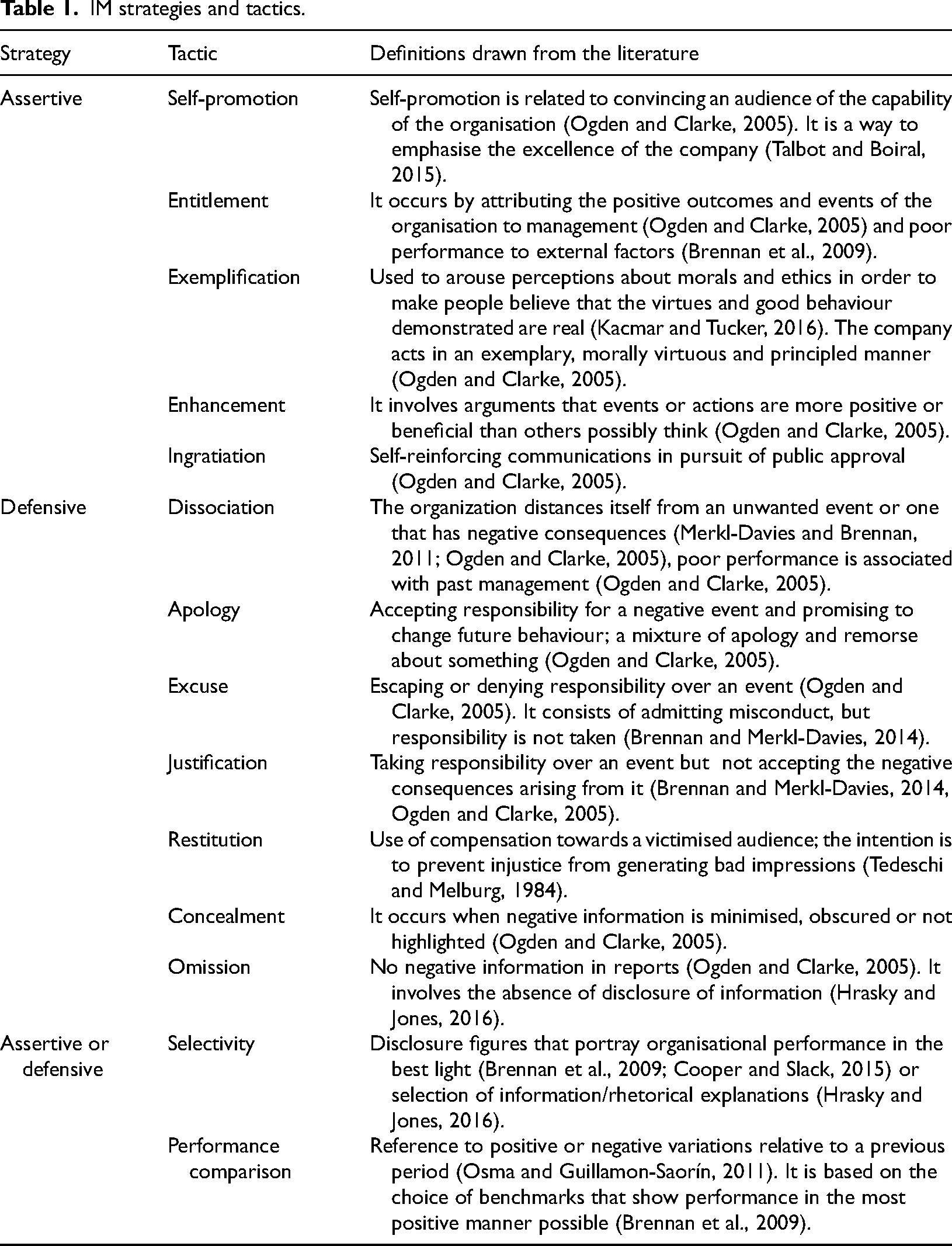
Assertive strategies highlight positive results (Yang and Liu, 2017), such as building an identity that is valued by information users (Cooper and Slack, 2015) and raising the profile of corporate social responsibility (Tata and Prasad, 2015). Assertive strategies include the following tactics: self-promotion, entitlement, exemplification, enhancement and ingratiation (Brennan et al., 2009; Cooper and Slack, 2015; Kacmar and Tucker, 2016; Ogden and Clarke, 2005; Talbot and Boiral, 2015; Tedeschi and Melburg, 1984). Defensive strategies are used in difficult or threatening circumstances, seeking to prevent the attribution of negative characteristics to the affected organisation (Merkl-Davies and Brennan, 2007). These strategies are a reaction to particular circumstance(s) (Cooper and Slack, 2015), and aim to improve corporate image (Tata and Prasad, 2015; Yang and Liu, 2017). The defensive tactics include: dissociation, apology, excuse, justification, restitution, concealment and omission (see Brennan and Merkl-Davies, 2014; Cooper and Slack, 2015; Hrasky and Jones, 2016; Merkl-Davies and Brennan, 2011; Ogden and Clarke, 2005; Tedeschi and Melburg, 1984). Cooper and Slack (2015) also point to selectivity and performance comparison as both assertive and defensive tactics. Table 1 summarises IM strategies and tactics.
IM strategies and tactics.
The presentational method is also of relevance within IM (Brennan et al., 2009; Merkl-Davies and Brennan, 2007). With the exception of omission, IM tactics are associated with both visual and narrative presentational methods. According to Cooper and Slack (2015: 835), ‘The visual, in all its forms, is a particularly powerful medium for communication’. Visual presentational methods include tables/graphs, pictures, special characters, lists/bullet points, font/colour and distortion. On the other hand, narrative presentational methods integrate reinforcement, diminution, obfuscation, syntactic manipulation, rhetorical manipulation and self-reference. Repetition and location, in prominent positions, are both visual and narrative presentational methods (Cooper and Slack, 2015; Pesci et al., 2015).
Emphasis by reinforcement occurs when information is emphasised through the use of qualifiers, that is, an additional word to emphasise a keyword (Brennan et al., 2009), such as an adjective. Likewise, messages can be diminished/attenuated using words (qualifiers) that underestimate their meaning (Cooper and Slack, 2015). Syntactic manipulation is based on the use of language to obfuscate corporate performance, especially negative performance, namely through more complex words and phrases (Brennan et al., 2009; Cooper and Slack, 2015). Also, with the intent to obfuscate, rhetorical manipulation uses linguistic choices and persuasive, compelling and credible rhetorical devices to hide the company's negative performance (Brennan et al., 2009). According to Cooper and Slack (2015: 805), another ‘form of bias is the increased use of self-referencing (I or we) when reporting more positive messages’.
Considering ‘impression management as a complex and multi-faceted practice’ Cooper and Slack (2015: 803) bring together the range of IM tactics presented in Table 1 and presentational methods described above in a more holistic approach to examining IM. According to the authors, ‘tactics are not mutually exclusive, but rather multiple tactics are commonly found to be used in conjunction with each other. Similarly, numerous presentational methods are often employed together…’ (p. 834).
Several studies have analysed the use of assertive strategies in corporate reports, such as the annual report (e.g., Cooper and Slack, 2015; Davison, 2008), or the president's letter (e.g., Aerts and Yan, 2017; Craig and Brennan, 2012; Martins et al., 2019). Amernic and Craig (2006) and Amernic et al. (2010) studied the linguistic characteristics of those letters as indicative of the influence that the issuer intends to exert on the reader. The letter is usually one of the first sections of the annual report and is a storytelling tool (Martins et al., 2019). Through the letter, messages are read in the form of a story told. Storytelling is a narrative communication technique that promotes ideas more simply than the enumeration of data and facts (Gendron and Breton, 2013). A story told is easily remembered (Breton, 2009) and an effective source of legitimacy (Eshraghi and Taffler, 2015). The stories depicted in annual reports show that they have evolved from a financial reporting tool to storytelling (Hooper et al., 2003), where the use of images helps to enhance the stories told (Steenkamp and Hooks, 2011). Together, images and narratives tell stories of organisations and comprehensively reflect them (Steenkamp and Hooks, 2011). These stories are not independent of the political, social and economic context. The social, normative and cultural changes are also prone to influence the content of the narratives. Thus, the messages that make them up are adapted and framed by the context in order to manage impressions, as articulated in the conception of accounting as a social practice (Carnegie et al., 2021, 2023; Hopwood and Miller, 1984).
Research method
This study embraces Carnegie et al. (2021, 2023) conception of accounting and recognises that far from being neutral, accounting has a social and moral function that affects (and reflects) people and nature, organisations and the social functioning and development. The article is grounded in a qualitative case study about Petrobras, during the period of military dictatorship, and analyses how the president's letter was used to build up and legitimise the company and the regime. Petrobras was ‘closely related to the Brazilian political, economic and social context’ (Petrobras, 2013: 6). Due to its exclusivity in the exploration and production of oil and natural gas and oil refining in Brazil, it was also a strategic company for the economic development aims of the military during the dictatorship period (see Brazil, 1974; Praun and Costa, 2016).
The study focuses on the period of military dictatorship (April 1964 to March 1985), that brought about profound changes in Brazilian politics, society and economy (CNV, 2014a). With the military coup of 1964, Petrobras went through a structural reorganisation. The military became part of the directorate (see CNV, 2014b; Petrobras, 2013), and from the very start tried to control the company (see Carvalho, 2021; Praun and Costa, 2016). Although this period is characterised by a lack of transparency of information and freedom of speech, the military proved to be efficient in building the national image and revitalising nationalist sentiments (see Petrobras, 2013). However, through a structure of surveillance, monitoring and investigation was set up within Petrobras at the time, the largest and most important state-owned company in Brazil watched, monitored, investigated and repressed its employees (see Carvalho, 2021; CNV, 2014b; Praun and Costa, 2016). These unique circumstances make Petrobras and the period of analysis worth studying within IM research.
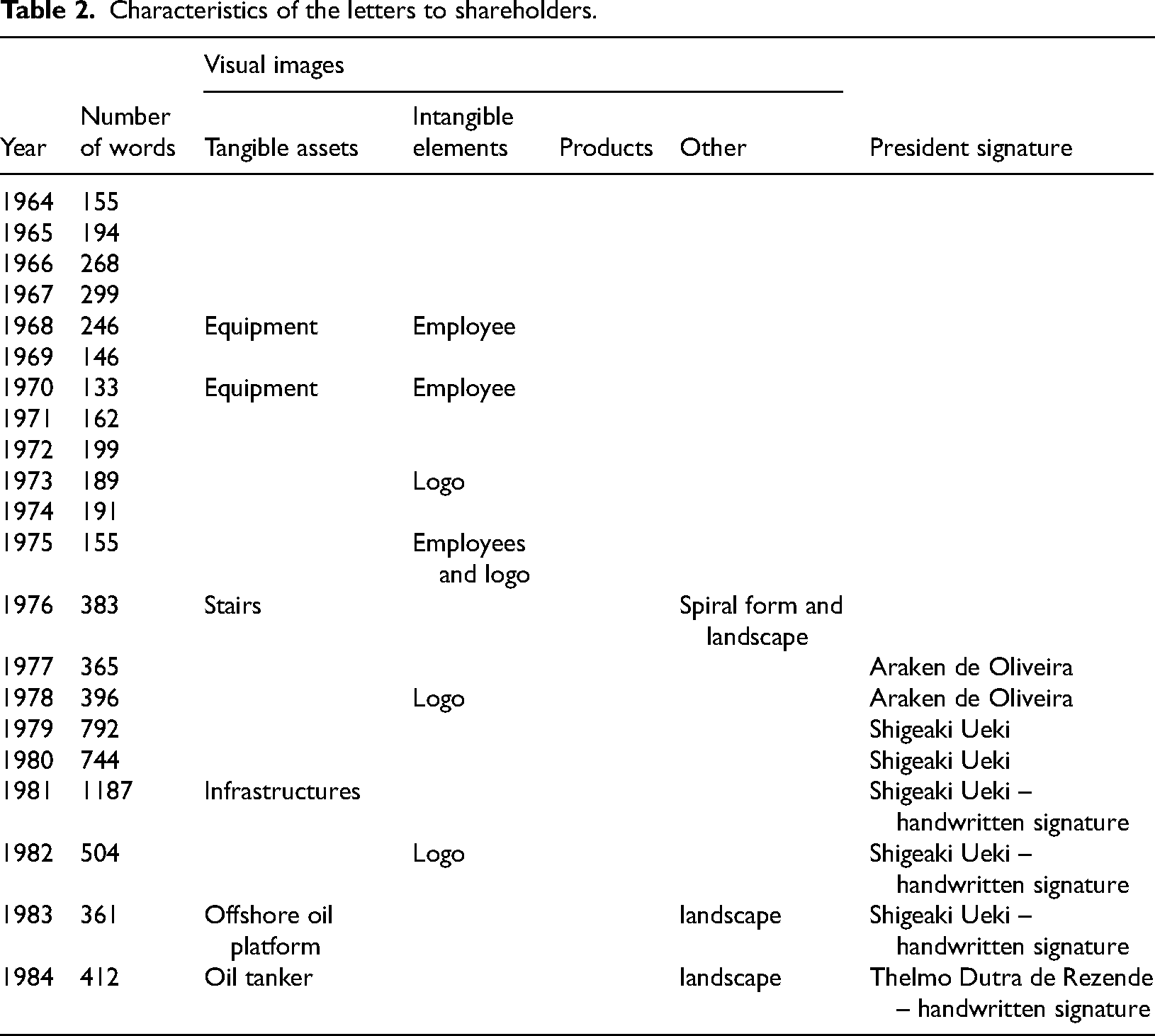
The sources include the 21 letters to shareholders from the 1964 to 1984 Petrobras’ annual reports, collected in Portuguese (Brazil's official language) at the National Library of Brazil (see Appendix 1). There is no document in Petrobras’ annual reports labelled the president's letter or letter to shareholders, aligned with its voluntary nature. So, consistent with the literature (see Amernic et al., 2010; Craig and Brennan, 2012), in this study the president's letter is the corporate message addressed to shareholders that open the annual report, appearing before the management report (Relatório da Administração). Usually, it ends with the thanks and may (or may not) be signed by the Board's president. The analysis was done in Portuguese since all researchers are Portuguese native speakers. The illustrative quotes used in the President’s letter: Nurturing the dream during the military dictatorship section are free translations made by the authors. Table 2 summarises some characteristics of the president's letters analysed.
Characteristics of the letters to shareholders.
Additionally, to understand the period of military dictatorship in Brazil, how Petrobras evolved, particularly from 1964 to 1984, and its role in the government's politics and strategies, other data sources were used. These include papers, articles, books, reports and websites about the political, social and economic history of that period and about Petrobras and the oil sector. From these documents, especially from the CNV reports (2014a, 2014b), some controversial issues that involved the company were identified in the period of the study (e.g., violations of workers and indigenous people's human rights – CNV, 2014b).
Following the method adopted by Martins et al. (2019), several stages were developed to investigate how the story of Petrobras was told in the president's letters given the Brazilian context at the time. In this analysis, both narrative and visual rhetoric (in combination, whenever applicable) were considered, as suggested by Cooper and Slack (2015). With the aim of ‘listening to the words of the text and understanding better the perspective(s) of the producer of these words’ (Berg, 2001: 242), a qualitative content analysis was undertaken. Thus, the researcher is drawn to what is the latent meaning to an interpretive reading of the symbolism of the data sources at disposal (Berg, 2001).
To increase internal validity and reliability, the coding process was applied individually by each of the authors, to each letter to shareholders. In the first phase, the analysis of the political, economic and social context guided the research to understand the action and role of Petrobras in Brazilian society. The second phase of analysis sought to reveal how the story of ascension was told through the president's letter. President's letters were coded according to IM tactics and then for specific IM presentation methods discussed in the previous section (see Appendix 2). We used the Cooper and Slack (2015) framework for IM that considers the complementary and interrelated nature of tactics and presentational methods. The definitions drawn from the literature are presented in Table 1 and the evidence provided by previous studies guided the operationalisation of IM tactics. In this stage, both narrative and visual rhetoric were considered. In what concerns visual rhetoric, that framework was extended with the methodology proposed by Greenwood et al. (2019) to analyse, explain and critically interpret the role of visual rhetoric in organisational communications.
The analysis of visual imagery, whenever they accompanied the letter's narrative, was undertaken following the Greenwood et al. (2019) method, which sequentially includes categorical analysis, content analysis and rhetorical analysis. A categorical analysis of ‘a priori categories known by everyday social actors and/or induced from a genre of communication’ (Greenwood et al., 2019: 803), such as the president's letter is undertaken to explore the use of semiotic elements related to Petrobras activity, such as tangible assets (e.g., equipment, machinery and buildings), intangible elements (e.g., human capital and relational capital) and products (e.g., oil) (see Table 2). All visual images included in the same pages of the written messages were analysed (see Appendix 1). The second phase, the content analysis, includes a denotative description of the perceived artefact, describing the signifier and responding to ‘what is it?’, and a connotative description of the cultural artefact, bringing out that which is signified. Then, the rhetorical analysis of connotative content in the context of shared cultural understandings across the president's letters visual images was developed (see Greenwood et al., 2019). Photography, non-photographic images, text in relation to images, accounting graphics and numbers and typography and layout have different rhetorical functions (Greenwood et al., 2019). Photography provides ‘visual shorthand via apparently uncoded objective data by association with broader cultural values and knowledge’; non-photographic images construct ‘complex meaning through the form of an image, by association with broader cultural values and knowledge’; text in relation to image lead ‘the audience to a particular reading of an image’; accounting graphics and numbers deliver ‘apparently uncoded objective data in a heavily connoted and symbolic manner’; and typography and layout direct attention, provides value, and groups objects’; they link ‘to cultural understandings to connote tone’ (Greenwood et al., 2019: 816). According to Greenwood et al. (2019: 809–810): It is important not to judge these visual rhetorical elements in isolation, but to consider their interrelationships in a given document … They work interactively to provide reinforcement, emphasis, anchorage, and context for each other and for their respective messages. … visual and narrative metaphors may be used in corporate reports to give simplified and positive impressions of a company. … Highlighting some features and hiding others constructs a partial version of the corporation, one that is devoid of its history, complexity, and disparate features. However, if repeated, especially alongside similar representations invoking similar meanings, this slim version may appear more stable and complete and, thus transformed into a myth, be mistaken for the full subject…
Figure 1 summarises the framework of analysis applied in the research.
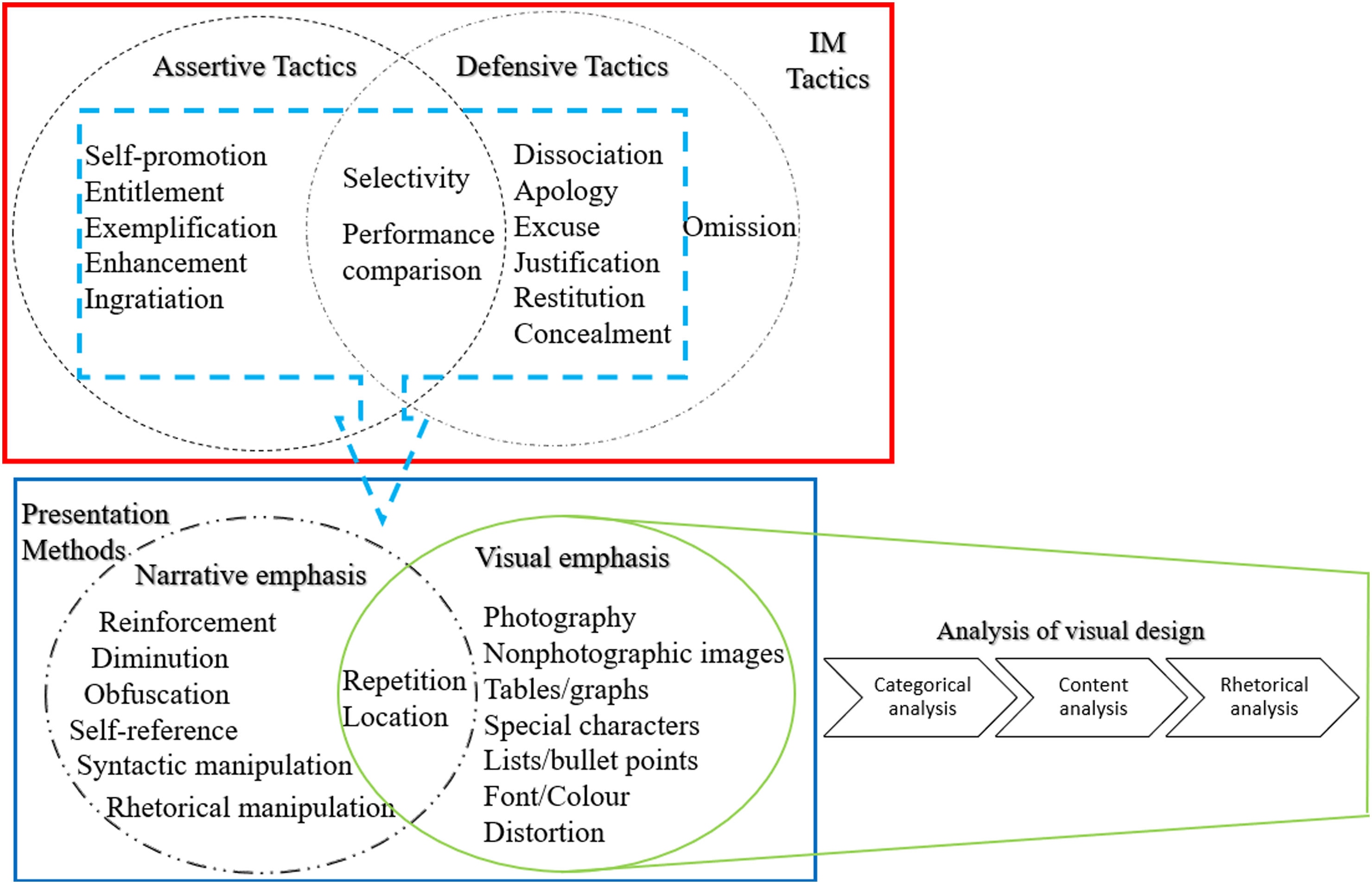
Framework of analysis.
In the last step, a combined analysis was made by the authors and the divergences found were discussed until a consensus was reached. As a social and moral practice, accounting is embedded in organisations and societies and has to be studied in the context in which it operates (Hopwood, 1983). The following section details the context and the company.
The Brazilian context and the company
The military dictatorship
From 1964 to 1985, Brazil lived a military dictatorship, which originated in a coup launched with the appearance of freeing the country from corruption, and communism and restoring democracy (Fausto, 1999). However, the military regime proved to be repressive, having used torture, censorship, lies, imprisonment and murder to silence and repress its opponents (CNV, 2014a). Under the aegis of ‘National Security’ and the progress of the nation, the military government began to sustain all its arbitrary actions against any manifestation of opposition. From 1964 to 1985 six presidents/dictators headed the government.
The Castelo Branco government (1964–1967) established the basis for the policy of repression of the regime (CNV, 2014a; Teixeira, 2004). Security was the priority and, linked to this, the development of Brazil. The idea was to associate development with international capital, ensure political stability and freedom for the private sector, financing the growth of the nation. But government’ actions were not successful, and investments in the country decreased (Markoff and Baretta, 1990).
The Costa e Silva government (1967–1969) put the country's economic development first and linked it to security. Additional repressive measures were enacted in the Institutional Act 5, including the recess of Congress, political annulments, suspension of constitutional guarantees, the fact that the President's actions were not subject to legal recourse, compulsory retirement of civil servants and intervention in organisations. The ‘country had never had … a set of measures that concentrated so much discretionary power in the hands of a head of state’ (CNV, 2014a: 101).
During the government of Médici (1969–1974), the dictatorship experienced the period of greatest repression, which was known as the ‘years of lead’ (Hermann, 2005a), along with the so-called ‘economic miracle’ (Campos and Claro, 2013). The sources for the development of financing were the state, multinationals and large national businessmen (Teixeira, 2004). Economic policies led to a high growth rate, favouring the big capital, without considering the effects on income distribution or the welfare of the working population (CNV, 2014a). The statistics omitted durable consumer goods industries without adequate infrastructure and whose main inputs depended on external sources, such as oil (Hermann, 2005b). Through political propaganda that had an apparently apolitical character (Fico, 1997), Médici's dictatorial state articulated repression, persecution and social control with optimistic narratives, silencing reality and promoting a ‘Great Brazil’.
The Geisel government (1974–1979) adopted a moderate policy, whose progressive economy was directed towards liberal national capitalism (Hermann, 2005b). The 1973 oil crisis and the economic miracle contributed to exposing Brazil's fragility. In an attempt to minimise the impacts resulting from the crisis, Geisel's government implemented the II National Development Plan (NDP) (II Plano de Desenvolvimento Nacional 1975–1979). The Plan intended to promote changes in the energy policy, deemed vital to the national strategy (Brazil, 1974). Movements against the regime, previously silenced, reappeared (Campos and Claro, 2013). In 1978, Institutional Act 5 was extinguished.
At the start of the second oil shock in 1979, Brazil produced only 13.9 per cent of the oil that supplied the country, which entailed serious consequences for the trade and payment balances. Consequently, the government continued to enact measures to encourage the production of alternative energy sources to replace oil, reduce oil consumption and increase national production (see Tamer, 1985). The Figueiredo government (1979–1985) adopted a strategy of slowing growth, reducing imports and stimulating exports. Government actions had high economic and social costs. The decrease in industrial production led to the dismissal of many employees (Teixeira, 2004), weakening the regime. Brazilian society claimed its rights through trade unions, associations and social movements, whose purpose was the democratisation of Brazil (Teixeira, 2004). The end of the dictatorship occurred in 1985, with the election of Tancredo Neves.
Petrobras as a Brazilian symbol
Petrobras was born as a result of the victory of the ‘O Petróleo é Nosso’ (‘Oil is ours’) campaign in 1953 when Getúlio Vargas sanctioned Law 2004. This Law required the Government to hold at least 51 per cent of the shares (Brazil, 1953), which would guarantee State control of the company and its subsidiaries. Initially, the Government subscribed for all the company's shares. Meanwhile, in August 1956, Petrobras listed common and preferred shares on the Rio de Janeiro Stock Exchange (only traded in 1957), and in 1968 on the São Paulo Stock Exchange. 3
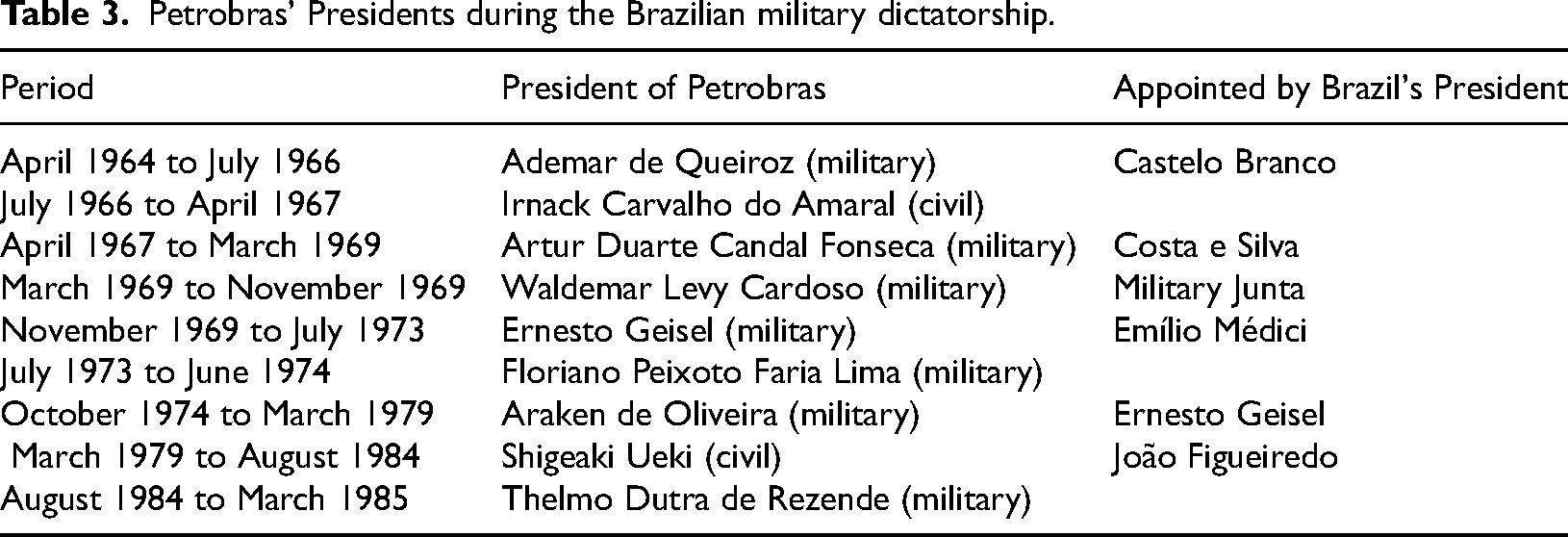
Decree 40,845 of 28 January 1957 (Brazil, 1957) and, later, Ordinance 235 of 17 February 1977, from the Ministry of Mines and Energy, regulated relations between Petrobras and the National Petroleum Council, which under Law 2004 was responsible for guiding and monitoring the oil monopoly. Also, according to Law 2004 and subsequent amendments enacted by Decree-Law No. 688 of 18 July 1969, the President of the board of directors is appointed by the President of Brazil. The remaining board members, until 1968, followed. The number of appointments was nominated by the President of the Republic of which three were elected by public law legal entities and two by individuals or legal entities of private law holding 7.5 per cent of voting shares (Brazil, 1953). As of 1969, the President of Brazil could appoint from three to six board members (Brazil, 1969). During the military dictatorship, Petrobras had nine presidents (see Table 3), with tight links to the political establishment.
Petrobras’ Presidents during the Brazilian military dictatorship.
Moved by a nationalist feeling and the anti-imperialism of the trusts, the Brazilians supported the foundation of a national company which would hold the state monopoly on oil (Miranda, 1983). The creation of Petrobras symbolically marked the idealisation of Brazilianness; society wanted to believe that oil would gush and supply the demand of the nation (Maia, 2005). However, the scenario faced was different from the idealised one. Petrobras continuously imported oil as it was not found in sufficient quantity to meet Brazil's needs (Smith, 1978). The Brazilian geology did not benefit from the accumulation of oil in large quantities, a situation pointed out in the Link Report in 1960, whose conclusions hit head-on the nationalist myth of oil abundance in Brazil (Dias and Quaglino, 1993). In 1968, Petrobras was the object of fierce criticism in the press (Petrobras, 1968a, 2013). The lack of oil prompted the company to redirect explorations to the offshore platform. Petrobras began drilling wells on the Northeast coast, in 1968, and the Campos Basin, in 1971. A cycle of important discoveries started in 1974, with oil discovery in Campo de Garoupa, in the Campos Basin region (Morais, 2013).
The oil shock crises of the 1970s exposed Brazil's dependence on external sources of oil. Therefore, to decrease this dependence, observing the legal monopoly for producing, transporting and refining oil, the II NDP established as a goal the increase of the internal oil supply through a programme of exploration and production, and shale industrialisation. Petrobras assumed a relevant role in the pursuit of these objectives (Brazil, 1974).
Additionally, the government authorised the company to enter into risk contracts with other companies in order to accelerate oil exploration and production. In case of exploration success, the contracted companies would be remunerated, which did not give them rights over the oil sources found. Petrobras used the geological knowledge it held and offered to risk contracts areas, with lower chances of success (Schutte, 2016).
Although the II NDP projected an increase in domestic oil production for two or three years (Brazil, 1974), positive results were achieved only in the 1980s. Discoveries made in the Campos Basin led the company to study the country's underwater areas, benefiting from technological advances from offshore platforms. Petrobras's efforts in offshore activities research continued to bear fruit. The discoveries of the giant fields of Albacora, in 1984, and Marlim, in 1985, were the outcome of a campaign started in 1984, in the third phase of exploration in Campos Basin (Morais, 2013). According to Morais (2013: 25): from 1974 to 1983, 345 exploratory wells were drilled, and 22 oil fields were discovered; Fifteen oil fields were put into production from 1977 to 1985, with all the necessary investments, in maritime waters with a depth between 90 and 383 meters … Daily oil production rose from 160,800 barrels in 1977 to 546,300 barrels in 1985. In order to meet the costs of building platforms and equipment in the Campos Basin, PETROBRAS’ investments in Exploration and Production increased from an annual average real value of US$877 million in 1970–1974 to US$2.5 billion in 1975–1979 and to US$5.4 billion in 1980–1984.
During the military dictatorship, Petrobras underwent a major expansion of its activities. The nationalist and developmentalist state interests were embedded in the interests of Petrobras. Like other state-controlled companies, Petrobras was widely used as an instrument of development policy. References to the company in the speeches of the Presidents of Brazil were recurrent (e.g., Médici, 1970–1974).
Petrobras also helped in accomplishing other strategic projects of the regime, such as the control of the structures of the Brazilian state, on behalf of national security. As stated by Praun and Costa (2016: 5): taking control of each sector of the company was, to the military leadership, part of the urgent and needed actions to guarantee the control of the structures of the Brazilian State and the deployment of the regime's strategic projects. With regards to the process of controlling the instances of Petrobras, it is no exaggeration to state that the relevance attached by the military to this state-owned company ‘was proportional to the repression actions unleashed on its workers’ … the extent of Petrobras’ facilities, would drive the establishment of a national system of information and repression. The monitoring undertaken by the Information Security Division (DSI) of Petróleo Brasileiro SA - Petrobras, a branch of the SNI [National Intelligence Service], shows that large state-owned companies have become veritable ‘laboratories’ for the establishment of a system of control and repression. On April 8, 1964, a CGI [committee of inquiry] was set up and began to operate systematically at the company … Petrobras provided a fertile ground for the implementation of an exemplary monitoring and repression system, seen as a cornerstone of national security. The militarization of the company was the natural consequence. The direct participation of the SNI, through the National Security Council (CSN), in the establishment of a sophisticated scheme of investigation and persecution of real and alleged opponents of the dictatorship gave Petrobras’ experience consistency, efficiency and durability, which worked as a role model for other large companies.
A strategy for the militarisation of the Petrobras factories took place and civilians in management and executive positions were replaced by military personnel (CNV, 2014b). This reorganisation also affected the communication area, which came to be headed by a military officer (Brigadier Ary Neves, replaced in 1969 by General António Luiz de Barros Nunes), and renamed in 1965 as the Public Relations Service (Serpub). ‘Although transparency of information and spaces for dialogue was not the prevailing characteristics of the military, one cannot deny their efficiency in building the image and revitalising nationalist feelings’ (Petrobras, 2013: 21), exploring traits that could reinforce Petrobras’ legitimacy and mimicking its image with the Brazilian identity (Petrobras, 2013). The democratisation process of the government structures, promoted by President João Figueiredo, made its way into business initiatives and, consequently, at Petrobras. In 1980, Serpub was replaced by the Social Communication Office, with a new head, Carlos Alberto Rabaça. This specialist in institutional communication was a former Public Relations advisor in the Medici Government that fostered the establishment of dialogue channels between the company and society (Petrobras, 2013). The evolution in the communication area at Petrobras is noticeable in the company's annual reports. The 1964 annual report was edited by the Petrobras General Public Relations Office, those from 1965 to 1979 by the Serpub, and the 1980–1984 annual reports by the Petrobras Social Communication Office.
President's letter: nurturing the dream during the military dictatorship
The analysis of the Petrobras president's letters is structured in two different periods: 1964–1973 and 1974–1984, justified by the characteristics of the document itself. From 1964 to 1973 the shareholders were explicitly the target whereby the letters began with the expression ‘Senhores Acionistas’ (‘Messrs. Shareholders’). From 1974 to 1984, the letters opened with the word ‘Apresentação’ (‘Presentation’), referring to the financial statements of Petrobras and its subsidiaries, and highlighting the Petrobras system.
From 1964 to 1973
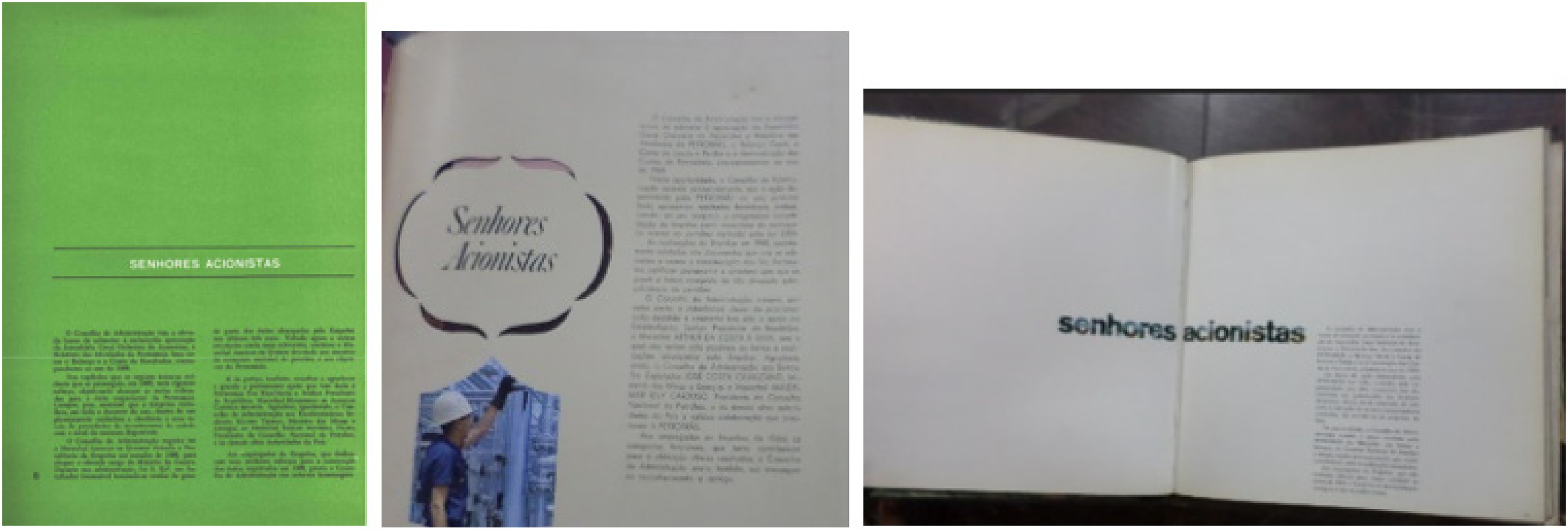
In the 1964–1973 period, the annual reports began with a message from the Petrobras Board of Directors to shareholders, with no reference to its President. These messages are brief (between three and five paragraphs) and are not signed. Visual emphasis is used in the presentation of the expression ‘Senhores Acionistas’ (‘Messrs. Shareholders’), by means of font size and/or font, use of bold type (Petrobras, 1964, 1965), use of distinctive colour (Petrobras, 1966, 1967, 1973), emphasis with a marker (Petrobras, 1968b) and/or occupation of two pages (Petrobras, 1969) (see Figure 2).
Visual emphasis in the letters to shareholders.
The first letter during the dictatorship dates from 1964. It emphasises the tenth anniversary of Petrobras and implicitly propagates the achievements of a fledgling government, pointing out that ‘thanks to the combined efforts of the leaders and servants of the Company, a plan was activated which, in 1965, would expand development to all sectors of activity’ (Petrobras, 1964: 3). The narrative positively connotes the management of Petrobras and the workers in achieving the expansion of the activities of the company in the future, for which government support is acknowledged as essential. There is self-promotion and promotion of government action.
The support of the Government for Petrobras is enhanced in the letters to shareholders, year after year. Its repeated mention connotes the existence of joint work. The emphasis on the gratitude coming from a company that symbolises the Brazilian nation conveys the acknowledgement of the Government's achievements for the development of Petrobras and, subtly, of the country. Between 1964 and 1968, the acknowledgements to members of the Government were still enumerated by name. As of 1969, only the Ministry of Mines and Energy and the National Petroleum Council were mentioned (Petrobras, 1964–1968b; Relatório de atividades).
The effort of the workers is emphasised and qualified positively in all the letters to shareholders (until 1984), contributing to the intended impression, since the theme of dedication to work was part of the list of objectives for political propaganda of the Government (Fico, 1997). Petrobras employees at the time were seen as representatives of the people, fighting for the achievement of petroleum autonomy and the consequent development of the country. The way the interaction of the company with workers and with the Government is narrated connotes the existence of a proximity that generates the perception of unity and agreement with the actions established by the company and the Government. This way of acting evidences the use of the ingratiation tactic, since the company seems to want to gain favourable acceptance from its employees. However, on the other hand, the persecution and repression of company workers (see CNV, 2014b; Praun and Costa, 2016) is a silenced reality in the letters.
The positive words in the narratives of the letters exalt the performance of the company, suggesting that Petrobras fulfils the purposes entrusted to it. Words such as ‘expansion’, ‘success’, ‘achievement’, ‘strengthening’, ‘progress’, ‘highlight’, ‘development’, ‘contribution’, ‘confidence’, ‘consolidation’, ‘achievement’ and ‘optimism’ (e.g., Petrobras, 1964, 1965, 1968b, 1969, 1971, 1972, 1973) raise the image of the company and along with it that of the country, being evident the use of rhetorical manipulation and reinforcement to self-promote and enhance their achievements. Its positive connotation suggests the achievement of values recognised by society, that is, an oil company on the rise, fulfilling the promise of economic independence for the Nation, indifferent to the criticism that society had been pointing out (see Petrobras, 2013). See the following example: The
The 1965 letter, written on a green background (visual emphasis) (see Figure 2) alluding to hope, highlights reinforcement through a qualifier. By affirming the achievement of successes ‘without any doubt’, a rhetorical strategy of reinforcing the achievements and the rightness of the national oil policy is used. The company reinforces its symbolic legitimacy by using the qualifiers ‘understood’ and ‘encouraged’, reiterated by ‘so well’, to qualify the positive stance of stakeholders (shareholders and the people) on the government's oil policy. The qualifier ‘unequivocal’ reinforces the ‘evidence’, connoting the total confidence of the Brazilian people and shareholders in the company’s actions. There is self-promotion and enhancement for Petrobras, without any reference to negative events.
The narratives of 1966 and 1967 continue promoting the action of the company as having been carried out ‘in a
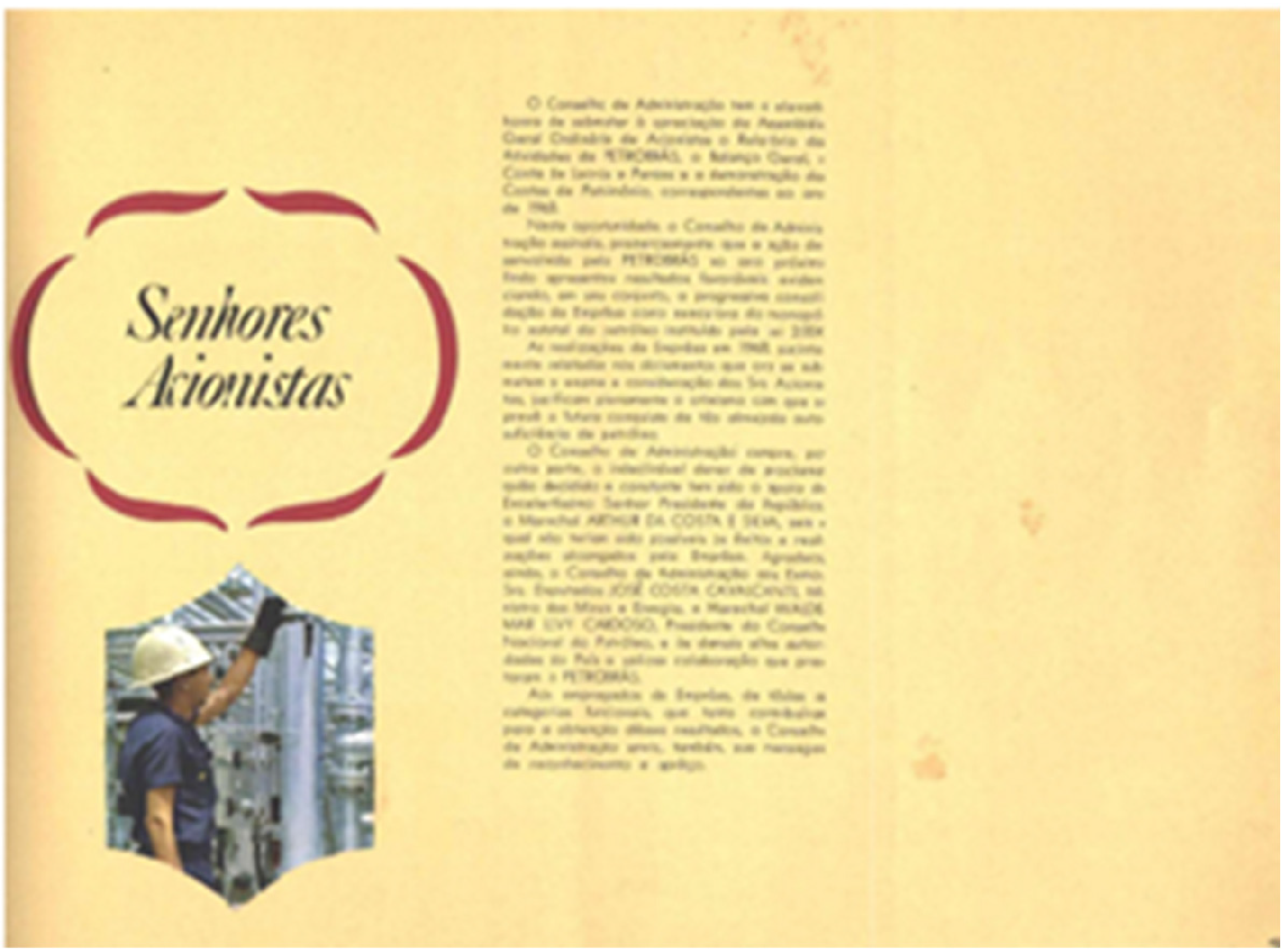
In 1968, Petrobras was the target of strong criticism in the press related to the oil monopoly, the results of the exploration area, the financial and human resources policies, the delays in the start-up of the refineries in Minas Gerais and Rio Grande do Sul, and the company’s inefficiency vis-à-vis the world's largest and newest crude oil producers (Petrobras, 1968a, 2013). As a reply to the ‘concerns of the public opinion’ (Petrobras, 2013: 24), the company issued ‘PETROBRAS (needed explanations)’ in June 1968 (Petrobras, 1968a), providing ‘the Company's necessary and due clarifications’ (Petrobras, 1968a: 11). In this context of fierce criticism and of strong political propaganda, Petrobras presented the 1968 letter to shareholders, accompanied on the same page by a photograph and without any reference to the criticism. The narrative highlights the ‘
1968 Letter to shareholders.
The contribution of Petrobras to the ‘progress of the country’, the ‘development of the country’ and the ‘development of the Brazilian economy’ is a constant in the narratives (e.g., Petrobras, 1969, 1971, 1972, 1973). In this regard, the 1969 letter refers to the ‘expressiveness of the figures’, which highlights the ‘successes of the company: The
There is evidence of IM through the use of the tactics of enhancement and self-promotion, using rhetorical manipulation and reinforcement. Rising Petrobras provides for the rise of the country and a supposed improvement in the living conditions of society.
During the period of the ‘Brazilian miracle’, the Médici government sought to propagate the economic development of the country. Thus, Petrobras's results were shown as a symbol of development and political propagation. Ernesto Geisel was then the president of Petrobras. It was he who during the Medici government, put the company to work for the campaign ‘Big Brazil’, defended by the military. This period saw the expansion and diversification of Petrobras’ industrial-technological capacity and international capillarity, alongside other state-owned companies (see Médici, 1970–1974).
However, there was a contradiction, for although the company was developing, the most important product imported by Brazil was oil. This caused an increase in foreign debt, besides being a vulnerable point of the ‘economic miracle’ (Fausto, 1999). In propagating Petrobras as a major player in the country's development, the 1969 Letter makes an essential omission, which benefits the Government, regarding the truth about the real impact of oil imports on the foreign exchange of the country. It was essential to maintain the impression of the development of Petrobras and, concomitantly, that of the Nation, a way of propagating an idealised performance incorporating the values of society, since, after all, Petrobras belongs to the Brazilian people.
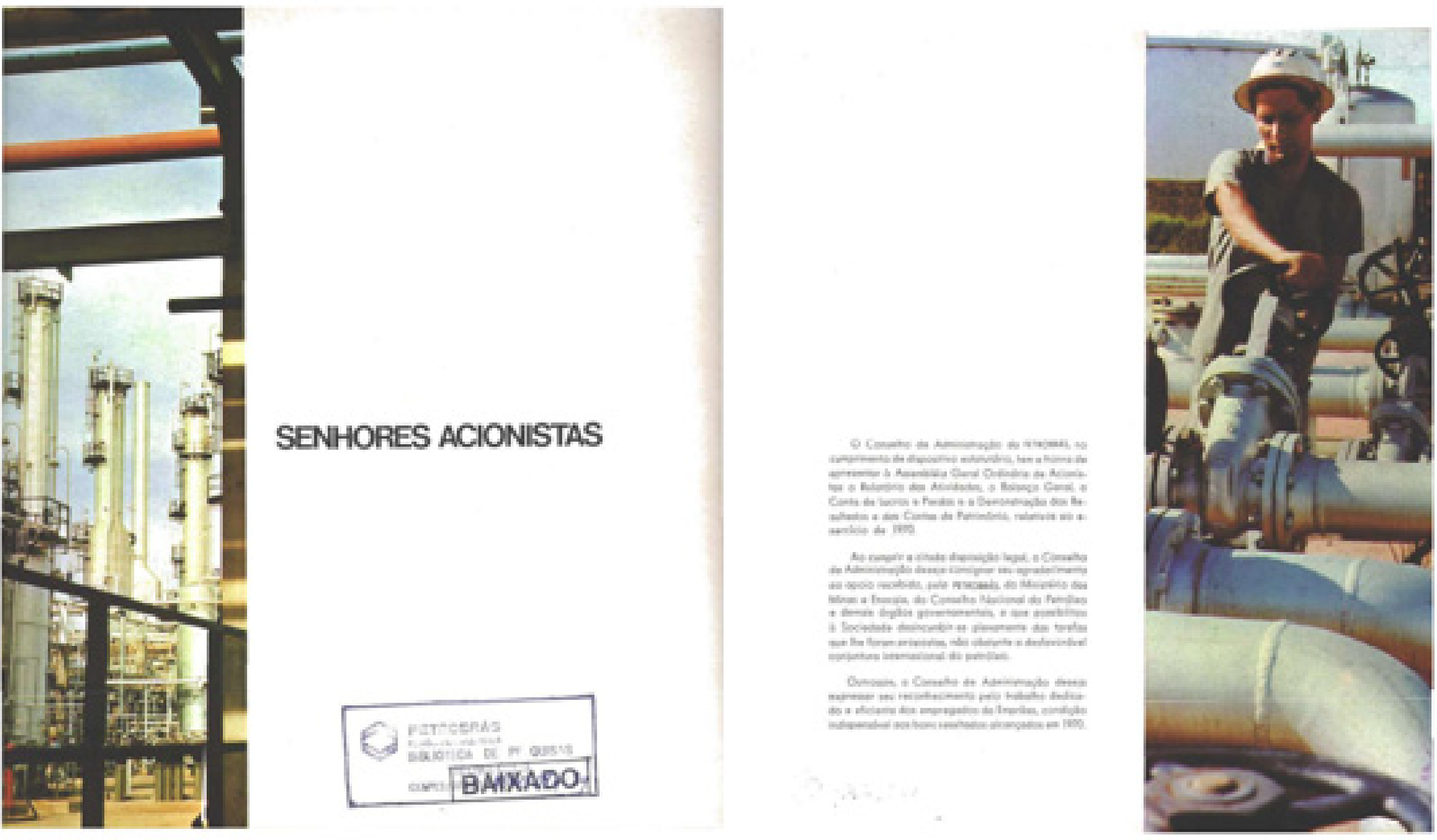
Occupying two pages of the annual report, the 1970 letter self-promotes the performance of Petrobras, which ‘[discharged]
1970 Letter to shareholders.
The 1971 and 1972 letters, once again, reinforce the actions of the company on behalf of the nation. The 1971 letter explicitly mentions ‘It is only fair to recognise the employees of PETROBRÁS for their dedicated and efficient work demonstrated in performing their tasks’ (Petrobras, 1971: 2). This evidences the use of the tactics of ingratiation, through rhetorical manipulation and reinforcement. Simultaneously, the omission tactic is also present. The use of the word ‘justice’ clashes with the cruel reality of human rights violations of its workers (see CNV, 2014b).
In the 1972 letter, the results that contribute to the ‘prominent place’ of the oil industry are attributed to Petrobras, but there is a call for ‘everyone’, connoting with society in general, to seek oil sources, in a practice of symbolic management of legitimacy (see Michelon et al., 2015). The Board of Directors assigns to ‘everyone’ the responsibility for the full supply of oil derivatives, somehow releasing the company in the full assumption of this responsibility: The results achieved by PETROBRAS in the set of its activities and in the context of the national economy place the oil industry
For the first time, the narrative reveals two events that led to ‘the loss of precious human lives in the fire in February in the Andraus Building in São Paulo and the explosion in March in the liquefied petroleum gas storage facility at the Duque de Caxias Refinery’ (Petrobras, 1972: 3). Regretting what happened, without, however, identifying Petrobras as responsible nor justifying it, the narrative presents the situation ‘Alongside the successes achieved, it is noted with deep regret …’ (Petrobras, 1972: 3). Accordingly, Petrobras admits that the event was tragic, but disassociates from it, using the excuse tactic. It was the first time that a defensive IM tactic was explicitly used.
The letter's narrative continuously and emphatically highlights the contribution of Petrobras’ activity to the progress of the nation: The elements offered below allow the Shareholders to visualise the results achieved by the Company, in all its sectors of activity, as well as the
The positive presentation of the company, including ‘as the executing agency of the national policy for the oil sector’ (Petrobras, 1973: 3), is once again made. However, the external dependency experienced continues to be concealed, managing impressions by highlighting through recourse to rhetorical manipulation that the company had ‘managed to keep the domestic market for derivatives
There is also visual emphasis in the 1973 letter (see Figure 5). At the top of the page, there is a non-photographic visual image of three continuous black lines, connoting the flow of oil in the pipelines. These lines, when the chapter number is displayed on the left, seem to form the Petrobras logo, again running along a continuum only interrupted by the expression ‘Messrs. Shareholders’, in green. This visual image refers to the process of change in the company's logo, which aimed to reflect Petrobras growth process: The logo seemed inadequate for Petrobras’ new physiognomy. An integration of the holding company and its subsidiaries was sought to create a Petrobras System identity. In October 1972, the new brand was approved. The old rhombus was turned into a hexagon-rhombus … The hexagon shape referred to the carbon chain and its relationship with the chemical composition of petroleum … the new brand should reflect the company's growth and expansion, even abroad. Hence the hexagon, almost a self-representation (the carbon symbol), stronger and more robust. (Petrobras, 2013: 28)
1976 Letter to shareholders.
From 1974 to 1984
In the period 1974–1984, the letter to shareholders begins with the word ‘Presentation’, using techniques of visual emphasis, without any reference to a particular stakeholder. This change of stance took place during the Geisel government, started a political opening and drove the Brazilian economy to a ‘liberal profile national capitalism’ (Fausto, 1999; Hermann, 2005b: 01).
During the Geisel government, the II NDP was launched, aiming for the country's autonomy in terms of basic inputs, including oil (Brazil, 1974). Brazilian industrialisation continued to be the focus, and at the centre were large state-owned companies, such as Petrobras, whose giant investments sustained the programme of the government (Fausto, 1999). In 1974 Petrobras discovered the Garoupa field on the offshore shelf in the Campos Basin, in Rio de Janeiro, which generated forecasts of increased national oil production for the following years (Petrobras, 1974), contradicting the pessimism of Geisel's final speech. Four years later, most of Brazil's reserves were in offshore oil fields (Morais, 2013). Leaving the presidency of the National Petroleum Council in October 1974, Araken de Oliveira became president of Petrobras. During his administration, he signed several risk contracts with foreign companies for oil prospecting on the Brazilian continental shelf. His administration concurred with the period of major increases in international oil prices and the subsequent measures taken by the Brazilian government to reduce fuel consumption (CPDOC-FGV, n.d.). As of 1974, for the first time, the letters refer to consolidated financial statements of Petrobras and its subsidiaries and highlight the ‘Sistema Petrobrás’ [Petrobras System]. The establishment of subsidiaries from 1968 onwards, with the foundation of Petrobras Química S.A. (Petroquisa), and the development they exhibited led Petrobras to become, directly or indirectly, a holding company for a growing number of companies (FGV, 2016). The 1974 letter presents another innovative element, the names, in capital letters (visual emphasis) and the corresponding positions, of the members of the Board of Directors, which ceases to be part of the narrative the following year. The names of three board members are also listed, all former presidents of Petrobras (Ademar de Queiroz, Irnack Carvalho do Amaral and Waldemar Levy Cardoso). This Letter stands for the discovery of new oil fields on the Brazilian continental shelf as ‘outstanding successes’ (Petrobras, 1974: 2) of the Petrobras system. Self-promotion and enhancement tactics are used, supported by reinforcement.
In 1975, next to the title ‘Presentation’ four face photographs in grey tones are placed, all four smiling, and in the upper right-hand corner the company logo – the hexagon is shown. Face photographs of workers appear in other sections of the annual report and the cover. The methods of presentation by repetition and location are evident. The smile connotes the satisfaction of belonging to Petrobras; in turn, the inclusion of the photographs generates the impression that human resources are valued by the company. In 1974, Petrobras restructured its human resources training policy (Petrobras (1969–1975) Relatório de atividades). Personnel training actions were taken over by the new Division of Planning and Pedagogical Studies and the higher education programmes oversaw the new Teaching Division (Morais, 2013). But until 1980 there is evidence of the use of the ‘political and social investigation control sheet’ by the Information Security Division of Petrobrás (DSI), in charge of carrying out political investigations on Petrobras’ employees, thus its workers were under the sights of the repression structures (Carvalho, 2021; Praun and Costa, 2016).
The content of the messages follows the line of previous ones, with the emphasis in 1975 on the fact that Petrobras had performed ‘in conditions of
From 1976 onwards, the narrative of the letters becomes longer. Regulatory changes took place during that year: the Securities and Exchange Commission was established, and the capital markets were regulated through Law no. 6385/1976, of December 7 (Brazil, 1976a). Additionally, the new Brazilian corporation law, Law no. 6404/1976, of December 15, was issued, disposing, among others, of company groups, consolidated financial statements and reporting (Brazil, 1976b). Petrobras was the first Brazilian company to publish consolidated statements in 1974 (Machado and Santos, 2004). As the largest company in Brazil, it was a role model for the newly implemented Brazilian regulatory changes.
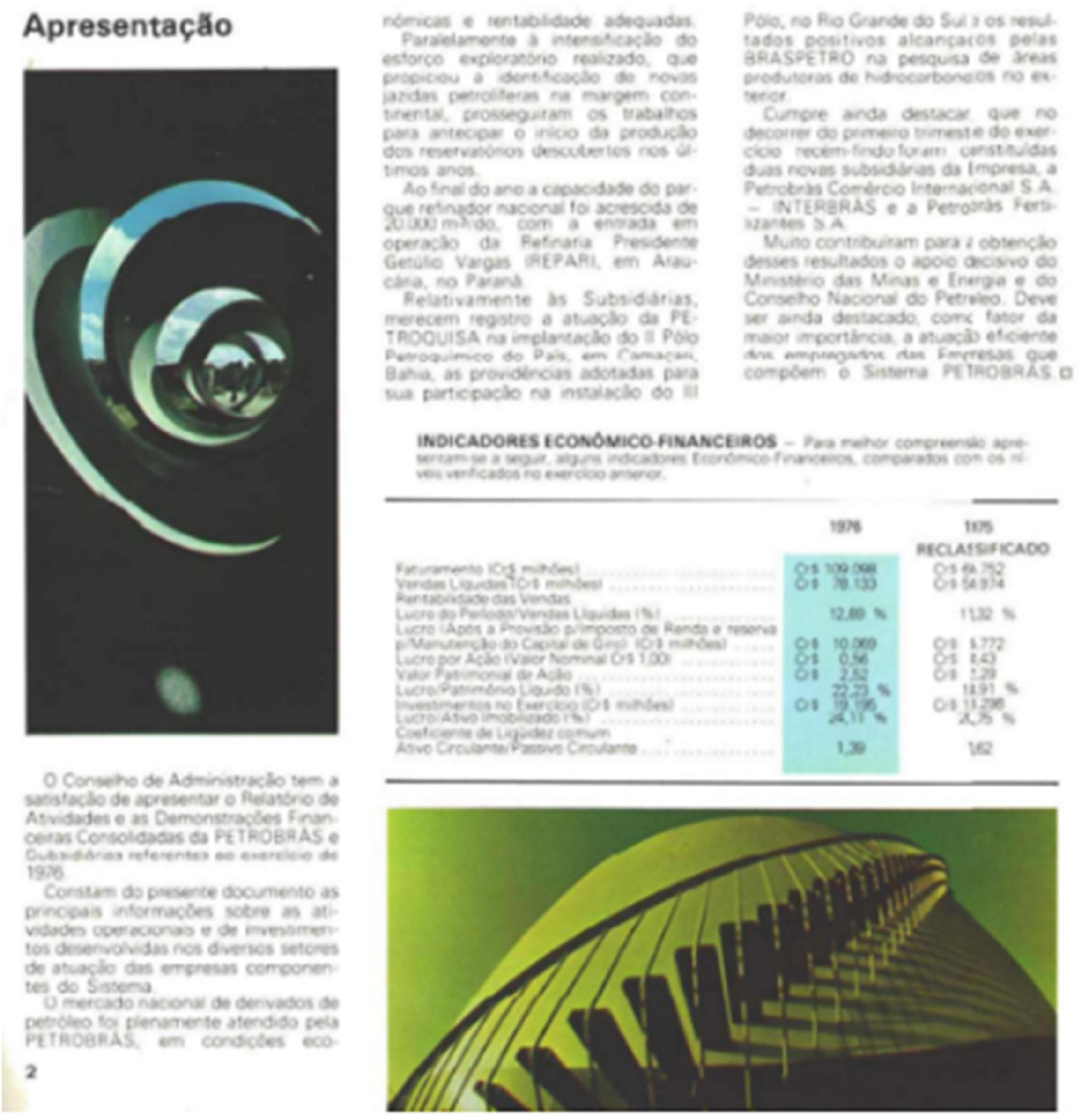
The 1976 letter is accompanied by images (see Figure 6). Visual emphasis using colour, images, font and font size, reinforcement and rhetorical manipulation, are the means of presentation and IM used. The use of benchmarks and selectivity of figures become part of the tactics used.
1981 President’s letter.
In Figure 6, the image on the left has a photograph with a black background, with a spiral, whose contours have the sky as the background; as for the second image, the message denoted is of an oil reservoir tank, surrounded by a ladder directed upwards. These images suggest that the activities of Petrobras were in a dynamic process of expansion and ascension, corroborating the narrative. There is a repetition (spiral effect) inherent to the visual emphasis used through the images. Their location on the page is also a form of visual presentation. In turn, the narrative makes use of enumeration to present the actions carried out by the company and its subsidiaries inland and abroad, as well as qualifiers (‘adequate’, ‘fully’, ‘in parallel’) to highlight the positive performance. For the first time, Petroquisa, Braspeto, and the ‘newly created subsidiaries’, Interbras and Petrobrás Fertilizantes S.A., were presented by their names. On the same page, ‘for a better understanding’ (Petrobras, 1976: 2), a table presents the economic-financial indicators with a comparison to the previous year (see Figure 3), using colour to highlight the figures for 1976. The ‘adequate economic conditions and profitability’ of Petrobras are once again reiterated. The contributions of the actions carried out in ‘parallel’ by the company are listed and benchmarks are used: The national market of petroleum products was By the end of the year the
The narrative structure of the 1977 letter is identical to that of 1976. In 1977, for the first time, the letter was signed by the President, Araken de Oliveira (although not handwritten). This is the first president's letter, in the literal meaning of the expression. The emphasis on meeting objectives and highlighting the contribution of Petrobras and its subsidiaries to the development of the Brazilian economy is increasingly evident (see Petrobras, 1977, 1978), with no mention of potential negative aspects arising from the activities. Expressions such as: ‘the
In the 1978 president's letter, the 25th-anniversary logo of the company is shown in full colour (visual emphasis) on the upper left side of the page. The letter begins with ‘Petrobras’ Board of Directors, represented by its President, has the honour to submit to the Regular General Meeting of Shareholders the 1978 management report and financial statements’ (Petrobras, 1978: 5). That reference to the President on behalf of the Board is new and the mention to ‘shareholders’ is unique during the period 1974–1984. Similar to previous letters, the activity is highlighted through the use of qualifiers: ‘The Company's proposed
In the government of Figueiredo (1979–1985), the opening of the regime was inevitable, but the economy and the people fared very badly. External pressures led the government to take drastic measures, one of which was to cut investments by state-owned companies (Fausto, 1999). In 1979, a second oil shock raised prices and worsened the balance of payments problem in Brazil (Fausto, 1999). According to Tamer (1985: 189), Brazil ‘lived, from 1973 to 1979, in the midst of a false island of tranquillity, profligately spending the dollars that we borrowed abroad at high rates, to import an oil that we had never seriously sought in the national subsoil’. Figueiredo ordered Petrobras to invest primarily in oil research and production ‘even overcoming resistance from the highest levels of the company … [Figueiredo] closed the question: Petrobras’ specific function is not to satisfactorily and efficiently meet the internal supply of petroleum derivatives, but, essentially, to seek self-sufficiency’ (Tamer, 1985: 189).
The communication stance of Petrobras changed direction when a civilian with experience in the communications field – Shigeaki Ueki – took over as President. He had been Minister of Mines and Energy during Geisel's presidency of Brazil (1974–1979). Earlier, in late 1969, after General Ernesto Geisel had been invested as president of Petrobras, Shigeaki Ueki was appointed director of marketing and international relations of the company (CPDOC-FGV, n.d.). As stated in Petrobras as a Brazilian symbol section, it was at that time (October 1979) that Carlos Rabaça became head of the company's Social Communication department (Petrobras, 2013). The democratisation process felt in the government structures during Figueiredo's government impacted business ventures, being ‘noticeable in Petrobras history’ (Petrobras, 2013: 31). Foundations were laid for a new phase at Petrobras: a ‘time for dialogue with society’ (Petrobras, 2013: 30). Democratic actions can be perceived in the president's letters in the annual report of the company, more informative and apparently more enlightening. In this global scenario, Petrobras propagated normality in the domestic supply of oil, as well as in the development of the nation, making use of the exemplification tactic, demonstrating to act in an exemplary manner: Bearing in mind the Government's guidelines for the sector, the investment program of the Company for 1979,
The 1979 president's letter appears in white on a blue background (visual emphasis), occupying two pages. Petrobras' achievements are listed (rhetorical manipulation), in an ‘efficient performance’ (Petrobras, 1979: 3), ‘intense … effort’ (p. 4), culminating in ‘good results’ and ‘success obtained’ (p. 4), which shows the use of reinforcement to enhance the performance of the company. There is also the use of repetition of the expression ‘Country’, which appears four times, and the expressions ‘contribution’/‘contribute’/‘contributed’, which together appear six times, emphasising Petrobras’ contribution to Brazil. Selectivity and performance comparison are also tactics present in the 1979 Letter, through the use of a selection of numbers and benchmarks. These tactics and presentation methods are also evident in 1980, 1981, 1982, 1983 and 1984. In the 1979 and subsequent letters, it is also explicitly mentioned that it is the President of the Board of Directors who presents the management report and financial statements of Petrobras System.
In the 1980 president's letter (Petrobras, 1980: 3–4), despite recognising the ‘energy dependence from abroad and … its impact on the country's Balance of Payments’, the ‘notable effort’ of the company's activity in reducing it is emphasised, with visible use of the tactic of attributing positive events to the organisation and negative ones implicitly to external factors: … By allocating to them The results reached attest to the (Petrobras, 1980: 3, emphasis added)
For the first time, the 1980 letter explicitly mentions the risk contracts with companies with government authorisation (Schutte, 2016), The narrative evidences the use of internal benchmarks, involving comparisons with previous periods or percentage variations, and selection of numbers. The president resorts to rhetorical manipulation to emphasise the continued upward activity of Petrobras, ‘a mark of significant expression in world terms’ (Petrobras, 1980: 3), a strategy also evident in subsequent years. Once again, ‘the success’ and ‘the good results’ are emphasised (see Petrobras, 1980: 3–4).
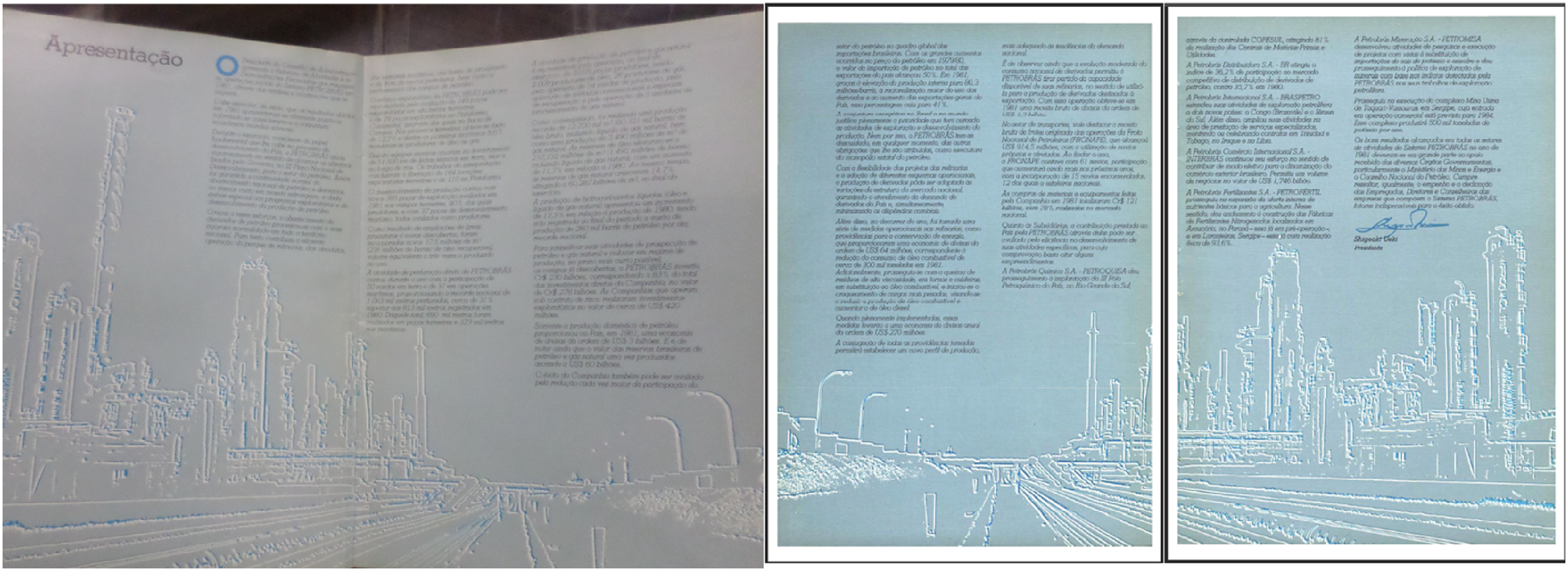
The 1981 letter is longer, and the change in visual strategies is also noticeable, featuring for the first time the handwritten signature of President Shigaki Ueki. The text of the letter is written on a greyish-blue background, where it is possible to see the contours of the company’s infrastructures, displayed in a mirror image on the four pages dedicated to the letter.
The IM tactics and the presentational methods used in previous letters are visible again. Of note is the use of verbs that indicate growth and future: ‘continued’, ‘will take’, ‘will allow’, ‘extended its activities’, ‘expanded its activities’, ‘continued its effort’, ‘continued expansion’, ‘developed activities’, and ‘continued the execution’ (Petrobras, 1981: 4–5). There is greater detail in the presentation of the activities and investments of Petrobras and its subsidiaries and of the investments made by the companies that operate under risk contracts, including through the use of figures and benchmarks. The ‘results achieved in 1981 were highly positive, especially considering the adverse world economic situation … [and] aware of its fundamental role in the development of the country, PETROBRÁS acted vigorously to achieve the goals set by the Government … for the oil sector’ (Petrobras, 1981: 2). There is evidence, more explicitly, of the use of tactics of self-promotion, entitlement, enhancement, exemplarity, ingratiation, selectivity and performance comparison, justified by the larger length of the letter. Another issue discussed in the document was the surveying of seismic lines with reference to the number of kilometres. However, there is an obvious omission regarding the invasion in August 1981 of the Sateré-Mawé territory by the French state company Elf Aquitaine, sheltered by a risk contract signed with Petrobras for a seismographic survey. This contract aimed at discovering oil beds, resulted in deaths and indiscriminate cutting down of the forest, as highlighted by the CNV (2014b).
The 1982 president's letter, once again, explicitly mentions the risk contracts with companies with government authorisation (Schutte, 2016), as well as the investment (‘ In this second invasion, 144 kilometres of tracks and 82 clearings were opened, destroying manioc plantations, guaranazales and a plethora of hardwoods. The Sateré-Mawé estimated the losses this time at 80 million cruzeiros, with Elf paying them only 8.6 million.
Seeking to prospect for natural gas and oil on indigenous lands, this French state-owned company ‘also played a criminal role in the far west of the Amazon … where it operated through an illegal agreement between Petrobras and FUNAI’, that ended up in deadly conflicts between workers and indigenous people (CNV, 2014b: 237). CNV (2014b: 237) states that: Stressing its position of not changing the pre-established schedules and counting on the agreement of Funai … Petrobras even stated that ‘measures will be taken to avoid any incident with the indigenous people, but, if one occurs, to minimize its effects as much as possible so that Petrobras’ exploration activities can continue’.
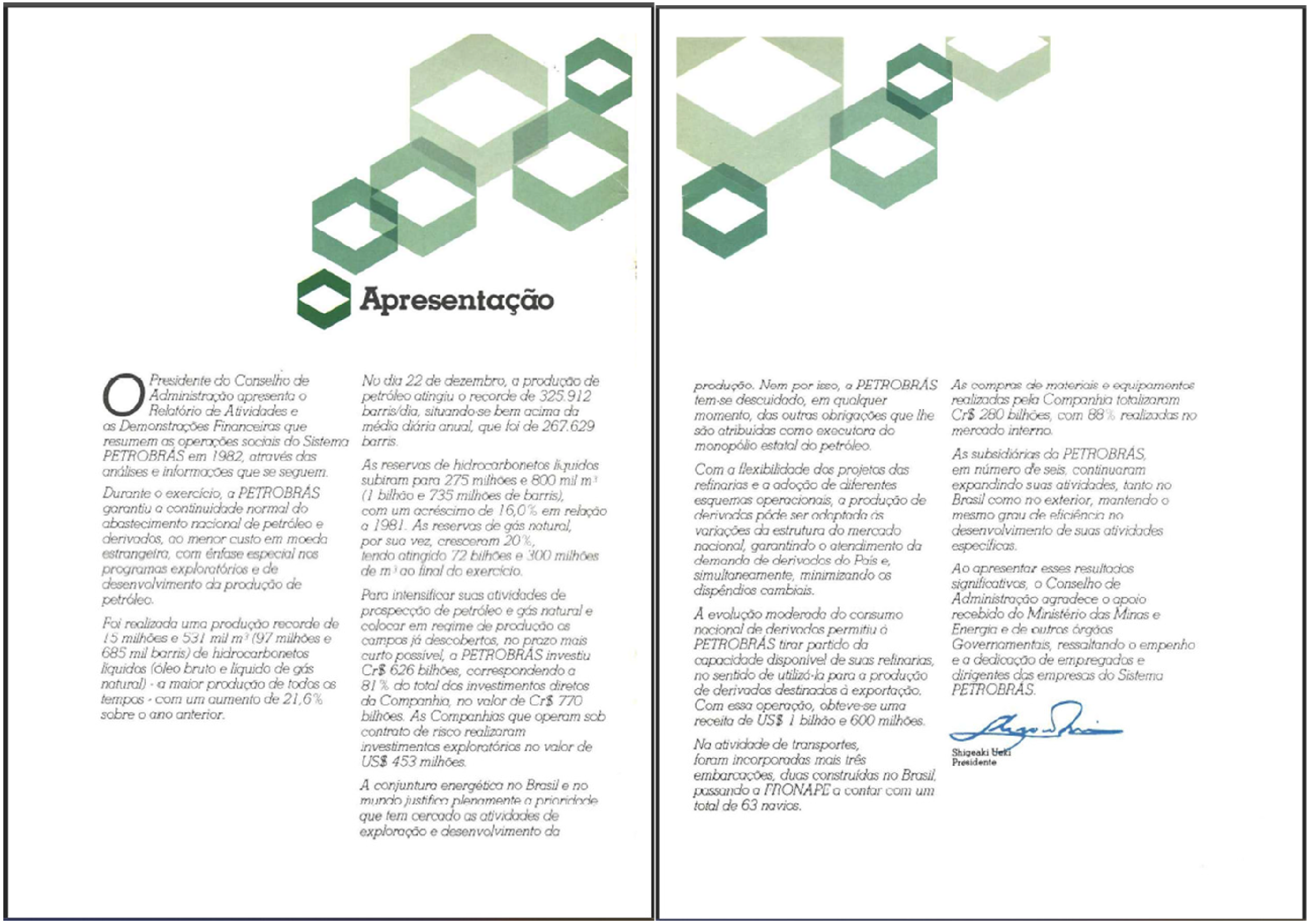
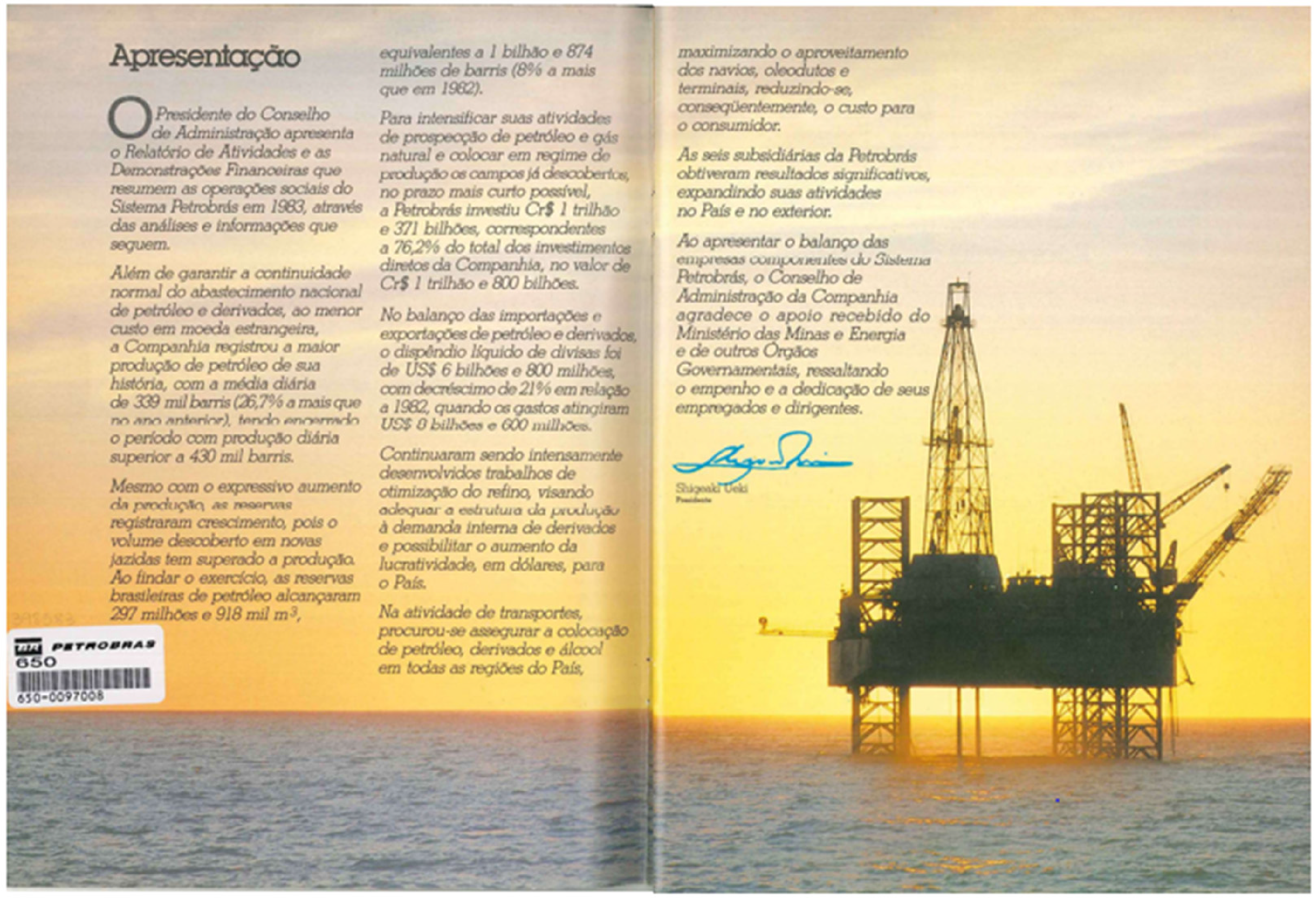
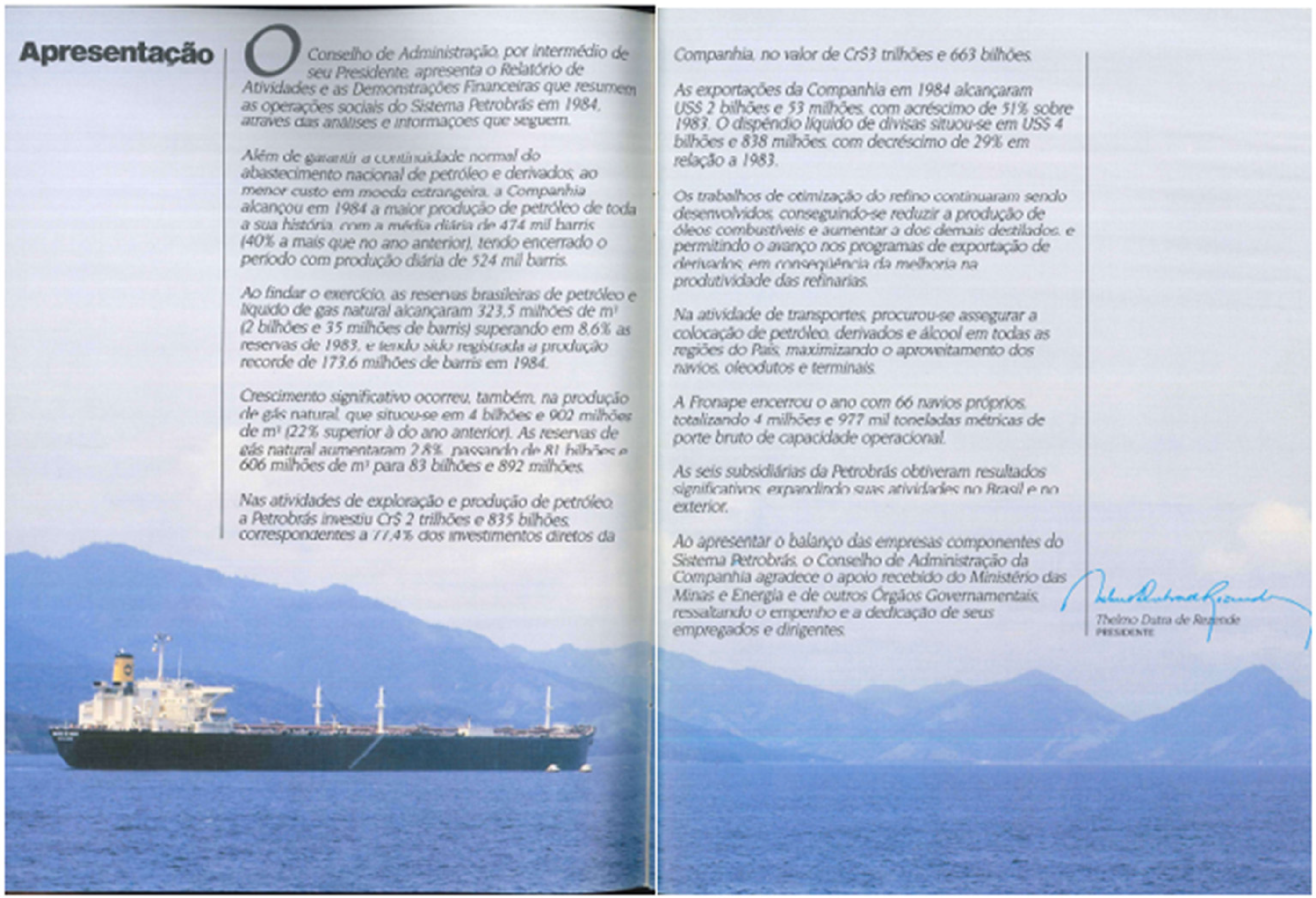
In the 1982 president's letter, and also in the 1983 and 1984 letters, visual emphasis is evident in the repetition of the company's logo (Figure 7), in different shades of green and sizes (1982 letter), and from the background photographs on which the narrative is inscribed (Figures 8 and 9 from 1983 and 1984 letters).
1982 President’s letter.
1983 President’s letter.
1984 President’s letter.
The photograph in Figure 8, which occupies two pages, denotes a sunset and an offshore oil platform attached to the activity of Petrobras. The immensity of the sea and sky and the horizon line can be read as a visual metaphor of expansion and growth, and the sunset of hope in the future, of a new dawn. The use of photography reinforces the Brazilian dream about Petrobras and the legitimacy of the organisation, corroborating the narrative. In the photograph in Figure 9 there is an oil tanker, which appears as a prominent element and emphasises the transport activity and investment in Petrobras ships referred to in the president's narrative. The huge sky, the sea and the land (mountains), these two elements in a shade of blue without any distinction, connote the breadth of the activities of the company and its subsidiaries, developed either on land or sea, on behalf of Brazil. The visual and narrative rhetoric underlying the 1983 and 1984 Petrobras’ letters emphasises the success of oil discoveries and production offshore. The oil price shocks in the 1970s led Petrobras to intensify oil exploration activities on the offshore platform; these activities expanded in the first half of the 1980s. After the first discoveries in shallow waters, successive discoveries occurred in deep and ultra-deep offshore waters (Morais, 2013).
From 1982 to 1984, the production is emphasised as the largest ever, through the use of emphasis by reinforcement: …the Company achieved the highest oil production in its entire history, with a daily average of 474,000 barrels (40% more than the previous year) … Significant growth also occurred in natural gas production … which stood at 4902 million cubic meters … Exports … reached US$2.53 billion, 51% more than in 1983. Net foreign exchange expenditure was US$4.828 billion, down 29% on 1983 … Fronape ended the year with 66 of its own ships totalling 4,977,000 deadweight tons of operational capacity. (Petrobras, 1984: 3–4, italics in original, emphasis added)
These letters (1982, 1983 and 1984) point out with a very similar text the Petrobras subsidiaries: ‘The six subsidiaries of PETROBRÁS achieved significant results by extending their activities in Brazil and abroad’ (Petrobras, 1983, 1984: 4; italics in original; see also Petrobras, 1982: 4). The 1984 letter was signed by Thelmo Dutra de Rezende, a former Petrobras director who became president in October 1984, replacing Shigaki Ueki. It finalises the story of the ascension of Petrobras during the military dictatorship since the 1985 letter was written during a democracy.
Conclusion
Petrobras was constituted as a symbol of hope for the Brazilian Nation, populating from the beginning, Brazilian's imaginary as a propeller of national economic independence. However, from early on it was faced with the difficulty of fully supplying the oil needs of Brazil. Under public scrutiny, the criticism against the company and the state monopoly was fierce. According to Smith (1978: 193): one cannot examine Petrobras solely or even primarily from the point of view of finance, since political, and even emotional factors must be considered, which may well be crucial - at least as far as the Brazilian people are concerned … in one word: nationalism. … Its achievements - real or imagined - since its creation, stimulated Brazilian nationalism. And this feeling can be viewed positively, because it has promoted national development, and this, in turn, is of strategic advantage to Brazil by providing a better life for future generations, as well as by preserving national independence.
The Brazilian oil history and the history of Petrobras are linked. It is not possible to insert political and emotional factors from the Brazilian history of oil in Petrobras’ accounting figures. However, accounting narratives can include such elements and then tell the story (see Gendron and Breton, 2013; Martins et al., 2019). The president's letter is one such narrative, which during the military dictatorship in Brazil worked as a legitimiser of the performance of the company, feeding the hope and optimism about the operations of Petrobras, seeking to demonstrate economic and social worthiness. The company strengthened the impression generated by its contribution to part of the supply of the nation and to reduce imports, with a mixture of reinforcement of the legitimacy of the government and Petrobras. The president's letter was used strategically as a rhetorical device to support an organisational and political agenda, to which the military dictatorship was not indifferent.
The results show an alignment between the company and the Government, projected in the letters of annual reports, favouring the construction of reality (see Hines, 1988) tied to the belief of the contribution to the country and feeding the optimism of the Brazilian society. This was supported by a mosaic of IM tactics and presentational methods, aligned with Cooper and Slack (2015). To that end, evidence of the conjunction use of multiple assertive IM tactics was found, namely self-promotion, enhancement, entitlement, exemplarity, selectivity and performance comparison (see Cooper and Slack, 2015), propagated Petrobras in ascendancy and with it the Brazilian Nation. Also, reinforcement, rhetorical manipulation, visual emphasis using images, colour, font and font size, repetition and location were presentational methods of IM that were often employed together (see Cooper and Slack, 2015), to convey the message of ascendancy and hope, even in periods of crisis and shocks to legitimacy. The adoption of defensive tactics was unusual, which is in line with the optimist nationalist discourse of the military regime (Fico, 1997). The clear exception was the omission tactic, consistent with the lack of transparency of the military regime (see CNV, 2014a, 2014b; Praun and Costa, 2016). No negative information, such as criticisms against the company (Petrobras, 2013) and the controversial issues identified by CNV (2014b), related to violations of workers’ and indigenous people's human rights, was disclosed in the analysed letters. Thus, Petrobras kept invisible damaging events.
Through the findings, this study supports Martins et al. (2019: 423) assertion: ‘it is possible to argue that, in a particularly changing and challenging environment, storytelling in the president's letters is a way to create a success story for the company and a legitimate façade’. In this case, a success story for Petrobras, and a legitimate façade for a government that propagated the ‘Great Brazil’ dream and silenced the reality.
Thus, by showing how the discretionary nature of the president's letter was used as a tool to propagate the story of the ascension of Petrobras and, consequently, of the political regime in force, this study evidence accounting as a social practice (Carnegie et al., 2021, 2023; Hopwood and Miller, 1994) that impacts the organisational and social functioning and development. Few studies (e.g., Cooper and Slack, 2015) have combined narrative and visual methods and considered the complementary and inter-related nature of tactics and presentational methods that may be used in IM. This article contributes to the literature on corporate communication (see Merkl-Davies and Brennan, 2017) and to the literature that highlights the importance of accounting figures and narratives for conducting social history (see Antonelli et al., 2022; McWatters and Lemarchand, 2010; Pinto and West, 2017). Additionally, by highlighting how the political, social and economic context of the Brazilian military dictatorship period affects the story told, financial reporting and communication practices, this research contributes to the literature on IM in a non-Anglo-American setting. Longitudinal analysis made it possible to study both the consistency and change in the letters and contribute to the history of the evolution of the president's letter by showing how the messages within it are adapted and framed to the context experienced by the organisation.
Arising from this research is the opportunity for further historical longitudinal studies that analyse how different economic, political and social contexts influence the use and extent of IM. Accordingly, and because this article limited its study to a specific state-controlled company (Petrobras) and period of time (the military dictatorship), there is still room to analyse the president's letters of other state-controlled companies and for different periods of time (e.g., before and after the dictatorship). Future research may also extend to the analysis of other sections of the annual report and/or other corporate reporting documents.
Footnotes
Funding
The author(s) disclosed receipt of the following financial support for the research, authorship and/or publication of this article: Ana Caria and Lídia Oliveira have conducted the study at NIPE, University of Minho.This study is financed by National Funds of the FCT– Portuguese Foundation for Science and Technology within the project (UIDB/03182/2020; UIDP/03182/2020).
Declaration of conflicting interests
The authors declare no potential conflicts of interest with respect to the research, authorship and/or publication of this article.
