




Abstract
This article addresses the role played by accounting in the government of the Italian colonies of Africa during the Liberal and Fascist periods. Drawing upon the work of Foucault, Scott and Said and their understandings of governmentality and colonialism, and using a wide range of primary sources, the article contributes to the accounting history literature by showing how calculative practices in the form of colonial budgets and regular censuses of the population helped the Italian government to control activities in its colonies. The article shows how accounting practices evolved under different political regimes in the achievement of different programmes of government. It also offers evidence of the ways in which accounting can be mobilised to enable penetrating interventions in the lives of indigenous populations.
Introduction
A new wave of historiographic studies that have re-interpreted the processes of colonisation and decolonisation (Loomba, 2015; Said, 1994) has recently heightened interest in European colonialism in the nineteenth and twentieth centuries. Not only do the processes of colonisation and decolonisation have specific relevance as the object of historical, sociological, political, anthropological and legal studies, but they also have an impact on today's international relations. As the former Western colonial powers seek to address their own colonial past this has been controversial due to the need to protect their national and international reputations and promote their image as promoters of democracy and peace (Fedorowich and Thomas, 2001).
Accounting history literature has extended the boundaries of investigations of colonialism, with particular reference to the role played by accounting as a tool to exercise control from a distance and the mechanisms of exclusion imposed by the accounting profession on indigenous practitioners (Dyball et al., 2007; Greer and Neu, 2009; Sian, 2011). Amidst this invigorated colonial research, Italy has yet to attract the attention of accounting historians. Italian unification took place in 1861, by which time the main colonial empires had already been formed and consolidated. Despite its political and military weakness, the newly formed Kingdom of Italy soon embarked on an aggressive colonial policy. In 1889, the Kingdom of Italy conquered its own ‘place in the sun’ by annexing Eritrea. In the early twentieth century, Somalia was added. Between 1911 and 1912, the Libyan regions of Tripolitania and Cyrenaica were conquered after the Italian-Turkish War. Lastly, under the Fascist regime, Ethiopia was invaded and conquered (1935–1936).
By drawing upon work on governmentality and colonialism by Foucault (1991, 2003, 2007), Scott (1995, 2005) and Said (1979, 1994), this article analyses the role played by accounting in the Italian colonies, with a focus on the budget of the Italian Ministry of the Colonies and on those of each colony. The Ministry of the Colonies was created in 1912 and continued its operations under the Fascist regime when it was transformed into the Ministry of Italian Africa. Formally, the Ministry of Italian Africa continued to operate until the 1950s, even if all the Italian colonies had been lost in 1941. For this reason, the years covered by this article include only the periods from 1912 to 1922, which in the article is referred to as the ‘Liberal age’, and from 1922 to 1941, the ‘Fascist age’. At the end of the nineteenth century, Italy did not use any specific form of accounting to control its colonies. By the early twentieth century, annual budgets had begun to appear, although they were quite superficial and provided only aggregated information. During the Fascist age, budgets became detailed documents that enabled close control of the conquered territories. This study has also drawn upon censuses of the colonised populations carried out in 1901, 1911, 1921, 1931 and 1936. Crucially, only censuses carried out in the Fascist age included native populations in the colonies. Consistent with Miller's (1998, 2001) call to extend the traditional boundaries of accounting to embrace non-financial, statistical information that informs governmental calculative practices, this study considers the census as an accounting technology, a means that provides information for decision-making. By focusing on populations as a distinct object of calculation, the census has the potential to provide insights into the economic, social and political life of a conquered territory, which in turn inform political decisions (Bisman, 2009; Francis and Samkin, 2014).
This article contributes to the accounting history literature by investigating the relations between Italian colonialism and accounting and adds to studies that have explored the ways in which accounting practices enabled colonial rule (Gomes et al., 2014; Huf, 2020; Neu, 2000a, 2000b; Rodrigues and Sangster, 2013). Whilst most studies of accounting and colonial government focus on a single set of political beliefs, this work offers a longitudinal analysis of how the role of accounting changed under different political regimes in the implementation of colonial programmes of government. The study also adds to accounting history research by considering an under-researched context (Coronella et al., 2013), the Italian Fascist regime, which is yet to attract a level of attention in accounting studies that is commensurate with the calamitous impact it had in the twentieth century (Antonelli et al., 2018, 2022; Bigoni, 2021; Bigoni et al., 2021; Cinquini et al., 2016; Funnell et al., 2022; Papi et al., 2019; Sargiacomo et al., 2016). The article begins with the presentation of the theoretical framework informing the study, which is then followed by a literature review and the research method. An overview of Italy's colonial penetration into Africa is then offered, before investigating the use of accounting in Italy's colonial strategies. Lastly, the findings of the article are discussed and its conclusions are presented.
Colonial governmentality
Rational government (governmentality) requires the identification of the ‘right manner of disposing of things’ (Foucault, 1991: 95) to channel to a ‘convenient’ end all the ‘things’ to be governed. Thus, rationality is a requisite of government in the sense that governing the population and the economy needs to be done in a well-organised manner (Dean, 2010), deploying the proper ends and means of government to achieve a set of stated goals (Miller and Rose, 1990). The introduction of ‘rational government’ into the sphere of politics meant a shift from the notion of the ‘state’ as the centre of political power managing an apparatus of control and repression to the notion of ‘government’ (Miller and Rose, 1990: 2), whereby the aim becomes shaping, guiding and affecting the conduct of individuals, social groups and populations (Gordon, 1991). Consistently, from the second half of the eighteenth-century power started to target life as a productive force that is to be managed in a way that enables the achievement of the goals of those in power (Foucault, 2003).
Intervention in the conduct of individuals by governments is particularly evident in the context of colonialism, whereby the different customs of the coloniser and the colonised clash. Sociological studies of colonialism and neo-colonialism have investigated the ways in which colonial modes of government are implemented and have a decisive impact on the life of native populations, even when they allegedly promote the well-being of the indigenous population (Said, 1979, 1994; Scott, 1995, 2005). Colonial rule rests on the separation of the worlds of the dominator and the dominated, on the creation of a discourse of ‘us’ and ‘them’ and, hence, on ‘a style of thought based upon an ontological and epistemological distinction made between the “Orient” and the “Occident”’ (Said, 1979: 2). This requires the use of techniques which inform the creation of new forms of knowledge about indigenous populations and their moral and cultural universe, which is depicted as backward and in need of intervention by the allegedly superior Western man. Colonialism is therefore ‘supported and perhaps even impelled by impressive ideological formations that include notions that certain territories and people require and beseech domination, as well as forms of knowledge affiliated with domination’ (Said, 1994: 9, emphasis in original).
Colonial rule requires penetrating action on how indigenous people conduct themselves to ensure that they embrace the values of the conquerors, thereby facilitating the latter's rule: ‘to be governed people must be counted, taxed, educated, and of course ruled in regulated places (house, school, hospital, work site)’ (Said, 1994: 327). Consistently, in countries such as South Africa, Egypt, and India the colonial state did not immediately impose home country rules, but gradually inserted new practices such as land management, hygiene and policing (Pesek, 2011). To produce malleable subjects and govern behaviour without resorting to a politically costly use of violence, it is essential to alter the political and social worlds of the colonised: ‘if modern power is concerned with disabling non-modern forms of life by dismantling their conditions, then its aim in putting in place new and different conditions is above all to produce governing effects on conduct’ (Scott, 2005: 44). The imposition of previously unknown personal and property rights, the adoption of a free market, the establishment of prisons and limitations on indigenous customs are enacted as the means of governing conduct and enforcing the domination of the colonial state in less obvious, non-violent ways (Foucault, 2003). Nevertheless, these practices modify the culture, the customs and, ultimately, the way of life of the indigenous people (Scott, 1995).
The enactment of effective interventions in the colonies requires knowledge of the phenomena to be governed. Only by these means can governments intervene in individual behaviours, social life and economic activity in a ‘rational’ way (Gordon, 1991). Numerical information contributes to the formation of the objects of government, to the development of cognition, calculation, experimentation and evaluation, and finally to produce a ‘political’ discourse (Rose and Miller, 1992). Among the technologies that can further the reach and impact of governmentality, accounting is particularly important. In the analysis of the role of accounting for governmental purposes, a distinction between political rationality, programmes of government and technologies of government is usually made (Rose and Miller, 1992). Political rationality represents a system of beliefs, concepts and values about society and the economy which encompasses the institutions involved in the rational way of governing (Miller, 1990; Rose and Miller, 1992). Thus, a crucial role is played by the distribution of tasks and power in the administrative apparatus of the state, a necessary premise for the implementation of the programmes of government (Dean, 2010). Programmes of government are established for the achievement of political objectives, finding solutions or overcoming difficulties (Rose and Miller, 1992). They refer to the details of plans and actions to be taken and require a clear intellectual construction of the reality under observation to act on it (Radcliffe, 1998). They are, however, abstract until technologies are applied to carry them out. Technologies of government include strategies, procedures, techniques and calculations needed to enable authorities to render their programmes operable (Rose and Miller, 1992). The calculative practices of accounting are such a technology.
Accounting practices help make the economy visible and measurable and enable new ways of acting upon and influencing the actions of individuals (Miller, 2001). Accounting researchers have explored the potential of accounting practices as technologies that can support rational government in different contexts (Antonelli et al., 2020; Bigoni and Funnell, 2015; Maran et al., 2016; Nikidehaghani et al., 2021). In the colonial context, accounting can provide information in the service of colonial strategies by translating into practice different colonial programmes of government. Accounting practices are important because they enable those in power to ‘bring home’ distant territories, making them visible and, hence, amenable to intervention. To do this, the government creates centres of calculation, institutions and organisations ‘at which information is accumulated about other places, processes, entities and activities that are distant’ (Miller, 1990: 318).
Particularly appealing to colonial powers in the implementation of their programmes of government are the ‘territorialising’ properties of accounting, which construct the calculable spaces that individuals inhabit (Mennicken and Miller, 2012; Miller and Power, 2013). As noted by Mennicken and Miller (2012: 20, emphasis in original), accounting territorialises in two main ways: First, it does so by making physical spaces calculable. This could mean a factory floor, a hospital ward, an office, a shop, or even a sub-area of a shop, and much else besides. Second, it does so by making abstract spaces calculable. Examples here could be a ‘division’ of a firm, a ‘profit centre’ or a ‘cost centre’ of an organization, or even an idea such as failure, public service, or personal identity.
The properties of accounting in enabling control of distant people and places were important in the context of Italian colonialism. Nevertheless, these properties were activated in different ways to achieve different goals under the Liberal and Fascist governments. Deceptively banal tools such as budgets and the census of the colonial population became technologies of government in the achievement of colonial programmes of government. This also included, especially under the Fascist regime, supporting penetrating interventions in the lives of indigenous populations and even racial discrimination.
Accounting for colonial domination
Studies of accounting and colonialism have investigated how ‘accounting discourses and technologies have been used to influence and control indigenous people’ (Greer and Neu, 2009: 470). To settle territories, the home government must control native populations (Neu, 2000b). Accounting supports this endeavour, but it can also ensure the exclusion of indigenous people from educational opportunities, political life and upward mobility within the military and civil society. Critical scholars have sought to offset the bias of earlier Eurocentric research, which assumed or asserted that the European institutions inserted into colonies were best for or would benefit those colonies (Neu, 2001). These studies have examined the resistance of local European accounting professionals to the entry of indigenous practitioners into the accounting profession in Fiji (Alam et al., 2004; Davie and McLean, 2017), Trinidad and Tobago (Annisette, 1999, 2000, 2003), Canada (Buhr, 2011), Australia (Carnegie and Edwards, 2001; Chua and Poullaos, 1998; Craig and Jenkins, 1996; Gibson, 2000), New Zealand (Gallhofer et al., 1999; Hooper et al., 1993; Kim, 2004), India (Legg, 2006), the Philippines (Dyball et al., 2007), Bangladesh (Uddin and Hopper, 2001), Kenya (Sian, 2006, 2011), Sierra Leone (Kaifala et al., 2019), South-Africa (Verhoef and Samkin, 2017), Nigeria (Wallace, 1992) and the Holy Land (Brock and Richardson, 2013).
Research has also investigated the technologies used by Western powers to exploit indigenous populations, especially the variety of accounting technologies used to translate governmental policies into practice. These include the development of a national accounting system (Baker and Rennie, 2012; Huf, 2020) and accounting policies that deny the rights of citizenship to natives (Davie, 2005; Neu, 1999; Neu and Heincke, 2004). Also examined have been financial reporting practices used for the colonies (Bakre, 2008; Power and Brennan, 2021), budgets (Burrows and Cobbin, 2011; Rodrigues and Sangster, 2013), taxation systems implemented (Bush and Maltby, 2004; Rodrigues et al., 2015) and accounting-based funding mechanisms which redistributed wealth unevenly (Hooper and Kearins, 2013).
Particularly important for this study, from a governmentality perspective, accounting discourses have been used to rationalise colonial relations, with accounting techniques applied both countrywide and locally (Gomes et al., 2014; Neu, 2000b; Neu and Heincke, 2004). Accounting contributed to imperialism by returning to the home country information that facilitated governance and dominance of the colonial power (Neu, 1999). The imposed accountings resulted in indigenous people being marginalised and excluded (Davie, 2000; Gallhofer and Chew, 2000; McDonald-Kerr and Boyce, 2020). From the coloniser's viewpoint, accounting techniques allowed them to enforce a desired cultural environment and begin the construction of a ‘modern’ world superimposed upon indigenous traditions (Neu and Graham, 2004). Consistently, research has shown that ‘accounting information was used both to define issues and problems related to the imperial enterprise and also to create political and social discourses or sets of meanings which would then inform and legitimise political debate and strategies essential to the preferred imperial political goals and beliefs’ (Funnell and Walker, 2013: 4). Given the oppressive lived experience of indigenous people under their colonial masters, accounting historians have been called upon to deepen their research into colonialism (Carnegie and Napier, 2012; Napier, 2006). The present study adds to this field of literature by exploring the shifting of accounting practices in Italian colonies in Africa in the service of two political regimes, the Liberal and the Fascist regimes, which pursued different values and beliefs.
Method
This study is based on a qualitative analysis of primary sources located in the archives of the Italian government and adopts a theoretically informed interpretive methodology (de Loo and Lowe, 2017) to develop a longitudinal analysis of how the role of accounting changed under Liberal and Fascist forms of colonialism. Thus, attention has been focused on primary sources that provide financial and non-financial data on Italian intervention in Africa between 1912 and 1941.
The most revealing financial information was obtained from the budgets of the colonies, which were consolidated with the budget of the Ministry of the Colonies. These have been gathered at the archive of the Ministry of Foreign Affairs in Rome. Budgets were consulted for the entire period examined in the article. The budgets and the census reports reveal what Rome demanded, how information requirements changed over time and how such data was collected and used by the ministerial bureaucracy. Important non-financial information was drawn from parliamentary debates on colonial matters and ministers’ official speeches appearing in the minutes of the Chamber of Deputies, which became the Chamber of Fasci and Corporations from 1939 to the fall of the Fascist regime in 1943. These records are in the Historical Archive of the Chamber of Deputies in Rome.
The parliamentary debates show the opinions and attitudes of the government and, as such, the ways in which the authorities in Rome used accounting tools for the purposes of colonial government. Other important non-financial, statistical data consisted of the final reports relating to the censuses of the Liberal age (1901, 1911, 1921) and the Fascist period (1931, 1936), which can be found in the archive of the Statistics Bureau of the Kingdom of Italy. This archive also contains the minutes of the meetings of the Board of the Bureau, Mussolini's speeches on statistical matters and the reports of the heads of the Statistics Bureau in the Fascist period. Censuses and other statistical information, especially during the Fascist regime, were important to identify how detailed information on the characteristics of the population in the colonies was enlisted to enable those in power to form a thorough knowledge of the social phenomena to be governed. 1 Newspaper articles concerning colonial budgets appear in La Stampa, the archives of which are available online. 2 Secondary sources, consisting of the vast literature on colonial history, were also used to support the historical re-enactment of political events.
Given the nature of these primary sources, which are all in Italian, attention has been paid to ensuring ‘the survival of the original meaning and sense of what has been said in the source language’ (Feldermann and Hiebl, 2020: 251). Therefore, data analysis was carried out in Italian. Italian-speaking authors started the investigation by analysing the budgets of the colonies and of the Ministry and their evolution over time. Attention was then focused on parliamentary debates which were used to put accounting data into context and to understand if and how accounting information was provided to the Parliament and enabled discussions on the goals and achievements of Italian colonialism in Africa. Statistical data was then analysed to appreciate the kind of non-financial information that was available to the government and, crucially, which were the attributes of the population in the colonies that were being documented.
Primary sources were read by each author individually. To mitigate the known limitation of interpretive research, namely the subjectivity of the findings (Maran et al., 2022), discussions were held to reach an agreement on which sets of data should have been included in the article and how data could be tentatively interpreted. The results of these discussions were then summarised and translated into English to gather the views of the non-Italian author and to finalise our interpretation of the events based on the chosen theoretical framework. All translations were carried out by a native speaker of Italian who has expert knowledge of English through his work in the UK. As far as the use of direct quotes is concerned, to preserve the ‘context-sensitivity’ of the materials and make them accessible to contemporary international readers (Feldermann and Hiebl, 2020), the focus has been on the main message of the quote rather than a word-for-word translation, although attention has been paid to preserving the nuances of the original text.
Italian colonialism in Africa
Political and military events
Italian colonial efforts began soon after the unification of the country in 1861. In 1869, the Rubattino shipping company bought the port of Massawa in Eritrea and set out to conquer the country commercially. In 1882, the government took over Rubattino and, moving inland, progressively occupied the remainder of Eritrea (Aruffo, 2003). In 1893, the Filonardi Company acquired administrative control over five ports in the Benadir area of Somalia. Through these companies, Italy ruled indirectly. In 1908, Somalia was formally annexed. In the early twentieth century, Italy penetrated the Libyan coasts with banks, trade agencies, consulates and offices utilising international agreements and treaties. The occupying Turkish government resisted the increasing Italian presence and in 1911 Italy declared war, which ended on 18th October 1912.
With the start of the First World War (WWI), Italy recalled its army and lost control over Tripolitania and Cyrenaica, the two main provinces of Libya. Immediately after WWI, crises in Italy culminated in Mussolini's March on Rome on 28th October 1922 and the establishment of a dictatorship in 1924. Italy soon turned its attention to the colonies, setting out to reconquer Tripolitania and Cyrenaica. Between 1922 and 1931, repression was severe. Only after causing the deaths of an estimated 100,000 people did Fascist Italy finally get the better of the last few pockets of resistance in Libya, whilst full control over Somalia was not reasserted until 1928 (Lazzarini, 2007). The Fascist regime invaded Ethiopia in 1935 and engaged in another brutal war, at the end of which Eritrea, Somalia and Ethiopia were merged into ‘Italian Eastern Africa’, and Victor Emmanuel III was proclaimed ‘King of Italy and Emperor of Ethiopia’. The empire was short-lived. Defeated by the British Army, Italy lost all her colonies between 1941 and 1943 (Labanca, 2007).
Distribution of colonial tasks and programmes of government in the Liberal age
The colonial intentions of the Liberal age 3 governments focused on the strategic goals of achieving international prestige and encouraging the emigration of the unemployed to the newly occupied lands. In each of the colonies then under Italian control, the government invested in farming, industrial operations and infrastructure to encourage emigration (Bevilacqua et al., 2001). The goal to settle citizens in a new ‘Italian’ land in large numbers, however, was not successful. The combination of arid conditions and poor soil acted against Rome's plans in all territories.
The distribution of colonial tasks and power in the administrative apparatus of the colonised states was designed around Italian authorities. The Prime Minister appointed colonial governors who in turn appointed local Italian officials to the Commissariats, the Italian bodies that were responsible for day-to-day operations in the colonies (Martone, 2008). The civil service was all Italian. Native clerks began to be employed in the administrative offices of the colonies only after WWI (Borsi, 1938). The Ministry of the Colonies in Rome coordinated colonial affairs and interfaced with the Prime Minister, the King and the military (Aquarone, 1989). The Ministry issued political, military and administrative guidelines, provided infrastructure, collected data and organised ‘colonial exhibitions’ where the products and other aspects of colonial work were displayed (MdC, 1914a); these were used as propaganda to prove the value of the colonies and to encourage Italians to move to the colonies.
Programmes of colonial government were inspired by prudence and pragmatism and the Liberal precepts of creating opportunities for economic and social improvements. Practices were established to supervise while not overly disrupting the pre-established local order. This role was conferred first on indigenous chieftains to avoid flooding the colony ‘with a horde of Italian clerks, and leaving monitoring, supervising and managing responsibilities to the few good among them, who could work peacefully and independently of any party, of any race or family competition, or any personal rivalry’ (CdD, 1913: 26,859). Chieftains operated in their own territories under the control of the local Commissariat. This would also have helped to keep the cost of managing the colonies low. Minister Bertolini defined the ‘philosophy’ of the colonial strategy of Liberal Italy as ‘spreading the idea that, because of our irrevocable rule, our interest lies in the welfare of the native population as much as the latter's interest lies in that loyal subjection, that the resources we can spend on Libya, instead of going to waste in defending our rule from disruption and rebellion, may be spent to add value to the Colony’ (CdD, 1913: 26,859). This ‘addition of value’ was represented by the economic exploitation of the colonies and the development of Italian business in Africa. Nevertheless, consistent with Liberal laissez-faire policies, state intervention was limited and the amount of resources invested in the colonies kept to a minimum.
New institutions were set up in environments where they had been unknown. The establishment of prisons, hospitals, schools and military conscription was unprecedented (Lazzarini, 2007). They were created in the hope of ensuring security in ways beyond mere military force. Accommodations were reached with Islamic law, although only Italian judges could issue sentences. Sharia law applied to family and inheritance relations (CdD, 1913: 26,863). The Liberal government wanted to ‘ensure the justice the native population is hungering for; respect their religion, ownership, customs and households’ (CdD, 1913: 26,859).
The government upgraded healthcare services, opened outpatient clinics and pharmacies, bacteriological laboratories, dispensaries for the treatment of venereal diseases, first-aid units and hospitals in large cities (CdD, 1913: 26,864). Vocational education was promoted, while it was thought prudent not to spread basic, humanist and critical culture to prevent ‘the native people forming large groups of misfits and paving the way to political unrest’ (CdD, 1913: 26,868). The local populations were progressively regimented through a number of actions intended to bind them to Rome's government, including specific laws, taxation, conscription and recognition of some personal and property rights. The presence and threat of armed intervention by the Royal Army and the corps of Carabinieri helped to reduce open resistance. A large part of the population adapted to their new status and cooperated with the occupying forces (MdC, 1914b).
Distribution of tasks and programmes of government in the Fascist age
Fascist action in the colonies was first aligned with the policy of making Italy a European power. The regime later intended the colonies to become producers of food to support a hoped-for increase in the Italian population. Mussolini considered it necessary to proceed to a rationalisation of economic activities in loco by creating specific structures designed to exploit local agricultural production, under the control of Rome (Labanca, 2007). The distribution of tasks was quite similar to that of the Liberal age and included the cabinet, the Ministry of the Colonies (then Ministry of Italian Africa), the governors and the local authorities. Power was mostly concentrated in Mussolini's hands and those of the Roman bureaucracy directly in his service (Aquarone, 1989).
Programmes of government differed from those of the Liberal age. Control over indigenous populations was strongly enforced, with military action as needed. The control over the colonial bureaucracy was also deeper. Fascism sought to intervene in the lives of indigenous people on a larger scale, building more schools, prisons, mental asylums, hospitals and barracks, and finally adopting a racial approach to the social structure of the colonies. Consequently, strict supervision of the Italian and native populations became a strategic goal. The Minister of the Colonies, Federzoni, emphasised the importance of fully enforcing Fascist rule (CdD, 1924b: 1015). Thus, the Libyan territories were subjected to fierce military repression (CdD, 1927b: 7023). At the same time, many tribal customs were banned (CdD, 1933a: 8120). The Fascists sought to further promote emigration to the Italian colonies by providing financial incentives and lands to potential settlers (CFC, 1939: 148).
Consistent with the more strident colonial intentions of the Fascists, the limited indigenous co-governance permitted in the Liberal age was abandoned: ‘they [the Liberal governments] not only gave wide powers to the local chiefs in inland areas, but they also placed people, always incompetent, often treacherous, in high hierarchical ranks and entrusted to unexperienced hands the most delicate mechanisms of colonial life’ (CdD, 1928: 8990). The Fascist government tightened its long-distance supervision while retaining native staff in the local civil service (Barile, 1935). The Minister of the Colonies, De Bono, explained that: ‘if one has to monitor what happens 8,000 kilometres away, one must allow for some flexibility in their guidelines. But the Minister is aware of this and is watchful, he goes there himself or sends someone he trusts, to keep objectively abreast of all the problems’ (CdD, 1932: 6137). In particular, ‘relations between colonial power and central power’ were defined ‘by conferring the regulatory authority on colonial power and the law-making authority on central power’ (CdD, 1927a: 6998).
All governmental practices of the Liberal age were strengthened and expanded. In Libya, doctors, nurses and midwives were placed in towns across the colony. They monitored not only health but behaviour as well (CdD, 1935a: 1331). The Minister of the Colonies Lanza di Scalea proclaimed that ‘providing healthcare to the native populations through specially trained colonial doctors …, as anyone can see, has great political importance as well’ (CdD, 1925: 2537). There were schools for Italians and some for the more well-to-do natives for ‘schools must be a political device of peaceful penetration and moral conquest of the native population’ (CdD, 1931: 3892–3893). Education of young Africans was restricted to lower levels, where they could learn a trade that would be a potential benefit to the Fascists. At the end of their vocational education, the native students, Minister De Bono explained, ‘are subjected to military discipline. This is how we have taken them away from vice and idleness. Someone might say: with this military discipline, we will end up teaching these students to use the weapons that one day they may aim at us. I do not hesitate to answer: No! Not at all. These young people will be our future soldiers’ (CdD, 1933a: 8122).
A particularly confronting strategy used by the Fascists was systematic racial discrimination, especially after 1936. The main purpose was to avoid ‘crossbreeding’ and inappropriate interactions between the Italians and ‘inferior’ races. Cohabitation and marriage between Italians and natives were forbidden. The possibility of achieving Italian citizenship was denied to natives and mixed-race individuals, although a special ‘Libyan-Italian’ citizenship could be granted to Libya-born subjects who had demonstrated their loyalty to the regime, such as by serving in the army. Segregation was also enforced. Italians and natives could undertake only those occupations specified by the regime and it was understood that Italians could not work for indigenous people (CFC, 1939: 153). A penetrating intervention in the life of indigenous populations was the fight against pastoral nomadism, especially in Libya, for moving populations would have been harder to control. To achieve this purpose, concentration camps were set up whereby inmates were forced to learn to till lands and went through re-education so that they ‘would understand that Italians are benefactors and not oppressors’ (CdD, 1932: 6144).
Accounting as a calculative practice in the Liberal Italian colonies
The colonial budget as a technology of government
Following commercial penetration by private companies, the Italian state became more involved in colonial strategy. The main way of translating strategic programmes into action was the budget. All territories occupied by the Italian army were divided into autonomous administrative jurisdictions. Each of these colonial lands was a distinct object of calculation and an annual budget was drawn up with reference to each territory and its revenues and expenses. After 1906 the Parliament approved the annual budgets of Eritrea and Somalia drawn up by their governors (GSI, 1912, see Table 1). These budgets were simple. In 1908, they consisted of three pages with little detail (RdI, 1908: 3754–3756). The lack of information and swift approval of budgets suggests that other problems dominated the Parliament's attention.
The budget of Eritrea and Somalia – 1908 (amounts in Liras).
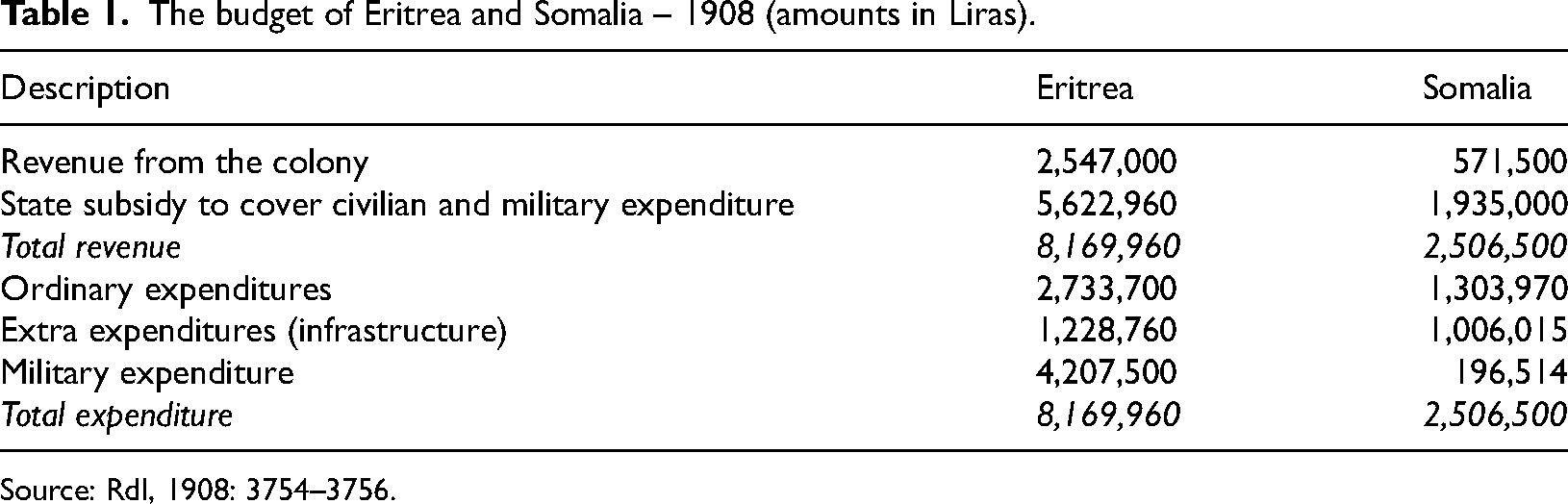
Source: RdI, 1908: 3754–3756.
After the establishment of the Ministry of the Colonies in 1912, the budget and the budgeting process changed. The Ministry's budget initially consisted of a single, extensive document, split into the budgets of Eritrea, Somalia and the Ministry itself. Parliament approved incremental changes from the prior year's budget, but there exists no documented analysis or discussion of the budget or its summary (CdD, 1914b). The budgets of Tripolitania and Cyrenaica were added in 1914–1915. These budget practices lasted until 1922. With the creation of a Ministry of the Colonies and the subsequent addition of budgets for each land under Italian control, the colonies were made visible as an object of government to the Italian leadership and could therefore be acted upon in economic terms. This goal was explicitly referred to when the Ministry of the Colonies was established and was allocated tasks that had been previously performed by the Ministry of Foreign Affairs: ‘for years the Minister of Foreign Affairs has been forced to present budget estimates here, which … were not reliable’ (CdD, 1912b: 21,396). It was believed that the creation of a separate accounting object such as the colonies could solve this problem. Budgets as ‘territorialising’ tools enabled the colonies to be understood as ‘something for which costs, revenues, and their risks, can be defined and calculated, something around which an “envelope” can be drawn, and of which financial calculations can be made’ (Miller and Power, 2013: 562). This was particularly important for Liberal governments, for whom reducing expenditure and maximising returns from their intervention in the colonies was a priority.
With the outbreak of WWI, all efforts of the country were devoted to that conflict. Consequently, neither the Ministry's nor the colonial budgets were approved by the Parliament. Adjustments were voted on if necessary, without a systematic plan in place. The second and last parliamentary debate about the colonial budget was held in 1922, just before the Fascist March on Rome. It was the first complete budget of the colonies to have been prepared in 14 years (RdI, 1922), by which time the territorialisation of the budget had been largely developed. Its nine sections referred to the Ministry of the Colonies, Tripolitania, Cyrenaica, Eritrea, and Somalia as well as to a number of associated entities that included Tripolitania Railways, Cyrenaica Railways, Eritrea Railways and the Royal Eastern Institute of Napoli. Table 2 provides an abridged form of the budget of the colonies.
The budget of the Italian colonies, fiscal year 1922–1923 (amounts in Liras).
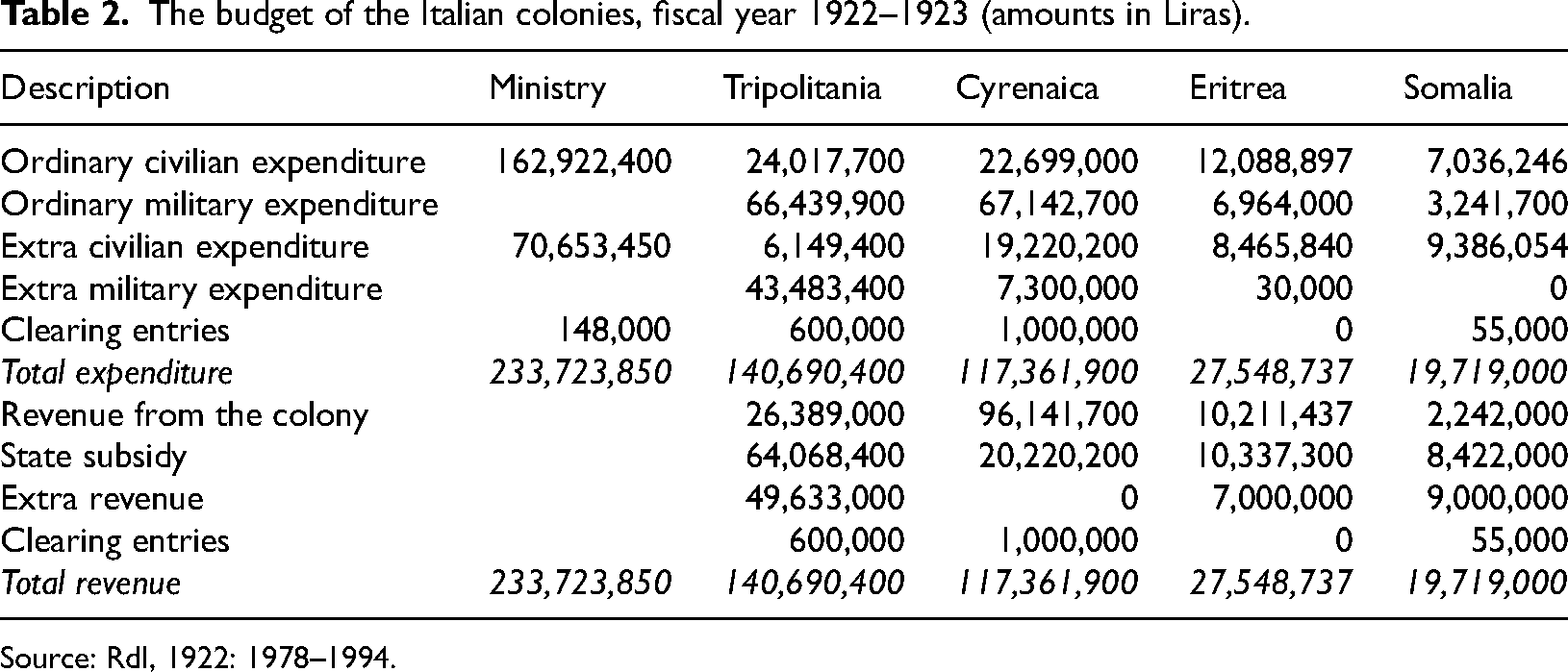
Source: RdI, 1922: 1978–1994.
The sections of the budget represented the physical and abstract spaces that both Italian colonisers and native populations inhabited and which were identified as units of calculation, then amenable to intervention (Mennicken and Miller, 2012). With the budget, African territories were turned into a clearly identifiable accounting object, for which resources were used consistent with the Liberals’ programmes of government. Resources provided with the budget were expected to allow governors to run their territories but within the goals set by the government and reflected in budgetary appropriations. The budget as a territorialising tool was therefore important to balance local autonomy and centralisation: these figures demonstrate that effectively the central administration is reduced only to political direction and high administrative control … there has already been substantial, and I believe even exaggerated, decentralisation: decentralisation which grants governors the faculty of having their accounting and their administrative autonomy. However, this administrative autonomy must not exceed certain limits, … especially the right, indeed the duty, of the central government to supervise, so that the appropriations are used for the ends approved by the Parliament. (CdD, 1922b: 6649)
The bond between the motherland and the colonies was crucial to the exploitation of the latter, the ultimate end of Italian colonialism in the Liberal age. As explained by a member of Parliament, in the absence of such a bond: ‘…no surveillance can be exercised over what is happening there and, what is worse, good commercial exchanges that facilitate the import of our goods cannot be created’ (CdD, 1915c: 7787). The parliamentary debate on the budget for the year 1922–1923 shows how by the 1920s the main goal of Italian colonialism had become ensuring the economic exploitation of the colonies so that the motherland could profit from them. Expenses were to be kept under control and colonial administration was not to burden the state's budget. It was, therefore, essential to ‘bring the revenues of our colonies to the same level as expenditure on civil services for colonies must provide for their own administration … We are approaching this goal: in the current financial year, this balance between revenues and civil expenses has been achieved in our Mediterranean colonies’ (CdD, 1922b: 6650).
Colonial budgets as governmental software
Despite the attempt at territorialising distant lands by turning them into economic objects and identifying specific areas for which economic results could be calculated (CdD, 1914a, 1914c, 1914d), the budget failed to properly reveal the efficiency of the Ministry in managing colonial resources, an issue harshly criticised by the opposition (CdD, 1914b). Many members of the Parliament criticised the lack of clarity in the measurement of the colonies’ ‘performance’: the colony of Benadir has a cost of ‘x’ and a revenue of ‘y’, the colony of Eritrea has a cost of ‘x’ and a revenue of ‘y’, the colony of Tripoli and Cyrenaica has a cost of ‘x’ and a revenue of ‘y’! … I hope that, in making his statements about the budget, the Hon. Minister of the Colonies will tell us what such figures mean so we know how much we, Italians, earn in those colonies. (CdD, 1922a: 6490) budget balancing for our four colonies (an expenditure item of approximately 306 million liras in the year 1922–23) sounds like an accounting trick. The budget is balanced by recording the State's subsidies as inflows, about 228 million overall; so it seems that the inflows, instead of consisting of the Colonial Administration Authorities’ own inflows, are merely the amounts that are recorded in the Ministry's budget as outflows. (CdD, 1922a: 6496)
Amendola defended the transparency and usefulness of the budget of the colonies: ‘Our colonial budgets are perfectly explicit, as they contain all expenses, including military ones, which refer to the management of our colonies, contain a justification of the appropriations, and … show that colonial administration is inspired by criteria of rigid parsimony’ (CdD, 1922b: 6649, emphasis added).
Despite criticism, the colonial budget was a technology that enabled interventions in the colonies by Liberal governments by detailing objectives, assigning them to the colonial authorities (especially the governors) and allocating resources (CdD, 1915a, 1915c; MdC, 1918). It was seen as a crucial tool to promote economic growth (CdD, 1914c: 2). The budget represented part of the ‘software’ of colonial governance for the purpose of controlling the population indirectly (Neu, 2003), one which went hand in hand with military intervention, as was the usual practice of other Liberal colonial powers (Hooper and Kearins, 2013). Within the budgets during the Liberal age, line items allocated funds for social and economic institutions. Starting from the establishment of the Ministry of the Colonies, doubts had been expressed about imposing European social institutions and democracy on indigenous peoples (CdD, 1912a: 21,328) while centralising the administrative power in Rome (CdD, 1912a: 21,331). Nevertheless, the practice continued and in the budget were resources for schools, hospitals and prisons (CdD, 1915a: 6913–6915). As to the mobilisation of populations to support colonial agendas, the budgets included financial support for tribal chiefs exercising administrative power subject to Italian colonial bureaucracy (CdD, 1915b: 6960). The salaries of indigenous judges, especially in Somalia, were included (CdD, 1922b: 6651) as were those of indigenous colonial troops (CdD, 1915a: 6909; RdI, 1922).
Colonies were mainly represented and accounted for as resources to exploit and not a set of individuals, social groups, organisations and institutions to be managed at a distance by combining ends and means in a rational way. This was clearly confirmed in the Liberal period when the censuses of 1901 (DGS, 1902), 1911 (DGS, 1912) and 1921 (ICSRI, 1930) collected information only about ‘Italian subjects abroad’. Detailed information about the indigenous populations living in the colonies was apparently neither of use nor of interest. Consistent with the Liberal goal of keeping nonessential expenditure to a minimum, the main reason behind the decision to exclude indigenous populations from censuses was the contradiction between the usefulness of the information and its cost, as explained by Minister Martini: ‘the census in Muslim countries is more than difficult, both for people and for cattle, because the Koran states that one must not number oneself: this is what happened in Eritrea where attempts have been made and where a census of livestock and the population exists, which is extremely unreliable’ (CdD, 1915c: 7794). The native people were thus rendered invisible. Knowledge about them was not a goal at this point in Italian history as it had been in other colonial territories (Neu, 1999). Since the strategic goal was to promote emigration, a census of the colonial Italian population provided the most appropriate figures in support of that policy. In addition, the apparent absence of a large indigenous population might have made the choice of emigrating more attractive. From both the parliamentary debates and the neglect of the indigenous population in the census, a conception of the colonies as an object of imperialism in a traditional sense emerged.
Accounting as a calculative practice in the Fascist Italian colonies
The colonial budget as a technology of government
The conquest of the new lands and the hopes for exploiting their resources, but especially the totalitarian idea of the state and the myth of empire, strongly reinforced the role played by the colonial budget in translating the Fascist colonial programmes of government into practice. Consequently, as shown in Table 3, during the Fascist period the official overall colonial budget grew increasingly detailed with a few exceptions. 4
Sections and length (number of pages) of budget reports during the Fascist Age.
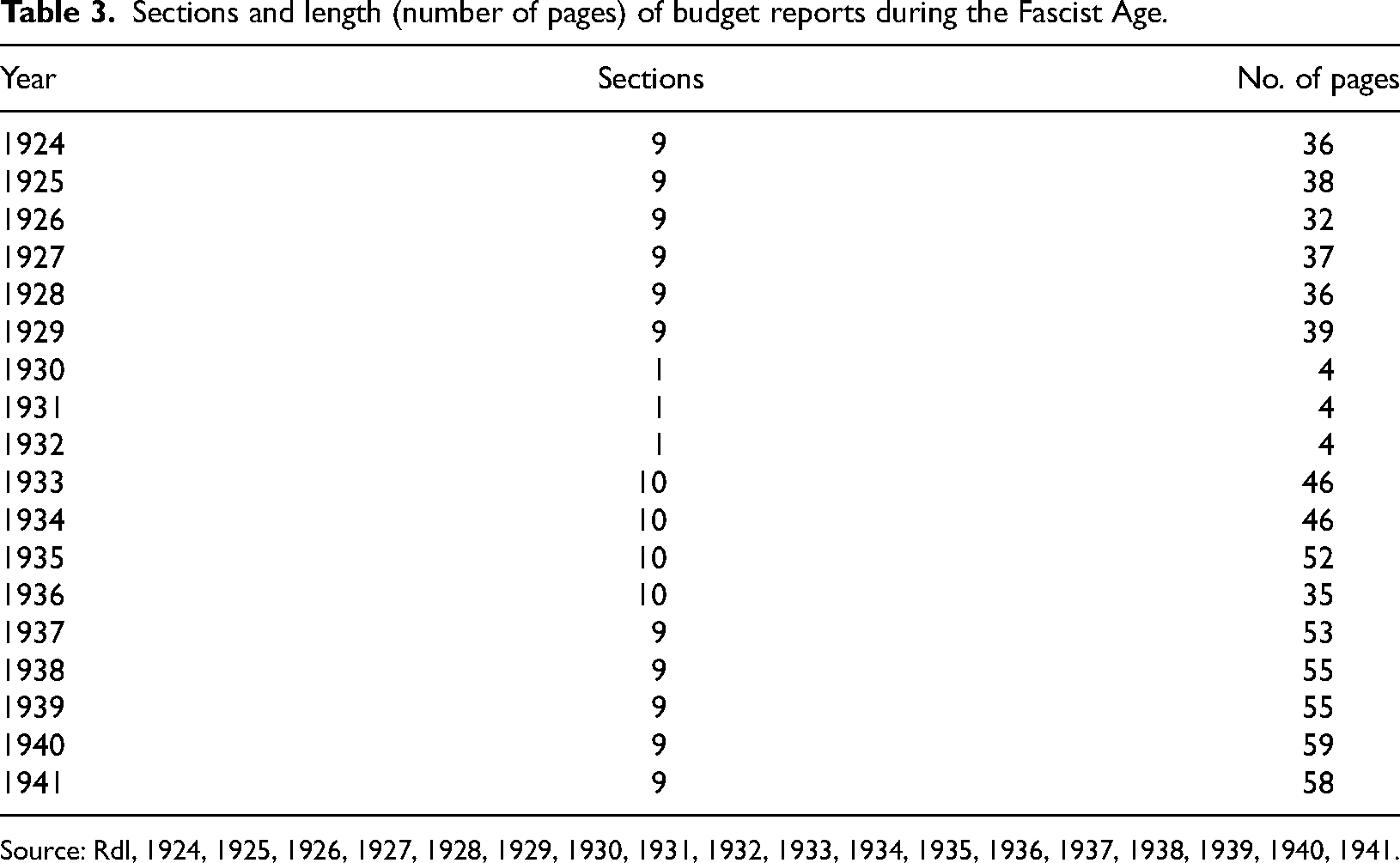
Source: RdI, 1924, 1925, 1926, 1927, 1928, 1929, 1930, 1931, 1932, 1933, 1934, 1935, 1936, 1937, 1938, 1939, 1940, 1941.
From 1937, the budgets of Tripolitania and Cyrenaica were combined to create Libya's budget. Those of Eritrea, Somalia and the recently conquered Ethiopia were in turn consolidated into the Italian East Africa budget. The Ministry was renamed ‘Ministry of Italian Africa’ in 1937 (CdD, 1937). A summary of the 1937–1938 budget appears in Table 4.
1937-38 Colonial budget summary (amounts in Liras).
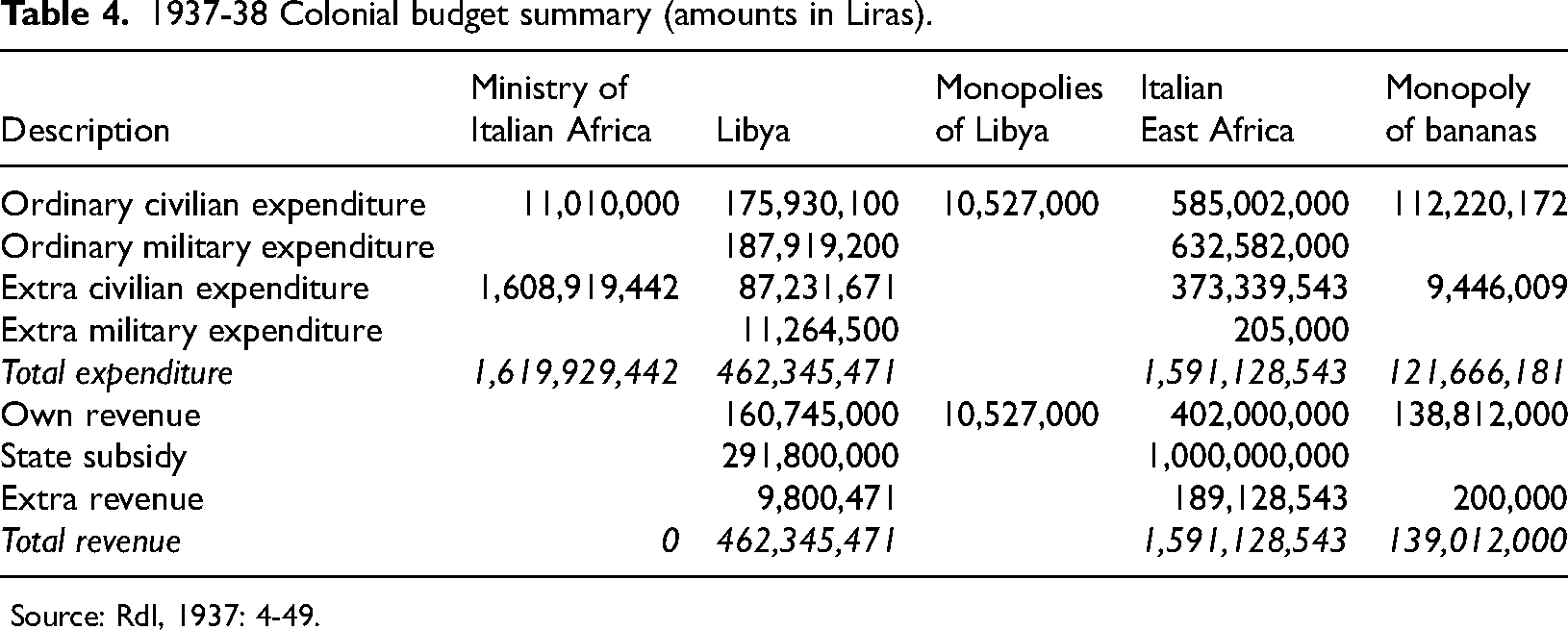
Source: RdI, 1937: 4-49.
The speeches and the debates reported in the official documents show how the Fascist government regularly used the budget to translate its policies into practice. The Minister of the Colonies, Lanza Di Scalea, explained that the budget placed a constraint on political matters. He pointed out that when drawing up a budget substantial funds had to be allocated for investment in the colonies (CdD 1926: 5429). At the same time, the Ministry, in managing and promoting the colonies, had to pursue efficiency with its own budget. Lanza di Scalea's successor, Federzoni, reported that ‘the Ministry of the Colonies must first and foremost harmoniously promote and coordinate the efforts of each colonial Government … This means that the goal must be achieved while spending the least amount of money or spending it in the best possible way’ (CdD, 1927a: 6988).
In 1928–1929, Mussolini himself headed the Ministry of the Colonies. His Undersecretary, De Bono, put the Ministry's budget back at the centre of the State's strategy. The budget was ‘eminently totalitarian, dynamic: thus, it is the quintessential “Fascist budget!”’ (CdD, 1929: 656). Then De Bono pointed out that the funds allocated to individual budget items should not become a ‘straightjacket’, since ‘flexibility is more necessary in the colonies, where the unexpected happens all the time and where more than the allocated funds may have to be spent on some other budget items’ (CdD, 1929: 672). The increased importance of the colonies in the context of Fascism is further demonstrated by the fact that in parliamentary debates it was suggested that colonial policies should have been funded even at the cost of reducing expenditure on home affairs (CdD, 1931: 3899). The importance of colonial programmes of government also meant a strengthening of their link with the technologies of government, especially accounting practices, which were employed to enact them. As noted by Miller and Power (2013: 581) ‘reform programmes and accounting technologies are more likely to be loosely coupled: the accounting means does not always realise the economic end’. This was the case in the Liberal age when the link between budgeting practices and programmes of government was still weak.
The Fascists strengthened the role of the budget as a territorialising tool which not only would make visible distant territories and turn them into objects of economic calculation but would enable the implementation of actions aimed at achieving goals that were not limited to the economic exploitation of the colonies. This territorialisation effort, at least on the surface, was based on devolved autonomy, with the colonies given financial autonomy. Intervention by the Fascist government was believed to have solved ‘the problem of the relationship between colonial power and central power by devolving the regulatory power to the colonies and retaining the power to issue laws to the government’, thereby determining ‘the true juridical figure of the colonies also from a financial point of view: thus establishing in the true sense of the word the autonomy of the colonial budgets’ (CdD, 1927a: 6998). The Fascists proudly proclaimed that they had shaped ‘the financial structure of the colonies, with the establishment of true colonial budgets, based on local revenues. The application of this new system will demonstrate the financial viability of the colonies’ (CdD, 1927b: 7023). Nevertheless, this autonomy was to be exercised under the control of the state.
The Fascist regime demanded a remarkable level of detail in the classification and measurement of each budget item. Each governor had to draw up increasingly thorough accounts and enrich them with notes, comments and tables (CdD, 1931; GSI 1924). The 1937 budget of Somalia offers insights into the increased level of detail expected of colonial budgets. The budget includes several notes and comments integrated into the report (GSI, 1937):
Salaried indigenous staff included 1,775 people: guards (924), customs officers (195), nurses (147), sailors (81), typists (75), and others (353). Substantial cheques were paid to native chieftains and notables. The army and police were paid out of the colony's budget. Military expenditure accounted for about 57 per cent of the colony's total budgeted costs. Extraordinary expenditures included non-recurring costs and investments: roads, hydraulic works, maritime works, sanitisation, buildings, telephone and telegraph works.
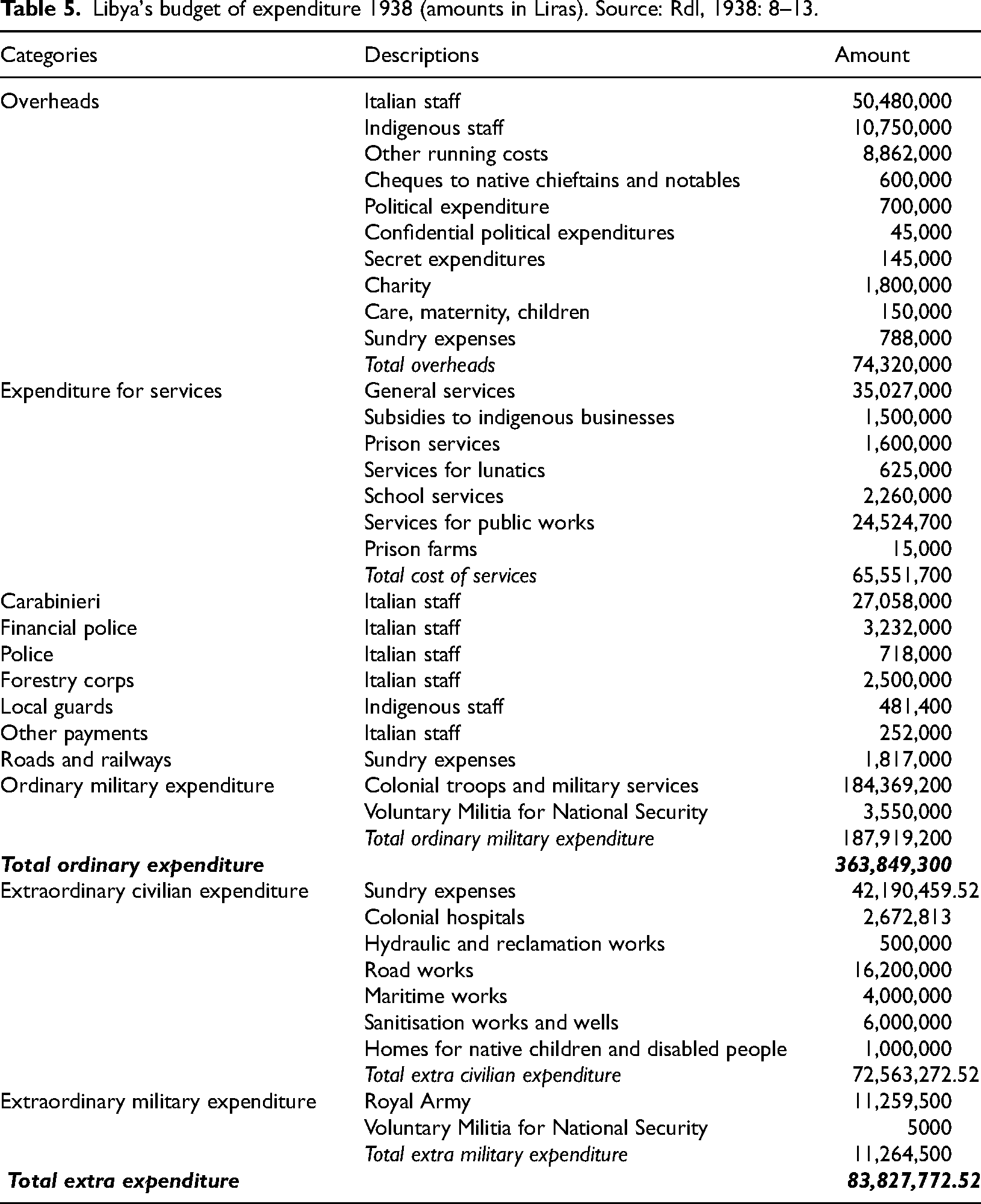
Libya's 1938 budget was equally detailed, as shown in Table 5. In total, there were 163 accounts, indicating the budget's comprehensive nature. Military expenditures remained high. Direct payments to indigenous people included wages, charity, business subsidies, voluntary militias and homes for native children and disabled people, whilst the so-called ‘Confidential Political Expenditures’ hid side payments and corruption. Other expenditures may have been intended for both Italians and the indigenous population, including prisons, schools, hospitals, mental asylums and the police force. Lastly, expenditures on new infrastructure and public works, primarily designed for the benefit of Italians, may have also served the indigenous people. As an implement of programmes of government, budgets as technologies of government (Miller and Rose, 1990; Rose and Miller, 1992) enabled Fascist governors and the cabinet in Rome to visualise the results of their policies more accurately, as opposed to the uncertain measurements that took place in the Liberal age.
Libya's budget of expenditure 1938 (amounts in Liras). Source: RdI, 1938: 8–13.
Colonial budgets as governmental software
The speeches of the Minister of the Colonies and other Fascist bureaucrats demonstrate the interest in planning, implementing and controlling the culture, health and loyalty of subjects, along with public order, sexual mores and ethics in each colony. Fascism explicitly aimed to render each colonial subject a ‘governable person’. In this way, the regime hoped to reduce the presence and the costs of military troops (CdD, 1930: 1873; CdD, 1931: 3900; CFC, 1939: 145). The budget items reveal Rome's policies established for the opening of clinics, prisons and schools (CFC, 1940a, 1940b). The governors provided details of such initiatives (e.g., CdD, 1924a: 974–978; 1926: 5429–5333; 1929: 652–656; 1936: 2597–2599; 1938: 4799–4802). Schools and medical facilities were believed to be crucial means to shape the conduct of indigenous populations: the teacher and the physician are the most effective means of pacific penetration … School will let natives know our history, our military organisation, our national traditions, it will be a formidable tool of elevation and force for us, whilst the hospital, the infirmary which heal and give back the joyful sense of life, will generate in the souls [of the natives] devotion and gratitude. (CdD, 1935b: 1348)
New hospitals and medical centres were considered important means to show the natives the benevolence of the conquerors, along with their superior culture and technology, thereby making acceptance of Italian rule easier. The use of such tactics was emphasised by a member of the Parliament who went as far as claiming that the conquest and pacification of the colonies would be achieved through doctors rather than weapons (CdD, 1924a: 978).
If the education of indigenous populations was limited during the time of Liberal Italy, when ignorance was a means to subdue natives, to the Fascists local populations, especially the young, needed to be educated in a way that was consistent with the place they were expected to take in Fascist society. Education was to ensure that young pupils could ‘become an element of penetration into the family, the clergy, the tribe: it is not a matter of creating “the top of the class”, it is a matter of scholastically and socially forming the “class”’ (CdD, 1931: 3892). Consistently, 57 schools for natives were operating in Tripolitania (CdD, 1935a: 1331) and soon after its conquest Ethiopia had already 97 schools for indigenous children (CFC, 1939: 150).
The Italian state accounting reform promoted by the regime (Royal Decrees 2440/1923 and 827/1924) reinforced the role played by the state budget within the administrative apparatus of each colony. Such ‘subjectivisation’ of the budget, that is the allocation of specific objectives and resources to individuals holding power at the local level involved: (a) governors and local bureaucracy; (b) army officers, quaestors (police chiefs) and prefects (government representatives); (c) state-owned companies; and (d) tribal leaders and indigenous troops (only in some areas and periods). Governors and their bureaucracies were engaged in civil affairs, including education, public works, tax collection, regulation, administration of justice and health. In doing so, they had to comply with specifically approved appropriations and no further or different type of expenditure or intervention was allowed (Aquarone, 1989; Borsi, 1938). Army officers, quaestors and prefects were all involved in security. All were assigned objectives for promoting the security of the territory under their jurisdiction. The colonial budget translated priorities into numbers and allocated specific resources for each territory under control. Consequently, the budgeted resources defined the number of troops, armaments and equipment, shift costs and, as a result, the quality of security in the territory (Martone, 2008).
All budget holders were responsible for managing expenses in strict accordance with the state budget (articles 81–83, RD 2440/1923). They were to assume budget standards as a rigid norm of behaviour. Deviations were not allowed. Thus, budget adjustments were rare and had to be authorised by the central government (Aquarone, 1989; Borsi, 1938). Without an approved adjustment, it was impossible to incur additional expenses (art. 43 RD 2440/1923) and the government clearly was not prepared to allow deviations from the plans. In the period 1931–1941, there was only one adjustment to the colonial budget (Law 593/1931). The only form of flexibility was the possibility to reinvest any unspent resources allocated to military actions for civil projects, thereby incentivising governors to pacify their areas with means other than violence (CdD, 1930: 1873). Budgets, therefore, were a normalising tool that enabled both the central government and those responsible for delivering the budget to know where they were relative to where they should be in the process of turning Fascist programmes of government into action.
Tribal leaders were engaged in the administration of justice and settling minor disputes whist they were not permitted to intervene in the government of the colony. They were mainly used by the Italian colonial government to ensure that unrest would be kept to a minimum, for which purpose they were remunerated. When indigenous troops could be involved in maintaining public order according to the Italian objectives of security, they were paid and the budget of the colony set the number, pay and equipment of such soldiers (CdD, 1928: 8981).
Governing the indigenous population: The censuses of the colonies
Statistics was conceived by the Fascist regime as one of the key modalities for the production of the knowledge necessary to govern (Leti, 2000). The role of the census and the use of statistics in support of policy expanded during the Fascist time. Until the 1920s, the Fascists complained that ‘Italians had to discuss on the basis of uncertain, fragmentary figures such serious issues as … the settlement process’ (CdD, 1927a: 6989). Mussolini stated that an ‘exact knowledge’ of economic and population events was needed (Mussolini, 1929: 629), since ‘as to population figures … the increase or decrease of such figures is a way to predict peoples’ fates’ (Mussolini, 1926: 23). Even more clearly, Mussolini said: ‘one cannot rule without the help of statistics … The figures show the extent, the scope, the character of an event … Statistics is neither a pessimist nor an optimist. It cannot serve any preconceived notion … The essence of statistics must be the full truth: no matter how inconvenient!’ (Mussolini, 1927: 45).
To this end, the Statistics Bureau of the Kingdom of Italy was founded in 1926. Mussolini appointed Corrado Gini, a Professor of Statistics, as the first president of the Bureau. Under Gini, the 1931 census collected information about the colonies in explicit support of the regime's policies. The goal was to measure in detail the ethnic and social features of the indigenous peoples and their economic activities (Podestà, 2012). Gini explicitly highlighted ‘the effort made by the Statistics Bureau to improve the collaboration [with the government] to provide the ruling classes … with statistical data useful for decision-making’ (Anonymous, 1931), thereby confirming how counting and classifying the population is crucial to governance (Foucault, 2007; Rose, 1991). With the rising importance of censuses, a new form of territorialisation appeared, one which turned indigenous populations and settlers into an explicit object of government.
The 1931 census report, published in 1935 (ICSRI, 1935), consisted of 215 pages with 90 pages devoted to the indigenous people. The report centred on the composition of the population, classified as Italian, foreign and indigenous, disaggregated by the four colonies of Cyrenaica, Tripolitania, Eritrea and Somalia (ICSRI, 1935: III-IV). The data covered:
Population by district of residence (distinguishing between resident, semi-nomadic and nomadic populations), age group and profession of the head of the family (farming, industry, transport, trade and banking, civil service, clergy, regulated professions, domestic work, other). Composition of the population by religion: Christian (Catholic, Coptic, Orthodox, Evangelical), Muslim (Hanafi and Shafi, Maliki, Ibadi), Jewish or other. Composition of the population by race (Arab-Berber, Cologhli, Black, other), knowledge of Italian, language or dialect. Composition of the population by age and marital status, including divorcees and Muslim polygamists. Profession of and number of children living with the head of the family. Composition of the population by profession and gender, making a distinction between the total number of Muslims and Jews. Population by residence, gender, family and cohabitants, age, race and language. Families classified by the profession of the head of the family (farming, hunting and fishing; industry; transport and communications; trade, banking and insurance; civil service; clergy; regulated professions; domestic work; other) and by the religion of the head of the family, resident members, number of cohabiting and unmarried children. Muslim monogamous and polygamous heads of family. Professions by category of economic activity, religion and gender, residence and age.
Given the importance of the census to inform policy, Mussolini decided that it was to be carried out every five years when in the past it had taken place every ten years (ICSRI, 1939). The 1936 census was, therefore, another occasion to take stock of the population in Italy and the colonies, a crucial means to appreciate the force of the state: ‘…numbers are the force of the nations. The knowledge of such numbers is fundamental to demonstrate the nation's force’ (Anonymous, 1936). Moreover, Mussolini himself dictated the questions to ask and which information to record (De Sandre and Favero, 2003). The results of the 1936 census are contained in a 252-page report (ICSRI, 1939). The section summarising data on indigenous people included the following information:
The implications of censuses for colonial policies were numerous. Resettlement was based on indigenous presence in the territories (CdD, 1936). Agricultural policy was also explicitly influenced by the census. The Colonial Commission for Farming, an institution of the Ministry of Agriculture, used census data to plan new fields for cereals, vegetables and livestock. Its aim was to select the most fertile lands and to allocate crops according to population data (CFC, 1939). Moreover, census information made sure that the Fascists could adopt an administrative partitioning of territories based on the ethnic groups and the main religion practised therein, which would have helped to reduce conflict with indigenous populations (Lessona, 1937). It also enabled the governing power to monitor the development of some of their policies, such as the attempt to tackle nomadism. It was, therefore, crucial to see ‘if these people can be bound to land through the provision of water wells … therefore making them farmers, with a conservative mentality, hence anti-rebellious’ (CdD, 1931: 890). The census therefore provided information on the number of individuals who still practised nomadism and those who had decided to permanently settle in a territory (CdD, 1937).
The census confirmed for Mussolini, the government, Fascist élites and the Italian people that the demographic, military and social policies laid down by the regime were sound and legitimate (CdD, 1933a, 1933b). It contributed to reinforcing and constructing concepts and ideas concerning the social structure of the colonies while the regime endeavoured to develop modern forms of agriculture and industry. Likewise, the census was used to plan the opening of new schools, clinics, barracks and prisons (De Sandre and Favero, 2003). The census also showed how Italian men considerably outnumbered Italian women, which led to widespread cohabitation with local women and even marriage, and a general acceptance of mixed-race children. However, this was unacceptable as, from the early days of the Fascist regime, it was made clear that ‘the native needs to feel dominated by the European, otherwise he loses faith in the latter, which in turn undermines his authority’ (CdD, 1924a: 982). It was the diffusion of these practices emerging from the 1931 and 1936 censuses that convinced Mussolini that racial discrimination was urgent and necessary to preserve the ‘Italian race’ in the colonies. The racial laws of 1937 focused firstly on Italian colonisers, notably prohibiting any sexual or familiar associations between the native and the conqueror and then restricting indigenous people's rights and opportunities (Bonmassar, 2019). At the same time, the regime started to promote the migration of entire families to Africa to minimise the risk of unwanted engagements between races (CFC, 1940b). Information provided by the census enabled the Fascists to shape colonial society along racial traits where the natives were treated as inescapably inferior to the conquerors. The Fascist intervention sought to frame ‘indigenous masses within the Italian element, in a totalitarian social and economic formation in which natives are returned to their traditional functions and can better serve the Italian element’ (CdD, 1931: 3890). Monitoring the occupations of Italians meant that some jobs were left to the indigenous population, such as animal farming, as they were believed to be too humble (CFC, 1939: 153). Moreover, as previously intimated, it was understood that Italians could not work for the natives: a member of the Parliament exclaimed: ‘we cannot tolerate that in Tripoli Italians work as the Arabs’ shoe-shine boys’ (CdD, 1930: 1866).
Discussion
Liberal and Fascist intervention in Italy's colonies differed considerably in terms of political rationalities, programmes of government and, most especially, technologies of colonial government. Although accounting information has the potential to enable penetrating interventions in the lives of individuals (Miller and Rose, 1990; Neu, 1999), its properties were mobilised in different ways by the Liberals and the Fascists in the enactment of their respective colonial programmes of government (Figure 1).
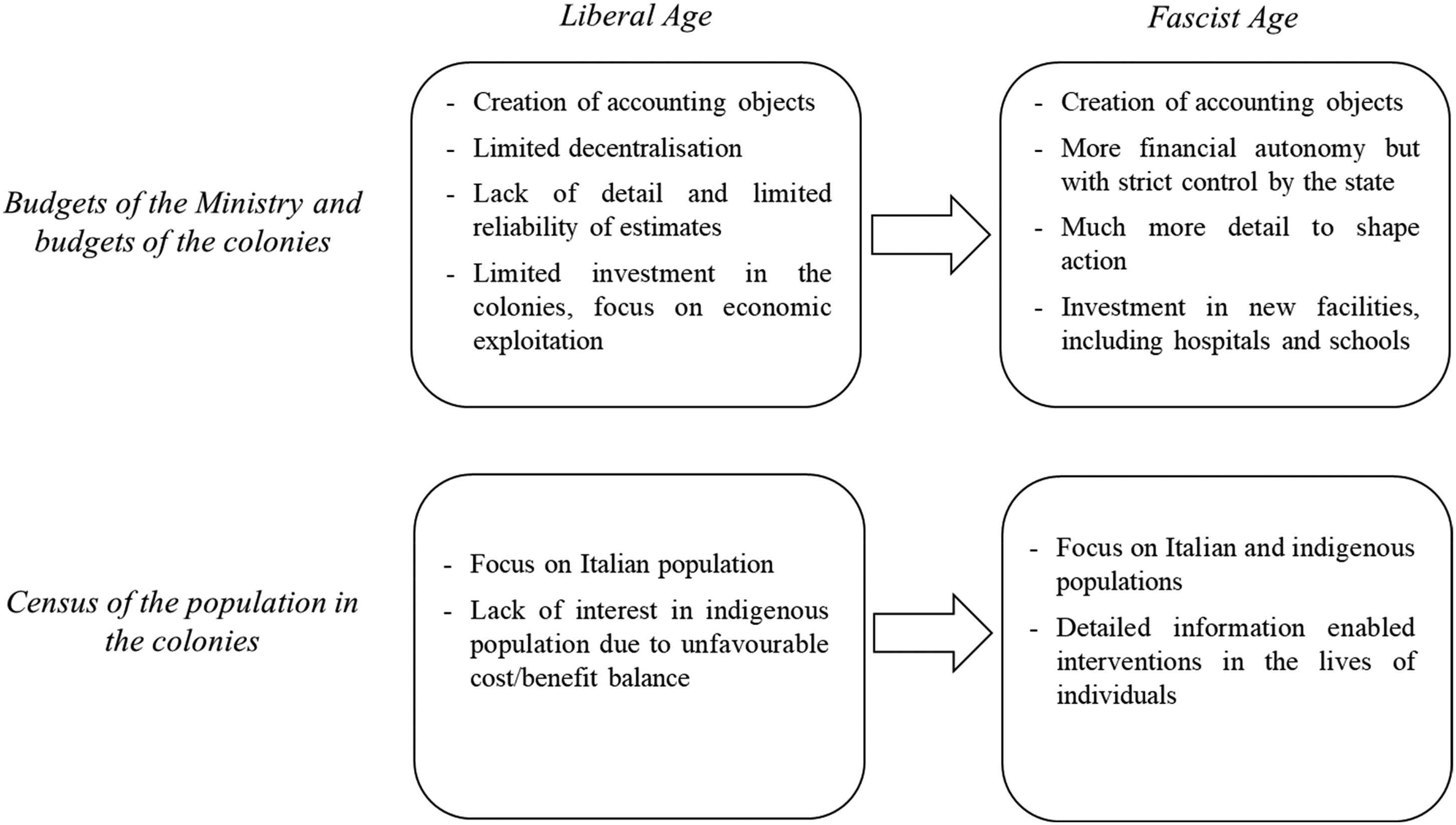
The evolution of calculative practices between the Liberal and Fascist ages.
In line with Liberal political rationalities, the state's main goal is ‘not interfering, allowing free movement, letting things follow their course; laisse faire, passer et aller – [which] basically and fundamentally means acting so that reality develops, goes its way, and follows its own course according to the laws, principles, and mechanisms of reality itself’ (Foucault, 2007: 70). To the Liberals, the ‘rational’ way of conducting the colonies was to ensure minimal state interventions, which would have enabled business to thrive. During the Liberal age, colonialising programmes of government were limited and mainly aimed at improving the conditions of life of the colonised by protecting the population, especially through the diffusion of medical facilities and hygienic measures. Moreover, the opening of the first schools aimed at providing the indigenous population with the means to interact with the conquerors and ensure that they could familiarise themselves with the new dominant culture. Liberal intervention in Africa shows how the selfish forces of colonialism employ the ‘protective colours … of disinterested movements’ such as science and education to pursue their goals (Said, 1994: 12). These tools, which ostensibly sought to ‘place a new society in the best conditions for prosperity and progress’ (Leroy-Beaulieu, quoted in Said, 1994: 107), represented an important means to facilitate acceptance of Italian rule and the minimisation of potential conflict, thereby creating the best conditions for the economic exploitation of the colonies. The promotion of less invasive interventions and the attempt to ensure that indigenous people would accept the customs and habits of the colonisers were key means of penetration into foreign lands by Western powers (Scott, 2005).
With several Italian corporations already operating in Africa since the early days of Italian colonialism, a key goal of Liberal governments was keeping peace and enabling the population to grow. This would have provided a cheap workforce for these businesses. These measures had an impact on the way of life of natives (Scott, 1995), but their ultimate goal was not promoting the well-being of indigenous populations per se but optimising the ‘complex interplay between individual and collective interests, between social utility and economic profit’ (Foucault, 2008: 44). During the Liberal age, the use of accounting tools was limited to the first forms of budgeting by the colonial state, which were mainly a means to control expenditure. The budget was a means to ‘problematise’ the colonies by framing them in those economic terms that were crucial to Liberal programmes of government. Given the limited experience of Italian governments in colonial matters with, unlike the great European powers, no colonies before the end of the nineteenth century, the budget was important for ‘making the previously incalculable calculable, reframing the concerns of others in ways that are amenable to its repertoire of ideas and instruments’ (Mennicken and Miller, 2012: 21). By means of accounting, distant lands were therefore made visible to the government and the Parliament not simply as geographic entities but rather as new economic objects for which costs and revenues could be accumulated and financial results calculated (Miller, 2001). As shown in parliamentary debates, accounting further partitioned these territories to identify whether different areas such as Benadir, Tripoli or Cyrenaica were contributing to the Italian economy. Accounting as a territorialising endeavour in the Liberal age reframed colonialism ‘in such a way that it [became] amenable to narratives of market and economic rationality’ (Miller and Power, 2013: 580) and enabled the centralisation of control in the hands of the government. At the same time, no real interest was shown by the Liberals in gathering non-financial information on indigenous populations. Parliamentary debates mainly focused on issues of efficiency and the limited success of the Liberal government in delivering what was expected of them: profiting from the exploitation of the colonies.
It was only with the advent of Fascism that accounting information was fully enlisted to the purpose of dominating colonies in the construction of a totalitarian state the aim of which was not simply economic exploitation of distant lands but interfering with every aspect of its people's behaviour, family life, social relations and economic activity. Through the colonial budget system, agricultural, demographic and military programmes were deployed, and their financial consequences were accounted for in detail. A new form of territorialisation was pursued with the budget, allowing more financial autonomy and apparent decentralisation to colonial governments. Nevertheless, through a strict top-down allocation of resources, Mussolini pursued complete control over the bureaucracy and the population in the colonies. Fascism strengthened its control of the ways in which colonial programmes of government were executed by expanding and monitoring the scope of budgets, forcing accounting tools onto every colony and prescribing hundreds of expense and revenue items.
Budgets were a normalisation tool that enabled the government to assess the behaviour of those responsible for delivering Fascist policies, including governors, bureaucrats, quaestors, prefects and army officers, by their ability to conform to the strict guidelines included in the budgets, which represented the ‘model’ to be followed (Foucault, 2007). It was so important to abide by the instructions coming from Rome that adjustments to the budgets were virtually non-existent. Unlike in Liberal Italy, during the Fascist regime budgets became detailed technologies of government to bring comprehensive colonial programmes of government to life. Written information in the form of budgets and the creation of a highly supervised administrative structure shows how in the implementation of programmes of government, even in totalitarian regimes, ‘systems of surveillance, hierarchies, inspections, bookkeeping, and reports’ (Foucault, 2003: 242) are crucial for they enable informed intervention in the field to be governed. In its African colonies, the regime enlarged the diffusion of institutions focused on the management of the population: hospitals and other medical facilities, police forces, courts of justice, prisons, schools, army conscription and discipline. The colonial budget enabled the measurement, allocation and redistribution of resources among the colonies to force European institutions into the way of life of indigenous people.
To further strengthen the weaponry of Fascism, the creation of a modern ‘centre of calculation’ (Miller, 1990), the Statistics Bureau of the Kingdom of Italy, was crucial. The Bureau was immediately engaged in developing a thorough knowledge of all those governed using a periodical and detailed colonial census, hence becoming the main centre for the accumulation of information ‘about other places, processes, entities and activities that are distant’ (Miller, 1990: 318). The colonial census was the consequence of the development of a ‘new’ concept of ‘colonial population’, one which was absent in the Liberal age, and was deployed in the achievement of the Fascists’ programmes of government (Podestà, 2012). As noted by Mennicken and Miller (2012: 20), ‘…a particular instrument remains marginal until there exists a social machine or a collective assemblage that is capable of animating it’. Censuses were in use in Liberal Italy too, but they were never extended to colonial populations. Fascist programmes of government centre-staged populations and individuals’ values and beliefs, hence, needed to prioritise tools that would help to understand populations and their dynamics for ‘knowledge about and power over colonised lands are related enterprises’ (Loomba, 2015: 44). The properties of accounting were not activated by the Fascists solely to promote discourses of economic rationality but also to frame the abstract phenomenon of the population as a new object of government, one which could have been acted upon in the enactment of colonial programmes of government. To the Fascists, written sources of information were crucial ‘to create not only knowledge but also the very reality that they appear to describe’ (Said, 1979: 117). Mussolini himself (1937) explicitly argued that the colonial population was primarily a statistical artefact. Once populations were counted and linked to the territories they inhabited, when statistical knowledge of their economic, social and demographic phenomena and the links between them was accumulated, they could become targets of regulation.
As colonisation suggests, indigenous people were to be schooled and kept healthy, which was not done for humanitarian purposes and not even, as in the Liberal age, to provide businesses with plenty of workforce, but rather to ensure the growth of the population which was seen as a way to strengthen the totalitarian state (Foucault, 2003) and to ensure that natives would internalise the way of life of the conquerors (Scott, 1995, 2005). Institutions such as hospitals and schools were to become manifestations of the superiority of the Italians over the ‘backward’ indigenous populations for only the former had the means to manage society in a scientific and modern way, which the natives were expected to respect and absorb. Fascist interventions were not limited to a few measures to nurture the population as in Liberal Italy; they sought to ensure the ‘systematic redefinition and transformation of the terrain on which the life of the colonized was lived’ (Scott, 2005: 36). Knowledge of other cultures enabled by means of accounting and statistics produced ‘what has been called “a duty” to natives, the requirement in Africa and elsewhere to establish colonies for the “benefit” of the natives … The rhetoric of la mission civilisatrice’ (Said, 1994: 108, emphasis in original). This was particularly obvious when nomads were forced to learn the benefits of settled agricultural civilisation, which in turn would have made conqueror control over them easier, or when young people were given an education, which was not a tool for social mobility but rather to make nomadic populations aware of the rulers’ superior culture (Said, 1994). These apparently banal and even benign interventions, which were enabled by information gathered by means of accounting, show the pervasiveness of less obvious forms of power which are often clothed in the dominator's professed selfless attempt to bring modernity and civilisation to underdeveloped territories when in reality any interventions are implemented to strengthen the latter's grip on distant people and lands (Said, 1979; Scott, 1995).
The census as a technology of colonial government rendered aspects of the indigenous population thinkable, visible and calculable. It also enabled a new discourse on ‘race’ and supported the Italian colonial authorities’ efforts to seek to shape, normalise and instrumentalise the conduct of people in the colonies while affirming the promoted superiority of the Italians. New racial categories previously unknown to Italians became a means of moral legitimisation of colonialism in Africa by popularising a view of colonies as territories inhabited by primitive individuals who deserved to be subjugated so that Italians ‘could think of the imperium as a protracted, almost metaphysical obligation to rule subordinate, inferior, or less advanced peoples’ (Said, 1994: 10, emphasis in original). Written sources of statistical information, among which the census is important, help support ‘a political vision of reality whose structure promoted a binary opposition between the familiar (Europe, the West, “us”) and the strange (the Orient, the East, “them”)’ (Said, 1979: 65), which provided justification for Italian domination.
Conclusion
The study has offered an investigation of Italian colonialism in Africa under Liberal and Fascist governments and has focused on the use of accounting practices as technologies of government in the achievement of colonial programmes of government. It has done so by drawing upon the work of Foucault (1991, 2003, 2007), Scott (1995, 2005) and Said (1979, 1994) on governmentality and colonialism. The article has contributed to the literature investigating accounting and colonialism from a historical perspective by adding evidence from an under-researched context, that of Italian colonialism, and by going beyond the focus on the accounting profession (Annisette, 1999, 2000, 2003, Brock and Richardson, 2013; Dyball et al., 2007) and the direct/indirect rule dichotomy in colonial administration which characterises colonial studies (Gerring et al., 2011). It has added to studies that have engaged with the use of accounting as a tool for colonial power (Gomes et al., 2014; Huf, 2020; Neu, 2000a, 2000b; Rodrigues and Sangster, 2013) by showing how the role of accounting evolved when the political rationalities underpinning its use changed under different political regimes. Different ways of governing ‘in the rational way’ mean that the use of accounting tools had to change if it was to support different sets of colonial goals. Prominence has been given to the way in which accounting practices can be mobilised to enable penetrating interventions that seek to modify the way of life of indigenous people, consistent with the shifting programmes of the government of the colonisers. Another contribution of the article is the extension of the governmentality framework to the analysis of a totalitarian regime. Foucault's (1991, 2007, 2008) analysis of governmentality has been developed with reference to democratic states and, as a result, accounting history literature has adopted this concept across its investigation of Liberalism and Neo-Liberalism. The article extends the Foucauldian conception of governmentality to a Fascist setting, thereby also adding to analyses of the use of accounting by Italian Fascism (Antonelli et al., 2022; Bigoni et al., 2021; Cinquini et al., 2016; Papi et al., 2019; Sargiacomo et al., 2016).
The main limitation of the article lies in the availability of sources. Although the study is based on an extensive investigation of primary sources, these have all been produced by the colonisers. It was not possible to document the enactment of Liberal and Fascist policies from the vantage point of the colonised, which would have helped to shed further light on the level of acceptance of (or resistance to) interventions and on the consequences of these interventions on the everyday life of indigenous people. There is considerable room for further research. The scope of the study could be extended to other calculative practices, including those used by businesses operating in the Italian colonies. It would be interesting to learn more about the relationship between race and accounting, especially in 1930s Libya, when Italo Balbo, one of the most prominent Fascist leaders, implemented his own policy for the integration and conversion to Fascism of the local population, despite it being not fully consistent with Mussolini's racial policy. The link between accounting and propaganda at home and in the colonies would also be an important future avenue of research, as accounting data could have been used to paint a deceptively positive picture of the actions of Italian governments in Africa, both to induce Italians to relocate and to increase Italy's international prestige. It would also be useful to conduct a comparative analysis of the budgeting and census practices used by Italian Liberal and Fascist governments with those adopted by other European colonial empires.
