




Abstract
This article contributes to the nascent research agenda on accounting for natural disasters by addressing the question: What responsibility did New Zealand's central government assume in respect of private property loss caused by natural disasters, and did this change over time? It considers the source of financial support to assist New Zealanders who suffered a loss due to a natural disaster in the period from early settlement until 1990. Although change occurred, throughout the period the state did not assume responsibility for private property loss. This article adopts historical institutionalism to contribute to the research agenda of accounting for natural disasters by considering policy and response over the long term, rather than focusing on a single disaster event or specific disaster type.
Introduction
Few events affect society as significantly as severe natural disasters, which destroy lives, livelihoods and property, create financial challenges for residents and governments, and potentially rend and reshape the social fabric. The ‘short sharp shock’ of the disaster event may last only a matter of seconds (earthquakes), minutes (tornadoes), or hours (cyclones), but the consequent ‘long deep rumble’ of a society's response and recovery may take years and change that society. Yet despite their salience, there is limited accounting history research on natural disasters (Sargiacomo, 2014, 2021; Sargiacomo et al., 2021). Moreover, prior research has ‘used recurrent loci of investigations, mainly focused on twentieth-century cases, and mostly addressed post-earthquake outcomes’ (Sargiacomo et al., 2021: 198). Research has also tended to focus on discrete disaster events rather than long-term policy and has largely ignored the effect of disasters on the domestic sphere. The field, therefore, remains an ‘open research agenda’ (Sargiacomo et al., 2021: 192).
This article contributes to this research agenda by addressing a single question: What responsibility did New Zealand's central government assume in respect of private property loss caused by natural disasters, and did this change over time? By shifting the focus from a single disaster event at a particular point in time to a range of disasters over the longer term, it shifts attention from the shock of the disaster itself as a discrete event to the rumble of social change – or lack thereof – over a longer period and range of disaster types. Since it considers a range of disasters, the article addresses the fraught question of what constitutes a natural disaster. Although the external cause is significant, human interest in a particular disaster event results from the effects of that event on humans and human society. A longer-term perspective may indicate how (or whether) a society's response to natural disasters changed over time.
This article adopts a historical institutionalist perspective, placing both disasters and the financial responsibility for such within their social domain (Hopwood, 1985). The question of whether there was a change over time in the government's role in addressing private property loss might suggest a disaster-induced change to social norms in which the disaster provides a critical juncture. Alternatively, institutional norms might be little affected by such events, as society follows its well-established path.
The article makes several contributions. In particular, it considers a range of disaster types over a prolonged period instead of focusing on a specific disaster event, enabling the identification of longer-term tends. The article also considers the effect of natural disasters on the private sphere by considering who took responsibility for the cost of private, including domestic, property losses resulting from a natural disaster.
This article focuses on New Zealand, a land subject to a wide variety of natural disasters, including fire, flood, earthquake, volcanism, and landslide. It concludes that the primary responsibility for natural disaster losses from the early days of Pākehā 1 settlement in New Zealand until now has rested with the private sector. Despite the establishment of a government-backed disaster insurer in the 1940s, and the introduction of a world-leading Social Security provision in the 1930s to address non-natural disaster loss, the New Zealand government did not accept the responsibility to indemnify private property natural disaster losses.
The following section discusses the motivation for this article, reviews prior research on natural disasters, and discusses the approach adopted. The next section provides a diachronic discussion of the funding of disaster relief in New Zealand. Implications are then drawn before the article concludes.
Motivation, prior research, and problem formulation
Motivation
As recently as 2014, the editor of a special issue entitled ‘Accounting for Natural Disasters and Humanitarian Interventions’ noted that there are ‘no contemporary studies addressing the interplay between accounting and natural disasters’ (Sargiacomo, 2014: 576), and issued an urgent call for further investigations of natural disasters by the accounting community. That issue comprised five articles, all but one of which related to a twenty-first-century natural disaster. Moreover, each article related to a single disaster typology and event: Hurricane Katrina in the Southern USA in 2005 (Baker, 2014); Australia's 2009 Black Saturday Bushfires (Taylor et al., 2014); drought in the Midwest of the USA in the 1930s (Walker, 2014); the 2009 Abruzzo earthquake in Italy (Sargiacomo et al., 2014); and the 2010 flood disaster in Veneto, Italy (Lai et al., 2014). However, seven years later, Sargiacomo et al. (2021) concluded that ‘historical investigations on natural disasters are still underdeveloped’.
A subsequent comprehensive literature review of 35 accounting/business/economic history and generalist journals identified and reviewed ‘11 articles to understand the main strands and sub-strands of research’ (Sargiacomo et al., 2021: 181) to ‘inspire further research among accounting historians’ (Sargiacomo et al., 2021: 182). The 11 articles are listed in Table 1 and indicate the limited scope of accounting history research into disasters. Nine of these 11 ‘relevant papers’ (Sargiacomo et al., 2021: 184) relate to a single disaster typology, namely earthquakes, four of which focus on the Great Kantō earthquake of 1923 in Japan. Sargiacomo et al. (2021) therefore called for the extension of historical research to other disaster typologies.
List of 11 ‘relevant papers’ identified by Sargiacomo et al. (2021).
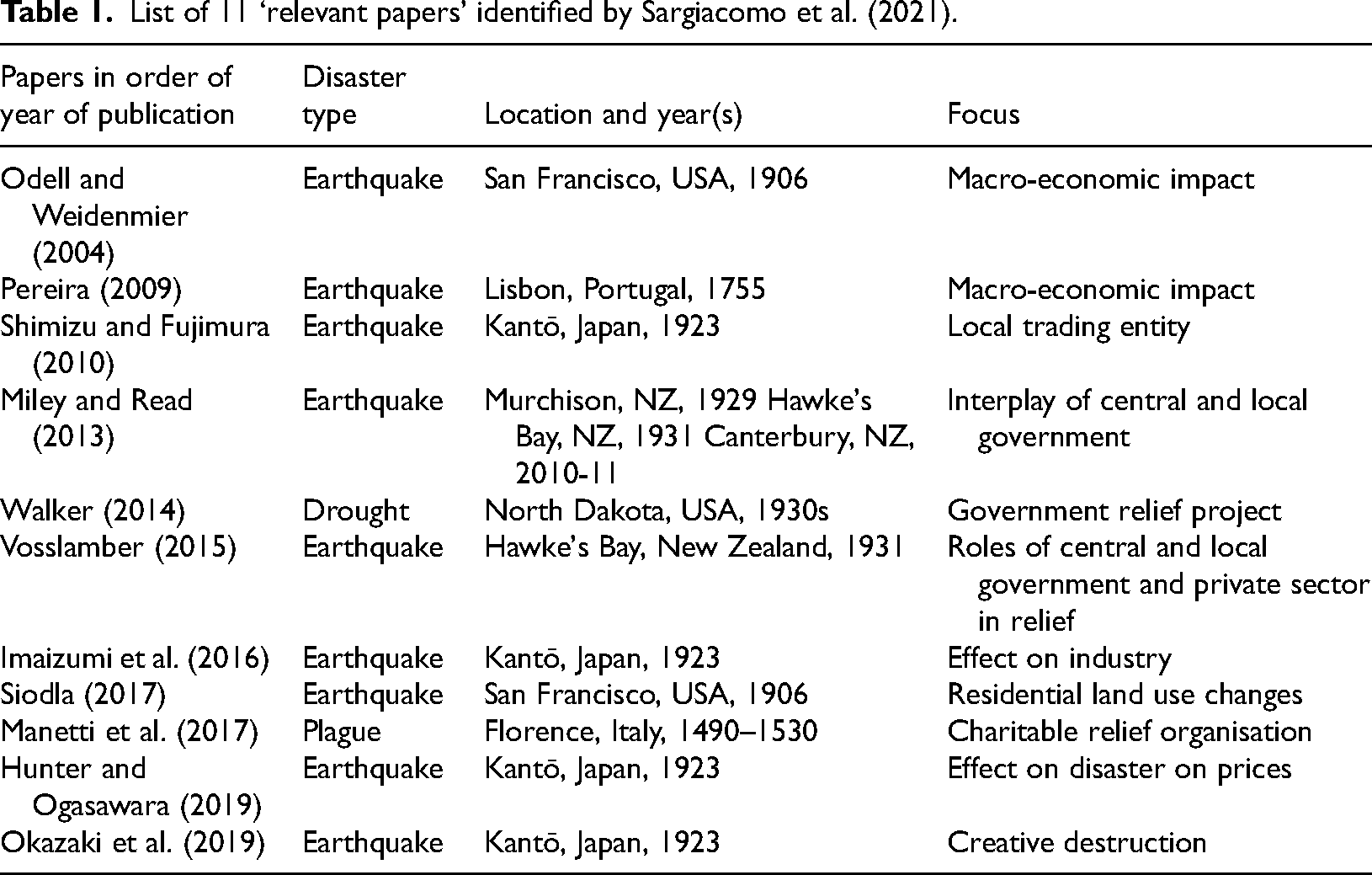
Furthermore, all but one of the eleven articles focused on a particular event. Given this focus on discrete events, previous research on natural disasters has also been limited to a short time frame. Miley and Read (2013) provide an exception; in their analysis of the interplay between central and local government, they consider three New Zealand earthquakes spread over an eight-decade period and note the benefits of historical comparison ‘because it reveals intricacies not apparent in a single episode, illustrates shifting dynamic[s] … and reveals weaknesses … that might otherwise remain hidden but which historical comparison throws into stark relief’. In assessing the longer term, historical comparative studies permit exploration of the ‘how and why questions’ behind the major social change (McKerchar, 2010: 117).
Since natural disasters are social phenomena, Sargiacomo et al. (2021) encouraged accounting historians ‘to view accounting as a technical and social practice’. Adopting such a longer-term focus on natural disaster research may thus mitigate the ‘tendency for technical histories of accounting to be written in isolation of their social, economic and institutional context. Accounting seemingly has been abstracted from its social domain’ (Hopwood, 1985: 365). In considering the real effects of natural disasters on real people living in a real but damaged location over an extended period, this research explores not only the role of the government (if any) in reimbursing private property loss resulting from natural disasters but also the institutional dynamics or stasis of such action over time. Specifically, did the government's role in providing financial support for private property loss change over the period? If so, did the change occur suddenly – akin to a short sharp shock, or slowly – more like a long deep rumble?
Lai and Samkin (2017) called for research on accounting history in diverse settings. A setting requiring further attention is studies on ‘Accounting, family/household business and post-disaster economic re-launch’ (Sargiacomo et al., 2021: 198). Given the loss of life, livelihood and home, natural disasters particularly affect the private and domestic sectors. Although there is a growing literature on accounting in the domestic sphere (e.g., Rossi, 2022), natural disaster research has largely focused on businesses (Imaizumi et al., 2016; Shimizu and Fujimura, 2010), the macro-economy (Odell and Weidenmier, 2004; Pereira, 2009), or the government (Miley and Read, 2013), rather than on the effects and recovery of households following a natural disaster. Households are particularly vulnerable to natural disaster loss since, being unpredictable, natural disasters are not easily amenable to a risk calculus. In fact, they simply may be too costly to insure against and were considered (Reed, 1936), and indeed may be (Kagan, 2022), uninsurable. The inability of the market to provide sufficient provision for such events leaves the victims, or their governments, to bear the cost of the consequent relief and recovery operations. Immediate relief operations and reconstruction to address the aftermath of a disaster are often government-coordinated and funded (Sargiacomo and Walker, 2020), but such provision has not usually extended to the indemnification of private property.
What is a natural disaster?
Accounting historians have paid little attention to the definition of natural disasters. Of the 11 articles discussed in Sargiacomo et al. (2021), only two provide any definition; Hunter and Ogasawara (2019) adopt an agent-centred view, referring to ‘the exogenous shocks constituted by climatic and geological disasters and epidemics’. To this, Walker (2014: 606) adds the social dimension: ‘Natural disasters have been defined as “some rapid, instantaneous or profound impact of the natural environment on the socioeconomic system”’. Where research addresses a specific disaster event, there is little need to define the term. Since this article considers a range of natural disasters over a longer timeframe, it is necessary to justify what constitutes a natural disaster.
Perry (2018: 3) refers to disaster as ‘an evolving concept’, and notes that ‘there are many definitions, from many sources, used for many purposes, so it is important to specify’ the definition being used, for: Definitions of disaster serve many important functions, particularly as an attempt to capture the content and essence of the concept. This is a critical issue for social scientists who must understand and specify the phenomena of disasters as a preface to systematic research that delineates their causes, conditions and consequences. (Perry, 2018: 3)
Perry (2018: 17) concludes that ‘Over time, researchers had moved away from an agent-centred, damage-driven, uncontrollable event vision, to recognise that ‘humans “cause” virtually all forms of occasions we label disasters’.
In contrast to a ‘narrow analysis of a particular disaster event, Gilbert (1998) provides a skeletal review of the evolution of the concept of disaster by social scientists since the mid-twentieth century. He discusses this development in terms of three paradigms: from a ‘war approach’, where the cause of the disaster is located in an external agent (e.g., God, or an anthropomorphised natural event) launching action against a community; to a ‘social vulnerability’ approach which ‘gets rid of the overwhelming notion of agent’, instead seeing the disaster as ‘a social consequence’ (Gilbert, 1998: 14). Gilbert (1998: 16) then notes a further shift: from considering a natural disaster as external to an individual (i.e., as a divine, natural or social) crisis, to an internal and psychological view of ‘disaster as uncertainty’.
This article adopts Albala-Bertrand's (1993: 11) definition of a natural disaster as a ‘suddenly significant disequilibrium of the interactive balance between the forces released by the natural system (i.e., geophysical and biological) … and the counteracting forces of the social system (i.e., physical and social)’. It, therefore, rejects the view that ‘there is no such thing as a natural disaster’ which Bartolini (2018: 11) suggests is ‘a current leitmotiv of disaster studies scholars’, where disasters with an exogenous, non-human source are commonly treated as a subset of disasters in general, distinguished by their immediate cause, if not their effects. Albala-Bertrand's (1993) definition excludes disasters that are triggered endogenously and result from processes embedded in society's structure or dynamics, including man-made disasters such as war, terrorism, or building collapse (Sargiacomo, 2014). Also excluded are slow-onset events (e.g., drought and sea-level rise), and down-stream disasters where the initial trigger was a natural disaster (e.g., a famine resulting from a flood).
As the concept evolves (Perry, 2018), it is also likely that the social response to and responsibility for disaster will also evolve (and vice versa). The definition of disaster, and whether or not an event is considered to be a natural disaster, matters, for it may affect who bears responsibility for the consequent costs. While recognising that, ‘[T]here is no generally accepted legal definition of [disaster] in international law’, with the field being a ‘definitional minefield’ (Bartolini, 2018: 10f), the International Law Commission (ILC) suggests that ‘a definition will help identify the situations in which protection may or shall be invoked … Describing the contours of “disaster” will also help identify the persons in need of protection and thus ascertain who is entitled to protection’ (Valencia-Ospina, 2009: 193). This is evident in Italy, where a legal categorisation is used to determine the level and locus of responsibility for disaster response (Sargiacomo et al., 2014), and a similar legal definition determines eligibility for state-supported disaster cover in New Zealand. 2 In defining disaster in general as ‘a calamitous event or series of events resulting in widespread loss of life, great human suffering and distress, mass displacement or environmental damage, thereby disrupting the functioning of society’, 3 the ILC includes both agent (the event) and effect (e.g., human suffering). This is consistent with the view of natural disasters adopted in this article.
As previously noted, prior studies have considered the role of accounting in the context of a specific disaster event. This study instead asks how the counteracting forces of the social system facilitated or hindered recovery from natural disasters over time. Given the social nature of natural disasters, accounting, as a ‘social and institutional practice … intrinsic to, and constitutive of, social relations’ (Miller, 1994: 1), may help inform understandings of society and expose evidence of institutional practice and the government's role in the disaster context. Accounting includes risk analysis which leads to the quantification of the likely cost of future disasters, enabling appropriate (financial, human, and material) preparations to be made. The efficient and effective allocation of resources to a disaster area in the immediate response to, and subsequent recovery from, a disaster requires clear lines of accountability and coordinated supply chains, lest wastage occurs and the response compound, rather than mitigate, suffering and loss. Subsequent research can confirm the cost of a disaster and assist with planning for the future. Accounting history can also provide a perspective on the nature and development of a particular society at a time of social stress, for the shock of a natural disaster may ‘enflame’ a state (Parker, 2013: 150), and may (or may not) lead to social change.
Institutions and institutional change
This article adopts the perspective of historical institutionalism to explore the development of a society's response to natural disasters. Historical institutionalism has been used by researchers who are ‘primarily interested in understanding and explaining specific real world political outcomes’ (Steinmo cited in Marriott, 2012: 97). Put simply, ‘historical institutionalism has something to do with history and something to do with institutions’ (Thelan, 2002: 92).
There is a range of definitions of institutions (Marriott, 2012; Marriott and Holmes, 2006; Moreno and Quinn, 2020), and ‘there has been a great deal of borrowing and cross-fertilization occurring across different strands of institutionalist thinking’ (Thelan, 2002: 92). In this article, institutions are understood to ‘provide the framework within which human beings interact. They establish the cooperative and competitive relationships which constitute a society’ (North, 1981: 201), and comprise ‘a set of rules, compliance procedures, and moral and ethical norms’ (North, 1981: 201f). Besides providing a shared belief system about the legitimate ends of government and the rights of citizens, and circumscribing the limits of government action, institutions define property and personal rights and provide credible commitments by the state (North, 2005: 107f). Institutions, therefore, constrain the range of behaviours that a government might implement on behalf of its citizenry, and ‘reduce uncertainty by providing a structure to everyday life. They are a guide to human interaction’ (North, 1990: 3). While not necessarily determinative, institutions ‘provide the contextual environment from within which analysis of choice can be made, thereby privileging certain policy options above others’ (Marriott, 2012: 98).
Institutional development is often considered dualistically, comprising ‘relatively long periods of path-dependent institution stability and reproduction that are punctuated occasionally by brief phases of institutional flux – referred to as critical junctures – during which more dramatic change is possible’ (Capoccia and Kelemen, 2007: 341). During periods of path-dependent stability, ‘institutions typically change incrementally rather than in discontinuous fashion [due to] the embeddedness of informal constraints on society’ (Kasper and Streit, 1998: 6), and which change in ‘subtle and gradual ways over time’ (Mahoney and Thelan, 2009: 1), for ‘the constraints on the choice set in the present … are derived from historical experiences of the past’ (North, 2005: 52). Critical junctures, such as disasters (whether natural or man-made), may punctuate longer-term social equilibria. However, opinions differ as to the effect of such events. Pierson (2004: 135) argues that ‘Junctures are “critical” because they place institutional arrangements on paths or trajectories which are then very difficult to alter.’ Alternatively, disasters may not significantly affect the longer-term path of a society, being mere événements – ‘surface disturbances, crests of foam that the tides of history carry on their strong backs’ (Braudel, 1995: 21).
Certainly, institutions may change following a disaster. Dynes (2000; 2005) argues that this was the case following the 1755 Lisbon earthquake natural disaster – suggesting that the disaster was a critical juncture. Alternatively, a society's disaster response may change as society itself changes incrementally over the longer term (Miley and Read, 2013; Vosslamber, 2015). Certainly, World War One as a non-natural disaster catalysed significant change to the social structure in England and was followed by an expansion in the powers of the state and a willingness to use these powers on behalf of more than mainly the ruling minority (Marwick, 1991). Similarly, the Great Depression and World War Two were followed by the introduction of comprehensive social security, inspired by both Keynesian economics, and by the Beveridge Report in Great Britain that sought to address the five giant evils of want, disease, ignorance, squalor and idleness (Beveridge, 1942: at e.g., para. 8, 456). Given the significant and increasing role of the state in responding to non-natural disasters, one might expect a similar change in the state's role in responding to a natural disaster. Yet Giddens (1985: 234) cautions against ‘the powerful grip that endogenous and evolutionary conceptions of change have had in the social sciences’ which suggests that, as a result of some discernible mechanism, there are trends of development in history which culminate in the emergence of modern societies. Adopting a longer view and a narrow focus on responsibility for private property loss, this article addresses change and continuity by reference to a government's response to natural disasters.
Approach
New Zealand frequently experiences a range of natural disasters and therefore provides a relevant location to consider stability and change in the response to natural disasters over a longer period. Moreover, New Zealand has been an innovator in social change. It introduced a world-leading social security scheme under the Social Security Act 1938, and offered state-organised and sponsored cover for earthquake loss with the establishment of the Earthquake and War Damage Commission (EWDC) in 1944 (O'Riordan, 1971; Parr, 1994). 4 The article covers the period from the first settlement in New Zealand of the indigenous Māori as early as the early fourteenth century AD (Walter et al., 2017), until the end of the 1990s. For reasons noted below, coverage of pre-colonial responses by Māori to natural disasters is limited.
The discussion which follows of specific natural disaster events is based on a range of sources, including the Papers Past digital archive of a large number of New Zealand newspapers from 1839 to the early 1970s (National Library of New Zealand, 2022), the New Zealand Parliamentary Debates, other government publications, and, for the period from 1942, the annual reports of the EWDC and its predecessor body the War Damage Commission. These were read to identify the financial contribution made by the central government to cover the cost of private property loss, and therefore what remained for the private sector to redress. Where possible, use has been made of sources contemporary with the disaster to mitigate the danger of reading the present into the past.
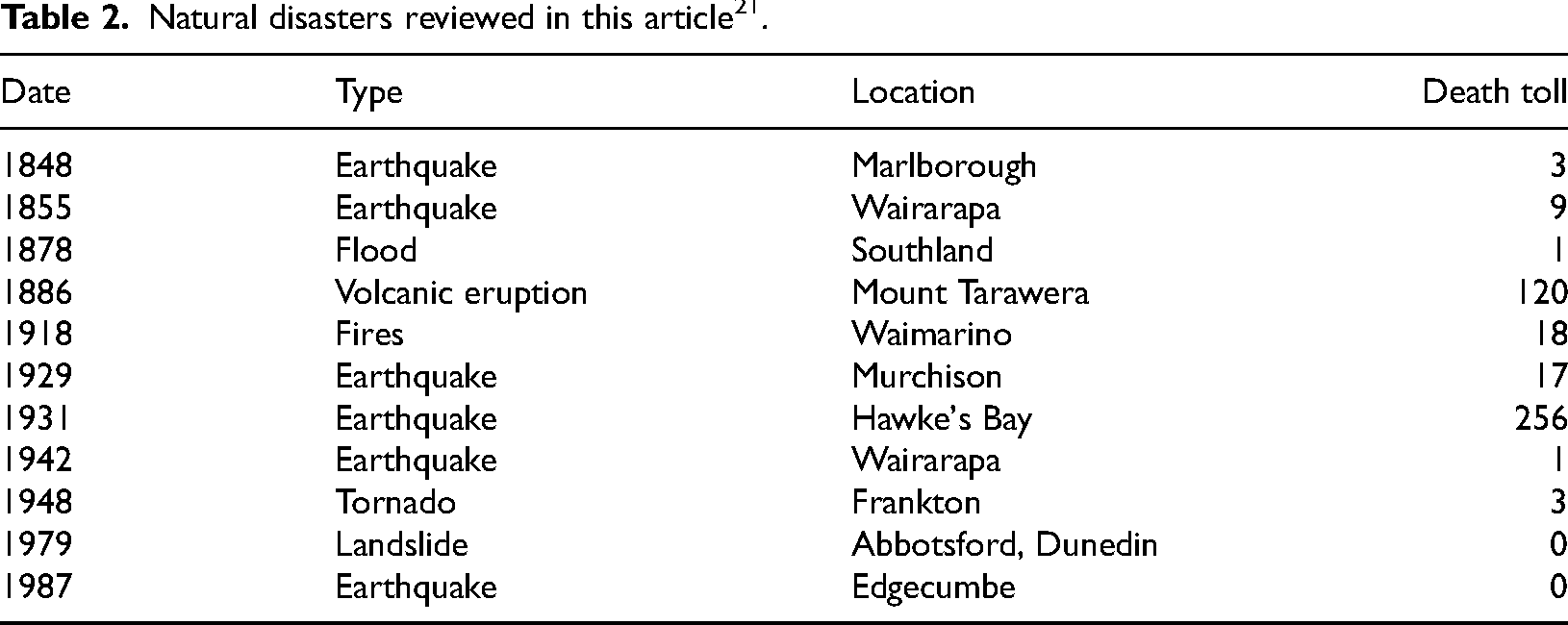
A purposeful sample of significant non-biological natural disasters was reviewed to obtain a diachronic spread and to include a range of disaster types. It also permitted the selection of ‘information-rich cases … from which one can learn a great deal about issues of central importance to the purpose of the inquiry’ (Patton, 2002: 230). A variety of disaster types was selected to avoid limiting the discussion to a single typology. Since the enquiry focused on private property loss rather than loss of human life, the number of fatalities was not a particularly relevant consideration, nor was the cost and relative burden borne by the central government as that is difficult to assess. 5 This approach prevented a false periodisation (Fischer, 1970) that might result in a pre-interpretation of the evidence, and exaggerate change while ignoring continuity. It also enabled the long term to be considered which also addressed Sargiacomo et al.'s (2021) concern that natural disaster research in accounting and economic history journals displays ‘a high concentration of studies only on one disaster's typology, namely, earthquakes’. Table 2 lists the disasters that are discussed below, and Figure 1 shows their approximate location (bearing in mind that the effects of all the disasters except the Abbotsford Landslide and Frankton Tornado were regional, and not merely local).
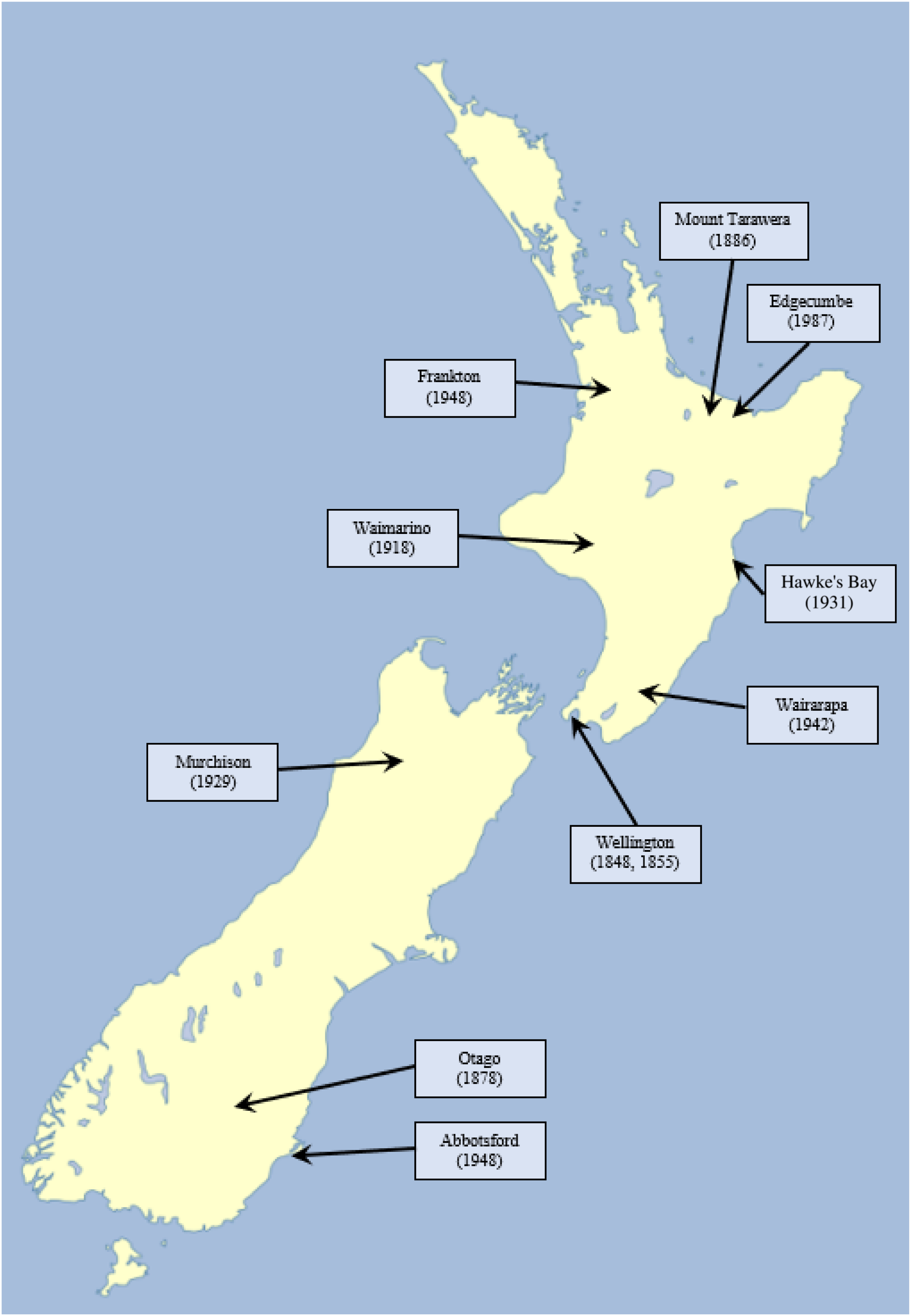
Indicative location of the natural disasters mentioned in this article.
Natural disasters reviewed in this article 21 .
Devastating, high-profile twenty-first-century disasters, such as the Tōhuku earthquake and tsunami in Japan (2011), the Canterbury earthquake sequence in New Zealand (2010–2011), the Indian Ocean tsunami (2004), Hurricane Katrina (2005), or the personal, social and economic ravages caused by Covid (2020 to date) were excluded. Change and/or continuity are best assessed over the longer term. Without this longer-term view, the effects of more recent disasters are difficult to assess historically. If history is written too soon after an event, premature judgements may be made that subsequently need to be revised after years, if not decades, of recovery, adjustment, and reflection (Vosslamber, 2015). 6 The short shock of the disaster event itself can obscure the more subtle denouement and possible social change.
Although a range of disasters was considered, earthquakes predominate in this article. 7 This is unavoidable as earthquakes are by far the most devastating and costly disasters that have hit New Zealand. Earthquakes were the three most costly natural disasters in New Zealand in the last half-century as measured by normalised natural disaster insurance losses, comprising some 92 per cent of the cost of the 10 most costly events. The Canterbury Earthquake Sequence of 2010/2011 alone contributed over 72 per cent of that total (McAneney et al., 2021). By comparison, only one earthquake features in the equivalent Australian top 10 (the 1989 Newcastle earthquake which contributed 12.5 per cent), with the balance comprising seven weather-related events (hailstorms, cyclones, floods) and two bushfires (McAneney et al., 2019). Given New Zealand's susceptibility to earthquakes due to its location on a tectonic faultline, and their unpredictable and devastating consequences, it is not surprising that earthquakes are foremost in most New Zealanders’ minds when thinking of natural disasters, and that the government-sponsored natural disaster insurer initially only covered earthquake damage and, despite an enlarged mandate, is still called the Earthquake Commission.
New Zealand Disasters
The question that this article addresses is, what responsibility did New Zealand's central government assume in respect of private property loss caused by natural disasters, and did this change over time? This section addresses the research question by reviewing a sequence of natural disasters that occurred in New Zealand to assess who bore the responsibility for private property loss.
Māori
New Zealand was first inhabited by the indigenous Māori as early as the early fourteenth century AD (Walter et al., 2017). Before European settlement, information and knowledge about storms, floods and landslides were repeated in the oral histories and traditions of the Māori people (King et al., 2007). A reported example was a tsunami in Fiordland in the lower South Island that killed several hundred persons (Downes et al., 2005).
Māori lore also records several historically attested earthquakes (King et al., 2007). Earthquakes were understood as the rumblings of Rūaumoko, the son of the sky and the earth, that disturb the land as he walks about (McSaveney, 2009). The failure of local Māori in their duty as kaitiaki (guardians) could ‘anger the gods. As fate would have it, in 1931, Rūaumoko awakened, and so began te rū – the [1931 Hawke's Bay] earthquake’ (Forsman, 2018: 52). Given the tribal organisation of the Māori, and their marginalisation in New Zealand society following colonisation, indigenous responses to such events continued to be localised, based at the tribal marae (meeting house), which ‘provided a refuge both physically and spiritually … In doing so it also afforded an expression of manaakitanga (hospitality) through the gathering of people in the face of hardship’ (Forsman, 2018: 60). While Māori understandings might be considered as pre-Enlightenment because of their non-secularity, indigenous perspectives are now starting to inform official approaches to disaster relief and recovery in New Zealand (Forsman, 2018; King et al., 2007). Moreover, in Pākehā society both religion and civil society have played a similar and ongoing role in understanding and responding to natural disasters.
Although of interest, the pre-European contact period is not discussed in detail in this article for several reasons. While such events caused considerable loss of life and property, the tribal nature of pre- or early-contact Māori society renders the application of Western private property concepts anachronistic (Kawharu, 1977). Moreover, documentation of events such as these comprises ‘Māori oral tradition recorded and interpreted by Europeans’ (Downes et al., 2005: 8; van Meijl, 1995), and may therefore be less than helpful in understanding Māori practices and perspectives.
Early colonial
Pākehā settlement of New Zealand commenced shortly after its rediscovery by Captain James Cook in 1769, and New Zealand became part of the British Empire following the signing of the Treaty of Waitangi between the Māori and the Crown in 1840. Institutional norms were imported into New Zealand by English settlers, but organisations had to be developed from scratch by what initially was a very small, but growing, non-Māori population. In terms of Marshall's (1950) schema, this was a time of the development of political, 8 rather than social, rights in England. The new poor law in England with its strictures on outside aid had been enacted in 1834, but poor relief remained tied to membership of local communities, and was locally funded and administered, albeit increasingly nationally conceived (Marshall, 1950: 21). A similar pattern appeared in New Zealand: locally funded and administered aid, with the developing central government asserting an increasing role in managing (but not funding) such relief (Thomson, 1998). Indeed, Pākehā disaster response remained localised throughout much of the post-settlement period.
Wellington earthquake, 1848
Following intentional Pākehā settlement in 1840, Wellington soon experienced the devastating effects of earthquakes, a phenomenon rarely experienced in Britain (Musson, 2003). 9 A large earthquake, estimated at 7.5 on the Richter scale, struck Marlborough on 16 October 1848 and caused damage in Wellington estimated by the Lieutenant-Governor at £15,000, of which £3,500 was ‘of the Colonial Government’ (Domett, 1848: 3; Hamer and Nicholls, 1990). 10 At the time, Wellington was a small settlement of around 4,500 people. This cost was met by private resources and gifts. At a public meeting, the Wellingtonians decided to return a gift of £500 subscribed by Aucklanders to assist in earthquake relief (Gore, 1956; Hamer and Nicholls, 1990; Public Meeting, 1848). The refusal to accept the Auckland gift might be attributed to ‘a spirit of misguided pride’ (Grayland, 1957: 18), but the gift may also have been regarded as a political ‘bribe’ by the Auckland-based Colonial Governor to sweeten his constitutional proposals, and rejected for this reason – despite the fact that in Auckland the £500 was subscribed by the general public and not the provincial government. A primary concern of the city's leadership seems to have been to cover up bad news that would prevent the development and population growth of the Wellington settlement, even though there was no lack of need (Carpenter, 1848).
This funding refusal is, however, consistent with the institutional norms already evident in the fledgling colony and reflected in what Thomson (1998, book title) refers to as ‘New Zealand's Colonial Experiment’, that is, ‘a World Without Welfare’. This was characterised by ‘a deliberate attempt to keep all formal collective welfare activity to a minimum, and to maximise individual, family and informal neighbourly assistance when need arose’ (Thomson, 1998: 18). Some locally-raised funds were applied to relief, including the balance of a fire fund that remained from an 1842 fire event (Untitled, 1848), but these had been privately subscribed. The central government, which was small and based in Auckland, did not assist in the recovery of local government or private property. In his despatch to the Governor-in-Chief of New Zealand, the Wellington-based Lieutenant-Governor noted that ‘with the exception of the wooden dwellings, most of the houses were seriously shattered, or fell in’, yet he made no call for funds or logistical support from the Governor-General. Instead, he reported on his calling, with the consent of his Executive Council, of ‘a day of public prayer and solemn fast, in order that supplication might be offered up to Almighty God to avert the recurrence of any similar visitation’ (Government Gazette, 1848). Not unlike the Māori, the disaster was assessed in terms of (divine) agency rather than society (see also Gilbert, 1998).
The Colonial Office in London was no more forthcoming. The following year, New Zealand's Governor George Grey sent a despatch to the Colonial Office enclosing a memorial from residents of Wellington appealing for ‘such a grant to meet their present distressed condition’ (Grey, 1849), and which itemised losses totalling £14,479. Earl Grey of the Colonial Office replied that ‘greatly as I deplore the occurrence of the event which gave rise to [the petition], I am of opinion [sic] that Her Majesty's Government could not with propriety recommend to Parliament to entertain such a request’ (Grey, 1850). The norm of self-help, indicated by the English Poor Act, precluded state support.
Wellington earthquake, 1855
This lack of government involvement was again evident following the magnitude 8.2 Wairarapa earthquake of 23 January 1855, which resulted in nine deaths and raised the land surrounding Wellington harbour, uplifting much of the land that is now Wellington's CBD as well as the main road and rail routes to the North. The Auckland-based parliament did not meet between September 1854 and August 1855. When it did, it focused on the establishment of responsible government and certain disturbances between indigenous Māori and Pākehā settlers, but the earthquake was not mentioned, perhaps in part because of the passage of time, but also because until 1865 Parliament met in Auckland, some 400 miles away.
The government responded similarly to subsequent earthquakes in the nineteenth century, and the relief effort was largely localised and voluntary. Following a significant earthquake in 1888 that dislodged the spire of Christchurch Cathedral, Rogers (1996) notes that the Minister of Public Works visited the area, but that relief was privately funded.
Otago floods, 1878
Aside from earthquakes, New Zealand is susceptible to floods. In the South Island, fast-flowing glacial-fed rivers flow from the mountains upon which clouds form, and can cause downstream flooding in the low country. The floods on the Clutha River in Otago in September and October 1878, although not uncommon, were more severe than usual, and inundated several townships in Otago (Grayland, 1978). Again, a relief fund was established which was distributed locally (New Zealand Telegrams, 1878). Of the £2,200 collected, only £1,200 was distributed, with the suggestion that the balance be devoted to the relief of an unrelated bushfire (Town and Country, 1878). While the government was called upon to repair the destroyed railway bridge at Balclutha, there is no evidence of government funding for private losses.
Mount Tarawera eruption, 1886
New Zealand's location on the Pacific ‘ring of fire’ (Allaby, 2013) results not only in seismic activity but also volcanism. The eruption of Mount Tarawera, 20 miles from Rotorua, ‘destroyed three villages, killed 153 people, submerged the Pink and White Terraces (among the wonders of the world), dried up a 284-acre lake, shattered roads, bridges, and communications, and spread a mantle of deadly ash and debris over 6000 square miles of farmland and forest, and even out to sea’ (Jones, 1966a). All but six deaths were of Māori persons.
On hearing the news, Premier Sir Robert Stout authorised a local mayor to give relief of up to £100 for hay to feed livestock, which the newspaper hoped would be ‘a preliminary step toward more generous relief’ (Untitled, 1886). Individual gifts, church offerings, and charity concerts provided funds that were deposited to mayoral relief funds, and the resultant cash, food supplies, and clothing were distributed by relief committees. However, the hoped-for relief from the central government was minimal. The 1886–1887 Public Accounts reveal two amounts: £1,260 through the Native Affairs Department to assist Māori refugees, and £1,511 through the Department of Mines to cover various costs. The request of local farmers that the government set aside £15,000 to assist settlers in buying stock and grass, to be given to settlers in the shape of a loan at the lowest rate of interest (Public meeting at Te Puke, 1886), and to remit rent, was not met. Yet concerns were expressed in Parliament as to ‘why the rescue work was left to private enterprise, and generally as to the want of proper organisation’ (Special Correspondent, 1886).
The relatively minor increase in the central government's financial contribution reflects the increasing settlement and settledness of the county, the population having grown to some 630,000 by 1887 (O'Neill, 2022), yet there is little evidence of any shift towards centralisation of relief, let alone the government's providing such in any significant measure. As with poor relief, localism prevailed, and self-help was the norm. After noting that, ‘The government steadfastly refused … to consider any claims for compensation for destroyed properties’, Keam (1988) opines that, ‘Certainly there was the expectation in days of relatively little Government taxation that privately donated money would provide a greater proportion of assistance than would be the case today’. New Zealand's ‘colonial experiment’ precluded such spending (Thomson, 1998).
Waimarino fires, 1918
At first glance, there appeared to be an increased central government response to natural disasters from the early twentieth century. After a very dry summer, a fire broke out in the isolated central North Island area of Waimarino on 18 March 1918, causing loss of life and property (Jones, 1966b). In response, the government provided £500 for immediate relief supplies, and subsequently a subsidy to the local relief committee ‘on production of evidence that public subscriptions to the amount of £10,000 had been received’ (Allen, 1984: 210). Requested but not provided following the 1886 Tarawera eruption, a £75,000 loan fund was established under section 33 of the Appropriation Act 1918. Of this, £59,336 had been advanced by 31 March 1919 (New Zealand Government, 1919: 738), including some £31,637 secured by promissory notes to cover the cost of grass seed, and the balance for rebuilding (Archives New Zealand, 1918a). Government support comprised interest-bearing mortgage-backed loans or secured promissory notes, rather than outright grants (Archives New Zealand, 1918b). Borrowers were still making repayments 40 years later (Allen, 1984; Archives New Zealand, 1958).
The response to the Waimarino fire indicates institutional continuity. Since Pākehā settlement, the primary responsibility for relief had rested with the private sector. In this context, private property ownership, particularly land and a home, was the primary source of security. Thomson (1998: 67) aptly notes that ‘Owning property was also the primary colonial way of securing one's future … Acquiring a piece of real estate was the colonial ideal and it became a wide reality. Governments worked hard to promote it: they also fell when they failed to do so’. What was changing was not direct relief of need, but increasing government support for property ownership by actively supplementing the market. From 1894, the government had engaged in a series of ‘State Advances’ schemes to develop the resources of the country (Centennial Branch, 1940), by way of state-provided loans for purchasing private property at a discounted interest rate. The support rendered to the Waimarino victims was consistent with this policy, for the government provided loans, not grants.
Murchison earthquake, 1929
On 17 June 1929, the rural Murchison region of the West Coast of the South Island suffered a severe earthquake which resulted in 17 casualties and significant property damage. Parliament again voted no funds for specific relief of personal property loss, although it did make available public resources of the state-owned railway and post and telegraph services to alleviate the immediate need. The government provider of mortgage finance, the State Advances Department, was also authorised to lend additional money to its customers whose houses had been damaged. The Prime Minister transmitted limited discretionary funds for immediate emergency relief but rejected the suggestion that the government should be asked to subsidise pound for pound the money raised by the public. The government's expenditure would vastly exceed such a subsidy, since ‘to restore the damage to roads, bridges, public buildings, telegraph, telephone, railway damage, and land settlers, soldiers &c ... a great deal of [money] would have to be found out of revenue' (Ward, 1929: 14). The government also administered relief contributions made by the general public. The Public Accounts for the year ended 31 March 1930 record contributions from the public amounting to £188,668 and payments of £180,821 (House of Representatives, 1930: 66). The distribution of this fund was delegated to a Central Earthquake Committee chaired by the Prime Minister (Ward, 1929: 261).
These responses confirm a demarcation between the role of the state in providing initial emergency support and repairing or reinstating public assets, and the role of the private sector in respect of private property (albeit supervised by the state). The New Zealand Parliamentary Debates provide no indication of any call for the state to involve itself in the latter, beyond coordinating and administering the privately funded relief funds.
Hawke's Bay earthquake, 1931
The earthquake which struck Hawke's Bay at midday on 3 February 1931 and claimed 256 lives remains New Zealand's most deadly natural disaster and resulted in significant property damage, severely damaging the cities of Napier and Hastings. The government initially provided grants of up to £100 for the purpose of repairing domestic damage. Although repayable, these loans were eventually written off (McKeen, 1942: 464). Beyond this, the Government's response was similar to that of the Murchison earthquake two years earlier: legislating for the administration and control of privately sourced relief funds, clarifying and confirming property rights, and reinstating public (but not private or local-government property) out of the Consolidated Fund (part III, Hawke's Bay Earthquake Act 1931).
Concerning private property damage, Part II of the Hawke's Bay Earthquake Act 1931 focused on rehabilitation. In particular, section 38 authorised the Minister of Finance to make payments not exceeding £1,250,000 to persons who had suffered loss or damage because of the earthquake, and up to £250,000 to local bodies. However, as with the Waimarino fires and the Murchison earthquake, most of the funds provided were by way of repayable loan, and not grant. Disaster recovery followed the pattern of State Advances Loans (Vosslamber, 2015).
After the recent increase in seismic activity and the massive cost incurred when an earthquake struck a city, the Prime Minister noted the need for a more secure footing for earthquake relief. While recognising that ‘[i]t would not be possible, without placing a heavy burden upon the people of the country, to provide full insurance cover in respect of earthquake loss’ (Forbes, 1931: 737), he suggested that it would be very desirable for there to be some fund available in the event of such a disaster. Yet proposals in the Bill to tax insurance companies and property owners to establish a fund for future emergencies lapsed in Parliament. 11 Notwithstanding the loan support provided by the government, responsibility for private property losses remained, as previously, with the property owner.
Interlude: War Damage Act 1941
The British government had made limited indemnity of war-related private property loss during World War One, 12 but no such provision was needed in New Zealand since it was not a theatre of war. In World War Two, the British government enacted the War Damage Act in early 1941, and the New Zealand Government, fearing a possible invasion, followed suit with its eponymous Act of the same year. Underpinning the New Zealand Act was a recognition that war loss was not a personal responsibility but should be shared by the community, and that war damage was uninsurable on the ordinary commercial insurance market. These factors, and the introduction of comprehensive Social Security in New Zealand in 1938, might suggest that the government would fund these losses through ordinary taxation, but the Act stopped short of the socialisation of war property losses, for cover was only available for persons who opted into the war damage scheme and paid their premium. Yet this was not a strictly market-based scheme for it involved compulsion, since one could not insure for fire damage unless one also insured and paid for war damage cover (War Damage Act 1941, s. 14). Nor did the scheme reflect standard insurance practice, for neither the amount of cover nor the flat-rate premium payable, was in any way related to risk. Moreover, although any amounts paid out on claims were intended to be covered by the fund, the Act provided that if the fund was insufficient the government would cover such deficiency, effectively by lending (not granting) the deficiency to the fund (War Damage Act 1941, s. 12).
Since New Zealand was never attacked, a large balance accumulated in the War Damage Fund. Unlike the British, New Zealanders sustained little property damage, and by 1944 the War Damage Fund had a balance of over £4,000,000. 13 Rather than refund this balance to War Damage policyholders, Section 13 of the War Damage Act 1941 directed that once all claims had been settled, any surplus remaining would be used ‘for the purposes of granting financial assistance to persons suffering loss or damage by reason of any earthquake or other disaster.’ The Earthquake Damage Emergency Regulations 1944, subsequently confirmed by the Earthquake and War Damage Act 1944, extended the cover provided by the War Damage Act 1941 to include earthquake damage (including damage by fire). A fund set up specifically to cover the consequences of uninsurable and unpredictable war was thereby applied to cover the effects of earthquakes on property. Although this indicated increasing state interest in disaster mitigation, it continued to place the onus on property owners to purchase insurance coverage. This contrasted with the more universal approach of social security, again indicating institutional continuity rather than a major change.
Wairarapa earthquake, 1942
The introduction of cover for earthquakes came too late for the rural Wairarapa town of Masterton. Two earthquakes in quick succession (24 June; 2 August) caused significant damage to the lower North Island. The government's response, which followed precedent, was challenged by several Members of Parliament who asked whether the Prime Minister would ‘consider enlarging the protection now offered under the War Damage Act 1941, or make provision independently of that Act, so as to cover damage to buildings or personal property which may result from earthquake activity’ (Robertson, 1942: 520). The Prime Minister demurred.
Frankton tornado, 1948
Although tornadoes occur infrequently in New Zealand, they can cause serious damage. The tornado that struck the Hamilton suburb of Frankton on 25 August 1948 caused three deaths, and 80 injuries, and destroyed 150 buildings. The government immediately pledged its support. The Prime Minister commented that all ‘homes and business places that were destroyed, would be re-erected at a minimum of cost … finance was a secondary consideration and did not enter into it at all’ (Frankton's Affliction, 1948). However, the Minister of Finance demurred, placing the responsibility back on the property owner. After all, he claimed that ‘Insurance of dwellings on a comprehensive basis [that is, via the EWDC scheme] … is available to the public at a small premium to that charged for fire insurance’ (Nash, 1948: 1910). At the time, however, this insurance did not cover tornado losses. The crisis of a tornado may have suggested the need for social support and provided the opportunity for political largesse; social (and legal) norms precluded radical action.
Interlude: Institutional change?
The government extended the EWDC scheme the following year. Like earthquakes, tornados were unpredictable and unavoidable ‘Acts of God’ (Frankton Disaster, 1948), so the decision to cover one but not the other seemed arbitrary. Moreover, a newspaper columnist suggested that it could be politically opportune to extend the cover retrospectively (Growler, 1948). Anticipating government plans to extend the range of risks covered, and concerned about the unfunded cost of a major disaster, the EWDC urged that the Earthquake Fund ‘should not be encroached upon to provide relief for other kinds of loss [beyond war and earthquake], however deserving’ (Earthquake and War Damage Commission, 1948: 2). Ignoring this plea, the government introduced disaster cover in 1949. No additional premium was charged, but 10 per cent of EWDC premiums were diverted to a disaster fund to cover extraordinary disaster damage due to storms or floods. In response, the Commission lamented that ‘It will be some years before the Fund will be sufficient to meet a disaster such as [the tornado that] occurred at Frankton Junction in 1948’ (Earthquake and War Damage Commission, 1951: 2). Despite the government guarantee, legal definitions of the natural disasters determined who was entitled to make a claim on the EWDC, and EWDC cover was limited to claimants who had a policy of fire insurance.
Abbotsford landslide, 1979
For several decades following the establishment of the Earthquake and War Damage Act 1944, New Zealand enjoyed a seismically quiet period. Meantime, the fund balance increased, and there were pressures for a larger range of natural disasters to be covered by the EWDC. From 1954 it was possible to pay an additional premium and voluntarily obtain cover against damage to property (but not land) due to landslips. The land on which any insured building was situated was not by covered the EWDC until 1984. 14 The EWDC noted that the landslip insurance which it offered on a voluntary basis resulted in 'adverse selection against the Commission' (Earthquake and War Damage Commission, 1957: 4). In subsequent annual reports, the Commission recommended strongly against providing such cover beyond the option to voluntarily opt-in, but in 1970 the government extended cover without the extra premium. 15 The EWDC premium rate remained unchanged until 2012, 16 (after the Canterbury earthquake sequence had resulted in the depletion of the Fund), while the types of risks covered by the EWDC had increased incrementally to include storm or flood damage, 17 volcanic activity, 18 and the effects of geothermal activity, 19 reflecting a political, rather than an economic, logic. However, these extensions of EWDC cover did not represent a major shift in institutional norms, for cover applied only to those who had fire insurance coverage on their property.
A landslip in July 1979 in Abbotsford, a suburb of Dunedin, confirmed that such cover was not comprehensive, since it covered damage to buildings only, but not to the land itself. The landslide wrecked 69 houses and left hundreds of people homeless (Gallen et al., 1980: 1.1.1). Mercifully, no lives were lost. The Prime Minister refused to acknowledge Abbotsford as a special area to allow the EWDC to pay full market value on damaged homes (18 July). A week later, he announced that no further action on compensation would be taken until a cause for the disaster had been established (23 July). Finally, on 6 August, the Cabinet announced a dollar-for-dollar subsidy on the national appeal up to a maximum of NZ$250,000 (Stuart, 1979).
In their submission to the subsequent Commission of Enquiry, the New Zealand Institute of Surveyors were generous in their commendation of the government's and the general public's role, noting that, ‘In the case of Abbotsford but for the Government and the charity of New Zealanders very real hardship could have resulted’ (New Zealand Institute of Surveyors, 1980: 21), due to underinsurance and uninsurability of land. However, their recommendation that ‘the objectives of the Earthquake and War Damage Commission be reviewed’ suggests the public was aware of gaps in cover and a lack of clarity as to who should bear the cost of disasters. Moreover, the Commission itself suggested that ‘a concern to protect the fund coloured the thinking’ concerning the Fund (Gallen et al., 1980: 132), reflecting both a concern for contractual niceties akin to a private for-profit insurance model, yet subject to political influence that might wish to address a personal and social need in a manner more similar to a social welfare model.
Edgecumbe earthquake, 1987
Despite the ‘low period of seismic activity’ (Earthquake and War Damage Commission, 1960, 1967) that followed the establishment of the EWDC, the Commission warned that the risk of a major earthquake continued to be ‘the principal disaster danger in New Zealand’ (Earthquake and War Damage Commission 1967: 3). An earthquake on 2 March 1987, centred on Edgecumbe and measuring 6.3 on the Richter scale, vindicated this concern.
The cost of the earthquake was met from a number of sources, including a NZ$10 million government support package mainly by way of loans to the government Housing Corporation, the successor to the public State Advances Corporation (Muller, 1987: 95). The government also gave a dollar-for-dollar contribution to the mayoral relief fund, initially for up to NZ$50,000, but eventually increased to NZ$380,000 (Muller, 1987: 124). Due to private sector generosity, the fund eventually exceeded NZ$1.6 million (Butcher et al., 1998: 108). Total losses were estimated at NZ$880 million, comprising uninsured losses of NZ$50 million, government costs of NZ$400 million, EWDC payments of NZ$130 million, and other insurance of NZ$300 million.
Despite the EWDC's contribution, concerns were raised about its effectiveness. Since the Commission provided indemnity cover only, many claimants discovered significant deficiencies when they rebuilt or repaired their properties; nor did the Commission cover damage to sewer lines, septic tanks, or waterpipes on people's properties. Red tape added stress, leaving victims ‘sorting out the bureaucratic bungles of the EWDC’ (Muller, 1987: 220). After four decades of existence, the EWDC provided some relief for those who had suffered earthquake damage but fell short of the (albeit also unrealised) cradle-to-grave ideal of social security.
Subsequent events
New Zealand's public scheme for earthquake cover was and remains unusual in the Western world, and has been described as ‘a rare attempt at coping nationally and rationally with an anticipatory programme of natural disaster loss mitigation’ (O'Riordan, 1971: 27). Yet while New Zealand may have been the only Western earthquake-prone country in which earthquake insurance is compulsory (for those purchasing fire insurance) (New Zealand Government, 1988), the scheme has always been a mixture of public (akin to social security) and private (insurance) models.
In the later 1980s, government policy focus shifted towards a reduction of state involvement and to user pays (Boston et al., 1996; Pallot, 1998), which also affected the EWDC. In 1988 the Government released a Public Discussion Paper entitled A Review of Earthquake Insurance (New Zealand Government, 1988), which foreshadowed a shift in focus from the principle that everyone should share in the costs of a natural disaster – a state of affairs never actually obtained in New Zealand – to a user-pays focus. This would also reduce the government's contingent liability in the event of a devastating disaster. The Discussion Paper proposed that a restructured EWDC be treated as if it were a private insurance company subject to full market discipline and competition. Although significant changes were made to the Earthquake and War Damage Act 1944, this strict market focus was short-lived. In 1991, the government reaffirmed that ‘In the aftermath of a major natural disaster, the Government's prime concern would be humanitarian’ (Kidd, 1991: 1).
This conclusion might seem obvious in a country prone to the full range of natural disasters for which it can be difficult to secure insurance cover, yet it did not result in a public commitment to accept responsibility for the costs of private property damage. A major plank of social security in New Zealand from the beginning has been self-help and home ownership. While the Government's desire may have been to provide security against all risks (Anon., 1943: 43), its provision with regard to property was limited. Disaster damage generally, and the EWDC scheme more specifically, suggests an abiding preference for self-help, supplemented by a quasi-market insurance scheme.
Discussion
This article addressed the question, what responsibility did New Zealand's central government assume in respect of private property loss caused by natural disasters, and did this change over time? The focus on New Zealand was justified by its natural susceptibility to significant geological and meteorological events. The entrance of humans into this context created the opportunity for disasters where natural forces interact with human society in ways that are detrimental to human life flourishing. New Zealand is particularly relevant as a research site since it was a pioneer in central government provision for social rights, including protection against poverty. Before World War II, the New Zealand government enacted a social security scheme that was generous in its day, and during that war, it introduced a state-sponsored provision for earthquake damage on an insurance model, subsequently extended to a wider range of disasters.
The research question was addressed by reviewing the extent of the government's financial commitment to the recovery of private property resulting from natural disasters which spanned a long period of time. While the government's role changed and support increased over the period, it did not mirror the radical changes in social security. Even though a natural disaster can exacerbate one or more of the ‘Great Evils’ (Beveridge, 1942) that social security was to address, property damage due to disasters was not covered by social security. New Zealand's ‘cradle to grave’ welfare state may be lauded as ‘the first attempt on a national scale to combine under one integrated system of economic security protection against all hazards’ (New Zealand Herald, 2017), and the state may have provided public housing and provided low-interest State Advances loans for residents to purchase their own home (Thomson, 1991), but this did not extend to covering the cost of post-disaster reinstatement of private property, and the establishment of the government-guaranteed EWDC scheme did not change this. Instead, responsibility for private property loss remained with the private sector, albeit with increasing government oversight. This is evident in the continued significance of public donations raised in response to a disaster, even after the establishment of the EWDC.
Change and continuity
The research question suggests that the government's response to natural disasters might have changed, consistent with a change in social rights over time, without confirming that this was so or indicating how (or why) this change occurred. Marshall (1950) proposed that social rights, including economic rights, were the last rights to develop, and not before the twentieth century. This might suggest very limited public provision for natural disaster losses before then, but an increase in provision subsequently. Titmuss (1976) expanded on social rights and suggested increasingly generous social provision was a social right. Both Marshall's and Titmuss's models assume progress. However, although this was evident in the government's provision for personal needs, such radical change was not evident in respect of natural disasters.
The New Zealand government's role did increase over time. In part this reflected the birth and subsequent growth of the central state apparatus as the settler population arrived and grew, British institutions were introduced and adapted, and local institutions developed. However, the primary source of funds for natural disaster relief remained with individuals and civil society, not the central government. Certainly, the government did provide in-kind relief (via the police, army, railways, etc.) to address immediate crises and to restore the public property, but support for private disaster losses came predominantly from the private sector. When the government did increase its involvement, this was by way of a repayable loan rather than a free grant, the oversight of private donations, and by mirroring the market with the quasi-insurer EWDC. In terms of Titmuss's (1976) options, the government's provision remained at best a conservative market-based model for restoration. There has been an evolution in natural disaster response, but hardly a revolution in policy.
This research considers who bore the cost of private property damage resulting from natural disasters. There were, and still are, two main ways this has been funded. Throughout the period, public appeals raised funds that were distributed by local committees to those assessed as needy. Over time, the central government increased its superintendence of such funds and even contributed to them (Vosslamber, 2015). Individuals might insure against such losses – either self-insuring by having savings to cover the losses (or deciding not to repair damaged property), or by purchasing insurance cover in anticipation of a disaster. The government's EWDC essentially followed this insurance model. However, what is not evident is a significant institutional shift. The patterns of self-help and fundraising already evident in Wellington in 1848 were still evident in 1989.
Specifically, although the EWDC was established during World War II as a modification of the earlier War Damage Act 1941, it did not result in the socialisation of private disaster loss. Instead, as with the War Damage Act, and consistent with State Advances loans, a private sector model was followed. Similarly, the earthquake provision did not extend the pattern of socialisation of personal needs and loss enacted in the Social Security Act 1938. While the state may have intended to make universal provision for the contingencies of unemployment, health, and age, this was not extended to the area of disaster provision in respect of private property losses. 20 Whereas social security was needs-based, EWDC cover retained a substantial element of self-help and specifically excluded any who did not purchase fire insurance. There continued to be a focus on personal responsibility (e.g., to purchase fire insurance or self-insure for property loss), and a dependence on private-sector donations to meet the costs of disaster recovery.
This is not to deny that change occurred. However, path dependency becomes evident when a ‘somewhat longer time frame’ (Mahoney and Thelan, 2009: 2) is reviewed. Although the exogenous shock of a natural disaster to the natural world significantly affects the social world, it did not radically alter the framework within which human beings interact or the cooperative and competitive relationships which constitute a society. By focusing on the longer term, continuity becomes evident as the social, economic and institutional contexts are considered (Hopwood, 1985). Considered over the longer term, the simple question of ‘Who paid?’ sheds light on whether and how much society changed.
Conclusion
The role of the New Zealand government in addressing natural disasters has changed over time. However, such change has been incremental. Moreover, the changes have not moved from a reliance on self-provision and self-help to a socialisation of loss. The short sharp shock of a natural disaster has not been matched by a similar shock to the social response. Rather, the incremental change in the government's response to private property loss has been longer term and by and large has maintained the existing institutional framework.
Certain inferences may be drawn from this study that is relevant to both accounting history and society. In terms of the study of disasters, accounting history can enhance understanding of a specific natural disaster, but also of social responses to disasters over time. Since accounting is a social event that leaves a trail of evidence, accounting is well-placed to provide insights into social change and continuity, describing events that might (with hindsight) form ‘critical junctures’, but also highlighting path dependency. The intertemporal contextualisation offered by historical institutionalism helps prevent simplistic periodisation schemata which emphasise specific events as causes of structural change. Focusing on a species (natural disaster), rather than a genus (e.g., a particular natural disaster event), also necessitates a clarification of what is included in the term ‘natural disaster’.
Several implications may be drawn. Given the interaction of natural forces and society, natural disasters continue to change and have become costlier and more frequent. This may primarily be due to social change, as enhanced building codes, greater wealth, and larger populations exacerbate the cost and damage inflicted by a disaster. However, the natural world is not static and as it changes this may exacerbate the intensity of natural disasters or create new ones, whether due to the advance of glaciers in the Little Ice Age (Fagan, 2019), or the rise in sea levels in the present (Iorns Magallanes et al., 2019). If future disasters increase in intensity or change in type, will longstanding institutions suffice to address the effects, or will they change? If so, how might the past inform the future?
Limitations and further research
As with all archival research, there is the risk of selection bias. More detailed investigations of specific events or relief organisations would nuance this discussion. Moreover, since the focus of this article is on natural disasters, the social response to non-natural disasters such as war or personal misadventure has not been considered. A comparison of the social response to different types of disasters would be informative.
A long-term view does not reduce the need for studies of specific organisations. More work remains to be done on the EWDC (now the EQC) to determine how (or whether) its operations and its response to disasters have changed over time in responding to disasters. Subject to the availability of archival sources, studies on Mayoral and other Relief Committees would increase understanding of how civil society responded to disasters. The role of other non-governmental organisations is also worthy of further research, as indeed is the abiding role of religion in shaping social understandings of disaster and the subsequent response. Far from disappearing at the time of the Enlightenment, this article suggests that religion has continued to animate human activity and social norms. As an institutional factor, the ongoing, dynamic role of religion in disaster responsibility and response merits further investigation.
The article also notes that the government's role in natural disasters, and specifically the structure and operation of the EWDC, was under scrutiny in the late twentieth century, but that ultimately significant change was not made. This episode is worthy of detailed attention as it involves contrasting institutional responses to natural disasters, and while foreshadowing change, this did not eventuate. Similarly, subsequent catastrophic disasters in the early twenty-first century (such as the earthquakes that affected Canterbury, 2010–2011, Marlborough, 2013, Kaikōura, 2016, and Hawke's Bay 2023) have not been considered, for reasons noted above. As time passes, and analysis becomes possible, the endpoint of this article should be extended to see whether the answer to the research question changed, and how.
