




Abstract
Accounting, agricultural and financial interests have played a role in the treatment and extinction of many animals throughout the world. This article focuses on the framing and moral loading of the thylacine, or Tasmanian tiger, beginning during the colonial settlement of Tasmania and the related commercial sheep operations through to post the federation of the Australian colonies. In doing so, we reflect on the extinction of the thylacine and the role of financial interests that promoted, or profited from, bounties by using moralisation and framing. Moralisation brings within the moral sphere an activity or object that was considered outside it, thus making behaviours related to such activity or object subject to moral evaluation, praise and blame. Contrasting frames for the thylacine within the agricultural industry are used to chart the thylacine's demoralisation and eventual re-moralisation that occurred, particularly after its extinction, into a symbol of ecological hope. As such, this article offers a narrative of the changing conditions for which the commercial and colonial activities, including policy and resourcing, intertwined with the ultimate extinction of the thylacine.
Introduction
The thylacine (Thylacinus cynocephalus) is one of the most fabled animals in the world. Yet, despite its fame, it is one of the least understood of Tasmania's native animals. European settlers were puzzled by it, feared it and killed it when they could. After only a century of white settlement the animal had been pushed to the brink of extinction (Tasmanian Department of Primary Industries Parks Water and the Environment, 2014).
One of Australia's most ‘fabled’ extinct species is the Thylacine, or Tasmanian Tiger (hereafter thylacine). This marsupial mammal was formally extinct by 1986, 50 years after the death of the last captive thylacine and it being added to the list of protected wildlife (Department of the Environment, 2023). 1 Numerous factors have been linked to its initial decline and eventual extinction, including the introduction of wild dogs by early settlers, habitat loss, extinction of prey species and disease (see e.g. Boyce, 2006; Guiler, 1985 and Paddle, 2002). Moreover, it gained – arguably unearned – a reputation as a sheep killer, as destructive, as savage, which in turn saw numerous bounties placed on its head. This article exemplifies the contrasting frames underpinning this notable symbol of extinction, within the context of the agricultural industry from early Tasmanian settlement to post-Federation. In doing so, we extend extant archival research with respect to the implications for accounting historicism, framing and moralisation.
Conservation of Australia's biological diversity is important, not only due to the provision of economic benefits, such as agricultural productivity, ecotourism, providing a source of clean water and air, medicines and resources, but also the special aesthetic and cultural values integral to Australia's Indigenous culture and people (Department of the Environment and Heritage, 2004). Geyle et al. (2018) aim to direct such profound benefits towards improving the prioritisation, direction and effective resource management to avert losses. As well as a lack of public awareness, where species are seen as ‘uncharismatic’, have a lack of taxonomic distinctiveness, 2 or those species that are seen as not having an important ecological role or cultural significance, can lead to lower prioritisation in resource allocations or other recovery processes (Woinarski et al., 2017). Similarly, Maroun and Atkins (2018) note that the majority of biodiversity disclosures are generally anthropocentric, focused on financial and reputational management, and focus on species considered ‘charismatic’ or ‘attractive’ (Atkins et al., 2014; Maroun and Atkins, 2018). For the thylacine, within its historical narrative, it went from being a menace, a sheep killer, to a symbol of hope against extinction. Here, we reflect upon the drivers of change.
Woinarski et al. (2017) argue that there is substantial scope for improvement in the management of extinctions in terms of legislation, policy and resourcing. They recommend legislation and policy that seeks to prevent extinctions from occurring and that provide a clear chain of accountability for the prevention of extinctions, as well as retrospective public inquiries following extinctions, processes for recovery planning, reservation, biosecurity and related policy development, sufficient resource allocation, monitoring programs, public reporting and intervention, research and public education (Woinarski et al., 2017). Such recommendations explicitly and implicitly link numerous stakeholders in the management and prevention of species extinctions: Government, policymakers, standard setters, politicians, scientists, conservationists, customs and border security, educators, media, the public and so forth, thereby, extending to the role of accounting for biodiversity and the natural environment, as well as notions of accountability.
With this in mind, historical research may offer insight into cutting-edge political debate (Parker, 1999). Reflecting upon thylacine as a symbol of ecological hope (Waterhouse and Mitchell, 2021) without historical context, this representation is inherently distorted (Bedeian, 1998; Morton, 2019; Parker, 1999). Take for example the various labels proffered for it as it was framed within differing contexts: Zebra opossum, zebra wolf, Tasmanian zebra, marsupial wolf, striped wolf, tiger wolf, Tasmanian wolf, Van Diemen's Land [modern day Tasmania] tiger, Tasmanian tiger, bulldog tiger, greyhound tiger, hyaena tiger, dog-faced dasyurus, dog-faced opossum, hyaena, native hyaena, opossum-hyaena, dingo/Tasmanian dingo and panther (Owen, 2011: 7).
Moreover, despite being a large carnivorous marsupial, it is more commonly known as the Tasmanian tiger (Dixon, 1989).
This article seeks to reflect upon the ‘far-reaching consequences of the attitudes of individuals who happen to hold particular positions at pivotal times in the fates of individual species’ (Woinarski et al., 2017: 20). As Woinarski et al. (2017) note, the narrative of the thylacine is ‘deeply marked’ by the presence and intervention of humankind and its framing, which can be contrasted with the commercial activities carried on (particularly with respect to sheep farming) through the periods of colonisation within the context of the early Tasmanian settlement to post the Federation of the six British colonies to form Australia in 1901 (hereafter post-federation). 3 We extend extant research across accounting historicism, framing and moralisation with respect to biodiversity and the natural environment. In particular, we conclude framing and moralisation drive shifting notions of accounting and accountability, and that the thylacine exemplifies a shift from more narrow moral domains with respect to financial interests towards broadening moral bounds and therefore encompassing responsibilities towards harm to nature (in particular the threat and actuality of extinction events).
In doing so, we first outline the literature with respect to framing and moralisation and how such a framework operates within the context of historicism. This then leads to the article's key focus of examining the contrasting frames underpinning the thylacine, within the context of the agricultural industry from early Tasmanian settlement to post-federation.
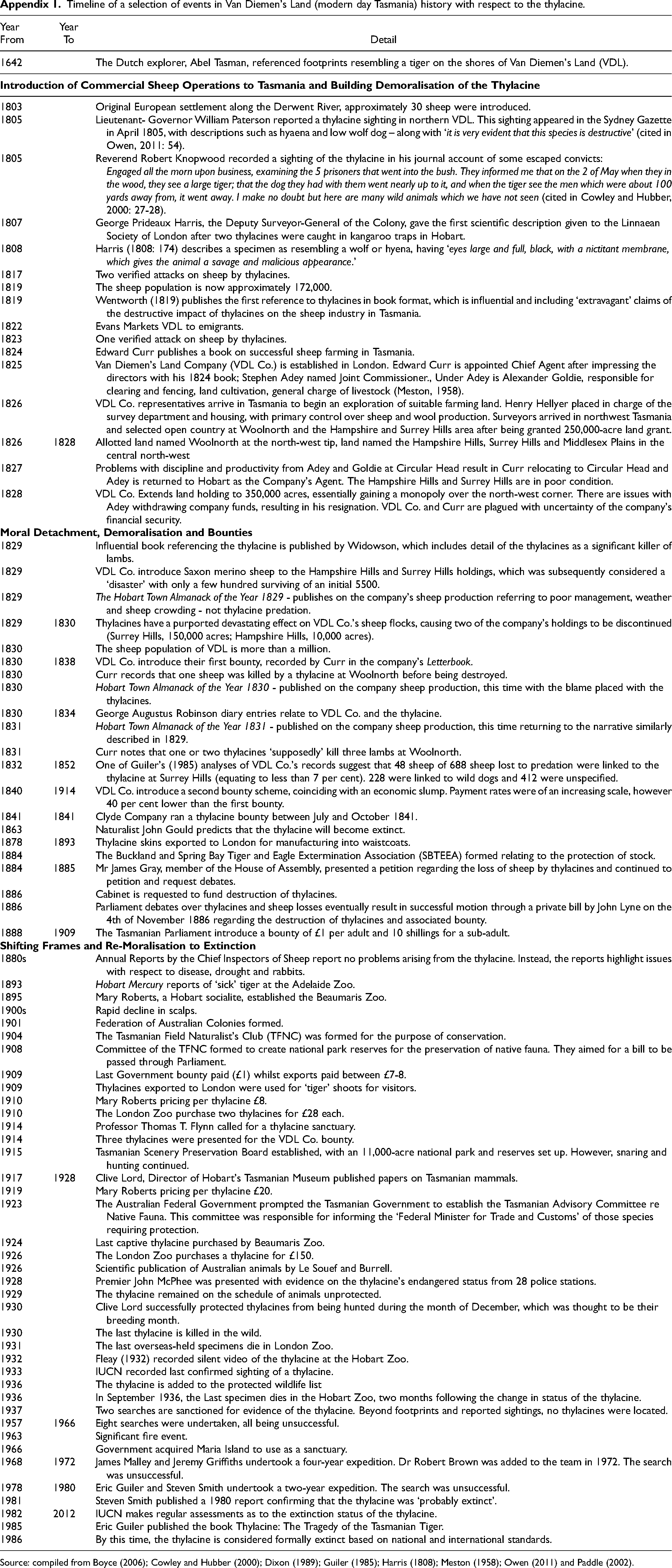
This is structured through considerations of the colonial settlement's introduction of commercial sheep operations and the struggles therein. We then examine the framing of the thylacine which was demoralised within this colonial context that ultimately resulted in the introduction of bounties for its destruction. These bounties transformed from numerous or private bounties to a government-supported bounty, the latter as a result of persistent pressure from a range of interested parties (see also the timeline of events outlined in Appendix 1). We then consider the shifting frames and re-moralisation of thylacine, albeit not preventing its ultimate extinction. Finally, we highlight the evolution of the thylacines’ frame into a symbol of ecological hope against extinction.
This leads to our examination of framing with respect to accounting historicism. Here we delve into the implications of this latent source of environmental history for the role of accounting for biodiversity and the natural environment, as well as the notions of accountability. We do so by considering framing and moralisation (1) with respect to notions of accountability, (2) with respect to stakeholders, and (3) as dynamic and temporal with respect to accountability. We then provide final remarks.
Framing and moralisation
Moralisation is the process that involves the acquisition of moral qualities by an activity or object that was previously morally neutral (Rozin, 1999; Rozin and Singh, 1999; Rozin et al., 1997). Rozin and his colleagues researched the effects of the moralisation of vegetarianism and cigarette smoking, principally in American society, and detect the moralisation of both. Thirty years ago, both smoking and carnivorism were mere preferences without any moral loading. They were amoral. But since then, as Rachels (1997: 100) describes vegetarianism: Cruelty to animals ought to be opposed, not only because of the ancillary effects on humans, but also because of the direct effects on the animals themselves. Animals that are tortured suffer, just as tortured humans suffer, and that is the primary reason it is wrong.
Moralisation converts preferences to values that are more durable than preferences, more central to the self and more internalised (Rozin et al., 1997). Values also tend to invoke strong moral emotions such as anger, contempt, disgust, guilt and shame. Moralisation introduces a prescription – the ‘ought’ – to an activity or object that only contained a description – the ‘is’ – and makes an object or activity that is aligned with one's moral views more prone to be liked.
Brown (2018: 1001) explains that ‘the process of moralisation brings within the moral domain activities that previously fell outside of it. This primarily describes a social process, by which activities come to acquire moral status within a particular social/cultural context at a particular time.’ Brown (2018) argues that every activity is likely to have moral significance and it is ‘unclear that any activity is ever truly “outside” the moral domain’; however, some activities ‘may be less commonly viewed as morally salient, and less subject to moral criticism or praise. Changes to contextual factors and the action of social norms will thus dictate whether or not something is considered to fall within the “moral domain”’ (Brown, 2018: 1001).
A behaviour is moralised when it is considered a moral or immoral act instead of only a personal choice or preference (Helweg-Larsen et al., 2010). Generally, ‘harm to others and responsibility for one's actions are important elements that determine whether something is subject to moral judgments’ (Mulder et al., 2015: 234).
While moral considerations increase the moral load of a behaviour, a number of environmental and cognitive factors have been identified to lead to demoralisation. Gino and Mogilner (2014) found that monetary interests are more likely to corrupt, leading to moral detachment and less reflection unlike time, which is more likely to improve reflection and ethical behaviour.
‘Moral recognition may be influenced by contextual factors as well as individual motivations … the attachment and detachment of moral significance may fluctuate over time and across situations within individuals.’ (Rhee et al., 2019: 6).
The status of animals is also important to consider, as it affects the attribution of moral responsibility and perceptions of harm. ‘Animals were deemed insensitive to pain—and therefore were seen as mere chattel—but now many people see harm in much of animal treatment and moralize it accordingly’ (Schein and Gray, 2016: 63).
Framing with respect to historicism
In contemplating framing and moralisation with respect to historicism, care must be taken to not do so from the perspective of the present (Carnegie, 1997). This article contemplates the narrative of the thylacine, with the understanding that: [T]he passage of time has profoundly altered both the conditions of life and the mentality of men and women – even perhaps human nature itself – and that an effort of the imagination must be made to relinquish present-day values and to see an earlier age from the inside (Tosh, 1991 cited in Carnegie, 1997: 6).
As such, this article offers a narrative of the changing conditions for which the commercial and colonial activities, including with respect to policy and resourcing, intertwined with the ultimate extinction of thylacine. This results in a reflective piece exemplifying the contrasting frames within the context of the agricultural industry from early Tasmanian settlement to post-Federation. In doing so, this examination reflects one element of the social and organisation context (Carnegie, 1997). In doing so, we rely on literature that illuminates the narrative of the thylacine (including the detailed works by Robert Paddle (2002), Eric Rowland Guiler (1985) and David Owen (2011)), for which archival analysis has been undertaken, including with respect to artefacts such as accounts of notable events as well as relevant company records such as letter books, field journals and cash accounts. 4 Building on this foundation, we extend the extant works with particular implications for accounting historicism, framing and moralisation. We acknowledge that this can be skewed by the limitations and bias in surviving written (Western) records and accounts, as well as the reliance on secondary data sources.
With this in mind, Carnegie (1997: 18-19) describes that: The colonisation of countries often resulted in the adoption of the notion of accountability accepted in the home country and the advent of institutions whose mode of operation bore a close resemblance to those based in the home country… As a British settlement, the educational, legal and political, and economic systems adopted in the six British colonies in Australia were broadly based on those prevailing in Britain.
We recognise that in the period which we examine, there will be numerous factors at play and do not intend to generalise, instead capture the particular phenomenon (the decline and ultimate extinction of the thylacine) as snapshots in time of the respective frames elucidated by the relevant literature. The framing with respect to this narrative reflects a western culture – a period of Australian colonisation.
These frames can be compared with the Australian Indigenous people (First Peoples),
5
in which the thylacine was suggested to have a relationship more akin to a domestic dog (Owen, 2011), although this in itself is a Western framing. For example, in ‘How the Tasmanian Tiger Got Its Stripes’ by Leigh Maynard, the Dreaming story of a young pup is recounted (Maynard, 2004). In summary, it is: [A] Dreaming story from the Nuenonne nation of Bruny Island about a young pup who rescues the boy-god Palana [the son of the great god Moinee] from Tarna, the Great Kangaroo. In recognition of his courage, Palana marks the pup with healing stripes made from his blood and spiritual power mixed with campfire ash. This transforms the pup into a thylacine, and aligns him with the great spirit and constellation Wurrawana-Corinna (Maynard, 2004: 2).
There is a second recorded recounting of a comparable Dreaming story, ‘Corrina, The Brave One’, however, it is suggested to be settler-ethnographic (see Maynard, 2004). In particular, whilst it is attributed to be a First Nations Dreaming story, questions over ‘folkloric license’ – European framing – have been raised in connection with the records stemming from a settler family (see Maynard, 2004). For example, phrases such as ‘Baptism’ have raised the concern of First Nations voices being overwritten (see Maynard, 2004).
Culture, being ‘a system of meanings in the heads of multiple individuals within a population’ (Rohner, 1984 cited in Carnegie, 1997: 21), is a critical facet of historicism – and, therefore, framing. As such, this reflection is limited in its cultural and temporal reach. Of focus is the contrasting commerciality of sheep operations with the native thylacine and the framing thereof. Thus, this offers a latent source of environmental history.
Framing and moralisation of the thylacine
The introduction of commercial sheep operations to Tasmania
Early Australian colonial history reveals a strong and rapidly advancing pastoral industry, particularly in the early nineteenth century (Carnegie, 1997). When the European settlers arrived on the shores of Van Diemen's Land 6 (modern-day Tasmania) in 1803, the thylacine population was a relict one (Tasmanian Department of Primary Industries Parks Water and the Environment, 2014). With this first settlement, located along the Derwent River, approximately 30 sheep were introduced (Paddle, 2002). As the settlement was established, sheep numbers increased and the thylacine was soon driven by the spreading settlement to the ‘deeper recesses of forests yet unexplored’ (Harris, 1808: 177).
Van Diemen's Land Company (hereafter VDL Co.) for example, established in 1824, was one company that saw an opportunity in the new settlement. Its London directors described it as having ‘envisaged handsome profits from the fine wool of a quarter of a million merinos, with no further English reliance on the expensive German and Spanish wool industries’ (Owen, 2011: 86). This was following the publication of a book on successful sheep farming by Edward Curr, who was then appointed Chief Agent for VDL Co. (Meston, 1958). The company arrived in 1826 and was allotted land holdings exceeding 250,000 acres, however, it soon struggled with the harsh conditions with the thylacine becoming the scapegoat for the subsequent failures (Paddle, 2002).
The sheep industry represented considerable economic importance to the colonists, however, Van Diemen's Land was a harsh place to live during the early settlement and conditions were harming the industry. Settlers suffered from problems such as unsuitable pastoral land with indifferent soil, poor animal husbandry, lack of supplies coming from Sydney, sheep theft and predation, natives and bushrangers (Owen, 2011). Although there were more than a million sheep by 1830, thousands were dying from the cold, starvation and predation: the latter primarily associated with wild dogs, Tasmanian devils and conflicting reports of the thylacine.
Boyce (2006) refers to the rapid spread of hunting dogs – which were likely responsible for many sheep killings – being the rationale for the bounties on tigers (details following). Their presence may have led to tigers vacating the more open country areas for the rugged and forested areas, where the lack of comparative speed was dismissed for the greater level of endurance (Boyce, 2006). According to Boyce (2006: 118): Paradoxically, more intensive settlement of woody grassland regions probably enabled the thylacine to repopulate these areas as merino-farming restricted the use and range of hunting dogs and encouraged the control of wild dog populations. This may explain why thylacine sightings seem to have increased in the second half of the nineteenth century. One settler recalled that ‘when the dogs had gone, native tigers took over, notably in the east and around Tooms Lake.’ An unfortunate consequence, however, was that the vilification and killing of thylacines then intensified.
Similarly, Paddle (2002) highlights the issue of the inability to distinguish between the different marsupial-carnivores and suggests that much of the unassigned sheep predation may have been caused by the Tasmanian devil.
The framing of the thylacine and its demoralisation
The framing of the thylacine as a powerful and voracious carnivore was a significant misapprehension of the animal, becoming a crucial theme in the narrative of the thylacine's extinction. The possibility of a bloodthirsty creature dwelling amidst the forests of Tasmania amplified already heightened anxieties of the colonial population, an affective response enfolded into the core myths of settler-colonial identity, as they sought a foothold amidst this strange new environment (Waterhouse and Mitchell, 2021: 2).
As Maroun and Atkins (2018) reflect, there is substantial anthropocentric bias in considerations of biodiversity, particularly with respect to those species considered ‘charismatic’ or ‘attractive’ (see also Atkins et al., 2014). Although contemporarily, the thylacine is perceived as a symbol of economic hope against ecological extinction (Waterhouse and Mitchell, 2021), during the early colonial period, the thylacine was described as a menace, a sheep killer (see e.g., Paddle, 2002; Waterhouse and Mitchell, 2021). Reflecting Rozin et al. (1997), through this period of demoralisation the framing reveals a strong focus on economic rather than moral values being evoked within the Tasmanian colonial settlement, and as a result, a particular ‘ought to’ arising.
Although Dixon (1989) indicated that Abel Tasman was the first to reference thylacine in 1642, it was only in the late 1700s to early 1800s that the first colonial descriptions were made (Cowley and Hubber, 2000; Waterhouse and Mitchell, 2021). Those early descriptions gave particular attention to the thylacines’ teeth and began a framing of the thylacine being powerful and a voracious carnivore (Waterhouse and Mitchell, 2021). During this early settlement period, between the original settlement in 1803 and 1829, there was minimal reference to thylacine as ‘sheep-killers’ (Paddle, 2002).
For example, Oxley (1810 cited in Paddle, 2002: 102) describes, ‘[the thylacine] has not been known to do any mischief.’ Moreover, only three verified attacks were noted prior to VDL Co.'s enterprise, two in 1817 and one in 1823 (Paddle, 2002). Despite this, public perception differed. For example, the replicated and influential books by Wentworth (1819) and Widowson (1829) drew darker portrayals (Paddle, 2002). Wentworth (1819) suggested that the thylacine caused ‘havoc’ and ‘ravaged’ the sheep, whilst Widowson (1829) described the thylacines as a significant killer of lambs – such ‘exaggerations’ Paddle (2002) argues were without substantiation: Available insights into popular perceptions of the thylacines at the time indicate, that on one hand, a developing mythology about the species, little tied to reality, with exaggerated and misattributed claims about the thylacine's reproductive and predatory behaviours, while on the other hand, different individuals had started raising thylacines as pets and companion animals (Paddle, 2002: 109).
Unlike the perceptions of the thylacine by the First Peoples, these early representations of the thylacine are argued to be an amalgamation of influences, responses, discourses and messages arising from the fears and imaginings of the European explorers and colonists – the thoughts of a rare, nocturnal, carnivorous, wolf-like animal – a strange and menacing creature in the wilderness of Van Diemen's Land (Freeman, 2007). Referring to an engraving of the thylacine by Harris (1808: 174), the thylacine is described as resembling a wolf or hyena, having ‘eyes large and full, black, with a nictitant membrane, which gives the animal a savage and malicious appearance’: The engraving is a sad embodiment of initial contact between Europeans and colonial fauna and that copies of this illustration develop the idea of an animal in need of extermination. Visual representations such as these in scientific and natural history works anticipated the failure of colonial societies to preserve the animals encountered in new environments (Freeman, 2007: 5).
Around 1829-1830, the perceived threat of the thylacine on the sheep industry shifted, beginning with VDL Co.: ‘it would appear that almost the entire thylacine population of Tasmania in 1829 and 1830 turned its attention to the flocks held on the frontier settlements of the Van Diemen's Land Company’ (Paddle, 2002: 110). Later, Ronald C. Gunn similarly described a situation where ‘the great increase of sheep in all directions obliges the shepherds to destroy them by every possible means’ (Gunn, 1850: 90). Paddle (2002) vigorously challenged the notion that the thylacines were a threat to the sheep industry, beyond the occasional predation, rather perceiving the thylacine as a scapegoat for failures of the VDL Co.'s sheep enterprise. For example, Guiler (1985) found that 48 sheep out of 688 sheep were lost to predation by the thylacine at VDL Co's Surrey Hills station, which equated to less than seven per cent. Substantially more were lost to wild dogs. We can reflect on Gino and Mogilner (2014) who found that monetary interests can lead to moral detachment.
As such, the framing enacted strong moral detachment against the thylacine leading to its demoralisation (Rozin et al., 1997) and therefore the activity of destruction fell within the framing that considered the ‘harm’ caused by the thylacine and not the harm caused to it (Mulder et al., 2015) removing its moral status within this cultural context (Brown, 2018).
The introduction of private bounties
According to the Merriam-Webster dictionary (accessed 2022), a bounty is defined as
1. something that is given generously, 2. liberality in giving: generosity, 3. yield especially of a crop, 4. a reward, premium, or subsidy especially when offered or given by a government: such as… c: a payment to encourage the destruction of noxious animals.
A bounty is a reward, in this instance to encourage the destruction of the thylacine, having been framed as something that is ‘noxious’ when reflecting the definition outlined. Its synonyms include for example, ‘price’ or ‘reward’ (Merriam-Webster Dictionary, 2022). The etymology of the term comes from bontet (Old French), bonitos (Latin) meaning goodness, and bonus meaning good (Collins English Dictionary, 2022). Its recorded usage peaked approximately in 1779 with minimal usage recorded in the last 50 years (Collins English Dictionary, 2022).
Pohja-Mykrä et al. (2005: 288) find that ‘direct financial benefit was achieved by the killing of large mammalian and avian predators, which were regarded as a threat to human welfare, and occasionally to life’ with the protection of livestock being a main consideration. They also attribute religious beliefs about ‘good and bad, and even into moral and immoral’ (Pohja-Mykrä et al., 2005: 289) animals as key influencers of ethical values that led to the justification of bounties.
Due to the apparent need to ‘control’ the thylacine, VDL Co. introduced the first bounty on the thylacine in April 1830, with an initial pricing mechanism depicting an increasing return as the number of destroyed thylacines increased (Paddle, 2002): see Figure 1. This was later revised to a flat rate of ten shillings per tiger (Paddle, 2002).
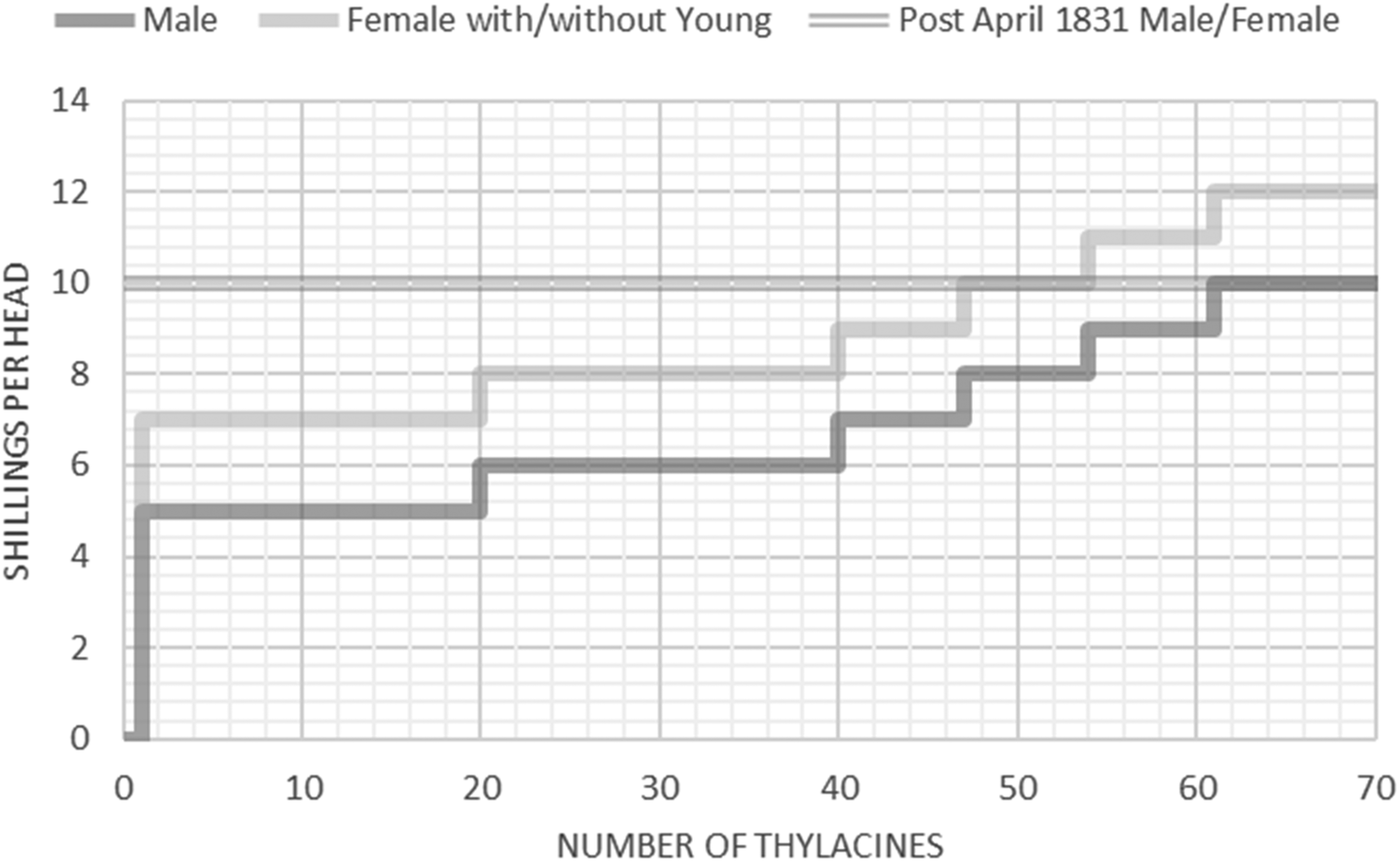
VDL Co. bounty pricing mechanism. Source: Compiled from Paddle (2002).
Paddle (2002: 110) describes the bounty as a ‘major plank in the edifice constructed for the thylacine as a significant predator on sheep’ that has ‘more to do with saving the necks of the management than saving the necks of the sheep’ (Paddle, 2002: 115). For example, The Hobart Town Almanack of the Year 1829 published on VDL Co.'s sheep production referred to poor management, weather and sheep crowding – not the thylacine predation. Yet the following 1830 publication placed blame on the thylacines – which then reversed to the original narrative described in 1829 in the 1831 publication (Paddle, 2002).
VDL Co. introduced a second bounty scheme, coinciding with an economic slump around 1840. Minimal records exist of the first bounty scheme, with Paddle (2002: 115) again arguing that the thylacine was merely an occasional predator on sheep ‘and most certainly not the major predator, or even the most obvious recipient of a bounty scheme’. According to Guiler (1985) the first bounty paid under VDL Co.'s second scheme was not recorded until 1850 and records indicated only 70 bounties being paid, an annual average of only five kills (Owen, 2011). Inadvertently, the bounties offered a rare insight into records of the thylacine and its behaviour: The hunting of the thylacine in pursuit of these bounties provided, in the historical record, some of the only extant observational records of the behaviours and family group structure of the thylacine. The notes of Archie Wilson, a bushman who came from a family of bounty hunters, recorded thylacine behaviour – an archival trace of the animal, presented as reluctant to stray from their ‘home range’, ‘shy and solitary’ and as capable of producing small litters of no more than four in a breeding season (Waterhouse and Mitchell, 2021: 4).
Yet, fear still existed as to the risk of thylacine to livestock (Waterhouse and Mitchell, 2021). Despite the apparently minimal return, numerous bounties were subsequently offered by other parties, including farmers, anti-thylacine associations, and finally the Tasmanian Government. Clyde Company, for example, which supplied meat to Hobart and surrounds through government contracts, also briefly introduced a thylacine bounty, lasting between July and October 1841 (Paddle, 2002). Paddle (2002) found, through analysis of the company archives, no specific instance of thylacine predation on sheep. However, he found significant suffering from predation by wild dogs, as well as the occasional stealing or attack by Aborigines, bushrangers, and convicts.
Associations and agents against the thylacine
Here, we reflect upon the link that Woinarski et al. (2017) highlight between those stakeholders involved in the management and prevention of extinction, which include a combination of Government, policymakers, standard setters, politicians, scientists, conservationists, customs and border security, educators, media, the public and so forth.
In 1884, the Buckland and Spring Bay Tiger and Eagle Extermination Association (SBTEEA), the first of four 7 ‘stock protection associations’ was established (Paddle, 2002) and introduced a bounty funded via membership fees. However, records indicate minimal thylacine kills but more importantly, this association was ‘a powerful rural body able to lobby its House of Assembly member, James Gray, to act on its behalf’ (Owen, 2011: 99).
In the same year, Mr James Gray, a member of the House of Assembly, presented a petition on behalf of 26 sheep owners that were described as having suffered serious losses by the thylacine, in order to grant Local Districts the power to impose rates on stocks (Paddle, 2002). Paddle (2002) notes that this could have been an attempt to enforce subscription to the SBTEEA. Yet, during the same period of time, annual reports by the Chief Inspector for Sheep revealed a contrasting position: While the petitions and bounty debates over the perceived threat of thylacines to the sheep industry were argued over in parliament between 1884 and 1887, resulting in the establishment of a government bounty in 1888, at no time was a thylacine problem ever entertained by the respective Chief Inspectors of Sheep. Their annual reports deal frankly with the problems of the industry over stock reduction and stock losses in the 1880s. Disease, drought and competition with rabbits are cited as the main environmental problems to the industry. At no stage in any of the official annual reports on the state of the industry during these crucial years was the thylacine mentioned even as a minor problem of significance to sheep farmers (Paddle, 2002: 143).
Gray continued with petitions and requested to debate the ‘ravages’ of the thylacines the following year (Paddle, 2002). On the pro-thylacine side of the debate, the Minister of Lands, N.J. Brown, was ‘deliberately inactive’ on the matter despite stating that it would be dealt with by the Cabinet (Paddle, 2002). Later, in 1886, Cabinet again did not appear to attend to a request for a small sum of money for the thylacine destructions (Paddle, 2002).
Government bounty and economic frames
Governments of Australia have promoted numerous bounties for ‘pest species’ resulting in the destruction of a vast number of animals and corresponding payments of millions of dollars (Allen and Sparkes, 2001) These have included dingoes, kangaroos and wallabies, pademelons, rat kangaroos, bandicoots, eagle harks, and so on. While Allen and Sparkes (2001: 86) do not find bounties are effective in dingo control, they note that ‘apparently, the perceived threat of predation and the intangible social and psychological rewards of a bounty outweigh their practical and economic failure’.
It was John Lyne who eventually tabled a successful motion to introduce a bounty on the thylacine: ‘He made ever-increasing, extravagant claims in parliament of the numbers of sheep killed by thylacines on his own “Gala” estate, and on the properties of other east coast farmers’ (Paddle, 2002: 150).
After multiple attempts since 1886 to introduce the debate to parliament, Lyne introduced a private bill in October with Parliamentary proceedings held on the 4th of November (Paddle, 2002). With 12 ayes and 11 noes, the motion to introduce a bounty was agreed on: The thylacine thus fell, victim of outrageous statistical exaggeration, blatant untruths and the buying of the racist vote. The power and influence of a political group – wealthy landowners – won the day over reasoned consideration. Facts did not matter; they scarcely entered debate (Owen, 2011: 105).
According to Guiler (1985: 29): ‘Those twelve parliamentarians who voted for the Bill to pay a bounty without enquiring into the authenticity of the facts and figures given have a great deal to answer for in the history of conversation in Tasmania’.
The bounty scheme eventually began in 1888 and run until 1909. The Tasmanian Parliament introduced its own bounty of £1 per adult and 10 shillings for a sub-adult. During the duration of the Government bounty scheme, 2184 bounties were paid for 2040 adult and 144 juvenile scalps (Dixon, 1989; Guiler, 1958). The bounty was good money for snarers, who presented the dead animal to a police station for their £1, or ten shillings if it was a pup. The toes or ears were removed to prevent the snarer taking the body elsewhere for another payment (Owen, 2011: 115).
But as Guiler (1985) described: Many trappers told me that up to half the thylacines killed were not submitted for bounty but were carted around the local property owners who paid a reward (usually £1) and when the carcass became too smelly it was dumped in the bush (Guiler, 1985: 24-25 cited in Owen, 2011: 115).
Furthermore, between 1878 and 1893, 3482 thylacine skins were exported to London in order to be manufactured into waistcoats, whilst visitors were offered ‘tiger’ shoots around 1909 (Dixon, 1989).
As such, comparable to the stream of accounting research, which reflects upon its role as having both negative (e.g., the ‘dark side’ of accounting such as examined by Pinto and West, 2017) and the positive side (e.g., extinction accounting such as Maroun and Atkins, 2018), bounties are far from amoral and reflect the moral framing within particular times and cultures.
Shifting frames and re-moralisation?
Framing and moral loading are not static conceptions. As Rhee et al. (2019: 6) note, moral recognition and significance can ‘fluctuate over time and across situations within individuals’. Moral emotions evoked (Rozin et al., 1997) with respect to the thylacine reveal the increasing concern about its rarity. As the thylacines’ context evolves, so do the social processes and social norms therein. Strengthening within the moral domain is the harm and responsibility for the thylacines’ rarity and continued existence. As a result, we reflect on the words of Brown (2018) who describes the shifting activities and moral salience within the moral domain.
Despite the bounty's introduction, there was a growing range of attitudes towards the thylacine through the 1880s, with various parties beginning to voice concern over the thylacines’ increasing rarity. These included naturalists and the Hobart Royal Society Museum staff voicing concern through newspaper editorials and letters to newspapers (Owen, 2011).
As the Government bounty commenced, the value and demand for live specimens began to increase as zoos flourished, helping to shift public perception (Owen, 2011). With European zoos becoming important in the scientific community in the late nineteenth century, the thylacine was seen as ‘exotic’ and sought after, particularly as warnings of its impending extinction grew and it became apparent that they could not breed the thylacine in captivity (Waterhouse and Mitchell, 2021): Outside of Tasmania they were exhibited at zoos in Adelaide, Melbourne, London, Liverpool, Berlin, Paris, Cologne, Antwerp, Washington and New York. The transportation and acclimatisation of these animals was often very fraught. The London Zoo displayed the first and last thylacine outside of Australia (Stark, 2018: 2).
There was a rapid decline in scalps after 1900, linked not only to the bounty scheme but also to a disease resembling distemper (Owen, 2011). Griffith (1972) adds that Tasmanian marsupials generally have a natural number-disease relationship rather than predator-prey, whilst also noting that humans may have introduced new diseases. However, the transportation of thylacine was also problematic. As Stark (2018) describes, of 25 thylacines transported to London, five had arrived dead, whilst a sixth had died only eight days after their arrival. Nonetheless, even in death, the thylacine was considered a tradeable commodity, with many having ‘found their way into museum collections such as the Hunterian Institute of the Royal College of Surgeons, the Zoological Institute in Stockholm, and the Natural History Museum in London’ (p.67).
With the increasing rarity, the prices for specimens were notably higher than the bounty offerings. When the last Government bounty was paid in 1909, which paid consistently £1 over the life of the bounty scheme, the export price was between £7 and £8 (Owen, 2011). The following year, the London Zoo purchased two thylacines for £28 each in 1910, then £150 for the last specimen in 1926 (Owen, 2011; Paddle, 2002). The dreaded Tasmanian wolf had therefore come to profit numerous groups: snarers and hunters through the bounty and the sale of pelts, exporters, zoos through their admission fees, and the sheep farmers twice over, for the thylacine had become a convenient cover for stock losses through mismanagement, and the government, not the farmers, was stumping up the bounty fees (Owen, 2011: 111).
Re-framing and re-moralisation towards conversation
Towards the close of the nineteenth century, industries including mining, dairy and timber were creating change, although agricultural land remained largely for sheep and cattle, and with it, 1901 saw the colonies join to form the Commonwealth (Owen, 2011). Naturalists such as Reverend Henry Dresser Atkinson and Geoffrey Smith wrote of the thylacine and newspaper articles showed changing perceptions (Owen, 2011).
In 1904, the first official group promoting the conservation of thylacine was formed: The Tasmanian Field Naturalist's Club. In 1908, the club appointed a general committee to create national park reserves for the preservation of native fauna with the aim of a bill to be passed through Parliament (Owen, 2011). Similarly, in 1914 Professor Thomas T. Flynn, a professor of biology at the University of Tasmania called for a sanctuary to be established for thylacine (Owen, 2011). Maria Island was mooted as a sanctuary and still holds that status-in-waiting. In 1915 the Tasmanian Scenery Preservation Board was established, which resulted in the first reserves being set up as well as an 11,000-acres national park: At this point, therefore, a fundamental shift had occurred. There was no longer any bounty schemes, safe havens were becoming available, and the public had begun to accept that the thylacine might be an asset, not a menace. Now, perhaps, science rather than politics might begin to chart a future for the seriously endangered animal. But in the bush, snaring and hunting went on, for skins and zoos. Thylacines were not to receive full protection for many years (Owen, 2011: 117).
However, by this time, sightings of thylacines were already rare. Clive Lord, the director of Hobart's Tasmanian Museum was a key party in the thylacines’ future. As well as publishing papers on Tasmania's mammals in 1917 and 1926–1928, Lord's effort resulted in thylacine protection in 1930 – preventing thylacines being hunted in December (thought to be the breeding month, Owen, 2011).
This small – but hard-won – step took some time to achieve results. In the 1920s the National Park Board was established to protect flora and fauna and in 1923 the Tasmanian Advisory Committee re Native Fauna was established, where Clive Lord was the secretary (Owen, 2011; Paddle, 2002). This resulted in the Committee recommending the protection of thylacine, including from exportation (Paddle, 2002). Owen (2011) notes that the latter was in part related to the high prices being offered by overseas zoos.
As Paddle (2002: 174) noted, following the move to protect the thylacine, pushback by particular parties was observed: [I] was immediately and effectively countered by rural-rump politicians and members of the conservative establishment who prevented, for as long as possible, any positive action being taken to preserve the thylacine, even as irrefutable evidence of the destruction of the species mounted.
In 1928, evidence was provided to Premier John McPhee regarding the thylacines’ endangered status, from data gathered by 38 police stations across Tasmania (Owen, 2011; Paddle, 2002: 178-179). Yet Clive Lord's attempts were repeatedly dismissed until 1930. According to Paddle (2002: 181), the Tasmanian Advisory Committee, taken over by the Tasmanian Animals and Birds Protection Board, was: Numerically controlled by a majority of newly appointed members selected by Cabinet, representing vested interests supporting the timber industry, the hunting and snaring of native game, and the uncontrolled expansion of agricultural enterprise.
The new board continued to defer consideration of the thylacines’ protection and by 1929, rather than considering the thylacine as being placed on the wholly protected list, the consideration was for the thylacine to remain in the schedule of animals unprotected (Paddle, 2002).
It was in 1930 that the hunting ban in December as well as the prohibition of exports could be passed. Despite this, snarers generally disregarded the prohibition and moreover, the measure increased the value of thylacine (Owen, 2011).
Beaumaris Zoo in Hobart, established by a wealthy Hobart socialite – Mary Roberts – hand reared a number of thylacines and also utilised the zoo to promote animal welfare through education and fundraising, including the event for the Royal Society for the Prevention of Cruelty to Animals (Owen, 2011). This event was attended by Governor Sir Henry Barron. Owen (2011: 129) suggested that: Mary Roberts was generally able to onsell thylacine for double the prices she paid to snares and trappers, with the prices themselves rising all the time. In 1910 she paid about £8 per thylacine; this had risen to £20 by 1919.
After the death of Mary Roberts in 1921, the zoo was donated to the Hobart City Council, resulting in the relocation of the zoo and the hiring of a new curator, Arthur Reid. Arthur Reid's daughter, Alison, took over the curation after Arthur's death (Owen, 2011).
Extinction despite re-framing and re-moralisation
The Tasmanian tiger now haunts the landscape not only in elegiac form, as a reminder of thoughtless intervention into ecosystems, but as a ghostly presence – tufts of fur amidst scrubby foliage, a flash of stripes caught out the corner of the eye (Waterhouse and Mitchell, 2021: 5).
Clive Lord continued to pursue the protection of thylacine with the Animals and Birds’ Protection Board up until his death in 1933. After his death, the Board did establish a committee to review the issue of saving thylacine (Owen, 2011).
A few years earlier in 1930, the last thylacine was killed in the wild, followed by the death of the last of the specimens in the London Zoo in 1931 and in 1936 in the Hobart Zoo. Fleay (1932) recorded silent video footage of the thylacine at Beaumaris Zoo, Hobart. This death, which occurred on 7th September 1936, was two months after the legislation was passed in the Tasmanian Parliament adding the thylacine to the protected wildlife list – by the then Tasmanian Governor, Ernest Clark, in July 1936 (Waterhouse and Mitchell, 2021). Paddle (2002: 185) described the death of the final thylacine, named ‘Benjamin’, as a result of: [A] series of insensitive and offensive administrative decisions made by a bureaucratic management structure with no representation from keeper or curatorial staff, no experience in animal care or zoo management and, ultimately, on economic grounds, no interest in the zoo's continuation.
As well as contributory factors such as the economic depression, Stark (2018) reflects on the thylacine at this point in time not being the ‘star attraction’, being less popular than those ‘exotic’ animals such as polar bears and leopards.
Since then, no specimens have been collected (Waterhouse and Mitchell, 2021). The Fauna Board (Animals and Birds’ Protection) Board sanctioned two searches in 1937, which resulted in footprints and investigation of some sightings, but nothing more (Owen, 2011). Over the next 40 years further searches occurred, with no substantial results (Waterhouse and Mitchell, 2021). David Fleay, the director of the animal sanctuary at Healesville, Victoria, led an expedition to capture a breeding pair at the end of World War II. Again, the group found footprints, obtained anecdotes of sightings, and heard a thylacine call, however, returned empty-handed (Owen, 2011). Between 1957 and 1966, eight official searches were undertaken by the Fauna Board. Eric Guiler,
8
who was chairman of the board at the time, was involved in each search (Owen, 2011). Owen (2011: 140) notes that: The Board was once again undermined by its own government, which secretly negotiated with a mainland media organisation and Life magazine to sell the visual rights arising out of any capture. Effectively, the government was auctioning off copyright in the thylacine.
All searches were unsuccessful. Griffith (1972: 123) painted a bleak picture, noting ‘there are very few natural, undisturbed, good game areas left in the State. Man's invasion of the wilderness alone will soon make it impossible for any thylacine to survive’. Here, a lack of untouched eucalypt forests, the unlikelihood of thylacines maintaining a habitat associated with logging activities, the burning-off of grass plains, and the ecological catastrophe of a significant fire in 1963 all contributed to the bleak assessment of the thylacine (Griffith, 1972).
In 1966, the government acquired Maria Island as a sanctuary for captured thylacines as a result of lobbying by Guiler and the Fauna Board (Owen, 2011). An additional group, the South-West Committee was also lobbying the board for a greater area, the southwest wilderness, to be protected, which the Hydro-Electric Commission was investigating as having commercial potential (Owen, 2011). Although not only in relation to the thylacine itself, rather the wilderness generally and the parties have come to a compromise on the issue, Owen (2011: 144) describes a situation beginning where: Three-way contact between Tasmania's Officialdom, its economic oligarchies and its conservationists. The first for Tasmania's future was about to start… Extinction, exploitation, preservation, had inevitably come together.
In 1968, James Malley, a real estate agent, and Jeremy Griffiths, a Sydney Zoologist, undertook what Owen (2011) describes as the largest expedition spanning four years. They were joined by Dr Robert Brown, who ran their Launceston information centre, in 1972 with the trio being known as the Thylacine Expedition Research Team and again the expedition was unsuccessful (Owen, 2011).
In 1978 – this time funded by the World Wildlife Fund, Eric Guiler and Steven Smith, from Tasmania's National Parks and Wildlife Service (previously the Fauna – Animals and Birds’ Protection – Board), began a two-year search, again finding nothing. Subsequently, Steven Smith wrote a report agreeing that the thylacine was probably extinct in 1980 (Smith, 1981). In 1985, Guiler published his book Thylacine: The Tragedy of the Tasmanian Tiger, then by 1986 the thylacine was formally extinct (Department of the Environment, 2023). An extinction that was notably predicted by naturalist John Gould in 1863: When the comparatively small island of Tasmania becomes more densely populated, and its primitive forests are intersected with roads from the eastern to the western coast, the numbers of this singular animal will speedily diminish, extermination will have its full sway, and it will then, like the Wolf in England and Scotland, be recorded as an animal of the past: although this will be a source of much regret, neither the shepherd nor the farmer can be blamed for wishing to rid the island of so troublesome a creature. A price is already put upon the head of the native Tiger, as it is called; but the fastnesses of the Tasmanian rocky gullies, clothes with impenetrable forests, will, for the present, preserve it from destruction (Gould, 1863: 60).
As Woinarski et al. (2017) note, the narrative of thylacine is ‘deeply marked’ by the presence and intervention of humankind and its framing. Yet, the thylacines’ demise has subsequently resulted in an ‘enduring presence in the cultural life of Tasmania and has become an international emblem of extinction’ (Stark, 2018: 1).
As a result of the thylacines’ extinction, it has been described as a ‘martyr’ (Banks and Hochuli, 2016: 390; Waterhouse and Mitchell, 2021: 19). As Waterhouse and Mitchell (2021: 19) describe its mythical status ‘is reanimated for advertising, publicity and the formation of local identity’. This framing reflects the thylacine as being a symbol for the political, social and capitalist, as it appears ‘in the branding identity for a television station, a furniture removal company, a fruit and vegetable wholesaler, an abalone company, a bus line, a supermarket, a publisher, craft stalls at Hobart's famous Salamanca Market, amongst others’ (Waterhouse and Mitchell, 2021: 19). Despite this though, Waterhouse and Mitchell (2021) see thylacine in this regard as ecological hope. In doing so, they then question whether for example, the thylacine is more valuable in this regard than as undergoing de-extinction.
Framing with respect to accounting historicism
The thylacine has been formally recognised as extinct, with numerous factors linked to its initial decline and eventual demise. Whilst its recent framing reflects that of ecological hope, in colonial times it had developed a reputation as a sheep killer and savage, culminating in numerous bounties placed on its head. This article exemplifies the contrasting frames underpinning its eventual decline, within the context of the agricultural industry from early Tasmanian settlement to post-Federation. In doing so, we extend extant archival research (in particular, Guiler, 1985; Owen, 2011; Paddle, 2002) with respect to the implications for accounting historicism, framing and moralisation. Further, we respond to Russell et al.'s (2017) call for research on historical case studies of calculative practices that mediate relations between humans and nature. We now turn more specifically to these intertwined issues.
Framing and moralisation with respect to notions of accountability
Considering framing and moralisation with respect to accounting and accountability, we reflect on the consequences arising from framing and moral loading by humankind, contrasting between commercial sheep operations the colonial settlement introduced and their native ‘pest’. Through these ventures, the framing of thylacine was quickly demoralised within this colonial context and reflected the cultural perceptions that prevailed in Britain. In essence, early settlement sheep were given higher moral loading, whilst the thylacines’ moral loading was shed. Bounties transformed from being localised, offered by farming enterprises, to more widespread government-initiated and funded arrangements. Bounties offered an economic reward for the destruction of the thylacine, reinforcing the framing of the thylacine and further augmenting the focus of financial interests. Thus, indicating that economics colonised and crowded out ‘alternative ways of determining values, decision outcomes and even what becomes thinkable’ (Russell et al., 2017: 1434). The framing of thylacine and its accounting influenced how people were able to see and understand the world, thus ‘creating particular possibilities for thought and action’ (Cuckston, 2022: 1442).
This ecological conceptualisation can be linked to the non-neutral role of accounting (Gallhofer et al., 2015; Maroun and Aitkins, 2018; McNichols and Barrett, 2005) and the interrelated conceptions of shifting accountability. Accounting itself is not amoral and can foster both positive and negative impacts (Carnegie et al., 2020). In particular, accounting is seen as a capable (culpable) enabler – in positive terms (such as recent approaches to extinction accounting aimed at capturing and preventing an entity's negative impact on biodiversity, reflected in the framework proposed by Maroun and Atkins, 2018) – and negative terms (such as the ‘dark side’ of accounting, where accounting has been linked to the perpetration of genocide and slavery, see e.g. Pinto and West, 2017). 9 Vollmers (2003) reminds us that behind the role of accounting – the routine, the banality – are stories of hardship and oppression, masked through accountings’ process of commodification.
The framing and moral domain aligned with the contrast in expectations of handsome profits and successful sheep farming (economic missions) and the reality of conditions as sheep numbers increased with the passage of time (economic pressures). Following Vollmers (2003) on banality and commodification, we see it as equally critical that banality in accounting – that is, the bounds of accountability – is an outcome of positive or negative stories. In some respects, it can be seen as both and/or as a pendulum, dependent on framing with respect to time and stakeholders.
Here, we posit that framing and moralisation drive shifting notions of accountability and the role of accounting. Norms and generally accepted principles ebb and flow through their interaction within communities, and as a result, communities can become captive by them (Morton, 2019).
For this latent source of environmental history, commercial sheep operations were rewarded by increased legitimacy and survival by the framing and moral domains. By the time this framing had become formalised through government bounties, the harm was being masked by well-established and substantially anthropocentric bias in considering biodiversity. For example, whilst for commercial sheep operations, sheep were in need of protection, we recognise that this was not free from harm. Their existence was founded upon their ultimate destruction (meat) and/or commodification (wool) of the sheep. Livestock value was inherently connected to anthropocentric notions of quality (age, pedigree, dispositions) and continued demand for their commodification (thus increasing quantities of sheep were observed). These perceptions continue in contemporary accounting practice.
In contrast, the thylacine was represented as effectively a liability (sheep predation) until commodification of harm similarly occurred; whether via bounties (price, reward), through the production of goods (e.g., waistcoats), for scientific investigations (specimens) and/or for entertainment (zoos, photo shoots). Thylacine's value was inherently connected to anthropocentric notions of rarity (thus decreasing quantities of thylacine increased notions of value). Here, perceptions (framing, intangible) rather than physicality (stock, natural capital).
Framing and moralisation with respect to stakeholders
Reflecting on framing and moralisation with respect to stakeholders, we consider the need to recognise the perceptions of objectivity, truth and faithfulness in records (see e.g. Bayou et al., 2011; Chambers, 1991; Collett, 1995; Hines, 1988; Moore, 2009; Morgan, 1988; West, 2003). However, we also examine how framing and moralisation drive interpretation across stakeholder groups. We have already highlighted the notion that norms over time can constrain principles, so too can conceptions of stakeholder sensemaking.
Within this context, we can consider the framing and moralisation across a multitude of key stakeholders, from nature itself to First Peoples, European settlers, sheep farmers such as VDL Co. and their overseas directors, government, police, bounty hunters, anti-thylacine associations, pro-thylacine associations, naturalists (such as John Gould), zoos (national and international), newspapers, publishers, convicts and bushrangers and so forth.
For example, Paddle (2002) describes the VDL Co. narrative as appearing to suggest the entire population of thylacines was turning its attention to its flocks of sheep despite its records failing to support significant thylacine predation on sheep. Similarly, Guiler (1985) questioned the parliamentarians for not enquiring into the authenticity of facts and figures presented as part of the private bill that led to the Government bounty scheme. Despite evidence to the contrary, including those from credible sources (police stations and Annual Reports by Chief Inspectors), the thylacine was still being considered a threat, regardless of the questionable facts that were purportedly relied upon by influential stakeholders. Following Mulder et al. (2015) the framing mechanism, the activity of destruction fell within the framing that considered the ‘harm’ caused by the thylacine and not the harm caused to it.
We reflect on the notion of ‘hypocognition’, the lack of cognitive or linguistic representation of concepts, which creates pervasive and powerful constraints on stakeholder sensemaking (see Wu and Dunning, 2018: 25). The impacts of hypocognition relate to the lack of capacity to understand and explain what is happening (Wu and Dunning, 2018). The resulting consequence is an effortless interpretation of information and events – precluding active cognition or leading to muted or underdeveloped ethical prototypes (Beach, 1990; Gioia, 1992; Piaget, 1929; Reynolds, 2006). Simply put, we reflect on stakeholders within the context of thylacine and their filtering of experiences (Werhane, 2008). Individuals and organisations: [S]ometimes have a narrow perspective of their situation and little in the way of moral imagination. They lack a sense of the variety of possibilities and moral consequences of their decisions, the ability to imagine a wide range of possible issues … consequences, and solutions. Worse, some individuals and institutions are trapped in the framework of history, organization, culture, and tradition of which they are only at best, vaguely aware, a framework that often they allow to drive their decision-making to preclude taking into account moral concerns (Werhane, 2008: 76).
So not only do we recognise the framing and moral domains with respect to accounting and accountability broadly, but diversity in moral imagination arises across stakeholders. Whilst we can reflect on the role of accounting and accountability – including the quality of inputs and therefore formal information – there is a need to recognise the diversity in the framing of the receiver and the impact this has on the interplay with accounting and accountability.
Framing impacts notions of value, thus the interpretation of data and the conceptions of accounting mechanisms. This creates the potential for competing or contradictory frames, and the need to consider the reconciliation of frames. For example, whilst a ban on hunting thylacine during the month of December was seen as a win for the pro-thylacine stakeholders, two key points are relevant: (1) snarers disregarded the prohibition, and (2) the value of thylacines increased. This connects with the bundle of factors that can drive norm development within communities (Morton, 2019).
Framing and moralisation as dynamic and temporal with respect to accountability
Although the framing ultimately shifted and the thylacine re-moralised, the harm of its extinction was not prevented. The thylacine continues to yield moral loading; however, it too has continued to evolve. It has shifted towards a symbol of ecological hope, and as such, holds moral loading in its continued extinction rather than in its potential for de-extinction. Here, the moral loading balances towards the protection of other species – in essence, a mea culpa.
We find the explicit recognition of judgement and subjectivity, the contrasting framing of being charismatic (non-charismatic), the interactions of conflict of interest in valuation, the impact of slow decision-making, and reaction time with respect to biodiversity and sustainability. This historical case exemplifies the interplay of nature conservation and the issues of framing in accountability.
Following Mulder et al. (2015) the thylacines’ framing reverted: the activity of destruction fell no longer within the framing that considered the ‘harm’ caused by the thylacine, but the harm caused to it. Bounties dropped away; a liability was imposed to provide safe havens as the thylacine was morphed into something of value. Following its extinction, the value is derived through derivative notions – video footage, art, narratives, and symbolic hope towards biodiversity conservation.
Critical to these considerations are perceptions of temporality and shifting community narratives, which are driven by a bundle of factors, not necessarily those that are formalised through institutional governance processes (Morton, 2019). Stakeholder framings are critical.
Moralisation and framing, we posit, are necessary for the same sense as non-neutrality. We conclude that whilst values may be lost through demoralisation, these are not static. As the role of accounting and notions of accountability shift, re-alignments of frames lead to re-alignments of representations. Here, we see contrasting representations during colonial settlements for animals that aligned with the cultural norms within the agricultural industry (sheep farming) thus actions more readily reflected interest, attachment, and accountability. In contrast, despite the thylacine being native to Australia, its lack of status within the moral domain created a detachment. There was a lack of accountability, therefore, a lack of moral responsibility to harm that ultimately occurred.
We reiterate here this framing and moralisation with respect to historicism and respect the need to relinquish contemporary value imposition in this analysis, as outlined earlier in this article. The need to do so comes from the implicit shift over time towards broader conceptions of accounting and accountability (Carnegie, 1997; Carnegie et al., 2020). Depending on ‘when’ our perceptions develop, accounting and accountability may be biased by – or masked – in favour of anthropocentric objectives. Critically, we note that not even contemporary perspectives are yet to resolve the critical concerns of mass extinction. Humanity may not only itself be at risk of extinction, but our extinction may be the ultimate solution to ecological sustainability (Gray and Milne, 2018). 10
Notions of accounting enabling positive (preventing extinction) and negative (facilitating extinction) outcomes are temporal and stakeholder dependent. Earlier settlers arrived in Tasmania with framing driven by the British institution (Carnegie, 1997). Due to the multitude of factors evolving with their time in Tasmania, these evolved – positive revolved around preventing harm to sheep, and outside of those moral bounds, was the consequential harm to the thylacine.
Over time, thylacines morphed from ‘ugly’ to ‘symbolic’ – in one sense this could be interpreted as transcending anthropocentric bias. We posit, however, that instead the pendulum has swung – still fundamentally resting within anthropocentric bias – simply seen as an attractive notion of ‘hope’ to humanity. The ugliness inherent in this is reorientated to the cause being humanity. Transferred to the resultant act of extinction. Now, thylacine has value in the commodification of its derivative existence: brand power. To prevent future extinctions and to champion sustainability.
Whilst in the colonial period the lack of ‘charisma’ or ‘attractiveness’ in the positive sense of the thylacine (see Atkins et al. 2014; Maroun and Atkins, 2018), contributed to its extinction, its very extinction created connectedness in the sense of it being a victim of harm, enabling it to be seen in a more charismatic light and thus champion conservation causes (see e.g. Cuckston, 2022). In doing so, there is no evident departure from the anthropocentric bias, instead, anthropocentric framing and re-moralisation are fundamental in accounting and nature conservation. Framing drives the human-nature relationships, therefore drives the scope of biodiversity considerations.
Critically, framing and re-moralisation are neither dichotomous nor rapid. Shifts in standards and norms underpinning behaviour can take time and turn on bundles of factors at play within communities (Morton, 2019). The concern is that some argue sustainable reporting in contemporary times may make developments more unsustainable (Tregidga et al., 2013). Through a lack of connection to the very thing it is purporting to protect – nature – and therefore obfuscating the contradictions within capitalism (Spence, 2009; Tregidga et al., 2014). Maroun and Atkins (2018) highlight for example with respect to Integrated Reporting, the issue of treating all six capitals as equal: without natural capital, all others are ‘meaningless’. Moreover, they note that the majority of contemporary biodiversity disclosures are generally anthropocentric, focused on financial and reputational management, and focus on species considered ‘charismatic’ or ‘attractive’ (Atkins et al., 2014; Cuckston, 2022; Maroun and Atkins, 2018). Accounting humility may help, through the recognition that we do not know the workings of nature and its interconnections (Russell et al., 2017).
Final remarks
Historical case studies are needed to understand the relationships between humans and nature (see e.g. Russell et al., 2017). Here, we have explored the framing and moralisation of the thylacine, by presenting a narrative of contrasting, contemporaneous frames with respect to nature, and the consequential shifting of accountability over time. Framing and moralisation drive shifting notions of accountability and the role of accounting. Moreover, positivity (negativity) therein is dependent on framing with respect to time and stakeholders. These ebb and flow, like a pendulum, and can lead to particular communities becoming captive (whilst others remain free) driven equally by contrasting framing and moralisation. Inherently, our relationship with nature is founded upon anthropocentric notions, such as quality, demand, or rarity.
These framings lead to constraints on sensemaking and therefore diversity in moral imagination, which interplays with notions of accounting and accountability. In short, framing impacts notions of value, thus the interpretation of data and the conceptions of accounting mechanisms. Understanding competing or contradicting frames and the processes in which we can reconcile frames is necessary. To do so however requires consideration of temporality and shifting community narratives. Re-aligning frames lead to re-aligning representations; however, these are neither dichotomous nor rapid.
Overall, we reiterate that notions of accountability within colonised countries reflect their home country and the institutions evolving within those newly established settlements (Carnegie, 1997). The narrative presented with respect to thylacine implicitly supports this proposition. Framing and moral domains reflected here are those of the British as distinct from the Indigenous First Peoples. The First Peoples’ connection to thylacine was distinct. We recognise whilst this article focuses on thylacine, there is a parallel destruction of the First Peoples and their cultures occurring. Recognising the authors’ Western perspectives, further work is needed in examining, acknowledging, and reflecting upon the western framing and therefore roles of accounting and accountability through colonisation.
Footnotes
Acknowledgements
We would like to acknowledge the Accounting History Special Interest Group as well as the organisers of the Accounting History Symposium 2018, the participants and reviewers. We would also like to thank Professor Niamh Brennan for the thoughtful feedback in the early shaping of this project.
Funding
The author(s) received no financial support for the research, authorship, and/or publication of this article.

Notes
Timeline of a selection of events in Van Diemen's Land (modern day Tasmania) history with respect to the thylacine.
| Year From | Year To | Detail |
|---|---|---|
| 1642 | The Dutch explorer, Abel Tasman, referenced footprints resembling a tiger on the shores of Van Diemen's Land (VDL). | |
|
|
||
| 1803 | Original European settlement along the Derwent River, approximately 30 sheep were introduced. | |
| 1805 | Lieutenant- Governor William Paterson reported a thylacine sighting in northern VDL. This sighting appeared in the Sydney Gazette in April 1805, with descriptions such as hyaena and low wolf dog – along with ‘it is very evident that this species is destructive’ (cited in Owen, 2011: 54). | |
| 1805 | Reverend Robert Knopwood recorded a sighting of the thylacine in his journal account of some escaped convicts: Engaged all the morn upon business, examining the 5 prisoners that went into the bush. They informed me that on the 2 of May when they in the wood, they see a large tiger; that the dog they had with them went nearly up to it, and when the tiger see the men which were about 100 yards away from, it went away. I make no doubt but here are many wild animals which we have not seen (cited in Cowley and Hubber, 2000: 27-28). |
|
| 1807 | George Prideaux Harris, the Deputy Surveyor-General of the Colony, gave the first scientific description given to the Linnaean Society of London after two thylacines were caught in kangaroo traps in Hobart. | |
| 1808 | Harris (1808: 174) describes a specimen as resembling a wolf or hyena, having ‘eyes large and full, black, with a nictitant membrane, which gives the animal a savage and malicious appearance.’ | |
| 1817 | Two verified attacks on sheep by thylacines. | |
| 1819 | The sheep population is now approximately 172,000. | |
| 1819 | Wentworth (1819) publishes the first reference to thylacines in book format, which is influential and including ‘extravagant’ claims of the destructive impact of thylacines on the sheep industry in Tasmania. | |
| 1822 | Evans Markets VDL to emigrants. | |
| 1823 | One verified attack on sheep by thylacines. | |
| 1824 | Edward Curr publishes a book on successful sheep farming in Tasmania. | |
| 1825 | Van Diemen's Land Company (VDL Co.) is established in London. Edward Curr is appointed Chief Agent after impressing the directors with his 1824 book; Stephen Adey named Joint Commissioner., Under Adey is Alexander Goldie, responsible for clearing and fencing, land cultivation, general charge of livestock (Meston, 1958). | |
| 1826 | VDL Co. representatives arrive in Tasmania to begin an exploration of suitable farming land. Henry Hellyer placed in charge of the survey department and housing, with primary control over sheep and wool production. Surveyors arrived in northwest Tasmania and selected open country at Woolnorth and the Hampshire and Surrey Hills area after being granted 250,000-acre land grant. | |
| 1826 | 1828 | Allotted land named Woolnorth at the north-west tip, land named the Hampshire Hills, Surrey Hills and Middlesex Plains in the central north-west |
| 1827 | Problems with discipline and productivity from Adey and Goldie at Circular Head result in Curr relocating to Circular Head and Adey is returned to Hobart as the Company's Agent. The Hampshire Hills and Surrey Hills are in poor condition. | |
| 1828 | VDL Co. Extends land holding to 350,000 acres, essentially gaining a monopoly over the north-west corner. There are issues with Adey withdrawing company funds, resulting in his resignation. VDL Co. and Curr are plagued with uncertainty of the company's financial security. | |
|
|
||
| 1829 | Influential book referencing the thylacine is published by Widowson, which includes detail of the thylacines as a significant killer of lambs. | |
| 1829 | VDL Co. introduce Saxon merino sheep to the Hampshire Hills and Surrey Hills holdings, which was subsequently considered a ‘disaster’ with only a few hundred surviving of an initial 5500. | |
| 1829 | The Hobart Town Almanack of the Year 1829 - publishes on the company's sheep production referring to poor management, weather and sheep crowding - not thylacine predation. | |
| 1829 | 1830 | Thylacines have a purported devastating effect on VDL Co.'s sheep flocks, causing two of the company's holdings to be discontinued (Surrey Hills, 150,000 acres; Hampshire Hills, 10,000 acres). |
| 1830 | The sheep population of VDL is more than a million. | |
| 1830 | 1838 | VDL Co. introduce their first bounty, recorded by Curr in the company's Letterbook. |
| 1830 | Curr records that one sheep was killed by a thylacine at Woolnorth before being destroyed. | |
| 1830 | Hobart Town Almanack of the Year 1830 - published on the company sheep production, this time with the blame placed with the thylacines. | |
| 1830 | 1834 | George Augustus Robinson diary entries relate to VDL Co. and the thylacine. |
| 1831 | Hobart Town Almanack of the Year 1831 - published on the company sheep production, this time returning to the narrative similarly described in 1829. | |
| 1831 | Curr notes that one or two thylacines ‘supposedly’ kill three lambs at Woolnorth. | |
| 1832 | 1852 | One of Guiler's (1985) analyses of VDL Co.'s records suggest that 48 sheep of 688 sheep lost to predation were linked to the thylacine at Surrey Hills (equating to less than 7 per cent). 228 were linked to wild dogs and 412 were unspecified. |
| 1840 | 1914 | VDL Co. introduce a second bounty scheme, coinciding with an economic slump. Payment rates were of an increasing scale, however 40 per cent lower than the first bounty. |
| 1841 | 1841 | Clyde Company ran a thylacine bounty between July and October 1841. |
| 1863 | Naturalist John Gould predicts that the thylacine will become extinct. | |
| 1878 | 1893 | Thylacine skins exported to London for manufacturing into waistcoats. |
| 1884 | The Buckland and Spring Bay Tiger and Eagle Extermination Association (SBTEEA) formed relating to the protection of stock. | |
| 1884 | 1885 | Mr James Gray, member of the House of Assembly, presented a petition regarding the loss of sheep by thylacines and continued to petition and request debates. |
| 1886 | Cabinet is requested to fund destruction of thylacines. | |
| 1886 | Parliament debates over thylacines and sheep losses eventually result in successful motion through a private bill by John Lyne on the 4th of November 1886 regarding the destruction of thylacines and associated bounty. | |
| 1888 | 1909 | The Tasmanian Parliament introduce a bounty of £1 per adult and 10 shillings for a sub-adult. |
|
|
||
| 1880s | Annual Reports by the Chief Inspectors of Sheep report no problems arising from the thylacine. Instead, the reports highlight issues with respect to disease, drought and rabbits. | |
| 1893 | Hobart Mercury reports of ‘sick’ tiger at the Adelaide Zoo. | |
| 1895 | Mary Roberts, a Hobart socialite, established the Beaumaris Zoo. | |
| 1900s | Rapid decline in scalps. | |
| 1901 | Federation of Australian Colonies formed. | |
| 1904 | The Tasmanian Field Naturalist's Club (TFNC) was formed for the purpose of conservation. | |
| 1908 | Committee of the TFNC formed to create national park reserves for the preservation of native fauna. They aimed for a bill to be passed through Parliament. | |
| 1909 | Last Government bounty paid (£1) whilst exports paid between £7-8. | |
| 1909 | Thylacines exported to London were used for ‘tiger’ shoots for visitors. | |
| 1910 | Mary Roberts pricing per thylacine £8. | |
| 1910 | The London Zoo purchase two thylacines for £28 each. | |
| 1914 | Professor Thomas T. Flynn called for a thylacine sanctuary. | |
| 1914 | Three thylacines were presented for the VDL Co. bounty. | |
| 1915 | Tasmanian Scenery Preservation Board established, with an 11,000-acre national park and reserves set up. However, snaring and hunting continued. | |
| 1917 | 1928 | Clive Lord, Director of Hobart's Tasmanian Museum published papers on Tasmanian mammals. |
| 1919 | Mary Roberts pricing per thylacine £20. | |
| 1923 | The Australian Federal Government prompted the Tasmanian Government to establish the Tasmanian Advisory Committee re Native Fauna. This committee was responsible for informing the ‘Federal Minister for Trade and Customs’ of those species requiring protection. | |
| 1924 | Last captive thylacine purchased by Beaumaris Zoo. | |
| 1926 | The London Zoo purchases a thylacine for £150. | |
| 1926 | Scientific publication of Australian animals by Le Souef and Burrell. | |
| 1928 | Premier John McPhee was presented with evidence on the thylacine's endangered status from 28 police stations. | |
| 1929 | The thylacine remained on the schedule of animals unprotected. | |
| 1930 | Clive Lord successfully protected thylacines from being hunted during the month of December, which was thought to be their breeding month. | |
| 1930 | The last thylacine is killed in the wild. | |
| 1931 | The last overseas-held specimens die in London Zoo. | |
| 1932 | Fleay (1932) recorded silent video of the thylacine at the Hobart Zoo. | |
| 1933 | IUCN recorded last confirmed sighting of a thylacine. | |
| 1936 | The thylacine is added to the protected wildlife list | |
| 1936 | In September 1936, the Last specimen dies in the Hobart Zoo, two months following the change in status of the thylacine. | |
| 1937 | Two searches are sanctioned for evidence of the thylacine. Beyond footprints and reported sightings, no thylacines were located. | |
| 1957 | 1966 | Eight searches were undertaken, all being unsuccessful. |
| 1963 | Significant fire event. | |
| 1966 | Government acquired Maria Island to use as a sanctuary. | |
| 1968 | 1972 | James Malley and Jeremy Griffiths undertook a four-year expedition. Dr Robert Brown was added to the team in 1972. The search was unsuccessful. |
| 1978 | 1980 | Eric Guiler and Steven Smith undertook a two-year expedition. The search was unsuccessful. |
| 1981 | Steven Smith published a 1980 report confirming that the thylacine was ‘probably extinct’. | |
| 1982 | 2012 | IUCN makes regular assessments as to the extinction status of the thylacine. |
| 1985 | Eric Guiler published the book Thylacine: The Tragedy of the Tasmanian Tiger. | |
| 1986 | By this time, the thylacine is considered formally extinct based on national and international standards. | |
Source: compiled from Boyce (2006); Cowley and Hubber (2000); Dixon (1989); Guiler (1985); Harris (1808); Meston (1958); Owen (2011) and Paddle (2002).