




Abstract
As in other disciplines, the Atlantic slave-trade and New World slavery have assumed an increasingly contentious role in accounting history. In her Accounting for Slavery, Rosenthal has recently located many current business practices in the nexus between accounting, capitalism and slavery. Other accounting historians have explored slave-trading ventures from Africa, the role of accounting and slavery in New World colonisation, and in accounting and managerial practices in the slave-estates of the Americas. Absent from the extant literature are studies that explore the nexus between accounting, capitalism and slavery from a multi-continental perspective that considers Atlantic slavery as an integrated whole. This study, by drawing on the Trans-Atlantic Slave-trade Database, seeks to fill this gap, examining the correlations between Atlantic slavery and African demographic and social regression, European prosperity and New World accounting and managerial practices. In doing so, it argues that accounting played a fundamentally different role in the slave economy to that which it undertook in emerging systems of industrial capitalism.
Introduction
Reflecting upon the research into Atlantic slavery, Fleischman et al. (2004: 37) observed in 2004 that although economic historians had ‘dissected the institution of slavery from virtually every conceivable perspective’, the ‘contribution of accounting historians’ was ‘sparce’. No one could come to such conclusions today as critical accounting historians locate capitalism's origins in the nexus between slavery and accounting. Among critical accounting studies, arguably the most significant is Rosenthal's recent Accounting for Slavery. According to Rosenthal (2018: 8), the ‘business innovations’ pioneered in the slave-plantations of the American South ‘were as central to the emerging capitalist systems as those in free factories’. A seminal feature of these innovations, she argues, was the use of accounting systems that underpinned a ‘profit-hungry labor regime’ (Rosenthal, 2018: 2–3). In a subsequent article, Rosenthal (2020: 309) argued that it is only ‘through the reductive lens of accounting’ that we can understand the nexus between slavery and capitalism. It was, she argues, through plantation inventories that slave labour was ‘commodified, calculated and allocated’ (Rosenthal, 2020: 303). Annisette and Ajnesh Prasad (2017: 9) also argue that capitalism was built on colonialism, slavery and ‘racialized accounts’ that tended to ‘de-humanize’ the racial ‘other’. In their study of Danish slave-trading ventures, Jensen et al. (2021: 1) similarly conclude that accounting made ‘humans visible as articles for trade while rendering invisible the innate, human qualities of enslaved Africans.’ Elsewhere, accounting historians have pointed to the role of accounting and slavery in the colonisation of the Caribbean (Graham, 2019; Tyson and Oldroyd, 2019) and Brazil (Pinto and West, 2017; Rodrigues et al., 2014; Silva et al., 2019). Others have used accounting records to explore slavery's role in the long-term economic success of France (McWatters and Lemarchand, 2009) and Britain (Draper, 2008; Eltis and Engerman, 2000; McDade, 2011).
The growing literature on the role of accounting in both slavery and the slave-trade features profound theoretical differences. Whereas Rosenthal (2018) sees Atlantic slavery as the cradle of modern capitalism, the Marxist accounting historian, Rob Bryer (2012: 528), argues that any such conclusion reduces capitalism to a single dynamic: exploitation. In truth, Bryer suggests, slavery was only interested in output-maximisation. By contrast, modern capitalism seeks advantage by lowering ‘the cost of production’ (Bryer, 2012: 542). Research into slavery and the slave-trade also features differences as to basic facts. Walvin (2019: 10, 14), for example, observes of the port of Liverpool that it rose to ‘commercial prominence on the back’ of the slave-trade. By contrast, the British abolitionist, Thomas Clarkson (1808: 59), after studying subsequently lost customs’ records, recorded that ‘Liverpool owed its greatness to … very different causes’. Of the city's 170,000 tons of shipping in 1787, only 13,000 tons was involved in the slave-trade. In terms of the slave-trade's demographic effects on Africa, Thomas (1997: 796) estimated that any losses were offset by nutritional gains obtained from the ‘introduction of those two wonderful American crops, maize and manioc’. By contrast, Law (1991) and Manning (2014) point to systematic ‘depopulation’. In reflecting upon Affleck's Plantation Record and Account Book, the most widely-used accounting system in the antebellum South (i.e., the southern United States before the Civil War of 1861–65), Rosenthal (2018: xii) declared it the ‘most comprehensive record book’ she has ever come across. Heier (1988), however, concluded that Affleck's system featured confusion and basic accounting errors. According to Rosenthal (2018: 2) plantation accounts in America's antebellum South were characterised by an intense productivity focus. By contrast, Tyson and Oldroyd (2019: 225) observe that ‘accounting records’ in both the antebellum South and the British West Indies ‘were rarely used to measure efficiency’.
Debates as to the nexus between accounting and slavery raise two related but nevertheless distinct issues: what role did accounting play in facilitating slavery and the slave-trade, and what do accounting records tell us about the nature of slavery and the slave-trade? From these central questions flow a number of secondary questions. Was slavery, as Rosenthal and others suggest, a forerunner of modern capitalist forms of management and control, or, alternatively, was it as Genovese (1965 [1989]) suggested, the very antithesis of capitalism? What was the short and long-term impact of the slave trade on Africa? Was Atlantic slavery and the slave-trade seminal to European industrialisation and wealth? In speaking to these questions this study addresses what we suggest are seminal problems in not only the accounting history literature but also the broader historical debate. Most obvious is the tendency to study discreet parts of Atlantic slavery (e.g., African circumstances, the mechanics of the slave trade, slave practices in the Americas) rather than perceiving the system for what it was: an integrated whole. Our analysis, therefore, differs from earlier studies in that it draws on the Trans-Atlantic Slave-trade Database (TASTD) found at www.slavevoyages.org to provide a multi-continental perspective that explores African circumstances, the significance of the slave-trade to European prosperity, and the nature of New World slavery. In our view, understanding the impact of slavery on Africa is as important as comprehending its significance in United States history. The second issue this study confronts is theoretical. In Rosenthal’s (2020: 331, 303) estimation, capitalism was built ‘on the commoditization of labor’, a process that subjected both slaves and waged-employees ‘to the same kinds of quantitative manipulation’. The view that slavery was an extreme form of capitalism is one that increasingly goes unchallenged. Even Tyson and Oldroyd (2019: 221) suggest that ‘the use of accounting appears unequivocal in support of the capitalist/slave-owner perspective’, even as they point to the absence of a productivity focus among plantation owners. To this assumption this study offers a counterview.
In exploring answers to these questions, this article begins by drawing a distinction between New World slavery and capitalism, or, to be more exact, the industrial capitalism that emerged from the mid-eighteenth century. While both slavery and industrial capitalism witness exploitation, the latter is also distinguished by waged labour and capital intensity. By contrast, as Marx (1894 [1959]: 788–89) observed in Capital, slaves are part of the slave-owner's stock of capital. By investing their capital in slave labour rather than machinery, slave-owners thus committed themselves to a production system that was fundamentally different to that associated with industrial capitalism. Within this slave system, we suggest, accounting also served fundamentally different ends to those required by industrial capitalism. Whereas matters relating to plant and machinery were of marginal significance on slave-plantations, they were central to the accounting practices of industrial corporations. For such firms, as Garcke and Fells (1893: 76) observed in 1893, ‘the question of the depreciation for factories and of plant must be regarded as … of paramount importance.’ Our second finding, which draws on TASTD estimates is that the slave-trade's direct demographic effect on Africa was significant but not enough in itself sufficient to cause a demographic retreat. The slave-trade's effects were nevertheless pernicious, causing internecine strife and an expansion of domestic slavery. Drawing again upon the TASTD, our third finding is that there was little correlation between slave-trade participation and national wealth. Among slave-carriers, Portugal and its Brazilian offshoot were pre-eminent, responsible for 47.7 per cent of the slaves carried to the Americas. The Netherlands carried only 4.4 percent (TASTD: estimates – flag of carrier). While the Netherlands prospered, however, Portugal remained poor. Our final finding contradicts the argument that accounting was seminal to ‘scientific agriculture’ in the America's antebellum South (Rosenthal, 2018, 2020). Not only did Affleck's accounting scheme – the most widely used system in the antebellum South – feature basic accounting errors, it also gave slavery an undeserved veneer of managerial rationality.
The remainder of this article is organised into five sections. The first of these fleshes out the theoretical distinction between slavery and industrial capitalism, and the profoundly different role that accounting played in each system. In the ensuing section, we explore the ways in which slave accounting systems have been understood. Our third section draws upon the TASTD to explore the slave-trade's impact on Africa. The penultimate section considers what accounting records tell us about the relationship between participation in the slave-trade and European wealth. Our final section explores what accounting records reveal about circumstances in America's antebellum South.
Theoretical understandings of capitalism and slavery
Central to the questions posed in our introduction is a theoretical understanding of capitalism and slavery. This is something that Rosenthal (2018: 2) acknowledges in the opening pages of Accounting for Slavery, where she asks: ‘How does the history of American slavery fit into the history of American capitalism?’ Having asked this seminal question, Rosenthal accurately observes that, ‘The precise reply still depends on how you define ‘capitalism’’ (2018: 3). Rather than provide such a definition, however, Rosenthal simply states that, ‘to a great extent we know the answer: slavery was central to the emergence of the economic system that now goes by that [capitalism's] name’ (2018: 3). In short, Rosenthal asserts an a priori connection between capitalism and slavery without defining either. What connects the two, in Rosenthal's estimation, is labour exploitation and the systems of ‘control’ that are ‘at the heart of modern accounting practices’ (Rosenthal, 2018: 6). In her subsequent article, ‘Capitalism when Labor was Capital’, Rosenthal (2020: 298) attempts a more systematic definition that implicitly concedes the shortcomings of her earlier efforts. Arguing that slavery ‘was both a system of labor and a system of capital’, Rosenthal (2020: 302–03) suggests that what capitalism and slavery have in common is labour ‘commodification’. With waged labour, capitalists buy by the hour. Under slavery, they purchase by the life. There are, however, many societies where slavery was normalised that few would suggest were capitalist: Periclean Athens, ancient Rome and pre-colonial West African societies where slave ownership was commonplace (Fenske, 2012; Law, 1991; Lovejoy, 2000).
How then does this study understand ‘capitalism’ and ‘slavery’? In discussing ‘capitalism’ it is useful to draw a distinction between the ‘commercial capitalism’ that prevailed before the mid-eighteenth century and the ‘industrial capitalism’ that has since prevailed. As Henri Pirenne (1925: 122) observed, the logic of commercial capitalism was to buy cheap and sell dear. To the extent that the merchant-capitalist concerned themselves with production, they typically engaged in what is described as ‘proto-industrialisation’, whereby merchants purchased raw materials and then coordinated their flow from one artisan to another. This system boasted little in the way of either capital-intensity or waged labour. It was to this system of merchant-capitalism that accounting was originally geared with Pollard (1965: 212) noting that, Among the wealth of accounting textbooks which came off the European presses between the sixteenth and the early nineteenth centuries nothing perhaps is more surprising than …[the] absence of reference to the needs of the industrialist.
If industrial capitalism's core features are capital-intensity and labour mobility, Atlantic slavery featured the reverse. A slave-owner's workforce was their main capital expense. Nor, Marx (1894 [1959]: 788–89) argued, was the money spent on slaves a part of the stock of capital that aided the extraction of ‘surplus labor’. ‘On the contrary’, Marx concluded: It is capital which the slave owner has parted with, it is a deduction from the capital which he has available for actual production.
In discussing the differences between industrial capitalism and slavery, the Marxist historian, Eugene Genovese (1965 [1989]: 17), observed that whereas the expansion of the former was ‘qualitative’ (i.e., it involved capital-intensity, skill-formation and innovation), increased output in slave plantations was ‘quantitative’. That is, increased output primarily rested upon an increase in slave numbers given that output per slave could be pushed only so far before the slave's health was threatened and, hence, the slave-owner's ‘capital’ investment. Whereas per unit labour costs have fallen remorselessly under industrial capitalism, increased output in Atlantic slavery was typically associated with rising slave prices as demand outstripped supply. Expressed in British sterling, the African purchase price for an adult male slave rose from £3–4 in the late-seventeenth century to £18–19 in the 1730s, before falling back to £13–18 at century's end (Lovejoy, 2000: 51). In the United States, as Figure 1 indicates, the antebellum expansion of the cotton industry also drove the price of prime-age (20–24 years old) males steadily upwards.
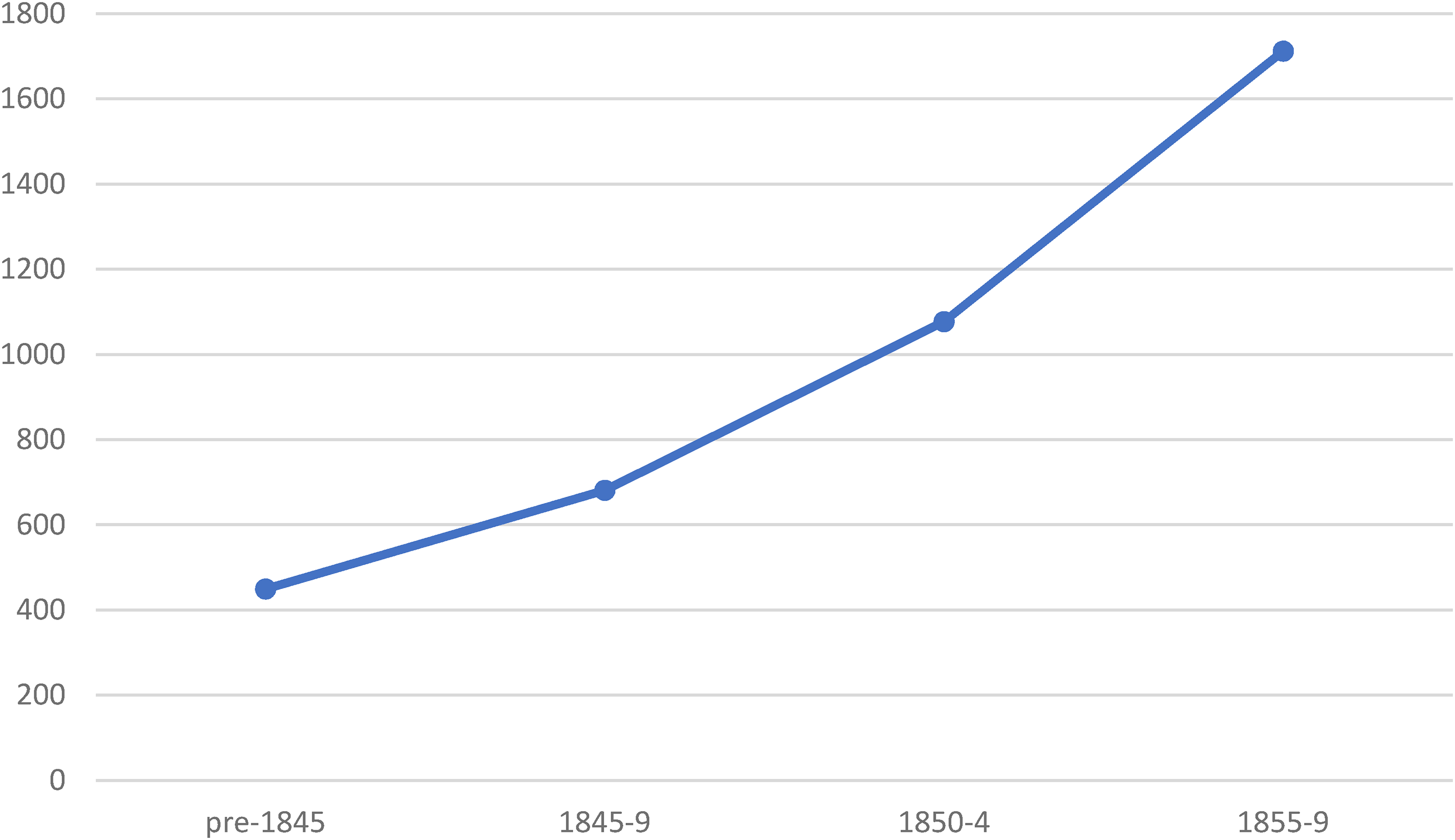
Mean slave Purchase Price (Historic US dollars), Males Aged 20–24 years, American Antebellum South. Fleischman et al. (2004), ‘Monetising human life’: 49.
Although there are many studies that equate Atlantic slavery with modern capitalism, a more-fitting comparison is the ancient Roman latifundia described in Cato the Elder's (c.160BC [1913]) De Agricultura, the oldest surviving study on slave-estate management. Like the ‘most profitable’ antebellum estates that Rosenthal (2018: 6) describes, Cato was obsessed with maximising per-slave output. Where time was lost to inclement weather, Cato (c.160BC [1913]: 25) recorded, ‘the slaves’ rations should be reduced as compared with what was allowed when they are working.’ Like the slave-estates of the Americas, Cato favoured labour-intensity over capital-intensity. ‘Where you find few tools’ on a property, he advised, then you know ‘it is not an expensive farm to operate’ (Cato, c.160BC [1913]: 22). Like the slave-estates of the Americas, Cato also regarded his slaves as little more than animals, recommending that ‘old and sick slaves’ be sold along with ‘worn-out oxen’ (Cato, c.160BC [1913]: 25). Parallels between Cato's latifundia and those of the antebellum South are also striking. In terms of clothing, Cato advised providing each slave ‘a smock’, a ‘cloak’ and a ‘pair of heavy wooden shoes … every other year’ (Cato, c.160BC [1913]: 37). In describing his life on a Maryland plantation in the 1830s, Frederick Douglass (1846: 9–10), the future abolitionist, similarly recalled how slaves received an annual issuance ‘of two coarse linen shirts, one pair of linen trousers … one jacket, one pair of trousers for winter’. Booker Washington (1901: 8–9), another influential African-American leader, remembered similar circumstances on the Virginian plantation of his youth. Washington's shoes were, like those of Roman times, rough ‘wooden’ affairs. In Cato's latifundia we witness, in short, a slave-mode of production that is not capitalist but which is nevertheless calculating, wealth-seeking and intent on maximising labour-intensity. A similar model was resurrected through Atlantic slavery. Yes, it is true, that in the antebellum South – as in ancient Rome – slave-owners possessed capital assets, the most significant of which was their stock of slaves. This, however, did not make them capitalists. For if we are to automatically equate slave ownership with capitalism than we would need to declare not only ancient Rome to be capitalist but also virtually every West African society in the pre-colonial period. As we discuss below, slave ownership was not only endemic in West Africa, it was also more important to clan wealth than land, given that land was abundant and labour was comparatively scarce.
Accounting records and sources
In exploring answers to our central question – which relates to both accounting's role in facilitating Atlantic slavery and what accounting records tell us about this phenomenon – it is evident that accounting was complicit in facilitating both slavery and the slave-trade. McWatters and Lemarchand (2009: 208), for example, in their study of the ‘triangular’ trade in commodities and slaves between Europe, Africa and the Americas, observe that, ‘Accounting supported these new network relations through its reporting mechanisms’. In a similar vein, Tyson and Oldroyd (2019: 221) state that, ‘What accounting did was to sustain a business model that enabled certain slave owners to realise a lifestyle of leisure and luxury.’ Can we, therefore, conclude that accounting was the pivotal factor underpinning Atlantic slavery, ‘an eminently suitable technology’ that was used to ‘manage and enact violence on racialized populations’ (Annisette and Ajnesh Prasad, 2017: 9)? To do so suggests delusions of grandeur on accounting's behalf. There were clearly many other factors that enabled Atlantic slavery: a revolution in shipping, marine insurance, mastery of muskets and cannon, a manufacturing surplus that could be traded for slaves, financial surpluses that could be reallocated to slave ventures, and demand for luxury stimulants and foods. Each of these factors was arguably as important, if not more important, as early-modern accounting. Of these pre-industrial accounting systems, Pollard (1965: 212) accurately observed, moreover, that there was ‘no sense in which they could relate profits to any fixed investment or the “capital” of a firm as a whole’.
If accounting was one of the enabling agents for Atlantic slavery it is also the case that slave accounts are often discussed as if they stood at the cutting edge of disciplinary practice. In Accounting for Slavery, for example, Rosenthal (2018: 2) declares that, … many planters in the American South and the West Indies shared our obsession with data … slaveholders built large and complex organizations, conducted productivity analysis akin to scientific management, and developed an array of ways to value and compare human capital.
… basic and uninformative … In neither the BWI [British West Indies] nor the American South was it normal practice to track the output of individual field hands … what stands out is their [slave-owners’] inability to see beyond physical coercion as the only effective means of labor discipline (Tyson and Oldroyd, 2019: 222, 225).
Details entered into accounting records were often deliberate falsifications. In studying the accounts that supposedly recorded individual performances in North Carolina's turpentine industry, for example, Vollmers (2003: 381–82) noted that the overseer recorded identical figures for each slave from Monday to Saturday, even though work only occurred between Monday and Friday. Aware of the unreliable nature of the accounts presented to him, one West Indian slaveowner reflected in 1811 that though they seemed ‘specious and encouraging … they are fallacious and delusive’ (cited in Fleischman et al., 2004: 42). Nor was it the case that accurate recording of picking rates automatically led to either greater profitability or labour efficiency. As Barney and Flesher (1994: 280) indicated, the Locust Grove plantation in Mississippi recorded detailed picking rates for 20 years (1825–44). Despite this effort, it was impossible to ascertain whether it was profitable given that the ‘actual costs of managing’ the estate were ‘unknown’ (Barney and Flesher, 1994: 281). Nor did the owner direct the collation of picking records towards lower labour costs. Instead, slave numbers were maintained even when their labour could not be fully utilised. For, as Barney and Flesher (1994: 281) note, relinquishment of slaves ‘might have been embarrassing’ in a society that equated wealth with the number of slaves that one owned.
Even where accounting systems such as Affleck's Plantation Record and Account Book were used with diligence we are still left with important questions. Who used the books? To what purpose, if any, were they directed? (Rhode, 2020: 294). Often, it appears, accounts were maintained almost as end-in-itself; something that one did because one was an educated businessperson. This appears to explain the accounts maintained by Thomas Jefferson, one of America's founding fathers, whose slave plantation was among Virginia's largest. As Baker’s (2019: 249) study indicates, Jefferson ‘kept daily accounting records of every receipt and expenditure that he made for a period of over 60 years.’ There is, however, no evidence that Jefferson ever used this information to mitigate his ‘financial position’, which was always ‘precarious’. We also need to be wary of assuming a causal relationship between outcomes and recording practices. A detailed study of antebellum plantation records by Olmstead and Rhode (2008: 1147), for example, found that mean cotton-picking rates rose from 28.1 lbs. per slave in 1801 to 114.2 lbs. in 1862, a 4.1-fold increase. Rosenthal (2018: 6) suggests that this improvement resulted from diligent accounting and associated work systems ‘akin to time and motion studies’. Olmstead and Rhode (2008: 1155–57), however, concluded that it had little to do with accounting. Rather, it was largely due to westward-movement into more favourable soils and the adoption of more easily-harvested cotton varieties that flourished in the ‘New South’ (i.e., Alabama, Texas, the lower Mississippi valley). Slaves picked more cotton, in short, not because they were working much harder but because the cotton was more easily picked.
What explains the fact that so many of the accounts maintained by slave-owners, even where information was recorded accurately, were ‘basic and uninformative’? The answer to this question, Tyson and Oldroyd (2019: 226) suggest, is found in their ‘primary purpose’ of tracking ‘inventory, debtors, and creditors’. What was counted were receipts, expenses, debts and repayments. The most extensively-maintained accounting records in Atlantic slavery were, therefore, not those that dealt with production but rather those that dealt with exchange. In quantitative terms, this makes the slave-trade an easier research target than plantation management. In the slave-trade, as McWatters and Lemarchand (2009: 208) note, ‘accounting systems’ were, moreover, ‘based on procedures long established in maritime trade’; procedures that included ship's logs, customs declarations, taxes and investment registers. This means, as Pinto and West (2017: 324) note in their study of Portuguese slave-trading, that we need to have, … a broad interpretation of what constitutes ‘accounting’, extending beyond just the numbers and descriptions contained expressly in financial records to also embrace the documents and other sources that provided the basis for, or otherwise influenced, those records.
The slave-trade and Africa
Africans were the principal victims of Atlantic slavery. According to the TASTD (estimates – flag of carrier), 12.5 million African slaves were shipped to the Americas. Of these, 10.7 million were alive at disembarkation.
If Africans suffered from the Atlantic slave-trade they were also enablers and beneficiaries. For the slave-trade was just that, a system of trade in which sophisticated and well-organised African elites exchanged fellow Africans for a variety of goods. What slave-traders of every European society desired was a reliable source of slaves that their ships could access with assurance. Even where feasible, raiding for slaves in opposition to local wishes disrupted rather than enhanced supply. Accordingly, although Western traders often manipulated local power arrangements to their own advantage, they rarely threatened the independence of the societies they traded with. Of the situation that prevailed in Senegambia (i.e., modern-day Gambia, Senegal, Guinea-Bissau, Guinea), Thomas (1997: 333) noted that few saw Europe ‘as constituting a political threat’. Instead, local elites perceived the trade primarily as a source of potential wealth. In what is today Ghana, Benin, Togo and Nigeria, Lovejoy (1983/2003: 98) similarly observed that local kings and nobles regulated the sale of slaves, taking ‘advantage of the desire of ship's captains to set sail as fast as was possible’. While permanent forts and trading posts were established along the African coast, the security and effectiveness of these outposts always rested on collaboration with indigenous rulers. Significantly, as the research of Green (2012) and Ferreira (2012) indicate, such outposts also resulted in mixed-race societies and cross-cultural alliances. Nowhere was this more evident than in Portuguese-dominated Luanda and its Angolan hinterland, where a distinct Lusophone culture increasingly prevailed. By the 1700s, this Lusophone society of mixed ancestry had drawn the Lunda people of the Angolan interior into the slave-trade. Waging wars of expansion that reached to Lake Tanganyika in the east, the Lunda created in turn what Thomas (1997: 366) described as a ‘great channel’ that drew slaves ‘from the heart of Africa’.
Reflecting on African involvement in the slave-trade, Obikili (2016: 1159) recently observed, ‘the opportunities and profits from the slave trade were open to everybody’. ‘Villages, local chiefs, and warlords’, all ‘participated heavily.’ While the scale of Atlantic slavery exceeded anything that Africa had previously experienced, both slavery and slave-trading were well-established when European slave-traders first appeared on the horizon. In Sub-Saharan Africa, the abundance of land made waged-labour an unattractive proposition. As Fenske (2012: 540) noted, ‘Individuals could earn more working for themselves than as hired labourers’. Ready-availability of land also meant that loans were secured by mortgaging the borrower or their family rather than land, non-repayment condemning those pledged to slavery (Lovejoy, 2000; Law, 1991). Slaves were also obtained through warfare and purchase. In Muslim North Africa, slavery was also an established institution. Slaves were found in virtually every walk of life (de Bellaigue, 2017). Given the prohibition on enslaving other Muslims, Muslim slave-markets drew heavily on historic slave-routes across the Sahara and the Red Sea. Between AD650 and 1600, an estimated 4.82 million slaves were forced-marched across the Sahara. Another 2.4 million were traded from East Africa and across the Red Sea between AD800 and 1600 (Lovejoy, 2000: 25).
What was the impact of the incorporation of Africa into an even more extensive system of slavery directed towards the Americas? At its most basic, this is a demographic question. When and where were slaves procured? Did this rate of forced removal overstretch the demographic capacity of the societies concerned? In seeking answers to these questions, Figure 2 draws on the TASTD to trace yearly shipments from three broad regions: West Africa, West Central Africa (Angola/Congo), and Southeast Africa and the Indian Ocean islands. Figure 3 breaks West Africa down into six sub-regions: Senegambia, Sierra Leone, Windward Coast (Liberia/Ivory Coast), Gold Coast (Ghana/Côte d’Ivoire), Bight of Benin (Togo/Benin/southwest Nigeria) and the Bight of Biafra (Nigeria/Cameroon).
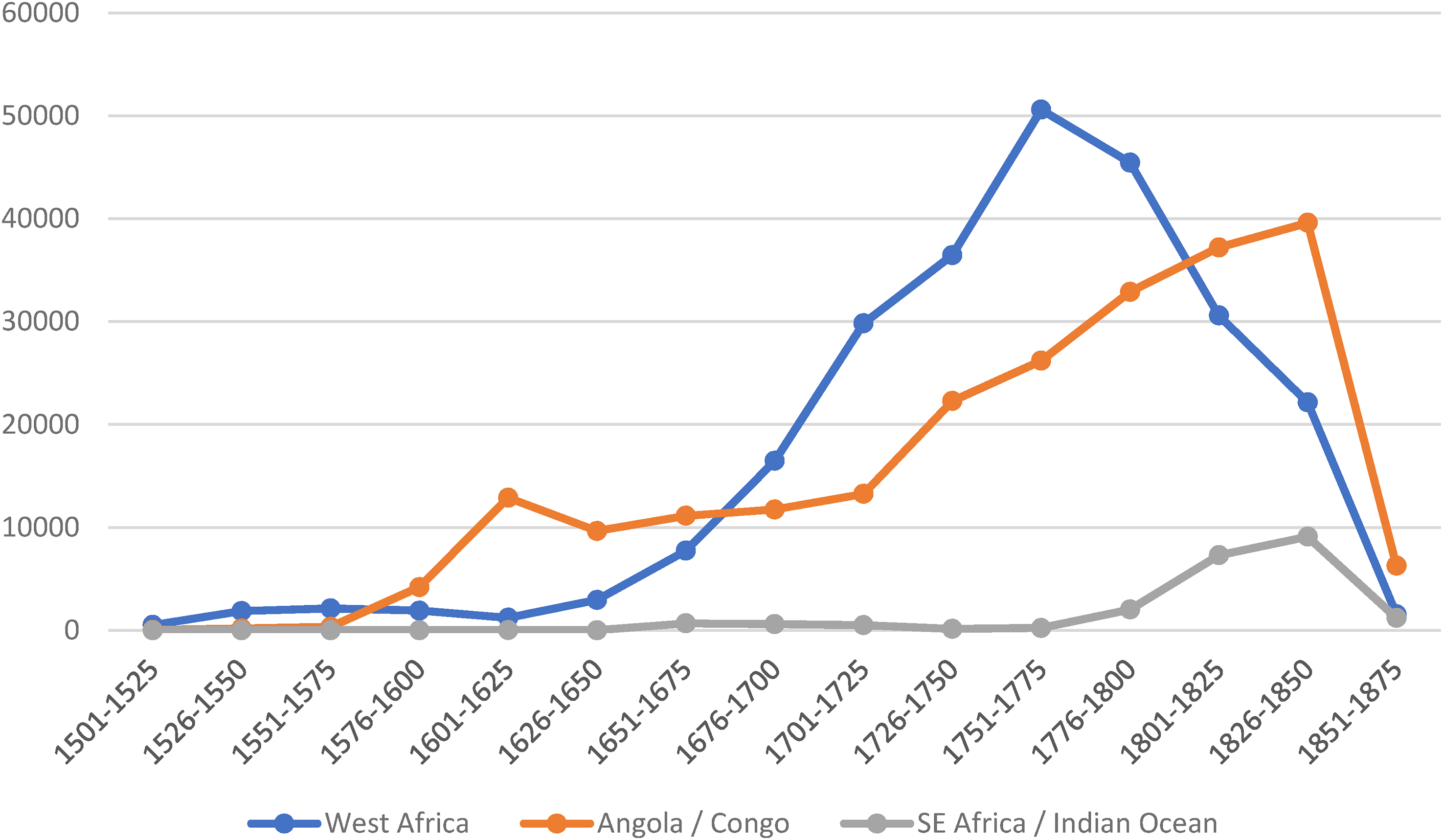
Slave-embarkation, Yearly Averages – Broad Regions, 1501–1875*. (Source: Calculated from Trans-Atlantic Slave-trade Database: estimates – Broad Embarkation Regions) *Note: yearly figures are averages for the 25-year period indicated.
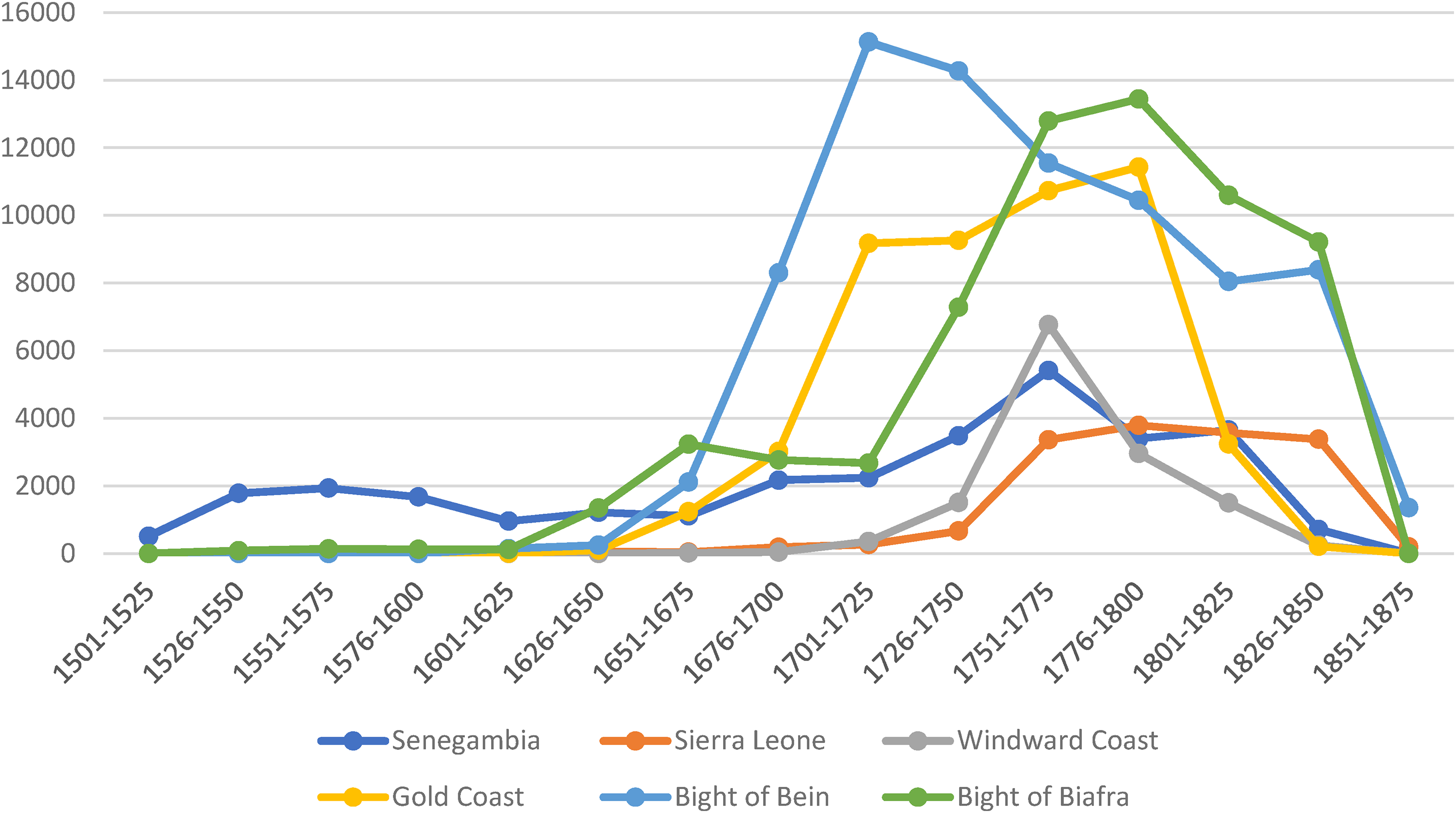
Slave-embarkation, Yearly Averages – West Africa: Specific Regions, 1501–1875*. (Source: Calculated from Trans-Atlantic Slave-trade Database: estimates – Broad Embarkation Regions) *Note: yearly figures are averages for the 25-year period indicated.
As Figure 2 indicates, the slave-trade's intensity varied over time. Initially, slave-traders targeted West Africa. The totals involved, however, were low. Prior to the mid-1600s average annual shipments never exceeded 3000. Then, during the first three-quarters of the seventeenth century it was Angola/Congo (West Central Africa) that bore the brunt. A veritable Portuguese preserve, average annual shipments from Angola/Congo during this period ranged between 9600 and 13,000 slaves. Subsequently, between 1676 and 1800, West Africa again bore the brunt as British, French and (to a lesser degree) Dutch slave-traders plied the coast in growing numbers. Across this 125-year period, West Africa's annual losses rose markedly. At the peak of the West African trade between 1751 and 1775 slightly more than 50,000 slaves were being shipped every year on average. In Angola/Congo, the slave-trade also grew rapidly from the second-quarter of the eighteenth century. By the first-quarter of the nineteenth century, the Angola / Congo region had become the main source of slaves as Portuguese ventures grew in scale even as Britain withdrew from the trade. By the second quarter of the nineteenth century, almost 40,000 slaves were lost to the region every year on average. In the nineteenth century, Southeast Africa and the Indian Ocean islands also became a significant source of slaves as slave-traders moved further afield to avoid British-led squadrons imposing an anti-slave-trade blockade. By the nineteenth century's second-quarter, more than 9000 slaves were shipped each year on average from this broad region.
When we explore West African circumstances by sub-region in Figure 3, it is evident the worst hit area was the Bight of Benin. Known as the ‘Slave Coast’, this sub-region lost more than 8000 individuals to the slave trade every year on average between 1676 and 1850. The worst period was between 1676 and 1700 when more than 15,000 slaves were lost each year on average. To the east, the Bight of Biafra also became a significant source of slaves between 1726 and 1850. Between 1776 and 1800 this sub-region surpassed even the Bight of Benin in terms of shipments. More than 13,000 slaves were lost to the Bight of Biafra each year on average. To the west, the Gold Coast lost more than 11,000 slaves each year on average during the same period. By comparison, slave-shipments from Senegambia, Sierra Leone and the Windward Coast were much smaller. On the Windward Coast the worst years were those between 1751 and 1775 when more than 6500 slaves were lost each year on average. These were also the worst years for Senegambia. During this period, Senegambia experienced the loss of more than 5000 slaves per year on average. In Sierra Leone, the greatest loss was experienced during the final quarter of the eighteenth century, a time that saw the shipment of more than 3500 of the region's sons and daughters each year on average (TASTD: estimates – broad embarkation region).
The demographic significance of these losses is fraught due to disagreements as to both the size of the base population and the offsetting effects of New World crops. Traditionally, Africa's population was depicted as one that stagnated at 100 million people between 1650 and 1850; a view legitimised by United Nations’ estimates in 1951, 1953 and 1973. This consensus no longer exists. Some have lowered pre-European contact (c.1500) estimates to 50 million or less (see Caldwell et al. (1982) and Caldwell and Schindlmayr (2002) for summary of the debate). By contrast, Manning (2014) estimates Africa's population at 138 million in 1700 and 145 million in 1890. In terms of the two regions most affected by the slave-trade – West and West Central Africa – Manning believes that both suffered decline. According to Manning (2014: 132), West Africa's population fell from 50 million in 1700 to 46 million in 1790 and 41 million in 1890. West Central Africa's population is estimated to have fallen from 22 million in 1700 to 17 million in 1790, before recovering to 19 million in 1890. Manning's portrayal of demographic decline in areas most effected by the slave-trade is associated with skepticism as to the offsetting benefits of New World crops. ‘It is possible’, Manning (2014: 136) suggests, ‘that Africans … had a broader diet but consumed no more calories’. This opinion is widely contradicted. Caldwell and Schindlmayr (2002: 195), for example, conclude that: The new crops were not only suited to the forests: maize became the dominant crop in Savannah and Savannah woodland areas … It is impossible to look at this evidence without concluding that African populations must have been growing continuously.
Cherniwchan and Moreno-Cruz (2019: 145–46) also argue that ‘the introduction of maize’ (corn) produced a ‘supply-side shock’, allowing both an increase in slave-exports and a large-scale population increase between 1600 and 1900 (for similar views on the impact of Columbian Exchange on Africa, see Thornton (1980), Thomas (1997), Nunn and Qian (2011)).
If we operate on Manning's ‘high’ estimates for West and West Central Africa, the population lost to the slave-trade was 0.6 per thousand per year (a loss of 29,823 per year from a population of 50 million) in West Africa in the first-quarter of the eighteenth century and 1.1 per thousand in the final quarter (a loss of 50,599 per year from a population of 46 million). In West Central Africa losses would have been 0.6 per thousand in the first-quarter (a loss of 13,247 per year from a population of 22 million) and 1.9 per thousand in the final (a loss of 32,882 per year from a population of 17 million). If the population of the two regions was only half of Manning's estimates then losses per thousand would be roughly double. Such losses, by themselves, are unlikely to have caused depopulation. As a point of comparison, birth and death rates in Western Europe during the seventeenth and eighteenth centuries were both in the vicinity of 40 per thousand (Braudel, 1979 [1981]: 71).
Although the direct effects of the slave-trade do not suggest demographic carnage, the consequences were nevertheless malignant. The most obvious of these was inter-African warfare. According to Obikili (2016: 1159), African competition for control of the slave-trade ‘led to the collapse of pre-existing forms of government, with larger states replaced by smaller groups.’ While this situation prevailed in West Central Africa, elsewhere the reverse occurred. The sub-regions in West Africa that suffered the largest slave shipments – the Bights of Benin and Biafra and the adjacent area of the Gold Coast – all featured centralised militaristic states (Asante, Dahomey, Oyo) that waged vicious wars to corner the local slave trade. As Verhoef (2017: 37) observes in relation to West African circumstances, ‘the trade in human beings occurred in a market manipulated by the king. It was not an open competitive market with free trade.’ The account books of European slave-traders also indicate that most were forced to pay a wide array of fees and charges: tribute, charges on individual ships, duties on each slave sold (Jensen et al., 2021; Law, 1991). Chiefs and warlords also preyed on their own, using legal processes to condemn subjects into slavery, and hence the slave-trade (Obikili, 2016: 1168–9). Perhaps the most pernicious effect of the slave-trade, however, was found in the ways in which it boosted domestic slavery. As Thomas (1997: 559–60) noted, by 1807 there were ‘more slaves in Africa … than in the Americas’. Among the Asante, ‘every man of property had slaves’. In the Muslim societies of the northern savannah, ‘there were slaves in households, in workshops, in the fields.’ With the decline of the Atlantic slave-trade, African slavery became even more significant as merchants and warlords compensated for lost income by using industrial-scale slave workforces to produce ‘legitimate’ exports: palm oil, kola nuts, gold. ‘Slave holdings in Dahomey and the Yoruba states … were so large’, Lovejoy (2000: 170–71, 184) recorded, ‘that free people constituted only a minority of the population’. At the end of the nineteenth century, between one-third and a half of the population of West Africa's savannah lands were slaves. As a result, Lovejoy (2000: 246) concluded, ‘the African social order was more firmly rooted in slavery than ever.’
The slave-trade and European prosperity
In Africa, it is evident, slavery enriched a comparative few. It little benefited either the ordinary African or the society at large. Did similar circumstances characterise European involvement in the slave-trade or, alternatively, was it the bedrock of European prosperity? Since the pioneering work of Williams (1940, 1944) a large body of research has argued the latter position (Beckert, 2014; Inikori, 2002; Pomeranz, 2000; Prieto and Phipps, 2021). By contrast, North and Thomas (1973) attributed Western success to institutional arrangements that favoured individual property rights. Marx (1887 [1938]) ascribed Western success primarily to bourgeois initiative. More prosaically, Allen (2009, 2011) attributes the Industrial Revolution and the emergence of industrial capitalism to Britain's cheap energy sources. Clark (2007: 231) simply puts the Industrial Revolution and Western success down to a fortunate set of ‘accidents and contingencies’.
What do accounting records, understood broadly, tell us about the contribution of Atlantic slavery to European prosperity?. In addition to the TASTD, there are numerous studies (Clarkson, 1808; Draper, 2008; Eltis and Engerman, 2000; Haggerty, 2009; McDade, 2011; McWatters and Lemarchand, 2009) that have explored the slave-trade's contribution to European wealth through examinations of customs records, investment registers and shipping logs. We can also correlate participation in the slave-trade with estimates of national output per capita (Palma and Reis, 2019).
In exploring European involvement in Atlantic slavery there are four issues to consider. Who transported the slaves? To where were slaves carried? How significant was the slave-trade to national wealth and economic development? How significant was slave-grown produce to Europe's economies?
Figures 4 and 5, drawing on the TASTD, provides answers to the first two questions. In terms of slave-traders, as Figure 4 indicates, the major participants between 1501 and 1850 – measured in terms of slaves disembarked alive – were Portugal (5.1 million), Britain (2.7 million) and France (1.2 million). Spain, one of the earliest participants in the slave-trade, carried 703,397 slaves prior to 1850, and another 181,525 after this date. The Netherlands carried 475,240. In terms of where slaves were landed between 1501 and 1850, the major destinations, as Figure 5 indicates, were Brazil (4.9 million), the British Caribbean (2.3 million), Spanish America (1.1 million) and the French Caribbean (1.1 million). Another 444,727 were transported to Dutch colonies in the Americas. Only 388,334 were shipped to what became the United States (TASTD: estimates).
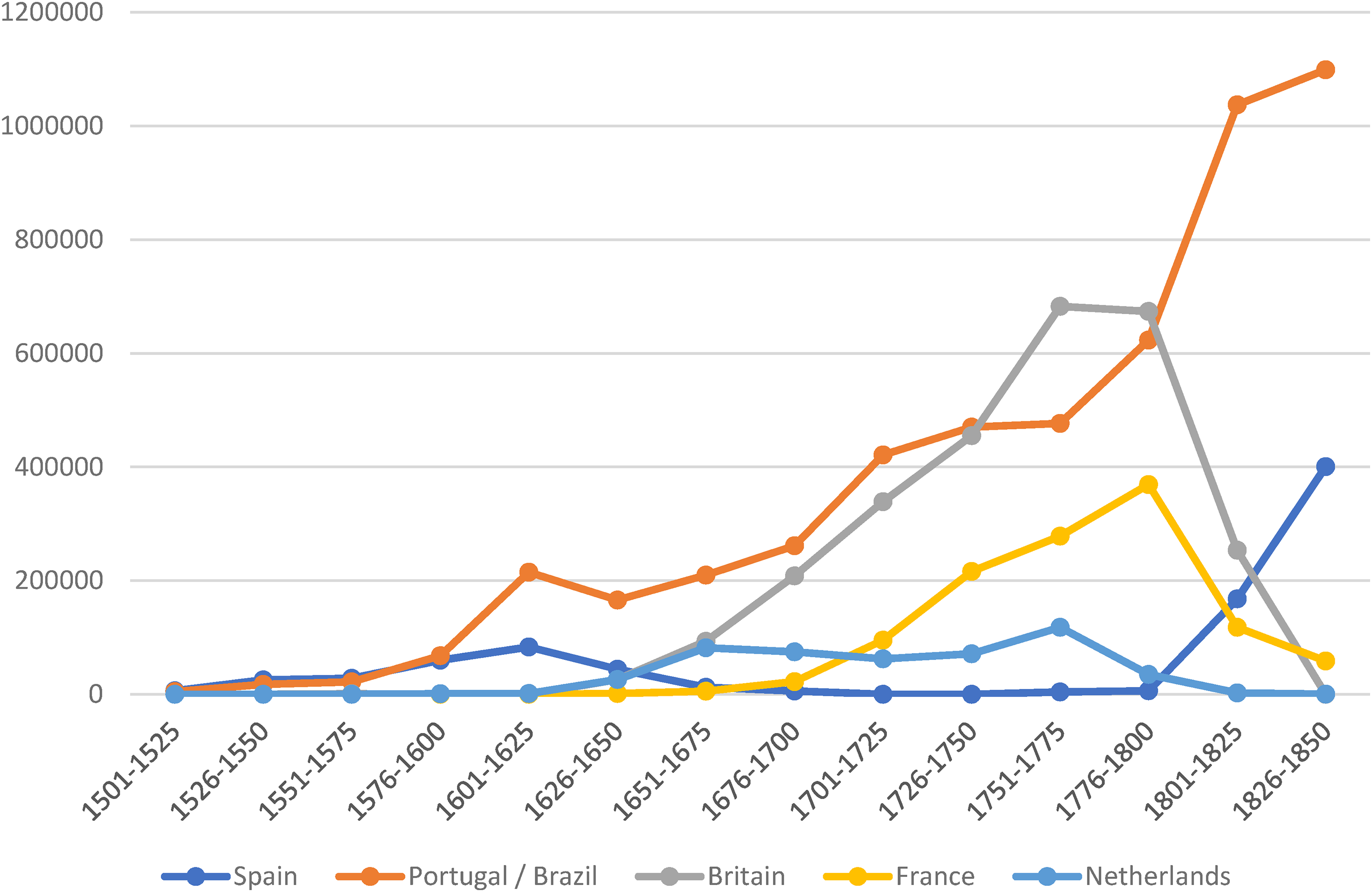
Slave-shipments (Disembarked Alive), 25-Year Totals: Flag of Carrier, 1501–1850. (Source: Trans-Atlantic Slave-trade Database: estimates – Carrier).
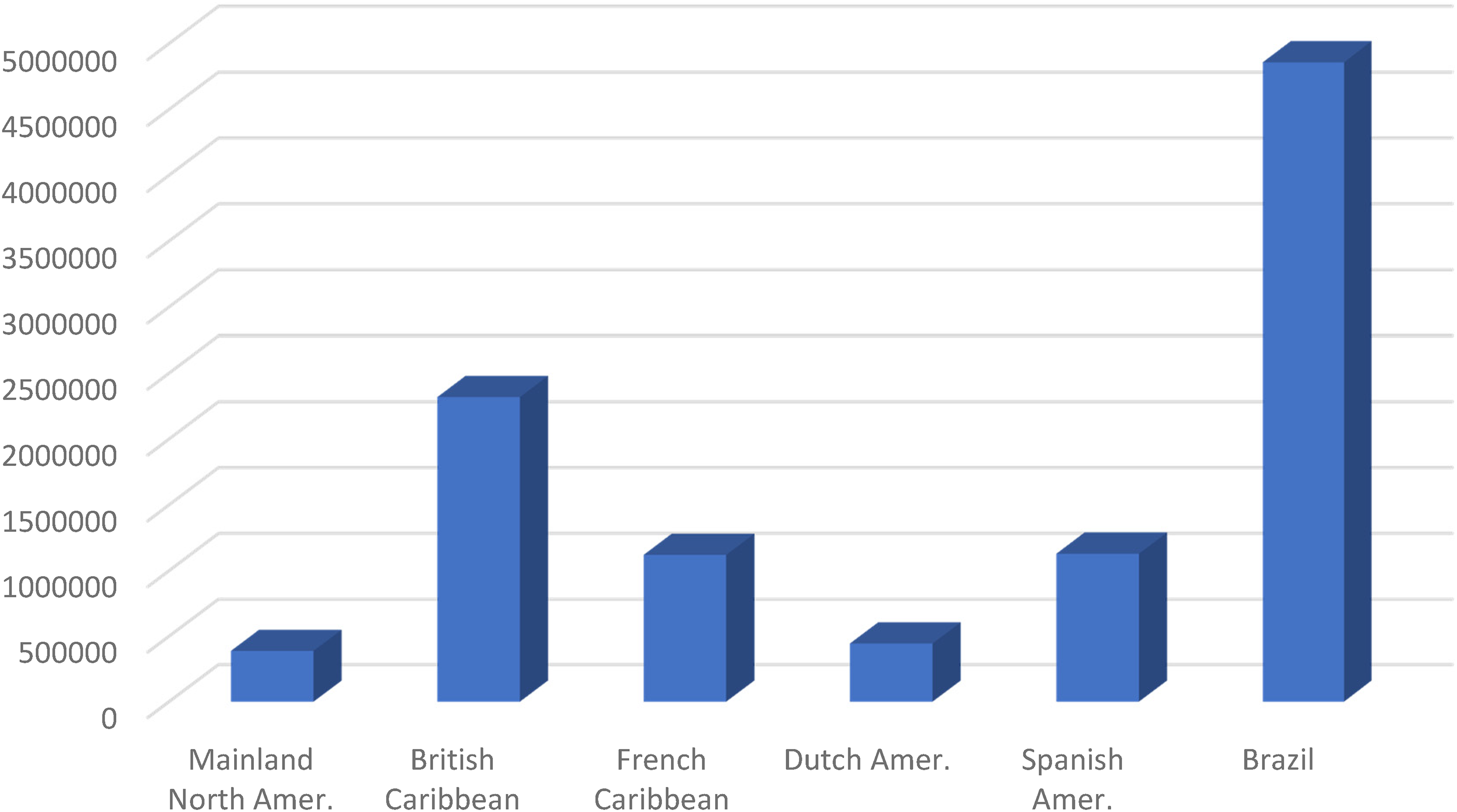
Slave-Disembarkation, Broad Regions, 1501–1850. (Source: Trans-Atlantic Slave-trade Database: estimates – Broad Disembarkation Region).
If participation in the slave-trade and colonial slave-ownership were the keys to national wealth then we would anticipate that Portugal would have been among Europe's richest nations while the Netherlands would have been among the poorest. In fact, as Figure 6 indicates – which traces national per capita output of Holland (the most significant Dutch province), Britain and Portugal, measured in constant 1990 United States dollars – the reverse is true. Holland prospered. Portugal did not. The transformation in Holland's economic circumstances also occurred prior to 1600, that is, before its involvement in the slave-trade. Conversely, the spike in Portuguese slave-trading numbers between 1750 and 1850 was associated with deteriorating Portuguese circumstances (Palma and Reis, 2019: 500).
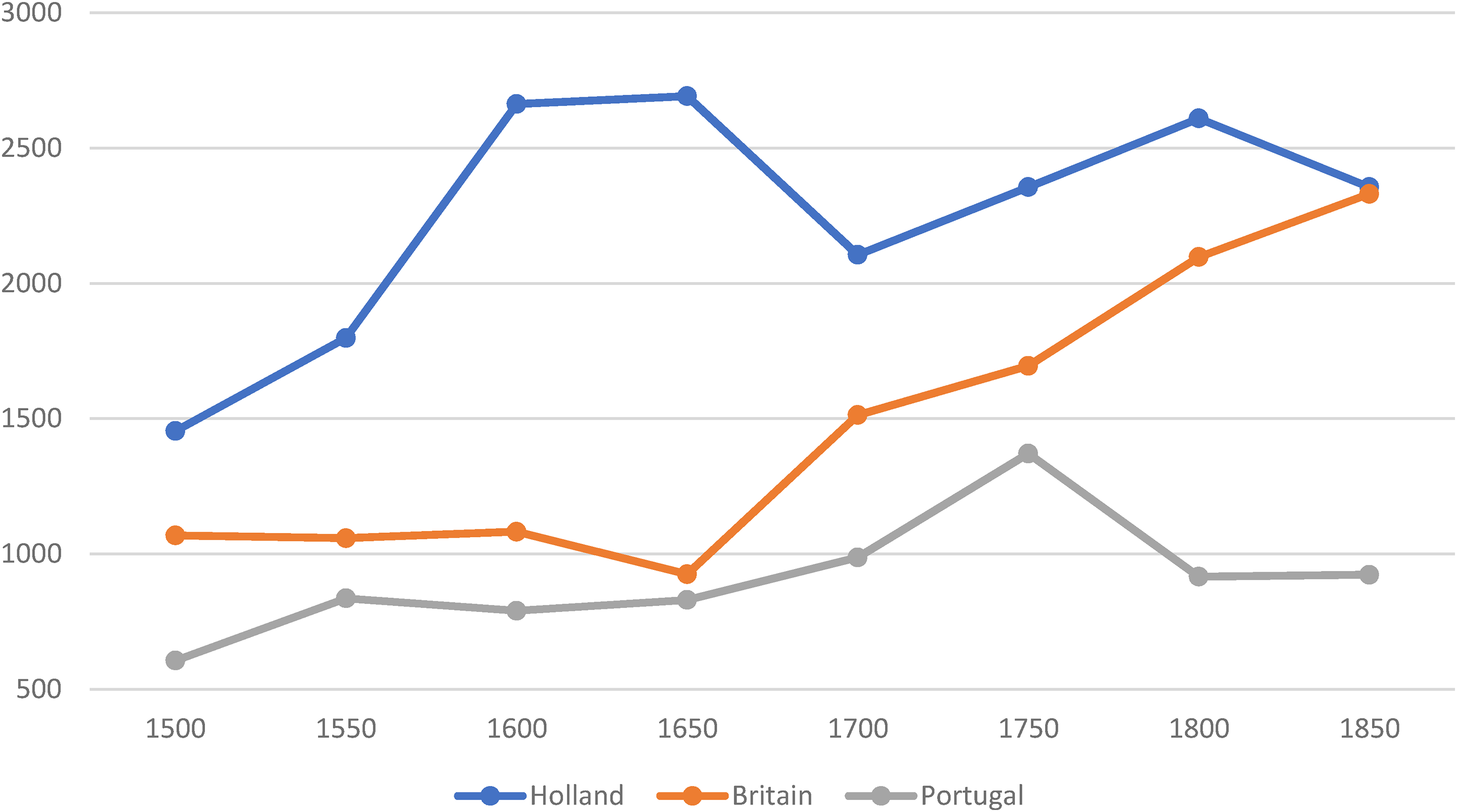
Output per capita (1990 US dollars), 1500–1850. (Source: Palma and Reis, ‘From Convergence to Divergence’, 500).
What of British circumstances, where the surge in output per capita between 1650 and 1800 did correspond to the peak of its involvement in the slave-trade? Did the success of London, Bristol and Liverpool rest on the slave-trade as Williams (1940, 1944), Walvin (2019) and others suggest? Or did it, as Clarkson (1808) argued, play only a minor role? The literature that has explored these questions over the last two decades points, with some equivocations, to the latter conclusion. Eltis and Engerman (2000: 129), for example, observed that in 1792, the peak year of Britain's involvement in the slave-trade, 204 vessels with a capacity of 38,099 tons were involved in the slave-trade. This represented ‘less than 1.5 percent of British ships, and less than 3 percent of British shipping tonnage.’ Haggerty (2009: 818–19), after studying Liverpool's commerce, concluded that ‘in terms of shipping and numbers of merchants, the slave trade was not dominant.’ Trade with Ireland, Spain, the Baltic and North America were all of comparable importance. After studying investment records in London, Draper (2008: 434) similarly concluded that ‘the evidence does not suggest that the City's prosperity was built exclusively or even largely on slavery’. By contrast, McDade’s (2011) analysis of investment records in Liverpool and Bristol finds that between 1725 and 1787 there were 2025 merchants involved in slave-trading in the former and 494 in the latter, a sizeable share of each city's totals. Most, however, were only occasional investors. Thomas (1997: 514) also estimated that ‘about 360’ Liverpool firms were involved in the slave-trade ‘in one way or another’ between 1783 and 1793.
The TASTD helps to provide answers for this contentious debate. As Figure 7 indicates – which traces average yearly slave-ship voyages from London, Liverpool and Bristol – it is hard to believe that the recorded number of slave voyages could have acted as the bedrock for the commercial success of these cities. The peaks in London and Bristol, achieved 25 years apart, were associated, respectively, with 34.6 and 33 voyages per year on average. This is considerably less than one voyage per week. In Liverpool, where peak involvement in the slave-trade was both higher and later, there were, on average, 72.2 annual slave voyages originating in the port between 1776 and 1800. This equated to slightly less than 1.4 voyages per week (TASTD: Tables – Port where Voyages Began).
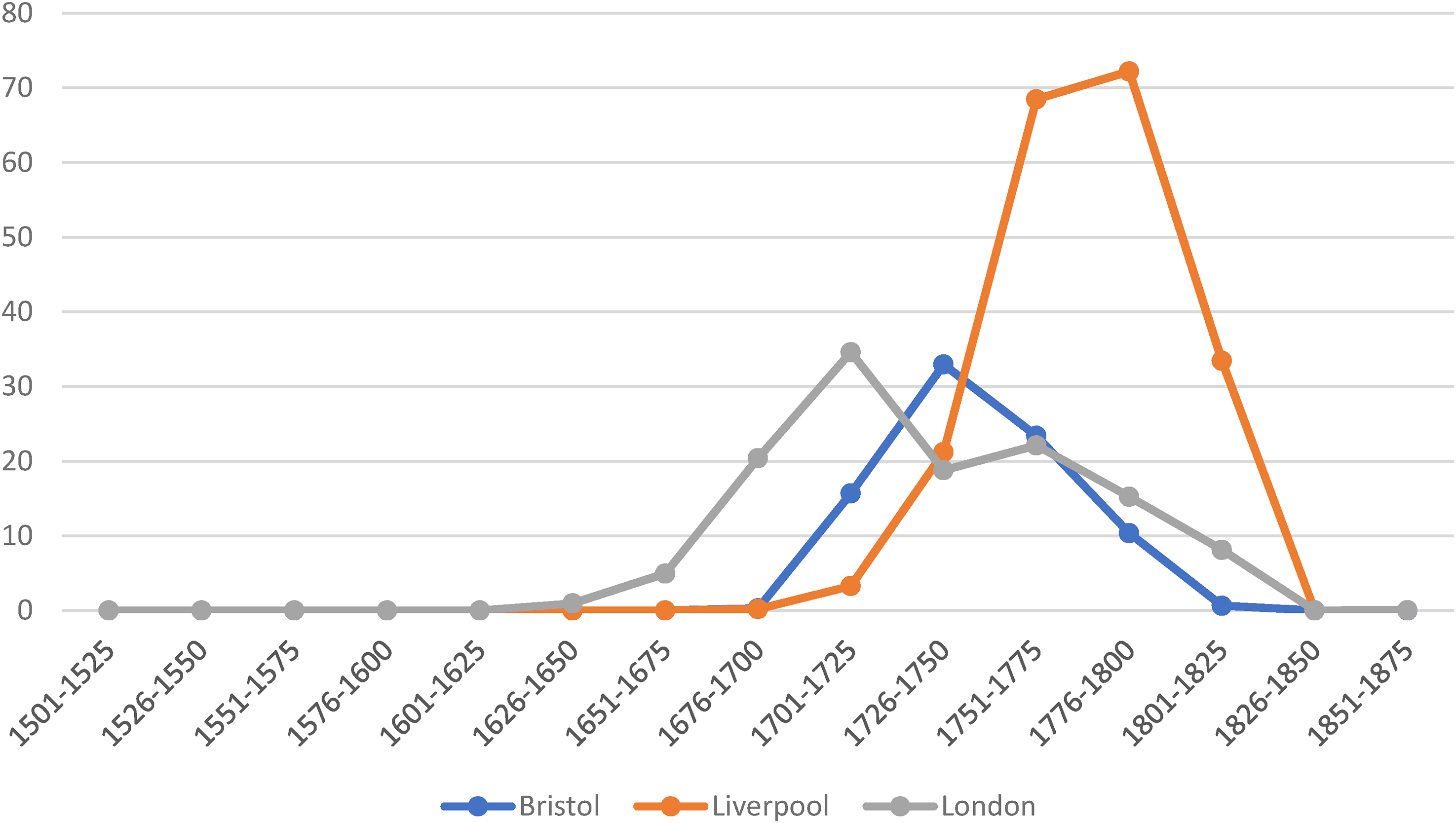
Average Yearly Slave-Voyages, 1501–25–1851–75. (Source: Trans-Atlantic Save-trade Database: Tables – Port where Voyage Began).
That comparatively few slave-voyages were undertaken from England's great ports highlights the fact that slave-trading was a highly specialised endeavour. As McWatters and Lemarchand’s (2009) insightful analysis of French slave-trading indicates, each slave-voyage involved considerable outlays and significant risks. Typically, the voyage from home port to Africa, the Americas and return took a year or more. On average, the French ships that McWatters and Lemarchand (2009: 201–02) studied spent almost six months off the African coast trading for slaves. The infamous ‘Middle Passage’ across the Atlantic took them almost another three months. In the Americas, French slave-traders struggled to find ‘credit-worthy buyers’. Haggerty (2009: 823) similarly observes that, ‘Planters in the West Indies had a terrible reputation for not paying their debts.’ By 1787, planters generally paid for their slaves with bills of exchange that had an 18-month to three-year maturity date. This meant that slave-traders potentially faced a four-year interval between financial outlays and returns. To add to their woes, bills of exchange were often dishonoured when they fell due. Nor should we exaggerate the size of slave ships. According to the TASTD (Tables – summary of statistics), the typical slave-trading vessel boasted a carrying-capacity of only 157.7 tons. This is equivalent to just 4.4 modern-day 40-foot shipping containers. The typical slave-ship's limited capacity is a reminder that slave-trading was a pre-industrial activity. Few ships survived half-a-dozen trips before their hulls were eaten away by marine borers. On an annual basis, the number of slaves transported was surprisingly small. At its peak, between 1751 and 1775, Britain shipped only 32,922 slaves per year on average. By comparison, in 1850, following a revolution in shipping, 369,980 immigrants entered the United States by sea (United States Department of Commerce, 1975: Series C89–119). That more than ten million slaves survived the dreaded Middle Passage was thus a product of the slave-trade's persistence rather than its sophistication.
The risks associated with slave-trading were offset by high potential profits. On an ‘ideal’ journey, Thomas (1997: 441) estimated, a profit of 35 percent was obtainable. Such ‘ideal’ journeys, however, appear the exception rather than the rule. Forty percent of Dutch slave-voyages between 1750 and 1800 ran at a loss. British profits during the same period were probably less than 10 percent. By comparison, a three percent return could be obtained from risk-free British government bonds (Thomas, 1997: 443). Long before abolition in 1807, slave-trading was also seen as morally reprehensible in civilised society. In 1780, for example, Lord Bathurst, a scion of the establishment, declared that ‘he was glad that his father, who was a West Indian planter, had left his affairs in total ruin, because, having no estate, he was not under the temptation of having slaves’ (cited Boswell, 1793 [1906]: 335). Why then would one risk one's fortune in slave-trading? The answer is that very few did. As Draper (2008: 442) observed of the slave-traders of Bristol and London, they ‘were not a largely indistinct cross-section of the eighteenth-century commercial community, but a specific commercial group, distinct in terms of personnel’. A large percentage were ‘new’ men with neither established fortune or reputation. This is not to say that established traders and firms did not on occasion invest in slave ventures. Many did (Haggerty, 2009; McDade, 2011). Few, however, tied their fortunes to it.
If it is difficult to attribute Britain's commercial and industrial success to the slave-trade per se, what then of the trade in plantation produce? Only two commodities were grown and imported on a scale that allows claims to economy-wide transformation: sugar and cotton.
There were two ways in which plantation-grown sugar supposedly underpinned European development. First, it is suggested that sugar provided industrial workforces with a critical source of calories. According to Pomeranz (2000: Appendix C), the 150,000 tons that Britain imported annually in the early 1800s provided the calorific equivalent to 1.2 million acres of wheat. Similarly, Walvin (2019: 35) argues that circa 1800, ‘Legions of working people …derived much of the energy they required …from the sugar they consumed’. The case for these arguments is underwhelming. Sugar in 1800 was an expensive luxury. Vast slave workforces, using primitive techniques, produced a feeble output. As Walvin (2019: 33, 74–5) notes, in the late-1700s the French colony of Saint-Domingue provided half the world's sugar, ‘producing an astonishing 60,000 tons’. To achieve this result, the French landed 800,000 slaves, of whom 600,000 were still alive in 1789. The ‘astonishing’ tonnage to which Walvin (2019) refers, however, would only one-third-fill a modern-day ‘capesize’ ship, the workhorses of today's shipping industry. Similarly, the 150,000 tons that Britain imported annually in the early 1800s amounted to only 1.2–1.5 ounces per person per day (7–10 teaspoons), if shared evenly. The price of sugar in 1800, however, ruled out an equitable distribution. Only after 1850, Mintz (1985: 148–9) concluded in his study of the global trade, did sugar make ‘a significant calorific contribution’ to ‘working class diet’.
What then of the argument that it was the profits from sugar that underpinned British wealth? (see, e.g., Muhammad, 2019; Walvin, 2019: 33–5; Williams, 1940: 83–4). As Figure 8 indicates, which draws on British customs records collated by Deane and Habakkuk (1963: 79), imports from the West Indies – the empire's great sugar producer – grew 3.8-fold between 1760–1764 and 1815–1819. Its share of Britain's trade, however, remained constant at around one-quarter. In 1760–64, Europe was still the most significant source of imports, responsible for half its total trade. By 1815–1819, trade with Asia was the most dynamic growth area. We should not, therefore, either understate or overstate the importance of sugar and other West Indian imports. The West Indies was an important element in Britain's overseas commerce. It never assumed, however, a dominant role. While some of this wealth would have spilled over into manufacturing ventures associated with the Industrial Revolution, such contributions would have been modest. Indeed, there is little evidence that the generality of Britain's commercial and financial houses showed much interest in Britain's nascent manufacturing sector. Instead, as Postan (1935: 3) noted, ‘the pioneers of the factory system had to draw almost entirely on their private savings, or on the assistance of friends.’ To the extent that the West Indies acted as a driver of British economic growth its role diminished rapidly after 1815. By 1855, it provided only 5.47 percent of British imports (United Kingdom Parliament, 1868: 14–15).
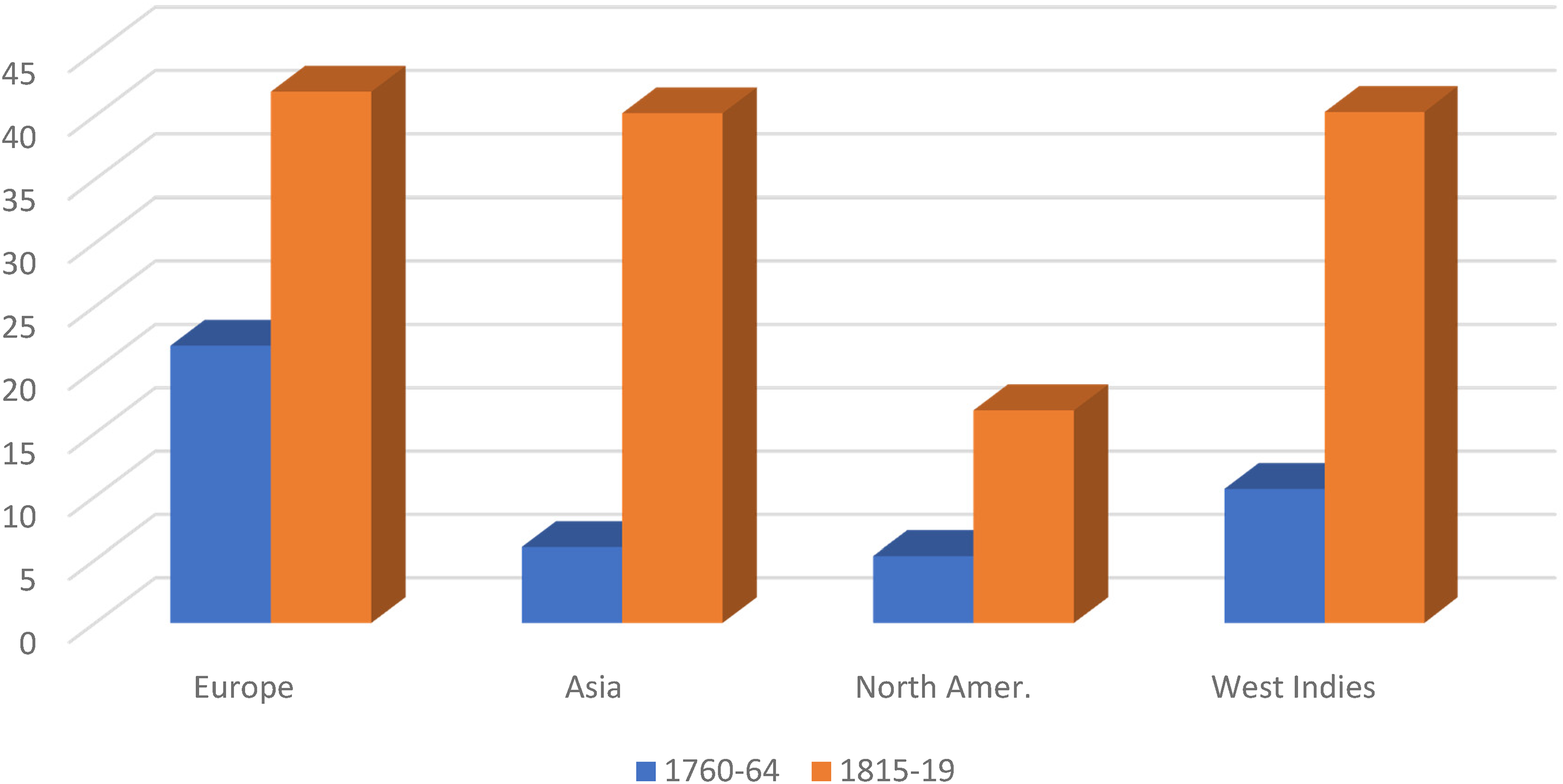
British Imports (historic pounds sterling), 1760–64, 1815–19. (Source: Deane and Habakkuk (1963), ‘The take-off in Britain’, 79, Table 2).
It is easier to make a claim that cotton, rather than sugar, was the essential ingredient in the Industrial Revolution. Cotton spinning was the first sector to experience industrial-scale mechanisation. By 1851, cotton textiles also employed 527,000 workers, half of whom were female (Clapham, 1926 [1967]: 24). From such undoubted truths, however, ill-founded assertions have been made. Thus, we are (wrongly) informed by Sven Beckert (2014: 73) in his Empire of Cotton that ‘by 1830, one in six workers in Britain laboured in cottons [manufacturing]’, whereas in fact only one-sixth of the workforce laboured in any form of manufacturing. Beckert also (wrongly) asserts that by 1831 the cotton sector was responsible for 22.4 percent of the ‘value added’ in the British economy. In truth, as Vries (2017: 132) noted in reviewing Beckert's book, ‘Cotton textile production … never amounted for more than 10 percent of Britain's GDP.’ In terms of employment, cotton manufacturing remained a minority phenomenon. In 1830, at the very end of the Industrial Revolution, the ‘cotton-mill population of Great Britain … was perhaps one-eightieth of the total population’ (Clapham, 1926 [1967]: 54). In reflecting upon the importance of cotton textiles to Britain's Industrial Revolution, Deane and Habakkuk (1963: 72) observed that, ‘it is difficult to see how the cotton industry could have led the national economy in any meaningful sense’ [emphasis in original]. According to Allen (2011: 273), ‘the great achievement of the British Industrial Revolution was, in fact, the creation of the first large engineering industry that could mass-produce productivity-raising machinery.’ Similar claims could be made on behalf of iron-making. After stagnating in the vicinity of 23,000 tons per year for centuries, British iron production rose from 33,000 tons per year in the 1760s to 265,000 tons per year at the beginning of the nineteenth century (Riden, 1977: 443). It was this iron-making revolution that allowed exponential growth in engineering. It also underpinned a transport revolution characterised by railways and iron-hulled ships.
If exaggerated claims are made about cotton manufacture, the same can be said with regard to the antebellum cotton exports of the United States. Yes, it is true that by the 1830s, as Bryer (2012: 528) noted, that ‘King Cotton’ was ‘America's largest export, earning more dollars than all other exports combined’. It is nevertheless a fallacy to believe, as is commonly argued (Beckert, 2014; Desmond, 2019 ; Johnson, 2013; Walvin, 2019), that British industrialisation would not have occurred or survived without United States cotton. As Figure 9 indicates, which draws upon United States customs records, there were no exports from the American South until 1794, by which time the Industrial Revolution (1760–1830) was half over. After climbing to a peak of 41 million pounds (lbs.) in 1803, it only surpassed this level in four of the subsequent eleven years. In 1808 and during the War of 1812 (1812–1815), exports collapsed (United States Department of Commerce, 1975: Series U 274–294). This troubled entry of American supply into the global market means, as Olmstead and Rhode (2018) recently observed, that United States cotton did not play a significant role ‘in kick-starting the Industrial Revolution.’ Nor is it accurate to argue, as Walvin (2019: 49) has, that in ‘the mid-nineteenth century’ the British textile industry ‘would have been lost without American cotton.’ Britain had surprisingly little difficulty in acquiring alternative supplies from Egypt and India during the American Civil War (1861–1865). In 1872, India and Egypt were still supplying almost half of Britain's (expanded) cotton needs (United Kingdom Parliament, 1886: Table 29).
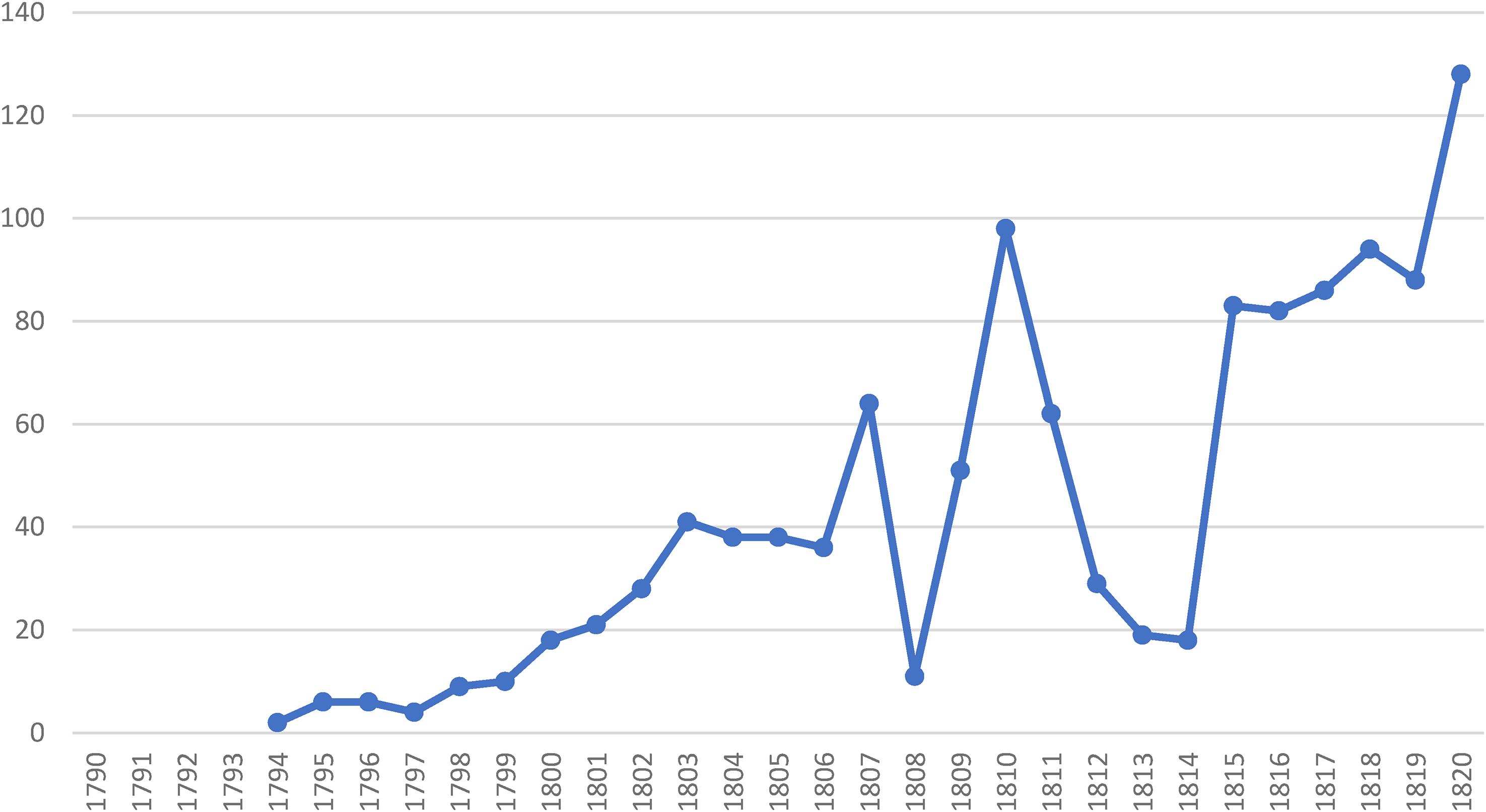
US Cotton Exports by Weight (Millions of lbs.), 1794–1820. (Source: United States Department of Commerce, 1975: series U 274–294).
Slavery in the American south
If we peruse the accounting history literature on slavery and, indeed, the wider business history field, it is evident that few now share the belief that slavery in the Americas was the antithesis of capitalism. Among accounting historians, Bryer (2012) has been a notable exception. There is, nevertheless, disagreement as to whether or not slavery was a productivity-maximising form of capitalism. It is to this debate, rather than the conceptual understandings of capitalism that we considered in the ‘Introduction’ setion 1, that we now turn. In exploring the debate as to the productivity and efficiency of slavery, we nevertheless argue that ultimately these two issues cannot be separated. In the final analysis, slavery's productivity problems reflected a pre-capitalist reliance on manual labour rather than machinery and technology.
In large part, debates in accounting history as to the productivity or otherwise of plantation-slavery are a product of the long-running research of three scholars: Fleischman, Oldroyd and Tyson. Their core argument is succinctly summed up in a recent study by Tyson and Oldroyd (2019). While accepting that slave-owners in the British West Indies and the American South were ‘unabashed capitalists’, Tyson and Oldroyd (2019: 221–22) also observe that their account books reveal a ‘lack of focus on maximising productivity and minimising costs’. They also demonstrate a reliance on ‘discipline’ imposed through ‘physical force’ (for similar views, see: Barney and Flesher, 1994; Fleischman et al., 2004; Fleischman et al., 2008; Fleischman and Tyson, 2004). In contributing to debates about slavery and productivity, it should be noted, these three scholars have also highlighted slavery's moral failings. The listing of slaves in inventories alongside animals, Fleischman et al. (2004: 52) recorded, represented ‘an overt manifestation of racism’. In an essay entitled, ‘Confronting moral issues from accounting's dark side’, Fleischman (2004: 18) lamented the fact that accounting was ‘far more complicit in sustaining slavery’ than many acknowledged. Despite such observations, Fleischman et al. (2008: 767) have been reluctant to construct analysis around ‘virtue’, arguing instead that morality and virtue are ‘historically contingent’.
Fleischman, Oldroyd and Tyson's long-held predilection for dispassionate assessment has attracted not only disagreement but also condemnation. In the work of these historians, Annisette and Ajnesh Prasad (2017: 10) state, we witness ‘a very narrow agenda’, one that uses accounting merely ‘as a data source, passively providing evidence presumed to be neutral and unbiased’.
Leaving aside the accusation that experienced researchers such as Fleischman, Oldroyd and Tyson would treat any evidence as ‘neutral and unbiased’, what we now witness in the slavery debate is an unusual bifurcation. Historically, slavery's proponents emphasised its supposed economic virtues while downplaying its moral shortcomings. Its opponents emphasised the reverse. In the late-eighteenth and early-nineteenth centuries, for example, abolitionists such as Clarkson opposed the slave-trade on the basis of Christian morality. At the same time, they argued that its economic contribution was overstated. Proponents of the slave-trade, by contrast, argued that abolition would cause ‘bankruptcy and ruin’ (cited in Clarkson, 1808: 89). In the antebellum period, abolitionists again opposed slavery largely on moral grounds while lambasting its supposed economic virtues. In 1848, the Kentucky newspaper editor, Cassius Clay (1848: 224), wrote that, ‘The twelve hundred million of capital invested in slaves is a dead loss to the South; the North getting from the same number of laborers … double the work.’ Between the 1950s and 1970s, however, a new generation of economic historians (Conrad and Myer, 1965; Fogel and Engerman, 1974; Stampp, 1956) transformed the debate, emphasising slavery's profitability and supposed efficiency rather than its moral failings. So efficient was the slave system of the American South, Fogel and Engerman (1974: 239) argued, that even slaves enjoyed an ‘average pecuniary income’ that was 15 percent higher than that obtained by the typical ‘free agricultural worker’ (in other words, slaves consumed more wealth than free citizens). As in the past, the opponents of this argument (Dowd, 1958; Genovese, 1965 [1989]) highlighted slavery's economic shortcoming as well as its moral failings. Slavery in the antebellum South, Dowd (1958: 441) concluded, was ‘an anachronism’ despite its profitability, an institution that hindered the ‘social rationality’ that lay at the core of ‘industrial capitalism.’
The shift in the slavery debate, whereby many opponents of slavery increasingly argue that it represented a highly-efficient form of capitalism, reflects changing understandings of capitalism. Prior to the 1970s, capitalism was primarily perceived as an economic phenomenon. Understandings were grounded in either classical economics or Marxism. By contrast, understandings of capitalism since the 1970s increasingly reflected Foucauldian understandings of accountability, control and power. In accounting history, this shift was particularly marked due to the influence of studies undertaken by Anthony Hopwood (1983), Keith Hoskin and Richard Macve (Hoskin and Macve, 1986), Peter Miller and Ted O’Leary (Miller and O’Leary, 1987). Collectively, this group spelt out ideas that became almost de rigueur: that accounting is ‘an instrument for social management’ (Burchell et al., 1985: 381), and that accounting is a ‘micro-technology of calculability’ (Hoskin and Macve, 1986: 124), and that accounting is central to ‘normalizing socio-political management’ (Miller and O’Leary, 1987: 240). It is this Foucauldian emphasis on accounting's micro-control capabilities that is at the heart of Rosenthal's analysis. ‘Control has always’, Rosenthal (2018: 3) argues, ‘been at the heart of modern accounting practices’; a system of control that allowed slave-owners ‘to manage with great precision’, manipulating ‘labor processes in minute ways’.
A characteristic feature of the current slavery debate in accounting and business history is that we thus have schools of thought that not only start from different theoretical premises but are also concerned with different things. Those whose ideas are founded in either classical economics or Marxism perceive slavery through the prism of economics. Conversely, those who frame their thinking in Foucauldian understandings perceive slavery primarily in terms of power and control. It is these profound theoretical differences that make resolution of the current debates about slavery such a difficult proposition.
Central to the current debate are different understandings of Affleck's Plantation Record and Account Book (hereafter Account Book). Through accounting systems such as Affleck's, Rosenthal (2018: 6) argues, antebellum slave-owners created a system of ‘scientific agriculture’ that prefigured many of the ‘scientific management’ techniques later popularised by Frederick Taylor. Even Tyson et al. (2004: 766) suggest that Affleck's system facilitated the grading of slaves ‘in ways that were comparable and antecedent to how proponents of scientific management would [later] use factory standards’.
Certainly, Affleck's (1851: 1) Account Book sold itself as a mechanism for holding individual slaves accountable for their ‘behavior, good and bad’. The evidence that such information was maintained in useable ways, however, is unconvincing. To the extent that individual performance records were kept, it typically occurred in an inconsistent and haphazard fashion (Fleischman and Tyson, 2004: 387). For all their superficial sophistication, Affleck's Account Book also suffered from a series of flaws. Rather than recording debits and credits, Affleck's recording system was simply a record of inventories, expenses and plantation activities that was buttressed by dubious calculations of slave values. This failing caused Heier (1988: 143) to wonder whether Affleck had even ‘a rudimentary understanding of double entry bookkeeping’. Affleck's treatment of the capital value of slaves was particularly problematic. Recognising that slaves were part of an owner's capital stock, Affleck sought to understandably apply the concept of ‘depreciation’ to the slave workforce. In doing so, however, he not only muddled ‘depreciation’ (i.e., a standardised write-down of the value of capital over its working life) with ‘wear and tear’, he also recommended a series of subjective assessments. On the one hand, Affleck (1851: 1) advised slave-owners to record a ‘depreciation in the value of the Negroes, occasioned by overwork and improper management’. This necessitated entirely subjective assessments as to the work and dietary regime of every slave. It also required an unlikely concession as to ‘overwork and improper’ treatment. On the other hand, he recommended that value be increased where ‘usefulness of the old’ was ‘sustained by kind treatment’. The latter additions, Affleck wishfully advised, ‘will form a handsome addition to the side of profits’. Again, such estimations were entirely subjective, if not fanciful.
Affleck's accounting system attempted to give a violent and irrational system an undeserved reputation for enlightened management. In recalling circumstances on the large Maryland plantation of his youth, Frederick Douglas (1846: 5, 17) remembered his overseer as ‘a miserable drunkard’ and ‘a savage monster’. Slaves were ‘frequently whipped when least deserving, and escaped whipping when most deserving.’ After analysing the records for a large Mississippi estate for 1840–1841, Herbert Gutman (1975: 19) estimated that slaves were whipped, ‘on average’, every 4.56 days. Yes, it is true that United States cotton exports rose nearly 100-fold to 1768 million lbs. between 1800 and 1860 (US Department of Commerce, 1975: Series U 274–294). Can this increase, however, be attributed to ‘scientific agriculture’ and efficient labour-management systems? There are certainly reasons to come to a contrary opinion. According to Olmstead and Rhode (2008: 1156), increased cotton productivity was almost solely due to a combination of ‘biological innovation’ (i.e., new cotton varieties, often discovered accidently) and ‘westward movement’ into virgin soils. Where these factors did not apply, there was often little improvement. For example, picking-rates for Sea Island cotton (one of the original varieties) grown along the coast of Georgia and the Carolinas (the industry's original homeland) were virtually unchanged throughout the antebellum period (Olmstead and Rhode, 2008: 1155).
A key failing in the analysis of Rosenthal (2018, 2020), Cooke (2003) and others of like-mind is that they associate ‘scientific management’ and ‘productivity’ with one factor: labour-intensification. In truth, improved productivity under industrial capitalism has owed more to capital-intensity than labour intensification. Nowhere was this more evident than in nineteenth-century agriculture. In broad-acre farming, mechanisation was the key to improvement. In intensive agriculture, fertilizers revolutionised production. Antebellum cotton growing featured neither of these developments on a significant scale. In the 1840s and 1850s, the key to improved European per acre agricultural production was imported guano (bird-droppings) from Peru. Despite the fact that an estimated 40 percent of the South's cotton lands were already exhausted in 1858, plantations used little of this fertilizer (Genovese, 1965 [1989]: 92–8). Mechanisation was also largely conspicuous by its absence. An analysis of plantation records in Virginia, Georgia and Mississippi indicates that in 1860 only 8 per cent possessed farm machinery worth more than $500 (Genovese, 1965 [1989]: 60). To put this in perspective, an adult male slave in the late 1850s typically sold for around $1700 (Fleischman et al., 2004: 49).
Superficially, the 1850s was a boom period for Southern slavery as cotton exports rose 2.8-fold. There were, however, looming problems on many fronts. The price of adult female slaves rose 2.8-fold between the early 1840s and the late 1850s. The cost of adult males rose 3.8-fold (Fleischman et al., 2004: 49). Due to soil exhaustion and lacklustre agricultural productivity in the ‘Old South’ – most particularly Maryland, Delaware, Virginia, South Carolina and eastern Georgia – the profitability of slavery in these older regions rested on exporting slaves to the more productive areas of the ‘New South’. This model, however, demanded ever-westward movement of the entire slave-economy. Confronted with this dynamic, plantation-owners could have ‘modernised’, selling off slaves and investing in fertilizer, machinery and more capital-intensive agriculture. In Maryland, Delaware and (to a lesser degree) Virginia, this is what many did. Typically, this was associated with a move towards smaller farms growing wheat and other produce for Northern cities. It was also associated with growth in the white population at the expense of African-Americans. In Maryland, the white population grew by 77 percent between 1830 and 1860. The slave population shrank by 15 percent. In Delaware, the slave population declined by 45 percnt during the same period, even as the white population rose by 57 percent (Genovese, 1965 [1989]: 137–42). Feasible for individual slaveholders, this ‘modernisation’ strategy was not a viable option for Southern slavery considered as a whole. It only worked if there was another slave-owner willing to buy your slaves. An archaic, brutal monstrosity, antebellum slavery was thus trapped within a cul-de-sac of its own making.
Conclusion
If slavery bound Africa, the Americas and Europe in enduring, if bitter, ties, those experiences nevertheless still pose questions for which there are no unanimously agreed answers. Was plantation-slavery an extreme form of capitalism? Was it seminal to European prosperity? Was it a proving-ground for practices subsequently associated with ‘scientific management’? Accounting historians have begun to play an increasingly central role in these debates. Their contributions, however, are characterised by the same divisions that feature in other disciplinary groups. Most hold that plantation-slavery was a form of capitalism within which accounting played a significant role. Bryer (2012: 538), however, holds a contrary view, arguing that American plantation-owners never ‘increased output by increasing labour productivity’ – a hallmark feature of industrial capitalism. While Rosenthal (2018: 2) finds that antebellum slave-owners ‘left behind thousands of volumes of account books’ that were key to increasing productivity, Tyson et al. (2013: 390) reject the view that ‘slave owners were “smart businessmen”’, or that they used accounting as a tool to impose ‘scientific management.’ Indeed, one can conclude, the primary social purpose of accounting systems such as Affleck's was not economic but political. As Tyson et al. (2013: 390) express, … Thomas Affleck's journal, which prescribed a scientific method plantation accounting, was published at a time when slavery was in its last throes … [and] it was important for slaveowners to reassure themselves as well as the outside world that they were engaged in a fully rational and indeed scientific business practice.
