




Abstract
This research considers the relationship between accounting and physical space, focusing on the creation of musical recordings within the musical and ‘magical’ space of Abbey Road Studios during the 1960s. Building on prior studies that have utilised the work of Foucault to theorise accounting's ability to contribute to making space more disciplinary, this study highlights how, at the beginning of the 1960s, accounting was part of a wider regime that rendered the non-disciplinary, musical space of the recording studio visible and controllable in order to standardise musical recording practices. As the period progressed, and against a backdrop of cultural revolution in 1960s Britain, existing rules and procedures were circumvented by musicians, producers and engineers who utilised experimental practices to create non-standardised, ‘magical’, sonic worlds. Control over the musical space of the recording studio waned and so too did accounting's ability to capture and manage the emergent creative practices.
Introduction
A lot of people have talked about the magic of Studio Two, but I think this is all a bit of a myth; people seem to say things like that just because of all the great records made there (George Martin, Record Producer, quoted in Southall et al., 2011: 73).
Our modern lives are dominated by musical recordings; they are here, there and everywhere. Whether we are passively listening to recorded music when shopping or more actively listening to recorded musical products such as vinyl, CD or via music streaming services, recordings are prominent features of our daily sonic landscape. The present study puts the historical creation of such musical recordings at the centre of its investigation by considering the role that accounting practices played in the creation of musical products in a culturally significant locale – Electric and Musical Industries Ltd's Abbey Road Studios (hereafter ‘Abbey Road’) – during a historically significant period: the 1960s.
Musical recordings have not always been so prevalent in our lives. In Great Britain, for example, it is only since the late 1950s that recorded music has become a central element of the cultural and sonic fabric of society in the manner we would recognise today. Following a period of stagnation in the sale and consumption of recorded music from the Great Depression to the early 1950s, rapid changes in technology provided British consumers with an abundance of fresh musical products that transitioned recorded music from a mere item of entertainment to a necessary fashion accessory and a ubiquitous feature of daily life (Day, 2002; Elborough, 2009). This moved the recording industry away from a prevailing business model centred around the song and live performance towards a model that placed greater emphasis on the recording musician and the recorded musical product (Thompson, 2008).
At the centre of this technological and recording revolution was the recording studio. Musical recordings were shaped by both the physical characteristics of the studio and the equipment used, both of which gave character to the music – what is commonly referred to as the ‘vibe’ of the recording studio space (Nisbett, 1995). These elements made significant contributions to musical recordings from the 1960s onwards as the practice of recording music moved from a concern with accurately capturing the live performance of musicians towards the creation of fictional, ‘magical’ sonic worlds (Kealy, 1979; Thompson, 2008). It is these elements, along with the mystique surrounding the artists who recorded within them, which has contributed to notions of recording studios being ‘magical’ spaces in the eyes of music consumers. Yet, much like when the secret to a magician's trick is revealed, the reality of the creation of musical recordings was far removed from these romanticised and magical notions. Instead, recording studios were highly functional spaces where the creation of music involves painstaking standardised processes of countless, repetitive takes and rigorous editing before the final recording is produced (Herbst, 2021).
Romanticised notions of magical inner workings of recording studios were particularly evident at Abbey Road, most notably after the notoriety generated following the release of an album by one of Britain's most successful bands – the Beatles – when Abbey Road became synonymous with notions of recording excellence and the ‘golden age’ of popular music recording in 1960s (Bennett, 2016). Indeed, Abbey Road took on a particular ‘mythology’ (Bennett, 2016: 398) following the subsequent dominant commercial success for the studio's owner Electric and Musical Industries Ltd (hereafter ‘EMI’) within the British, and international, recorded music market.
The commercial success of companies such as EMI was achieved through rigid corporate control that involved overseeing and controlling the entire chain of musical recording from the discovery of musicians to production and distribution. Via ownership of recording studios, control of the manufacturing and distribution of recorded music, and having the necessary capital to invest significant amounts of money into a marketing division to advertise new releases, companies such as EMI could maximise their share of the market (Bakker, 2006; Negus, 1999; Tennent, 2013; Thompson, 2008). The present study considers the extent to which this corporate control extended into the musical space of the recording studio, shaping the processes used to create musical recordings (Bakker, 2006; Tennent, 2013). More specifically, the aim is to examine the extent to which accounting practices supported the exercise of discipline over the musical space of the recording studio in the pursuit of control over all aspects of the creation of recorded music.
The current study draws on analysis of (auto)biographies, detailed descriptions of recording sessions (sessionographies) and interviews with record production staff published in secondary sources which all document the British music industries during the 1960s. Contained within these sources is documentation that provides examples of record-keeping that highlights how accounting practices directly contributed to the disciplining of the originally non-disciplinary, musical space of recording studios within Abbey Road to ensure that this was an administratively ‘useful space’ (Foucault, 1979: 143) that promoted efficiency through the implementation of standardised operating procedures. Further details on the sources used in this study, and the analysis of these sources, are provided in the ‘Sources’ section below.
Overall, the study finds that accounting practices and detailed record-keeping techniques contributed to an overall system of bureaucracy that included strict disciplinary control and standardised procedures that were designed to shape the sound and production of musical recordings. The findings of the study show that at the beginning of the period of study accounting practices were part of a wider apparatus of instruments designed to wield disciplinary power over the physical, musical space of the recording studio. As will be shown, accounting practices played a supportive role in this regard by contributing to the rigid demarcation of time and physical space whilst simultaneously acting as instruments to control the actions of the recording artists, record producers and recording engineers who, along with recording technology, were the driving force behind the creation of musical recordings. As the 1960s progressed, Britain underwent a cultural transformation that saw the continuation of post-War growth in consumerism and a reaction against the stifling authoritarian conventions of earlier periods, which many postulated as being driven by ‘youth culture’ (Marwick, 2005). This feeling was both reflected in and influenced by the popular cultural output released during this period, including popular musical recordings (Osgerby, 2012). In the case of the creation of musical recordings, this meant breaking free from existing standardised processes and pushing the boundaries of how the space of the recording studio was used to create recorded music. Led by acts such as the Beatles, these experimental, creative and ‘magical’ practices subverted control and discipline, existing outside of the reach of accounting and record-keeping practices.
This article contributes to the existing literature in the following ways. First, the article extends prior research that has theorised the relationship between accounting practices and spatial practices. The study does this by considering the role of accounting within a space that was initially designed without disciplinary motives in mind. Where prior studies have considered the construction and design of spaces designed to improve efficiency and increase discipline such as the construction of new factory spaces (Carmona et al., 2002; Walsh and Stewart, 1993) or the re-design of office space (Labardin, 2014), the present study considers the recording studio, a space designed to maximise the acoustic quality of the musical recording. The article, therefore, furthers our understanding of accounting's contributory role in the transformation of the non-disciplinary spaces where popular cultural products are created into spaces that are ‘more disciplinary’ (Carmona et al., 2002: 239).
Second, the findings of this study suggest a more nuanced interpretation of accounting's ability to support the exercise of disciplinary control over physical space through the imposition of its calculative logic over spaces, particularly where individuals have the desire to circumvent rules, push boundaries and resist existing procedures in the pursuit of creative goals. As musical recording practices within recording studios became increasingly creative, expansive and ‘magical’ throughout the 1960s they were no longer easily captured by accounting practices. As these new recording practices took place outside the realm of existing, standardised techniques they were also outside the reach of existing accounting procedures. The ability of accounting techniques to be used to make space more disciplinary, therefore, is highly contingent on the compatibility of the activities that accounting is attempting to capture and document. These findings add further evidence to research that has highlighted the tension and potential incompatibility of accounting and music (Jacobs and Evans, 2012; Mariani and Zan, 2011; Miley and Read, 2017; Smith and Jacobs, 2011; Zan, 1998) by highlighting that although there were no direct tensions between creative individuals and accounting, accounting was part of an overall disciplinary regime that was eventually disregarded, ignored and circumvented by musicians, recording engineers and record producers in pursuit of their creative ambitions.
The remainder of this article is structured as follows. The section following this discusses the relationship between accounting and music. This is followed by a section that details prior research on accounting and space which is, in a large part, driven by the work of Foucault (1979) to discuss the ability of accounting to aid in the disciplining of space. The fourth section provides an indication of the sources utilised in this work, followed by a brief history of the ‘magical’ space of Abbey Road. The following parts of the article discuss the practices and procedures involved in the creation of recorded music at the studios during the 1960s. The final section of the article provides some concluding comments.
Accounting's relationship with music
Accounting influences the creation of the cultural products that mark our existence yet little remains known about the extent of accounting's influence in this regard (Hopwood, 1994; Jeacle, 2021). Research motivated by this notion, however, has attempted to rectify this by considering the historic role of accounting in entertainment (Jeacle, 2021; Rentschler et al., 2021) including popular music and classical music (Balluchi et al., 2021; De Loo and Davis, 2003; Jacobs and Evans, 2012; Miley and Read, 2017; Smith and Jacobs, 2011). These articles represent welcome forays into the relationship between the creative, ‘magical’ practices commonly associated with the creation of music alongside the perceived restrictions that accounting would have on such practices (Negus, 1995). Indeed, what emerges from this literature is a focus on the tensions that exist between these two seemingly disparate worlds. Miley and Read (2017), for example, examine the use of financial mechanisms by the British Government to control the activities of the pirate radio station, Radio Caroline, during the 1960s. The aim of the Government was to close the service while simultaneously avoiding blame for its closure with financial mechanisms serving as objects of government used to mask this process. Miley and Read (2017) note the indirect ways in which financial control mechanisms are used in attempts to curtail access to cultural outputs deemed inappropriate by those in positions of power.
Further emphasising tension between accounting and music, Smith and Jacobs (2011) examine the characterisation of accounting by musicians through an analysis of song lyrics from popular music from the 1960s onwards. They find that, although in some songs the accountant and accounting are presented as positively facilitating the achievement of wealth, in most instances the accountant is depicted negatively, often being associated with fraud, deception and an overall lack of trust More importantly, this is the notion that accountants are considered servants of capitalism and thus seen as destroyers of creativity, by dint of their risk aversion and financial conservatism.
The concerns highlighted in these studies are representative of the inner tensions and internal debates that developed amongst many musicians during the 1960s whereby there emerged a conflict between the accumulation of economic wealth and the maintenance of an image of artistic purity, as highlighted in the study by Jacobs and Evans (2012). Their study notes the conflict that exists between the bourgeois world of accountancy and the apparent authenticity of the creative realm which emphasises romanticised notions of art-for-art's sake. Drawing upon Bourdieu's (1986) suggestion that the accountant is an embodiment of the ‘bourgeois man’, they state that the rejection of accounting and associated notions of profit or wealth is an important element in maintaining the very notion of art-for-art's sake. These studies highlight that accounting and control are therefore a necessary, if contentious, ingredient in the production of music, but the full extent of the relationship between accounting and music is something that we, as accounting scholars, still know little about (Mariani and Zan, 2011; Zan, 1998).
The perception of tension between accounting and music stems from accounting's desire for order as compared to the alleged disorder, creativity and magic of music whereby musical creation is seen to be driven by inherent unknowability in both production and consumption (Caves, 2002). The notion of cultural production, particularly the creation of musical recordings, conflicting with commerce has been recently challenged as being overly simplistic with Keith Negus emphasising that music production does not take place only within the confines of the corporate environment ‘structured according to the requirements of capitalist production or organizational formulae’ (Negus, 1999: 14), but rather cultural production represents the outcome of broader cultural practices that are outside of the direct control of the corporate agenda. This was certainly the case in Britain during the 1960s, which witnessed a cultural revolution, elaborated upon later in the article, that contributed to the spaces in which musical recordings were taking place, taking on a mystique and aura of magical and creative performances driven by the physical, musical space of the recording studio (Bates, 2012; Bennett, 2016; Gibson, 2005; Herbst, 2021). The spaces from which cultural products have historically emerged are the focus of the present study.
Accounting and the disciplining of organisational space
Space, and the theorisation of space, has a long history in social theory (Bauman, 1993; Foucault, 1979; Giddens, 1984, 1991; Lefebvre, 1991) and organisational theory (Rodner et al., 2020; Taylor and Spicer, 2007; Weinfurtner and Seidl, 2019). Yet, by comparison, less attention has been paid to the theorisation of space in accounting research (Bigoni et al., 2021; Carmona and Ezzamel, 2009; McBride and Verma, 2021). That said, an interest in organisational space represents an exception to this notion and is one area that has attracted the attention of accounting academics (Carmona et al., 1997, 2002; Carmona and Ezzamel, 2016; Labardin, 2014; Miller and O’Leary, 1987, 1994; Quattrone and Hopper, 2005; Walsh and Stewart, 1993). Studies in this area have furthered our understanding of how accounting practices render organisational spaces visible and calculable (Miller, 2001) through the impartation of accounting's logic onto spaces making them controllable, manageable and, ultimately, more disciplinary (Carmona et al., 1997, 2002). As part of a disciplinary regime accounting imposes visibility on that which is subject to its calculation (Carmona et al., 1997, 2002; Hoskin and Macve, 1986; Miller and O’Leary, 1994) and it is via this visibility that individuals are transformed into controllable subjects (Carmona et al., 1997). Following this, authors have considered the role that accounting practices play, most commonly within the enclosed space of the factory (Carmona et al., 1997, 2002; Miller and O’Leary, 1994; Walsh and Stewart, 1993) but, more recently, within the space of the office (Carmona and Ezzamel, 2016; Jeacle and Parker, 2013; Labardin, 2014). In relation to the former, Walsh and Stewart (1993) examine the practices of the New Mills Woollen Manufactory (1681–1703) and the New Lanark Cotton Factory (1800–1812). The panoptical enclosed space of the New Lanark factory allowed for a more totalising view of the movements of materials from one room or department or mill to another. It was the intentional design of physical space, along with an intensification of organisational time, which resulted in a new form of accounting emerging, one which placed emphasis on visibility and calculation that paralleled the making of things. A disciplinary space was deliberately designed and constructed, and accounting practices followed.
In their study of the implementation of a cost accounting system at the Royal Tobacco Factory in eighteenth-century Spain, Carmona et al. (1997) show how a new factory space was specifically designed by architects to render the act of enclosing and partitioning of subjects more disciplinary than it was previously. Importantly, accounting data did not only follow design and construction as in the case of the study by Walsh and Stewart (1993) but was fundamental to the reconfiguration of factory space by setting up a complex web of cost centres which, in turn, quantified the activities taking place within the centres and rendered spaces visible and subjects accountable.
Continuing the theme of the physical spaces being designed and constructed with discipline in mind, and utilising the ideas developed by Foucault (1979), Carmona et al. (2002) examine the role of accounting practices in the production and control of space within the Royal Tobacco Factory's move to a new physical space during the eighteenth century. Numerous accounting practices were developed in the new factory space to monitor production more effectively, providing administrators at the Royal Tobacco Factory with new visibilities and possibilities for discipline. In particular, discipline was instilled upon the space firstly through the act of ‘enclosure’ (Foucault, 1979), which was achieved through the ‘specification of a space that is enclosed upon itself while being heterogeneous to all others’ (Carmona et al., 2002: 243; Foucault, 1979). Accounting practices enclosed and created new meanings for the physical factory space and was instrumental in controlling and shaping the activities that took place within this space.
Complementing ‘enclosure’ in Foucault's conceptualisation of the disciplining of space is the act of ‘partitioning’. As Foucault (1979: 143) notes, disciplinary space ‘tends to be divided into as many sections as there are bodies or elements to be distributed’. Spaces are allocated to individuals and individuals are allocated to spaces (Carmona et al., 2002). Prior research tells us that accounting directly supports this partitioning as accounting can ‘reinforce existing spatial configurations by visualising activities within each partition and emphasising spatial boundaries, for example, by attributing specific cost items to specific partitions’ (Carmona et al., 2002: 244). Accounting captures and makes visible certain spaces demarcating them as centres of calculation and therefore control.
‘Coding’, according to Foucault, refers to the classification, categorisation, and quantification of individuals and activities to transform an otherwise passive space into a ‘useful space’ (Foucault, 1979: 143). Accounting assists management in the exercise of disciplinary control over an enclosed space by coding that space with its calculative and disciplinary logic. Through this spaces become useful and manageable (Carmona et al., 2002; Miller and O’Leary, 1994).
Foucault's thoughts on coding also relate to how individuals come to be assessed based on their efficiency and skill at performing a task, which subsequently allows for these individuals to be ‘ranked’ according to specific classification criteria. Separation from others is the driving force in this instance, with individuals traditionally being physically distanced from one another to isolate and map the performance of everyone onto the requirements of management. Indeed, discipline ‘is an art of rank, a technique for the transformation of arrangements. It individualises bodies by a location that does not give them a fixed position, but distributes them and circulates them in a network of relations’ (Foucault, 1979: 145). Accounting practices support this insofar as they ‘provide a basis for the eventual inclusion, or exclusion, of particular individuals into specific social groups placed at clearly identifiable locations in organizational social space’ (Carmona and Ezzamel, 2009: 146). In sum, therefore, accounting directly supports the transformation of non-disciplinary spaces disciplinary ones through the impartation of its calculative regimes and the creation of specific visibilities that support the needs of management.
It is important to note that accounting's reach may be limited in some instances, particularly where resistance is noted (Papi et al., 2019). We have previously seen that ‘accounting does not always succeed in penetrating space’ in part because spaces are ‘often organised in ways that preclude full capture by accounting practices’ (Carmona et al., 2002: 244). However, in addition to the organisation of space itself, it may be that the nature of the activities taking place within a particular space is beyond the capture of accounting. Creative activities, such as those associated with the creation of musical recordings, would fit the definition of activities that are not easily captured by accounting due to the complex and somewhat troublesome relationship between accounting and creativity (Jacobs and Evans, 2012; Mariani and Zan, 2011; Smith and Jacobs, 2011; Zan, 1998).
A key feature of the aforementioned studies is that they discuss physical spaces that have been specifically designed and constructed to allow for the exercise of discipline and control over individuals, with accounting intervening to make these spaces ‘more disciplinary’ (Carmona et al., 2002: 239). This marks a point of departure for the present study. Recording studios such as Abbey Road were not designed as disciplinary spaces. The primary goal in the historical development of recording spaces was to capture musical sounds to the highest possible quality, often having to overcome the substantial limitations of recording technology of the period. Although recording spaces were not designed to be disciplinary music companies asserted corporate control over the recording process and it was discipline rather than the ‘magic’ of the creative activities of music production that ruled the space of the recording studio.
Sources
To facilitate an in-depth understanding of the role of accounting practices in the creation of musical recordings at Abbey Road during the 1960s, a qualitative textual analysis approach was conducted using multiple qualitative data sources, as detailed below (Bicudo de Castro and Mihret, 2020; Bigoni, 2021; Kuckartz, 2013). The research commenced with a wider analysis of the 1960s music industries to situate the study within the wider context of the production of music during this period, beginning with music-centric histories of the time (Barfe, 2013; Chapple and Garofalo, 1977; Cohn, 2016; Cunningham, 1999; Thompson, 2008). Following this, several texts on the history of music production (Burgess, 2014; Day, 2002; Elborough, 2009; Milner, 2009; Schmidt-Horning, 2016) and more general business histories that focus on EMI as a company (Cavendish, 2017; Martland, 1997; Pandit, 1996; Southall, 2012) were reviewed. Next, texts that cover the history and the inner workings of British recording studios including, but not limited to, EMI's Abbey Road were consulted (Clark and Cogan, 2003; Hudson, 2010; Lawrence, 2016; Massey, 2015; Southall et al., 2011; Wadsworth, 2007).
As recording studios are often considered ‘mythological’ places full of ‘inextricable magic’ (Gibson, 2005: 201), leading to romanticised notions of the activities taking place within (Bates, 2012; Bennett, 2016; Gibson, 2005), there is an intense interest in uncovering the secrets to the ‘magical’ process of music production. This is exemplified by the production of texts that go beyond mere histories of recording studios and instead attempt to detail every moment from every recording session of certain musicians who were active during the 1960s such as Cliff Richard (Lewry and Goodall, 1991), The Rolling Stones (Elliott, 2002), The Beatles (Kehew and Ryan, 2006; Lewisohn, 2013), Eric Clapton (Roberty, 1995) and Fleetwood Mac (Lewry, 1998). These ‘sessionographies’ use a combination of archival material, including evidence of record-keeping, and first-hand accounts to capture the intimate detail of the recording sessions – from the equipment used to the activities undertaken. This was a valuable source for the current study as it revealed the inner workings of the music production process and provided access to record-keeping practices that were hitherto unavailable.
A further useful source was the many biographies and autobiographies of musicians, music producers and recording engineers (Atkins, 2000; Blake, 2011; Boyd, 2017; Brown, 2010; Emerick and Massey, 2007; Fitch, 2005; Johns, 2014; Kerridge, 2021; Martin and Hornsby, 1979; Miles, 2009; Napier-Bell, 1998; Perasi, 2013; Repsch, 2000; Russell and Medvedev, 2017; Scott and Owsinski, 2012; Smith, 2020; Womack, 2017, 2019) who contributed to the creation of music recordings during the 1960s. These sources added further important contextualisation to the experience of individuals working at Abbey Road, giving an insight into the working practices of the studios. This was supplemented by the utilisation of a host of second-hand interviews with musicians, music producers and recording engineers who operated during the 1960s. These interviews, conducted by other researchers, are collected and reproduced across several books (such as Massey, 2000, 2009).
A qualitative text analysis (Kuckartz, 2013) was used to analyse the aforementioned sources to, first, understand the music production practices used during this period and, second, to uncover the role accounting practices played within this. From this emerged a sense of the technical, mundane and repetitive nature of the practice of music production which contradicted the idea of ‘magic’, as well as revealing the extensive nature of record-keeping practices which formed part of a wider disciplinary regime that was driven by a desire to ensure that recording studio spaces were subject to the discipline and control necessary to ensure that they were ‘useful’ spaces (Foucault, 1979).
Behind the magic: Making music at Abbey Road during the 1960s
The Swinging Sixties
A cultural revolution was taking place in 1960s Britain, one that was transforming the everyday lives of ordinary people and that was being driven by a distinct emergent ‘youth culture’ closely connected to commercialism and consumerism (Marwick, 2005). Following on from the post-war affluence of the late 1950s (Donnelly, 2005), the 1960s saw a remarkable increase in the availability of products emanating from the culture industries, often led by popular music. Many individuals now had disposable income at levels not previously witnessed and whilst the adult population spent their disposable income on televisions, white goods and cars, the youth of the day spent their disposable income on leisure, luxury and, in particular, ‘cultural markers’ (Donnelly, 2005: 35). Popular music was at the forefront of cultural products, becoming a kind of ‘universal language’ (Marwick, 2005: 44) with the 1960s seeing British popular music becoming the medium and outlet that captured the new-found desire for freedom and expression that gripped the youth of Britain. The recording studios at Abbey Road were at the forefront of the commercial output of popular music associated with this period, as evidenced by six of the top ten selling acts between 1960 and 1969 – Cliff Richard, The Beatles, The Shadows, The Hollies, Manfred Mann and Adam Faith – having recorded their music at Abbey Road (Donnelly, 2005). As a result of the cultural and commercial success of musical recordings being produced within its walls, the space of Abbey Road achieved an almost mythological reputation as a representative of the epitome of inspirational, magical bouts of creativity (Bennett, 2016). The notion of magical moments of creativity within recording studios does not represent the reality of music production. Instead, recording sessions were often tedious and laborious (Herbst, 2021) – and Abbey Road was no exception.
The ‘magical’ space of Abbey Road
The initial construction and design of the studios at Abbey Road was motivated by the functional goal of maximising acoustic recording quality. Construction began in 1929, prior to the merger of two prominent music companies – Columbia Graphophone Limited and The Gramophone Company – which resulted in the formation of EMI. The plan was to convert a former residential building into a large recording studio complex and on 12 November 1931 this plan was completed with the recording studios at Abbey Road officially opening under the ownership of the new company. At the time, it was widely believed that Abbey Road was the world's largest building designed solely for the recording of gramophone records (Southall et al., 2011) and the first purpose-built recording facility in the world (Théberge, 2004).
Constructing the space required to create high-quality musical recordings required a significant capital investment meaning that purpose-built studios were rare, particularly in the UK. Regarding the construction of the original studios, it is noted that … it was a great financial investment. It cost £100,000 to buy, build and equip and now must be worth many millions of pounds. It was extraordinarily ahead of its time. The music world didn't have recording facilities anything like Abbey Road and its opening led the way for many other companies to build independent studios (David Bicknell, Former Manager of International Artists at EMI, quoted in Southall et al., 2011: 13).
More than simply building a dedicated recording facility, Abbey Road was constructed with the aim of achieving the highest possible sonic quality to allow the company to demonstrate the technical superiority of its hardware (gramophones) and software (gramophone records). The press release issued at the time by EMI noted: The walls of these studios are specially designed to give correct resonance to all sounds and to avoid any echo. A special system of air cleaning and ventilation has been installed in order that the atmosphere in each studio will ensure that artistes and musicians will be able to perform during any period of the year under the most comfortable conditions. The warm air is continually washed and purified. Just over four and a half miles of electric cable connect the three studios with the central control room. Six microphones can be used at any one time in each studio and each microphone has separate control. This will ensure that all records will be recorded with the correct balance of instruments and vocalists (Southall et al., 2011: 13).
Achieving technical excellence was, and still is, a recurring theme in the history of Abbey Road. Refinements to the overall studio complex continued after its initial construction in order to achieve the highest possible quality of musical recordings and by the 1960s Abbey Road comprised a larger complex with three main recording studios, as shown in Figure 1. Within the complex, each individual recording studio operated as a separate closed-off space, with each space used for differing recording purposes as a result of varying acoustic qualities.
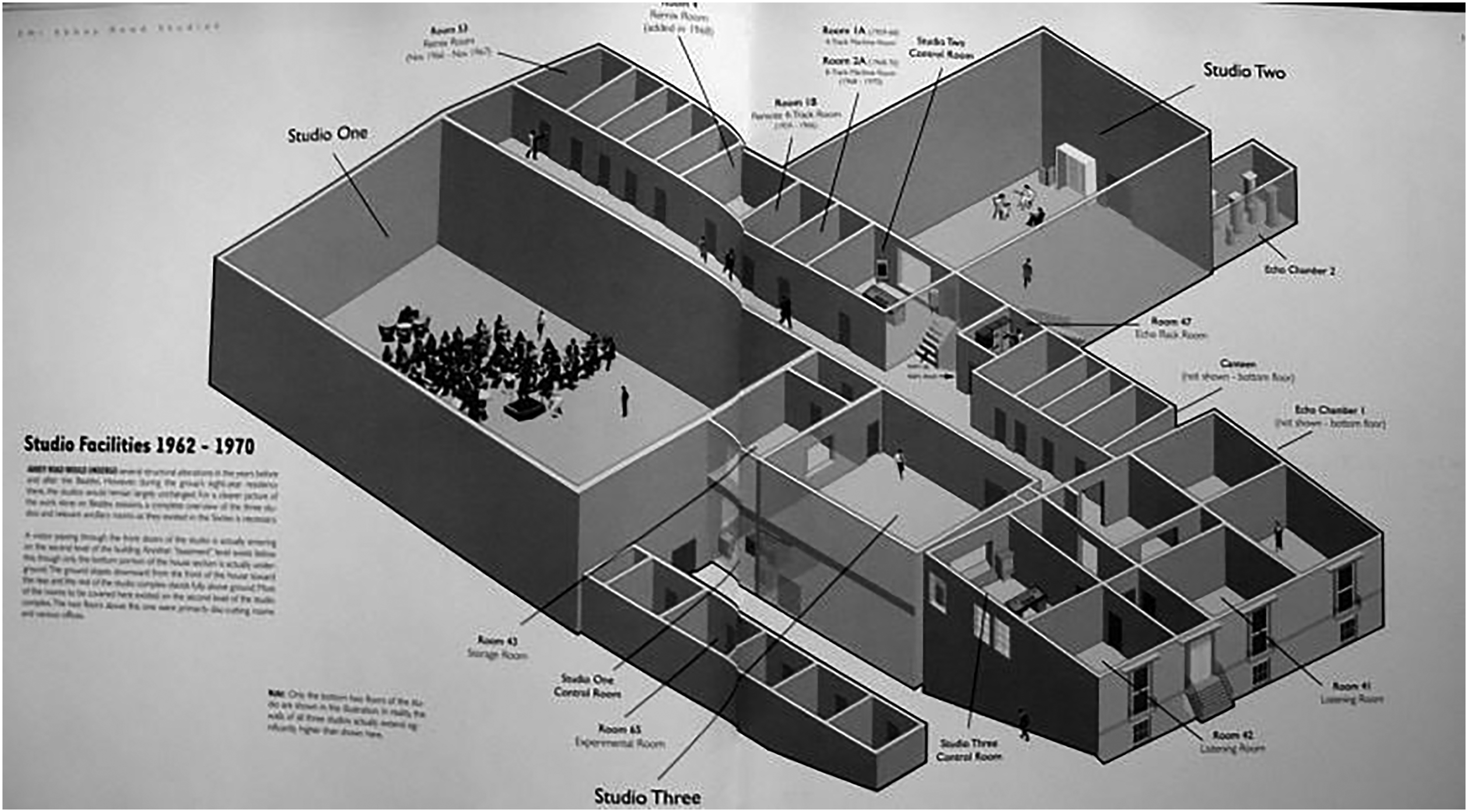
The layout of Abbey Road during the 1960s (Lewisohn, 2013: 3).
Studio One was originally designed to replicate a concert hall and was capable of housing a full 100-piece symphony orchestra (Massey, 2015). The studio provided over 5300 square feet of space alongside a small control room. Despite the best attempts to design the studio with acoustics in mind, the company that designed the studio … had filled the place with damping material the roof and walls were packed with the stuff, and it was dead as could be. Only when this stuff was pulled out after the war, and replaced with resonating material, did it become a good studio (David Bicknell, Former Manager of International Artists at EMI, quoted in Southall et al., 2011: 16).
It is Studio Two, however, that has become the most revered as this is where the majority of the commercially successful popular music recordings from the 1960s were recorded. Studio Two was smaller than Studio One with 2200 square feet of space and a 28-foot ceiling and forms the focus of the majority of the analysis in the present study (Massey, 2015: 22).
Finally, Studio Three, although only one-tenth of the size of Studio One at 1300-square-feet, was spacious enough to accommodate small chamber groups and, occasionally, pop bands (Massey, 2015). Regardless of the studio design in the fledgling music industry of the early twentieth century, Abbey Road created a new level of excellence – a professional working environment with the very latest in musical recording technology, supported by the world's greatest inventors, engineers, and technicians (Lawrence, 2016: 10).
Yet a feature of the studios was that, throughout the 1960s in particular, the ‘vibe’ of the Abbey Road complex as a whole was often referred to as cold and mechanical as summed up by Sir Paul McCartney: People either like or hate EMI and if they hate it,’ suggests Paul, ‘they hate it because it's too like a government building or like the BBC; it has its name on the toilet paper and there's something sort of horrible and huge or impersonal about it. I love it because of all those things (Paul McCartney, Member of The Beatles, quoted in Southall, 2012: 120).
The space here was, therefore, not inherently ‘magical’ nor created with the exercise of discipline in mind – it was intended to be functional. However, discipline and control were a recurring theme in how record companies controlled and managed their operations across the full range of music industries, and conceptualisations of magic followed with commercial success and cultural importance. In their desire to exercise control of the music creation process, management attempted to transform the musical space into an administratively useful one, including using accounting practices. The following sections discuss this in detail.
Enclosure: A disciplinary space within a musical place
Each individual recording studio space was unique in terms of both the design of physical space, the materials used to construct that space, the technology available within and the resulting ‘vibe’ that the combination of these elements provided. By design, then, the recording studios at Abbey Road represented specific enclosed spaces that, when coupled with being one of only a few high-quality recording spaces available at the beginning of the 1960s, meant that the management of EMI could exercise significant control over access to the recording studio space(s) as part of a wider corporate control regime.
During the earlier part of the 1960s, recording sessions were restricted to three main time slots within a working day which made up the ‘standard three-hour sessions of 10 A.M. to 1 P.M., 2:30 P.M. to 5:30 P.M., or 7 P.M. to 10 P.M’ (Scott and Owsinski, 2012: 37). The three-hour time slot was influenced by the Musicians’ Union with recording musicians who were members of the Union playing for three hours at a time before requiring a break in recording. At Abbey Road, the fixed nature of start times for the time slots, rather than the three-hour restriction on recording, often grated with record producers and musicians alike. Mickie Most, who used Abbey Road as an external paying client, states: they were totally inflexible on their times. When I wanted to record … we had to start at eight in the morning and Abbey Road Studios refused to open up before 10 am so I had to go to another studio … We also asked Abbey Road Studios about recording at midnight, but they wouldn't do that either’ (Mickie Most, Record Producer, quoted in Southall et al., 2011: 91).
Due to the strictness of the time slots, there was an expectation that record producers worked as efficiently and effectively as possible within the restricted time that was available. If a specific recording looked as if it would not be completed within the three-hour period, a further three-hour session would have to be booked. Record producers were thus under significant pressure to deliver recordings within a difficult environment: Given the restricted resources of this environment, corporations placed a premium on the time effective use of their studios and usually expected producers in a single three-hour session (which included a short tea break) to have both sides of a single ready for mastering (Thompson, 2008: 23).
Despite the strict, standardised, control of the recording studio space, there does exist evidence that recording time within the studios would be rented out to musicians who were not members of the Musicians’ Union outside of standard hours, sometimes late into the night (Lawrence, 2016).
Applications for use of the studios were prepared by record producers subject to the approval of the management. Permission to begin recording was sought using an ‘Instructions for Recording’ form, colloquially known at Abbey Road as the ‘Red Form’, and this gives the first hints as to the accounting system in place within the studios. An example is shown in Figure 2. The ‘Red Form’ was used to seek financial approval for recording time for a given project from company management. As Figure 2 shows, the form provides details of the session which include the recording artist, the songs to be recorded plus the cost of any external (session) musicians required, as well as additional equipment. The cost of this is detailed at the bottom of the form along with details of the composer and orchestration required. Of the process, one recording engineer, Norman Smith, notes that the ‘Red Form’ he submitted ‘wouldn't have to be exactly to the last penny’; however, ‘they would have a yea or nay on it,’ even though Smith ‘never did get a nay … I wouldn't be called up about it or anything like that, so long as your budget was balanced with credits and debits and pretty even, then they didn't mind … you would not get away with too many failures before things were tightened up’ (Thompson, 2008: 68).
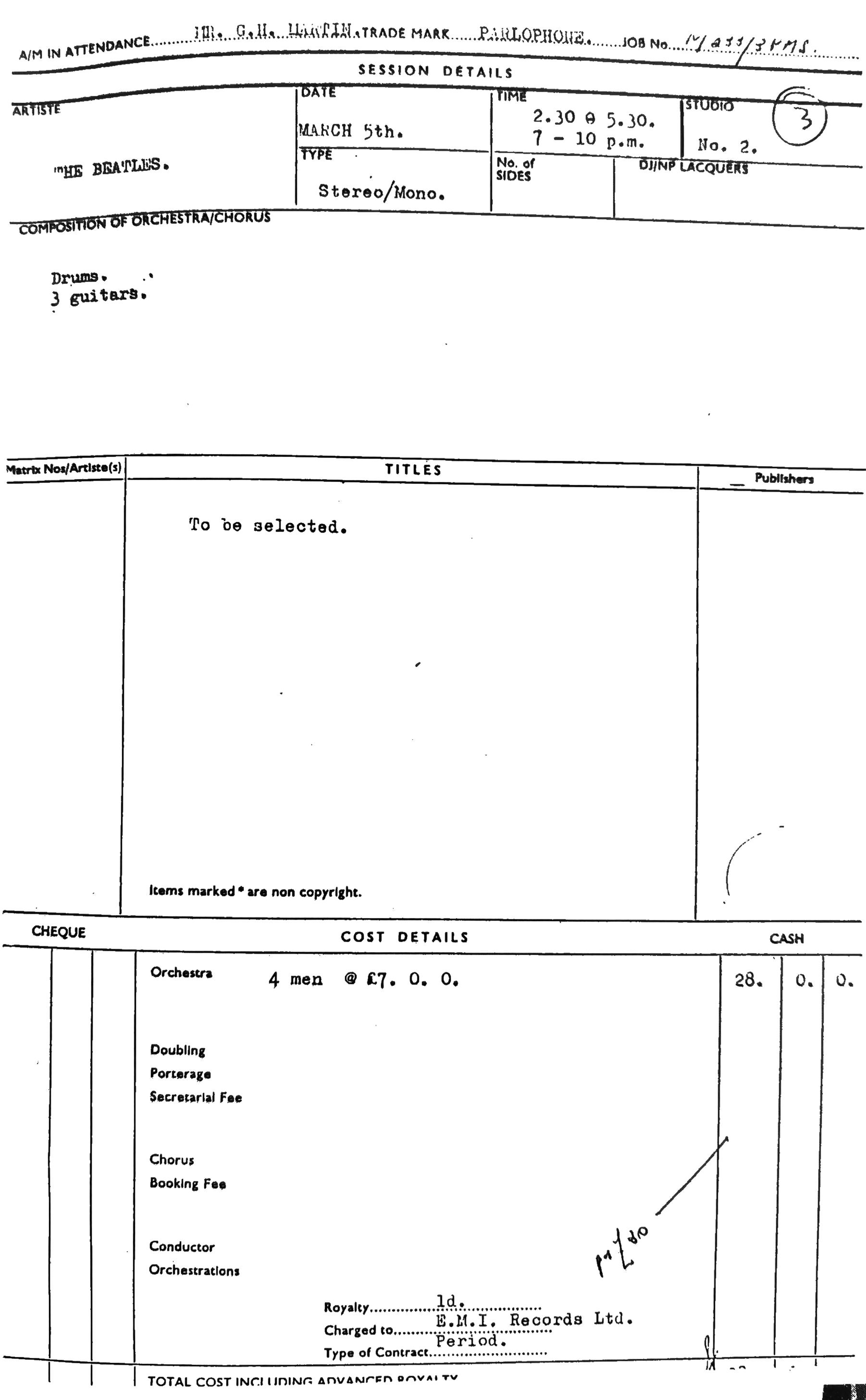
‘Red Form’ from 1963 (Lewisohn, 2013: 29).
The highly structured approach to recording continued to be used in recording sessions that featured session musicians or Musicians’ Union members but, as the musical landscape changed during the 1960s, artists increasingly began to write and record their own material resulting in this standardised structuring beginning to fall away with the studio space even being rented out to recording musicians that were not under contract with EMI, something that had hitherto been forbidden: Surprisingly, there was a time when Studio Two was under-booked and this opened the way for non-EMI artists to start using Abbey Road. It was opened up before Alan Stagge arrived in the mid-Sixties but only because Number Two was under-booked. When Stagge arrived, he opened the whole building up for use by non-EMI artists and the classical people were furious – they were dead against the idea from the start (Samwell, Former Studio Booking Manager, quoted in Southall et al. 2011: 100).
When recording musicians and record producers were within the enclosed space of Abbey Road, regardless of who they were contracted to, the standardised operating procedures, discipline and control that were imparted by EMI's management had to be followed, as the next section discusses.
‘The big black window’: Partitioning, assigning space and respecting roles
Aside from dividing the recording complex into individual recording studios, partitioning within Studios One, Two and Three at Abbey Road involved two further spaces which were themselves enclosed: the recording area – where recording artists and recording equipment (musical instrument, amplifiers, microphones and other equipment) were placed – and the control room – which was, up until the 1960s at least, the sole domain of record producers and recording engineers. The separation of the recording space and the space of the control room was important to the exercise of order and discipline within Abbey Road: ‘Those were the days when they didn't let you near the control room – you just had to wait for ‘em to say yes or no through the loudspeakers at the end of the session’ (Roy Wood, musician, quoted in Southall et al., 2011).
Not originally intended with disciplinary objectives in mind, separate enclosure of the control room ultimately provided a mechanism for the furthering of disciplinary practices by increasing the potential for monitoring and surveillance of the artists who were recording within the studio space with the space for recording and the control being separated by a glass partition. The extent of monitoring and surveillance is perhaps best emphasised by considering Studio Two. As can been seen from Figure 3, in Studio Two, the control room was placed high up on the studio wall meaning that record producers and recording engineers were always looking down at recording musicians. Rather than be separated by only a door and a pane of glass (and often a short corridor), musicians would instead have to physically climb a set of stairs if they wished to attempt to access the control room. Sir Paul McCartney recounted his experience of recording in Studio Two: ‘We were in a corner [of Studio Two] looking up at this big window, this big black window where there were people moving around’ (Paul McCartney, Member of the Beatles, quoted in Southall et al., 2011: 115).
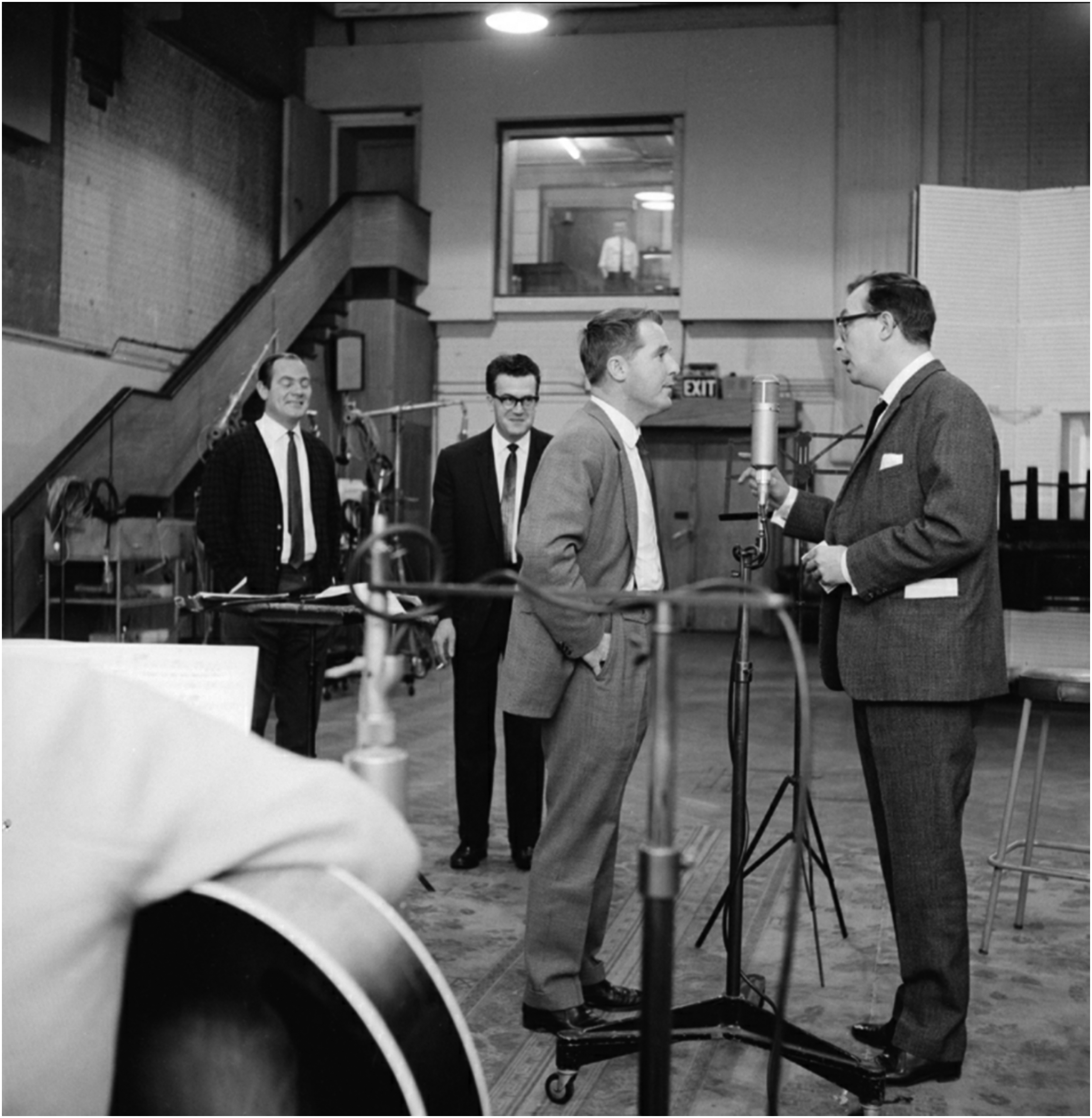
Studio Two (Lawrence, 2016: 35).
The physical separation of bodies in this way furthered the hierarchical separation of individuals that existed within EMI more generally and Abbey Road more specifically. We know that organisations exist as gatherings of people with explicit or implied organisational hierarchies (Carnegie et al., 2020), and there was ‘a clearly defined hierarchy within Abbey Road, and the studio had a well-established path that employees must take to progress through the ranks’ (Kehew and Ryan, 2006: 32). The recording studios themselves were managed by a studio manager but with respect to producing musical recordings there was a rigid hierarchy: At the top came the producer, who was responsible for managing a recording session. Next came the audio engineer with an assistant engineer charged with running the tape machine and sharing the workload. The common path was to start in the library, move onto disc cutting, followed by tape operation, and finally to work as an audio engineer (Lawrence, 2016: 30).
At the bottom of the hierarchical structure, tape operators or assistant engineers were charged with starting, stopping, rewinding and fast-forwarding tape at the demand of record producers but they were also responsible for annotating the session notes, indicating which takes and edited pieces a tape reel contained. Basic record-keeping was a significant aspect of the role of recording engineers as Malcolm Addey notes: We were more like clerks: we took notes, we didn't even set up or touch any microphones, that was all done in those days by the electronic maintenance department. They used to set up floors according to our layouts. That's why they produced so many sessions in a day so easily; somebody else was doing that work for you (Thompson, 2008: 111).
The sound or balance engineer was a role slightly higher up in the hierarchy than tape operator. Balance engineers were responsible for establishing the best position of musicians and microphones within the studio space and were charged with operating the mixing console. However, it was only technical engineers, who worked across all recording studios within the Abbey Road complex, who had permission from management to set up equipment. If there was a problem in the studio, the balance engineers would call for technical staff to come and rectify the issue as they were not allowed to touch the equipment. The ability of record production staff to shape a recording was limited during this period, as noted by Ken Scott from his time working at Abbey Road: In fact, the engineers couldn't even put their own mics out. That was the job of the amp room guys (who all wore white lab coats so they wouldn't get their clothes dirty and, contrary to popular belief, were the only ones in the building to wear these coats), the technical and maintenance wizards from upstairs. The engineer could do the final placement, but the ‘white coats’ had to put the mics out and set up the session, a feat accomplished by having the engineer fill out a setup sheet before every session (Ken Scott, Recording Engineer, quoted in Scott and Owsinski, 2012: 320).
At the head of the hierarchy was the record producer. At the start of the 1960s, most, if not all, record producers and recording engineers were full-time employees of record companies and were paid a salary. At this time, the so-called ‘corporate’ record producers were considered part of the management structure and were charged with overseeing the selection, recording and release of singles and albums under their respective record labels. Decisions about what songs to record, which recordings to give preference to for release and how the recordings should take place lay at the feet of record producers. The producer became even more influential as he was tasked with not only creating the song but a complete marketable product (Hennion, 1983). Corporate producers took care of the availability of financial means, coordinated schedules and looked after artists on behalf of the record companies (Avalon, 2006; Massey, 2000, 2009; Tschmuck, 2012).
The role of the corporate record producer as head of the record production hierarchy is perhaps best epitomised by accounts of George Martin recording with musicians during the 1960s, including the Beatles. Martin epitomised the transformation of the space into a disciplinary and useful space, with Martin himself (1979: 132) remembering: ‘I would perch myself on a high stool, and John and Paul would stand around me with their acoustic guitars and play and sing songs they wanted to record’. Martin is noted as being a record producer who demanded respect and who ‘built psychological intimidation into his persona’, although this relationship appears to have been primarily with musicians and Martin is also noted for developing a team approach to musical production (Thompson, 2008: 63). The hierarchical structure extended the control of corporate management into the closed physical space of the recording studio allowing management to exert disciplinary power over space, with the coding of that space being important to the achievement of these goals, as is discussed in the next section.
‘Controlled by the money men’: Coding space through record-keeping
With respect to the coding of space, there is evidence of EMI management's attempts to maintain the space of the recording studio as a bureaucratic and administratively ‘useful space’ (Foucault, 1979: 143) through the use of an extensive record-keeping regime which acted as a supporting mechanism to the rigid operating procedures and corporate control within Abbey Road. As previously alluded to, at Abbey Road record producers and recording engineers were discouraged from touching and placing the recording equipment in the recording space, yet they were held responsible for the sound and quality of the recording. Engineers did have some control over where they wanted the equipment to be placed within the recording studio space, even if they were not allowed to place it there themselves. Before a recording session would be allowed to commence, recording engineers were required to submit a ‘setup sheet’ for approval by management. Once approved, the setup sheet instructed the Abbey Road technicians, who were the only individuals allowed to handle the equipment at this point, where record production staff would like the equipment to be placed within the studio. This is demonstrated in Figure 4.
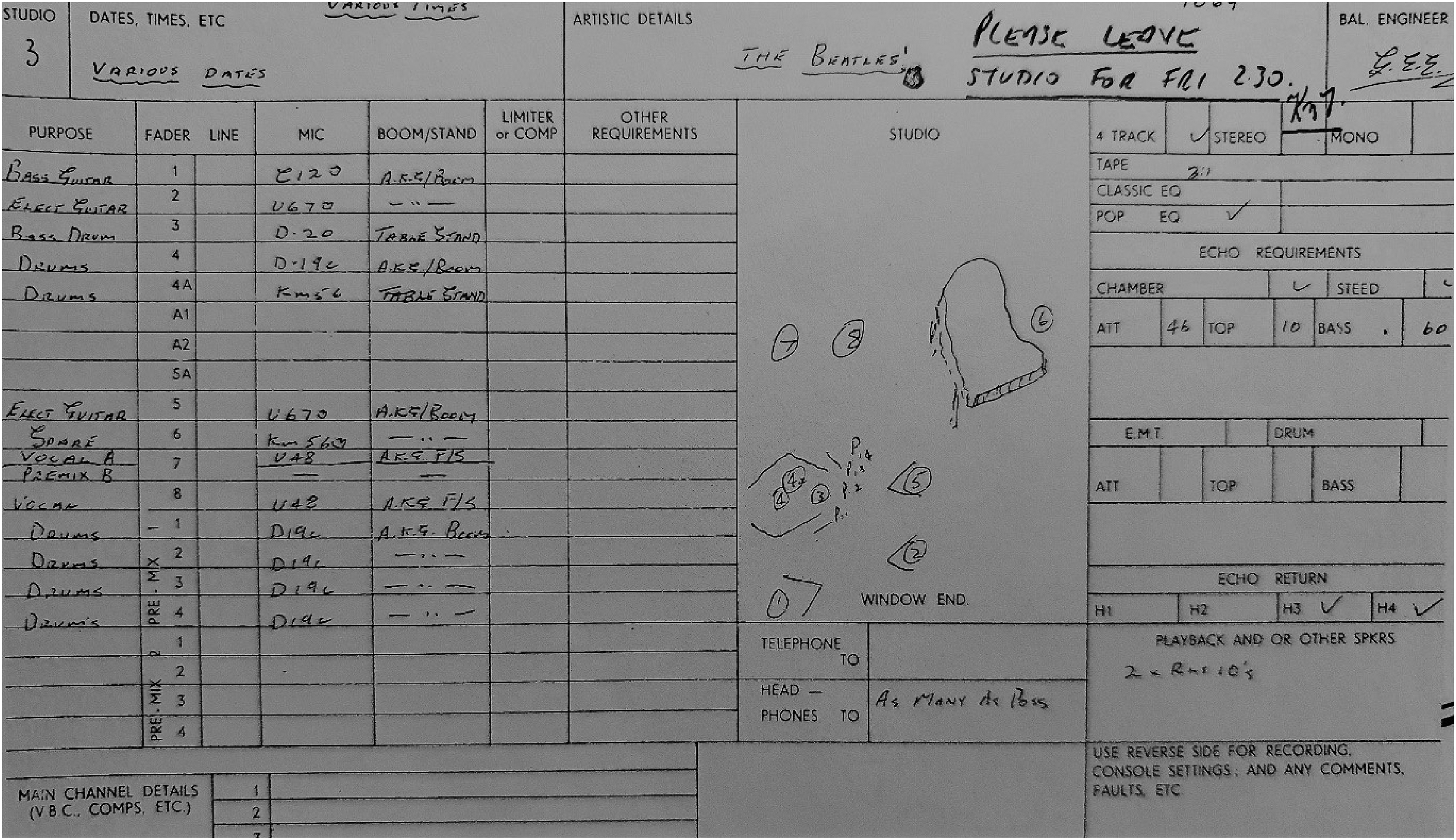
An example of a setup sheet for a recording session under job number 1069 (Lewisohn, 2013: 149).
Along with the date and the time of the intended recording session, the setup sheet details the equipment that engineers wish to use in the recording and includes a drawing of how the production staff would like the studio to be arranged. Once approved, the technical staff would set up the equipment in preparation for the recording taking place. The level of detailed planning displayed here is indicative of the controlled environment of early music production, and the recording session would not commence until the appropriate paperwork had been completed and submitted to the technicians, as one former employee recounts: I arrived at the studio at about five to ten for a 10 o’clock start and discovered that the necessary paperwork had not arrived. Peter Vince, the engineer, wasn't at all bothered and began setting up the studio for the group who duly arrived for the session. Suddenly Alan Stagge, the studio manager, stormed in and in front of this group, who at the time thought Tim Rice was a big shot at EMI, ‘gave me the all-time bollocking about starting without the proper paperwork’ (Tim Rice, Record Producer and Songwriter, quoted in Southall et al., 2011: 99).
The standardised bureaucratic and administrative processes in place at Abbey Road were important and linked to attempts by EMI to extend corporate control over all aspects of the creation and sale of recorded music. As previously noted, those at the bottom of the studio hierarchy, tape operators, spent a significant portion of their time creating a detailed record of the recording session that they were currently working on. This involved filling in a big ledger, with about four or five carbon copies, which gave you the artist, the studio, the time of starting, the time of booking, the time of starting and finishing each title, take numbers, accurately recorded with the publishers and songwriters if known. Every single thing about that session was on there (Addey, quoted in Thompson, 2008: 11).
This record-keeping is best evidenced by the inscriptions found on another administrative mechanism – part of the ledger referred to in the quote above – the ‘recording sheet’. Figure 5 shows a typical recording sheet used at Abbey Road prior to 1960. By the 1960s, the style of the recording sheet had changed but the information collected remained the same as demonstrated by Figure 6. This style of sheet continued to be used for many years, with Figure 7 showing an example of the very same recording sheet template still being utilised in 1978. This practice was therefore firmly embedded in the operating procedures at Abbey Road.
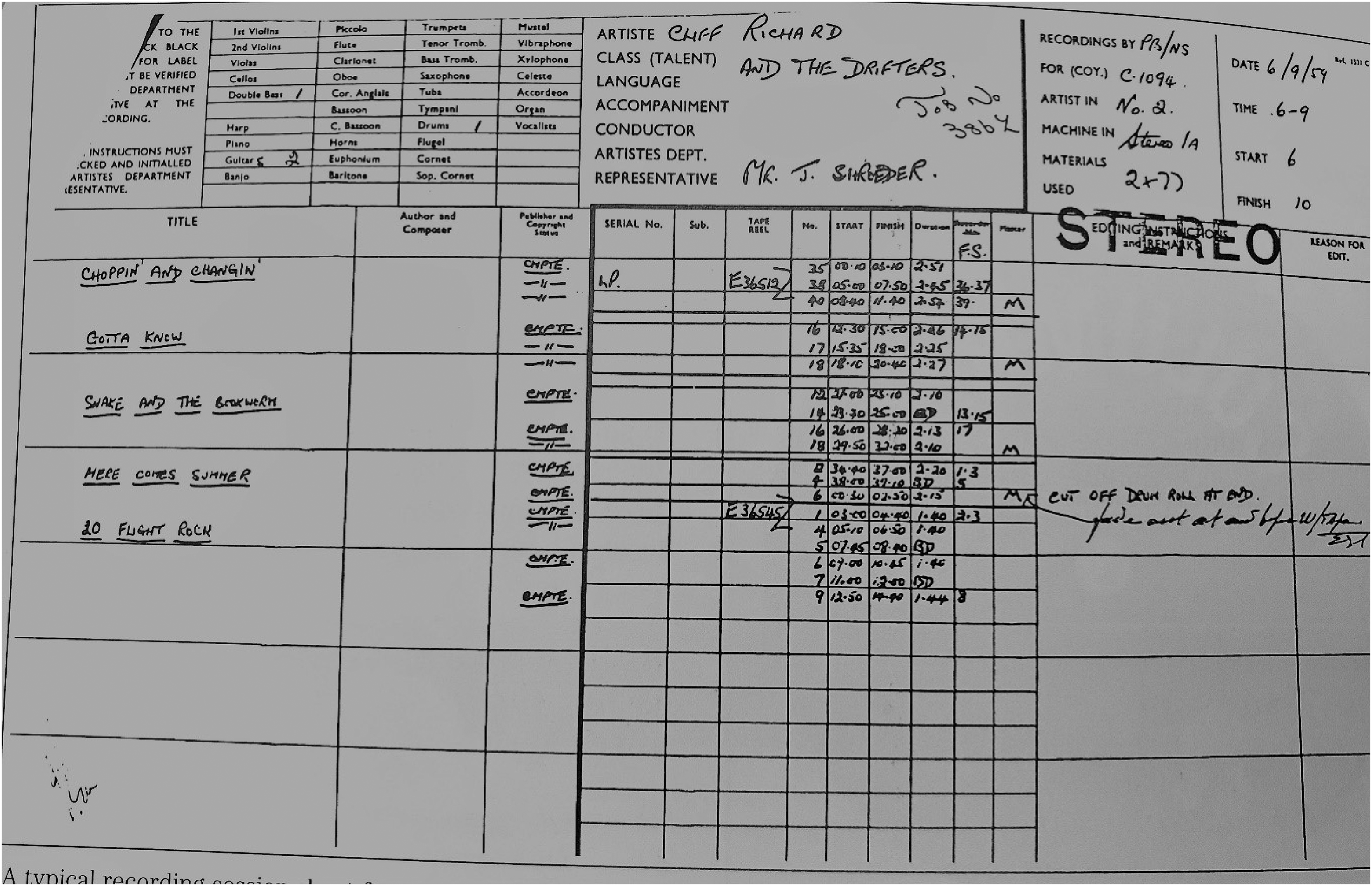
An example of a recording sheet from 1959 (Lewry and Goodall, 1991: 22).
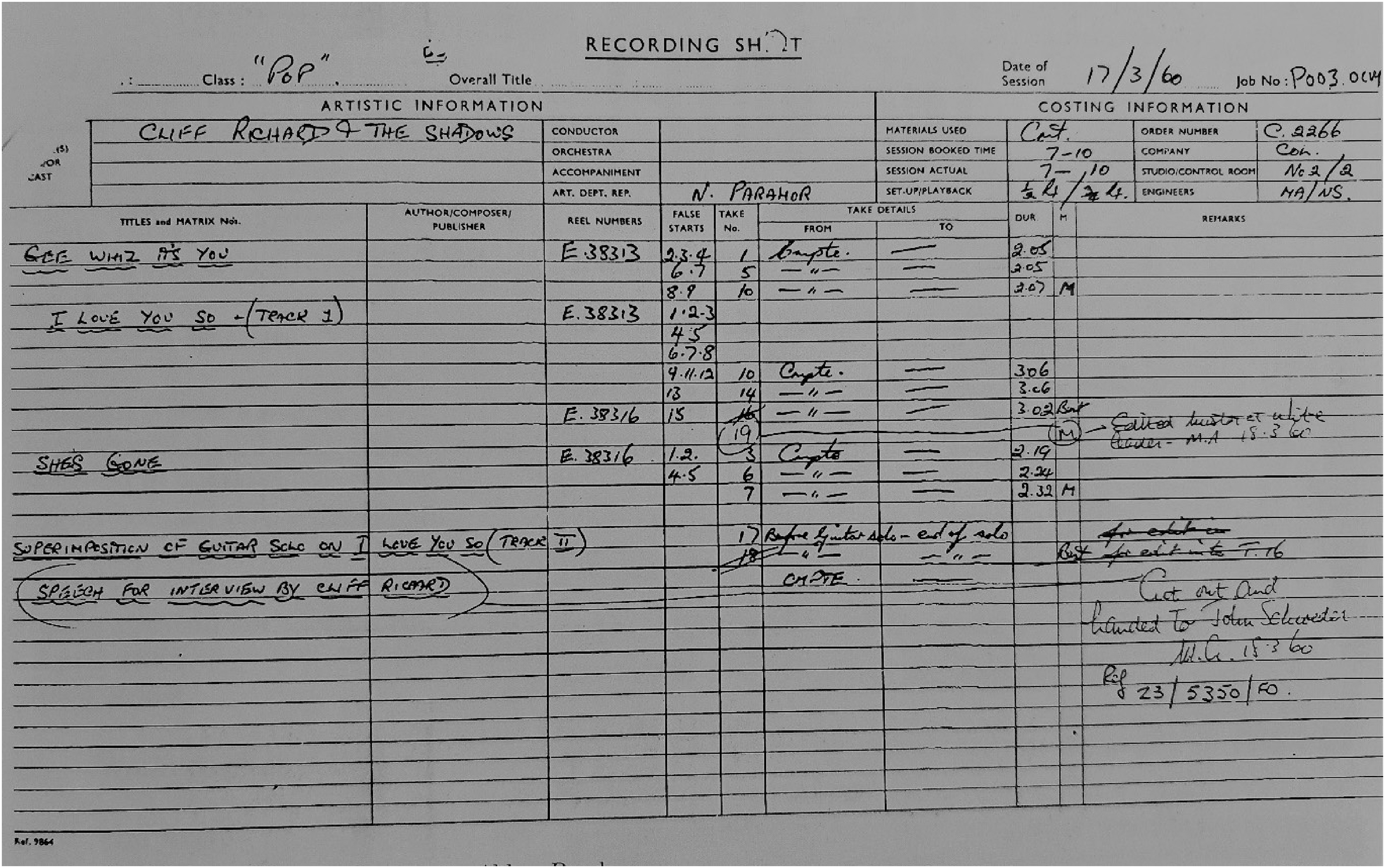
Recording Sheet from 1960 (Lewry and Goodall, 1991: 31).
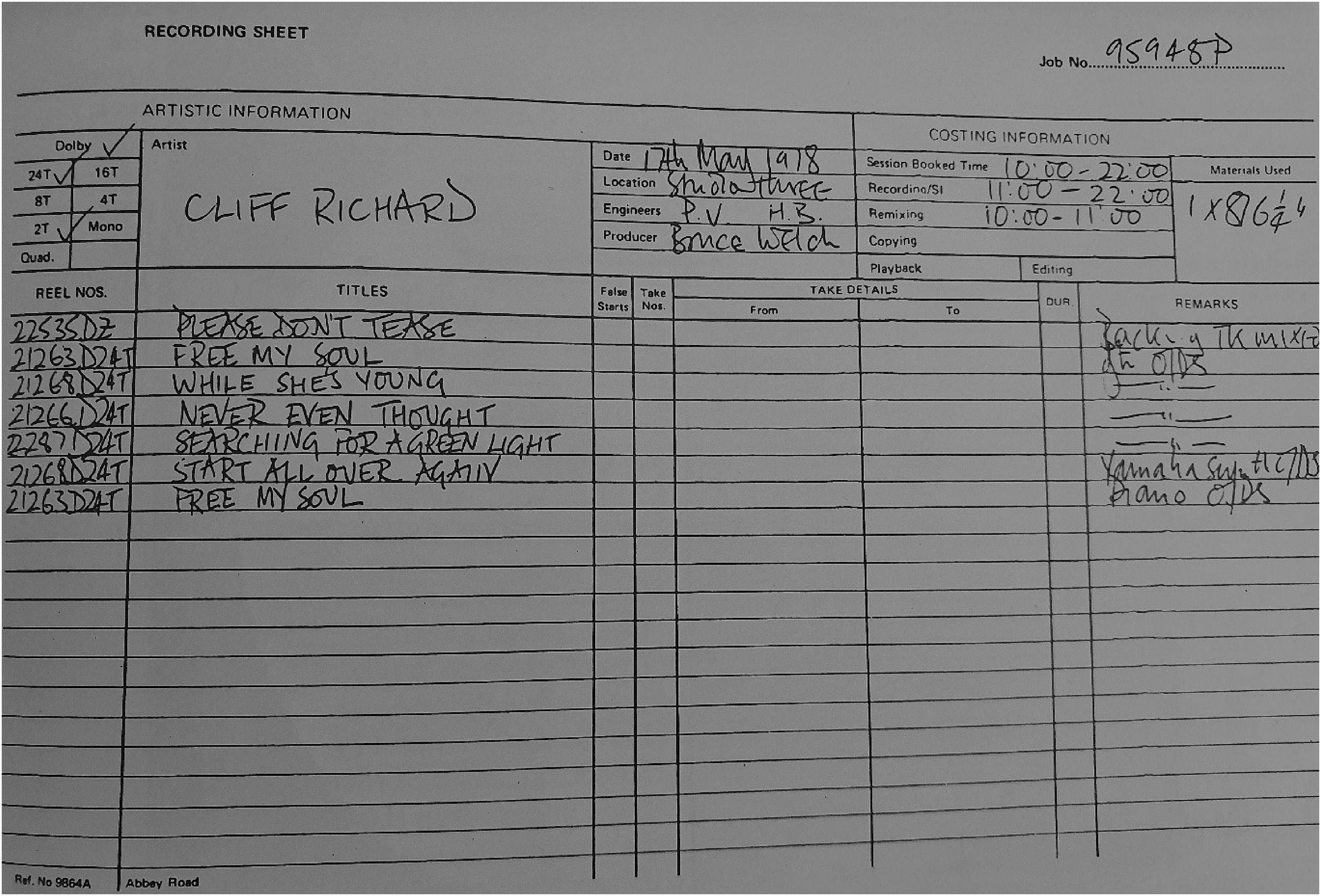
Recording Sheet from 1978 (Lewry and Goodall, 1991: 121).
As highlighted in the figures, the recording sheet included basic information regarding who was present at the recording including which artist was being recorded and which members of the production staff were present in the control room. The main body of the form details the titles of the individual songs – known as tracks – that were recorded in the sessions as shown in the far-left column. The subsequent column titled ‘author/composer/publisher’, referring to who owned the rights to the song being recorded, was often left blank but was completed if the information was known at the time of recording. The third column contains reference numbers that cross-reference the recording sheet to the tape that was used in the recording process, allowing artists and staff to listen to individual takes and make decisions on whether they were acceptable or not. Following on from this, the number of ‘takes’ is recorded alongside the duration of the track. Finally, there is a column for remarks where production staff can make notes relating to individual tracks, such as which ‘take’ they felt was the best at the time of recording.
In the upper right-hand corner of the recording sheet, there is a section titled ‘costing information’. This refers to details of the materials that were used in making the recording as well as how long the session was booked versus the actual duration of the recording session. This allowed management to compare the actual costs of the session to the costs submitted on the original ‘red form’.
Next to the date, there is space to include a specific job number relating to the specific recording session. Figures 4, 8 and 9 show the setup sheet, ‘Red Form’ and recording sheet relating to recording sessions under the job number ‘1069’. From this, it can be surmised that the management of the recording studio was operating a job costing system that tracked the cost of recording activities connected to different recording artists, record producers and recording projects across time and space, as noted by the differences in date with Figure 8 showing details of a session from September 1968 and Figure 9 showing details of sessions from October of the same year.
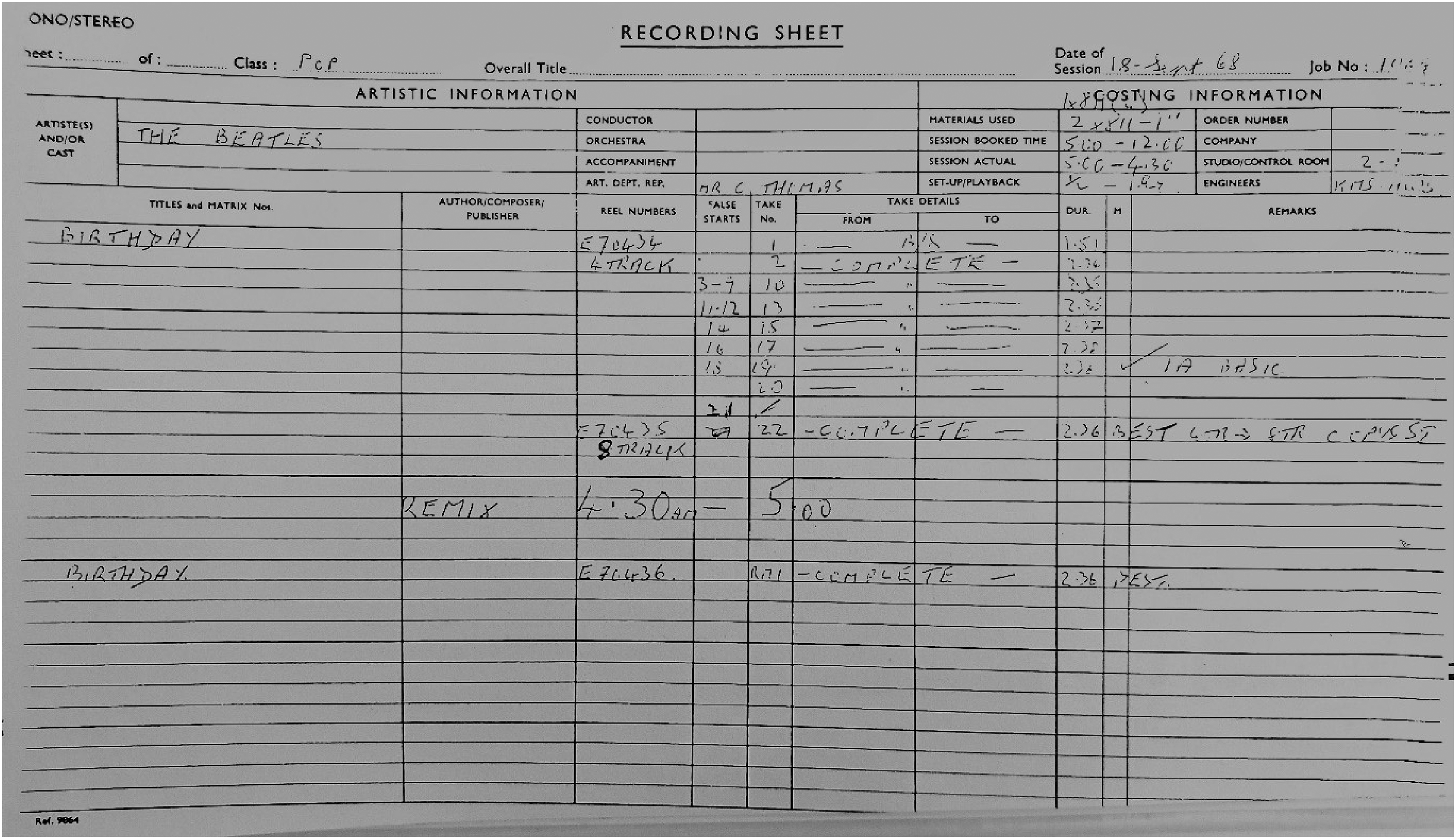
The recording sheet for a session under job number 1069 (Lewisohn, 2013: 157).
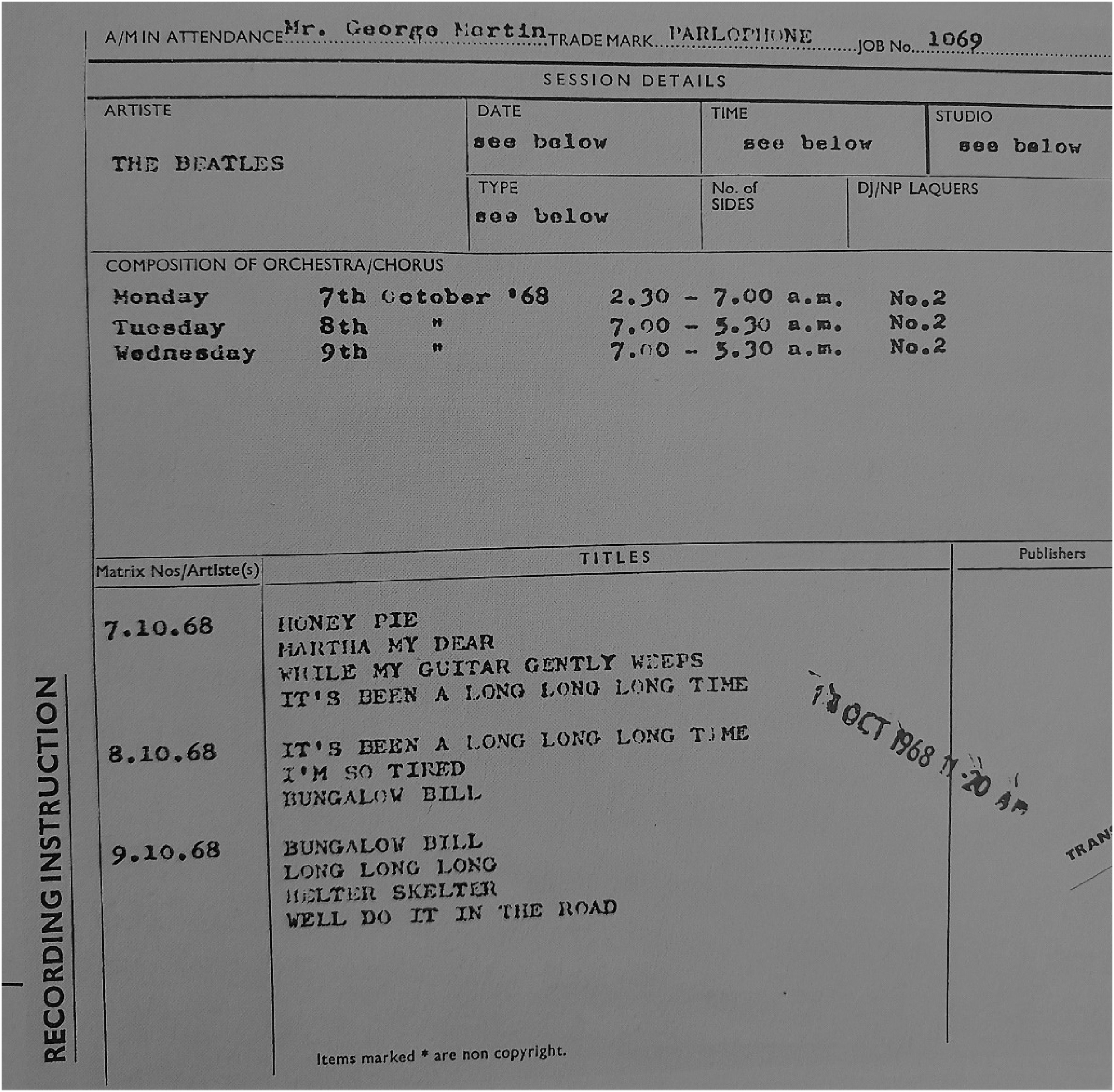
The ‘Red Form’ for a recording session under job number 1069 (Lewisohn, 2013: 160).
Record-keeping practices were, therefore, implicated in supporting the imposition of control and discipline over the space of the recording studio. Attempts at systematically capturing and controlling the various aspects of musical activity were used, coupled with standardised operating procedures, hierarchical surveillance and an extensive record-keeping regime that mapped and controlled the activities within the recording studio space. This allowed the management of EMI and Abbey Road to exercise disciplinary power designed to ensure the enforcement of standards of production, equipment placement and recording procedures.
Attempting to maintain discipline and control remained important throughout and beyond the period of study, with the bureaucratic, administrative approach of disciplinary power and control continuing to exist in the face of changes to musical and recording styles and changes in personnel that were in a large part driven by the cultural revolution taking place outside of the walls of Abbey Road. The slow pace of change within the recording studios has previously been noted: ‘[C]hanges at Abbey Road Studios in those days were controlled by the money men. EMI was run by much older people who didn't understand the technical requirements and put everything down to cost’ (Welch, musician, quoted in Southall et al., 2011: 110).
The slow pace of change with the bureaucratic and administrative procedures at Abbey Road, in general, is in evidence when considering the record-keeping activities from Abbey Road during the latter period of the 1960s where we can see that even as control over the record production process relaxed, the record-keeping practices continued. Indeed, as highlighted earlier in Figure 7, the attempts to document and control record production activities through detailed record-keeping continued long after the fragmentation of the industry that began to occur in the latter part of the 1960s.
Breaking rank: Revolution within Abbey Road
Following the capture of space for disciplinary ends through the coding of space, discipline becomes ‘an art of rank, a technique for the transformation of arrangements. It individualises bodies by a location that does not give them a fixed position but distributes them and circulates them in a network of relations’ (Foucault, 1979: 145). As noted above, members of staff involved in the creation of musical recordings at EMI were part of a hierarchy of roles within the recording studio, which was not driven by dividing up space per se. Indeed, hierarchical rank extended beyond the studio and was often driven by an individual's track record of creating recordings that provided commercial success for the company. At the beginning of the 1960s, George Martin ‘noticed that profits from pop music were being used to fund classical recordings’ (Lawrence, 2016: 79). However, as the 1960s progressed, the commercial success of EMI's most successful artists, including the Beatles, resulted in a transformation within EMI and Abbey Road: As the shift from Abbey Road being a classically dominated operation took place, we soon realised that, in a commercial environment, it was the pop that was making the bread and we had to accommodate ourselves to that fact (Andry, quoted in Southall et al., 2011: 94).
Indeed, a – or perhaps the – key measure of success for EMI's management was the ability of record producers to record a ‘hit’. Commercial success was paramount. This was evident in how far company management allowed engineers, producers and musicians to push back against Abbey Road's standardised operating procedures as long as the ‘experiment’ with different techniques, equipment or placements produced financial results: The Beatles were not the first artists to work late into the night at Abbey Road, but they were the first to experiment extensively with its space. They recorded in cupboards, alcoves, and other unorthodox corners – purely to see what effects these would offer. This creativity and lateral thinking ran in parallel to the different musical styles they embraced. Many of these experiments occurred not just under the watchful eye, but also with the encouragement, of George Martin (Lawrence, 2016: 155).
Recording artists, therefore, crossed the boundary between recording space and the previously closed-off space of the control room. They penetrated the glass divide between these two realms, taking greater control over their music, how it sounded and, in the case of the Beatles, pushed the boundaries of the discipline and control that EMI management had previously been able to impart.
Not only did the Beatles challenge and change the operating procedures of EMI, but they also directly challenged George Martin's role as record producer, and therefore, challenged the rigid operating hierarchy of the recording studio space. Whereas Martin had been in control early on, the Beatles now demanded their own say, including crossing the divide into the control room and participating in the mixing of recordings. This was extremely unusual at this point in time but following the example set by the Beatles, and against a backdrop of youth-led cultural rebellion, recording musicians now asserted themselves in ways that EMI and Abbey Road had never anticipated.
Discipline
create[s] complex spaces that are at once architectural, functional and hierarchical. It is spaces that provide fixed positions and permit circulation; they carve out individual segments and establish operational links; they mark places and indicate values; they guarantee not only the obedience of individuals but also a better economy of time and gesture (Foucault, 1979: 146).
In this instance, the ranked space referred less to a physical place within the recording studio but rather the placement of individuals within the wider network of relations in operation within Abbey Road.
Defying Abbey Road's standardised operating procedures was not left solely to recording artists, however. This was an era that George Martin described as ‘trying things out like mad in the studio’ (Elborough, 2009: 229). From the mid-1960s, record producers began to become artists in their own right as they employed ever-improving sound technologies as a tool in the creative process (Negus, 1995). At the same time, rapidly improving technology meant that engineering became a technically sophisticated role that was left to full-time recording engineers. Driven by a new generation of young engineers, ambitious self-contained bands and record producers who were willing to push the boundaries of creativity in search of the next hit records, the disciplinary regime at Abbey Road was under significant threat as the 1960s progressed.
Perhaps the clearest evidence of this is that in August 1965 George Martin left EMI and, with three other record producers, set up his own recording studio and formed Associated Independent Recordings (London) Limited thus joining the expanding numbers of independent recording studios – independent of the large music companies – that were emerging throughout the 1960s. The motivation for setting up independent studios was to be free of interference from the large music companies, with Martin frustrated by the rigidity of Abbey Road's operating procedures and EMI's refusal to recognise the creative contribution of record producers on musical recordings by refusing to grant them royalties (Martin and Hornsby, 1979; Thompson, 2008).
By the end of the 1960s, then, there were numerous instances of the disciplinary control at Abbey Road being circumvented to create innovative era-defining musical recordings. Outside of Abbey Road, there was a wider cultural and musical revolution taking place that sought to push the boundaries of artistic and musical expression which influenced the recordings being produced within Abbey Road. Despite this, and despite some exceptions being granted, the default position within Abbey Road was one of the attempting to ensure that the physical, musical space of the recording studios remained ‘useful’, manageable and controllable, and accounting continued to attempt to support these aims, albeit somewhat unsuccessfully in many cases.
Conclusions
The aim of this study was to consider the role of accounting in the creation of musical recordings, focusing on the physical, musical space of the recording studio. More specifically, this research considered the supportive role that accounting played in the exercise of disciplinary control over the space of EMI's Abbey Road Studios during the 1960s. The findings of the current study highlight that at the beginning of the 1960s, accounting practices were one element of a series of techniques used by EMI management to exercise disciplinary power and standardisation over the musical space and activities of the recording studio. Accounting furthered the enclosure of space through extensive record-keeping that documented and made controllable the actions of the recording musicians, record producers and recording engineers operating within the recording studios. Of critical importance here is that the original musical spaces within Abbey Road's recording studio complex were designed without disciplinary motives in mind; the spaces were primarily designed to produce the highest possible quality musical recordings.
Throughout the 1960s, the level of discipline and control exercised within Abbey Road contrasted with romanticised notions of magical inner workings that later emerged amongst consumers of popular music following the commercial and cultural success of musical output from the studios. Towards the end of the 1960s, pioneering musicians and record production staff pushed beyond the boundaries of extant control mechanisms in pursuit of the creation of expansive and ‘magical’ sonic worlds, overriding the previous standardised procedures and norms of recording. The practices used to achieve these outcomes circumvented existing procedures and were beyond the capture of accounting practices, yet the evidence presented here shows a continuation of existing accounting practices and resistance to change from company management in this regard.
This article has contributed to the existing literature in the following ways. First, the study furthers existing research that has theorised the relationship between accounting and space. Where prior studies have considered the construction and design of new spaces specifically designed to improve efficiency and enforce discipline (Carmona et al., 1997, 2002; Labardin, 2014; Walsh and Stewart, 1993), the present study has considered the recording studio, a space that was originally designed to maximise the sonic quality of recordings taking place within that space. Thus, the findings of this study further our understanding of accounting's ability to transform the spaces that produce cultural products that soundtrack our everyday lives (Hopwood, 1994; Jeacle, 2021) and extend our understanding of accounting's ability to support the disciplining of space beyond traditional locales such as the factory and the office to the musical space of the recording studio.
Second, the findings of this study suggest that accounting's ability to support the exercise of disciplinary control over physical space is more complex than that identified in prior studies (Carmona et al., 1997, 2002; Labardin, 2014; Walsh and Stewart, 1993). As musical recording practices became less standardised and more creative, expansive and ‘magical’ throughout the 1960s (Kealy, 1979), these practices were out of the reach of accounting. Thus, the ability of accounting techniques to be used to ‘make space more disciplinary’ (Carmona et al., 2002: 239) is contingent on the compatibility of the spaces and activities that accounting is attempting to capture and the nature of the creative, non-standardised practices that were emerging during the 1960s which were at odds with the disciplinary regime that accounting was a part of. Accounting continued to shape musical products but in a much less direct manner.
The findings of the study, therefore, add to prior studies that have highlighted the tension that has historically existed between the creative practices of music production and the control that has been imparted over such practices (Jacobs and Evans, 2012; Mariani and Zan, 2011; Miley and Read, 2017; Smith and Jacobs, 2011; Zan, 1998). In this instance, there were no direct tensions between creative individuals and accounting practices. Rather, accounting practices were part of an overall disciplinary regime that was eventually disregarded, ignored and circumvented by musicians, recording engineers and record producers in pursuit of their creative ambitions.
The spaces where popular cultural products are created are historically and culturally important to our everyday lives. Investigating the role that accounting plays in the creation of the popular cultural artefacts in these sites helps us to better understand the transformative role of accounting within society. Recent accounting research has successfully furthered our understanding of accounting's role in a range of popular cultural arenas, yet, despite this, there is scope for further study with respect to the relationship between accounting and recorded music, particularly given the cultural and commercial importance of recorded music both historically and within a more contemporary setting. The format may have changed from physical products to digitalised streams, but the importance of musical recordings lives on, and there is significant value in further understanding the relationship between accounting and the spaces where cultural and creative products are produced. In doing so, the secrets behind the magic can be revealed.
Footnotes
Acknowledgements
The author is extremely grateful to Professor Steve Walker for his useful and constructive comments on earlier versions of this draft. The author would also like to thank the two anonymous reviewers for their helpful comments and suggestions.
Funding
The author received no financial support for the research, authorship, and/or publication of this article.
