



Abstract
Listening to music is a strategy used by many people to regulate mood and enhance subjective quality of life, in daily life and particularly during emotionally moving times. The present study examined whether listening to music for emotion regulation is associated with subjective stress (e.g., demands, COVID-19-related stress) and problem-focused coping (e.g., active coping, planning, seeking social support). Variables were assessed in a three-wave longitudinal study (with intervals of approximately 1 year) with 262 adults aged 30–80 years. Longitudinal effects were computed with latent growth models. The cross-sectional results showed that emotion regulation through music listening (ERtM) is correlated with subjective stress and the use of problem-focused coping. The longitudinal results showed that increases in ERtM are associated with increases in problem-focused coping and demands but not with COVID-19-related stress. This study provides cross-sectional and longitudinal evidence for the use of music in association with the use of intentional coping efforts during times of increased stress. The protective function, or the extent to which emotions successfully change through music listening, remains an open question.
Listening to music can have profound effects on emotions. In everyday life, listeners can seek these effects and use music to affect their emotions, an example of a process that in general is referred to as emotion regulation (Gross, 2008). Previous studies have investigated the relationships between strategies using music to regulate emotions and general coping mechanisms (Henry et al., 2021) or how listening to music is related to general coping (Leipold & Loepthien, 2015). In this study, we examined the interplay between emotion regulation through music listening (ERtM) and the general process of coping and adaptation over time. People often listen to music to relax and thus reduce stress (Juslin & Laukka, 2004). The findings of several experimental studies indicate that music listening is a commonly used and effective means of reducing stress (Baccarani et al., 2023; Baltazar et al., 2019), but this effect appears to be more pronounced in therapeutic settings (Adiasto et al., 2022; Pelletier, 2004; Witte et al., 2020). Little is known, however, about these relationships over longer periods of time. From a developmental perspective, it has been pointed out that coping and emotion regulation are interconnected (Miranda, 2019) and can support each other because successful coping in a specific domain may lead to better adjustment in other domains (e.g., Leipold et al., 2018; Super, 1980). Because knowledge about the temporal dynamic between listening to music and general coping tendencies is important for (music) therapeutic interventions, the present study examined the relationships between changes in ERtM and the use of coping strategies (instrumental and social coping) as well as subjective stress.
Emotion regulation through music listening
Emotions are a central aspect of human existence and experience in everyday life. However, in certain situations, experiencing or expressing one’s emotions may not be desirable because of their intensity or their affective qualities (valence/arousal). Here, emotion regulation refers to any processes aimed at altering the emotional experience by regulating the elicitation and/or the expression of emotions (Gross, 2002). Music listening is a potential means to regulate emotions (Schäfer et al., 2013; Schäfer & Riedel, 2018), and people often listen to music to alter and regulate their emotions (Juslin & Laukka, 2004; Randall & Rickard, 2017; Tekin-Gurgen, 2016). van Goethem and Sloboda (2011) established a starting point for structuring the processes and strategies inherent in ERtM, describing them in terms of goals, strategies, tactics, and mechanisms. Emotion regulation is motivated by an explicit or implicit goal that implies the emotional state that is subject to regulative efforts. To achieve this goal, strategies are applied, such as diverting oneself from negative thoughts. Here, music listening comes into play as a potential tactic to facilitate diversion. Music can support diversion through certain mechanisms, such as a catchy rhythm, a haunting melody, or evoked memories. In the description above, diverting oneself from aversive emotions is an exemplary strategy for ERtM. In a series of qualitative studies, Saarikallio and Erkkilä (2007) and Saarikallio (2011) investigated emotion regulation strategies applied by listening to music. They differentiated between five strategies used by adolescents and adults: 1
Revival: regaining energy through music listening
Diversion: music is used to distract from negative thoughts and/or emotions
Discharge: venting negative emotions
Mental work: music is used to establish a background for reflection
Solace: music provides comfort (Saarikallio, 2008, 2011; Saarikallio & Erkkilä, 2007).
Both the strategies of ERtM and those described by van Goethem and Sloboda (2011) describe deliberate strategies and actions aimed at regulating emotions through music listening. Hence, ERtM is defined here as a behavior that requires the explicit decision to listen to music with the aim of altering one’s affective state. Thus, ERtM does not entail situations where music is merely playing in the background but rather situations in which one deliberately decides to listen to music and pays attention to it. Following this definition, the listed strategies of ERtM reflect active, problem-focused regulatory mechanisms. This is also reflected in Baltazar and Saarikallio’s (2016) definition of ERtM as any attempt to influence one’s affective states, where the term attempt implies a conscious and instrumental process. The same authors further regard ERtM as the strategic use of music to regulate one’s affect (Baltazar & Saarikallio, 2019). In the following, we explain why ERtM is associated with problem-focused coping. 2
ERtM and coping
Coping strategies are processes aimed at adapting to stressful events, which entail efforts by people to overcome obstacles or problems (problem-focused coping) or processes aimed at influencing emotions evoked by the event (emotion-focused coping; Carver, 2011; Lazarus & Folkman, 1984). When these instrumental facets of coping are considered, its similarities with strategic ERtM become apparent. An individual deliberately decides to be involved in certain actions (listening to music, overcoming obstacles, seeking advice) to regulate aversive emotions (ERtM) or deal with a negative situation (coping). Accordingly, several studies have revealed relationships between ERtM and general coping processes (Henry et al., 2021; Leipold & Loepthien, 2015; Silverman, 2021, 2022). In terms of problem-focused coping, Silverman (2021) investigated adults with substance use disorder and found that active coping mechanisms were related to diversion. Specifically, he demonstrated that seeking instrumental support (i.e., social coping mechanisms) is positively associated with almost all the strategies of ERtM except discharge. In a subsequent investigation of adults hospitalized with cancer, he demonstrated similar associations such that problem-focused coping is positively related to mental work, and instrumental support with diversion, mental work, and solace (Silverman, 2022).
Studies investigating the use of music to regulate negative emotions following the COVID-19 pandemic revealed that music listening is used as a strategy to regulate negative emotions resulting from the pandemic (Fink et al., 2021; Giordano et al., 2020; Hennessy et al., 2021; Martín et al., 2021; Vidas et al., 2021; Ziv & Hollander-Shabtai, 2022). Henry et al. (2021) investigated the role of music-related emotion regulation among general coping mechanisms. They found active coping mechanisms and positive reframing to be related to all music-related emotion regulation strategies except for discharge. In sum, the results of previous studies show that relationships can be expected between ERtM and problem-focused coping mechanisms.
ERtM and subjective stress
Cross-sectional results indicate that higher perceived stress is related to more use of music to regulate emotions (Getz et al., 2014). Zoteyeva et al. (2016) found similar results. In the latter study, discharge, mental work, and cognitive uses of music were positively related to higher perceived stress in military veterans. In a study of young adults, Thomson et al. (2014) found that stress was predicted by ERtM strategy diversion and discharge. Overall, these results indicate a positive relationship between ERtM and subjective stress.
To date, studies have investigated the relationships between ERtM and general subjective stress. The COVID-19 pandemic can be regarded as a domain of stress that confronted individuals with challenges and constraints (e.g., reduced social contact, financial stress, fear of infection) requiring adaptive processes and emotion regulation. Several studies have shown that music listening is a means to cope with stress and regulate negative emotions resulting from the pandemic (Ferreri et al., 2021; Fink et al., 2021; Giordano et al., 2020; Hennessy et al., 2021; Martín et al., 2021; Vidas et al., 2021; Ziv & Hollander-Shabtai, 2022). Relationships between pandemic-related stress and the use of music to regulate emotions were found by Ziv and Hollander-Shabtai (2022). In this cross-sectional study, a higher degree of negative emotions (e.g., anxiety) following the pandemic was related to participants’ more frequent use of music to influence their mood, seek distraction, or reduce anxiety. Carlson et al. (2021) also found relationships between ERtM and anxiety during the pandemic and showed that the strategies of diversion, mental work, and solace covaried positively with anxiety.
Overall, these and other studies have shown that perceived subjective stress, either general or following the COVID-19 pandemic, is related to ERtM. Although the positive relationships are mostly correlational, they might suggest that higher degrees of perceived stress elicit more regulative efforts and thus also higher levels of ERtM.
The present study
Previous studies have shown that the instrumental character of ERtM is reflected in relationships with problem-focused coping mechanisms (active coping, seeking social support). Positive relationships between ERtM and stress have been found for general as well as COVID-19 pandemic-related stress. Since these relationships are positive, they illustrate more use of ERtM when individuals experience a high amount of stress. However, all the studies reported here are of a cross-sectional nature and thus no conclusions can be drawn about the course of these relationships over time. In other words, how does ERtM develop when more stress is experienced or when individuals engage more in coping? The aim of the current study was to examine whether changes in ERtM are associated with changes in subjective stress and problem-focused coping. We tested the following hypotheses:
Hypothesis 1a: ERtM is an instrumental means of regulating emotions when coping with negative events. We expected to find positive correlations between ERtM and problem-focused coping (active coping, planning, use of informational support) measured at baseline. In addition (Hypothesis 1b), we expected that increases in problem-focused coping over time would be related to increases in ERtM.
Hypothesis 2a: ERtM is a means of regulating subjective stress in general as well as stress in response to the COVID-19 pandemic. We expected to find positive correlations between ERtM and both facets of stress, measured at baseline. In addition (Hypothesis 2b), we expected that an increase in both general and pandemic-related stress over time would be related to an increase in ERtM.
Method
Participants
Participants were recruited through an online sampling service that has a databank with persons interested in taking part in online research in Germany. After participating at the first measurement point (baseline or T0), the same participants were approached one (T1) and two years later (T2) by the panel administrators. We aimed to recruit a heterogeneous sample of adults between 30 and 80 years of age, with equal distributions of men and women. There were no criteria with regard to social and health status. Participants received financial compensation (around €4) for taking part in the study at each of the three measurement points. A total of 525 potential participants were interested in the study and began participating at T0; 124 of these potential participants had to be removed because they did not complete the whole questionnaire, failed the attention check, or demonstrated questionable authenticity or quality (e.g., extremely fast completion). The initial sample therefore consisted of 401 participants. The baseline measurement (T0) took place in May 2020, T1 in June 2021 (i.e., t0 after the two lockdowns, and t1 after the beginning of the vaccination campaign in Germany), and T2 in June 2022, approximately 3 months after the case numbers in Germany reached their highest point. All three questionnaires were in the German language and were distributed online. Participants had been informed about the aims of the study and given their consent before they began to complete the first questionnaire. The study protocol was approved by the ethics committee of the University of the Bundeswehr München.
The t1 sample consisted of 333 participants. Those who showed outlier values (±3 SD) or stereotyped responses to items were not included in the analyses. The T2 sample consisted of 262 participants who had already completed the questionnaire at T0 and T1. No significant differences were found between the group of 139 participants who failed to complete the questionnaire at T1 and/or T2 and the remaining participants with regard to age, sex, or any of the variables relevant for hypothesis testing. A non-significant tendency was observed only for ERtMDischarge such that individuals who stopped participating had higher ERtMDischarge at T0 (M = 2.35, SD = 1.12) than those who took part at all three measurement points (M = 2.14, SD = 1.04), t(400) = 1.86, p = .06, d = .19 [–.01, .40].
At T0, participants who completed the questionnaires at all three measurement points were between 30 and 80 years old (M = 55.01, SD = 13.59). A total of 47% were female and 53% were male; 13% reported a low level of education (9 years of schooling), 40% reported a medium level of education (10 years of schooling), and 48% reported a high level of education (German equivalent to subject-related entrance qualification and A-levels).
Measures
Problem-focused coping
Problem-focused coping was assessed with the planning, active coping, and instrumental support subscales of the Brief-COPE by Carver (1997), which constitute problem-focused coping efforts. Each scale consisted of two items measured using a 7-point Likert-type scale ranging from 1 (does not apply at all) to 7 (applies completely). Because we used structural equation models to estimate change correlations, we conducted principal component analysis and tested the dimensionality of the items. Oblique rotation and an eigenvalue >1 criterion were used. The analysis revealed a two-factor solution, with the items of the planning and active coping subscales as one dimension and the items of instrumental support as the second. We therefore continued with two distinct coping efforts, namely instrumental coping and social coping. For both instrumental coping and social coping, we calculated the mean values of the four and two items, respectively. Reliabilities for both scales were good at each time point (αs were .74, .73, and .77 for active coping/planning and .87, 86, and .88 for social coping).
Emotion regulation through music listening
We assessed ERtM using the brief version of the Music in Mood Regulation questionnaire (Saarikallio, 2012). As noted, we included only those subscales that described an emotion regulation strategy but not an effect of music listening (Sakka & Juslin, 2018): revival (three items, e.g., “I listen to music to perk up after a rough day”), diversion (three items, e.g., “For me, music is a way to forget about my worries”), discharge (three items, e.g., “When I’m really angry, I feel like listening to some angry music”), mental work (three items, e.g., “Music helps me to understand different feelings in myself”), and solace (three items, e.g., “When I’m feeling sad, listening to music comforts me”). Participants reported the extent to which they agreed with the items using a 5-point Likert-type scale ranging from 1 (does not apply at all) to 5 (applies completely). Higher values indicate more use of the respective strategy. Because high correlation coefficients (rs > .79) were found at t0 for revival, diversion, mental work, and solace, we calculated the mean value ERtM for these four scales (αs = .96, .96, .96). The subscale of discharge (ERtMDischarge) was computed with the three related items (αs = .81, .78, .81).
Subjective stress
The demands scale of the German version of the Perceived Stress Questionnaire (Fliege et al., 2001) was used to assess the amount of subjective stress. The scale captures the subjective assessment of external stressors and consists of five items (e.g., “During the last four weeks, I felt deadline pressure”). Responses were given on a 7-point Likert-type scale ranging from 1 (does not apply at all) to 7 (applies completely). A mean score was calculated. The scale had good internal consistency at all measurement points (αs = .86, .89, 88).
COVID-19 pandemic-related stress
At the beginning of our data collection, to the best of our knowledge, no validated questionnaire was available to assess stress and strain caused by the COVID-19 pandemic. We therefore formulated five items similar to the items used by Saalwirth and Leipold (2021) including three different sources of stress that were reported to be the most prominent concerns regarding the pandemic according to general surveys (American Psychiatric Association, 2020; Qiu et al., 2020). These involved concerns about one’s health, concerns about the economy and negative future developments, and concerns about restrictions in daily life and social routines. We assessed pandemic-related stress with five items (“Because of the current COVID-19 pandemic . . . I am afraid for my health,” “I am worried about possible consequences for my financial situation,” “I am worried about my future,” “The restrictions due to the current COVID-19 pandemic burden me,” and “The current COVID-19 pandemic scares me”). Responses were given on a 7-point Likert-type scale ranging from 1 (does not apply at all) to 7 (applies completely). Higher values indicate more stress following the COVID-19 pandemic. A principal component analysis with an eigenvalue >1 criterion revealed one factor, and the mean score was calculated (αs = .82, .82, .80).
Music education
To investigate the possible influences of music education on coping via music listening, we assessed the participants’ level of music education using the musical training subscale of the German version of the Gold-MSI (Schaal et al., 2014). This subscale assessed seven facets of music education (e.g., number of instruments played, years of practice) in an open-ended answer format. Values were converted to a 7-point Likert-type scale ranging from 1 (no music education at all) to 7 (very sophisticated music education). Internal consistency was high (α = .86).
Data analysis
Table 1 shows the descriptive statistics and correlations between the central variables obtained at t0 from participants who completed the questionnaires at all three measurement points. To test Hypotheses 1a and 2a, we conducted correlational analyses and partial correlations; to test Hypotheses 1b and 2b, we conducted repeated-measures analysis of variance (ANOVA), using IBM SPSS version 29. To investigate longitudinal relationships between ERtM, problem-focused coping, and subjective stress measures, we modeled longitudinal change as a participant’s intercept and slope of a given variable, using latent growth curve models developed using LISREL version 9.30.
Relationships between music-related regulation, coping, and stress measures at T0.

Note: N = 262 (only participants who took part at all three measurement points). ERtM = emotion regulation through music listening.
1 = male, 2 = female.
p < .05. **p < .01. ***p < .001.
Overview of structural equation modeling. To investigate the change correlations between ERtM, facets of problem-focused coping, and stress, we used latent growth models with intercepts coded as 1, 1, 1 and slopes coded as 0, 1, 2 (Little, 2013). To examine the change correlations, we regressed the slopes of ERtM and subjective stress on the intercepts of both. The mean values of musical emotion regulation through revival, diversion, mental work, and solace were used as markers of ERtM for each time point. Test halves for each time point were created to estimate the remaining latent constructs. All analyses were based on maximum likelihood estimates.
Results
Hypotheses 1a and 2a
To examine cross-sectional relationships at T0, we calculated correlations between the assessed variables and covariations between the variables relevant to the hypotheses and possible confounding variables (age, sex, music education). The results are illustrated in Table 1. As predicted by Hypothesis 1a, problem-focused coping facets (instrumental coping and social coping) were related to ERtM and ERtMDischarge, and the relationship between instrumental coping and discharge was weaker than the remaining ones. As predicted by Hypothesis 2a, subjective stress was significantly correlated with emotion regulation through music. The relationships differed in strength, with ERtM showing a weak relationship and discharge showing a medium relationship with subjective stress. COVID-19 pandemic-related stress, however, was associated with neither ERtM nor ERtMDischarge. Younger participants reported more ERtM and discharge and problem-focused coping and stress. Positive relationships were found between music education and music-related emotion regulation, problem-focused coping, and general stress. Older participants reported lower levels of music education. Sex was not related to any other variable, and pandemic-related stress did not covary with age or music education.
Because age and music education were also associated with the central variables of the present study, we conducted additional analyses to examine whether the present associations remained significant after controlling for age and music education. The partial correlations between coping and ERtM remained significant (rpartial = .31 for instrumental coping and .23 for social coping, ps < .001). For ERtMDischarge, the correlation with social coping remained significant (rpartial = .15, p < .05) but not with instrumental coping. Regarding the associations with subjective stress, only the association with ERtMDischarge remained significant (rpartial = .16, p < .05). The association with ERtM dropped to 0 (rpartial = .03, p > .10).
Hypotheses 1b and 2b
First, the mean values representing the main variables at each of the three measurement points over the 2-year period and the results of the repeated-measures ANOVA are presented in Table 2. There were significant effects of time on the mean values representing social coping, subjective stress, and COVID-19 pandemic-related stress but no effects of time on ERtM, ERtMDischarge, or instrumental coping. Post hoc analyses with Bonferroni correction showed that social coping and subjective stress increased from T0 to T2. Pandemic-related stress increased from T0 to T1 but decreased to well below its value at t0 from T1 to T2.
Means, standard deviations, and repeated-measures analysis of variance for study variables.

Note: ERtM = emotion regulation through music listening.
p < .01. ***p < .001.
The hypothesized longitudinal relationships between stress, coping, and music-related emotion regulation were examined using latent growth curve modeling. Figure 1 shows the correlation between the slopes: an increase in ERtM over time was related to an increase in instrumental coping (Figure 1(a)) and social coping (Figure 1(b)). Both models showed good fit indices. Changes in discharge were not related to instrumental coping or social coping, and both models showed unacceptable fit indices. Hypothesis 1b was thus supported for ERtM but not for discharge. In an additional analysis, we tested whether the correlations between the slopes for ERtM remained significant after controlling for age differences and music education. The change correlations remained significant (rchange = .42, p < .05 and .24, p < .05)
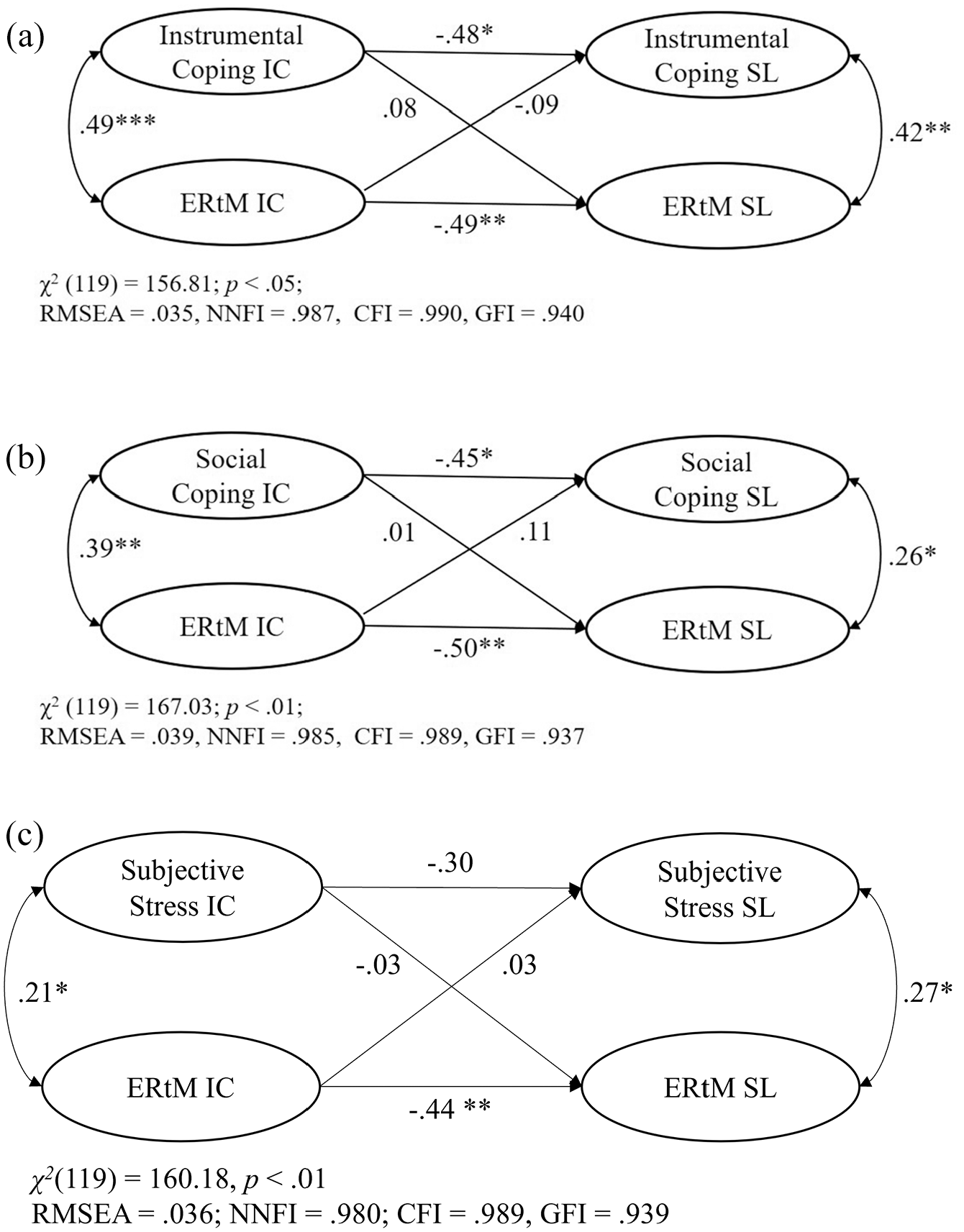
Latent growth curve models of the relationships between emotion regulation through music and (a) instrumental coping, (b) social coping, and (c) subjective stress.
Figure 2 shows the latent growth curve model that illustrates the longitudinal relationships between ERtM and subjective stress. As expected, an increase in experienced stress over the 2-year period was related to increasing use of ERtM. The model showed good fit indices. The correlation between the slopes was significant after controlling for age and music education (rchange = .30, p < .05). No such relationship was found between subjective stress and discharge, and the model fit was not acceptable. No significant relationships were found between COVID-19-related stress and ERtM or discharge. 3
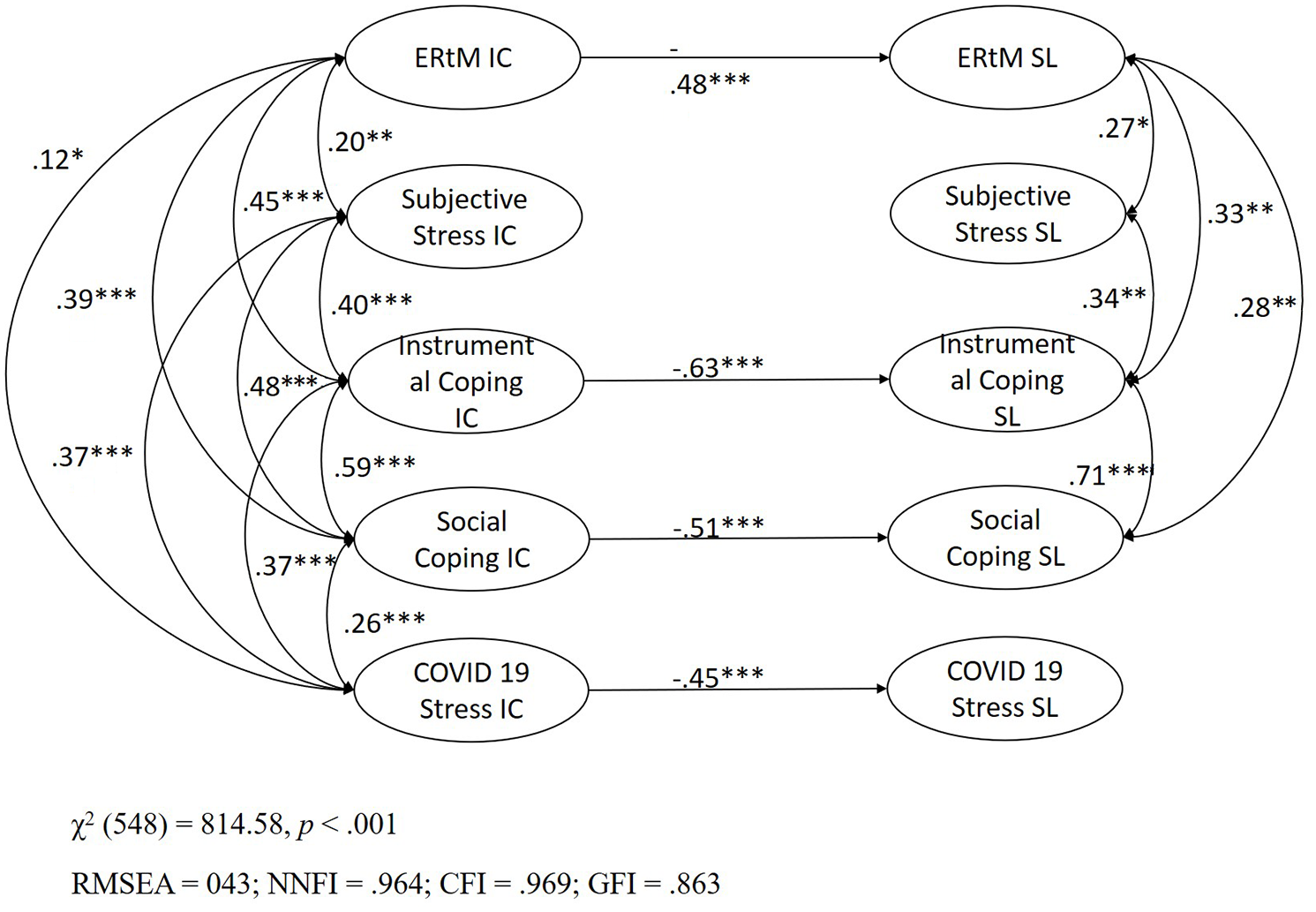
Latent growth curve model of the relationships between stress and music-related emotion regulation.
Discussion
The present study investigated cross-sectional and longitudinal relationships between ERtM, problem-focused coping mechanisms, and facets of stress. The expected relationships between ERtM, problem-focused coping, and subjective stress were present in the findings of both the cross-sectional and longitudinal analyses. Discharge was correlated with these variables at t0, but no longitudinal associations were found. Contrary to our expectations, COVID-19 pandemic-related stress was not associated with ERtM or discharge, either cross-sectionally or longitudinally.
The present results indicate the role of ERtM in coping with negative events. Positive relationships between ERtM and instrumental and social coping mechanisms over time show that people engage more in behaviors which suggest that these mechanisms are operating. They also increase their use of music to regulate emotions, with the exception of discharging negative emotions. Thus, ERtM is an important aspect of the overall interplay between regulation and coping mechanisms when dealing with negative events. The longitudinal relationships (i.e., slope-slope correlations) presented here are in line with the findings of cross-sectional studies that indicate positive relationships between ERtM and problem-focused coping (e.g., Silverman, 2021, 2022). The relationships between problem-focused coping and ERtM found here indicate an overlap between the inter-individual variability inherent in both processes, not only in terms of stable traits but also with respect to changes over time. The present study is, to our knowledge, the first to show these longitudinal relationships for music-related emotion regulation, but is also in agreement with studies that have investigated general emotion regulation. For example, Heffer and Willoughby (2017) found that coping mechanisms predicted emotion regulation 1 year later and vice versa.
The amount of stress experienced appears to be crucial for both coping processes and ERtM. Stress is an aversive affective state and, as levels of stress increase, so is more effort required to deal with it. Thus problem-focused coping mechanisms underlie attempts to overcome stressful situations, whereas individuals implement ERtM to regulate the emotional experience of stress and its accompanying aversive emotions. Further, ERtM can produce cognitive mindsets that facilitate efforts to overcome stressful situations (Fredrickson, 2002). Again, this study is the first to show that ERtM can be used to manage stress experienced over time. The findings are supported by longitudinal studies demonstrating relationships between general emotion regulation processes and anxiety over time (Dawel et al., 2021) as well as between coping and anxiety (Szabo et al., 2016). The results of the present study include positive correlations between experienced stress and instrumental coping, suggesting that the use of self-regulation strategies increases in stressful times.
Given that people with high levels of stress also experienced the constraints resulting from the COVID-19 pandemic, we were surprised to find no significant relationship between this particular stressor and ERtM. This might be because restrictions following the pandemic had specific causes beyond the personal control of individuals and thus it was more difficult to address pandemic-related negative emotions by listening to music. The findings of Kar et al. (2021) support this interpretation, since they indicate that individuals tried to cope with pandemic-related constraints through hope or religious faith, suggesting a perceived lack of control. Furthermore, pandemic-related restrictions required specific actions (social distancing, hygiene, etc.) rather than emotion-focused processes such as ERtM. According to Tambling et al. (2021), the pandemic mainly increased financial and health-related stress, which might require more specific regulation processes than ERtM.
Using music to vent (i.e., discharge) negative emotions differs from other ERtM strategies. Participants reported using music for discharge less frequently than ERtM in general. This is reflected in the lower covariances between discharge and the remaining ERtM strategies. Discharge also showed unique relationships with stress and coping in that it was only related to general stress cross-sectionally, but we found no longitudinal relationships between discharge and stress or any coping mechanisms. It may therefore be that experiencing stress does not require one to discharge negative emotions. These results are in line with those of studies that found unique relationships between coping through discharge and stress (Thomson et al., 2014) and coping processes (Silverman, 2021, 2022). Miranda (2020) even found maladaptive patterns for discharge because it mediates the relationship between neuroticism and internalizing symptoms, but only in a cross-sectional design. The values for discharge may however be confounded with an individual’s amount of experienced anger because the items of this subscale mostly refer to venting anger. Thus, it may be that it is not the strategy of venting emotions through music listening that leads to these results but rather the high levels of experienced anger that are implied by the items of the scale and reflected in the measured values.
Limitations and future research
The longitudinal relationships between ERtM and general stress found in the present study do not indicate the efficiency of the former. The results show related trajectories of the two processes over time, yet it remains unclear whether stress is effectively reduced by ERtM. Studies on a situational level (e.g., experience-sampling studies) that evaluate changes in stress and/or well-being measures when listening to music to regulate emotions can provide further insights. Although the present study was longitudinal, it does not support causal interpretations because no randomized allocation to different treatments occurred. Hence, third-variable effects cannot be ruled out (Duckworth et al., 2010). Experimental studies are required to investigate causality. Further research should also investigate why discharge differs from other ERtM strategies. To allow conclusions about the functionality of discharge, an instrument that is not confounded with the amount of experienced anger is required. Finally, it should be noted that music listening does not always improve mood nor does emotion regulation always aim at mood improvement (Tamir, 2016). For example, listening to music to suppress an initial positive mood led to a decrease in positive mood (Randall et al., 2014). Dingle et al. (2016) developed a program to teach adolescents how to use music to regulate their emotions effectively. Interestingly, they found this program particularly useful in decreasing the use of suppression as an emotion regulation strategy. More research is needed to understand how certain strategies of ERtM can be promoted.
Conclusion
ERtM is an instrumental strategy to regulate negative emotions and stress. It is used in conjunction with other problem-focused coping processes, not only in specific situations but also over time. Hence, changes in ERtM are not isolated from other coping efforts but are embedded in a set of problem-focused coping mechanisms. Stress requires regulative efforts such as ERtM. As stress increases, so does ERtM, illustrating the need for regulation. Taken together, the results of this study support the view that people turn to music to regulate their emotions when they experience increased stress. However, whether ERtM decreases stress effectively remains an open question. Further research is needed to formulate suggestions for evaluating the efficiency of ERtM strategies, among other coping mechanisms, in applied contexts such as music pedagogy and music therapy.
Supplemental Material
sj-docx-1-msx-10.1177_10298649251321693 – Supplemental material for Emotion regulation through music listening, subjective stress, and problem-focused coping: Longitudinal results
Supplemental material, sj-docx-1-msx-10.1177_10298649251321693 for Emotion regulation through music listening, subjective stress, and problem-focused coping: Longitudinal results by Bernhard Leipold, Barbara Loidl, Christina Saalwirth and Tim Loepthien in Musicae Scientiae
Footnotes
Acknowledgements
The authors acknowledge many fruitful discussions with Amy Michéle-Malkowsky and her comments on an earlier version of this article.
Declaration of conflicting interests
The authors declared no potential conflicts of interest with respect to the research, authorship, and/or publication of this article.
Funding
The authors disclosed receipt of the following financial support for the research, authorship, and/or publication of this article: The authors acknowledge the financial support from the University of the Bundeswehr Munich.
Ethical approval
The study had been approved by the Ethics Committee of the University of the Bundeswehr Munich (18 February 2020).
Informed consent
Participants gave their informed consent before participating.

Data availability statement
Data are provided within the article. The datasets used and analyzed in the current study can be requested from the corresponding author.
Supplemental material
Supplemental material for this article is available online.
Notes
References
Supplementary Material
Please find the following supplemental material available below.
For Open Access articles published under a Creative Commons License, all supplemental material carries the same license as the article it is associated with.
For non-Open Access articles published, all supplemental material carries a non-exclusive license, and permission requests for re-use of supplemental material or any part of supplemental material shall be sent directly to the copyright owner as specified in the copyright notice associated with the article.
