




Abstract
Although remote music training has its limitations, the use of technology can lower barriers to its accessibility. This exploratory study compared the effects of remote and in-person percussion training on motor performance, performance quality, and students’ enjoyment. The training involved the motor aspects of playing legato on percussion instruments. Twenty percussionists received the training either remotely from an instructor using videoconferencing technology or in person from the same instructor who was in the training room. Motor behavior, legato expressivity, performance quality, and participants’ self-rated enjoyment were compared to determine potential advantages and disadvantages of training in the two formats. Furthermore, participants rated their interest in continuing to receive training in the same way they had experienced it, remote or in person. Regardless of whether the instructor was remote or in person, participants lifted their mallets to a greater height above the drums post-training, perhaps because there was more spatial and velocity variability in the movements of their elbows and wrists. Changes in their patterns of post-training movements were paralleled by higher ratings for expressivity of legato and performance quality. Critically, participants who received training from the remote instructor expressed greater interest in continuing training than those who received training from the instructor who was physically present, in both the short and long term. These findings may suggest that remote and in-person instruction yielded comparable changes on motor behavior, as demonstrated by the altered speed at which movements of the elbow and wrist were executed, which in turn may influence the perception of expressivity in legato playing. The results may support the use of remote training as an adjunct to physical practice to lower some barriers to music education.
Private lessons are ubiquitous in university music departments, conservatories, and music academies. Despite this ubiquity, consistent access to private lessons remains a barrier for certain segments of the population, which may prevent them from receiving or continuing with music training (Kinney, 2019). As an adjunct to in-person private lessons, remote musical training facilitated via videoconferencing technology can lower barriers to accessibility, which may increase overall levels of participation in music education (Biasutti et al., 2022; Lancaster, 2007). However, poor audio quality and signal transmission interruptions can limit the effectiveness of remote musical training, reducing its feasibility and sustainability. Furthermore, many performance idioms involve physical mechanics that instructors might find difficult to visually observe and assess in a videoconferencing context (e.g., finger movements of a pianist or diaphragm control of a singer or wind instrumentalist). The nature of percussion performance is such that both issues can be circumvented. First, it requires a substantial degree of gross-motor mechanics that are readily visible even via videoconferencing technology. Second, since the physical gestures of percussionists’ upper limbs and torso can influence the expressivity (i.e., clarity) of musical phrases (see Schutz & Lipscomb, 2007), percussion pedagogy may be less impacted by audio-quality limitations common within other performance idioms. Accordingly, this exploratory study was designed to mitigate the limitations of previous research. We compared the effects of remote and in-person percussion training on 20 percussionists’ performances of a work scored for multi-percussion setup (see Figure 1) by measuring participants’ upper limb movements and obtaining expert judgments of performances and participants’ ratings of the training.
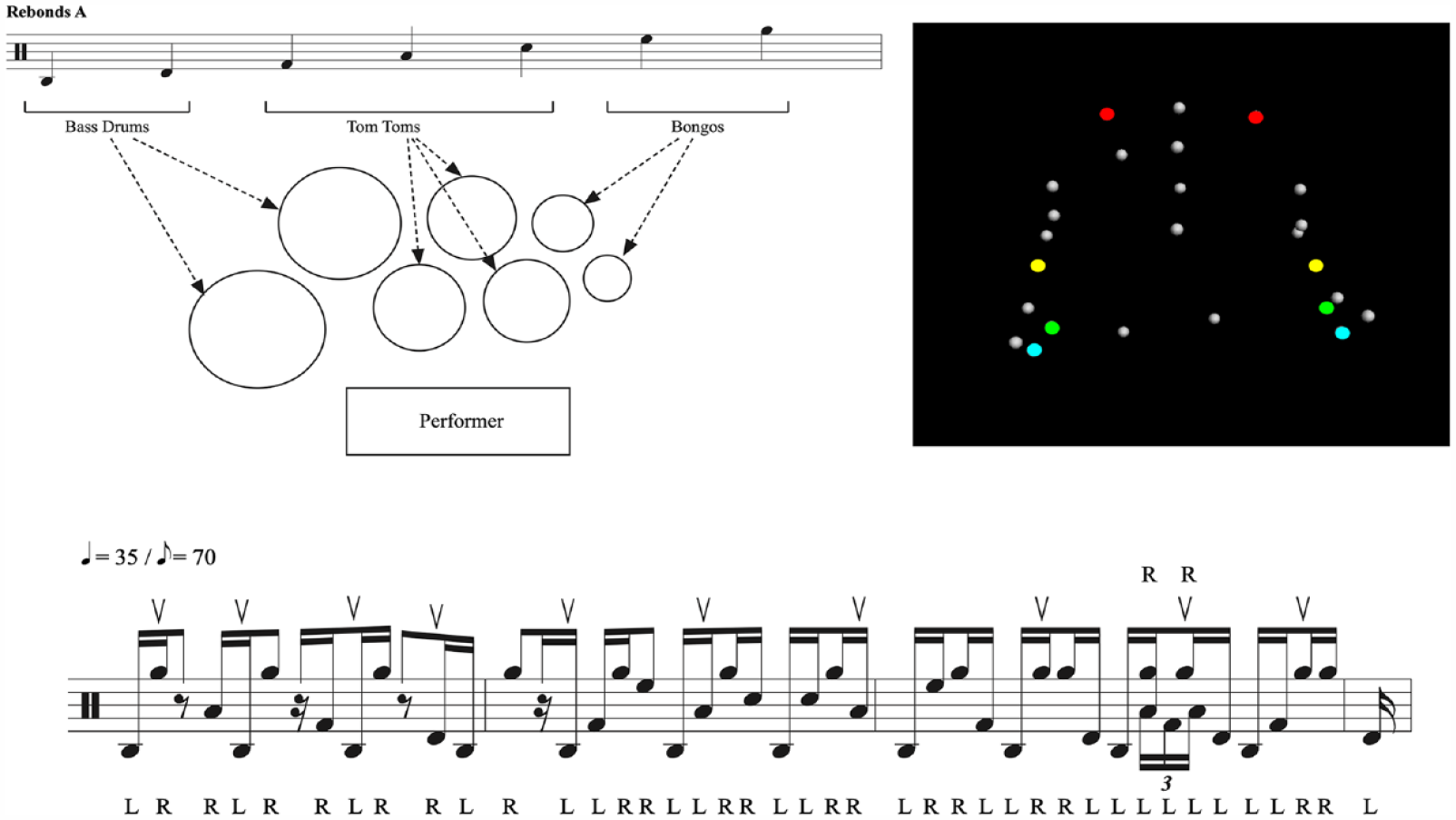
Multi-percussion setup, marker locations (red = shoulders, yellow = elbows, green = wrists, blue = hands), and the excerpt performed by participants.
Videoconferencing technology can be used effectively as a pedagogical tool for music training. Remote lessons often involve structured one-to-one interactions between teacher and student, which have been shown to improve motivation for learning piano and generate measurable improvements in skill (Biasutti, 2015; Kruse et al., 2013). Yet remote training still has limitations, including poor audio quality, lack of internet access, time needed to set up equipment, instructors’ and students’ poor digital literacy, lack of spontaneous interactions helping to create a relaxing lesson atmosphere, and the instructor’s inability to adequately monitor performance aspects such as the performer’s posture and finger position (Biasutti, 2018; Koutsoupidou, 2014; Kruse et al., 2013; Lancaster, 2007; MacRitchie et al., 2022; Schiavo et al., 2021; Pike & Shoemaker, 2013). Such limitations may ultimately reduce the feasibility and sustainability of remote training in the short and long term. We aimed to mitigate some of these limitations by focusing instruction on the visual rather than the auditory aspects of performance, since the physical elements of percussion performance include the gross-motor control of the upper limbs and torso that can easily be observed via a screen in a remote training environment. In this exploratory study we asked if differences in training format (i.e., remote vs in person) would affect participants’ upper limb movements, expert judgments of performance, and participants’ ratings of the training.
Due to its physicality, percussion performance is both seen and heard. Movements related to sound production involve substantial levels of motor control. Previous work has demonstrated that movement along the vertical Z-axis, responsible for initiating contact between the drumstick or mallet and the playing surface, is crucial (Broughton & Davidson, 2016; Dahl, 2000, 2004; Dahl & Altenmüller, 2008). The perception of percussion performance is also influenced by a complex interaction between musical (sonic) gestures and the performer’s physical gestures that serve as visual cues to the listener (Hartenberger, 2016; Schutz & Lipscomb, 2007). One outcome of the interaction between these gestures is legato, which can refer to the binding of temporally adjacent sounds.
Despite its frequent use in Western percussion music, legato is rarely discussed in either the score-based analytical or percussion literature. A limitation of many percussion instruments is that the sounds they make often decay rapidly, within a brief temporal envelope. It is possible to connect adjacent sounds and thus produce a legato effect in situations where the sound decays more slowly, for example, by paying careful attention to dynamic scaling in the lower register of the marimba (Stevens, 2000). But in other situations, especially in dry performance venues or when playing on drums whose sonic envelope is comparatively brief, percussionists wishing to play legato may consider how their physical gestures can help them in the sonic domain. Although the extent to which sonic and physical gestures respectively influence the perception of legato is not well established, physical gestures are clearly important, making legato an appropriate musical concept to teach in a remote environment where sound quality may be suboptimal.
Legato was the focus of the present study for four reasons, besides the lack of attention paid to it in the music analysis literature. First, the study involved an instructor coaching percussionists, and legato is a straightforward concept to coach as percussionists can simply be asked to use more of it rather than being encouraged to make specific movements to achieve it. Second, performing legato on percussion may, in certain contexts, involve a substantial visual element. Third, unlike parameters such as tenuto, staccato, and marcato, legato is normally produced at the phrase level (i.e., longer strings of notes) rather than on single or very small groups of notes. This was especially important in the present study because kinematic data were averaged across entire performances (see the “Data reduction” section). And fourth, because no standard literature on legato percussion performance exists, we could control for the potential bias of certain participants’ legato performances being systematically influenced by a certain pedagogical approach or aesthetic school of thought prevalent within the percussion community.
This study used motion capture technology to track the movements of the upper limbs and mallets during percussionists’ performances before and after an instructor gave them a series of coaching prompts for playing legato. Based on the available literature, we predicted (1) that training would alter participants’ mallet trajectories along the vertical Z-axis (see Beveridge et al., 2020; Dahl, 2000, 2004; Dahl & Altenmüller, 2008). Based on the finding that kinematic changes in the elbow and wrist affected marimbists’ mallet movements (Loria, Tan, et al., 2022; Loria, Teich, et al., 2022), we also predicted (2) that kinematic changes in the upper limbs such as changes in upper limb velocity would affect percussionists’ mallet movements when playing the multi-percussion setup used in the present study. We expected that these modified movements would influence judges’ ratings of the expressivity of legato and perceived performance quality, as well as participants’ subjective reports of the training they had received and their interest in continuing with it. Primarily, we wished to determine whether these changes would be observed regardless of training format (the null hypothesis) or only after training either remotely or in person (the experimental hypothesis). Were we to accept the null hypothesis it would be possible to infer that, as training affects motor behavior, legato expressivity, and subjective reports of training regardless of format, remote percussion training may be as effective as in-person training.
Method
Participants
Twenty participants (six female) with a mean age of 27.7 years (SD = 10) completed the protocol described below. They included percussion students from the University of Toronto’s Faculty of Music and trained percussionists active in the Greater Toronto Area. Participants were pursuing or had completed degrees in percussion performance and had a mean of 15 years (SD = 10.1) of percussion experience at the time of participation (see Table 1). All participants self-reported as right-handed. The study was approved by the University of Toronto Research Ethics Board (Protocol no. 39537) and participants provided informed written consent for inclusion, collection, and use of data for publication prior to the commencement of the experiment. Participants were financially compensated for completing the study.
Demographic information by condition: means (standard deviations).
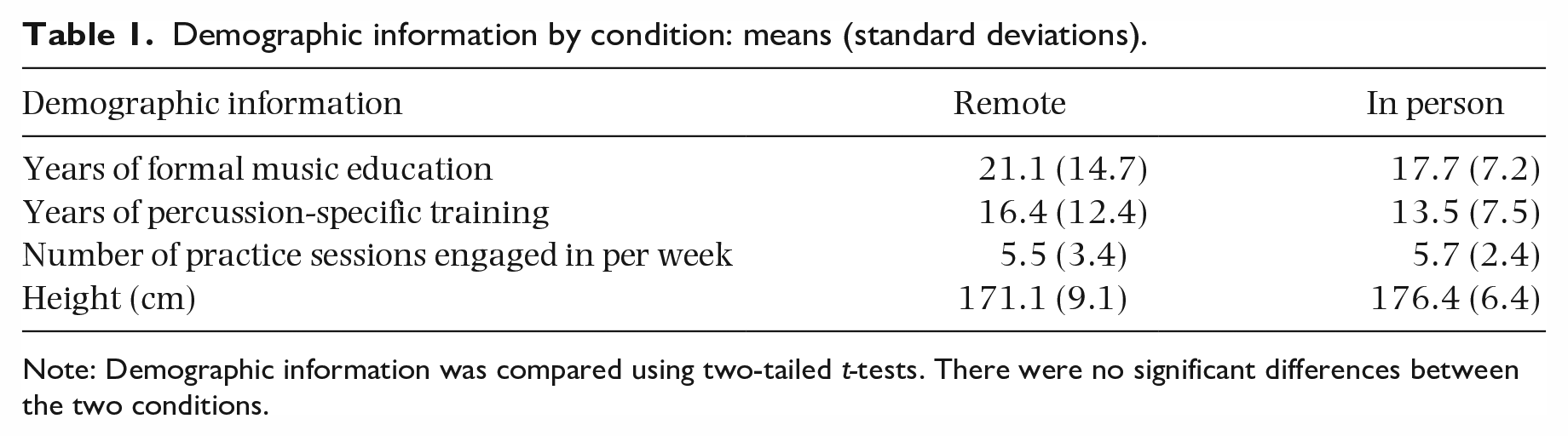
Note: Demographic information was compared using two-tailed t-tests. There were no significant differences between the two conditions.
Apparatus
Participants performed the test excerpt on a multi-percussion setup using standard percussion instruments available in most university music departments. The setup consisted of seven drums (see Figure 1) including: a 32-inch Ludwig concert bass drum (Ludwig Drums, Charlotte, North Carolina), a 24-inch Black Swamp MultiBass (Black Swamp Percussion LLC, Zeeland, Michigan); three Pearl tom-toms (Pearl Musical Instrument Company, Yachiyo) measuring 10, 12, and 14 inches, respectively; and a pair of 7- and 9-inch Pearl Elite Oak Bongos (all measurements are of the diameters of the drums).
Motion capture technology was used to gather kinematic data and compute velocities at markers affixed to the participants’ upper limbs and mallets (see Figure 1). The motion capture setup consisted of eight Vicon Vero cameras (Vicon Motion Capture, Oxford). The system’s standard resolution is 2.2 megapixels (i.e., 2,048 × 1,088) with a camera latency of 3.6 ms and spatial resolution of 0.1 mm. Twenty-seven markers were affixed to the participants’ limbs in line with the upper limb model in Vicon BodyLanguage (Murray, 1999). Five markers were positioned on the upper half of the torso including the spinous process of the seventh cervical vertebra, the right scapula, the spinous process of the tenth thoracic vertebra, the jugular notch where the clavicles meet the sternum, and the xiphoid process of the sternum. Markers were further positioned on the left and right limbs including the acromion-clavicular joints (used to measure shoulder movements), three inches apart on the upper arms, the lateral epicondyle approximately at the elbow joints (used to measure elbow movements), the midpoint of the forearms, the thumb side of the radial styloid (used to measure wrist movements), the little-finger side of the ulnar styloids, and just below the third metacarpus on both hands (used to measure hand movements, see Cutti et al., 2005; Murray, 1999). One marker was positioned at the central point of the ball of each mallet (i.e., two in total). These markers were subsequently used to track the movements of each mallet. All markers were sampled at 200 Hz. The motion capture system was calibrated in such a way that the original position on the vertical Z-axis was the playing surface of the lowest drum in the multi-percussion setup (i.e., the bass drum on the furthest left, see Figure 1). Participants were not permitted to adjust drum heights because this would have altered the capture volume on a participant-by-participant basis.
Procedure
Participants were randomly assigned to one of two conditions: remote, in which the instructor delivered the training via Zoom (n = 10), or in person, in which the instructor was physically present (n = 10). The task was to learn and perform a short, 3-measure excerpt from the first movement of Rebonds (Xenakis, 1989) in a 60-min one-to-one session in the laboratory (see Figure 1). Rebonds has become standard in the solo percussion literature, having served as a test piece in many prominent percussion competitions including the Tromp International Percussion Competition (Eindhoven), the ARD Music Competition (Munich), the Concours de Genève (Geneva), and the Percussive Arts Society International Percussion Competition (Indianapolis). Many university-level percussionists therefore have some degree of familiarity with Rebonds (Duinker, 2021). Indeed, four participants in each condition reported having experienced it, but not in the previous 6 months. The first movement, entitled Rebonds A, is scored for seven drums, from low to high: two bass drums, three tom-toms, and two bongos (see Figure 1). The composer did not specify pitches or specific drum sizes but did stipulate that the instruments should be tuned over the widest possible pitch range.
At the beginning of the session there was a 10-min practice period in which participants familiarized themselves with the excerpt and adjusted their motor performance to the imposed drum heights. They were free to practice at any tempo but had been told that they would be playing the trials to a metronome set to 70 eighth-note beats per minute (bpm). This tempo was chosen because 70 bpm was the median tempo in a survey of 10 commercial recordings of Rebonds A (Duinker, 2021). Each note of the score was given a sticking, marked with either an L or an R to indicate which mallet to use for each note (see Figure 1), determined by the instructor who delivered the coaching to all participants. The stickings were formulated to maximize ergonomic comfort (e.g., drums to the left of the performer were normally assigned to the left hand) and avoid long strings of attacks played with one hand. Stickings were intended to normalize performance across the two conditions.
At the end of the practice period, the experimenter used motion capture and the Zoom software to record the participant playing through the excerpt five times; these recordings were saved as pre-training trials. The instructor then joined the participant either remotely or in-person, depending on the condition to which the participant had been assigned. Participants played the excerpt 15 times, in five blocks of three trials, to the instructor. Between each block the instructor gave one of a series of pre-formulated coaching prompts for legato performance (see Table 2). When the participant had completed the final block of trials, the instructor left the room and the experimenter used motion capture and the Zoom software to record the participant playing the excerpt five more times; these recordings were saved as post-training trials.
Coaching prompts provided to participants during training.
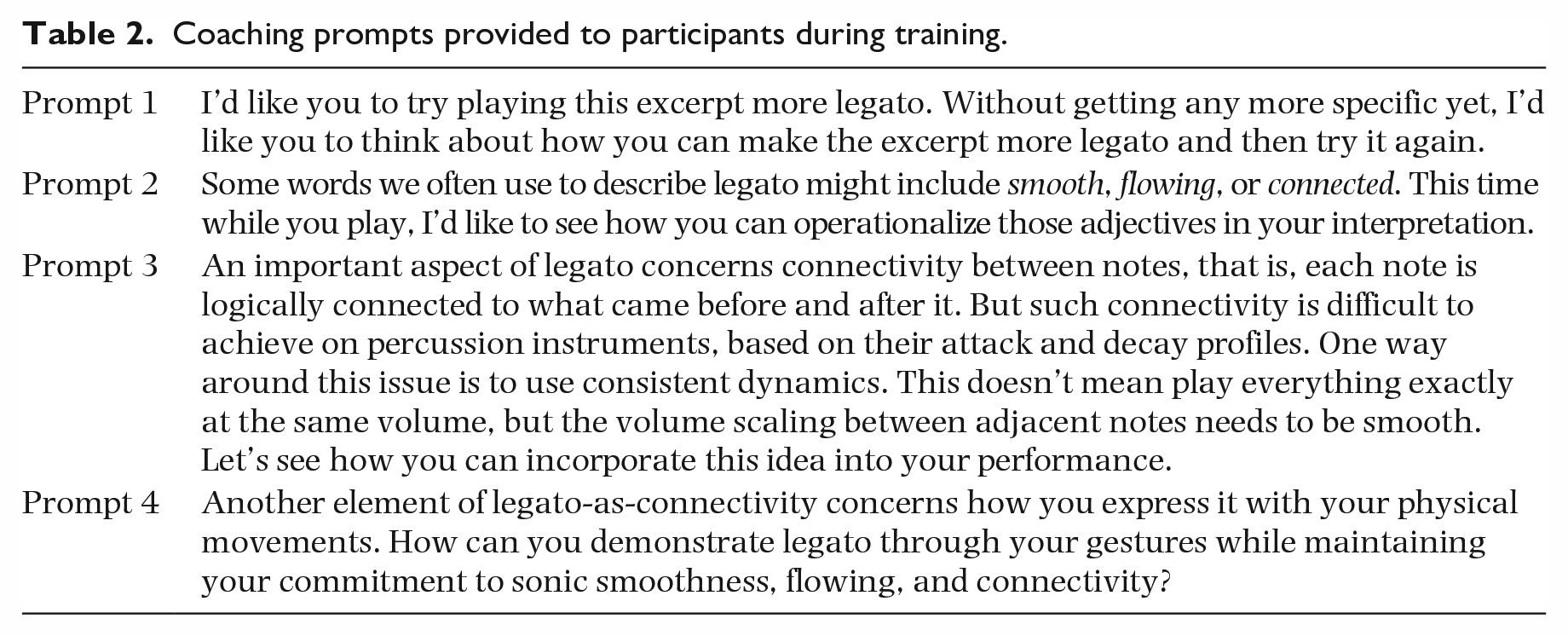
The coaching prompts had been formulated to mirror the type and delivery of feedback provided in a typically structured percussion lesson but included minimal instructions specifically pertaining to kinematics. The instructor gave positive, encouraging reinforcement at the beginning of each coaching prompt, regardless of the quality of the participant’s performance as perceived by the instructor. The prompts were designed to improve the legato performance of the participants cumulatively, over the course of the session, by increasing their sensitivity to legato. The first prompt was simply to encourage participants to play more legato, as they were not yet aware that this would be the topic of instruction. It was immediately observed (though not empirically measured) by the instructor and experimenter that participants began to play quieter upon receiving this coaching, which could be explained through legato’s association in the percussion repertoire with gentler, quieter approaches to sound production (Currie, 2016; Moersch, 2016; Stevens, 2000). The second prompt invoked terms that one might associate with legato, such as smooth, flowing, or connected, and asked participants how they might incorporate these adjectives into their performances. The third prompt asked participants to produce a consistent sonic profile with few dynamic fluctuations across the excerpt. The fourth prompt encouraged participants to pay close attention to their physical relationship with the drums and mallets, especially through their gestures (Schutz & Manning, 2012).
Data reduction
Movements of the upper limbs and mallets
The analyses of the motion capture data focused on determining how upper limb and mallet movements changed along the vertical Z-axis over time and between the participants in the two conditions, given that initial data screening revealed no significant effects along the mediolateral X-axis or anteroposterior Y-axis. Data reduction focused on the five pre- and five post-training trials. The mean position and mean velocity of the shoulders, elbows, wrists, hands, and mallets were obtained across the pre- and post-training trials (see Figure 2). The standard deviations of these data were also obtained to assess changes in spatial and velocity variability over time (for a previously published example see Loria, Tan, et al., 2022; Loria, Teich, et al., 2022).
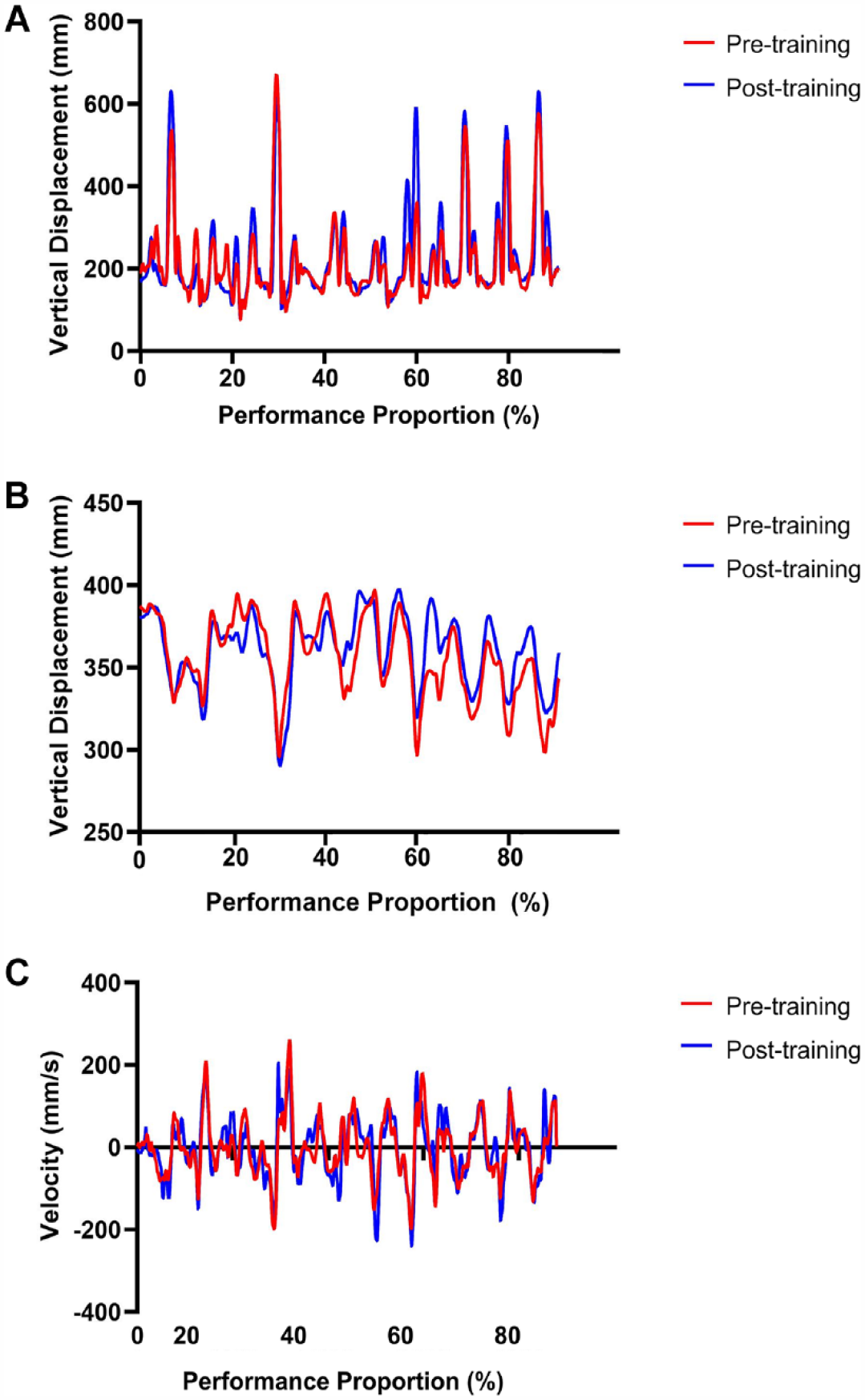
Raw kinematic data used to compute the upper limb and mallet movements of one sample participant. Panel A shows the trajectory of the right mallet along the vertical Z-axis, Panel B shows the displacement of the right elbow, and Panel C shows the velocity of the right wrist.
Ratings of performances
The audiovisual recordings of all the pre- and post-training trials, made using the Zoom software, were judged by three experienced percussionists. They had a mean age of 29.3 years (SD = 1.2) with 14.3 years (SD = 5.1) of formal music education and 10.7 years (SD = 3.8) of percussion training. Audio recordings were compressed to reduce background noise and standardize the output. Frequencies below 50 Hz and above 8.0 kHz were filtered to reduce background noise, and compression was applied at a ratio of 2:1 and a threshold of −21.0 dB to regulate volume across recordings. Video recordings were cropped so that the faces of the participants were not visible to the judges (see Broughton & Davidson, 2016; Broughton & Stevens, 2009). After pre-processing had been completed, ID numbers were assigned to the video recordings so the judges would not know whether participants were in the remote or in-person condition, or if the performance had been given pre- or post-training. Judges were asked to rate the expressivity of the legato and the overall quality of the performance using a Likert-type scale from 1 (bad), 2 (poor), 3 (mediocre), 4 (good), 5 (great) to 6 (outstanding). The Likert scale was provided to judges with these descriptions. Although the audio and audiovisual recordings had been standardized as described above, and their quality was identical, it was nevertheless suboptimal. Judges were therefore reminded that the recordings had been made using the Zoom software and that they should ignore the quality of the recording and focus on the performances themselves. Ratings for each participant’s performance were averaged across the three judges and compared by time (pre- vs post-training) and condition (remote vs in-person instructor).
Participant survey data
At the end of the training session, participants completed a survey asking about their subjective experience of the training (see Table 3). They were asked how effective they found the instructor and the coaching and if they thought they would be able to apply what they had learned to other repertoire. They were also asked to say if they would like to continue receiving lessons from a remote or in-person instructor, according to condition, for 2 or 4 weeks (short term) and indefinitely (long term). Participants responded using a Likert-type scale from 1 (strongly disagree), 2 (mostly disagree), 3 (somewhat agree), 4 (mostly agree), 5 (agree) to 6 (strongly agree). The scale was provided to participants with this description.
Survey data: means (standard deviations).
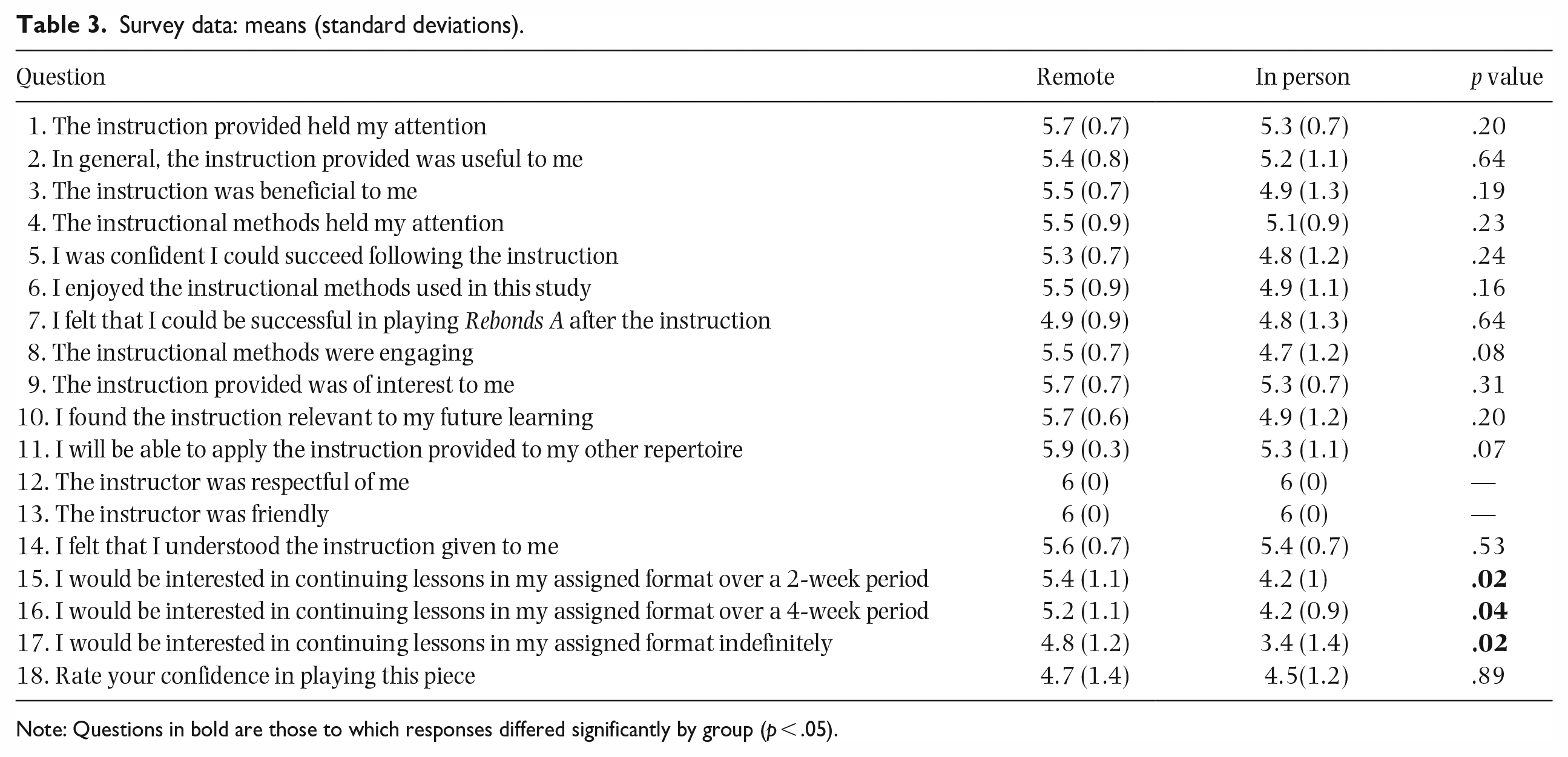
Note: Questions in bold are those to which responses differed significantly by group (p < .05).
Statistical analyses
To compare the effects of training in the two formats (i.e., remote vs in person), movements of the upper limbs and mallets were analyzed using mixed-model analyses of variance (ANOVAs) with time (pre-training vs post-training) as the within-participants factor and condition (remote vs in-person instructor) as the between-participants factor. Separate mixed-model ANOVAs were conducted for mean spatial position, mean spatial variability, mean velocity, and mean velocity variability for the left and right shoulders, elbows, wrists, hands, and mallets along the vertical Z-axis (see Loria, Tan, et al., 2022; Loria, Teich, et al., 2022). Separate mixed-model ANOVAs were also conducted for expressivity of legato and overall performance quality. Finally, data from the survey (see Table 3) were analyzed using separate independent samples t-tests to compare participants’ ratings in the remote and in-person conditions. For the sake of brevity, we report significant effects (p < .05) only.
Results
Movements of the upper limbs and mallets
The two-way mixed-model ANOVA comparing time (pre- vs post-training) and group (remote vs in person) revealed main effects of time on the movements of the left, F (1, 18) = 6.1, p = .02,
ANOVA also revealed main effects of time on the spatial variability of the movements of both the left, F (1, 18) = 15.1, p = .001,
Velocity variability increased in the left, F (1, 18) = 8.8, p = .01,
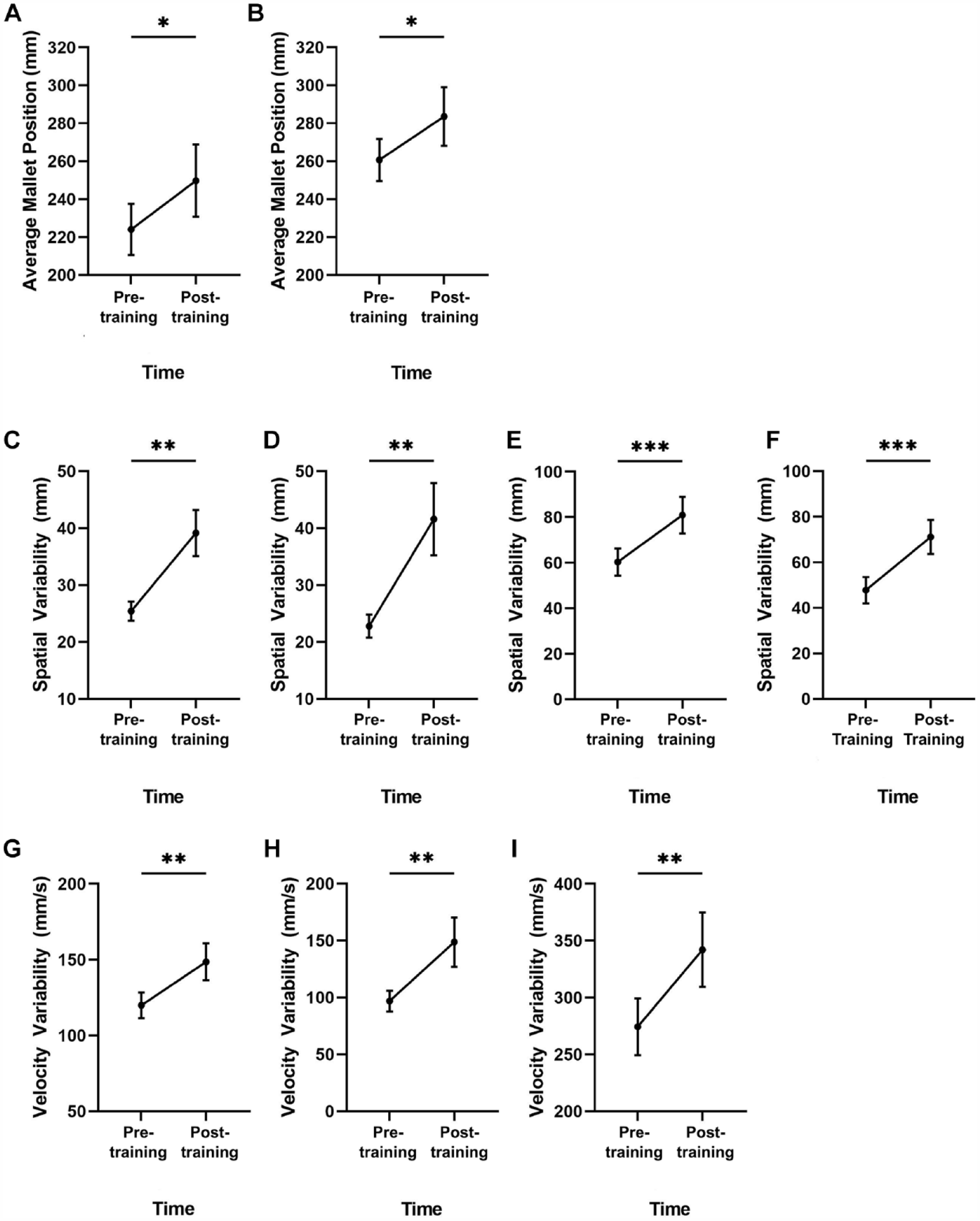
Upper limb and mallet movements as a function of time. Panels A and B: average positions of the left and right mallets, respectively. Panels C and D: spatial variability in the left and right elbows, respectively. Panels E and F: spatial variability in the left and right wrists, respectively. Panels G, H, and I: velocity variability in the left and right elbows and the right wrist, respectively.
Post hoc power analyses were subsequently conducted using G*Power (Faul et al., 2007) for all non-significant time × group interactions. The lowest observed power of 80% was found for left wrist velocity variability (i.e.,
Ratings of performances
The ANOVA performed on performance quality yielded a main effect of time, F (1, 18) = 20.6, p < .001,
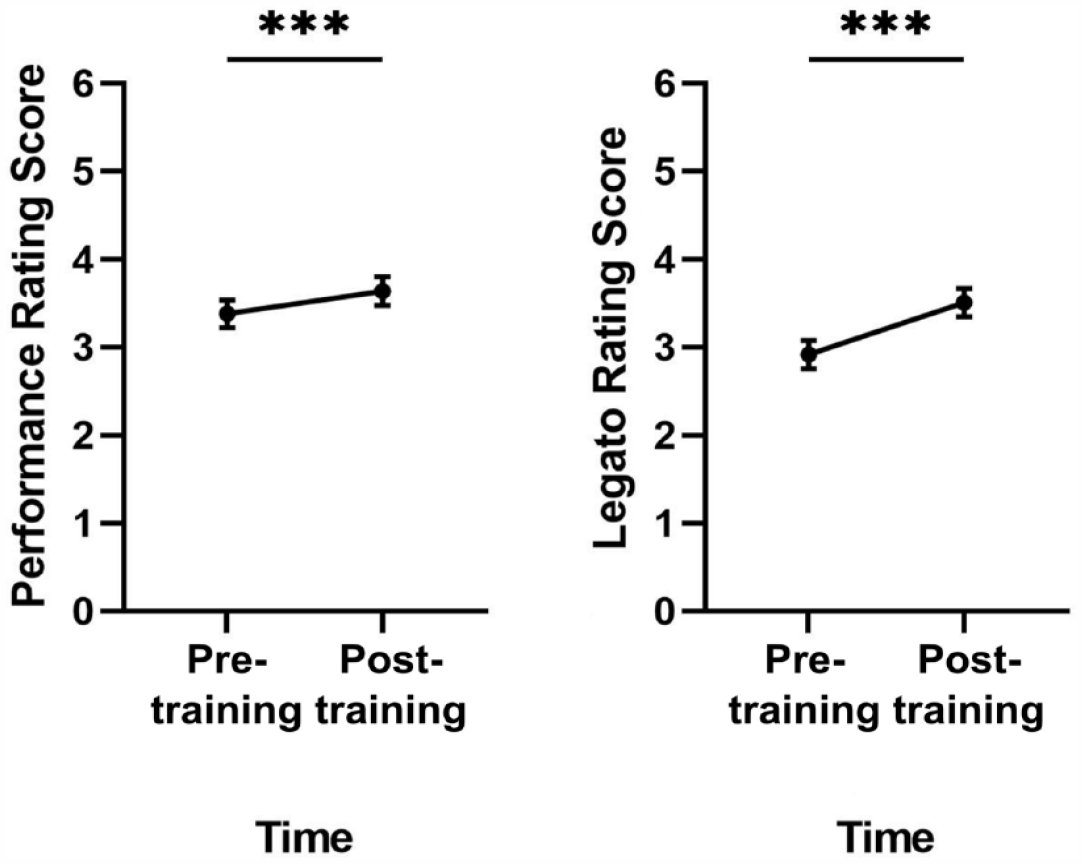
Judges’ ratings of overall performance quality (left) and expressivity of legato (right).
Participant survey data
Responses to the survey completed by participants can be found in Table 3. Independent-samples t-tests revealed significant differences between the two groups such that participants whose instructor was remote (M = 5.4, SD = 1.1) gave significantly higher ratings than the in-person group (M = 4.2, SD = 1) when asked to continue training over a 2-week period, t (18) = 2.6, p = .02, 95% confidence interval (CI) = [.21, 2.2]. The remote group (M = 5.2, SD = 1.2) was also more interested in continuing training compared to the in-person group (M = 4.2, SD = .9) over a 4-week period, t (18) = 2.2, p = .04, 95% CI = [.04, 2.1], as well as indefinitely (remote M = 4.8, SD = 1.2, in person M = 3.4, SD = 1.3), t (18) = 2.5, p = .02, 95% CI = [.2, 2.6]. Note that all remaining non-significant effects had associated p-values >.07.
Discussion
Although remote and in-person training in piano performance has previously been explored, the advantages and disadvantages of teaching percussion remotely have not yet been studied empirically. This exploratory study partially addressed this gap by comparing the effects of training by an instructor who was either remote or physically present on the performance of legato by right-handed percussionists performing a multi-percussion excerpt. Analyses revealed significant effects predominantly for the factor of time. It was predicted that training would alter participants’ mallet trajectories along the vertical Z-axis (e.g., Dahl, 2004). As predicted, increases in average mallet height were found post-training. It was also predicted that kinematic changes in the upper limbs such as changes in upper limb velocity would affect participants’ mallet movements (e.g., Loria, Teich et al., 2022). Again, as predicted, increases in the spatial and velocity variability of the movements of participants’ elbows and wrists were found regardless of condition. These modified movement patterns influenced judges’ ratings of the expressivity of legato and perceived performance such that post-training performances were rated higher than the pre-training performances in terms of both legato expressivity and overall performance quality. Finally, participants with a remote instructor reported greater interest in continuing their training in this manner, in both the short and long term, although the two groups of participants did not differ in their enjoyment of the training.
Comparing movements of the participants’ upper limbs and mallet and judges’ ratings of performance may indicate a relationship between upper limb movements and perceived performance quality. Previous work has shown that trained percussionists alter wrist and mallet trajectories predominantly along the vertical Z-axis for specific expressive actions, such as playing accents or changing dynamics (Beveridge et al., 2020; Dahl, 2000, 2004, 2011; Gonzalez-Sanchez et al., 2019). In the present study, the average height of both mallets was found to be higher post- than pre-training, whether remote or in person. Mallet height may have been influenced by increased spatial and velocity variability in the left and right elbows and right wrist. While there were differences between the variabilities in the left and right wrists, the excerpt required an equal balance of left and right mallet usage, with neither hand playing most accented notes. The effects of movement variability may seem counterintuitive at first glance, given that it is believed that upper limb control is optimal when movement variability is minimal (Harris & Wolpert, 1998; Todorov & Jordan, 2002; van Beers et al., 2004). This belief was not confirmed, however, by the ratings of the judges in the present study.
Variability in upper limb and mallet movements could be interpreted as participants’ attempts to increase the expressivity of their legato. If so, these attempts were successful, given that judges rated post-training performances higher for legato expressivity and overall performance quality. Theories of motor control support the conclusion that variability in participants’ movements of the elbows and wrists, post-training, was attributable to the instructors’ coaching prompts. Reinforcement Learning Theory (RLT) proposes that a performer executes various actions and registers or updates motor plans in response to feedback (in this case, the coaching prompts), which in turn enhances motor control and improves performance of the target actions (Dhawale et al., 2017; Eshel et al., 2015; Kaelbling et al., 1996; Lee et al., 2012; Sutton & Barto, 1998). Taken together, the movements of the participants’ upper limbs and mallets and the judges’ ratings of participants’ performances suggest that increasing the spatial and velocity variability of the elbows and wrists can influence the extent to which legato is perceived to be expressive. Future research could focus on the influence of upper limb variability on the perception of other parameters such as staccato and tenuto, and to correlate measures of upper limb kinematics to more specific performance measures such as rhythm and timbre. The findings could help facilitate both the remote and in person training of percussionists.
No significant effect of condition (i.e., remote vs in person) on motor performance was found, although the study was appropriately powered and the analyses only just failed to reach significance. Previous researchers have interpreted similar findings to imply that the outcomes for the two groups were comparable if not equivalent. For example, Karlinsky and Hodges (2018) evaluated learning outcomes for two groups who practiced a balancing task either individually or with a randomly allocated partner. The authors report a non-significant difference between the two groups but suggest nevertheless that learning with a partner can improve training efficiency, but not effectiveness. If we assume that the two training formats in the present study were comparable, this may be because the training that was provided focused predominantly on visual aspects of percussion performance (Schutz & Lipscomb, 2007; Schutz & Manning, 2012) rather than auditory aspects, and the remote training format was not therefore disadvantaged as it was in a recent study limited by the poor audio quality of the videoconferencing technology used (Biasutti et al., 2022). Focusing on visual aspects, in this case, allowed us to improve efficiency of training, insofar as instructors could teach students in a range of geographical locations, but not its effectiveness (cf. Karlinsky & Hodges, 2018).
Participants in both conditions found the training useful and effective but those with a remote instructor were keener to continue training for 2 weeks, 4 weeks, and indefinitely. Although they were not able to elaborate on their responses to the survey, they may have wanted to continue their training in this way because of performance anxiety. Musicians commonly experience performance-related anxiety that can have an impact on the quality of their performances (Kokotsaki & Davidson, 2003; MacAfee & Comeau, 2020). Perhaps receiving instruction from a remote instructor via videoconference is less likely to induce performance anxiety than the presence of an instructor in the same room as the student. Given the opportunity to receive in-person tuition in a large urban environment, participants might have preferred to save time and money by taking remote lessons instead of traveling into the city (see MacRitchie et al., 2022). If these were indeed factors underlying participants’ responses to the survey, they highlight the possibility that offering remote training could reduce attrition in music education. This is an important issue in formal music pedagogy, so innovative approaches that enhance training adherence are warranted (González-Moreno, 2012). The provision of remote training is an approach that may enhance training adherence and accessibility. That is, remote training may lower barriers to accessibility, as it allows students to learn from anywhere in the world (Lancaster, 2007). For example, Kinney (2019) found that fewer students enrolled in instrumental music lessons and continued to take them, following initial training, when their families moved to another city or town. Another barrier to accessibility is socioeconomic status where students from lower income families are often unable to learn music because of poorly funded, inadequate, or non-existent music programs in schools (Elpus, 2014; Elpus & Abril, 2011; Kinney, 2019). In the present study, however, it is important to note that the sample consisted of university music students and our findings may not be generalizable to less advanced learners. Nevertheless, our results may highlight remote percussion lessons as one way of improving equitable and sustainable access to music education, and adherence to training.
It is important to note that to study the movements of the upper limbs and mallets it was necessary for all the participants to be in the laboratory, so only the instructor was remote. It could be argued that this approach does not constitute true remote training and should thus be considered a limitation of the present study, but it has the merit of being ecologically valid, insofar as university classes are regularly taught by remote instructors. Another limitation is that judges were asked to rate legato expressivity and overall quality of performance in general terms. Had we asked more specific questions it would have been possible to analyze correlations between motor variability, as measured in this study, and performance metrics, but we did not do so on this occasion. We speculate that legato expressivity may represent a nuanced approach to sound quality and timbre in performance. Also, participants reported their subjective experiences using only Likert-type scales. In future research, participants should be encouraged to elaborate on their responses verbally so that the effects of training format on outcomes can be understood better. Also, to further evaluate the effects of remote training, two training conditions (remote vs in person) could be compared with a no-training (practice only) condition. We would predict that outcomes would be better in the two training conditions than the practice-only condition, and we could compare differences between outcomes in each of the training conditions with the practice-only condition. We also recommend introducing a 24-retention test to evaluate the effects of remote training on motor learning.
In conclusion, remote teaching may serve as an effective adjunct to in-person training in percussion pedagogy. We speculate that the spatial and velocity variability of performers’ upper limbs and mallets was related to judgments of legato expressivity. With additional empirical investigation, the preliminary evidence provided here could be incorporated into percussion pedagogy in line with theories of motor control (e.g., RLT). Training, regardless of whether it took place remotely or in person, had significant effects on the movements of participants’ upper limbs and mallets, judges’ ratings of the expressivity of legato and overall performance quality, and participants’ enjoyment. Interestingly, participants with a remote instructor subjectively reported greater willingness to continue their lessons than those whose instructor was physically present. Remote lessons for university music students could thus represent an innovative approach to percussion teaching, and one that promotes adherence to training.
Footnotes
Declaration of conflicting interests
The authors declared no potential conflicts of interest with respect to the research, authorship, and/or publication of this article.
Funding
The authors disclosed receipt of the following financial support for the research, authorship, and/or publication of this article: This work was supported by the Social Sciences and Humanities Research Council of Canada and the Canada Foundation for Innovation.

Data availability statement
Data will be made available upon reasonable request to the corresponding author.