



Abstract
Regional conflict, growing technological developments, and climate change have seen high migration rates, which are likely to rise. Discrimination and violence at the hands of host societies continue to threaten the well-being of immigrant communities, as well as wider social cohesion in migration destinations. The urgency of the situation has been highlighted in several international policy documents released since 2020 by the United Nations (UN) and related agencies. In response, we have seen a global movement of intercultural music ensembles intended to break down cultural barriers and explore sites of cultural intersection, yet the real-world benefits of such initiatives remain unclear. There is a need to further explore and understand how and when music can be used as an instrument or site for fostering inclusion, understanding, and cohesion between migrants and their host communities. On appraising the evidence, we propose a conceptual framework for explaining how different cultures can interact with each other through musical participation.
Keywords
In a world that increasingly requires people of many different backgrounds to live together, routes to encourage intercultural social cohesion are of great importance. This article builds on evidence that the arts—and music in particular—offer unique spaces for fostering a shared socio-emotional experience.
Music is a source of cultural understanding and a site for cultural exchange. As a multimodal activity that invites cognitive, emotional, social, and physical engagement, music provides an embodied and situated experience that is deeply intertwined with cultural traditions and attitudes (DeNora, 2000). For these reasons, it has also played a major role in communicating cultural traditions across linguistic and ethnocultural divides (DeNora, 2000) and offers an effective conduit for exposing whole societies to the cultures of minority groups. 1 Yet, while this form of exchange may be ancient, the rate at which people encounter different cultural musics has risen sharply over the last century, with various forms of migration and exposure to different cultures being accelerated with a rise in technological advances, mass media, the Internet, and tourism (Aubert, 2007). These trends have aided the broadening of cultural understanding, facilitating access to mainstream distribution channels for minority cultures, and have “given birth to the concept of world music and to its commercial exploitation” (p. xii). Fifteen years on from Aubert, it is reasonable to assume that such processes have grown exponentially in parallel with the mediums now used to distribute and consume music.
Reflecting on several UNESCO reports stating that cultural incompatibility is responsible for the majority of conflict around the world, Oehrle (1996) argued that structured music participation (in particular, music education) has value in supporting cultural harmony: [music] promotes communication, develops appreciation and new behaviour patterns in relation to the world’s people, broadens our outlook of the world’s peoples, helps us understand the world’s cultures and their diversities, develops multicultural sensitivity, and is a unifying source with positive social significance. Above all, it is a way of breaking down the barriers and prejudices which isolate people from one another: a way of moving towards a culture of tolerance. (p. 99)
The idea that music affords opportunities for intercultural understanding and social cohesion has shaped policy and media discourse. Both UK and European Union policymakers have promoted music events, such as festivals, as a way to foster cultural diversity and mitigate social barriers to the inclusion of migrant populations in Western countries (Wilks, 2011). Similarly, live music scenes have been positioned as sites in which young people can gain a sense of cultural pride and forge new collective identities that celebrate the growing diversity of a given community (van der Hoeven & Hitters, 2019).
Yet some evidence challenges the notion that music participation automatically produces intercultural cohesion. Wilks (2011) found that music festivals increased social bonding within existing social groups but did little to foster inter-group interaction. In his analysis of live music in the nightlife setting, Grazian (2009) argues that music scenes can in fact deepen divisions through exclusionary or violent practices against racial, cultural, and gender minorities. There is also increasing dialogue around the potential for cultural violence and appropriation in music-based service professions (Hutchings, 2021; Thomas & Norris, 2021). 2
In a recent review of studies using music as a way of reducing prejudice during the educational development of young people, Miranda and Gaudreau (2018, p. 299) concluded that there was only “some potential” for this outcome and called for the implementation of more stringent experimental designs. Specifically, they argued that longitudinal research designs are needed that focus on “how much and what kind of music-based prevention is needed to obtain sustainable anti-prejudice effects at different ages” (p. 11).
There is also evidence that collective music participation can have undesirable as well as desirable consequences, such as strengthening divisions between people. The most famous examples are historical and include Nazi nationalist and propaganda music. Such potential, albeit in arguably less explicit forms, is also well acknowledged in contemporary settings. Wilks (2011), who investigated policy claims that live music events and festivals would bolster cohesion between different cultural groups, found that such gatherings served to strengthen bonds between existing groups, but did little for inter-group relations. In debating the value of live music scenes in metropolitan spaces (e.g., localized punk, metal, blues, and Hip Hop community venues and events), van der Hoeven and Hitters (2019) suggest that, while music scenes are a powerful way for people to gain a sense of belonging and express collective identity, this is often the case among culturally similar groups, and is accompanied by discriminatory practices toward other groups. Van der Hoeven and Hitters go on to echo Grazian’s (2009) caution that live music scenes can deepen divisions, and call for more equitable access to live music infrastructure for minority groups.
These brief insights suggest that it is necessary to explore and understand further how and when music can afford opportunities for fostering inclusion, understanding, and cohesion between migrants and their host communities. In the current article, we report an interrogation of literature and research across various fields including intercultural psychology, business studies, and critical race theory. Our aim was to provide a framework for intercultural music engagement (ICME) by identifying existing academic discourses on intercultural engagement relevant to musical participation that can both facilitate social cohesion and avoid cultural violence.
Positionality statements
Themes of music and cultural identity, as well as otherness and connectedness to host culture, are central to this article. We therefore provide brief accounts of our positionalities in relation to these themes to provide some transparency as to how we, as individuals, relate to both these specific themes and the concept of ICME more broadly.
The first author is a White man of predominantly Scottish ancestry who lives in and benefits from a settler colonial society in so-called Australia. While he has lived mainly in his host country since birth, he has traveled extensively to other countries. He has played musical instruments since the age of five, still performs publicly, and continues to make new music. As a researcher/practitioner in community arts, music and health, Hip Hop studies, social policy, and cultural studies, his disciplinary bias is toward anti-colonial, culture-centered, and critical theory approaches.
The second author is a Canadian/Australian White settler of Irish ancestry who migrated to Australia in mid-adulthood. He has conducted cross-cultural investigations and written on the subject for 20 years. As a psychologist, his disciplinary bias is toward the interrogation of mental processes and similarities between people from diverse cultural ecologies, but his recent work has emphasized differences between the experiences of those inside and outside distinct musical communities.
The third author is a woman of Indonesian and Australian descent who has been engaged as a community arts practitioner in the music and dance of a range of cultures. As a community psychologist, her research and practice are oriented toward the person in their social and cultural context.
The fourth author is a White woman of British heritage who has traveled widely, lived in several parts of Europe and Canada, and migrated to Australia in mid-adulthood. She has been involved in musical arts and dance since early childhood and has extensive experience of performing and training others in classical and community music contexts. As an applied social psychologist, her disciplinary bias is toward explorations of the individual and social processes associated with music, with a focus on its specific and universal cultural functions.
The challenges of growing multiculturalism
Increasing global connectivity has heralded an exponential growth in both inter-country relations and the physical movement of people around the planet (McAuliffe & Khadria, 2019). 3 While much of this movement can be attributed to voluntary immigration (e.g., career development, personal interest), the International Organization for Migration (IOM, 2020) reported that the main drivers of migration are armed conflict and significant social unrest in countries of origin.
Forced migration can save lives, yet social harmony depends upon host countries addressing the challenges of introducing new populations into societies with entrenched traditions, attitudes, and beliefs. The psychological trauma and physical challenges of leaving home countries, being housed in refugee holding or detention centers, and then having to adjust to new circumstances are all well documented and reflected in the prevailing rates of disadvantage among migrant communities (Marks et al., 2021; Valdez, 2020). The high rate of trauma experienced in these populations, as well as the fracturing of family groups and social support structures, makes these populations particularly vulnerable (Sheikh-Mohammed et al., 2006). While settlement programs exist, migrants are often left to navigate unfamiliar social systems in a completely new language.
The attitudes and actions of host communities are critical to the immigration process. Widespread reports of racial discrimination, social exclusion (Cooray et al., 2018), and violence (Valdez, 2020) experienced by migrants at the hands of host communities suggest that there is an urgent need to build cohesive relationships between migrant communities and their host societies. Scholars and governments have recommended strategies to improve relations between these groups (Choi et al., 2019), but such strategies need to be intensified given the tensions associated with COVID-19 and revelations that children and adolescents are a major target of immigrant discrimination in countries such as the United States (Marks et al., 2021). Furthermore, policy responses to anti-immigration sentiment have historically focused on the traits of individual perpetrators and perceived competition with or threats to the economic well-being of host communities (Marks et al., 2021; Yakushko, 2009). Yet critics argue that these foci prevent the examination of underlying racist beliefs (Sundstrom & Kim, 2014) and ingrained but concealed structural factors in host societies (Tafira, 2011). In promoting more holistic approaches to immigration, Marks et al. (2021) stress the need to explicitly acknowledge and address histories of racism and structural oppression in host societies.
Acknowledging the complex, global challenges of migration, the United Nations (UN; Dasli, 2019) and IOM (2020) have lobbied for increased intercultural dialogue and better strategies to help build intercultural understanding, empathy, and conciliation between host societies and immigrants, as well as cultural minorities more generally. Initiatives aimed at easing tensions and building social cohesion have been implemented by many governments (Choi et al., 2019). Inevitably, such efforts have sought to raise public awareness, and change popular attitudes toward migrant groups, through campaigns for diversity or multiculturalism including specific days, events, and festivals where immigrants are encouraged to present their culture in school, work, or community settings. Such efforts may reduce some tensions between immigrant and host communities, but are limited in what they can achieve (Grønseth, 2001). Accordingly, the need remains for additional strategies that encourage deeper, more embodied forms of intercultural engagement (Grønseth, 2011; McCrady, 2017).
To fulfill the aim of providing a framework for ICME, we begin by establishing a basic understanding of intercultural interaction and processes of acculturation as described by psychological theory and research. We then explore contemporary uses of music designed to nurture positive changes in intercultural understanding before considering critical perspectives and music-based service professions that highlight both the opportunities and challenges associated with ICME.
Cross- and intercultural interaction: Psychological perspectives
For the cross-cultural psychologist John Berry, the process of acculturation is central to cross-cultural and intercultural relations. Acculturation refers to how an individual or group forms a relationship with the dominant culture of a new or host society. It is a group (sociocultural) phenomenon, which considers shifts in social structures and normative practices following cross-cultural contact, in contradistinction to enculturation at an individual (psychological) level, which considers the emotional and cognitive changes that occur within an individual following cross-cultural contact (Berry, 1980).
As shown in Figure 1, acculturation at the individual level is depicted in Berry’s model of acculturation strategies in ethnocultural groups and the larger society in the left-hand rounded rectangle, representing the relative significance of an immigrant’s desire to maintain their heritage cultural or identity (shown on the y-axis) and their desire to maintain positive relationships with the larger society (shown on the x-axis). Individuals’ desires for each outcome varies from strong (positive = high) to weak (negative = low), and the balance of these desires determines their acculturation style. For example, a high desire for cultural heritage and a low desire for engaging with the larger society lead to separation from the new mainstream society, whereas a high desire to engage with the larger society and a low desire to maintain one’s cultural heritage lead to assimilation into the mainstream society with the concomitant loss of connection to the individual’s cultural heritage (Berry, 1980). Integrated individuals (top left-hand quadrant of rectangle) participate and feel included in the host society, while being able to maintain their cultural identity (Berry, 2019). Conversely, marginalized individuals (bottom right-hand quadrant of rectangle) are disconnected from both the mainstream host society and their cultural heritage.
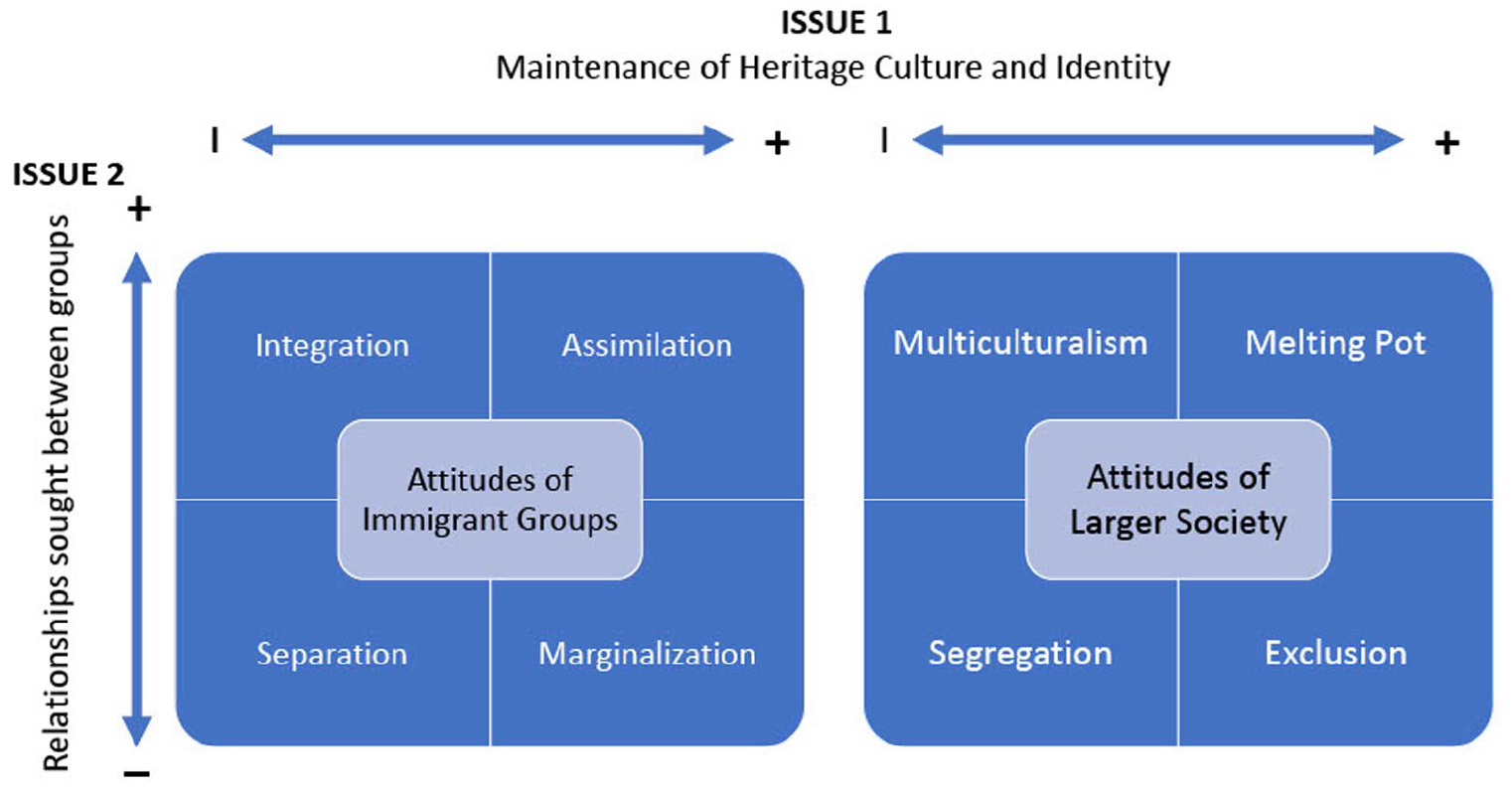
Acculturation strategies in ethnocultural groups and the larger society.
Cross-cultural psychologists also believe that there are universal forms of social engagement. Their universality can be seen in practices common to all groups such as weddings and unions, sharing food, connecting through music, and the use of spoken language. Differences between the ways in which groups express these universal practices, however, depend to a great extent on their cultural context and constitute diversity. As Berry (2010) writes, “the ecocultural framework considers human diversity (both cultural and psychological) to be a set of collective and individual adaptations to context” (Berry, 2010, p. 96). For Berry, this approach avoids the polarities of absolutism and relativism and rejects any notion that one culture or society is more advanced, civilized, or superior to another. Importantly, it also makes a clear distinction between diversity and multiculturalism. Whereas diversity is used to describe societies including people from a wide range of different cultural backgrounds, multiculturalism goes further by providing rights and opportunities for everyone to participate as culturally diverse people in society (Hartmann & Gerteis, 2005). Many countries have embraced diversity without emphasizing the importance of multiculturalism, and this can be problematic as it puts cultural minorities at risk of being forced to assimilate and/or having their cultures erased (Berry, 2016).
The attitudes and behaviors of the host society toward cultural minorities are shown in the right-hand rectangle in Figure 1. A high desire for migrant participation in the mainstream culture, and a low desire for them to maintain their culture, leads to a so-called melting-pot model, whereby migrants are expected to participate in the host society and adopt its culture. A low desire for relationships between migrants and the mainstream culture, and a high desire for them to maintain their culture, leads to segregation, whereby minorities practice their cultures separately from the mainstream. Low desires for both relationships between migrants and the mainstream culture and migrants’ maintenance of their own culture lead to outright social exclusion, while high desires for both represent multiculturalism, whereby all cultures are integral to the mainstream, regardless of their size (Berry, 2006). Berry conceptualizes these group behaviors and attitudes as social and/or political strategies for pursuing either the inclusion or exclusion of cultural others. For societies pursuing social inclusion, strategies include multicultural school curriculums, culturally safe healthcare, regulations against discrimination in workplaces, and other ways of supporting culturally diverse engagement in key social institutions (Berry, 2005).
While the model illustrated above accounts for attitudes or approaches to acculturation, Berry and his colleagues’ conceptualization of change (i.e., measurable outcomes) is framed in terms of two kinds of adaptation. 4 Sociocultural adaptation (also referred to as sociocultural competence by Sam and Berry, 2010) refers to the tendency to exhibit positive behaviors in one’s local community, where integration is linked to prosocial behavior, and segregation and marginalization are linked to antisocial behavior. Psychological adaptation refers to well-being and pairs integration approaches with higher self-esteem and life satisfaction, and segregation and marginalization with psychological distress and rumination (Berry, 2010).
Understandably, these theories have been challenged (Triandis, 1997), debated, and updated (Ward & Kus, 2012), often by Berry himself, and his colleagues (Berry, 2019). A major thrust within this refining process has been the need to further consider the nuances of sociocultural factors. For example, Ward (2008) argues that the dichotomous nature of acculturation orientations in Berry’s model fails to account for the internal conflict between the demands of host and home cultures that may be experienced by an individual or group, and the psychological impact of such conflict on the individual or group’s well-being and experience of acculturation. Similarly, Garcia et al. (2020) argue for a wider concept of cultural identity, beyond race and ethnicity, which includes sub-cultural and other identities salient to experiences of migration, such as gender, sexual orientation, nationality, and disability. Given these criticisms, it seems clear that any musical initiatives aimed at influencing migration experiences need to consider a broad a range of sociocultural factors that extend beyond the dichotomies of host and home cultures.
Given the potential for further refinement of Berry et al.’s model, we argue that the basic framework and understanding of diversity provides a useful foundation for conceptualizing contact between different cultures in different contexts, including musical participation. Ultimately, for persons of different cultural backgrounds to interact with and to adapt to each other, they need to share some basic psychological [and social] features (processes and capacities). Even though their competencies and performances may differ greatly across cultures and individuals, these basic psychological [and social] features enable individuals and groups to interact with, and to understand each other. These commonalities are required in order to achieve mutual accommodation within plural societies. (Berry, 2010, p. 97)
Thus, music itself may be considered a shared social feature insofar as it is shared by cultures. Furthermore, the human ability to experience the emotional affordances of music could be considered a shared psychological feature.
The study of intercultural engagement has been presented to this point by exploring psychologically focused research. It is also valuable to interrogate research taking a pragmatic approach to operationalizing theories of intercultural relations and it to these that we now turn.
Conceptualizing and operationalizing interculturality
The practical application of intercultural theories, as it has emerged in international business and management studies, focuses primarily on measuring the quality and extent of intercultural understanding. Associated survey tools are designed to assess individuals’ ability or readiness to engage with people and contexts outside their own culture. These measures have also tended to focus on individuals’ ability to interact respectfully across multiple cultures, often for the purpose of business negotiations. Consequently, scholars have proposed numerous constructs designed to capture the optimal state of cultural understanding including intercultural communication (Neuliep, 2012), intercultural sensitivity (lee Olson & Kroeger, 2001), intercultural competence (Lustig & Koester, 2005), intercultural effectiveness (Hammer et al., 1978), and intercultural communication competence (ICC, Beamer, 1992). While Portalla and Chen (2010) argue that this range of terminology denotes conceptual ambiguity within the field, Matsumoto and Hwang (2013) suggest they can be referred to collectively as cross-cultural competence or 3C models.
Despite the suggestion that these models are sufficiently similar to be given a single label, it is notable that their desired outcomes, and the measurement of their achievement, continue to be debated. For example, Mellizo (2019) frames desired outcomes as movement along dimensions reflecting three key variables: an increase in cultural understanding, which is difficult to attain at high levels; prejudice reduction, for example, decreased racial stereotyping; and multicultural sensitivity, described as a “large-scale” outcome encompassing “a spectrum reaching from a fundamental awareness of similarities and differences across cultures to deep empathy for people of various circumstances” (Howard, 2015, pp. 19–20, as quoted in Mellizo, 2019). By contrast, Matsumoto and Hwang (2013) conclude from their review of the 3C tests available at the time that the primary desired outcomes can be understood as forms of adaptation and adjustment. While these terms are often used interchangeably, Matsumoto and Hwang make important distinctions between them. Adaptation is “altering one’s behavior in response to the environment, circumstances, or social pressure” (p. 850), and can be thought of as a change in how individuals relate to others. Conversely, adjustment refers to how individuals relate to themselves through the subjective experiences associated with adaptation, and may be assessed by mood states, self-esteem, self-awareness, physical health, self-confidence, stress, psychological and psychosomatic concerns, early return to one’s home country, dysfunctional communication, culture shock, depression, anxiety, diminished school and work performance, and difficulties in interpersonal relationships. In extreme cases, negative adjustment can involve antisocial behavior (gangs, substance abuse, crime) and even suicide. (Matsumoto & Hwang, 2013, p. 850)
Mellizo (2019) and Matsumoto and Hwang’s (2013) conceptualizations reveal two distinct 3C approaches to intercultural contact, which are also evident in Berry’s work. As in Berry’s model for immigrants, Matsumoto and Hwang focus on the assimilation of those from a cultural minority into a host society. Yet from their review of 3C tests they conclude that they lack not only validity and theoretical clarity, but also cross-cultural applicability, given that they were created in a Western setting. This observation echoes the earlier critique of Hermans and Kempen (1998), who argued that many theoretical positions uphold colonial tropes such as the false dichotomy between the West and the East. Again, these positions are based on a White, or Western, worldview (e.g., framing phenomena in relation to individualist as opposed to collectivist goals and processes). For example, the so-called desirable outcomes measured by the tools reviewed by Matsumoto and Hwang (2013) review include the ability to adapt to host cultures, thus placing the onus on migrants rather than hosts to assimilate and acquire intercultural knowledge and sensitivity. This addresses only half of the challenge of promoting intercultural understanding and harmony, and places responsibility on communities that are often less resourced, and always on the receiving end of intercultural tensions. It is for these reasons that Berry has stressed that mutual accommodation must be central to multicultural policy (Berry, 2016).
Aligning with Berry’s model for host societies, the second 3C orientation (adjustment) aims to reduce the prejudice of dominant cultures toward minorities. Two models represent this discourse. First, Hammer et al. (2003) proposed a Developmental Model of Intercultural Sensitivity (DMIS). According to this model, individuals progress through stages of intercultural sensitivity with increased exposure to and engagement with a different culture until they accept cultural difference. This progression can be captured using the Intercultural Development Inventory (Hammer et al., 2003). Second, Portalla and Chen (2010) proposed an ICC model. This characterizes the core processes needed to support “an individual’s ability to achieve their communication goal while effectively and appropriately utilizing communication behaviors to negotiate between the different identities present within a culturally diverse environment” (Portalla & Chen, 2010, p. 21). This ability has three core dimensions: intercultural awareness, denoting cognitive awareness of one’s own and another’s culture; intercultural sensitivity, an affect-related concept relating to the understanding and appreciation of subjective differences (feelings, behaviors) between cultures; and intercultural effectiveness, the ability to reach desired intercultural communication goals.
This second orientation toward increasing the intercultural capabilities of people within dominant cultures has had a bigger impact than the first 3C orientation (adaptation) in organizational settings. As Matsumoto and Hwang (2013) note, measures developed in this area primarily aim to “identify goals of intervention, allowing practitioners to design effective training programs and assess efficacy, which are important for organizations and individuals” (p. 849). While such programs can be linked to international business pursuits, a plethora of training courses aimed at enhancing cultural competency or cultural sensitivity have been implemented across a wide range of governmental departments and helping professions, particularly in Western countries such as the United States and Australia (Rose, 2013). Some of these programs are presumed to reduce prejudice by enabling engagement with the musical traditions of migrant or non-dominant cultures.
Yet a number of these approaches to reducing prejudice have been criticized by those who question whether intercultural interventions should focus on enhancing sensitivity only to a single culture, or many. Matsumoto and Hwang (2013) term these “culture-specific” and “culture-general” approaches, respectively (p. 850) and argue that most available 3C assessments of intercultural competence are only suited to culture-general approaches. In other words, the evaluation tools currently available are designed to measure individuals’ sensitivity to all foreign cultures, rather than a specific culture. Mellizo (2019) sees this as problematic given the growing awareness that level of immersion in a specific culture is directly related to the ability to understand and interact with someone from that culture but may have little or no impact on attitudes toward people from other cultures.
The problematic nature of a culture-general focus is supported by the findings of research seeking to demonstrate the benefits of ICME programs. Neto et al. (2018) carried out an intervention study aiming to reduce Portuguese school students’ prejudice toward Cape Verdeans and Brazilians. For the intervention group, the music program included Portuguese and Cape Verdean music, while for the control group, it included Portuguese music only. The intervention program reduced prejudice toward Cape Verdeans, but not Brazilians, while no reduction of prejudice was recorded for the control group. The authors surmise that music programs need to focus on a specific culture if they are to have an impact on prejudicial attitudes toward that culture. They also suggest that an alternative explanation for their results is that culture-general music programs have little impact on intercultural understanding and/or relations.
Using Bennett’s (1993) DMIS framework, Mellizo (2019) explored the effect of a focused music education program on intercultural sensitivity throughout adolescence. She adopted a mixed-methods approach and found that active music making facilitated growth on a DMIS-specific measure of intercultural sensitivity. These results were attributable to the high-immersion, culturally diverse music curriculum intervention that focused on a single music culture in depth for an extended time period, prioritised active music-making experiences, and emphasised sociocultural and human connections in the music. (Mellizo, 2019, p. 485)
The idea that music is more likely to facilitate cohesion between cultural groups in some situations than in others is reinforced in the broader literature. Notions of dosage—levels of exposure to, or immersion in specific cultures—have been raised by others such as Zarnick (2010), who found that short-term study-abroad programs were insufficient for developing intercultural sensitivity in young adults. Van de Vyver et al. (2019) explored the effects of participatory arts on young people’s intentions to carry out prosocial behaviors aimed at benefiting others. Highlighting the role of empathy, Clarke et al. (2015) report that listening to music from another culture can increase positive attitudes to people of that culture, but only fractionally and only for people with already-established high levels of trait empathy.
The usefulness of 3C approaches for addressing the issues at the core of intercultural tensions, such as understandings of whiteness, colonialism, and White supremacy, has also been questioned (Hutchings, 2021). As the Indigenous scholar Rose (2013) contends, “Simply put ‘cultural competency’ [in] its current incarnation is not the panacea that it is being purported to be in universities, professions and in government who translate it into an ever growing feeding frenzy for training programs” (p. 21).
While the description of 3C approaches above offers some insight into how intercultural theories have been operationalized, the ways in which they have been criticized suggest that more information is needed when designing intercultural music programs, such as whose culture is being explored, and which culture is doing the exploring. A critically engaged discourse is also needed to address the cultural assumptions of existing models. Indeed, it seems necessary to look to other disciplines to gain a more grounded understanding of intercultural engagement in musical spaces.
Critical perspectives
To pursue the goal of increasing social harmony through intercultural interaction, it is important to consider the meaning of culture and racism in the 21st century, and how prejudice and intolerance have evolved into new forms that are often undetected or unacknowledged, but pervasive: Those who believe in racial hierarchy and separatism (old racisms) are a minority and are largely the same people who self-identify as being prejudiced. The “new racisms” of cultural intolerance, denial of Anglo-privilege and narrow constructions of nation have a much stronger hold. (Dunn et al., 2004, p. 409)
One example is “aversive racism,” which DiAngelo (2018, p. 43) associates with educated, liberal, White people who maintain racist or discriminatory systems and actions while simultaneously professing liberal views. Although Applebaum (2017) and McWhorter (2020) criticize DiAngelo’s work for containing its own race-based assumptions, it highlights the nuances of contemporary prejudice and intolerance, and questions the capacity for existing 3C models to account for or capture them.
The 3C models are also problematized by the concept of cultural humility, or the awareness and acknowledgment that full competence in another’s culture occurs through lived experience (Fisher-Borne et al., 2015). Proponents of cultural humility warn that any programs designed to achieve competency in minority cultures risk superficial understandings that ultimately perpetuate cultural insensitivity, and can even lead to a process of cultural appropriation whereby “individuals from rich and powerful majority cultures appropriate from disadvantaged, indigenous and minority cultures” (Young, 2010, p. ix). Thus, cultural humility offers an approach to cross-cultural interaction characterized by humility, curiosity, an openness to learn something new, and the ability to suspend or acknowledge one’s own bias or pre-judgments about that culture (Hook et al., 2013). Fisher-Borne et al. (2015) describe this as a shift from mastery to accountability in cross-cultural interactions. Similarly, scholars have argued that a shift from cultural competency to cultural safety is necessary for equality in the health services: Health practitioners, healthcare organisations and health systems need to be engaged in working towards cultural safety and critical consciousness. To do this, they must be prepared to critique the “taken for granted” power structures and be prepared to challenge their own culture and cultural systems rather than prioritise becoming “competent” in the cultures of others. (Curtis et al., 2019, p. 1)
Both explicit and implicit power dynamics are highly relevant to intercultural understanding. Berry (2019) observed that contact between cultures can be deeply influenced by power dynamics formed over centuries of trade and, of course, colonization. From a colonial standpoint, Western engagement with a culture of the other is often driven by interest, opportunity, or mere curiosity: engagement is a choice. Yet the other is often impelled to learn, adapt to, and operate within the dominant culture. Thus, the stakes for the other in this exchange are higher, particularly for Indigenous communities who are a cultural minority on their own lands. For example, artists from the Indigenous nations around Australia argue that access to their culture is vital for maintaining not only a sense of identity, but connection to generations of history and knowledge that has been all but lost under colonial rule (Moreton-Robinson, 2015). Furthermore, Western cultural forms, including music, have been used as tools of colonization. The cultural imperialism project waged with Western song books, instruments, and literature can be traced across various colonial invasions (Irving, 2010; Ogasapian, 2004; Pasler, 2004). Colonial music practices persist in educational (Locke & Prentice, 2016), therapeutic (Comte, 2016), and larger community or social settings (Rosamond, 2020).
These observations and arguments suggest that intercultural understanding is by necessity asymmetric, and that this asymmetry should be reflected in approaches designed to enhance this understanding. On the one hand, active engagement in the traditions of a marginalized culture by both groups will have greater benefits to the intercultural understanding of the dominant group than the minority group. On the other hand, when minorities engage with the dominant culture, goals of integration or assimilation risk the marginalization and erasure of the minority culture. Given these potential outcomes, it is incumbent on dominant cultures to do more of the work, using careful and sensitive approaches, when engaging with the practices of minority cultures or inviting minorities to participate in mainstream cultural practices.
ICME: What is it and how do we approach it?
The literature we have reviewed reports and discusses a wealth of critical work carried out in a range of academic fields on the topic of intercultural interaction and music making. Yet there is currently no dedicated framework that brings together the perspectives represented in a way that is designed to inform intercultural musical practices. We now turn our attention to exploring what such a framework might encompass. While our main goal in this article was to identify and describe the challenges of ICME, a sub-goal is to provide a framework for people who work in contexts where it is important to engage critically to enrich their own practices. We propose ICME as a conceptual framework highlighting the sociopolitical implications and pitfalls outlined above, and that might be considered when designing new programs and experiences. As there is continuous evolution of the awareness of the complexities and subtleties of power dynamics, and endemic forms of ethnocultural bias, the ICME framework is a dynamic model that can and should be expanded and refined as new understandings of intercultural interactions arise.
We construe the core of ICME as the process whereby people come into contact with cultures other than their own through participating in a musical act, defined broadly by Small (1998) as musicking. In proposing this framework, we aim to highlight both the positive and negative affordances of navigating cultural differences through musical means, recognizing that music engagement can be used for both social cohesion and social division. We draw upon a range of music-based disciplines to establish a structure for developing musical activities that promote intercultural understanding and social cohesion.
Music reflects our universalities and our diversity
Applying Berry’s conceptual model to music, we can begin by considering the structural universalities of music, such as rhythm, pitch, and dynamics. These universalities, in turn, have different expressions as determined by varying contexts, leading to musical diversity. In addition to structural universalities, certain functions of music may be universal, such as the communication of emotion, storytelling, and an accompaniment to community and/or cultural events. Although such functions may be universal, the sociocultural expression of such functions may be unrecognizable to other groups. For example, funeral music can sound very different in different cultural contexts, but its function is universally understood, so funeral music can offer shared foundations upon which people from different cultures can meet and come to know one another (Davidson & Rocke, 2021). The functions of lullabies provide another opportunity, offering a universal meeting point for people from a range of cultural backgrounds, who can build a sense of community and intercultural understanding through sharing different variations of this widespread musical phenomenon (Dieckmann & Davidson, 2018; Mehr et al., 2019).
Thus, the idea of universalities in music offers a useful foundation for the ICME framework: while our music may sound and feel different, we all have music. Furthermore, we all have some understanding of musical features such as pitch, rhythm, and dynamics, and the idea of using music for important social or cultural events. We propose that these universalities offer a valuable starting point when thinking about how one might carry out an intercultural conversation with or through music. As Berry writes, Even though their competencies and performances may differ greatly across cultures and individuals, these basic . . . features enable individuals and groups to interact with, and to understand each other. These commonalities are required in order to achieve mutual accommodation within plural societies. (p. 97)
Yet music also demonstrates and embodies our cultural differences. Thus, not only can we use the universalities of music to meet across cultures, but in learning and appreciating the diversity and differences of musical expression, we can practice learning and appreciating cultural difference. Using music in this way therefore offers both a container and proxy for navigating wider cultural differences.
Humility and safety rather than competency
Early discussions of cultural engagement identified a threshold beyond which individuals new to a society were said to have cultural competence (Kirmayer, 2012), and the concept has found its way into healthcare curriculums across disciplines and geographic settings (Hunt, 2019). However, this construct has since been challenged on two key points. The first is the recognition that the idea of competence understates the depth of understandings shared by those who have lived their lives within a particular cultural habitus (Greene-Moton & Minkler, 2020). Second, “cultural competency has been challenged for its failure to account for the structural forces that shape individuals’ experiences and opportunities” (Fisher-Borne et al., 2015, p. 165). An alternative concept, that of cultural humility, has been proposed to shift the emphasis of intercultural programs and initiatives from mastery to accountability. This is both because cultural humility advocates a humble, curious, and respectful approach to otherness, and because “the concept . . . takes into account the fluidity of culture and challenges both individuals and institutions to address inequalities” (Fisher-Borne et al., 2015, p. 165).
As an extension of this debate, we propose that intercultural musical engagement should not necessarily aim for the desired goal of cultural competency. Instead, we draw from critical perspectives in both cultural studies and fields such as music therapy in arguing that the concept of cultural humility offers a more useful aspiration based on the recognition that assuming competency in another’s culture can lead to symbolic violence and ultimately have a negative effect on intercultural relations. This argument challenges existing 3C approaches and may require a paradigm shift in the understanding of the goals and implications of existing intercultural endeavors. Nevertheless, we believe that such a shift is necessary to address or disassemble colonial and other power structures that continue to have an impact on our social realities, and the nature of intercultural relations.
We also advocate the importance of cultural safety in ICME. This emerged among Maori nurses in Aotearoa (Doutrich et al., 2014), and has been defined as: an environment, which is safe for people; where there is no assault, challenge or denial of their identity, of who they are and what they need. It is about shared respect, shared meaning, shared knowledge and experience, of learning together with dignity, and truly listening. (Williams, 1999, p. 213)
Curtis et al. (2019) argue that the concept of cultural safety is critical to fostering spaces that are inclusive and anti-oppressive. Likewise, we suggest that such environments offer optimal conditions for ICME seeking to foster empathy and promote social cohesion.
The need to review the desired outcomes or foci of existing intercultural models, and move away from the idea of competency or mastery, is echoed in the wider intercultural literature. Specifically, there is a growing body of work that stresses the importance of empathy as an outcome (Bennett, 1993; lee Olson & Kroeger, 2001), given that it represents a high level of understanding regarding intercultural dynamics: Empathy, commonly known as the ability to put oneself into another’s shoes, is more precisely the ability to treat someone as they would wish to be treated. It has been coined as the platinum rule. This rule is esteemed to be superior to the old golden rule—treat others as you would wish to be treated—because it takes into consideration the values and perspective of the person you are treating rather than assuming they would benefit equally from the same treatment as you would. (Emphasis in the original, lee Olson & Kroeger, 2001, p. 118)
Clarke et al. (2015) also state that “in musicology, the psychology of music, the sociology of music, and ethnomusicology, empathy has been seen as a way to conceptualize a whole range of affiliative, social bonding, identity-forming, and ‘self-fashioning’ capacities in relation to music” (Clarke et al., 2015, p. 63). In naming these capacities, Clarke et al. (2015) not only point to a range of cognitive processes by which music can enhance empathy, but also see empathy as a pre-requisite for increasing cultural understanding through music engagement.
We therefore argue that music initiatives drawing upon concepts of humility, safety, and empathy should be more useful for fostering intercultural understanding through music than initiatives that side-step them. This may be particularly important for initiatives not only aiming to nurture cultural understanding but also striving to reduce prejudice in mainstream cultures toward cultural minorities (see below for further discussion on directing programs at dominant or minority cultures).
Incorporating embodied understanding
We also argue for the inherent value of embodied or experiential learning through direct engagement in ICME, as opposed to text-based or didactic methods of learning. This is partly based on the understanding that developing cultural humility, understanding, and/or empathy often requires engagement in certain actions or experiences that cannot necessarily be recreated in a classroom. Drawing on the idea of negotiation of engagement, from Wenger’s (1998) communities-of-practice theory, music therapists have argued that this represents a hermeneutic process that emerges through interaction: for someone to learn the skills or knowledge required to engage in negotiation—whether through music or otherwise—they have to first engage with the other (Enge & Stige, 2022). In this way, rather than through prescribed activities, music may offer a shared process where people can practice being with each other or negotiating differences. This idea is further supported by Mellizo’s (2019) argument that high immersion and active music making are important conditions for fostering understanding and empathy through ICME.
Additionally, we advocate for the role of embodied experience in investigating and learning about these processes, congruent with current research that stresses the importance of embodied knowing as a way of approaching and understanding the process and value of intercultural contact through music (Dieckmann & Davidson, 2018).
Cultural ecology
Berry (2010) proposed an ecocultural approach that considers all potential influences on the individual’s cultural identity, ranging from their psychological make-up to their family structure, immediate community, and wider social norms and social institutions as they affect intercultural engagement. According to the ecocultural approach, culture is always evolving in response to a confluence of sociopolitical phenomena, such that mental processes and behavior at a population level can be considered adaptations to these phenomena.
The ecocultural approach is useful for ICME and can also be extended. Berry’s model identified two distinct orientations: “a relative preference for (1) maintaining one’s heritage culture and identity and (2) a relative preference for having contact with and participating in the larger society along with other ethnocultural groups” (Berry, 2010, p. 99). Following this logic, a group or individual’s attitude toward either of these orientations is also highly dependent on their immediate ecological context. In musical terms, this can be translated to the idea that an individual or group’s attitude toward engaging in music from a certain culture, in a certain setting, is informed by how that culture and setting relate to a given ecological context. For example, asking a German military choir to perform in Israel would have very different implications from those of asking a Puerto Rican drum group to perform at a street festival in New York.
This suggests that those responsible for music-based initiatives would benefit from paying close attention to contextual factors when seeking to facilitate intercultural experiences. This aligns with Community Music Therapy (CoMT) models that emphasize the value of an ecological approach for understanding how both individual and social factors impact all aspects of community and social well-being (Enge & Stige, 2022). CoMT also stresses the impact of setting on musical experience, and argues that it is necessary to consider the social environment when trying to achieve social and community goals through music (Stige & Aarø, 2012), as suggested by research highlighting the importance of exploring cultures in detail when facilitating intercultural experiences (Mellizo, 2019). As already noted, several scholars contend that long-term, in-depth engagement with all aspects of a given culture are necessary conditions for increasing empathy and cultural understanding through music participation (Van de Vyver et al., 2019; Zarnick, 2010).
We draw from critical theory in suggesting that an understanding of context would also allow practitioners and scholars alike to become cognizant of other veiled power structures present in the wider arena, and take steps toward dismantling them (Denzin & Lincoln, 2011). As Marks et al. (2021) have argued, these ecological approaches are necessary to identify and undo the impacts of colonial and other race-based power structures which remain omnipresent in contemporary society, and continue to shape intercultural relations.
We also posit that understanding context is crucial to deciding to whom intercultural music experiences are geared toward. As noted above, scholars such as Berry (2016) have raised the need to consider whether intercultural endeavors seek to increase the understanding and empathy of minority migrant groups, or their dominant host cultures. We argue that it is critically important to have a deep and informed understanding of a given social context when deciding on the orientation of intercultural initiatives, ensuring that they are best positioned to effect real change without placing an unnecessary burden on minority cultures.
Music and power are interconnected
While some have proposed that music itself can be abstracted into an apolitical, a-cultural, musical essence, there are strong counter arguments to suggest that music, culture, politics, and power are inextricably linked (Bowman, 2007; Jorgensen, 2007; Koza, 2010). Indeed, the features that give music its color, flavor, and diversity are inherently reflections of the same sociopolitical factors that impact our cultures. A direct example of this is Punk music, a musical subculture which was formed in response to a certain form of politics (neoliberalism), and explicitly sought to disrupt or reject it through lyrics, style, dress, and behavior (Malraux et al., 2006).
The philosophy of music education stresses that acknowledging the link between music and power is essential to providing musical experiences that foster social justice outcomes (Bowman, 2007; Jorgensen, 2007; Koza, 2010). For example, in educational contexts, the type of music that is made available and taught in classes often has ethnocultural and class associations, and may reinforce unequal power relations between the in-group communities associated with the music and various outgroups (Bowman, 2007; Jorgensen, 2007; Koza, 2010). For ICME, understanding how power relations may be carried in or triggered by certain musical experiences offers important insights into how certain musical styles and aesthetics can have an impact on intercultural contact for certain groups.
Another reason for adopting this critical stance is to remain grounded in a realistic understanding of the affordances provided by musical participation. As already observed, while it can lead to a raft of community and individual benefits, it can also lead to negative outcomes in both these areas. This critical perspective regarding the affordances of music is not new. Indeed, key scholars in several fields have argued that it is necessary to consider not only the potential of music to be used for nefarious purposes, but also how such purposes may be linked to larger social processes: Are we to regard music’s affiliative and divisive attributes as two sides of the same coin, or as a more fundamental incompatibility between emancipatory and oppressive qualities? Indeed, rather than considering how music might help to make a bridge between apparently pre-existent cultural ghettos, should we not be asking in what ways music is already implicated in the establishment and maintenance of those very ghettos in the first place? (Clarke et al., 2015, p. 82)
As Hesmondhalgh (2013) has argued, we are best placed to be enriched by music when we acknowledge that positive experiences are not inevitable, and that music itself is inherently bound up in the same internal and external struggles human beings face in the world.
This acknowledgment helps us to remain aware not only of issues of access and cultural representation, but also of the implications of engaging in another culture’s music, and to avoid trivializing factors such as respect and access to cultural music. It also helps us avoid issues related to cultural appropriation, which—while widely understood as disrespectful and harmful to minority cultures—can still be found in contemporary education (Davis, 2005; Howard, 2020), therapy, community practice settings, and contemporary arts more generally, including use of dress/aesthetics, instruments, and repertoire (Young, 2010). One example is the tendency for White music therapists to appropriate Black and Indigenous cultural forms and artifacts (Leonard, 2020; Low et al., 2020; Norris, 2019, 2020). Another is ongoing practice in music education whereby teachers fail to explore source cultures in sufficient depth, ultimately demeaning or exploiting the music of other cultures (Howard, 2020).
Conclusion
The proposed ICME framework provides a multidisciplinary context for understanding the act of engaging with different cultures through music. Such considerations may help us understand contextualized expressions and diversity in music, and can advance the field in line with a social justice approach. The understanding that the universalities of music underpin all these expressions is just as critical to an ICME framework, however. It is conceivably these universalities that offer the conduits or platforms for communicating, understanding, and developing social bonds with others.
We hope that the components and structure of the ICME framework shown in Figure 2 will not only help music performers, facilitators, and policymakers to conceptualize an anti-oppressive approach to ICME, but also inform research and the development of theory in this area. Specifically, the framework highlights some of the complexities of music engagement within different cultural environments, as well as insights into the mechanisms that may help or hinder intercultural understanding at individual, community, and societal levels.
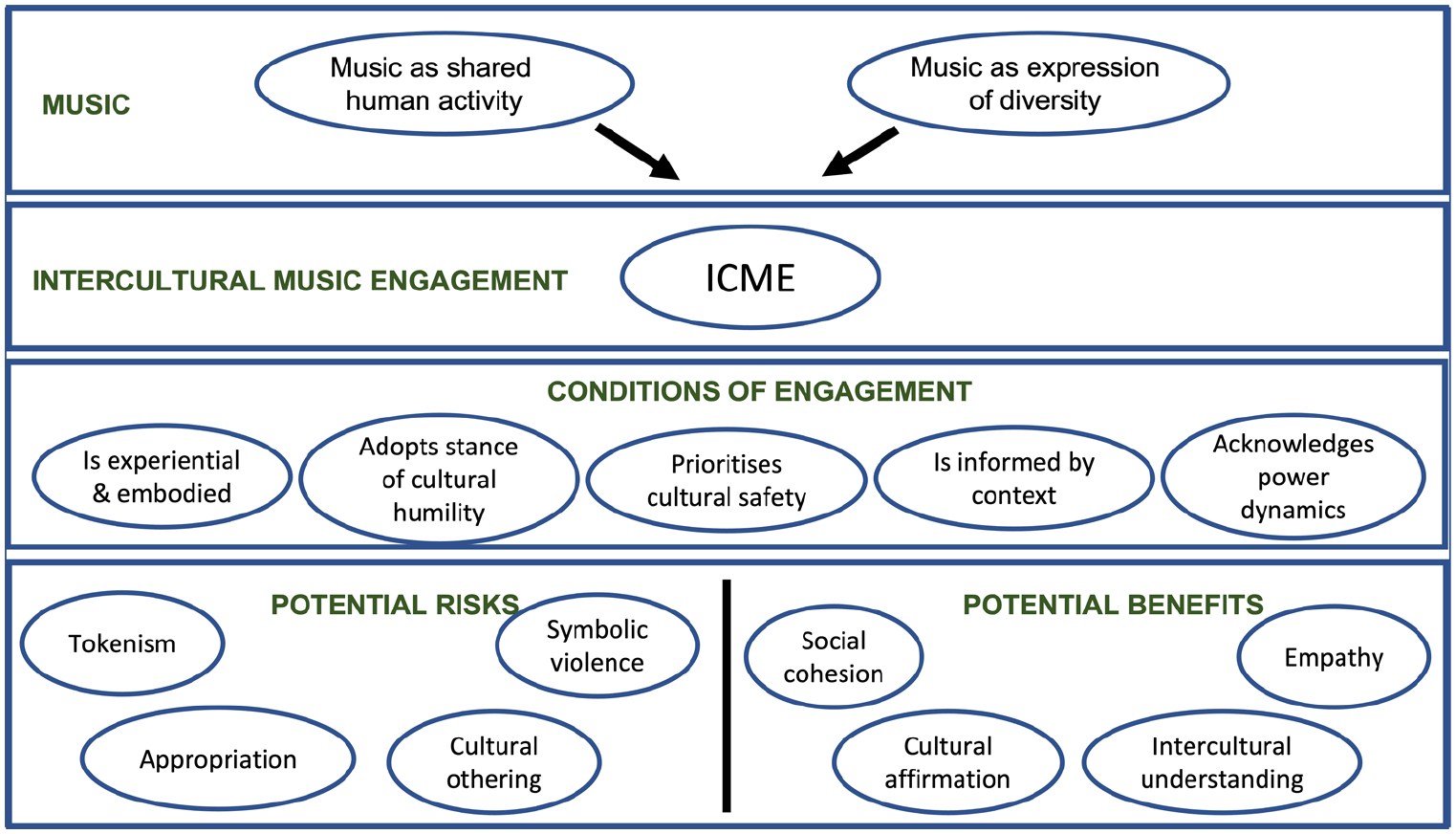
Visual representation of framework showing the basis, conditions, and potential outcomes of Intercultural Music Engagement.
The purpose of this discussion of intercultural engagement was to explore how increased empathy, compassion, and understanding between cultures can occur using music, in an ever-diversifying world. The framework presented is regarded as a starting point. Our next step is to attempt to apply it in different real-world contexts, employing suitable methods.
Footnotes
Authors’ Note
William Forde Thompson is now affiliated to Bond University, Queensland, Australia.
Declaration of conflicting interests
The authors declared no potential conflicts of interest with respect to the research, authorship, and/or publication of this article.
Funding
The authors disclosed receipt of the following financial support for the research, authorship, and/or publication of this article: This work was supported by a Discovery Project research grant awarded by the Australian Research Council, Grant award # GA28982.
