




Abstract
Reading music notation is not an easy skill to acquire and can take years of training to master. In addition, it is not strictly necessary to be able to read music to make music. Nevertheless, music teaching and learning in the West has traditionally centered around the skill of reading music. This study explored participants’ reasons for learning to read music and the reported benefits of this skill for musical activities. We developed an online questionnaire with open-ended questions to gather the views of 64 people, both music readers and non-readers, on their musical activities using or not using notated scores. Their responses were analyzed thematically. The analysis showed that participants believe that learning and engaging with music notation adds to their multisensory experience of music involving vision, sound, and action; that, compared to learning by ear, the visual aspects of notation support the quick learning and improved theoretical understanding of a musical work: and that the skill of reading music is valuable in the context of group music making. They also believe, however, that notation can inhibit expressive performance or improvisation, and non-readers believe that sound technologies can be used as an alternative to notation. Finally, reading music was seen by readers, but not non-readers, as integral to playing an instrument. This may reflect differences between the practices and genres of music favored by the two groups.
Keywords
Musical scores, whether printed or displayed digitally, are ubiquitous in many musical settings: a child’s violin practice, a choir rehearsal, a professional orchestra performing a concert, or a YouTube video of a famous piece of music including score and lyrics. It is valuable to be able to read scores, especially those using Western staff notation, not only for learning a piece of music to be performed (Bautista et al., 2009; Hultberg, 2002; Marín et al., 2012), but also in non-performance settings such as writing down and preserving musical ideas (Fleet, 2017; Hodges & Nolker, 2011), and analyzing music (Fleet, 2017). Since scores are used in a variety of important musical activities, many musicians—particularly in the classical tradition—consider it crucial to be able to read music (Gudmundsdottir, 2010a, 2010b; Sloboda, 1978).
Being able to read music notation (i.e., read music) is the skill of extracting information from a score to comprehend a piece of music, and this process is often but not always accompanied by the production of music by singing or playing an instrument. Reading music does not require performance skills; conductors for example, can read the scores of pieces written for instruments they cannot play. By contrast, the skill of reading music is a prerequisite for sight-reading or sight-singing, which is being able to sing or play a new piece of music while reading a score without any prior preparation or knowledge of the piece. Dahl (2009) defines music literacy as the whole process of decoding information from notation, understanding and interpreting a piece, and performing to communicate, so the skill of reading music is the foundation of music literacy. As observed by Kivijärvi and Väkevä (2020), approaches to music education in countries in which Western tonal music is dominant are heavily centered around teaching this skill.
However, being able to read music is not a prerequisite for singing, playing an instrument, or composing. Young children can sing, play tunes on the piano, or create songs without any knowledge of notation. In popular music practice, aural skill is highly valued, and the ability to read music is not always required (Green, 2002). In some genres, such as blues, performance involves a great deal of improvisation, with no notation and little to no prior verbal agreement (Green, 2002). The skill of reading music does not always correlate with an individual’s performance ability or musical creativity, as is evidenced by blind classical instrumental players (e.g., the Japanese pianist Nobuyuki Tsuji) and the many musicians who can create or perform complex pieces of music without being able to read music, especially in popular genres (e.g., Paul McCartney). In addition, advances in sound technology and a ready access to music on computers make it easier for those who cannot read music to participate in musical activities (Dean, 2019). With a mobile phone or computer and access to the internet, a musician can easily learn a piece by listening to a recorded performance, record a tune they have composed, and notate it without necessarily being able to read music.
As well as not being a prerequisite for playing music, reading music is a skill that is difficult both to learn and teach (e.g., Carmon & Elkoshi, 2012; Gudmundsdottir, 2010a; Holden & Button, 2006), a controversial issue in music education in both the United States (Asmus, 2004) and England (Fautley, 2017). It takes years of training to learn to read music proficiently, as learners must not only learn the name of each note and the meaning of each symbol, but also grasp phrases and chords in their musical context, and know how to produce music using their body and their instrument. Mills and McPherson (2006) emphasize that, to achieve this, it is crucial to establish multisensory links between symbol (notation), action (playing an instrument or singing), and sound (the sound of music as an outcome of reading music) when learning to read music. However, as Gudmundsdottir (2010b) points out, teaching often relies on convention rather than research, and there is an absence of research-based pedagogy into the acquisition of the skill of reading music. Unfortunately, some children fail to master this skill due to its difficulty and the way in which it is taught, which in some cases becomes an impediment to learning music altogether (Mills & McPherson, 2006).
Given that it is both difficult to read music and not a prerequisite for participating in musical activities, why should people learn to do it? Most previous studies relating to the reading of music focus mainly on sight-reading skills (e.g., Kopiez & Lee, 2008; McPherson, 1994), the invention of alternatives to Western staff notation (e.g., Carmon & Elkoshi, 2012; Kuo & Chuang, 2013), or methods for teaching it (e.g., Burton, 2017). Although the importance of being able to read music has been discussed in the context of musicianship in the classical music tradition (e.g., Sloboda, 1978), and sight-reading skills (e.g., Kopiez & Lee, 2008), reasons for learning to read music have not received much attention in the literature. As Kivijärvi and Väkevä (2020) point out, the skill of reading music has been taught without being questioned in the Western classical music tradition. The issue of the extent to which it is a necessary skill has been raised, however, in the context of popular music education (e.g., Dean, 2019; Fleet, 2017). Dean (2019) found from interviews with students of popular music that their motivation for learning to read music was that they believed it would increase their employability as professional musicians, rather than being worthwhile for its own sake as a skill potentially conferring musical benefits. So, what might these benefits be? What value is there in being able to read music when it is not necessary for engaging in musical activities?
To answer these questions, this study examined participants’ views on being able to read music in both the Western classical tradition and non-classical genres (e.g., jazz, pop, and rock). In an online questionnaire, we asked those who had already acquired the skill of reading music (readers) about their experience of learning to read music, their use of music reading skills, and how these skills contribute to their musical activities and musical abilities. For those who could not read music (non-readers), the questionnaire asked about the aids they use to support their musical learning, composing, and performing, and how their lack of reading ability influences their musical activities. Gathering the views of readers and non-readers allowed us to re-evaluate the significance of being able to read music for musical activities and to consider whether and why people should learn to do so.
Method
Participants
A total of 66 individuals, 43 readers and 23 non-readers, took part voluntarily in an online survey. A link to the survey was sent to classical music, popular music, and psychology students; local choirs; a cappella singing groups that do not use scores; popular music musicians; and music researchers. The criterion for participation was that they should participate in musical activities. Two incomplete responses from readers were excluded, resulting in 64 responses for analysis (female: n = 27, male: n = 36, prefer not to say: n = 1; Mage = 39.12, SDage = 16.49). All participants had undertaken compulsory education in countries in which Western music is dominant: the United Kingdom (n = 26), European countries (n = 19), United States (n = 9), and other (South America: n = 3; Australia: n = 2; Asia: n = 3; Africa: n = 2). Ethics approval for this study was obtained from Bath Spa University Research Ethics Committee, and participants gave consent prior to participating in the online study.
Among the 41 readers, the majority had learned how to read treble (n = 34, 82.91%) and bass clefs (n = 21, 51.22%) between the ages of 4 and 8. Only three participants (7.32%) had learned to read music as adults. More than a third of participants had learned to read the alto (n = 18, 43.90%) and tenor clefs (n = 17, 41.46%). Learning to read music took place in private instrument lessons (n = 33, 80.49%), at school (n = 20, 48.78%), home (n = 10, 24.39%), church (n = 1,2.44%), and/or in a community orchestra (n = 1, 2.44%).
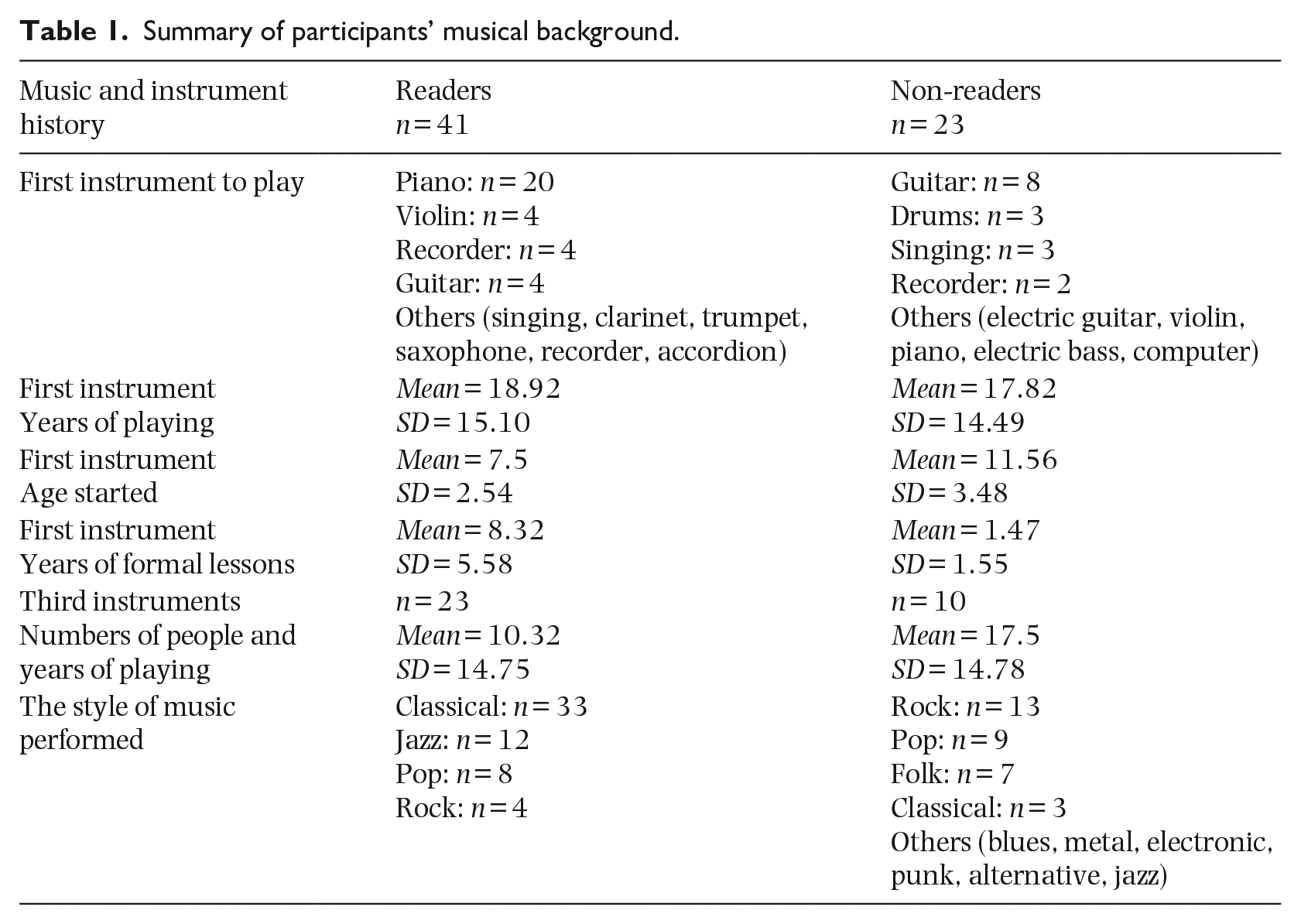
Participants’ musical backgrounds are summarized in Table 1. While the number of years of playing first instrument did not differ greatly between the two groups of participants, readers tended to have started playing younger and to have had longer formal lessons compared to non-readers. Also, readers preferred classical and jazz, while non-readers typically preferred popular music genres.
Summary of participants’ musical background.
Survey
The survey was in two sections. The first section asked participants for demographic information and about their musical background. The second section included 13 open-ended questions for readers about their experience of learning to read music, their ability to read music, their use of scores, and the significance of this ability for their musical activities. For non-readers, there were eight open-ended questions in the second section. The questions probed their reasons for not learning to read music; how they learn, transcribe, record, and analyze music without being able to read notation; and their thoughts on musicality and on not being able to read music. Generic wording was chosen for the questions to encourage free and descriptive responses. The second sections of the survey for readers and non-readers can be found in Appendices 1 and 2, respectively.
Analysis
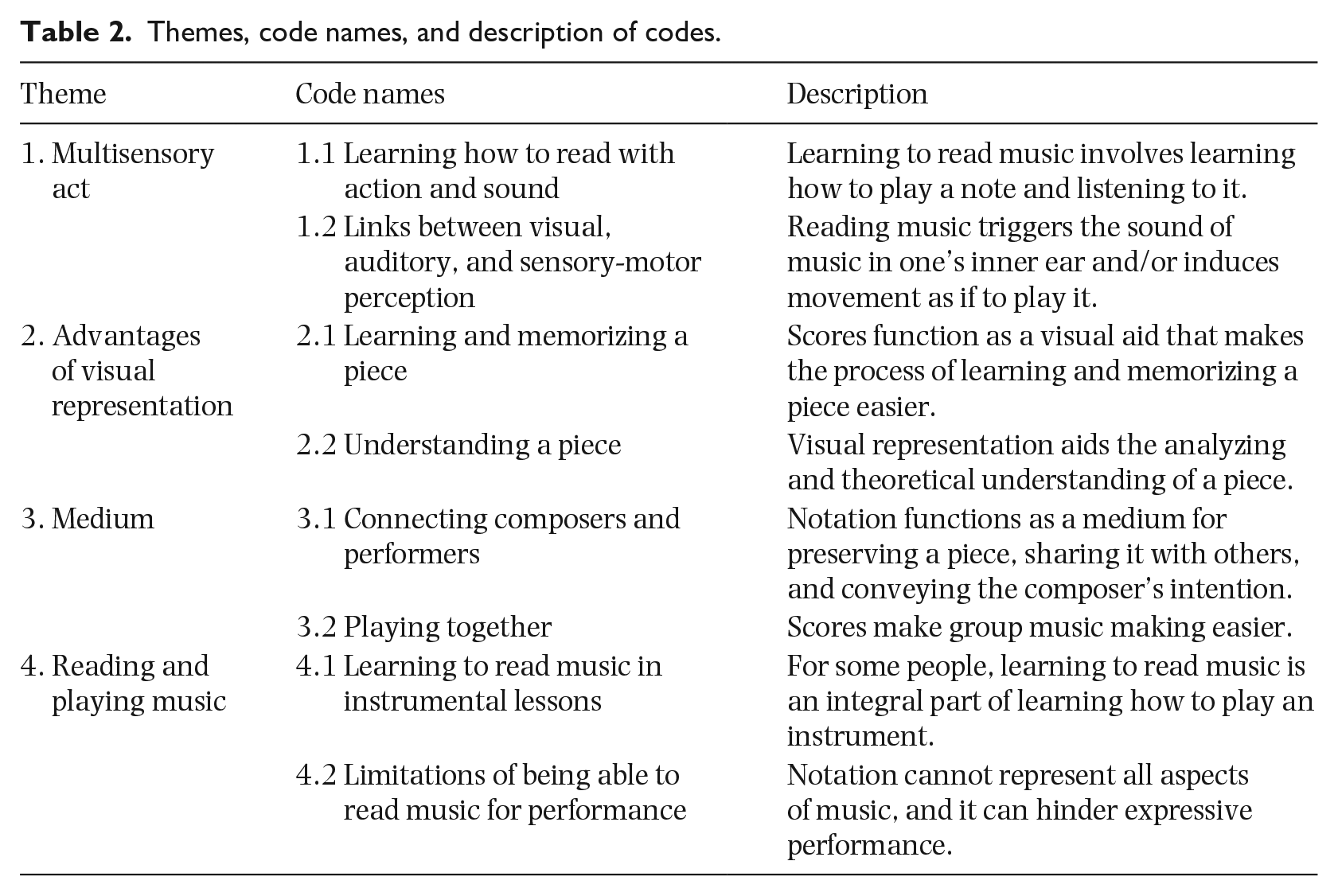
Data were analyzed inductively using thematic analysis with the assistance of NVivo 12 data management software (QSR International, Australia). Thematic analysis was the most appropriate method for the purposes of this study since it enabled the inductive, qualitative analysis of a rich dataset of people’s experiences and views (Braun & Clarke, 2006). This approach has been successfully implemented in previous studies on music making and music teaching (e.g., Cespedes-Guevara & Dibben, 2021; Schiavio et al., 2020). The analysis involved the following steps. The researchers began by reading the dataset several times to become familiar with it. Responses were placed into categories according to their similarity. Eight codes emerged from the categorization process, as can be seen in Table 2. In the next step, these eight codes were grouped, producing four themes based on the concepts underlying the codes: (1) Multisensory act, (2) Advantages of visual representation, (3) Medium, and (4) Reading and playing music. The themes were reviewed to check that all responses supported the themes to which they had been allocated. When the researchers’ allocations were inconsistent, notes were compared and discussed until a final consensus was reached.
Themes, code names, and description of codes.
Findings
Multisensory act
What emerged as a common experience from our participants’ descriptions is that the process (act) of reading music is often accompanied by different sensations such as hearing and movement. This theme, multisensory act, explores the multisensory nature of engagement with notation.
Learning how to read with action and sound
The multisensory nature of engagement with notation derives from the way in which people learn to read music, often during lessons in which they are learning to play an instrument. Learning to read music does not consist in merely memorizing the meaning of each symbol, but also learning about many other things, including each forte sound or vivace tempo, and how to produce them with the body, if singing, or instrument. This method enables the musician to connect visual symbols with sounds and the actions that are needed to produce them. The quotation below highlights the integration of learning to read music with the act of playing notes on an instrument: I started by learning note names and where they were on the stave, as well as how to play that note on my instrument. I gradually learned short pieces including only those notes and expanded my repertoire as I extended my range. (P31, 33 years old, flute, singing and piano, classical, folk, and jazz)
Links between visual, auditory, and sensory-motor perception
Singing and playing an instrument are by their nature multisensory and embodied experiences (e.g., Schiavio & Timmers, 2016), regardless of the musician’s ability to read music. Some non-readers described how they would practice a piece repeatedly until their fingers and bodies could play it automatically. Some of the readers’ responses to our survey made us aware that the skill of reading music adds to and deepens the individual’s multisensory and embodied experience of playing music. For example, many participants reported how when reading music silently, without producing any sound, they nonetheless hear music automatically and unconsciously in their mind. This phenomenon is known as notational audiation (Brodsky et al., 2008; Gordon, 1980), and is more likely to occur when a reader sees the score of a piece with which they are familiar or that they have already played.
Similarly, physical sensations of movement as if playing the piece can often occur when reading music silently. It seems that the sensation of imagined physical movement can become a spontaneous reaction to notation after long-term training and the practice of playing from a score. This was mentioned by some musicians: “the notation translates directly to finger placement in my mind. It is just as automatic as naming the note” (P31, 33 years old, flute, singing and piano, classical, folk, and jazz), or “I also find myself making fingering for the violin for what I am ‘hearing’ when reading music notation” (P37, 42 years old, violin and viola, classical and pop). These statements indicate that participants see notation not just as symbols on a sheet of paper or screen, but as something that triggers visual, auditory, and motor perception simultaneously.
Advantages of visual representation
This theme addresses the perceived benefits of the visual aspect of notation for both performance- and non-performance-related musical activities.
Learning and memorizing a piece
Readers reported that they use notation to learn a piece of music, and that it provides a quick, easy, and accurate way of extracting all the essential information about the piece (e.g., key, time signature, the notes that constitute melodies and chords, dynamics, tempo, and expression). Two of the most fundamental pieces of information to be extracted from notation are the pitch and duration of each note. Some participants commented that identifying pitch from the notation is easier than recognizing note duration and rhythmic patterns: “I can see how the music sounds by looking at whether the note is higher, the same, or lower than the previous note. I can see patterns and shapes and they translate easier in my head than rhythm” (P10, 26 years old, guitar, piano, and violin, classical and rock). It may be that consistent and simpler visualizations of pitch information allow for smoother processing. The pitch of a note is represented solely by its vertical position: higher or lower on the staff, whereas information on the duration of a note is represented graphically in more varied and complex ways, such as a black or white notehead, stem, tail, beam, and dot. Also, note pitch is absolute once the frequency of a reference note has been fixed (e.g., A = 440 Hz), whereas the duration of each note is relative and depends on the tempo of a piece, which differs according to the piece and can even change within it. It is also possible that the processing of pitch information influences the identification of rhythmic patterns and vice versa, since some empirical evidence suggests that information on pitch and note duration are processed jointly when reading music (Lee, 2013; see Schön & Besson, 2002 for contradictory findings). When it comes to the question of whether pitch or rhythm is easier to sing or play accurately from the score, it depends to some extent on the instrument (including voice) being used: “I don’t have to think about it [pitch] when playing piano, it is more difficult when singing” (P22, 32 years old, piano and guitar, classical).
By contrast, non-readers rely heavily on their aural skills, listening repeatedly to recordings, in particular, when learning a piece of music: “I learn almost entirely by ear . . . I play it over and over until I have committed it to memory” (P66, 64 years old, guitar and singing, folk, pop and classical). Indeed, Green (2002) describes how listening forms the foundation for learning in popular music. Non-readers also make use of technology, such as software (e.g., iReal Pro) that plays other instruments as an accompaniment while they practice, or presents chord charts while they are playing a song, and YouTube videos that offer tutorials on playing popular pieces of music. Learning from other performers in person is also a common method mentioned by our participants. As an aid to learning, non-readers sometimes use forms of visual reference besides staff notation, such as guitar tablature, chord names, “my own form and notes” (P65, 46 years old, singing, guitar and drum, rock, pop, and folk), and “word sheets and hand signals which I find an easy way to learn” (P66, 64 years old, guitar and singing, folk, pop, and classical).
Readers’ reliance on notation, compared with the range of methods used by non-readers for learning pieces, perhaps reflects the characteristics of different musical genres. For instance, readers mostly practice classical music, while non-readers perform in popular music genres. This would make sense, since it is more difficult to learn a piece of classical music by ear than a pop song, as classical pieces tend to be longer and more complicated. Moreover, the conventional belief and custom in classical music is that the performer must reproduce notated music accurately to convey the composer’s intention. By contrast, it is acceptable or even expected that cover versions of pop songs will depart from the original in any number of ways. In such cases, notation is simply less useful.
People use scores not only for learning but also for memorizing and recalling music. In addition to representing pitches, their durations and articulations, for example, the score provides instructions on how to play them (e.g., fingering, bowing). As such, it functions as a prompt when the musician forgets a particular phrase or how to play it, while memorizing a piece without any visual aid requires listening “lots and lots of times” (P42, 23 years old, drum and guitar, rock). Interestingly, some musicians memorize the score visually when learning a piece. This visual memory is then used to recall the music, as the following quotation demonstrates: “sometimes I imagine the written score when I am trying to remember it” (P22, 32 years old, piano and guitar, classical).
While being able to learn a piece from a score is not directly related to performance skills, some participants pointed out a secondary benefit: learning quickly from notation allows more time for focusing on and improving the expressive and artistic aspects of performance. As one musician said, “I am able to quickly pick up pieces and sight read them with the knowledge!! Being able to do the basics without thinking too hard allows me to make my performances more musical” (P4, 21 years old, trumpet and piano, classical and jazz). Indeed, a study by Bautista et al. (2009) found that less experienced music students focus on extracting basic information about a piece from the score, while those with more experience focus on the expressive and artistic aspects of performance. This supports the notion that proficient music reading skills allows for efficient use of time which, in turn, leads to greater musical achievement.
Understanding a piece
Another benefit of notation as a visual medium is the ease with which the structure of a piece can be analyzed and understood, since “notation helps [you] to find groupings, patterns and segmentations” (P23, 45 years old, piano, classical). People who can read music are instantly able to see how concurrent but different melody lines move, and go back and forward freely as they follow a particular line or chord sequence when attempting to gain a theoretical and analytical understanding of a piece. The importance of notation for comprehension is illustrated by a study by Stenberg and Cross (2019), which demonstrates that a well-designed visual representation of music enables musicians to process the information it is designed to convey and enhances their ability to perform it. Readers may find it easier to understand the elements and structure of a piece of music by looking at the notation than by listening to a recorded performance. As one musician stated, “I look into intervals and harmony by looking at the score, it would be much harder to get into details of it without visual notation” (P22, 32 years old, piano and guitar, classical). Reading music can be particularly useful when trying to understand the relationship between different instruments or voices in a piece.
I would look at my part (tenor) and try to understand how my part fits in (e.g., do I start on the tonic, dominant, etc.? Where do I have the melodic line? Am I singing in harmony or in unison with other parts? Are there any tricky intervals or unexpected notes . . .?) (P45, 40 years old, piano, guitar and singing, classical, rock and pop)
This quotation demonstrates how the visual aspect of notation makes it possible for this singer to grasp easily, and perhaps accurately, how the musical elements work with each other, which in turn helps prepare them for their singing. As the above statements imply, it would be more difficult and time-consuming to gain such theoretical and analytical understanding of a piece solely from listening. One non-reader stated, “I would have loved to . . . have a better understanding of jazz music and a lack of classic notation skill has hampered this” (P42, 23 years old, drum and guitar, rock). This statement supports Dean’s (2019) contention that it is difficult to develop a theoretical understanding without a knowledge of notation. A visual representation of music helps the reader to conceptualize and contextualize music that would otherwise be difficult to pin down.
Medium
This theme explores the function of notation as a medium for preserving and distributing pieces of music. It also examines its capacity to connect composers with performers, and performers with co-performers.
Connecting composers and performers
As has often been discussed, one of the most important functions of notation is to preserve a piece of music (e.g., Hodges & Nolker, 2011). For composers, it is a useful way to record their musical ideas accurately so that others can convey them later. One participant, for example, stated that without notation, “I wouldn’t be able to compose as precisely and share the nuances of particular rhythms and melodies with others” (P31, 30 years old, recorder, clarinet and piano, classical, jazz, and indie pop). Another participant stated that his ability to read music enables him to play “music that would otherwise not have survived today, if people did not have the ability to write it down in order to maintain the existence of the piece after their death” (P24, 29 years old, singing, piano and flute, classical). This echoes Fleet’s (2017) remark that notation “can be separated from the composer by both geography and time and yet the composer’s intentions can still be realized” (Fleet, 2017, p. 167).
Still, notation is not the only way of recording and preserving music. Some non-readers have used mobile phone or computer recording technology when composing and preserving pieces of music. In terms of preservation, recording technology is more effective and accurate than notation since it preserves the music itself in the form of sound including timbre, actual changes in dynamics and tempo, and articulation. Also, unlike notation, a recorded piece of music can be realized in the absence of a performer/mediator. Dahl (2009) points out that the development and spread of notation separated composers and performers in the Renaissance. By contrast, in the 21st century, the development of and ready access to sound technologies allows people to compose and perform at the same time and then to share their music with others. Consequently, sound technologies may blur the boundary between composers and performers, at least in some musical genres.
Playing together
Another important benefit of being able to read music is that it provides opportunities to make music with other people in an orchestra, choir, or band, for example. By reading the same score, performers can share and play the same piece of music together: “When you’re in an orchestra or band with a lot of people, it’s great to have sheet music because everyone can just sit down and play it” (P27, 27 years old, piano and saxophone, classical, pop and jazz). Proficiency in reading music—and, ideally, the ability to sight-read or sight-sing unfamiliar works—can be crucial for group music making, especially in classical music contexts such as choral or orchestral rehearsals, in which rehearsal time is often limited. It is common for individuals to be expected to perform unfamiliar pieces without stopping or making mistakes in these settings. As the following quotation asserts, “my ability to read music provides a framework for efficiently putting the parts of a piece of music together with other musicians” (P24, 29 years old, singing, piano and flute, classical). Furthermore, this potential benefit of group music making can provide a motive for learning to read music; one reader revealed that the reason they had learned to read music at the age of 10 was “to be able to perform with a large ensemble” (P32, 60 years old, clarinet, classical). Some non-readers opined that their inability to read music could prevent them from joining certain music groups such as jazz or session bands: “not being able to read music can make approaching new bands intimidating as I do not know if I’ll be able to play without reading” (P48, 40 years old, electric bass, trombone, popular music).
Moreover, some mentioned that notation helps to facilitate communication between performers who, by referring to a bar or page number in the score, can discuss a particular moment in a piece during rehearsals. Conversely, a non-reading drummer reported difficulty when performing a newly composed piece for a show. The piece was written only in staff notation and no recordings existed: “it was more challenging to keep up with the rest of the pit band when I didn’t have easy ways to communicate what part of a song we were in besides vocal cues” (P56, 28 years old, drums, guitar, rock, and alternative).
Reading and playing music
This theme explores the topic of whether and to what extent the ability to read music is integral to playing an instrument or singing. In particular, it examines the role of reading music when learning to play or sing, and how it may contribute to musical skills.
Learning to read music in instrumental lessons
Common to readers’ responses to the survey was the view that learning to read music was inseparable from learning to play an instrument in the context of private lessons. Several responses indicated that learning to read while learning to play was considered compulsory and that they had no choice in the matter. One participant stated explicitly that musical tuition and practice centers around notation and that, for some, being able to read music is necessary for playing it.
It was how I was taught to play piano by my teacher. Neither himself, nor myself, considered that there would be a more appropriate way for me to learn to play the piano than by learning to read staff notation. (P21, 26 years old, piano, guitar and drum, jazz and classical)
It is striking that some participants conflated being able to read music with being able to play an instrument, despite their being separate skills. Moreover, 31 of the 41 readers (75.61%) reported that they had started learning to read music between the ages of 4 and 8 when they began learning to play their instrument. This would suggest that some instrumental teachers, at least, perceive the skill of reading music to be integral to general musical proficiency.
In contrast, responses from non-readers revealed their belief that being able to read music is not integral to playing an instrument: “When playing guitar it is not strictly necessary to read music notation” (P57, 27 years old, electric guitar and singing, rock). Also, in contrast to readers, non-readers reported having had little or no formal tuition (as shown in Table 1) that might have included the teaching of notation. Furthermore, while the predominant genre for readers was classical, non-readers typically played in popular music genres. The contrasting views of the two groups of participants on the relationship between being able to read music and being able to play an instrument or sing are probably attributable to different practices in different musical genres.
Limitations of being able to read music for performance
Some participants reported that being able to read music is vital in that it helps them learn and perform. However, there are limits to the extent to which this skill contributes to their overall musical ability, particularly in relation to interpreting music and giving expressive performances. One participant noted that there are certain “nuances to performing and writing” (P10, 26 years old, guitar, piano, and violin, classical, and rock) that cannot be captured by notation. Similarly, Bamberger (2005) argues that, when music is represented visually, certain aspects are lost.
Notwithstanding the limitations of visual representation, the score provides the performer with detailed guidance as to how to play the music. If the performer sees the score as a series of instructions, however, they may place too much emphasis on realizing them accurately. Some participants said that they worried that notation can be too “restrictive” (P24, 29 years old, singing, piano and flute, classical); that it might hinder “musicality and musical expression” (P24, 29 years old, singing, piano and flute, classical); and that it might discourage “improvisation” (P31, 33 years old, flute, singing and piano, classical, folk, and jazz). For these and similar reasons, some reported trying not to depend too much on notation: “whenever possible I try to memorize my music, as disconnecting from the sheet music enhances my musicality” (P32, 60 years old, clarinet, classical). A non-reader claimed that not being able to read music “makes [performing] a free-flowing process rather than restricting it to presets. Especially in blues, where a lot of solos and guitar licks are improvisation” (P14, 21 years old, guitar, blues, and metal). The suggestion that scores cannot convey musical expression adequately and that reliance on them can hinder expressive performance highlight participants’ perceptions of the limitations of notation as a visual medium when music is an auditory signal. More importantly, they suggest that the ability to read music, despite being considered essential in the Western classical tradition (e.g., Gudmundsdottir, 2010a, 2010b; Sloboda, 1978), does not necessarily enhance the ability to make music or give an expressive performance. For example, I feel like musicality is partially an instinctive/innate feeling, so therefore my ability to read music may fail to contribute to my musicality. However, the ability to read music notation maybe allows for that musicality to be expressed/explained more easily to others, and it allows for the sharing/collaboration of music. The ability to read music notation however does not make someone inherently musical. (P5, 20 years old, cornet, singing and piano, classical)
This statement suggests that the skill of reading music is seen as a tool for making the possessor’s musical ability more visible and available to others, rather than automatically endowing them with enhanced musical abilities. It can help people engage in musical activities but it is not essential or sufficient for them to achieve a level of proficiency as musicians. The idea that musical ability is made visible by musical literacy is a reminder that music is above all a medium shared with others. Perhaps the most valued benefit of the ability to read music is that it helps people make music together, in groups.
Discussion and conclusion
This study sought the views of musicians, both readers and non-readers, on the ability to read music, and aimed to evaluate its significance for music making. Participants’ insights highlight several key aspects of this skill: first, that engagement with notation is perceived as a multisensory experience; second, that it is seen to function as a visual aid for learning, understanding, and playing music; third, that it is understood to serve as a medium connecting people who participate in music making. The study also revealed participants’ views on the limitations of notation as a visual medium: it cannot convey all the nuances of a musical performance and its prescriptive nature can hinder expressive performance.
Under the theme multisensory act, we explored how engagement with notation is perceived as a multisensory experience in both learning and reading. Being able to link visual, sensorimotor, and auditory information is crucial for mastering the skill of reading music (Mills & McPherson, 2006). Many of our participants reported learning how to read scores, carry out the actions required to play them on their instrument, and hear the results simultaneously. This parallels the findings from experimental studies showing that learning with action is effective for memorizing music (Schiavio & Timmers, 2016) and giving accurate performances (Stewart et al., 2003). The multisensory nature of the experience of engaging with notation was also revealed by participants’ reports that, years after acquiring the skill of being able to read music, the act of score reading evokes sounds in their mind’s ear or sensations of bodily movement. This corroborates the findings of neuroimaging studies showing that reading music activates areas of the brain that typically process sound, suggesting multisensory links between seeing and hearing (e.g., Nakada et al., 1998; Schürmann et al., 2002). As non-readers commented, singing and playing instruments are in themselves multisensory experiences. Furthermore, the multisensory nature of our engagement with notation helps us understand the extent to which it contributes to our experience of musical production and perception.
Other findings from this study also show how being able to read music shapes our musical experience. As reported in the code Understanding a piece, notation enables readers to see and easily comprehend the details of a piece by revealing visual patterns, groupings, and how its elements relate to each other. This echoes Bamberger (2005), whose study of children who were asked to organize and play a tune on bells of different pitches revealed that knowing how to read music shapes the development of an internal hierarchical structure of tones. Notation provides signposts within a framework for music readers to understand what might otherwise be an obscure and ambiguous series of sounds. The skill of reading music thus provides its possessor with eyes to see music, and a whole new medium through which to experience it.
Some participants commented on the usefulness of notation as a medium to preserve and distribute their works, and for accessing the works of others. The skill of reading music provides access to any piece of music using a common form of notation, and is not restricted by time and space (Bamberger, 2005; Fleet, 2017). For example, the use of notation has made it possible to revive forgotten pieces of music (e.g., Felix Mendelssohn’s revival of J.S. Bach’s St Matthew Passion in 1829). However, in the 21st century, notation is no longer the only medium used to preserve and distribute music. Many of our non-readers described recording musical ideas or pieces on their phones or computers; sound technologies may make or have already made notation less important for our musical activities.
Notwithstanding the perceived advantages of notation, it is not without its flaws. Bamberger (2005) argues that the transformation of an event into a representation inevitably involves the loss of some aspects of that event, and that the representation is therefore incomplete. Some participants’ comments echoed the view that not all elements of music can be notated, particularly those subtle nuances that help to make a performance more expressive. For this reason, musicians try to apply their own interpretations and explore different ways of performing a piece when learning from a score (Bautista et al., 2009; Hultberg, 2002). So, while the impossibility of notating all aspects of a piece of music may seem to be a disadvantage, it does in fact enable a rich and potentially unlimited variety of performances to be given.
One of the major motivations for learning to play an instrument or sing is to make music with other people. Group music making is a source of pleasure, sense of belonging, and social interaction; it also allows us to extend our repertoire, improve our technique, and take on the challenge of difficult pieces that we cannot play on our own (Pitts, 2005), thereby enriching our musical experience. Our data highlighted the view that being able to read music makes it easier to participate in group music making, for example, by enhancing communication between members of the group.
Some participants saw learning to read music as integral to learning to play an instrument. Readers may achieve more in the course of their musical endeavors than they would if they did not read music, for example, when learning a long and complicated piece that would be too difficult to learn by ear. They may thus acquire more advanced skills and a wider musical repertoire. Also, as reported in the code Learning and memorizing a piece, readers may be able to learn pieces more quickly and accurately, reducing the time needed for practicing and rehearsing. Although being able to read music is not a prerequisite for playing an instrument, it may be valued because it is seen as a skill that can increase achievement, efficiency when learning, and musical understanding and performance.
In summary, this study demonstrates that notation is perceived as a medium for engaging with music that can be useful in both performance and non-performance contexts, enabling group music making and effective communication with other musicians. While being able to read music does not necessarily help musicians give expressive performances, as evidenced by some of our participants arguing that it can hinder free expression and improvisation, we would argue that it is a tool that enhances musical experiences and activities. Although learning to read music is not always easy—it can take years, and its benefits may only become evident in the long term—it is a skill well worth acquiring, according to the readers in our sample of participants. The time and effort spent on its acquisition are outweighed by the benefits it confers. Music making is a lifelong pursuit for many people, and the skill of reading music is one that is typically retained over the course of their lives.
This is the first study of the significance of reading music for making music, and its advantages and disadvantages. In this article we have elucidated the functions of notation and examined the benefits of being able to read music for teaching and learning music, and for music education more generally. However, this study is not without its limitations. First, we surveyed considerably more readers than non-readers. The latter should be recruited as participants in future research to report a greater variety of musical experiences. Second, we did not consider participants’ preferred genres of music in our analysis because we believed—correctly, according to the majority of our participants—that musicians typically enjoy playing in a variety of genres, and that the musical skills gained in one genre are transferable to others. Nevertheless, the degree of importance placed on notation does vary according to genre (see Green, 2002), so this should be considered in future research. It would also be worth examining the effects of teaching setting (e.g., schools vs private lessons, as the latter are not accessible to everyone), teaching method, instrument played, learner’s age, and the spread of sound technologies on learning to read music and using scores. Such investigations would provide a better understanding of the contributions of notation to musical life and ability, and how these have changed and are continuing to change.
Footnotes
Appendix 1
Appendix 2
Acknowledgements
We would like to express our gratitude to two anonymous reviewers for their helpful comments and suggestions, and to the editor for her support. Our colleagues and friends helped us in distributing the survey, which we greatly appreciate: Andy Arthurs, Jane Arthurs, Jonathan Simmons, Renee Timmers, Lindsay Udall, and Tom Worley. We also wish to thank our participants for sharing with us their opinions and experiences.
Funding
The authors received no financial support for the research, authorship, and/or publication of this article.
