




Abstract
This article sets out the case that there is a conflation of personal and situational liminality in the music industry. The response to this needs to include greater dynamism and development both of musical identities and innovations in the production and business of music. However, the confluence of liminalities produces vulnerabilities and precarities which militate against learning and innovation and lean toward stasis. I offer an alternative way forward, which adopts a different conceptualization of vulnerability and discusses how a situated learning approach can be used to develop socially enabled resilience.
The situation of musicians and musical practices can be regarded as being an exemplar of longitudinal, excessive liminality. The level of dynamism, fluidity, and, in some cases, turmoil experienced by musicians has meant that very few things have remained stable, and identities and structures have been thrown into flux. While change can be welcome, there has been increasing precarity in the music industry, and this is reflected in challenges to the careers and identities of musicians, industry practitioners, and students. Liminality occurs simultaneously in the situation and for individuals. Consequently, change can be experienced as occurring without a destination, and periods of flux lack resolution. A key question, therefore, is how can people in the music industry best be enabled to cope with perpetual liminality?
Liminality is the state of becoming when a person is between two forms of identity (Turner, 1967). It is an experience of being outside normal social and identity structures and often includes contradictions that are traditionally managed through social rituals (Beech, 2011). For example, transitions from adolescence to adulthood can involve the person undergoing a liminal identity change (the liminar), whereby they are separated from society, and undergo ritualized preparation for re-entry in their new identity. This period of separation normally involves mentors and supporters as helpers during the transition, and the outcome is often recognized by society ceremonially, as the adult person is acknowledged to have new rights and responsibilities, and is expected to conform to certain adult norms.
In Western societies, liminal identity changes from being single to being married have been ritualized through publicly announced engagements, hen and stag parties/holidays, and ceremonial speech acts in which two people are pronounced married by a person deemed to have the relevant authority. This traditional view of liminality has personal and social functions. The period of difference and uncertainty (the person is not single but not yet married) is circumscribed: it has a beginning and an end. There is an established process for going through the uncertain period of being betwixt and between (Turner, 1967) the two identity states, and there is resolution as the liminar takes on their new identity and is adopted into a socially recognized position. As a result, the emotions associated with the change, both positive and negative, are supported and managed, and the person continues in established social structures in a new or adapted identity. Both the person and the society have a coherent identity narrative that includes change in a predictable and accepted way.
Personal liminality can be defined as the individual’s direct experience of discontinuity and disjuncture. Situational liminality can be defined as the disruption of institutions, social and work structures, and unresolved disturbances in established ways of being. I will argue that musicians and the music industry are in both personal and situational liminality, and that this poses significant challenges of precarity. At the intersection between the two forms of liminality is an increased vulnerability, and the danger of this is that, just when greater innovation and resilience are needed, the anxieties associated with vulnerability militate against positive action: that is, there is a natural move toward stasis. The proposition I make is that it is possible to reconceive vulnerability as a source of learning and, by adopting a situated learning, community-of-practice approach, it is possible to develop a socially supported form of resilience that can enable agency.
The article is structured as follows: I set out the arguments for seeing the music industry as situationally liminal and those working in it as commonly undergoing personal liminality. I argue that this presents significant challenges and then set out an approach to vulnerability and developing resources for learning and social resilience that offers a way of meeting the challenges. I close with some practical implications.
Situational liminality
Situational liminality in the music industry is not new. There has long been precarity in careers, particularly for freelancers, and business models for recording, distribution, and performance have changed almost beyond recognition in the last two decades (Beech et al., 2016), but this change has accelerated during the pandemic. Breakwell and Jaspal (2022) explored the identity and well-being of musicians during the COVID-19 pandemic. Many performances and tours were canceled or postponed, venues and festivals closed such that there was a significant loss of practice and income (Crosby & McKenzie, 2021), and consequently “many musical artists felt compelled to withdraw from the music industry amid the great uncertainty they faced” (Breakwell & Jaspal, 2022, this volume). Furthermore, Breakwell and Jaspal note that a very high proportion of music professionals have reported loneliness, anxiety, and financial hardship during the pandemic (Spiro et al., 2021).
Allan et al. (2021) argue that converging forces have increased precarity in work generally, and this is true in particular for musicians and those employed in the music industry. As López-Íñiguez et al. (2022) point out, “precarious and nonlinear careers . . . characterize music work” (this volume). Allan et al. (2021) argue that these converging forces are producing three types of precarity: precarity of work, in which there is uncertainty about the continuity of work; precarity at work, in which people may face unsafe conditions or sociopsychological harms from discrimination and harassment; and precarity from work, in which there is uncertainty because people hold jobs that may not meet their basic needs. Although Breakwell and Jaspal use a different analytical framework, the first and third types of precarity types are discernible in the cases they present, and previous research (e.g., Beech et al., 2016) has shown the potential for unbalanced and discriminatory precarity in musical work settings such as pop and indie bands, with their gendered roles.
In addition, music education is in a challenged and challenging position. As Angel-Alvarado et al. (2022) show in their analysis of music education in Chile, the principal common factor across four geographical zones is the undervaluing of music education in the school system, with budgets and learning times being reduced and a lack of musical instruments and students, influenced by parents and schools that are focusing on other subjects. Similarly, in Europe, there are pressures which have a negative impact on music education. For example, in the United Kingdom, school-level music education has been declining. As the Incorporated Society of Musicians notes (ISM, 2021), exam entries at Advanced Level fell by 44% between 2011 and 2021, and music entries for the General Certificate of Secondary Education (GCSE) have fallen by 19% since 2011. In Finland, too, the status of music as an important subject in the school curriculum in relation to children’s growth and development has declined in recent years (Juntunen, 2017).
Situational liminality in the context of music work has thus multiplied and intensified. Long-standing precarity is associated with many careers and business models, and the more recent turmoil created by the pandemic. As a consequence, the majority of players and participants in the music industry are operating in circumstances that are always unsettled and unsettling. Liminality, as traditionally conceived, comes to a point of conclusion when a more stable identity is established within a known social context, but those working in the music industry now face perpetual and unresolved situational liminality. These disruptions have an impact on both opportunities to practice and the sociopsychological well-being of players and other participants. This impact has the potential to form a vicious cycle in which it is hard to innovate, and so new limitations to old business models form barriers to growth and development of individuals, practices, and industries.
Personal liminality
In addition to the situational liminality of the music industry and education, musicians and industry practitioners also face more and lengthier experiences of liminality. MacDonald and Saarikallio (2022, this volume), drawing on a very considerable body of research (e.g., MacDonald et al., 2002, 2017), propose a framework for understanding musical identities: Musical Identities in Action (MIIA). They frame their theoretical framework within a social context based on the idea of mess (Law, 2004), which emphasizes the psycho-social complexity and constant change of the experience of everyday life. This messy, dynamic complexity is not regarded as reducible to simple or consistent social structures or institutions. Rather, MacDonald and Saarikallio reject simple binaries and essentialist views of identity in favor of a dynamic and interactive conceptualization of identity that is lived out in an equally dynamic and interactive social setting. Instead of holding the traditional view of identity as the characteristics of the person that are consistent in different circumstances and over time, MacDonald and Saarikallio (2022) see identity as dynamic, embodied, and situated.
Identity is dynamic because it is interactive, or dialogical, and performed actively. This part of MacDonald and Saarikallio’s (2022) conceptualization fits well with theories of identity drawn more broadly in social science (see, for example, Brown, 2021) where identity is not regarded as inherent and immutable, but consists of a process of forming and refining through dialogues, some of which are externalized and relate to encounters with others that influence the self, and some of which are internalized and relate to utterances and concepts that repeatedly play through the scripts of the self that are rehearsed in an inner dialogue (Beech, 2008). Identity dialogues, whether conducted with the self or with others, are enacted in a social context and, as López-Íñiguez et al. (2022) put it, “making music is mainly a social activity—something we do with and for others” (this volume).
Musical identities are also embodied insofar as making music is a physical act. Becoming proficient or expert in playing a musical instrument or singing often requires physical changes in the body such as muscle development, and listening is similarly physical. In addition, making or listening to music can be an embodied emotional experience including nervousness, excitement, contemplation, and shared (or communicated) emotions related to togetherness or, sometimes, opposition. The role and impact of emotions are highlighted in Burland et al.’s (2022) development of the Musical Identity Measure (MIM: this volume), and they are clearly significant in framing and motivating decisions that people take when they identify with social groups, for example, which is not merely a cognitive process but is emotionally motivated, or when they produce performances that inspire others.
For MacDonald and Saarikallio, MIIA are also situated in that they emerge in and from social contexts, cultural settings that influence a range of possible expressions of identity and modes of group membership. This situatedness of musical identities also relates to technologies that interact with social contexts; for example, technologies for music making can vary enormously in price, so their effective availability relates to individuals’ and societies’ levels of affluence, among other factors. These foci on interactive dynamics, embodiment, and situated socio-materiality/technologies resonate with some learning theories, particularly those underlying transformational (Illeris, 2014) and situated learning (Lave & Wenger, 1991), and I will return to these conceptual links later.
MacDonald and Saarikallio’s (2022) conceptualization of MIIA produces a liminal vision of identity, one in which there is no simple destination at the end of change, but an experience in which there is perpetual change. In some circumstances, perpetual change can be positive and joyous, but in other circumstances, and for some people, it can be self-diminishing, anxiety-provoking, and part of a negative experience of precarity (Beech, 2017). This can be related to the level of vulnerability experienced by the individual while in a liminal position. While López-Íñiguez et al. (2022) do not explicitly refer to vulnerability, it can clearly be seen in their data and analysis. As one of their respondents remarks, “I’m always scared about the techniques and technical stuff on the cello . . . I always feel a bit bad or a bit weak among these people.” Others talk of a lack of resilience and of low self-confidence and self-efficacy. Here, and elsewhere in their data, López-Íñiguez et al. show musicians’ experience of vulnerability as a gap, something that they feel they should know or be able to do but cannot, or a gap between their self-judged abilities (typically defined as musical abilities rather than broader skills) and the skill level they perceive in others or in an idealized version of the self. The perceived (and felt) gaps, which carry identity and emotive power, can have a stultifying effect and act as a barrier to learning and development. As the respondent quoted above says, “I don’t think too much about learning;” or, as another puts it, “I know I have a will to learn new things, but I don’t always have a great trust in my abilities.” Burland et al. (2022) see learning and a growth mindset as centrally important in enabling greater psychological well-being and more effective career choices. Similarly, MacDonald and Saarikallio build an argument for a more inclusive form of music education incorporating more than musical, technical education, and taking in interactive, social, and business skills.
However, there is a significant problem: the very causes of a greater need for transformational and innovative learning are themselves major barriers to such learning. The increased situational and personal liminality that creates a need for a learning orientation to personal and practice-wide innovation also increases precarity, anxiety, and perceived vulnerability, all of which have a negative impact on learning. As Hashempour and Mehrad (2014) have argued, among others, learners with higher levels of academic anxiety tend to overstate the importance of the situation and understate their ability to cope, often militating against optimal cognitive processing and memory performance. People who have self-perceived and felt gaps in their abilities, anxieties about their abilities, and the precarities of work and the socioeconomic setting, are less likely to be in a good psycho-social position for significant or transformational learning (Illeris, 2014).
Toward an alternative view of vulnerability and resource-building for thriving learning
I have argued that, from an identity perspective, we have arrived at a paradoxical situation. The context of musical work and performance is messy (Law, 2004; MacDonald & Saarikallio, 2022) and perpetually unfinished (Breakwell & Jaspal, 2022). Similarly, the identities of music professionals (Burland et al., 2022; López-Íñiguez et al., 2022) and students (Angel-Alvarado et al., 2022, this volume) have been disrupted to the extent that a sense of settled state appears unlikely to arrive in the short term, if ever. A key question, therefore, is how people in the music industry can best be enabled to cope with perpetual liminality, both situational and personal. The answer to this cannot be to do more of the same, but rather to innovate practice, and this requires learning that is not confined to the musical and the technical. This learning needs to enable people to be different in a new context and is what Ligorio (2010) calls transformational learning.
For Ligorio, transformational learning entails both content learning, in our case the theoretical and technical learning of music, and also what he terms “innovation of the self” (p. 96). Innovation of the self is foundational for practice change and innovation more widely. Ligorio (2010) envisages three modes of learning that can produce innovation of the self: when a person moves to a new position; when a position moves from background to foreground; and when two or more positions are combined. This type of learning typically takes learners (and teachers) outside the normal constraint and enablement of curriculum, classroom/studio, and typical student-teacher roles. It can include a student moving from a position of performer to one of music director or band leader, for example, or foregrounding technological production in a performance such that they (and the way they are evaluated) move from musical technique to use of technology to enable a performance, or a combination of roles, for example, as promoter and critic.
This pedagogical orientation builds on student centredness and involves learning by imagining, enacting, and also through teaching others (Fiorella & Mayer, 2016). Its experiential nature means that learning is dynamic, embodied, and situated. But it also means that both students and teachers are pushed outside their comfort zones into learning spaces where no one has full expertise, emotions are part of the mix, and different sorts of evaluation are required because, while a student may be very advanced in music performance, they may be far less so in the use of technology, for example, or the dilemmas of marketing.
In their study of musicians’ careers and identities, Bennett and Hennekam (2018) found that expert–inexpert paradoxes are experienced by musicians throughout their careers. Tracing 108 case studies of musicians, Bennett and Hennekam show how an early-career focus on performance is followed by 80% of mid-career musicians changing their career goals at least once, and later-stage musicians deploying an even wider range of skills to remain active in their careers. These skills include entrepreneurship, organizing, and networking, the very skills on which they had put less value on when they were musicians in training. At the mid and later career stages, musicians were reacting both to the positive learning that enabled them to build up networks, for example, and also the painful experiences that influenced them to reconceive their careers and identity. As one participant put it, “I’m unable to get used to the negative feedback and rejection during auditions . . . it does influence how I see myself” (p.116). In a context in which “recruiters seem to believe creativity declines with age” (p.119), the response was that existing competencies could be used in different and more entrepreneurial ways. Thus, in selecting goals, optimizing effort and resources, and compensating for the context, musicians were consistently liminal and in the process of transforming themselves. Learning entailed foregrounding skills and abilities that had previously been in the background and, at times, less valued in the self, and coming to see the self in a new way, for example, as a hybrid performer-teacher or performer-entrepreneur.
Although this innovation-of-the-self style of learning (Ligorio, 2010) may help equip people with more fluid identities, a different range of skills, and more informed ways of working across the boundaries of music production, performance, distribution, and consumption, it can also increase vulnerability as the person seeks to learn and act outside their current competencies, and potentially across role and industry structures which, it has been argued, are increasingly precarious (Allan et al., 2021). This can be problematic because vulnerability, and the anxiety associated with it, can militate against the learning of even basic content, let alone adventurous innovation of the self. In a study of vulnerability in experiential learning, Corlett et al. (2019) found that typical responses to the exposure of perceived vulnerabilities include disguising and deprioritizing vulnerable areas by redirecting attention toward areas of perceived competence. The result is a lack of learning and consequent stasis. This provokes questions as to how vulnerability might be acknowledged, rather than hidden, in the learning process, and how we might approach the development of more inclusive learning identities that could enable us to learn in liminal situations (see Figure 1).
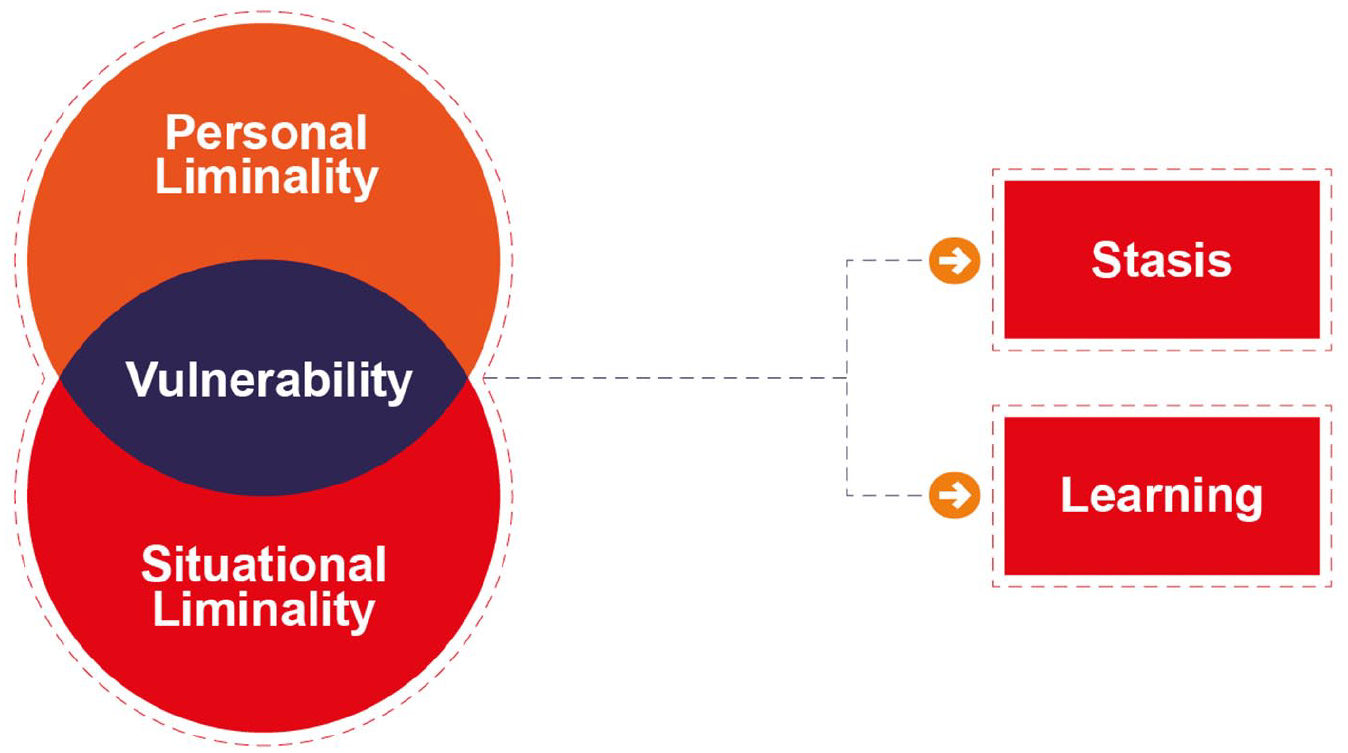
Acknowledging the role of vulnerability in creating the context for either stasis or learning.
One way to answer these questions is to reframe the way in which vulnerability is commonly conceived, and Corlett et al. (2019) do this by developing the ideas of Judith Butler (2003, 2004). For Butler, the general state of vulnerability in which we live as human beings might offer an opportunity to develop a different politics. This is because, for Butler, we are fundamentally interdependent, and our vulnerabilities produce not only the risks of harm or loss but also opportunities for connection. For Corlett et al., in the right kind of social context, expressing vulnerability can enable people to relate to each other with greater understanding, and this can lead to transformative innovations of the self as the person explores aspects of the self that may typically remain private. Vulnerability can surface and cut through defensiveness, and acknowledging our own and others’ vulnerabilities can be “one of the most important resources” available to us for making connections (Butler, 2003, p. 19). This can provide an alternative to defensive identity work (Ybema et al., 2009) in which vulnerabilities are avoided and disguised. However, as Corlett et al. say, acknowledging vulnerability needs a social environment in which there is trust and support. For them, such environments include safe boundaries, supportive peers and/or mentors, and a leadership culture that supports learning through vulnerability.
The requirement for this kind of social environmental is discernible in studies of both liminality and situated learning. In liminal situations, the liminar is traditionally recognized as undergoing significant change, equivalent to Ligorio’s (2010) concept of learning as innovating the self. In order to move through the transitional period, the liminar is supported by peers and mentors, and follows a set of processes that have helped others through transitions. In situated learning (Lave & Wenger, 1991), the key dynamic of learning is legitimate peripheral participation through which the learner comes to understand and enact the practices of a specific community of practice. This process is fundamentally social and includes learning through observation, instruction, support, and experimentation, the last being the most important.
Situated learning and practice are not separate but entwined and consist of more than learning by doing. Rather, practice involves whole-person learning, understanding the techniques and technologies as well as the social structures and identities that underpin and are expressed through practice. The community is composed of those who acknowledge each other as being part of the practicing community and, as learners, gain the technical and social skills they identify, and that are identified, with the community. Situated learning theory has been applied to a variety of musical settings from classical orchestras (Gaunt & Dobson, 2014) to heavy metal (Snell & Hodgetts, 2007). An aspect of situated learning that is particularly relevant here is its bi-modal influence. Learners do not simply absorb and conform to the technical and social rules of the community; they also influence the nature and shape of those rules. Members of the community introduce deliberate or inadvertent variations in practice, improvise new solutions to old problems, and encounter new problems; thus, dynamism is built into the whole community. Hence, learning and identifying are not processes of equipping an individual with the right skills so that they can fit into a preordained social structure. Rather, as people learn, experiment, and adjust, they influence those around them, and they form part of the peer and mentor context of others. It follows that growing and developing communities of practice is an important way of building resources on which people can draw when coping or even thriving in multiple and perpetual liminal situations (see Figure 2).
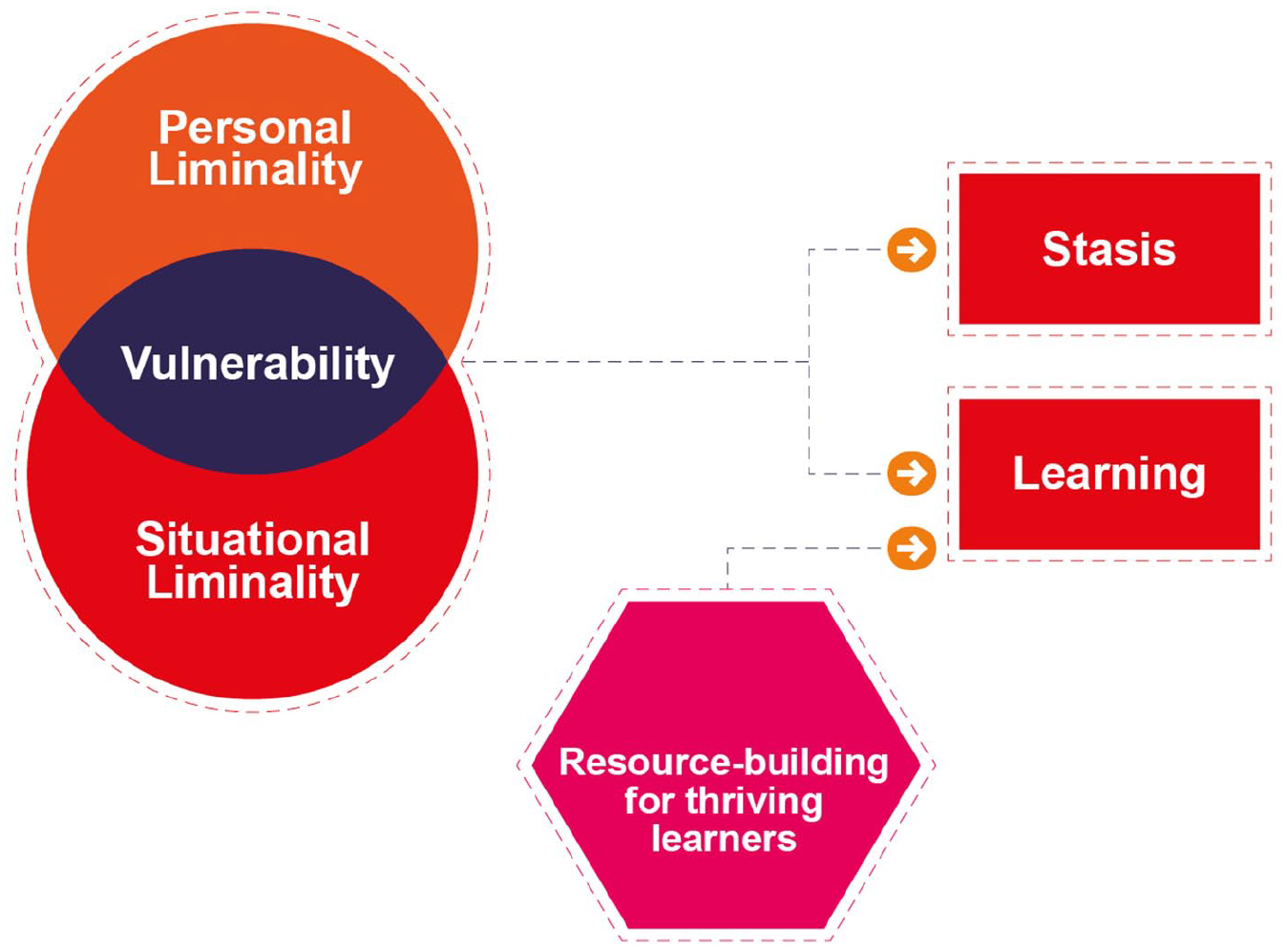
Adding social and personal resources to enable learning.
My proposal is that a learning orientation should be at the heart of how musicians, music students, and people in general can cope better with perpetual liminality, both situational and personal. While this includes traditional forms of education, I suggest that this is an incomplete solution in that, as López-Íñiguez et al. (2022) and MacDonald and Saarikallio (2022) point out, while formal education has developed a track record in enhancing technical practice and cognitive skills, it is generally less focused on the ongoing development of situated identity or production of transformative learning (Illeris, 2014; Ligorio, 2010). To a certain extent, renewed interest in lifelong learning presents opportunities for this to change, but it is the practice-oriented, in situ learning central to situated learning (Lave & Wenger, 1991), that has the potential, in addition to formal educational settings, to be a continuous support for the challenges of precarity and the struggles associated with perpetual liminality. Academics are well equipped to facilitate and support such learning in their engagement beyond their traditional education and research roles, and there are opportunities in processes such as mentoring, reverse mentoring, coaching, and peer group learning.
I asked above how vulnerability might be acknowledged in the learning process, and how we might approach the development of more inclusive learning identities that could enable us to learn in liminal situations. To answer these questions explicitly, it is possible in situated learning settings to acknowledge vulnerability and use it, as Corlett et al. (2019) suggest, as an input and a stimulation for learning. This relies on trust, and the shared experiences built by the community over time, in which leaders need to act as role models. The development of more inclusive learning identities needs not only a particular form of social context but also a mindset that accepts liminality and incompleteness, and supports people in working through their experiences (Hibbert et al., 2016). The emphasis here is on social rather than individual learning, assuming a dynamism of both identities and the situation. Situated learning is not based on a deterministic theory in which the situation defines the skills that are needed, and individuals are simply subject to its demands. It is not about finding the best fit between an identity and a career opportunity (as if those were stable entities), but is rather about using learning resources to find flexibility in both identity and the situation. The application of an approach to improvisation (MacDonald, 2022) that uses existing frameworks and patterns in new formulations is an orientation that would support situated learning for liminal contexts. In the next section I will present some of the implications of this orientation as an illustration of how learning developed in communities-of-practice (Lave & Wenger, 1991) might be applied. It is not intended to be a definitive list but is offered as an invitation to others to add and adapt further examples.
Conclusion: Implications for a community approach to resilience
Resilience is often thought of as a personal quality, and Jackson et al. (2007) encapsulate this well. Writing about a different context, but one in which individuals can experience considerable adversity, they say: “Resilience is the ability of an individual to positively adjust to adversity . . . nurses can actively participate in the development and strengthening of their own personal resilience to reduce their vulnerability to workplace” (p. 1). They suggest that nurses can learn how to maintain positivity, gain emotional insight, increase reflection, and nurture professional relationships. They go on to argue that resilience building should be incorporated into nursing education and continuous professional development. While resilience can be personal, learning is seen, from a situated and transformational learning position, as essentially social, and so from this perspective I present some suggestions as to what we might do in education, and also in communities of practice, for example, in peer group discussions, mentoring, and coaching:
Replace meager, projected identities that permit others to be stereotyped and objectified. The concept of the other is complex and dynamic, and knowing this helps us enquire into how they are being and why, rather than casting them in over-simplified ways such as competitor, opponent, or hero, all of which make learning more difficult and increase the potential for precarity at work. Accepting that the other is also in a liminal situation invites thinking about how they might change (and learn), rather than assuming they have a fixed identity. This, in turn, invites thinking about how one might interact with the other to support the change or development that one would like to see.
As boundaries and transitions in work and career structures become less determinate, disjunctions proliferate, and passages of liminality are less likely to lead to resolution, we should accept this as reality and acknowledge that sometimes our deeply held assumptions, or what we might recast as our preferences, will be thwarted. This is part of learning to live with liminality. We need to develop in ourselves and in each other the flexibility of understanding to help deal with the distress of having our preferences thwarted. Such distress may be disguised as rational argument, or sometimes anger, but it can be helpful to recognize that it is a normal emotional response to thwarting. Applying flexible thinking can help to generate alternative second choices that are grounded in how things are, not in how they “ought” to be. This might include foregrounding options that were previously in the background or developing new options that are more adaptive.
Empower others by demystifying success and failure. It is quite normal for people to recount their stories of success and failure, but often in a way that avoids vulnerability and decomplexifies causation. Especially in liminal situations, and from a situated learning perspective, agency is often distributed and incomplete. Traditional narratives that attribute agency to the self in successes and to the social context or oppositional others in failure tend to gloss over the helpful learning for others who are in the midst of their own challenges. It is helpful for people joining a community of practice to hear from established members of their own struggles and the episodes that get edited out of CVs and biographies (which naturally list successes).
Empower the self by asking for help. It is remarkable how responsive people often are to direct and clear requests for help. When we are in difficult circumstances, displaying a little of our challenges, and asking others for advice or support that is within their power to give, enables them to play a generative role in the community and for this to be part of their identity.
To quote John Lennon (1971), “you may say I’m a dreamer,” but versions and snippets of these practices occur regularly in what Goffman (1980) calls the backstage region. When community members are not in front-stage performance mode with an audience, informal mentoring, peer support, and dialogic sharing are part of how we bond in communities of practice. One of Ligorio’s (2010) modes of innovating the self is to bring a role that was in the background to the fore. This thinking might also apply to a community. It is possible for us to talk about messy realities, complex identities, unresolved liminalities, and our vulnerabilities, particularly if established members model these behaviors, and there is strong reception and support within the community for times when others can speak. This form of engaging can help people in situations of liminality focus on the possible, sometimes invent new versions of the possible, and take action because of their learning, rather than end up in stasis because they have become overwhelmed by complexity, incompleteness, and the anxiety associated with vulnerability.
Postscript
My proposal is open to certain criticisms, and I want to address two briefly. First, the situated learning orientation may be criticized for leaving open the possibilities for precarity and even exploitation to continue. This is true to an extent, and while effective communities of practice can militate against precarity and exploitation, the purpose of my proposal is to highlight the possibility for a social learning orientation to help people cope with perpetual liminality rather than remove it. Second, a developmental learning approach is sometimes criticized as lacking focus on business outcomes; particularly, in times of economic hardship, it can be regarded as a luxury rather than a necessity. When contemplating such criticisms, it is worth being aware that research accumulated over more than a quarter of a century has shown the value of a learning orientation in enhancing business performance generally (e.g., Salin & Notelaers, 2020; Tregaskis et al., 2012). In their initial education, at conservatoires, and through lifelong learning (Smilde, 2009), musicians, who often have disjointed careers (Bennett & Hennekam, 2018) and what Smilde calls postmodern lives, need to develop a range of technical, artistic, teaching, and leadership skills, among others, together with the tacit knowledge of artistry and critical reflexivity.
