




Abstract
Scholarship on prison music-making projects and programmes to date has largely overlooked the perspectives of prison music facilitators, who form an integral part of many prison music activities. The aim of the study, which was exploratory in nature, was to contribute to a better understanding overall of the relationship between music and imprisonment by focusing on the perspectives of prison music practitioners. Drawing from data collected in four Norwegian prisons through ethnographic research, data was analysed thematically with four key themes emerging: interpersonal communication and emotional connection; social responsibility; prison system and environment, and (in)difference and exclusion. The findings highlight the fact that the range of prison music activities offered in many Norwegian prisons affects music facilitators deeply in a number of ways, and support existing studies that find that prison music practices can contribute to creating a community of caring individuals both inside and outside prisons. Notably, the emergence of the (in)difference and exclusion theme demonstrates a more critical and nuanced view of prison music facilitators’ experiences as going beyond simplistic, romantic notions of music’s function in social transformation. Concerns raised for those who appear to be excluded or differentiated from music-making opportunities in prison – in particular foreign nationals and women – suggest that (even) in the Norwegian context, music in prisons remains a “reward” rather than a fundamental “right.” This study marks a step towards a richer and more critical understanding of prison musicking and aims to inform future research, practice, and the processes involved in the possibilities for offering music in prisons.
Keywords
Norwegian prison exceptionalism?
In recent criminological scholarship, the Nordic countries are known for their relatively low rates of imprisonment and more humane prison system, referred to as Nordic or Scandinavian exceptionalism 1 (Pratt 2008), which lies in opposition to more punitive cultures of mass incarceration. Norway, in particular, is often considered the pinnacle of the Scandinavian penal exceptionalism model, with a reputation as a world leader in socially democratic, progressive prison culture. Since the 1970s, Norway’s criminal justice system has been anchored in principles of restorative justice, prisoner rehabilitation, and normality. Life inside prison should resemble life outside as much as possible. Norway has one of the lowest crime rates in the world and one of the lowest recidivism rates in the world at 20%. With a national population of 5.37 million in February 2020, the Norwegian prison population rate per 100,000 stands at 60, which is at the lower end of the prison population spectrum. 2 There is no privatisation in Norwegian prisons, no death penalty, and no such thing as a life sentence; the maximum custodial sentence is 21 years. 3 Thus it is considered that almost every person who goes to prison will be returning to their community.
In contrast, despite an exceptionally low incarceration rate per capita, Norway’s rate for incarcerating foreign prisoners is steadily on the increase; it was 29% at the time of writing. This is a cause for concern sounded by Ugelvik (2017) and others, who argue that the nascent neo-liberalization of the welfare state has heralded a new era of rapid systematic changes in Norway’s increasingly punitive penal state. This is evidenced not only by a growing rate of incarceration, raised sentencing levels, and a divergence in Norwegian prisons where a more exclusionary alternative system is now being developed to respond to the perceived challenges presented by foreign nationals in the criminal legal system. Indeed, the establishment in 2013 of Norway’s first prison designed exclusively for foreign nationals, Kongsvinger, has been interpreted by many as representing the beginning of this new era.
Music in prisons: The Norwegian context
Music – as an integral and vital part of human life in times of joy and triumph, as well as in times of crisis and isolation – has a long history of being used in prisons (Papaeti & Grant, 2013). In recent years there has been increased interest in community-based arts and cultural activities in prison settings (Balfour et al., 2019) and a growing number of studies on the effects, experience, and impact of such activities (Cohen, 2019; De Quadros, 2019; Doxat-Pratt, 2018). This interest in the role of music among incarcerated populations is exemplified in recent scholarship stemming primarily from the fields of music therapy, community music and music education (Bartleet & Higgins, 2018; Cohen & Henley, 2018). Yet scholarship that deals with musicking (Small, 1998) in prisons remains largely uneven; despite a growing interest in globalization and an international academic perspective, most writing remains under a strong Anglo-American influence. There are recent notable exceptions to this, which demonstrate the growth in the field, including chapters in Balfour et al.’s (2019) edited volume on the performing arts in prisons, Mangaoang’s (2015; 2019) work on the complex ways music is used and mediated in a Philippine prison, and Edri and Bensimon’s (2019) article on the role of music in everyday Israeli prison life.
The earliest evidence of formalized prison musical activities and music-making programmes in Norway stems from the 1990s. Since 1991, Norway has been home to Musikk i fengsel og frihet (Music in prison and freedom: MIFF), founded by Venja Ruud Nilsen, a bass player, music therapist and educator. Starting in just one institution, Bredtveit women’s prison in Oslo, Nilsen wanted to find a way to bring music – especially opportunities for playing in pop/rock bands – to women in custody who had few other opportunities for cultural activities. MIFF offers music services primarily in the form of music groups, bands, choirs, and music production for beginners and advanced students, both inside and outside/after prison. By 2007, MIFF was involved with nine prisons, and by 2019 they provided musical services to people living in 42 prison facilities across Norway. These actions have helped pave the way for significant state investment in mobilizing music resources for prisoner rehabilitation on a national scale.
Alongside MIFF, other prison music initiatives exist at local and regional levels. These include Blues Factory, who provide music education and tutoring in five prisons in southern Norway. Founded in 2012 by Bjørn Anderson after his release from Bastøy prison, Blues Factory formed an alliance with Notodden Blues Festival, one of Europe’s largest annual blues festivals, to create the Jailhouse Stage, curating a unique programme of house bands from each of the local prisons with the aim of making the skills of the musicians in custody visible to large, international audiences. 4 Elsewhere, state institutions such as Halden prison made international headlines because of Halden prison’s state-of-the-art recording studio where men serving sentences record and release albums on the prison’s very own Criminal Records record label. On the west coast, medium security facilities such as Bjørgvin Fengsel are pioneering in having a full-time music therapist, philosopher-in-residence, and creative writer as part of their permanent correctional staff focusing on rehabilitation and desistance (Gold et al., 2014).
This strong musical tradition in Norwegian prisons may be partly attributed to Norway’s rich history and vibrant discourse on community music (Ruud, 1998; Boeskov, 2017; Bartleet & Higgins, 2018; Almås & Gimmestad, 2020). 5 The result is that a small but notable body of writing on prison music now stems from Norway. These published and unpublished accounts, mostly written in Norwegian, primarily comprise evaluations, reports, and personal reflections on various aspects of prison music projects (Gotaas, 2006; Mortensen & Nilsen, 2019; Almås & Gimmestad, 2020). However, despite the number of prison music initiatives being carried out in Norway, relatively little has been written about them compared to prison music initiatives in the Anglo-American context, nor has there been much Norwegian music scholarship addressed to international audiences (notable exceptions include Gold et al., 2014; Hjørnevik & Waage, 2018).
Overview and aims
The research presented in this article is part of a larger study by the author on music in Norwegian prisons, which examines the uses and experiences of music from multiple perspectives including those in custody, facilitators, and prison staff. The aim of this article is to report research that was exploratory in nature to contribute to a better understanding, overall, of the relationship between music and imprisonment by focusing on the perspectives of prison music facilitators. This term is used here to describe non-incarcerated individuals who are employed (or who volunteer) at prisons for the purpose of facilitating musicking with people in custody. 6 Research in this area is limited when compared to that of penology and prison music scholarship, from which the complex and nuanced perspectives of those delivering music in prisons is largely omitted. This study takes as its starting point research by Anderson (2015), who notes the gap in literature that documents arts practitioners’ practices in prison. Similarly, Doxat-Pratt calls for the critical investigation of practitioners’ experiences of prison music projects, and describes practitioners as an “untapped resource, given their wealth of knowledge” of prison music interventions (2018, p. 240). De Quadros (2019) and Cohen highlight the need “for greater insight” into not only the histories and practices of prison music activities (in Cohen’s case, choirs in US prisons), but also observe that it is imperative to gain “an adequate understanding of the conditions under which prison choirs are formed, and the ways in which they actually operate” (Cohen, 2012, pp. 227-228).
However, Norwegian prisons provide a different context for exploring the use of music in prison as they are based on principles other than those of the Anglo-American prison system described by Anderson, Cohen, and Doxat-Pratt. Musical interactions in prison thus have different outcomes, both for the prison community and beyond. Even though material conditions in Norwegian prisons are widely described as exceptional, prisons still have some fundamental characteristics associated with their role as places of punishment. It is understood in criminological scholarship that staff relationships with people in custody are “at the heart of the prison system,” and that interactions between staff and prisoners can make all the difference to the quality and experience of a prison sentence (Liebling & Tait, 2006). Prison music facilitators occupy a unique place in the prison regime; they are almost never directly employed by the prison and cannot, as such, be considered prison staff, at least in comparison with prison officers. Rather, they are a motley crew: a mixture of music tutors, freelance community musicians, music therapists, activists, and volunteers, giving their time for free or for a nominal fee. They must undergo background checks before they are granted access to a prison and are subject to being confined themselves, to a certain extent, when they are there, delivering music; facilitators must be escorted in, out, and through the prison, and are rarely permitted to move about freely during or between the sessions.
Method
This article draws on the experiences of music facilitators who work in prison settings. In order to do this, the research uses an inductive, qualitative approach known as grounded theory (Glaser & Straus 1967). Maruna (2010, p. 5) used grounded theory in his study of the experiences of participants in a prison music project, believing it advantageous in this setting as it can provide “a realistic rather than an idealistic guide” to what music can do, how it is done, and what actually appears to happen during the music projects. The analysis provided in this article consisted of a thematic analysis (Boeije, 2009) of qualitative data from three main sources:
1) 10 interviews with prison music facilitators who were working or had worked in various Norwegian prisons;
2) case study observations at four prison music interventions (music workshops, projects, and concerts);
3) participant observations during one five-week prison choir project in the spring of 2018.
Participants
Ten prison music facilitators (shown in Table 1) were selected and invited to participate in the study on the basis of their involvement in the Norwegian prison music services described above. The three women and seven men ranged in age from 24 to 60. They all lived in Norway. Although the sample was small (see limitations section below), it represented the relatively small number of suitable potential participants and was desirable for an in-depth, applied case study. The study was registered with and adhered to the Norwegian Centre for Research Data (NSD) ethical framework; ethical approval for the research was granted by each prison prior to data collection.
Overview of the participants involved in prison music in Norway and their roles.
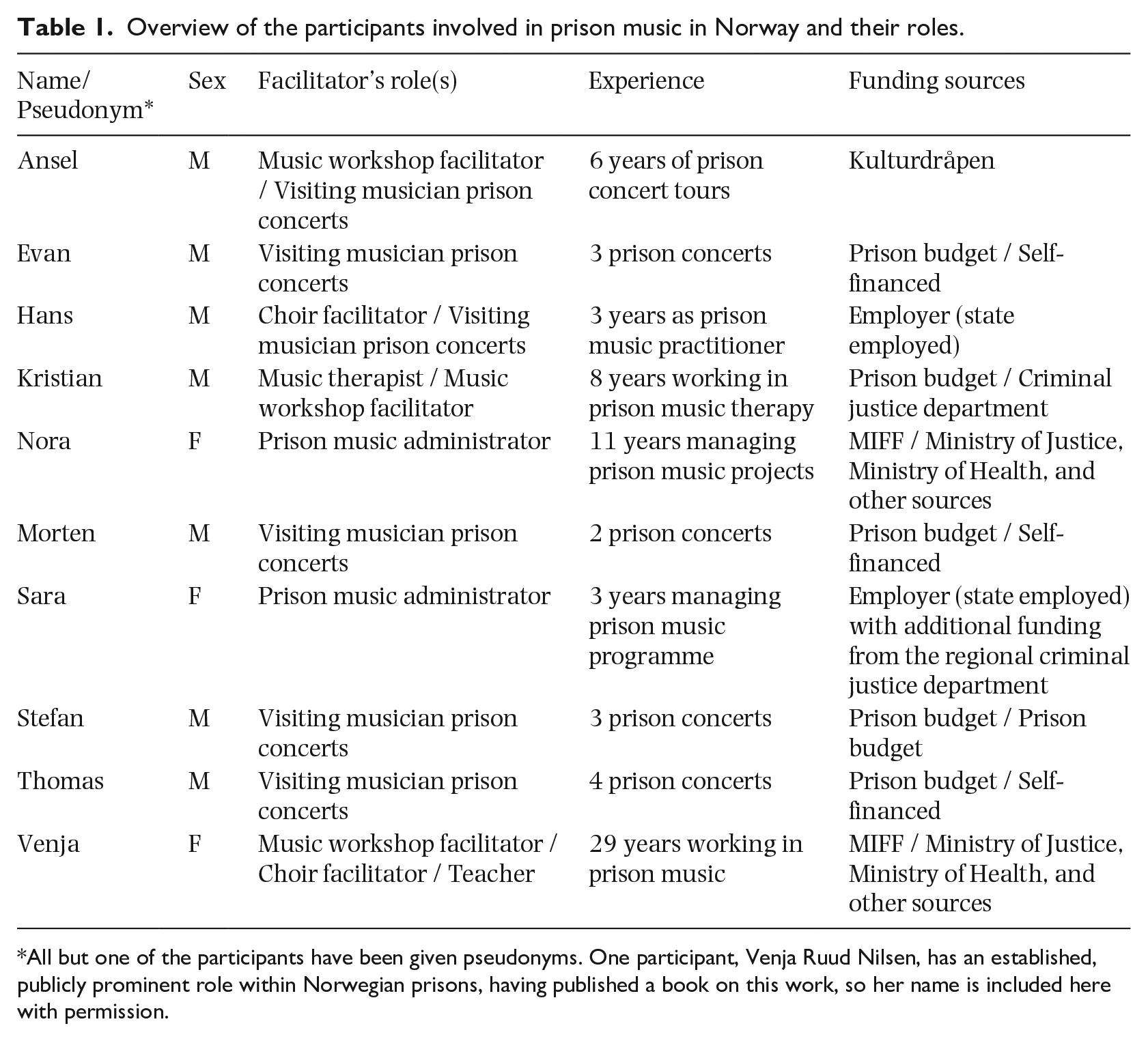
All but one of the participants have been given pseudonyms. One participant, Venja Ruud Nilsen, has an established, publicly prominent role within Norwegian prisons, having published a book on this work, so her name is included here with permission.
Analyses
Interview data were transcribed verbatim, as were case study and participant observation field notes. All transcripts were read closely multiple times and any terms or phrases considered important were coded as part of a thematic content analysis. A pattern-making logic was employed, which clustered together any similar or recurring codes from the data, with the aim of identifying emergent sub-themes and capturing meaning in the dataset. Lastly, interpretive coding was used when comparing themes and sub-themes that had emerged in coding the interview data with field notes from the author’s observation diaries of experiences at the different prison music events.
Norwegian prison music: Case studies
The cases presented in this article include examples of the various kinds of formalized prison music activities that take place regularly in different Norwegian prisons. 7 On the basis of the data collected in this study, music in Norwegian prisons includes the activities shown in Table 2, although it should be noted that they are not always mutually exclusive (i.e., people in custody can make use of opportunities to take part in two or more activities at the same prison), they are not available at all prisons, and they are not necessarily available to all people in custody.
Overview of the four strands of activities on offer in Norwegian prisons today.
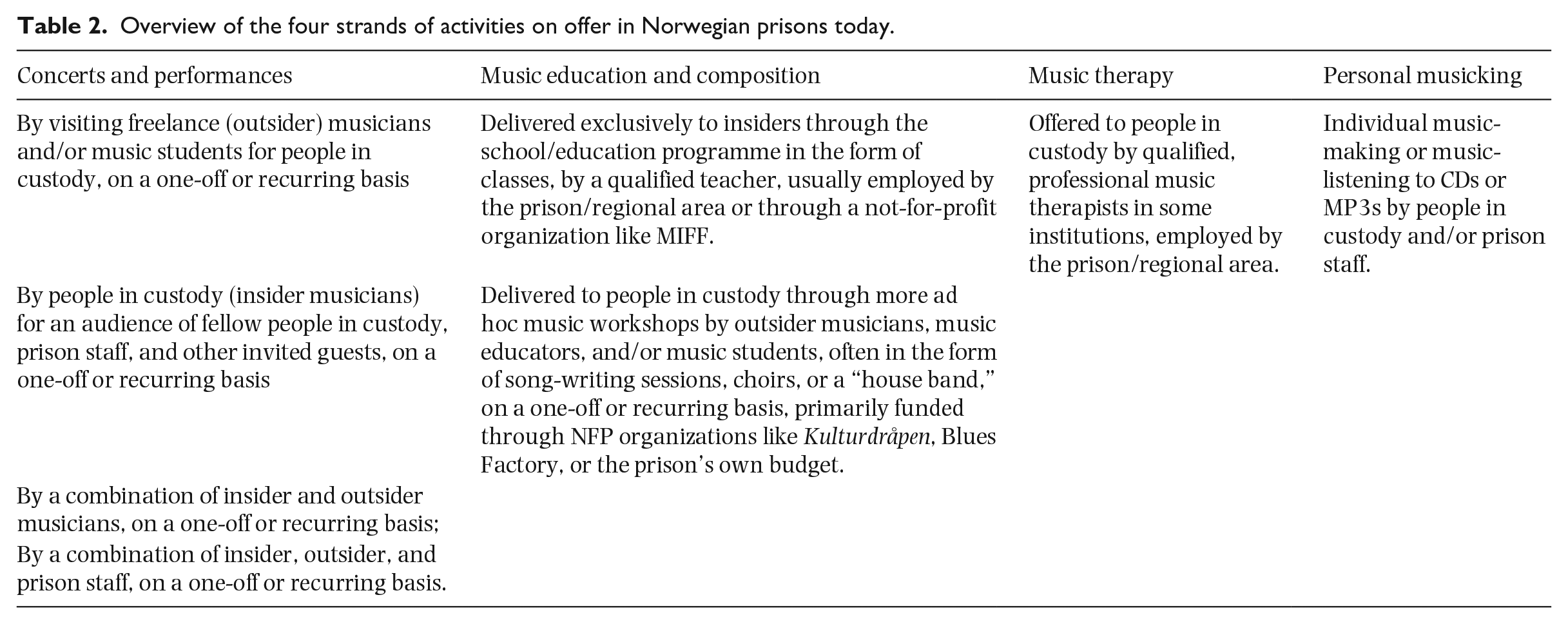
For the purposes of this study, the author sought out musical activities in prisons including concerts and performances, on the one hand, and music education and composition, on the other. She carried out fieldwork during concerts and performances, taking notes and, where possible, creating recordings of the events. 8 The author’s visits to different prisons while these musical activities were taking place, and her participation in them, formed the starting point for the research, and they proved crucial in framing the research questions and determining the methodological approach. This experience was essential for the author to gain an on-the-ground understanding of how prison music activities operate, and provided an opportunity to meet various actors involved in the Norwegian prison music context.
Results and discussion
Codes from the datasets were identified, analysed thematically and reviewed. Four broad, overarching themes emerged from the participants’ reported experiences. An overview of each of these overarching themes is provided below supported by quotations from the interview transcripts.
Interpersonal communication and emotional connection
It is impossible to overstate how often the participants discussed aspects of interpersonal communication and feeling connected to those in prison through taking part in shared musical experiences. Such moments of communication and connection were conveyed in different ways. The most prominent responses were about music as a process for communication and practices of musical connection. Hans, who had facilitated a choir in prison for over three years, described how he imagines the potential for music to offer moments of “escape” from everyday prison life, and sees singing as a means to starting a bigger conversation with those in prison. This was supported by the author’s observations at choir practice, where coffee breaks offered a chance for the facilitators and members of the choir, and prison staff, to mingle over coffee and cake that had been freshly baked that day by one of the members of the choir. In addition to offering a space for socializing, some members would take the opportunity to pick up an acoustic guitar and show off their skills to an audience of peers, prison officers, and outsiders.
Others discussed the perceived usefulness of music rather than language as a mode of communication, and some espoused a belief in the universality of music. For example, Nora, a prison music administrator who works in a music organization, was asked by prison officers to establish a music programme in a prison with a high number of non-Norwegian speakers, as a way of bringing together people with no common mother tongue: I went to Oslo prison, they said to me: “Okay! We have 65 languages in here that people are speaking, and with 13 of these languages, only one person is speaking that language. We don’t understand them, can you please help us with music so they can express themselves?” So we helped them to build a music studio. (Nora, prison music administrator)
The idea that music opens doors for people who might otherwise never meet to communicate and make connections extends not only to people in custody, but also facilitators. For example, prison officers understand the value of music in relational terms, as a means of expression and collaboration for young people in detention who are awaiting sentencing, holding the romanticized (and not unproblematic) belief that music operates as a form of universal language that can take its place when speech fails.
As well as viewing music as a means of interpersonal communication, prison officers seem to be hyper-aware of how facilitators appear in the prison context. In comparison with most performance venues hosting visiting musicians, prisons are unusual. They do not have concert halls so gigs are performed in whatever spaces are available, often sports halls or chapels. Chairs for the audience are put out and neatly organized in rows. There is no proper stage so bands are literally and metaphorically at the same level as the audience. Several participants described experiencing their visibility to the audience as vulnerability, expressing feelings of self-consciousness in the prison performance setting. In interviews different participants also singled out, specifically, the significance of maintaining eye contact while performing in prison concerts, even though this might cause them some discomfort. Watching Evan perform with his band in the bright prison chapel, it was noticeable that he was uncertain where to look while playing: “I normally look down when I play. But now I feel like I can’t do the shoe-gaze thing. It is not appropriate” (Evan, freelance indie-rock guitarist).
In contrast, Ansel stated that he was confident looking straight into the eyes of his audience at his hip hop prison shows: When you are inside it is important to have eye contact with the guys. They are not being seen by society and not being regarded as equals, right? So if you don’t look them in the eyes you don’t recognise them. You are standing right in front of them and even then you are not recognising them. (Ansel, rapper/workshop leader)
At prison concerts, the author observed how both musical genre and the performers’ personal attributes lent themselves to diverse connections with audiences. The intimacy of Norwegian prison concerts, at which audiences can consist of as few as 15-20 people or more than a hundred, depending on the institution, can also promote displays of vulnerability. Both Stefan and Ansel used the term “naked” when describing their experiences of feeling exposed and rather vulnerable when performing in prisons: It’s a bright room in daylight, so we see them as clearly as they see us . . . here it’s no barrier, just “hey” right there. So it’s intimate and very naked in a way. (Stefan, freelance drummer) You cannot hide behind sunglasses and you cannot hide behind gimmicks – everything is just naked. No special effects. (Ansel, rapper/workshop leader)
It is well established that all parties involved in prison music activities must demonstrate high levels of trust, honesty, and generosity (Anderson, 2009, 2015; Cohen, 2019). The participants who had worked in prisons for a decade or more pointed out that the trust that had developed, combined with their identity as women, and specifically as middle-aged women, elicited the perception of familial connections from the men and women in prison. Nora described being treated like “a kind of mother or grandmother,” while Venja described the long-lasting relationships she had formed as the result of playing with the same women for up to 15 years, some of whom would make statements such as “I wish you were my mother.” This echoes Cohen (2012, p. 232), who describes how prison music communities provide a safe refuge from the persistently agonistic day-to-day life in prison, a “safe haven” and a familial environment in which women choir conductors are referred to as the choir’s “mother.” In the Norwegian prison context, according to the participants, such connections function reciprocally. Interactions between facilitators and people in custody were described, overall, as conveying great respect, notions of care, deep affection, and at times, even love.
The ladies say “Thank you, Venja! You helped me through the day.” . . . I love these ladies. (Venja, musician/facilitator)
We see a form of solidarity in action through prison music making practices, illustrated by Venja’s expression of the belief that her job in prison music education is of significance, and her display of an ethos of care and, in particular, love. Freire (1970) repeatedly asserts the importance of the ethics of love in rethinking pedagogical practices in order to expose social justice. Freire’s theoretical framework emphasizes that education is an act of love; that educators must risk acts of love; and that love is necessary to establish a better world (Schoder, 2011). The capacity for music in prison to act as a catalyst for creating a community of care is discussed in more detail below.
Social responsibility
The second most prominent theme emerging from the interview data was that prison music practices offered a reframing of participants’ own values and sense of responsibility, albeit for different ends. The motivation of prison music facilitators is complex, since the job entails a fundamental paradox. Balfour et al. (2019) remind us that “arts practitioners work within the contradictions of a system in which there is a duality of focus: the state’s wish for punishment and the need for deterrence, as well as a focus on rehabilitation” (p. 5). Some participants spoke powerfully about their personal values and why they had prioritized bringing music to prisons, when it can involve extremely challenging work with unstable pay. For example, Morten, a keyboard player, had a rather utopian, idealistic outlook and prior experience of working on social justice projects. For these reasons, he was prepared to play with his band in prisons without payment. Ansel gave similar reasons for bringing his live touring hip hop band (four musicians and a sound engineer) to prisons in Norway: I am putting [in] time to do the prisons because that’s a priority. I have the luxury to choose things that are not necessarily [the] best paid thing you can do, but it is definitely one of the most rewarding things I can do. You can make an impact . . . This is the real stuff. This is the essence. (Ansel, rapper/workshop leader)
Such feelings of professional satisfaction and meaningful, rewarding work were shared by several of the participants. These may be described as performing a form of “musical-social work” (Ansdell, 2014, p. 193). The term is used here deliberately to reflect the nature of the participatory music-making encounters between the participants and people in custody, in which music is mobilized to support equality, and promote well-being and positive social change.
The idea of using musical practices to respond to social injustice was echoed by several of the participants, who were certain that people in custody should have the same access to cultural offerings as other Norwegian citizens. Sara, an outreach officer at the Norwegian National Museum for Popular Music, who initiated a prison choir as part of her job, explained how her interpretation of the public she serves came to include people in custody because, at the museum, she is responsible for all types of people including those who cannot gain physical access to it. For Sara, people in custody are “supposed to get every offer that others get – cultural, health, priest, school, job and whatever. So we are the cultural part of it.” This belief that those in prison are as deserving as others of opportunities to enjoy all that the museum can offer was fundamental to her initiating the prison choir, a musical collaboration that had continued for more than three years. Yet Sara’s belief that the remit of the museum included making opportunities available to people in prison was met with a degree of scepticism from her colleagues, who wondered if this was really what a museum should be doing.
Some freelance musicians who do musical-social work in prison have mixed motivations for doing so; they seem as ambivalent as Sara’s colleagues at the museum. Stefan explained that he agreed to do a prison tour not because of any romantic notion but because he was asked to do the gig by the band leader who booked the tour. Stefan’s primary motivation for taking on the tour was the opportunity to play live music, not the prison venues. The band leader concerned, Thomas, made a similar confession when asked why he had organized a tour of prisons in his home county, more than 500 kilometres away from his current base in Oslo: I thought that we have this important gig tonight and that we are more practiced. That is also a little bit of the reason maybe. And we have not rehearsed that much. (Thomas, freelance band leader)
The tour – three shows in different prisons on two days – served a dual purpose for Thomas: for him it was an opportunity to perform a form of progressive prison politics, and at the same time use the prison gigs as intensive practice for an “important” gig in an “outside” concert venue the evening after the second day of prison shows. This was understandable, as the financial costs of the tour were borne by him personally. His six-piece band performed without payment; Thomas funded their transport and accommodation, since the small fee he received from each prison for the concert they gave barely covered the outlay for hiring a local sound engineer and PA system. This being the case, it is obvious that significant and sustained financial investment is needed if bands are to continue playing in prisons, whether such investment comes from the state, charities, or individuals.
Prison environment and exceptionalism
The most prominent response related to working within the prison environment centred on economic feasibility, a sense of constant precarity, and operating within an ever-changing political climate. “We are begging for money,” said Nora, who had spoken at the Norwegian Parliament’s annual pre-Budget hearing on behalf of MIFF. In 2013 there was a change of government and, according to Nora, the new administration “didn’t want [their approach to prisons and justice] to be as soft, as they called it,” so MIFF have lost funding every year since then. Venja echoed this, saying the most difficult part of her job is “to get money,” along with the uncertainty surrounding funding allocations for each coming year. These findings corroborate recent research by Doxat-Pratt (2018) and Balfour et al. (2019) who observed an increasing competition for public funding to meet a growing demand for prison arts services amidst government cutbacks.
Aspects of control, or lack of control, related to working in the prison environment featured almost as prominently as financial anxieties in all the interviews. Several participants mentioned the challenges of working in institutions in which the venues and personnel are constantly changing. Kristian, a music therapist and prison music facilitator, described this as the main “insecurity of working in a ‘secure’ facility.” The consistently high turnover of people taking part in prison music activities is common to prison arts practices, and features in previous scholarship on music in prisons (Anderson, 2009, 2015; Balfour et al., 2019). Yet the coming and going of people in custody does not affect musicians visiting prisons to give concerts, however, as it does those who facilitate other prison music activities. As such, prison concert series offer one way of establishing relationships between people in custody and visiting musicians that may be sustained on the outside. Nonetheless, being in a prison environment can affect visiting musicians in other ways. Some feel the pressure to provide a high-quality 45-minute show that contributes something of real value to a literally captive audience. For example, Ansel reported not wanting to waste the audience’s time, even if “ironically, time is what they have” (Ansel, rapper/workshop leader). Evan expressed his sense of anxiety about what kind of banter is permissible at a concert in a prison environment: You really feel that you have to give them something good because this is their concert. I also think there is a tension in what jokes you can make. Can you for example say, “thanks for coming”? There is also something about the fact that we are actually playing in their home. This is basically where they go around in their sweatpants and crocs [laughs]. They are completely relaxed. People in a seated concert, for example at Rockefeller [Oslo music venue], would not be that relaxed. (Evan, indie-rock guitarist)
For Evan and musicians like him, playing gigs in prison brings with it the awareness that visiting bands come into their audience’s home, even if their home is a public building in the form of a state prison. Another participant reported wondering if the men in prison had chosen to attend the show, or had only found out afterwards that it was not mandatory. In a setting as tightly controlled as a prison there is a potential shift in power dynamics during prison concerts where the audience feels very much at home, and the visiting musicians are the uneasy, awkward spectacle on show.
Speaking of the first coronavirus lockdown in the spring of 2020, which precluded musicians from making physical visits to prisons, Venja reported the unprecedented speed with which new systems for music making were put in place. Now that iPads have been introduced into the prison, she can request visits with her students using special, secure video-conferencing platforms, and the prison officers will bring the iPad to the student in prison for their lesson. This demonstrates the high level of trust shared between all three parties and their willingness and flexibility to adapt to new systems in a time of crisis. This high level not only of trust but also of material conditions illustrated by the provision of iPads are also examples of the exceptional features of Nordic prison policy (Ugelvik, 2017), although this is an example of Nordic privilege, as such musical interactions in prison are only available to those institutions that can afford to buy appropriate technological equipment, provide a stable internet connection, and are staffed adequately to cater for individual requests.
(In)difference and exclusion
The (in)difference and exclusion theme describes how participants presented a range of different factors that played a role in how they perceived or experienced differentiation, preconceptions, and prejudice in Norwegian prison music and/or aspects of exclusion from it. Several articulated their preconceptions of people in custody; they felt that their prejudices were both confirmed and challenged when they were faced with a live audience at prison concerts.
Last time when we played in [named prison] the social worker said: “they are just ordinary guys”, and then they came in and looked like Prison Break guys [laughs]. That was not what I thought. They looked very much like prisoners because they work out a lot, have many tattoos and short hair. (Thomas, freelance band leader) A lot of those guys [prison concert audience] looked like people I went to middle school or primary school with. The ones that did not have the best family or social situation. That was also something I thought about before we came there – that a lot of these people probably are just like us, but they have had a tough time. They were quite normal and did not look like the characters you see in American TV shows. (Morten, freelance keyboard player)
Morten showed a sensitivity and empathy towards his audience, something he seems to have developed before entering the prison. While Norway’s egalitarian, welfare-state society should, in theory, protect against most extreme forms of social problems such as hunger, poverty, and homelessness, there are nevertheless perceptions of differentiation between members of different social classes, as shown by Thomas’s initial reaction to an audience of men with shaved heads and tattoos.
Ansel reported that the people in custody who took part in his hip hop workshops articulate the view that they do not possess “the same value as people on the outside – not the same self-worth, not the same self-esteem, not being regarded as the same class of citizens.” As he explained: There is a stigma to being in jail of course and in Norway, even though in general that people are well-off, there is a huge gap between filthy rich and working class. Coming out and explaining your gap on the CV and things is hard, and harder because it is a small country. (Ansel, rapper/workshop leader)
Such perceived differentiations are articulated on an even greater scale when it comes to non-Norwegian nationals. Nora, an administrator for Norway’s largest prison music service provider, reported that the only prison she had been unable to access is Kongsvinger prison, the prison exclusively for foreign nationals. She was told by officials, she said, that because these women are serving shorter sentences and are meant to be deported afterwards, that: They should have nothing like this [music] in here. The latest statistics I heard said that 30% of foreign national prisoners are staying there for a very long time. (Nora, prison music administrator)
Venja also mentioned that the demographic of women in Bredtveit prison has changed in recent years because a lot of women “not from Norway” are sent to Kongsvinger instead of Bredtveit. “I do not think there is any music there,” Venja remarks, and “I think it is a bad place to be” because these women are sentenced to be deported from Norway once their sentence is served. Although she has not been to Kongsvinger prison, she says “I do not think they have music. I tried to give them a piano, but I could not. I said that they could pick it up and have it, but it was not possible.”
Furthermore, Venja explained that while relatively new prisons such as Halden are considered to have the best facilities in Norway, they are for men only. So far as she is concerned, the situation is much worse for women in prison, with older, second-rate prisons and none of the purpose-built musical facilities typical of Halden and other modern prisons. Women are only 6% of the prison population, and the best prisons are built for the 94% majority, Venja asserts.
Reflecting on the recent changes in Norway’s prison demographic, in particular the rising number of foreign nationals being incarcerated, Ansel pointed out that, on a “logistical level,” it may be practical for a prison such as Kongsvinger to house only foreign nationals: I would assume it is when they pour monetary resources into the [music] rehabilitation program you know, they probably want to stay in the community – you know what I mean? Like if they have too many that they give these resources to, when they get released they would only go back to their countries and never see the benefits of these resources. (Ansel, rapper/workshop leader)
He went on to say that if music services are not made available to certain men and women serving sentences, music in Norwegian prisons is likely to be perceived as “a reward rather than a right.”
Final thoughts: The meaning of dugnad in the Norwegian prison music context
These findings, representing the perspectives of music facilitators in Norwegian prisons, show that interactions between facilitators and people in custody can foster new relationships, friendships and trust. Despite their limitations for both audiences and performers, concerts given by visiting musicians serve as rare occasions in prison life when people in custody can gather to participate in a shared social experience. The choice of freelance musicians to bring their music to audiences in Norway’s small, local prisons can be understood as a form of dugnad. The word is etymologically derived from the old Norwegian word duge, which means “be good enough,” and can be translated as doing “’voluntary work amongst friends,’ but in practice, it related to a broad range of mutually reciprocated, taken-for-granted neighbourly activities and support” that strengthen societal “unity and solidarity” (Pratt, 2008, p.125). In Norway, the tradition of dugnad is well-established as a form of community volunteerism or social cooperation. Dugnad values and mentality are deeply ingrained in Norway’s socially democratic society, both as a symbolic gesture of care but even more as a moral obligation to participate in projects for the good of the community (Klepp, 2001). The findings of this study show that, while the views of participants differed in many ways, they all reflected on their experiences using variations of dugnad rhetoric. When discussing prison concerts, they reflected on how “everyone is equal” in the spaces in which they take place, even if performing in such close proximity to the audience causes the musicians some personal discomfort. All the participants articulated at least some of the features of the dugnad spirit: care, solidarity, and a feeling of social responsibility and even moral obligation to recognise that people in custody are members of the public, as defined by cultural institutions. Since individuals serve sentences in their local prisons, and an important, if not the main aim of the Norwegian correctional services is reintegration into the local community, all Norwegians have a social responsibility within the dugnad framework to participate in projects for the good of their local community.
The findings of this study suggest that prison music-making services, while complementing other provisions for reintegration such as assistance with employment, education, and housing, function as a form of dugnad. Because music relies on dugnad volunteerism it is not prioritized in official reintegration services and does not receive long-term, secure funding or organization. MIFF’s continuing music-in-the-community programmes provide ongoing support through what they term the “freedom” part of their organization, for example, but as they are at the mercy of constantly changing political agendas and government funding, their financial situation is permanently precarious, and their ability to guarantee long-term service to Norway’s correctional services is constantly under threat.
It is clear from the data that participants understand music as paradoxically both built into Norwegian practices of prisoner rehabilitation and desistance, and at the same time distributed unevenly among and practiced unequally in different detained populations. They believe this to be especially the case in prisons housing women and foreign nationals, which fall particularly short in terms of their provision and facilities for music making compared to well-known exemplars of Norwegian prisons such as Halden and Bastøy. The reliance of music in prisons as a form of dugnad also limits the opportunities for music available to non-Norwegian citizens serving sentences.
Limitations and suggestions for future research
Findings from a qualitative case study with 10 participants are inevitably limited to the particular research context and cannot be generalized or transferred to other contexts. Nevertheless, they contribute to a developing knowledge of prison music initiatives and how they function, informed by the perspectives of prison music facilitators, who are largely overlooked in scholarship to date. The findings reveal new insights into how music is currently or could be embedded in a prison culture, and demonstrate that learning from facilitators may be valuable in creating a more inclusive and humane experience. Future research might seek to combine the perspectives of people in custody, facilitators, and prison staff, in order to gain a more comprehensive understanding of the use and experience of music in contemporary prisons.
Conclusion
Criminologists have argued that Nordic prison policy is exceptional in that “the highly egalitarian cultural values and social structures of [Nordic] societies” (Pratt, 2008, p. 120, emphasis in the original) explain their comparatively low levels of imprisonment and humane prison conditions. Is Norway’s vibrant prison music culture a product of such exceptional and egalitarian penal policies? Unquestionably, the exceptional material conditions of several of the prisons, such as high-quality musical instruments, well-equipped recording studios, and access to music-making opportunities, are of fundamental importance in supporting music in prison. Nonetheless, the resources required for creating music and providing opportunities to perform cannot be taken for granted, even in Norway’s exceptional prison culture. State-of-the-art music facilities are available only at very few prisons such as Halden and Bastøy. Like prison music initiatives in the UK, US and Australia, according to the research literature, prison music initiatives in Norway are funded almost exclusively by the state budget in two ways. First, it provides financial support for music facilitators. Second, freelance musicians can apply to a government music organization for funding to give concerts in prisons. Changes in the political climate and level of government funding and a lack of potential financing from charitable or private bodies have seriously compromised prison music facilitators’ ability to plan activities for each coming year.
The findings of this study highlight some of the key experiences shared by music facilitators working in Norwegian prisons, and provide strong support for the suggestion that music can be a foundation for the creation of a community of caring individuals both inside and outside prisons (Cohen, 2019, p. 209). Notably, the facilitators’ concern for those who appear to be excluded from or differentiated in relation to music-making opportunities in prison – in particular foreign nationals and women – suggests that music in Norwegian prisons remains a reward rather than a fundamental right. Despite the exceptional character of Norway’s prisons, overall, similar levels of care are not yet being afforded to all people in custody, and not all have equal opportunities for or access to music-making.
Footnotes
Acknowledgements
The author would like to thank the facilitators, prison staff, and people in custody who participated in the study, as well as Kirstin Anderson, Mary Cohen, Jo Collinson Scott, Victoria Nybråten, Brydie-Leigh Bartleet, Lukas Pairon, Jane Ginsborg, and two anonymous reviewers for their insightful comments on earlier drafts of the article.
Funding
The author received no financial support for the research, authorship, and/or publication of this article.
1.
2.
3.
The 21-year life sentence comes with the caveat that it can be extended if the courts feel that the prisoner has not yet been fully rehabilitated.
4.
Blues Factory has received accolades from local and national media, and enjoyed collaborations with international musicians such as the actor and guitarist for Bruce Springsteen Steven Van Zandt, who delivered an adaptation of his Rock’n’roll Forever Foundation workshop for Bastøy musicians in custody in 2017. For more details on Blues Factory, see their website (in Norwegian only): 
5.
The large number of Norwegian prison music programmes may also be attributed to the principles of community music and social accountability embedded in the mission of the Centre of Educational Research in Music (CERM) at the Norwegian Academy of Music, where many of Norway’s music therapists, educators, and community musicians are trained.
6.
The term prison music facilitator, rather than the term practitioner typically used in reports of Anglo-American case studies, is used deliberately to reflect the range of people who engage with prison populations through music in the Norwegian prison context. They include, but are not limited to, music practitioners, music teachers, choir conductors, music therapists, freelance/touring musicians, and prison arts administrators.
7.
Personal musicking – for example, individual music making or listening to CDs or MP3s – is the most frequently practiced form of music in prison, by people in custody and prison staff alike. It was beyond the remit of this study, however, which focused on official, organized musical activities offered by the prison. In relation to this, there is evidence of at least one music group consisting of prison staff, the Halden prison staff choir, which shares videos of its cover versions of classic pop songs on YouTube. This would seem to represent a public relations exercise. It is certainly worthy of further investigation, but was not included in the present study.
8.
Since the third strand of Norway’s prison music activities includes therapeutic sessions, the author did not observe these but interviewed a music therapist working in a Norwegian prison instead.