




Abstract
The dominant analyses of trends and flows in International Student Mobility (ISM) overlook different hierarchies of destinations and the pathways students take to reach these locations. The tendency to conceptualize ISM as a linear involvement of the global elites masks the mobility patterns and trajectories of students with mobility capital shortage. Theorizing on the stepwise migration, this explanatory mixed-methods study investigates the onward migration intentions of international students in Türkiye. Although the stepwise migration theory has been applied to explain low-skilled migration, this study partially confirms that a significant number of international students in Türkiye have developed stepwise migration intentions toward Western countries and use Türkiye as an intermediary, leveraging it to build and accumulate various capitals before moving on to economically developed Western destinations.
Keywords
Introduction
Decades of research have documented various factors influencing students’ choices of country, city, and institution for studying abroad (e.g., Beine et al., 2014; Caruso & de Wit, 2014; Hovdhaugen & Wiers-Jenssen, 2023). Among these factors, the prospect of permanently migrating to a host country is one of the most commonly cited reasons for studying abroad (Perkins & Neumayer, 2014; Ziguras & Law, 2006). Findlay et al. (2017) argued that social forces generating ISM contribute to the development of lifelong mobility plans, which present mobility options in the post-study era rather than being limited to circular mobility trajectories. The prospect of migrating permanently to a host country indicates a close connection between employability, migration, and the growth of ISM (Kuvik, 2015; Zijlstra, 2021). In other words, a key motivation for studying abroad is expanding human capital through higher education and acquiring credentials essential for transitioning into the labor market and eventually migrating permanently to the host country (Baas, 2019; Wu & Wilkes, 2017).
Classifying International Student Mobility (ISM) as a form of international migration is not new in the literature, as several seminal studies on ISM have utilized international migration theories and concepts (e.g., Chen & Barnett, 2000; Kondakci, 2011; Mazzarol & Soutar, 2002). However, two major issues exist in the prevailing theoretical explanations of ISM flows worldwide. First, similar to the international migration literature (Paul & Yeoh, 2021), the vast majority of research on ISM conceptualizes the mobility to study abroad as a single, smooth journey between home and host countries. Second, while the East-West axis remains the primary route for International Students (IS) (Barnett et al., 2016; Chen & Barnett, 2000; Glass & Cruz, 2022; Kondakci et al., 2018), an overemphasis on this pattern tends to overlook other geographies involved in ISM (Brooks & Waters, 2023). These two issues lead to neglecting the influence of global economic and academic hierarchies that shape non-linear ISM paths. In other words, although Western countries with strong economies remain the primary destinations for IS, these destinations are not always directly accessible, prompting students to develop stepwise strategies: initially building migration capacity, then pursuing migration to their ultimate target country. Mulvey and Mason (2022) argued that South-South mobility is often viewed as secondary compared to East-West mobility. However, students encounter mobility restrictions and limited mobility capital that prevent direct moves to target countries, mostly Anglophone nations with advanced economies and top universities (Brooks & Waters, 2011; Findlay et al., 2017). These points suggest that a segment of global ISM, driven by the goal of migrating to a Western country, follows non-linear, stepwise paths. Students who cannot directly migrate to a developed Western country for their studies and eventual migration tend to split these goals, pursuing them sequentially—initially moving to an intermediary country to obtain a degree, then accumulating migration and human capital to complete their mobility (Zijlstra, 2020). Consequently, they develop non-linear, stepwise mobility trajectories for higher education with the aim of eventually residing permanently in an economically advanced country.
Despite its significance, the stepwise mobility of students has not been widely investigated. New perspectives on international migration argue that immigrants are not passive subjects of various forces that pull or push them to migrate (e.g., de Haas, 2021). Likewise, in ISM the students make informed choices to determine where to live and develop conscious strategies to realize their life prospects. Against this background, this study aims to uncover the stepwise migration intentions of IS in a semi-peripheral country and to elaborate on the factors shaping these intentions. The study answered the following research questions: Do IS have an intention of migrating to a third country after completing their studies in Türkiye? What are the factors shaping the onward migration intention of the IS in Türkiye?
Theoretical Framework: Stepwise Migration Theory
Paul (2011), the proponent of the theory, defined stepwise migration as “a pattern of multistage international labor migration involving stints of substantive duration working in intermediate countries as an intentional strategy adopted by low-capital migrants unable to gain immediate entry into their preferred destination countries” (p. 1843). Stepwise international migration trajectories share a hierarchical, incremental, path-dependent, and dynamic quality, and the migrants’ stepwise strategies are the result of their lack of capital and less an act of volition; hence, it is a hierarchical, iterative, and progressive movement toward a predetermined target country (Paul, 2011; 2015). In stepwise migration, the migrants construct a categorization of countries and specify an end station. Although this categorization is informed by social, economic, and political data, the subjectivity of the migrants in assessing these factors is evident. If the end destination is not feasible, the migrants may start from the first accessible country to gather all necessary forms of capital (van Hear, 2014). Paul (2011) argued that low-capital international immigrants face structural barriers such as high-cost hurdles and immigration policy restrictions that limit their direct movement from their home to a host country. Specifically, stepwise international migrants move to an intermediary country to develop economic and human capital as well as to build a network of contacts, which they believe will help them gain entry to a predetermined destination (Paul, 2011; 2015).
Compared to mainstream research on ISM, the number of studies on stepwise migration is very limited (e.g., Garvik & Valenta, 2023; Mulvey, 2021; Sadri & Chaichian, 2018; Zijlstra, 2020). However, stepwise migration offers a solid explanation for ISM in the semi-periphery, where students from peripheral countries often face mobility restrictions, as indicated by several studies (Hawthorne, 2014; Luthra & Platt, 2016). In stepwise migration, students plan their academic, social, and cultural experiences in station countries to build different forms of capital, enabling the next move. According to de Haas (2021) aspirations-capabilities framework, it can be argued that many international students who are unable to move directly to the target country choose to step into a country where they can develop their ability to move to the place they desire. Building on the core ideas of stepwise migration, we identified several factors that make a semi-peripheral country an attractive station for international students, helping them build academic, social, economic, and mobility capital for a second step toward a Western country. Ease of access to an intermediary country (Collins, 2021; Kondakci et al., 2018; Zijlstra, 2020), academic quality, available fields of study (Kondakci, 2011; Zijlstra, 2021), affordability of living costs and tuition fees (Baas, 2019; Perkins & Neumayer, 2014; Tan & Hugo, 2017) are the most prominent factors that may encourage stepwise migration intentions among international students.
The Context
Türkiye ranks among the top countries in the world for inbound student numbers. Overall, there are 224048 inbound students in Türkiye, making up 2.7% of the total student population (UNESCO UIS n.d.). Unsurprisingly, most of these students come from neighboring countries such as the Syrian Arab Republic (47483), Azerbaijan (23772), Turkmenistan (19384), Iraq (14809), Iran (11223), Afghanistan (8429), Somalia (8142), Yemen (5860), Egypt (5822), and Jordan (5317). This pattern supports the key ideas of stepwise migration. Several studies on international migration and student mobility (Kondakci, 2011; Kondakci et al., 2018; Zijlstra, 2020) classify Türkiye as a semi-peripheral country. Its geographical position makes it a crossroads for migrants from peripheral countries heading toward Western Europe, transforming Türkiye into a transit nation in international migration (İcduygu, 2000).
When mobility is limited to ISM, Türkiye's position remains quite similar. Several studies on ISM patterns in Türkiye show that it functions as a regional hub for international students from neighboring countries (e.g., Kaya-Kasikci & Glass, 2025), and a significant number of these students hope to advance further with the goal of permanently migrating to a Western country (Kondakci, 2011; Sadri & Chaichian, 2018). These analyses suggest that geographical proximity is a key factor in understanding the dynamics of stepwise student mobility in Türkiye. However, other factors also play a role in understanding the stepwise migration of IS. Like other regional hubs, students are often attracted to Türkiye because of its relative economic development, political stability, the academic quality of some leading universities, availability of government scholarships, straightforward visa procedures, geographical, cultural, and linguistic proximity to their home countries, affordable tuition, flexible visa policies, and better economic and job opportunities elsewhere (Kondakci et al., 2017).
Method
The complexity involved with the intention of stepwise migration and using international study for this purpose required the use of different data sets to grasp the phenomenon. Therefore, an explanatory sequential mixed-method design was employed in the study (Creswell & Clark, 2018). The quantitative phase was arranged as a correlational study to identify the predictors of stepwise migration intentions of IS, while the qualitative phase, designed as a generic qualitative research, aimed to provide a deep understanding of the quantitative findings by explaining the reasoning behind the current situation.
Sampling and Data Collection
Quantitative Sample
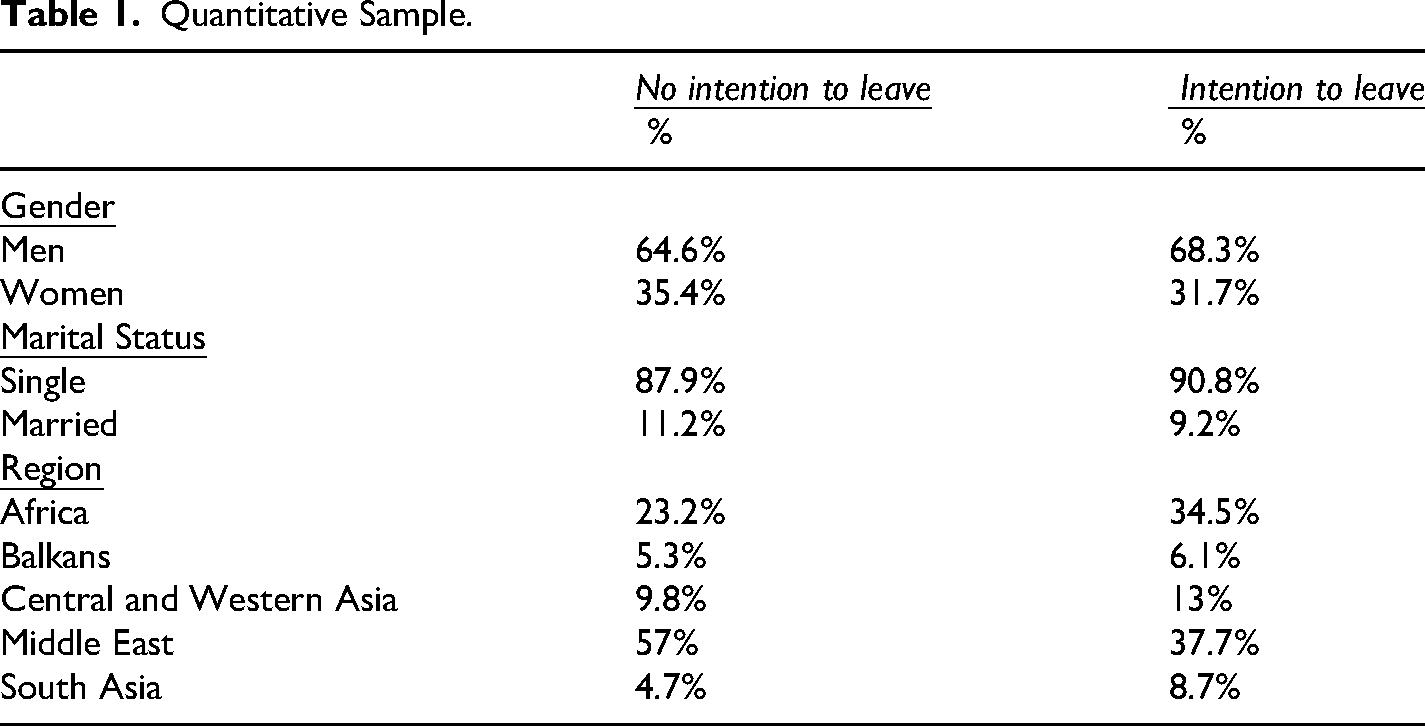
International degree-seeking students in Türkiye are spread across 206 higher education institutions, although most of the IS concentrate in 20 universities. Due to limited travel resources, an online version of the survey was developed and shared with students via university mailing lists, the National Agency of Türkiye, and Türkiye Scholarships. As a result, responses from 2708 students (approximately 2.5% of the total student population in Türkiye) from 55 universities nationwide were collected. Based on the premise of stepwise migration, only students from non-Western and/or low-GDP countries were included in the sample (n = 1752). The participants were from the Middle East (48.1%), Africa (28.4%), Central and Western Asia (11.3%), Southeast Asia (6.5%), and the Balkans (5.7%). Men (66.3%) and single participants (89.3%) outnumbered women (33.7%) and married individuals (10.2%). The average age was 22.69 years (SD = 4.34). More than half of the students (60.4%) were pursuing bachelor's degrees, followed by master's (23.8%) and Ph.D. (12.9%) programs across various fields, including engineering and natural sciences (40%), medical sciences (8.45%), and social sciences and humanities (33.4%). Among participants, 53.9% (n = 945) indicated no intention to leave Türkiye, while 46.1% (n = 807) expressed a desire to migrate further to Western countries. Additional detailed information about participants in each group is provided in Table 1.
Quantitative Sample.
Qualitative Sample
In the qualitative phase, a snowball sampling method was used to identify study participants. Some initial contacts were made with students during the quantitative data collection in the first part of the study. Initial interviews were conducted with these well-connected students. After interviewing these initial contacts, they were asked for referrals, preferably from different disciplines and universities. As a result, interviews with 25 IS (men = 18; women = 7) from 15 countries in Asia, the Middle East, and the Balkans were conducted (see Table 2). The participants are pursuing degrees in engineering, education, and the natural and social sciences. It is important to note that the students attend flagship universities in Ankara and Istanbul, two major cities known for their cosmopolitan environments.
Qualitative Sample.
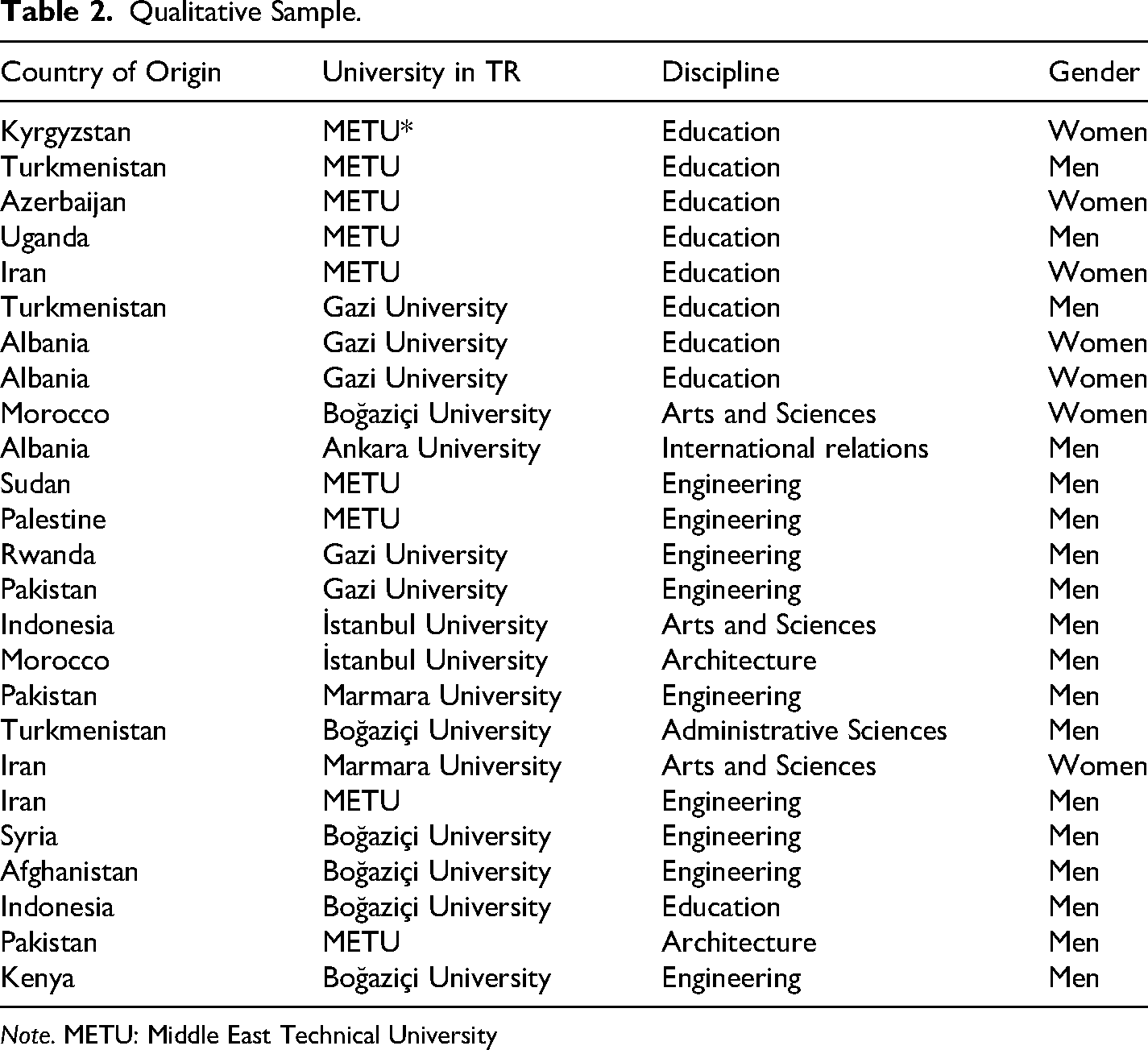
Note. METU: Middle East Technical University
Instruments and Data Analysis
The quantitative instrument consisted of four main parts: demographic questions such as age, gender, home country, and reasons for choosing the station country; satisfaction in the station country; and social (interaction with ISs), economic (living expenses), and academic experiences within the station country. Participants were asked to rate their experiences using a six-point scale from 1 (totally disagree) to 6 (totally agree). Additionally, interactions with other ISs were evaluated through one survey item that measured the frequency of contact with these counterparts. Furthermore, three survey items assessed economic status: (1) the affordability of tuition fees, rated on a six-point scale, (2) the affordability of living expenses in the station country, answered with yes or no, and (3) scholarship status, recorded as yes or no.
The quantitative data were analyzed using logistic regression to determine how well ease of access to Türkiye, ease of access to the university, academic quality, field of study, interaction with international students, affordability of living expenses, scholarship status, and affordability of tuition fees predict the likelihood of intending to leave the host country. The outcome variable was binary, reflecting participants’ responses to the question about their intention to leave the host country (0 = no; 1 = yes). The categorical predictors were dummy coded. The academic major of international students was obtained through an open-ended question. Being the only categorical predictor with three levels, it was coded as follows: 1 = engineering and natural sciences, 2 = medical sciences, and 3 = humanities and social sciences, with category 1 set as the reference category.
For the qualitative part, the interview form included four sections with a total of 20 questions. These covered demographics, reasons for choosing the station country, experiences with life and higher education during their stay, plans to leave the station country, and the underlying reasons for their choices. The interviews were recorded with participants’ permission and transcribed verbatim. The collected data were analyzed inductively through coding and theme identification (Bogdan & Biklen, 2007).
Results
Quantitative Strand
The quantitative part of this research used binary logistic regression to identify the predictors of international students’ intention to leave the host country for a third country. The descriptive results showed that most variables had a mean score above 3, indicating participants’ positive evaluations of academic quality, ease of access to the country and higher education, and lower tuition fees. However, the mean score for interaction with other international students was below 3.
Binary logistic regression analysis was conducted to predict whether individual, social, economic, and academic life-related factors were associated with the stepwise migration intentions of ISs. The preliminary analysis confirmed that the linearity assumption in the logit was tested through the Box-Tidwell approach and was not violated, as all interactions between predictors and their log transformations were non-significant (p > .05) (Hosmer & Lemeshow, 1989, as cited in Field, 2009). Additionally, there was no evidence of multicollinearity, with the highest correlation among predictors being .24; tolerance values ranged from .90 to .98, well above the .02 threshold (Menard, 1995). Outlier analysis identified only five outliers based on leverage calculation; however, no outliers were found regarding Cook's distance and DFBeta values, so these five cases were included in the main analysis. Table 3 displays the variables and the results of the binary logistic regression. The full model, compared to the intercept-only model, significantly predicted the likelihood of ISs’ intentions to leave 2(9) = 62.73, p < .05, with a −2LL of 1779.64 and Nagelkerke R2 = 0.061. The model correctly classified 57.6% of those intending to leave, with an overall accuracy of 59.3%.
Joint Display of Quantitative and Qualitative Results.
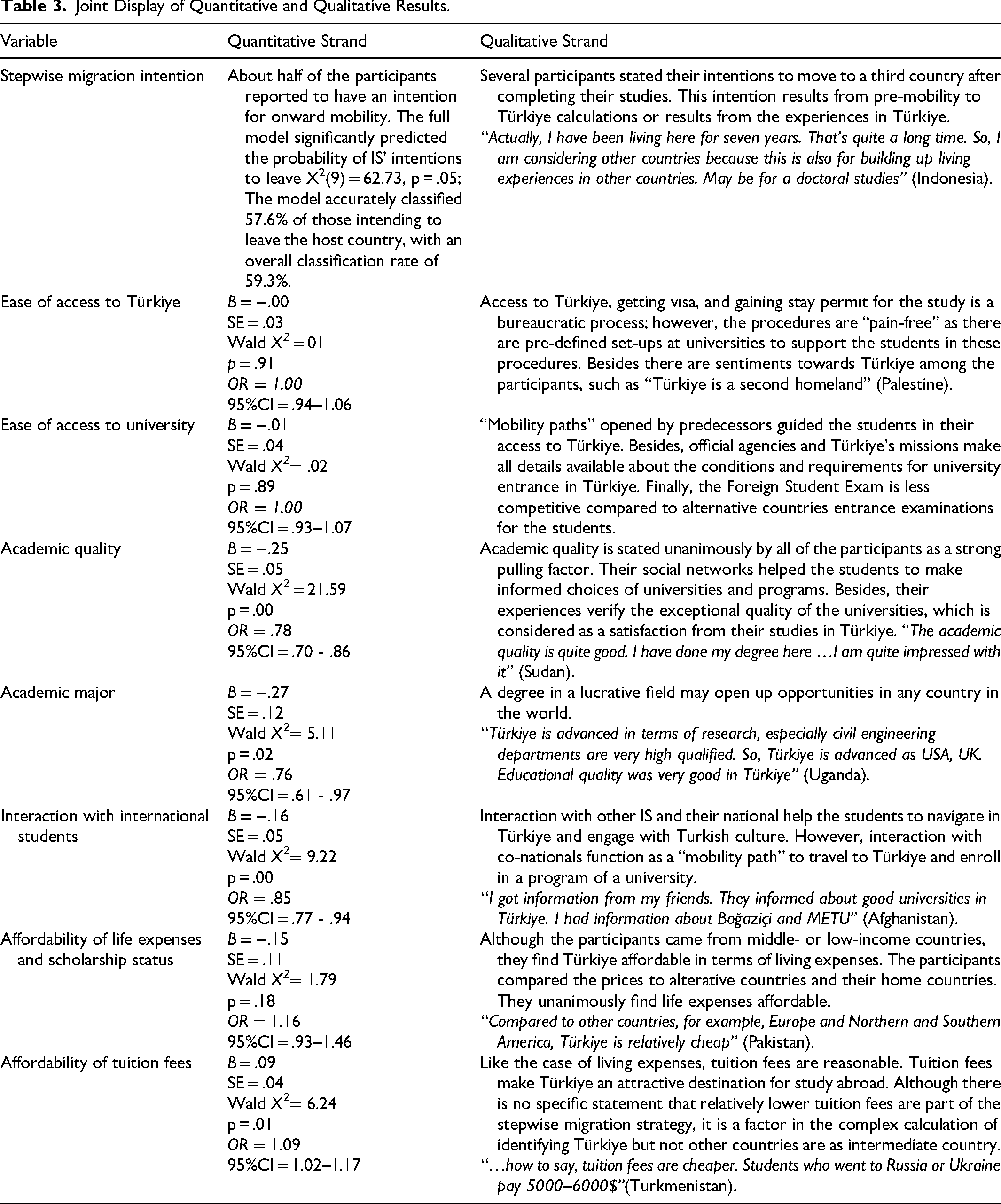
As shown in Table 3, the academic quality, academic major, social interaction with other ISs, and affordability of tuition fees were significant predictors of the stepwise migration intentions of ISs. A one-point increase in the evaluation of the academic quality of higher education in the host country was associated with a 0.78 times lower odds of intending to leave (Wald 2(1) = 21.59, p = .00; 95% CI [.70, .86]). The likelihood of onward mobility was significantly higher for participants in engineering and natural sciences compared to those in medical sciences (Wald 2(1) = 17.95, p = .00; 95% CI [.29 - .64]) and in humanities and social sciences (Wald 2(1) = 5.11, p = .02; 95% CI [.61, .97]). Results also indicated that as social interaction with other ISs increased by one unit, the probability of students’ intention to leave the host country decreased by a factor of 0.85 (Wald 2(1) = 9.22, p = .00; 95% CI [.77, .94]). Additionally, the affordability of tuition fees (Wald 2(1) = 6.24, p = .01; 95% CI [1.02, 1.17]) predicted an increase in students’ intention to leave the host country by a factor of 1.09. Contrary to our hypothesis, ease of access to the country and university, affordability of living expenses, and having a scholarship in the host country did not influence the likelihood of leaving. Overall, the results suggest that lower academic quality, less interaction with ISs, and lower tuition fees are associated with a stronger intention to leave the host country. Furthermore, students in engineering and natural sciences display a greater intention to leave compared to students in medical sciences and in humanities and social sciences.
Qualitative Strand
In the qualitative section, students were asked to explain their intentions to move forward, stay in Türkiye, or return to their home country, along with the academic, social, cultural, and economic factors that shape these choices.
The qualitative findings identified two pathways for further mobility. First, aligning with the concept of stepwise migration, participants mentioned economically advanced countries, mainly in the West, as potential destinations, including the USA (n = 5), Germany (n = 5), Australia (n = 3), Canada (n = 2), France (n = 1), the Netherlands (n = 1), Japan (n = 1), and Italy (n = 1). Second, participants pointed to other semi-peripheral regional hubs with promising job prospects, such as Malaysia (n = 3), Russia (n = 3), India (n = 2), Indonesia (n = 1), South Africa (n = 1), Singapore (n = 1), Romania (n = 1), Albania (n = 1), and Jordan (n = 1). Conversely, students’ initial decision to study in Türkiye rather than these destinations was influenced by various factors, such as mobility constraints, academic requirements, language barriers, and cultural differences in the desired location. As a result, Türkiye became the second-best option for participants. Additionally, the results were categorized based on ease of access to the host country and university, quality of education, field of study, and economic conditions.
Parallel to the premises of stepwise migration, the students’ statements suggest that they aim to move to another country after finishing their studies in Türkiye. One student from Morocco said, “After completing my bachelor's, I want to go further…My first option is going to Europe, I would love to work in Europe.” Another student from Romania reported that the economic turmoil in Türkiye had sped up plans to move to a third country. In response to the same question, the student said, “Yes, it depends on the conditions; there have been changes in the conditions, unfortunately.” A student from Turkmenistan expressed the intention of gaining international experience in a third country before possibly returning to Turkmenistan.
Unlike the core premises of the stepwise migration theory, some students expressed their intention to move to semi-peripheral countries within their nearby regions. When asked, “Do you consider moving to other countries?” one student from Turkmenistan replied, “Yes, I was considering India, Indonesia, and China.” The desire to move to a third country is not simple for several participants. A student from Syria said, “I have always wanted to go to Germany. Probably I would still go. However, thinking about the positive experiences here, I am considering if it is worth risking [the life in Türkiye].”
Documenting the factors contributing to this intention helps identify students’ academic, social, and economic experiences in Türkiye that shaped their decision. The choice of students to study in Türkiye instead of other destinations was initially influenced by various restrictions, including mobility, academic, language, or cultural barriers in the preferred location. As a result, Türkiye became the second-best option for the participants. Additionally, the findings were organized based on ease of access to the host country and university, quality of education, field of study, and economic conditions. An Albanian student highlighted economic constraints through the following statements: Yes, at that time I had Germany and the US (as possible destinations). I wanted to study and live abroad as soon as possible. I did not want to wait for the university. If my family was rich, they would plunk the money, and I would go to the UK, for example. However, Türkiye was the only country that provided scholarships. I did not have another option to choose (Albania).
Another student from Morocco indicated the challenges of access to France make Türkiye a good alternative for him/her, …I am going to tell you why I haven’t chosen France because a lot of my friends who chose France could not go because the number of students accepted into France is a little low which risks my chances (Morocco).
Ease of Access to Türkiye and the University
IS tend to choose their station country either due to travel restrictions in the desired destination or the relatively smooth visa procedures in semi-peripheral countries. Although our quantitative results showed no significant impact of visa procedures on their onward migration intentions, the qualitative findings highlighted other access-related factors in their decision to study abroad in Türkiye. For example, several participants described the legal procedures for obtaining their residence permits in Türkiye as hassle-free. Upon arrival, they characterized the processes at the immigration office as smooth, both at the registrar's and the immigration offices.
Regarding access to the university, the results highlighted the importance of being informed about study opportunities and the influence of significant others and social networks in acquiring knowledge about studying and living in Türkiye. Specifically, online research, the Turkish embassy in their home countries, scholarship providers, and educational expos were identified as the main sources for participants to gather information about universities, programs, and admission procedures. Additionally, they recognized that social connections such as family members, friends, or former students who studied in Türkiye acted as guides and helped facilitate their university access. Essentially, these well-informed connections formed the students’ network for mobility. A participant from Kyrgyzstan mentioned, “My teacher graduated from METU [Middle East Technical University]. He informed me about the quality of education at METU, which is conducted in English,” demonstrating how these students leveraged the paths established by earlier entrants.
Another perspective related to the ease of access to the university was the exam process. The participants took an aptitude test called the Foreign Student Exam (FSE) to access their study programs. IS in Türkiye took a less competitive exam to access the same study program as Turkish students. One student from Turkmenistan mentioned that she took the FSE during the last semester of high school in April, received the results in May, and was accepted with a scholarship without needing to prepare further for the exam. All these factors influenced their decision to choose Türkiye as a destination country, even though they primarily aimed to go to Western countries.
Overall, access to the university was easier compared to alternative destinations. For example, the following quote demonstrates how a student shifted from Australia into Türkiye for study abroad because, compared to Australia, access to a Turkish university was easier, I tried to register at one of the universities in Australia, but at that time I was not ready because I had to submit my TOEFL score and then other international examinations. But when I was preparing to go to Australia I have heard about Türkiye. Then I applied to this university and I was accepted (Indonesia).
Quality of Education
All participants in the qualitative strand unanimously expressed their satisfaction with the academic quality of their study programs. This is not surprising since these students enrolled in the flagship universities in Türkiye, some of which offered programs or degrees in English. The results indicated that students made informed choices when selecting prestigious universities, recognizing the varying standards among institutions in Türkiye. In other words, academic excellence is a strong reason for studying in Türkiye to earn a degree while improving different aspects of human capital. This also explains why participants showed a high level of academic satisfaction. The statements of two participants confirmed that the students made informed decisions about academic quality and were satisfied with it education. More importantly, the academic quality is expected as a capital builder, which may empower them to move onward to a Western country. When a student from Morocco was asked the plans after the study he/she responded, …As I already told you, I want to study architecture. Türkiye has the best architecture in the world. So it does not have to be like your own country. I may go Europe or America maybe for a post-doc study. Hopefully! just hope the best (Morocco).
Field of the Study
Out of 25 participants, nine were studying in various engineering departments, and two were studying architecture. These fields are considered profitable, and earning a degree from a reputable institution can lead to job opportunities not only in Türkiye but also in their home country or another country. Besides evaluating the overall quality of education, they gave positive feedback on the engineering education in Türkiye. Moreover, the absence of well-paying programs or their low quality in their home country prompted some participants to choose Türkiye, as several of them expressed. An architecture student remarked, The Turkish higher education system is academically very sound. In my country, at least for my field of specialization, which is the conservation of cultural heritage, master's degrees do not exist. Even in basic architecture, there are only three institutions, I think now there are three institutions that offer a master's in architecture. These programs are not preferred by many individuals due to our newness, lack of faculty, inadequate adherence to academic standards, and so on (Pakistan).
Although specific calculations on how to construct onward migration trajectories after receiving their engineering diploma were not clear in the interviews, several participants mentioned that the engineering education they receive in Türkiye will prepare them with the skills and qualifications to work in any other country. One student explicitly stated, In software engineering, we were taught how to use programs, and they do try to prepare you for the outside world. So, I would say that they are compatible with international standards. The international standards are helping students be more equipped (Rwanda).
Interaction with iS and co-Nationals
The students commented broadly on their interactions with local students and citizens in Türkiye. Overall, they shared their feelings about these interactions and emphasized cultural proximity as the key reason for their positive sentiments. An even more important aspect of this study was exploring the role of interaction with other international students and co-nationals, and how this influences their plans to move to a third country. First, the students’ remarks suggest that interacting with international people (including their co-nationals) is crucial for navigating life in Türkiye. More significantly, other international students and co-nationals serve as primary sources of information about universities, programs, job opportunities, and potential pathways after completing their studies in Türkiye. The following statement illustrates how the students networked with other students when deciding to leave their home countries, the factors played role in leaving the country, as well as the intention of moving to another country after finishing the study in Türkiye, “Actually, there are different reasons [of leaving Iran]. First of all, I wanted to leave Iran to experience other countries. I studied sociology, and you know, these days, because of political issues, studying sociology, you know, speaking easily about some social problems is not that easy. So I decided to leave Iran to have experience with other professors in Türkiye. But another important thing, I mean the main reason for choosing Türkiye was my friends. They suggested to me if I could not go to other countries, I could come to Türkiye easily, then I could decide on other countries, so I came here, and then I just knew about Ankara University here in Ankara (Iran).
Affordability of Living Expenses and Tuition Fees
The qualitative aspect suggests that choosing Türkiye is economically rational for obtaining a high-quality education at an affordable cost, along with scholarship opportunities. In other words, Türkiye offers the best possible option for developing human capital, which can lead to employment opportunities or prepare them for higher academic degrees (e.g., PhD or Post-Doc) in any country, including Western nations. More importantly, the participants noted that they made calculations comparing Türkiye with Western countries in terms of cost-effectiveness, as indicated by one of the participants, I am from Rwanda, and there are some economic reasons. Türkiye is a cheap country compared to some other countries, such as the US or the UK. You can see that education quality is almost the same. For these reasons, I think this is the best choice. Do I want to stay in Türkiye after getting my degree? Not really, I want to go to English-speaking countries (Rwanda).
International students also considered their financial constraints when making decisions to study in Türkiye, aiming to maximize their limited resources and social capital. Students with onward migration intentions are accounted for the reasonable cost of living in Türkiye. In other words, Türkiye is the most reasonable place to study and build various capitals that will help them to move onward. The following quote from a student from Iran indicates how he/she accounted for the cost of living in choosing Türkiye, how he/she finds Türkiye an economically reasonable place to improve human capitals, and subsequently move onward for a post-doc degree in a Western country, You know, living, for example, in Europe or America is much more expensive, I mean going there then is more reasonable…here renting a place or even staying in a dormitory is really easier and cheaper than European countries and as I told you…here you learn in English so that problem I wanted to improve my English, [my concern to ] develop my English language was solved. I should think about a country or place that I can find a job. Plus, I want to continue my education for me is not over after this PhD, may be a Post-Doc or another PhD (Iran).
One student from Albania shared how the cost of living is accounted and how they build a hierarchy among alternative destinations, which concluded in Türkiye as the most reasonable place for study abroad, For example, American schools provide prestige, provide job opportunities. Then schools [universities] in the UK, then schools in Europe, and lastly schools in Türkiye. For example, if I were a child of a deputy in Albania, I would go to the US. The primary reason is the capability-benefit-cost. All families want good opportunities for their children, but it is a matter of capability. In my capabilities, Türkiye was the most viable alternative (Albania).
Discussion and Conclusions
The purpose of this study was to explore the stepwise mobility intentions of IS and their predictors, using an explanatory mixed-method approach. The quantitative results show that the sample is evenly split between those intending to move to a Western country and those who do not—either staying in Türkiye or returning to their home country. In other words, the quantitative strand indicates that a significant number of IS in Türkiye are developing an intention to migrate further. The qualitative data provide strong evidence for the existence of stepwise migration intentions among IS, as well as the factors contributing to these intentions. Consistent with Zijlstra (2020) and Sadri and Chaichian (2018), these findings suggest that Türkiye functions as a transit context for IS, at least from the perspective of about half the sample. However, given the high number of students who do not develop stepwise migration intentions in the quantitative data, Türkiye may act as an instrumental, but not a definitive, context in forming these intentions (Robertson, 2013). Several economic, social, and political factors might reduce Türkiye's role as a transit hub in stepwise migration. Türkiye's relative economic development and political stability (Kondakci, 2011), along with growing public opposition to migration in the West (Altbach & De Wit, 2018), and positive life experiences in Türkiye, could weaken the desire for stepwise migration and increase the likelihood of staying in Türkiye or engaging in circular mobility. Additionally, the quantitative model designed to identify variables influencing stepwise migration intentions indicates that positive experiences in Türkiye do not promote stepwise migration. Instead, positive academic, social, and economic experiences in Türkiye tend to diminish the desire for stepwise migration. These findings suggest that positive experiences in the host (station) country may encourage them to reconsider their intentions to take the next step, as the next step can be vague and risky. Finally, the higher education experience itself and interaction with other IS on campus also decrease the likelihood of step-by-step migration. Interaction with other IS may boost their satisfaction in Türkiye, expand their social support network, strengthen their sense of belonging, and give a feeling of control over their lives (Glass & Westmont, 2014). In this case, staying in Türkiye can be a more attractive future goal than pursuing an uncertain and challenging path of migrating to a third country.
Türkiye has implemented two parallel strategies that have supported its internationalization efforts. The Türkiye Scholarship program was expanded to include more students and reach a broader geographic area. Additionally, the Higher Education Council of Türkiye adopted a formal internationalization policy in 2017. As a result, internationalization evolved into a structured and deliberate effort rather than an ad hoc activity by universities. These measures appear to effectively attract international students with circular mobility intentions rather than onward mobility ambitions.
This study shows that hierarchies of universities, created and maintained through league tables and rankings at the global level (Brooks & Waters, 2011; Findlay et al., 2017; Perkins & Neumayer, 2014), are also evident at the national level and influence the selection of Türkiye for study abroad. The participants’ statements indicate that Türkiye provides high-quality higher education through its few flagship universities, and this reputation attracts IS. Most participants in the qualitative study were studying at flagship universities in Türkiye. Highly sought-after programs like engineering and architecture are accredited, and diplomas from these institutions are recognized in Western countries. As confirmed in the qualitative phase, participants already have knowledge of the country's higher education system through relatives, friends, and teachers. Therefore, the path to access flagship universities and lucrative programs has been established, and these pathways continue to serve the current student population.
Finally, when both quantitative and qualitative results are interpreted together, this study indicates that students consider the affordability of living expenses and education costs (especially tuition fees) when developing a mobility strategy and determining the hierarchy of destinations. The quantitative results suggest that the affordability of tuition fees is a key factor in forming a stepwise migration strategy. Although higher education has been targeted by policies and practices aimed at marketization and commodification in Türkiye, tuition fees, particularly at public universities, remain very low compared to many other Western countries. Additionally, the participants in the qualitative study compared expenses comparatively, which indicates that although Türkiye is more expensive than their home countries, it is still more affordable than Western destinations. However, while these considerations influence the choice of a study abroad destination, they are not fully reflected in the development of a stepwise migration intention.
Although this study used a mixed-methods design, it still has limitations. First, it did not examine actual behavior but rather intention. While investigating actual migration paths provides accurate insights into stepwise migrants’ movements, studying the intention to relocate to a third country in progress can reveal how this intent is formed and what factors influence it. The second limitation is that the qualitative sample was drawn from IS students studying at Türkiye's flagship universities, which may explain the specific stepwise migration intentions of IS students. A two-stage sampling strategy seems necessary for qualitative research on stepwise migration intentions to identify students with such intentions.
Footnotes

Funding
The authors disclosed receipt of the following financial support for the research, authorship, and/or publication of this article: This work is part of a large-scale research project investigating the attraction and satisfaction of international students in Türkiye, which was supported by the Scientific and Technological Research Council of Türkiye (Türkiye Bilimsel ve Teknolojik Araştırma Kurumu) (grant number 114K721).
Declaration of Conflicting Interests
The authors declared no potential conflicts of interest with respect to the research, authorship, and/or publication of this article.