



Abstract
This paper presents the outcomes of the international research that took place in 2022–2023 and included the social sciences and humanities students at the university in the Czech Republic, Poland and Slovakia. We focus on the phenomenon of virtual mobilities and its place and potential for students in Higher Education. Specifically, we use the data gathered via 163 online student questionnaires focused on psychosocial and intercultural aspects impacting the quality of education. We analyse the place of virtual mobilities and its potential to enhance student competencies while considering the factors which play a role in students’ self-evaluation. Our results demonstrate the crucial dependence between study conditions and mobility evaluation. It also shows a strong correlation between the character of the study and the enhancement of competencies. With our research, we intend to contribute to quality enhancement of virtual mobilities.
Keywords
Introduction
In this paper, we deal with a vividly discussed phenomenon of virtual mobilities (VM) and its role in strengthening the competencies of social sciences and humanities (SSH) students in the twenty-first-century higher education (HE) in the European context. Due to its interchangeability with other existing international educational formats that use information and communication technologies (ICT) and a variety of existing definitions, the meaning of the term VM remains rather blurred. For the purpose of this paper, we understand VM as a course-based type of mobility, which involves at least two participating countries and the use of ICT, thus enabling the students to learn internationally and interculturally without the actual need to travel abroad (comp. Bedenlier & Marín, 2021).
VM and similar formats have been supported by the European Union (EU) via programmes such as REal Virtual Erasmus, VM-BASE, EuroPACE or The EADTU Mobility Matrix. During the Covid-19 pandemic, the need to create new forms of online international cooperation became even more pressing. Among the benefits related to these types of international education, the access/inclusion and environmental sustainability, raising cultural awareness, developing intercultural collaboration skills, transversal and soft skills are emphasised (Bedenlier & Marín, 2021; Bruhn-Zass, 2020; Buiskool & Hudepohl, 2020; Iucu et al., 2022, p. 9; Montes et al., 2011, p. 2; Otto, 2018; Ruiz-Corbella & Álvarez-González, 2014; Sabzalieva et al., 2022, pp. 11–12; Versteijlen et al., 2018).
In our contribution to the discussion on the benefits and challenges of online international formats, we focus particularly on VM and developing skills required in the twenty-first century. There we draw on Binkley et al. (2012) and Suto and Eccles (2014), who discuss the twenty-first-century skills-set and Bedenlier and Marín (2021), who focus specifically on skills developed via VM. The analysis is based on an international survey undertaken between 2022 and 2023 among three middle-European universities in the Czech Republic, Poland, and Slovakia. Our paper provides a follow-up to Baranowski and Jabkowski (2023), who researched patterns and determinants of VM. We intend to look particularly at students’ perspectives, thus enriching a limited number of studies providing such focus (e.g., López-Duarte et al., 2022). We analyse the overall evaluation of VM, the strengthening of specific competencies (ICT skills, communication skills, English language skills, intercultural competencies), the factors impacting the evaluation, and the motivation for further mobility.
Virtual Mobility, its Place and Potential in Higher Education
Throughout the last decades, internationalisation has been representing a major strategic component in HE (de Wit & Altbach, 2020; Marinoni & Pina Cardoba, 2024; Tereseviciene et al., 2013; Wächter, 2002). The current EU strategy is promoted via the European Higher Education Area (EHEA) and the Bologna Process (Bologna Declaration 1999). As many scholars point out, a major factor influencing the character of IHE throughout the last decades is globalisation (Altbach & Knight, 2007; Altbach et al., 2009; de Wit & Altbach, 2020; Ge, 2022; Knight, 2004; Varghese, 2018; Woicolesco et al., 2022), pushing forward the issues of sustainability, the need to raise the intercultural awareness or acquiring the ICT skills. HE institutions are not seen as “ivory towers” anymore but rather as products and players of the global market under neo-liberal political agendas, the products of which ought to be accessible to basically everyone (Brandenburg et al., 2019; comp. de Wit, 2019, p. 10; Finn & Holton, 2021, p. 27). Besides the need for more inclusiveness, the interest in global collaboration and digitisation has been identified as the main drivers for the current IHE (Dietrich & Besana, 2023; Rajagopal et al., 2020, p. 2), where the ultimate goal is to produce a global labour force competent to answer the demands of the twenty-first century.
Globalisation, technological advancement, and political transformations have changed how IHE has been approached. Since the late 80's, internationalisation has been considered a synonym for physical mobility (van Hove, 2021). International mobility experience should contribute to employability and the development of European identity (Buiskool & Hudepohl, 2020, p. 2; de Wit, 1999, p. 3). The Bologna Declaration (1999) explicitly states that “mobility of students, teachers, researchers and administrative staff should be encouraged, evaluating and recognising all training and work periods completed within the general context of Europe” (Ruiz-Corbella & Álvarez-González, 2014, p. 166), thus bringing the aspect of mobility to the centre of IHE (Tereseviciene et al., 2011, p. 6) along with the awareness of international competitiveness in employability (Schreurs et al., 2006, p. 6). Three decades later, the trend towards a more comprehensive strategy of IHE has opened up a space for aspects such as Internationalization at Home (IaH), Internationalisation of the Curriculum (IoC), internationalisation of research, university governance, and engagement with local communities and industries (Gao, 2019; Georghiou & Laredo, 2015; Take & Shoraku, 2018; van den Besselaar et al., 2012). Hence, new strategies for measuring the IHE evolved along with new indicators such as the number of international students and academic staff, the use of English as the language of instruction or international reputation (de Wit, 2011; Ge, 2022, p. 230). International student mobility still represents one of the key elements of IHE. UNESCO (2023) reports: “the number of internationally mobile students in higher education has grown dramatically from 0.3 million in 1963, to 2 million in 2000 and up to 6 million in 2019. However, this is just 2.6% of the total world student population.” Scholars point out that uneven participation of disadvantaged groups may reinforce the existing social inequalities (Brooks & Waters, 2011; Finn & Holton, 2021, p. 27; Ruiz-Corbella & Álvarez-González, 2014, p. 166; Sabzalieva et al., 2022, p. 11).
With the advancement of ICT, new formats such as Collaborative Online International Learning (COIL), Massive Open Online Courses (MOOCs) or virtual mobility (VM) came into existence, providing opportunities to gain international and intercultural learning experience for those unable to undertake physical mobility (Altbach & Knight, 2007; Iucu et al., 2022, p. 11; Rivza et al., 2007; Tait, 2018). The Covid-19 pandemic escalated the need for implementing new formats such as VM. The first ideas concerning VM appeared at the turn of the twenty-first century (Boninsegna & Dondi, 1998; van de Bunt‐Kokhuis, 2001; Tereseviciene et al., 2013; Van der Wende, 1998). Yet, the VM definition and status vary across the institutions, countries and scholars (comp. Bassani & Buchem, 2019, p. 25; Dietrich & Besana, 2023, p. 26; Firssova & Rajagopal, 2018; Rajagopal et al., 2020, p. 2). For example, Bedenlier and Marín (2021) do not claim a substantial difference between COIL and VM, accentuate the idea of mobility inherent in the concept and practice of COIL (p. 87), and suggest scholarly attention to be paid to where the students themselves feel to be mobile (2021, p. 100). In contrary, Dietrich and Besana (2023) emphasise the need to outline the borderlines among the key concepts with more rigour. In their general taxonomy of digital internationalisation formats (Dietrich & Besana, 2023, pp. 17–26), they differentiate between: 1/ online learning (which includes VM or virtual global internships), 2/ virtual exchange (which includes COIL or telecollaboration), 3/ digital enrichment of international education, 4/ international student mobility, 5/ hybrid and blended mobility, and 6/ international online collaboration. VM represents, in their view, “a form of online learning in the context of institutional partnerships that allows students in one institution in one country to take courses from another institution in a different country” (Dietrich & Besana, 2023, p. 18). Importantly, The Erasmus + 2019 Programme Guide (2019) recognised VM as a legitimate form of international student mobility along with internationalisation strategies such as “strategic partnerships” or “European universities” (Henderikx & Ubachs, 2019).
VM represents not only a crisis solution, but an independent beneficial study format. Many studies prove the benefits of VM and similar formats, inclusion and environmental sustainability having the strongest direct social impact (Bedenlier & Marín, 2021; Bruhn-Zass, 2020; Buiskool & Hudepohl, 2020; Iucu et al., 2022, p. 9; Montes et al., 2011; p. 2 Otto, 2018; Sabzalieva et al., 2022). At the same time, UNESCO identified one of the biggest persisting challenges in a digital divide, pointing out the global unequal distribution of ICT infrastructure (Sabzalieva et al., 2022). There has been a vivid discussion concerning the skills acquired by the students, among which digital literacy, intercultural awareness, collaboration, language and communication, transversal or ICT skills are emphasised (Bruhn-Zass, 2020; Buiskool & Hudepohl, 2020; Helm & van der Velden, 2019; Kearney & Gras-Velázquez, 2018; Sabzalieva et al., 2022). However, van Hove (2021) points out that “simply following online courses” does not guarantee acquiring desired competencies and a fruitful international learning experience. In line with this statement, the document by CULT Committee points out that “[n]o clear evidence is available that compares virtual formats with physical mobility in terms of the learning process, outcomes and wider benefits for participants” (Buiskool & Hudepohl, 2020). Some studies suggest that virtual formats may have a good potential for the development of international/intercultural competencies and soft skills (Buiskool & Hudepohl, 2020; van Hove, 2021). It is, however, often unclear what competencies students ought to acquire when it comes to researching the pros and cons of virtual formats (comp. Rajagopal et al., 2020, p. 4).
We aim to contribute to the current body of research on online international mobility student experience, specifically that of VM. Following the definition provided by Bedenlier and Marín (2021), we understand VM to be “a distinct form of academic mobility that is realised through the usage of educational technology tools and occurs online. It is course-based and involves at least two study programmes/in two different countries with the intention to provide students an international and intercultural learning experience. Virtually mobile students do not physically cross boundaries but work with their international peers jointly and collaboratively at distance.” Further, in accord with Dietrich and Besana (2023, p. 18), we see VM as an individual student experience taking place within the context of institutional partnership. We analyse the benefits and challenges VM poses when it comes to acquiring skills required in the twenty-first century. In our operationalisation of the twenty-first-century skills, we draw on the approaches introduced by Binkley et al. (2012) and Suto and Eccles (2014), who outline the four main areas in which skills need to be developed, i.e., thinking, learning, working and living. For our purposes, we excluded the profession-specific skills and life skills while focusing on areas where VM can have particular impact. In line with the thinking of Bedenlier and Marín (2021), who state that the learning setting, collaboration and communication are central to VM, we included categories of ICT skills, communication/language, collaboration and intercultural competencies, where the potential impact of virtual formats is seen as most probable and desirable (comp. Bedenlier & Marín, 2021; Bruhn-Zass, 2020; Buiskool & Hudepohl, 2020; Helm & van der Velden, 2019; Iucu et al., 2022; Kearney & Gras-Velázquez, 2018; Otto, 2018; Sabzalieva et al., 2022) Simultaneously, we contribute to studies which take into account the perspectives of the students themselves (e.g., Brooks & Waters, 2011; López-Duarte et al., 2022) by presenting the international research outcomes conducted in three middle-European countries: the Czech Republic, Poland and Slovakia. We follow up Baranowski and Jabkowski (2023), whose comparative study focused on the scope of student participation in VM among the same countries. Unlike theirs, our analysis does not deal with the differences on the national level. We analyse the factors impacting the students’ self-assessment with regards to obtained competencies and general satisfaction, which makes our results complementary.
Research Background and Methodology
Project Description: Scopes and Aims
The project dealt with the enhancement of education quality in SSH in Central Europe. The research was realised as a part of the ERASMUS+ project Enhancing Quality Teaching of Humanities and Social Sciences in Higher Education for 21+ in cooperation with the University of Hradec Králové (Czech Republic), Adam Mickiewicz University in Poznan (Poland) and Constantine the Philosopher University in Nitra (Slovakia). The project addressed the goals defined by the EU, the EHEA, the Bologna Process and the national ministries, focusing on lifelong learning and modernisation of teaching, learning and training in humanities and social sciences. It aimed to develop new didactic methods by using digital tools, connecting with the employers’ sphere and internationalising the curricula and learning skills required for the twenty-first century. Our research team represented one of the project research sections, in which we focused with the acquisition of student skills via VM.
Data Gathering and Analysis
The quantitative survey concerned with VM was part of a broader questionnaire that focused on psychosocial and intercultural aspects impacting the quality of HE. For our part, the goal was to research whether and how domestic students experienced VM with regard to the enhancement of their skills for the twenty-first century. The data were gathered via online student questionnaires in the years 2022–2023 at three central-European universities: University of Hradec Králové (Czech Republic), Adam Mickiewicz University in Poznan (Poland) and Constantine the Philosopher University in Nitra (Slovakia). The target population were students enrolled in the domestic programmes in SSH at B.A. or M.A. level.
The total number of respondents at the three universities altogether was 1.382. The total number of students in the respective faculties was 2.755 for Poland, 1.642 for Slovakia and 1.250 for the Czech Republic. 663 respondents declared experiencing some form of mobility, 163 respondents declared experiencing VM (100, i.e., 15.1% of respondents declared experiencing VM, and 63, i.e., 9.5%, declared experiencing both physical and virtual mobility). Not all those who declared experiencing VM answered all the questions in the questionnaire. The number of respondents who answered ranged from 140 to 150.
We focused on the overall satisfaction of students who experienced VM, whether they experienced the strengthening of selected competencies, what selected factors played a role in this, and whether the experience motivated students to conduct any mobility in the future.
Our research questions were the following:
Which competencies do students strengthen – in their opinion – during VM? ICT skills (statement: I improved/developed my ICT skills) communication skills (statement: I improved/developed my communication skills) English language skills (statement: I improved/developed my general English language skills) intercultural competencies (statement: I learned about other cultures from my fellow students) What factors influenced the evaluation of the VM experience?
What factors influenced the students’ self-assessment of how they had enhanced their competencies during VM? What factors influenced the overall evaluation of the VM experience? What factors had an impact on the motivation for further mobility? Which categories of students evaluated the acquired competencies best and worst? This question was answered using the compare means method.
The compare means method was used to examine the self-assessment of competencies in the following areas:
Respondents rated on a five-point scale (I strongly disagree - I disagree - I have no opinion - I agree - I strongly agree).
The regression analysis included - as independent variables - questions concerning the conditions for study on the students’ part (A), in terms of technical equipment for learning (A1 - I had adequate technical resources to undertake studies in the form of VM) and in terms of the ability to organise other duties at the student's place of study (A2 - I was able to organise my VM duties effectively while remaining in my current place of residence). It also looked at the nature of learning during VM (B), specifically whether the lessons had been delivered in a synchronous mode (B1 - Classes were conducted in real-time), whether they involved group activities (B2 - The activities included group tasks and activities), and whether the course content and assessment were communicated ahead and followed accordingly (B3 - Task plans for individual courses/activities were communicated in advance and implemented as agreed). The measured aspects of students’ VM experience can be expressed in terms of: learning conditions (A): technical facilities (A1), organisational facilities (A2); the character of teaching (B): synchronous mode (B1), group activities (B2), course schedule (B3).
Among the students who answered our initial filtering question in the questionnaire, almost a quarter (163 out of 663) declared experiencing VM. The proportion of students with the experience of mobility differed little across the surveyed faculties, but concerning the total number of students, the highest number of respondents with the experience of VM came from the Polish University (i.e., 112, out of which 64 with the virtual and 48 with both forms of mobility experience). A total of 32 respondents from the Czech university experienced VM (i.e., 23 had experience with VM and 10 with both forms of mobility). At the Slovak university, a total of 18 students declared experiencing VM (i.e., 13 with the virtual and 5 with both forms of mobility). Among the students with VM experience, women predominated with a total of 103 (out of which 63 experienced VM only and 40 had experience of both forms of mobility). Men declared experiencing VM with a total of 35 (out of which 25 experienced solely VM and 10 experienced both forms of mobility). A total of 9 respondents declared “other” gender (out of which 3 experienced VM and 6 had experience with both forms of mobility). The remaining students did not answer the question concerning gender. B.A. students with VM experience reached a total of 81 (out of which 53 were virtual and 28 with both types of mobility experience), thus slightly outnumbering M.A. students with VM experience with a total of 66 (out of which 38 were virtual and 28 with both types of mobility experience). However, B.A. students showed a higher proportion of those experiencing solely VM. Almost 70% of students who experienced VM studied from home (i.e., 77% of respondents from the Czech Republic, 66% from Poland and 80% from Slovakia), only 3% studied from dormitories (i.e., 2 people for the Czech Republic, 2 people for Poland and 0 for Slovakia), while more than a quarter from rented flats (i.e., 11.5% for the Czech Republic, 32.1% for Poland and 13.3% for Slovakia).
Results
In this section, we present the results of the international survey analysis.
1. Which competencies do students strengthen – in their opinion – during their VM?
Respondents declared that due to VM, they improved the most in ICT skills, less so in communication and English language skills. They declared the most minor progress in intercultural competencies. However, the average rating of the overall experience was higher than in the case of strengthening competencies. In other words, they found VM more enjoyable than beneficial regarding skills development. Hence, it is probable that the overall evaluation of VM does not reflect solely the improvement in students’ competencies. These results suggest there may be additional benefits to VM experience for students than we focused on in our research (Figure 1).
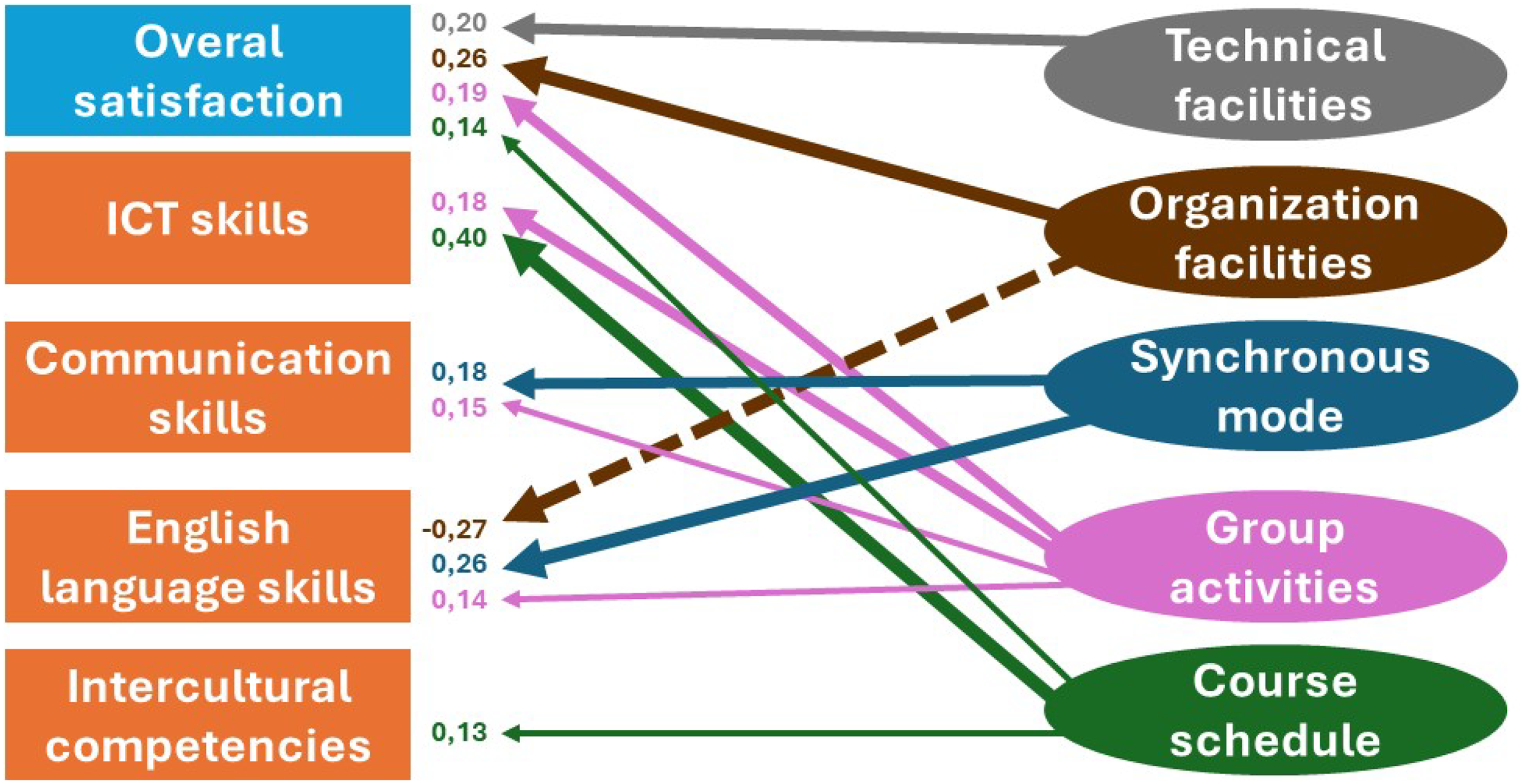
Influence of student's background and aspects of teaching on overall satisfaction and strengthening of competencies based on regression analyses (Beta coefficients). Note 1: Adjusted R Square - Overall satisfaction with virtual mobility 0.34; ICT skills 0.26; Communication skills 0.06; English language skills 0.07; Intercultural competencies 0.01. Note 2: Beta coefficients lower than 0.1 are not shown.
2. What factors influenced the evaluation of VM experience?
What factors influenced the students’ self-assessment of how they had enhanced their competencies during VM?
The relative strength of the influence of several factors on the enhancement of specific competencies through VM was addressed by linear regression analysis. These are: learning conditions (A), including the technical facilities (A1) and organisational facilities (A2), the character of teaching (B), including the synchronous mode of classes (B1) and group activities (B2), and course schedule (B3) (Figure 1).
The measured aspects of VM experience (A and B) had the most substantial overall relative effect on ICT skills (adjusted R square 0.26 = our observed factors explain 26% of the variability of the responses to the dependent variable) and, on the contrary, a minimal effect on intercultural competences (adjusted R square 0.01). Slightly stronger was the influence on the self-assessment in English language skills (adjusted R square 0.07) and communication skills (adjusted R square 0.06). The strength of the influence in the different aspects varies across competencies.
The evaluation of the ICT skills gained from the measured aspects of VM experience (A and B) is most dependent on the quality of the learning experience in terms of its plan (B3) (Beta coefficient 0.40). Including group activities (B2) was also important, but significantly less so (Beta coefficient 0.18). The evaluation of improved English language skills depended mainly on a successful organisation of the VM in the study environment (A2), but with a reversed sign (Beta coefficient −0.27) and on the learning in a synchronous mode (B1) (Beta coefficient 0.26). The acquired communication skills evaluation was most affected by the implementation of teaching in a synchronous mode (B1) (Beta coefficient 0.18) and group activities (B2) (Beta coefficient 0.15). The evaluation of gained intercultural competencies was most influenced by the quality of teaching in terms of its plan (B3) (Beta coefficient 0.13).
What factors influenced the overall assessment of VM? What factors had an impact on the motivation for further mobility? Which categories of students rate the acquired competencies best and worst?
The observed aspects (i.e., learning conditions (A) and character of teaching (B)) explain more than one-third of the variability in overall satisfaction with VM (adjusted R square 0.34). The organisational conditions (A2) (Beta coefficient 0.26), technical facilities (A1) (Beta coefficient 0.20), group activities (B2) (Beta coefficient 0.19) and the quality of teaching in terms of its plan (B3) (Beta coefficient 0.14) represent the most impactful factors. Interestingly, the influence of the synchronous teaching mode on overall satisfaction with VM is insignificant. However, it proves to be significant in the self-assessment of the acquired communication and language skills (Figure 1).
The measured aspects of VM experience, i.e., learning conditions (A) and the character of teaching (B), have a solid overall effect on the motivation for further VM (adjusted R square 0.23). In contrast, they have almost no effect on the motivation for further physical mobility (adjusted R square 0.05). Motivation for further VM depends mainly on the overall experience (Beta coefficient 0.37) and less on the quality of the learning experience in terms of its plan (B3) (Beta coefficient 0.18) and the incorporation of group activities (B2) (Beta coefficient 0.14). Motivation for further physical mobility depends mainly on the implementation of teaching in a synchronous mode (B1) (Beta coefficient 0.33) and on the quality of technical equipment (A1) with a negative sign (Beta coefficient −0.29) (Figure 2).
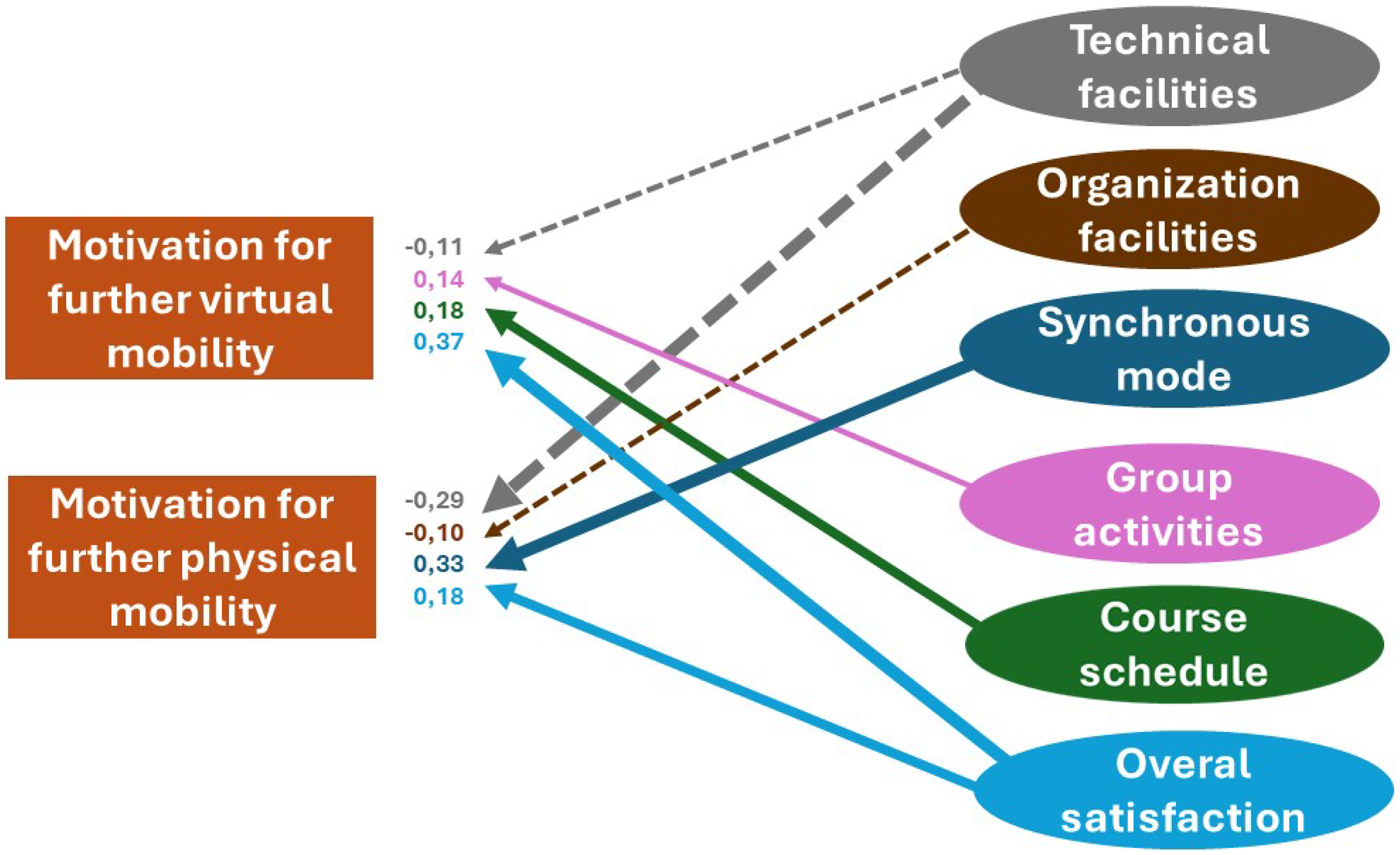
Influence of student's background, aspects of teaching and overall satisfaction on motivation for further mobility based on regression analyses (Beta coefficients). Note 1: Adjusted R Square - Virtual mobility 0.23; Physical mobility 0.05. Note 2: Beta coefficients lower than 0.1 are not shown.
Drawing on research question 2.a, we extend the above results to show how different categories of students evaluate their improvement in specific competencies depending on how they rated the learning conditions (A) and the character of teaching (B) on a five-point scale. The evaluation of the acquired competencies is differentiated mainly by the rating of the character of teaching (B). To a lesser extent, it was influenced by their conditions for learning in terms of technical equipment (A1) and organisation of their duties (A2).
Improving ICT Skills
The evaluation of the acquired ICT skills differs “linearly” according to the evaluation of the learning conditions (A) and the character of teaching (B). The differences are statistically significant. The highest levels of ICT skills enhancement were declared by those who “strongly agreed” that the information on the course content and assessment was communicated in advance (B3) and those who “strongly agreed” that the teaching included group activities (B2). The lowest level of ICT skills enhancement was declared by those who “strongly disagreed” that lessons had been taught in synchronous mode (B1) and that the course information was communicated in advance and remained unaltered (B3) (Table 1).
Self-assessment of the Acquired Skills According to the Student's Background and Aspects of Teaching.
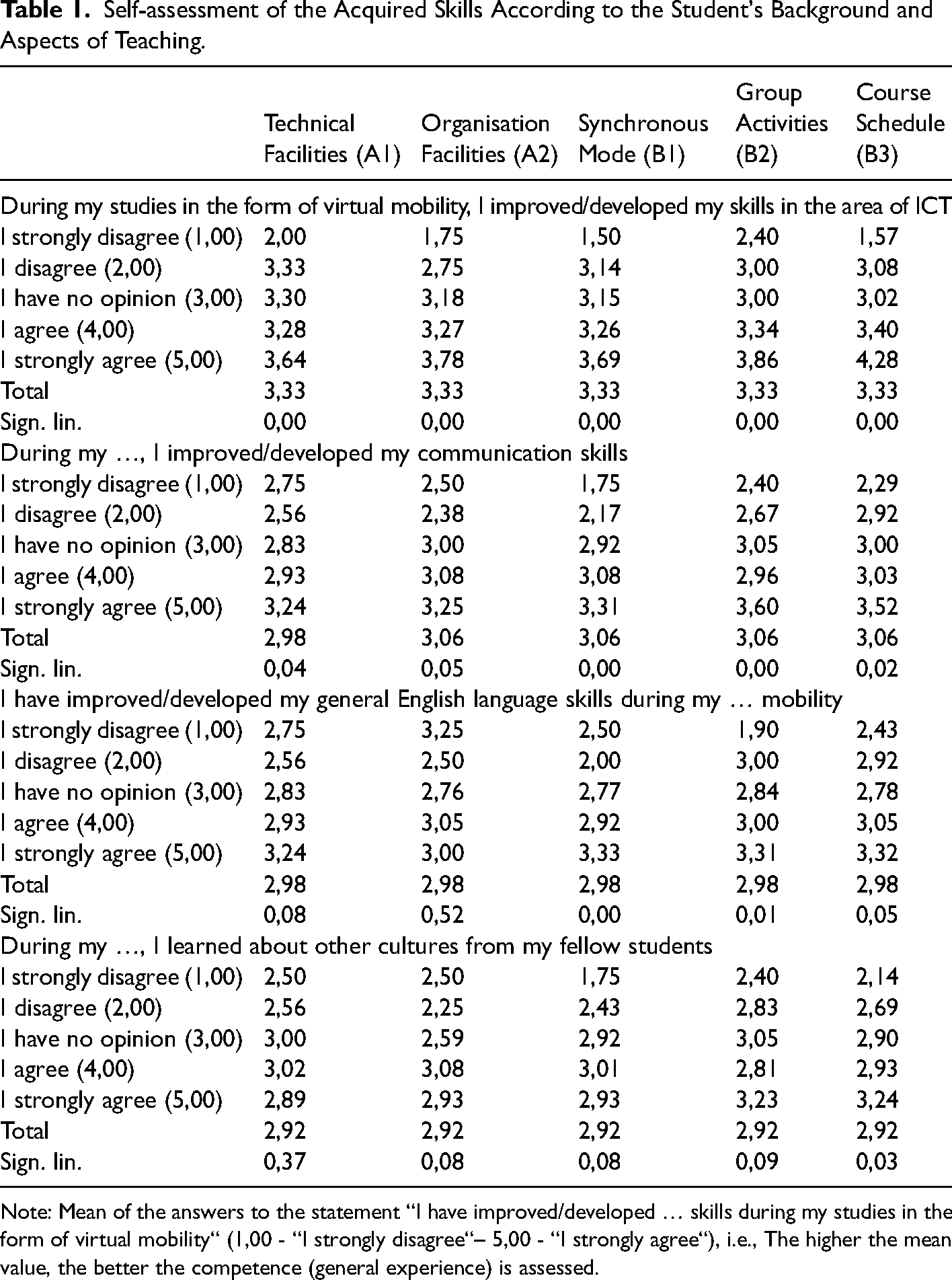
Note: Mean of the answers to the statement “I have improved/developed … skills during my studies in the form of virtual mobility“ (1,00 - “I strongly disagree“– 5,00 - “I strongly agree“), i.e., The higher the mean value, the better the competence (general experience) is assessed.
Improving Communication Skills
The evaluation of the acquired communication skills differs “linearly” according to the evaluation of the learning conditions (A) and the character of teaching (B). The differences are statistically significant, although the statistical significance is weaker than in the case of ICT skills. The highest levels of communication skills enhancement were declared by those who “strongly agreed” the lessons included group activities (B2) and those who “strongly agreed” the information about the study had been communicated in advance and respected (B3). Similarly, those who “strongly disagreed” and “rather disagreed” that the lessons included group activities (B2) along with those who “strongly disagreed” that the lessons were delivered in a synchronous mode (B1) and that course information was communicated ahead (B3), declared the lowest level of communication skills enhancement (Table 1).
Improving English Language Skills
The evaluation of the acquired English language skills varies “linearly” according to the character of teaching (B). The differences are statistically significant, although the statistical significance is weaker than in the case of ICT skills. In contrast, the self-assessment in improving English language skills is not related to learning conditions (A). The highest level of English language skills enhancement was declared by those who “strongly agreed” that the lessons were delivered in a synchronous mode (B1), the course information was communicated in advance and respected (B3), and the lessons included group activities (B2). The lowest levels of English language skills enhancement were declared by those who “strongly disagreed” that the lessons included group activities (B2) and those who “strongly disagreed” that the lessons were conducted in a synchronous mode (B1) (Table 1).
Improving Intercultural Competencies
The evaluation of the acquired intercultural competencies varies “linearly” according to the character of teaching (B). However, the differences are statistically significant only when evaluating the quality of teaching in terms of its plan (B3). On the contrary, the intercultural competencies evaluation does not appear linearly related to the learning conditions (A). The highest level of intercultural competence enhancement was declared by those who “strongly agreed” that the information on content and assessment was communicated in advance and remained unaltered (B3), and the classes included group activities (B2). The lowest level of intercultural competence enhancement was declared by those who “strongly disagreed” that the classes included group activities (B2) and those who “strongly disagreed” that the lessons were delivered in a synchronous mode (B2) (Table 1).
Conclusions and Discussion
This study presents the outcomes of an international survey among three central European universities in the Czech Republic, Poland and Slovakia. In our research, we dealt with the phenomenon of VM representing a progressive learning/teaching format and its benefits/challenges in the enhancement of twenty-first-century skills for the students in SSH in the European context. For analytical purposes we used the definition of VM provided by Bedenlier and Marín (2021) and Dietrich and Besana (2023) and we draw on selected categories of skills for the twenty-first century presented in Binkley et al. (2012) and Suto and Eccles (2014), taking into account the emphasis on specific areas of VM potential contribution made by Bedenlier and Marín (2021) and others researching international online formats (e.g., Bruhn-Zass, 2020; Buiskool & Hudepohl, 2020; Helm & van der Velden, 2019; Iucu et al., 2022; Kearney & Gras-Velázquez, 2018; Otto, 2018; Ruiz-Corbella & Álvarez-González, 2014; Sabzalieva et al., 2022). We were particularly interested in students’ perspectives on skills development enhanced by VM (Rajagopal et al., 2020).
Our analysis focused on 1/ overall satisfaction, 2/ four selected competencies, 3/ two aspects of VM experience (learning conditions and the character of teaching) and 4/ motivation for further mobility. While the competencies acquired during VM are also dependent on the character of teaching (B), according to our data, overall satisfaction depends to a much greater extent on the learning conditions (A). The competencies (ICT, communication, English language skills and intercultural competencies) in which students believe they improved the most are ranked in descending order (according to the average self-assessment), with an indication of the factors that had a positive and negative impact on the self-assessment. The most pronounced influence was observed on the positively rated character of teaching (B), especially if the plan of activities was declared in advance and respected (B3), the lectures were delivered in a synchronous mode (B1) and involved group activities (B2). Hence, it follows that the most enjoyed lectures were those where students participated in discussions and collective tasks. The influence of technical equipment (A1) and the organisational background (A2) on the self-assessment is weaker on the whole. Since the VM students do not have the chance to visit the students’ centre/department beforehand in person, we suggest communicating the content and assessment beforehand and sticking with is a crucial move that impacts the VM results. The course plan (B3) represents an important factor for developing competencies. We may assume that seeing the list of activities and requirements in advance allowed the students to prepare themselves also in terms of ICT equipment/software usage. Surprisingly, the students declared the highest strengthening in ICT skills. It is supposedly due to the fact that VM shed a light on this particular dimension, thus challenging the students to adapt swiftly to succeed under the given circumstances. On the other hand, we observed relatively low progress evaluation in intercultural competencies and communication skills. In the case of the asynchronous mode of teaching (B1), the marked progress in the areas of intercultural, communication and English language skills was low. The low rates in self-assessment measures in this area may suggest it was specifically the intercultural competencies that the students expected to improve the most during their VM. It is, at the same time, safe to assume that due to the necessity of switching to VM during the Covid-19 pandemic, many courses were, as a matter of fact, underdeveloped in terms of teaching the intercultural competencies (comp. Bruhn-Zass, 2022; Montes et al., 2011, p. 2). While considering these arguments, we remain positive, along with van Hove (2021) and Buiskool and Hudepohl (2020) that virtual formats have a good potential for developing international/intercultural competencies and soft skills. Suppose the teachers wish to succeed in having an impact on communication/language and intercultural competencies in their VM students. In that case, it is advisable to include discussions and group activities in which the students can also learn about their fellow students’ cultural background. In our understanding, it seems to be in the interest and responsibility of SSH faculties to provide instruction on how to teach these soft skills for the twenty-first-century globalised world.
The overall VM experience depends on the learning conditions, where the technical equipment (A1) and organisational conditions at the place of study (A2) are the most critical factors of the evaluation. The character of teaching (B), having the teaching plan beforehand (B3), and group activities (B2) were of a lower importance to the overall satisfaction. Baranowski and Jabkowski (2023) claim that the data showed low interest in further VM. Our findings complement this claim by adding that the overall evaluation strongly influences the motivation to pursue more VM. The group activities (B2) and the information on the learning plan available to the students beforehand (B3) led to a higher interest in the future VM. The results show that VM stimulated interest in physical mobility when students experienced studying in a synchronous mode (B1), and they provided a negative evaluation of their technical equipment (A1). If the student did not have adequate learning conditions (A), the overall VM experience was rated negatively.
These results suggest it is not so straightforward that VM can overcome the inequalities in access to education. Our research exemplifies the digital divide, as identified by UNESCO (Sabzalieva et al., 2022) as one of the biggest persisting challenges to VM. We do believe VM creates a chance to undertake an international mobility for those who otherwise could not. Nevertheless, our data demonstrate that if students do not have the right conditions for studying (quiet study environment, technological facilities, stable internet access), they are less likely to evaluate their mobility positively. In that respect, our findings do not align entirely with the idea that VM and similar formats secure social inclusion (Iucu et al., 2022, p. 9; Ruiz-Corbella & Álvarez-González, 2014). Unequal distribution of ICT infrastructure and support (Sabzalieva et al., 2022) exists not only on a global scale. There are persisting inequalities on each country's level, which may affect students from disadvantaged social backgrounds when studying from home. The inequalities, however, may be significantly evened out when learning takes place on campus. Therefore, we suggest that the institutions supporting VM consider this option. There is no doubt that if we are to reach the goal set for the year 2025 by the European Commission within the Erasmus + programme KA2 to have at least 50% of the students benefitting from either physical or blended/virtual mobility (Iucu et al., 2022, p. 9; Sabzalieva et al., 2022, p. 13), there needs to be much more support for the formats that use ICT internationally. However, it requires much broader support and investment in creating ICT infrastructure. What remains to be answered is how to support individual disadvantaged students who, in times like the pandemic of Covid-19, might not have access to sufficient technological means in their home setting or the campus.
We hope to stimulate further the debate on VM and its benefits in HE. Much of our results and recommendations can be applied, as we believe, in the context of related formats of online international education such as COIL, MOOCs or VE. More research on VM needs to be done on profession-specific skills/knowledge development or civil life domain. Last but not least, in the area of soft skills, more qualitatively oriented contributions shall be of value.
Footnotes
Funding
The authors disclosed receipt of the following financial support for the research, authorship, and/or publication of this article: This study was supported by the ERASMUS+project Enhancing Quality Teaching of Humanities and Social Sciences in Higher Education for 21+, registration no. 2021-1-CZ01-KA220-HED-000031122, at the Philosophical Faculty, University of Hradec Kralove.
