



Abstract
Transnational higher education (TNHE) of UK universities has been noticeably expanding during the last two decades in the Arab Gulf region, but few studies investigated qualitatively the different ways in which students in that region experience both teaching and learning. The aim of this study is to understand the ways that students conceptualise their learning and educational experiences at a British TNHE in Qatar. Employing a phenomenographic approach, we interviewed forty students in a TNHE UK programme within a Qatari higher education institution (HEI). The outcomes of our interviews generated three hierarchically related categories as follows: developing academic skills, acquiring self-learning skills, and acquiring employability skills. Our findings also suggest themes of interdependence in learning and transferability of skills developed by students. This study offers HEIs a better understanding and insight into the design of TNHE programmes that would respond to the students’ learning experiences and educational development.
Introduction
In this study, we look at how students feel a British TNHE programme is contributing to their learning and educational development by using the phenomenographic approach to look into students’ different conceptions or understandings of their educational development experiences in the programme. The primary question of this research was ‘What are the learning and educational developmental experiences of undergraduate students enrolled in a British TNHE programme that is based in Qatar?’ Researching students’ learning and educational development experiences could lead to a broader understanding of what TNHE programmes can offer students, and how to improve the design of these programmes to support the host country's vision. The scope of this paper does not allow for a detailed discussion of different aspects of TNHE due to confidentiality issues; therefore, the focus is on students’ learning experiences and educational development. The findings could be taken to understand the development of skills of students not only in Qatar, but also within the Middle East region with neighbouring countries who share similar cultural, political and economic characteristics.
TNHE is commonly known as a form of internationalisation of HE, referring to HEIs that award their degrees to students located in a different country (Shams, 2017). Whilst the structure of TNHE may vary between franchising and distance learning, the articulation arrangements approach seems to be the most common (Szkornik, 2017), in which providers in different countries allow students to gain credit from an institution other than that which is awarding the qualification (Brandenburg, 2012). What is noticeable is that TNHE multiple dimensions and aspects could differ from one programme to another due to the complexity involved between the host country and the home country of the institution (McBurnie, 2007), and even though TNHE providers tend to market their programmes as having the same quality and standards as the main campus, multiple studies such as (Bordogna, 2018; Edwards et al., 2010; Heffernan et al., 2018; Maxwell-Stuart & Huisman, 2018; Seawright & Hodges, 2016; Szkornik, 2017; Wilkins, 2020; Wood, 2011) have found various differences across student learning and their overall university experience.
TNHE programmes have noticeably expanded during the last three decades across the globe (Brandenburg, 2012) where the higher education (HE) sector in Western countries has been negatively impacted by drastic cuts in public expenditure, thus universities prioritised alternative funding models by targeting new markets and promoting the provision of quality education. According to Wilkins and Neri (2019), the scale of TNHE programmes and recruiting students to study abroad has grown significantly, especially in Asia and the Gulf, where British, Australian, and American institutions have the highest number of offshore programme partnerships in these regions. Miller-Idriss and Hanauer (2011) state that countries in the Middle East were one of the key target markets for TNHE proliferation due to the need to reform education initiatives, which began over the last two decades, and of TNHE programmes currently taught globally, one-third are in the Arabian Gulf. According to Mohamed and Morris (2021), countries in that region have ranked below average when it comes to international standards’ examination, such as the Programme for International Student Assessment and Trends in International Mathematics and Science Study, and additionally, the overall national ranking of public universities across the Middle East is considered below average in terms of international standards, such as rankings in QS World, Times Higher Education and Shanghai Ranking (QS Top Universities, 2020; Shanghai Ranking, 2020; Times Higher Education, 2020).
Qatari TNHE Context
In Qatar, the government invested heavily in the HE sector by attracting foreign HE providers to establish operations within its borders. In 2008, the Emir of the State of Qatar launched the Qatar National Vision 2030 (QNV, 2030), which had ambitions to transform the tiny state into a sophisticated and advanced society capable of providing a high standard of living in the areas of health and human development, economic development, and environmental development (Planning Statistics Authority, 2020). One of the acute needs that QNV 2030 identified is the necessity of a highly educated and skilled Qatari national workforce to fill the high demand for skilled labour across sectors. According to the Planning Statistics Authority (2020), the total population of Qatar was approximately 2.7 million in 2019, with an estimated ethnic Qatari demographic of less than 15% of the overall population. Qatar has therefore focused on employing large numbers of expatriate professionals to meet the immediate demands of the labour market. Further, expatriates comprise a significant 94% of Qatar's total workforce across various sectors, both private and public. As a result of the need to diversify and stimulate economic activity within the country, the government has invested in human capital by providing beneficial training and high-quality education through the implementation of an initiative to reform the country's K-12 and postsecondary educational systems (Ahmed, 2019). The newly established strategic goal of education is to replace expatriate professionals with native Qataris, a process called ‘Qatarisation’. This reform is anticipated to provide Qataris with high-quality education and the necessary skills through multiple postsecondary programmes readily available to citizens (Khalifa et al., 2016). The government, since 1997, has also worked on establishing partnerships with reputable HE institutions (mostly from the United States and the United Kingdom) to open branches in Qatar which costs Qatar more than $400 million annually on hosting branch campuses of six leading US universities (Havergal, 2016). Currently, there are more than 20 international HEIs offering a range of specialisation and degree programmes with the aim of providing citizens and residents with a high-quality education (Ministry of Education & Higher Education, 2020). Some studies have explored the student experience of branch campuses in Qatar and highlighted the importance of family influences in choosing a higher education pathway and the tensions faced by Qatari students as they negotiate being a ‘home’ student on an international campus (Alkuwari, 2019). However, despite TNHE's popularity in that region and particularly in recent years in Qatar, few studies have explored the students’ learning and educational development experiences in such programmes.
The paper will first look into relevant literature about student learning in international education and then describe the methodology and approach. Having analysed the data which emerged from the interviews, the findings of the study will then be discussed.
Literature Review
When critically analysing the literature regarding TNHE and internationalisation, there appears to be quite a significant amount of research of TNHE at the institutional level that discusses different issues, such as globalisation and TNHE development (Mok et al., 2018), quality assurance of TNHE programmes (McBurnie, 2007), student satisfaction (Ahmad, 2015) and the teaching challenges of flying faculty (Szkornik, 2017). In Qatar, Ahmed (2019) explored the effects of the globalisation of international education, including TNHE and branch campuses, on Qatari society, and reported that many people still think that the Western model of education could disrupt Qatar's historical Arab-Islamic values. Additionally, Seawright and Hodges (2016) stated that use of the English language as a medium of instruction in the Middle East has caused frustration and resistance from students, parents and members of the community. Therefore, TNHE is a highly complex environment which could impact various facets of society, and requires a highly collaborative arrangement between all stakeholders involved (Bordogna, 2018).
There have been a number of studies that have discussed learning and teaching in TNHE with a focus on students’ learning styles and cultural differences (Heffernan et al., 2010), as well as faculty teaching development experiences (Keevers et al., 2014). However, there is limited research investigating students’ learning experiences and educational development conceptions within TNHE (Liu et al., 2021), particularly in British TNHE programmes within the Middle East context. Therefore, this paper will focus on a smaller body of work that discusses students who are studying in international education programmes by looking into studies that researched students’ learning and educational development experiences, academic language challenges, choices and satisfaction.
Cultural Experience
Most of the studies that discussed TNHE or offshore experiences focused fully or partially on the cultural impact of these programmes and suggested that universities intending to go offshore should start by considering the cultural differences in the host country (Bordogna, 2018; Dale, 2005; Heffernan et al., 2010; Kosmaczewska, 2020; Lemke-Westcott & Johnson, 2013; Liu et al., 2021; McBurnie, 2007; Nghiêm-Phú & Nguyễn, 2020; Seawright & Hodges, 2016). Students’ learning experiences could differ from one country to another due to the culture of the host country, the cultural background of the flying faculty, and the internationalisation of the curriculum, which could lead to a mismatch in teaching methods and students’ learning styles (Lemke-Westcott & Johnson, 2013). For example, Money and Coughlan (2016) examined students’ learning experiences regarding having more than one lecturer teach a subject and found that students preferred modules which were delivered by a single lecturer due to the consistency of teaching style. In the case of TNHE partnerships, however, students are exposed to more than one faculty member per module, which might cause confusion and instability in their learning. Conversely, multiple lecturers could provide multiple points of view to students and increase their knowledge.
In their study, Lemke-Westcott and Johnson (2013) examined Qatari and Arab students’ learning styles at a Canadian university located in Qatar, wherein all the faculty were Canadian, and found that students experienced ‘culture shock’ in their initial year of study when trying to adapt to new learning systems, but Prowse and Goddard (2010) examined the cultural context of a transnational post-secondary program offered by the Faculty of Business at a Canadian college, with campuses located in both St. John's and Doha and found that the resulting teaching strategies appear to represent successful pedagogical adaptations to cultural context. Nevertheless, it is concluded that most TNHE programmes in the Middle East are facing cultural challenges due to students’ previous learning experiences in Middle Eastern elementary through secondary schools. Both students and teachers had different expectations towards each other, which caused a mismatch when it came to the preferred style of teaching and learning.
Language and Other Academic Challenges
In investigating the challenges facing students attending an international university in Qatar, Khalifa et al. (2016) reported students’ struggling with the English language and understanding courses at the university level. This could be the result of using Arabic as a teaching language in most courses delivered in secondary public schools in Qatar. Similarly, Ellili-Cherif and Alkhateeb (2015) investigated the outlooks of 295 college students in Qatar concerning the shift in the language of instruction from English to Arabic and found that students preferred Arabic as a medium of instruction, even though they valued the English language, as it helps with their future job prospects in comparing to Arabic. This raises a question regarding students’ learning when studying in a foreign language and what specific skills students need to succeed.
Similarly, a study conducted by Yang (2012) which explored Chinese students’ learning experiences when studying at a TNHE programme in an Australian university in China, reported students’ difficulties in learning due to a lack of English-language proficiency, localisation of course content and the lack of recognition of different experiences. Due et al. (2015) found that language differences have a huge impact on students’ learning and is one of the main causes of academic stress. Furthermore, Wang (2005) investigated Chinese students’ learning experience in an Australian TNHE programme and demonstrated that students developed a more complex understanding of learning during their studies. However, compared to the context of other Arab countries in the Gulf, mainly UAE, it appears that different national policies have an impact on student experience as language was not reported to be an academic challenge for students of TNHE programmes (Mikecz Munday, 2021).
International Experience
Different studies have discussed the key motivating factors for students choosing to participate in an international programme, and most indicate that students opt for TNHE programmes that provide suitable international employability skills (Fang & Wang, 2014; Liu et al., 2021; Mahmoud et al., 2020; Wilkins et al., 2012; Wu & Myhill, 2017). According to (Mok et al., 2018), students’ main intention for joining TNHE programmes is gaining international experience that will enhance their future job prospects and career development. Pyvis and Chapman (2007) found that students desire a ‘self-transformation’ of their outlook and identity to improve their employment prospects. Other studies reported similar results (Jeckells, 2021), and other such as Trahar (2015) proposed that many universities now want to include an international dimension in their curriculum to enhance global skill building and to improve intercultural relations in mixed classrooms across countries. Although this is not directly the focus of this study, this angle could offer insights into general student experiences. Other studies that have discussed students’ experiences in TNHE programmes have focused on student satisfaction (Leung & Waters, 2013; Shah & Nair, 2011; Sid Nair et al., 2011), and studies such as (Ahmed, 2019; Khalifa et al., 2016; Khodr, 2011; Romanowski & Nasser, 2015; Walker et al., 2016; Wilby et al., 2015) focused on concepts of TNHE substantiality, academic adjustment and policy drivers supporting TNHE expansion in Qatar. In addition, most of the studies discussed focused on negative learning experiences when studying in international programmes.
Methodology
Phenomenography Approach
This study was inspired by a qualitative interpretivist approach ‘phenomenography’ to identify the different ways in which students understand specific phenomena in the world (Bowden, 2000; Marton, 1997). These phenomena can comprise a specific concept, such as the value of a product (Pang & Marton, 2005), or it can be a more general experience, such as students’ learning and development experiences in a specific discipline. According to González (2010), phenomenography is concerned with developing a hierarchically structured set of categories from the data gathered which represents people's alternative ways of understanding a phenomenon. Additionally, phenomenography focuses on describing the ‘collective consciousness’ regarding a phenomenon (Marton, 1997). One of the strengths of the phenomenographic approach is that it offers detailed structural descriptions of learners’ understandings, which may provide educators and policymakers with insights regarding superior implementation and design of learning experiences for their students (Streitwieser & Light, 2018).
Since its development in the 1970s, phenomenography is considered an important research design within HE, in particular for researching learning and teaching. Moreover, the phenomenographic approach is the only research design to have been created and developed within the HE fields (Tight, 2016). The approach is appropriate when the main objective of the research is to investigate different ways of viewing or looking at a phenomenon within a specific population (Marton, 1994); Prior studies (such as Akerlind, 2005; Bowden, 2000; Khan, 2014) recommended that interviews are the best methods to collect and analyse data using the phenomenographic approach
Participants
Forty students from Doha/Qatar enrolled in the undergraduate programme at QFBA-NU (the British TNHE programme located in Qatar) were interviewed online. For this study, participants needed to have had the experiences of studying at a British TNHE programme. The sample size was deliberately selected with respect to phenomenographic research conditions: a good number of samples to ensure the discovery of variation, but not so large as to make it difficult to manage the collected data (Bowden, 2000). Students were purposefully selected to identify the maximum variation of understanding of the learning experience at the British TNHE programme, with a range of genders, disciplines, years of study, and duration spent at the university. The participants’ gender breakdown comprises twenty-six males and fourteen females. The sample consists of eight students in their first year (level 4), sixteen in their second year (level 5), and sixteen in their final year (level 6), as per the UK qualification and framework system (QAA, 2020). The distribution of the sample included twenty-eight students majoring in Finance and Investment Management and twelve students majoring in International Banking and Finance.
Data Collection and Analysis
The interviews were in-depth and semi-structured, following a set of 10 main questions that were asked to all students with follow-up questions used to probe for participants’ deeper awareness and experiences whilst studying in a British TNHE programme. The interview commenced with basic background questions and discovering the reasons why they wanted to pursue their study in the QFBA-NU TNHE programme before transitioning to reflecting on the meaning and value of their learning and educational developmental experiences. Moreover, the introduction included discussing with students what TNHE means and the aim of this study to provide direction and context.
Each interview ranged in length between 30 to 45 min and was conducted in English. Though all students were asked if they preferred to answer in Arabic, all of them decided to engage in English. The interviews were recorded using a PC recorder and were professionally transcribed.
The analysis process (see Figure 1) was manual and included five main steps guided by (Akerlind, 2005; Bowden, 2000; González, 2010). The steps included the following:
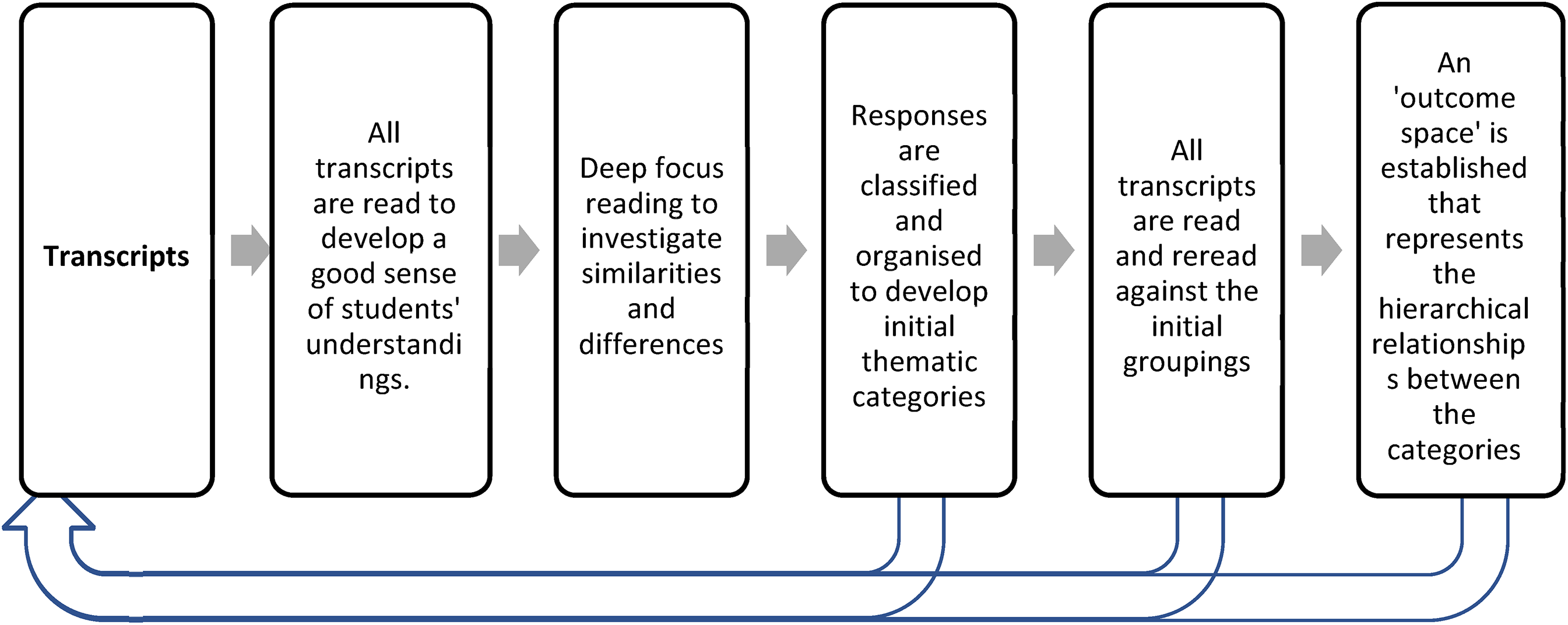
Data analysis process of the research guided by (Akerlind, 2005; Bowden, 2000; González, 2010).
Findings
The analysis of the transcripts yielded three categories of student conceptions or accounts of learning and educational development. Across these categories, students described their learning and educational development experiences, identifying different aspects of learning and development at the British TNHE provider in Qatar with a focus on skills. The categories have been given descriptive titles: developing, acquiring, and applying.
Category 1: Developing Academic Skills
Students’ accounts that emerged from the first category describe learning and educational development at a British TNHE in Qatar as a way to develop a set of academic skills. These academic skills include being able to use the library website and other search engines to search for books and published articles; writing in an academic fashion, including proper structure, appropriate use of citations, and referencing other works; and using the English language in reading and writing with a good academic writing style. As mentioned earlier, most of the students who are enrolled in QFBA-NU are Arabs and English is considered their second language. In addition, writing detailed articles in English was considered a new skill and was described as significantly more complex than at the high school or diploma level. Students also described that their level of academic skill is developing with time between one semester to another, and due to the increase in the number of assignments. Examples of students’ views: ‘For me maybe I wasn't actually ready for all this heavy literature review, it was challenging because we have to read and write in English which is not easy for non-English speaker … I’ve learned how to search and read’ (Level 4).
‘Students need to manage their time probably and also they need to do a lot of research … you need to like your studies, your topic you will need to read a lot about it’ (Level 5).
‘QFBA-NU is heavier a little bit, it's more than previous college … in one semester I got …I think four research projects, which means it's more that what I used to before…university… it pushed me to the limit and developed my writing, reading, and researching skills’ (Level 6).
‘It was a challenge because we weren't or I wasn't actually used to the curriculum and how the structure of the university, the materials, the learning materials so it was a challenge to be honest I was speaking for myself…heavy literature review…so coming from that area actually as a double major graduate coming to a 4th year literature research based system was really heavy challenge and…I have to read …’ (Level 6).
‘…to manage your time, you need to do a lot of research, referencing, reading but also writing an assignment is a good thing it will improve your knowledge and experience you’ll see more than 1 opinion on your subject on your matter…say if you want to learn or you want to explore you need to read. Reading in the university library, or you need to research in the internet to find the information this learning style… it change my learning style so now I like reading…Every day I open 1 of the financial website I go through it I read a financial reviews, this one let's say the 2 year experience its adding something new to my learning style’ (Level 5).
Category 2: Acquiring Self-Learning Skills
In this second category, learning and educational development at a British TNHE in Qatar is seen as an opportunity to acquire the ability to research information and expand one's knowledge beyond the structure of the module. Whilst this category is inclusive of the first category of developing academic skills, students’ accounts in this category also involve watching online videos about certain topics and using technology and international media, which helps when it comes to participating in class discussions. In addition, for participants, learning and educational development meant engaging with the literature and exploring different ways to learn the material through more than just attending classes and completing assignments, in other words, it involved being responsible for self-learning and development. Students in this category considered themselves to be self-learners who seek knowledge for its own sake by using different kinds of tools beyond the curriculum and engaging with ideas through participating actively in classes: ‘So yeah, my learning style actually changed. I can understand the material online on YouTube, there's really good people out there that can teach you the modules, teach you different styles on how to learn the thing… you don't need to just go by a book and just memorise you can go online and understand’ (Level 4).
‘So the university did a really good job in preparing the PowerPoint structure in each module, but for me I use YouTube for example to learn my modules. I use a lot of journals to learn about my modules. So it's actually really good because they gave the students the flexibility to self-study and self-direct inwards for the assignments’ (Level 5).
‘Attending class would not be enough for you to gain knowledge and experience to pass with good marks in all of your modules, so you need to do a lot of research, you need to like your study, you will need to read a lot about it all by yourself. I started watching movies about finance after I joined QFBA-NU’ (Level 6).
‘…for me I use YouTube for example to learn my modules I use a lot of journals to learn about my modules…’ (Level 6).
‘… I learn how to depend on myself, of teaching myself, on finding the information by myself… I know how to depend on myself its much difficult than other university, but I think it will prepare me for real life…’ (Level 5).
Category 3: Acquiring Employability Skills
Students’ accounts from this category are related to employability; students conceptualised learning and educational development in a British TNHE programme as an opportunity to apply the knowledge and skills which are necessary to obtain jobs. Aspects that arose from this category focused on being practical, the ability to apply knowledge and skills, and readiness for jobs: ‘Here in QFBA-NU we did a lot of simulations, like we are doing trades. A trading demo in a lab or ISO, QFBA-NU specifically are giving you the best practical experience so when you graduate from this university, you’ll be ready for a job’ (Level 5).
‘I’m able now to say my opinion and discuss different perspectives. I think this will help me a lot in the job’ (Level 5).
‘Most of our courses, you know, it's all practical. You need to do—you need to create a demo portfolio, you need to do a trading demo, you will evaluate your trading, you will evaluate your portfolio. So, all of this stuff they are doing it in a real job’ (Level 6).
‘… yeah, I’ve learned a lot of it actually I entered in national market in real life buying stocks and commodities.so I learned a lot’ (Level 5).
‘…first of all, what I feel that here the British University they are more practical…But here in Northumbria we are doing a lot of stimulation …at least you will have a good background on what happen on the real job’ (Level 6).
‘…it provides me with a better option to develop my career when I have an international education certificate from an international known university…so I feel that one also in way a positive thing because help you to apply later on, on your career and how is coming from public education for example in school also maybe you know is totally different out…’
Relationships Between the Three Categories
Independence in study and learning skills increases from category 1 to 3. As shown above, students in the first category have lower independence compared to categories 2 and 3. In category 2 there is a higher level of independence and students were actively looking for answers on their own without the help of others. In category 3 the students demonstrate very high independence and confidence in their ability to do the work. These students also demonstrate more confidence regarding job readiness.
It is also possible to see a relationship amongst all categories regarding the transferability of knowledge, skills, and abilities. One very clear common factor indicates that students can move from education (category 1) to work (category 3) to be successful in their endeavours. Even though categories 1 to 3 show inclusivity, some students might experience difficulties in moving from one category to another. In addition, students might take longer to reach the milestone for each category. During the interviews, some students mentioned that support from faculty and their peers at the beginning of their university journey assisted with their academic development. ‘I received support from the faculty [and] also my peers [at] the university. I managed to g[et] through—I challenged myself’ (Level 5).
‘I like how they present Northumbria …they push you to certain area that you not went before …’ (Level 6).
Additionally, students focused on the importance of self-study to gain their degree and job readiness. Therefore, some students might remain in a category if they lacked enough support and the willingness to be independent (i.e. focus on self-study). This also indicates that categories are not necessarily connected to the year of study; some students in level 6 might still face difficulties in developing academic skills, which will delay their development of self-learning and employability skills, while a level-4 student might go all the way from category 1 to category 3 quickly. Students’ accounts describe the transferability of knowledge and skills into practice, which helps them prepare for employment. It could be argued that the connection to work is not clearly mentioned in the first two categories, but it is an implicit understanding that undergraduate students would develop employability skills to secure meaningful employment post-graduation. However, some students argue that there was a lack of focus on local cases that reflect the Qatari context: ‘…but some of the programs some of the module inside, especially this course there's something that is not related to our economy here in Qatar and all about UK economy so it should be I think amended or something…’ (Level 5).
Discussion
The findings reveal a complex typology of three distinct (but related) student conceptions of learning and educational development.
The conceptions of the first category echo the findings from previous studies (Khalifa et al., 2016; Walker et al., 2016; Yang, 2012) which revealed that students encounter academic challenges when studying in international programmes. These academic challenges for students could be as a result of the lack of English proficiency, which was pointed out in students’ accounts regarding difficulty in reading and writing in English. However, even though these negative challenges were raised, when we look into the collective meaning of students’ accounts about their learning and educational development experiences at a British TNHE, students conceptualised learning and educational development as a way of developing academic skills that lead to success in such a programme. In addition, students value the English language and see it as way to get future jobs, which aligns with (Ellili-Cherif & Alkhateeb, 2015). Furthermore, in their study, Crossman and Clarke (2010) specified the importance of English when it comes to job requirements. Employers tend to prefer graduates with English language knowledge. Such graduates are more employable than others who are not bilingual. In brief, this indicates the dominance of the English language as the ‘lingua franca’ of the business world (Chan & Dimmock, 2008).
Students also conceptualise learning and educational development as a process of acquiring self-learning skills. This conception associates learning and educational development in a British TNHE programme with acquiring knowledge and skills by themselves, enabling students to search for knowledge from different sources and develop their skills without the support of others.
Our findings on the conception of students’ learning experience and educational development are in line with the idea of Knight and Yorke (2003) that employability skills are related to a good quality of learning in HE. Students in this study view learning and educational development in a British TNHE programme as essential to building their employability skills, which positively impacts their future employment. According to Crossman and Clarke (2010), employability skills are defined as the ability to use skills and knowledge to find a job, which is also associated with individual characteristics and behaviours that are necessary to maintain a job. The findings of this study also align with the literature (Mok et al., 2018; Wang, 2005) that found that students who studied in international programmes, including TNHE's, develop employability skills and expand their knowledge. This clearly indicates that the QFBA-NU programme is in line with the QNV 2030, which aims to develop a highly educated and skilled Qatari national workforce. Students’ experiences in the QFBA-NU programme demonstrate how students transform their knowledge into practical skills, which can contribute to the national workforce and the wider economy.
Students did not seem to focus on certain aspects of the TNHE experience that much of the studies in the literature review touched on, such as the cultural experience and ‘culture shock’ issue that has been discussed in studies such as (Lemke-Westcott & Johnson, 2013; Romanowski & Nasser, 2015; Streitwieser & Light, 2018; Wilby et al., 2015). Perhaps most students are Qatari, so they are not experiencing the kind of cultural diversity from they might learn intercultural competencies. Additionally, based on the generated themes, the students did not identify other benefits or conceptions of studying in an international programme, such as maturation, self-development, international curricula and self-actualisation. Students in this small sample tended to display an instrumental connection between education and job-readiness. This instrumental connection and correlation between academic pursuits and employment contrasts with the Mustafa et al. (2018) study of Qatari students who valued the quality of education, cultural values and academic costs as key factors towards their academic choices. Further, this instrumental connection to employability could be as a result of Finance students adopting a return-on-investment mindset (finance concept) towards their education. This is in line with Muddiman (2018), which found that business students in both Britain and Singapore undertake tertiary studies for the purpose of being employable. It could therefore be argued that students demonstrated a homogenous mindset due to a lack of diversity of disciplines offered by the institution.
Limitations, Recommendations and Future Research
This study could contribute to the broader knowledge of students’ learning and educational development experiences within the transnational context. It could also add value to the ongoing debate on conducting phenomenographic research, which clearly identified several aspects which could help TNHE educators and administrators to better design policies in their practices. The study provides a better understanding of students within the TNHE context in the Middle East region, where one-third of the world's TNHE providers are located (Miller-Idriss & Hanauer, 2011).
It is important to acknowledge the limitations of this study. The number of participants was relatively small and collected from just one British university. It is possible that with a wider sample from multiple universities, other critical aspects may emerge. However, a sample of 40 is not uncommon in phenomenographic research (Trigwell, 2006). It is also important to note that the learning and educational development experiences described by participants may not reflect on other TNHE programmes in Qatar, such as American and Canadian programmes or local HE provider. Whilst experiences in other TNHE programmes in Qatar could be similar, it is important to acknowledge that further studies regarding students’ learning and educational development experiences in such programmes may identify other conceptions not found in this investigation.
The findings of the study highlight some recommendations to enhance student experience of teaching and learning in TNHE programmes. Based on the three categories, TNHE managers could better articulate a more structured learning journey for TNHE students that would be more appropriate for each level of learning. For example, developing academic skills could be more appropriate for level 4 students, acquiring self-learning skills for level 5 students, and acquiring employability skills for level 6-students. When it comes to acquiring for employability skills, TNHE programmes need also to reflect the realities of the local market and cases (Qatari context), not the UK context only.
Conclusion
This study was motivated by the limited research on students’ deeper understanding of their learning and educational development experiences in British TNHE programmes. The study highlights the relationship between TNHE programmes and acquiring skills that could benefit students towards employability. Additionally, categories show relationships characterized by themes of independence and the transferability of skills. In brief, students conceptualise learning and educational development at a British TNHE as an opportunity to develop the skills that are necessary for jobs and future success in their endeavours. The findings of the study align with the Qatar's vision to attract international universities to upskill the national workforce across various sectors. Further studies regarding TNHE graduates’ performance in work settings will provide rich information regarding the quality of learning in TNHE programmes and whether graduates have the skills needed to positively contribute to the workforce. In addition, this study offers TNHE managers rich qualitative output to better understand students’ educational development experiences within the TNHE system in Qatar.
Footnotes
Declaration of Conflicting Interests
The author(s) declared no potential conflicts of interest with respect to the research, authorship, and/or publication of this article.
Funding
The author(s) received no financial support for the research, authorship and/or publication of this article.
