




Abstract
To prepare students for an increasingly globalized world, intercultural group work (IGW) holds promise as a pedagogical tool, because it may help them develop intercultural competence and second-language proficiency. These skills also are needed to complete the discipline-specific aspects of group work successfully. This study investigates the extent to which cultural intelligence (CQ), English language proficiency, and personality contribute to students’ cognitive engagement in IGW. A questionnaire was completed by 846 students from six universities in the Netherlands and Canada. Structural equation modeling analyses revealed that CQ and the personality trait of openness are the strongest predictors of cognitive engagement. English language proficiency is a relatively weak predictor. The development of CQ thus should be actively promoted to enhance students’ cognitive engagement in IGW.
Keywords
Introduction
Higher education institutions facilitate an intercultural, international learning and research environment that offers many opportunities to enhance student learning and develop key competencies for a highly connected and globalized world (Denson & Zhang, 2010; Leask, 2016). Many universities are including the development of intercultural competence and global citizenship in their graduate attributes and mission statements, thereby fulfilling societal and economic roles by preparing their graduates to participate effectively in diverse societies. Internationalization of the curriculum and internationalization at home provide an inclusive context for both home and international students to develop those learning outcomes (Leask, 2016).
Intercultural group work (IGW) is a promising pedagogical tool that equips students with these competencies and attitudes. Participation in IGW exposes students to diverse cultural perspectives, communication styles, and ways of working—all of which, over time and with proper guidance, may contribute to the development of intercultural competence (De Hei et al., 2020; Liang & Schartner, 2020). Group work settings that require students to learn and communicate in a shared language enhance the language skills of non-native speakers and help native speakers learn how to communicate with speakers of other languages (Poort et al., 2019). Intercultural competence and language proficiency are not only the results of IGW but also necessary collaboration tools. To achieve the goals of group work projects, students need to know how to function and communicate in intercultural environments. However, students often lack these skills; for example, they experience miscommunication as a result of differing communication styles, frustration resulting from differing expectations about the meaning of ‘collaboration’ (Trahar & Hyland, 2011), segregation due to English language abilities (Liang & Schartner, 2020), difficulty with understanding English that is spoken with certain accents, and fear of offending cultural others (Peacock & Harrison, 2009). These challenges can cause students to avoid actively engaging in group work.
The extent to which these aspects are associated with student engagement in IGW remains underexplored. Accordingly, we investigate (a) the extent to which intercultural competence contributes to students’ cognitive engagement in IGW and (b) how English language proficiency and personality traits contribute to both intercultural competence and student engagement. Understanding the role of these student characteristics is important for designing effective international learning environments.
Theoretical Framework and Previous Research
Cognitive Engagement in Intercultural Group Work
Learning in group work settings reflects sociocultural theory, which proposes that learning is a social/cultural act in which knowledge is co-constructed through communication, interaction, and collaboration (Oxford, 1997; Vygotsky, 1986). The theory implies that for students to learn and experience the benefit of collaborative learning, they must truly engage with their group members, assignments, and differing group perspectives. Although the importance of the construct is widely accepted, definitions of student engagement and its sub-dimensions vary (Appleton et al., 2006; Zhoc, Webster, King, Li, & Chung, 2019).
We focus on students’ cognitive engagement in group work, that is, the mental energy students apply to learning in and through the group (Fredricks et al., 2004; Zhoc et al., 2019). This energy might be manifest in critical evaluations of diverse perspectives and ideas represented in a group (including personal perspective) and conscious integration of new knowledge that emerges. Cognitive engagement is needed for deeper learning, higher performance, and study success (Summers & Volet, 2010; Zhoc et al., 2019).
Because engagement is key to collaborative group interactions educators need to know which factors promote or hinder the desired cognitive engagement. Accordingly, we consider the contributions of three student characteristics: (a) cultural intelligence (CQ), emphasizing the skills aspect of intercultural competence; (b) English language proficiency; and (c) personality.
Cultural Intelligence
Although there is a general consensus that intercultural competence refers to an individual’s ability to function effectively across cultures, different intercultural competence models highlight different aspects of the construct and can be categorized as trait-based, attitude/worldview-based, capability-based, and mixed models (Leung et al., 2014). CQ is a capability-based, aggregate multidimensional construct; it is a set of malleable intercultural capabilities that enable people to function effectively in culturally diverse settings (Ang et al., 2007; Earley & Ang, 2003). It consists of four sub-dimensions: cognitive, metacognitive, motivational, and behavioral. This construct includes the ability to gather the necessary information in new cultural settings which is needed to create new mental frameworks for understanding what is experienced and witnessed, then translating those frameworks into appropriate, effective behavior (Earley & Ang, 2003). It is applicable to students working in internationalized learning environments, because throughout their studies they are part of multiple culturally diverse groups; they need the flexibility to adapt their mental frameworks and behaviors instead of relying on cultural stereotypes.
The CQ construct correlates positively with three IGW-relevant factors: idea-sharing with culturally different others (Chua et al., 2012), intercultural cooperation (Mor et al., 2013), and team performance of culturally diverse teams (Groves & Feyerherm, 2011). To our knowledge, CQ has not been studied in relation to cognitive engagement extensively, even though its four sub-dimensions may contribute to the dialogue needed for deep learning in IGW settings.
Among the four sub-dimensions of CQ, cognitive CQ implies knowledge of norms, practices, and conventions in different cultures (Ang & Van Dyne, 2008). In group work this is crucial for identifying how cultures communicate, interact, and collaborate. Metacognitive CQ refers to the mental capability to acquire and understand cultural knowledge, including control over individual thought processes relating to culture (Ang et al., 2006). People need to heed environmental cues and translate those cues into appropriate behavior, and it is particularly important in IGW settings to prevent students from acting and reacting according to broad cultural stereotypes. Motivational CQ refers to the magnitude and direction of energy applied to learning about and functioning in intercultural situations (Ang & Van Dyne, 2008). Students’ interest in cultural others facilitates dialogue, for exploring different points of view and considering different ways of approaching tasks. Behavioral CQ reflects the ability to exhibit appropriate verbal and non-verbal actions when interacting with people from diverse cultural backgrounds (Ang & Van Dyne, 2008). Because communication styles can differ, having the flexibility to change communication behavior to make oneself understood can contribute greatly to collaboration. Together, these CQ sub-dimensions help students navigate the intercultural collaboration process. Accordingly, we expect that higher levels of overall CQ promote cognitive engagement.
English Language Proficiency
According to Vygotsky’s (1986) sociocultural theory, processes of learning and knowledge co-construction are mediated by psychological tools such as language, signs, symbols, and gestures. Language is the most significant psychological tool because it is used not only to communicate existing thoughts and ideas but also to form ideas (Kozulin, 1998). Because each culture has its own set of psychological tools, students who collaborate in internationalized settings must acquire new, shared systems of psychological tools (Kozulin, 2003).
Research on IGW underlines the important role of language in learning processes and identifies lack of language proficiency as one of the main challenges to success. Frambach et al. (2014) conclude that discussion is inhibited if group work is conducted in a second language and not all group members sufficiently master the language used. Hou and McDowell (2014) describe a double-language barrier that blocks interactions between British and Chinese students because each group communicating in its native language leaves the other group feeling excluded. Such situations hinder the communication, interaction, and development of new ideas at the core of cognitive engagement.
Language proficiency may be either an antecedent or an enabler of CQ, which then affects engagement. As an antecedent, it encourages CQ by helping people obtain new cultural knowledge, understand when to adapt their own cultural knowledge, and know when to add to their repertoires of appropriate communication behaviors in culturally diverse settings (Shannon & Begley, 2008). As an enabler, it increases the hypothesized positive effect of CQ on cognitive engagement.
Personality
The ‘Big Five’ personality traits—openness to experiences, conscientiousness, extroversion, agreeableness, and neuroticism—reflect core aspects of human personality that are relatively stable and affect individual choices and behaviors (McCrae & Costa, 2008). These traits can be identified regardless of culture (Schmitt et al., 2007).
There are several ways personality traits may affect cognitive engagement in IGW. Openness positively correlates with students’ engagement in scientific research (Salgueira et al., 2012); it is likely to manifest in IGW through curiosity about the cultures of group members and receptiveness to new ways of doing things. Conscientious people are responsible and hardworking and tend to think about how their behaviors affect others; their conscientiousness likely results in high cognitive engagement. Extroversion is characterized by sociability and talkativeness, which may enhance meaningful dialogue and compensate for a lack of language proficiency. The tendencies of agreeable people to show empathy and support for collaboration may be useful in collaborative learning groups in which perspective-taking is crucial for deep learning. Neuroticism, characterized by emotional instability and anxiety, may lead people to withdraw from IGW situations that are uncomfortable or stressful. Ang et al. (2006) detail personality as a predictor of CQ, through significant positive correlations between the Big Five personality traits and the four dimensions of CQ: conscientiousness with metacognitive CQ; agreeableness and neuroticism with behavioral CQ; extroversion with cognitive, motivational, and behavioral CQ; and openness with all four factors of CQ.
Therefore, in accordance with previous research and theory, we expect openness, conscientiousness, extroversion, and agreeableness to have positive effects, and neuroticism to have a negative effect, on both CQ and cognitive engagement.
Conceptual Model and Research Questions
From prior literature, CQ, language proficiency, and personality traits emerge as factors that may affect students’ engagement in IGW. We explore the extent to which these factors are interrelated and to which, in combination, they contribute to cognitive engagement in the IGW context. We specifically consider the mediating role of CQ; that is, we investigate to what extent personality affects CQ, which then in turn affects cognitive engagement. We also explore the moderating role of language proficiency in enabling the effective use of CQ; that is, we investigate whether the strength of the effect that CQ has on cognitive engagement differs depending on the level of language proficiency. Figure 1 summarizes the hypothesized relationships.
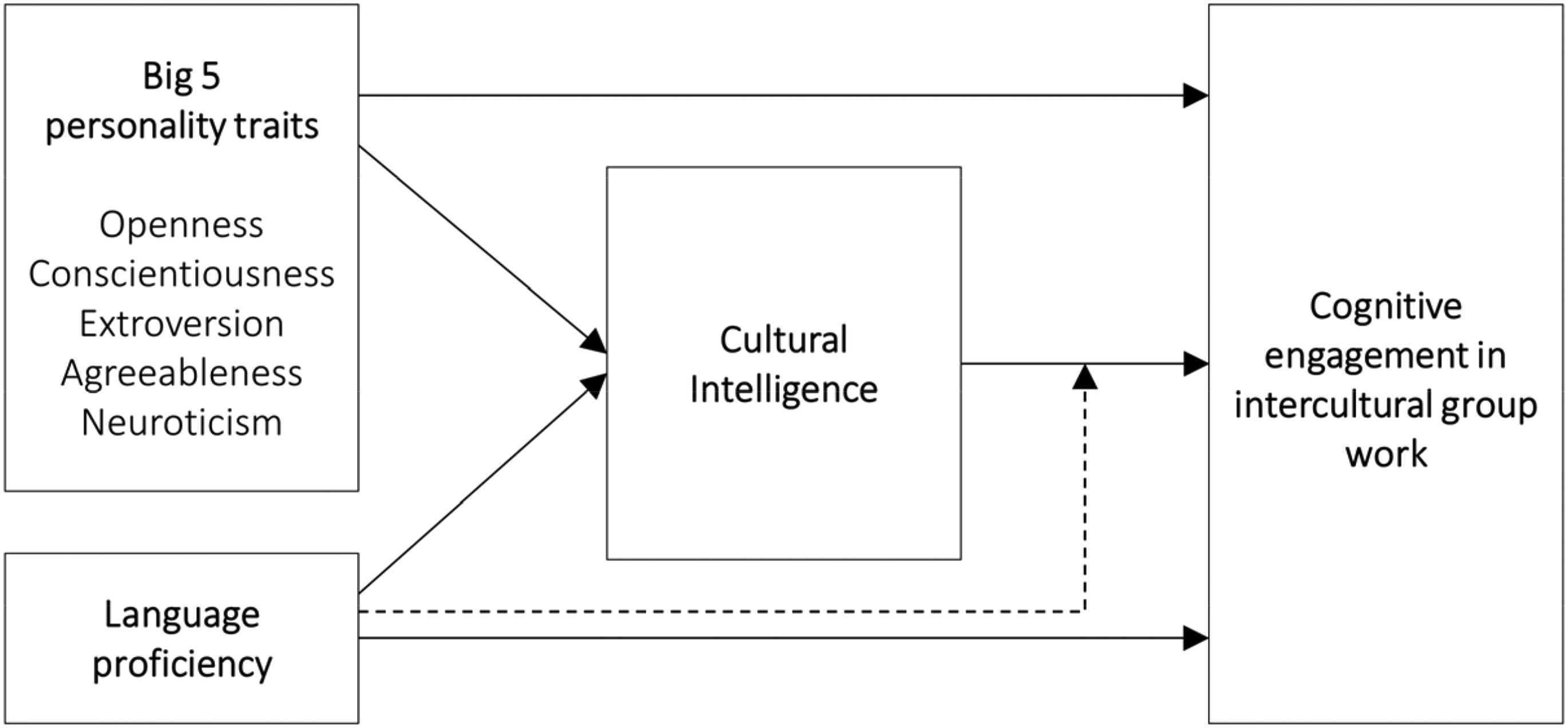
Conceptual model of relationships among personality, CQ, English language proficiency, and cognitive engagement. Note. Dashed line indicates the moderating effect. CQ=cultural intelligence.
We pose the following research questions:
To what extent do students’ personalities, CQ, and English language proficiency explain variability in their cognitive engagement in IGW? To what extent does CQ mediate the effect of personality and English language proficiency on cognitive engagement in IGW? To what extent does English language proficiency moderate the effect of CQ on cognitive engagement in IGW?
Method and Analysis
Participants
In total, 846 students of 70 nationalities, with male and female respondents approximately equally represented, participated in this study. Ages ranged from 17 to 37 years, with a mean of 20.6 years (SD = 2.4). Students were enrolled in internationally oriented, English-taught bachelor’s programs at six universities, with four located in the Netherlands (n = 728) and two in Canada (n = 118). Students represented a wide variety of disciplines (e.g., business, spatial sciences arts, education). Students participated in IGW which we defined as a collaborative approach to learning in which three or more students, representing at least two different nationalities, worked together on a project that was assessed as part of a course. The collaboration took place within or outside the classroom and consisted of face-to-face meetings as well as online communication. For most students (86.2%), English was not their native or most fluent language. The average group size was five students. See Table 1 for further demographic and study information.
Demographic and Study Data.
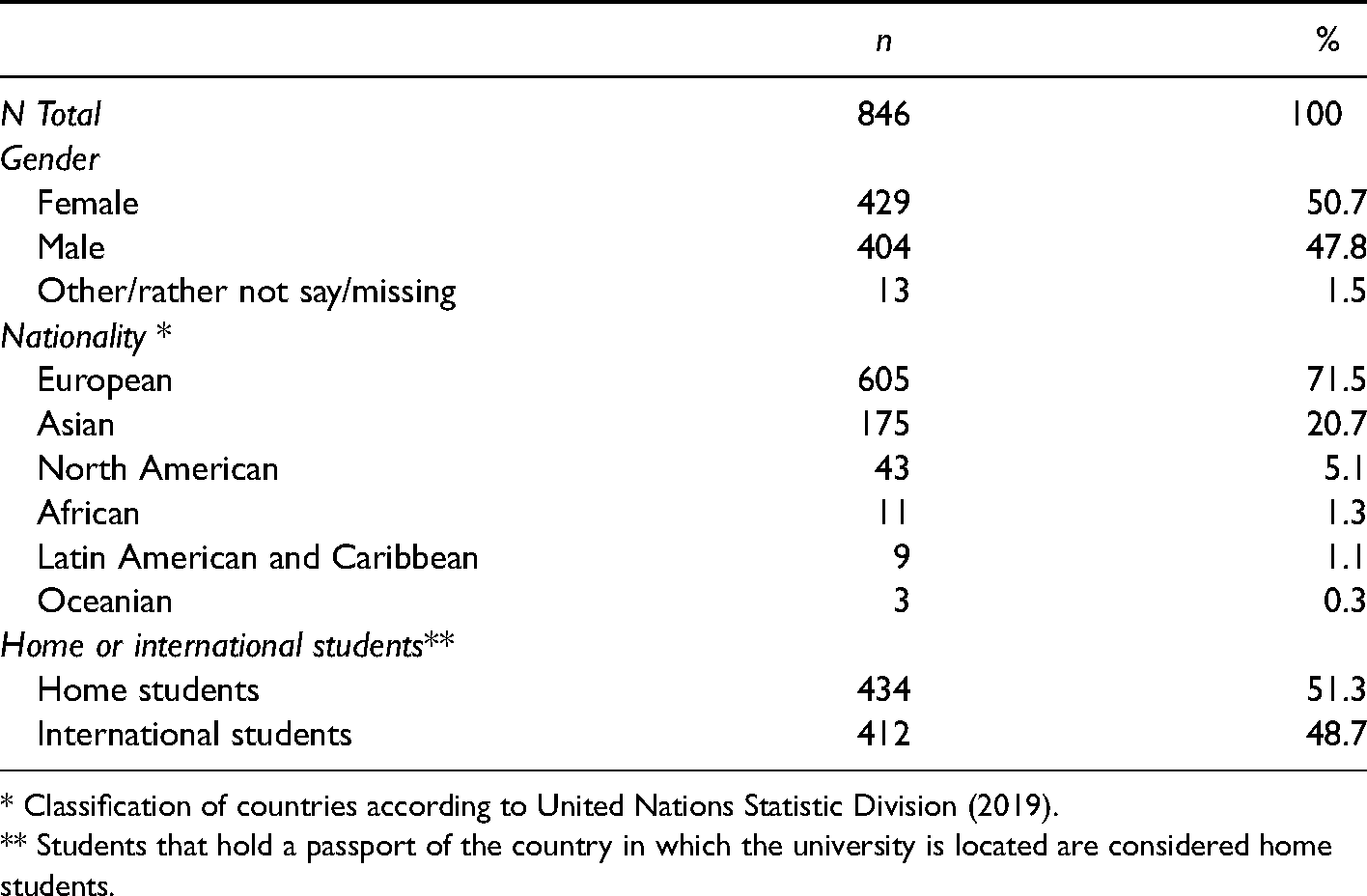
* Classification of countries according to United Nations Statistic Division (2019).
** Students that hold a passport of the country in which the university is located are considered home students.
Procedure
As part of a research project investigating factors that promote university students’ engagement in IGW, we invited students who participated in IGW as part of a course requirement to complete a questionnaire. Students were approached by teachers or coordinators of the programs they were enrolled in, through an online message board, or directly by the researchers. They were assured that participation was anonymous and voluntary and would have no consequences for their course grades. After giving informed consent, participants answered questions related to their backgrounds and the group work they were doing at that time. They completed the questionnaire on paper or online.
Measures
The data collection included latent measures for the Big Five personality traits, CQ, English language proficiency, and cognitive engagement in group work. For these measures, we asked students to rate statements on a Likert scale (see Table 2). We assessed the Big Five personality traits using the BFI-S, a short 15-item instrument that, in cases of time constraint, provides a good alternative for the more elaborate 44-item Big Five Inventory (Gerlitz & Schupp, 2005; Hahn et al., 2012).
Latent Measures—Items, Scale, Internal Reliability, and Fit Indices.
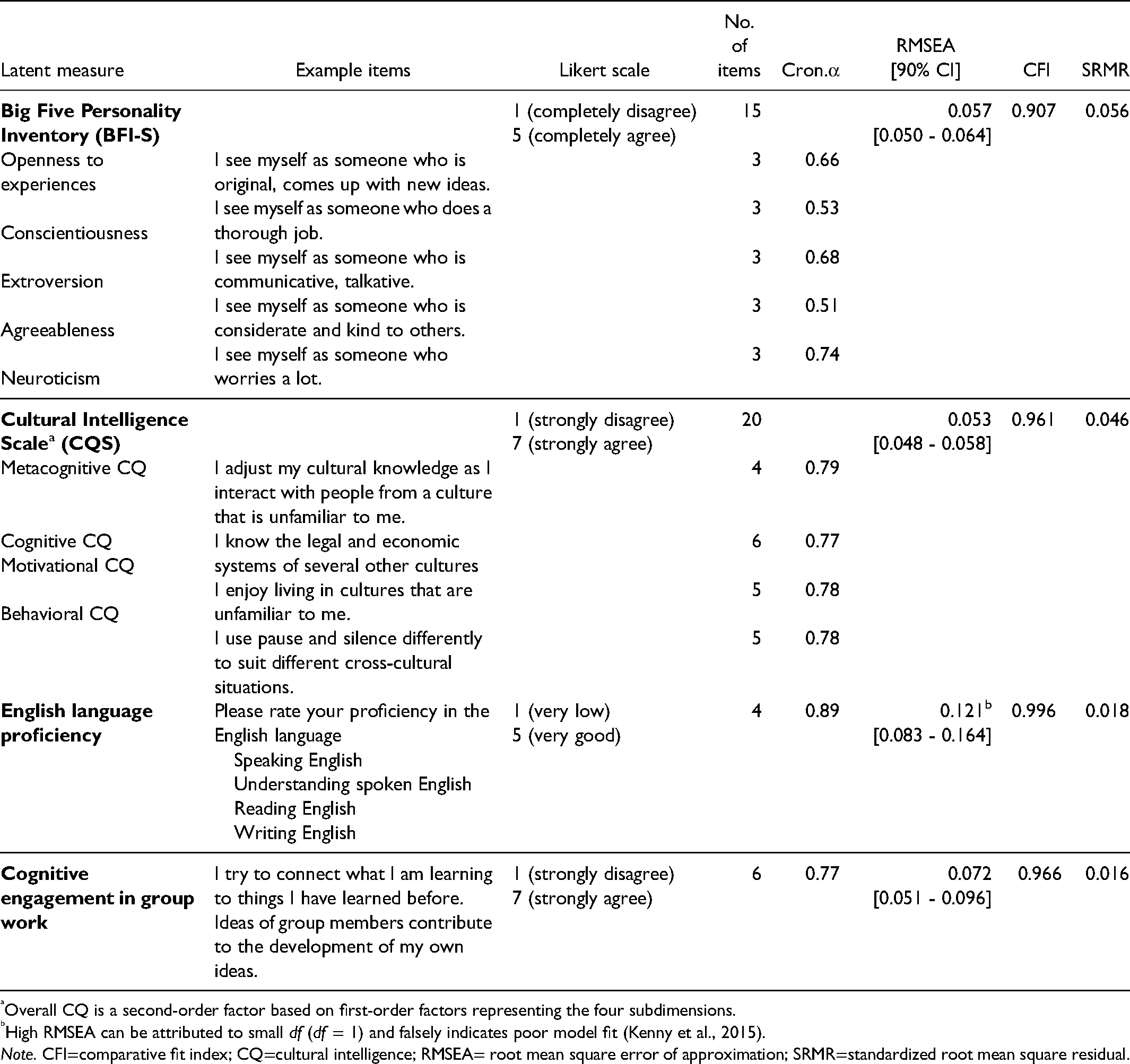
Overall CQ is a second-order factor based on first-order factors representing the four subdimensions.
High RMSEA can be attributed to small df (df = 1) and falsely indicates poor model fit (Kenny et al., 2015).
Note. CFI=comparative fit index; CQ=cultural intelligence; RMSEA= root mean square error of approximation; SRMR=standardized root mean square residual.
We measured cultural intelligence, consisting of four sub-dimensions—cognitive, metacognitive, motivational, and behavioral—using the Cultural Intelligence Scale (CQS) (Cultural Intelligence Center, 2005). The 20-item self-report scale, developed by Ang et al. (2007), has been validated in a variety of contexts (Leung et al., 2014; Van Dyne et al., 2012). According to participants’ feedback during the pilot test, we made one minor adjustment in the wording of items that measured cognitive CQ. We measured self-perceived English language proficiency by asking participants to rate their proficiency for speaking, reading, writing, and understanding spoken English.
To our knowledge, no existing scales measure cognitive engagement in group work. Therefore, we developed items using existing instruments for different or more general contexts (Pintrich et al., 1991; Wang et al., 2016). We pilot-tested these items and adjusted them to clarify wording. Based on exploratory factor analyses in Mplus (version 8.3) on a random half of the data set, we modified the latent measure by reducing the number of items and allowing for correlated errors in cases of similar item wording. We conducted confirmatory factor analyses on the other half of the data set to evaluate model fit.
Statistical Analyses
We used Mplus software (version 8.3) for structural equation modeling techniques to test the model as shown in Figure 1. Structural equation modeling enabled us to statistically test the hypothesized relationships among personality, CQ, English language proficiency, and cognitive engagement together. With this simultaneous analysis we could determine the extent to which the hypothesized model is consistent with the data (Byrne, 2012). If model fit indices show that the goodness-of-fit of the model is adequate, it supports the plausibility of the hypothesized relationships.
We followed Kline (2016) to establish the measurement models for each latent variable prior to examining their structural associations. We assessed model fit for measurement models and the structural equation model by scrutinizing the residual correlations and the model fit indices (Loehlin & Beaujean, 2017). Indicators suggestive of good/acceptable fit include a root mean square error of approximation (RMSEA) of less than 0.06/0.08, a comparative fit index (CFI) greater than 0.95/0.90, and a standardized root mean square residual (SRMR) less than 0.08/0.10 (Hu & Bentler, 1999; Schweizer, 2010). We did not consider chi-square, because it mistakenly can reject good models with larger sample sizes. We examined mediation by estimating and evaluating the statistical significance of indirect effects. For each of the personality traits and language proficiency, we determined the percentage mediation by dividing the indirect effects by the total effects (MacKinnon, 2008). We examined moderation by estimating and evaluating the statistical significance of an interaction term, added to the model.
Missing data for items of the various latent measures were small: English language proficiency (0.4–0.6%), BFI-S (0.1–1.9%), CQS (0.5–1.4%), and cognitive engagement (1.2–1.8%). Accordingly, we applied pairwise deletion (Enders, 2010). In the model, we clustered all analyses according to the course in which each student was enrolled. The purpose of this study is not to compare countries, however, the country in which the university was located might have an effect on cognitive engagement. Therefore, we included it as a covariate to account for possible variation across countries.
Results
Establishing Measurement Model
Confirmatory factor analyses support the proposed measurement structures of the Big Five personality traits, CQ, English language proficiency, and cognitive engagement. The Big Five personality traits have relatively low internal reliability; however, with a larger sample size, a somewhat lower score reliability is acceptable in latent variable methods compared with observed variable methods (Little et al., 1999). The relatively high RMSEA for English language proficiency can be attributed to a small df (df = 1) and falsely indicates poor model fit (Kenny et al., 2015). Internal reliability and fit indices of the measurement models combined (see Table 2) indicate adequate fit for all latent measures. Standardized factor loadings for the second-order factor of overall CQ are 0.995 for metacognitive CQ, 0.826 for motivational CQ, 0.815 for cognitive CQ, and 0.796 for behavioral CQ.
Research Question 1: Structural Model
After establishing the measurement models, we used structural equation modeling to test whether the data supported the relations among the variables as hypothesized in the conceptual model (Figure 1). The structural model (Figure 2) achieved good fit (RMSEA = 0.025, CFI = 0.945, SRMR = 0.059). Figure 2 shows that most of the hypothesized direct effects on cognitive engagement were indeed supported by the data. CQ has the largest direct effect (β = 0.337) on cognitive engagement followed by agreeableness (β = 0.161), conscientiousness (β = 0.145), openness (β = 0.121), and extroversion (β = 0.084). No statistically significant direct effects were found for neuroticism and language proficiency, which had the smallest coefficient values (β = 0.059) and the largest p-values (p = .054 and p = .055, respectively).
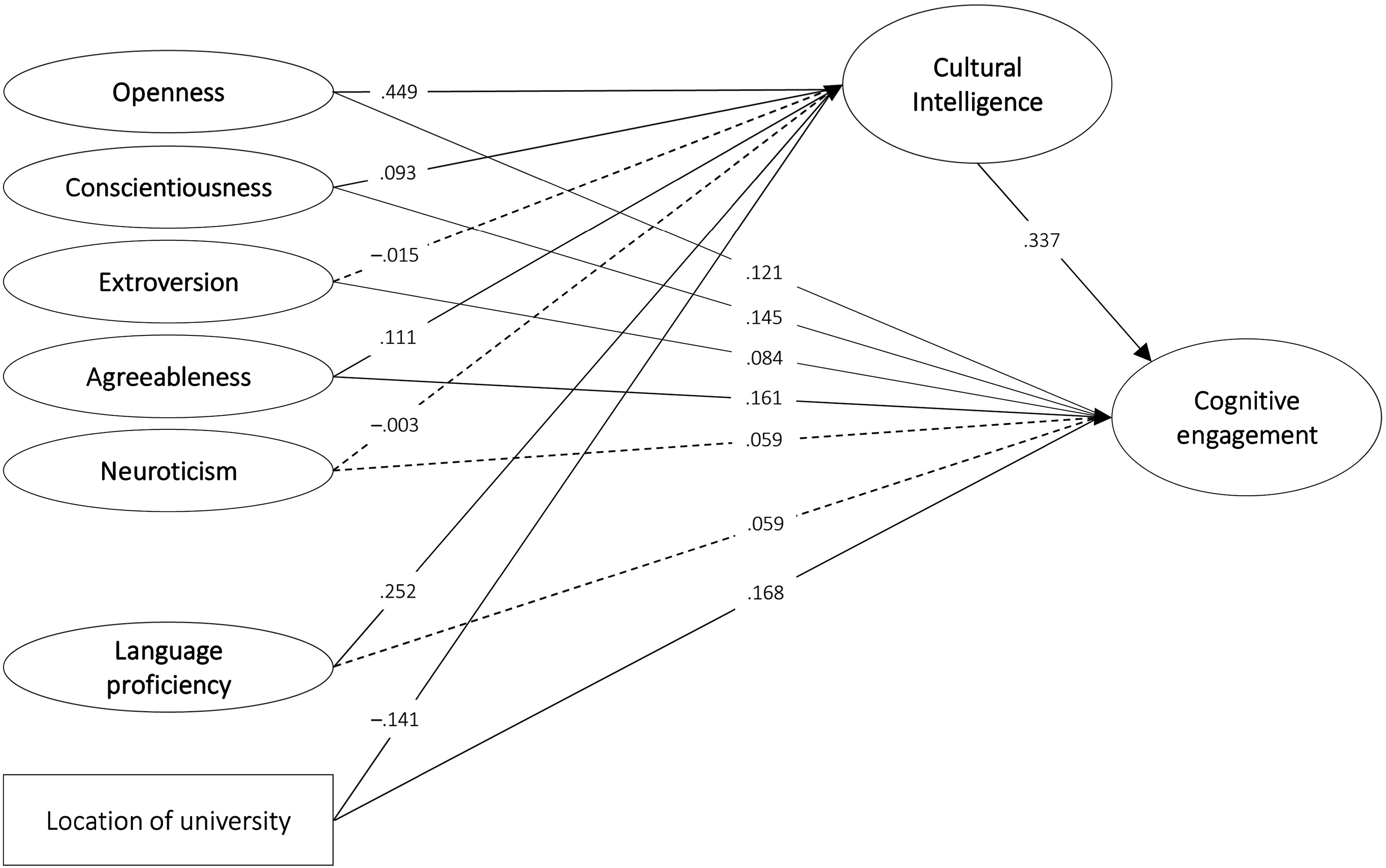
Structural equation model of personality, language proficiency, and CQ impacting cognitive engagement in IGW. Notes: Weighted least squares mean and variance adjusted (WLSMV) estimator. All path coefficients are standardized (β). The higher the number ( + or -), the stronger the effect. Dashed lines signify nonsignificant paths (p >.05). Model fit: RMSEA = 0.025, CFI = 0.945, SRMR = 0.059. R2 (variance explained): CQ = 0.413, Cognitive engagement = 0.396. CFI=comparative fit index; CQ=cultural intelligence; IGW=intercultural group work; RMSEA=root mean square error of approximation; SRMR=standardized root mean square residual.
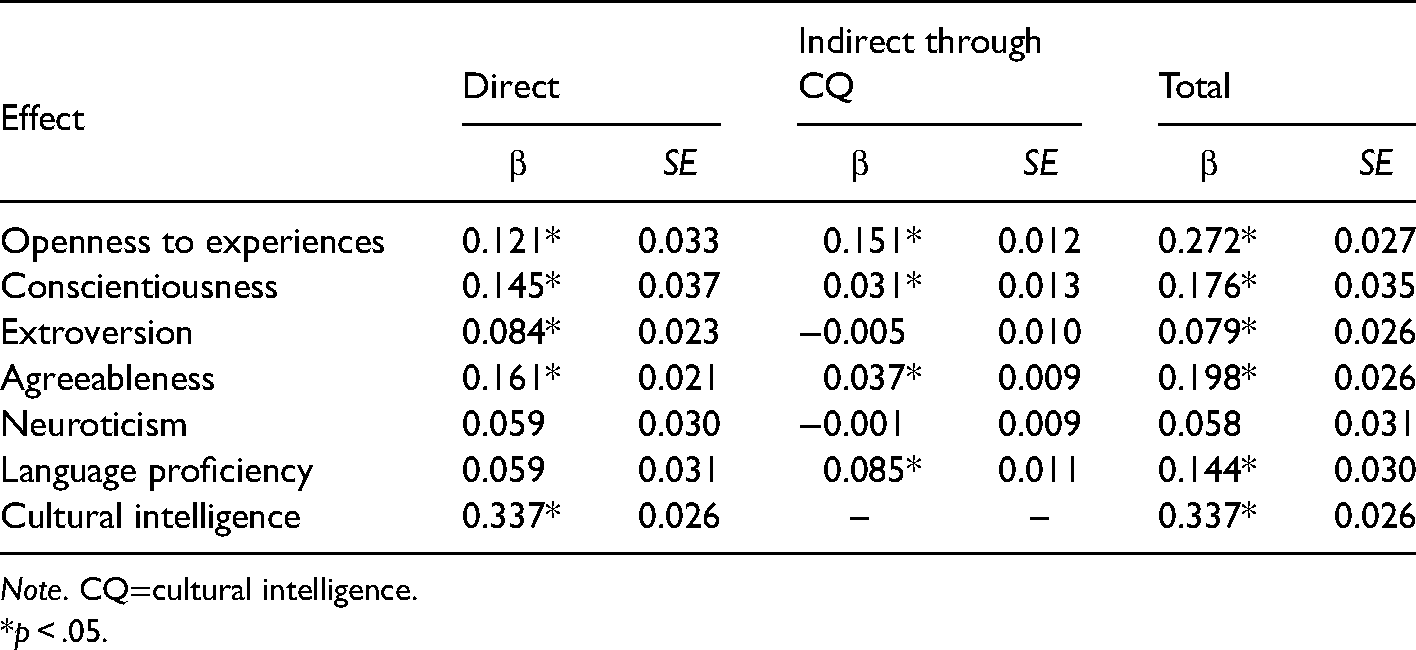
When considering the total effects on cognitive engagement (i.e., the sum of the indirect and direct effects), CQ is the strongest predictor (Table 3). The second-strongest predictor is openness to experiences, followed by agreeableness, conscientiousness, language proficiency, and extroversion. Neuroticism has the smallest and non-significant total effect (β = 0.058, p = .060) on cognitive engagement.
Direct, Indirect and Total Effects of Personality Traits, Language Proficiency, and CQ on Cognitive Engagement.
Note. CQ=cultural intelligence.
*p < .05.
The variables combined, including the covariate of university location, explain 39.6% of the variance of cognitive engagement.
Research Question 2: Mediating Role of CQ
We examined mediation by estimating and evaluating the statistical significance of indirect effects. For language proficiency and each personality trait we determined the percentage of mediation by dividing the indirect effect (i.e., the effect that runs through CQ) by the total effect (i.e., the sum of the indirect and direct effect on cognitive engagement). The evaluation of the indirect effects (Table 3) supports the mediating role of CQ for some factors. It establishes partial mediation through CQ for the effect of language proficiency (59.0%), openness (55.5%), agreeableness (18.7%), and conscientiousness (17.6%) on cognitive engagement in IGW. That is, openness to experiences, conscientiousness, agreeableness, and language proficiency influence CQ, which then increases the level of cognitive engagement. The effects of extroversion and neuroticism on cognitive engagement are not mediated by CQ.
Research Question 3: Moderating Role of Language Proficiency
We investigated the possible moderating role of language proficiency by estimating and evaluating the statistical significance of an interaction term, added to the model. The results indicate that a moderating effect of language proficiency on the relationship between CQ and cognitive engagement is not supported (β = -0.012, SE = 0.073, p = .871). That is, the strength of the positive effect of CQ on cognitive engagement does not depend on the level of language proficiency.
Discussion and Conclusion
The analyses revealed that CQ and the personality trait of openness to experiences are the strongest predictors of cognitive engagement. English language proficiency is a relatively weak predictor. As expected, students with higher CQ display higher cognitive engagement; CQ enhances the exploration of different perspectives, enabling students to critically evaluate their own views, and it facilitates the communication processes needed for higher-level learning in a culturally diverse context. The measurement model for CQ identifies metacognitive CQ as the strongest determinant of overall CQ, which is in line with previous research that identifies metacognitive CQ as the key component that integrates the other dimensions (Thomas et al., 2008; Van Der Horst & Albertyn, 2018). Cultural metacognition can facilitate cognitive engagement, because it allows students to adapt their communication flexibly, in a way that is beneficial in that particular group (Ang et al., 2007; Chua et al., 2012). Moreover, metacognitive CQ and cognitive engagement have similar underlying metacognitive skills; both require students to acquire and comprehend new information and cues in the environment, critically evaluate their own views and assumptions, and calibrate their knowledge and ideas. Those with high metacognitive CQ are likely to apply their underlying general metacognitive skills, not only to function effectively in specific cultural situations of groups but also to engage more deeply in group work.
In studies of the challenges of IGW, lack of language proficiency often emerges as one of the main causes of ineffective group work (e.g., Popov et al., 2012; Spencer-Oatey & Dauber, 2017). However, we show that compared with the contributions of CQ and some personality traits, the contribution of language proficiency to engagement is limited. This unexpected outcome can be explained in several ways. First, students and teachers may identify differences in language proficiency as a major problem, because they are very noticeable, whereas differences in CQ and personality traits, such as openness to experiences and agreeableness, are less obvious. Therefore, they might overemphasize the relative importance of language proficiency.
Second, the characteristics of the particular group of participants that we study may limit the contribution of language proficiency. Most research on IGW is set in English-speaking countries, such that significant parts of groups consist of native English speakers. This composition makes differences in language proficiency more pronounced. In our study, the majority (86%) of participants were non-native English speakers. This composition is not unique to this study; it reflects the situation in countries such as the Netherlands, Sweden, and Denmark, in which home students also have to study in a second language because many programs are English-taught. The results could indicate that when the majority of the group members are non-native speakers, language proficiency becomes less of an issue. Moreover, the participants in this study were enrolled in internationally oriented and English-taught programs, which means the students were already used to communicating in English with their peers. Most of our participants rated their proficiency between average and very good, implying that an average level of proficiency would be sufficient to function and cognitively engage in group work, whereas a further increase in proficiency would not result in a significant increase in engagement. If the participants would have had less experience in communicating in English and rated their language proficiency as low, its effect on engagement might have been stronger. In light of sociocultural learning theory, which views language as the main tool that mediates learning, this implication raises the question: Does student engagement depend only on their proficiency in the shared language, or is cognitive engagement also mediated by their native language? For example, students might discuss a topic with group members that speak the same language or engage by taking time translating English into their native language.
In our investigation of the contribution of language proficiency, we also consider its relationship with CQ. The data support the hypothesis that language proficiency contributes to the level of CQ and thereby enhances cognitive engagement; 59% of the effect of language proficiency on engagement is through CQ. This finding suggests that language proficiency in itself is not sufficient; in combination with CQ, it can enhance cognitive engagement. Moderation analysis shows language proficiency does not amplify the positive effect of CQ on cognitive engagement. Therefore, either language proficiency does not act as an enabler of CQ or it affects only the relationship between CQ and engagement under a certain threshold. Most participants scored themselves as average or higher for language proficiency, possibly masking the moderating role.
Of the various personality traits, openness makes the biggest contribution to cognitive engagement. People who are high in openness to experiences are broad-minded and eager to learn new things (John et al., 2008). This attitude facilitates cognitive engagement at a deeper level. Although conscientiousness emerges from prior literature as the strongest predictor of academic achievement (O’Connor & Paunonen, 2007), we show that openness is more important for cognitive engagement in IGW. This result is not surprising: The diversity represented in IGW likely is particularly appealing to students who are by nature curious about other people. The second personality trait that we identify as a contributor to engagement is agreeableness. In a collaboration setting, this trait helps students put themselves ‘in the shoes’ of other students and understand their different perspectives. Such perspective-taking is at the core of cognitive engagement. We also find a limited effect of extroversion on cognitive engagement; the ease that extroverted people often display in social interactions does not automatically result in deeper cognitive interactions. Finally, neuroticism neither helps nor hinders cognitive engagement. In contrast with our expectation, the potential stressful situation did not cause neurotic students to withdraw cognitively.
In line with Ang et al. (2006), we find that openness, conscientiousness, and agreeableness are associated with CQ. Although CQ is considered to be a set of malleable intercultural capabilities, these results imply that someone’s personality plays a role in their CQ-level. These personality traits positively affect the level of CQ, thereby increasing cognitive engagement. Our finding that openness is a strong contributor to engagement, both directly and indirectly through CQ, confirms other research that links openness to intercultural competence and intercultural effectiveness (Deardorff, 2006; Wilson et al., 2013). We cannot, however, confirm the correlation of extroversion and neuroticism with CQ that Ang et al. (2006) reported.
Limitations and Recommendations for Further Research
The cross-sectional nature of this study limits our understanding of the directionality of effects. While structural equation modeling techniques support the proposed relationships between CQ, language proficiency, and engagement, there may be directional differences for the relationship between these variables. Possibly, CQ can promote cognitive engagement, which in turn can promote further development of CQ. A longitudinal approach would provide insights into the development of CQ, language proficiency, and engagement over time, as well as show how these factors affect one another. We focus on CQ as an aggregate construct; investigations of the effects of each CQ sub-dimension on engagement could provide further insight into these relationships and determine the relative importance of each sub-dimension.
Further research into the role of language in cognitive engagement could include a quasi-experimental design in which one group is expected to use the shared language only and another group can make additional use of their native language in communicating with same-language peers.
We included the country the university is located in as a covariate, but did not further investigate this variable. However, the effects on both CQ and cognitive engagement found in this study imply that elements in the national or university context do play a role. Further research could specifically investigate these contextual elements.
With regard to the cognitive engagement items that we use, we note that they have not been used or examined in other studies; therefore, they require further validation.
Finally, we collected data using a self-reported instrument. These self-reports can be valuable because they reflect a person’s language and intercultural self-efficacy (Leung et al., 2014). A stronger self-efficacy will enhance engagement even if students slightly overestimate their capabilities (Bandura, 1997). However, students’ ways of evaluating their own language proficiency, CQ, and engagement could differ from their actual proficiency, CQ, and engagement. It would be valuable to have additional observational data to measure these variables more objectively, to confirm the effects of personality, CQ, and language proficiency on engagement.
Implications
Because limited language proficiency is often viewed as one of the main problems, enhancement of language proficiency is offered as the solution to tackle IGW challenges. However, we show there are other factors, such as personality and CQ, that have even greater impacts on student engagement.
Lower language proficiency can result in limited verbal group work participation, which is often viewed as evidence of lack of engagement and critical thinking. However, in some cultures verbal participation is less valued. For example, Japanese students do not relate verbal silence to intellectual passivity. These students emphasize that critical learning also involves critical thinking, and thus arguing for a point of view itself is not an assurance of critical learning (Welikala, 2008). Therefore, educators should be careful not to simply use verbal participation as an indicator of cognitive engagement, but should consider other ways in which students display their cognitive engagement.
Our findings show that the personality trait of openness to new experiences greatly affects engagement. Students who score low on this personality trait would benefit from an assignment that is designed to encourage and guide them to explore other perspectives.
The construct of CQ is very relevant in IGW settings for three reasons: (a) It represents the ability to be effective in a wide range of intercultural contexts and is not bound to a specific culture, thereby allowing students to use their CQ skills to adapt to changing contexts of IGW (Ang & Van Dyne, 2008; Earley & Ang, 2003); (b) it represents malleable capabilities that can be enhanced by intercultural experiences (Ang & Van Dyne, 2008); and (c) it is positively associated with cognitive engagement in IGW. Educators emphasize the importance of CQ and other intercultural competence models to students’ future careers. We show, however, that CQ also is important to student learning; we suggest CQ should be included deliberately in IGW assignments. The intercultural experiences of students in IGW provide suitable settings for students to develop and apply their CQ skills immediately. Activities can be included that support group interaction by helping students reflect on the effect culture has on their own views, behaviors, and assumptions about other cultures (Reid & Garson, 2017). Students can learn to adjust their mental models about cultures and practice communication that enhances their repertoires. Cultural perspective-taking (Mor et al., 2013) fosters metacognitive CQ; it can be integrated into assignments such that students go beyond superficial cultural comparisons to understand underlying values and reasoning, rather than being ‘stuck’ in stereotypical thinking. When these types of activities are purposefully integrated into assignments, cultural perspective-taking and cognitive engagement in group work will go hand in hand. By dedicating time to developing CQ skills and integrating them into group work assessments, educators can show students that the skills are relevant to their learning, as well as their future careers.
IGW is considered a valuable learning tool to prepare students for globalized societies and enhance deep learning. However, the presence of cultural diversity in a group does not automatically result in meaningful engagement and learning. Although language proficiency does play a part in engagement, this research emphasizes the importance of looking beyond the language challenges. The personality trait openness to experiences contributes strongly to cognitive engagement in IGW, both directly and indirectly through CQ. CQ, referring to the malleable intercultural competences that enable people to function effectively in culturally diverse settings, plays an essential role in cognitive engagement. Therefore, focusing on building students’ intercultural competence will equip them to cognitively engage. Whereas previous research views intercultural competence as an outcome of IGW, we argue that intercultural competence is a necessary tool for students to turn IGW into a meaningful learning experience.
Footnotes
We thank Dr. Richard Sawatzky for providing statistical support and comments on earlier drafts of this manuscript.
Declaration of Conflicting Interests
The author(s) declared no potential conflicts of interest with respect to the research, authorship, and/or publication of this article.
Funding
The author(s) received no financial support for the research, authorship, and/or publication of this article.
