




Abstract
The global mobility of students is on the rise and the recruitment of international students is high on the agenda of institutions in higher education. By communicating a distinctive corporate identity on their websites, universities can distinguish themselves from competitors and generate a positive image to attract talented international students. In this study, the online corporate identity of top universities in 12 countries is compared by semantic network analyses. This cross-country comparison demonstrates that universities in different countries create a distinctive online corporate identity by using different (combinations of) frames within four identified themes: internal characteristics, student resources, external position and affairs, and corporate citizenship. These insights are useful in the development of communication strategies by universities and national governments.
Keywords
Introduction
Statistics show that the international mobility of students in higher education is expanding at a fast pace. The number of international students has grown from 1.7 million to 4.6 million between 1995 and 2015 (OECD, 2017, p. 295), and this number may climb to 8 million by 2025 (Tremblay et al., 2012). Because of this increase in student mobility and the value of talented students (Becker & Kolster, 2012; Lomer et al., 2018), the recruitment of international students is high on the agenda of universities and national governments and the competition between countries is fierce. Since “the principal way universities compete is through their images and reputations” (Balmer & Gray, 1999, p. 172), universities are encouraged to develop and manage a corporate identity that is distinctive from competing universities abroad (Hemsley-Brown et al., 2016). The online presentation of the corporate identity is particularly relevant, since many prospective students search the internet for information on overseas studies, often by visiting the websites of educational institutions (Hemsley-Brown, 2012; QS, 2019).
Several studies indicated that there is a dearth of empirical research addressing the (online) corporate identity in international higher education (Hemsley-Brown et al., 2016; Hemsley-Brown & Oplatka, 2006; Lomer et al., 2018), which is remarkable given the competitiveness between universities in international student recruitment. For universities, it is important to learn how competing universities in other countries position themselves and how internationally distinctive their corporate identity is. On the basis of such insights, universities can join forces in developing a distinctive corporate identity on a national level 1 that positively impacts their capacity to compete for international students on the international playing field. In addition, it may allow national governments to optimize their international student recruitment policies.
To explore how universities from different countries position themselves in the global market for international students and succeed in creating a distinctive online corporate identity, the online corporate identity of 48 universities in 12 different countries were analyzed by semantic network analyses (Vlieger & Leydesdorff, 2011). These analyses reveal the latent (and thus unbiased) frames that universities use in their online corporate identity. Semantic network analyses are often used to dissect media, public and scientific discourse (for examples, see Hellsten et al., 2010; Jonkman & Verhoeven, 2013; Leydesdorff & Hellsten, 2005), but have hardly been used to study corporate identities (Grbic et al., 2013). In this vein, the present study also makes a methodological contribution to existing research.
International Student Recruitment
Academic studies into international student mobility are largely focused on explaining the motivations of students to apply for a study overseas. These studies typically concentrate on identifying the push and pull factors underlying international student mobility. Where push factors identify the reasons to leave countries of origin, pull factors explain why international students are attracted towards host countries and institutions. This field of research is well developed and demonstrates that international students are attracted to studies overseas for a variety of reasons, such as university rankings and reputations, location, the presence of students with a similar nationality, teaching facilities, financial advantages, and future employment prospects (Hemsley-Brown, 2012; Mazzarol & Soutar, 2012; Wilkins & Huisman, 2013).
National governments and universities are increasingly competitive in the recruitment of talented international students (Abdullah et al., 2017; Mazzarol & Soutar, 2012). They seek opportunities to establish and solidify a robust position in this emerging market. Hemsley-Brown's study (2012) signals that the strategic use of communication can play an important role in attracting students from abroad. In identifying which factors pull international students towards a postgraduate study in the UK, Hemsley-Brown (2012) finds that the online information provided by the university and the British Council and personal statements that were written by international applicants largely correspond. This overlap in discourse suggests that information on institutional websites has a significant impact on the motives that international applicants provide for choosing a study overseas. The author mentions that these motives may as well inspire universities to update the information on their websites. In other words, both discourses could work in a mutually reinforcing way.
Corporate identity management is considered an important communication strategy for universities to position themselves in the competitive market of international student recruitment and attract international students (Balmer & Gray, 1999; Lomer et al., 2018; Mazzarol & Soutar, 2012; Wilkins & Huisman, 2013). A corporate identity entails the “reality and uniqueness of an organization which is integrally related to its external and internal image and reputation through corporate communication” (Balmer & Gray, 1999, p. 171). National governments encourage their universities to develop and communicate a distinct corporate identity to differentiate from universities in other countries (Becker & Kolster, 2012; Lomer et al., 2018). The online communication of such a distinctive corporate identity is of particular relevance, as the current generation of prospective students is highly technologically skilled. As digital natives, they largely rely on the internet for searching information about international study destinations. Especially the websites of educational institutions are important information sources for prospective international students (Hemsley-Brown, 2012; QS, 2019).
Distinctiveness of Online Corporate Identities
In contrast to the recognition of the role of corporate identity management in international student recruitment, the amount of empirical research into this topic has thus far remained scarce (Hemsley-Brown et al., 2016; Hemsley-Brown & Oplatka, 2006; Lomer et al., 2018). Yet, based on a relatively small number of empirical studies there is reason to believe that universities from different countries succeed in creating a distinctive online corporate identity.
Research findings suggest that homogeneity but also a level of heterogeneity is found in the way that universities within a country express their corporate identity online. For example, Grbic et al. (2013) analyzed the online mission statements of medical schools across the United States and Puerto Rico using a combination of text and network analyses. The authors conclude that the corporate identities in their sample are rather homogenous. However, their findings do show meaningful differences between the mission statements when comparing between types of medical schools. Opoku et al. (2008) compared the online brand personality characteristics of Swedish universities on the basis of a content analysis. They found that not all universities are equally successful in clearly positioning themselves. Though their study shows that universities communicate different brand personality characteristics, Opoku and colleagues did notice an underrepresentation of certain characteristics in the Swedish market. This implies that there are indeed individual differences between universities, but at the same time there are similarities between universities when compared on a national level. In a Belgian (Flemish) context, Mampaey et al. (2015) identified seven thematic clusters when analyzing the online mission, vision and strategy of universities. Their analysis shows that while Flemish universities are unified in using similar themes in their online corporate identities, simultaneously differentiation takes place by accentuating different (combinations of) themes. According to Mampaey et al., higher educational institutions “are positioned in systems that contain both competitive pressures (to differentiate) and institutional pressures (to meet taken-for-granted expectations), where neither of the pressures is clearly dominant” (2015, p. 1178).
Jungblut and Jungblut (2017) argue that some countries actually encourage universities to differentiate their corporate identities, based on the idea that this increases international competitiveness and performance. For example, Germany has undertaken several initiatives to overturn the traditionally homogeneous character of its universities. To see whether such initiatives indeed lead to more differentiation, Jungblut and Jungblut (2017) make a comparison between the online mission statements of public universities in Germany. Based on word frequency and cluster analyses, they find that universities do have “somewhat” different orientations in their mission statements (2017, p. 543). Supplementary analyses demonstrate that these different orientations cannot be explained by university characteristics or successful participation in differentiation initiatives. So all in all, the study does not provide a convincing answer to the question whether German universities successfully manage to differentiate. The study does, however, paint a clear picture of the different themes with which German universities characterize their identity in their mission statements. And these themes may well be country-specific.
Chiper (2006) investigates the online discourse of different types of Romanian universities. In addition to this study, and unlike the literature reviewed above, she makes a comparison between discourse used by universities from various countries. Her comparison shows that universities from different countries represent themselves in dissimilar ways. For example, she describes German discourse as “dialogical” and “joking”, while characterizing French discourse in terms of “facts and figures” (2006, p. 722).
Based on the research findings described above and on the notion that national governments develop international student recruitment strategies (e.g., Abdullah et al., 2017; Becker and Kolster, 2012; Hemsley-Brown, 2012; Lomer et al., 2018; Mazzarol and Soutar, 2012), considerable coherence in the online corporate identities of universities on the national level is assumed. For similar reasons, and because universities are encouraged to develop and manage a corporate identity that is distinctive from competing universities abroad, distinctiveness of the online corporate identity of universities on the international level is expected.
Methodology
In this study, semantic network analyses are conducted to compare the online corporate identity of universities in different countries. A semantic network analysis is a type of computer-assisted content analysis. This method can be used to show which words in a text are related and form latent frames (Vlieger & Leydesdorff, 2011). These frames are then interpreted and labeled by the researcher.
The selection of countries and universities is discussed in the following paragraph, followed by an explanation of the selection of the website content. Finally, the semantic network analyses are explicated.
Selection of Countries and Universities
The selection of countries eligible for inclusion in the analyses is based on data on the inbound rate of international students enrolled in tertiary education in 2012 (The World Bank, 2016). These data are available for 98 countries. In the countries in the quartile with the highest inbound rate, at least seven percent of the registered students in tertiary education consists of international students. In these countries, universities were selected that offer bachelor and/or master programs to international students. The academic reputation of universities proves to be one of the most important indicators for students to apply for a study overseas (Hemsley-Brown, 2012). Consequently, for each of the countries, the five highest ranked universities in 2016 were selected, as long as these universities were among the best 250 universities in the world according to the 2016/17 QS World University Rankings (QS, 2016) 2 . In addition, given the key expectations in this study, only public universities were included as these are most likely to (be stimulated to) align their corporate identity to other universities on a national level. For making a cross-country comparison of the online corporate identity of universities, it is relevant to ensure a certain level of comparability between countries and universities. This is why the selected countries have comparable inbound rates of international students, and the selected universities have in common that they are public universities with a high international ranking. Applying these selection criteria results into a final sample of 48 universities in 12 countries. Table 1 shows an overview of the universities that are included in the final sample, with their 2016 QS World University rank and the percentage of international students enrolled.
Selection of universities.
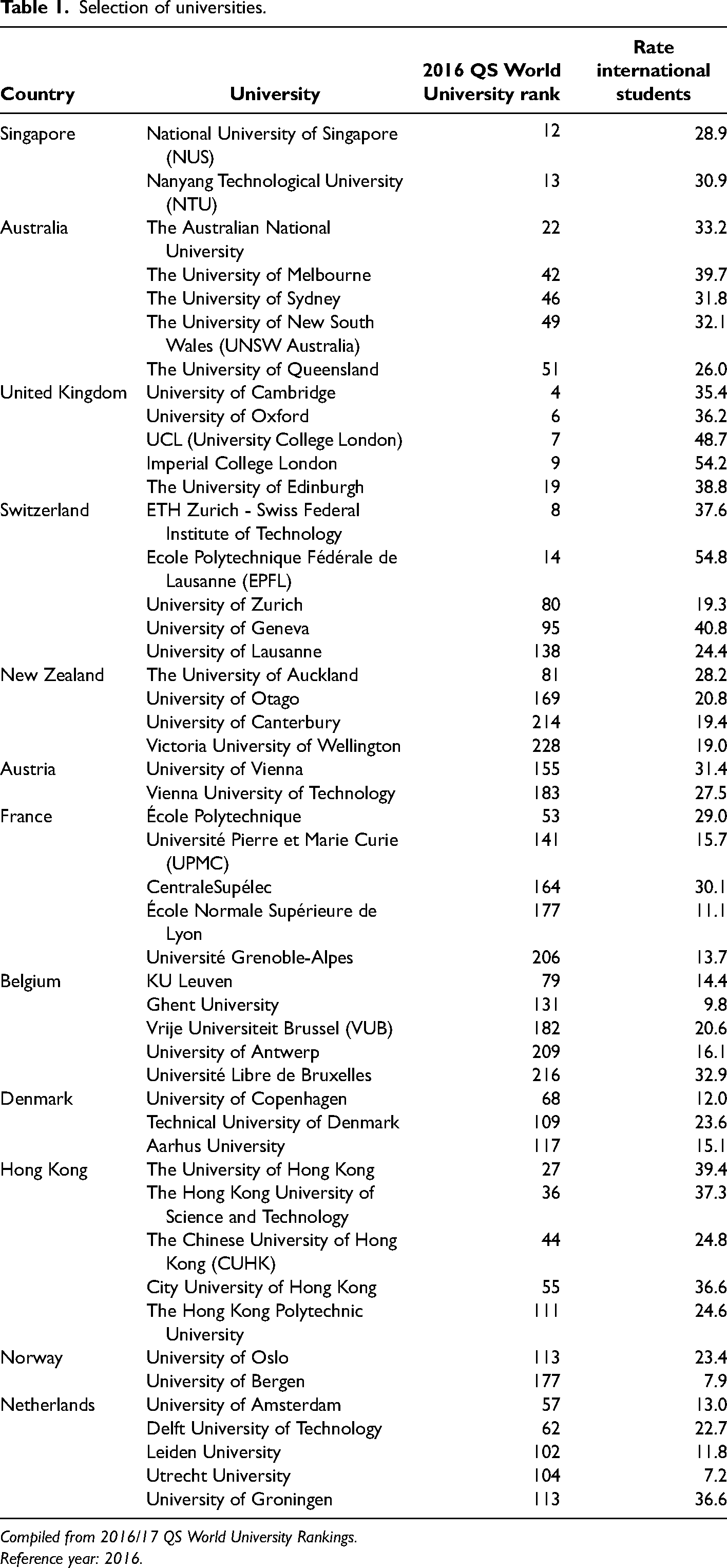
Compiled from 2016/17 QS World University Rankings.
Reference year: 2016.
Selection of Website Content
A selection of written content on the university websites forms the corpus for the semantic network analyses. The corpus was collected in different sections of the universities’ English websites that prospective international students are most likely to visit when searching for information: the homepage, the “about us” page, and the page for prospective (international) students. This strategy is consistent with the data collection methods applied by Hoang and Rojas-Lizana, who conclude that on these pages, universities “exhibit a promotional discourse which is constructed to represent themselves and attract potential students” (2015, p. 17). Where relevant, corpus was collected up to four hierarchical levels down the homepage. On the selected webpages, explicit textual statements referring to the corporate identity were selected, in which the universities express who they are (their vision) and what they strive to achieve (their mission).
Content Analyses
Following the guidelines of Vlieger and Leydesdorff (2011), for each country a list of the 75 most frequently used words in the texts was generated with the program FrqList. Words that occurred only once and stopwords were not included in this list. Next, the program FullText was used to generate word/document occurrence matrices that were imported into the statistical program SPSS for further analysis. In SPSS, factor analyses with rotation were conducted to show which words belong to the same underlying dimension. To ensure that the outcomes of the factor analyses are interpretable, the maximum number of components per country was set on six (Vlieger & Leydesdorff, 2011). Each of these components represents a frame with words that are correlated. When the components contained words with a negative factor loading, these words were excluded and the analyses were repeated. Once each component contained words with positive factor loadings, Cronbach's alpha (α) was calculated to assess the reliability of the components. Cronbach's alpha indicates the strength of the internal consistency of each component. Its coefficient can range between 0 and 1 and is considered acceptable when at least .65. Similar to Jonkman and Verhoeven (2013), the EigenValue (EV) and Explained Variance (R2) of the components were calculated (both after rotation). These measures show how much of the variance can be explained by each of the extracted components. A higher score indicates that a component is more dominant. The Total Explained Variance (Total R2) shows the relative amount of variance explained by the six components together.
The analyses resulted in 72 components in total (6 components per country). Subsequently, all components were compared. Components that were similar across countries were grouped as a frame, and unique components were identified as unique frames. Each frame was then given a fitting label. In total, 22 frames were identified. These are discussed in detail in the results section.
In addition, the findings were visualized with the program Pajek. For every country, a semantic network of the overall corporate identity of universities was generated. The semantic networks display the relationship between the words in the six frames and show which attributes universities have selected and made salient in their online corporate identity.
Results
The results are presented in two stages. In the first stage, the identified frames are described. Second, an overview is provided per country showing how universities from different countries position themselves in the global market for international students.
Identification of Frames
The identified frames either have an internal or external perspective, indicating whether the online corporate identity emphasizes internal or external issues and activities. In addition, the frames refer to either university characteristics or university contributions, demonstrating whether the identity is focused on what the university is versus what the university does. Based on these characteristics, four main themes emerge: internal characteristics, student resources, external position and affairs, and corporate citizenship (Figure 1).
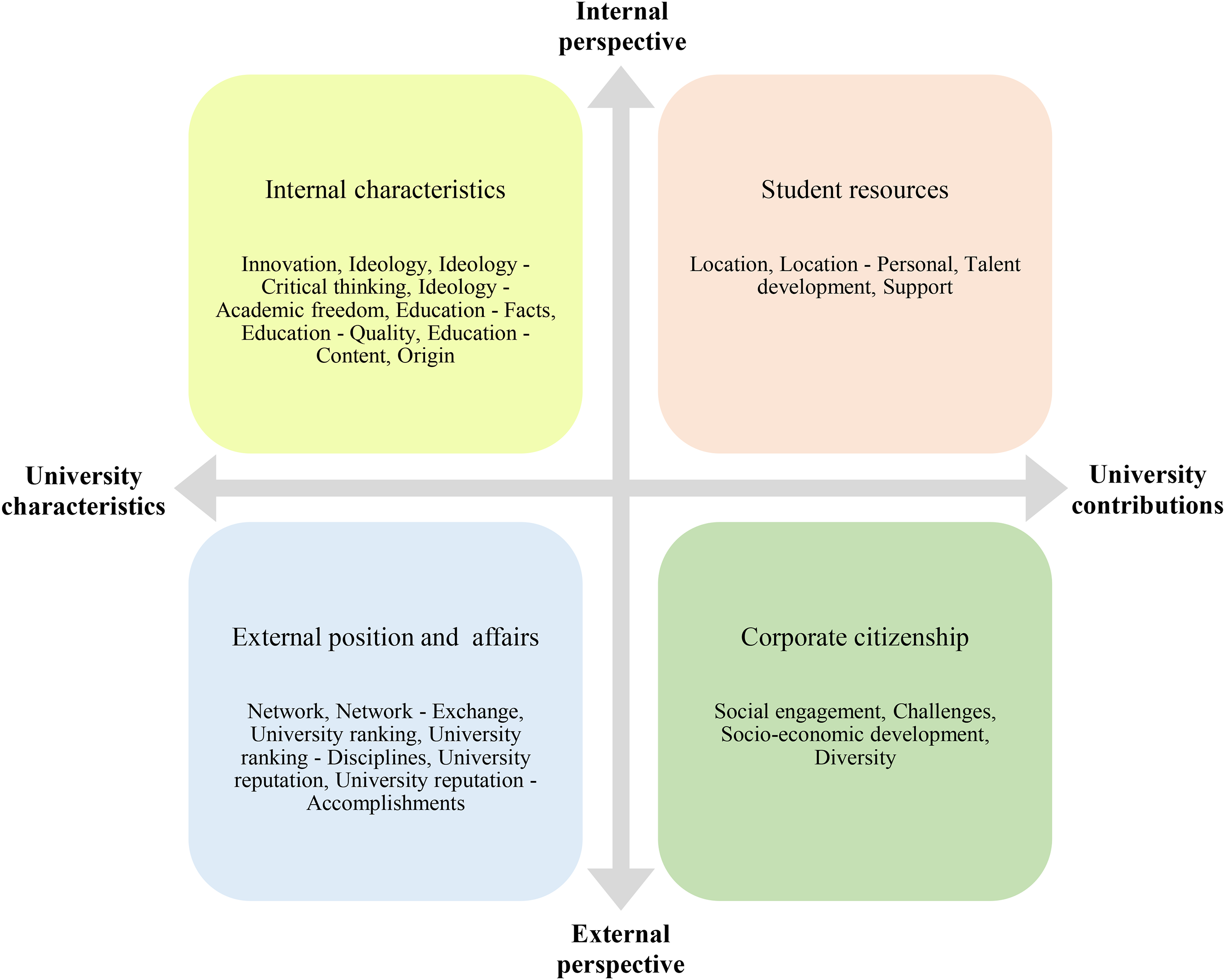
Visualization of frame themes and frames. The vertical axis represents an internal versus external perspective. The horizontal axis represents university characteristics versus university contributions. Each quadrant represents a frame theme (on top) with frames (below the frame theme).
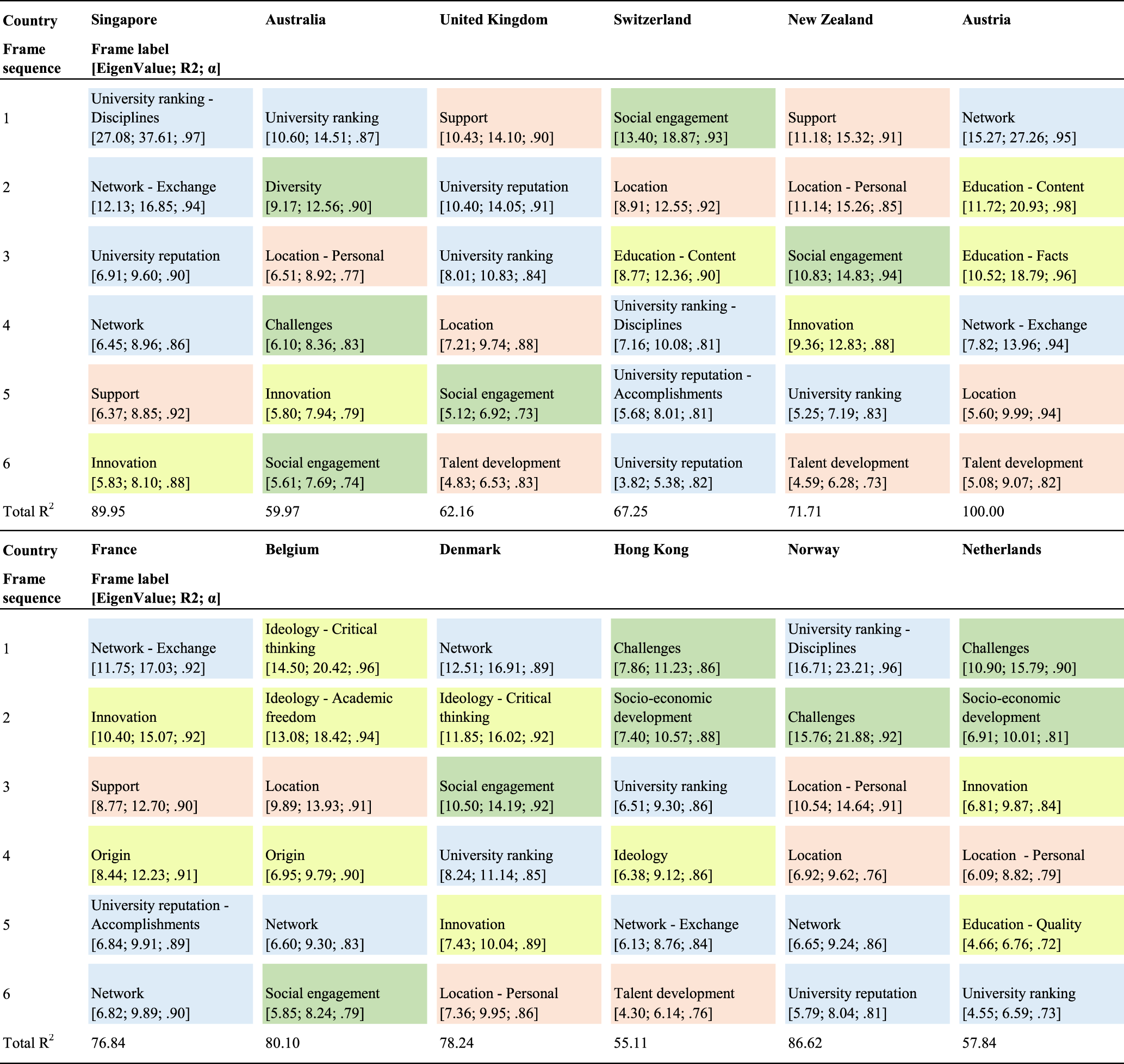
Frames per country. The colors are in line with those in Figure 1 and represent the themes that the frames belong to: yellow stands for internal characteristics, pink for student resources, blue for external position and affairs, and green for corporate citizenship.
Internal characteristics. In eight frames the internal character of the universities is expressed. The “Innovation” frame refers to a corporate identity in which universities express ambitions to innovate in the future (with words like innovation, future, ambition and development). The “Ideology” frame highlights the universities’ ideological beliefs and values. The “Ideology - Critical thinking” frame is more specific (with words like knowledge, reflection, and thinking), as is the “Ideology – Academic freedom” frame (with words like freedom, spirit, and debate). The “Education - Facts” frame focuses on objective characteristics of the education offered by the universities (with words like largest, educational, and teaching). The “Education - Quality” frame highlights the quality of education (with words like high quality and lecturer). The “Education - Content” frame is about the academic and practical knowledge and skills that can be acquired (with words like knowledge and know-how). The “Origin” frame describes the history and essential purpose of the universities (with words like founded, tradition, and history).
Student resources. Four frames mention resources that are available to students. The “Location” frame refers to the location and facilities of the universities (with words like central, located, infrastructure, environment, culture, and city). The frame “Location - Personal” also refers to the location, but a personal tone of voice is used by using second-person pronouns such as “you” and “your” when addressing students. The “Talent development” frame is about opportunities for personal and professional development (with words like career, skill, and development). The “Support” frame describes the support services that are available to students (with words like aid, support, facilities, and living).
External position and affairs. Six frames are focused on universities’ external position and affairs. The “Network” frame refers to the (external) networks in which universities partake (with words like partnership, alliance, and project). The frame “Network - Exchange” is explicitly focused on international exchange (with words like overseas, exchange, and abroad). The “University ranking” frame is about the position of universities in international rankings (with words like ranking, world, top and international), and in the “University ranking - Disciplines” frame explicit references are made to university disciplines, such as engineering, humanities, medicine and biology. The “University reputation” frame describes the distinctive competences of universities (with words like reputation, renowned, hallmark, and leading). “University reputation - Accomplishments” highlights the accomplishments of universities by referring to awards.
Corporate citizenship. In four frames, universities present themselves as good corporate citizens, for example by showing responsibility towards their local community and societal issues at large. The “Social engagement” frame refers to the public responsibility of universities (with words like responsibility, community, public, and contribution). The “Challenges” frame is about the external issues and challenges that universities are faced with and the contributions they make to society (with words like society, challenge, issue, and contribution). The “Socio-economic development” frame has a strong focus on social and economic development (with words like social, economic, advance, and development). In the Diversity” frame, social inclusion is considered important (with words like community, diversity, and people).
Online Corporate Identity per Country
Figure 2 provides an overview of the frames that were found in the universities’ online corporate identity in each of the 12 countries. To indicate the theme to which a frame belongs, all frames are colored using the color scheme of Figure 1. The reliability of each of the frames is satisfactory, ranging between .72 and .98. The Total R2 shows that the frames explain a large amount of variability in the data, ranging between 55,11% (Hong Kong) and 100% (Austria). The semantic networks in Supplementary Figures S1 to S12 (see Online Supplement) visualize the findings per country.
Universities in Singapore (Supplementary Figure S1) predominantly frame their corporate identity in terms of their external position and affairs. They show how they are positioned in comparison to other universities and highlight their partnerships and exchange opportunities. The most dominant frame is the “University ranking – Disciplines” frame (EV = 27.08, R2 = 37.61, α = .97), defined by words such as ranked, technology, and engineering. None of the frames focuses on corporate citizenship.
In Australia (Supplementary Figure S2), the “University ranking” frame is most dominant (EV = 10.60, R2 = 14.51, α = .87), with words like ranking and outstanding. The second most dominant frame is the “Diversity” frame (EV = 9.17, R2 = 12.56, α = .90), which is unique to Australian universities. Although all of the four frame themes are present in the Australian universities’ online corporate identity, there is a strong focus on corporate citizenship. The universities are presented as institutes that are engaged with society and societal issues.
In the United Kingdom (Supplementary Figure S3), half of the frames focuses on the resources that are available to students, such as support services, the attractive location of the universities and opportunities for talent development. The “Support” frame is most dominant (EV = 10.43, R2 = 14.10, α = .90), characterized by words such as benefit, staff, and support. None of the frames focuses on the universities’ internal characteristics.
In Switzerland (Supplementary Figure S4) the four most dominant frames represent four different themes. Most dominant is the “Social engagement” frame (EV = 13.40, R2 = 18.87, α = .93) that entails the societal contribution of the Swiss universities. This frame contains words like responsibility and community. As three frames are identified in which the universities position themselves in terms of ranking and reputation, external position and affairs can also be considered a relevant theme.
Universities in New Zealand (Supplementary Figure S5) largely describe their corporate identity in terms of student resources. The most dominant frame is the “Support” frame (EV = 11.18, R2 = 15.32, α = .91), with words like facilities and network, followed by the location and facilities of the universities, that are described with a personal tone of voice (EV = 11.14, R2 = 15.26, α = .85). Examples of words in this frame are culture, your, experience, and outdoor. Also within this theme, the possibilities for talent development are explicated. Overall, all four frame themes are present.
The most dominant frame in Austria (Supplementary Figure S6) is the “Network” frame (EV = 15.27, R2 = 27.26, α = .95), in which the universities indicate in which (external) networks they participate, for example by using words like research, collaboration, and project. The focus on education facts is distinctive to Austria. Frames that refer to corporate citizenship are absent.
In France (Supplementary Figure S7), universities primarily present themselves in terms of their external position and affairs, referring to international partnerships and studying abroad. The most dominant frame is the “Network - Exchange” frame (EV = 11.75, R2 = 17.03, α = .92). Typical words in this frame are network, partnership, and exchange. The internal character of the universities is also highlighted by emphasizing their ambitions to innovate and their origin. There are no frames that refer to corporate citizenship.
The universities in Belgium (Supplementary Figure S8) are strongly focused on their internal character, in particular on their ideological beliefs and values. Critical thinking is most dominantly present (EV = 14.50, R2 = 20.42, α = .96), with words such as philosophical, critical, and reflection. Academic freedom closely follows (EV = 13.08, R2 = 18.42, α = .94) with words like knowledge, freedom, and debate. Additionally, references are made to the universities’ history and origin. The other three frame themes are also represented.
For Denmark (Supplementary Figure S9), the findings show that there is no strong focus on either of the frame themes in the Danish universities’ online corporate identity. Instead, all four themes are represented. The most dominant frame is the “Network” frame (EV = 12.51, R2 = 16.91, α = .89), characterized by words such as collaboration, and partnership.
In the online corporate identity of Hong Kong universities (Supplementary Figure S10), all four frame themes are present. The corporate citizenship frames are most dominant though, with the “Challenges” frame as the main frame (EV = 7.86, R2 = 11.23, α = .86), with words like future, challenge and innovative. The second most dominant “Socio-economic development” frame (EV = 7.40, R2 = 10.57, α = .88) contains words such as environment and development. Hence, universities in Hong Kong demonstrate efforts to be responsible corporate citizens.
In Norway (Supplementary Figure S11), the “University ranking - Disciplines” frame is most dominant (EV = 16.71, R2 = 23.21, α = .96). This frame is defined by words as ranking, top, law, and humanities. Also in line with the external affairs theme, but less dominant in framing, the universities use frames in which they describe their global projects and associations and in which they describe their (research) excellence. None of the frames focuses on the universities’ internal character.
Universities in the Netherlands (Supplementary Figure S12) utilize all four frame themes. The two most dominant frames belong to the theme of corporate citizenship. The “Challenges” frame (EV = 10.90, R2 = 15.79, α = .90) consists of words such as culture, contribution, and challenge. “Socio-economic development” (EV = 6.91, R2 = 10.01, α = .81) is the second most dominant frame.
Conclusion and Discussion
In the light of the expansion of international student mobility, understanding how to attract talented international students is increasingly important to universities and national governments. By making a cross-country comparison of the online corporate identity of universities, this study explores how universities from different countries position themselves in the global market for international students and how they succeed in creating a distinctive online corporate identity.
How Universities From Different Countries Position Themselves in the Global Market for International Students
The outcomes of the study indicate that the universities position themselves in the global market for international students by using an internal and/or external perspective along with an emphasis on their institutional characteristics and/or the contributions they make. These conditions generate four themes: internal characteristics, student resources, external position and affairs, and corporate citizenship. Each of these four themes encompasses multiple frames. Some of these frames also emerge in previous studies, as specified below.
The first theme addresses internal university characteristics: the innovative character of the university, its ideological beliefs and values, educational features, and its origin. Other researchers mention comparable characteristics in their studies, such as values and academic affiliation (Mampaey et al., 2015), educational features (Grbic et al., 2013; Jungblut & Jungblut, 2017; Lomer et al., 2018), and history (Jungblut & Jungblut, 2017).
The second theme concerns resources that are available to students: the location of the university (sometimes by using a personal tone of voice), possibilities for talent development, and support services. Such resources are also visible in previous studies, for example by addressing students in general (Chiper, 2006; Grbic et al., 2013), location and student facilities (Hemsley-Brown, 2012), student experience (Jungblut & Jungblut, 2017; Lomer et al., 2018), student development and employability (Hemsley-Brown, 2012; Jungblut & Jungblut, 2017; Lomer et al., 2018). Moreover, one study explicitly mentions a personalized tone of voice towards students (Chiper, 2006).
The third theme describes the universities’ external position and affairs: the network that the university belongs to, the position of the university in terms of ranking, and university reputation. This theme emerges in previous research as well, for instance by making reference to internationalization and collaboration (Jungblut & Jungblut, 2017; Mampaey et al., 2015), and reputation, prestige and quality (Grbic et al., 2013; Hemsley-Brown, 2012; Jungblut & Jungblut, 2017; Lomer et al., 2018; Mampaey et al., 2015).
The fourth theme demonstrates corporate citizenship: the social engagement of the university, its involvement in societal challenges, the focus on socio-economic development, and attention for diversity. Corporate citizenship is also mentioned in other studies, for example in terms of social justice (Mampaey et al., 2015), (contributing to) people, communities and society (Grbic et al., 2013; Mampaey et al., 2015), and diversity (Mampaey et al., 2015).
How Universities From Different Countries Succeed in Creating a Distinctive Online Corporate Identity
In order to assess how universities in different countries succeed in creating a distinctive online corporate identity, the usage of frames is compared across countries.
First, in all countries a variety of frame themes is addressed. Frames regarding the universities’ external position and affairs and frames about student resources are present in all cases. In Singapore, Austria and France no references are made to corporate citizenship. For Singapore this is quite remarkable as its strategy is focused on building long-term relationships with international students, hoping that they will stay and contribute to Singaporean society (Waring, 2014). The United Kingdom and Norway have in common that internal characteristics are not part of their universities’ online corporate identity. However, the Norwegian government does recognize the relevance of such internal characteristics, as one of their strategic goals is to “strengthen the Norwegian higher education landscape based on the core values of academic freedom and institutional autonomy” (Universities Norway, 2018, goal 3).
Second, it becomes clear that the six frames in each country are distributed differently over the four themes. In other words, the patterns in framing across the countries are different. For example, Belgium is the only country in which half of the frames focuses on the internal characteristics of the universities. This does not seem to be a strategic choice though, as the Belgian government does not have a strong vision with regard to the internationalization of its higher education (Steur et al., 2019). The frames in the United Kingdom and New Zealand primarily lean to the side of student resources. This finding corresponds to the strategies of both countries. The UK government focuses on opportunities for student development (HM Government, 2019), whereas New Zealand's strategy is aimed at international student wellbeing (New Zealand Government, 2018). The external position and affairs of universities is represented most in Singapore, Switzerland, France, and Norway. This theme is indeed visible in the strategies of these four countries. The Singaporean government used to focus on becoming an international education hub (Waring, 2014) while the Swiss strategy is aimed at strengthening the position and recognition of Switzerland internationally (Schweitzerische Eidgenossenschaft, 2010). France and Norway both want to increase the visibility of their institutions (Campus France, n.d.; Universities Norway, 2018). Corporate citizenship appears to be the most popular frame in Australia. This is also not surprising, as engagement with local communities is an important part of the Australian strategy for international education (Australian Government, 2016). In Austria, Denmark, Hong Kong and the Netherlands the frames are more evenly distributed over the frame themes.
Third, even when countries share specific frames, their universities’ online corporate identity has notably different accents. In both Singapore and France the emphasis is on the universities’ reputation, network, and international exchange. In addition, the focus on the innovative character of the universities and student support corresponds. None of the frames addresses corporate citizenship. Nonetheless, the identity of universities in Singapore and France is dominated by different frames. For example, Singapore's most dominant frame focuses on “University ranking – Disciplines”, whereas this frame does not play a role at all in France. There are also similarities between universities in Australia and those in New Zealand, Denmark and the Netherlands. For example, these countries all share the “University ranking” frame and the frame that describes universities’ location in a personalized tone of voice. The innovative character of the universities is highlighted, as well as frames that demonstrate corporate citizenship. Despite these similarities, the results show that the frames in these countries lean towards different themes. As mentioned before, corporate citizenship is the most common theme in Australia, while in New Zealand the student resources theme appears most frequently. In Denmark and the Netherlands all four frame themes are represented. In addition, all four countries have a different dominant frame: the “University ranking” frame in Australia, the “Support” frame in New Zealand, the “Network” frame in Denmark, and the “Challenges” frame in the Netherlands. Universities in Australia and the Netherlands are further differentiated by the usage of frames that are unique to these countries. Furthermore, parallels occur between the United Kingdom and New Zealand. In both countries, several frames refer to student resources, with a dominant “Support” frame and least dominant “Talent development” frame. In addition, there are similarities when it comes to the “University ranking” and “Social engagement” frame. However, reputation is an important frame in the UK but not in New Zealand. Likewise, innovation plays a role in New Zealand but not in the UK.
Some of the identified frames are found to be unique to certain countries. The “Diversity” frame is the second most important frame in Australia, and does not appear in any other country. Australian universities value diversity of thinking and social inclusion, and include this in their online corporate identity. The “Education - Facts” frame is unique to Austria. This frame focuses on purely objective characteristics of the education. The “Education - Quality” frame is only used by universities in the Netherlands, highlighting the quality of their education.
Summarizing, although the cross-country comparison shows some overlap in themes and frames, (a) the four frame themes are not equally represented in every country; (b) frames are distributed differently over the themes; (c) each country has a different composition of frames; (d) even when countries share a significant number of similar frames, the most dominant frame mostly differs; and (e) several countries have frames that are unique. It can thus be concluded that universities in different countries are successful in creating a distinctive online corporate identity.
Limitations and Implications
This study is unique in providing insight into how universities in 12 countries position themselves in the recruitment of international students. However, the study comes with some limitations.
This study is built on the notion of ‘unity in diversity': even though universities within countries have diverse online corporate identities, it is presumed that at the same time there is a considerable level of homogeneity in the way that universities within countries express their corporate identity online (i.e. Grbic et al., 2013; Jungblut and Jungblut, 2017; Mampaey et al., 2015; Opoku et al., 2008). This is why the online corporate identities of universities were aggregated on the country level to allow for making a cross-country comparison. In future research it is relevant to also make comparisons between universities within countries. This will lead to a more thorough understanding of the interplay between corporate identities on different levels.
The sampling strategy that was used resulted in the selection of public top-universities in countries with high inbound rates. Yet the sample is heterogenous on many other characteristics, which makes it difficult to decipher why certain similarities and differences between the online corporate identities were found. In future research it is therefore relevant to further explore the relationship between characteristics of countries and universities and their online corporate identities. For instance, the findings in this study often show parallels between government strategies regarding international student recruitment and the framing of online corporate identities, which implies that a thorough comparison between such strategies and framing is a relevant avenue for future research. It may also be interesting to apply a different sampling strategy that allows for making comparisons between different types of universities, such as between public and private universities or between universities with different rankings. A different sampling strategy may also be applied to accomplish a more representative sample in terms of geographical location. In this study, European universities were overrepresented. This poses limitations to the generalizability of the findings. It remains the question to what extent similar themes and frames would emerge in a different sample. In addition, repeating this study in the future can provide insight into how online corporate identities of universities develop over time, for example in relation to changes in policies, political decisions, or other developments like the COVID-19 pandemic. Also, it is of interest to study how the interaction between prospective international students and universities may shape corporate identities. Hemsley-Brown's study (2012) suggests that corporate identities are shaped by communicative processes between universities and students, which corresponds to the idea of a constitutive model of communication. Cornelissen et al. (2012) encourage more discussion of this perspective leading to further development of corporate identity theory. In summary, more research is needed to investigate the reasons behind the findings as well as the tenability of the findings in different contexts and over time.
Using semantic network analyses to study online corporate identities is uncommon, yet its potential is recognized by Grbic et al. (2013) and Jungblut and Jungblut (2017). In this study, the method has indeed proven to be useful and promising for corporate identity research. Despite the fact that some researchers express concerns that that universities may paradoxically use similar expressions in an attempt to express their distinctiveness (e.g., Stensaker, 2015), the results of this study show that it is possible for universities from different countries to accentuate their identity in a distinctive way compared to competitors abroad. This implies that framing can be used strategically in international student recruitment.
Supplemental Material
sj-docx-1-jsi-10.1177_10283153211042087 - Supplemental material for Framing in International Student Recruitment: A Cross-Country Comparison of the Online Corporate Identity of Universities
Supplemental material, sj-docx-1-jsi-10.1177_10283153211042087 for Framing in International Student Recruitment: A Cross-Country Comparison of the Online Corporate Identity of Universities by Pernill Gerdien Antoinette van der Rijt in Journal of Studies in International Education
Supplemental Material
sj-docx-2-jsi-10.1177_10283153211042087 - Supplemental material for Framing in International Student Recruitment: A Cross-Country Comparison of the Online Corporate Identity of Universities
Supplemental material, sj-docx-2-jsi-10.1177_10283153211042087 for Framing in International Student Recruitment: A Cross-Country Comparison of the Online Corporate Identity of Universities by Pernill Gerdien Antoinette van der Rijt in Journal of Studies in International Education
Supplemental Material
sj-docx-3-jsi-10.1177_10283153211042087 - Supplemental material for Framing in International Student Recruitment: A Cross-Country Comparison of the Online Corporate Identity of Universities
Supplemental material, sj-docx-3-jsi-10.1177_10283153211042087 for Framing in International Student Recruitment: A Cross-Country Comparison of the Online Corporate Identity of Universities by Pernill Gerdien Antoinette van der Rijt in Journal of Studies in International Education
Supplemental Material
sj-docx-4-jsi-10.1177_10283153211042087 - Supplemental material for Framing in International Student Recruitment: A Cross-Country Comparison of the Online Corporate Identity of Universities
Supplemental material, sj-docx-4-jsi-10.1177_10283153211042087 for Framing in International Student Recruitment: A Cross-Country Comparison of the Online Corporate Identity of Universities by Pernill Gerdien Antoinette van der Rijt in Journal of Studies in International Education
Supplemental Material
sj-docx-5-jsi-10.1177_10283153211042087 - Supplemental material for Framing in International Student Recruitment: A Cross-Country Comparison of the Online Corporate Identity of Universities
Supplemental material, sj-docx-5-jsi-10.1177_10283153211042087 for Framing in International Student Recruitment: A Cross-Country Comparison of the Online Corporate Identity of Universities by Pernill Gerdien Antoinette van der Rijt in Journal of Studies in International Education
Supplemental Material
sj-docx-6-jsi-10.1177_10283153211042087 - Supplemental material for Framing in International Student Recruitment: A Cross-Country Comparison of the Online Corporate Identity of Universities
Supplemental material, sj-docx-6-jsi-10.1177_10283153211042087 for Framing in International Student Recruitment: A Cross-Country Comparison of the Online Corporate Identity of Universities by Pernill Gerdien Antoinette van der Rijt in Journal of Studies in International Education
Supplemental Material
sj-docx-7-jsi-10.1177_10283153211042087 - Supplemental material for Framing in International Student Recruitment: A Cross-Country Comparison of the Online Corporate Identity of Universities
Supplemental material, sj-docx-7-jsi-10.1177_10283153211042087 for Framing in International Student Recruitment: A Cross-Country Comparison of the Online Corporate Identity of Universities by Pernill Gerdien Antoinette van der Rijt in Journal of Studies in International Education
Supplemental Material
sj-docx-8-jsi-10.1177_10283153211042087 - Supplemental material for Framing in International Student Recruitment: A Cross-Country Comparison of the Online Corporate Identity of Universities
Supplemental material, sj-docx-8-jsi-10.1177_10283153211042087 for Framing in International Student Recruitment: A Cross-Country Comparison of the Online Corporate Identity of Universities by Pernill Gerdien Antoinette van der Rijt in Journal of Studies in International Education
Supplemental Material
sj-docx-9-jsi-10.1177_10283153211042087 - Supplemental material for Framing in International Student Recruitment: A Cross-Country Comparison of the Online Corporate Identity of Universities
Supplemental material, sj-docx-9-jsi-10.1177_10283153211042087 for Framing in International Student Recruitment: A Cross-Country Comparison of the Online Corporate Identity of Universities by Pernill Gerdien Antoinette van der Rijt in Journal of Studies in International Education
Supplemental Material
sj-docx-10-jsi-10.1177_10283153211042087 - Supplemental material for Framing in International Student Recruitment: A Cross-Country Comparison of the Online Corporate Identity of Universities
Supplemental material, sj-docx-10-jsi-10.1177_10283153211042087 for Framing in International Student Recruitment: A Cross-Country Comparison of the Online Corporate Identity of Universities by Pernill Gerdien Antoinette van der Rijt in Journal of Studies in International Education
Supplemental Material
sj-docx-11-jsi-10.1177_10283153211042087 - Supplemental material for Framing in International Student Recruitment: A Cross-Country Comparison of the Online Corporate Identity of Universities
Supplemental material, sj-docx-11-jsi-10.1177_10283153211042087 for Framing in International Student Recruitment: A Cross-Country Comparison of the Online Corporate Identity of Universities by Pernill Gerdien Antoinette van der Rijt in Journal of Studies in International Education
Supplemental Material
sj-docx-12-jsi-10.1177_10283153211042087 - Supplemental material for Framing in International Student Recruitment: A Cross-Country Comparison of the Online Corporate Identity of Universities
Supplemental material, sj-docx-12-jsi-10.1177_10283153211042087 for Framing in International Student Recruitment: A Cross-Country Comparison of the Online Corporate Identity of Universities by Pernill Gerdien Antoinette van der Rijt in Journal of Studies in International Education
Supplemental Material
sj-pdf-12-jsi-10.1177_10283153211042087 - Supplemental material for Framing in International Student Recruitment: A Cross-Country Comparison of the Online Corporate Identity of Universities
Supplemental material, sj-pdf-12-jsi-10.1177_10283153211042087 for Framing in International Student Recruitment: A Cross-Country Comparison of the Online Corporate Identity of Universities by Pernill Gerdien Antoinette van der Rijt in Journal of Studies in International Education
Footnotes
Declaration of Conflicting Interests
The author(s) declared no potential conflicts of interest with respect to the research, authorship, and/or publication of this article.
Funding
The author(s) received no financial support for the research, authorship and/or publication of this article.

Supplemental material
Supplemental material for this article is available online.
Notes
Author Biography
References
Supplementary Material
Please find the following supplemental material available below.
For Open Access articles published under a Creative Commons License, all supplemental material carries the same license as the article it is associated with.
For non-Open Access articles published, all supplemental material carries a non-exclusive license, and permission requests for re-use of supplemental material or any part of supplemental material shall be sent directly to the copyright owner as specified in the copyright notice associated with the article.
