




Abstract
Analyzing the number of publications and proportion of corresponding authors of Latin American scholars and scholars from the German Max Planck Society (MPS) and the Leibniz Association (LA; 1954–2018), this article asks if North–South partnerships continue to represent power imbalances. Our bibliometric analysis indicates that (a) in comparison with the LA, the MPS’s scientists published more articles with Latin American countries, led by Brazil, Chile, Argentina, and Mexico; (b) researchers from the MPS and the LA frequently took the role of corresponding author; (c) researchers from Brazil, Chile, Argentina, and Mexico primarily controlled their region’s productivity, but (d) Brazil built its own multinational research networks; and (e) countries with less productivity, such as Colombia and Uruguay, are on peripheries of research networks. Our findings indicate that the decolonial perspective needs further development to identify multipolar relationships of dominance and collaboration have developed out of a dichotomy world of North–South relations.
Keywords
Introduction
To what extent does current scientific collaboration act as a form of neocolonial control that is exerted through knowledge production? Most studies on research partnerships (Baud, 2002; Mazzoleni & Nelson, 2007) and contemporary bibliometric analysis of research partnerships (Aldieri et al., 2018; Belter et al., 2019; Eduan & Yuanqun, 2018; Owusu-Nimo & Boshoff, 2017; Payumo et al., 2019; Pohl & Lane, 2018) seem to take for granted the positive outcomes of research collaboration for all parties through identifying social and educational conditions that enable scientific networks. Reflections on potential power relationships inherited from colonial legacies, however, are usually absent in this literature. Although critical perspectives may offer an approach to the study of research collaboration that involves power and cultural imbalances, current theoretical reflections (Pineda & Streitwieser, 2018; Woldegiyorgis et al., 2018; Zingerli, 2010) are often not based on empirical, bibliometric data. An overview of the current scientific landscape is therefore needed as a way to account for the validity of decolonial arguments in contemporary research collaboration.
In this article, we investigate whether joint scientific inquiry creates and reproduces imbalances among countries. This position has been argued by decolonial authors (Mignolo, 2006; Quijano, 2000), in viewing the context of intentional North–South collaborations that are aimed specifically at developing the South. The analytical focus we take in our research is intended to move the discussion beyond the dichotomous categories of North and South. Instead, it is our aim to identify the greater degrees of nuance that exist in Latin American countries through their scientific associations and the types of mutual research collaboration links they have worked to establish.
In our analysis, we have chosen to make a bibliometric analysis of research partnerships of two of the largest scientific societies in Germany for research partnerships: the Max Planck Society (MPS) for the Advancement of Science and the Leibniz Association (LA). Both organizations yield significant influence in the global research community, well beyond Germany, and are also well connected in Latin America, more than most of the other and smaller scientific societies in Europe. First, we explain how bibliometric analysis is used for research purposes. Second, we explain what the particular collaboration instruments were that we utilized to conduct our North–South analysis. Third, we present our findings on the scientific outputs of cooperating Latin American countries, as well as the proportion of corresponding authors studied and the position of the Latin American countries’ research networks represented by the bibliometric (co-citation) maps of participating countries.
In our discussion, we question whether the interaction of the MPS and the LA can rightfully continue to be framed, as the decolonial authors we cite have traditionally argued, as an imbalance. Or instead, if they merely promote and continue to reproduce cultural alienation from a scientific system that shuts them out and is controlled by researchers in Western European countries and the United States. We conclude our article with theoretical reflections on how contemporary decolonial conceptions of research partnerships should be further developed to differentiate between those countries, regions, and associations that reproduce colonial legacies and those that have moved to other positions through controlling their research and cultural agendas.
Decolonial and Bibliometric Perspectives of Research Cooperation
According to decolonial Latin American authors, international science is dominated by centers of power with their own episteme and research agendas (Mignolo, 2011b). Cooperation between scientists is framed by an invisible hierarchical structure represented by western scholars who are at the top of the power structure (Quijano, 2000). The decolonial approach shares with the dependency theory (Cardoso & Feletto, 1979; Prebisch, 1950) and the world systems theory (Quijano & Wallerstein, 1992) their conceptualization of an interconnected world system and the dependency between broad regions of the world labeled as center and periphery along with the common decolonial terminology of Global North and South. Decolonial authors, however, see this dependency as economic control mechanisms that benefit countries at the Global North. “Global South is where liberation from Western democratic rhetoric to justify economic takeover and cultural management is taking place” (Mignolo, 2011a, p. 165). Thus, decolonial thought frames scientific collaboration beyond the role of higher education and policies, providing a theoretical framework to empirically study patterns of imbalances in scientific cooperation.
Enduring colonial imbalances reflected by Latin American decolonial authors is described in terms of an enduring neocolonialism that no longer uses direct military power but cultural control, exemplified by the continuing domination of English and French former colonies even after independence (Quijano, 2000). Furthermore, a decolonial perspective would aim not only to create an intellectual endeavor for understanding the “colonial matrix of power” (Mignolo, 2011b) that conceptualizes the invisible conditions that determine imbalances between previous countries and people. If these patterns hold true nowadays, then they should be encountered in the dominance of outputs from researchers from some countries and in their control of research agendas. Studies based in this perspective adopt a critical theoretical paradigm that both unveils and promotes a radical change—decolonizes invisible previous power relations. Research following decolonial arguments may promote policies that counterbalance communities affected by educational and scientific systems that were not designed to promote the agendas of local communities but of former colonial powers.
A decolonial perspective, of research cooperation, however, is contested by bibliometric research of research networks that mostly coincide on highlighting the worldwide benefits of international scientific networks without considering possible the enduring heritage of colonial imbalances. Belter et al. (2019) show an exponential number of publications on biomedical research due to the collaboration with researchers from the United States, the United Kingdom, Brazil, and Spain but criticize that research is mostly based on a single private university and the lack of long-term sustainability perspective of governmental funds. Based on citation impact measures, Aldieri et al. (2018) argue that European universities improve the quality of their research reflected through collaboration but that Italian and Russian universities have benefited less than Germany, France, and the United Kingdom. In Africa, increasing coauthored papers in the Web of Science are used to justify the benefits of external research funds in Ghana to the point that 92% of research in public universities, 98% of research in government institutions, and 76% of collaborations of Ghana shown are written in international cooperation (Owusu-Nimo & Boshoff, 2017). Payumo et al. (2019) add to the visualized benefits of cooperation with Africa for African countries gender parity externalities through the increasing participation of women in international research collaboration. Through comparing publication trends, international branch campuses in Asia (Qatar, the United Arab Emirates, and Malaysia) are also found to be “collectively (…) more international than their host countries and individually more international than their home campuses” (Pohl & Lane, 2018, p. 1731).
Other science and higher education policy scholars follow a dialectical reasoning that acknowledges the validity of the decolonial critiques to the Northern dominance of research agenda but recognize the possibilities that local policy can open to counterbalance cultural domination. Gaillard (1994) distinguishes between North–South collaboration and cooperation into various periods. Accordingly, there was a shift from developmental assistance in the 1950s and 1960s where some countries engage in a dynamic cooperation to enable the research activities of others to a more genuine approach to a bilateral collaboration.
In the same line, Mazzoleni and Nelson (2007) argue that foreign scholars coming from abroad and nationals studying abroad have enabled countries such as Brazil to “catch-up.” Pineda and Streitwieser (2018) show that the failures to connect to wider research programs in Latin America can not only be explained merely by invisible agendas emanating from the North but must also consider the needed stability of programs and research funds that may help to partially counterbalance the Northern domination of research agendas. Government higher education and science policies may explain, for example, the higher research productivity and establishment of research networks by Chilean researchers in contrast to other countries, such as Colombia (Pineda, 2015b). Woldegiyorgis et al. (2018) agree with the central role of national and institutional policies but argue that they are limited given the “national, regional, institutional, disciplinary, and individual” factors that influence to top-down dynamics of research collaboration. These updated alternative reflections critical to the decolonial perspective suggest that the main decolonial hypothesis on the persistence of imbalances deserves being further tested through more sophisticated methods that allow gaining insights about contemporary research collaboration.
Method
None of the previous research, however, has focused on the control of the research agenda through using alternative bibliometric measures, such as proportion of corresponding authors, which is what we utilize as our measure. In this study, we used bibliometric analysis as a tool to manage big data to explore the relationship between Latin American partners and universities, the MPS and the LA. We compared number of articles, corresponding authors, and position in scientific networks to analyze the position of Latin American countries. This way we operationalized balances and imbalances in research cooperation.
We expected to find that German authors would be more productive and the most common corresponding authors and that other countries controlling the agenda would mostly correspond to those in the Global North. The corresponding author is usually the one who takes the major responsibility in the supervision of the research (Mattsson et al., 2010), gets the major credit, and takes the major decisions. Therefore, we assume that it is a good proxy for the control and contribution to the research process. We categorized the countries into the North–South divide according to the Brandt line (Independent Commission on International Development Issues, 1980) that first conceptualized the relationship derived from colonial legacies: countries located in Europe, the United States, Canada, and local powers such as Japan and South Korea are classified as belonging to the Global North (Solarz, 2012). The Brandt line allows us to trace possible imbalances in connection to colonial legacies; it does not necessarily assume a priori that the Brandt line still exists. For example, it is unclear whether the economic growth over the last decades of countries such as China and India have generated a disruption in the North–South categorization of world trade imbalances, which is an argument made by dependency theorists (Cardoso & Feletto, 1979; Prebisch, 1950). The measurements made by development indicators that explain country differences in other dimensions, such as the Human Development Index (United Nations, 2019), also show that living conditions may vary and that wealth is divided in a more multipolar way than a mere dichotomist conceptualization suggests. Still, North–South divide remains a useful Gestalt for studying modern scientific relationships.
We chose the MPS and the LA because each one has a distinctive, basic, and applied research emphasis, which allowed us to make wider inferences about the degrees and forms of collaboration that exist among different countries. We are interested in cooperation instruments, understood as actions such as the creation of positions to promote collaboration, establishment of research facilities abroad, and research groups or recruitment processes of foreign scientists and students (Pineda & Streitwieser, 2018). On the Latin American side, collaboration instruments (Pineda, 2015b) may include the previous as well as mechanisms to support scientific activities and indirectly the creation of scientific networks such as long-term programs for supporting universities, scholarships for advanced scientific education, stable and competitive funds for basic and applied research, and research hubs in specific areas.
We focus on the cooperation between Latin American and German institutions because those in Germany offered a better opportunity to compare both leading associations in basic and applied sciences with broad thematic emphases in comparison with other countries. We guided our decision by the location of the MPS and LA in place 4 and 75 in Nature Index (2019) of Life Sciences. Other Global North countries with institutions in the list such as the United States, the United Kingdom Japan, Australia, France, Spain, Sweden, and Israel had either most visible research based on universities or institutions focused in one thematic area only one institution in the list.
We acknowledge our data have some limitations. It would be useful to measure scientific productivity through patents or books but we decided to only analyze articles as the volume of scientific production involved in the activities of the MPS and the LA is overwhelming. We also considered using databases in other languages; however, Scopus does include titles and abstracts in English for articles written in other languages. Another restriction of our data was in the use of correspondence authors as an indicator of control of the research projects driving publication. Before 1998, information about corresponding authors is missing in approximately 60% of the publications; however, since then close to 98% identify the author(s) (Mattsson et al., 2010). We labeled the 2,225 and 225 articles from the MPS and the LA, respectively, without information of corresponding as “undefined.”
Our analysis was conducted in three steps after downloading the files from Scopus. First, we counted in Excel the number of articles with authors affiliated to the MPS and the LA in collaboration with Latin American researchers. Second, we explored the proportion of corresponding authors. It is preferable to use information about corresponding authors rather than the order of authors, given that the use of first author has become less reliable to identify individual contribution given the increase of number of authors (Mattsson et al., 2010). Third, we built two bibliometric (co-citation) maps to analyze the position of Latin American countries in the research networks. The networks were analyzed with the aid of the VOSviewer program (van Eck & Waltman, 2010) to visualize which countries collaborate with which other countries.
Cooperation and Collaboration Instruments
MPS
The MPS was founded in 1911 and their joint institutes follow their budget setup. This is not the case with the institutes associated with the LA, and even less so with the other major German research associations, such as the Fraunhofer Society and the Helmholtz Association of German Research Centers (1.7, 1.93, 2.3, and 4.38 billion Euros, respectively). The main difference between the funding schemes of the institutes related to each of these other associations is that the Fraunhofer Society generally receives 70% of its budget from independent funding because of its applied research emphasis (Bittner & Hornbostel 2012).
The Max Planck institutes are mostly focused on basic research in the natural sciences and to a lesser degree on the arts and humanities. In 2017, the MPS (2019) had 84 institutes and research facilities with 23,425 staff and 6,772 scientists; 1,199 are scholarship holders and 1,843 visiting researchers. The MPS reports that 50.9% of its researchers, 35.9% of its directors, and 19.8% of its staff are non-German citizens. The MPS also cooperates with universities to train doctoral students, some of which are non-Germans.
The MPS has developed different cooperation instruments that aim to strength international scientific networks. One of their main strategies is the establishment of research facilities outside of Germany. Further cooperation instruments that promote cooperation with foreign scientists are MPS’s Partner Institutes. The CONICET-MPG Institute in Buenos Aires is the only Latin American partner institute that has put into practice this form of cooperation. This office was created in Buenos Aires in 2013. The MPS (2017) states that the main objective of that office is not only to have access to biological and cultural diversity in this region but also to promote scientific networks. In addition, there are two centers that cooperate but are owned by other institutions.
The MPS has also established 16 associated groups with members from research institutes and universities in Latin America. The leader of each group must have a postdoctoral stay at a Max Planck Institute before being eligible to lead an associated group for a period of 5 years in a university or at a research center. Another kind of international partnering is done through 25 Tandem and Independent Research Groups. These have a leader recruited through international calls who works in their home country with regular access to the research infrastructure and advice of members and institutes of the MPS.
LA
The LA (2019) has 95 institutes with 19,141 scientists working on research projects that link basic and applied research in all areas of knowledge. Its institutes are organized into five sections: humanities and education research; economic and social sciences, spatial sciences; life sciences; mathematics, natural and engineering sciences; and environmental sciences. The LA reports that roughly 14.5% of their total staff, 20% of their researchers, 30% of postdoctoral researchers, and 24% of doctoral students (working there in association with universities) are non-German. Work and study at the LA are funded through shared funding budgets from the Marie Skłodowska-Curie fellows, the European Union, the DAAD (German Academic Exchange System), and the Alexander von Humboldt Foundation.
As is the case with the other main German scientific associations noted, the work of the LA is possible because of a national framework that enables the joint funding of research across German states. Support for scientific associations is framed by the German Constitution, which grants German States the autonomy to create joint funding on their activities. In 1977, joint research funding possibilities were materialized into a so-called “blue list” of 46 areas that could be jointly funded. The blue list was further expanded after German reunification in 1990 when the institutes in East Germany were also joined with the existing West German associations, which then led to the formal founding of the Working Group Blue List (Arbeitsgemeinschaft Blaue Liste), which subsequently changed its name in 1997 to Scientific Association Gottfried Wilhelm Leibniz (Wissenschaftsgemeinschaft Gottfried Wilhelm Leibniz) and since 2002 has taken the brand name “Leibniz Association” (Brill, 2017).
Since 2006, the three versions (2006–2012, 2011–2015, and 2016–2020) of the “Pact for Research and Innovation” (Pakt für Forschung und Innovation) have provided a framework of further commitment of the central and federal governments through continuously increasing funding for the four research associations and the German Research Association (DFG). The LA has used these funds to strengthen research cooperation and to emphasize internationalization, including the recruitment of international experts from all over the world (Brill, 2017). Research funds come from the central and the federal governments in equal proportions. There is also third-party funding: in 2017 it was equivalent to 22.1% additional funds. LA’s total estimated budget is 1.93 billion Euro for 2017 (Leibniz Gemeinschaft, 2019).
The LA is headquartered in Berlin but does not have offices or institutes abroad. The quality of research is evaluated every 7 years by a senate to the LA, which is made up of external reviewers. This is a procedure that has employed since 1979 and also served to integrate some of the institutes of East Germany after reunification in 1990. Since 2000, the Scientific Council of Germany (Wissenschaftsrat), an advisory board setting scientific policy in Germany, has overseen the external evaluation of the research areas of the LA. The LA does not have any cooperation instruments directly related to enhancing collaboration with universities and research institutes outside of Germany. Formal cooperation with universities and other research institutions is formalized through “Leibniz Research Alliances” (Leibniz Gemeinschaft, 2019). Through searching the list of partners from these 12 formal networks, we found external institutes outside of Germany that are working in tandem with the LA. Cooperation with Latin American scientists and those in other regions of the world takes place via projects and field research.
Research Collaboration
Number of Publications
According to the information provided earlier, the general budget of these two institutions is similar. However, the MPS has been able to produce more research cooperation with Latin American scholars, as shown in Figure 1. The number of publications also grew exponentially over the last 20 years. This productivity mimics the general trend of other nations around the world (Drori et al., 2003). Latin America has been showing an increasing institutionalization of research over about the same time period (Pineda, 2014, 2015a).
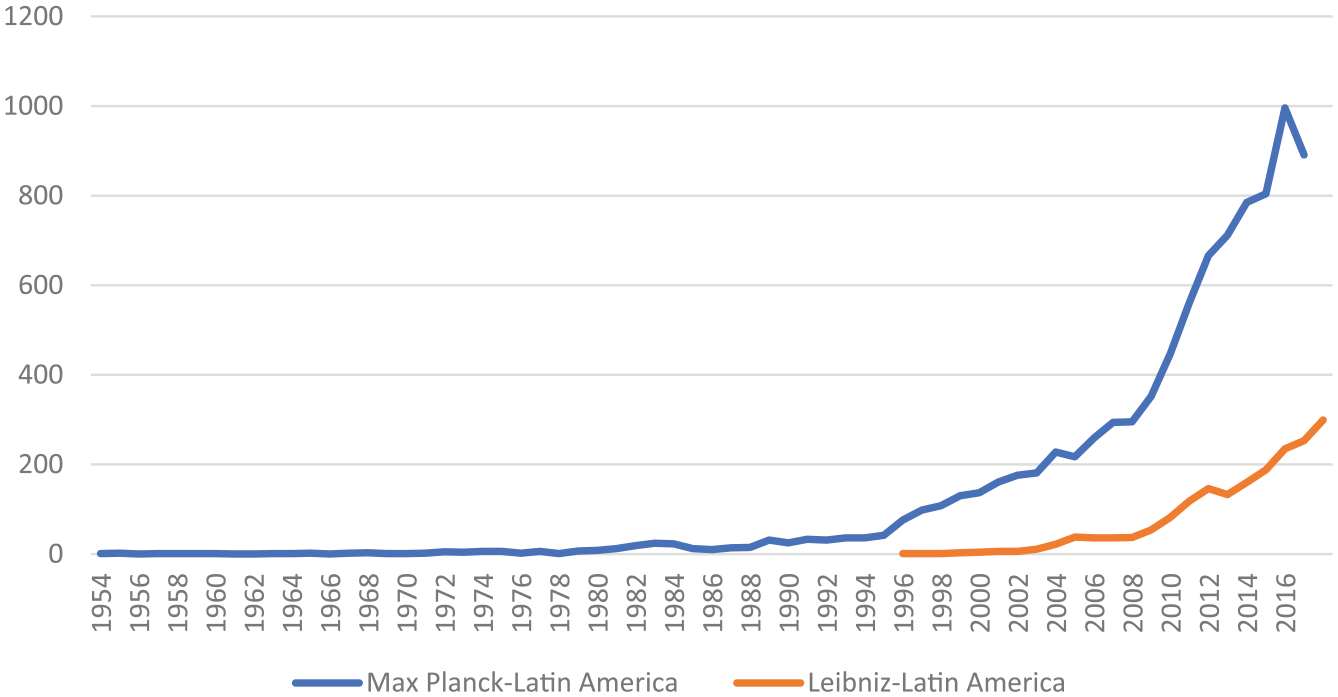
Published documents with Latin American researchers.
Figure 1 also indicates that most of the productivity of the MPS began to pick up around the same time as it did for the LA. That number of publications represented a bit more than 5% of the total output for both associations (see Table 1).
Publications of the Max Planck Society or the Leibniz Association with authors in Latin America.
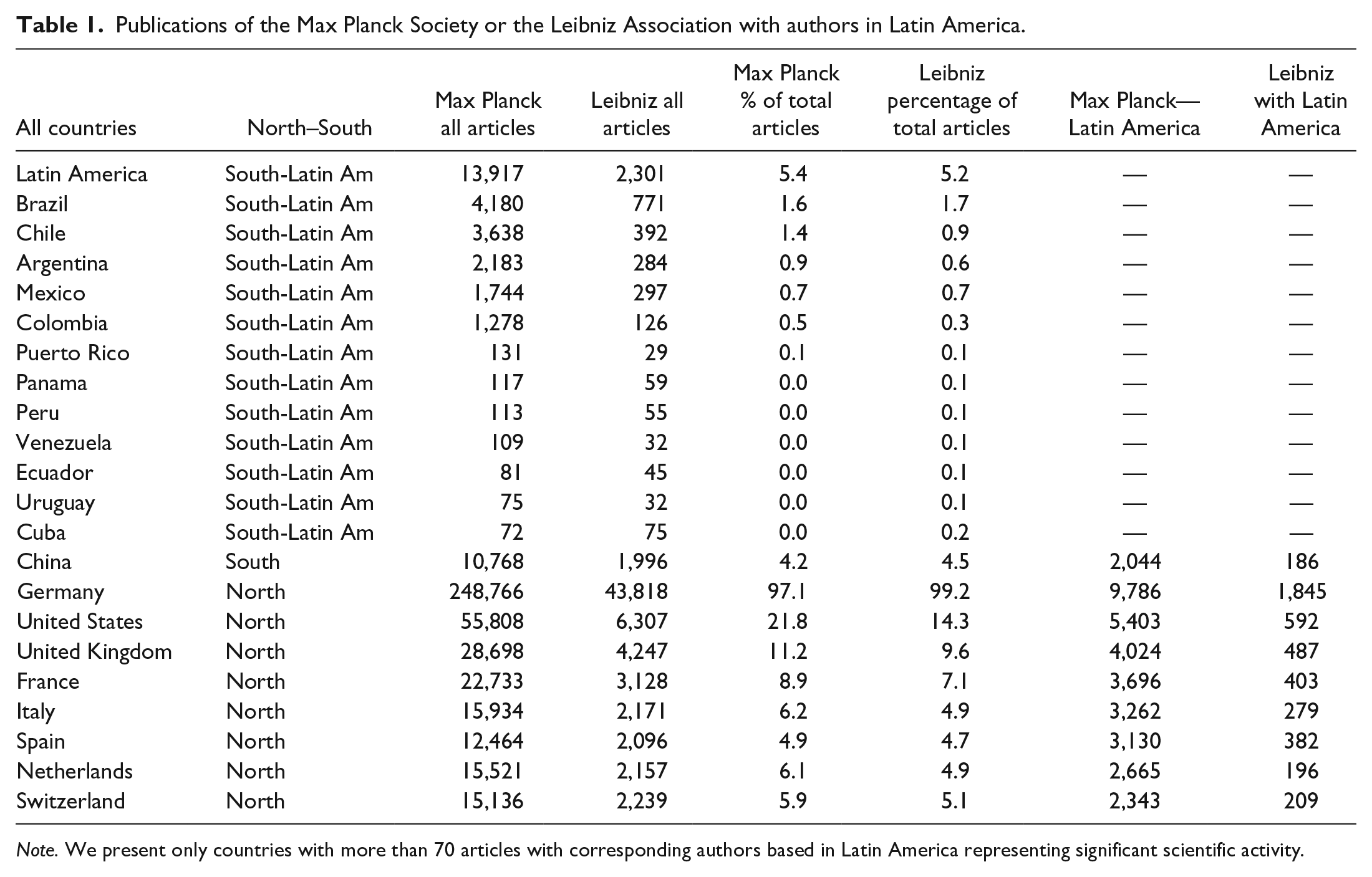
Note. We present only countries with more than 70 articles with corresponding authors based in Latin America representing significant scientific activity.
Table 1 further shows that from 1954 to 2018 the MPS produced, in total, 13,917 papers (with the possibility that more than one country is mentioned). From 1996 to 2018, the LA generated 2,301 documents in association with at least one author located in Latin America. The moments of expansion of cooperation in 1996 and 2002 for MPS and LA do not seem to correspond to any major possible policy shifts that we could identify in the history of the associations. Therefore, we believe that increase in cooperation by the MPS in 1996 is related to a new phase in the institutionalization of research in Latin America that followed the Latin American “lost decade” of the 1980s, and the relaxation of the austerity policies as a response to the debt crisis that also affected science and technology (Bulmer-Tomas, 2003; Pineda, 2015a; Schwartzman, 1991). Increasing cooperation between Latin America and the LA, in turn, may be explained by a moment of consolidation after the recent foundation in 1997 and the increased visibility of its activities after the standardization of the name as LA in 2002 (Brill, 2017).
Using additional information from Scopus to check current details, in 2018, the MPS and the LA published 997 and 299 articles, respectively, jointly with Latin America, out of their total output of 10,537 and 4,931, respectively, for the same year. Scientists associated with the MPS published approximately two articles for every one article from the LA; however, when it comes to Latin America, that proportion increased even to three articles to one. This level of output would indicate that scientific collaboration from the MPS with Latin America is more robust than the LA’s output with the same region.
According to Table 1, for both German associations, Brazil, Chile, Argentina, and Mexico are the most productive countries, although the total representation is still relatively minor when compared with activity in the Global North. Brazil, with the largest publication output, represents 4,180 for the MPS and 771 of LA (1.6% and 1.7%); Chile follows with 3,638 and 392 (1.4% and 0.9%). Over the last two decades, these two countries have applied strong funding policies in an attempt to significantly advance their knowledge production (Pineda, 2015a; Schwartzman & Balbachevsky, 2013).
Brazil is the only country that has a less participation in joint articles with the MPS than LA. By way of comparison, China also has a slightly higher participation in the LA. Given that the MPS has a major emphasis in basic research, we think the distinctive relationship may respond to local policies.
In the case of North–North collaboration, Table 1 shows that the two German associations are still co-authoring many more papers with leading economies than with the Global South. For instance, the United States represented 55,808 and 6,307 (21.8% and 14.3%), respectively, of the total papers produced by the MPS and the LA. The United Kingdom had 28,698 and 4,247 (11.2% and 9.6%), respectively, of both institutions’ total productivity.
Corresponding Authors
The LA had a higher ratio of the corresponding authors from the region, with 22% (518) versus a 14% (1,925) of the MPS. This means that even though the global Latin American share for each association is about the same for the total number of articles (5.4% and 5.2%; see Table 1), the proportion of regional corresponding authors is greater for the LA. If Germany is taken into consideration as the leading country, then 27% (2,609 out of 9,786) of the corresponding authors from the MPS and 34% (630 out of 1,845) of the leading authors from the LA work with researchers in Latin America. This is particularly significant because nearly all the articles produced by both associations worldwide had at least one German author (97.1% and 99.2% respectively).
Figure 2 visually represents the corresponding authors for both institutions; darker colors indicate the highest ratios.
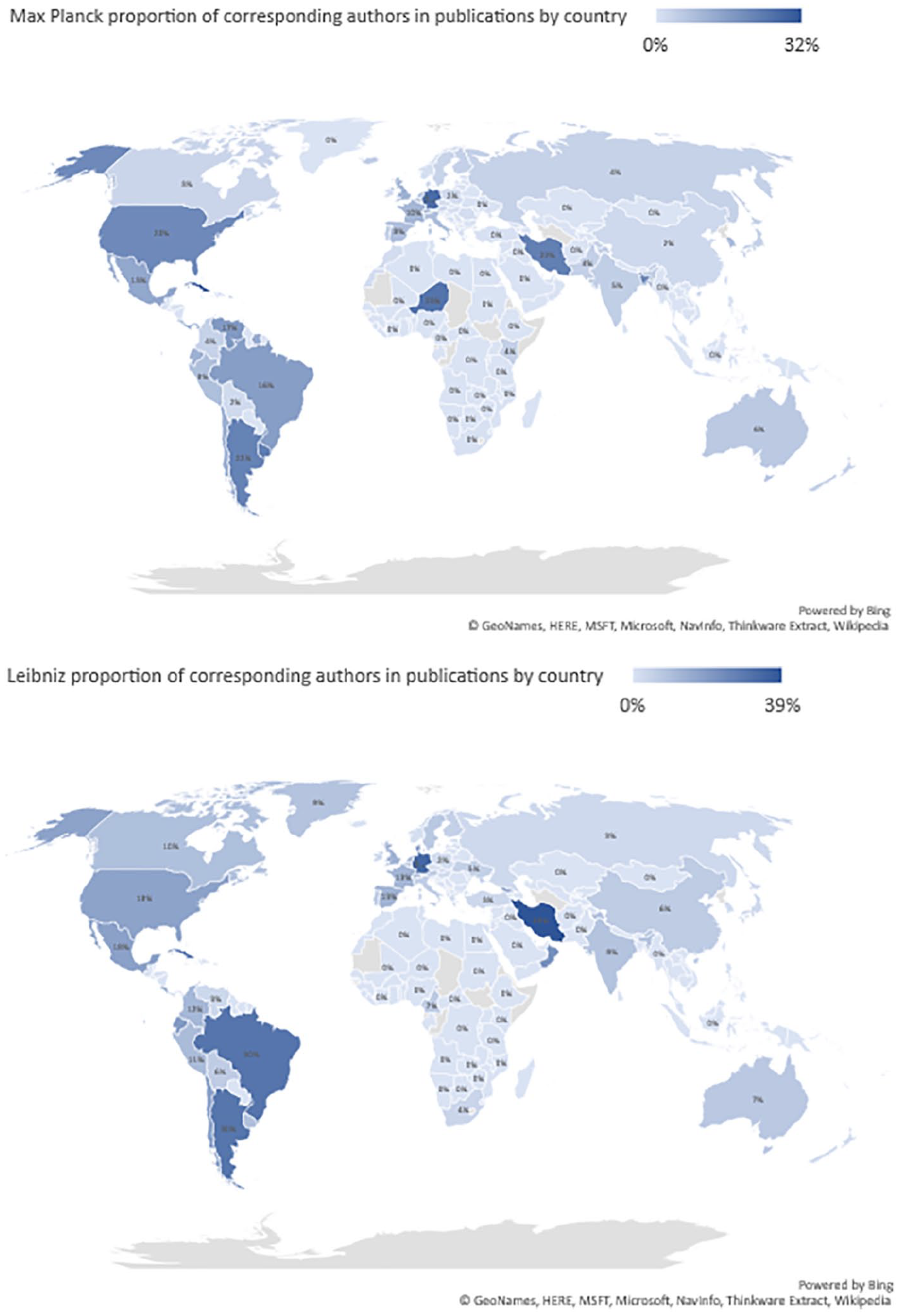
Proportion of corresponding authors is the total number of publications of Max Planck Society and LA with researchers in Latin America.
In Latin America, Cuba, Argentina, Brazil, and Chile (32% and 31%, 22% and 30%, 16% and 30%, and 11% and 19%) conform a first group with the corresponding authors at the leading role over the joint research with MPS and LA. Comparing this information with the total amount of research produced (Table 1), we can see how these same countries collaborate more and as such tend to have a leading role as inferred from the corresponding authors. The authors from Colombia, Peru, Bolivia, and Paraguay make up a second group of countries that take less frequently the role of corresponding authors (4% and 12%, 8% and 11%, 2% and 6%, and 0% and no joint publications). This trend reveals an imbalance or, in decolonial terms, a continuation of the “colonial matrix of power” (Mignolo, 2011b) where some authors invite others to participate in a preestablished power relationship.
The global picture presented in Figure 2 shows that Iran, the United States, France, and the United Kingdom (33% and 39%, 20% and 18%, 10% and 13%, and 20% and 18%) have a percentage of first authors greater than 10%, similar to the first group of Latin American countries with researchers having a greater control of the research agenda. Niger in Africa has only four articles and is therefore not representative. It is also true that scientists based in countries such as India, Spain, China, and Australia participate as corresponding authors in our dataset of collaboration (5% and 9%, 8% and 13%, 2% and 6%, and 6% and 7%) but with percentages lower than 10%, similar to the second group of Latin American countries with greater imbalances in research collaboration.
Research Networks
Figure 3 visually represents the five clusters or scientific networks built by scientists from the MPS and the five clusters build by the LA that collaborated with Latin American scholars. The chart visually represents the degrees of cooperation, by the distance between nodes, by country, and the amount of research in each of the nodes.
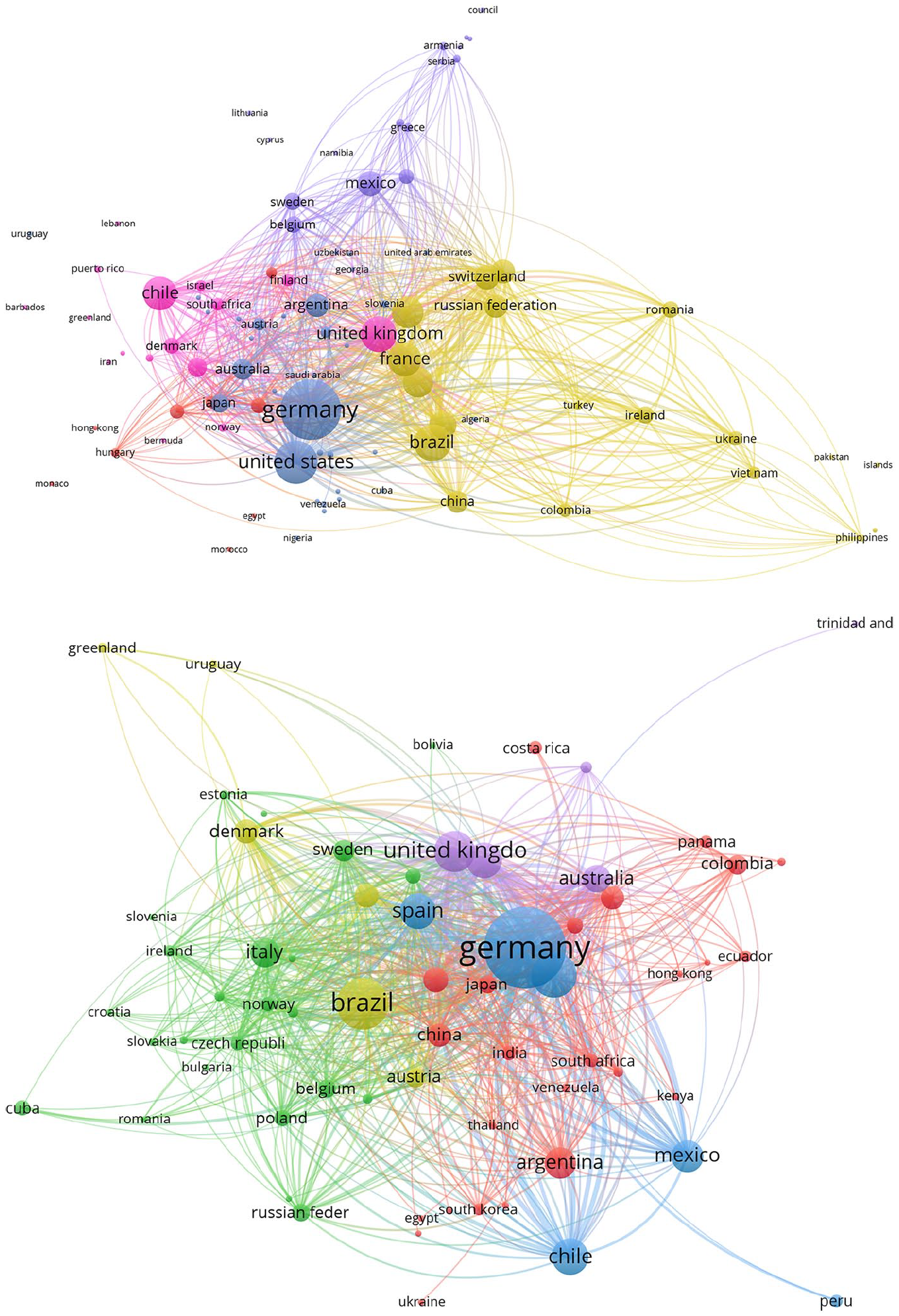
Bibliometric map of co-authorship between Latin America, the Max Planck Society (upper side), and the LA (lower side).
The bibliometric map of the MPS (Figure 3, upper side) shows that Latin American countries are located as main nodes in four of the five clusters that represent research networks. Chile, Mexico, Brazil, and Argentina are the main nodes of the pink, purple, yellow, and blue clusters. The smallest red cluster has a majority of countries located in south-east Asia (India, South Korea, and Hong Kong) and, therefore, we labeled it the “south-eastern cluster.” Scientific networks build by the MPS and researchers based in Latin America are very heterogeneous. Each of them involves countries worldwide where scientific activities seem to go beyond geopolitical barriers.
The networks build by the LA (Figure 3, lower side) are comparatively more homogeneous. The figure represents five global research networks of countries that have geographical and political proximity. We label the first red node as “peripheral Latin American partners” because it is mostly made up of less productive Latin American countries linked to other countries in the Global South. Argentina, Venezuela, and Colombia built this network, as did less productive and less populated Latin American countries such as Panama, Bolivia, and Puerto Rico, which appear in a peripheral position. In blue, the United States and Germany show the largest cluster of “Main Latin American partners,” a scenario that is confirmed by the information in Table 1. Scientists based in Chile and Mexico collaborate closely and hence make up this same cluster. We labeled the yellow cluster the “Brazilian cluster” because it is the most important cooperating actor with the LA. Brazilian authors are linked to LA research institutes in Germany but seem to build a more independent network. The United Kingdom and France are the main nodes of the purple, “West-European” cluster. The green cluster is what we have labeled the “Eastern-European cluster” and is represented mostly by countries located in Eastern Europe, with the exception of Italy as the main node within this cluster. Cuba is the only Latin American country located far from others in the region and thus lies at the other pole of the Western cluster.
When compared, researchers from the MPS have built remarkably less homogeneous research networks. The only cluster that would represent a geopolitical group is the “south-eastern cluster.” The LA, in turn, shows a clear separation of activities between Western and Eastern-European countries. Our previous comparison of the historical trajectories of the two scientific societies leads us to infer that this division could be related to a path-dependency-type relationship related to the history of the LA’s integration of research institutes from East Germany after German reunification in 1990. Alternatively, the type of basic research by the MPS may be more suitable for transnational cooperation of bigger and more diverse groups that work independent from political agendas. These are both intriguing hypotheses to pursue in future research.
Altogether, our analysis of research cooperation does not provide evidence of a completely polarized world reproduced by German research associations. Although some countries are located at the center and periphery of research cooperation with German scientific associations, Latin American countries have gained different positions. Notably, Brazil builds independent networks with German partners and other countries. Scientists working in Chile and Mexico consistently form part of the scientific networks of German partners without consistently creating independent research with other countries different from Germany and the United States. Colombia, Uruguay, and Cuba are located at the periphery. It should be taken into consideration that Latin American countries with lower levels of scientific activities may indeed represent countries that are lacking independent research infrastructures and collaboration instruments.
Conclusion
In this article, we have analyzed the research outputs and networks associated with two of the largest scientific societies of the Global North: the German MPS and the LA. The MPS’s scientists published many more articles with Latin American authors than did those working at the LA. This fact signals significant differences in the degree of research collaboration among the 84 institutes that are affiliated with the MPS.
Higher research publications with the MPS are remarkable given that associated researchers are more dedicated to basic research than those in the LA. Latin American countries seem to support both basic and applied research but still academics in universities dedicate nowadays more time to applied research activities in countries such as Brazil, Argentina, and Mexico (Bentley et al., 2015). Consequently, we believe that shared productivity differences between both scientific associations may be attributed to the kinds of cooperation instruments they employ. The LA has no formal office or institute abroad and fewer non-German researchers, including Latin Americans. This may explain why the research networks they built are also less global. These findings provide evidence to support Pineda and Streitwieser’s (2018) earlier argument on the capacity that the MPS’s policies may be contributing to a more international profile. The MPS shares practices that can be helpful for understanding better ways to decolonialize research from the North, while also giving an opportunity to the South to advance its own intellectual scientific output. That is, a critically important finding within the larger discussion of North–South imbalances and traces of neocolonial legacy.
Brazil’s slight proportional higher collaboration with the LA may be further explained by local collaboration instruments that may have fostered a stronger applied research-oriented university and with which to cooperate. Brazilian-applied research policies are comparatively strong in the region (Mazzoleni & Nelson, 2007; Pineda, 2015a). Further research may explore whether the higher investment in research and development and the support of research hub projects in Sao Paolo and Minas Gerais in the areas of aeronautics and agriculture is reflected in greater cooperation with applied research-oriented institutes from abroad such as those affiliated to the LA.
These different degrees of cooperation do not imply significant differences in the final balance of ratios of the corresponding authors in either associations. Thus, the results did not support the assumption that the majority of corresponding authors would be based in Germany. Both associations have approximately one third of their corresponding authors based in Germany (see Table 1). Contrary to our expectations, we did not find differences in the participation of non-German corresponding authors among the two societies. Researchers from the MPS and the LA took the role of corresponding author when a Latin American country was involved. However, researchers from some countries of the region also at times took the leading role of the research process.
Contrary to our expectations, we also found that, for instance, Cuba and Brazil had an opportunity to build more balanced relationships with the North, when measured by the proportion of corresponding authors and the countries’ location within the given scientific network. This form of cooperation among players shows that the research activities of the MPS and the LA in fact likely act in a mutually beneficial way. The cooperation instruments we observed helped to ease the creation of networks with German institutes and other countries where, otherwise, individual actions would hardly have been achieved. These facts confirm previous analyses (Baud, 2002; Mazzoleni & Nelson, 2007) that local collaboration instruments are pivotal for the institutionalization of science.
However, mutual benefits of research cooperation are less active for countries that seem to be located in a peripheral position indicated by lower number of publications and a smaller proportion of corresponding authors such as Colombia, Peru, Paraguay, and Bolivia. We also did not find evidence that less populated countries such as Barbados, Grenada, Honduras, French Guiana, Trinidad and Tobago, Jamaica, Suriname, El Salvador, and Guatemala had a high degree of cooperation nor domain of the research agenda relative to their small size of cooperation.
A paradigmatic case to further study would be Chile. Seventh in Latin America in terms of population, it has nevertheless managed to position itself as the second most active country engaging in joint scientific activities with both the MPS and the LA even though it was positioned in the Global South according to the Brandt line in 1980 (Independent Commission on International Development Issues, 1980). However, the position of Chile in research networks shows that it has less multinational cooperation when compared with Brazil.
The overall argument we advance in this article has important implications for the study of the decolonial theory. The data show that multinational corresponding authors who work in teams to generate collaborative research projects are moving beyond traditionally rigid North–South divides. This implies that power imbalances may depend not only on the location of scientists but also on the policies of the associations and instruments with which they choose to collaborate. Power imbalances may depend not only on the location of scientists but also on the local policies within which they have to operate. The CONICET-MPG Institute, a unique partner institution financially supported by the Argentinian government, for example, demonstrates the role played by its overseeing governments. The world now is more multipolar than it has ever been before, which implies that contemporary scientific networks can no longer be explained in only very simple terms, where two poles of dominance determine all activity, and former colonial logics go on unchecked. The decolonial perspective may continue to be valuable in its focus of cultural imbalances that may be reflected in disproportionate control of research agendas. In investigating research collaboration with partners, we need to locate Latin American countries within the context of their colonial histories. Only then can we accurately analyze the complex transnational dynamics of partnership.
In this article, we have illustrated how decolonial thinking is also applicable to analyzing the degree and forms of the institutionalization of science. We suggest that theorizations need to be grounded in data, such as those available by bibliometric measures. Along these lines, scientific and higher education governance of countries in the so-called “global South” may play a major explanatory role in understanding different degrees in which imbalances may occur. Our findings show that countries have been positioning themselves differently in relation to the former domination of the research agenda by once colonial powers in the region. This study provides further evidence for the capacity of countries to build a research infrastructure, regardless the conditions of economic and cultural imbalance in which they may have historically been located. Pineda (2015a, 2015b) has shown that the different outputs can be related to a more stable institutional framework. Comparative research may continue to provide evidence of different forms of governance in the institutionalization of science. This research thereby opens new paths for further comparatively investigating the role of public and higher education policy of countries in the Global South, toward promoting stable and long-term cooperation that countries in the North achieve through their own state-supported cooperation instruments.
Footnotes
Declaration of Conflicting Interests
The author(s) declared no potential conflicts of interest with respect to the research, authorship, and/or publication of this article.
Funding
The author(s) disclosed receipt of the following financial support for the research, authorship, and/or publication of this article: Pedro Pineda wrote this article while supported by a Research Scholarship [number Az. 40.18.0.003SO] of the Fritz Thyssen Foundation.
